Industrial Heating Equipment Market Size, Share & Trends Analysis Report by Equipment Type (Electric Heating Equipment, Fuel-Based Heating Equipment, Steam Heating Equipment, Hot Water Heating Equipment, and Thermal Fluid Heating Systems), Rated Power, Rated Capacity, Fuel Type, Control System, End-Use Industry, and Geography (North America, Europe, Asia Pacific, Middle East, Africa, and South America) – Global Industry Data, Trends, and Forecasts, 2026–2035
|
|
|
Segmental Data Insights |
|
|
Demand Trends |
|
|
Competitive Landscape |
|
|
Strategic Development |
|
|
Future Outlook & Opportunities |
|
Industrial-Heating-Equipment-Market Size, Share, and Growth
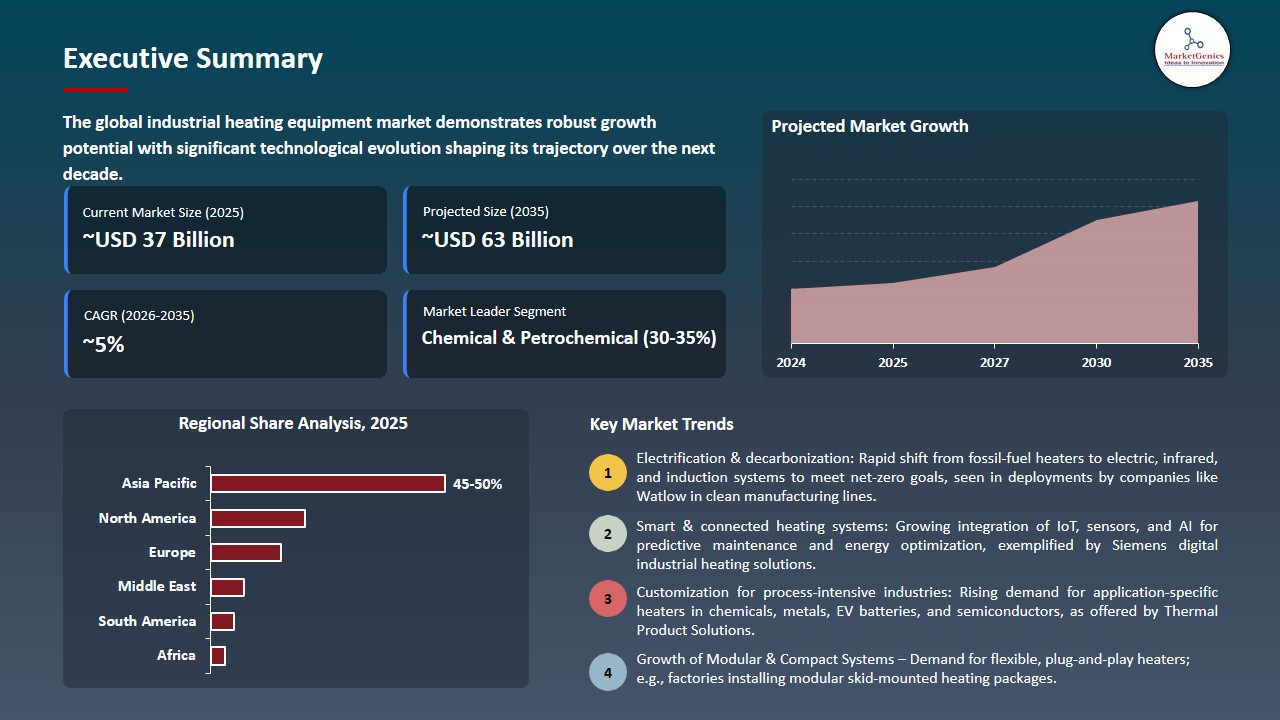
The global industrial heating equipment market is witnessing strong growth, valued at USD 37.3 billion in 2025 and projected to reach USD 63.1 billion by 2035, expanding at a CAGR of 5.4% during the forecast period. North America is the fastest-growing region in the industrial heating equipment market due to increasing investments in advanced manufacturing technologies, stringent energy-efficiency regulations, and the replacement of aging industrial infrastructure with modern, high-performance heating systems.
Irina Gorbounova, Head of the XCarb Innovation fund, said, “Electrifying high temperature heating processes, and thereby reducing reliance on fossil fuel use, in steelmaking is a widely recognised challenge. Having scoured the market for companies looking to address this, Electrified Thermal’s patented technology stood out. They have made good progress in recent years, and we are investing at an important time in the company’s development as they look to move to commercial scale pilots”.
The industrial heating equipment market is being driven by an increasing demand towards energy-efficient heating systems as manufacturers strive to cut down on operational expenses without compromising the reliability of the processes. Modernized boilers, electric heating, and hybrid heating offer the best use of fuels, reduce the use of energy, and enhance the efficiency of the entire system. Such technologies contribute to the industries in terms of saving money, increasing productivity, and achieving the sustainability objectives, so energy-efficient heating equipment is a highly valuable investment in each process-intensive industry.
The growth of waste-heat recovery and energy-recycling systems is also a good growth opportunity in the industrial heating equipment market since manufacturers are also aiming to increase their energy efficiency and lower costs of operation. Industries are now adopting the use of heat exchanger, recuperator and regenerative heating system to sequester and recycle the reflexive thermal energy to facilitate sustainability agenda, reduce fuel usage, and comply with the more stringent environmental standards.
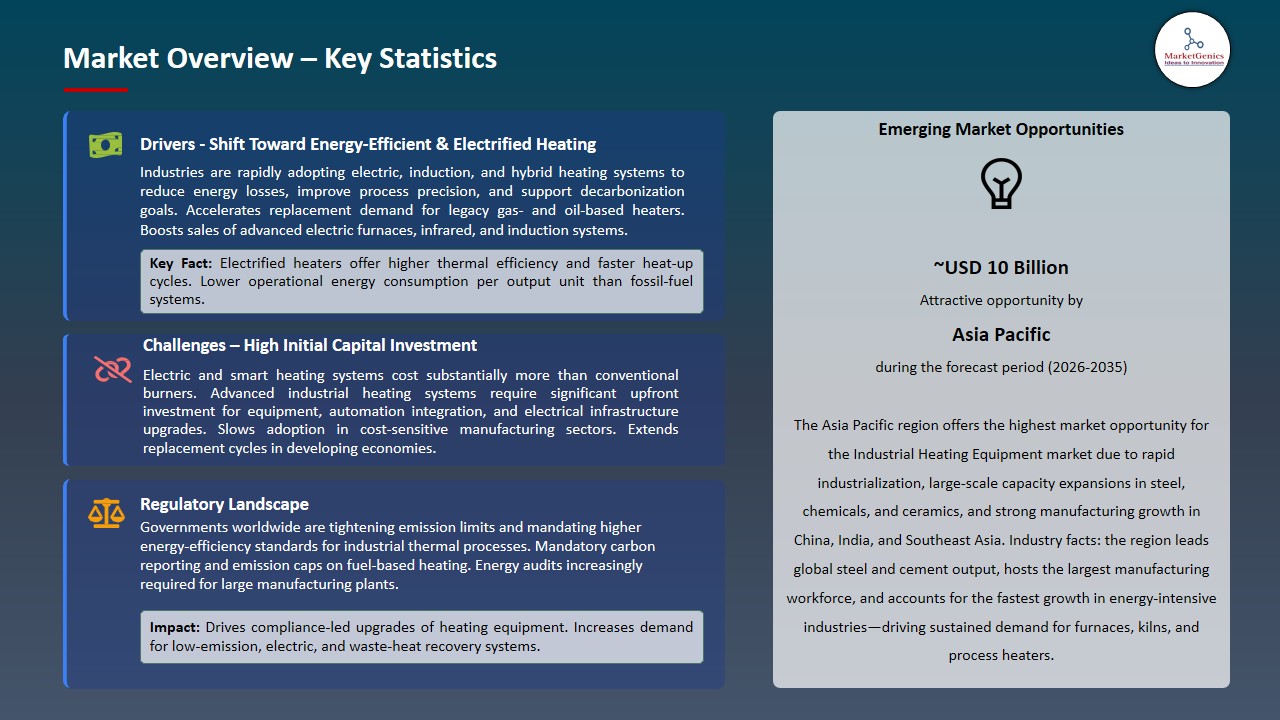
The industrial heating equipment market offers adjacent opportunities in waste-heat recovery systems, electrification and hybrid heating solutions, smart and AI-enabled heating controls and aftermarket services. Increasing usage of energy-recycling technologies, digital monitoring to predictive maintenance and incorporation of heating systems with renewable sources of power is broadening the revenue potential beyond direct equipment sales. Also, the increasing demand of batteries manufacturing, hydrogen production, and advanced materials processing is establishing new application-based growth opportunities.
Industrial Heating Equipment Market Dynamics and Trends
Driver: Environmental Regulations Drive Adoption of Low-Emission Industrial Heating Solutions
-
The growing environmental regulations are being considered as one of the biggest sources of the industrial heating equipment market since the governments and the regulatory authorities in the entire world are coming up with more stringent laws on the emissions, energy usage, and the effects caused on the environment.
- The pressure on industrial installations to upgrade old and inefficient heating systems with low-emission and energy-efficient systems in order to meet these regulations. This has been the driving force behind the investments in sophisticated boilers, electric heaters and hybrid heating systems that reduce greenhouse gases emissions as well as maximizing fuel consumption.
- Not only does compliance guarantee legal compliance but also assists companies to meet sustainability goals, minimise costs of operation, and improve corporate responsibility, thus, environmentally friendly heating equipment is a very important investment in the contemporary industry.
- Spirax Group developed its sustainability efforts in its TargetZero and Electric Thermal Solutions program, launching the first-to-world decarbonisation technologies in industrial heating. Such solutions as SteamVolt (first-fit electric boilers), ElectroFit (retrofit fuel-fired boilers to electric), and SteamBattery (flexible thermal energy storage) allow industries to electrify steam generation, recycle waste heat and minimize scope 1 and 2 greenhouse gas emissions.
- The innovations enable industrial customers to enhance energy efficiency, keep important processes, and meet higher environmental standards, which explains the increasing popularity of low-emission and energy-efficient industrial heating equipment.
Restraint: Integration Challenges with Existing Infrastructure Restrain Industrial Heating Equipment Adoption
-
Technical problems in the adoption of new heating systems and compatibility with the existing infrastructure are a major limitation to the Industrial Heating Equipment market. Most industrial facilities use older equipment and complicated production systems that cannot be easily changed to the use of modern heating technologies without interfering with the current operations.
- The retrofitting of advanced boilers, electric heaters or hybrid heating systems usually involves substantial alteration of piping, control systems and safety systems, which may add to the time and cost of installation. Also, the smart and IoT-enabled heating systems may not be adopted successfully due to compatibility problems with the available automation and energy management systems.
- The operators of industries also need to put into consideration process related constraints like temperature limits, steam pressure demand and material handling restrictions that could further complicate integration. Such technical barriers can cause delays in the project, increase in spending of capital and risks to the operations in the transition phase.
- The implication of this is that integration issues may slow adoption and constrain the growth of markets, especially the small and medium-sized enterprise with older infrastructure.
Opportunity: Electrified & Hybrid Heating Technologies Drive the Next Wave of Growth in Industrial Heating
-
Increasing demand of electrified and hybrid heating technologies is a significant growth potential of the industrial heating equipment market as industries scale up their decarbonization and energy efficiency.
- Manufacturers in the metals industry, chemicals industry, food processing industry, and the automotive industry are moving away from fossil-based systems to electric furnaces, inductive heaters, infrared heaters and hybrid solutions to address the strict emission limits and ESG goals. Such technologies provide accurate temperature regulation, reduced heating duration, reduced maintenance, and compatibility with renewable sources of power.
- In September2025, ArcelorMittal invested in Electrified Thermal Solutions through its XCarb Innovation Fund to conduct pilot electric high-temperature heating on steel decarbonization. The renewable electricity is stored in Joule Hive Thermal Battery in order to work as heat up to 1,700 C. H2 2025 commissioning of a 1MW/5MWh commercial demonstration plant in Texas indicates increased use of electrified industrial heating systems.
- The growing uptake of electrified and hybrid heating systems, due to decarbonization goals and energy efficiency requirements, is becoming a significant long-term growth engine to the global industrial heating equipment industry.
Key Trend: Increasing Use of Data Analytics and AI for Energy Optimization and Maintenance Planning
-
The industrial heating equipment market is experiencing a fast trend of using data analytics and artificial intelligence to achieve greater energy efficiency, operational reliability and asset performance. Artificial intelligence-based systems are able to measure real-time temperature profiles, fluctuations in loads, fuel consumption, and process data and dynamically optimize the heating cycles to reduce power wastage.
- The robotically controlled predictive maintenance algorithms utilize sensor information to predict the wear of components, anomalies and unplanned shutdowns, among others, and minimize downtime and maintenance expenses. Digital twins and intelligent control platforms also empower automated performance benchmarking, remote control, and automation of processes- fulfilling objectives of manufacturers to increase productivity and reduce operating expense and enhance regulatory compliance.
- GE Vernova announced the launch of Proficy, an AI-based program of GE Vernova in February 2024, which was created to optimize the use of energy and utilities in the work of industrial plants. One of the European automotive manufacturers of Tier-1 utilized the platform to optimize factory heating systems and had 18% energy savings by dynamically controlling heating setpoints according to the outside air temperatures and detecting control and valve inefficiencies.
- The increasing adoption of AI-based analytics and intelligent control solutions is changing the nature of heating processes in industries as it allows optimizing energy consumption on the basis of data, predicting failures, and achieving quantifiable improvements.
Industrial-Heating-Equipment-Market Analysis and Segmental Data
Chemical & Petrochemical Dominate Global Industrial Heating Equipment Market
-
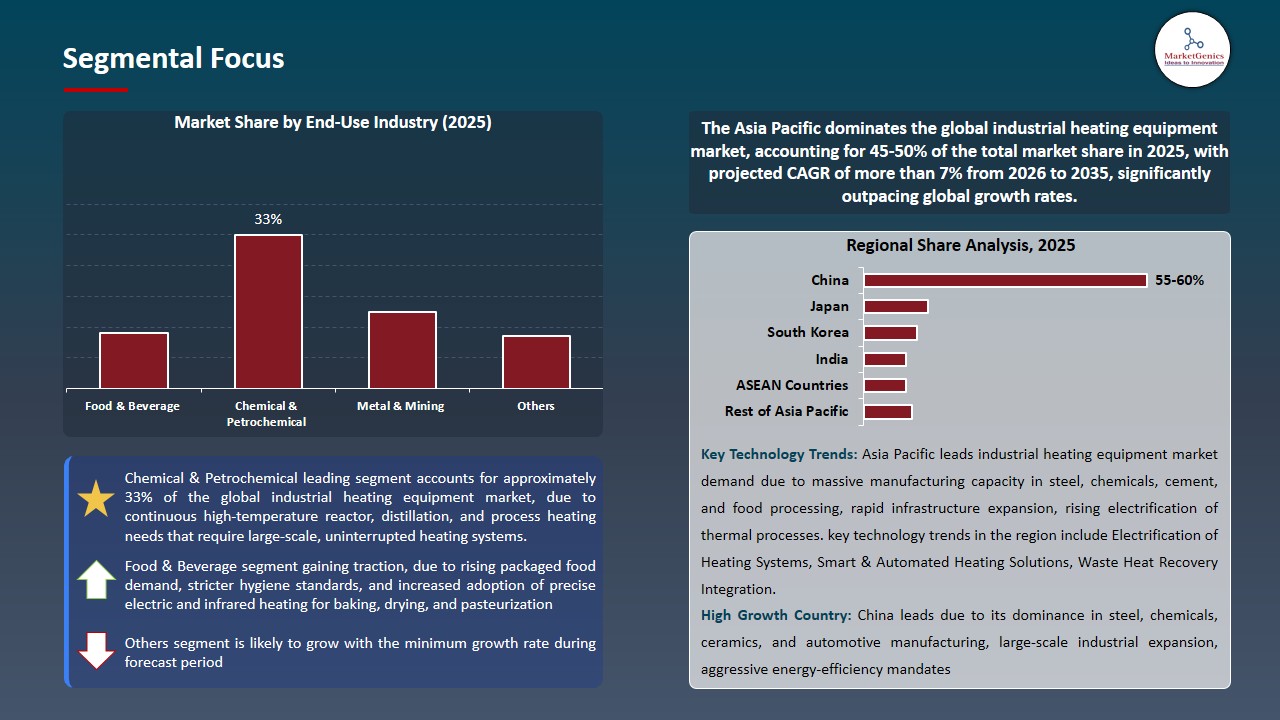
The chemical and petrochemical sector is the leading segment in the global industrial heating equipment market, driven by its high energy demand and complex process requirements. These industries rely heavily on precise temperature control for critical processes such as cracking, distillation, refining, and polymerization, making efficient and reliable heating systems indispensable.
- The increased manufacture of petrochemicals, growth of specialty chemicals, and the high standards of quality also increase the demand of advanced furnaces, heaters and thermal management solutions. Also, the use of energy efficient and environmental-friendly heating technologies is taking off in this segment, with manufacturers aiming to lower operational expenses, maximize on the use of energy and to satisfy the tightening of emission standards that keep increasing globally.
- Babcock and Wilcox (B&W) received contracts in March 2024 valued at an estimated 24 million dollars to design, fabricate, and supply three industrial boilers to petrochemical plants in the Middle East and Central Asia. The boilers have strong designs with fuel flexibility which has the capability to support oil, gas, hydrogen, and other fuels and is aimed at improving the efficiency and reliability of operation in the petrochemical processes which are energy intensive.
- The high demand of sophisticated, efficient, and versatile heating systems highlights the fact that the chemical and petrochemical industry remains the dominating force in the global industrial heating equipment market.
Asia Pacific Leads Global Industrial Heating Equipment Market Demand
-
The Asia Pacific region is the leading region for industrial heating equipment market, driven by rapid industrialization, expanding manufacturing activities, and rising energy demand across key economies such as China, India, Japan, and South Korea. The region hosts a significant concentration of energy-intensive industries, including chemicals, petrochemicals, metals, automotive, and food processing, which require efficient and reliable heating systems for operations like melting, drying, curing, and heat treatment.
- Rising industrial output, increasing foreign direct investment, and government initiatives promoting modernization of manufacturing facilities are further fueling demand for advanced industrial heating solutions. Additionally, the adoption of energy-efficient, environmentally compliant, and AI-driven heating technologies is gaining traction in the region, as companies seek to optimize energy consumption, reduce operating costs, and comply with stringent emission regulations.
- Asia Pacific continues to dominate both in terms of volume and revenue, establishing itself as a key driver of growth in the global industrial heating equipment market.
Industrial-Heating-Equipment-Market Ecosystem
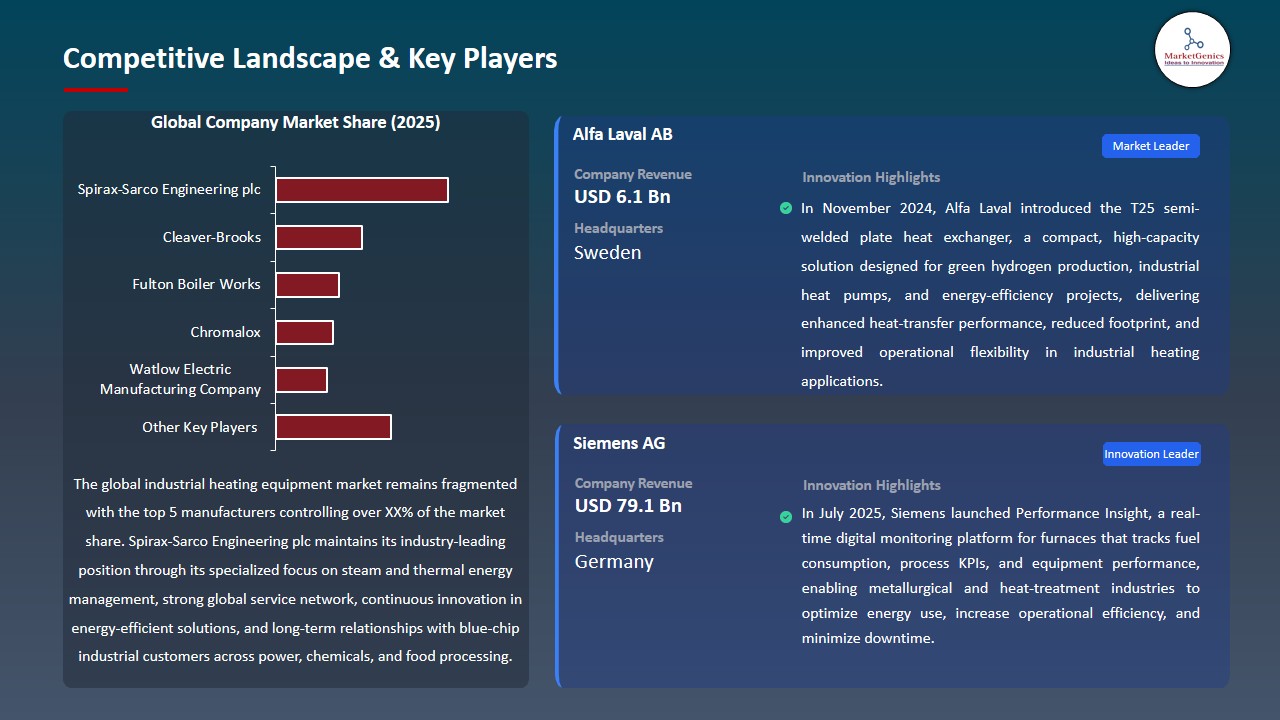
The industrial heating equipment market is fragmented, with leading players including Spirax-Sarco Engineering plc, Cleaver-Brooks, Fulton Boiler Works, Chromalox, and Watlow Electric Manufacturing Company. These companies hold competitive advantages through extensive global distribution networks, advanced heating technologies, digital and IoT-enabled controls, energy-efficient systems, predictive maintenance solutions, and seamless integration with industrial automation and energy management platforms.
The market value chain encompasses design and development of heating systems, manufacturing of boilers, furnaces, and thermal equipment, calibration and quality testing, system integration, installation and commissioning, compliance with energy-efficiency and safety standards, and after-sales services including remote monitoring, predictive maintenance, performance analytics, and software upgrades.
Entry barriers are significant due to high capital investment, integration challenges with existing industrial infrastructure, strict adherence to energy and safety regulations, and the technical expertise required for designing and maintaining advanced heating systems. The market continues to evolve and differentiate through technological innovations such as IoT-enabled smart heaters, AI-driven predictive maintenance, energy-optimized systems, and Industry 4.0-compatible solutions.
Recent Development and Strategic Overview:
-
In July 2024, Danfoss introduced the 6-cylinder semi-hermetic BOCK HGX56 CO2 T for large-capacity industrial heat pumps and the PSH scroll for reversible rooftop and hydronic systems. These compressors enhance energy efficiency, reduce GWP refrigerants, simplify system design, and support decarbonization in industrial and commercial heating applications.
- In May 2025, Modine announced the acquisition of L.B. White, a leader in portable and agriculture heating solutions. The deal diversifies Modine’s HVAC portfolio, adding direct-fired, radiant, indirect-fired, and electric heating technologies, expanding market presence in agriculture, construction, and specialty heating segments.
Report Scope
|
Detail |
|
|
Market Size in 2025 |
USD 37.3 Bn |
|
Market Forecast Value in 2035 |
USD 63.1 Bn |
|
Growth Rate (CAGR) |
5.4% |
|
Forecast Period |
2026 – 2035 |
|
Historical Data Available for |
2021 – 2024 |
|
Market Size Units |
US$ Billion for Value Thousand Units for Volume |
|
Report Format |
Electronic (PDF) + Excel |
|
North America |
Europe |
Asia Pacific |
Middle East |
Africa |
South America |
|
|
|
|
|
|
|
Companies Covered |
|||||
|
|
|
|
|
|
Industrial-Heating-Equipment-Market Segmentation and Highlights
|
Segment |
Sub-segment |
|
Industrial Heating Equipment Market, By Equipment Type |
|
|
Industrial Heating Equipment Market, By Rated Power |
|
|
Industrial Heating Equipment Market, By Rated Capacity |
|
|
Industrial Heating Equipment Market, By Fuel Type |
|
|
Industrial Heating Equipment Market, By Control System |
|
|
Industrial Heating Equipment Market, By End-Use Industry |
|
Frequently Asked Questions
Table of Contents
- 1. Research Methodology and Assumptions
- 1.1. Definitions
- 1.2. Research Design and Approach
- 1.3. Data Collection Methods
- 1.4. Base Estimates and Calculations
- 1.5. Forecasting Models
- 1.5.1. Key Forecast Factors & Impact Analysis
- 1.6. Secondary Research
- 1.6.1. Open Sources
- 1.6.2. Paid Databases
- 1.6.3. Associations
- 1.7. Primary Research
- 1.7.1. Primary Sources
- 1.7.2. Primary Interviews with Stakeholders across Ecosystem
- 2. Executive Summary
- 2.1. Global Industrial Heating Equipment Market Outlook
- 2.1.1. Industrial Heating Equipment Market Size Volume (Thousand Units) and Value (US$ Bn), and Forecasts, 2021-2035
- 2.1.2. Compounded Annual Growth Rate Analysis
- 2.1.3. Growth Opportunity Analysis
- 2.1.4. Segmental Share Analysis
- 2.1.5. Geographical Share Analysis
- 2.2. Market Analysis and Facts
- 2.3. Supply-Demand Analysis
- 2.4. Competitive Benchmarking
- 2.5. Go-to- Market Strategy
- 2.5.1. Customer/ End-use Industry Assessment
- 2.5.2. Growth Opportunity Data, 2026-2035
- 2.5.2.1. Regional Data
- 2.5.2.2. Country Data
- 2.5.2.3. Segmental Data
- 2.5.3. Identification of Potential Market Spaces
- 2.5.4. GAP Analysis
- 2.5.5. Potential Attractive Price Points
- 2.5.6. Prevailing Market Risks & Challenges
- 2.5.7. Preferred Sales & Marketing Strategies
- 2.5.8. Key Recommendations and Analysis
- 2.5.9. A Way Forward
- 2.1. Global Industrial Heating Equipment Market Outlook
- 3. Industry Data and Premium Insights
- 3.1. Global Industrial Machinery Overview, 2025
- 3.1.1. Industrial Machinery Ecosystem Analysis
- 3.1.2. Key Trends for Industrial Machinery
- 3.1.3. Regional Distribution for Industrial Machinery
- 3.2. Supplier Customer Data
- 3.3. Technology Roadmap and Developments
- 3.4. Trade Analysis
- 3.4.1. Import & Export Analysis, 2025
- 3.4.2. Top Importing Countries
- 3.4.3. Top Exporting Countries
- 3.5. Trump Tariff Impact Analysis
- 3.5.1. Manufacturer
- 3.5.1.1. Based on the component & Raw material
- 3.5.2. Supply Chain
- 3.5.3. End Consumer
- 3.5.1. Manufacturer
- 3.6. Raw Material Analysis
- 3.1. Global Industrial Machinery Overview, 2025
- 4. Market Overview
- 4.1. Market Dynamics
- 4.1.1. Drivers
- 4.1.1.1. Growth in heavy manufacturing and industrialization (metals, chemicals, automotive).
- 4.1.1.2. Adoption of energy-efficient & advanced heating technologies (induction, infrared, smart controls).
- 4.1.1.3. Rising demand for process optimization and replacement of outdated equipment.
- 4.1.2. Restraints
- 4.1.2.1. High capital expenditure and lifecycle maintenance costs.
- 4.1.2.2. Volatile energy prices and tightening environmental/emissions regulations.
- 4.1.1. Drivers
- 4.2. Key Trend Analysis
- 4.3. Regulatory Framework
- 4.3.1. Key Regulations, Norms, and Subsidies, by Key Countries
- 4.3.2. Tariffs and Standards
- 4.3.3. Impact Analysis of Regulations on the Market
- 4.4. Value Chain Analysis
- 4.4.1. Raw Material & Component Suppliers
- 4.4.2. Industrial Heating Equipment Manufacturers
- 4.4.3. Distribution & Sales Channels
- 4.4.4. End Users / Industries
- 4.5. Porter’s Five Forces Analysis
- 4.6. PESTEL Analysis
- 4.7. Global Industrial Heating Equipment Market Demand
- 4.7.1. Historical Market Size – Volume (Thousand Units) and Value (US$ Bn), 2020-2024
- 4.7.2. Current and Future Market Size – Volume (Thousand Units) and Value (US$ Bn), 2026–2035
- 4.7.2.1. Y-o-Y Growth Trends
- 4.7.2.2. Absolute $ Opportunity Assessment
- 4.1. Market Dynamics
- 5. Competition Landscape
- 5.1. Competition structure
- 5.1.1. Fragmented v/s consolidated
- 5.2. Company Share Analysis, 2025
- 5.2.1. Global Company Market Share
- 5.2.2. By Region
- 5.2.2.1. North America
- 5.2.2.2. Europe
- 5.2.2.3. Asia Pacific
- 5.2.2.4. Middle East
- 5.2.2.5. Africa
- 5.2.2.6. South America
- 5.3. Product Comparison Matrix
- 5.3.1. Specifications
- 5.3.2. Market Positioning
- 5.3.3. Pricing
- 5.1. Competition structure
- 6. Global Industrial Heating Equipment Market Analysis, by Equipment Type
- 6.1. Key Segment Analysis
- 6.2. Industrial Heating Equipment Market Size Volume (Thousand Units) and Value (US$ Bn), Analysis, and Forecasts, by Equipment Type, 2021-2035
- 6.2.1. Electric Heating Equipment
- 6.2.1.1. Resistance Heaters
- 6.2.1.2. Induction Heaters
- 6.2.1.3. Infrared Heaters
- 6.2.1.4. Dielectric Heaters
- 6.2.1.5. Others
- 6.2.2. Fuel-Based Heating Equipment
- 6.2.2.1. Gas Burners
- 6.2.2.2. Oil Burners
- 6.2.2.3. Biomass Burners
- 6.2.2.4. Others
- 6.2.3. Steam Heating Equipment
- 6.2.4. Hot Water Heating Equipment
- 6.2.5. Thermal Fluid Heating Systems
- 6.2.1. Electric Heating Equipment
- 7. Global Industrial Heating Equipment Market Analysis, by Rated Power
- 7.1. Key Segment Analysis
- 7.2. Industrial Heating Equipment Market Size Volume (Thousand Units) and Value (US$ Bn), Analysis, and Forecasts, by Rated Power, 2021-2035
- 7.2.1. Up to 50 kW
- 7.2.2. 50-100 kW
- 7.2.3. 100-250 kW
- 7.2.4. Above 250 kW
- 8. Global Industrial Heating Equipment Market Analysis, by Rated Capacity
- 8.1. Key Segment Analysis
- 8.2. Industrial Heating Equipment Market Size Volume (Thousand Units) and Value (US$ Bn), Analysis, and Forecasts, by Rated Capacity, 2021-2035
- 8.2.1. Less than 1 MMBtu/hr
- 8.2.2. 1-5 MMBtu/hr
- 8.2.3. 5-10 MMBtu/hr
- 8.2.4. 10-20 MMBtu/hr
- 8.2.5. Above 20 MMBtu/hr
- 9. Global Industrial Heating Equipment Market Analysis, by Fuel Type
- 9.1. Key Segment Analysis
- 9.2. Industrial Heating Equipment Market Size Volume (Thousand Units) and Value (US$ Bn), Analysis, and Forecasts, by Fuel Type, 2021-2035
- 9.2.1. Natural Gas
- 9.2.2. LPG (Liquefied Petroleum Gas)
- 9.2.3. Diesel
- 9.2.4. Heavy Fuel Oil
- 9.2.5. Electricity
- 9.2.6. Renewable/Biomass
- 10. Global Industrial Heating Equipment Market Analysis, by Control System
- 10.1. Key Segment Analysis
- 10.2. Industrial Heating Equipment Market Size Volume (Thousand Units) and Value (US$ Bn), Analysis, and Forecasts, by Control System, 2021-2035
- 10.2.1. Manual Control
- 10.2.2. Semi-Automatic Control
- 10.2.3. Fully Automatic Control
- 10.2.4. PLC-Based Control
- 11. Global Industrial Heating Equipment Market Analysis, by End-Use Industry
- 11.1. Key Segment Analysis
- 11.2. Industrial Heating Equipment Market Size Volume (Thousand Units) and Value (US$ Bn), Analysis, and Forecasts, by End-Use Industry, 2021-2035
- 11.2.1. Food & Beverage
- 11.2.1.1. Baking and Roasting
- 11.2.1.2. Sterilization and Pasteurization
- 11.2.1.3. Drying and Dehydration
- 11.2.1.4. Cooking and Processing
- 11.2.1.5. Others
- 11.2.2. Chemical & Petrochemical
- 11.2.2.1. Process Heating
- 11.2.2.2. Distillation
- 11.2.2.3. Polymerization
- 11.2.2.4. Reactor Heating
- 11.2.2.5. Storage Tank Heating
- 11.2.2.6. Others
- 11.2.3. Metal & Mining
- 11.2.3.1. Metal Melting and Casting
- 11.2.3.2. Forging
- 11.2.3.3. Heat Treatment and Annealing
- 11.2.3.4. Welding and Brazing
- 11.2.3.5. Smelting
- 11.2.3.6. Others
- 11.2.4. Oil & Gas
- 11.2.4.1. Crude Oil Heating
- 11.2.4.2. Pipeline Heating
- 11.2.4.3. Storage Tank Heating
- 11.2.4.4. Refinery Process Heating
- 11.2.4.5. Gas Processing
- 11.2.4.6. Others
- 11.2.5. Automotive
- 11.2.5.1. Paint Curing
- 11.2.5.2. Metal Forming
- 11.2.5.3. Component Manufacturing
- 11.2.5.4. Assembly Line Heating
- 11.2.5.5. Others
- 11.2.6. Pharmaceutical
- 11.2.6.1. Sterilization
- 11.2.6.2. Drying
- 11.2.6.3. Tablet Coating
- 11.2.6.4. Granulation
- 11.2.6.5. API Manufacturing
- 11.2.6.6. Others
- 11.2.7. Textile
- 11.2.7.1. Fabric Drying
- 11.2.7.2. Dyeing Process
- 11.2.7.3. Heat Setting
- 11.2.7.4. Printing
- 11.2.7.5. Others
- 11.2.8. Paper & Pulp
- 11.2.8.1. Pulp Digestion
- 11.2.8.2. Paper Drying
- 11.2.8.3. Coating
- 11.2.8.4. Corrugation
- 11.2.8.5. Others
- 11.2.9. Plastic & Rubber
- 11.2.9.1. Molding
- 11.2.9.2. Extrusion
- 11.2.9.3. Vulcanization
- 11.2.9.4. Thermoforming
- 11.2.9.5. Others
- 11.2.10. Glass & Ceramics
- 11.2.10.1. Melting
- 11.2.10.2. Annealing
- 11.2.10.3. Firing and Sintering
- 11.2.10.4. Tempering
- 11.2.10.5. Others
- 11.2.11. Power Generation
- 11.2.11.1. Boiler Systems
- 11.2.11.2. Turbine Heating
- 11.2.11.3. Auxiliary Heating Systems
- 11.2.11.4. Others
- 11.2.12. Construction Materials
- 11.2.12.1. Asphalt Heating
- 11.2.12.2. Concrete Curing
- 11.2.12.3. Brick and Tile Manufacturing
- 11.2.12.4. Others
- 11.2.1. Food & Beverage
- 12. Global Industrial Heating Equipment Market Analysis and Forecasts, by Region
- 12.1. Key Findings
- 12.2. Industrial Heating Equipment Market Size Volume (Thousand Units) and Value (US$ Bn), Analysis, and Forecasts, by Region, 2021-2035
- 12.2.1. North America
- 12.2.2. Europe
- 12.2.3. Asia Pacific
- 12.2.4. Middle East
- 12.2.5. Africa
- 12.2.6. South America
- 13. North America Industrial Heating Equipment Market Analysis
- 13.1. Key Segment Analysis
- 13.2. Regional Snapshot
- 13.3. North America Industrial Heating Equipment Market Size- Volume (Thousand Units) and Value (US$ Bn), Analysis, and Forecasts, 2021-2035
- 13.3.1. Equipment Type
- 13.3.2. Rated Power
- 13.3.3. Rated Capacity
- 13.3.4. Fuel Type
- 13.3.5. Control System
- 13.3.6. End-Use Industry
- 13.3.7. Country
- 13.3.7.1. USA
- 13.3.7.2. Canada
- 13.3.7.3. Mexico
- 13.4. USA Industrial Heating Equipment Market
- 13.4.1. Country Segmental Analysis
- 13.4.2. Equipment Type
- 13.4.3. Rated Power
- 13.4.4. Rated Capacity
- 13.4.5. Fuel Type
- 13.4.6. Control System
- 13.4.7. End-Use Industry
- 13.5. Canada Industrial Heating Equipment Market
- 13.5.1. Country Segmental Analysis
- 13.5.2. Equipment Type
- 13.5.3. Rated Power
- 13.5.4. Rated Capacity
- 13.5.5. Fuel Type
- 13.5.6. Control System
- 13.5.7. End-Use Industry
- 13.6. Mexico Industrial Heating Equipment Market
- 13.6.1. Country Segmental Analysis
- 13.6.2. Equipment Type
- 13.6.3. Rated Power
- 13.6.4. Rated Capacity
- 13.6.5. Fuel Type
- 13.6.6. Control System
- 13.6.7. End-Use Industry
- 14. Europe Industrial Heating Equipment Market Analysis
- 14.1. Key Segment Analysis
- 14.2. Regional Snapshot
- 14.3. Europe Industrial Heating Equipment Market Size Volume (Thousand Units) and Value (US$ Bn), Analysis, and Forecasts, 2021-2035
- 14.3.1. Equipment Type
- 14.3.2. Rated Power
- 14.3.3. Rated Capacity
- 14.3.4. Fuel Type
- 14.3.5. Control System
- 14.3.6. End-Use Industry
- 14.3.7. Country
- 14.3.7.1. Germany
- 14.3.7.2. United Kingdom
- 14.3.7.3. France
- 14.3.7.4. Italy
- 14.3.7.5. Spain
- 14.3.7.6. Netherlands
- 14.3.7.7. Nordic Countries
- 14.3.7.8. Poland
- 14.3.7.9. Russia & CIS
- 14.3.7.10. Rest of Europe
- 14.4. Germany Industrial Heating Equipment Market
- 14.4.1. Country Segmental Analysis
- 14.4.2. Equipment Type
- 14.4.3. Rated Power
- 14.4.4. Rated Capacity
- 14.4.5. Fuel Type
- 14.4.6. Control System
- 14.4.7. End-Use Industry
- 14.5. United Kingdom Industrial Heating Equipment Market
- 14.5.1. Country Segmental Analysis
- 14.5.2. Equipment Type
- 14.5.3. Rated Power
- 14.5.4. Rated Capacity
- 14.5.5. Fuel Type
- 14.5.6. Control System
- 14.5.7. End-Use Industry
- 14.6. France Industrial Heating Equipment Market
- 14.6.1. Country Segmental Analysis
- 14.6.2. Equipment Type
- 14.6.3. Rated Power
- 14.6.4. Rated Capacity
- 14.6.5. Fuel Type
- 14.6.6. Control System
- 14.6.7. End-Use Industry
- 14.7. Italy Industrial Heating Equipment Market
- 14.7.1. Country Segmental Analysis
- 14.7.2. Equipment Type
- 14.7.3. Rated Power
- 14.7.4. Rated Capacity
- 14.7.5. Fuel Type
- 14.7.6. Control System
- 14.7.7. End-Use Industry
- 14.8. Spain Industrial Heating Equipment Market
- 14.8.1. Country Segmental Analysis
- 14.8.2. Equipment Type
- 14.8.3. Rated Power
- 14.8.4. Rated Capacity
- 14.8.5. Fuel Type
- 14.8.6. Control System
- 14.8.7. End-Use Industry
- 14.9. Netherlands Industrial Heating Equipment Market
- 14.9.1. Country Segmental Analysis
- 14.9.2. Equipment Type
- 14.9.3. Rated Power
- 14.9.4. Rated Capacity
- 14.9.5. Fuel Type
- 14.9.6. Control System
- 14.9.7. End-Use Industry
- 14.10. Nordic Countries Industrial Heating Equipment Market
- 14.10.1. Country Segmental Analysis
- 14.10.2. Equipment Type
- 14.10.3. Rated Power
- 14.10.4. Rated Capacity
- 14.10.5. Fuel Type
- 14.10.6. Control System
- 14.10.7. End-Use Industry
- 14.11. Poland Industrial Heating Equipment Market
- 14.11.1. Country Segmental Analysis
- 14.11.2. Equipment Type
- 14.11.3. Rated Power
- 14.11.4. Rated Capacity
- 14.11.5. Fuel Type
- 14.11.6. Control System
- 14.11.7. End-Use Industry
- 14.12. Russia & CIS Industrial Heating Equipment Market
- 14.12.1. Country Segmental Analysis
- 14.12.2. Equipment Type
- 14.12.3. Rated Power
- 14.12.4. Rated Capacity
- 14.12.5. Fuel Type
- 14.12.6. Control System
- 14.12.7. End-Use Industry
- 14.13. Rest of Europe Industrial Heating Equipment Market
- 14.13.1. Country Segmental Analysis
- 14.13.2. Equipment Type
- 14.13.3. Rated Power
- 14.13.4. Rated Capacity
- 14.13.5. Fuel Type
- 14.13.6. Control System
- 14.13.7. End-Use Industry
- 15. Asia Pacific Industrial Heating Equipment Market Analysis
- 15.1. Key Segment Analysis
- 15.2. Regional Snapshot
- 15.3. Asia Pacific Industrial Heating Equipment Market Size Volume (Thousand Units) and Value (US$ Bn), Analysis, and Forecasts, 2021-2035
- 15.3.1. Equipment Type
- 15.3.2. Rated Power
- 15.3.3. Rated Capacity
- 15.3.4. Fuel Type
- 15.3.5. Control System
- 15.3.6. End-Use Industry
- 15.3.7. Country
- 15.3.7.1. China
- 15.3.7.2. India
- 15.3.7.3. Japan
- 15.3.7.4. South Korea
- 15.3.7.5. Australia and New Zealand
- 15.3.7.6. Indonesia
- 15.3.7.7. Malaysia
- 15.3.7.8. Thailand
- 15.3.7.9. Vietnam
- 15.3.7.10. Rest of Asia Pacific
- 15.4. China Industrial Heating Equipment Market
- 15.4.1. Country Segmental Analysis
- 15.4.2. Equipment Type
- 15.4.3. Rated Power
- 15.4.4. Rated Capacity
- 15.4.5. Fuel Type
- 15.4.6. Control System
- 15.4.7. End-Use Industry
- 15.5. India Industrial Heating Equipment Market
- 15.5.1. Country Segmental Analysis
- 15.5.2. Equipment Type
- 15.5.3. Rated Power
- 15.5.4. Rated Capacity
- 15.5.5. Fuel Type
- 15.5.6. Control System
- 15.5.7. End-Use Industry
- 15.6. Japan Industrial Heating Equipment Market
- 15.6.1. Country Segmental Analysis
- 15.6.2. Equipment Type
- 15.6.3. Rated Power
- 15.6.4. Rated Capacity
- 15.6.5. Fuel Type
- 15.6.6. Control System
- 15.6.7. End-Use Industry
- 15.7. South Korea Industrial Heating Equipment Market
- 15.7.1. Country Segmental Analysis
- 15.7.2. Equipment Type
- 15.7.3. Rated Power
- 15.7.4. Rated Capacity
- 15.7.5. Fuel Type
- 15.7.6. Control System
- 15.7.7. End-Use Industry
- 15.8. Australia and New Zealand Industrial Heating Equipment Market
- 15.8.1. Country Segmental Analysis
- 15.8.2. Equipment Type
- 15.8.3. Rated Power
- 15.8.4. Rated Capacity
- 15.8.5. Fuel Type
- 15.8.6. Control System
- 15.8.7. End-Use Industry
- 15.9. Indonesia Industrial Heating Equipment Market
- 15.9.1. Country Segmental Analysis
- 15.9.2. Equipment Type
- 15.9.3. Rated Power
- 15.9.4. Rated Capacity
- 15.9.5. Fuel Type
- 15.9.6. Control System
- 15.9.7. End-Use Industry
- 15.10. Malaysia Industrial Heating Equipment Market
- 15.10.1. Country Segmental Analysis
- 15.10.2. Equipment Type
- 15.10.3. Rated Power
- 15.10.4. Rated Capacity
- 15.10.5. Fuel Type
- 15.10.6. Control System
- 15.10.7. End-Use Industry
- 15.11. Thailand Industrial Heating Equipment Market
- 15.11.1. Country Segmental Analysis
- 15.11.2. Equipment Type
- 15.11.3. Rated Power
- 15.11.4. Rated Capacity
- 15.11.5. Fuel Type
- 15.11.6. Control System
- 15.11.7. End-Use Industry
- 15.12. Vietnam Industrial Heating Equipment Market
- 15.12.1. Country Segmental Analysis
- 15.12.2. Equipment Type
- 15.12.3. Rated Power
- 15.12.4. Rated Capacity
- 15.12.5. Fuel Type
- 15.12.6. Control System
- 15.12.7. End-Use Industry
- 15.13. Rest of Asia Pacific Industrial Heating Equipment Market
- 15.13.1. Country Segmental Analysis
- 15.13.2. Equipment Type
- 15.13.3. Rated Power
- 15.13.4. Rated Capacity
- 15.13.5. Fuel Type
- 15.13.6. Control System
- 15.13.7. End-Use Industry
- 16. Middle East Industrial Heating Equipment Market Analysis
- 16.1. Key Segment Analysis
- 16.2. Regional Snapshot
- 16.3. Middle East Industrial Heating Equipment Market Size Volume (Thousand Units) and Value (US$ Bn), Analysis, and Forecasts, 2021-2035
- 16.3.1. Equipment Type
- 16.3.2. Rated Power
- 16.3.3. Rated Capacity
- 16.3.4. Fuel Type
- 16.3.5. Control System
- 16.3.6. End-Use Industry
- 16.3.7. Country
- 16.3.7.1. Turkey
- 16.3.7.2. UAE
- 16.3.7.3. Saudi Arabia
- 16.3.7.4. Israel
- 16.3.7.5. Rest of Middle East
- 16.4. Turkey Industrial Heating Equipment Market
- 16.4.1. Country Segmental Analysis
- 16.4.2. Equipment Type
- 16.4.3. Rated Power
- 16.4.4. Rated Capacity
- 16.4.5. Fuel Type
- 16.4.6. Control System
- 16.4.7. End-Use Industry
- 16.5. UAE Industrial Heating Equipment Market
- 16.5.1. Country Segmental Analysis
- 16.5.2. Equipment Type
- 16.5.3. Rated Power
- 16.5.4. Rated Capacity
- 16.5.5. Fuel Type
- 16.5.6. Control System
- 16.5.7. End-Use Industry
- 16.6. Saudi Arabia Industrial Heating Equipment Market
- 16.6.1. Country Segmental Analysis
- 16.6.2. Equipment Type
- 16.6.3. Rated Power
- 16.6.4. Rated Capacity
- 16.6.5. Fuel Type
- 16.6.6. Control System
- 16.6.7. End-Use Industry
- 16.7. Israel Industrial Heating Equipment Market
- 16.7.1. Country Segmental Analysis
- 16.7.2. Equipment Type
- 16.7.3. Rated Power
- 16.7.4. Rated Capacity
- 16.7.5. Fuel Type
- 16.7.6. Control System
- 16.7.7. End-Use Industry
- 16.8. Rest of Middle East Industrial Heating Equipment Market
- 16.8.1. Country Segmental Analysis
- 16.8.2. Equipment Type
- 16.8.3. Rated Power
- 16.8.4. Rated Capacity
- 16.8.5. Fuel Type
- 16.8.6. Control System
- 16.8.7. End-Use Industry
- 17. Africa Industrial Heating Equipment Market Analysis
- 17.1. Key Segment Analysis
- 17.2. Regional Snapshot
- 17.3. Africa Industrial Heating Equipment Market Size Volume (Thousand Units) and Value (US$ Bn), Analysis, and Forecasts, 2021-2035
- 17.3.1. Equipment Type
- 17.3.2. Rated Power
- 17.3.3. Rated Capacity
- 17.3.4. Fuel Type
- 17.3.5. Control System
- 17.3.6. End-Use Industry
- 17.3.7. Country
- 17.3.7.1. South Africa
- 17.3.7.2. Egypt
- 17.3.7.3. Nigeria
- 17.3.7.4. Algeria
- 17.3.7.5. Rest of Africa
- 17.4. South Africa Industrial Heating Equipment Market
- 17.4.1. Country Segmental Analysis
- 17.4.2. Equipment Type
- 17.4.3. Rated Power
- 17.4.4. Rated Capacity
- 17.4.5. Fuel Type
- 17.4.6. Control System
- 17.4.7. End-Use Industry
- 17.5. Egypt Industrial Heating Equipment Market
- 17.5.1. Country Segmental Analysis
- 17.5.2. Equipment Type
- 17.5.3. Rated Power
- 17.5.4. Rated Capacity
- 17.5.5. Fuel Type
- 17.5.6. Control System
- 17.5.7. End-Use Industry
- 17.6. Nigeria Industrial Heating Equipment Market
- 17.6.1. Country Segmental Analysis
- 17.6.2. Equipment Type
- 17.6.3. Rated Power
- 17.6.4. Rated Capacity
- 17.6.5. Fuel Type
- 17.6.6. Control System
- 17.6.7. End-Use Industry
- 17.7. Algeria Industrial Heating Equipment Market
- 17.7.1. Country Segmental Analysis
- 17.7.2. Equipment Type
- 17.7.3. Rated Power
- 17.7.4. Rated Capacity
- 17.7.5. Fuel Type
- 17.7.6. Control System
- 17.7.7. End-Use Industry
- 17.8. Rest of Africa Industrial Heating Equipment Market
- 17.8.1. Country Segmental Analysis
- 17.8.2. Equipment Type
- 17.8.3. Rated Power
- 17.8.4. Rated Capacity
- 17.8.5. Fuel Type
- 17.8.6. Control System
- 17.8.7. End-Use Industry
- 18. South America Industrial Heating Equipment Market Analysis
- 18.1. Key Segment Analysis
- 18.2. Regional Snapshot
- 18.3. South America Industrial Heating Equipment Market Size Volume (Thousand Units) and Value (US$ Bn), Analysis, and Forecasts, 2021-2035
- 18.3.1. Equipment Type
- 18.3.2. Rated Power
- 18.3.3. Rated Capacity
- 18.3.4. Fuel Type
- 18.3.5. Control System
- 18.3.6. End-Use Industry
- 18.3.7. Country
- 18.3.7.1. Brazil
- 18.3.7.2. Argentina
- 18.3.7.3. Rest of South America
- 18.4. Brazil Industrial Heating Equipment Market
- 18.4.1. Country Segmental Analysis
- 18.4.2. Equipment Type
- 18.4.3. Rated Power
- 18.4.4. Rated Capacity
- 18.4.5. Fuel Type
- 18.4.6. Control System
- 18.4.7. End-Use Industry
- 18.5. Argentina Industrial Heating Equipment Market
- 18.5.1. Country Segmental Analysis
- 18.5.2. Equipment Type
- 18.5.3. Rated Power
- 18.5.4. Rated Capacity
- 18.5.5. Fuel Type
- 18.5.6. Control System
- 18.5.7. End-Use Industry
- 18.6. Rest of South America Industrial Heating Equipment Market
- 18.6.1. Country Segmental Analysis
- 18.6.2. Equipment Type
- 18.6.3. Rated Power
- 18.6.4. Rated Capacity
- 18.6.5. Fuel Type
- 18.6.6. Control System
- 18.6.7. End-Use Industry
- 19. Key Players/ Company Profile
- 19.1. ABB Ltd.
- 19.1.1. Company Details/ Overview
- 19.1.2. Company Financials
- 19.1.3. Key Customers and Competitors
- 19.1.4. Business/ Industry Portfolio
- 19.1.5. Product Portfolio/ Specification Details
- 19.1.6. Pricing Data
- 19.1.7. Strategic Overview
- 19.1.8. Recent Developments
- 19.2. Babcock Wanson
- 19.3. Chromalox
- 19.4. Cleaver-Brooks
- 19.5. Dunham-Bush Limited
- 19.6. Durex Industries
- 19.7. Fulton Boiler Works
- 19.8. Gordo Sales Inc.
- 19.9. Heat Trace Products LLC
- 19.10. Honeywell International Inc.
- 19.11. Hotwatt Inc.
- 19.12. Inductotherm Group
- 19.13. OMEGA Engineering
- 19.14. Process Heating Company
- 19.15. Schneider Electric
- 19.16. Siemens AG
- 19.17. Spirax-Sarco Engineering plc
- 19.18. Thermal Transfer Systems
- 19.19. Thermon Group Holdings
- 19.20. Tutco-Farnam
- 19.21. Vulcanic
- 19.22. Watlow Electric Manufacturing Company
- 19.23. Wattco
- 19.24. Other Key Players
- 19.1. ABB Ltd.
Note* - This is just tentative list of players. While providing the report, we will cover more number of players based on their revenue and share for each geography
Research Design
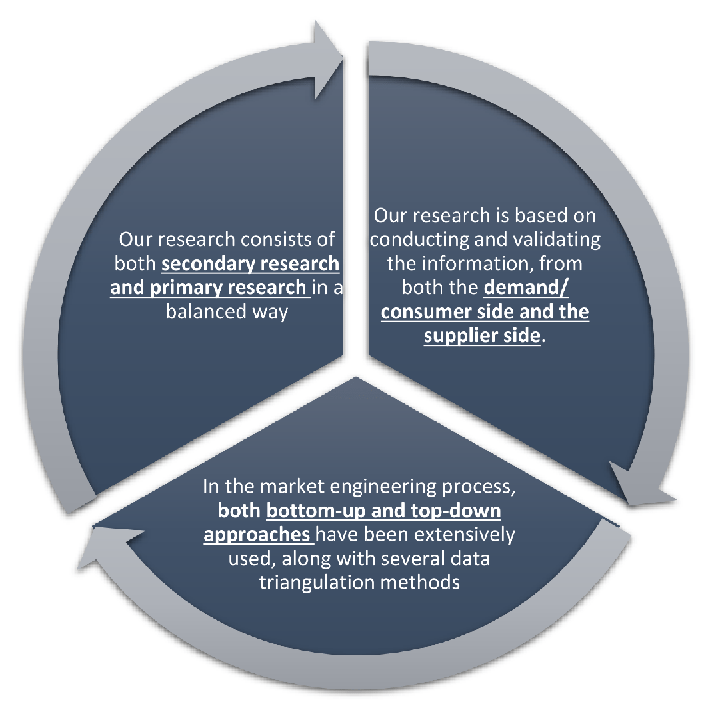
Our research design integrates both demand-side and supply-side analysis through a balanced combination of primary and secondary research methodologies. By utilizing both bottom-up and top-down approaches alongside rigorous data triangulation methods, we deliver robust market intelligence that supports strategic decision-making.
MarketGenics' comprehensive research design framework ensures the delivery of accurate, reliable, and actionable market intelligence. Through the integration of multiple research approaches, rigorous validation processes, and expert analysis, we provide our clients with the insights needed to make informed strategic decisions and capitalize on market opportunities.
MarketGenics leverages a dedicated industry panel of experts and a comprehensive suite of paid databases to effectively collect, consolidate, and analyze market intelligence.
Our approach has consistently proven to be reliable and effective in generating accurate market insights, identifying key industry trends, and uncovering emerging business opportunities.
Through both primary and secondary research, we capture and analyze critical company-level data such as manufacturing footprints, including technical centers, R&D facilities, sales offices, and headquarters.
Our expert panel further enhances our ability to estimate market size for specific brands based on validated field-level intelligence.
Our data mining techniques incorporate both parametric and non-parametric methods, allowing for structured data collection, sorting, processing, and cleaning.
Demand projections are derived from large-scale data sets analyzed through proprietary algorithms, culminating in robust and reliable market sizing.
Research Approach
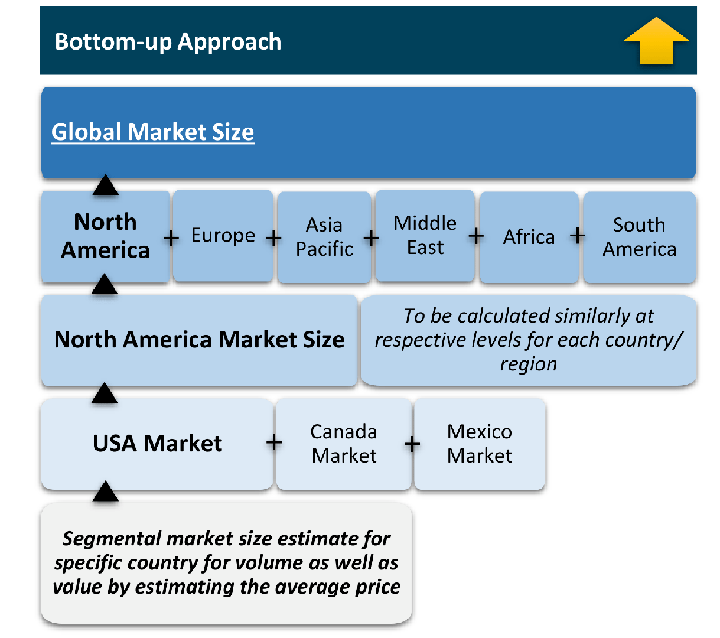
The bottom-up approach builds market estimates by starting with the smallest addressable market units and systematically aggregating them to create comprehensive market size projections.
This method begins with specific, granular data points and builds upward to create the complete market landscape.
Customer Analysis → Segmental Analysis → Geographical Analysis
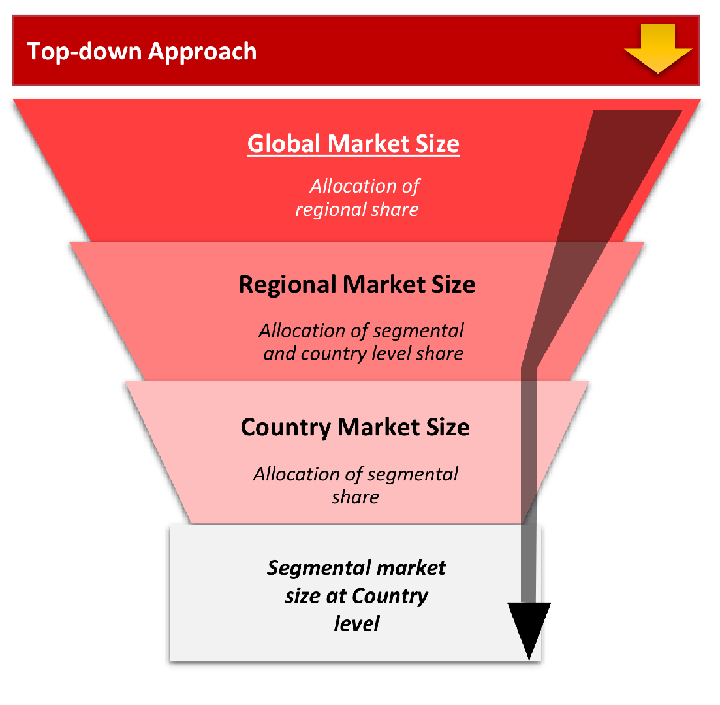
The top-down approach starts with the broadest possible market data and systematically narrows it down through a series of filters and assumptions to arrive at specific market segments or opportunities.
This method begins with the big picture and works downward to increasingly specific market slices.
TAM → SAM → SOM
Research Methods
Desk / Secondary Research
While analysing the market, we extensively study secondary sources, directories, and databases to identify and collect information useful for this technical, market-oriented, and commercial report. Secondary sources that we utilize are not only the public sources, but it is a combination of Open Source, Associations, Paid Databases, MG Repository & Knowledgebase, and others.
- Company websites, annual reports, financial reports, broker reports, and investor presentations
- National government documents, statistical databases and reports
- News articles, press releases and web-casts specific to the companies operating in the market, Magazines, reports, and others
- We gather information from commercial data sources for deriving company specific data such as segmental revenue, share for geography, product revenue, and others
- Internal and external proprietary databases (industry-specific), relevant patent, and regulatory databases
- Governing Bodies, Government Organizations
- Relevant Authorities, Country-specific Associations for Industries
We also employ the model mapping approach to estimate the product level market data through the players' product portfolio
Primary Research
Primary research/ interviews is vital in analyzing the market. Most of the cases involves paid primary interviews. Primary sources include primary interviews through e-mail interactions, telephonic interviews, surveys as well as face-to-face interviews with the different stakeholders across the value chain including several industry experts.
| Type of Respondents | Number of Primaries |
|---|---|
| Tier 2/3 Suppliers | ~20 |
| Tier 1 Suppliers | ~25 |
| End-users | ~25 |
| Industry Expert/ Panel/ Consultant | ~30 |
| Total | ~100 |
MG Knowledgebase
• Repository of industry blog, newsletter and case studies
• Online platform covering detailed market reports, and company profiles
Forecasting Factors and Models
Forecasting Factors
- Historical Trends – Past market patterns, cycles, and major events that shaped how markets behave over time. Understanding past trends helps predict future behavior.
- Industry Factors – Specific characteristics of the industry like structure, regulations, and innovation cycles that affect market dynamics.
- Macroeconomic Factors – Economic conditions like GDP growth, inflation, and employment rates that affect how much money people have to spend.
- Demographic Factors – Population characteristics like age, income, and location that determine who can buy your product.
- Technology Factors – How quickly people adopt new technology and how much technology infrastructure exists.
- Regulatory Factors – Government rules, laws, and policies that can help or restrict market growth.
- Competitive Factors – Analyzing competition structure such as degree of competition and bargaining power of buyers and suppliers.
Forecasting Models / Techniques
Multiple Regression Analysis
- Identify and quantify factors that drive market changes
- Statistical modeling to establish relationships between market drivers and outcomes
Time Series Analysis – Seasonal Patterns
- Understand regular cyclical patterns in market demand
- Advanced statistical techniques to separate trend, seasonal, and irregular components
Time Series Analysis – Trend Analysis
- Identify underlying market growth patterns and momentum
- Statistical analysis of historical data to project future trends
Expert Opinion – Expert Interviews
- Gather deep industry insights and contextual understanding
- In-depth interviews with key industry stakeholders
Multi-Scenario Development
- Prepare for uncertainty by modeling different possible futures
- Creating optimistic, pessimistic, and most likely scenarios
Time Series Analysis – Moving Averages
- Sophisticated forecasting for complex time series data
- Auto-regressive integrated moving average models with seasonal components
Econometric Models
- Apply economic theory to market forecasting
- Sophisticated economic models that account for market interactions
Expert Opinion – Delphi Method
- Harness collective wisdom of industry experts
- Structured, multi-round expert consultation process
Monte Carlo Simulation
- Quantify uncertainty and probability distributions
- Thousands of simulations with varying input parameters
Research Analysis
Our research framework is built upon the fundamental principle of validating market intelligence from both demand and supply perspectives. This dual-sided approach ensures comprehensive market understanding and reduces the risk of single-source bias.
Demand-Side Analysis: We understand end-user/application behavior, preferences, and market needs along with the penetration of the product for specific application.
Supply-Side Analysis: We estimate overall market revenue, analyze the segmental share along with industry capacity, competitive landscape, and market structure.
Validation & Evaluation
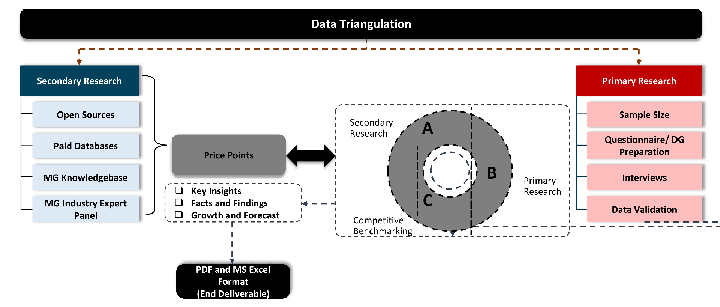
Data triangulation is a validation technique that uses multiple methods, sources, or perspectives to examine the same research question, thereby increasing the credibility and reliability of research findings. In market research, triangulation serves as a quality assurance mechanism that helps identify and minimize bias, validate assumptions, and ensure accuracy in market estimates.
- Data Source Triangulation – Using multiple data sources to examine the same phenomenon
- Methodological Triangulation – Using multiple research methods to study the same research question
- Investigator Triangulation – Using multiple researchers or analysts to examine the same data
- Theoretical Triangulation – Using multiple theoretical perspectives to interpret the same data
Custom Market Research Services
We will customise the research for you, in case the report listed above does not meet your requirements.
Get 10% Free Customisation