Pharmacogenomics Market Size, Share & Trends Analysis Report by Product & Services (Kits and Reagents, Instruments, Software and Bioinformatics Platforms, Pharmacogenomic Testing Services, Data Analysis and Interpretation Services, Others), Technology, Therapeutic Area, Workflow Stage, Gene Type, Indication, Application, End User and Geography (North America, Europe, Asia Pacific, Middle East, Africa, and South America) – Global Industry Data, Trends, and Forecasts, 2025–2035
|
Market Structure & Evolution |
|
|
Segmental Data Insights |
|
|
Demand Trends |
|
|
Competitive Landscape |
|
|
Strategic Development |
|
|
Future Outlook & Opportunities |
|
Pharmacogenomics-Market Size, Share, and Growth
The global pharmacogenomics market is experiencing robust growth, with its estimated value of USD 4.9 billion in the year 2025 and USD 13.1 billion by 2035, registering a CAGR of 10.4% during the forecast period.
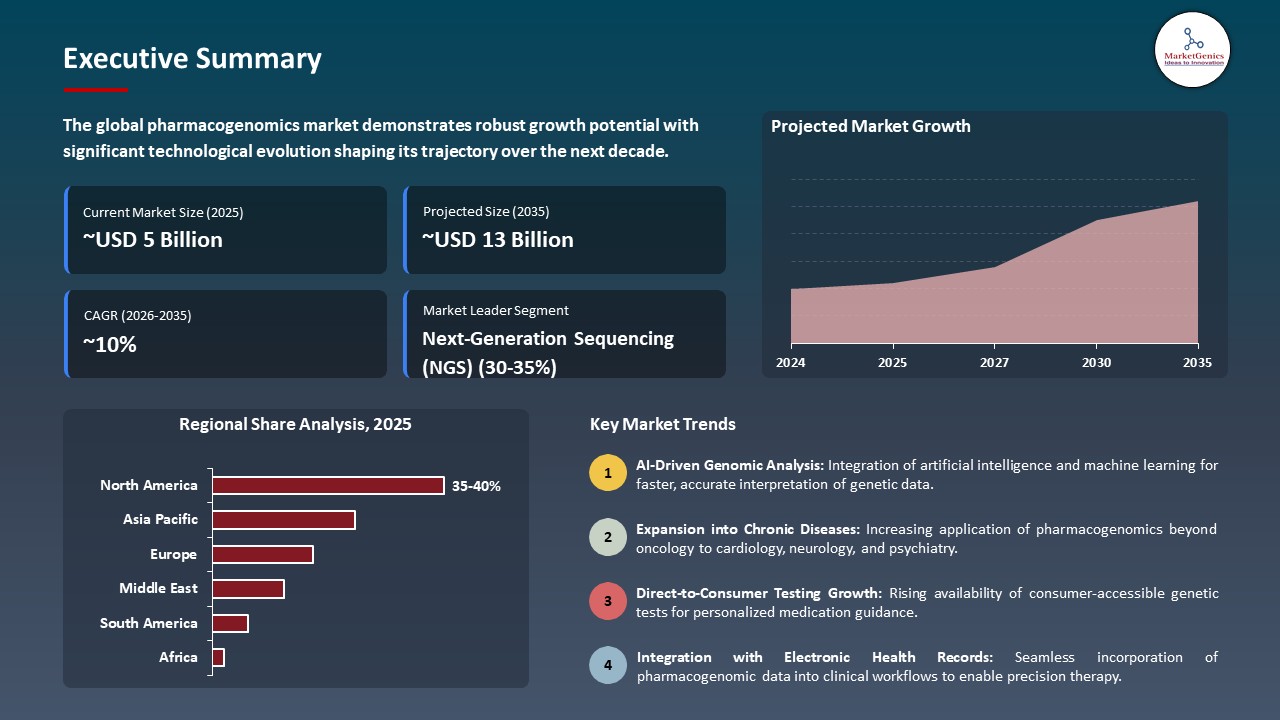
Pharmacogenomics transforms healthcare by providing doctors and scientists with the ability to develop treatments based on a patient's unique genetic makeup, which leads to better patient outcomes according to Dr. Catherine Oliver. Our research proves that combining pharmacogenomic data with medical decision processes leads to customized treatment methods which protect patients from drug interactions and speed up the use of precise medical treatments in multiple treatment fields.
The global pharmacogenomics market experiences growth because genetic testing technologies have developed into tools which accurately forecast how patients will react to medications. The NovaSeq X Plus platform from Illumina provides ultra-high-throughput sequencing which delivers fast results to help doctors deliver customized treatment solutions when it launches in January 2025.
The increasing occurrence of chronic and complex diseases, which include cancer and cardiovascular disorders and psychiatric conditions, drives the need for personalized medical treatment methods. The Mayo Clinic established an oncology program which used pharmacogenomic testing to develop better chemotherapy protocols while reducing harmful medication effects in March 2025.
The FDA supports precision medicine implementation by providing guidance about using pharmacogenomic biomarkers in drug labeling. The market experiences growth through technological advancements which create regulatory structures to address rising disease cases because healthcare providers achieve better treatment results with fewer side effects at decreased costs.
The market needs to explore companion diagnostics and bioinformatics platforms and clinical decision support and pharmacovigilance solutions and genetic counseling services. The precision medicine ecosystem provides companies with revenue opportunities which they can develop through personalized medicine initiatives that use these market segments.
 Pharmacogenomics Market Dynamics and Trends
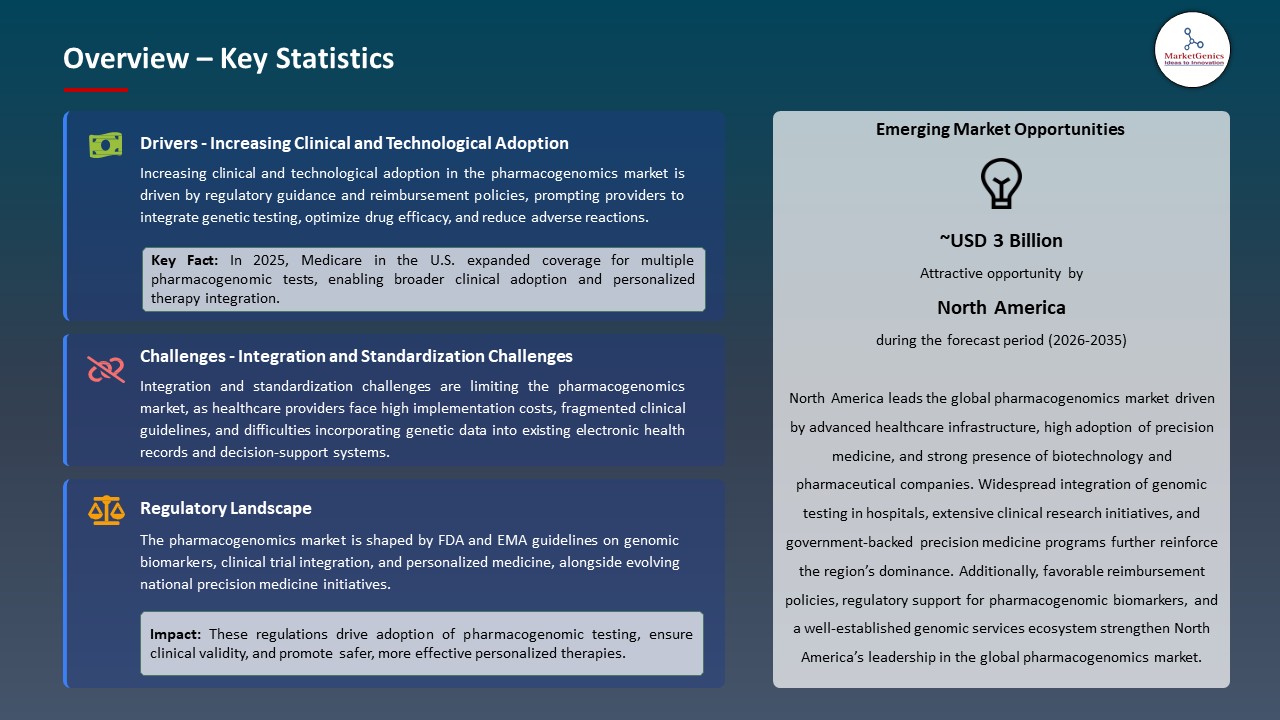
Driver: Increasing Clinical and Technological Adoption Driving Pharmacogenomics Integration
-
Healthcare systems have begun to use genetic information for making better drug prescriptions which has created growth in the pharmacogenomics market. In 2025 Germany approved its public health system to implement pharmacogenomics‑guided prescribing for oncology which resulted in hospitals needing genotyping kits.
- The adoption of genetic biomarkers is accelerating because regulatory bodies now recognize these genetic markers. In 2025 the European Commission amended GDPR genomic data clauses which required major genomic testing companies to update their compliance procedures because pharmacogenomic practices became more regulated.
- The number of patients who know about pharmacogenomic testing and the number of doctors who support this testing continue to grow because research shows that physicians around the world have high interest in the testing and educational programs help doctors use genetic data for personalized treatment. All these factors are likely to continue to escalate the growth of the pharmacogenomics market.
Restraint: Integration and Standardization Challenges Limiting Widespread Clinical Adoption
-
Fragmented clinical guidelines and inconsistent implementation across geographical regions hinder the adoption of pharmacogenomics due to their complexity, causing clinician decision support integration challenges and delaying the integration of pharmacogenomics into routine patient care.
- There are also high-cost infrastructure and limited reimbursement policies in most market segments; therefore, it is difficult for pharmacogenomic testing to be able to be provided throughout the world. Tests may not be reimbursed by public insurance in many countries in emerging markets.
- Workforce deficits and inconsistent training on interpreting genomic results have also limited seamless implementation of pharmacogenomics into smaller healthcare systems may be especially problematic. All these elements are expected to restrict the expansion of the pharmacogenomics market.
Opportunity: Expansion into Chronic Disease Management and Global Precision Medicine Programs
-
Worldwide, pharmacogenomic initiatives are becoming more popular. For instance, more than 900,000 patients have been tested for PGx in Germany's national clinical testing program in 2024; this demonstrates the large-scale clinical utility of PGx for clinicians.
- Moreover, in Asia Pacific, PGx testing volumes are rapidly increasing throughout the region. China has performed over 500,000 PGx tests in 2024. India is developing plans to enact new genomic medicine policies that will incorporate PGx into their national healthcare systems by 2025.
- Additionally, venture capital funding and new startup activity is also rising. For example, UGenome AI and other pharmacogenomic startups that will be available in 2025 are using AI-enabled interpretation of genetic data together with clinical workflows to provide actionable genetic information at point of care. And thus, is expected to create more opportunities in future for pharmacogenomics market.
Key Trend: Integration of AI, Bioinformatics, and Real‑World Evidence Enhancing Clinical Utility
-
The development of AI-based pharmacogenomics tools has been progressing at a fast pace because the AI-based Sirius system launched in 2024-2025 provides personalized drug prescriptions through genomic profile analysis which extends its clinical applicability for multiple medications.
- According to American Pharmacogenomics Association (APGxA) 2025 research study on real-world implementations demonstrates that clinical workflows can successfully use PGx testing through pilot programs which Saudi Arabian hospitals operate to connect genomic test results with cardiology and neurology care.
- The deployment of next-generation sequencing and genotyping technologies combined with extensive research initiatives at hospitals has created better scientific proof about how PGx testing benefits patients with oncology and psychiatry and chronic disease conditions. Therefore, is expected to influence significant trends in the pharmacogenomics market.
 Pharmacogenomics Market Analysis and Segmental Data
Next‑Generation Sequencing (NGS) Dominates Global Pharmacogenomics Market amid Rising Adoption of Personalized Medicine
-
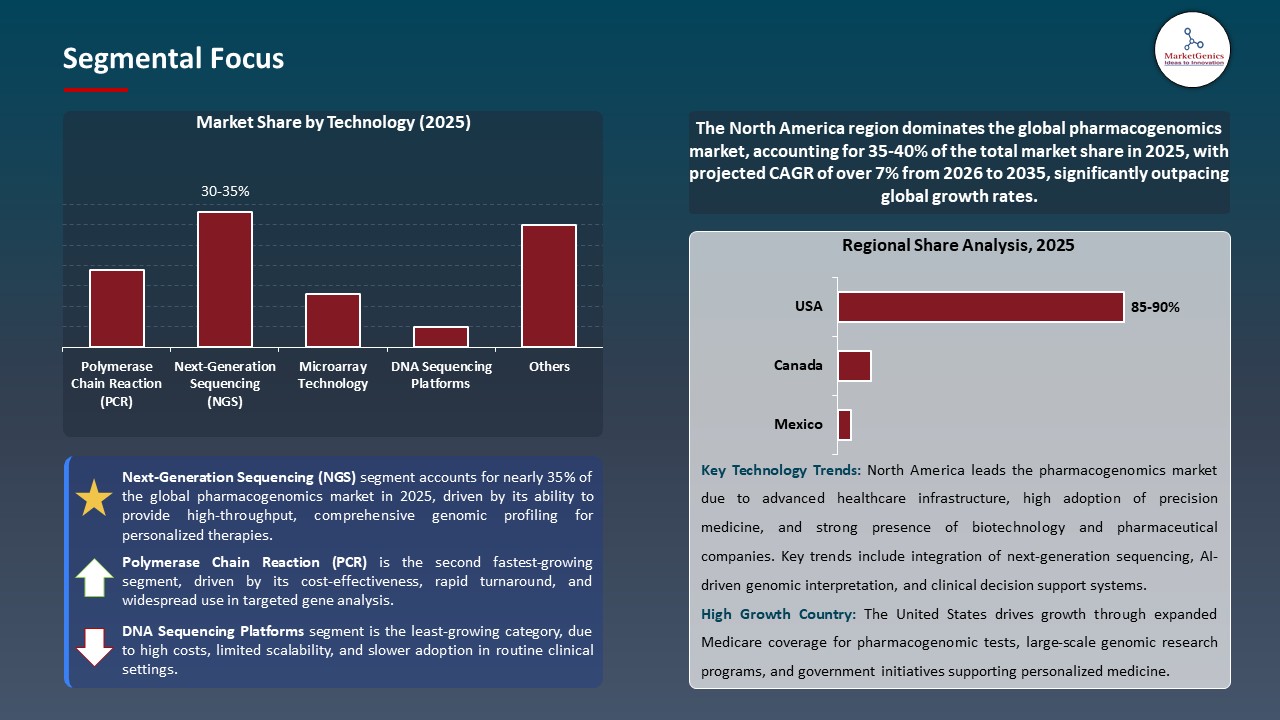
The pharmacogenomics market is currently led by next‑generation sequencing (NGS), which enables complete genomic analysis for drug selection and dosing in precision medicine, which has now become necessary for clinical treatment. Next‑generation sequencing has become the leading method for detecting genetic variations that affect drug response because sequencing costs have decreased while testing efficiency has improved.
- Clinical adoption has started to spread from oncology into cardiology and neurology, which receives support from Oxford Nanopore's 2024 Pharmacogenomics Beta Program that provides next‑generation sequencing target enrichment with real-time sequencing for personalized treatment development.
- Next‑generation sequencing usage increases because regulators now recognize genomic biomarkers while the number of people with chronic diseases continues to grow, which establishes next‑generation sequencing as the dominant technology in the pharmacogenomics market.
North America Dominates Pharmacogenomics Market amid Advanced Healthcare Infrastructure and Strong Regulatory Support
-
The global pharmacogenomics market in North America has its largest share because of the region's superior healthcare infrastructure and extensive funding for genomic research and its widespread use of precision medicine in clinical settings.
- The region benefits from well-established diagnostic laboratories and the common use of pharmacogenomic data in electronic health records and the existing reimbursement and regulatory systems which drive test adoption. Medicare expanded its coverage for more than 40 U.S. states in June 2025 to include multiple pharmacogenetic tests which demonstrates the increasing institutional backing for genomic-based treatment decision-making.
- North America's position as the top region in the biotechnology and pharmaceutical sectors receives additional support from ongoing government funding of precision medicine programs and the region is expected to continue to strengthen pharmacogenomics market in North America.
Pharmacogenomics Market Ecosystem
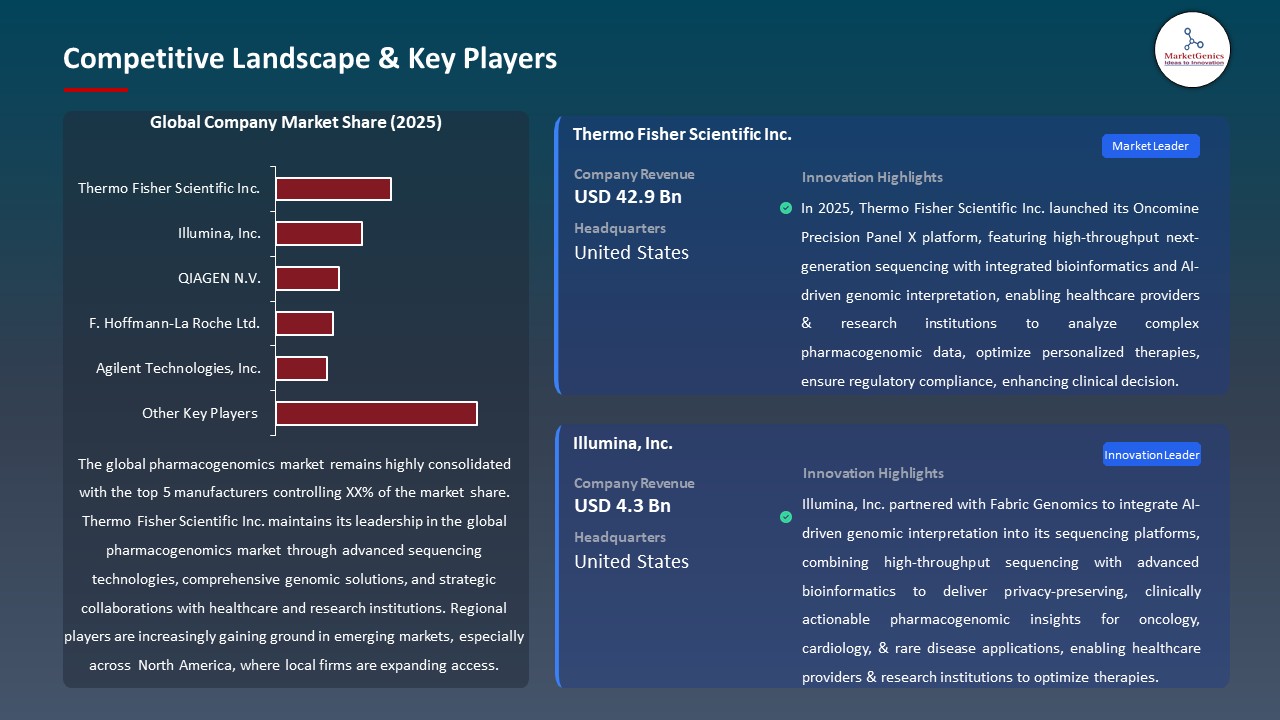
The global pharmacogenomics market is highly consolidated because Tier 1 leaders Illumina Thermo Fisher Qiagen and Roche control a major market share while Tier 2 regional specialists and Tier 3 emerging service firms compete in the market.
The value chain's key elements develop genomic assays and sequencing platforms while they deliver clinical interpretation and reporting services that help doctors make treatment decisions. A recent example is the 2025 Quest Diagnostics–Coriell Life Sciences collaboration, which will introduce advanced pharmacogenomic tests designed to create personalized drug therapies for major clinical areas.
 Recent Development and Strategic Overview:
-
In September 2025, Quest Diagnostics established an advanced pharmacogenomics testing laboratory through its partnership with Coriell Life Sciences which enables doctors to determine how patients process medications based on their genetic information across multiple medical fields including psychiatry and oncology and cardiology. The service provides complete genotype and phenotypic data alongside practical medication recommendations which demonstrate how pharmacogenomic data is applied in actual clinical settings to enhance treatment results.
- In August 2025, PGxAI and Sequencing.com formed a strategic partnership to provide low-cost pharmacogenomic testing at consumer level through their AI-based precision medicine solutions which use genetic data from accessible platforms. The collaboration aims to reduce adverse drug reactions while increasing the use of pharmacogenomic testing in healthcare facilities and insurance companies and genomic laboratories.
Report Scope
|
Attribute |
Detail |
|
Market Size in 2025 |
USD 4.9 Bn |
|
Market Forecast Value in 2035 |
USD 13.1 Bn |
|
Growth Rate (CAGR) |
10.4% |
|
Forecast Period |
2025 – 2035 |
|
Historical Data Available for |
2020 – 2024 |
|
Market Size Units |
USD Billion for Value |
|
Report Format |
Electronic (PDF) + Excel |
|
Regions and Countries Covered |
|||||
|
North America |
Europe |
Asia Pacific |
Middle East |
Africa |
South America |
|
|
|
|
|
|
|
Companies Covered |
|||||
|
|
|
|
|
|
Pharmacogenomics Market Segmentation and Highlights
|
Segment |
Sub-segment |
|
Pharmacogenomics Market, By Product & Services |
|
|
Pharmacogenomics Market, By Technology |
|
|
Pharmacogenomics Market, By Therapeutic Area |
|
|
Pharmacogenomics Market, By Workflow Stage |
|
|
Pharmacogenomics Market, By Gene Type |
|
|
Pharmacogenomics Market, By Indication |
|
|
Pharmacogenomics Market, By Application |
|
|
Pharmacogenomics Market, By End User |
|
Frequently Asked Questions
Table of Contents
- 1. Research Methodology and Assumptions
- 1.1. Definitions
- 1.2. Research Design and Approach
- 1.3. Data Collection Methods
- 1.4. Base Estimates and Calculations
- 1.5. Forecasting Models
- 1.5.1. Key Forecast Factors & Impact Analysis
- 1.6. Secondary Research
- 1.6.1. Open Natures
- 1.6.2. Paid Databases
- 1.6.3. Associations
- 1.7. Primary Research
- 1.7.1. Primary Natures
- 1.7.2. Primary Interviews with Stakeholders across Ecosystem
- 2. Executive Summary
- 2.1. Global Pharmacogenomics Market Outlook
- 2.1.1. Pharmacogenomics Market Size (Value - US$ Bn), and Forecasts, 2021-2035
- 2.1.2. Compounded Annual Growth Rate Analysis
- 2.1.3. Growth Opportunity Analysis
- 2.1.4. Segmental Share Analysis
- 2.1.5. Geographical Share Analysis
- 2.2. Market Analysis and Facts
- 2.3. Supply-Demand Analysis
- 2.4. Competitive Benchmarking
- 2.5. Go-to- Market Strategy
- 2.5.1. Customer/ End-use Industry Assessment
- 2.5.2. Growth Opportunity Data, 2026-2035
- 2.5.2.1. Regional Data
- 2.5.2.2. Country Data
- 2.5.2.3. Segmental Data
- 2.5.3. Identification of Potential Market Spaces
- 2.5.4. GAP Analysis
- 2.5.5. Potential Attractive Price Points
- 2.5.6. Prevailing Market Risks & Challenges
- 2.5.7. Preferred Sales & Marketing Strategies
- 2.5.8. Key Recommendations and Analysis
- 2.5.9. A Way Forward
- 2.1. Global Pharmacogenomics Market Outlook
- 3. Industry Data and Premium Insights
- 3.1. Global Healthcare & Pharmaceutical Industry Overview, 2025
- 3.1.1. Healthcare & Pharmaceutical Industry Analysis
- 3.1.2. Key Trends for Healthcare & Pharmaceutical Industry
- 3.1.3. Regional Distribution for Healthcare & Pharmaceutical Industry
- 3.2. Supplier Customer Data
- 3.3. Technology Roadmap and Developments
- 3.1. Global Healthcare & Pharmaceutical Industry Overview, 2025
- 4. Market Overview
- 4.1. Market Dynamics
- 4.1.1. Drivers
- 4.1.1.1. Rising adoption of personalized medicine to optimize drug efficacy and minimize adverse reactions.
- 4.1.1.2. Technological advancements in next-generation sequencing and AI-driven genomic interpretation.
- 4.1.1.3. Government-backed precision medicine initiatives and favorable reimbursement policies.
- 4.1.2. Restraints
- 4.1.2.1. High cost of pharmacogenomic testing and limited insurance coverage in some regions.
- 4.1.2.2. Integration challenges with electronic health records and clinical decision-support systems.
- 4.1.1. Drivers
- 4.2. Key Trend Analysis
- 4.3. Regulatory Framework
- 4.3.1. Key Regulations, Norms, and Subsidies, by Key Countries
- 4.3.2. Tariffs and Standards
- 4.3.3. Impact Analysis of Regulations on the Market
- 4.4. Value Chain Analysis/ Ecosystem Analysis
- 4.5. Cost Structure Analysis
- 4.6. Porter’s Five Forces Analysis
- 4.7. PESTEL Analysis
- 4.8. Global Pharmacogenomics Market Demand
- 4.8.1. Historical Market Size – Value (US$ Bn), 2020-2024
- 4.8.2. Current and Future Market Size – Value (US$ Bn), 2026–2035
- 4.8.2.1. Y-o-Y Growth Trends
- 4.8.2.2. Absolute $ Opportunity Assessment
- 4.1. Market Dynamics
- 5. Competition Landscape
- 5.1. Competition structure
- 5.1.1. Fragmented v/s consolidated
- 5.2. Company Share Analysis, 2025
- 5.2.1. Global Company Market Share
- 5.2.2. By Region
- 5.2.2.1. North America
- 5.2.2.2. Europe
- 5.2.2.3. Asia Pacific
- 5.2.2.4. Middle East
- 5.2.2.5. Africa
- 5.2.2.6. South America
- 5.3. Product Comparison Matrix
- 5.3.1. Specifications
- 5.3.2. Market Positioning
- 5.3.3. Pricing
- 5.1. Competition structure
- 6. Global Pharmacogenomics Market Analysis, by Product & Services
- 6.1. Key Segment Analysis
- 6.2. Pharmacogenomics Market Size (Value - US$ Bn), Analysis, and Forecasts, by Product & Services, 2021-2035
- 6.2.1. Kits and Reagents
- 6.2.2. Instruments
- 6.2.3. Software and Bioinformatics Platforms
- 6.2.4. Pharmacogenomic Testing Services
- 6.2.5. Data Analysis and Interpretation Services
- 6.2.6. Others
- 7. Global Pharmacogenomics Market Analysis, by Technology
- 7.1. Key Segment Analysis
- 7.2. Pharmacogenomics Market Size (Value - US$ Bn), Analysis, and Forecasts, by Technology, 2021-2035
- 7.2.1. Next-Generation Sequencing (NGS)
- 7.2.2. Polymerase Chain Reaction (PCR)
- 7.2.3. Microarray Technology
- 7.2.4. Gel Electrophoresis
- 7.2.5. Mass Spectrometry
- 7.2.6. DNA Sequencing Platforms
- 7.2.7. Others
- 8. Global Pharmacogenomics Market Analysis, by Therapeutic Area
- 8.1. Key Segment Analysis
- 8.2. Pharmacogenomics Market Size (Value - US$ Bn), Analysis, and Forecasts, by Therapeutic Area, 2021-2035
- 8.2.1. Oncology
- 8.2.2. Cardiovascular Diseases
- 8.2.3. Neurological Disorders
- 8.2.4. Infectious Diseases
- 8.2.5. Pain Management
- 8.2.6. Metabolic Disorders
- 8.2.7. Psychiatric Disorders
- 8.2.8. Others
- 9. Global Pharmacogenomics Market Analysis, by Workflow Stage
- 9.1. Key Segment Analysis
- 9.2. Pharmacogenomics Market Size (Value - US$ Bn), Analysis, and Forecasts, by Workflow Stage, 2021-2035
- 9.2.1. Sample Preparation
- 9.2.2. Gene Sequencing and Genotyping
- 9.2.3. Variant Detection and Analysis
- 9.2.4. Data Interpretation and Clinical Reporting
- 9.2.5. Others
- 10. Global Pharmacogenomics Market Analysis, by Gene Type
- 10.1. Key Segment Analysis
- 10.2. Pharmacogenomics Market Size (Value - US$ Bn), Analysis, and Forecasts, by Gene Type, 2021-2035
- 10.2.1. Cytochrome P450 (CYP) Genes
- 10.2.2. Drug Transporter Genes
- 10.2.3. Drug Target Genes
- 10.2.4. Immune Response Genes
- 10.2.5. Others
- 11. Global Pharmacogenomics Market Analysis, by Indication
- 11.1. Key Segment Analysis
- 11.2. Pharmacogenomics Market Size (Value - US$ Bn), Analysis, and Forecasts, by Indication, 2021-2035
- 11.2.1. Cancer
- 11.2.2. Cardiovascular Disorders
- 11.2.3. Depression and Psychiatric Disorders
- 11.2.4. Neurological Disorders
- 11.2.5. Infectious Diseases
- 11.2.6. Others
- 12. Global Pharmacogenomics Market Analysis, by Application
- 12.1. Key Segment Analysis
- 12.2. Pharmacogenomics Market Size (Value - US$ Bn), Analysis, and Forecasts, by Application, 2021-2035
- 12.2.1. Drug Discovery and Development
- 12.2.2. Clinical Diagnostics
- 12.2.3. Personalized Medicine
- 12.2.4. Precision Medicine
- 12.2.5. Pharmacogenetic Testing
- 12.2.6. Biomarker Identification
- 12.2.7. Others
- 13. Global Pharmacogenomics Market Analysis, by End User
- 13.1. Key Segment Analysis
- 13.2. Pharmacogenomics Market Size (Value - US$ Bn), Analysis, and Forecasts, by End User, 2021-2035
- 13.2.1. Hospitals and Clinics
- 13.2.2. Academic and Research Institutes
- 13.2.3. Pharmaceutical and Biotechnology Companies
- 13.2.4. Contract Research Organizations
- 13.2.5. Diagnostic Laboratories
- 13.2.6. Others
- 14. Global Pharmacogenomics Market Analysis and Forecasts, by Region
- 14.1. Key Findings
- 14.2. Pharmacogenomics Market Size (Value - US$ Bn), Analysis, and Forecasts, by Region, 2021-2035
- 14.2.1. North America
- 14.2.2. Europe
- 14.2.3. Asia Pacific
- 14.2.4. Middle East
- 14.2.5. Africa
- 14.2.6. South America
- 15. North America Pharmacogenomics Market Analysis
- 15.1. Key Segment Analysis
- 15.2. Regional Snapshot
- 15.3. North America Pharmacogenomics Market Size (Value - US$ Bn), Analysis, and Forecasts, 2021-2035
- 15.3.1. Product & Services
- 15.3.2. Technology
- 15.3.3. Therapeutic Area
- 15.3.4. Workflow Stage
- 15.3.5. Gene Type
- 15.3.6. Indication
- 15.3.7. Application
- 15.3.8. End User
- 15.3.9. Country
- 15.3.9.1. USA
- 15.3.9.2. Canada
- 15.3.9.3. Mexico
- 15.4. USA Pharmacogenomics Market
- 15.4.1. Country Segmental Analysis
- 15.4.2. Product & Services
- 15.4.3. Technology
- 15.4.4. Therapeutic Area
- 15.4.5. Workflow Stage
- 15.4.6. Gene Type
- 15.4.7. Indication
- 15.4.8. Application
- 15.4.9. End User
- 15.5. Canada Pharmacogenomics Market
- 15.5.1. Country Segmental Analysis
- 15.5.2. Product & Services
- 15.5.3. Technology
- 15.5.4. Therapeutic Area
- 15.5.5. Workflow Stage
- 15.5.6. Gene Type
- 15.5.7. Indication
- 15.5.8. Application
- 15.5.9. End User
- 15.6. Mexico Pharmacogenomics Market
- 15.6.1. Country Segmental Analysis
- 15.6.2. Product & Services
- 15.6.3. Technology
- 15.6.4. Therapeutic Area
- 15.6.5. Workflow Stage
- 15.6.6. Gene Type
- 15.6.7. Indication
- 15.6.8. Application
- 15.6.9. End User
- 16. Europe Pharmacogenomics Market Analysis
- 16.1. Key Segment Analysis
- 16.2. Regional Snapshot
- 16.3. Europe Pharmacogenomics Market Size (Value - US$ Bn), Analysis, and Forecasts, 2021-2035
- 16.3.1. Product & Services
- 16.3.2. Technology
- 16.3.3. Therapeutic Area
- 16.3.4. Workflow Stage
- 16.3.5. Gene Type
- 16.3.6. Indication
- 16.3.7. Application
- 16.3.8. End User
- 16.3.9. Country
- 16.3.9.1. Germany
- 16.3.9.2. United Kingdom
- 16.3.9.3. France
- 16.3.9.4. Italy
- 16.3.9.5. Spain
- 16.3.9.6. Netherlands
- 16.3.9.7. Nordic Countries
- 16.3.9.8. Poland
- 16.3.9.9. Russia & CIS
- 16.3.9.10. Rest of Europe
- 16.4. Germany Pharmacogenomics Market
- 16.4.1. Country Segmental Analysis
- 16.4.2. Product & Services
- 16.4.3. Technology
- 16.4.4. Therapeutic Area
- 16.4.5. Workflow Stage
- 16.4.6. Gene Type
- 16.4.7. Indication
- 16.4.8. Application
- 16.4.9. End User
- 16.5. United Kingdom Pharmacogenomics Market
- 16.5.1. Country Segmental Analysis
- 16.5.2. Product & Services
- 16.5.3. Technology
- 16.5.4. Therapeutic Area
- 16.5.5. Workflow Stage
- 16.5.6. Gene Type
- 16.5.7. Indication
- 16.5.8. Application
- 16.5.9. End User
- 16.6. France Pharmacogenomics Market
- 16.6.1. Country Segmental Analysis
- 16.6.2. Product & Services
- 16.6.3. Technology
- 16.6.4. Therapeutic Area
- 16.6.5. Workflow Stage
- 16.6.6. Gene Type
- 16.6.7. Indication
- 16.6.8. Application
- 16.6.9. End User
- 16.7. Italy Pharmacogenomics Market
- 16.7.1. Country Segmental Analysis
- 16.7.2. Product & Services
- 16.7.3. Technology
- 16.7.4. Therapeutic Area
- 16.7.5. Workflow Stage
- 16.7.6. Gene Type
- 16.7.7. Indication
- 16.7.8. Application
- 16.7.9. End User
- 16.8. Spain Pharmacogenomics Market
- 16.8.1. Country Segmental Analysis
- 16.8.2. Product & Services
- 16.8.3. Technology
- 16.8.4. Therapeutic Area
- 16.8.5. Workflow Stage
- 16.8.6. Gene Type
- 16.8.7. Indication
- 16.8.8. Application
- 16.8.9. End User
- 16.9. Netherlands Pharmacogenomics Market
- 16.9.1. Country Segmental Analysis
- 16.9.2. Product & Services
- 16.9.3. Technology
- 16.9.4. Therapeutic Area
- 16.9.5. Workflow Stage
- 16.9.6. Gene Type
- 16.9.7. Indication
- 16.9.8. Application
- 16.9.9. End User
- 16.10. Nordic Countries Pharmacogenomics Market
- 16.10.1. Country Segmental Analysis
- 16.10.2. Product & Services
- 16.10.3. Technology
- 16.10.4. Therapeutic Area
- 16.10.5. Workflow Stage
- 16.10.6. Gene Type
- 16.10.7. Indication
- 16.10.8. Application
- 16.10.9. End User
- 16.11. Poland Pharmacogenomics Market
- 16.11.1. Country Segmental Analysis
- 16.11.2. Product & Services
- 16.11.3. Technology
- 16.11.4. Therapeutic Area
- 16.11.5. Workflow Stage
- 16.11.6. Gene Type
- 16.11.7. Indication
- 16.11.8. Application
- 16.11.9. End User
- 16.12. Russia & CIS Pharmacogenomics Market
- 16.12.1. Country Segmental Analysis
- 16.12.2. Product & Services
- 16.12.3. Technology
- 16.12.4. Therapeutic Area
- 16.12.5. Workflow Stage
- 16.12.6. Gene Type
- 16.12.7. Indication
- 16.12.8. Application
- 16.12.9. End User
- 16.13. Rest of Europe Pharmacogenomics Market
- 16.13.1. Country Segmental Analysis
- 16.13.2. Product & Services
- 16.13.3. Technology
- 16.13.4. Therapeutic Area
- 16.13.5. Workflow Stage
- 16.13.6. Gene Type
- 16.13.7. Indication
- 16.13.8. Application
- 16.13.9. End User
- 17. Asia Pacific Pharmacogenomics Market Analysis
- 17.1. Key Segment Analysis
- 17.2. Regional Snapshot
- 17.3. Asia Pacific Pharmacogenomics Market Size (Value - US$ Bn), Analysis, and Forecasts, 2021-2035
- 17.3.1. Product & Services
- 17.3.2. Technology
- 17.3.3. Therapeutic Area
- 17.3.4. Workflow Stage
- 17.3.5. Gene Type
- 17.3.6. Indication
- 17.3.7. Application
- 17.3.8. End User
- 17.3.9. Country
- 17.3.9.1. China
- 17.3.9.2. India
- 17.3.9.3. Japan
- 17.3.9.4. South Korea
- 17.3.9.5. Australia and New Zealand
- 17.3.9.6. Indonesia
- 17.3.9.7. Malaysia
- 17.3.9.8. Thailand
- 17.3.9.9. Vietnam
- 17.3.9.10. Rest of Asia Pacific
- 17.4. China Pharmacogenomics Market
- 17.4.1. Country Segmental Analysis
- 17.4.2. Product & Services
- 17.4.3. Technology
- 17.4.4. Therapeutic Area
- 17.4.5. Workflow Stage
- 17.4.6. Gene Type
- 17.4.7. Indication
- 17.4.8. Application
- 17.4.9. End User
- 17.5. India Pharmacogenomics Market
- 17.5.1. Country Segmental Analysis
- 17.5.2. Product & Services
- 17.5.3. Technology
- 17.5.4. Therapeutic Area
- 17.5.5. Workflow Stage
- 17.5.6. Gene Type
- 17.5.7. Indication
- 17.5.8. Application
- 17.5.9. End User
- 17.6. Japan Pharmacogenomics Market
- 17.6.1. Country Segmental Analysis
- 17.6.2. Product & Services
- 17.6.3. Technology
- 17.6.4. Therapeutic Area
- 17.6.5. Workflow Stage
- 17.6.6. Gene Type
- 17.6.7. Indication
- 17.6.8. Application
- 17.6.9. End User
- 17.7. South Korea Pharmacogenomics Market
- 17.7.1. Country Segmental Analysis
- 17.7.2. Product & Services
- 17.7.3. Technology
- 17.7.4. Therapeutic Area
- 17.7.5. Workflow Stage
- 17.7.6. Gene Type
- 17.7.7. Indication
- 17.7.8. Application
- 17.7.9. End User
- 17.8. Australia and New Zealand Pharmacogenomics Market
- 17.8.1. Country Segmental Analysis
- 17.8.2. Product & Services
- 17.8.3. Technology
- 17.8.4. Therapeutic Area
- 17.8.5. Workflow Stage
- 17.8.6. Gene Type
- 17.8.7. Indication
- 17.8.8. Application
- 17.8.9. End User
- 17.9. Indonesia Pharmacogenomics Market
- 17.9.1. Country Segmental Analysis
- 17.9.2. Product & Services
- 17.9.3. Technology
- 17.9.4. Therapeutic Area
- 17.9.5. Workflow Stage
- 17.9.6. Gene Type
- 17.9.7. Indication
- 17.9.8. Application
- 17.9.9. End User
- 17.10. Malaysia Pharmacogenomics Market
- 17.10.1. Country Segmental Analysis
- 17.10.2. Product & Services
- 17.10.3. Technology
- 17.10.4. Therapeutic Area
- 17.10.5. Workflow Stage
- 17.10.6. Gene Type
- 17.10.7. Indication
- 17.10.8. Application
- 17.10.9. End User
- 17.11. Thailand Pharmacogenomics Market
- 17.11.1. Country Segmental Analysis
- 17.11.2. Product & Services
- 17.11.3. Technology
- 17.11.4. Therapeutic Area
- 17.11.5. Workflow Stage
- 17.11.6. Gene Type
- 17.11.7. Indication
- 17.11.8. Application
- 17.11.9. End User
- 17.12. Vietnam Pharmacogenomics Market
- 17.12.1. Country Segmental Analysis
- 17.12.2. Product & Services
- 17.12.3. Technology
- 17.12.4. Therapeutic Area
- 17.12.5. Workflow Stage
- 17.12.6. Gene Type
- 17.12.7. Indication
- 17.12.8. Application
- 17.12.9. End User
- 17.13. Rest of Asia Pacific Pharmacogenomics Market
- 17.13.1. Country Segmental Analysis
- 17.13.2. Product & Services
- 17.13.3. Technology
- 17.13.4. Therapeutic Area
- 17.13.5. Workflow Stage
- 17.13.6. Gene Type
- 17.13.7. Indication
- 17.13.8. Application
- 17.13.9. End User
- 18. Middle East Pharmacogenomics Market Analysis
- 18.1. Key Segment Analysis
- 18.2. Regional Snapshot
- 18.3. Middle East Pharmacogenomics Market Size (Value - US$ Bn), Analysis, and Forecasts, 2021-2035
- 18.3.1. Product & Services
- 18.3.2. Technology
- 18.3.3. Therapeutic Area
- 18.3.4. Workflow Stage
- 18.3.5. Gene Type
- 18.3.6. Indication
- 18.3.7. Application
- 18.3.8. End User
- 18.3.9. Country
- 18.3.9.1. Turkey
- 18.3.9.2. UAE
- 18.3.9.3. Saudi Arabia
- 18.3.9.4. Israel
- 18.3.9.5. Rest of Middle East
- 18.4. Turkey Pharmacogenomics Market
- 18.4.1. Country Segmental Analysis
- 18.4.2. Product & Services
- 18.4.3. Technology
- 18.4.4. Therapeutic Area
- 18.4.5. Workflow Stage
- 18.4.6. Gene Type
- 18.4.7. Indication
- 18.4.8. Application
- 18.4.9. End User
- 18.5. UAE Pharmacogenomics Market
- 18.5.1. Country Segmental Analysis
- 18.5.2. Product & Services
- 18.5.3. Technology
- 18.5.4. Therapeutic Area
- 18.5.5. Workflow Stage
- 18.5.6. Gene Type
- 18.5.7. Indication
- 18.5.8. Application
- 18.5.9. End User
- 18.6. Saudi Arabia Pharmacogenomics Market
- 18.6.1. Country Segmental Analysis
- 18.6.2. Product & Services
- 18.6.3. Technology
- 18.6.4. Therapeutic Area
- 18.6.5. Workflow Stage
- 18.6.6. Gene Type
- 18.6.7. Indication
- 18.6.8. Application
- 18.6.9. End User
- 18.7. Israel Pharmacogenomics Market
- 18.7.1. Country Segmental Analysis
- 18.7.2. Product & Services
- 18.7.3. Technology
- 18.7.4. Therapeutic Area
- 18.7.5. Workflow Stage
- 18.7.6. Gene Type
- 18.7.7. Indication
- 18.7.8. Application
- 18.7.9. End User
- 18.8. Rest of Middle East Pharmacogenomics Market
- 18.8.1. Country Segmental Analysis
- 18.8.2. Product & Services
- 18.8.3. Technology
- 18.8.4. Therapeutic Area
- 18.8.5. Workflow Stage
- 18.8.6. Gene Type
- 18.8.7. Indication
- 18.8.8. Application
- 18.8.9. End User
- 19. Africa Pharmacogenomics Market Analysis
- 19.1. Key Segment Analysis
- 19.2. Regional Snapshot
- 19.3. Africa Pharmacogenomics Market Size (Value - US$ Bn), Analysis, and Forecasts, 2021-2035
- 19.3.1. Product & Services
- 19.3.2. Technology
- 19.3.3. Therapeutic Area
- 19.3.4. Workflow Stage
- 19.3.5. Gene Type
- 19.3.6. Indication
- 19.3.7. Application
- 19.3.8. End User
- 19.3.9. Country
- 19.3.9.1. South Africa
- 19.3.9.2. Egypt
- 19.3.9.3. Nigeria
- 19.3.9.4. Algeria
- 19.3.9.5. Rest of Africa
- 19.4. South Africa Pharmacogenomics Market
- 19.4.1. Country Segmental Analysis
- 19.4.2. Product & Services
- 19.4.3. Technology
- 19.4.4. Therapeutic Area
- 19.4.5. Workflow Stage
- 19.4.6. Gene Type
- 19.4.7. Indication
- 19.4.8. Application
- 19.4.9. End User
- 19.5. Egypt Pharmacogenomics Market
- 19.5.1. Country Segmental Analysis
- 19.5.2. Product & Services
- 19.5.3. Technology
- 19.5.4. Therapeutic Area
- 19.5.5. Workflow Stage
- 19.5.6. Gene Type
- 19.5.7. Indication
- 19.5.8. Application
- 19.5.9. End User
- 19.6. Nigeria Pharmacogenomics Market
- 19.6.1. Country Segmental Analysis
- 19.6.2. Product & Services
- 19.6.3. Technology
- 19.6.4. Therapeutic Area
- 19.6.5. Workflow Stage
- 19.6.6. Gene Type
- 19.6.7. Indication
- 19.6.8. Application
- 19.6.9. End User
- 19.7. Algeria Pharmacogenomics Market
- 19.7.1. Country Segmental Analysis
- 19.7.2. Product & Services
- 19.7.3. Technology
- 19.7.4. Therapeutic Area
- 19.7.5. Workflow Stage
- 19.7.6. Gene Type
- 19.7.7. Indication
- 19.7.8. Application
- 19.7.9. End User
- 19.8. Rest of Africa Pharmacogenomics Market
- 19.8.1. Country Segmental Analysis
- 19.8.2. Product & Services
- 19.8.3. Technology
- 19.8.4. Therapeutic Area
- 19.8.5. Workflow Stage
- 19.8.6. Gene Type
- 19.8.7. Indication
- 19.8.8. Application
- 19.8.9. End User
- 20. South America Pharmacogenomics Market Analysis
- 20.1. Key Segment Analysis
- 20.2. Regional Snapshot
- 20.3. South America Pharmacogenomics Market Size (Value - US$ Bn), Analysis, and Forecasts, 2021-2035
- 20.3.1. Product & Services
- 20.3.2. Technology
- 20.3.3. Therapeutic Area
- 20.3.4. Workflow Stage
- 20.3.5. Gene Type
- 20.3.6. Indication
- 20.3.7. Application
- 20.3.8. End User
- 20.3.9. Country
- 20.3.9.1. Brazil
- 20.3.9.2. Argentina
- 20.3.9.3. Rest of South America
- 20.4. Brazil Pharmacogenomics Market
- 20.4.1. Country Segmental Analysis
- 20.4.2. Product & Services
- 20.4.3. Technology
- 20.4.4. Therapeutic Area
- 20.4.5. Workflow Stage
- 20.4.6. Gene Type
- 20.4.7. Indication
- 20.4.8. Application
- 20.4.9. End User
- 20.5. Argentina Pharmacogenomics Market
- 20.5.1. Country Segmental Analysis
- 20.5.2. Product & Services
- 20.5.3. Technology
- 20.5.4. Therapeutic Area
- 20.5.5. Workflow Stage
- 20.5.6. Gene Type
- 20.5.7. Indication
- 20.5.8. Application
- 20.5.9. End User
- 20.6. Rest of South America Pharmacogenomics Market
- 20.6.1. Country Segmental Analysis
- 20.6.2. Product & Services
- 20.6.3. Technology
- 20.6.4. Therapeutic Area
- 20.6.5. Workflow Stage
- 20.6.6. Gene Type
- 20.6.7. Indication
- 20.6.8. Application
- 20.6.9. End User
- 21. Key Players/ Company Profile
- 21.1. Abbott Laboratories
- 21.1.1. Company Details/ Overview
- 21.1.2. Company Financials
- 21.1.3. Key Customers and Competitors
- 21.1.4. Business/ Industry Portfolio
- 21.1.5. Product Portfolio/ Specification Details
- 21.1.6. Pricing Data
- 21.1.7. Strategic Overview
- 21.1.8. Recent Developments
- 21.2. Agilent Technologies, Inc.
- 21.3. BGI Genomics Co., Ltd.
- 21.4. Bio-Rad Laboratories, Inc.
- 21.5. Charles River Laboratories International, Inc.
- 21.6. Danaher Corporation
- 21.7. Eurofins Scientific SE
- 21.8. F. Hoffmann-La Roche Ltd.
- 21.9. Illumina, Inc.
- 21.10. Laboratory Corporation of America Holdings
- 21.11. Macrogen, Inc.
- 21.12. Myriad Genetics, Inc.
- 21.13. Novogene Co., Ltd.
- 21.14. PacBio (Pacific Biosciences of California, Inc.)
- 21.15. Personalis, Inc.
- 21.16. QIAGEN N.V.
- 21.17. Revvity, Inc.
- 21.18. SOPHiA GENETICS SA
- 21.19. Takara Bio Inc.
- 21.20. Thermo Fisher Scientific Inc.
- 21.21. Other Key Players
- 21.1. Abbott Laboratories
Note* - This is just tentative list of players. While providing the report, we will cover more number of players based on their revenue and share for each geography
Research Design
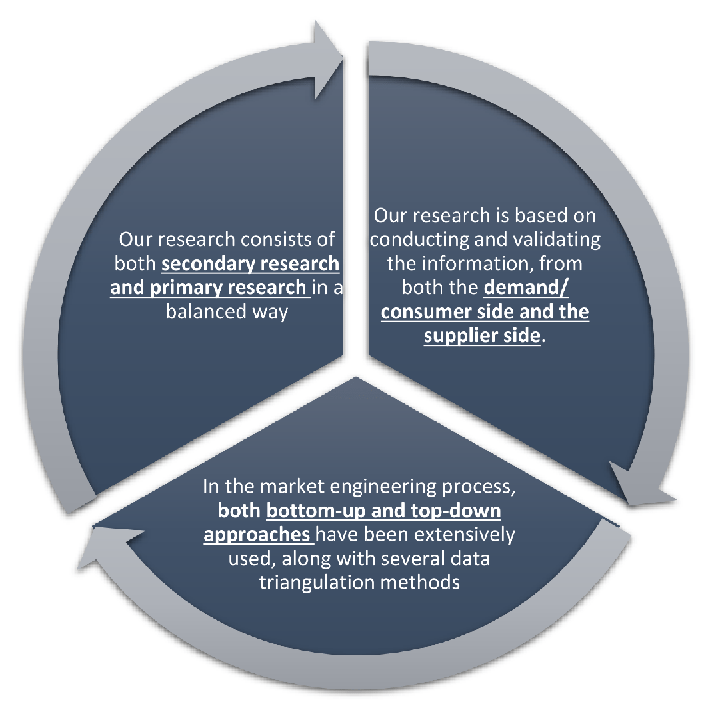
Our research design integrates both demand-side and supply-side analysis through a balanced combination of primary and secondary research methodologies. By utilizing both bottom-up and top-down approaches alongside rigorous data triangulation methods, we deliver robust market intelligence that supports strategic decision-making.
MarketGenics' comprehensive research design framework ensures the delivery of accurate, reliable, and actionable market intelligence. Through the integration of multiple research approaches, rigorous validation processes, and expert analysis, we provide our clients with the insights needed to make informed strategic decisions and capitalize on market opportunities.
MarketGenics leverages a dedicated industry panel of experts and a comprehensive suite of paid databases to effectively collect, consolidate, and analyze market intelligence.
Our approach has consistently proven to be reliable and effective in generating accurate market insights, identifying key industry trends, and uncovering emerging business opportunities.
Through both primary and secondary research, we capture and analyze critical company-level data such as manufacturing footprints, including technical centers, R&D facilities, sales offices, and headquarters.
Our expert panel further enhances our ability to estimate market size for specific brands based on validated field-level intelligence.
Our data mining techniques incorporate both parametric and non-parametric methods, allowing for structured data collection, sorting, processing, and cleaning.
Demand projections are derived from large-scale data sets analyzed through proprietary algorithms, culminating in robust and reliable market sizing.
Research Approach
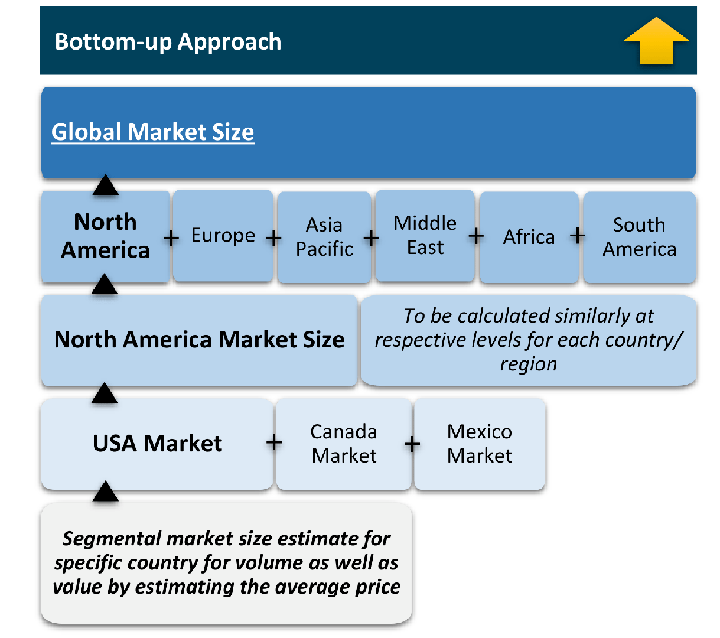
The bottom-up approach builds market estimates by starting with the smallest addressable market units and systematically aggregating them to create comprehensive market size projections.
This method begins with specific, granular data points and builds upward to create the complete market landscape.
Customer Analysis → Segmental Analysis → Geographical Analysis
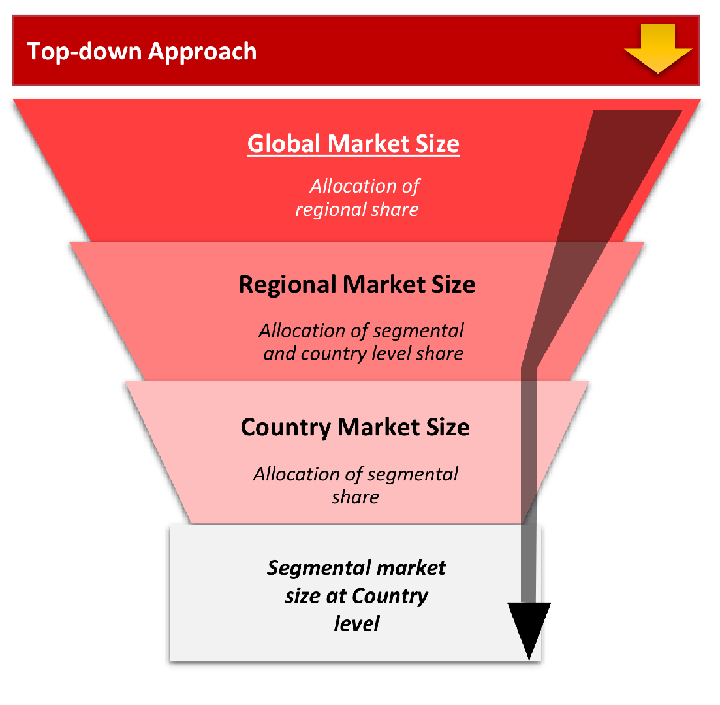
The top-down approach starts with the broadest possible market data and systematically narrows it down through a series of filters and assumptions to arrive at specific market segments or opportunities.
This method begins with the big picture and works downward to increasingly specific market slices.
TAM → SAM → SOM
Research Methods
Desk / Secondary Research
While analysing the market, we extensively study secondary sources, directories, and databases to identify and collect information useful for this technical, market-oriented, and commercial report. Secondary sources that we utilize are not only the public sources, but it is a combination of Open Source, Associations, Paid Databases, MG Repository & Knowledgebase, and others.
- Company websites, annual reports, financial reports, broker reports, and investor presentations
- National government documents, statistical databases and reports
- News articles, press releases and web-casts specific to the companies operating in the market, Magazines, reports, and others
- We gather information from commercial data sources for deriving company specific data such as segmental revenue, share for geography, product revenue, and others
- Internal and external proprietary databases (industry-specific), relevant patent, and regulatory databases
- Governing Bodies, Government Organizations
- Relevant Authorities, Country-specific Associations for Industries
We also employ the model mapping approach to estimate the product level market data through the players' product portfolio
Primary Research
Primary research/ interviews is vital in analyzing the market. Most of the cases involves paid primary interviews. Primary sources include primary interviews through e-mail interactions, telephonic interviews, surveys as well as face-to-face interviews with the different stakeholders across the value chain including several industry experts.
| Type of Respondents | Number of Primaries |
|---|---|
| Tier 2/3 Suppliers | ~20 |
| Tier 1 Suppliers | ~25 |
| End-users | ~25 |
| Industry Expert/ Panel/ Consultant | ~30 |
| Total | ~100 |
MG Knowledgebase
• Repository of industry blog, newsletter and case studies
• Online platform covering detailed market reports, and company profiles
Forecasting Factors and Models
Forecasting Factors
- Historical Trends – Past market patterns, cycles, and major events that shaped how markets behave over time. Understanding past trends helps predict future behavior.
- Industry Factors – Specific characteristics of the industry like structure, regulations, and innovation cycles that affect market dynamics.
- Macroeconomic Factors – Economic conditions like GDP growth, inflation, and employment rates that affect how much money people have to spend.
- Demographic Factors – Population characteristics like age, income, and location that determine who can buy your product.
- Technology Factors – How quickly people adopt new technology and how much technology infrastructure exists.
- Regulatory Factors – Government rules, laws, and policies that can help or restrict market growth.
- Competitive Factors – Analyzing competition structure such as degree of competition and bargaining power of buyers and suppliers.
Forecasting Models / Techniques
Multiple Regression Analysis
- Identify and quantify factors that drive market changes
- Statistical modeling to establish relationships between market drivers and outcomes
Time Series Analysis – Seasonal Patterns
- Understand regular cyclical patterns in market demand
- Advanced statistical techniques to separate trend, seasonal, and irregular components
Time Series Analysis – Trend Analysis
- Identify underlying market growth patterns and momentum
- Statistical analysis of historical data to project future trends
Expert Opinion – Expert Interviews
- Gather deep industry insights and contextual understanding
- In-depth interviews with key industry stakeholders
Multi-Scenario Development
- Prepare for uncertainty by modeling different possible futures
- Creating optimistic, pessimistic, and most likely scenarios
Time Series Analysis – Moving Averages
- Sophisticated forecasting for complex time series data
- Auto-regressive integrated moving average models with seasonal components
Econometric Models
- Apply economic theory to market forecasting
- Sophisticated economic models that account for market interactions
Expert Opinion – Delphi Method
- Harness collective wisdom of industry experts
- Structured, multi-round expert consultation process
Monte Carlo Simulation
- Quantify uncertainty and probability distributions
- Thousands of simulations with varying input parameters
Research Analysis
Our research framework is built upon the fundamental principle of validating market intelligence from both demand and supply perspectives. This dual-sided approach ensures comprehensive market understanding and reduces the risk of single-source bias.
Demand-Side Analysis: We understand end-user/application behavior, preferences, and market needs along with the penetration of the product for specific application.
Supply-Side Analysis: We estimate overall market revenue, analyze the segmental share along with industry capacity, competitive landscape, and market structure.
Validation & Evaluation
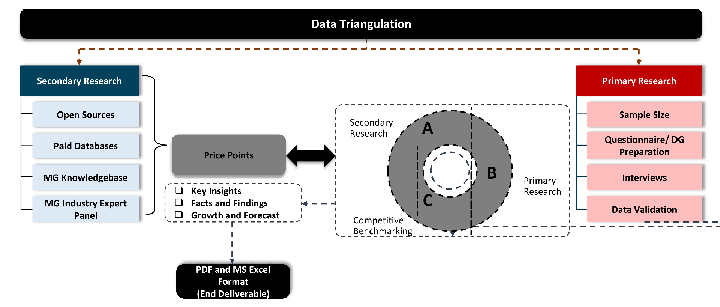
Data triangulation is a validation technique that uses multiple methods, sources, or perspectives to examine the same research question, thereby increasing the credibility and reliability of research findings. In market research, triangulation serves as a quality assurance mechanism that helps identify and minimize bias, validate assumptions, and ensure accuracy in market estimates.
- Data Source Triangulation – Using multiple data sources to examine the same phenomenon
- Methodological Triangulation – Using multiple research methods to study the same research question
- Investigator Triangulation – Using multiple researchers or analysts to examine the same data
- Theoretical Triangulation – Using multiple theoretical perspectives to interpret the same data
Custom Market Research Services
We will customise the research for you, in case the report listed above does not meet your requirements.
Get 10% Free Customisation