Green Chemicals Market Size, Share & Trends Analysis Report by Product Type (Bio-Alcohols, Bio-Organic Acids, Bio-Ketones, Biopolymers, Platform Chemicals, Other Green Chemicals), Feedstock/Source, Chemical Classification, Industry Verticals, and Geography (North America, Europe, Asia Pacific, Middle East, Africa, and South America) – Global Industry Data, Trends, and Forecasts, 2026–2035
Green Chemicals Market Overview:
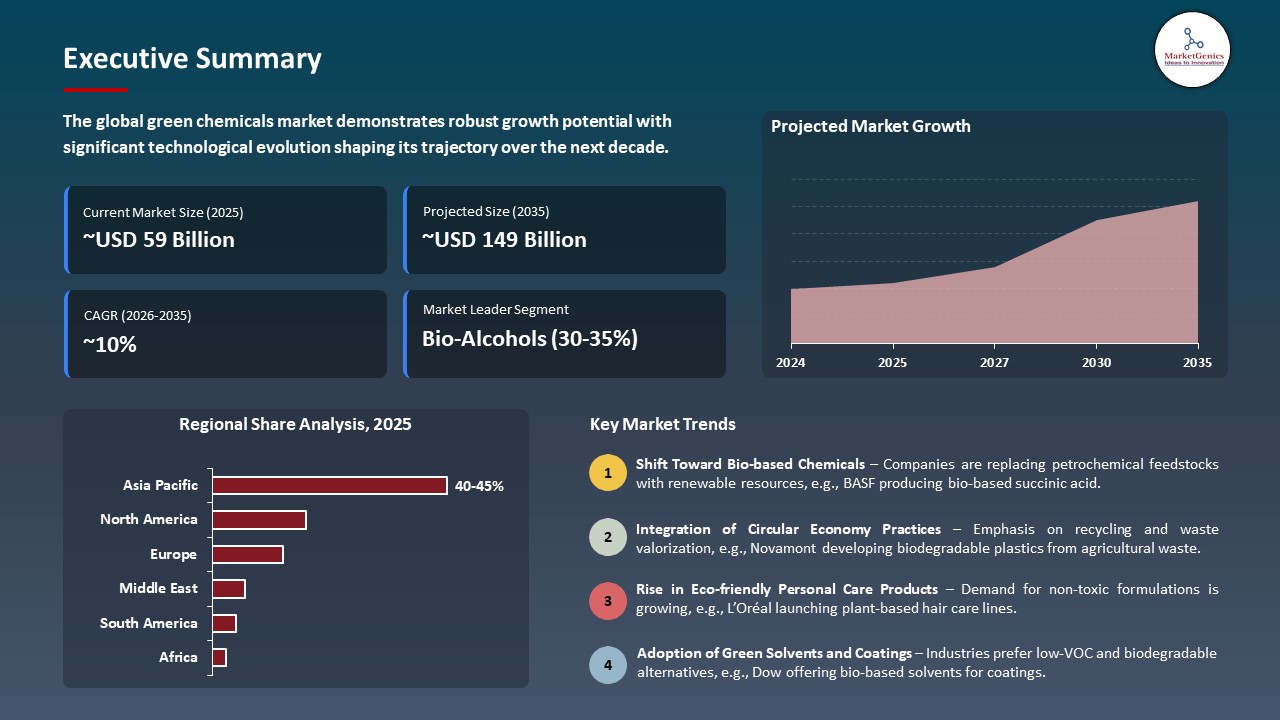
The global green chemicals market is exhibiting strong growth, with an estimated value of USD 59.1 billion in 2025 and USD 149.2 billion by 2035, achieving a CAGR of 9.7%, during the forecast period.
|
|
|
Segmental Data Insights |
|
|
Demand Trends |
|
|
Competitive Landscape |
|
|
Strategic Development |
|
|
Future Outlook & Opportunities |
|
Green-Chemicals-Market Size, Share, and Growth
The global green chemicals market is driven by rising environmental regulations, increasing consumer preference for sustainable products, growing adoption of bio-based and renewable materials, and corporate commitments to reduce carbon footprints across industries.
“We are proud to partner with V.J.T.I. in this bold initiative to push the boundaries of green chemistry and sustainable technologies. At Archroma, sustainability is not just a commitment—it’s at the core of how we innovate and operate,” said Anjani Prasad, VP South Asia, Archroma. “This partnership enables us to combine our global industrial expertise with academic excellence to create scalable, science-driven solutions for the environmental challenges facing our industry and planet.”
The growing strategic alliances and research and development by industry giants is driving the green chemicals market towards greater acceptance of sustainable chemical innovations. For instance, in July 2025, Archroma signed a strategic research agreement with Veermata Jijabai Technological Institute (V.J.T.I.) in Mumbai to jointly develop biofuels, bioplastics, and other new sustainable materials and renewable feedstock, which will add to the contributions of collaborative innovation to the use of green chemistry. The market growth is pushed by strategic partnerships and research and development in the development and uptake of sustainable chemical solutions.
Moreover, the shift toward sustainable products portfolio and global sustainability programs by major chemical producers is driving the green chemicals market. For example, in January 2025, LG Chem joined the Global Impact Coalition (GIC), which underscores its intentions to scale circular and net-zero chemical solutions by cooperating with other global stakeholders regarding sustainability-oriented innovation. The focus on sustainable product portfolios and global initiatives is catalyzing the adoption of green chemicals, as well as strengthening the market expansion.
Key adjacent opportunities for the global green chemicals market include expansion into bio-based polymers, renewable surfactants, green solvents, biodegradable packaging materials, and sustainable specialty chemicals for personal care and industrial applications. These industries aid manufacturers to spread the offerings, comply with regulatory sustainability levels and access emerging consumer markets of eco-friendly products. These adjacent opportunities include market application expansion, innovation and long-term development of sustainable chemical solutions.
Green Chemicals Market Dynamics and Trends
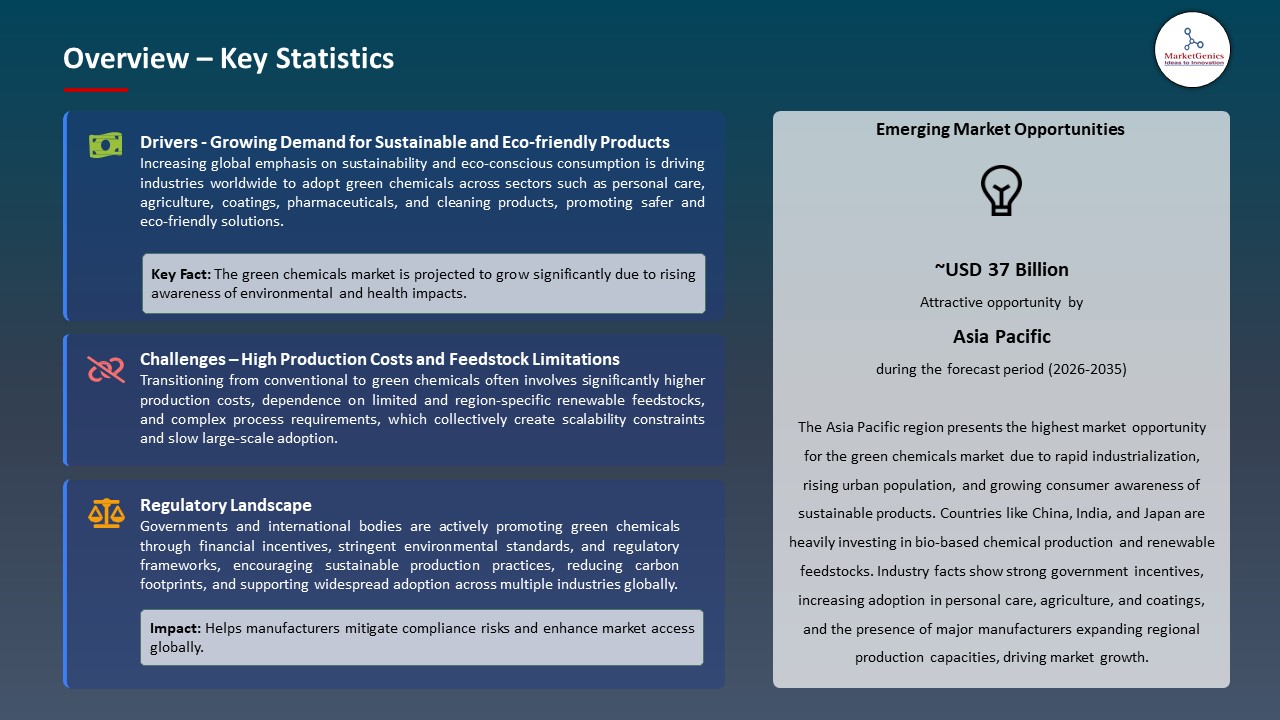
Driver: Expansion of Renewable Electricity and Biomass Balance Production in Green Chemical Portfolios
-
The strategic use of renewable electricity and biomass balance (BMB) production strategies by major chemical producers are driving the green chemicals market to make companies more sustainable in product portfolios and aid the larger decarbonization agenda.
- For instance, in April 2025, BASF has added to its EcoBalanced product range in North America, with EcoBalanced grades of personal care ingredients, such as Dehyton PK 45 and Dehyton KE UP, in which fossil-based raw materials are substituted by certified renewable feedstocks on a mass balance basis to reduce cradle-to-gate carbon emissions by a significant margin.
- Meanwhile, BASF is operating 6 U.S. Care Chemicals locations fully on renewable electricity that removes Scope 2 emissions and makes biomass and renewable energy objectives part and parcel of operations, achieving sustainability goals and enhancing competitiveness in the market.
- This driver is increasing the uptake of renewable feedstocks and eco-optimized chemicals which contributes to the strengthening market growth and environmental performance.
Restraint: Supply Chain Instability for Sustainable Feedstocks Increasing Production Complexity
-
The unstable supply chain for sustainable feedstocks is a major barrier to the green chemicals market, making production more difficult and limiting expansion. Agricultural outputs, and developing processing infrastructure can frequently be susceptible to seasonal variations, logistic bottlenecks, and fluctuating prices, and bios based and renewable feeds including plant oils, fermentation-derived intermediates, and biomass are often vulnerable to these issues.
- The lack of renewable feedstocks of high quality can slow the scale-up of green chemicals and increase costs compared to fossil-based alternatives. The stability of supply must be ensured with the help of good partnerships, volume contracts, as well as diversification of regions. New renewable supply chains generate timing and pricing catastrophes creating sluggish cost parity and postponing wider market uptake.
- Feedstock supply instability increases production complexity and cost risk, constraining near-term market expansion.
Opportunity: Deployment of Next‑Generation Renewable and Bio‑Sensor Enabled Green Solutions
-
The implementation of next-generation renewable solutions that combine sustainable chemistry with digital or sensor-enabled features represents a substantial opportunity in the green chemicals market. The features of these high-technology products, including smart biodegradable ingredients with monitoring performance and lifecycle data, are a value-added solution to the chemical products that just offer a combination of sustainability knowledge with operational intelligence.
- For instance, in April 2025, BASF introduced biodegradable and natural-based cosmetic polymers and ingredients, such as Verdessence Maize, and other plant-based polymers presented in formulations, all of which provide sustainable benefits without impacting the efficacy. These innovations are based on increasing consumer demand, in terms of transparency, renewable content, and biodegradability, to higher-value personal care, home care and specialty segments.
- By providing the formulations that combine the sustainability credentials with the performance, the chemical manufacturers will be able to value the premium prices, build brand affiliations, and increase penetration to the end-use markets.
- This opportunity increases product differentiation and promotes the growth in related sustainable markets, which in turn facilitates the increase in revenue in the long term.
Key Trend: Integration of Circular Value Chains and Responsible Sourcing in Chemical Manufacturing
-
The adoption of mixed strategies of both circular value chain and responsible sourcing in the global green chemicals markets has become a major trend in both manufacturing and supply processes. Most of the major companies are not only considering sustainability as part of developing renewable products but also as part of their sourcing, production, and customer interaction to guarantee traceable, ethically sourced ingredients with lower environmental impact.
- For example, BASF’s Care Chemicals division published its 2024 Responsible Sourcing Report, highlighting progress in sustainable supply chains through partnerships with renewable feedstock producers and improvements in environmental, economic, and social outcomes. This reflects a broader shift toward holistic sustainability frameworks addressing biodiversity, community impact, and transparency. The use of circularity, recycled materials, renewable materials, and standard sustainability measures is now necessary to satisfy regulations, consumer confidence, and competitive edge.
- The trend maximizes supply chain transparency and circularity, which will promote market acceptance and resiliency in the long run.
Green Chemicals Market Analysis and Segmental Data
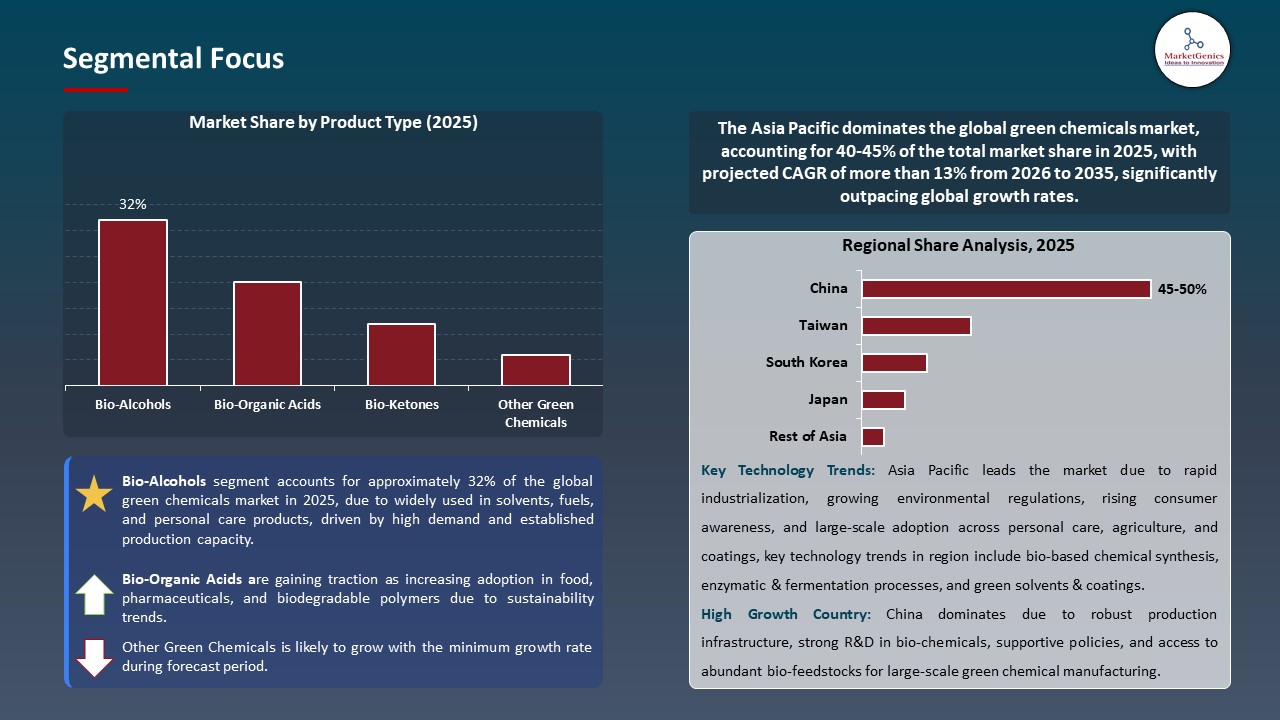
Bio-Alcohols Dominate Global Green Chemicals Market
-
The bio-alcohols segment dominates the global green chemicals market driven by their widespread use as renewable fuels, industrial solvents, and chemical intermediates. Established fermentation and production infrastructure ensures predictable performance and sustainability benefits, reinforcing their market dominance.
- Ethanol and methanol derived from plant-based feedstocks are central to this dominance, offering versatile applications across fuel blending, coatings, cleaners, and petrochemical feedstock replacements, while reducing environmental impact.
- For example, in December 16, 2024, Godavari Biorefineries Limited announced an investment of ~₹130 crore to expand ethanol production with a new corn/grain‑based distillery, enhancing sustainable bio‑alcohol supply to meet growing energy and green chemical demand.
- This expansion strengthens the bio‑alcohol supply chain, supporting sustainable energy initiatives and reinforcing the segment’s leadership in the global green chemicals market.
Asia Pacific Leads Global Green Chemicals Market Demand
- Asia Pacific leads the green chemicals market, because of supportive regulatory frameworks and sustainable industry plans in Asia Pacific, especially China’s aggressive bio economy initiatives and preferential green chemical policies, have bolstered demand for renewable and biodegradable chemicals, making the region a manufacturing and consumption hub.
- Additionally, leading companies are scaling sustainable production within the region to address rising local demand. For instance, in November 2025, BASF increased Alkyl Polyglucosides (APGs) production capacity at its Bangpakong, Thailand facility, addressing the rising regional demand for biodegradable surfactants in personal and industrial care applications.
- This expansion reinforces Asia Pacific’s position as a key hub for sustainable chemical production, driving market growth and supporting the regional transition toward eco‑friendly and circular chemical solutions.
Green Chemicals Market Ecosystem
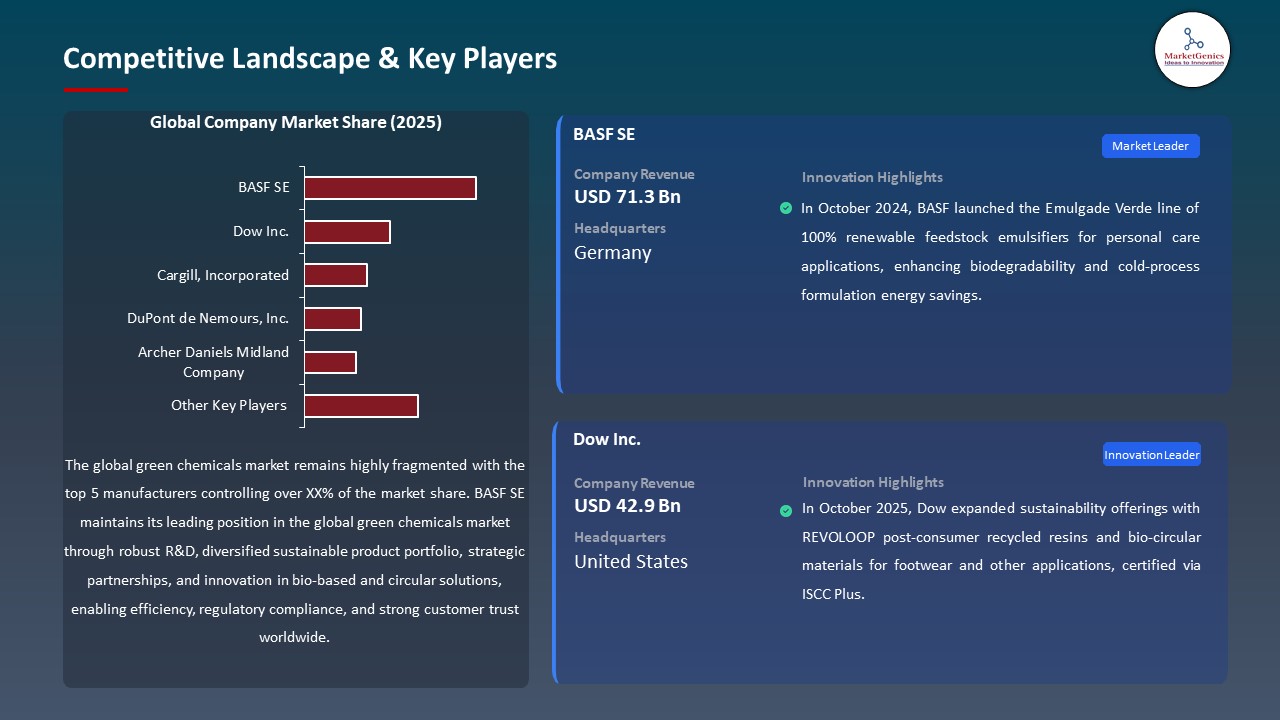
The global green chemicals market is highly fragmented, with leading firms such as BASF SE, Dow Inc., Cargill, Incorporated, DuPont de Nemours, Inc., and Archer Daniels Midland Company dominating through advanced sustainable technologies, renewable feedstocks, and circular chemistry solutions that set industry standards.
These key players emphasize specialized innovations from biomass‑balanced surfactants and bio‑based polymers to renewable intermediates and enzymatic catalysis that drive focused development and differentiation in niche segments like personal care, packaging, and performance materials.
In alignment with evolving market demands and sustainability commitments, key players are actively pursuing product diversification, portfolio expansion, and integrated solutions to enhance operational efficiency, environmental performance, and value creation, leveraging digitalization and process optimization to strengthen competitiveness.
A notable recent development includes Dow’s July 2024 collaboration with New Energy Blue to implement advanced biorefinery technology, converting agricultural residues into bio-based ethylene and propylene. This initiative, targeting commercialization by 2026, aims to reduce dependence on fossil feedstocks and improve sustainable production metrics.
These strategic initiatives underscore the green chemicals market’s robust growth trajectory, driven by regulatory support, R&D investment, and cross-sector collaborations that accelerate the adoption of eco-efficient chemical technologies.
 Recent Development and Strategic Overview:
- In August 2025, ADM established a strategic partnership to develop a demonstration facility at its Decatur site, converting biogenic CO₂ into sustainable formates for industrial and consumer chemical applications, supporting the advancement of bio-based chemical production.
- In April 2025, BASF broadened its EcoBalanced portfolio with the launch of renewable biomass‑balanced surfactants, Dehyton PK 45 and Dehyton KE UP, enhancing sustainability in personal care formulations and lowering cradle‑to‑gate carbon emissions for customers.
Report Scope
|
Detail |
|
|
Market Size in 2025 |
USD 59.1 Bn |
|
Market Forecast Value in 2035 |
USD 149.2 Bn |
|
Growth Rate (CAGR) |
9.7% |
|
Forecast Period |
2026 – 2035 |
|
Historical Data Available for |
2021 – 2024 |
|
Market Size Units |
US$ Billion for Value Tons for Volume |
|
Report Format |
Electronic (PDF) + Excel |
|
North America |
Europe |
Asia Pacific |
Middle East |
Africa |
South America |
|
|
|
|
|
|
|
Companies Covered |
|||||
|
|
|
|
|
|
Green Chemicals Market Segmentation and Highlights
|
Segment |
Sub-segment |
|
Green Chemicals Market, By Product Type |
|
|
Green Chemicals Market, By Feedstock/Source |
|
|
Green Chemicals Market, By Chemical Classification |
|
|
Green Chemicals Market, By Industry Verticals |
|
Frequently Asked Questions
Table of Contents
- 1. Research Methodology and Assumptions
- 1.1. Definitions
- 1.2. Research Design and Approach
- 1.3. Data Collection Methods
- 1.4. Base Estimates and Calculations
- 1.5. Forecasting Models
- 1.5.1. Key Forecast Factors & Impact Analysis
- 1.6. Secondary Research
- 1.6.1. Open Sources
- 1.6.2. Paid Databases
- 1.6.3. Associations
- 1.7. Primary Research
- 1.7.1. Primary Sources
- 1.7.2. Primary Interviews with Stakeholders across Ecosystem
- 2. Executive Summary
- 2.1. Global Green Chemicals Market Outlook
- 2.1.1. Green Chemicals Market Size (Volume - Tons and Value - US$ Bn), and Forecasts, 2021-2035
- 2.1.2. Compounded Annual Growth Rate Analysis
- 2.1.3. Growth Opportunity Analysis
- 2.1.4. Segmental Share Analysis
- 2.1.5. Geographical Share Analysis
- 2.2. Market Analysis and Facts
- 2.3. Supply-Demand Analysis
- 2.4. Competitive Benchmarking
- 2.5. Go-to- Market Strategy
- 2.5.1. Customer/ End-use Industry Assessment
- 2.5.2. Growth Opportunity Data, 2026-2035
- 2.5.2.1. Regional Data
- 2.5.2.2. Country Data
- 2.5.2.3. Segmental Data
- 2.5.3. Identification of Potential Market Spaces
- 2.5.4. GAP Analysis
- 2.5.5. Potential Attractive Price Points
- 2.5.6. Prevailing Market Risks & Challenges
- 2.5.7. Preferred Sales & Marketing Strategies
- 2.5.8. Key Recommendations and Analysis
- 2.5.9. A Way Forward
- 2.1. Global Green Chemicals Market Outlook
- 3. Industry Data and Premium Insights
- 3.1. Global Chemicals & Materials Industry Overview, 2025
- 3.1.1. Chemicals & Materials Ecosystem Analysis
- 3.1.2. Key Trends for Chemicals & Materials Industry
- 3.1.3. Regional Distribution for Chemicals & Materials Industry
- 3.2. Supplier Customer Data
- 3.3. Technology Roadmap and Developments
- 3.4. Trade Analysis
- 3.4.1. Import & Export Analysis, 2025
- 3.4.2. Top Importing Countries
- 3.4.3. Top Exporting Countries
- 3.5. Trump Tariff Impact Analysis
- 3.5.1. Manufacturer
- 3.5.1.1. Based on the component & Raw material
- 3.5.2. Supply Chain
- 3.5.3. End Consumer
- 3.5.1. Manufacturer
- 3.6. Raw Material Analysis
- 3.1. Global Chemicals & Materials Industry Overview, 2025
- 4. Market Overview
- 4.1. Market Dynamics
- 4.1.1. Drivers
- 4.1.1.1. Rising demand for sustainable and eco-friendly products across industries
- 4.1.1.2. Government incentives and regulations promoting low-carbon and biodegradable chemicals
- 4.1.1.3. Growing consumer awareness and preference for green and non-toxic products
- 4.1.2. Restraints
- 4.1.2.1. High production costs compared to conventional chemicals
- 4.1.2.2. Limited availability of bio-based raw materials
- 4.1.1. Drivers
- 4.2. Key Trend Analysis
- 4.3. Regulatory Framework
- 4.3.1. Key Regulations, Norms, and Subsidies, by Key Countries
- 4.3.2. Tariffs and Standards
- 4.3.3. Impact Analysis of Regulations on the Market
- 4.4. Value Chain Analysis
- 4.4.1. Raw Material Suppliers
- 4.4.2. Manufacturers
- 4.4.3. Distributors/ Dealers
- 4.4.4. End-users/ Customers
- 4.5. Cost Structure Analysis
- 4.5.1. Parameter’s Share for Cost Associated
- 4.5.2. COGP vs COGS
- 4.5.3. Profit Margin Analysis
- 4.6. Pricing Analysis
- 4.6.1. Regional Pricing Analysis
- 4.6.2. Segmental Pricing Trends
- 4.6.3. Factors Influencing Pricing
- 4.7. Porter’s Five Forces Analysis
- 4.8. PESTEL Analysis
- 4.9. Global Green Chemicals Market Demand
- 4.9.1. Historical Market Size – in Volume (Tons) and Value (US$ Bn), 2020-2024
- 4.9.2. Current and Future Market Size – in Volume (Tons) and Value (US$ Bn), 2026–2035
- 4.9.2.1. Y-o-Y Growth Trends
- 4.9.2.2. Absolute $ Opportunity Assessment
- 4.1. Market Dynamics
- 5. Competition Landscape
- 5.1. Competition structure
- 5.1.1. Fragmented v/s consolidated
- 5.2. Company Share Analysis, 2025
- 5.2.1. Global Company Market Share
- 5.2.2. By Region
- 5.2.2.1. North America
- 5.2.2.2. Europe
- 5.2.2.3. Asia Pacific
- 5.2.2.4. Middle East
- 5.2.2.5. Africa
- 5.2.2.6. South America
- 5.3. Product Comparison Matrix
- 5.3.1. Specifications
- 5.3.2. Market Positioning
- 5.3.3. Pricing
- 5.1. Competition structure
- 6. Global Green Chemicals Market Analysis, by Product Type
- 6.1. Key Segment Analysis
- 6.2. Green Chemicals Market Size (Volume - Tons and Value - US$ Bn), Analysis, and Forecasts, by Product Type, 2021-2035
- 6.2.1. Bio-Alcohols
- 6.2.1.1. Bio-Ethanol
- 6.2.1.2. Bio-Butanol
- 6.2.1.3. Bio-Methanol
- 6.2.1.4. Other Bio-Alcohols
- 6.2.2. Bio-Organic Acids
- 6.2.2.1. Bio-Lactic Acid
- 6.2.2.2. Bio-Acetic Acid
- 6.2.2.3. Bio-Citric Acid
- 6.2.2.4. Bio-Adipic Acid
- 6.2.2.5. Bio-Acrylic Acid
- 6.2.2.6. Bio-Succinic Acid
- 6.2.2.7. Other Bio-Organic Acids
- 6.2.3. Bio-Ketones
- 6.2.4. Biopolymers
- 6.2.4.1. Polylactic Acid (PLA)
- 6.2.4.2. Bio-Polyethylene
- 6.2.4.3. Other Bio-Polymers
- 6.2.5. Platform Chemicals
- 6.2.6. Other Green Chemicals
- 6.2.1. Bio-Alcohols
- 7. Global Green Chemicals Market Analysis, by Feedstock/Source
- 7.1. Key Segment Analysis
- 7.2. Green Chemicals Market Size (Volume - Tons and Value - US$ Bn), Analysis, and Forecasts, by Feedstock/Source, 2021-2035
- 7.2.1. Plant-Based
- 7.2.2. Animal-Based
- 7.2.3. Microorganisms
- 7.2.4. Waste and Byproducts
- 8. Global Green Chemicals Market Analysis, by Chemical Classification
- 8.1. Key Segment Analysis
- 8.2. Green Chemicals Market Size (Volume - Tons and Value - US$ Bn), Analysis, and Forecasts, by Chemical Classification, 2021-2035
- 8.2.1. Bio-based Chemicals
- 8.2.2. Green Solvents
- 8.2.2.1. Water-based Solvents
- 8.2.2.2. Biodegradable Solvents
- 8.2.2.3. Natural Solvents
- 8.2.2.4. Supercritical CO2 Solvents
- 8.2.2.5. Ionic Liquids
- 8.2.2.6. Others
- 8.2.3. Green Surfactants
- 8.2.3.1. Anionic Surfactants
- 8.2.3.2. Cationic Surfactants
- 8.2.3.3. Non-ionic Surfactants
- 8.2.3.4. Amphoteric Surfactants
- 8.2.3.5. Natural Surfactants
- 8.2.3.6. Others
- 8.2.4. Green Adhesives
- 8.2.4.1. Bio-based Adhesives
- 8.2.4.2. Water-based Adhesives
- 8.2.4.3. Hot Melt Adhesives
- 8.2.4.4. Pressure-sensitive Adhesives
- 8.2.4.5. Structural Adhesives
- 8.2.4.6. Others
- 8.2.5. Green Coatings
- 8.2.5.1. Waterborne Coatings
- 8.2.5.2. Powder Coatings
- 8.2.5.3. UV-cured Coatings
- 8.2.5.4. Natural Resin-based Coatings
- 8.2.5.5. Bio-based Paints
- 8.2.5.6. Others
- 9. Global Green Chemicals Market Analysis, by Industry Verticals
- 9.1. Key Segment Analysis
- 9.2. Green Chemicals Market Size (Volume - Tons and Value - US$ Bn), Analysis, and Forecasts, by Industry Verticals, 2021-2035
- 9.2.1. Packaging and Plastics
- 9.2.2. Food and Beverages
- 9.2.3. Pharmaceuticals
- 9.2.4. Automotive and Transportation
- 9.2.5. Paints and Coatings
- 9.2.6. Building and Construction
- 9.2.7. Textiles and Apparel
- 9.2.8. Electronics and Consumer Goods
- 9.2.9. Personal Care and Cosmetics
- 9.2.10. Industrial and Chemicals
- 9.2.11. Agriculture
- 9.2.12. Others
- 10. Global Green Chemicals Market Analysis, by Region
- 10.1. Key Findings
- 10.2. Green Chemicals Market Size (Volume - Tons and Value - US$ Bn), Analysis, and Forecasts, by Region, 2021-2035
- 10.2.1. North America
- 10.2.2. Europe
- 10.2.3. Asia Pacific
- 10.2.4. Middle East
- 10.2.5. Africa
- 10.2.6. South America
- 11. North America Green Chemicals Market Analysis
- 11.1. Key Segment Analysis
- 11.2. Regional Snapshot
- 11.3. North America Green Chemicals Market Size (Volume - Tons and Value - US$ Bn), Analysis, and Forecasts, 2021-2035
- 11.3.1. Product Type
- 11.3.2. Feedstock/Source
- 11.3.3. Chemical Classification
- 11.3.4. Industry Verticals
- 11.3.5. Country
- 11.3.5.1. USA
- 11.3.5.2. Canada
- 11.3.5.3. Mexico
- 11.4. USA Green Chemicals Market
- 11.4.1. Country Segmental Analysis
- 11.4.2. Product Type
- 11.4.3. Feedstock/Source
- 11.4.4. Chemical Classification
- 11.4.5. Industry Verticals
- 11.5. Canada Green Chemicals Market
- 11.5.1. Country Segmental Analysis
- 11.5.2. Product Type
- 11.5.3. Feedstock/Source
- 11.5.4. Chemical Classification
- 11.5.5. Industry Verticals
- 11.6. Mexico Green Chemicals Market
- 11.6.1. Country Segmental Analysis
- 11.6.2. Product Type
- 11.6.3. Feedstock/Source
- 11.6.4. Chemical Classification
- 11.6.5. Industry Verticals
- 12. Europe Green Chemicals Market Analysis
- 12.1. Key Segment Analysis
- 12.2. Regional Snapshot
- 12.3. Europe Green Chemicals Market Size (Volume - Tons and Value - US$ Bn), Analysis, and Forecasts, 2021-2035
- 12.3.1. Product Type
- 12.3.2. Feedstock/Source
- 12.3.3. Chemical Classification
- 12.3.4. Industry Verticals
- 12.3.5. Country
- 12.3.5.1. Germany
- 12.3.5.2. United Kingdom
- 12.3.5.3. France
- 12.3.5.4. Italy
- 12.3.5.5. Spain
- 12.3.5.6. Netherlands
- 12.3.5.7. Nordic Countries
- 12.3.5.8. Poland
- 12.3.5.9. Russia & CIS
- 12.3.5.10. Rest of Europe
- 12.4. Germany Green Chemicals Market
- 12.4.1. Country Segmental Analysis
- 12.4.2. Product Type
- 12.4.3. Feedstock/Source
- 12.4.4. Chemical Classification
- 12.4.5. Industry Verticals
- 12.5. United Kingdom Green Chemicals Market
- 12.5.1. Country Segmental Analysis
- 12.5.2. Product Type
- 12.5.3. Feedstock/Source
- 12.5.4. Chemical Classification
- 12.5.5. Industry Verticals
- 12.6. France Green Chemicals Market
- 12.6.1. Country Segmental Analysis
- 12.6.2. Product Type
- 12.6.3. Feedstock/Source
- 12.6.4. Chemical Classification
- 12.6.5. Industry Verticals
- 12.7. Italy Green Chemicals Market
- 12.7.1. Country Segmental Analysis
- 12.7.2. Product Type
- 12.7.3. Feedstock/Source
- 12.7.4. Chemical Classification
- 12.7.5. Industry Verticals
- 12.8. Spain Green Chemicals Market
- 12.8.1. Country Segmental Analysis
- 12.8.2. Product Type
- 12.8.3. Feedstock/Source
- 12.8.4. Chemical Classification
- 12.8.5. Industry Verticals
- 12.9. Netherlands Green Chemicals Market
- 12.9.1. Country Segmental Analysis
- 12.9.2. Product Type
- 12.9.3. Feedstock/Source
- 12.9.4. Chemical Classification
- 12.9.5. Industry Verticals
- 12.10. Nordic Countries Green Chemicals Market
- 12.10.1. Country Segmental Analysis
- 12.10.2. Product Type
- 12.10.3. Feedstock/Source
- 12.10.4. Chemical Classification
- 12.10.5. Industry Verticals
- 12.11. Poland Green Chemicals Market
- 12.11.1. Country Segmental Analysis
- 12.11.2. Product Type
- 12.11.3. Feedstock/Source
- 12.11.4. Chemical Classification
- 12.11.5. Industry Verticals
- 12.12. Russia & CIS Green Chemicals Market
- 12.12.1. Country Segmental Analysis
- 12.12.2. Product Type
- 12.12.3. Feedstock/Source
- 12.12.4. Chemical Classification
- 12.12.5. Industry Verticals
- 12.13. Rest of Europe Green Chemicals Market
- 12.13.1. Country Segmental Analysis
- 12.13.2. Product Type
- 12.13.3. Feedstock/Source
- 12.13.4. Chemical Classification
- 12.13.5. Industry Verticals
- 13. Asia Pacific Green Chemicals Market Analysis
- 13.1. Key Segment Analysis
- 13.2. Regional Snapshot
- 13.3. Asia Pacific Green Chemicals Market Size (Volume - Tons and Value - US$ Bn), Analysis, and Forecasts, 2021-2035
- 13.3.1. Product Type
- 13.3.2. Feedstock/Source
- 13.3.3. Chemical Classification
- 13.3.4. Industry Verticals
- 13.3.5. Country
- 13.3.5.1. China
- 13.3.5.2. India
- 13.3.5.3. Japan
- 13.3.5.4. South Korea
- 13.3.5.5. Australia and New Zealand
- 13.3.5.6. Indonesia
- 13.3.5.7. Malaysia
- 13.3.5.8. Thailand
- 13.3.5.9. Vietnam
- 13.3.5.10. Rest of Asia Pacific
- 13.4. China Green Chemicals Market
- 13.4.1. Country Segmental Analysis
- 13.4.2. Product Type
- 13.4.3. Feedstock/Source
- 13.4.4. Chemical Classification
- 13.4.5. Industry Verticals
- 13.5. India Green Chemicals Market
- 13.5.1. Country Segmental Analysis
- 13.5.2. Product Type
- 13.5.3. Feedstock/Source
- 13.5.4. Chemical Classification
- 13.5.5. Industry Verticals
- 13.6. Japan Green Chemicals Market
- 13.6.1. Country Segmental Analysis
- 13.6.2. Product Type
- 13.6.3. Feedstock/Source
- 13.6.4. Chemical Classification
- 13.6.5. Industry Verticals
- 13.7. South Korea Green Chemicals Market
- 13.7.1. Country Segmental Analysis
- 13.7.2. Product Type
- 13.7.3. Feedstock/Source
- 13.7.4. Chemical Classification
- 13.7.5. Industry Verticals
- 13.8. Australia and New Zealand Green Chemicals Market
- 13.8.1. Country Segmental Analysis
- 13.8.2. Product Type
- 13.8.3. Feedstock/Source
- 13.8.4. Chemical Classification
- 13.8.5. Industry Verticals
- 13.9. Indonesia Green Chemicals Market
- 13.9.1. Country Segmental Analysis
- 13.9.2. Product Type
- 13.9.3. Feedstock/Source
- 13.9.4. Chemical Classification
- 13.9.5. Industry Verticals
- 13.10. Malaysia Green Chemicals Market
- 13.10.1. Country Segmental Analysis
- 13.10.2. Product Type
- 13.10.3. Feedstock/Source
- 13.10.4. Chemical Classification
- 13.10.5. Industry Verticals
- 13.11. Thailand Green Chemicals Market
- 13.11.1. Country Segmental Analysis
- 13.11.2. Product Type
- 13.11.3. Feedstock/Source
- 13.11.4. Chemical Classification
- 13.11.5. Industry Verticals
- 13.12. Vietnam Green Chemicals Market
- 13.12.1. Country Segmental Analysis
- 13.12.2. Product Type
- 13.12.3. Feedstock/Source
- 13.12.4. Chemical Classification
- 13.12.5. Industry Verticals
- 13.13. Rest of Asia Pacific Green Chemicals Market
- 13.13.1. Country Segmental Analysis
- 13.13.2. Product Type
- 13.13.3. Feedstock/Source
- 13.13.4. Chemical Classification
- 13.13.5. Industry Verticals
- 14. Middle East Green Chemicals Market Analysis
- 14.1. Key Segment Analysis
- 14.2. Regional Snapshot
- 14.3. Middle East Green Chemicals Market Size (Volume - Tons and Value - US$ Bn), Analysis, and Forecasts, 2021-2035
- 14.3.1. Product Type
- 14.3.2. Feedstock/Source
- 14.3.3. Chemical Classification
- 14.3.4. Industry Verticals
- 14.3.5. Country
- 14.3.5.1. Turkey
- 14.3.5.2. UAE
- 14.3.5.3. Saudi Arabia
- 14.3.5.4. Israel
- 14.3.5.5. Rest of Middle East
- 14.4. Turkey Green Chemicals Market
- 14.4.1. Country Segmental Analysis
- 14.4.2. Product Type
- 14.4.3. Feedstock/Source
- 14.4.4. Chemical Classification
- 14.4.5. Industry Verticals
- 14.5. UAE Green Chemicals Market
- 14.5.1. Country Segmental Analysis
- 14.5.2. Product Type
- 14.5.3. Feedstock/Source
- 14.5.4. Chemical Classification
- 14.5.5. Industry Verticals
- 14.6. Saudi Arabia Green Chemicals Market
- 14.6.1. Country Segmental Analysis
- 14.6.2. Product Type
- 14.6.3. Feedstock/Source
- 14.6.4. Chemical Classification
- 14.6.5. Industry Verticals
- 14.7. Israel Green Chemicals Market
- 14.7.1. Country Segmental Analysis
- 14.7.2. Product Type
- 14.7.3. Feedstock/Source
- 14.7.4. Chemical Classification
- 14.7.5. Industry Verticals
- 14.8. Rest of Middle East Green Chemicals Market
- 14.8.1. Country Segmental Analysis
- 14.8.2. Product Type
- 14.8.3. Feedstock/Source
- 14.8.4. Chemical Classification
- 14.8.5. Industry Verticals
- 15. Africa Green Chemicals Market Analysis
- 15.1. Key Segment Analysis
- 15.2. Regional Snapshot
- 15.3. Africa Green Chemicals Market Size (Volume - Tons and Value - US$ Bn), Analysis, and Forecasts, 2021-2035
- 15.3.1. Product Type
- 15.3.2. Feedstock/Source
- 15.3.3. Chemical Classification
- 15.3.4. Industry Verticals
- 15.3.5. Country
- 15.3.5.1. South Africa
- 15.3.5.2. Egypt
- 15.3.5.3. Nigeria
- 15.3.5.4. Algeria
- 15.3.5.5. Rest of Africa
- 15.4. South Africa Green Chemicals Market
- 15.4.1. Country Segmental Analysis
- 15.4.2. Product Type
- 15.4.3. Feedstock/Source
- 15.4.4. Chemical Classification
- 15.4.5. Industry Verticals
- 15.5. Egypt Green Chemicals Market
- 15.5.1. Country Segmental Analysis
- 15.5.2. Product Type
- 15.5.3. Feedstock/Source
- 15.5.4. Chemical Classification
- 15.5.5. Industry Verticals
- 15.6. Nigeria Green Chemicals Market
- 15.6.1. Country Segmental Analysis
- 15.6.2. Product Type
- 15.6.3. Feedstock/Source
- 15.6.4. Chemical Classification
- 15.6.5. Industry Verticals
- 15.7. Algeria Green Chemicals Market
- 15.7.1. Country Segmental Analysis
- 15.7.2. Product Type
- 15.7.3. Feedstock/Source
- 15.7.4. Chemical Classification
- 15.7.5. Industry Verticals
- 15.8. Rest of Africa Green Chemicals Market
- 15.8.1. Country Segmental Analysis
- 15.8.2. Product Type
- 15.8.3. Feedstock/Source
- 15.8.4. Chemical Classification
- 15.8.5. Industry Verticals
- 16. South America Green Chemicals Market Analysis
- 16.1. Key Segment Analysis
- 16.2. Regional Snapshot
- 16.3. South America Green Chemicals Market Size (Volume - Tons and Value - US$ Bn), Analysis, and Forecasts, 2021-2035
- 16.3.1. Product Type
- 16.3.2. Feedstock/Source
- 16.3.3. Chemical Classification
- 16.3.4. Industry Verticals
- 16.3.5. Country
- 16.3.5.1. Brazil
- 16.3.5.2. Argentina
- 16.3.5.3. Rest of South America
- 16.4. Brazil Green Chemicals Market
- 16.4.1. Country Segmental Analysis
- 16.4.2. Product Type
- 16.4.3. Feedstock/Source
- 16.4.4. Chemical Classification
- 16.4.5. Industry Verticals
- 16.5. Argentina Green Chemicals Market
- 16.5.1. Country Segmental Analysis
- 16.5.2. Product Type
- 16.5.3. Feedstock/Source
- 16.5.4. Chemical Classification
- 16.5.5. Industry Verticals
- 16.6. Rest of South America Green Chemicals Market
- 16.6.1. Country Segmental Analysis
- 16.6.2. Product Type
- 16.6.3. Feedstock/Source
- 16.6.4. Chemical Classification
- 16.6.5. Industry Verticals
- 17. Key Players/ Company Profile
- 17.1. BASF SE
- 17.1.1. Company Details/ Overview
- 17.1.2. Company Financials
- 17.1.3. Key Customers and Competitors
- 17.1.4. Business/ Industry Portfolio
- 17.1.5. Product Portfolio/ Specification Details
- 17.1.6. Pricing Data
- 17.1.7. Strategic Overview
- 17.1.8. Recent Developments
- 17.2. AkzoNobel N.V.
- 17.3. Archer Daniels Midland Company
- 17.4. Bayer AG
- 17.5. Cargill, Incorporated
- 17.6. Clariant AG
- 17.7. Corbion N.V.
- 17.8. Croda International PLC
- 17.9. Dow Inc.
- 17.10. DuPont de Nemours, Inc.
- 17.11. Evonik Industries AG
- 17.12. Henkel AG & Co. KGaA
- 17.13. Huntsman Corporation
- 17.14. Ineos Group Holdings S.A.
- 17.15. Koninklijke DSM N.V.
- 17.16. LyondellBasell Industries N.V.
- 17.17. Mitsubishi Chemical Group Corporation
- 17.18. NatureWorks LLC
- 17.19. Novozymes A/S
- 17.20. Solvay S.A.
- 17.21. Stepan Company
- 17.22. Other Key Players
- 17.1. BASF SE
Note* - This is just tentative list of players. While providing the report, we will cover more number of players based on their revenue and share for each geography
Research Design
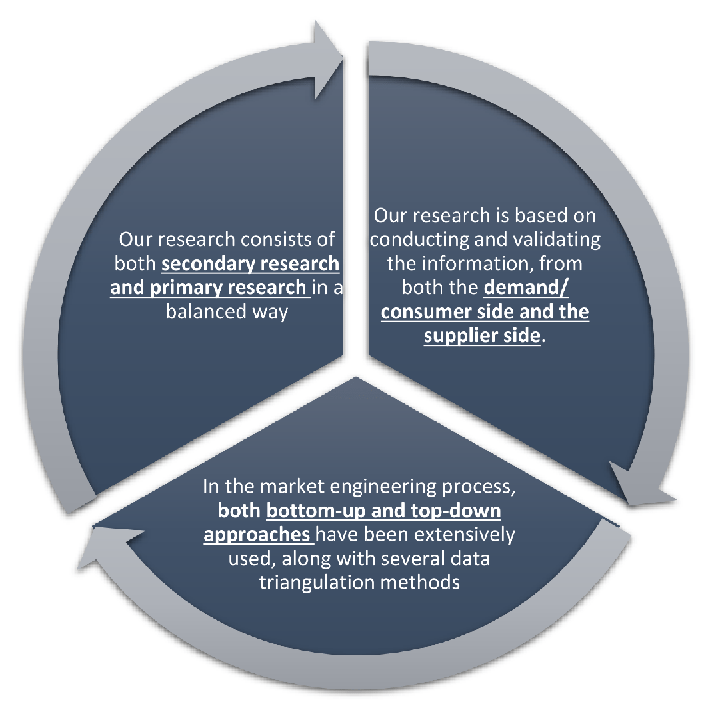
Our research design integrates both demand-side and supply-side analysis through a balanced combination of primary and secondary research methodologies. By utilizing both bottom-up and top-down approaches alongside rigorous data triangulation methods, we deliver robust market intelligence that supports strategic decision-making.
MarketGenics' comprehensive research design framework ensures the delivery of accurate, reliable, and actionable market intelligence. Through the integration of multiple research approaches, rigorous validation processes, and expert analysis, we provide our clients with the insights needed to make informed strategic decisions and capitalize on market opportunities.
MarketGenics leverages a dedicated industry panel of experts and a comprehensive suite of paid databases to effectively collect, consolidate, and analyze market intelligence.
Our approach has consistently proven to be reliable and effective in generating accurate market insights, identifying key industry trends, and uncovering emerging business opportunities.
Through both primary and secondary research, we capture and analyze critical company-level data such as manufacturing footprints, including technical centers, R&D facilities, sales offices, and headquarters.
Our expert panel further enhances our ability to estimate market size for specific brands based on validated field-level intelligence.
Our data mining techniques incorporate both parametric and non-parametric methods, allowing for structured data collection, sorting, processing, and cleaning.
Demand projections are derived from large-scale data sets analyzed through proprietary algorithms, culminating in robust and reliable market sizing.
Research Approach
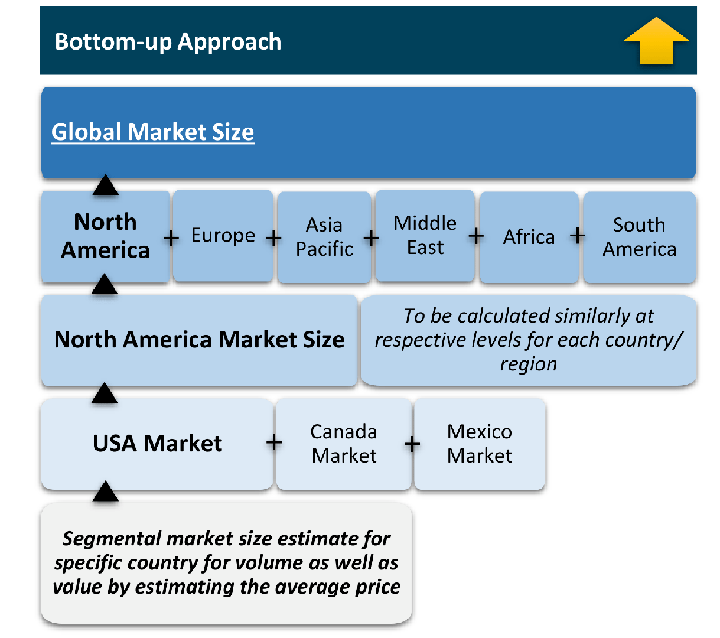
The bottom-up approach builds market estimates by starting with the smallest addressable market units and systematically aggregating them to create comprehensive market size projections.
This method begins with specific, granular data points and builds upward to create the complete market landscape.
Customer Analysis → Segmental Analysis → Geographical Analysis
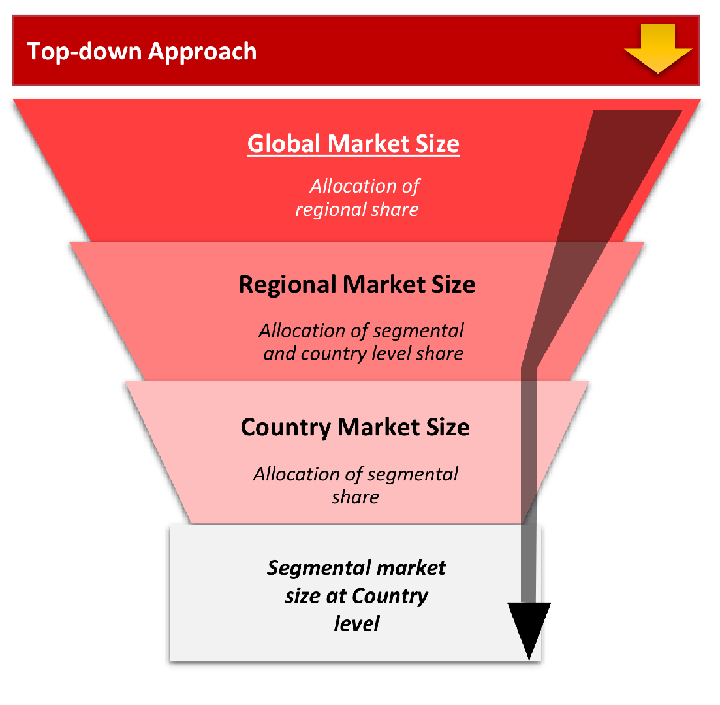
The top-down approach starts with the broadest possible market data and systematically narrows it down through a series of filters and assumptions to arrive at specific market segments or opportunities.
This method begins with the big picture and works downward to increasingly specific market slices.
TAM → SAM → SOM
Research Methods
Desk / Secondary Research
While analysing the market, we extensively study secondary sources, directories, and databases to identify and collect information useful for this technical, market-oriented, and commercial report. Secondary sources that we utilize are not only the public sources, but it is a combination of Open Source, Associations, Paid Databases, MG Repository & Knowledgebase, and others.
- Company websites, annual reports, financial reports, broker reports, and investor presentations
- National government documents, statistical databases and reports
- News articles, press releases and web-casts specific to the companies operating in the market, Magazines, reports, and others
- We gather information from commercial data sources for deriving company specific data such as segmental revenue, share for geography, product revenue, and others
- Internal and external proprietary databases (industry-specific), relevant patent, and regulatory databases
- Governing Bodies, Government Organizations
- Relevant Authorities, Country-specific Associations for Industries
We also employ the model mapping approach to estimate the product level market data through the players' product portfolio
Primary Research
Primary research/ interviews is vital in analyzing the market. Most of the cases involves paid primary interviews. Primary sources include primary interviews through e-mail interactions, telephonic interviews, surveys as well as face-to-face interviews with the different stakeholders across the value chain including several industry experts.
| Type of Respondents | Number of Primaries |
|---|---|
| Tier 2/3 Suppliers | ~20 |
| Tier 1 Suppliers | ~25 |
| End-users | ~25 |
| Industry Expert/ Panel/ Consultant | ~30 |
| Total | ~100 |
MG Knowledgebase
• Repository of industry blog, newsletter and case studies
• Online platform covering detailed market reports, and company profiles
Forecasting Factors and Models
Forecasting Factors
- Historical Trends – Past market patterns, cycles, and major events that shaped how markets behave over time. Understanding past trends helps predict future behavior.
- Industry Factors – Specific characteristics of the industry like structure, regulations, and innovation cycles that affect market dynamics.
- Macroeconomic Factors – Economic conditions like GDP growth, inflation, and employment rates that affect how much money people have to spend.
- Demographic Factors – Population characteristics like age, income, and location that determine who can buy your product.
- Technology Factors – How quickly people adopt new technology and how much technology infrastructure exists.
- Regulatory Factors – Government rules, laws, and policies that can help or restrict market growth.
- Competitive Factors – Analyzing competition structure such as degree of competition and bargaining power of buyers and suppliers.
Forecasting Models / Techniques
Multiple Regression Analysis
- Identify and quantify factors that drive market changes
- Statistical modeling to establish relationships between market drivers and outcomes
Time Series Analysis – Seasonal Patterns
- Understand regular cyclical patterns in market demand
- Advanced statistical techniques to separate trend, seasonal, and irregular components
Time Series Analysis – Trend Analysis
- Identify underlying market growth patterns and momentum
- Statistical analysis of historical data to project future trends
Expert Opinion – Expert Interviews
- Gather deep industry insights and contextual understanding
- In-depth interviews with key industry stakeholders
Multi-Scenario Development
- Prepare for uncertainty by modeling different possible futures
- Creating optimistic, pessimistic, and most likely scenarios
Time Series Analysis – Moving Averages
- Sophisticated forecasting for complex time series data
- Auto-regressive integrated moving average models with seasonal components
Econometric Models
- Apply economic theory to market forecasting
- Sophisticated economic models that account for market interactions
Expert Opinion – Delphi Method
- Harness collective wisdom of industry experts
- Structured, multi-round expert consultation process
Monte Carlo Simulation
- Quantify uncertainty and probability distributions
- Thousands of simulations with varying input parameters
Research Analysis
Our research framework is built upon the fundamental principle of validating market intelligence from both demand and supply perspectives. This dual-sided approach ensures comprehensive market understanding and reduces the risk of single-source bias.
Demand-Side Analysis: We understand end-user/application behavior, preferences, and market needs along with the penetration of the product for specific application.
Supply-Side Analysis: We estimate overall market revenue, analyze the segmental share along with industry capacity, competitive landscape, and market structure.
Validation & Evaluation
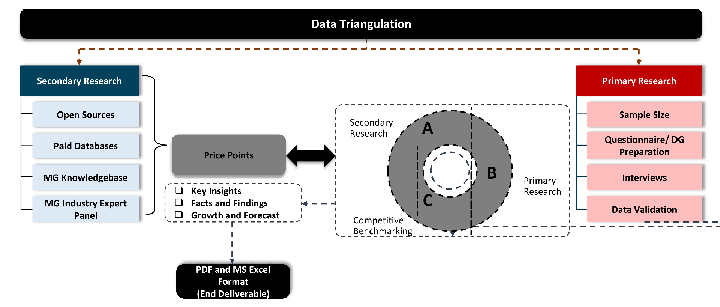
Data triangulation is a validation technique that uses multiple methods, sources, or perspectives to examine the same research question, thereby increasing the credibility and reliability of research findings. In market research, triangulation serves as a quality assurance mechanism that helps identify and minimize bias, validate assumptions, and ensure accuracy in market estimates.
- Data Source Triangulation – Using multiple data sources to examine the same phenomenon
- Methodological Triangulation – Using multiple research methods to study the same research question
- Investigator Triangulation – Using multiple researchers or analysts to examine the same data
- Theoretical Triangulation – Using multiple theoretical perspectives to interpret the same data
Custom Market Research Services
We will customise the research for you, in case the report listed above does not meet your requirements.
Get 10% Free Customisation