Astaxanthin Market Size, Share & Trends Analysis Report by Source/Origin (Natural Astaxanthin, Synthetic Astaxanthin), Form, Grade/Purity Level, Concentration Level, Production Technology, End-users, Distribution Channel, Packaging Type, and Geography (North America, Europe, Asia Pacific, Middle East, Africa, and South America) – Global Industry Data, Trends, and Forecasts, 2026–2035
|
|
|
Segmental Data Insights |
|
|
Demand Trends |
|
|
Competitive Landscape |
|
|
Strategic Development |
|
|
Future Outlook & Opportunities |
|
Astaxanthin Market Size, Share, and Growth
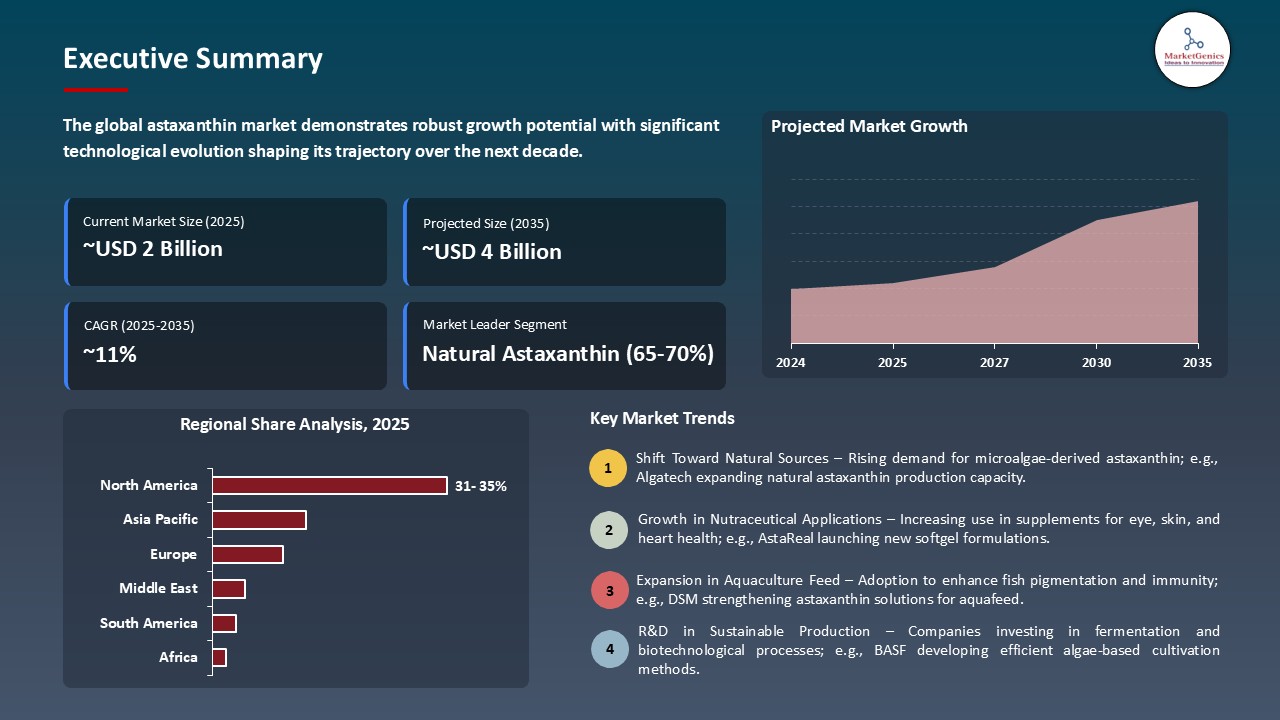
The global astaxanthin market is experiencing robust growth, with its estimated value of USD 1.6 billion in the year 2025 and USD 4.4 billion by the period 2035, registering a CAGR of 10.6%, during the forecast period. The global astaxanthin market is expanding because of the increasing health-consciousness and popularity of natural and antioxidant-containing supplements. Formulation innovations and increased distribution channels are also enhancing adoption across the world.
Abhijit Natu, Vice President of Sales and Marketing at Maypro, said, “LCY’s astaxanthin is a true game-changer for the supplement market. This high concentration and free-form astaxanthin significantly enhances formulation options for manufacturers allowing them to create more effective products with a smaller dose. Plus, LCY’s proprietary astaxanthin has no fishy taste or odor, making it ideal for a variety of applications, including gummies, candies, and beverages.
The rising consumer awareness of the strong antioxidant effects and the rising salmon aquaculture contribute to the growth of the global astaxanthin market. Natural astaxanthin, mostly found in Haematococcus pluvialis, has much higher antioxidant ability than most conventional antioxidants such as vitamin C. For instance, in September 2025, AlgalIceland ehf. Introduced Astalíf 15 which is the first 15 percent natural astaxanthin oleoresin, offering a high-density form of dietary supplements that promotes clean labeling and lower-dose forms. This is an indication of the shift to high-end, science-supported and consumer-friendly supplement formats.
The use of astaxanthin is increasing due to technological changes. For instnace, in May 2025, BGG increased its manufacturing capacity and created a new research laboratory to boost its AstaZine line capacity, quality, and innovation in Yunnan. Also, Algal Bio and JBSL introduced a collaborative initiative in Kyushu, Japan, to commercialize high-concentration astaxanthin with a closed-panel indoor production method to enhance the efficiency and bioavailability of production.
Astaxanthin complements its growth and use in strategic adjacent markets. Vitamins such as spirulina, chlorella and carotenoids (beta-carotene, lutein, zeaxanthin) are synergistically formable. Also, there are omega-3 products, anti-aging skincare, as well as sports nutrition supplements that provide diversified stream of income. These elements in combination favor product innovation, high-end positioning, and increased consumer adoption in a wide variety of industries.
Astaxanthin Market Dynamics and Trends
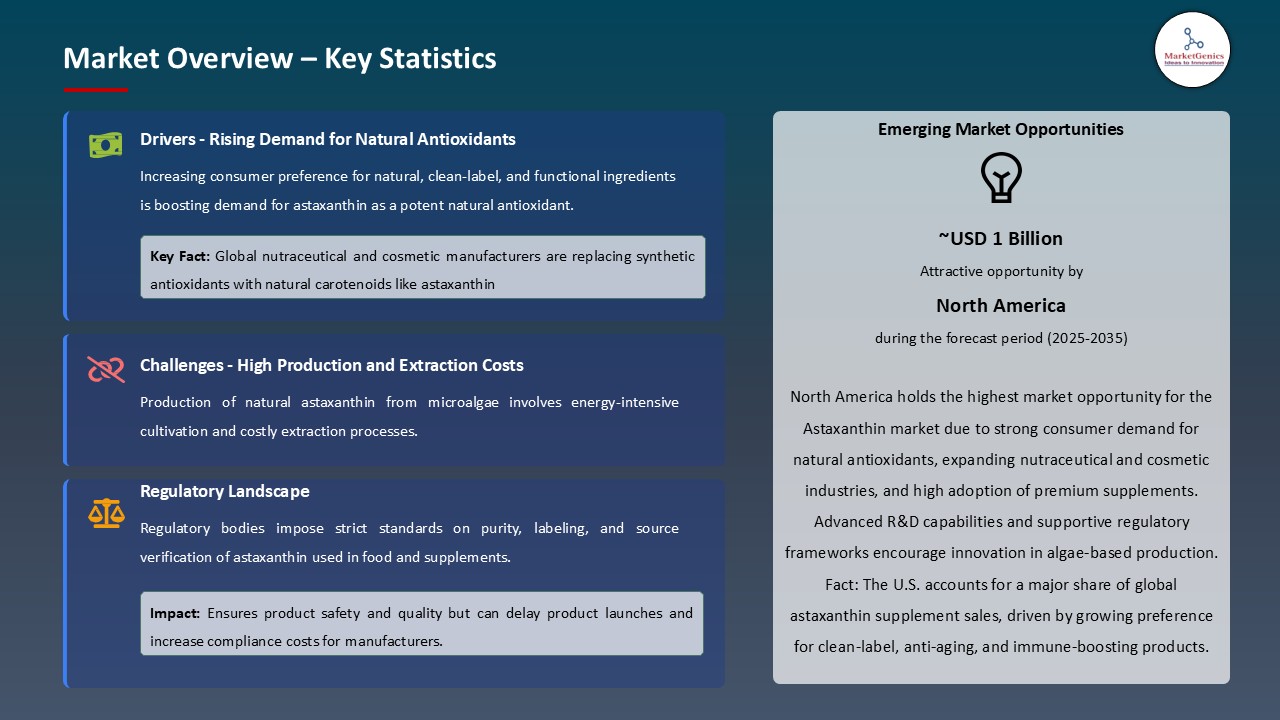
Driver: Expanding Aquaculture Industry and Salmon Feed Applications
- The global astaxanthin market is experiencing robust growth mainly attributed to the growth of aquaculture industry (especially salmon and trout rearing) where astaxanthin is a valuable feed supplement. It provides the trait pink-orange color needed in flesh to be commercially valuable and accepted and is thus necessitated in commercial feed formulations.
- The increased value on high-quality, sustainable astaxanthin products, For instance, in August 2025, Corbion joined forces with Kuehnle AgroSystems (KAS) in creating and commercialising non-GMO, fermentation-produced astaxanthin in the human and animal nutrition markets. The collaboration aims at enhancing stability, solubility, and bioavailability.
- The increased demand is also being driven by expansion into the emerging markets where producers in these regions are matching with international standards of quality to access the export and high-end domestic seafood markets. The technical need, growth of the industry, and geographic diversification creates a strong demand base of astaxanthin that shields the market against the vagaries that characterize discretionary nutraceutical constituents.
Restraint: High Production Costs and Limited Supply of Natural Astaxanthin
- The limitation of astaxanthin market is due to the high cost of production of natural astaxanthin through Haematococcus pluvialis which involves complex photobioreactor systems, control of nutrients, stress induction methods and multi-stage extraction of natural astaxanthin. This compound production demands enable natural astaxanthin to be much more costly than synthetic products, restricting its use in price-sensitive markets.
- Additionally, the process of cultivation has a number of challenges, which include the risks of contamination, slowness of growth and climate sensitivity in productivity. These components pose problems of supply reliability, as producers are unable to sustain production and respond to changes in demand with efficiency.
- As a result, the chronic cost and supply problems limit market penetration within some segments and create strategic weaknesses in firms that do not have enough production size or vertical integration. To stay afloat in the international astaxanthin market, producers have to work through these complexities in operations and balance the quality, sustainability, and economic viability.
Opportunity: Growing Demand in Nutraceuticals and Cosmeceuticals
- The astaxanthin market is showing well-developed growth prospects via diversification in human nutrition, skincare, sports supplements, and functional foodstuffs. Increasing consumer interest in natural antioxidants, sustainable and clinically supported antioxidants is compelling manufacturers to come up with innovative formulations and high value products. To address the changing consumer demands and regulatory requirements, companies are investing more in production scale-up and research and development. The process of entering the emerging and high-growth markets is also contributing to the necessity of efficient manufacturing capacities and strong supply chains.
- The adoption of astaxanthin in cosmeceutical brands is being catalyzed by clinical evidence that astaxanthin has in enhancing skin elasticity, fine line reduction, and photoprotection. For instance, in May 2025, BGG (Beijing Gingko Group) opened a new astaxanthin plant in China, which combined farming, extraction, drying, packing, and research to boost its production capacity to meet the nutraceutical and skin care demand. Equally, sports nutrition market is on the rise and astaxanthin has been demonstrated to decrease exercise-related oxidative stress, increase endurance and shorten recovery.
- The increased health awareness, aging in developed economies, strong clinical validation all auger well with further growth of astaxanthin in high-value nutraceutical and cosmeceutical products, and attract better margins than conventional aquaculture feed applications.
Key Trend: Biotechnology Innovation in Production Methods
- The global astaxanthin market is experiencing massive technological revolution based on alternative production technology, which involves fermentation by yeast, synthetic biology, and sophisticated photobioreactor technology, to address cost and scalability limitations of natural astaxanthin in the past. These innovations will improve access to the market and keep the quality high.
- Continued advancements in the production of astaxanthin are moving towards higher levels of concentration, consistent, and broad use products to satisfy the increased nutraceutical, cosmeceutical, and functional food demand. For instance, in July 2025, Algalif Iceland introduced Astalíf 15, the first 15 percent natural astaxanthin oleoresin in the world, which was more stable, easily dosed and more readily incorporated in the product.
- Also, new developments in photobioreactors with LED based illumination are increasing the efficiency of Haematococcus growth, consuming less energy and raising astaxanthin levels several-fold. Firms such as Solix Algredials are adopting next generation vertical systems that will help them maximize their productivity and reduce land use. It is anticipated that the convergence of synthetic biology, fermentation engineering, and photo-bioreactor technologies will accelerate market penetration in both the price-sensitive and the premium market segments, and change the competitive environment.
Astaxanthin Market Analysis and Segmental Data

Natural Astaxanthin Dominate Global Astaxanthin Market
- The natural astaxanthin segment is dominating the global astaxanthin market because of high preference to naturally sourced ingredients, regulatory benefits in the main regions as well as high bioavailability. The demand to have high-quality cultivation as Haematococcus pluvialis microalgae cultivation, and sophisticated extraction procedures ensure consistency in purity, safety, and functionality to meet the ever-increasing premium and clean-label product demand.
- Major manufacturers are increasing natural astaxanthin to enable an increased demand. For instance, in May 2024, Divi Nutraceuticals, in partnership with Algalíf Iceland ehf, introduced AstaBead, a concentrated beadlet format which can be used in tablets and powders and is not confined to the normal soft-gels. This indicates the tendency to high quality, science-supported natural astaxanthin with open formulations that can attract health conscious consumers and prestigious supplement divisions.
- The market strength of natural astaxanthin is enhanced by the presence of good regulatory laws, consumer confidence, and market acceptance in North America, Europe and Asia. These aspects can allow manufacturers to increase production volume, offer special recipes, and also take advantage of the high end distance of naturally sourced antioxidants in the global astaxanthin market.
North America Leads Global Astaxanthin Market Demand
- North America has dominated the global astaxanthin market, due to the developed nutraceutical and cosmetical sectors, high customer health consciousness, high purchasing power, favorable regulatory environments, and the availability of major manufacturers and research facilities. The market forces focus on quality, clinical substantiation and innovation, which contributes to high uptake of natural astaxanthin.
- Major firms keep increasing the number of products to satisfy the increasing demand. For instance, in March 2024, Nutrex-Hawaii, a subsidiary company of Cyanotech Corporation, introduced BioAstin, Hawaiian Astaxanthin, as a sugar-free vegan gummy, with 12 mg of each service size of natural Hawaiian astaxanthin. This is indicative of the shift toward higher value, consumer-friendly products that would attract health conscious customers and consolidate brands in North America.
- The high-quality natural astaxanthin feed additives are also promoted in the region as the high-value aquaculture unit so as to improve the salmon flesh coloration and sustainability expectations. An intensive research infrastructure enhances leadership in the market through the creation of clinical evidence, regulatory permission, and consumer confidence, making North America the worldwide leader in value in terms of natural astaxanthin.
Astaxanthin-Market Ecosystem
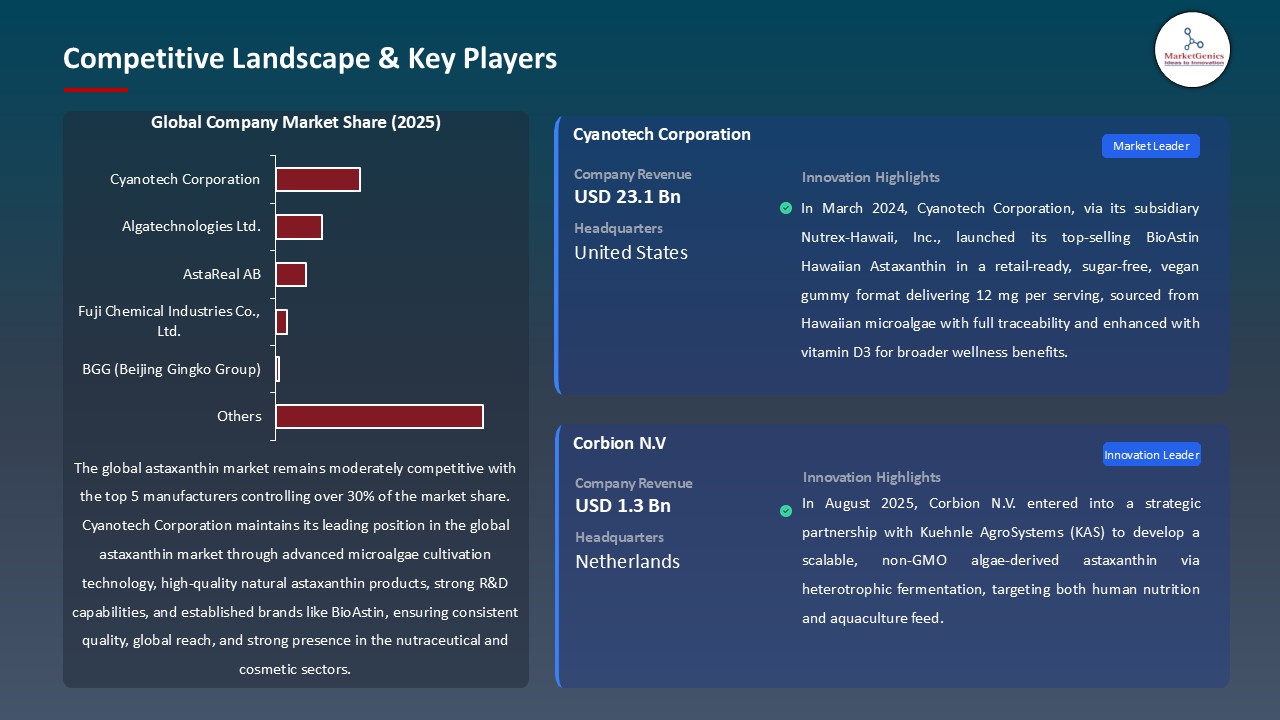
The global astaxanthin market is moderately concentrated and there is specialization in terms of the types of sources as well as the end-use applications. A small group of vertically integrated firms have meticulous control of the ownership and distribution of proprietary cultivation, extraction, and supply chains across aquaculture, nutraceutical and cosmetic markets; they are Cyanotech Corporation, Algatechnologies Ltd., AstaReal AB, Fuji Chemical Industries Co., Ltd., BGG (Beijing Gingko Group). Most of these companies heavily invest in R&D, clinical research and application development to sustain a technological leadership and superior positioning.
Chemical and specialty companies including DSM-Firmenich, BASF and Zhejiang NHU have dominated the synthetic astaxanthin industry with large-scale production and international distribution networks to supply aquaculture with price-sensitive products on a reliable basis. The value chain extends to upstream cultivation or synthesis, extraction and purification, formulation and stabilization, regulatory compliance, and distribution with the distribution having specialized ingredient channels.
Academic alliances as in the case of BGG and Lycored to come up with astaxanthin-lycopene combination products depict a market trend of pursuing complex, solution-based formulations with better clinical effects and superior pricing. This industry is marked by high technical and regulatory obstacles especially to natural astaxanthin where growth know-how, contamination management and dossier development of products require substantial investment, and synthetic substitutes have the disadvantage of perceptions by consumers despite their lower costs.
Recent Development and Strategic Overview:
- In July 2025, INNOBIO Corporation Limited announced a novel high-end astaxanthin powder, based on Haematococcus pluvialis microalgae, to be used in extensive health-and-wellness products and services. The vegan ingredient has a high antioxidant ability and can be used in dietary supplements, functional foods, and beverages. High purity and strict qualityassurance are emphasised in the launch, which is in line with the increasing consumer demand of natural, sciencebased nutrition solutions.
- In July 2025, Algal Bio and Japan Bio Science Laboratory (JBSL) released high-concentration of astaxanthin derived in Haematococcus pluvialis in Japan. The Kyushu facility of indoor cultivation assures quality production and uniformity in production. This invention relies on the Microalgae Bio-foundry Platform of Algal Bio to select the optimum strains and scalability. The development aids the use in supplements, functional food, cosmetics, and aquaculture feed.
Report Scope
|
Detail |
|
|
Market Size in 2025 |
USD 1.6 Bn |
|
Market Forecast Value in 2035 |
USD 4.4 Bn |
|
Growth Rate (CAGR) |
10.6% |
|
Forecast Period |
2026 – 2035 |
|
Historical Data Available for |
2021 – 2024 |
|
Market Size Units |
US$ Billion for Value Metric Tons for Volume |
|
Report Format |
Electronic (PDF) + Excel |
|
North America |
Europe |
Asia Pacific |
Middle East |
Africa |
South America |
|
|
|
|
|
|
|
Companies Covered |
|||||
|
|
|
|
|
|
Astaxanthin-Market Segmentation and Highlights
|
Segment |
Sub-segment |
|
Astaxanthin Market, By Source/Origin |
|
|
Astaxanthin Market, By Form |
|
|
Astaxanthin Market, By Grade/Purity Level |
|
|
Astaxanthin Market, By Concentration Level |
|
|
Astaxanthin Market, Production Technology |
|
|
Astaxanthin Market, By End-users |
|
|
Astaxanthin Market, By Distribution Channel |
|
|
Astaxanthin Market, By Packaging Type |
|
Frequently Asked Questions
Table of Contents
- 1. Research Methodology and Assumptions
- 1.1. Definitions
- 1.2. Research Design and Approach
- 1.3. Data Collection Methods
- 1.4. Base Estimates and Calculations
- 1.5. Forecasting Models
- 1.5.1. Key Forecast Factors & Impact Analysis
- 1.6. Secondary Research
- 1.6.1. Open Sources
- 1.6.2. Paid Databases
- 1.6.3. Associations
- 1.7. Primary Research
- 1.7.1. Primary Sources
- 1.7.2. Primary Interviews with Stakeholders across Ecosystem
- 2. Executive Summary
- 2.1. Global Astaxanthin Market Outlook
- 2.1.1. Astaxanthin Market Size (Volume - Metric Tons and Value - US$ Bn), and Forecasts, 2021-2035
- 2.1.2. Compounded Annual Growth Rate Analysis
- 2.1.3. Growth Opportunity Analysis
- 2.1.4. Segmental Share Analysis
- 2.1.5. Geographical Share Analysis
- 2.2. Market Analysis and Facts
- 2.3. Supply-Demand Analysis
- 2.4. Competitive Benchmarking
- 2.5. Go-to- Market Strategy
- 2.5.1. Customer/ End-use Industry Assessment
- 2.5.2. Growth Opportunity Data, 2026-2035
- 2.5.2.1. Regional Data
- 2.5.2.2. Country Data
- 2.5.2.3. Segmental Data
- 2.5.3. Identification of Potential Market Spaces
- 2.5.4. GAP Analysis
- 2.5.5. Potential Attractive Price Points
- 2.5.6. Prevailing Market Risks & Challenges
- 2.5.7. Preferred Sales & Marketing Strategies
- 2.5.8. Key Recommendations and Analysis
- 2.5.9. A Way Forward
- 2.1. Global Astaxanthin Market Outlook
- 3. Industry Data and Premium Insights
- 3.1. Global Food & Beverages Industry Overview, 2025
- 3.1.1. Industry Ecosystem Analysis
- 3.1.2. Key Trends for Food & Beverages Industry
- 3.1.3. Regional Distribution for Food & Beverages Industry
- 3.2. Supplier Customer Data
- 3.3. Technology Roadmap and Developments
- 3.4. Trade Analysis
- 3.4.1. Import & Export Analysis, 2025
- 3.4.2. Top Importing Countries
- 3.4.3. Top Exporting Countries
- 3.5. Trump Tariff Impact Analysis
- 3.5.1. Manufacturer
- 3.5.1.1. Based on the component & Raw material
- 3.5.2. Supply Chain
- 3.5.3. End Consumer
- 3.5.1. Manufacturer
- 3.6. Raw Material Analysis
- 3.1. Global Food & Beverages Industry Overview, 2025
- 4. Market Overview
- 4.1. Market Dynamics
- 4.1.1. Drivers
- 4.1.1.1. Rising demand for natural antioxidants in nutraceutical and cosmetic products.
- 4.1.1.2. Increasing use of astaxanthin in aquaculture feed to enhance fish pigmentation and health.
- 4.1.1.3. Growing consumer preference for clean-label and natural-origin ingredients.
- 4.1.2. Restraints
- 4.1.2.1. High production and extraction costs of natural astaxanthin.
- 4.1.2.2. Limited raw material availability and complex cultivation processes.
- 4.1.1. Drivers
- 4.2. Key Trend Analysis
- 4.3. Regulatory Framework
- 4.3.1. Key Regulations, Norms, and Subsidies, by Key Countries
- 4.3.2. Tariffs and Standards
- 4.3.3. Impact Analysis of Regulations on the Market
- 4.4. Value Chain Analysis
- 4.4.1. Raw Material Suppliers
- 4.4.2. Manufacturers
- 4.4.3. Distributors
- 4.4.4. End-Users/ Consumers
- 4.5. Cost Structure Analysis
- 4.5.1. Parameter’s Share for Cost Associated
- 4.5.2. COGP vs COGS
- 4.5.3. Profit Margin Analysis
- 4.6. Pricing Analysis
- 4.6.1. Regional Pricing Analysis
- 4.6.2. Segmental Pricing Trends
- 4.6.3. Factors Influencing Pricing
- 4.7. Porter’s Five Forces Analysis
- 4.8. PESTEL Analysis
- 4.9. Global Astaxanthin Market Demand
- 4.9.1. Historical Market Size –Volume (Metric Tons) and Value (US$ Bn), 2020-2024
- 4.9.2. Current and Future Market Size –Volume (Metric Tons) and (US$ Bn), 2026–2035
- 4.9.2.1. Y-o-Y Growth Trends
- 4.9.2.2. Absolute $ Opportunity Assessment
- 4.1. Market Dynamics
- 5. Competition Landscape
- 5.1. Competition structure
- 5.1.1. Fragmented v/s consolidated
- 5.2. Company Share Analysis, 2025
- 5.2.1. Global Company Market Share
- 5.2.2. By Region
- 5.2.2.1. North America
- 5.2.2.2. Europe
- 5.2.2.3. Asia Pacific
- 5.2.2.4. Middle East
- 5.2.2.5. Africa
- 5.2.2.6. South America
- 5.3. Product Comparison Matrix
- 5.3.1. Specifications
- 5.3.2. Market Positioning
- 5.3.3. Pricing
- 5.1. Competition structure
- 6. Global Astaxanthin Market Analysis, by Source/Origin
- 6.1. Key Segment Analysis
- 6.2. Astaxanthin Market Size (Volume - Metric Tons and Value - US$ Bn), Analysis, and Forecasts, by Source/Origin, 2021-2035
- 6.2.1. Natural Astaxanthin
- 6.2.1.1. Haematococcus pluvialis (Microalgae)
- 6.2.1.2. Phaffia rhodozyma (Yeast)
- 6.2.1.3. Shrimp/Krill/Crab shells
- 6.2.1.4. Salmon
- 6.2.1.5. Other marine sources
- 6.2.1.6. Others
- 6.2.2. Synthetic Astaxanthin
- 6.2.2.1. Petrochemical-derived
- 6.2.2.2. Laboratory synthesized
- 6.2.2.3. Others
- 6.2.1. Natural Astaxanthin
- 7. Global Astaxanthin Market Analysis, by Form
- 7.1. Key Segment Analysis
- 7.2. Astaxanthin Market Size (Volume - Metric Tons and Value - US$ Bn), Analysis, and Forecasts, by Form, 2021-2035
- 7.2.1. Powder
- 7.2.2. Oil/Oleoresin
- 7.2.3. Liquid/Suspension
- 7.2.4. Beadlets/Granules
- 7.2.5. Soft gels/Capsules
- 7.2.6. Emulsion
- 7.2.7. Others
- 8. Global Astaxanthin Market Analysis, by Grade/Purity Level
- 8.1. Key Segment Analysis
- 8.2. Astaxanthin Market Size (Volume - Metric Tons and Value - US$ Bn), Analysis, and Forecasts, by Grade/Purity Level, 2021-2035
- 8.2.1. Pharmaceutical Grade
- 8.2.2. Food Grade
- 8.2.3. Feed Grade
- 8.2.4. Cosmetic Grade
- 8.2.5. Nutraceutical Grade
- 9. Global Astaxanthin Market Analysis, by Concentration Level
- 9.1. Key Segment Analysis
- 9.2. Astaxanthin Market Size (Volume - Metric Tons and Value - US$ Bn), Analysis, and Forecasts, by Concentration Level, 2021-2035
- 9.2.1. Below 2%
- 9.2.2. 2% - 5%
- 9.2.3. 5% - 10%
- 9.2.4. Above 10%
- 10. Global Astaxanthin Market Analysis, by Production Technology
- 10.1. Key Segment Analysis
- 10.2. Astaxanthin Market Size (Volume - Metric Tons and Value - US$ Bn), Analysis, and Forecasts, by Production Technology, 2021-2035
- 10.2.1. Extraction Technology
- 10.2.2. Cultivation Technology
- 10.2.3. Chemical Synthesis
- 11. Global Astaxanthin Market Analysis, by End-users
- 11.1. Key Segment Analysis
- 11.2. Astaxanthin Market Size (Volume - Metric Tons and Value - US$ Bn), Analysis, and Forecasts, by End-users, 2021-2035
- 11.2.1. Nutraceuticals & Dietary Supplements
- 11.2.1.1. Eye Health Supplements
- 11.2.1.2. Cardiovascular Health Supplements
- 11.2.1.3. Brain Health & Cognitive Function
- 11.2.1.4. Anti-aging & Skin Health
- 11.2.1.5. Joint Health & Sports Nutrition
- 11.2.1.6. Immune System Support
- 11.2.1.7. Others
- 11.2.2. Food & Beverages
- 11.2.2.1. Functional Foods
- 11.2.2.2. Functional Beverages
- 11.2.2.3. Dairy Products
- 11.2.2.4. Bakery & Confectionery
- 11.2.2.5. Nutritional Bars
- 11.2.2.6. Others
- 11.2.3. Aquaculture & Animal Feed
- 11.2.3.1. Fish Feed
- 11.2.3.2. Crustacean Feed
- 11.2.3.3. Poultry Feed
- 11.2.3.4. Pet Food
- 11.2.3.5. Others
- 11.2.4. Cosmetics & Personal Care
- 11.2.4.1. Anti-aging Creams & Serums
- 11.2.4.2. Sunscreen & Sun Care Products
- 11.2.4.3. Moisturizers & Lotions
- 11.2.4.4. Color Cosmetics
- 11.2.4.5. Others
- 11.2.5. Pharmaceuticals
- 11.2.5.1. Prescription Drugs
- 11.2.5.2. Over-the-Counter (OTC) Medications
- 11.2.5.3. Ophthalmic Preparations
- 11.2.5.4. Dermatological Preparations
- 11.2.5.5. Others
- 11.2.6. Other End-users
- 11.2.1. Nutraceuticals & Dietary Supplements
- 12. Global Astaxanthin Market Analysis, by Distribution Channel
- 12.1. Key Segment Analysis
- 12.2. Astaxanthin Market Size (Volume - Metric Tons and Value - US$ Bn), Analysis, and Forecasts, by Distribution Channel, 2021-2035
- 12.2.1. Direct Sales/B2B
- 12.2.2. Distributors/Wholesalers
- 12.2.3. Online Retail
- 12.2.4. Specialty Stores
- 13. Global Astaxanthin Market Analysis, by Packaging Type
- 13.1. Key Segment Analysis
- 13.2. Astaxanthin Market Size (Volume - Metric Tons and Value - US$ Bn), Analysis, and Forecasts, by Packaging Type, 2021-2035
- 13.2.1. Bulk Packaging
- 13.2.2. Retail Packaging
- 13.2.2.1. Bottles
- 13.2.2.2. Blister packs
- 13.2.2.3. Sachets/Pouches
- 13.2.2.4. Tubes
- 13.2.2.5. Others
- 14. Global Astaxanthin Market Analysis and Forecasts, by Region
- 14.1. Key Findings
- 14.2. Astaxanthin Market Size (Volume - Metric Tons and Value - US$ Bn), Analysis, and Forecasts, by Region, 2021-2035
- 14.2.1. North America
- 14.2.2. Europe
- 14.2.3. Asia Pacific
- 14.2.4. Middle East
- 14.2.5. Africa
- 14.2.6. South America
- 15. North America Astaxanthin Market Analysis
- 15.1. Key Segment Analysis
- 15.2. Regional Snapshot
- 15.3. North America Astaxanthin Market Size Volume - Metric Tons and Value - US$ Bn), Analysis, and Forecasts, 2021-2035
- 15.3.1. Source/Origin
- 15.3.2. Form
- 15.3.3. Grade/Purity Level
- 15.3.4. Concentration Level
- 15.3.5. Production Technology
- 15.3.6. End-users
- 15.3.7. Distribution Channel
- 15.3.8. Packaging Type
- 15.3.9. Country
- 15.3.9.1. USA
- 15.3.9.2. Canada
- 15.3.9.3. Mexico
- 15.4. USA Astaxanthin Market
- 15.4.1. Country Segmental Analysis
- 15.4.2. Source/Origin
- 15.4.3. Form
- 15.4.4. Grade/Purity Level
- 15.4.5. Concentration Level
- 15.4.6. Production Technology
- 15.4.7. End-users
- 15.4.8. Distribution Channel
- 15.4.9. Packaging Type
- 15.5. Canada Astaxanthin Market
- 15.5.1. Country Segmental Analysis
- 15.5.2. Source/Origin
- 15.5.3. Form
- 15.5.4. Grade/Purity Level
- 15.5.5. Concentration Level
- 15.5.6. Production Technology
- 15.5.7. End-users
- 15.5.8. Distribution Channel
- 15.5.9. Packaging Type
- 15.6. Mexico Astaxanthin Market
- 15.6.1. Country Segmental Analysis
- 15.6.2. Source/Origin
- 15.6.3. Form
- 15.6.4. Grade/Purity Level
- 15.6.5. Concentration Level
- 15.6.6. Production Technology
- 15.6.7. End-users
- 15.6.8. Distribution Channel
- 15.6.9. Packaging Type
- 16. Europe Astaxanthin Market Analysis
- 16.1. Key Segment Analysis
- 16.2. Regional Snapshot
- 16.3. Europe Astaxanthin Market Size (Volume - Metric Tons and Value - US$ Bn), Analysis, and Forecasts, 2021-2035
- 16.3.1. Source/Origin
- 16.3.2. Form
- 16.3.3. Grade/Purity Level
- 16.3.4. Concentration Level
- 16.3.5. Production Technology
- 16.3.6. End-users
- 16.3.7. Distribution Channel
- 16.3.8. Packaging Type
- 16.3.9. Country
- 16.3.9.1. Germany
- 16.3.9.2. United Kingdom
- 16.3.9.3. France
- 16.3.9.4. Italy
- 16.3.9.5. Spain
- 16.3.9.6. Netherlands
- 16.3.9.7. Nordic Countries
- 16.3.9.8. Poland
- 16.3.9.9. Russia & CIS
- 16.3.9.10. Rest of Europe
- 16.4. Germany Astaxanthin Market
- 16.4.1. Country Segmental Analysis
- 16.4.2. Source/Origin
- 16.4.3. Form
- 16.4.4. Grade/Purity Level
- 16.4.5. Concentration Level
- 16.4.6. Production Technology
- 16.4.7. End-users
- 16.4.8. Distribution Channel
- 16.4.9. Packaging Type
- 16.5. United Kingdom Astaxanthin Market
- 16.5.1. Country Segmental Analysis
- 16.5.2. Source/Origin
- 16.5.3. Form
- 16.5.4. Grade/Purity Level
- 16.5.5. Concentration Level
- 16.5.6. Production Technology
- 16.5.7. End-users
- 16.5.8. Distribution Channel
- 16.5.9. Packaging Type
- 16.6. France Astaxanthin Market
- 16.6.1. Country Segmental Analysis
- 16.6.2. Source/Origin
- 16.6.3. Form
- 16.6.4. Grade/Purity Level
- 16.6.5. Concentration Level
- 16.6.6. Production Technology
- 16.6.7. End-users
- 16.6.8. Distribution Channel
- 16.6.9. Packaging Type
- 16.7. Italy Astaxanthin Market
- 16.7.1. Country Segmental Analysis
- 16.7.2. Source/Origin
- 16.7.3. Form
- 16.7.4. Grade/Purity Level
- 16.7.5. Concentration Level
- 16.7.6. Production Technology
- 16.7.7. End-users
- 16.7.8. Distribution Channel
- 16.7.9. Packaging Type
- 16.8. Spain Astaxanthin Market
- 16.8.1. Country Segmental Analysis
- 16.8.2. Source/Origin
- 16.8.3. Form
- 16.8.4. Grade/Purity Level
- 16.8.5. Concentration Level
- 16.8.6. Production Technology
- 16.8.7. End-users
- 16.8.8. Distribution Channel
- 16.8.9. Packaging Type
- 16.9. Netherlands Astaxanthin Market
- 16.9.1. Country Segmental Analysis
- 16.9.2. Source/Origin
- 16.9.3. Form
- 16.9.4. Grade/Purity Level
- 16.9.5. Concentration Level
- 16.9.6. Production Technology
- 16.9.7. End-users
- 16.9.8. Distribution Channel
- 16.9.9. Packaging Type
- 16.10. Nordic Countries Astaxanthin Market
- 16.10.1. Country Segmental Analysis
- 16.10.2. Source/Origin
- 16.10.3. Form
- 16.10.4. Grade/Purity Level
- 16.10.5. Concentration Level
- 16.10.6. Production Technology
- 16.10.7. End-users
- 16.10.8. Distribution Channel
- 16.10.9. Packaging Type
- 16.11. Poland Astaxanthin Market
- 16.11.1. Country Segmental Analysis
- 16.11.2. Source/Origin
- 16.11.3. Form
- 16.11.4. Grade/Purity Level
- 16.11.5. Concentration Level
- 16.11.6. Production Technology
- 16.11.7. End-users
- 16.11.8. Distribution Channel
- 16.11.9. Packaging Type
- 16.12. Russia & CIS Astaxanthin Market
- 16.12.1. Country Segmental Analysis
- 16.12.2. Source/Origin
- 16.12.3. Form
- 16.12.4. Grade/Purity Level
- 16.12.5. Concentration Level
- 16.12.6. Production Technology
- 16.12.7. End-users
- 16.12.8. Distribution Channel
- 16.12.9. Packaging Type
- 16.13. Rest of Europe Astaxanthin Market
- 16.13.1. Country Segmental Analysis
- 16.13.2. Source/Origin
- 16.13.3. Form
- 16.13.4. Grade/Purity Level
- 16.13.5. Concentration Level
- 16.13.6. Production Technology
- 16.13.7. End-users
- 16.13.8. Distribution Channel
- 16.13.9. Packaging Type
- 17. Asia Pacific Astaxanthin Market Analysis
- 17.1. Key Segment Analysis
- 17.2. Regional Snapshot
- 17.3. Asia Pacific Astaxanthin Market Size (Volume - Metric Tons and Value - US$ Bn), Analysis, and Forecasts, 2021-2035
- 17.3.1. Source/Origin
- 17.3.2. Form
- 17.3.3. Grade/Purity Level
- 17.3.4. Concentration Level
- 17.3.5. Production Technology
- 17.3.6. End-users
- 17.3.7. Distribution Channel
- 17.3.8. Packaging Type
- 17.3.9. Country
- 17.3.9.1. China
- 17.3.9.2. India
- 17.3.9.3. Japan
- 17.3.9.4. South Korea
- 17.3.9.5. Australia and New Zealand
- 17.3.9.6. Indonesia
- 17.3.9.7. Malaysia
- 17.3.9.8. Thailand
- 17.3.9.9. Vietnam
- 17.3.9.10. Rest of Asia Pacific
- 17.4. China Astaxanthin Market
- 17.4.1. Country Segmental Analysis
- 17.4.2. Source/Origin
- 17.4.3. Form
- 17.4.4. Grade/Purity Level
- 17.4.5. Concentration Level
- 17.4.6. Production Technology
- 17.4.7. End-users
- 17.4.8. Distribution Channel
- 17.4.9. Packaging Type
- 17.5. India Astaxanthin Market
- 17.5.1. Country Segmental Analysis
- 17.5.2. Source/Origin
- 17.5.3. Form
- 17.5.4. Grade/Purity Level
- 17.5.5. Concentration Level
- 17.5.6. Production Technology
- 17.5.7. End-users
- 17.5.8. Distribution Channel
- 17.5.9. Packaging Type
- 17.6. Japan Astaxanthin Market
- 17.6.1. Country Segmental Analysis
- 17.6.2. Source/Origin
- 17.6.3. Form
- 17.6.4. Grade/Purity Level
- 17.6.5. Concentration Level
- 17.6.6. Production Technology
- 17.6.7. End-users
- 17.6.8. Distribution Channel
- 17.6.9. Packaging Type
- 17.7. South Korea Astaxanthin Market
- 17.7.1. Country Segmental Analysis
- 17.7.2. Source/Origin
- 17.7.3. Form
- 17.7.4. Grade/Purity Level
- 17.7.5. Concentration Level
- 17.7.6. Production Technology
- 17.7.7. End-users
- 17.7.8. Distribution Channel
- 17.7.9. Packaging Type
- 17.8. Australia and New Zealand Astaxanthin Market
- 17.8.1. Country Segmental Analysis
- 17.8.2. Source/Origin
- 17.8.3. Form
- 17.8.4. Grade/Purity Level
- 17.8.5. Concentration Level
- 17.8.6. Production Technology
- 17.8.7. End-users
- 17.8.8. Distribution Channel
- 17.8.9. Packaging Type
- 17.9. Indonesia Astaxanthin Market
- 17.9.1. Country Segmental Analysis
- 17.9.2. Source/Origin
- 17.9.3. Form
- 17.9.4. Grade/Purity Level
- 17.9.5. Concentration Level
- 17.9.6. Production Technology
- 17.9.7. End-users
- 17.9.8. Distribution Channel
- 17.9.9. Packaging Type
- 17.10. Malaysia Astaxanthin Market
- 17.10.1. Country Segmental Analysis
- 17.10.2. Source/Origin
- 17.10.3. Form
- 17.10.4. Grade/Purity Level
- 17.10.5. Concentration Level
- 17.10.6. Production Technology
- 17.10.7. End-users
- 17.10.8. Distribution Channel
- 17.10.9. Packaging Type
- 17.11. Thailand Astaxanthin Market
- 17.11.1. Country Segmental Analysis
- 17.11.2. Source/Origin
- 17.11.3. Form
- 17.11.4. Grade/Purity Level
- 17.11.5. Concentration Level
- 17.11.6. Production Technology
- 17.11.7. End-users
- 17.11.8. Distribution Channel
- 17.11.9. Packaging Type
- 17.12. Vietnam Astaxanthin Market
- 17.12.1. Country Segmental Analysis
- 17.12.2. Source/Origin
- 17.12.3. Form
- 17.12.4. Grade/Purity Level
- 17.12.5. Concentration Level
- 17.12.6. Production Technology
- 17.12.7. End-users
- 17.12.8. Distribution Channel
- 17.12.9. Packaging Type
- 17.13. Rest of Asia Pacific Astaxanthin Market
- 17.13.1. Country Segmental Analysis
- 17.13.2. Source/Origin
- 17.13.3. Form
- 17.13.4. Grade/Purity Level
- 17.13.5. Concentration Level
- 17.13.6. Production Technology
- 17.13.7. End-users
- 17.13.8. Distribution Channel
- 17.13.9. Packaging Type
- 18. Middle East Astaxanthin Market Analysis
- 18.1. Key Segment Analysis
- 18.2. Regional Snapshot
- 18.3. Middle East Astaxanthin Market Size (Volume - Metric Tons and Value - US$ Bn), Analysis, and Forecasts, 2021-2035
- 18.3.1. Source/Origin
- 18.3.2. Form
- 18.3.3. Grade/Purity Level
- 18.3.4. Concentration Level
- 18.3.5. Production Technology
- 18.3.6. End-users
- 18.3.7. Distribution Channel
- 18.3.8. Packaging Type
- 18.3.9. Country
- 18.3.9.1. Turkey
- 18.3.9.2. UAE
- 18.3.9.3. Saudi Arabia
- 18.3.9.4. Israel
- 18.3.9.5. Rest of Middle East
- 18.4. Turkey Astaxanthin Market
- 18.4.1. Country Segmental Analysis
- 18.4.2. Source/Origin
- 18.4.3. Form
- 18.4.4. Grade/Purity Level
- 18.4.5. Concentration Level
- 18.4.6. Production Technology
- 18.4.7. End-users
- 18.4.8. Distribution Channel
- 18.4.9. Packaging Type
- 18.5. UAE Astaxanthin Market
- 18.5.1. Country Segmental Analysis
- 18.5.2. Source/Origin
- 18.5.3. Form
- 18.5.4. Grade/Purity Level
- 18.5.5. Concentration Level
- 18.5.6. Production Technology
- 18.5.7. End-users
- 18.5.8. Distribution Channel
- 18.5.9. Packaging Type
- 18.6. Saudi Arabia Astaxanthin Market
- 18.6.1. Country Segmental Analysis
- 18.6.2. Source/Origin
- 18.6.3. Form
- 18.6.4. Grade/Purity Level
- 18.6.5. Concentration Level
- 18.6.6. Production Technology
- 18.6.7. End-users
- 18.6.8. Distribution Channel
- 18.6.9. Packaging Type
- 18.7. Israel Astaxanthin Market
- 18.7.1. Country Segmental Analysis
- 18.7.2. Source/Origin
- 18.7.3. Form
- 18.7.4. Grade/Purity Level
- 18.7.5. Concentration Level
- 18.7.6. Production Technology
- 18.7.7. End-users
- 18.7.8. Distribution Channel
- 18.7.9. Packaging Type
- 18.8. Rest of Middle East Astaxanthin Market
- 18.8.1. Country Segmental Analysis
- 18.8.2. Source/Origin
- 18.8.3. Form
- 18.8.4. Grade/Purity Level
- 18.8.5. Concentration Level
- 18.8.6. Production Technology
- 18.8.7. End-users
- 18.8.8. Distribution Channel
- 18.8.9. Packaging Type
- 19. Africa Astaxanthin Market Analysis
- 19.1. Key Segment Analysis
- 19.2. Regional Snapshot
- 19.3. Africa Astaxanthin Market Size (Volume - Metric Tons and Value - US$ Bn), Analysis, and Forecasts, 2021-2035
- 19.3.1. Source/Origin
- 19.3.2. Form
- 19.3.3. Grade/Purity Level
- 19.3.4. Concentration Level
- 19.3.5. Production Technology
- 19.3.6. End-users
- 19.3.7. Distribution Channel
- 19.3.8. Packaging Type
- 19.3.9. Country
- 19.3.9.1. South Africa
- 19.3.9.2. Egypt
- 19.3.9.3. Nigeria
- 19.3.9.4. Algeria
- 19.3.9.5. Rest of Africa
- 19.4. South Africa Astaxanthin Market
- 19.4.1. Country Segmental Analysis
- 19.4.2. Source/Origin
- 19.4.3. Form
- 19.4.4. Grade/Purity Level
- 19.4.5. Concentration Level
- 19.4.6. Production Technology
- 19.4.7. End-users
- 19.4.8. Distribution Channel
- 19.4.9. Packaging Type
- 19.5. Egypt Astaxanthin Market
- 19.5.1. Country Segmental Analysis
- 19.5.2. Source/Origin
- 19.5.3. Form
- 19.5.4. Grade/Purity Level
- 19.5.5. Concentration Level
- 19.5.6. Production Technology
- 19.5.7. End-users
- 19.5.8. Distribution Channel
- 19.5.9. Packaging Type
- 19.6. Nigeria Astaxanthin Market
- 19.6.1. Country Segmental Analysis
- 19.6.2. Source/Origin
- 19.6.3. Form
- 19.6.4. Grade/Purity Level
- 19.6.5. Concentration Level
- 19.6.6. Production Technology
- 19.6.7. End-users
- 19.6.8. Distribution Channel
- 19.6.9. Packaging Type
- 19.7. Algeria Astaxanthin Market
- 19.7.1. Country Segmental Analysis
- 19.7.2. Source/Origin
- 19.7.3. Form
- 19.7.4. Grade/Purity Level
- 19.7.5. Concentration Level
- 19.7.6. Production Technology
- 19.7.7. End-users
- 19.7.8. Distribution Channel
- 19.7.9. Packaging Type
- 19.8. Rest of Africa Astaxanthin Market
- 19.8.1. Country Segmental Analysis
- 19.8.2. Source/Origin
- 19.8.3. Form
- 19.8.4. Grade/Purity Level
- 19.8.5. Concentration Level
- 19.8.6. Production Technology
- 19.8.7. End-users
- 19.8.8. Distribution Channel
- 19.8.9. Packaging Type
- 20. South America Astaxanthin Market Analysis
- 20.1. Key Segment Analysis
- 20.2. Regional Snapshot
- 20.3. South America Astaxanthin Market Size (Volume - Metric Tons and Value - US$ Bn), Analysis, and Forecasts, 2021-2035
- 20.3.1. Source/Origin
- 20.3.2. Form
- 20.3.3. Grade/Purity Level
- 20.3.4. Concentration Level
- 20.3.5. Production Technology
- 20.3.6. End-users
- 20.3.7. Distribution Channel
- 20.3.8. Packaging Type
- 20.3.9. Country
- 20.3.9.1. Brazil
- 20.3.9.2. Argentina
- 20.3.9.3. Rest of South America
- 20.4. Brazil Astaxanthin Market
- 20.4.1. Country Segmental Analysis
- 20.4.2. Source/Origin
- 20.4.3. Form
- 20.4.4. Grade/Purity Level
- 20.4.5. Concentration Level
- 20.4.6. Production Technology
- 20.4.7. End-users
- 20.4.8. Distribution Channel
- 20.4.9. Packaging Type
- 20.5. Argentina Astaxanthin Market
- 20.5.1. Country Segmental Analysis
- 20.5.2. Source/Origin
- 20.5.3. Form
- 20.5.4. Grade/Purity Level
- 20.5.5. Concentration Level
- 20.5.6. Production Technology
- 20.5.7. End-users
- 20.5.8. Distribution Channel
- 20.5.9. Packaging Type
- 20.6. Rest of South America Astaxanthin Market
- 20.6.1. Country Segmental Analysis
- 20.6.2. Source/Origin
- 20.6.3. Form
- 20.6.4. Grade/Purity Level
- 20.6.5. Concentration Level
- 20.6.6. Production Technology
- 20.6.7. End-users
- 20.6.8. Distribution Channel
- 20.6.9. Packaging Type
- 21. Key Players/ Company Profile
- 21.1. Algalif Iceland
- 21.1.1. Company Details/ Overview
- 21.1.2. Company Financials
- 21.1.3. Key Customers and Competitors
- 21.1.4. Business/ Industry Portfolio
- 21.1.5. Product Portfolio/ Specification Details
- 21.1.6. Pricing Data
- 21.1.7. Strategic Overview
- 21.1.8. Recent Developments
- 21.2. Algatechnologies Ltd.
- 21.3. AstaReal AB
- 21.4. Atacama Bio Natural Products S.A.
- 21.5. BASF SE
- 21.6. BGG (Beijing Gingko Group)
- 21.7. BlueBioTech International GmbH
- 21.8. Cardax Pharmaceuticals
- 21.9. Cyanotech Corporation
- 21.10. Divi's Nutraceuticals
- 21.11. DSM Nutritional Products
- 21.12. Fuji Chemical Industries Co., Ltd.
- 21.13. Jingzhou Natural Astaxanthin Inc.
- 21.14. Mitushi Biopharma
- 21.15. Naturex SA (Givaudan)
- 21.16. Parry Nutraceuticals (EID Parry)
- 21.17. Piveg Inc.
- 21.18. Valensa International
- 21.19. Yunnan Alphy Biotech Co., Ltd.
- 21.20. Zhejiang NHU Company Ltd.
- 21.21. Other Key Players
- 21.1. Algalif Iceland
Note* - This is just tentative list of players. While providing the report, we will cover more number of players based on their revenue and share for each geography
Research Design
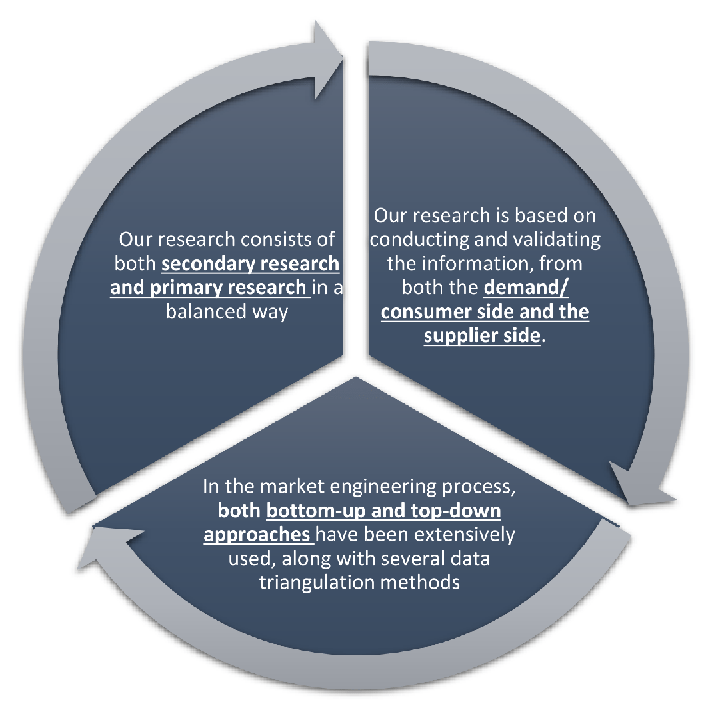
Our research design integrates both demand-side and supply-side analysis through a balanced combination of primary and secondary research methodologies. By utilizing both bottom-up and top-down approaches alongside rigorous data triangulation methods, we deliver robust market intelligence that supports strategic decision-making.
MarketGenics' comprehensive research design framework ensures the delivery of accurate, reliable, and actionable market intelligence. Through the integration of multiple research approaches, rigorous validation processes, and expert analysis, we provide our clients with the insights needed to make informed strategic decisions and capitalize on market opportunities.
MarketGenics leverages a dedicated industry panel of experts and a comprehensive suite of paid databases to effectively collect, consolidate, and analyze market intelligence.
Our approach has consistently proven to be reliable and effective in generating accurate market insights, identifying key industry trends, and uncovering emerging business opportunities.
Through both primary and secondary research, we capture and analyze critical company-level data such as manufacturing footprints, including technical centers, R&D facilities, sales offices, and headquarters.
Our expert panel further enhances our ability to estimate market size for specific brands based on validated field-level intelligence.
Our data mining techniques incorporate both parametric and non-parametric methods, allowing for structured data collection, sorting, processing, and cleaning.
Demand projections are derived from large-scale data sets analyzed through proprietary algorithms, culminating in robust and reliable market sizing.
Research Approach
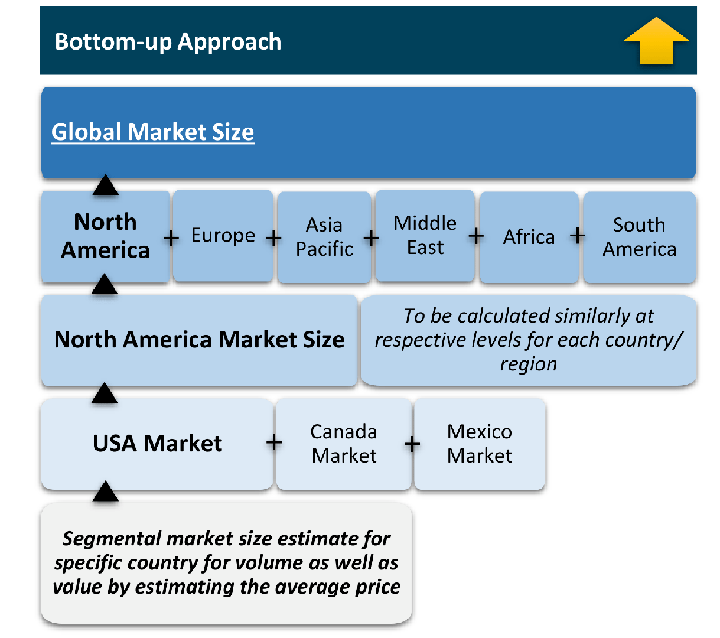
The bottom-up approach builds market estimates by starting with the smallest addressable market units and systematically aggregating them to create comprehensive market size projections.
This method begins with specific, granular data points and builds upward to create the complete market landscape.
Customer Analysis → Segmental Analysis → Geographical Analysis
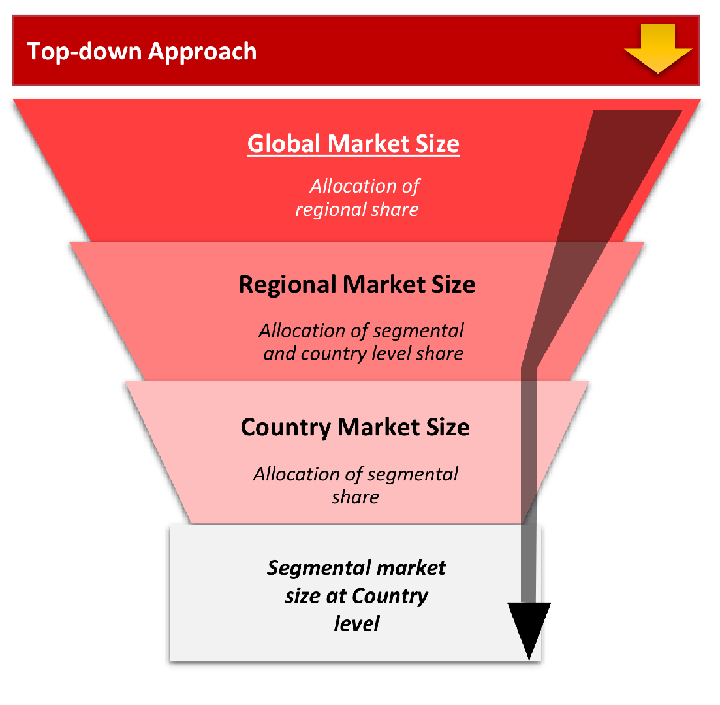
The top-down approach starts with the broadest possible market data and systematically narrows it down through a series of filters and assumptions to arrive at specific market segments or opportunities.
This method begins with the big picture and works downward to increasingly specific market slices.
TAM → SAM → SOM
Research Methods
Desk / Secondary Research
While analysing the market, we extensively study secondary sources, directories, and databases to identify and collect information useful for this technical, market-oriented, and commercial report. Secondary sources that we utilize are not only the public sources, but it is a combination of Open Source, Associations, Paid Databases, MG Repository & Knowledgebase, and others.
- Company websites, annual reports, financial reports, broker reports, and investor presentations
- National government documents, statistical databases and reports
- News articles, press releases and web-casts specific to the companies operating in the market, Magazines, reports, and others
- We gather information from commercial data sources for deriving company specific data such as segmental revenue, share for geography, product revenue, and others
- Internal and external proprietary databases (industry-specific), relevant patent, and regulatory databases
- Governing Bodies, Government Organizations
- Relevant Authorities, Country-specific Associations for Industries
We also employ the model mapping approach to estimate the product level market data through the players' product portfolio
Primary Research
Primary research/ interviews is vital in analyzing the market. Most of the cases involves paid primary interviews. Primary sources include primary interviews through e-mail interactions, telephonic interviews, surveys as well as face-to-face interviews with the different stakeholders across the value chain including several industry experts.
| Type of Respondents | Number of Primaries |
|---|---|
| Tier 2/3 Suppliers | ~20 |
| Tier 1 Suppliers | ~25 |
| End-users | ~25 |
| Industry Expert/ Panel/ Consultant | ~30 |
| Total | ~100 |
MG Knowledgebase
• Repository of industry blog, newsletter and case studies
• Online platform covering detailed market reports, and company profiles
Forecasting Factors and Models
Forecasting Factors
- Historical Trends – Past market patterns, cycles, and major events that shaped how markets behave over time. Understanding past trends helps predict future behavior.
- Industry Factors – Specific characteristics of the industry like structure, regulations, and innovation cycles that affect market dynamics.
- Macroeconomic Factors – Economic conditions like GDP growth, inflation, and employment rates that affect how much money people have to spend.
- Demographic Factors – Population characteristics like age, income, and location that determine who can buy your product.
- Technology Factors – How quickly people adopt new technology and how much technology infrastructure exists.
- Regulatory Factors – Government rules, laws, and policies that can help or restrict market growth.
- Competitive Factors – Analyzing competition structure such as degree of competition and bargaining power of buyers and suppliers.
Forecasting Models / Techniques
Multiple Regression Analysis
- Identify and quantify factors that drive market changes
- Statistical modeling to establish relationships between market drivers and outcomes
Time Series Analysis – Seasonal Patterns
- Understand regular cyclical patterns in market demand
- Advanced statistical techniques to separate trend, seasonal, and irregular components
Time Series Analysis – Trend Analysis
- Identify underlying market growth patterns and momentum
- Statistical analysis of historical data to project future trends
Expert Opinion – Expert Interviews
- Gather deep industry insights and contextual understanding
- In-depth interviews with key industry stakeholders
Multi-Scenario Development
- Prepare for uncertainty by modeling different possible futures
- Creating optimistic, pessimistic, and most likely scenarios
Time Series Analysis – Moving Averages
- Sophisticated forecasting for complex time series data
- Auto-regressive integrated moving average models with seasonal components
Econometric Models
- Apply economic theory to market forecasting
- Sophisticated economic models that account for market interactions
Expert Opinion – Delphi Method
- Harness collective wisdom of industry experts
- Structured, multi-round expert consultation process
Monte Carlo Simulation
- Quantify uncertainty and probability distributions
- Thousands of simulations with varying input parameters
Research Analysis
Our research framework is built upon the fundamental principle of validating market intelligence from both demand and supply perspectives. This dual-sided approach ensures comprehensive market understanding and reduces the risk of single-source bias.
Demand-Side Analysis: We understand end-user/application behavior, preferences, and market needs along with the penetration of the product for specific application.
Supply-Side Analysis: We estimate overall market revenue, analyze the segmental share along with industry capacity, competitive landscape, and market structure.
Validation & Evaluation
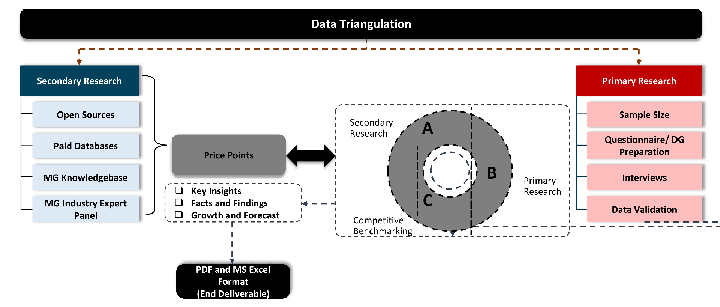
Data triangulation is a validation technique that uses multiple methods, sources, or perspectives to examine the same research question, thereby increasing the credibility and reliability of research findings. In market research, triangulation serves as a quality assurance mechanism that helps identify and minimize bias, validate assumptions, and ensure accuracy in market estimates.
- Data Source Triangulation – Using multiple data sources to examine the same phenomenon
- Methodological Triangulation – Using multiple research methods to study the same research question
- Investigator Triangulation – Using multiple researchers or analysts to examine the same data
- Theoretical Triangulation – Using multiple theoretical perspectives to interpret the same data
Custom Market Research Services
We will customise the research for you, in case the report listed above does not meet your requirements.
Get 10% Free Customisation