Beauty and Personal Care Market Size, Share & Trends Analysis Report by Product Type (Skin Care, Hair Care, Color Cosmetics, Fragrances, Oral Care, Grooming Products, Bath & Shower Products), Gender, Form, Ingredient Type, Consumer Behavior, Distribution Channel, End-users, and Geography (North America, Europe, Asia Pacific, Middle East, Africa, and South America) – Global Industry Data, Trends, and Forecasts, 2026–2035
Market Overview:
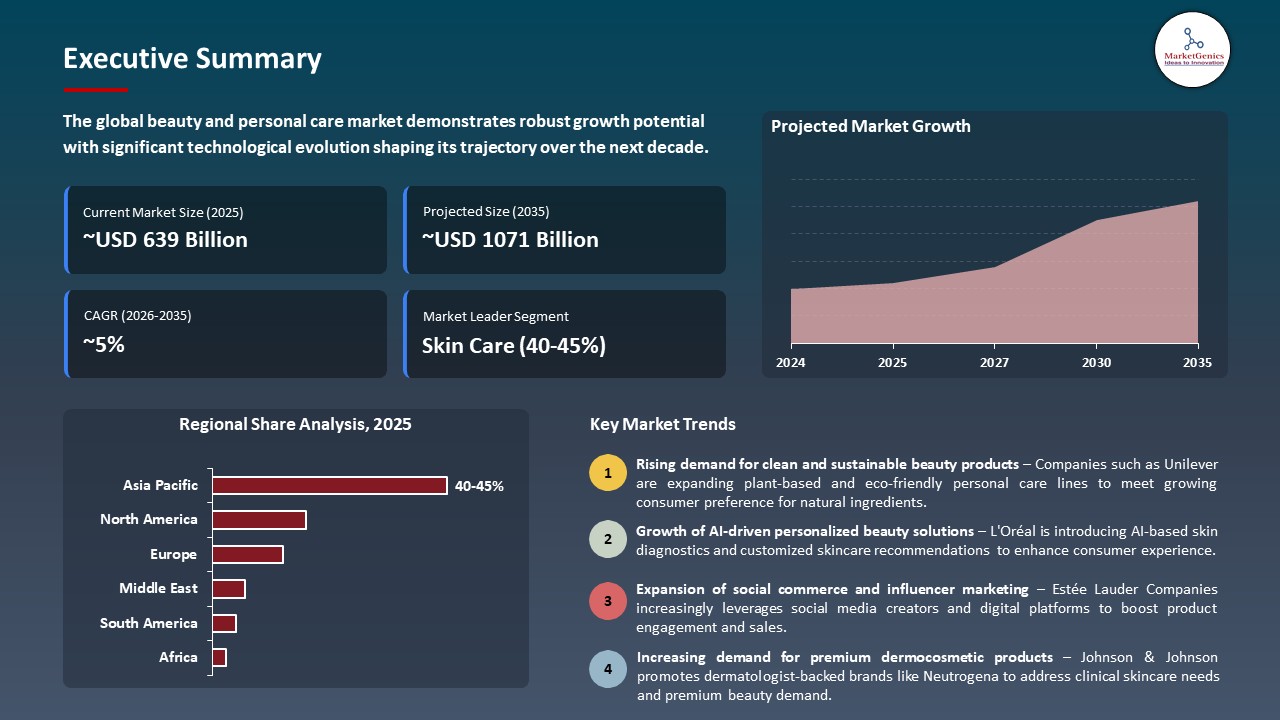
According to Marketgenics analysis, the global beauty and personal care market is witnessing steady expansion, with an estimated value of approximately USD 638.9 billion in 2025 and projected to reach nearly USD 1,070.8 billion by 2035, growing at a CAGR of around 5.3% during the forecast period.
|
|
|
Segmental Data Insights |
|
|
Demand Trends |
|
|
Competitive Landscape |
|
|
Strategic Development |
|
|
Future Outlook & Opportunities |
|
Beauty and Personal Care Market Size, Share, and Growth
The global beauty and personal care market is driven by rising consumer focus on personal grooming and wellness, growing disposable incomes, rapid expansion of e-commerce and social media influence, and increasing demand for natural and premium products offered by companies such as L'Oréal and Unilever.
"At L'Oréal, we're always looking toward the future of beauty, blending cutting-edge discoveries with our long-standing beauty expertise. With skin being the largest organ, and a key part of people's wellbeing, we are thrilled to unveil Cell BioPrint, an exclusive microfluidic lab-on-a-chip technology coupled with our century-long skin science leadership. With the Cell BioPrint device, we offer people the ability to discover deeper insights about their skin through specific biomarkers and to proactively address the beauty and longevity of their skin," said Barbara Lavernos, Deputy CEO in charge of Research, Innovation and Technology at L'Oréal Groupe.
The increased need in individualized beauty and skincare products according to the type of skin and lifestyle is contributing to an increase in the market, with the help of AI and smart products, which provide real-time and customized formulations. For instance, in November 2025, Indian beauty retailer Nykaa announced its AI-powered Skin Scan option on the Nykaa app that took a selfie and real-time camera scan to analyze up to 15 skin parameters and give personalized skincare advice. The innovation will increase customer interaction, create brand loyalty, and make Nykaa a leader in personalized beauty solutions based on AI.
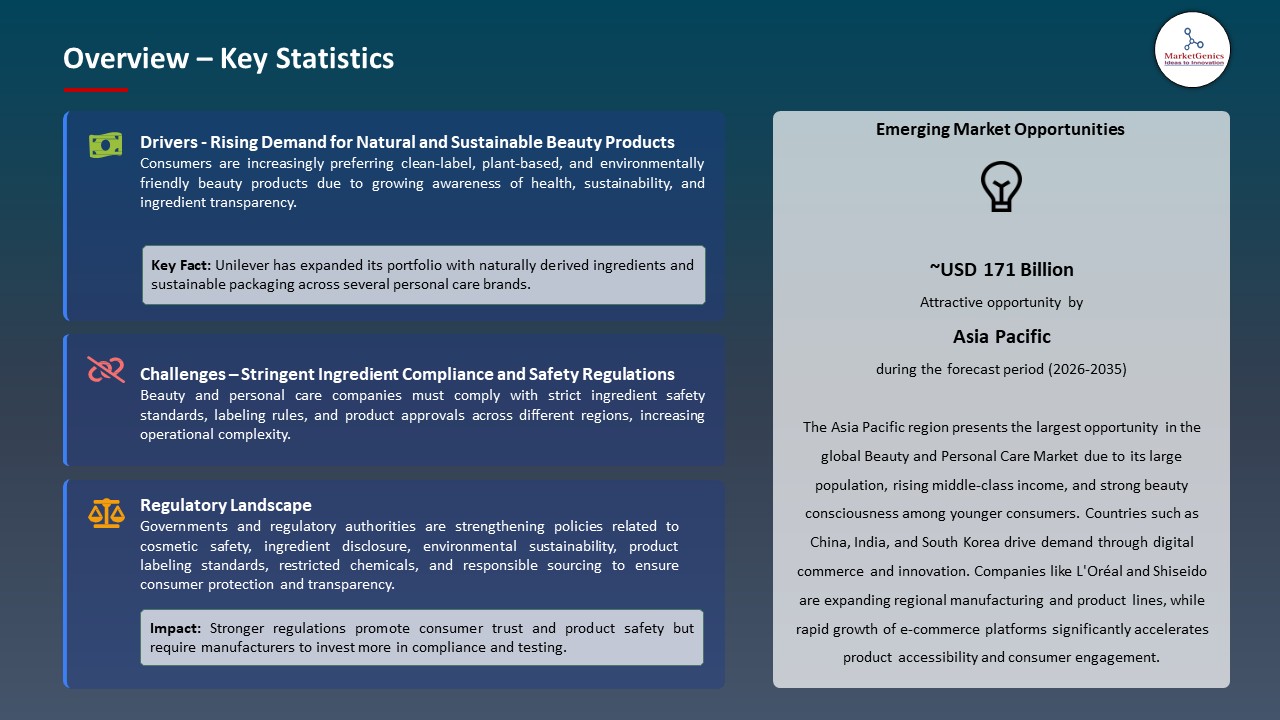
Moreover, the increasing demand of consumers in green products and sustainable packaging is compelling beauty and personal care companies to consider sustainability in their primary strategy, enhancing brand reputation and future market approachability. For instance, in October 2024, Unilever invested more in recyclable, and compostable materials research in its Future Flexibles program to cut down on virgin plastic in beauty and personal care products. This strategy builds consumer confidence and is consistent with regulatory and societal demands toward less impact on the environment.
The global beauty and personal care market present adjacent opportunities in cosmeceuticals, nutraceuticals, personal hygiene products, wellness supplements, and sustainable packaging solutions. These industries experience the positive influence of increasing health awareness, clean-label, and lifestyle consumption. The diversification of revenues through the expansion into these adjacent markets improves brand relevance, increase long-term growth, and supports revenue growth.
 Beauty and Personal Care Market Dynamics and Trends
Driver: Technological Advancements in Beauty Innovation Enhancing Consumer Experience
-
Innovation in beauty technology and AI-based product development is also driving the beauty and personal care market forward, allowing companies to offer more effective and personalized solutions to meet the changing consumer expectations.
- The efforts of major participants are the use of innovative technology that increases product development, consumer interaction, and places companies in the forefront of industry transformation. For instance, in 2025, L’Oréal demonstrated such a trend, introducing AI-based longevity science, real-time skin diagnostics, and immersive digital beauty experiences, which demonstrates its strategic belief in the combination of scientific progress and consumer-centred innovation.
- The strategic use of technology to enable product differentiation, consumer adoption, and support market expansion by matching the supply and demand of personalized, digitally empowered beauty experiences.
Restraint: Persistent Supply Chain and Raw Material Cost Pressures Limiting Expansion
-
Volatile raw material pricing and global supply chain disruptions provide substantial hurdles to the beauty and personal care business, hindering profitability, production planning, and timely new releases, despite strong demand.
- The major producers are experiencing an increase in ingredient costs and supply crunches, which affect the cost structure and could also force the companies to raise their prices to consumers. Such pressures have the disproportionate impact on small players and force bigger companies to take on additional expenses or to run at lower margins, thus restricting the overall market growth.
- Ongoing volatility of the supply chain, and pressure on the cost of raw materials inhibit investment in innovation, slows growth in the market, and compels consideration of operational resilience, as opposed to aggressive growth.
Opportunity: Strategic Acquisition to Expand Global Market Footprint and Local Expertise
-
Strategic acquisitions offer a significant growth prospect in the beauty and personal care industry by availing access to high growth regional markets, availability of high local relevance. For instance, in March 2026, the Estée Lauder Companies fully acquired the Indian Ayurvedic luxury brand Forest Essentials, enhancing its presence in one of the most rapidly expanding beauty markets in the world.
- The acquisition will allow Estee Lauder to capitalize on the cultural heritage and product authenticity of Forest Essentials, and increase distribution worldwide as well as capitalize on high-end demand of natural luxury skincare. The relocation is an example of a regional specialization and portfolio diversification strategy that will enable the company to seize new consumer segments and brand presence in the emerging markets.
- Strategic acquisitions support revenue growth, competitive positioning, and sustainable and long-term market expansion in high-potential markets.
Key Trend: Rise of Hybrid Beauty‑Wellness Products Reflecting Holistic Consumer Preferences
-
The beauty and personal care market are seeing a significant move toward hybrid solutions that combine cosmetic efficacy with wellness and health-supporting advantages, reflecting a growing consumer emphasis on comprehensive self-care. There is a tendency of companies to come up with products that improve the appearance and maintain skin health, stress management, and overall well-being, effectively combining the categories of beauty and well-being.
- The consumer needs to acquire multifunctional items that provide quantifiable health benefits to the consumer combined with appearance enhancement, which is prompting innovation in the multifunctional items (e.g., nutraceutical-added skincare, adaptogen-enhanced formulas, stress-responsive rituals, etc.). The brands that embrace this strategy are able to address emerging demands in the changing lifestyle and distinguish themselves in a competitive market.
- The integration of beauty and wellness expands the market opportunities, attracts health-conscious buyers and enables high pricing of multifunctional and value-added products.
 Beauty and Personal Care Market Analysis and Segmental Data
Skin Care Dominate Global Beauty and Personal Care Market
-
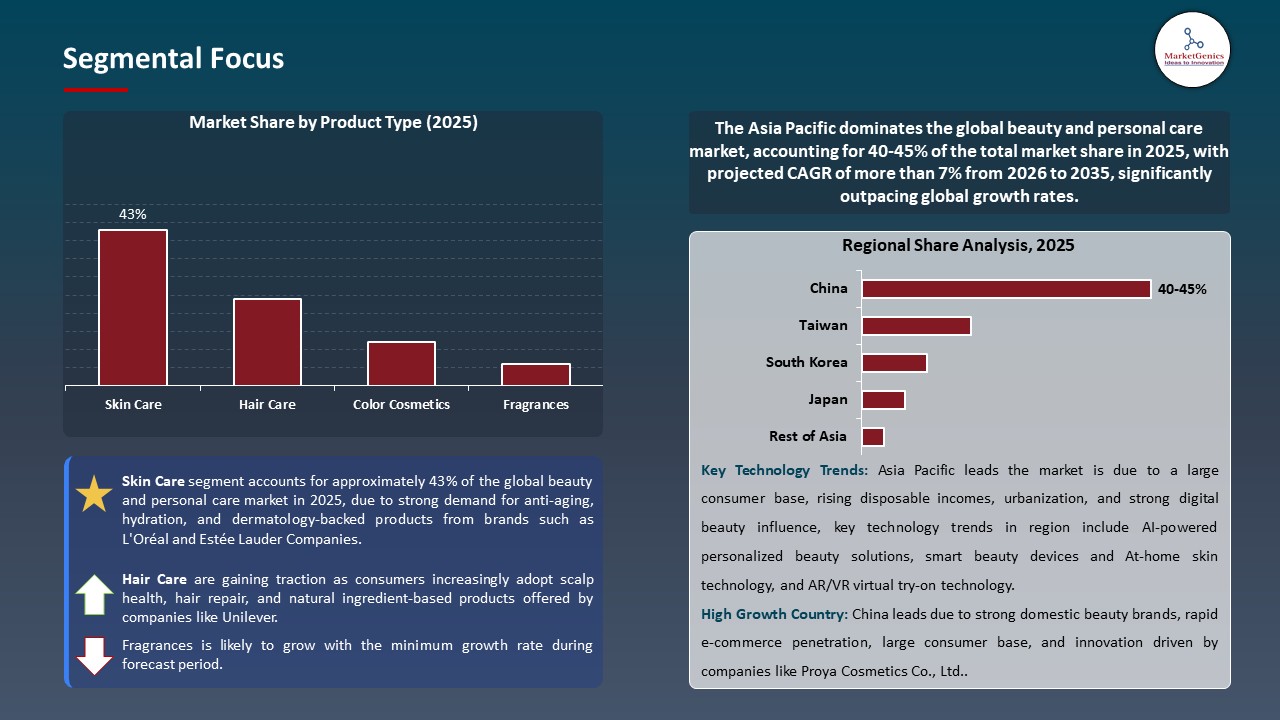
The skin care segment dominates the global beauty and personal care market is driven by the prevalence of consumer interest in anti-aging, hydration, sun protection and customized regimens, and increasing awareness regarding the importance of skin health issues such as pollution, sensitivity and aging.
- In June 2025, L’Oréal acquired a majority stake in British skincare brand Medik8, reinforcing its focus on science-driven, performance-oriented skin solutions. This strategic move enhances L’Oréal’s dermocosmetics portfolio including La Roche‑Posay, CeraVe, and Vichy.
- The dominance of skin care positions a sustained R&D investment, innovation in personalized and clinical solutions, and provides a basis of long-term revenue growth in large beauty manufacturing companies.
Asia Pacific Leads Global Beauty and Personal Care Market Demand
-
Asia Pacific leads the beauty and personal care market is propelled by the growing digital commerce and mobile retail penetration in Asia Pacific is increasing is boosting the sales of beauty and personal care products, expanding consumer access and shopping options, especially among the younger population groups. For instance, Unilever 2025 performance, in which the company stated that personal care volume was highly encouraging due to the contribution of the Asia Pacific market, particularly in Indonesia and China, should be supported with digital interaction and competence.
- Moreover, the increasing trend of premiumization and localized innovation in beauty products is also driving the demand in Asia Pacific as customers desire products that are science-based, culturally adapted. For instance, in Q1 fiscal 2026, Estée Lauder Companies has reported a 4% sales growth year-on-year, with a recovery in Mainland China and Asia Pacific.
- These drivers make Asia Pacific a powerful growth engine, increasing market share and earning revenue by engaging digitally and offering personalized and premium services.
Beauty and Personal Care Market Ecosystem
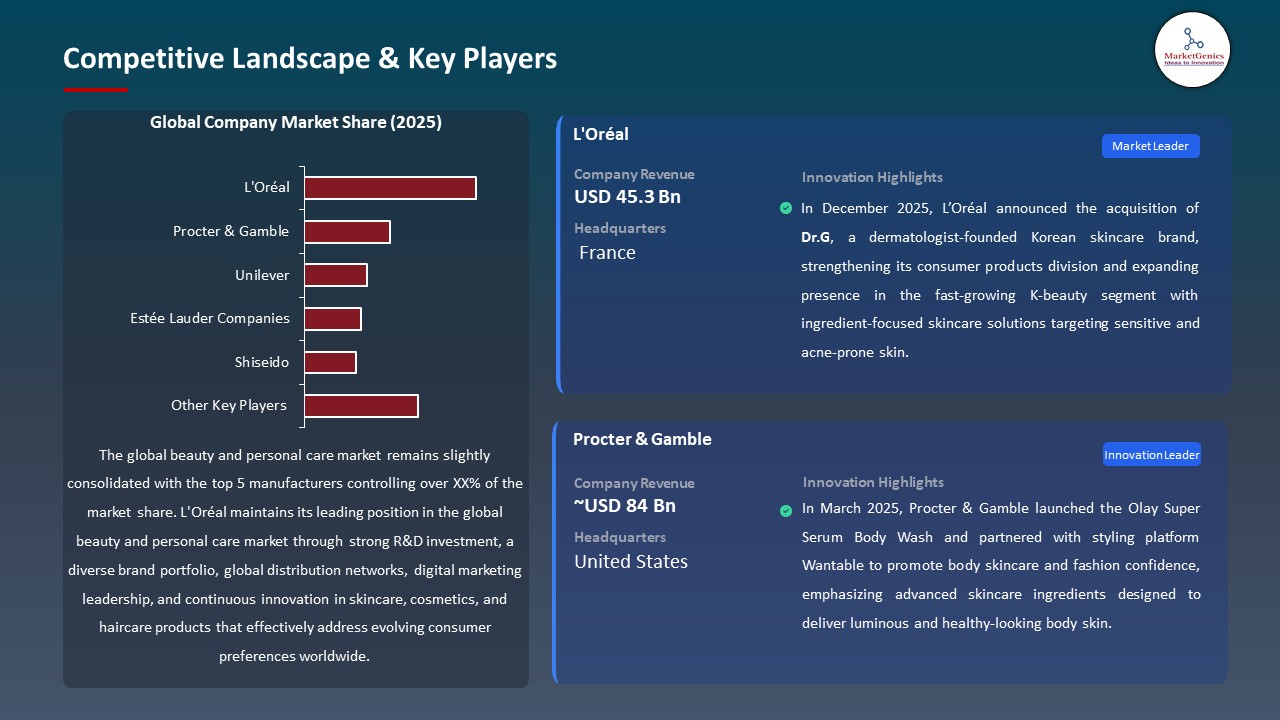
The global beauty and personal care market is slightly consolidated, with leading multinational corporations such as L’Oréal, Procter & Gamble, Unilever, Estée Lauder Companies, and Shiseido dominating global share through robust brand portfolios, extensive distribution networks, and the integration of cutting‑edge technologies into product development and consumer engagement.
These key players increasingly focus on niche technologies and specialized solutions that drive product innovation and differentiation. For example, firms deploy AI‑enabled personalization tools, virtual diagnostics, and advanced biodegradable packaging to meet evolving consumer expectations, while tailor‑made skincare devices and sustainability‑oriented formulations underscore their investment in high‑value segments.
Government bodies and research institutions also contribute to technological advancement in the sector. Regulatory enhancements, such as the European Union’s Cosmetics Regulation 2025/848, enacted in May 2025, mandate greater ingredient transparency and safety standards, prompting manufacturers to innovate responsibly and invest more in compliant, high‑quality solutions.
These regulatory measures have accelerated innovation, improved product safety, and strengthened consumer trust across the beauty and personal care market.
 Recent Development and Strategic Overview:
-
In January 2026, L’Oréal unveiled Cell BioPrint, a lab-on-a-chip diagnostic device that analyzes skin biomarkers and predicts aging patterns within minutes, enabling personalized skincare recommendations and ingredient suitability analysis. The technology uses advanced proteomics and microfluidics to deliver tailored beauty solutions and will initially pilot in Asia
- In June 2025, Procter & Gamble has introduced the Olay Summer Fizz Scent Collection, comprising serum-infused body washes enriched with niacinamide, lipids, and a hyaluronic serum complex. This launch aims to enhance skin hydration and softness while offering seasonal fragrances, further expanding Olay’s premium body-care portfolio.
Report Scope
|
Detail |
|
|
Market Size in 2025 |
USD 638.9 Bn |
|
Market Forecast Value in 2035 |
USD 1070.8 Bn |
|
Growth Rate (CAGR) |
5.3% |
|
Forecast Period |
2026 – 2035 |
|
Historical Data Available for |
2021 – 2024 |
|
Market Size Units |
US$ Billion for Value Thousand Units for Volume |
|
Report Format |
Electronic (PDF) + Excel |
|
North America |
Europe |
Asia Pacific |
Middle East |
Africa |
South America |
|
|
|
|
|
|
|
Companies Covered |
|||||
|
|
|
|
|
|
Beauty and Personal Care Market Segmentation and Highlights
|
Segment |
Sub-segment |
|
Beauty and Personal Care Market, By Product Type |
|
|
Beauty and Personal Care Market, By Gender |
|
|
Beauty and Personal Care Market, By Form |
|
|
Beauty and Personal Care Market, By Ingredient Type |
|
|
Beauty and Personal Care Market, By Consumer Behavior |
|
|
Beauty and Personal Care Market, By Distribution Channel |
|
|
Beauty and Personal Care Market, By End-users |
|
Frequently Asked Questions
Table of Contents
- 1. Research Methodology and Assumptions
- 1.1. Definitions
- 1.2. Research Design and Approach
- 1.3. Data Collection Methods
- 1.4. Base Estimates and Calculations
- 1.5. Forecasting Models
- 1.5.1. Key Forecast Factors & Impact Analysis
- 1.6. Secondary Research
- 1.6.1. Open Sources
- 1.6.2. Paid Databases
- 1.6.3. Associations
- 1.7. Primary Research
- 1.7.1. Primary Sources
- 1.7.2. Primary Interviews with Stakeholders across Ecosystem
- 2. Executive Summary
- 2.1. Global Beauty and Personal Care Market Outlook
- 2.1.1. Beauty and Personal Care Market Size (Volume - Thousand Units and Value - US$ Bn), and Forecasts, 2021-2035
- 2.1.2. Compounded Annual Growth Rate Analysis
- 2.1.3. Growth Opportunity Analysis
- 2.1.4. Segmental Share Analysis
- 2.1.5. Geographical Share Analysis
- 2.2. Market Analysis and Facts
- 2.3. Supply-Demand Analysis
- 2.4. Competitive Benchmarking
- 2.5. Go-to- Market Strategy
- 2.5.1. Customer/ End-use Industry Assessment
- 2.5.2. Growth Opportunity Data, 2026-2035
- 2.5.2.1. Regional Data
- 2.5.2.2. Country Data
- 2.5.2.3. Segmental Data
- 2.5.3. Identification of Potential Market Spaces
- 2.5.4. GAP Analysis
- 2.5.5. Potential Attractive Price Points
- 2.5.6. Prevailing Market Risks & Challenges
- 2.5.7. Preferred Sales & Marketing Strategies
- 2.5.8. Key Recommendations and Analysis
- 2.5.9. A Way Forward
- 2.1. Global Beauty and Personal Care Market Outlook
- 3. Industry Data and Premium Insights
- 3.1. Global Consumer Goods & Services Industry Overview, 2025
- 3.1.1. Consumer Goods & Services Ecosystem Analysis
- 3.1.2. Key Trends for Consumer Goods & Services Industry
- 3.1.3. Regional Distribution for Consumer Goods & Services Industry
- 3.2. Supplier Customer Data
- 3.3. Technology Roadmap and Developments
- 3.4. Trade Analysis
- 3.4.1. Import & Export Analysis, 2025
- 3.4.2. Top Importing Countries
- 3.4.3. Top Exporting Countries
- 3.5. Trump Tariff Impact Analysis
- 3.5.1. Manufacturer
- 3.5.1.1. Based on the component & Raw material
- 3.5.2. Supply Chain
- 3.5.3. End Consumer
- 3.5.1. Manufacturer
- 3.6. Raw Material Analysis
- 3.1. Global Consumer Goods & Services Industry Overview, 2025
- 4. Market Overview
- 4.1. Market Dynamics
- 4.1.1. Drivers
- 4.1.1.1. Rising consumer awareness of personal grooming, hygiene, and self-care
- 4.1.1.2. Increasing demand for natural, organic, and sustainable beauty products
- 4.1.1.3. Rapid growth of e-commerce platforms and social media-driven beauty trends
- 4.1.2. Restraints
- 4.1.2.1. Stringent regulatory requirements and product safety compliance across regions
- 4.1.2.2. High market competition and presence of counterfeit beauty products
- 4.1.1. Drivers
- 4.2. Key Trend Analysis
- 4.3. Regulatory Framework
- 4.3.1. Key Regulations, Norms, and Subsidies, by Key Countries
- 4.3.2. Tariffs and Standards
- 4.3.3. Impact Analysis of Regulations on the Market
- 4.4. Value Chain Analysis
- 4.4.1. Raw Material Suppliers
- 4.4.2. Manufacturers
- 4.4.3. Distribution & Logistics
- 4.4.4. End Consumers
- 4.5. Cost Structure Analysis
- 4.5.1. Parameter’s Share for Cost Associated
- 4.5.2. COGP vs COGS
- 4.5.3. Profit Margin Analysis
- 4.6. Pricing Analysis
- 4.6.1. Regional Pricing Analysis
- 4.6.2. Segmental Pricing Trends
- 4.6.3. Factors Influencing Pricing
- 4.7. Porter’s Five Forces Analysis
- 4.8. PESTEL Analysis
- 4.9. Global Beauty and Personal Care Market Demand
- 4.9.1. Historical Market Size – in Volume (Thousand Units) and Value (US$ Bn), 2020-2024
- 4.9.2. Current and Future Market Size – in Volume (Thousand Units) and Value (US$ Bn), 2026–2035
- 4.9.2.1. Y-o-Y Growth Trends
- 4.9.2.2. Absolute $ Opportunity Assessment
- 4.1. Market Dynamics
- 5. Competition Landscape
- 5.1. Competition structure
- 5.1.1. Fragmented v/s consolidated
- 5.2. Company Share Analysis, 2025
- 5.2.1. Global Company Market Share
- 5.2.2. By Region
- 5.2.2.1. North America
- 5.2.2.2. Europe
- 5.2.2.3. Asia Pacific
- 5.2.2.4. Middle East
- 5.2.2.5. Africa
- 5.2.2.6. South America
- 5.3. Product Comparison Matrix
- 5.3.1. Specifications
- 5.3.2. Market Positioning
- 5.3.3. Pricing
- 5.1. Competition structure
- 6. Global Beauty and Personal Care Market Analysis, by Product Type
- 6.1. Key Segment Analysis
- 6.2. Beauty and Personal Care Market Size (Volume - Thousand Units and Value - US$ Bn), Analysis, and Forecasts, by Product Type, 2021-2035
- 6.2.1. Skin Care
- 6.2.1.1. Face Care
- 6.2.1.2. Body Care
- 6.2.1.3. Specialized Treatments
- 6.2.2. Hair Care
- 6.2.2.1. Shampoos
- 6.2.2.2. Conditioners
- 6.2.2.3. Hair Oils
- 6.2.2.4. Hair Masks & Treatments
- 6.2.2.5. Others
- 6.2.3. Color Cosmetics
- 6.2.3.1. Face Makeup
- 6.2.3.2. Eye Makeup
- 6.2.3.3. Lip Products
- 6.2.3.4. Nail Products
- 6.2.3.5. Others
- 6.2.4. Fragrances
- 6.2.5. Oral Care
- 6.2.6. Grooming Products
- 6.2.7. Bath & Shower Products
- 6.2.1. Skin Care
- 7. Global Beauty and Personal Care Market Analysis, by Gender
- 7.1. Key Segment Analysis
- 7.2. Beauty and Personal Care Market Size (Volume - Thousand Units and Value - US$ Bn), Analysis, and Forecasts, by Gender, 2021-2035
- 7.2.1. Women
- 7.2.2. Men
- 7.2.3. Unisex
- 7.2.4. Kids
- 8. Global Beauty and Personal Care Market Analysis, by Form
- 8.1. Key Segment Analysis
- 8.2. Beauty and Personal Care Market Size (Volume - Thousand Units and Value - US$ Bn), Analysis, and Forecasts, by Form, 2021-2035
- 8.2.1. Liquid
- 8.2.2. Cream/Lotion
- 8.2.3. Gel
- 8.2.4. Powder
- 8.2.5. Spray/Aerosol
- 8.2.6. Others (Foam, Wipes, etc.)
- 9. Global Beauty and Personal Care Market Analysis, by Ingredient Type
- 9.1. Key Segment Analysis
- 9.2. Beauty and Personal Care Market Size (Volume - Thousand Units and Value - US$ Bn), Analysis, and Forecasts, by Ingredient Type, 2021-2035
- 9.2.1. Organic/Natural
- 9.2.2. Synthetic
- 9.2.3. Vegan
- 9.2.4. Hybrid
- 10. Global Beauty and Personal Care Market Analysis, by Consumer Behavior
- 10.1. Key Segment Analysis
- 10.2. Beauty and Personal Care Market Size (Volume - Thousand Units and Value - US$ Bn), Analysis, and Forecasts, by Consumer Behavior, 2021-2035
- 10.2.1. Daily Use
- 10.2.2. Occasional Use
- 10.2.3. Professional Use
- 11. Global Beauty and Personal Care Market Analysis, by Distribution Channel
- 11.1. Key Segment Analysis
- 11.2. Beauty and Personal Care Market Size (Volume - Thousand Units and Value - US$ Bn), Analysis, and Forecasts, by Distribution Channel, 2021-2035
- 11.2.1. Online Retail
- 11.2.1.1. E-commerce Platforms
- 11.2.1.2. Brand Websites
- 11.2.2. Offline Retail
- 11.2.2.1. Hypermarkets & Supermarkets
- 11.2.2.2. Specialty Stores
- 11.2.2.3. Pharmacies & Drugstores
- 11.2.2.4. Direct Selling
- 11.2.2.5. Others
- 11.2.1. Online Retail
- 12. Global Beauty and Personal Care Market Analysis, by End-users
- 12.1. Key Segment Analysis
- 12.2. Beauty and Personal Care Market Size (Volume - Thousand Units and Value - US$ Bn), Analysis, and Forecasts, by End-users, 2021-2035
- 12.2.1. Individual Consumers
- 12.2.1.1. Personal Daily Care
- 12.2.1.2. Special Occasions
- 12.2.1.3. Problem-specific Treatment
- 12.2.1.4. Others
- 12.2.2. Professional Use
- 12.2.2.1. Salon/Spa Services
- 12.2.2.2. Clinical Applications
- 12.2.2.3. Commercial Services
- 12.2.2.4. Makeup Services
- 12.2.2.5. Hair Styling
- 12.2.2.6. Grooming Services
- 12.2.2.7. Others
- 12.2.1. Individual Consumers
- 13. Global Beauty and Personal Care Market Analysis, by Region
- 13.1. Key Findings
- 13.2. Beauty and Personal Care Market Size (Volume - Thousand Units and Value - US$ Bn), Analysis, and Forecasts, by Region, 2021-2035
- 13.2.1. North America
- 13.2.2. Europe
- 13.2.3. Asia Pacific
- 13.2.4. Middle East
- 13.2.5. Africa
- 13.2.6. South America
- 14. North America Beauty and Personal Care Market Analysis
- 14.1. Key Segment Analysis
- 14.2. Regional Snapshot
- 14.3. North America Beauty and Personal Care Market Size (Volume - Thousand Units and Value - US$ Bn), Analysis, and Forecasts, 2021-2035
- 14.3.1. Product Type
- 14.3.2. Gender
- 14.3.3. Form
- 14.3.4. Ingredient Type
- 14.3.5. Consumer Behavior
- 14.3.6. Distribution Channel
- 14.3.7. End-users
- 14.3.8. Country
- 14.3.8.1. USA
- 14.3.8.2. Canada
- 14.3.8.3. Mexico
- 14.4. USA Beauty and Personal Care Market
- 14.4.1. Country Segmental Analysis
- 14.4.2. Product Type
- 14.4.3. Gender
- 14.4.4. Form
- 14.4.5. Ingredient Type
- 14.4.6. Consumer Behavior
- 14.4.7. Distribution Channel
- 14.4.8. End-users
- 14.5. Canada Beauty and Personal Care Market
- 14.5.1. Country Segmental Analysis
- 14.5.2. Product Type
- 14.5.3. Gender
- 14.5.4. Form
- 14.5.5. Ingredient Type
- 14.5.6. Consumer Behavior
- 14.5.7. Distribution Channel
- 14.5.8. End-users
- 14.6. Mexico Beauty and Personal Care Market
- 14.6.1. Country Segmental Analysis
- 14.6.2. Product Type
- 14.6.3. Gender
- 14.6.4. Form
- 14.6.5. Ingredient Type
- 14.6.6. Consumer Behavior
- 14.6.7. Distribution Channel
- 14.6.8. End-users
- 15. Europe Beauty and Personal Care Market Analysis
- 15.1. Key Segment Analysis
- 15.2. Regional Snapshot
- 15.3. Europe Beauty and Personal Care Market Si Size (Volume - Thousand Units and Value - US$ Bn), Analysis, and Forecasts, 2021-2035
- 15.3.1. Product Type
- 15.3.2. Gender
- 15.3.3. Form
- 15.3.4. Ingredient Type
- 15.3.5. Consumer Behavior
- 15.3.6. Distribution Channel
- 15.3.7. End-users
- 15.3.8. Country
- 15.3.8.1. Germany
- 15.3.8.2. United Kingdom
- 15.3.8.3. France
- 15.3.8.4. Italy
- 15.3.8.5. Spain
- 15.3.8.6. Netherlands
- 15.3.8.7. Nordic Countries
- 15.3.8.8. Poland
- 15.3.8.9. Russia & CIS
- 15.3.8.10. Rest of Europe
- 15.4. Germany Beauty and Personal Care Market
- 15.4.1. Country Segmental Analysis
- 15.4.2. Product Type
- 15.4.3. Gender
- 15.4.4. Form
- 15.4.5. Ingredient Type
- 15.4.6. Consumer Behavior
- 15.4.7. Distribution Channel
- 15.4.8. End-users
- 15.5. United Kingdom Beauty and Personal Care Market
- 15.5.1. Country Segmental Analysis
- 15.5.2. Product Type
- 15.5.3. Gender
- 15.5.4. Form
- 15.5.5. Ingredient Type
- 15.5.6. Consumer Behavior
- 15.5.7. Distribution Channel
- 15.5.8. End-users
- 15.6. France Beauty and Personal Care Market
- 15.6.1. Country Segmental Analysis
- 15.6.2. Product Type
- 15.6.3. Gender
- 15.6.4. Form
- 15.6.5. Ingredient Type
- 15.6.6. Consumer Behavior
- 15.6.7. Distribution Channel
- 15.6.8. End-users
- 15.7. Italy Beauty and Personal Care Market
- 15.7.1. Country Segmental Analysis
- 15.7.2. Product Type
- 15.7.3. Gender
- 15.7.4. Form
- 15.7.5. Ingredient Type
- 15.7.6. Consumer Behavior
- 15.7.7. Distribution Channel
- 15.7.8. End-users
- 15.8. Spain Beauty and Personal Care Market
- 15.8.1. Country Segmental Analysis
- 15.8.2. Product Type
- 15.8.3. Gender
- 15.8.4. Form
- 15.8.5. Ingredient Type
- 15.8.6. Consumer Behavior
- 15.8.7. Distribution Channel
- 15.8.8. End-users
- 15.9. Netherlands Beauty and Personal Care Market
- 15.9.1. Country Segmental Analysis
- 15.9.2. Product Type
- 15.9.3. Gender
- 15.9.4. Form
- 15.9.5. Ingredient Type
- 15.9.6. Consumer Behavior
- 15.9.7. Distribution Channel
- 15.9.8. End-users
- 15.10. Nordic Countries Beauty and Personal Care Market
- 15.10.1. Country Segmental Analysis
- 15.10.2. Product Type
- 15.10.3. Gender
- 15.10.4. Form
- 15.10.5. Ingredient Type
- 15.10.6. Consumer Behavior
- 15.10.7. Distribution Channel
- 15.10.8. End-users
- 15.11. Poland Beauty and Personal Care Market
- 15.11.1. Country Segmental Analysis
- 15.11.2. Product Type
- 15.11.3. Gender
- 15.11.4. Form
- 15.11.5. Ingredient Type
- 15.11.6. Consumer Behavior
- 15.11.7. Distribution Channel
- 15.11.8. End-users
- 15.12. Russia & CIS Beauty and Personal Care Market
- 15.12.1. Country Segmental Analysis
- 15.12.2. Product Type
- 15.12.3. Gender
- 15.12.4. Form
- 15.12.5. Ingredient Type
- 15.12.6. Consumer Behavior
- 15.12.7. Distribution Channel
- 15.12.8. End-users
- 15.13. Rest of Europe Beauty and Personal Care Market
- 15.13.1. Country Segmental Analysis
- 15.13.2. Product Type
- 15.13.3. Gender
- 15.13.4. Form
- 15.13.5. Ingredient Type
- 15.13.6. Consumer Behavior
- 15.13.7. Distribution Channel
- 15.13.8. End-users
- 16. Asia Pacific Beauty and Personal Care Market Analysis
- 16.1. Key Segment Analysis
- 16.2. Regional Snapshot
- 16.3. Asia Pacific Beauty and Personal Care Market Size (Volume - Thousand Units and Value - US$ Bn), Analysis, and Forecasts, 2021-2035
- 16.3.1. Product Type
- 16.3.2. Gender
- 16.3.3. Form
- 16.3.4. Ingredient Type
- 16.3.5. Consumer Behavior
- 16.3.6. Distribution Channel
- 16.3.7. End-users
- 16.3.8. Country
- 16.3.8.1. China
- 16.3.8.2. India
- 16.3.8.3. Japan
- 16.3.8.4. South Korea
- 16.3.8.5. Australia and New Zealand
- 16.3.8.6. Indonesia
- 16.3.8.7. Malaysia
- 16.3.8.8. Thailand
- 16.3.8.9. Vietnam
- 16.3.8.10. Rest of Asia Pacific
- 16.4. China Beauty and Personal Care Market
- 16.4.1. Country Segmental Analysis
- 16.4.2. Product Type
- 16.4.3. Gender
- 16.4.4. Form
- 16.4.5. Ingredient Type
- 16.4.6. Consumer Behavior
- 16.4.7. Distribution Channel
- 16.4.8. End-users
- 16.5. India Beauty and Personal Care Market
- 16.5.1. Country Segmental Analysis
- 16.5.2. Product Type
- 16.5.3. Gender
- 16.5.4. Form
- 16.5.5. Ingredient Type
- 16.5.6. Consumer Behavior
- 16.5.7. Distribution Channel
- 16.5.8. End-users
- 16.6. Japan Beauty and Personal Care Market
- 16.6.1. Country Segmental Analysis
- 16.6.2. Product Type
- 16.6.3. Gender
- 16.6.4. Form
- 16.6.5. Ingredient Type
- 16.6.6. Consumer Behavior
- 16.6.7. Distribution Channel
- 16.6.8. End-users
- 16.7. South Korea Beauty and Personal Care Market
- 16.7.1. Country Segmental Analysis
- 16.7.2. Product Type
- 16.7.3. Gender
- 16.7.4. Form
- 16.7.5. Ingredient Type
- 16.7.6. Consumer Behavior
- 16.7.7. Distribution Channel
- 16.7.8. End-users
- 16.8. Australia and New Zealand Beauty and Personal Care Market
- 16.8.1. Country Segmental Analysis
- 16.8.2. Product Type
- 16.8.3. Gender
- 16.8.4. Form
- 16.8.5. Ingredient Type
- 16.8.6. Consumer Behavior
- 16.8.7. Distribution Channel
- 16.8.8. End-users
- 16.9. Indonesia Beauty and Personal Care Market
- 16.9.1. Country Segmental Analysis
- 16.9.2. Product Type
- 16.9.3. Gender
- 16.9.4. Form
- 16.9.5. Ingredient Type
- 16.9.6. Consumer Behavior
- 16.9.7. Distribution Channel
- 16.9.8. End-users
- 16.10. Malaysia Beauty and Personal Care Market
- 16.10.1. Country Segmental Analysis
- 16.10.2. Product Type
- 16.10.3. Gender
- 16.10.4. Form
- 16.10.5. Ingredient Type
- 16.10.6. Consumer Behavior
- 16.10.7. Distribution Channel
- 16.10.8. End-users
- 16.11. Thailand Beauty and Personal Care Market
- 16.11.1. Country Segmental Analysis
- 16.11.2. Product Type
- 16.11.3. Gender
- 16.11.4. Form
- 16.11.5. Ingredient Type
- 16.11.6. Consumer Behavior
- 16.11.7. Distribution Channel
- 16.11.8. End-users
- 16.12. Vietnam Beauty and Personal Care Market
- 16.12.1. Country Segmental Analysis
- 16.12.2. Product Type
- 16.12.3. Gender
- 16.12.4. Form
- 16.12.5. Ingredient Type
- 16.12.6. Consumer Behavior
- 16.12.7. Distribution Channel
- 16.12.8. End-users
- 16.13. Rest of Asia Pacific Beauty and Personal Care Market
- 16.13.1. Country Segmental Analysis
- 16.13.2. Product Type
- 16.13.3. Gender
- 16.13.4. Form
- 16.13.5. Ingredient Type
- 16.13.6. Consumer Behavior
- 16.13.7. Distribution Channel
- 16.13.8. End-users
- 17. Middle East Beauty and Personal Care Market Analysis
- 17.1. Key Segment Analysis
- 17.2. Regional Snapshot
- 17.3. Middle East Beauty and Personal Care Market Size (Volume - Thousand Units and Value - US$ Bn), Analysis, and Forecasts, 2021-2035
- 17.3.1. Product Type
- 17.3.2. Gender
- 17.3.3. Form
- 17.3.4. Ingredient Type
- 17.3.5. Consumer Behavior
- 17.3.6. Distribution Channel
- 17.3.7. End-users
- 17.3.8. Country
- 17.3.8.1. Turkey
- 17.3.8.2. UAE
- 17.3.8.3. Saudi Arabia
- 17.3.8.4. Israel
- 17.3.8.5. Rest of Middle East
- 17.4. Turkey Beauty and Personal Care Market
- 17.4.1. Country Segmental Analysis
- 17.4.2. Product Type
- 17.4.3. Gender
- 17.4.4. Form
- 17.4.5. Ingredient Type
- 17.4.6. Consumer Behavior
- 17.4.7. Distribution Channel
- 17.4.8. End-users
- 17.5. UAE Beauty and Personal Care Market
- 17.5.1. Country Segmental Analysis
- 17.5.2. Product Type
- 17.5.3. Gender
- 17.5.4. Form
- 17.5.5. Ingredient Type
- 17.5.6. Consumer Behavior
- 17.5.7. Distribution Channel
- 17.5.8. End-users
- 17.6. Saudi Arabia Beauty and Personal Care Market
- 17.6.1. Country Segmental Analysis
- 17.6.2. Product Type
- 17.6.3. Gender
- 17.6.4. Form
- 17.6.5. Ingredient Type
- 17.6.6. Consumer Behavior
- 17.6.7. Distribution Channel
- 17.6.8. End-users
- 17.7. Israel Beauty and Personal Care Market
- 17.7.1. Country Segmental Analysis
- 17.7.2. Product Type
- 17.7.3. Gender
- 17.7.4. Form
- 17.7.5. Ingredient Type
- 17.7.6. Consumer Behavior
- 17.7.7. Distribution Channel
- 17.7.8. End-users
- 17.8. Rest of Middle East Beauty and Personal Care Market
- 17.8.1. Country Segmental Analysis
- 17.8.2. Product Type
- 17.8.3. Gender
- 17.8.4. Form
- 17.8.5. Ingredient Type
- 17.8.6. Consumer Behavior
- 17.8.7. Distribution Channel
- 17.8.8. End-users
- 18. Africa Beauty and Personal Care Market Analysis
- 18.1. Key Segment Analysis
- 18.2. Regional Snapshot
- 18.3. Africa Beauty and Personal Care Market Size (Volume - Thousand Units and Value - US$ Bn), Analysis, and Forecasts, 2021-2035
- 18.3.1. Product Type
- 18.3.2. Gender
- 18.3.3. Form
- 18.3.4. Ingredient Type
- 18.3.5. Consumer Behavior
- 18.3.6. Distribution Channel
- 18.3.7. End-users
- 18.3.8. Country
- 18.3.8.1. South Africa
- 18.3.8.2. Egypt
- 18.3.8.3. Nigeria
- 18.3.8.4. Algeria
- 18.3.8.5. Rest of Africa
- 18.4. South Africa Beauty and Personal Care Market
- 18.4.1. Country Segmental Analysis
- 18.4.2. Product Type
- 18.4.3. Gender
- 18.4.4. Form
- 18.4.5. Ingredient Type
- 18.4.6. Consumer Behavior
- 18.4.7. Distribution Channel
- 18.4.8. End-users
- 18.5. Egypt Beauty and Personal Care Market
- 18.5.1. Country Segmental Analysis
- 18.5.2. Product Type
- 18.5.3. Gender
- 18.5.4. Form
- 18.5.5. Ingredient Type
- 18.5.6. Consumer Behavior
- 18.5.7. Distribution Channel
- 18.5.8. End-users
- 18.6. Nigeria Beauty and Personal Care Market
- 18.6.1. Country Segmental Analysis
- 18.6.2. Product Type
- 18.6.3. Gender
- 18.6.4. Form
- 18.6.5. Ingredient Type
- 18.6.6. Consumer Behavior
- 18.6.7. Distribution Channel
- 18.6.8. End-users
- 18.7. Algeria Beauty and Personal Care Market
- 18.7.1. Country Segmental Analysis
- 18.7.2. Product Type
- 18.7.3. Gender
- 18.7.4. Form
- 18.7.5. Ingredient Type
- 18.7.6. Consumer Behavior
- 18.7.7. Distribution Channel
- 18.7.8. End-users
- 18.8. Rest of Africa Beauty and Personal Care Market
- 18.8.1. Country Segmental Analysis
- 18.8.2. Product Type
- 18.8.3. Gender
- 18.8.4. Form
- 18.8.5. Ingredient Type
- 18.8.6. Consumer Behavior
- 18.8.7. Distribution Channel
- 18.8.8. End-users
- 19. South America Beauty and Personal Care Market Analysis
- 19.1. Key Segment Analysis
- 19.2. Regional Snapshot
- 19.3. South America Beauty and Personal Care Market Size (Volume - Thousand Units and Value - US$ Bn), Analysis, and Forecasts, 2021-2035
- 19.3.1. Product Type
- 19.3.2. Gender
- 19.3.3. Form
- 19.3.4. Ingredient Type
- 19.3.5. Consumer Behavior
- 19.3.6. Distribution Channel
- 19.3.7. End-users
- 19.3.8. Country
- 19.3.8.1. Brazil
- 19.3.8.2. Argentina
- 19.3.8.3. Rest of South America
- 19.4. Brazil Beauty and Personal Care Market
- 19.4.1. Country Segmental Analysis
- 19.4.2. Product Type
- 19.4.3. Gender
- 19.4.4. Form
- 19.4.5. Ingredient Type
- 19.4.6. Consumer Behavior
- 19.4.7. Distribution Channel
- 19.4.8. End-users
- 19.5. Argentina Beauty and Personal Care Market
- 19.5.1. Country Segmental Analysis
- 19.5.2. Product Type
- 19.5.3. Gender
- 19.5.4. Form
- 19.5.5. Ingredient Type
- 19.5.6. Consumer Behavior
- 19.5.7. Distribution Channel
- 19.5.8. End-users
- 19.6. Rest of South America Beauty and Personal Care Market
- 19.6.1. Country Segmental Analysis
- 19.6.2. Product Type
- 19.6.3. Gender
- 19.6.4. Form
- 19.6.5. Ingredient Type
- 19.6.6. Consumer Behavior
- 19.6.7. Distribution Channel
- 19.6.8. End-users
- 20. Key Players/ Company Profile
- 20.1. Amorepacific Corporation
- 20.1.1. Company Details/ Overview
- 20.1.2. Company Financials
- 20.1.3. Key Customers and Competitors
- 20.1.4. Business/ Industry Portfolio
- 20.1.5. Product Portfolio/ Specification Details
- 20.1.6. Pricing Data
- 20.1.7. Strategic Overview
- 20.1.8. Recent Developments
- 20.2. Avon Products
- 20.3. Beiersdorf
- 20.4. Chanel, Inc.
- 20.5. Church & Dwight
- 20.6. Colgate-Palmivic
- 20.7. Coty
- 20.8. Estée Lauder Companies
- 20.9. Johnson & Johnson
- 20.10. Kao Corporation
- 20.11. LG H&H Co., Ltd.
- 20.12. L'Oréal
- 20.13. LVMH
- 20.14. Mary Kay
- 20.15. Oriflame Cosmetics SA.
- 20.16. Procter & Gamble
- 20.17. Puig Brands, S.A.
- 20.18. Revlon
- 20.19. Shiseido
- 20.20. Unilever
- 20.21. Other Key Players
- 20.1. Amorepacific Corporation
Note* - This is just tentative list of players. While providing the report, we will cover more number of players based on their revenue and share for each geography
Research Design
Our research design integrates both demand-side and supply-side analysis through a balanced combination of primary and secondary research methodologies. By utilizing both bottom-up and top-down approaches alongside rigorous data triangulation methods, we deliver robust market intelligence that supports strategic decision-making.
MarketGenics' comprehensive research design framework ensures the delivery of accurate, reliable, and actionable market intelligence. Through the integration of multiple research approaches, rigorous validation processes, and expert analysis, we provide our clients with the insights needed to make informed strategic decisions and capitalize on market opportunities.
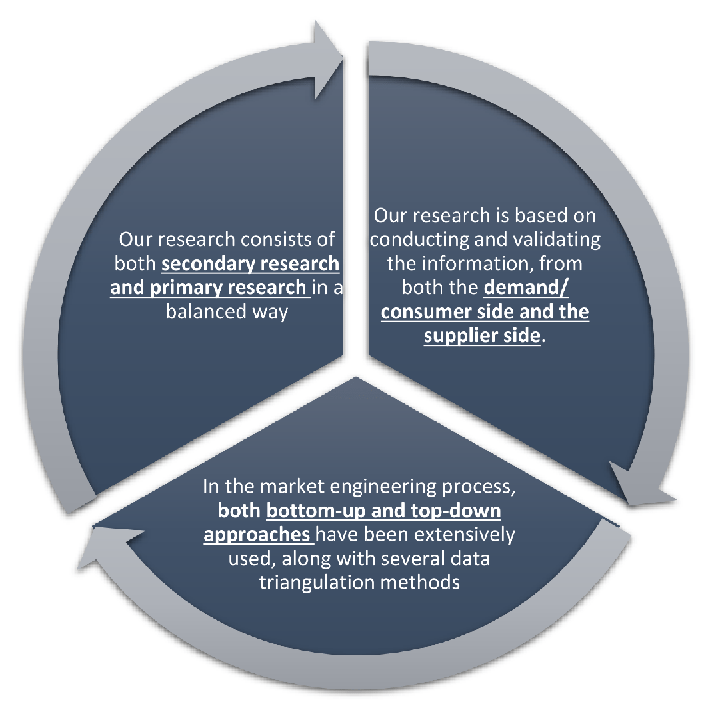
MarketGenics leverages a dedicated industry panel of experts and a comprehensive suite of paid databases to effectively collect, consolidate, and analyze market intelligence.
Our approach has consistently proven to be reliable and effective in generating accurate market insights, identifying key industry trends, and uncovering emerging business opportunities.
Through both primary and secondary research, we capture and analyze critical company-level data such as manufacturing footprints, including technical centers, R&D facilities, sales offices, and headquarters.
Our expert panel further enhances our ability to estimate market size for specific brands based on validated field-level intelligence.
Our data mining techniques incorporate both parametric and non-parametric methods, allowing for structured data collection, sorting, processing, and cleaning.
Demand projections are derived from large-scale data sets analyzed through proprietary algorithms, culminating in robust and reliable market sizing.
Research Approach
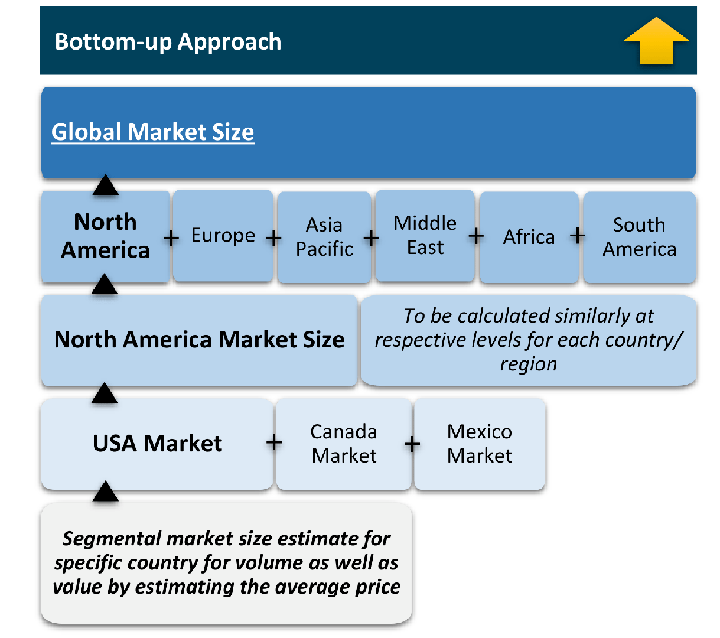
The bottom-up approach builds market estimates by starting with the smallest addressable market units and systematically aggregating them to create comprehensive market size projections.
This method begins with specific, granular data points and builds upward to create the complete market landscape.
Customer Analysis → Segmental Analysis → Geographical Analysis
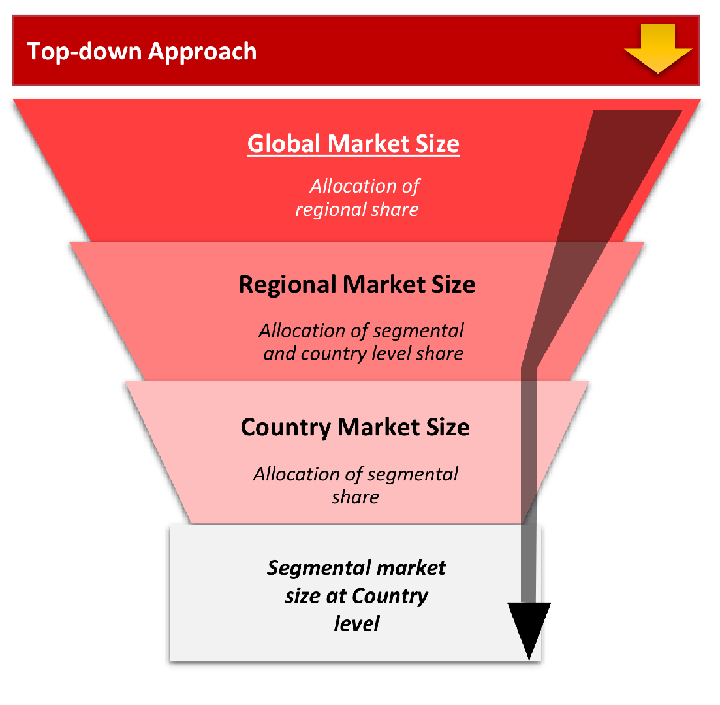
The top-down approach starts with the broadest possible market data and systematically narrows it down through a series of filters and assumptions to arrive at specific market segments or opportunities.
This method begins with the big picture and works downward to increasingly specific market slices.
TAM → SAM → SOM
Research Methods
Desk / Secondary Research
While analysing the market, we extensively study secondary sources, directories, and databases to identify and collect information useful for this technical, market-oriented, and commercial report. Secondary sources that we utilize are not only the public sources, but it is a combination of Open Source, Associations, Paid Databases, MG Repository & Knowledgebase, and others.
- Company websites, annual reports, financial reports, broker reports, and investor presentations
- National government documents, statistical databases and reports
- News articles, press releases and web-casts specific to the companies operating in the market, Magazines, reports, and others
- We gather information from commercial data sources for deriving company specific data such as segmental revenue, share for geography, product revenue, and others
- Internal and external proprietary databases (industry-specific), relevant patent, and regulatory databases
- Governing Bodies, Government Organizations
- Relevant Authorities, Country-specific Associations for Industries
We also employ the model mapping approach to estimate the product level market data through the players' product portfolio
Primary Research
Primary research/ interviews is vital in analyzing the market. Most of the cases involves paid primary interviews. Primary sources include primary interviews through e-mail interactions, telephonic interviews, surveys as well as face-to-face interviews with the different stakeholders across the value chain including several industry experts.
| Type of Respondents | Number of Primaries |
|---|---|
| Tier 2/3 Suppliers | ~20 |
| Tier 1 Suppliers | ~25 |
| End-users | ~25 |
| Industry Expert/ Panel/ Consultant | ~30 |
| Total | ~100 |
MG Knowledgebase
• Repository of industry blog, newsletter and case studies
• Online platform covering detailed market reports, and company profiles
Forecasting Factors and Models
Forecasting Factors
- Historical Trends – Past market patterns, cycles, and major events that shaped how markets behave over time. Understanding past trends helps predict future behavior.
- Industry Factors – Specific characteristics of the industry like structure, regulations, and innovation cycles that affect market dynamics.
- Macroeconomic Factors – Economic conditions like GDP growth, inflation, and employment rates that affect how much money people have to spend.
- Demographic Factors – Population characteristics like age, income, and location that determine who can buy your product.
- Technology Factors – How quickly people adopt new technology and how much technology infrastructure exists.
- Regulatory Factors – Government rules, laws, and policies that can help or restrict market growth.
- Competitive Factors – Analyzing competition structure such as degree of competition and bargaining power of buyers and suppliers.
Forecasting Models / Techniques
Multiple Regression Analysis
- Identify and quantify factors that drive market changes
- Statistical modeling to establish relationships between market drivers and outcomes
Time Series Analysis – Seasonal Patterns
- Understand regular cyclical patterns in market demand
- Advanced statistical techniques to separate trend, seasonal, and irregular components
Time Series Analysis – Trend Analysis
- Identify underlying market growth patterns and momentum
- Statistical analysis of historical data to project future trends
Expert Opinion – Expert Interviews
- Gather deep industry insights and contextual understanding
- In-depth interviews with key industry stakeholders
Multi-Scenario Development
- Prepare for uncertainty by modeling different possible futures
- Creating optimistic, pessimistic, and most likely scenarios
Time Series Analysis – Moving Averages
- Sophisticated forecasting for complex time series data
- Auto-regressive integrated moving average models with seasonal components
Econometric Models
- Apply economic theory to market forecasting
- Sophisticated economic models that account for market interactions
Expert Opinion – Delphi Method
- Harness collective wisdom of industry experts
- Structured, multi-round expert consultation process
Monte Carlo Simulation
- Quantify uncertainty and probability distributions
- Thousands of simulations with varying input parameters
Research Analysis
Our research framework is built upon the fundamental principle of validating market intelligence from both demand and supply perspectives. This dual-sided approach ensures comprehensive market understanding and reduces the risk of single-source bias.
Demand-Side Analysis: We understand end-user/application behavior, preferences, and market needs along with the penetration of the product for specific application.
Supply-Side Analysis: We estimate overall market revenue, analyze the segmental share along with industry capacity, competitive landscape, and market structure.
Validation & Evaluation
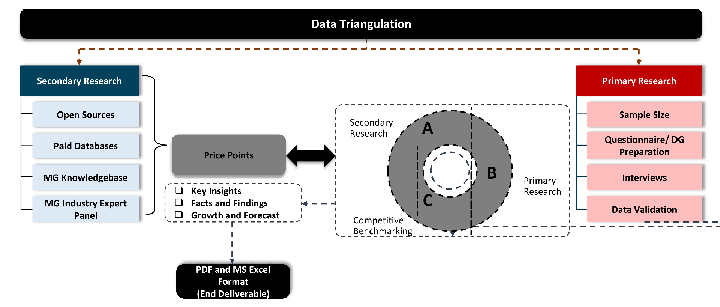
Data triangulation is a validation technique that uses multiple methods, sources, or perspectives to examine the same research question, thereby increasing the credibility and reliability of research findings. In market research, triangulation serves as a quality assurance mechanism that helps identify and minimize bias, validate assumptions, and ensure accuracy in market estimates.
- Data Source Triangulation – Using multiple data sources to examine the same phenomenon
- Methodological Triangulation – Using multiple research methods to study the same research question
- Investigator Triangulation – Using multiple researchers or analysts to examine the same data
- Theoretical Triangulation – Using multiple theoretical perspectives to interpret the same data
Custom Market Research Services
We will customise the research for you, in case the report listed above does not meet your requirements.
Get 10% Free Customisation