E-Commerce Market Size, Share & Trends Analysis Report by Product Category (Fashion & Apparel, Electronics & Media, Home & Furniture, Food & Beverages, Health & Beauty, Sports & Outdoor, Books, Music & Video, Automotive Parts & Accessories, Other Products), Business Model, Transaction Type, Platform Type, Payment Method, Delivery Model, Device Type and Geography (North America, Europe, Asia Pacific, Middle East, Africa, and South America) – Global Industry Data, Trends, and Forecasts, 2026–2035
|
|
|
Segmental Data Insights |
|
|
Demand Trends |
|
|
Competitive Landscape |
|
|
Strategic Development |
|
|
Future Outlook & Opportunities |
|
E-Commerce Market Size, Share, and Growth
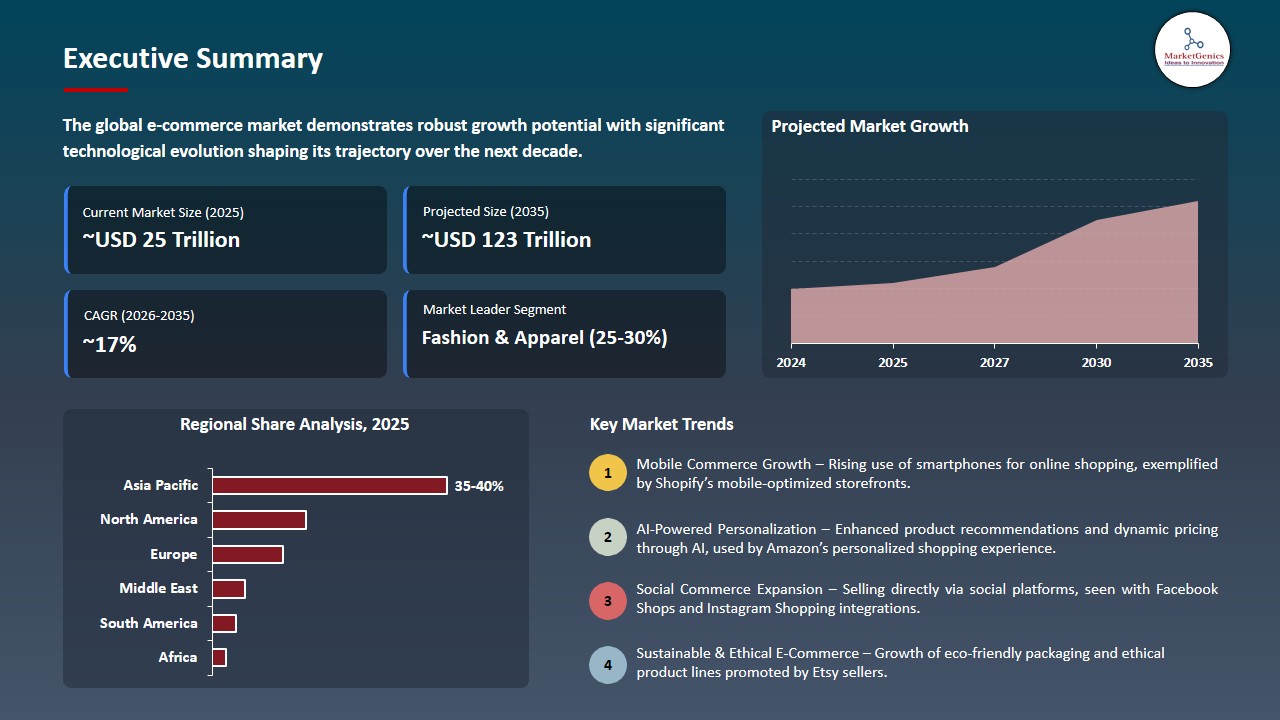
The global e-commerce market is witnessing strong growth, valued at USD 24.8 trillion in 2025 and projected to reach USD 123.3 trillion by 2035, expanding at a CAGR of 17.4% during the forecast period. North America is the fastest-growing region due to advanced digital payment systems, high internet and smartphone penetration, and widespread adoption of omnichannel retail strategies boosting e-commerce sales.
Julie Bornstein, CEO and founder of Daydream, said, “Online shopping today is completely overwhelming and time consuming. Traditional search falls short in fashion because it doesn't understand the nuances of personal taste; by leveraging large language models and combining them with a deep understanding of the fashion space, we're building the online shopping platform of the future”
The development of the e-commerce market is encouraged by the fast development of digital infrastructure, the transformation of consumer behavior, and the evolution of logistics technology. The growing levels of convenience, variety and price transparency of online platforms are becoming more popular among consumers, and retailers are improving their digital channel and fulfilment capacity.
Amazon launched sophisticated AI and robotics in October 2025, including an agentic AI tool, Blue Jay robotics, and Project Eluna, to streamline e-commerce activities. Likewise, in 2024, Shopify released Shopify Editions 2024, introducing AI-based features such as Shopify Sidekick and Shopify Magic to simplify store management, automate content creation, and improve customer experience. These changes depict that technology, fulfilment efficiency, and digital interaction are transforming retail by turning online shopping additional convenient, more intimate, and more obtainable in terms of region and demographics.
The rise of e-commerce opens adjacent opportunities in last-mile delivery services, digital payment solutions, AI-driven logistics, warehouse automation, and online marketing platforms. Businesses can leverage these areas to enhance efficiency, improve customer experience, and capture value from growing digital commerce ecosystems. These adjacent markets fuel e-commerce scalability and profitability.
E-Commerce Market Dynamics and Trends
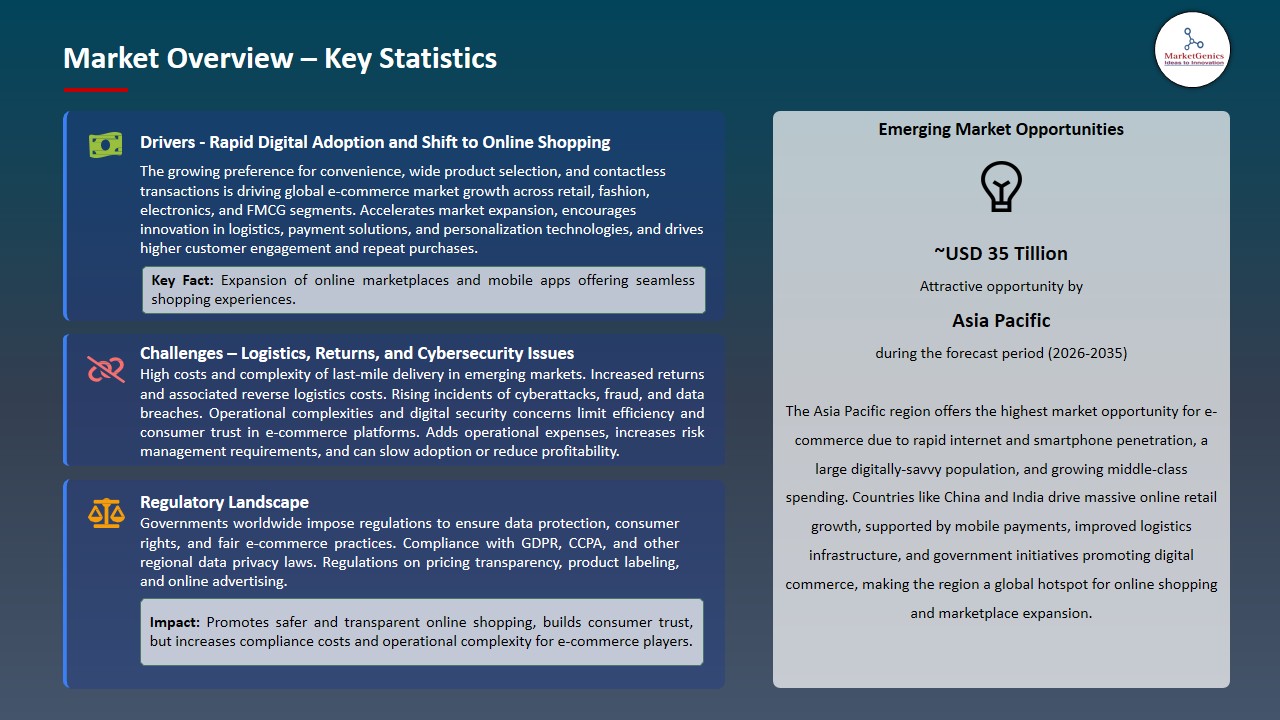
Driver: Rapid Growth of AI-Powered Personalization Enhancing Customer Experiences
-
The need to employ AI-based personalization is fueling the growth of the e-commerce market tremendously. Retailers use AI tools to understand consumer behavior, offer personalized recommendations, and optimize web and application interface to enhance interaction and conversion rates.
- Chatbots, predictive analytics, and dynamically suggested products are some of these solutions that decrease cart abandonment and boost repeat purchase. With the help of their ability to provide tailored shopping behaviors, e-commerce stores have the potential to develop more advanced customer loyalty, attract more substantial average order values, and achieve a competitive edge in the already cluttered online retail marketplace.
- In October 2025, Amazon launched Blue Jay and Project Eluna, which integrates robotics and agentic AI to support front line workers, minimize repetitive work, increase safety, and improve productivity. These innovations streamline the work, make the process of decision-making easier, and expand the previous innovations in AI.
- AI-enabled customization and robotization is improving operational efficiency, elevating customer interactions, and competitive advantage throughout the e-commerce industry.
Restraint: Increasing Cybersecurity Risks Impacting Online Shopping Confidence
-
The increasing online security risks are taking a toll on consumer security in online retailing. Breach of data, phishing, and instances of payment fraud share sensitive personal and financial data, which make shoppers nervous to make a purchase.
- E-commerce sites are under increasing pressure to enhance security measures such as multi factor authentication, encryption and constant monitoring, to protect customer information. Smaller retailers are generally unable to invest in strong cybersecurity measures mostly because of the limited resources, which expose them to attacks and damage their reputation.
- Regulatory pressures, like GDPR and CCPA, only further introduce compliance costs, forcing businesses to invest in security infrastructure and employee education. The inability to sufficiently manage these risks may lead to losing money, losing client trust, and decreasing the pace of digital commerce solution acceptance.
- Cybersecurity issues can decrease the rate of online purchases, and platforms will have to invest heavily in data protection to retain consumer confidence and grow the market.
Opportunity: Expansion of Same-Day Delivery and Logistics Optimization Services Globally
-
The increasing need to deliver products faster is compelling e-commerce firms to increase same-day deliveries and streamline logistic operations. To address consumer demands of speed and convenience, retailers are investing in automated warehouses, AI-assisted route planning and last-mile delivery solutions.
- The trend presents possibilities of collaboration with logistics companies, technology makers, and fulfillment services to make the operations streamlined and less expensive. Organisations taking advantage of such solutions are able to enhance customer satisfaction, boost those who make repeated purchases, and achieve a competitive advantage in the online retail environment in the world marketplace.
- In 2025, Walmart Inc. began to increase the delivery speed in the U.S. using its 4,700-store network to provide ultra-fast delivery, where orders could be fulfilled in less than five minutes and regular deliveries took less than 30 minutes.
- The global e-commerce customer loyalty is improving, increasing sales, and competitive positioning through the ultra-fast delivery projects.
Key Trend: Integration of AI Content Automation Streamlining Merchant Operations Globally
-
Integrating content automation with AI is revolutionizing the e-commerce industry, as it simplifies tasks of merchants and cuts down on manual labor. Currently, retailers have the opportunity to use AI to create product descriptions, optimize listing, email marketing can be automated and customer interaction is personalized, which increases efficiency and consistency across channels.
- The technological trend can provide a faster go-to-market timeline, enhanced SEO performance and scalable content management so that merchants can invest in strategic growth, customer interaction, and innovation in an ever-competitive online retail market.
- Shopify launched Shopify Magic (a collection of AI-based tools) in its product in 2026, in addition to the Sidekick AI assistant, to enable merchants to automate content generation, automate back-end processes, and make decisions informed by data.
- Solutions based on AI can improve operational efficiency, increase sales, and enable the merchants to provide more personalized and competitive e-commerce experiences.
E-Commerce-Market Analysis and Segmental Data
Fashion & Apparel Dominate Global E-Commerce Market
-
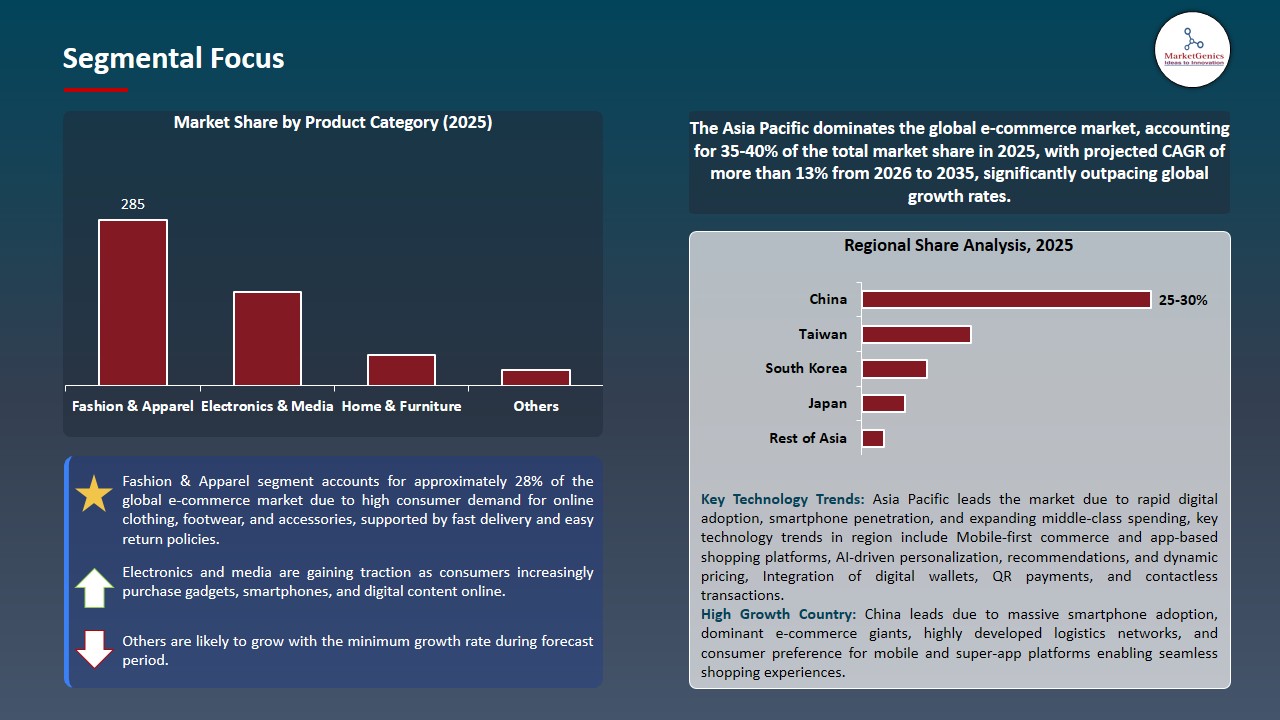
The fashion and apparel industry dominate the entire e-commerce market in the world, recording the highest percentage of the market because of the consumer preference towards the trendy, convenient and personalized shopping experience. The online shopping platforms provide a wide range of clothing, footwear, and accessories with the help of such features as virtual try-on, size advice, and trendy recommendations, contributing to increased customer involvement and satisfaction.
- The growth of the segment is also encouraged by the power of social media, influencer marketing and seasonal sales hence fashion and apparel is the most profitable and competitive industry in the e-commerce sector around the world.
- Daydream introduced its AI-focused chat-based fashion shopping platform in June 2025, with personalized, conversational discovery in almost 2 million products in over 8,000 brands worldwide. The platform uses a natural language understanding and a multimodal AI to play the role of a virtual personal shopper to boost online fashion search and contribute to the customer experience.
- The innovation enhances the fashion e-commerce segment as it enhances increased engagement and personalized shopping experiences as well as higher conversion rates in the global market.
Asia Pacific Leads Global E-Commerce Market Demand
-
The Asia Pacific region is leading in global demand of e-commerce as a result of high rate of digital uptake, large number of smartphones, and growing internet connectivity. The Asian countries like China, India and other nations of Southeast Asia are experiencing a surge of online shopping because of the population that is youthful, techno savvy, and therefore, online shopping is a convenient and favorable option, offering choices and variety.
- The e-commerce is being accelerated by the strong government support of online economies and the growing confidence of consumers in using online payment and delivery systems. The emergence of local and regional online markets, as well as the entry of global markets into the arena, have led to the increased availability of products both in the urban and rural regions.
- Moreover, the consistent growth is maintained by the increasing number of consumers who use faster delivery, tailored suggestions, and combined social shopping experiences. The e-commerce ecosystem is dynamic in the Asia Pacific region making it the largest and most powerful market in the world.
- This leadership makes the Asia Pacific a key growth factor in global e-commerce development.
E-Commerce-Market Ecosystem
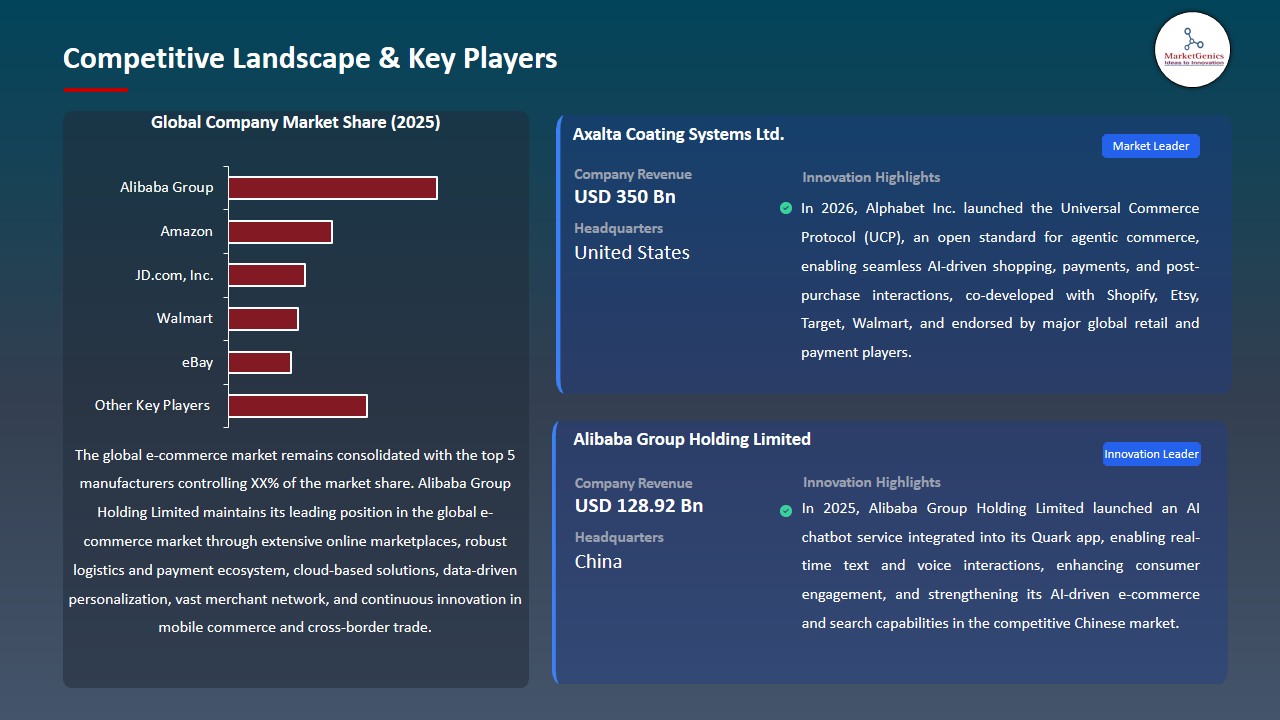
The global e-commerce market is consolidated, with key players including Alibaba Group, Amazon, JD.com, Inc., Walmart, and eBay. The competitive advantages of these companies include online retail portfolios, high-tech digital platform technologies, and comprehensive global logistics and distribution networks. They are strengthened by their consistent investments in AI-based personalization, automated fulfilment, mobile commerce solutions, and strategic partnerships in the retail, payment services and cloud infrastructure spaces.
The e-commerce value chain includes platform development, seller onboarding, digital marketing, product listing and contents management, payment processing, order fulfillment, last mile delivery and post-sale features like returns management, customer support and performance analytics. The stages of it will guarantee smooth user experiences, stability, and durability of consumer and business segments.
The barriers to entry are high because of the technological sophistication, capital-intensive logistics networks, brand loyalty, and long-term relationships with merchants and payment providers. Differentiation, scalability, sustainable growth in global online retailing are a continued innovation of AI-based suggestions, end-day shipping, and mobile-first experiences.
Recent Development and Strategic Overview:
-
In October 2025, JD Logistics announced a five-year plan to deploy three million robots, one million autonomous vehicles, and 100,000 drones, expanding its “Wolf Pack” automation network across warehouses, sorting, transportation, and last-mile delivery in over 20 Chinese provinces and 10 countries, enhancing operational efficiency and next-generation intelligent supply chain capabilities.
- In February 2026, India’s Startup India program partnered with Alibaba.com to help MSMEs expand exports, providing financial and technical support, access to over 50 million global buyers, and B2B marketplace tools. The initiative aims to diversify markets, strengthen international reach, and boost India’s export-driven growth while navigating regulatory restrictions on Chinese consumer apps.
Report Scope
|
Detail |
|
|
Market Size in 2025 |
USD 24.8 Tn |
|
Market Forecast Value in 2035 |
USD 123.3 Tn |
|
Growth Rate (CAGR) |
17.4% |
|
Forecast Period |
2026 – 2035 |
|
Historical Data Available for |
2021 – 2024 |
|
Market Size Units |
US$ Billion for Value |
|
Report Format |
Electronic (PDF) + Excel |
|
North America |
Europe |
Asia Pacific |
Middle East |
Africa |
South America |
|
|
|
|
|
|
|
Companies Covered |
|||||
|
|
|
|
|
|
E-Commerce-Market Segmentation and Highlights
|
Segment |
Sub-segment |
|
E-Commerce Market, By Product Category |
|
|
E-Commerce Market, By Business Model |
|
|
E-Commerce Market, By Transaction Type |
|
|
E-Commerce Market, By Platform Type |
|
|
E-Commerce Market, By Payment Method |
|
|
E-Commerce Market, By Delivery Model |
|
|
E-Commerce Market, By Device Type |
|
Frequently Asked Questions
Table of Contents
- 1. Research Methodology and Assumptions
- 1.1. Definitions
- 1.2. Research Design and Approach
- 1.3. Data Collection Methods
- 1.4. Base Estimates and Calculations
- 1.5. Forecasting Models
- 1.5.1. Key Forecast Factors & Impact Analysis
- 1.6. Secondary Research
- 1.6.1. Open Sources
- 1.6.2. Paid Databases
- 1.6.3. Associations
- 1.7. Primary Research
- 1.7.1. Primary Sources
- 1.7.2. Primary Interviews with Stakeholders across Ecosystem
- 2. Executive Summary
- 2.1. Global E-Commerce Market Outlook
- 2.1.1. E-Commerce Market Size Value (US$ Bn), and Forecasts, 2021-2035
- 2.1.2. Compounded Annual Growth Rate Analysis
- 2.1.3. Growth Opportunity Analysis
- 2.1.4. Segmental Share Analysis
- 2.1.5. Geographical Share Analysis
- 2.2. Market Analysis and Facts
- 2.3. Supply-Demand Analysis
- 2.4. Competitive Benchmarking
- 2.5. Go-to- Market Strategy
- 2.5.1. Customer/ End-use Industry Assessment
- 2.5.2. Growth Opportunity Data, 2026-2035
- 2.5.2.1. Regional Data
- 2.5.2.2. Country Data
- 2.5.2.3. Segmental Data
- 2.5.3. Identification of Potential Market Spaces
- 2.5.4. GAP Analysis
- 2.5.5. Potential Attractive Price Points
- 2.5.6. Prevailing Market Risks & Challenges
- 2.5.7. Preferred Sales & Marketing Strategies
- 2.5.8. Key Recommendations and Analysis
- 2.5.9. A Way Forward
- 2.1. Global E-Commerce Market Outlook
- 3. Industry Data and Premium Insights
- 3.1. Global Consumer Goods & Services Industry Overview, 2025
- 3.1.1. Consumer Goods & Services Industry Ecosystem Analysis
- 3.1.2. Key Trends for Consumer Goods & Services Industry
- 3.1.3. Regional Distribution for Consumer Goods & Services Industry
- 3.2. Supplier Customer Data
- 3.3. Technology Roadmap and Developments
- 3.4. Trade Analysis
- 3.4.1. Import & Export Analysis, 2025
- 3.4.2. Top Importing Countries
- 3.4.3. Top Exporting Countries
- 3.1. Global Consumer Goods & Services Industry Overview, 2025
- 4. Market Overview
- 4.1. Market Dynamics
- 4.1.1. Drivers
- 4.1.1.1. Rapid digital adoption and growing internet and smartphone penetration.
- 4.1.1.2. Increasing consumer preference for convenience, variety, and contactless shopping.
- 4.1.1.3. Expansion of online payment solutions and efficient logistics infrastructure.
- 4.1.2. Restraints
- 4.1.2.1. Cybersecurity risks and data privacy concerns.
- 4.1.2.2. High operational costs and challenges in cross-border logistics.
- 4.1.1. Drivers
- 4.2. Key Trend Analysis
- 4.3. Regulatory Framework
- 4.3.1. Key Regulations, Norms, and Subsidies, by Key Countries
- 4.3.2. Tariffs and Standards
- 4.3.3. Impact Analysis of Regulations on the Market
- 4.4. Value Chain Analysis/ Ecosystem Analysis
- 4.5. Porter’s Five Forces Analysis
- 4.6. PESTEL Analysis
- 4.7. Global E-Commerce Market Demand
- 4.7.1. Historical Market Size – Value (US$ Bn), 2020-2024
- 4.7.2. Current and Future Market Size - Value (US$ Bn), 2026–2035
- 4.7.2.1. Y-o-Y Growth Trends
- 4.7.2.2. Absolute $ Opportunity AssessmenT
- 4.1. Market Dynamics
- 5. Competition Landscape
- 5.1. Competition structure
- 5.1.1. Fragmented v/s consolidated
- 5.2. Company Share Analysis, 2025
- 5.2.1. Global Company Market Share
- 5.2.2. By Region
- 5.2.2.1. North America
- 5.2.2.2. Europe
- 5.2.2.3. Asia Pacific
- 5.2.2.4. Middle East
- 5.2.2.5. Africa
- 5.2.2.6. South America
- 5.3. Product Comparison Matrix
- 5.3.1. Specifications
- 5.3.2. Market Positioning
- 5.3.3. Pricing
- 5.1. Competition structure
- 6. Global E-Commerce Market Analysis, by Product Category
- 6.1. Key Segment Analysis
- 6.2. E-Commerce Market Size Value (US$ Bn), Analysis, and Forecasts, by Product Category, 2021-2035
- 6.2.1. Fashion & Apparel
- 6.2.1.1. Clothing
- 6.2.1.2. Footwear
- 6.2.1.3. Accessories
- 6.2.1.4. Others
- 6.2.2. Electronics & Media
- 6.2.2.1. Consumer Electronics
- 6.2.2.2. Computers & Peripherals
- 6.2.2.3. Entertainment Media
- 6.2.2.4. Others
- 6.2.3. Home & Furniture
- 6.2.3.1. Furniture
- 6.2.3.2. Home Decor
- 6.2.3.3. Kitchen & Dining
- 6.2.3.4. Others
- 6.2.4. Food & Beverages
- 6.2.4.1. Grocery
- 6.2.4.2. Meal Kits
- 6.2.4.3. Specialty Foods
- 6.2.4.4. Others
- 6.2.5. Health & Beauty
- 6.2.5.1. Personal Care
- 6.2.5.2. Cosmetics
- 6.2.5.3. Wellness Products
- 6.2.5.4. Others
- 6.2.6. Sports & Outdoor
- 6.2.7. Books, Music & Video
- 6.2.8. Automotive Parts & Accessories
- 6.2.9. Other Products
- 6.2.1. Fashion & Apparel
- 7. Global E-Commerce Market Analysis, by Business Model
- 7.1. Key Segment Analysis
- 7.2. E-Commerce Market Size Value (US$ Bn), Analysis, and Forecasts, by Business Model, 2021-2035
- 7.2.1. B2C (Business-to-Consumer)
- 7.2.2. B2B (Business-to-Business)
- 7.2.3. C2C (Consumer-to-Consumer)
- 7.2.4. C2B (Consumer-to-Business)
- 8. Global E-Commerce Market Analysis, by Transaction Type
- 8.1. Key Segment Analysis
- 8.2. E-Commerce Market Size Value (US$ Bn), Analysis, and Forecasts, by Transaction Type, 2021-2035
- 8.2.1. Products
- 8.2.1.1. Physical Goods
- 8.2.1.2. Digital Products
- 8.2.2. Services
- 8.2.2.1. Professional Services
- 8.2.2.2. Personal Services
- 8.2.2.3. Subscription Services
- 8.2.1. Products
- 9. Global E-Commerce Market Analysis, by Platform Type
- 9.1. Key Segment Analysis
- 9.2. E-Commerce Market Size Value (US$ Bn), Analysis, and Forecasts, by Platform Type, 2021-2035
- 9.2.1. Online Marketplaces
- 9.2.2. Direct-to-Consumer Websites
- 9.2.3. Social Commerce Platforms
- 9.2.4. Mobile Commerce Applications
- 9.2.5. Others
- 10. Global E-Commerce Market Analysis, by Payment Method
- 10.1. Key Segment Analysis
- 10.2. E-Commerce Market Size Value (US$ Bn), Analysis, and Forecasts, by Payment Method, 2021-2035
- 10.2.1. Credit/Debit Cards
- 10.2.2. Digital Wallets
- 10.2.3. Bank Transfers
- 10.2.4. Cash on Delivery
- 10.2.5. Buy Now Pay Later (BNPL)
- 10.2.6. Cryptocurrency
- 10.2.7. Mobile Payment Solutions
- 10.2.8. Others
- 11. Global E-Commerce Market Analysis, by Delivery Model
- 11.1. Key Segment Analysis
- 11.2. E-Commerce Market Size Value (US$ Bn), Analysis, and Forecasts, by Delivery Model, 2021-2035
- 11.2.1. Standard Shipping
- 11.2.2. Express Delivery
- 11.2.3. Same-Day Delivery
- 11.2.4. Instant Delivery (Quick Commerce)
- 11.2.5. Others
- 12. Global E-Commerce Market Analysis, by Device Type
- 12.1. Key Segment Analysis
- 12.2. E-Commerce Market Size Value (US$ Bn), Analysis, and Forecasts, by Device Type, 2021-2035
- 12.2.1. Desktop/Laptop
- 12.2.2. Smartphones
- 12.2.3. Tablets
- 12.2.4. Wearable Devices
- 12.2.5. PoS Devices
- 12.2.6. Others
- 13. Global E-Commerce Market Analysis and Forecasts, by Region
- 13.1. Key Findings
- 13.2. E-Commerce Market Size Value (US$ Bn), Analysis, and Forecasts, by Region, 2021-2035
- 13.2.1. North America
- 13.2.2. Europe
- 13.2.3. Asia Pacific
- 13.2.4. Middle East
- 13.2.5. Africa
- 13.2.6. South America
- 14. North America E-Commerce Market Analysis
- 14.1. Key Segment Analysis
- 14.2. Regional Snapshot
- 14.3. North America E-Commerce Market Size- Value (US$ Bn), Analysis, and Forecasts, 2021-2035
- 14.3.1. Product Category
- 14.3.2. Business Model
- 14.3.3. Transaction Type
- 14.3.4. Platform Type
- 14.3.5. Payment Method
- 14.3.6. Delivery Model
- 14.3.7. Device Type
- 14.3.8. Country
- 14.3.8.1. USA
- 14.3.8.2. Canada
- 14.3.8.3. Mexico
- 14.4. USA E-Commerce Market
- 14.4.1. Country Segmental Analysis
- 14.4.2. Product Category
- 14.4.3. Business Model
- 14.4.4. Transaction Type
- 14.4.5. Platform Type
- 14.4.6. Payment Method
- 14.4.7. Delivery Model
- 14.4.8. Device Type
- 14.5. Canada E-Commerce Market
- 14.5.1. Country Segmental Analysis
- 14.5.2. Product Category
- 14.5.3. Business Model
- 14.5.4. Transaction Type
- 14.5.5. Platform Type
- 14.5.6. Payment Method
- 14.5.7. Delivery Model
- 14.5.8. Device Type
- 14.6. Mexico E-Commerce Market
- 14.6.1. Country Segmental Analysis
- 14.6.2. Product Category
- 14.6.3. Business Model
- 14.6.4. Transaction Type
- 14.6.5. Platform Type
- 14.6.6. Payment Method
- 14.6.7. Delivery Model
- 14.6.8. Device Type
- 15. Europe E-Commerce Market Analysis
- 15.1. Key Segment Analysis
- 15.2. Regional Snapshot
- 15.3. Europe E-Commerce Market Size Value (US$ Bn), Analysis, and Forecasts, 2021-2035
- 15.3.1. Product Category
- 15.3.2. Business Model
- 15.3.3. Transaction Type
- 15.3.4. Platform Type
- 15.3.5. Payment Method
- 15.3.6. Delivery Model
- 15.3.7. Device Type
- 15.3.8. Country
- 15.3.8.1. Germany
- 15.3.8.2. United Kingdom
- 15.3.8.3. France
- 15.3.8.4. Italy
- 15.3.8.5. Spain
- 15.3.8.6. Netherlands
- 15.3.8.7. Nordic Countries
- 15.3.8.8. Poland
- 15.3.8.9. Russia & CIS
- 15.3.8.10. Rest of Europe
- 15.4. Germany E-Commerce Market
- 15.4.1. Country Segmental Analysis
- 15.4.2. Product Category
- 15.4.3. Business Model
- 15.4.4. Transaction Type
- 15.4.5. Platform Type
- 15.4.6. Payment Method
- 15.4.7. Delivery Model
- 15.4.8. Device Type
- 15.5. United Kingdom E-Commerce Market
- 15.5.1. Country Segmental Analysis
- 15.5.2. Product Category
- 15.5.3. Business Model
- 15.5.4. Transaction Type
- 15.5.5. Platform Type
- 15.5.6. Payment Method
- 15.5.7. Delivery Model
- 15.5.8. Device Type
- 15.6. France E-Commerce Market
- 15.6.1. Country Segmental Analysis
- 15.6.2. Product Category
- 15.6.3. Business Model
- 15.6.4. Transaction Type
- 15.6.5. Platform Type
- 15.6.6. Payment Method
- 15.6.7. Delivery Model
- 15.6.8. Device Type
- 15.7. Italy E-Commerce Market
- 15.7.1. Country Segmental Analysis
- 15.7.2. Product Category
- 15.7.3. Business Model
- 15.7.4. Transaction Type
- 15.7.5. Platform Type
- 15.7.6. Payment Method
- 15.7.7. Delivery Model
- 15.7.8. Device Type
- 15.8. Spain E-Commerce Market
- 15.8.1. Country Segmental Analysis
- 15.8.2. Product Category
- 15.8.3. Business Model
- 15.8.4. Transaction Type
- 15.8.5. Platform Type
- 15.8.6. Payment Method
- 15.8.7. Delivery Model
- 15.8.8. Device Type
- 15.9. Netherlands E-Commerce Market
- 15.9.1. Country Segmental Analysis
- 15.9.2. Product Category
- 15.9.3. Business Model
- 15.9.4. Transaction Type
- 15.9.5. Platform Type
- 15.9.6. Payment Method
- 15.9.7. Delivery Model
- 15.9.8. Device Type
- 15.10. Nordic Countries E-Commerce Market
- 15.10.1. Country Segmental Analysis
- 15.10.2. Product Category
- 15.10.3. Business Model
- 15.10.4. Transaction Type
- 15.10.5. Platform Type
- 15.10.6. Payment Method
- 15.10.7. Delivery Model
- 15.10.8. Device Type
- 15.11. Poland E-Commerce Market
- 15.11.1. Country Segmental Analysis
- 15.11.2. Product Category
- 15.11.3. Business Model
- 15.11.4. Transaction Type
- 15.11.5. Platform Type
- 15.11.6. Payment Method
- 15.11.7. Delivery Model
- 15.11.8. Device Type
- 15.12. Russia & CIS E-Commerce Market
- 15.12.1. Country Segmental Analysis
- 15.12.2. Product Category
- 15.12.3. Business Model
- 15.12.4. Transaction Type
- 15.12.5. Platform Type
- 15.12.6. Payment Method
- 15.12.7. Delivery Model
- 15.12.8. Device Type
- 15.13. Rest of Europe E-Commerce Market
- 15.13.1. Country Segmental Analysis
- 15.13.2. Product Category
- 15.13.3. Business Model
- 15.13.4. Transaction Type
- 15.13.5. Platform Type
- 15.13.6. Payment Method
- 15.13.7. Delivery Model
- 15.13.8. Device Type
- 16. Asia Pacific E-Commerce Market Analysis
- 16.1. Key Segment Analysis
- 16.2. Regional Snapshot
- 16.3. Asia Pacific E-Commerce Market Size Value (US$ Bn), Analysis, and Forecasts, 2021-2035
- 16.3.1. Product Category
- 16.3.2. Business Model
- 16.3.3. Transaction Type
- 16.3.4. Platform Type
- 16.3.5. Payment Method
- 16.3.6. Delivery Model
- 16.3.7. Device Type
- 16.3.8. Country
- 16.3.8.1. China
- 16.3.8.2. India
- 16.3.8.3. Japan
- 16.3.8.4. South Korea
- 16.3.8.5. Australia and New Zealand
- 16.3.8.6. Indonesia
- 16.3.8.7. Malaysia
- 16.3.8.8. Thailand
- 16.3.8.9. Vietnam
- 16.3.8.10. Rest of Asia Pacific
- 16.4. China E-Commerce Market
- 16.4.1. Country Segmental Analysis
- 16.4.2. Product Category
- 16.4.3. Business Model
- 16.4.4. Transaction Type
- 16.4.5. Platform Type
- 16.4.6. Payment Method
- 16.4.7. Delivery Model
- 16.4.8. Device Type
- 16.5. India E-Commerce Market
- 16.5.1. Country Segmental Analysis
- 16.5.2. Product Category
- 16.5.3. Business Model
- 16.5.4. Transaction Type
- 16.5.5. Platform Type
- 16.5.6. Payment Method
- 16.5.7. Delivery Model
- 16.5.8. Device Type
- 16.6. Japan E-Commerce Market
- 16.6.1. Country Segmental Analysis
- 16.6.2. Product Category
- 16.6.3. Business Model
- 16.6.4. Transaction Type
- 16.6.5. Platform Type
- 16.6.6. Payment Method
- 16.6.7. Delivery Model
- 16.6.8. Device Type
- 16.7. South Korea E-Commerce Market
- 16.7.1. Country Segmental Analysis
- 16.7.2. Product Category
- 16.7.3. Business Model
- 16.7.4. Transaction Type
- 16.7.5. Platform Type
- 16.7.6. Payment Method
- 16.7.7. Delivery Model
- 16.7.8. Device Type
- 16.8. Australia and New Zealand E-Commerce Market
- 16.8.1. Country Segmental Analysis
- 16.8.2. Product Category
- 16.8.3. Business Model
- 16.8.4. Transaction Type
- 16.8.5. Platform Type
- 16.8.6. Payment Method
- 16.8.7. Delivery Model
- 16.8.8. Device Type
- 16.9. Indonesia E-Commerce Market
- 16.9.1. Country Segmental Analysis
- 16.9.2. Product Category
- 16.9.3. Business Model
- 16.9.4. Transaction Type
- 16.9.5. Platform Type
- 16.9.6. Payment Method
- 16.9.7. Delivery Model
- 16.9.8. Device Type
- 16.10. Malaysia E-Commerce Market
- 16.10.1. Country Segmental Analysis
- 16.10.2. Product Category
- 16.10.3. Business Model
- 16.10.4. Transaction Type
- 16.10.5. Platform Type
- 16.10.6. Payment Method
- 16.10.7. Delivery Model
- 16.10.8. Device Type
- 16.11. Thailand E-Commerce Market
- 16.11.1. Country Segmental Analysis
- 16.11.2. Product Category
- 16.11.3. Business Model
- 16.11.4. Transaction Type
- 16.11.5. Platform Type
- 16.11.6. Payment Method
- 16.11.7. Delivery Model
- 16.11.8. Device Type
- 16.12. Vietnam E-Commerce Market
- 16.12.1. Country Segmental Analysis
- 16.12.2. Product Category
- 16.12.3. Business Model
- 16.12.4. Transaction Type
- 16.12.5. Platform Type
- 16.12.6. Payment Method
- 16.12.7. Delivery Model
- 16.12.8. Device Type
- 16.13. Rest of Asia Pacific E-Commerce Market
- 16.13.1. Country Segmental Analysis
- 16.13.2. Product Category
- 16.13.3. Business Model
- 16.13.4. Transaction Type
- 16.13.5. Platform Type
- 16.13.6. Payment Method
- 16.13.7. Delivery Model
- 16.13.8. Device Type
- 17. Middle East E-Commerce Market Analysis
- 17.1. Key Segment Analysis
- 17.2. Regional Snapshot
- 17.3. Middle East E-Commerce Market Size Value (US$ Bn), Analysis, and Forecasts, 2021-2035
- 17.3.1. Product Category
- 17.3.2. Business Model
- 17.3.3. Transaction Type
- 17.3.4. Platform Type
- 17.3.5. Payment Method
- 17.3.6. Delivery Model
- 17.3.7. Device Type
- 17.3.8. Country
- 17.3.8.1. Turkey
- 17.3.8.2. UAE
- 17.3.8.3. Saudi Arabia
- 17.3.8.4. Israel
- 17.3.8.5. Rest of Middle East
- 17.4. Turkey E-Commerce Market
- 17.4.1. Country Segmental Analysis
- 17.4.2. Product Category
- 17.4.3. Business Model
- 17.4.4. Transaction Type
- 17.4.5. Platform Type
- 17.4.6. Payment Method
- 17.4.7. Delivery Model
- 17.4.8. Device Type
- 17.5. UAE E-Commerce Market
- 17.5.1. Country Segmental Analysis
- 17.5.2. Product Category
- 17.5.3. Business Model
- 17.5.4. Transaction Type
- 17.5.5. Platform Type
- 17.5.6. Payment Method
- 17.5.7. Delivery Model
- 17.5.8. Device Type
- 17.6. Saudi Arabia E-Commerce Market
- 17.6.1. Country Segmental Analysis
- 17.6.2. Product Category
- 17.6.3. Business Model
- 17.6.4. Transaction Type
- 17.6.5. Platform Type
- 17.6.6. Payment Method
- 17.6.7. Delivery Model
- 17.6.8. Device Type
- 17.7. Israel E-Commerce Market
- 17.7.1. Country Segmental Analysis
- 17.7.2. Product Category
- 17.7.3. Business Model
- 17.7.4. Transaction Type
- 17.7.5. Platform Type
- 17.7.6. Payment Method
- 17.7.7. Delivery Model
- 17.7.8. Device Type
- 17.8. Rest of Middle East E-Commerce Market
- 17.8.1. Country Segmental Analysis
- 17.8.2. Product Category
- 17.8.3. Business Model
- 17.8.4. Transaction Type
- 17.8.5. Platform Type
- 17.8.6. Payment Method
- 17.8.7. Delivery Model
- 17.8.8. Device Type
- 18. Africa E-Commerce Market Analysis
- 18.1. Key Segment Analysis
- 18.2. Regional Snapshot
- 18.3. Africa E-Commerce Market Size Value (US$ Bn), Analysis, and Forecasts, 2021-2035
- 18.3.1. Product Category
- 18.3.2. Business Model
- 18.3.3. Transaction Type
- 18.3.4. Platform Type
- 18.3.5. Payment Method
- 18.3.6. Delivery Model
- 18.3.7. Device Type
- 18.3.8. Country
- 18.3.8.1. South Africa
- 18.3.8.2. Egypt
- 18.3.8.3. Nigeria
- 18.3.8.4. Algeria
- 18.3.8.5. Rest of Africa
- 18.4. South Africa E-Commerce Market
- 18.4.1. Country Segmental Analysis
- 18.4.2. Product Category
- 18.4.3. Business Model
- 18.4.4. Transaction Type
- 18.4.5. Platform Type
- 18.4.6. Payment Method
- 18.4.7. Delivery Model
- 18.4.8. Device Type
- 18.5. Egypt E-Commerce Market
- 18.5.1. Country Segmental Analysis
- 18.5.2. Product Category
- 18.5.3. Business Model
- 18.5.4. Transaction Type
- 18.5.5. Platform Type
- 18.5.6. Payment Method
- 18.5.7. Delivery Model
- 18.5.8. Device Type
- 18.6. Nigeria E-Commerce Market
- 18.6.1. Country Segmental Analysis
- 18.6.2. Product Category
- 18.6.3. Business Model
- 18.6.4. Transaction Type
- 18.6.5. Platform Type
- 18.6.6. Payment Method
- 18.6.7. Delivery Model
- 18.6.8. Device Type
- 18.7. Algeria E-Commerce Market
- 18.7.1. Country Segmental Analysis
- 18.7.2. Product Category
- 18.7.3. Business Model
- 18.7.4. Transaction Type
- 18.7.5. Platform Type
- 18.7.6. Payment Method
- 18.7.7. Delivery Model
- 18.7.8. Device Type
- 18.8. Rest of Africa E-Commerce Market
- 18.8.1. Country Segmental Analysis
- 18.8.2. Product Category
- 18.8.3. Business Model
- 18.8.4. Transaction Type
- 18.8.5. Platform Type
- 18.8.6. Payment Method
- 18.8.7. Delivery Model
- 18.8.8. Device Type
- 19. South America E-Commerce Market Analysis
- 19.1. Key Segment Analysis
- 19.2. Regional Snapshot
- 19.3. South America E-Commerce Market Size Value (US$ Bn), Analysis, and Forecasts, 2021-2035
- 19.3.1. Product Category
- 19.3.2. Business Model
- 19.3.3. Transaction Type
- 19.3.4. Platform Type
- 19.3.5. Payment Method
- 19.3.6. Delivery Model
- 19.3.7. Device Type
- 19.3.8. Country
- 19.3.8.1. Brazil
- 19.3.8.2. Argentina
- 19.3.8.3. Rest of South America
- 19.4. Brazil E-Commerce Market
- 19.4.1. Country Segmental Analysis
- 19.4.2. Product Category
- 19.4.3. Business Model
- 19.4.4. Transaction Type
- 19.4.5. Platform Type
- 19.4.6. Payment Method
- 19.4.7. Delivery Model
- 19.4.8. Device Type
- 19.5. Argentina E-Commerce Market
- 19.5.1. Country Segmental Analysis
- 19.5.2. Product Category
- 19.5.3. Business Model
- 19.5.4. Transaction Type
- 19.5.5. Platform Type
- 19.5.6. Payment Method
- 19.5.7. Delivery Model
- 19.5.8. Device Type
- 19.6. Rest of South America E-Commerce Market
- 19.6.1. Country Segmental Analysis
- 19.6.2. Product Category
- 19.6.3. Business Model
- 19.6.4. Transaction Type
- 19.6.5. Platform Type
- 19.6.6. Payment Method
- 19.6.7. Delivery Model
- 19.6.8. Device Type
- 20. Key Players/ Company Profile
- 20.1. Alibaba Group
- 20.1.1. Company Details/ Overview
- 20.1.2. Company Financials
- 20.1.3. Key Customers and Competitors
- 20.1.4. Business/ Industry Portfolio
- 20.1.5. Product Portfolio/ Specification Details
- 20.1.6. Pricing Data
- 20.1.7. Strategic Overview
- 20.1.8. Recent Developments
- 20.2. Amazon
- 20.3. Best Buy
- 20.4. Costco Wholesale
- 20.5. Coupang
- 20.6. DoorDash
- 20.7. eBay
- 20.8. Etsy
- 20.9. Flipkart
- 20.10. IKEA
- 20.11. JD.com, Inc.
- 20.12. MercadoLibre
- 20.13. Otto Group
- 20.14. Pinduoduo
- 20.15. Rakuten
- 20.16. Shopify
- 20.17. The Home Depot
- 20.18. Walmart
- 20.19. Wayfair
- 20.20. Zalando
- 20.21. Other Key Players
- 20.1. Alibaba Group
Note* - This is just tentative list of players. While providing the report, we will cover more number of players based on their revenue and share for each geography
Research Design
Our research design integrates both demand-side and supply-side analysis through a balanced combination of primary and secondary research methodologies. By utilizing both bottom-up and top-down approaches alongside rigorous data triangulation methods, we deliver robust market intelligence that supports strategic decision-making.
MarketGenics' comprehensive research design framework ensures the delivery of accurate, reliable, and actionable market intelligence. Through the integration of multiple research approaches, rigorous validation processes, and expert analysis, we provide our clients with the insights needed to make informed strategic decisions and capitalize on market opportunities.
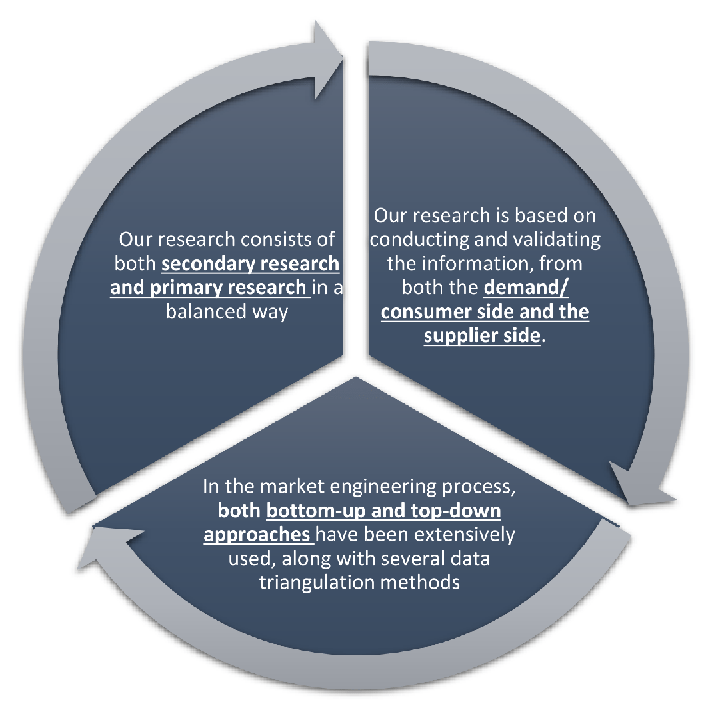
MarketGenics leverages a dedicated industry panel of experts and a comprehensive suite of paid databases to effectively collect, consolidate, and analyze market intelligence.
Our approach has consistently proven to be reliable and effective in generating accurate market insights, identifying key industry trends, and uncovering emerging business opportunities.
Through both primary and secondary research, we capture and analyze critical company-level data such as manufacturing footprints, including technical centers, R&D facilities, sales offices, and headquarters.
Our expert panel further enhances our ability to estimate market size for specific brands based on validated field-level intelligence.
Our data mining techniques incorporate both parametric and non-parametric methods, allowing for structured data collection, sorting, processing, and cleaning.
Demand projections are derived from large-scale data sets analyzed through proprietary algorithms, culminating in robust and reliable market sizing.
Research Approach
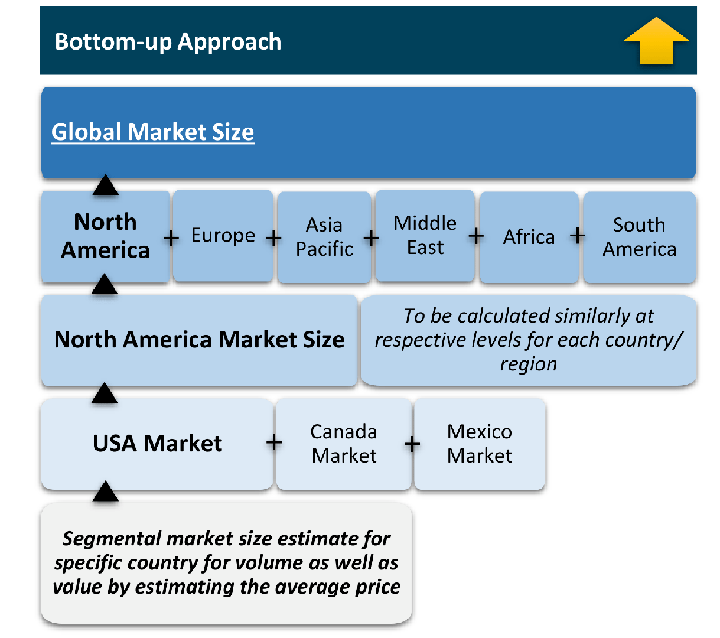
The bottom-up approach builds market estimates by starting with the smallest addressable market units and systematically aggregating them to create comprehensive market size projections.
This method begins with specific, granular data points and builds upward to create the complete market landscape.
Customer Analysis → Segmental Analysis → Geographical Analysis
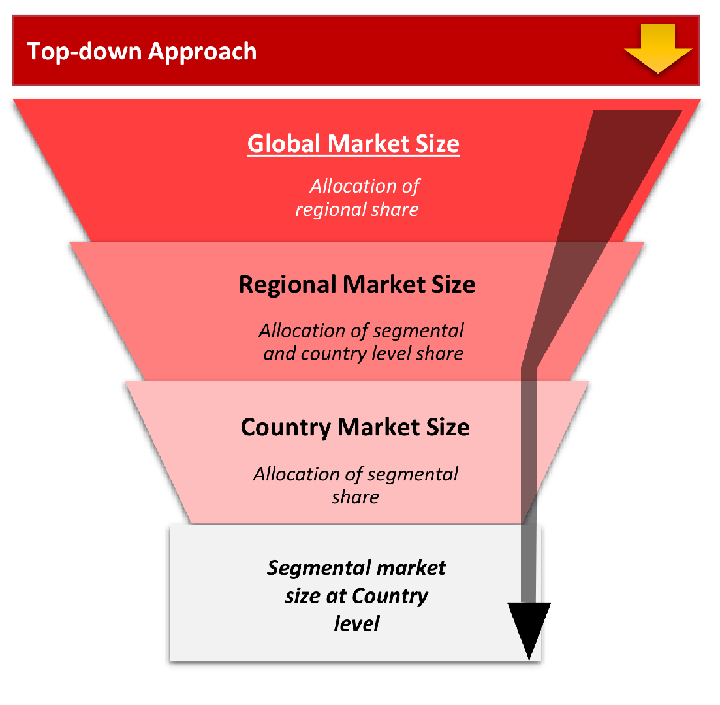
The top-down approach starts with the broadest possible market data and systematically narrows it down through a series of filters and assumptions to arrive at specific market segments or opportunities.
This method begins with the big picture and works downward to increasingly specific market slices.
TAM → SAM → SOM
Research Methods
Desk / Secondary Research
While analysing the market, we extensively study secondary sources, directories, and databases to identify and collect information useful for this technical, market-oriented, and commercial report. Secondary sources that we utilize are not only the public sources, but it is a combination of Open Source, Associations, Paid Databases, MG Repository & Knowledgebase, and others.
- Company websites, annual reports, financial reports, broker reports, and investor presentations
- National government documents, statistical databases and reports
- News articles, press releases and web-casts specific to the companies operating in the market, Magazines, reports, and others
- We gather information from commercial data sources for deriving company specific data such as segmental revenue, share for geography, product revenue, and others
- Internal and external proprietary databases (industry-specific), relevant patent, and regulatory databases
- Governing Bodies, Government Organizations
- Relevant Authorities, Country-specific Associations for Industries
We also employ the model mapping approach to estimate the product level market data through the players' product portfolio
Primary Research
Primary research/ interviews is vital in analyzing the market. Most of the cases involves paid primary interviews. Primary sources include primary interviews through e-mail interactions, telephonic interviews, surveys as well as face-to-face interviews with the different stakeholders across the value chain including several industry experts.
| Type of Respondents | Number of Primaries |
|---|---|
| Tier 2/3 Suppliers | ~20 |
| Tier 1 Suppliers | ~25 |
| End-users | ~25 |
| Industry Expert/ Panel/ Consultant | ~30 |
| Total | ~100 |
MG Knowledgebase
• Repository of industry blog, newsletter and case studies
• Online platform covering detailed market reports, and company profiles
Forecasting Factors and Models
Forecasting Factors
- Historical Trends – Past market patterns, cycles, and major events that shaped how markets behave over time. Understanding past trends helps predict future behavior.
- Industry Factors – Specific characteristics of the industry like structure, regulations, and innovation cycles that affect market dynamics.
- Macroeconomic Factors – Economic conditions like GDP growth, inflation, and employment rates that affect how much money people have to spend.
- Demographic Factors – Population characteristics like age, income, and location that determine who can buy your product.
- Technology Factors – How quickly people adopt new technology and how much technology infrastructure exists.
- Regulatory Factors – Government rules, laws, and policies that can help or restrict market growth.
- Competitive Factors – Analyzing competition structure such as degree of competition and bargaining power of buyers and suppliers.
Forecasting Models / Techniques
Multiple Regression Analysis
- Identify and quantify factors that drive market changes
- Statistical modeling to establish relationships between market drivers and outcomes
Time Series Analysis – Seasonal Patterns
- Understand regular cyclical patterns in market demand
- Advanced statistical techniques to separate trend, seasonal, and irregular components
Time Series Analysis – Trend Analysis
- Identify underlying market growth patterns and momentum
- Statistical analysis of historical data to project future trends
Expert Opinion – Expert Interviews
- Gather deep industry insights and contextual understanding
- In-depth interviews with key industry stakeholders
Multi-Scenario Development
- Prepare for uncertainty by modeling different possible futures
- Creating optimistic, pessimistic, and most likely scenarios
Time Series Analysis – Moving Averages
- Sophisticated forecasting for complex time series data
- Auto-regressive integrated moving average models with seasonal components
Econometric Models
- Apply economic theory to market forecasting
- Sophisticated economic models that account for market interactions
Expert Opinion – Delphi Method
- Harness collective wisdom of industry experts
- Structured, multi-round expert consultation process
Monte Carlo Simulation
- Quantify uncertainty and probability distributions
- Thousands of simulations with varying input parameters
Research Analysis
Our research framework is built upon the fundamental principle of validating market intelligence from both demand and supply perspectives. This dual-sided approach ensures comprehensive market understanding and reduces the risk of single-source bias.
Demand-Side Analysis: We understand end-user/application behavior, preferences, and market needs along with the penetration of the product for specific application.
Supply-Side Analysis: We estimate overall market revenue, analyze the segmental share along with industry capacity, competitive landscape, and market structure.
Validation & Evaluation
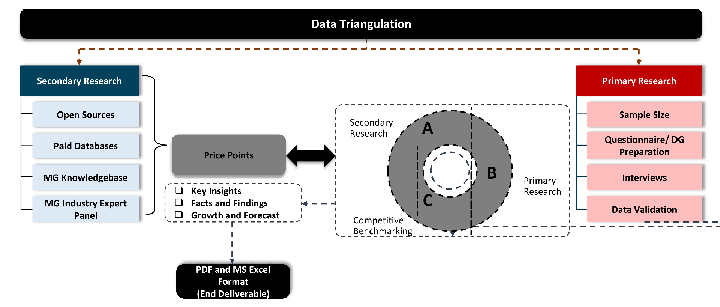
Data triangulation is a validation technique that uses multiple methods, sources, or perspectives to examine the same research question, thereby increasing the credibility and reliability of research findings. In market research, triangulation serves as a quality assurance mechanism that helps identify and minimize bias, validate assumptions, and ensure accuracy in market estimates.
- Data Source Triangulation – Using multiple data sources to examine the same phenomenon
- Methodological Triangulation – Using multiple research methods to study the same research question
- Investigator Triangulation – Using multiple researchers or analysts to examine the same data
- Theoretical Triangulation – Using multiple theoretical perspectives to interpret the same data
Custom Market Research Services
We will customise the research for you, in case the report listed above does not meet your requirements.
Get 10% Free Customisation