Fermentation Technology Market Size, Share & Trends Analysis Report by Product Type (Fermenters & Bioreactors, Accessories (Sensors, Probes, Filters), Control & Monitoring Systems, Media & Reagents, Others), Fermentation Process, Fermentation Type, Microorganism Used, Scale of Operation, Mode of Operation, Technology, Application, End User and Geography (North America, Europe, Asia Pacific, Middle East, Africa, and South America) – Global Industry Data, Trends, and Forecasts, 2026–2035
|
Market Structure & Evolution |
|
|
Segmental Data Insights |
|
|
Demand Trends |
|
|
Competitive Landscape |
|
|
Strategic Development |
|
|
Future Outlook & Opportunities |
|
Fermentation-Technology-Market Size, Share, and Growth
The global fermentation technology market is experiencing robust growth, with its estimated value of USD 21.3 billion in the year 2025 and USD 35.3 billion by the period 2035, registering a CAGR of 5.2% during the forecast period.
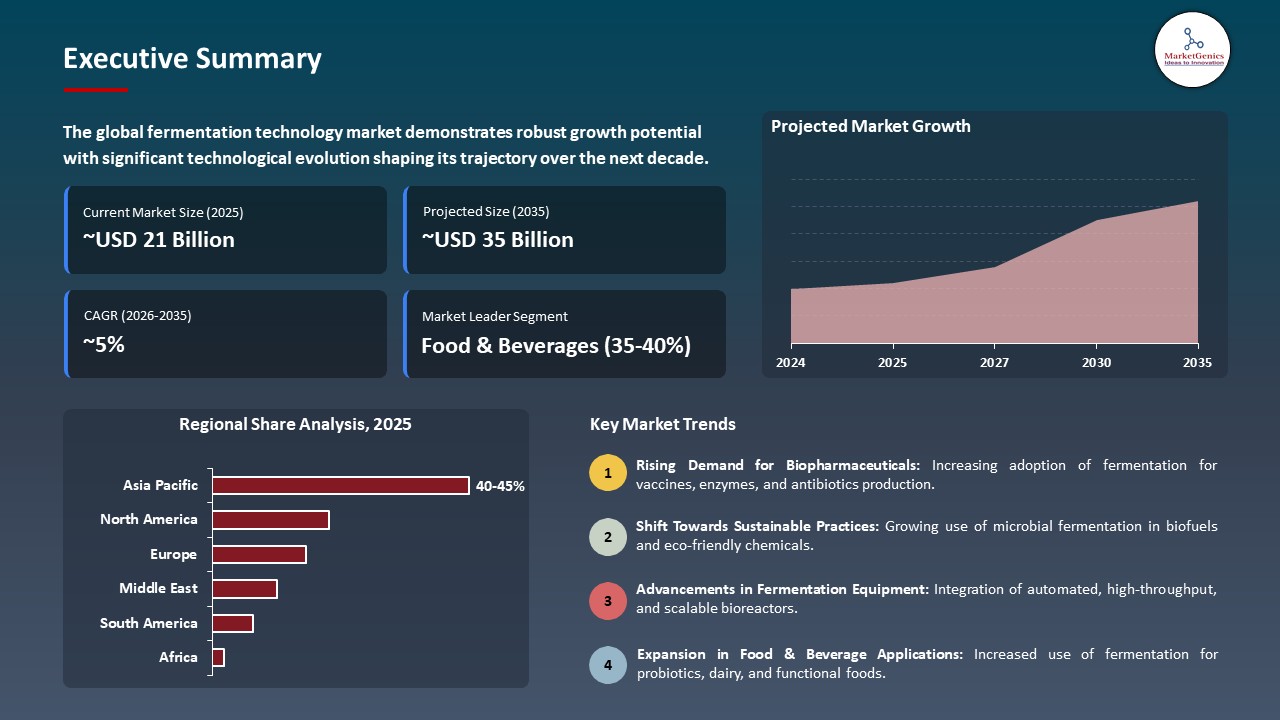
Bosco Emparanza Garca, Founder and CEO of MOA Foodtech, stated, Our new AI, driven Albatros fermentation platform will greatly speed up the development of fermentation, based ingredients, cut production time from months to weeks, and open up new sustainable food solutions, " pointing out how advanced technology is changing the efficiency of fermentation and the commercial scalability of such processes.
The global fermentation technology market is experiencing robust growth, boosted by a variety of factors, among which is the creation of new, more efficient, and scalable fermentation systems that have shown better reliability and productivity.
Moreover, key bioprocess suppliers have prepared automated bioreactors, single-use fermentation systems, and AI, enabled monitoring platforms that precisely control critical parameters such as pH, temperature, and oxygen levels, thus improving yield and consistency. For instance, top life, science equipment manufacturers have been enlarging their next-generation bioreactor portfolios to accommodate the large, scale production of biologics, enzymes, and fermented food ingredients.
Simultaneously, the growing need for biopharmaceuticals, vaccines, probiotics, and bio, based chemicals has further increased the requirement for a state-of-the-art fermentation infrastructure. Moreover, stringent regulatory requirements, including Good Manufacturing Practice (GMP) standards, which are the U.S. Food and Drug Administration and European Medicines Agency's, have made the manufacturers come up with compliant, high, performance fermentation technologies.
Furthermore, the fermentation technology market is unveiling nearby opportunities such as cell-culture media development, downstream processing equipment, bioprocess analytics software, and precision, fermentation platforms, thereby enabling the suppliers to extend their portfolios and grab the additional value throughout the biotechnology ecosystem.
 Fermentation Technology Market Dynamics and Trends
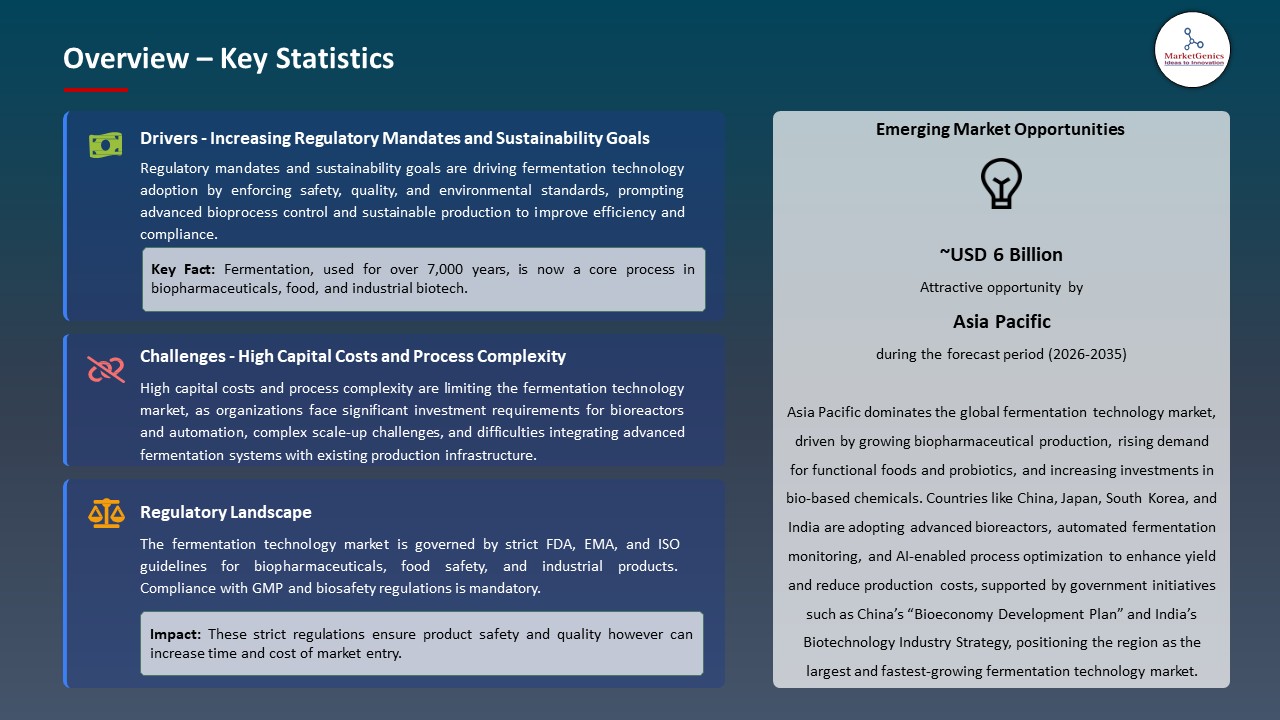
Driver: Increasing Regulatory Mandates and Sustainability Goals Driving Adoption of Advanced Fermentation Technologies
-
The accelerated growth of the fermentation technology market can be attributed to the fact that evolving regulations and sustainable policies on a worldwide basis, such as more stringent GMP guidelines for biopharmaceuticals and increasing government policies aimed at increasing bio-based and low-carbon production, have created strong incentives for food, pharma and chemical manufacturers to convert from traditional fermentation processes to automated and compliant fermentation systems.
- Developments in climate change and sustainability in the EU and Asia-Pacific regions are driving food and pharmaceutical manufacturers to invest in new microbial and precision fermentation technologies. In 2025, several global food and beverage companies have announced plans to open new precision fermentation plants because of regulatory and environmental pressures from these regions.
- Additionally, the continued rise in demand from end consumers for traceability, quality control, and biosafety in all of the health and food supply chains has accelerated the implementation of advanced fermentation platforms across all industry sectors. All these factors are likely to boost the growth of the fermentation technology market.
Restraint: High Capital Costs and Process Complexity Limiting Widespread Adoption
-
Even though market momentum is quite robust, the use of fermentation technology has been limited mainly on account of the high capital expenditure for large scale bioreactors, downstream purification systems, and GMP compliant facilities. Across 2024-2025, several precision fermentation startups in North America and Europe really made public the postponement of their scale up plans due to equipment costs and financing challenges in the context of a more restrictive funding environment.
- The complexity of scale up still remains a significant stumbling block since the continuation of sterility, yield consistency, and contamination control across pilot to commercial scale operation necessitate the involvement of highly skilled specialists and very lengthy validation cycles.
- Simultaneously, adherence to FDA, EMA, and worldwide biosafety regulations raises not only operational costs but also lead times to market, especially for small and medium sized manufacturers. All these elements are expected to restrict the expansion of the fermentation technology market.
Opportunity: Expansion in Emerging Markets and Government-Led Bioeconomy Programs
-
Emerging economies in the Asia Pacific and Latin America regions are stepping up their investments in biotechnology through national bioeconomy and self, reliance programs. India, for instance, has increased its investment in the production of fermentation-based vaccines, enzymes, and bio-inputs as part of its biotechnology and Make in India initiatives in 2025.
- Countries like Brazil and Indonesia are channeling their efforts into the local fermentation infrastructure for the production of biofuels and food ingredients, thereby generating demand for low, cost, modular fermentation systems.
- Equipment suppliers, media developers, and process automation providers are being presented with a great opportunity by these initiatives to set up local production and partnerships. And thus, is expected to create more opportunities in future for fermentation technology market.
Key Trend: Integration of Automation, AI, and Precision Fermentation
-
While fermentation facilities continue to implement AI technology into their control systems for fermentation processes through the use of digital twins, and real-time sensor analytics more effectively manage yield, minimize batch failure, and improve energy usage.
- In 2025, there will be several bioprocess technology providers releasing "smart" bioreactor platforms with predictive analytics and remote monitoring capabilities for continuous fermentation models.
- Precision fermentation is becoming a cornerstone of many producers and is now providing the opportunity to scale produce alternative proteins, specialty fats, enzymes, and bio-based materials on all levels of food and pharmaceutical as well as industrial biotechnology value chains. All these elements are expected to influence significant trends in the fermentation technology market.
 Fermentation Technology Market Analysis and Segmental Data
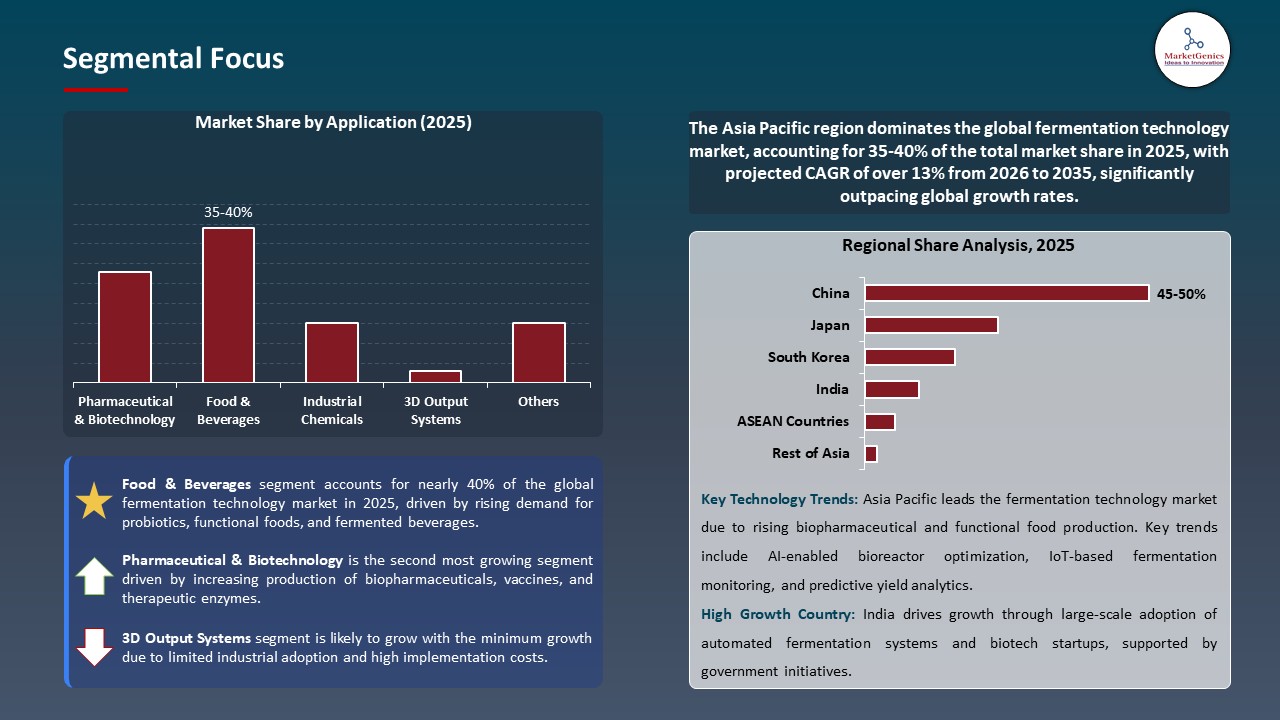
“Food & Beverages Segment Dominates the Global Fermentation Technology Market amid Rising Demand for Functional Foods and Probiotics”
-
Food & Beverages are the most dominant in the global fermentation technology market as consumers demand more functional foods, probiotics, and naturally fermented products for digestive health and immunity. Awareness of gut health has fueled many clean-label and minimally processed foods produced using fermentation methods for use in the manufacture of dairy substitutes, ferments, bread, and nutraceuticals.
- Major food manufacturers have invested in more sophisticated means of producing fermented goods to tap into the flavor benefits, extended shelf life, and enhanced nutritional benefit associated with fermentation; many companies are now producing fermented goods with fewer or no artificial additives. In addition to producing food-grade products, fermented products can be efficiently produced on a large-scale to create vitamins, amino acids, and organic acids.
- Global manufacturers are expanding their precision fermentation-based protein and probiotic portfolios in 2024–2025, which will continue to meet an ever-increasing demand for products. Food safety regulations that support fermentation technology and the ongoing development of improved microbial strains and process automation will also support continued growth and food & beverages will continue to be the leading segment within the fermentation technology market.
“Asia Pacific Dominates the Fermentation Technology Market amid Rapid Industrialization and Expanding Food & Beverage Production”
-
The fermentation technology market is growing rapidly in the Asia-Pacific region, attributed to rapid industrial growth, a large population of food consumers, and a growing trend in the food and beverage industry in China, India, Japan, and Southeast Asia. The increase in demand for fermented foods, functional beverages, probiotics, and plant-derived proteins has accelerated the adoption of microbial fermentation technology.
- Further, the cost-effective availability of raw materials and agricultural feedstocks; combined with low production costs; allows for larger fermentation facilities operating at scale. The support from government for food processing and biotechnology, as well as for sustainable manufacturing practices will help maintain leadership in the market.
- Additionally, regional players have expanded their precision fermentation and enzyme production capabilities for alternative proteins, dairy-free products, and nutraceuticals. The increasing number of investments by many global ingredient suppliers and contract fermentation providers in the Asia-Pacific region has built up local supply chains and enhanced technology transfer.
- The combination of scale of manufacture, demand from consumers and investment in biotechnology will maintain the position of the Asia-Pacific region as the leading region in the global fermentation technology market.
Fermentation Technology Market Ecosystem
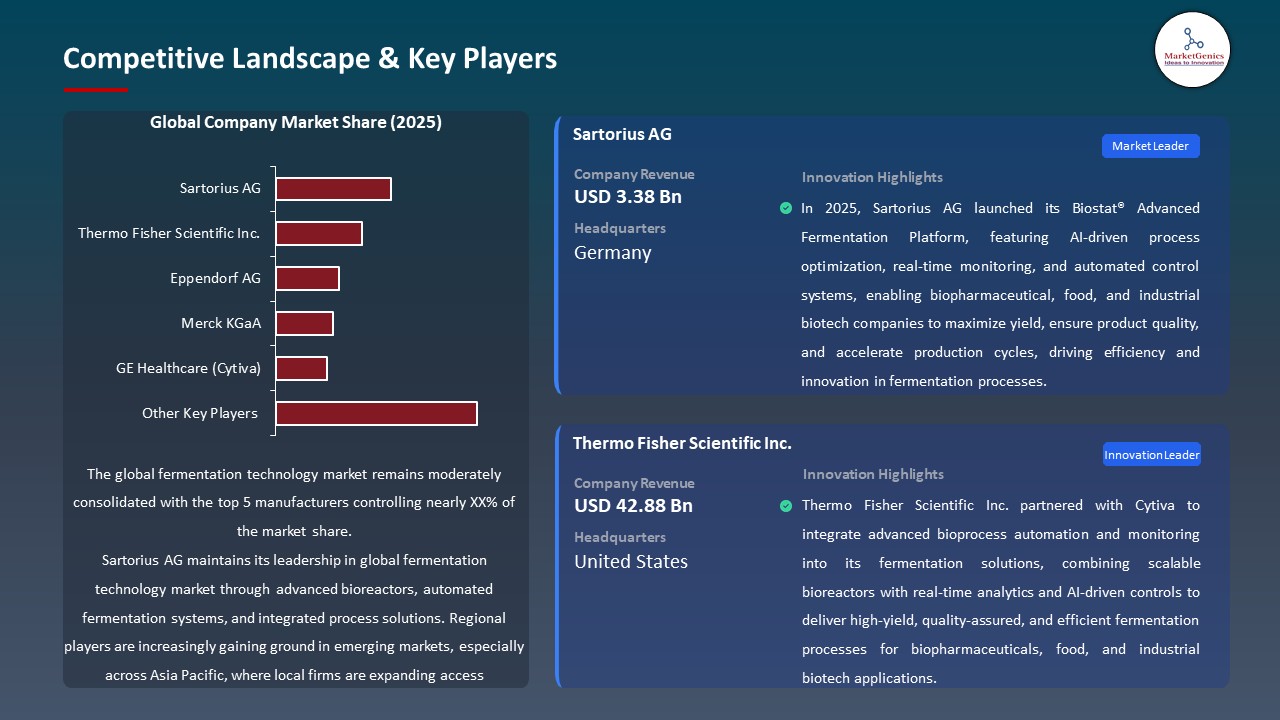
The fermentation technology market is moderately consolidated with a few large players such as Thermo Fisher Scientific Inc., Sartorius AG, Merck KGaA, Eppendorf AG, GE Healthcare (Cytiva), and INFORS HT taking the lead by offering the latest bioprocessing systems, single, use fermenters, and equipment with automated control. These companies use their large scale, strong distribution channels, and continuous product development to keep a competitive advantage in the area of food, pharmaceutical, and industrial biotechnology applications.
Major players are shifting their focus towards more specialized products such as high, precision benchtop fermenters, single, use bioreactors, smart sensors, and software, based process analytics which are compatible with precision fermentation, alternative proteins, and biopharmaceutical manufacturing. This kind of product differentiation helps to speed up process optimization, increase the consistency of yields, and decrease contamination risks.
Government agencies and academia are instrumental as well. For instance, a consortium funded by the European Union's Horizon Europe program developed AI, based fermentation monitoring systems in June 2024, which resulted in improved product consistency and energy savings during large, scale bioprocessing.
Market leaders are mainly putting effort into product variation and combined solutions that meld hardware, consumables, and digital platforms for productivity and efficiency enhancement. In September 2024, an industry and university partnership presented AI, powered fermentation regulation mechanisms which resulted in more than 15% increased batch efficiency, thus automating, AI, and IoT technologies are the main drivers of innovations and the next, gen fermentation process trends.
 Recent Development and Strategic Overview:
-
In July 2025, Bioengineering AG launched their SmartFerment product. SmartFerment uses real-time sensor data combined with machine learning to optimize conditions for the growth of micro-organisms. SmartFerment is designed to allow for predictive control of the pH, temperature and oxygen concentration in fermenters, which can improve the quantity of the final fermented product produced from a fermentation process, reduce the total energy consumed during the process, and reduce the chance that a batch will have to be discarded.
- In September 2025, Merck KGaA launched DigiBioTrack system. The DigiBioTrack system combines all of the steps in the production of a single-use bioreactor into a single system, which includes real-time monitoring of all process parameters, cloud-based data analysis and remote control via the Internet of Things. The DigiBioTrack system allows bioreactor operators to have constant visibility of all the processes being conducted inside their bioreactor.
Report Scope
|
Attribute |
Detail |
|
Market Size in 2025 |
USD 21.3 Bn |
|
Market Forecast Value in 2035 |
USD 35.3 Bn |
|
Growth Rate (CAGR) |
5.2% |
|
Forecast Period |
2026 – 2035 |
|
Historical Data Available for |
2021 – 2024 |
|
Market Size Units |
USD Bn for Value |
|
Report Format |
Electronic (PDF) + Excel |
|
Regions and Countries Covered |
|||||
|
North America |
Europe |
Asia Pacific |
Middle East |
Africa |
South America |
|
|
|
|
|
|
|
Companies Covered |
|||||
|
|
|
|
|
|
Fermentation Technology Market Segmentation and Highlights
|
Segment |
Sub-segment |
|
Fermentation Technology Market, By Product Type |
|
|
Fermentation Technology Market, By Fermentation Process |
|
|
Fermentation Technology Market, By Fermentation Type |
|
|
Fermentation Technology Market, By Microorganism Used |
|
|
Fermentation Technology Market, By Scale of Operation |
|
|
Fermentation Technology Market, By Mode of Operation |
|
|
Fermentation Technology Market, By Technology |
|
|
Fermentation Technology Market, By Application |
|
|
Fermentation Technology Market, By End User |
|
Frequently Asked Questions
Table of Contents
- 1. Research Methodology and Assumptions
- 1.1. Definitions
- 1.2. Research Design and Approach
- 1.3. Data Collection Methods
- 1.4. Base Estimates and Calculations
- 1.5. Forecasting Models
- 1.5.1. Key Forecast Factors & Impact Analysis
- 1.6. Secondary Research
- 1.6.1. Open Sources
- 1.6.2. Paid Databases
- 1.6.3. Associations
- 1.7. Primary Research
- 1.7.1. Primary Sources
- 1.7.2. Primary Interviews with Stakeholders across Ecosystem
- 2. Executive Summary
- 2.1. Global Fermentation Technology Market Outlook
- 2.1.1. Fermentation Technology Market Size (Value - US$ Bn), and Forecasts, 2021-2035
- 2.1.2. Compounded Annual Growth Rate Analysis
- 2.1.3. Growth Opportunity Analysis
- 2.1.4. Segmental Share Analysis
- 2.1.5. Geographical Share Analysis
- 2.2. Market Analysis and Facts
- 2.3. Supply-Demand Analysis
- 2.4. Competitive Benchmarking
- 2.5. Go-to- Market Strategy
- 2.5.1. Customer/ End-use Industry Assessment
- 2.5.2. Growth Opportunity Data, 2026-2035
- 2.5.2.1. Regional Data
- 2.5.2.2. Country Data
- 2.5.2.3. Segmental Data
- 2.5.3. Identification of Potential Market Spaces
- 2.5.4. GAP Analysis
- 2.5.5. Potential Attractive Price Points
- 2.5.6. Prevailing Market Risks & Challenges
- 2.5.7. Preferred Sales & Marketing Strategies
- 2.5.8. Key Recommendations and Analysis
- 2.5.9. A Way Forward
- 2.1. Global Fermentation Technology Market Outlook
- 3. Industry Data and Premium Insights
- 3.1. Global Food & Beverages Industry Overview, 2025
- 3.1.1. Food & Beverages Industry Analysis
- 3.1.2. Key Trends for Food & Beverages Industry
- 3.1.3. Regional Distribution for Food & Beverages Industry
- 3.2. Supplier Customer Data
- 3.3. Technology Roadmap and Developments
- 3.1. Global Food & Beverages Industry Overview, 2025
- 4. Market Overview
- 4.1. Market Dynamics
- 4.1.1. Drivers
- 4.1.1.1. Growing production of vaccines, biologics, enzymes, and recombinant proteins using fermentation processes.
- 4.1.1.2. Increasing adoption of precision fermentation for alternative proteins, probiotics, and clean-label food ingredients.
- 4.1.1.3. Integration of automated bioreactors, AI-driven process optimization, and real-time monitoring systems.
- 4.1.2. Restraints
- 4.1.2.1. Significant investment required for fermentation equipment, scale-up, and regulatory compliance.
- 4.1.2.2. Strict GMP, biosafety, and quality standards can increase time-to-market and development costs.
- 4.1.1. Drivers
- 4.2. Key Trend Analysis
- 4.3. Regulatory Framework
- 4.3.1. Key Regulations, Norms, and Subsidies, by Key Countries
- 4.3.2. Tariffs and Standards
- 4.3.3. Impact Analysis of Regulations on the Market
- 4.4. Value Chain Analysis
- 4.4.1. Component Suppliers
- 4.4.2. System Integrators/ Technology Providers
- 4.4.3. Fermentation Technology Providers
- 4.4.4. End Users
- 4.5. Cost Structure Analysis
- 4.6. Porter’s Five Forces Analysis
- 4.7. PESTEL Analysis
- 4.8. Global Fermentation Technology Market Demand
- 4.8.1. Historical Market Size –Value (US$ Bn), 2020-2024
- 4.8.2. Current and Future Market Size –Value (US$ Bn), 2026–2035
- 4.8.2.1. Y-o-Y Growth Trends
- 4.8.2.2. Absolute $ Opportunity Assessment
- 4.1. Market Dynamics
- 5. Competition Landscape
- 5.1. Competition structure
- 5.1.1. Fragmented v/s consolidated
- 5.2. Company Share Analysis, 2025
- 5.2.1. Global Company Market Share
- 5.2.2. By Region
- 5.2.2.1. North America
- 5.2.2.2. Europe
- 5.2.2.3. Asia Pacific
- 5.2.2.4. Middle East
- 5.2.2.5. Africa
- 5.2.2.6. South America
- 5.3. Product Comparison Matrix
- 5.3.1. Specifications
- 5.3.2. Market Positioning
- 5.3.3. Pricing
- 5.1. Competition structure
- 6. Global Fermentation Technology Market Analysis, by Product Type
- 6.1. Key Segment Analysis
- 6.2. Fermentation Technology Market Size (Value - US$ Bn), Analysis, and Forecasts, by Product Type, 2021-2035
- 6.2.1. Fermenters & Bioreactors
- 6.2.2. Accessories (Sensors, Probes, Filters)
- 6.2.3. Control & Monitoring Systems
- 6.2.4. Media & Reagents
- 6.2.5. Others
- 7. Global Fermentation Technology Market Analysis, by Fermentation Process
- 7.1. Key Segment Analysis
- 7.2. Fermentation Technology Market Size (Value - US$ Bn), Analysis, and Forecasts, by Fermentation Process, 2021-2035
- 7.2.1. Batch Fermentation
- 7.2.2. Fed-Batch Fermentation
- 7.2.3. Continuous Fermentation
- 8. Global Fermentation Technology Market Analysis, by Fermentation Type
- 8.1. Key Segment Analysis
- 8.2. Fermentation Technology Market Size (Value - US$ Bn), Analysis, and Forecasts, by Fermentation Type, 2021-2035
- 8.2.1. Aerobic Fermentation
- 8.2.2. Anaerobic Fermentation
- 9. Global Fermentation Technology Market Analysis, by Microorganism Used
- 9.1. Key Segment Analysis
- 9.2. Fermentation Technology Market Size (Value - US$ Bn), Analysis, and Forecasts, by Microorganism Used, 2021-2035
- 9.2.1. Bacteria
- 9.2.2. Yeast
- 9.2.3. Fungi
- 9.2.4. Algae
- 9.2.5. Mixed Cultures
- 9.2.6. Others
- 10. Global Fermentation Technology Market Analysis, by Scale of Operation
- 10.1. Key Segment Analysis
- 10.2. Fermentation Technology Market Size (Value - US$ Bn), Analysis, and Forecasts, by Scale of Operation, 2021-2035
- 10.2.1. Laboratory Scale
- 10.2.2. Pilot Scale
- 10.2.3. Industrial/Commercial Scale
- 10.2.4. Others
- 11. Global Fermentation Technology Market Analysis, by Mode of Operation
- 11.1. Key Segment Analysis
- 11.2. Fermentation Technology Market Size (Value - US$ Bn), Analysis, and Forecasts, by Mode of Operation, 2021-2035
- 11.2.1. Automated Fermentation Systems
- 11.2.2. Semi-Automated Fermentation Systems
- 11.2.3. Manual Fermentation Systems
- 12. Global Fermentation Technology Market Analysis, by Technology
- 12.1. Key Segment Analysis
- 12.2. Fermentation Technology Market Size (Value - US$ Bn), Analysis, and Forecasts, by Technology, 2021-2035
- 12.2.1. Conventional Fermentation Technology
- 12.2.2. Precision Fermentation
- 12.2.3. Solid-State Fermentation
- 12.2.4. Submerged Fermentation
- 12.2.5. Others
- 13. Global Fermentation Technology Market Analysis, by Application
- 13.1. Key Segment Analysis
- 13.2. Fermentation Technology Market Size (Value - US$ Bn), Analysis, and Forecasts, by Application, 2021-2035
- 13.2.1. Pharmaceutical & Biotechnology
- 13.2.2. Food & Beverages
- 13.2.3. Industrial Chemicals
- 13.2.4. Biofuels & Bioenergy
- 13.2.5. Agriculture
- 13.2.6. Environmental Applications
- 13.2.7. 3D Output Systems
- 13.2.8. Others
- 14. Global Fermentation Technology Market Analysis, by End User
- 14.1. Key Segment Analysis
- 14.2. Fermentation Technology Market Size (Value - US$ Bn), Analysis, and Forecasts, by End User, 2021-2035
- 14.2.1. Pharmaceutical & Biotech Companies
- 14.2.2. Food & Beverage Manufacturers
- 14.2.3. Contract Research & Manufacturing Organizations (CROs/CMOs)
- 14.2.4. Academic & Research Institutes
- 14.2.5. Industrial Manufacturers
- 14.2.6. Others
- 15. Global Fermentation Technology Market Analysis and Forecasts, by Region
- 15.1. Key Findings
- 15.2. Fermentation Technology Market Size (Value - US$ Bn), Analysis, and Forecasts, by Region, 2021-2035
- 15.2.1. North America
- 15.2.2. Europe
- 15.2.3. Asia Pacific
- 15.2.4. Middle East
- 15.2.5. Africa
- 15.2.6. South America
- 16. North America Fermentation Technology Market Analysis
- 16.1. Key Segment Analysis
- 16.2. Regional Snapshot
- 16.3. North America Fermentation Technology Market Size (Value - US$ Bn), Analysis, and Forecasts, 2021-2035
- 16.3.1. Product Type
- 16.3.2. Fermentation Process
- 16.3.3. Fermentation Type
- 16.3.4. Microorganism Used
- 16.3.5. Scale of Operation
- 16.3.6. Mode of Operation
- 16.3.7. Technology
- 16.3.8. Application
- 16.3.9. End User
- 16.3.10. Country
- 16.3.10.1. USA
- 16.3.10.2. Canada
- 16.3.10.3. Mexico
- 16.4. USA Fermentation Technology Market
- 16.4.1. Country Segmental Analysis
- 16.4.2. Product Type
- 16.4.3. Fermentation Process
- 16.4.4. Fermentation Type
- 16.4.5. Microorganism Used
- 16.4.6. Scale of Operation
- 16.4.7. Mode of Operation
- 16.4.8. Technology
- 16.4.9. Application
- 16.4.10. End User
- 16.5. Canada Fermentation Technology Market
- 16.5.1. Country Segmental Analysis
- 16.5.2. Product Type
- 16.5.3. Fermentation Process
- 16.5.4. Fermentation Type
- 16.5.5. Microorganism Used
- 16.5.6. Scale of Operation
- 16.5.7. Mode of Operation
- 16.5.8. Technology
- 16.5.9. Application
- 16.5.10. End User
- 16.6. Mexico Fermentation Technology Market
- 16.6.1. Country Segmental Analysis
- 16.6.2. Product Type
- 16.6.3. Fermentation Process
- 16.6.4. Fermentation Type
- 16.6.5. Microorganism Used
- 16.6.6. Scale of Operation
- 16.6.7. Mode of Operation
- 16.6.8. Technology
- 16.6.9. Application
- 16.6.10. End User
- 17. Europe Fermentation Technology Market Analysis
- 17.1. Key Segment Analysis
- 17.2. Regional Snapshot
- 17.3. Europe Fermentation Technology Market Size (Value - US$ Bn), Analysis, and Forecasts, 2021-2035
- 17.3.1. Product Type
- 17.3.2. Fermentation Process
- 17.3.3. Fermentation Type
- 17.3.4. Microorganism Used
- 17.3.5. Scale of Operation
- 17.3.6. Mode of Operation
- 17.3.7. Technology
- 17.3.8. Application
- 17.3.9. End User
- 17.3.10. Country
- 17.3.10.1. Germany
- 17.3.10.2. United Kingdom
- 17.3.10.3. France
- 17.3.10.4. Italy
- 17.3.10.5. Spain
- 17.3.10.6. Netherlands
- 17.3.10.7. Nordic Countries
- 17.3.10.8. Poland
- 17.3.10.9. Russia & CIS
- 17.3.10.10. Rest of Europe
- 17.4. Germany Fermentation Technology Market
- 17.4.1. Country Segmental Analysis
- 17.4.2. Product Type
- 17.4.3. Fermentation Process
- 17.4.4. Fermentation Type
- 17.4.5. Microorganism Used
- 17.4.6. Scale of Operation
- 17.4.7. Mode of Operation
- 17.4.8. Technology
- 17.4.9. Application
- 17.4.10. End User
- 17.5. United Kingdom Fermentation Technology Market
- 17.5.1. Country Segmental Analysis
- 17.5.2. Product Type
- 17.5.3. Fermentation Process
- 17.5.4. Fermentation Type
- 17.5.5. Microorganism Used
- 17.5.6. Scale of Operation
- 17.5.7. Mode of Operation
- 17.5.8. Technology
- 17.5.9. Application
- 17.5.10. End User
- 17.6. France Fermentation Technology Market
- 17.6.1. Country Segmental Analysis
- 17.6.2. Product Type
- 17.6.3. Fermentation Process
- 17.6.4. Fermentation Type
- 17.6.5. Microorganism Used
- 17.6.6. Scale of Operation
- 17.6.7. Mode of Operation
- 17.6.8. Technology
- 17.6.9. Application
- 17.6.10. End User
- 17.7. Italy Fermentation Technology Market
- 17.7.1. Country Segmental Analysis
- 17.7.2. Product Type
- 17.7.3. Fermentation Process
- 17.7.4. Fermentation Type
- 17.7.5. Microorganism Used
- 17.7.6. Scale of Operation
- 17.7.7. Mode of Operation
- 17.7.8. Technology
- 17.7.9. Application
- 17.7.10. End User
- 17.8. Spain Fermentation Technology Market
- 17.8.1. Country Segmental Analysis
- 17.8.2. Product Type
- 17.8.3. Fermentation Process
- 17.8.4. Fermentation Type
- 17.8.5. Microorganism Used
- 17.8.6. Scale of Operation
- 17.8.7. Mode of Operation
- 17.8.8. Technology
- 17.8.9. Application
- 17.8.10. End User
- 17.9. Netherlands Fermentation Technology Market
- 17.9.1. Country Segmental Analysis
- 17.9.2. Product Type
- 17.9.3. Fermentation Process
- 17.9.4. Fermentation Type
- 17.9.5. Microorganism Used
- 17.9.6. Scale of Operation
- 17.9.7. Mode of Operation
- 17.9.8. Technology
- 17.9.9. Application
- 17.9.10. End User
- 17.10. Nordic Countries Fermentation Technology Market
- 17.10.1. Country Segmental Analysis
- 17.10.2. Product Type
- 17.10.3. Fermentation Process
- 17.10.4. Fermentation Type
- 17.10.5. Microorganism Used
- 17.10.6. Scale of Operation
- 17.10.7. Mode of Operation
- 17.10.8. Technology
- 17.10.9. Application
- 17.10.10. End User
- 17.11. Poland Fermentation Technology Market
- 17.11.1. Country Segmental Analysis
- 17.11.2. Product Type
- 17.11.3. Fermentation Process
- 17.11.4. Fermentation Type
- 17.11.5. Microorganism Used
- 17.11.6. Scale of Operation
- 17.11.7. Mode of Operation
- 17.11.8. Technology
- 17.11.9. Application
- 17.11.10. End User
- 17.12. Russia & CIS Fermentation Technology Market
- 17.12.1. Country Segmental Analysis
- 17.12.2. Product Type
- 17.12.3. Fermentation Process
- 17.12.4. Fermentation Type
- 17.12.5. Microorganism Used
- 17.12.6. Scale of Operation
- 17.12.7. Mode of Operation
- 17.12.8. Technology
- 17.12.9. Application
- 17.12.10. End User
- 17.13. Rest of Europe Fermentation Technology Market
- 17.13.1. Country Segmental Analysis
- 17.13.2. Product Type
- 17.13.3. Fermentation Process
- 17.13.4. Fermentation Type
- 17.13.5. Microorganism Used
- 17.13.6. Scale of Operation
- 17.13.7. Mode of Operation
- 17.13.8. Technology
- 17.13.9. Application
- 17.13.10. End User
- 18. Asia Pacific Fermentation Technology Market Analysis
- 18.1. Key Segment Analysis
- 18.2. Regional Snapshot
- 18.3. Asia Pacific Fermentation Technology Market Size (Value - US$ Bn), Analysis, and Forecasts, 2021-2035
- 18.3.1. Product Type
- 18.3.2. Fermentation Process
- 18.3.3. Fermentation Type
- 18.3.4. Microorganism Used
- 18.3.5. Scale of Operation
- 18.3.6. Mode of Operation
- 18.3.7. Technology
- 18.3.8. Application
- 18.3.9. End User
- 18.3.10. Country
- 18.3.10.1. China
- 18.3.10.2. India
- 18.3.10.3. Japan
- 18.3.10.4. South Korea
- 18.3.10.5. Australia and New Zealand
- 18.3.10.6. Indonesia
- 18.3.10.7. Malaysia
- 18.3.10.8. Thailand
- 18.3.10.9. Vietnam
- 18.3.10.10. Rest of Asia Pacific
- 18.4. China Fermentation Technology Market
- 18.4.1. Country Segmental Analysis
- 18.4.2. Product Type
- 18.4.3. Fermentation Process
- 18.4.4. Fermentation Type
- 18.4.5. Microorganism Used
- 18.4.6. Scale of Operation
- 18.4.7. Mode of Operation
- 18.4.8. Technology
- 18.4.9. Application
- 18.4.10. End User
- 18.5. India Fermentation Technology Market
- 18.5.1. Country Segmental Analysis
- 18.5.2. Product Type
- 18.5.3. Fermentation Process
- 18.5.4. Fermentation Type
- 18.5.5. Microorganism Used
- 18.5.6. Scale of Operation
- 18.5.7. Mode of Operation
- 18.5.8. Technology
- 18.5.9. Application
- 18.5.10. End User
- 18.6. Japan Fermentation Technology Market
- 18.6.1. Country Segmental Analysis
- 18.6.2. Product Type
- 18.6.3. Fermentation Process
- 18.6.4. Fermentation Type
- 18.6.5. Microorganism Used
- 18.6.6. Scale of Operation
- 18.6.7. Mode of Operation
- 18.6.8. Technology
- 18.6.9. Application
- 18.6.10. End User
- 18.7. South Korea Fermentation Technology Market
- 18.7.1. Country Segmental Analysis
- 18.7.2. Product Type
- 18.7.3. Fermentation Process
- 18.7.4. Fermentation Type
- 18.7.5. Microorganism Used
- 18.7.6. Scale of Operation
- 18.7.7. Mode of Operation
- 18.7.8. Technology
- 18.7.9. Application
- 18.7.10. End User
- 18.8. Australia and New Zealand Fermentation Technology Market
- 18.8.1. Country Segmental Analysis
- 18.8.2. Product Type
- 18.8.3. Fermentation Process
- 18.8.4. Fermentation Type
- 18.8.5. Microorganism Used
- 18.8.6. Scale of Operation
- 18.8.7. Mode of Operation
- 18.8.8. Technology
- 18.8.9. Application
- 18.8.10. End User
- 18.9. Indonesia Fermentation Technology Market
- 18.9.1. Country Segmental Analysis
- 18.9.2. Product Type
- 18.9.3. Fermentation Process
- 18.9.4. Fermentation Type
- 18.9.5. Microorganism Used
- 18.9.6. Scale of Operation
- 18.9.7. Mode of Operation
- 18.9.8. Technology
- 18.9.9. Application
- 18.9.10. End User
- 18.10. Malaysia Fermentation Technology Market
- 18.10.1. Country Segmental Analysis
- 18.10.2. Product Type
- 18.10.3. Fermentation Process
- 18.10.4. Fermentation Type
- 18.10.5. Microorganism Used
- 18.10.6. Scale of Operation
- 18.10.7. Mode of Operation
- 18.10.8. Technology
- 18.10.9. Application
- 18.10.10. End User
- 18.11. Thailand Fermentation Technology Market
- 18.11.1. Country Segmental Analysis
- 18.11.2. Product Type
- 18.11.3. Fermentation Process
- 18.11.4. Fermentation Type
- 18.11.5. Microorganism Used
- 18.11.6. Scale of Operation
- 18.11.7. Mode of Operation
- 18.11.8. Technology
- 18.11.9. Application
- 18.11.10. End User
- 18.12. Vietnam Fermentation Technology Market
- 18.12.1. Country Segmental Analysis
- 18.12.2. Product Type
- 18.12.3. Fermentation Process
- 18.12.4. Fermentation Type
- 18.12.5. Microorganism Used
- 18.12.6. Scale of Operation
- 18.12.7. Mode of Operation
- 18.12.8. Technology
- 18.12.9. Application
- 18.12.10. End User
- 18.13. Rest of Asia Pacific Fermentation Technology Market
- 18.13.1. Country Segmental Analysis
- 18.13.2. Product Type
- 18.13.3. Fermentation Process
- 18.13.4. Fermentation Type
- 18.13.5. Microorganism Used
- 18.13.6. Scale of Operation
- 18.13.7. Mode of Operation
- 18.13.8. Technology
- 18.13.9. Application
- 18.13.10. End User
- 19. Middle East Fermentation Technology Market Analysis
- 19.1. Key Segment Analysis
- 19.2. Regional Snapshot
- 19.3. Middle East Fermentation Technology Market Size (Value - US$ Bn), Analysis, and Forecasts, 2021-2035
- 19.3.1. Product Type
- 19.3.2. Fermentation Process
- 19.3.3. Fermentation Type
- 19.3.4. Microorganism Used
- 19.3.5. Scale of Operation
- 19.3.6. Mode of Operation
- 19.3.7. Technology
- 19.3.8. Application
- 19.3.9. End User
- 19.3.10. Country
- 19.3.10.1. Turkey
- 19.3.10.2. UAE
- 19.3.10.3. Saudi Arabia
- 19.3.10.4. Israel
- 19.3.10.5. Rest of Middle East
- 19.4. Turkey Fermentation Technology Market
- 19.4.1. Country Segmental Analysis
- 19.4.2. Product Type
- 19.4.3. Fermentation Process
- 19.4.4. Fermentation Type
- 19.4.5. Microorganism Used
- 19.4.6. Scale of Operation
- 19.4.7. Mode of Operation
- 19.4.8. Technology
- 19.4.9. Application
- 19.4.10. End User
- 19.5. UAE Fermentation Technology Market
- 19.5.1. Country Segmental Analysis
- 19.5.2. Product Type
- 19.5.3. Fermentation Process
- 19.5.4. Fermentation Type
- 19.5.5. Microorganism Used
- 19.5.6. Scale of Operation
- 19.5.7. Mode of Operation
- 19.5.8. Technology
- 19.5.9. Application
- 19.5.10. End User
- 19.6. Saudi Arabia Fermentation Technology Market
- 19.6.1. Country Segmental Analysis
- 19.6.2. Product Type
- 19.6.3. Fermentation Process
- 19.6.4. Fermentation Type
- 19.6.5. Microorganism Used
- 19.6.6. Scale of Operation
- 19.6.7. Mode of Operation
- 19.6.8. Technology
- 19.6.9. Application
- 19.6.10. End User
- 19.7. Israel Fermentation Technology Market
- 19.7.1. Country Segmental Analysis
- 19.7.2. Product Type
- 19.7.3. Fermentation Process
- 19.7.4. Fermentation Type
- 19.7.5. Microorganism Used
- 19.7.6. Scale of Operation
- 19.7.7. Mode of Operation
- 19.7.8. Technology
- 19.7.9. Application
- 19.7.10. End User
- 19.8. Rest of Middle East Fermentation Technology Market
- 19.8.1. Country Segmental Analysis
- 19.8.2. Product Type
- 19.8.3. Fermentation Process
- 19.8.4. Fermentation Type
- 19.8.5. Microorganism Used
- 19.8.6. Scale of Operation
- 19.8.7. Mode of Operation
- 19.8.8. Technology
- 19.8.9. Application
- 19.8.10. End User
- 20. Africa Fermentation Technology Market Analysis
- 20.1. Key Segment Analysis
- 20.2. Regional Snapshot
- 20.3. Africa Fermentation Technology Market Size (Value - US$ Bn), Analysis, and Forecasts, 2021-2035
- 20.3.1. Product Type
- 20.3.2. Fermentation Process
- 20.3.3. Fermentation Type
- 20.3.4. Microorganism Used
- 20.3.5. Scale of Operation
- 20.3.6. Mode of Operation
- 20.3.7. Technology
- 20.3.8. Application
- 20.3.9. End User
- 20.3.10. Country
- 20.3.10.1. South Africa
- 20.3.10.2. Egypt
- 20.3.10.3. Nigeria
- 20.3.10.4. Algeria
- 20.3.10.5. Rest of Africa
- 20.4. South Africa Fermentation Technology Market
- 20.4.1. Country Segmental Analysis
- 20.4.2. Product Type
- 20.4.3. Fermentation Process
- 20.4.4. Fermentation Type
- 20.4.5. Microorganism Used
- 20.4.6. Scale of Operation
- 20.4.7. Mode of Operation
- 20.4.8. Technology
- 20.4.9. Application
- 20.4.10. End User
- 20.5. Egypt Fermentation Technology Market
- 20.5.1. Country Segmental Analysis
- 20.5.2. Product Type
- 20.5.3. Fermentation Process
- 20.5.4. Fermentation Type
- 20.5.5. Microorganism Used
- 20.5.6. Scale of Operation
- 20.5.7. Mode of Operation
- 20.5.8. Technology
- 20.5.9. Application
- 20.5.10. End User
- 20.6. Nigeria Fermentation Technology Market
- 20.6.1. Country Segmental Analysis
- 20.6.2. Product Type
- 20.6.3. Fermentation Process
- 20.6.4. Fermentation Type
- 20.6.5. Microorganism Used
- 20.6.6. Scale of Operation
- 20.6.7. Mode of Operation
- 20.6.8. Technology
- 20.6.9. Application
- 20.6.10. End User
- 20.7. Algeria Fermentation Technology Market
- 20.7.1. Country Segmental Analysis
- 20.7.2. Product Type
- 20.7.3. Fermentation Process
- 20.7.4. Fermentation Type
- 20.7.5. Microorganism Used
- 20.7.6. Scale of Operation
- 20.7.7. Mode of Operation
- 20.7.8. Technology
- 20.7.9. Application
- 20.7.10. End User
- 20.8. Rest of Africa Fermentation Technology Market
- 20.8.1. Country Segmental Analysis
- 20.8.2. Product Type
- 20.8.3. Fermentation Process
- 20.8.4. Fermentation Type
- 20.8.5. Microorganism Used
- 20.8.6. Scale of Operation
- 20.8.7. Mode of Operation
- 20.8.8. Technology
- 20.8.9. Application
- 20.8.10. End User
- 21. South America Fermentation Technology Market Analysis
- 21.1. Key Segment Analysis
- 21.2. Regional Snapshot
- 21.3. South America Fermentation Technology Market Size (Value - US$ Bn), Analysis, and Forecasts, 2021-2035
- 21.3.1. Product Type
- 21.3.2. Fermentation Process
- 21.3.3. Fermentation Type
- 21.3.4. Microorganism Used
- 21.3.5. Scale of Operation
- 21.3.6. Mode of Operation
- 21.3.7. Technology
- 21.3.8. Application
- 21.3.9. End User
- 21.3.10. Country
- 21.3.10.1. Brazil
- 21.3.10.2. Argentina
- 21.3.10.3. Rest of South America
- 21.4. Brazil Fermentation Technology Market
- 21.4.1. Country Segmental Analysis
- 21.4.2. Product Type
- 21.4.3. Fermentation Process
- 21.4.4. Fermentation Type
- 21.4.5. Microorganism Used
- 21.4.6. Scale of Operation
- 21.4.7. Mode of Operation
- 21.4.8. Technology
- 21.4.9. Application
- 21.4.10. End User
- 21.5. Argentina Fermentation Technology Market
- 21.5.1. Country Segmental Analysis
- 21.5.2. Product Type
- 21.5.3. Fermentation Process
- 21.5.4. Fermentation Type
- 21.5.5. Microorganism Used
- 21.5.6. Scale of Operation
- 21.5.7. Mode of Operation
- 21.5.8. Technology
- 21.5.9. Application
- 21.5.10. End User
- 21.6. Rest of South America Fermentation Technology Market
- 21.6.1. Country Segmental Analysis
- 21.6.2. Product Type
- 21.6.3. Fermentation Process
- 21.6.4. Fermentation Type
- 21.6.5. Microorganism Used
- 21.6.6. Scale of Operation
- 21.6.7. Mode of Operation
- 21.6.8. Technology
- 21.6.9. Application
- 21.6.10. End User
- 22. Key Players/ Company Profile
- 22.1. ABEC Inc.
- 22.1.1. Company Details/ Overview
- 22.1.2. Company Financials
- 22.1.3. Key Customers and Competitors
- 22.1.4. Business/ Industry Portfolio
- 22.1.5. Product Portfolio/ Specification Details
- 22.1.6. Pricing Data
- 22.1.7. Strategic Overview
- 22.1.8. Recent Developments
- 22.2. Advanced Instruments Inc.
- 22.3. Applikon Biotechnology
- 22.4. Asahi Glassplant Inc.
- 22.5. B. Braun Melsungen AG
- 22.6. Bioengineering AG
- 22.7. Bronkhorst High-Tech B.V.
- 22.8. Eppendorf AG
- 22.9. ForBioProcess
- 22.10. GE Healthcare (Cytiva)
- 22.11. Hamilton Company
- 22.12. HOKUTO DENKO CORPORATION
- 22.13. INFORS HT
- 22.14. Merck KGaA
- 22.15. New Brunswick Scientific (Eppendorf)
- 22.16. Parker Hannifin Corporation (Fluid Handling Division)
- 22.17. Sartorius AG
- 22.18. Tecan Group Ltd.
- 22.19. Thermo Fisher Scientific Inc.
- 22.20. Yamato Scientific Co., Ltd.
- 22.21. Other Key Players
- 22.1. ABEC Inc.
Note* - This is just tentative list of players. While providing the report, we will cover more number of players based on their revenue and share for each geography
Research Design
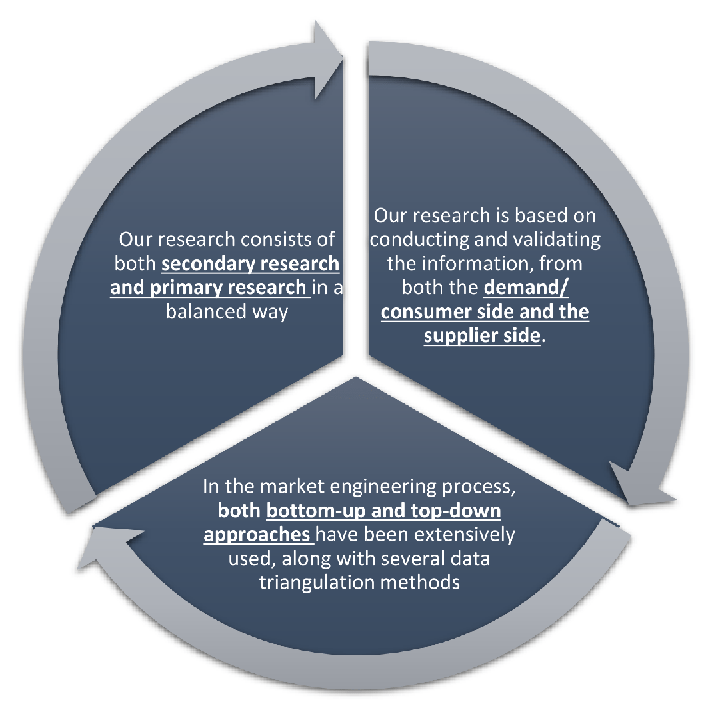
Our research design integrates both demand-side and supply-side analysis through a balanced combination of primary and secondary research methodologies. By utilizing both bottom-up and top-down approaches alongside rigorous data triangulation methods, we deliver robust market intelligence that supports strategic decision-making.
MarketGenics' comprehensive research design framework ensures the delivery of accurate, reliable, and actionable market intelligence. Through the integration of multiple research approaches, rigorous validation processes, and expert analysis, we provide our clients with the insights needed to make informed strategic decisions and capitalize on market opportunities.
MarketGenics leverages a dedicated industry panel of experts and a comprehensive suite of paid databases to effectively collect, consolidate, and analyze market intelligence.
Our approach has consistently proven to be reliable and effective in generating accurate market insights, identifying key industry trends, and uncovering emerging business opportunities.
Through both primary and secondary research, we capture and analyze critical company-level data such as manufacturing footprints, including technical centers, R&D facilities, sales offices, and headquarters.
Our expert panel further enhances our ability to estimate market size for specific brands based on validated field-level intelligence.
Our data mining techniques incorporate both parametric and non-parametric methods, allowing for structured data collection, sorting, processing, and cleaning.
Demand projections are derived from large-scale data sets analyzed through proprietary algorithms, culminating in robust and reliable market sizing.
Research Approach
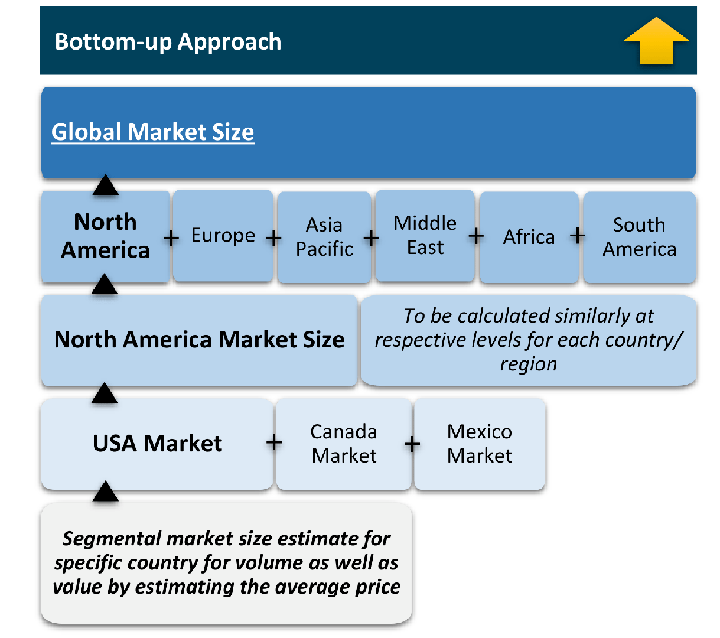
The bottom-up approach builds market estimates by starting with the smallest addressable market units and systematically aggregating them to create comprehensive market size projections.
This method begins with specific, granular data points and builds upward to create the complete market landscape.
Customer Analysis → Segmental Analysis → Geographical Analysis
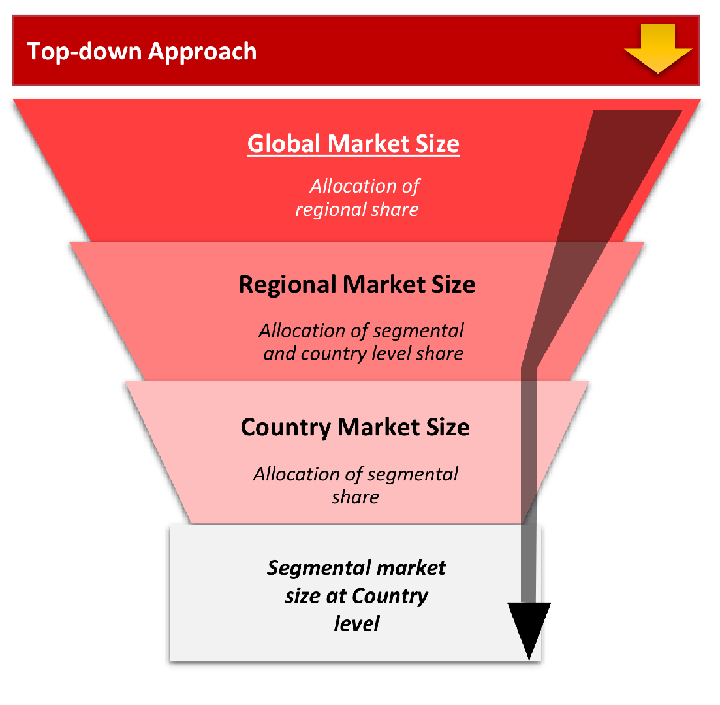
The top-down approach starts with the broadest possible market data and systematically narrows it down through a series of filters and assumptions to arrive at specific market segments or opportunities.
This method begins with the big picture and works downward to increasingly specific market slices.
TAM → SAM → SOM
Research Methods
Desk / Secondary Research
While analysing the market, we extensively study secondary sources, directories, and databases to identify and collect information useful for this technical, market-oriented, and commercial report. Secondary sources that we utilize are not only the public sources, but it is a combination of Open Source, Associations, Paid Databases, MG Repository & Knowledgebase, and others.
- Company websites, annual reports, financial reports, broker reports, and investor presentations
- National government documents, statistical databases and reports
- News articles, press releases and web-casts specific to the companies operating in the market, Magazines, reports, and others
- We gather information from commercial data sources for deriving company specific data such as segmental revenue, share for geography, product revenue, and others
- Internal and external proprietary databases (industry-specific), relevant patent, and regulatory databases
- Governing Bodies, Government Organizations
- Relevant Authorities, Country-specific Associations for Industries
We also employ the model mapping approach to estimate the product level market data through the players' product portfolio
Primary Research
Primary research/ interviews is vital in analyzing the market. Most of the cases involves paid primary interviews. Primary sources include primary interviews through e-mail interactions, telephonic interviews, surveys as well as face-to-face interviews with the different stakeholders across the value chain including several industry experts.
| Type of Respondents | Number of Primaries |
|---|---|
| Tier 2/3 Suppliers | ~20 |
| Tier 1 Suppliers | ~25 |
| End-users | ~25 |
| Industry Expert/ Panel/ Consultant | ~30 |
| Total | ~100 |
MG Knowledgebase
• Repository of industry blog, newsletter and case studies
• Online platform covering detailed market reports, and company profiles
Forecasting Factors and Models
Forecasting Factors
- Historical Trends – Past market patterns, cycles, and major events that shaped how markets behave over time. Understanding past trends helps predict future behavior.
- Industry Factors – Specific characteristics of the industry like structure, regulations, and innovation cycles that affect market dynamics.
- Macroeconomic Factors – Economic conditions like GDP growth, inflation, and employment rates that affect how much money people have to spend.
- Demographic Factors – Population characteristics like age, income, and location that determine who can buy your product.
- Technology Factors – How quickly people adopt new technology and how much technology infrastructure exists.
- Regulatory Factors – Government rules, laws, and policies that can help or restrict market growth.
- Competitive Factors – Analyzing competition structure such as degree of competition and bargaining power of buyers and suppliers.
Forecasting Models / Techniques
Multiple Regression Analysis
- Identify and quantify factors that drive market changes
- Statistical modeling to establish relationships between market drivers and outcomes
Time Series Analysis – Seasonal Patterns
- Understand regular cyclical patterns in market demand
- Advanced statistical techniques to separate trend, seasonal, and irregular components
Time Series Analysis – Trend Analysis
- Identify underlying market growth patterns and momentum
- Statistical analysis of historical data to project future trends
Expert Opinion – Expert Interviews
- Gather deep industry insights and contextual understanding
- In-depth interviews with key industry stakeholders
Multi-Scenario Development
- Prepare for uncertainty by modeling different possible futures
- Creating optimistic, pessimistic, and most likely scenarios
Time Series Analysis – Moving Averages
- Sophisticated forecasting for complex time series data
- Auto-regressive integrated moving average models with seasonal components
Econometric Models
- Apply economic theory to market forecasting
- Sophisticated economic models that account for market interactions
Expert Opinion – Delphi Method
- Harness collective wisdom of industry experts
- Structured, multi-round expert consultation process
Monte Carlo Simulation
- Quantify uncertainty and probability distributions
- Thousands of simulations with varying input parameters
Research Analysis
Our research framework is built upon the fundamental principle of validating market intelligence from both demand and supply perspectives. This dual-sided approach ensures comprehensive market understanding and reduces the risk of single-source bias.
Demand-Side Analysis: We understand end-user/application behavior, preferences, and market needs along with the penetration of the product for specific application.
Supply-Side Analysis: We estimate overall market revenue, analyze the segmental share along with industry capacity, competitive landscape, and market structure.
Validation & Evaluation
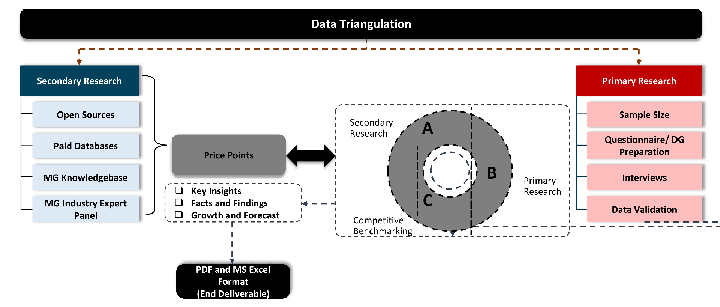
Data triangulation is a validation technique that uses multiple methods, sources, or perspectives to examine the same research question, thereby increasing the credibility and reliability of research findings. In market research, triangulation serves as a quality assurance mechanism that helps identify and minimize bias, validate assumptions, and ensure accuracy in market estimates.
- Data Source Triangulation – Using multiple data sources to examine the same phenomenon
- Methodological Triangulation – Using multiple research methods to study the same research question
- Investigator Triangulation – Using multiple researchers or analysts to examine the same data
- Theoretical Triangulation – Using multiple theoretical perspectives to interpret the same data
Custom Market Research Services
We will customise the research for you, in case the report listed above does not meet your requirements.
Get 10% Free Customisation