Floriculture Market Size, Share & Trends Analysis Report by Product Type (Cut Flowers, Potted Plants, Cut Foliage, Dried Flowers, Live Plants & Bulbs, Seeds, Others), Flower Form, End Product, Distribution Channel, Packaging Type, and Geography (North America, Europe, Asia Pacific, Middle East, Africa, and South America) – Global Industry Data, Trends, and Forecasts, 2026–2035
|
|
|
Segmental Data Insights |
|
|
Demand Trends |
|
|
Competitive Landscape |
|
|
Strategic Development |
|
|
Future Outlook & Opportunities |
|
Floriculture-Market Size, Share, and Growth
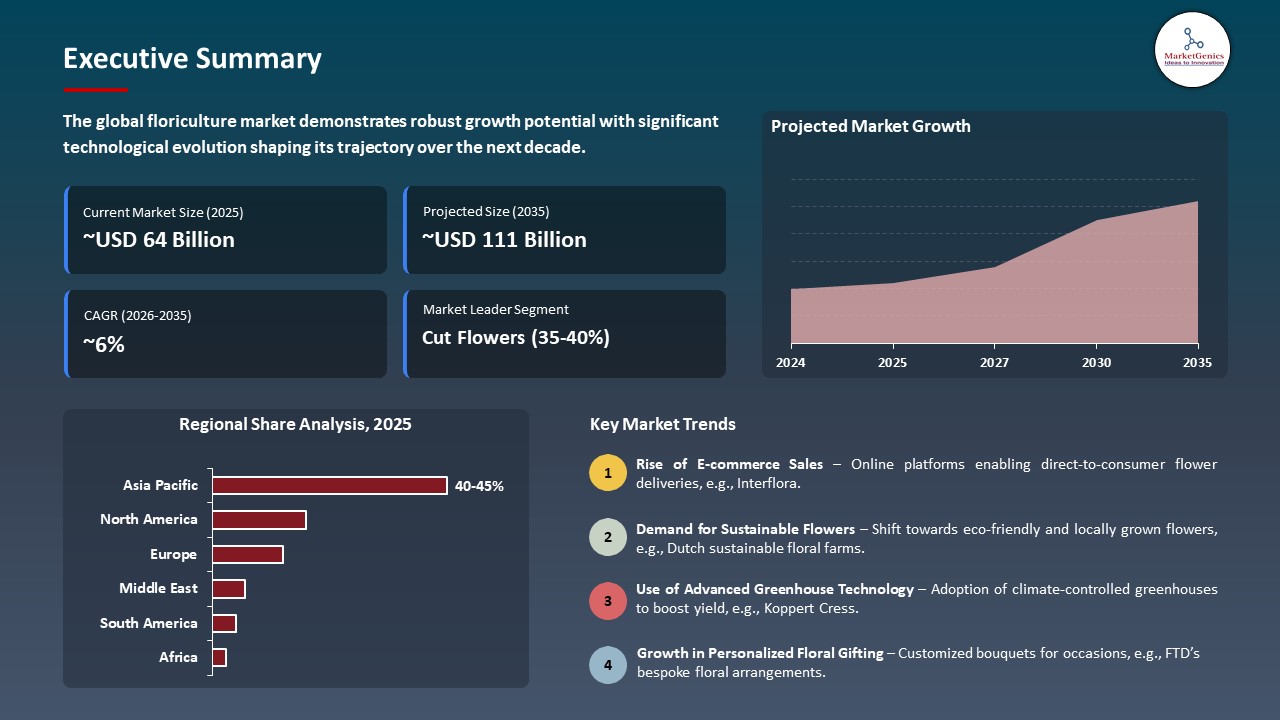
The global floriculture market is exhibiting strong growth, with an estimated value of USD 64.3 billion in 2025 and USD 110.9 billion by 2035, achieving a CAGR of 5.6%, during the forecast period. The global floriculture market is driven by rising consumer demand for ornamental plants and flowers, increasing urbanization, growth in e-commerce and online flower delivery, expansion of landscaping and interior decoration trends, innovations in plant breeding, and rising awareness of sustainable and high-quality horticultural products.
"Afriflora Sher Ethiopia continued expanding its international supply footprint, boosting cut‑flower exports to key markets and investing in logistics and quality standards to meet rising global demand for roses and other premium floriculture products."
The increasing popularity of the home aesthetics, wellness, and natural interior decor is leading to the popularity of ornamental flowers and plants, which is driving the floriculture market growth. Retail, gifting, and commercial landscaping customers are also demanding floral displays and greenery that are more appealing to the eye and producers of floriculture products are under pressure to diversify their products and aim at higher sales. For example, in March 2025, Dümmen Orange showcased new ornamental annuals and perennials, including Dahlia Summer Bees Purple Bicolor and Garden Party Fall Fantastic. The growth in consumer demand to ornamental and decor-oriented floriculture products is broadening the market and spurring innovation in the floriculture industry.
Moreover, strategic expansions and improved integration of supply chains are also driving the floriculture market where growers, distributors and retailers can streamline their operations and reduce their costs, and expand market reach. Joint activities and direct-to-market processes are enhancing supply chains and facilitating effective distribution of ornamental plants to customers all over the world. For instance, in December 2025, One Flora Group introduced Plant Partners where growers were linked with the markets to facilitate the supply chain of the ornamental horticulture industry and favorable distribution of floriculture in a sustainable and efficient manner. The efficiency of the market, decrease of distribution costs, greater world use of floriculture products is being amplified by strategic expansion and supply chain integration.
Adjacent opportunities to the global floriculture market include landscaping and garden design services, ornamental plant exports, indoor and vertical gardening solutions, flower subscription and gifting services, and horticultural tourism experiences. These industries use the products and skills of floriculture, which allows the business representatives to diversify sources of revenues and seize new trends of consumers. Acquisition into the adjacent markets is opening up new sources of revenue and boosting the industry generally in the global floriculture market.
Floriculture Market Dynamics and Trends
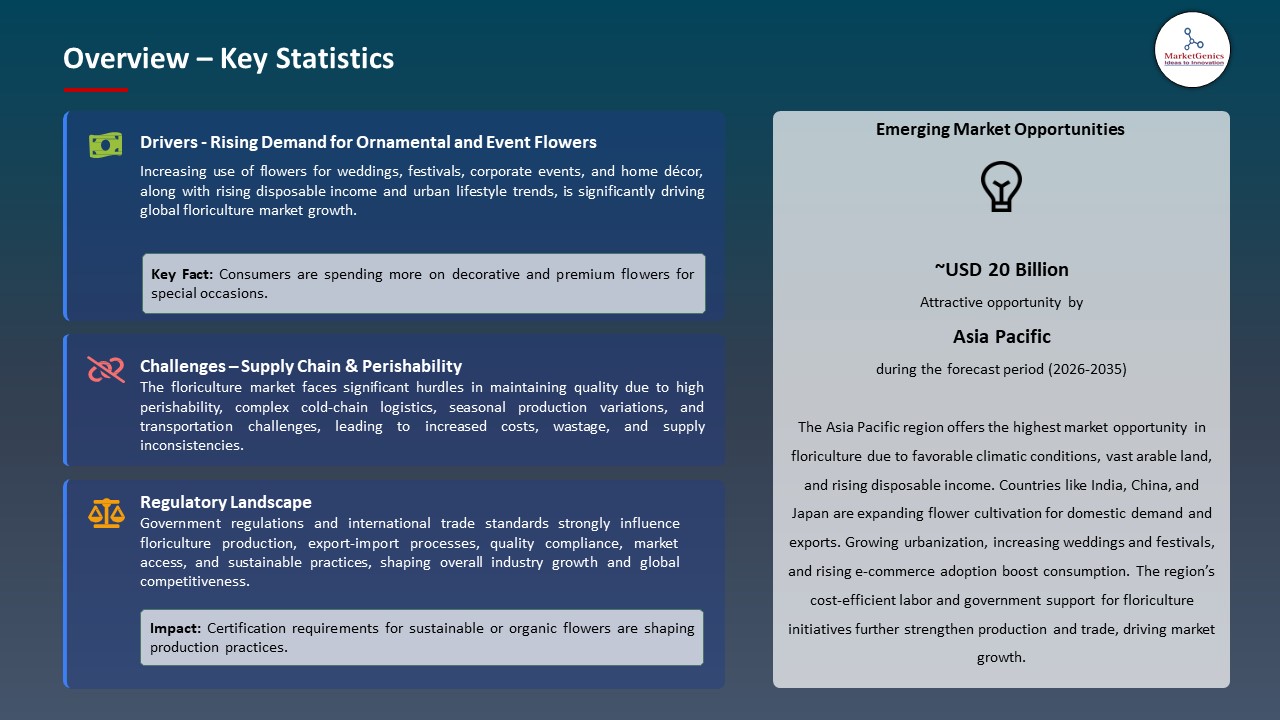
Driver: Growing Retail Demand for Sustainable and Eco‑Friendly Floral Products
-
Retail industry demand of sustainable, eco-friendly floral goods and packaging is propelling the floriculture market, with more and more environmentally conscious consumers willing to buy blooms and other plant gifts that are manufactured with the minimum of chemical use and could be recycled. Floral lines and biodegradable packaging that have been sustainably certified, as well as notable growers and suppliers, are reacting to this consumer shift by creating and pushing sustainably certified floral lines and packaging that is greener.
- For instance, in June 2025, Selecta One introduced its new product line, EcoFlor, of sustainably bred flowers with eco-friendly packaging, and how producers and retailers are responding to the rise in demand among consumers to use more environmentally friendly floral products. This move raises the need towards flowers and plants that are grown in a responsible way not only based on their aesthetic value but also based on their provenance and their effects on the environment.
- The growing attention to sustainable floral goods is widening market and promoting product innovation that is in line with the changing consumer values.
Restraint: Fluctuating Input Costs Undermining Profitability for Growers
-
Variability in significant input costs, such as labor, energy, fertilizers, and transportation, has a substantial impact on farmer profitability and pricing stability, hence constraining the floriculture market. Unstable fuel and electricity prices increase the costs of greenhouse heating and cooling, whereas shortage of labor and the increase of wages increase the cost of cultivation and handling.
- These pressures can erode margins for growers, particularly smaller operations without scale advantages or long-term procurement contracts. This can cause cost pressures among producers which can result in retail prices rising which can affect demand in the price-sensitive segments. Financial pressures may also deter investment in new varieties and technologies, retard innovation and reduce market growth generally.
- The constant volatility of input costs may hinder market expansion through the squeeze on grower margins and investment capacity.
Opportunity: Expansion of Digital Flower Retailing and E‑Commerce Platforms
-
The rapid growth in digital flower retailing and e-commerce sites offers a significant opportunity to the global floriculture market as more consumers move their shopping activities online. Digital platforms allow producers of floriculture and florists to expand their customer base, support individual and subscription services and combine data-based marketing solutions to increase the value of customer and customer loyalty.
- In July 2025, FTD Companies expanded its digital platform capabilities, integrating AI‑based recommendation engines and same‑day delivery optimization to improve online sales conversions and customer experience. E-commerce also facilitates adaptable merchandise, including seasonal selections, gift packages, and personalization, to find a varied group of customers. Increased online presence will allow decreasing reliance on traditional retail outlets and territorial constraints, generating novel sources of revenues.
- The expansion of digital retailing is broadening the market access, sales opportunities, and changing the way products of the floriculture are being sold and bought.
Key Trend: Adoption of Climate‑Resilient and Stress‑Tolerant Floral Varieties
-
Climate resilience and stress tolerance Climate-resilient and stress-tolerant floral varieties are a major trend that is influencing the floriculture market, which was developed using advanced breeding methods to cope with heat, drought, and unpredictable weather patterns. Climate unpredictability and severe weather conditions have increased the necessity of strong genetics in plants that could hold good and economical quality and prolong their lifespan despite the reduced resource input. Breeders are also using both traditional and modern selection techniques to come up with varieties that have better tolerance to stress and still have aesthetic appeal.
- For instance, the portfolio of Syngenta, “Heat Lover” specifically provides ornamental plant varieties that are genetically modified to grow under the sun and heat, so that they need less watering and are able to regain lost moisture shortly after drying, which further testifies to the creation of drought-tolerant and stress-resistant floral genetics. These varieties also accommodate more stable production patterns and minimize losses of crops, which makes them be adopted in different regions.
- The shift toward climate‑adaptive floral genetics is increasing cultivation resilience, lowering operational risks, and expanding production potential in challenging environments.
 Floriculture Market Analysis and Segmental Data
Cut Flowers Dominate Global Floriculture Market
-
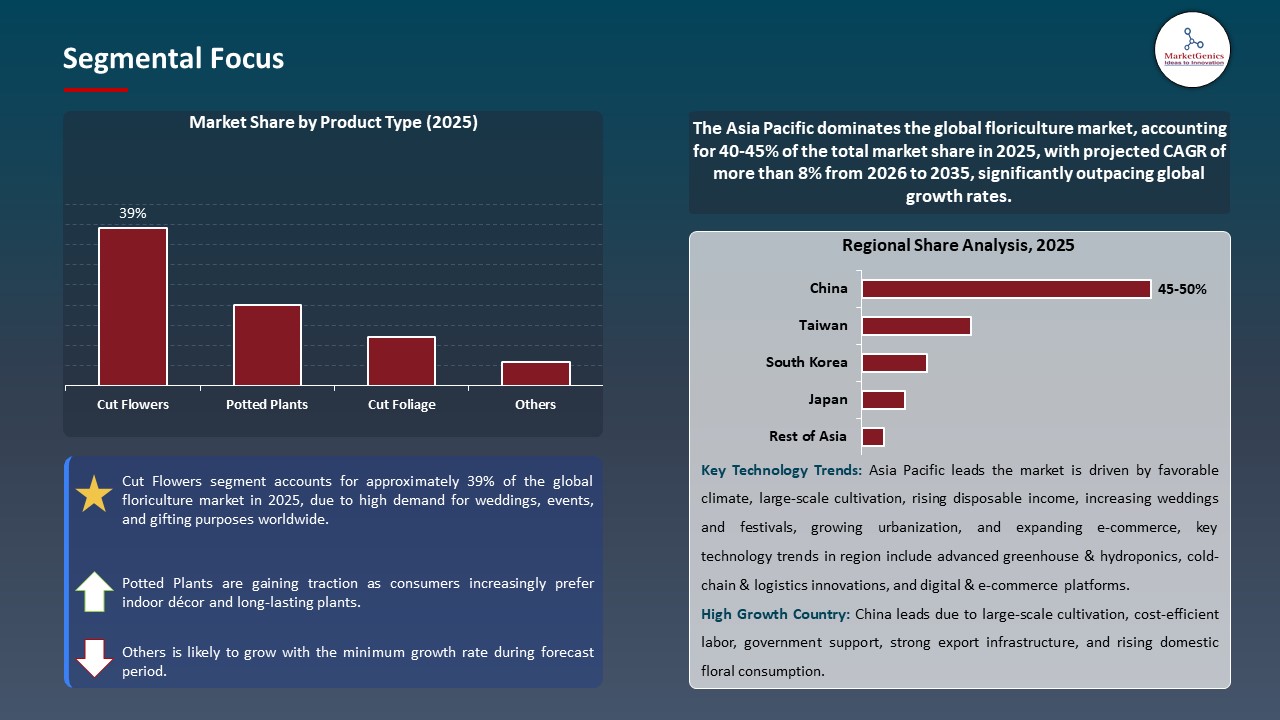
The cut flowers segment dominates the global floriculture market, due to they are used in gifting, events, decoration and rituals, and exhibit high demand all year long. Their universal use of personal gifts during the Valentine and Mother day holidays and corporate events and hospitality decor is a sure way of sales and turnovers at all times, which results in cultivation and trade activities across the globe.
- Major suppliers of floriculture hold large cut flower portfolios. For example, Dümmen Orange offers a large selection of cut flower varieties such as roses, gerberas, chrysanthemums and carnations as core products in its product mix, being a strong supply in its segmentation since the industry has long been concentrated on this high demand segment.
- Well-developed cold-chain logistics and international trade networks are also favorable to cut flowers, including import and export of cut flowers in North America and Europe between major production areas such as the Netherlands, Colombia and Kenya and major consumption areas.
- The monopoly of the cut flowers strengthens the market revenue stability of floriculture and promotes further innovations in breeding, distribution, and retailing.
Asia Pacific Leads Global Floriculture Market Demand
- Asia Pacific leads the floriculture market is driven by increasing cultural activities and change of lifestyles in the Asian Pacific increasing the demand of the ornamental flowers and potted plant with the growers and breeders in response to the local tastes and seasons. For instance, the Flower Trials 2025 held by Syngenta Flowers invited growers across several Asian markets such as China, India, Australia and Vietnam, clearly demonstrating the interest that global breeders have on regional product development.
- Additionally, strategic programs on regional involvement and customer reach are enhancing the market of floriculture products through intensifying brand presence, product offerings that consider the local taste, and increasing the channels of distribution. Events led by the manufacturers, exhibitions, and direct contacts with the growers and retailers facilitate better market penetration and adoption of different varieties of ornamental plants. For instance, in December 2025, DUMMEN Orange opened its first in-house showroom exhibition in Japan with a vast amount of cut flowers and potted plant solutions based on the local consumer and retail demands.
- The continued cultural demand and the active involvement of manufactures are cementing the position of the Asia Pacific in the global floriculture market.
Floriculture Market Ecosystem
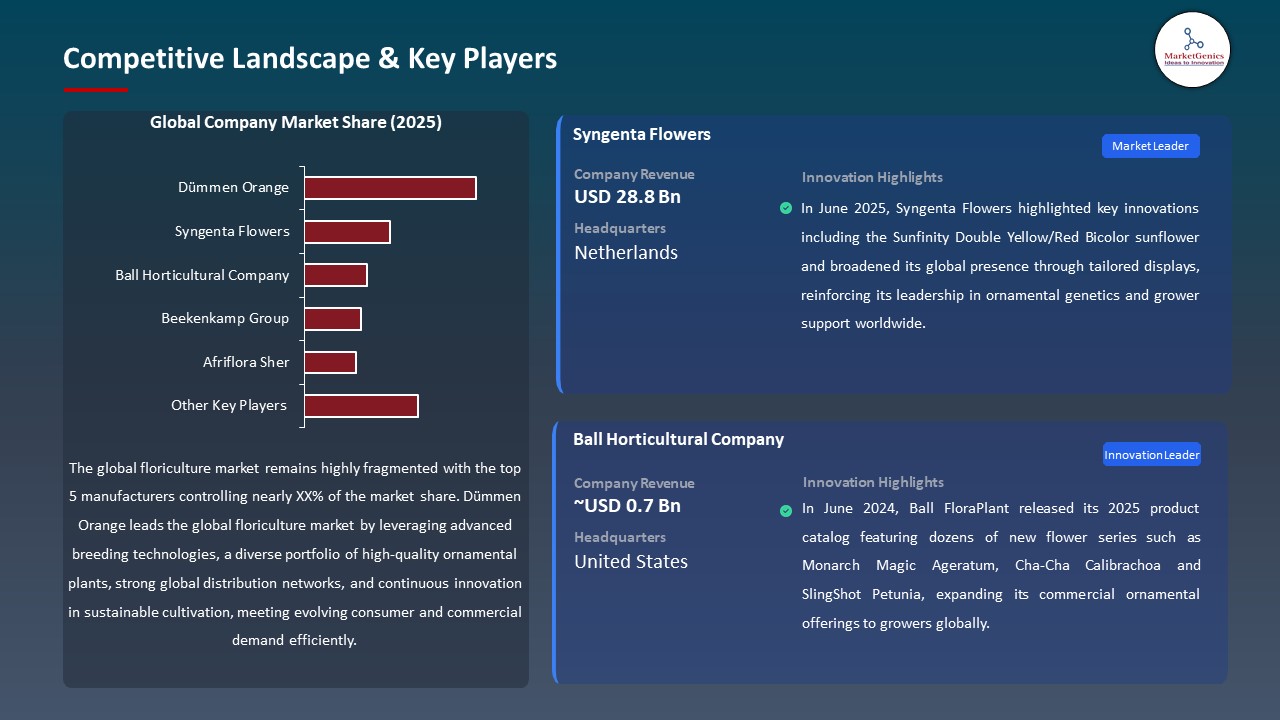
The global floriculture market is highly fragmented, with leading companies such as Dümmen Orange, Syngenta Flowers, Ball Horticultural Company, Beekenkamp Group, and Afriflora Sher maintaining dominance through advanced breeding programs, genetic technologies, and robust global distribution networks. These firms use the wide-ranging R&D and integrated supply to push innovation, quality and market development.
The major players are concentrating on niche solutions and technological developments to make their offerings differentiate. An example, the development of disease-resistant varieties by the company Syngenta Flowers, such as Cora XDR Vinca, which will reduce losses due to crop diseases and will consume less chemicals or greenhouse-grown young plants that will be optimized into the pot and bedding segments by Beekenkamp Group. The wide range of ornament in Dummen Orange serves the needs of retail and landscape similar to the preeminence of aesthetics and business profitability.
Technology is enhanced by state agencies, research institutions and industrial associations. In 2024, Dummen Orange collaborated with the Naturalis Biodiversity Center to develop a breeding and testing system that is environmentally friendly to pollinators, assessing the characteristics of a species, such as the size of the nectars and attractiveness to the flowers, to increase the diversity and healthy breeding patterns.
This project will not only enhance sustainable breeding but also biodiversity, increase efficiency in pollination, and the marketability of ornamental plants that are ecologically friendly.
 Recent Development and Strategic Overview:
- In June 2025, Syngenta Flowers unveiled a range of innovative, high-performance varieties, including Penny Pro violas, Calliope pelargoniums, and Sunfinity sunflowers. These new cultivars are specifically engineered to enhance grower efficiency, extend bloom cycles, improve resilience, and strengthen market competitiveness, offering versatile options for commercial growers and ornamental plant retailers worldwide.
- In May 2025, Dümmen Orange conducted its 2025 FlowerTrials at De Kwakel, presenting its comprehensive ornamental plant portfolio in a single venue. The event highlighted the company’s R&D leadership and strengthened global grower engagement through trend-focused displays tailored for retail and landscaping markets.
Report Scope
|
Detail |
|
|
Market Size in 2025 |
USD 64.3 Bn |
|
Market Forecast Value in 2035 |
USD 110.9 Bn |
|
Growth Rate (CAGR) |
5.6% |
|
Forecast Period |
2026 – 2035 |
|
Historical Data Available for |
2021 – 2024 |
|
Market Size Units |
US$ Billion for Value Thousand Units for Volume |
|
Report Format |
Electronic (PDF) + Excel |
|
North America |
Europe |
Asia Pacific |
Middle East |
Africa |
South America |
|
|
|
|
|
|
|
Companies Covered |
|||||
|
|
|
|
|
|
Floriculture Market Segmentation and Highlights
|
Segment |
Sub-segment |
|
Floriculture Market, By Product Type |
|
|
Floriculture Market, By Flower Form |
|
|
Floriculture Market, By End Product |
|
|
Floriculture Market, By Distribution Channel |
|
|
Floriculture Market, By Packaging Type |
|
Frequently Asked Questions
Table of Contents
- 1. Research Methodology and Assumptions
- 1.1. Definitions
- 1.2. Research Design and Approach
- 1.3. Data Collection Methods
- 1.4. Base Estimates and Calculations
- 1.5. Forecasting Models
- 1.5.1. Key Forecast Factors & Impact Analysis
- 1.6. Secondary Research
- 1.6.1. Open Sources
- 1.6.2. Paid Databases
- 1.6.3. Associations
- 1.7. Primary Research
- 1.7.1. Primary Sources
- 1.7.2. Primary Interviews with Stakeholders across Ecosystem
- 2. Executive Summary
- 2.1. Global Floriculture Market Outlook
- 2.1.1. Floriculture Market Size (Volume - MMT and Value - US$ Bn), and Forecasts, 2021-2035
- 2.1.2. Compounded Annual Growth Rate Analysis
- 2.1.3. Growth Opportunity Analysis
- 2.1.4. Segmental Share Analysis
- 2.1.5. Geographical Share Analysis
- 2.2. Market Analysis and Facts
- 2.3. Supply-Demand Analysis
- 2.4. Competitive Benchmarking
- 2.5. Go-to- Market Strategy
- 2.5.1. Customer/ End-use Industry Assessment
- 2.5.2. Growth Opportunity Data, 2026-2035
- 2.5.2.1. Regional Data
- 2.5.2.2. Country Data
- 2.5.2.3. Segmental Data
- 2.5.3. Identification of Potential Market Spaces
- 2.5.4. GAP Analysis
- 2.5.5. Potential Attractive Price Points
- 2.5.6. Prevailing Market Risks & Challenges
- 2.5.7. Preferred Sales & Marketing Strategies
- 2.5.8. Key Recommendations and Analysis
- 2.5.9. A Way Forward
- 2.1. Global Floriculture Market Outlook
- 3. Industry Data and Premium Insights
- 3.1. Global Consumer Goods Industry Overview, 2025
- 3.1.1. Consumer Goods Ecosystem Analysis
- 3.1.2. Key Trends for Consumer Goods Industry
- 3.1.3. Regional Distribution for Consumer Goods Industry
- 3.2. Supplier Customer Data
- 3.3. Technology Roadmap and Developments
- 3.4. Trade Analysis
- 3.4.1. Import & Export Analysis, 2025
- 3.4.2. Top Importing Countries
- 3.4.3. Top Exporting Countries
- 3.5. Trump Tariff Impact Analysis
- 3.5.1. Manufacturer
- 3.5.1.1. Based on the component & Raw material
- 3.5.2. Supply Chain
- 3.5.3. End Consumer
- 3.5.1. Manufacturer
- 3.6. Raw Material Analysis
- 3.1. Global Consumer Goods Industry Overview, 2025
- 4. Market Overview
- 4.1. Market Dynamics
- 4.1.1. Drivers
- 4.1.1.1. Rising demand for decorative and event-related flowers
- 4.1.1.2. Growing preference for sustainable and locally sourced floral products
- 4.1.1.3. Expansion of e-commerce and online sales channels
- 4.1.2. Restraints
- 4.1.2.1. High perishability and logistics challenges
- 4.1.2.2. Vulnerability to climate and seasonal fluctuations
- 4.1.1. Drivers
- 4.2. Key Trend Analysis
- 4.3. Regulatory Framework
- 4.3.1. Key Regulations, Norms, and Subsidies, by Key Countries
- 4.3.2. Tariffs and Standards
- 4.3.3. Impact Analysis of Regulations on the Market
- 4.4. Value Chain Analysis
- 4.5. Cost Structure Analysis
- 4.5.1. Parameter’s Share for Cost Associated
- 4.5.2. COGP vs COGS
- 4.5.3. Profit Margin Analysis
- 4.6. Pricing Analysis
- 4.6.1. Regional Pricing Analysis
- 4.6.2. Segmental Pricing Trends
- 4.6.3. Factors Influencing Pricing
- 4.7. Porter’s Five Forces Analysis
- 4.8. PESTEL Analysis
- 4.9. Global Floriculture Market Demand
- 4.9.1. Historical Market Size – in Volume (MMT) and Value (US$ Bn), 2020-2024
- 4.9.2. Current and Future Market Size – in Volume (MMT) and Value (US$ Bn), 2026–2035
- 4.9.2.1. Y-o-Y Growth Trends
- 4.9.2.2. Absolute $ Opportunity Assessment
- 4.1. Market Dynamics
- 5. Competition Landscape
- 5.1. Competition structure
- 5.1.1. Fragmented v/s consolidated
- 5.2. Company Share Analysis, 2025
- 5.2.1. Global Company Market Share
- 5.2.2. By Region
- 5.2.2.1. North America
- 5.2.2.2. Europe
- 5.2.2.3. Asia Pacific
- 5.2.2.4. Middle East
- 5.2.2.5. Africa
- 5.2.2.6. South America
- 5.3. Product Comparison Matrix
- 5.3.1. Specifications
- 5.3.2. Market Positioning
- 5.3.3. Pricing
- 5.1. Competition structure
- 6. Global Floriculture Market Analysis, by Product Type
- 6.1. Key Segment Analysis
- 6.2. Floriculture Market Size (Volume - MMT and Value - US$ Bn), Analysis, and Forecasts, by Product Type, 2021-2035
- 6.2.1. Cut Flowers
- 6.2.1.1. Roses
- 6.2.1.2. Chrysanthemums
- 6.2.1.3. Tulips
- 6.2.1.4. Lilies
- 6.2.1.5. Gerberas
- 6.2.1.6. Others
- 6.2.2. Potted Plants
- 6.2.2.1. Flowering Potted Plants
- 6.2.2.2. Foliage Potted Plants
- 6.2.2.3. Bedding Plants
- 6.2.2.4. Others
- 6.2.3. Cut Foliage
- 6.2.3.1. Ferns
- 6.2.3.2. Palm Leaves
- 6.2.3.3. Eucalyptus
- 6.2.3.4. Other Foliage
- 6.2.4. Dried Flowers
- 6.2.5. Live Plants & Bulbs
- 6.2.6. Seeds
- 6.2.7. Others
- 6.2.1. Cut Flowers
- 7. Global Floriculture Market Analysis, by Flower Form
- 7.1. Key Segment Analysis
- 7.2. Floriculture Market Size (Volume - MMT and Value - US$ Bn), Analysis, and Forecasts, by Flower Form, 2021-2035
- 7.2.1. Fresh Flowers
- 7.2.2. Dried Flowers
- 7.2.3. Artificial/Silk Flowers
- 7.2.4. Preserved Flowers
- 7.2.5. Freeze-Dried Flowers
- 8. Global Floriculture Market Analysis, by End Product
- 8.1. Key Segment Analysis
- 8.2. Floriculture Market Size (Volume - MMT and Value - US$ Bn), Analysis, and Forecasts, by End Product, 2021-2035
- 8.2.1. Decorative Flowers
- 8.2.2. Essential Oil Extraction
- 8.2.3. Perfumery Products
- 8.2.4. Medicinal/Herbal Products
- 8.2.5. Cosmetic Products
- 8.2.6. Food & Beverage (Edible Flowers)
- 9. Global Floriculture Market Analysis, by Distribution Channel
- 9.1. Key Segment Analysis
- 9.2. Floriculture Market Size (Volume - MMT and Value - US$ Bn), Analysis, and Forecasts, by Distribution Channel, 2021-2035
- 9.2.1. Direct Sales
- 9.2.2. Wholesale Markets
- 9.2.3. Retail
- 9.2.4. Online/E-commerce
- 10. Global Floriculture Market Analysis, by Packaging Type
- 10.1. Key Segment Analysis
- 10.2. Floriculture Market Size (Volume - MMT and Value - US$ Bn), Analysis, and Forecasts, by Packaging Type, 2021-2035
- 10.2.1. Bouquets
- 10.2.2. Bunches
- 10.2.3. Boxes
- 10.2.4. Baskets
- 10.2.5. Vase Arrangements
- 10.2.6. Wrapped Stems
- 10.2.7. Loose Flowers
- 10.2.8. Others
- 11. Global Floriculture Market Analysis, by Region
- 11.1. Key Findings
- 11.2. Floriculture Market Size (Volume - MMT and Value - US$ Bn), Analysis, and Forecasts, by Region, 2021-2035
- 11.2.1. North America
- 11.2.2. Europe
- 11.2.3. Asia Pacific
- 11.2.4. Middle East
- 11.2.5. Africa
- 11.2.6. South America
- 12. North America Floriculture Market Analysis
- 12.1. Key Segment Analysis
- 12.2. Regional Snapshot
- 12.3. North America Floriculture Market Size (Volume - MMT and Value - US$ Bn), Analysis, and Forecasts, 2021-2035
- 12.3.1. Product Type
- 12.3.2. Flower Form
- 12.3.3. End Product
- 12.3.4. Distribution Channel
- 12.3.5. Packaging Type
- 12.3.6. Country
- 12.3.6.1. USA
- 12.3.6.2. Canada
- 12.3.6.3. Mexico
- 12.4. USA Floriculture Market
- 12.4.1. Country Segmental Analysis
- 12.4.2. Product Type
- 12.4.3. Flower Form
- 12.4.4. End Product
- 12.4.5. Distribution Channel
- 12.4.6. Packaging Type
- 12.5. Canada Floriculture Market
- 12.5.1. Country Segmental Analysis
- 12.5.2. Product Type
- 12.5.3. Flower Form
- 12.5.4. End Product
- 12.5.5. Distribution Channel
- 12.5.6. Packaging Type
- 12.6. Mexico Floriculture Market
- 12.6.1. Country Segmental Analysis
- 12.6.2. Product Type
- 12.6.3. Flower Form
- 12.6.4. End Product
- 12.6.5. Distribution Channel
- 12.6.6. Packaging Type
- 13. Europe Floriculture Market Analysis
- 13.1. Key Segment Analysis
- 13.2. Regional Snapshot
- 13.3. Europe Floriculture Market Size (Volume - MMT and Value - US$ Bn), Analysis, and Forecasts, 2021-2035
- 13.3.1. Product Type
- 13.3.2. Flower Form
- 13.3.3. End Product
- 13.3.4. Distribution Channel
- 13.3.5. Packaging Type
- 13.3.6. Country
- 13.3.6.1. Germany
- 13.3.6.2. United Kingdom
- 13.3.6.3. France
- 13.3.6.4. Italy
- 13.3.6.5. Spain
- 13.3.6.6. Netherlands
- 13.3.6.7. Nordic Countries
- 13.3.6.8. Poland
- 13.3.6.9. Russia & CIS
- 13.3.6.10. Rest of Europe
- 13.4. Germany Floriculture Market
- 13.4.1. Country Segmental Analysis
- 13.4.2. Product Type
- 13.4.3. Flower Form
- 13.4.4. End Product
- 13.4.5. Distribution Channel
- 13.4.6. Packaging Type
- 13.5. United Kingdom Floriculture Market
- 13.5.1. Country Segmental Analysis
- 13.5.2. Product Type
- 13.5.3. Flower Form
- 13.5.4. End Product
- 13.5.5. Distribution Channel
- 13.5.6. Packaging Type
- 13.6. France Floriculture Market
- 13.6.1. Country Segmental Analysis
- 13.6.2. Product Type
- 13.6.3. Flower Form
- 13.6.4. End Product
- 13.6.5. Distribution Channel
- 13.6.6. Packaging Type
- 13.7. Italy Floriculture Market
- 13.7.1. Country Segmental Analysis
- 13.7.2. Product Type
- 13.7.3. Flower Form
- 13.7.4. End Product
- 13.7.5. Distribution Channel
- 13.7.6. Packaging Type
- 13.8. Spain Floriculture Market
- 13.8.1. Country Segmental Analysis
- 13.8.2. Product Type
- 13.8.3. Flower Form
- 13.8.4. End Product
- 13.8.5. Distribution Channel
- 13.8.6. Packaging Type
- 13.9. Netherlands Floriculture Market
- 13.9.1. Country Segmental Analysis
- 13.9.2. Product Type
- 13.9.3. Flower Form
- 13.9.4. End Product
- 13.9.5. Distribution Channel
- 13.9.6. Packaging Type
- 13.10. Nordic Countries Floriculture Market
- 13.10.1. Country Segmental Analysis
- 13.10.2. Product Type
- 13.10.3. Flower Form
- 13.10.4. End Product
- 13.10.5. Distribution Channel
- 13.10.6. Packaging Type
- 13.11. Poland Floriculture Market
- 13.11.1. Country Segmental Analysis
- 13.11.2. Product Type
- 13.11.3. Flower Form
- 13.11.4. End Product
- 13.11.5. Distribution Channel
- 13.11.6. Packaging Type
- 13.12. Russia & CIS Floriculture Market
- 13.12.1. Country Segmental Analysis
- 13.12.2. Product Type
- 13.12.3. Flower Form
- 13.12.4. End Product
- 13.12.5. Distribution Channel
- 13.12.6. Packaging Type
- 13.13. Rest of Europe Floriculture Market
- 13.13.1. Country Segmental Analysis
- 13.13.2. Product Type
- 13.13.3. Flower Form
- 13.13.4. End Product
- 13.13.5. Distribution Channel
- 13.13.6. Packaging Type
- 14. Asia Pacific Floriculture Market Analysis
- 14.1. Key Segment Analysis
- 14.2. Regional Snapshot
- 14.3. Asia Pacific Floriculture Market Size (Volume - MMT and Value - US$ Bn), Analysis, and Forecasts, 2021-2035
- 14.3.1. Product Type
- 14.3.2. Flower Form
- 14.3.3. End Product
- 14.3.4. Distribution Channel
- 14.3.5. Packaging Type
- 14.3.6. Country
- 14.3.6.1. China
- 14.3.6.2. India
- 14.3.6.3. Japan
- 14.3.6.4. South Korea
- 14.3.6.5. Australia and New Zealand
- 14.3.6.6. Indonesia
- 14.3.6.7. Malaysia
- 14.3.6.8. Thailand
- 14.3.6.9. Vietnam
- 14.3.6.10. Rest of Asia Pacific
- 14.4. China Floriculture Market
- 14.4.1. Country Segmental Analysis
- 14.4.2. Product Type
- 14.4.3. Flower Form
- 14.4.4. End Product
- 14.4.5. Distribution Channel
- 14.4.6. Packaging Type
- 14.5. India Floriculture Market
- 14.5.1. Country Segmental Analysis
- 14.5.2. Product Type
- 14.5.3. Flower Form
- 14.5.4. End Product
- 14.5.5. Distribution Channel
- 14.5.6. Packaging Type
- 14.6. Japan Floriculture Market
- 14.6.1. Country Segmental Analysis
- 14.6.2. Product Type
- 14.6.3. Flower Form
- 14.6.4. End Product
- 14.6.5. Distribution Channel
- 14.6.6. Packaging Type
- 14.7. South Korea Floriculture Market
- 14.7.1. Country Segmental Analysis
- 14.7.2. Product Type
- 14.7.3. Flower Form
- 14.7.4. End Product
- 14.7.5. Distribution Channel
- 14.7.6. Packaging Type
- 14.8. Australia and New Zealand Floriculture Market
- 14.8.1. Country Segmental Analysis
- 14.8.2. Product Type
- 14.8.3. Flower Form
- 14.8.4. End Product
- 14.8.5. Distribution Channel
- 14.8.6. Packaging Type
- 14.9. Indonesia Floriculture Market
- 14.9.1. Country Segmental Analysis
- 14.9.2. Product Type
- 14.9.3. Flower Form
- 14.9.4. End Product
- 14.9.5. Distribution Channel
- 14.9.6. Packaging Type
- 14.10. Malaysia Floriculture Market
- 14.10.1. Country Segmental Analysis
- 14.10.2. Product Type
- 14.10.3. Flower Form
- 14.10.4. End Product
- 14.10.5. Distribution Channel
- 14.10.6. Packaging Type
- 14.11. Thailand Floriculture Market
- 14.11.1. Country Segmental Analysis
- 14.11.2. Product Type
- 14.11.3. Flower Form
- 14.11.4. End Product
- 14.11.5. Distribution Channel
- 14.11.6. Packaging Type
- 14.12. Vietnam Floriculture Market
- 14.12.1. Country Segmental Analysis
- 14.12.2. Product Type
- 14.12.3. Flower Form
- 14.12.4. End Product
- 14.12.5. Distribution Channel
- 14.12.6. Packaging Type
- 14.13. Rest of Asia Pacific Floriculture Market
- 14.13.1. Country Segmental Analysis
- 14.13.2. Product Type
- 14.13.3. Flower Form
- 14.13.4. End Product
- 14.13.5. Distribution Channel
- 14.13.6. Packaging Type
- 15. Middle East Floriculture Market Analysis
- 15.1. Key Segment Analysis
- 15.2. Regional Snapshot
- 15.3. Middle East Floriculture Market Size (Volume - MMT and Value - US$ Bn), Analysis, and Forecasts, 2021-2035
- 15.3.1. Product Type
- 15.3.2. Flower Form
- 15.3.3. End Product
- 15.3.4. Distribution Channel
- 15.3.5. Packaging Type
- 15.3.6. Country
- 15.3.6.1. Turkey
- 15.3.6.2. UAE
- 15.3.6.3. Saudi Arabia
- 15.3.6.4. Israel
- 15.3.6.5. Rest of Middle East
- 15.4. Turkey Floriculture Market
- 15.4.1. Country Segmental Analysis
- 15.4.2. Product Type
- 15.4.3. Flower Form
- 15.4.4. End Product
- 15.4.5. Distribution Channel
- 15.4.6. Packaging Type
- 15.5. UAE Floriculture Market
- 15.5.1. Country Segmental Analysis
- 15.5.2. Product Type
- 15.5.3. Flower Form
- 15.5.4. End Product
- 15.5.5. Distribution Channel
- 15.5.6. Packaging Type
- 15.6. Saudi Arabia Floriculture Market
- 15.6.1. Country Segmental Analysis
- 15.6.2. Product Type
- 15.6.3. Flower Form
- 15.6.4. End Product
- 15.6.5. Distribution Channel
- 15.6.6. Packaging Type
- 15.7. Israel Floriculture Market
- 15.7.1. Country Segmental Analysis
- 15.7.2. Product Type
- 15.7.3. Flower Form
- 15.7.4. End Product
- 15.7.5. Distribution Channel
- 15.7.6. Packaging Type
- 15.8. Rest of Middle East Floriculture Market
- 15.8.1. Country Segmental Analysis
- 15.8.2. Product Type
- 15.8.3. Flower Form
- 15.8.4. End Product
- 15.8.5. Distribution Channel
- 15.8.6. Packaging Type
- 16. Africa Floriculture Market Analysis
- 16.1. Key Segment Analysis
- 16.2. Regional Snapshot
- 16.3. Africa Floriculture Market Size (Volume - MMT and Value - US$ Bn), Analysis, and Forecasts, 2021-2035
- 16.3.1. Product Type
- 16.3.2. Flower Form
- 16.3.3. End Product
- 16.3.4. Distribution Channel
- 16.3.5. Packaging Type
- 16.3.6. Country
- 16.3.6.1. South Africa
- 16.3.6.2. Egypt
- 16.3.6.3. Nigeria
- 16.3.6.4. Algeria
- 16.3.6.5. Rest of Africa
- 16.4. South Africa Floriculture Market
- 16.4.1. Country Segmental Analysis
- 16.4.2. Product Type
- 16.4.3. Flower Form
- 16.4.4. End Product
- 16.4.5. Distribution Channel
- 16.4.6. Packaging Type
- 16.5. Egypt Floriculture Market
- 16.5.1. Country Segmental Analysis
- 16.5.2. Product Type
- 16.5.3. Flower Form
- 16.5.4. End Product
- 16.5.5. Distribution Channel
- 16.5.6. Packaging Type
- 16.6. Nigeria Floriculture Market
- 16.6.1. Country Segmental Analysis
- 16.6.2. Product Type
- 16.6.3. Flower Form
- 16.6.4. End Product
- 16.6.5. Distribution Channel
- 16.6.6. Packaging Type
- 16.7. Algeria Floriculture Market
- 16.7.1. Country Segmental Analysis
- 16.7.2. Product Type
- 16.7.3. Flower Form
- 16.7.4. End Product
- 16.7.5. Distribution Channel
- 16.7.6. Packaging Type
- 16.8. Rest of Africa Floriculture Market
- 16.8.1. Country Segmental Analysis
- 16.8.2. Product Type
- 16.8.3. Flower Form
- 16.8.4. End Product
- 16.8.5. Distribution Channel
- 16.8.6. Packaging Type
- 17. South America Floriculture Market Analysis
- 17.1. Key Segment Analysis
- 17.2. Regional Snapshot
- 17.3. South America Floriculture Market Size (Volume - MMT and Value - US$ Bn), Analysis, and Forecasts, 2021-2035
- 17.3.1. Product Type
- 17.3.2. Flower Form
- 17.3.3. End Product
- 17.3.4. Distribution Channel
- 17.3.5. Packaging Type
- 17.3.6. Country
- 17.3.6.1. Brazil
- 17.3.6.2. Argentina
- 17.3.6.3. Rest of South America
- 17.4. Brazil Floriculture Market
- 17.4.1. Country Segmental Analysis
- 17.4.2. Product Type
- 17.4.3. Flower Form
- 17.4.4. End Product
- 17.4.5. Distribution Channel
- 17.4.6. Packaging Type
- 17.5. Argentina Floriculture Market
- 17.5.1. Country Segmental Analysis
- 17.5.2. Product Type
- 17.5.3. Flower Form
- 17.5.4. End Product
- 17.5.5. Distribution Channel
- 17.5.6. Packaging Type
- 17.6. Rest of South America Floriculture Market
- 17.6.1. Country Segmental Analysis
- 17.6.2. Product Type
- 17.6.3. Flower Form
- 17.6.4. End Product
- 17.6.5. Distribution Channel
- 17.6.6. Packaging Type
- 18. Key Players/ Company Profile
- 18.1. Afriflora Sher
- 18.1.1. Company Details/ Overview
- 18.1.2. Company Financials
- 18.1.3. Key Customers and Competitors
- 18.1.4. Business/ Industry Portfolio
- 18.1.5. Product Portfolio/ Specification Details
- 18.1.6. Pricing Data
- 18.1.7. Strategic Overview
- 18.1.8. Recent Developments
- 18.2. Arcangeli Giovanni & Figlio
- 18.3. Ball Horticultural Company
- 18.4. Beekenkamp Group
- 18.5. Brookside Flowers
- 18.6. Carzan Flowers Kenya
- 18.7. Deliflor Chrysanten
- 18.8. Dümmen Orange
- 18.9. Finlays
- 18.10. Flamingo Horticulture
- 18.11. Fujian Minhou Lily Co., Ltd.
- 18.12. Harvest Flower
- 18.13. Karen Roses
- 18.14. Kariki Limited
- 18.15. Marginpar BV
- 18.16. Multiflora
- 18.17. Oserian Development Company
- 18.18. Red Lands Roses
- 18.19. Sakata Ornamentals
- 18.20. Selecta One
- 18.21. Syngenta Flowers
- 18.22. Takii & Company
- 18.23. Van den Bos Flowerbulbs
- 18.24. Washington Bulb Company
- 18.25. Other Key Players
- 18.1. Afriflora Sher
Note* - This is just tentative list of players. While providing the report, we will cover more number of players based on their revenue and share for each geography
Research Design
Our research design integrates both demand-side and supply-side analysis through a balanced combination of primary and secondary research methodologies. By utilizing both bottom-up and top-down approaches alongside rigorous data triangulation methods, we deliver robust market intelligence that supports strategic decision-making.
MarketGenics' comprehensive research design framework ensures the delivery of accurate, reliable, and actionable market intelligence. Through the integration of multiple research approaches, rigorous validation processes, and expert analysis, we provide our clients with the insights needed to make informed strategic decisions and capitalize on market opportunities.
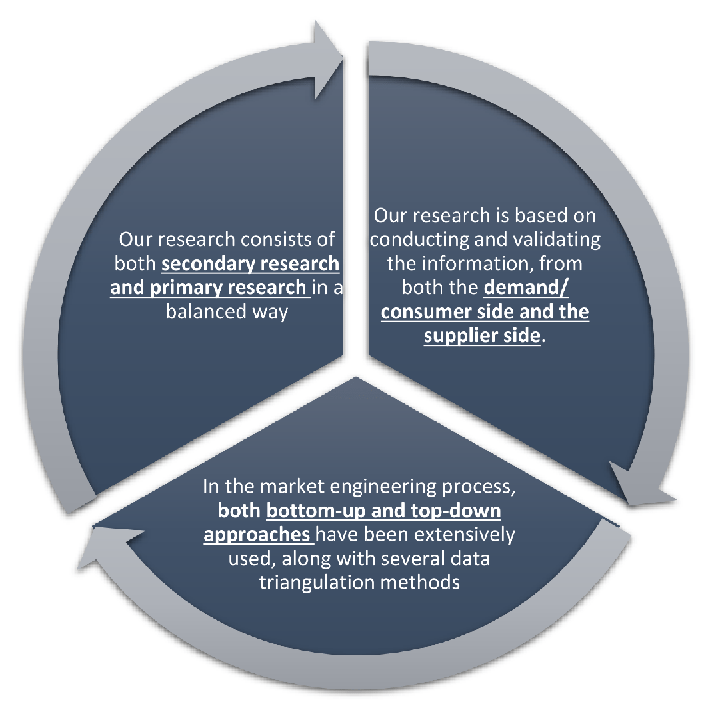
MarketGenics leverages a dedicated industry panel of experts and a comprehensive suite of paid databases to effectively collect, consolidate, and analyze market intelligence.
Our approach has consistently proven to be reliable and effective in generating accurate market insights, identifying key industry trends, and uncovering emerging business opportunities.
Through both primary and secondary research, we capture and analyze critical company-level data such as manufacturing footprints, including technical centers, R&D facilities, sales offices, and headquarters.
Our expert panel further enhances our ability to estimate market size for specific brands based on validated field-level intelligence.
Our data mining techniques incorporate both parametric and non-parametric methods, allowing for structured data collection, sorting, processing, and cleaning.
Demand projections are derived from large-scale data sets analyzed through proprietary algorithms, culminating in robust and reliable market sizing.
Research Approach
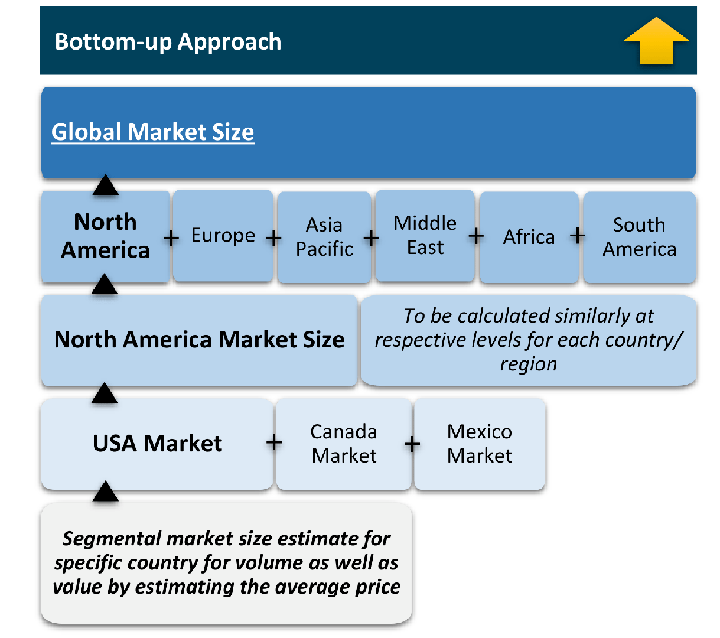
The bottom-up approach builds market estimates by starting with the smallest addressable market units and systematically aggregating them to create comprehensive market size projections.
This method begins with specific, granular data points and builds upward to create the complete market landscape.
Customer Analysis → Segmental Analysis → Geographical Analysis
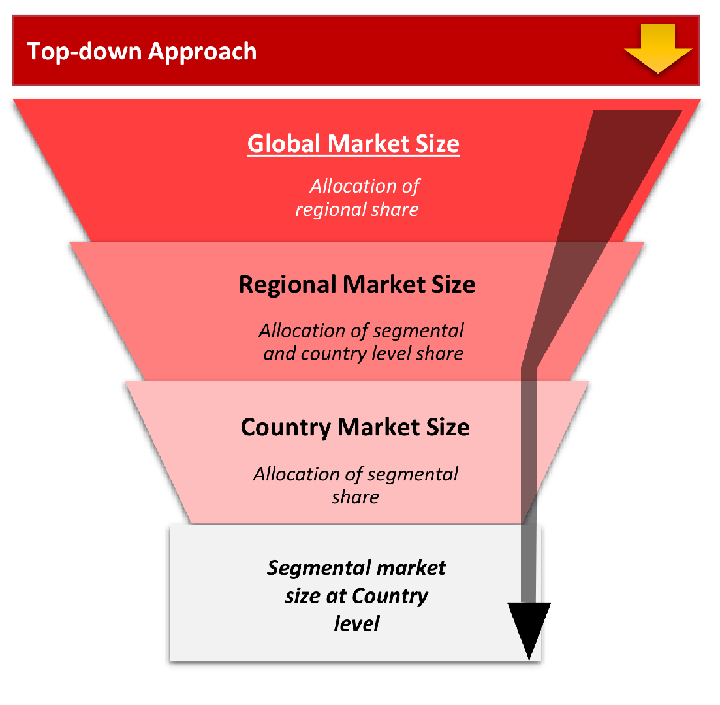
The top-down approach starts with the broadest possible market data and systematically narrows it down through a series of filters and assumptions to arrive at specific market segments or opportunities.
This method begins with the big picture and works downward to increasingly specific market slices.
TAM → SAM → SOM
Research Methods
Desk / Secondary Research
While analysing the market, we extensively study secondary sources, directories, and databases to identify and collect information useful for this technical, market-oriented, and commercial report. Secondary sources that we utilize are not only the public sources, but it is a combination of Open Source, Associations, Paid Databases, MG Repository & Knowledgebase, and others.
- Company websites, annual reports, financial reports, broker reports, and investor presentations
- National government documents, statistical databases and reports
- News articles, press releases and web-casts specific to the companies operating in the market, Magazines, reports, and others
- We gather information from commercial data sources for deriving company specific data such as segmental revenue, share for geography, product revenue, and others
- Internal and external proprietary databases (industry-specific), relevant patent, and regulatory databases
- Governing Bodies, Government Organizations
- Relevant Authorities, Country-specific Associations for Industries
We also employ the model mapping approach to estimate the product level market data through the players' product portfolio
Primary Research
Primary research/ interviews is vital in analyzing the market. Most of the cases involves paid primary interviews. Primary sources include primary interviews through e-mail interactions, telephonic interviews, surveys as well as face-to-face interviews with the different stakeholders across the value chain including several industry experts.
| Type of Respondents | Number of Primaries |
|---|---|
| Tier 2/3 Suppliers | ~20 |
| Tier 1 Suppliers | ~25 |
| End-users | ~25 |
| Industry Expert/ Panel/ Consultant | ~30 |
| Total | ~100 |
MG Knowledgebase
• Repository of industry blog, newsletter and case studies
• Online platform covering detailed market reports, and company profiles
Forecasting Factors and Models
Forecasting Factors
- Historical Trends – Past market patterns, cycles, and major events that shaped how markets behave over time. Understanding past trends helps predict future behavior.
- Industry Factors – Specific characteristics of the industry like structure, regulations, and innovation cycles that affect market dynamics.
- Macroeconomic Factors – Economic conditions like GDP growth, inflation, and employment rates that affect how much money people have to spend.
- Demographic Factors – Population characteristics like age, income, and location that determine who can buy your product.
- Technology Factors – How quickly people adopt new technology and how much technology infrastructure exists.
- Regulatory Factors – Government rules, laws, and policies that can help or restrict market growth.
- Competitive Factors – Analyzing competition structure such as degree of competition and bargaining power of buyers and suppliers.
Forecasting Models / Techniques
Multiple Regression Analysis
- Identify and quantify factors that drive market changes
- Statistical modeling to establish relationships between market drivers and outcomes
Time Series Analysis – Seasonal Patterns
- Understand regular cyclical patterns in market demand
- Advanced statistical techniques to separate trend, seasonal, and irregular components
Time Series Analysis – Trend Analysis
- Identify underlying market growth patterns and momentum
- Statistical analysis of historical data to project future trends
Expert Opinion – Expert Interviews
- Gather deep industry insights and contextual understanding
- In-depth interviews with key industry stakeholders
Multi-Scenario Development
- Prepare for uncertainty by modeling different possible futures
- Creating optimistic, pessimistic, and most likely scenarios
Time Series Analysis – Moving Averages
- Sophisticated forecasting for complex time series data
- Auto-regressive integrated moving average models with seasonal components
Econometric Models
- Apply economic theory to market forecasting
- Sophisticated economic models that account for market interactions
Expert Opinion – Delphi Method
- Harness collective wisdom of industry experts
- Structured, multi-round expert consultation process
Monte Carlo Simulation
- Quantify uncertainty and probability distributions
- Thousands of simulations with varying input parameters
Research Analysis
Our research framework is built upon the fundamental principle of validating market intelligence from both demand and supply perspectives. This dual-sided approach ensures comprehensive market understanding and reduces the risk of single-source bias.
Demand-Side Analysis: We understand end-user/application behavior, preferences, and market needs along with the penetration of the product for specific application.
Supply-Side Analysis: We estimate overall market revenue, analyze the segmental share along with industry capacity, competitive landscape, and market structure.
Validation & Evaluation
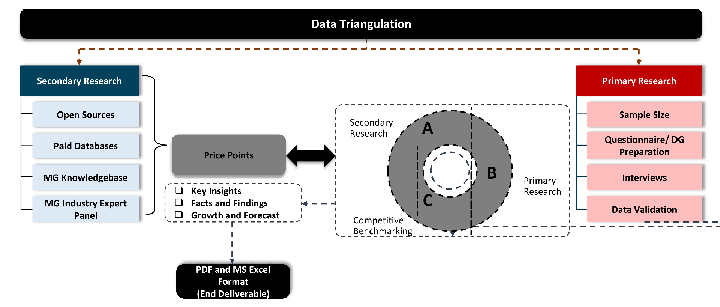
Data triangulation is a validation technique that uses multiple methods, sources, or perspectives to examine the same research question, thereby increasing the credibility and reliability of research findings. In market research, triangulation serves as a quality assurance mechanism that helps identify and minimize bias, validate assumptions, and ensure accuracy in market estimates.
- Data Source Triangulation – Using multiple data sources to examine the same phenomenon
- Methodological Triangulation – Using multiple research methods to study the same research question
- Investigator Triangulation – Using multiple researchers or analysts to examine the same data
- Theoretical Triangulation – Using multiple theoretical perspectives to interpret the same data
Custom Market Research Services
We will customise the research for you, in case the report listed above does not meet your requirements.
Get 10% Free Customisation