Home Appliances Market Size, Share & Trends Analysis Report by Product Type (Major Appliances (White Goods), Small Appliances (Brown Goods), Home Comfort Appliances, Cleaning Appliances, Smart Home Appliances), Installation Type, Distribution Channel, Price Range, End-use, and Geography (North America, Europe, Asia Pacific, Middle East, Africa, and South America) – Global Industry Data, Trends, and Forecasts, 2026–2035
Market Overview:
According to Marketgenics analysis, the global home appliances market is witnessing robust growth, with an estimated value of approximately USD 529.5 billion in 2025 and projected to reach nearly USD 939.3 billion by 2035, expanding at a CAGR of around 5.9% during the forecast period.
|
|
|
Segmental Data Insights |
|
|
Demand Trends |
|
|
Competitive Landscape |
|
|
Strategic Development |
|
|
Future Outlook & Opportunities |
|
Home Appliances Market Size, Share, and Growth
The global home appliances market is driven by rising disposable incomes, rapid urbanization, expanding middle-class populations, increasing adoption of smart and energy-efficient appliances, government incentives for sustainable products, and growing consumer preference for convenience, automation, and connected home solutions across residential and commercial sectors.
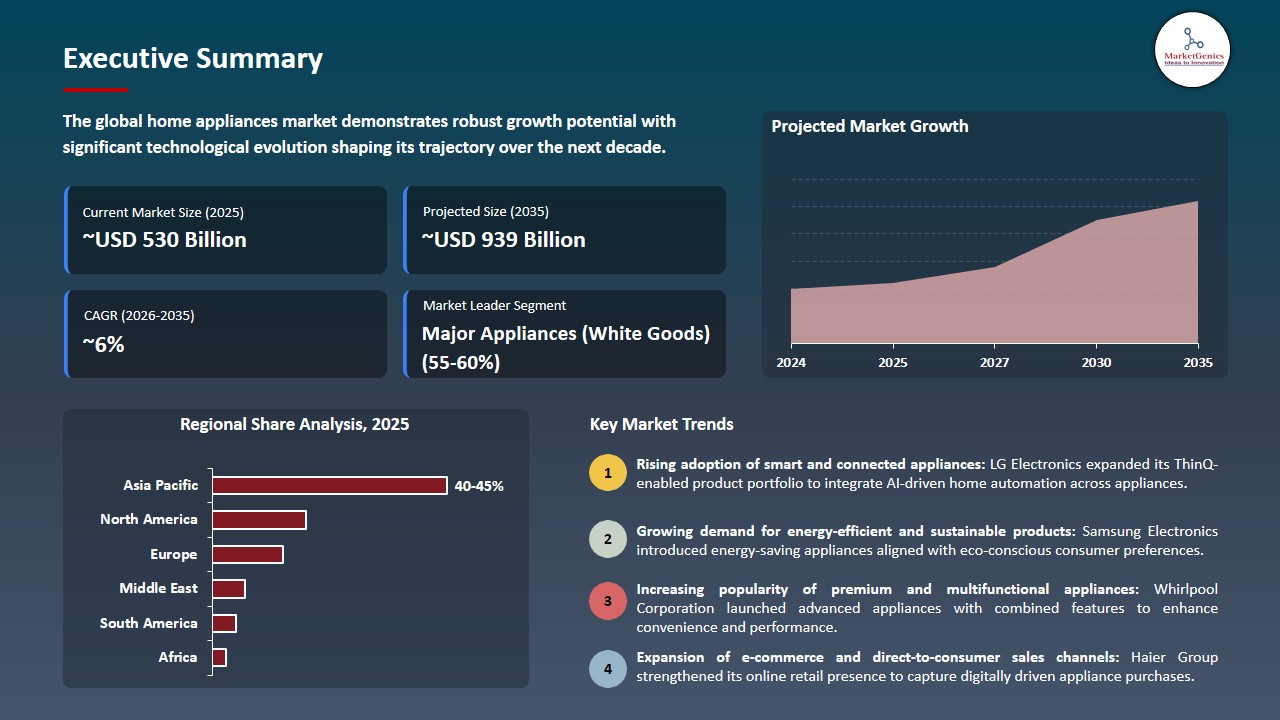
“The LG Essential Series marks a new chapter in our commitment to Indian consumers, following the successful market listing of LGEIL,” said Hong-ju Jeon, managing director of LG Electronics India Ltd. “Designed from the ground-up with insights from thousands of households, this series brings together premium design and everyday reliability. It addresses the real needs of Indian families with appliances built for local conditions – enhancing convenience and enriching daily life. With this launch, LG is making Life’s Good more accessible, turning aspirations into reality across India.”
The localized innovation that is adapted to particular regional needs drives the home appliance market, allowing producers to provide goods that satisfy a range of consumer preferences, cultural demands, and market conditions. For instance, in October 2025, LG Electronics introduced its Essential Series, which is specifically made and priced to suit India households, and it includes durable, feature-rich refrigerators, washing machines, air conditioners, and ovens to satisfy the various local demands. This strategy increases consumerism and brand loyalty leading to long term growth in the domestic and international home appliances market.
Additionally, the use of smart connectivity and long-term software maintenance drives the home appliances market, which improves product usability, durability, and smooth smart home experiences by consumers. For instance, in August 2025, Samsung announced its One UI platform expansion and 7-year software updates on smart home appliances, with a promise of improved security, increased intelligence, and integrated device experience. This innovation contributes to increased consumer confidence and interest, making the process of connected appliances use more accelerated and encouraging more long-term development of the market.
Key opportunities adjacent to the global home appliances market include smart home automation systems, energy-efficient lighting solutions, connected HVAC systems, IoT-enabled kitchen appliances, and home robotics. These sectors complement appliance functionality, foster cross-product integration, and open avenues for technology-driven solutions, enhancing consumer convenience and sustainable living. Leveraging these adjacent markets accelerates innovation, drives revenue diversification, and strengthens long-term growth prospects for the home appliances industry.
Home Appliances Market Dynamics and Trends
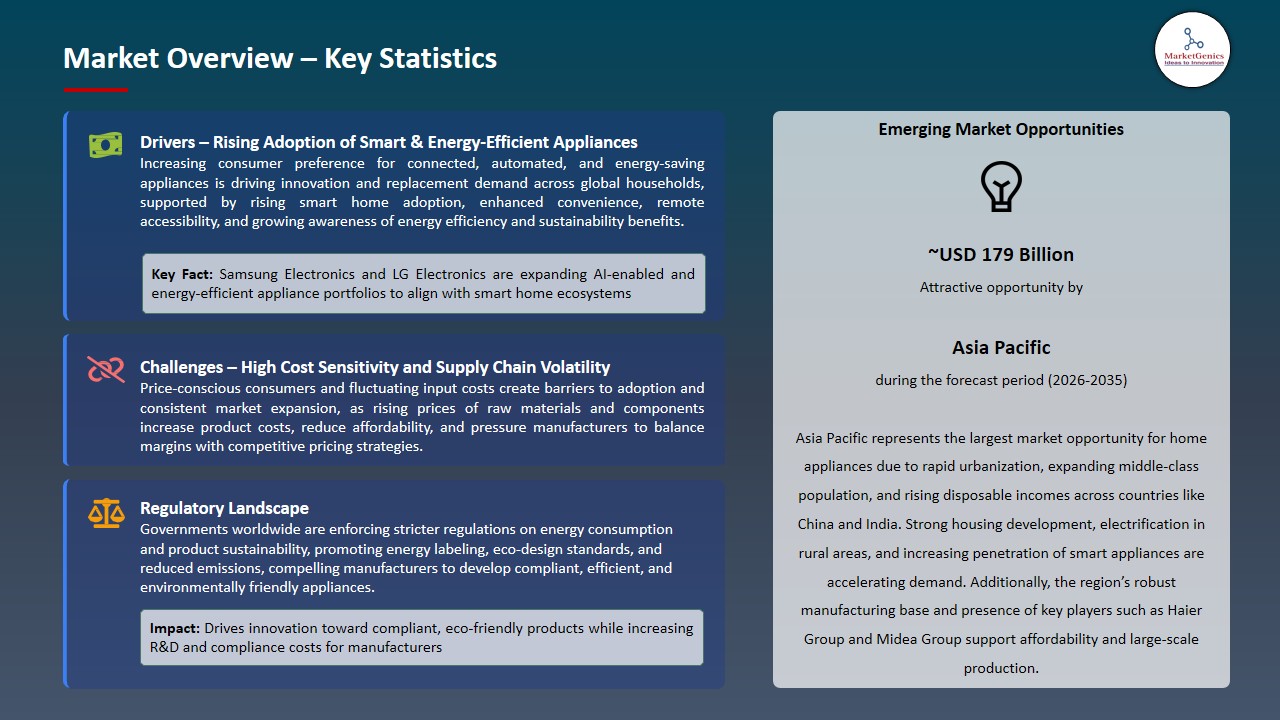
Driver: AI and Smart Appliance Integration Enhancing Consumer Experience
-
The increased integration of AI and intelligent connectivity, which makes appliances provide automated, data-driven performance and integrated user experiences, forces driving the global market of home appliances. The major makers are incorporating the highly developed sensors, machine learning, and IoT-enabled systems in the major appliance segments, such as refrigerators, washing machines, ovens, and HVAC systems, to support adaptive energy use, predictive maintenance, and smart app or voice control.
- AI will enhance a smooth interaction between appliances, improved fabric management, and optimized energy use depending on the needs of the regional consumers. For instance, in September 2025, LG Electronics unveiled its AI-powered home solutions under the “LG AI Home” initiative. The strategic application of AI technology will meet current needs of convenience and connected living and allow brands to differentiate by high performance and integrated ecosystems.
- The driver enhances faster embrace of high-quality appliances and cement values in the market that make products congruent to the current digital life demands.
Restraint: Rising Input Costs and Geopolitical Trade Tensions
-
Changing raw material prices and escalating geopolitical trade tensions, which raise production costs and limit manufacturer profitability, are a significant barrier to the global home appliance market. The essential materials like steel, copper and semiconductor parts that are essential in the production of appliances and smart features have had unstable high prices, sitting well on the margins of the industry giants. Also, the changing trade environment has complicated the competitive positioning and discontinued the global supply chains.
- In November 2025, Whirlpool Corporation filed a case in the U.S. International Trade Commission against other competitors, Samsung and LG, claiming infringement of patents on major microwave-hood designs. These pressures in operations could constrain investment in research and development and decrease the price flexibility especially in markets that are sensitive to economic fluctuations and ability to purchase products.
- These obstacles have the potential of stalling market expansion, forcing manufacturers to reconsider sourcing strategies, supply chain pricing mechanisms, and global supply chain management.
Opportunity: Expanded Portfolio for Emerging Markets and Custom Solutions
-
Expanding product portfolios to meet region-specific needs in emerging economies, where customers are demanding more affordable smart features and culturally relevant design innovations, is a substantial growth opportunity in the global home appliances market. The ability to provide a solution that is balanced in terms of performance, convenience, and local taste can help companies earn a market share.
- For instance, in January 2026, Whirlpool India released its Xpert Care line of wash machines with the Ozone Air Refresh technology, which fulfills the regional demand of high-quality care of fabrics, cost-effective and accompanying everyday functionality.
- Manufacturers of such products can tap into new markets and increase brand loyalty by creating products that cater to local needs, including special cooling, optimized rainy season washing, or seasonally adjusted air conditioning. Further growth potential is increased by the targeted expansion to underserved areas such as South Asia and Latin America.
- Strategic portfolio expansion increases market penetration, revenue growth, and creation of long-term consumer activity in diverse global markets.
Key Trend: Sustainability and Energy Efficiency Shaping Product Roadmaps
-
The focus on sustainability and energy efficient product design is a key trend influencing the global home appliances market, which is driven by the increasing environmental sensitivity of consumers, regulatory measures, and corporate social responsibility to minimize ecological footprint. Increased energy prices and environmental issues are creating the need to have an appliance that is not only at its best but also consumes less power.
- Manufacturers are also moving towards advanced insulation, inverter technology and smart usage algorithms to gain a measurable increase in efficiency. In 2025, Whirlpool Corporation’s Corporate Responsibility Impact Report highlighted updated emissions reduction targets and significant advancements in product efficiency, demonstrating the company’s dedication to sustainable operations and lower-impact appliance solutions. This is a tendency in line with the changing tastes of the consumers, as environmentally conscious consumers are becoming more and more concerned with the products that are energy efficient and environmentally friendly.
- The emphasis on the sustainability boosts brand reputation, facilitates differentiation in the competitive markets, and fosters long-term development in line with the environmental and regulatory concerns.
Home Appliances Market Analysis and Segmental Data
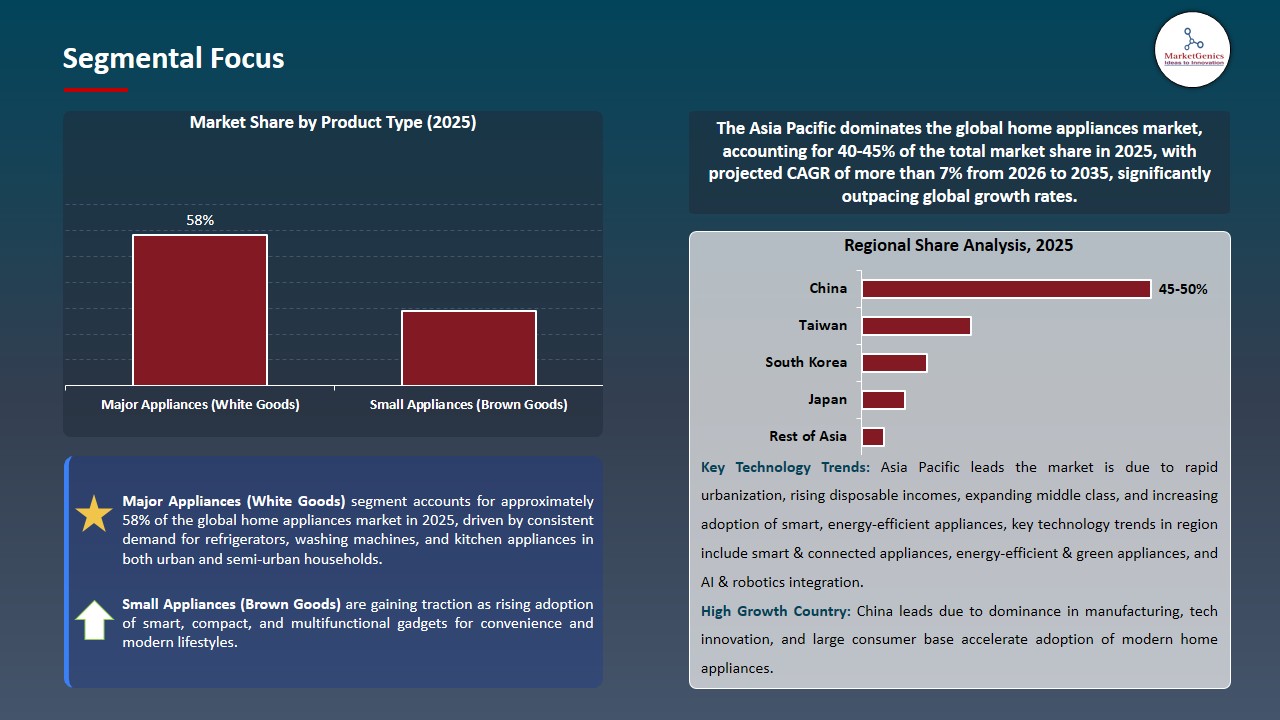
Major Appliances (White Goods) Dominate Global Home Appliances Market
-
The major appliances (white goods) segment dominates the global home appliances market is due to major appliances form the backbone of the global home appliances market, reflecting their essential role in everyday household functionality and large revenue contribution. These products include refrigerators, washing machines, air conditioners, dishwashers, and ovens, and consistently account for the largest share of market value due to their indispensability in modern living.
- Leading manufacturers such as LG Electronics actively emphasize these categories in their growth strategies. In February 2026, LG expanded its lineup of essential refrigerators, washing machines, and air conditioners tailored for key markets like India, demonstrating continued investment and focus on core white goods.
- The sustained prominence of major appliances is driven by ongoing urbanization, rising disposable incomes, replacement cycles for long‑lasting products, and the increasing integration of smart, connected features that enhance convenience and energy efficiency for consumers worldwide.
Asia Pacific Leads Global Home Appliances Market Demand
-
Asia Pacific leads the Home Appliances market is driven by increasing urban household formation and rising middle-class purchasing power in such countries as China and India that support high sales of modern appliances. For instance, Haier Smart Home recorded high-growth revenues in both South Asia and Southeast Asia in August 2025, which indicates that more consumers are purchasing refrigerators, washers and HVAC units in the region.
- Also, enhanced strategic emphasis by international producers on regional interaction and alliance initiatives that offer regional growth. In September 2025 Midea Group Co., Ltd. organized the first Asia Pacific dealer conference ever with a variety of solutions on display and restated its intentions to develop regional relations and market expansion in accordance with the local needs.
- These drivers lead to the rapid introduction of modern appliances, building regional market leadership, and enticing long-term investment and development in the Asia Pacific home appliances industry.
Home Appliances Market Ecosystem
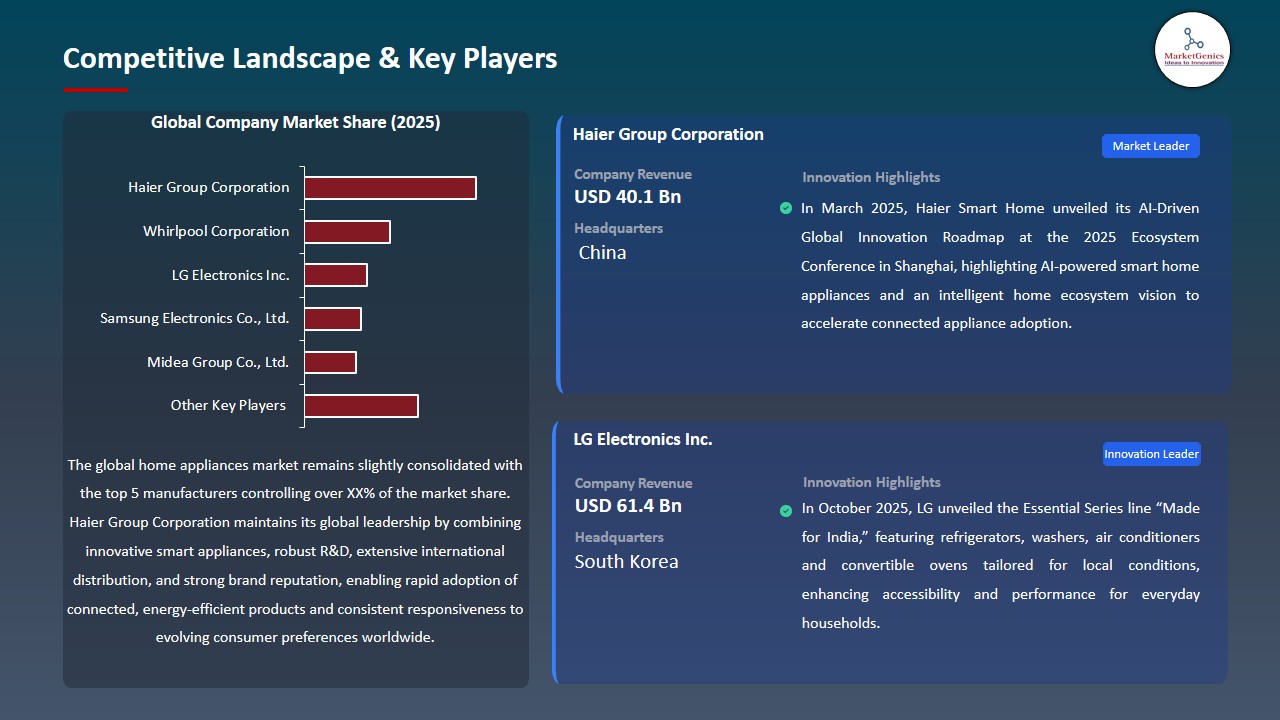
The global home appliances market is slightly consolidated, with leading manufacturers such as Haier Group Corporation, Whirlpool Corporation, LG Electronics Inc., Samsung Electronics Co., Ltd., and Midea Group Co., Ltd. dominating through extensive scale, innovation, and advanced technologies. These companies are using combined hardware-software, intelligent connection, artificial intelligence (AI) and the Internet of Things (IoT) to stay ahead of competitors and gain a considerable market share in both developed and developing markets.
Key players are those that are niche oriented in terms of technology and specialized solutions that help in innovation and market differentiation. As an example, Samsung Bespoke AI appliances use AI Vision and SmartThings connectivity that adds convenience to the user, whereas LG ThinQ AI is an ecosystem that integrates the washers, refrigerators, and smart hubs. Haier is focused on complete ecosystem IoT solutions and Midea focused on space optimization designs and energy efficient products lines that appeal to the urban consumers.
These new inventions and specialized technology have greatly enhanced the rate at which the consumers are adopting smart appliances that consume less energy, enhancing brand loyalty and leading to the continued growth of the home appliances market all over the world.
Recent Development and Strategic Overview:
-
In September 2025, Midea unveiled its “Master Your Home” portfolio, featuring the SPACE MASTER, SMART MASTER, and ECOMASTER appliance lines, emphasizing energy efficiency, space-optimized designs, and integrated solutions to enhance overall home comfort and user convenience.
- In June 2025, Samsung launched its 2025 Bespoke AI home appliance portfolio, featuring AI-enabled refrigerators and laundry systems with SmartThings integration and advanced AI Home displays, reinforcing its leadership in intelligent, connected home solutions on a global scale.
Report Scope
|
Detail |
|
|
Market Size in 2025 |
USD 529.5 Bn |
|
Market Forecast Value in 2035 |
USD 939.3 Bn |
|
Growth Rate (CAGR) |
5.9% |
|
Forecast Period |
2026 – 2035 |
|
Historical Data Available for |
2021 – 2024 |
|
Market Size Units |
US$ Billion for Value Thousand Units for Volume |
|
Report Format |
Electronic (PDF) + Excel |
|
North America |
Europe |
Asia Pacific |
Middle East |
Africa |
South America |
|
|
|
|
|
|
|
Companies Covered |
|||||
|
|
|
|
|
|
Home Appliances Market Segmentation and Highlights
|
Segment |
Sub-segment |
|
Home Appliances Market, By Product Type |
|
|
Home Appliances Market, By Installation Type |
|
|
Home Appliances Market, By Distribution Channel |
|
|
Home Appliances Market, By Price Range |
|
|
Home Appliances Market, By End-use |
|
Frequently Asked Questions
Table of Contents
- 1. Research Methodology and Assumptions
- 1.1. Definitions
- 1.2. Research Design and Approach
- 1.3. Data Collection Methods
- 1.4. Base Estimates and Calculations
- 1.5. Forecasting Models
- 1.5.1. Key Forecast Factors & Impact Analysis
- 1.6. Secondary Research
- 1.6.1. Open Sources
- 1.6.2. Paid Databases
- 1.6.3. Associations
- 1.7. Primary Research
- 1.7.1. Primary Sources
- 1.7.2. Primary Interviews with Stakeholders across Ecosystem
- 2. Executive Summary
- 2.1. Global Home Appliances Market Outlook
- 2.1.1. Home Appliances Market Size (Volume - Thousand Units and Value - US$ Bn), and Forecasts, 2021-2035
- 2.1.2. Compounded Annual Growth Rate Analysis
- 2.1.3. Growth Opportunity Analysis
- 2.1.4. Segmental Share Analysis
- 2.1.5. Geographical Share Analysis
- 2.2. Market Analysis and Facts
- 2.3. Supply-Demand Analysis
- 2.4. Competitive Benchmarking
- 2.5. Go-to- Market Strategy
- 2.5.1. Customer/ End-use Industry Assessment
- 2.5.2. Growth Opportunity Data, 2026-2035
- 2.5.2.1. Regional Data
- 2.5.2.2. Country Data
- 2.5.2.3. Segmental Data
- 2.5.3. Identification of Potential Market Spaces
- 2.5.4. GAP Analysis
- 2.5.5. Potential Attractive Price Points
- 2.5.6. Prevailing Market Risks & Challenges
- 2.5.7. Preferred Sales & Marketing Strategies
- 2.5.8. Key Recommendations and Analysis
- 2.5.9. A Way Forward
- 2.1. Global Home Appliances Market Outlook
- 3. Industry Data and Premium Insights
- 3.1. Global Consumer Goods & Services Industry Overview, 2025
- 3.1.1. Consumer Goods & Services Ecosystem Analysis
- 3.1.2. Key Trends for Consumer Goods & Services Industry
- 3.1.3. Regional Distribution for Consumer Goods & Services Industry
- 3.2. Supplier Customer Data
- 3.3. Technology Roadmap and Developments
- 3.4. Trade Analysis
- 3.4.1. Import & Export Analysis, 2025
- 3.4.2. Top Importing Countries
- 3.4.3. Top Exporting Countries
- 3.5. Trump Tariff Impact Analysis
- 3.5.1. Manufacturer
- 3.5.1.1. Based on the component & Raw material
- 3.5.2. Supply Chain
- 3.5.3. End Consumer
- 3.5.1. Manufacturer
- 3.6. Raw Material Analysis
- 3.1. Global Consumer Goods & Services Industry Overview, 2025
- 4. Market Overview
- 4.1. Market Dynamics
- 4.1.1. Drivers
- 4.1.1.1. Rising disposable income and improving living standards boosting consumer spending on home appliances
- 4.1.1.2. Rapid urbanization and evolving lifestyles increasing demand for convenience-driven products
- 4.1.1.3. Technological advancements and growing adoption of smart and IoT-enabled appliances
- 4.1.2. Restraints
- 4.1.2.1. High initial cost and maintenance concerns limiting adoption in price-sensitive markets
- 4.1.2.2. Fluctuating raw material prices and supply chain disruptions impacting production costs
- 4.1.1. Drivers
- 4.2. Key Trend Analysis
- 4.3. Regulatory Framework
- 4.3.1. Key Regulations, Norms, and Subsidies, by Key Countries
- 4.3.2. Tariffs and Standards
- 4.3.3. Impact Analysis of Regulations on the Market
- 4.4. Value Chain Analysis
- 4.4.1. Component Suppliers
- 4.4.2. Appliance Manufacturing & Assembly
- 4.4.3. Distribution & Logistics
- 4.4.4. End Users
- 4.5. Cost Structure Analysis
- 4.5.1. Parameter’s Share for Cost Associated
- 4.5.2. COGP vs COGS
- 4.5.3. Profit Margin Analysis
- 4.6. Pricing Analysis
- 4.6.1. Regional Pricing Analysis
- 4.6.2. Segmental Pricing Trends
- 4.6.3. Factors Influencing Pricing
- 4.7. Porter’s Five Forces Analysis
- 4.8. PESTEL Analysis
- 4.9. Global Home Appliances Market Demand
- 4.9.1. Historical Market Size – in Volume (Thousand Units) and Value (US$ Bn), 2020-2024
- 4.9.2. Current and Future Market Size – in Volume (Thousand Units) and Value (US$ Bn), 2026–2035
- 4.9.2.1. Y-o-Y Growth Trends
- 4.9.2.2. Absolute $ Opportunity Assessment
- 4.1. Market Dynamics
- 5. Competition Landscape
- 5.1. Competition structure
- 5.1.1. Fragmented v/s consolidated
- 5.2. Company Share Analysis, 2025
- 5.2.1. Global Company Market Share
- 5.2.2. By Region
- 5.2.2.1. North America
- 5.2.2.2. Europe
- 5.2.2.3. Asia Pacific
- 5.2.2.4. Middle East
- 5.2.2.5. Africa
- 5.2.2.6. South America
- 5.3. Product Comparison Matrix
- 5.3.1. Specifications
- 5.3.2. Market Positioning
- 5.3.3. Pricing
- 5.1. Competition structure
- 6. Global Home Appliances Market Analysis, by Product Type
- 6.1. Key Segment Analysis
- 6.2. Home Appliances Market Size (Volume - Thousand Units and Value - US$ Bn), Analysis, and Forecasts, by Product Type, 2021-2035
- 6.2.1. Major Appliances (White Goods)
- 6.2.1.1. Refrigerators & Freezers
- 6.2.1.2. Washing Machines
- 6.2.1.3. Dryers
- 6.2.1.4. Dishwashers
- 6.2.1.5. Cooking Appliances
- 6.2.1.6. Air Conditioners
- 6.2.1.7. Others
- 6.2.2. Small Appliances (Brown Goods)
- 6.2.2.1. Kitchen Appliances
- 6.2.2.1.1. Blenders & Mixers
- 6.2.2.1.2. Food Processors
- 6.2.2.1.3. Coffee Makers & Espresso Machines
- 6.2.2.1.4. Toasters & Toaster Ovens
- 6.2.2.1.5. Electric Kettles
- 6.2.2.1.6. Juicers
- 6.2.2.1.7. Slow Cookers & Pressure Cookers
- 6.2.2.1.8. Rice Cookers
- 6.2.2.1.9. Air Fryers
- 6.2.2.1.10. Induction Cooktops
- 6.2.2.1.11. Others
- 6.2.2.2. Home Comfort Appliances
- 6.2.2.2.1. Fans (Ceiling, Table, Stand, Exhaust)
- 6.2.2.2.2. Air Purifiers
- 6.2.2.2.3. Humidifiers & Dehumidifiers
- 6.2.2.2.4. Space Heaters
- 6.2.2.2.5. Water Heaters (Instant, Storage)
- 6.2.2.2.6. Others
- 6.2.2.3. Cleaning Appliances
- 6.2.2.3.1. Vacuum Cleaners (Upright, Canister, Robotic, Handheld, Stick)
- 6.2.2.3.2. Steam Cleaners
- 6.2.2.3.3. Floor Polishers
- 6.2.2.3.4. Carpet Cleaners
- 6.2.2.3.5. Others
- 6.2.2.1. Kitchen Appliances
- 6.2.3. Smart Home Appliances
- 6.2.1. Major Appliances (White Goods)
- 7. Global Home Appliances Market Analysis, by Installation Type
- 7.1. Key Segment Analysis
- 7.2. Home Appliances Market Size (Volume - Thousand Units and Value - US$ Bn), Analysis, and Forecasts, by Installation Type, 2021-2035
- 7.2.1. Freestanding/Portable
- 7.2.2. Built-in/Integrated
- 7.2.3. Wall-mounted
- 7.2.4. Under-counter
- 7.2.5. Modular
- 7.2.6. Others
- 8. Global Home Appliances Market Analysis, by Distribution Channel
- 8.1. Key Segment Analysis
- 8.2. Home Appliances Market Size (Volume - Thousand Units and Value - US$ Bn), Analysis, and Forecasts, by Distribution Channel, 2021-2035
- 8.2.1. Online Channels
- 8.2.1.1. E-commerce Platforms
- 8.2.1.2. Brand Websites
- 8.2.1.3. Online Marketplaces
- 8.2.2. Offline Channels
- 8.2.2.1. Hypermarkets & Supermarkets
- 8.2.2.2. Specialty Stores
- 8.2.2.3. Brand Exclusive Stores
- 8.2.2.4. Electronics Retail Chains
- 8.2.2.5. Department Stores
- 8.2.2.6. Independent Retailers
- 8.2.2.7. Direct Sales
- 8.2.1. Online Channels
- 9. Global Home Appliances Market Analysis, by Price Range
- 9.1. Key Segment Analysis
- 9.2. Home Appliances Market Size (Volume - Thousand Units and Value - US$ Bn), Analysis, and Forecasts, by Price Range, 2021-2035
- 9.2.1. Economy/Budget Segment
- 9.2.2. Mid-range Segment
- 9.2.3. Premium Segment
- 9.2.4. Luxury/Ultra-premium Segment
- 10. Global Home Appliances Market Analysis, by End-use
- 10.1. Key Segment Analysis
- 10.2. Home Appliances Market Size (Volume - Thousand Units and Value - US$ Bn), Analysis, and Forecasts, by End-use, 2021-2035
- 10.2.1. Residential Use
- 10.2.1.1. Single-family Homes
- 10.2.1.2. Apartments/Condominiums
- 10.2.1.3. Townhouses
- 10.2.1.4. Mobile Homes
- 10.2.1.5. Others
- 10.2.2. Commercial Use
- 10.2.2.1. Hotels & Hospitality
- 10.2.2.2. Restaurants & Cafeterias
- 10.2.2.3. Laundromats
- 10.2.2.4. Student Housing/Dormitories
- 10.2.2.5. Healthcare Facilities
- 10.2.2.6. Offices
- 10.2.2.7. Retail Spaces
- 10.2.2.8. Others
- 10.2.3. Institutional Use
- 10.2.3.1. Schools & Universities
- 10.2.3.2. Government Buildings
- 10.2.3.3. Hospitals
- 10.2.3.4. Military Facilities
- 10.2.3.5. Others
- 10.2.1. Residential Use
- 11. Global Home Appliances Market Analysis, by Region
- 11.1. Key Findings
- 11.2. Home Appliances Market Size (Volume - Thousand Units and Value - US$ Bn), Analysis, and Forecasts, by Region, 2021-2035
- 11.2.1. North America
- 11.2.2. Europe
- 11.2.3. Asia Pacific
- 11.2.4. Middle East
- 11.2.5. Africa
- 11.2.6. South America
- 12. North America Home Appliances Market Analysis
- 12.1. Key Segment Analysis
- 12.2. Regional Snapshot
- 12.3. North America Home Appliances Market Size (Volume - Thousand Units and Value - US$ Bn), Analysis, and Forecasts, 2021-2035
- 12.3.1. Product Type
- 12.3.2. Installation Type
- 12.3.3. Distribution Channel
- 12.3.4. Price Range
- 12.3.5. End-use
- 12.3.6. Country
- 12.3.6.1. USA
- 12.3.6.2. Canada
- 12.3.6.3. Mexico
- 12.4. USA Home Appliances Market
- 12.4.1. Country Segmental Analysis
- 12.4.2. Product Type
- 12.4.3. Installation Type
- 12.4.4. Distribution Channel
- 12.4.5. Price Range
- 12.4.6. End-use
- 12.5. Canada Home Appliances Market
- 12.5.1. Country Segmental Analysis
- 12.5.2. Product Type
- 12.5.3. Installation Type
- 12.5.4. Distribution Channel
- 12.5.5. Price Range
- 12.5.6. End-use
- 12.6. Mexico Home Appliances Market
- 12.6.1. Country Segmental Analysis
- 12.6.2. Product Type
- 12.6.3. Installation Type
- 12.6.4. Distribution Channel
- 12.6.5. Price Range
- 12.6.6. End-use
- 13. Europe Home Appliances Market Analysis
- 13.1. Key Segment Analysis
- 13.2. Regional Snapshot
- 13.3. Europe Home Appliances Market Size (Volume - Thousand Units and Value - US$ Bn), Analysis, and Forecasts, 2021-2035
- 13.3.1. Product Type
- 13.3.2. Installation Type
- 13.3.3. Distribution Channel
- 13.3.4. Price Range
- 13.3.5. End-use
- 13.3.6. Country
- 13.3.6.1. Germany
- 13.3.6.2. United Kingdom
- 13.3.6.3. France
- 13.3.6.4. Italy
- 13.3.6.5. Spain
- 13.3.6.6. Netherlands
- 13.3.6.7. Nordic Countries
- 13.3.6.8. Poland
- 13.3.6.9. Russia & CIS
- 13.3.6.10. Rest of Europe
- 13.4. Germany Home Appliances Market
- 13.4.1. Country Segmental Analysis
- 13.4.2. Product Type
- 13.4.3. Installation Type
- 13.4.4. Distribution Channel
- 13.4.5. Price Range
- 13.4.6. End-use
- 13.5. United Kingdom Home Appliances Market
- 13.5.1. Country Segmental Analysis
- 13.5.2. Product Type
- 13.5.3. Installation Type
- 13.5.4. Distribution Channel
- 13.5.5. Price Range
- 13.5.6. End-use
- 13.6. France Home Appliances Market
- 13.6.1. Country Segmental Analysis
- 13.6.2. Product Type
- 13.6.3. Installation Type
- 13.6.4. Distribution Channel
- 13.6.5. Price Range
- 13.6.6. End-use
- 13.7. Italy Home Appliances Market
- 13.7.1. Country Segmental Analysis
- 13.7.2. Product Type
- 13.7.3. Installation Type
- 13.7.4. Distribution Channel
- 13.7.5. Price Range
- 13.7.6. End-use
- 13.8. Spain Home Appliances Market
- 13.8.1. Country Segmental Analysis
- 13.8.2. Product Type
- 13.8.3. Installation Type
- 13.8.4. Distribution Channel
- 13.8.5. Price Range
- 13.8.6. End-use
- 13.9. Netherlands Home Appliances Market
- 13.9.1. Country Segmental Analysis
- 13.9.2. Product Type
- 13.9.3. Installation Type
- 13.9.4. Distribution Channel
- 13.9.5. Price Range
- 13.9.6. End-use
- 13.10. Nordic Countries Home Appliances Market
- 13.10.1. Country Segmental Analysis
- 13.10.2. Product Type
- 13.10.3. Installation Type
- 13.10.4. Distribution Channel
- 13.10.5. Price Range
- 13.10.6. End-use
- 13.11. Poland Home Appliances Market
- 13.11.1. Country Segmental Analysis
- 13.11.2. Product Type
- 13.11.3. Installation Type
- 13.11.4. Distribution Channel
- 13.11.5. Price Range
- 13.11.6. End-use
- 13.12. Russia & CIS Home Appliances Market
- 13.12.1. Country Segmental Analysis
- 13.12.2. Product Type
- 13.12.3. Installation Type
- 13.12.4. Distribution Channel
- 13.12.5. Price Range
- 13.12.6. End-use
- 13.13. Rest of Europe Home Appliances Market
- 13.13.1. Country Segmental Analysis
- 13.13.2. Product Type
- 13.13.3. Installation Type
- 13.13.4. Distribution Channel
- 13.13.5. Price Range
- 13.13.6. End-use
- 14. Asia Pacific Home Appliances Market Analysis
- 14.1. Key Segment Analysis
- 14.2. Regional Snapshot
- 14.3. Asia Pacific Home Appliances Market Size (Volume - Thousand Units and Value - US$ Bn), Analysis, and Forecasts, 2021-2035
- 14.3.1. Product Type
- 14.3.2. Installation Type
- 14.3.3. Distribution Channel
- 14.3.4. Price Range
- 14.3.5. End-use
- 14.3.6. Country
- 14.3.6.1. China
- 14.3.6.2. India
- 14.3.6.3. Japan
- 14.3.6.4. South Korea
- 14.3.6.5. Australia and New Zealand
- 14.3.6.6. Indonesia
- 14.3.6.7. Malaysia
- 14.3.6.8. Thailand
- 14.3.6.9. Vietnam
- 14.3.6.10. Rest of Asia Pacific
- 14.4. China Home Appliances Market
- 14.4.1. Country Segmental Analysis
- 14.4.2. Product Type
- 14.4.3. Installation Type
- 14.4.4. Distribution Channel
- 14.4.5. Price Range
- 14.4.6. End-use
- 14.5. India Home Appliances Market
- 14.5.1. Country Segmental Analysis
- 14.5.2. Product Type
- 14.5.3. Installation Type
- 14.5.4. Distribution Channel
- 14.5.5. Price Range
- 14.5.6. End-use
- 14.6. Japan Home Appliances Market
- 14.6.1. Country Segmental Analysis
- 14.6.2. Product Type
- 14.6.3. Installation Type
- 14.6.4. Distribution Channel
- 14.6.5. Price Range
- 14.6.6. End-use
- 14.7. South Korea Home Appliances Market
- 14.7.1. Country Segmental Analysis
- 14.7.2. Product Type
- 14.7.3. Installation Type
- 14.7.4. Distribution Channel
- 14.7.5. Price Range
- 14.7.6. End-use
- 14.8. Australia and New Zealand Home Appliances Market
- 14.8.1. Country Segmental Analysis
- 14.8.2. Product Type
- 14.8.3. Installation Type
- 14.8.4. Distribution Channel
- 14.8.5. Price Range
- 14.8.6. End-use
- 14.9. Indonesia Home Appliances Market
- 14.9.1. Country Segmental Analysis
- 14.9.2. Product Type
- 14.9.3. Installation Type
- 14.9.4. Distribution Channel
- 14.9.5. Price Range
- 14.9.6. End-use
- 14.10. Malaysia Home Appliances Market
- 14.10.1. Country Segmental Analysis
- 14.10.2. Product Type
- 14.10.3. Installation Type
- 14.10.4. Distribution Channel
- 14.10.5. Price Range
- 14.10.6. End-use
- 14.11. Thailand Home Appliances Market
- 14.11.1. Country Segmental Analysis
- 14.11.2. Product Type
- 14.11.3. Installation Type
- 14.11.4. Distribution Channel
- 14.11.5. Price Range
- 14.11.6. End-use
- 14.12. Vietnam Home Appliances Market
- 14.12.1. Country Segmental Analysis
- 14.12.2. Product Type
- 14.12.3. Installation Type
- 14.12.4. Distribution Channel
- 14.12.5. Price Range
- 14.12.6. End-use
- 14.13. Rest of Asia Pacific Home Appliances Market
- 14.13.1. Country Segmental Analysis
- 14.13.2. Product Type
- 14.13.3. Installation Type
- 14.13.4. Distribution Channel
- 14.13.5. Price Range
- 14.13.6. End-use
- 15. Middle East Home Appliances Market Analysis
- 15.1. Key Segment Analysis
- 15.2. Regional Snapshot
- 15.3. Middle East Home Appliances Market Size (Volume - Thousand Units and Value - US$ Bn), Analysis, and Forecasts, 2021-2035
- 15.3.1. Product Type
- 15.3.2. Installation Type
- 15.3.3. Distribution Channel
- 15.3.4. Price Range
- 15.3.5. End-use
- 15.3.6. Country
- 15.3.6.1. Turkey
- 15.3.6.2. UAE
- 15.3.6.3. Saudi Arabia
- 15.3.6.4. Israel
- 15.3.6.5. Rest of Middle East
- 15.4. Turkey Home Appliances Market
- 15.4.1. Country Segmental Analysis
- 15.4.2. Product Type
- 15.4.3. Installation Type
- 15.4.4. Distribution Channel
- 15.4.5. Price Range
- 15.4.6. End-use
- 15.5. UAE Home Appliances Market
- 15.5.1. Country Segmental Analysis
- 15.5.2. Product Type
- 15.5.3. Installation Type
- 15.5.4. Distribution Channel
- 15.5.5. Price Range
- 15.5.6. End-use
- 15.6. Saudi Arabia Home Appliances Market
- 15.6.1. Country Segmental Analysis
- 15.6.2. Product Type
- 15.6.3. Installation Type
- 15.6.4. Distribution Channel
- 15.6.5. Price Range
- 15.6.6. End-use
- 15.7. Israel Home Appliances Market
- 15.7.1. Country Segmental Analysis
- 15.7.2. Product Type
- 15.7.3. Installation Type
- 15.7.4. Distribution Channel
- 15.7.5. Price Range
- 15.7.6. End-use
- 15.8. Rest of Middle East Home Appliances Market
- 15.8.1. Country Segmental Analysis
- 15.8.2. Product Type
- 15.8.3. Installation Type
- 15.8.4. Distribution Channel
- 15.8.5. Price Range
- 15.8.6. End-use
- 16. Africa Home Appliances Market Analysis
- 16.1. Key Segment Analysis
- 16.2. Regional Snapshot
- 16.3. Africa Home Appliances Market Size (Volume - Thousand Units and Value - US$ Bn), Analysis, and Forecasts, 2021-2035
- 16.3.1. Product Type
- 16.3.2. Installation Type
- 16.3.3. Distribution Channel
- 16.3.4. Price Range
- 16.3.5. End-use
- 16.3.6. Country
- 16.3.6.1. South Africa
- 16.3.6.2. Egypt
- 16.3.6.3. Nigeria
- 16.3.6.4. Algeria
- 16.3.6.5. Rest of Africa
- 16.4. South Africa Home Appliances Market
- 16.4.1. Country Segmental Analysis
- 16.4.2. Product Type
- 16.4.3. Installation Type
- 16.4.4. Distribution Channel
- 16.4.5. Price Range
- 16.4.6. End-use
- 16.5. Egypt Home Appliances Market
- 16.5.1. Country Segmental Analysis
- 16.5.2. Product Type
- 16.5.3. Installation Type
- 16.5.4. Distribution Channel
- 16.5.5. Price Range
- 16.5.6. End-use
- 16.6. Nigeria Home Appliances Market
- 16.6.1. Country Segmental Analysis
- 16.6.2. Product Type
- 16.6.3. Installation Type
- 16.6.4. Distribution Channel
- 16.6.5. Price Range
- 16.6.6. End-use
- 16.7. Algeria Home Appliances Market
- 16.7.1. Country Segmental Analysis
- 16.7.2. Product Type
- 16.7.3. Installation Type
- 16.7.4. Distribution Channel
- 16.7.5. Price Range
- 16.7.6. End-use
- 16.8. Rest of Africa Home Appliances Market
- 16.8.1. Country Segmental Analysis
- 16.8.2. Product Type
- 16.8.3. Installation Type
- 16.8.4. Distribution Channel
- 16.8.5. Price Range
- 16.8.6. End-use
- 17. South America Home Appliances Market Analysis
- 17.1. Key Segment Analysis
- 17.2. Regional Snapshot
- 17.3. South America Home Appliances Market Size (Volume - Thousand Units and Value - US$ Bn), Analysis, and Forecasts, 2021-2035
- 17.3.1. Product Type
- 17.3.2. Installation Type
- 17.3.3. Distribution Channel
- 17.3.4. Price Range
- 17.3.5. End-use
- 17.3.6. Country
- 17.3.6.1. Brazil
- 17.3.6.2. Argentina
- 17.3.6.3. Rest of South America
- 17.4. Brazil Home Appliances Market
- 17.4.1. Country Segmental Analysis
- 17.4.2. Product Type
- 17.4.3. Installation Type
- 17.4.4. Distribution Channel
- 17.4.5. Price Range
- 17.4.6. End-use
- 17.5. Argentina Home Appliances Market
- 17.5.1. Country Segmental Analysis
- 17.5.2. Product Type
- 17.5.3. Installation Type
- 17.5.4. Distribution Channel
- 17.5.5. Price Range
- 17.5.6. End-use
- 17.6. Rest of South America Home Appliances Market
- 17.6.1. Country Segmental Analysis
- 17.6.2. Product Type
- 17.6.3. Installation Type
- 17.6.4. Distribution Channel
- 17.6.5. Price Range
- 17.6.6. End-use
- 18. Key Players/ Company Profile
- 18.1. Breville Group Limited
- 18.1.1. Company Details/ Overview
- 18.1.2. Company Financials
- 18.1.3. Key Customers and Competitors
- 18.1.4. Business/ Industry Portfolio
- 18.1.5. Product Portfolio/ Specification Details
- 18.1.6. Pricing Data
- 18.1.7. Strategic Overview
- 18.1.8. Recent Developments
- 18.2. BSH Hausgeräte GmbH
- 18.3. De'Longhi S.p.A.
- 18.4. Dyson Ltd.
- 18.5. Electrolux AB
- 18.6. GE Appliances (Haier)
- 18.7. Godrej & Boyce Manufacturing Company Limited
- 18.8. Gree Electric Appliances Inc.
- 18.9. Haier Group Corporation
- 18.10. Hisense Group
- 18.11. Hitachi, Ltd.
- 18.12. LG Electronics Inc.
- 18.13. Midea Group Co., Ltd.
- 18.14. Miele & Cie. KG
- 18.15. Panasonic Corporation
- 18.16. Philips (Koninklijke Philips N.V.)
- 18.17. Samsung Electronics Co., Ltd.
- 18.18. Sharp Corporation
- 18.19. Siemens AG
- 18.20. Sony Corporation
- 18.21. TCL Corporation
- 18.22. Toshiba Corporation
- 18.23. Voltas Limited
- 18.24. Whirlpool Corporation
- 18.25. Other Key Players
- 18.1. Breville Group Limited
Note* - This is just tentative list of players. While providing the report, we will cover more number of players based on their revenue and share for each geography
Research Design
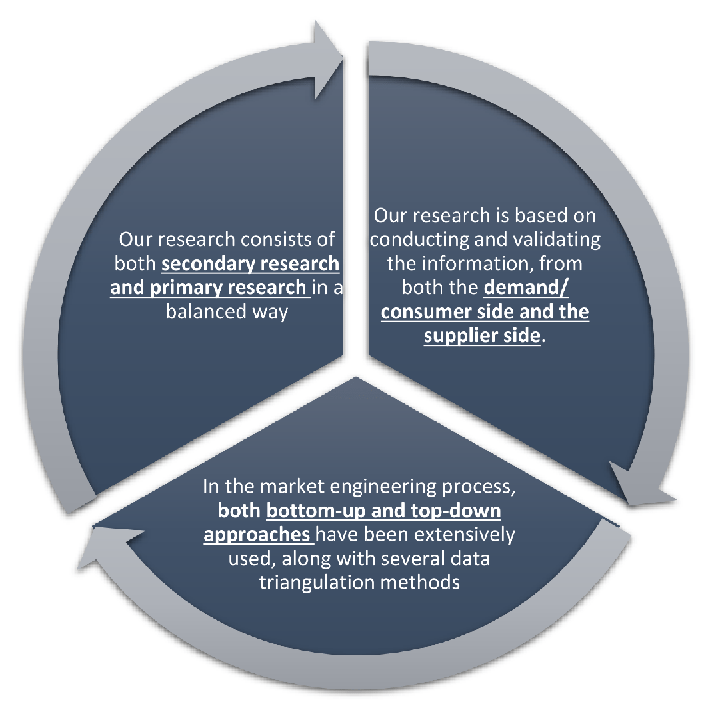
Our research design integrates both demand-side and supply-side analysis through a balanced combination of primary and secondary research methodologies. By utilizing both bottom-up and top-down approaches alongside rigorous data triangulation methods, we deliver robust market intelligence that supports strategic decision-making.
MarketGenics' comprehensive research design framework ensures the delivery of accurate, reliable, and actionable market intelligence. Through the integration of multiple research approaches, rigorous validation processes, and expert analysis, we provide our clients with the insights needed to make informed strategic decisions and capitalize on market opportunities.
MarketGenics leverages a dedicated industry panel of experts and a comprehensive suite of paid databases to effectively collect, consolidate, and analyze market intelligence.
Our approach has consistently proven to be reliable and effective in generating accurate market insights, identifying key industry trends, and uncovering emerging business opportunities.
Through both primary and secondary research, we capture and analyze critical company-level data such as manufacturing footprints, including technical centers, R&D facilities, sales offices, and headquarters.
Our expert panel further enhances our ability to estimate market size for specific brands based on validated field-level intelligence.
Our data mining techniques incorporate both parametric and non-parametric methods, allowing for structured data collection, sorting, processing, and cleaning.
Demand projections are derived from large-scale data sets analyzed through proprietary algorithms, culminating in robust and reliable market sizing.
Research Approach
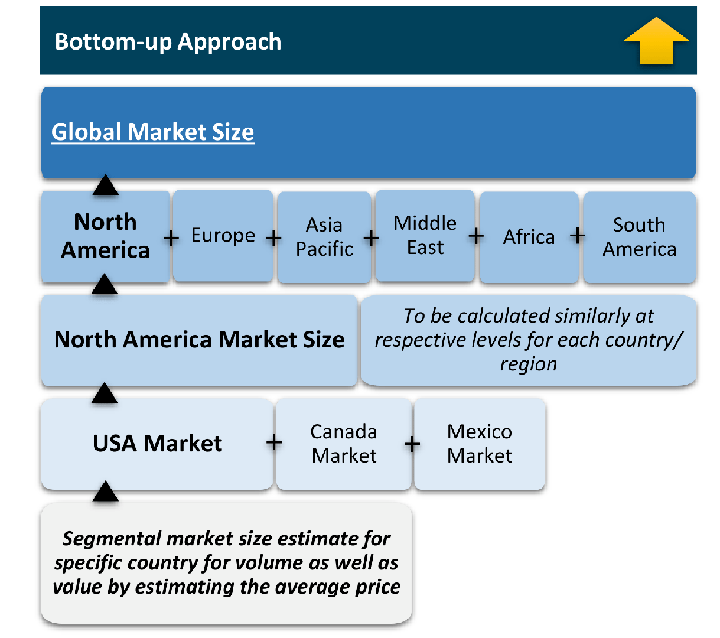
The bottom-up approach builds market estimates by starting with the smallest addressable market units and systematically aggregating them to create comprehensive market size projections.
This method begins with specific, granular data points and builds upward to create the complete market landscape.
Customer Analysis → Segmental Analysis → Geographical Analysis
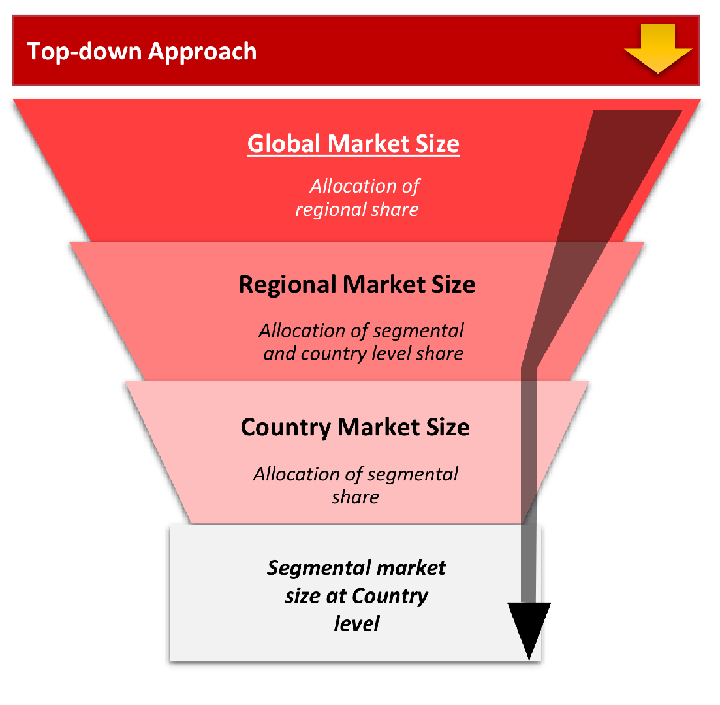
The top-down approach starts with the broadest possible market data and systematically narrows it down through a series of filters and assumptions to arrive at specific market segments or opportunities.
This method begins with the big picture and works downward to increasingly specific market slices.
TAM → SAM → SOM
Research Methods
Desk / Secondary Research
While analysing the market, we extensively study secondary sources, directories, and databases to identify and collect information useful for this technical, market-oriented, and commercial report. Secondary sources that we utilize are not only the public sources, but it is a combination of Open Source, Associations, Paid Databases, MG Repository & Knowledgebase, and others.
- Company websites, annual reports, financial reports, broker reports, and investor presentations
- National government documents, statistical databases and reports
- News articles, press releases and web-casts specific to the companies operating in the market, Magazines, reports, and others
- We gather information from commercial data sources for deriving company specific data such as segmental revenue, share for geography, product revenue, and others
- Internal and external proprietary databases (industry-specific), relevant patent, and regulatory databases
- Governing Bodies, Government Organizations
- Relevant Authorities, Country-specific Associations for Industries
We also employ the model mapping approach to estimate the product level market data through the players' product portfolio
Primary Research
Primary research/ interviews is vital in analyzing the market. Most of the cases involves paid primary interviews. Primary sources include primary interviews through e-mail interactions, telephonic interviews, surveys as well as face-to-face interviews with the different stakeholders across the value chain including several industry experts.
| Type of Respondents | Number of Primaries |
|---|---|
| Tier 2/3 Suppliers | ~20 |
| Tier 1 Suppliers | ~25 |
| End-users | ~25 |
| Industry Expert/ Panel/ Consultant | ~30 |
| Total | ~100 |
MG Knowledgebase
• Repository of industry blog, newsletter and case studies
• Online platform covering detailed market reports, and company profiles
Forecasting Factors and Models
Forecasting Factors
- Historical Trends – Past market patterns, cycles, and major events that shaped how markets behave over time. Understanding past trends helps predict future behavior.
- Industry Factors – Specific characteristics of the industry like structure, regulations, and innovation cycles that affect market dynamics.
- Macroeconomic Factors – Economic conditions like GDP growth, inflation, and employment rates that affect how much money people have to spend.
- Demographic Factors – Population characteristics like age, income, and location that determine who can buy your product.
- Technology Factors – How quickly people adopt new technology and how much technology infrastructure exists.
- Regulatory Factors – Government rules, laws, and policies that can help or restrict market growth.
- Competitive Factors – Analyzing competition structure such as degree of competition and bargaining power of buyers and suppliers.
Forecasting Models / Techniques
Multiple Regression Analysis
- Identify and quantify factors that drive market changes
- Statistical modeling to establish relationships between market drivers and outcomes
Time Series Analysis – Seasonal Patterns
- Understand regular cyclical patterns in market demand
- Advanced statistical techniques to separate trend, seasonal, and irregular components
Time Series Analysis – Trend Analysis
- Identify underlying market growth patterns and momentum
- Statistical analysis of historical data to project future trends
Expert Opinion – Expert Interviews
- Gather deep industry insights and contextual understanding
- In-depth interviews with key industry stakeholders
Multi-Scenario Development
- Prepare for uncertainty by modeling different possible futures
- Creating optimistic, pessimistic, and most likely scenarios
Time Series Analysis – Moving Averages
- Sophisticated forecasting for complex time series data
- Auto-regressive integrated moving average models with seasonal components
Econometric Models
- Apply economic theory to market forecasting
- Sophisticated economic models that account for market interactions
Expert Opinion – Delphi Method
- Harness collective wisdom of industry experts
- Structured, multi-round expert consultation process
Monte Carlo Simulation
- Quantify uncertainty and probability distributions
- Thousands of simulations with varying input parameters
Research Analysis
Our research framework is built upon the fundamental principle of validating market intelligence from both demand and supply perspectives. This dual-sided approach ensures comprehensive market understanding and reduces the risk of single-source bias.
Demand-Side Analysis: We understand end-user/application behavior, preferences, and market needs along with the penetration of the product for specific application.
Supply-Side Analysis: We estimate overall market revenue, analyze the segmental share along with industry capacity, competitive landscape, and market structure.
Validation & Evaluation
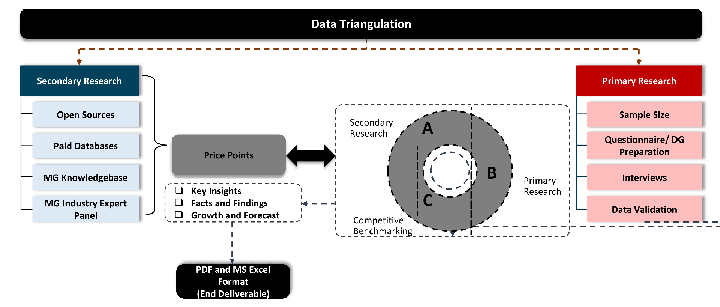
Data triangulation is a validation technique that uses multiple methods, sources, or perspectives to examine the same research question, thereby increasing the credibility and reliability of research findings. In market research, triangulation serves as a quality assurance mechanism that helps identify and minimize bias, validate assumptions, and ensure accuracy in market estimates.
- Data Source Triangulation – Using multiple data sources to examine the same phenomenon
- Methodological Triangulation – Using multiple research methods to study the same research question
- Investigator Triangulation – Using multiple researchers or analysts to examine the same data
- Theoretical Triangulation – Using multiple theoretical perspectives to interpret the same data
Custom Market Research Services
We will customise the research for you, in case the report listed above does not meet your requirements.
Get 10% Free Customisation