Personal Care Products Market Size, Share & Trends Analysis Report Product Type (Skin Care Products, Hair Care Products, Oral Care Products, Cosmetics & Color Cosmetics, Fragrances & Deodorants, Bath & Shower Products, Men's Grooming Products, Baby Care Products, Personal Hygiene Products, Other Product Types), Gender, Age Group, Form, Packaging Type, Distribution Channel, Application Frequency, Price Range, and Geography (North America, Europe, Asia Pacific, Middle East, Africa, and South America) – Global Industry Data, Trends, and Forecasts, 2026–2035
|
|
|
Segmental Data Insights |
|
|
Demand Trends |
|
|
Competitive Landscape |
|
|
Strategic Development |
|
|
Future Outlook & Opportunities |
|
Personal-Care-Products-Market Size, Share, and Growth
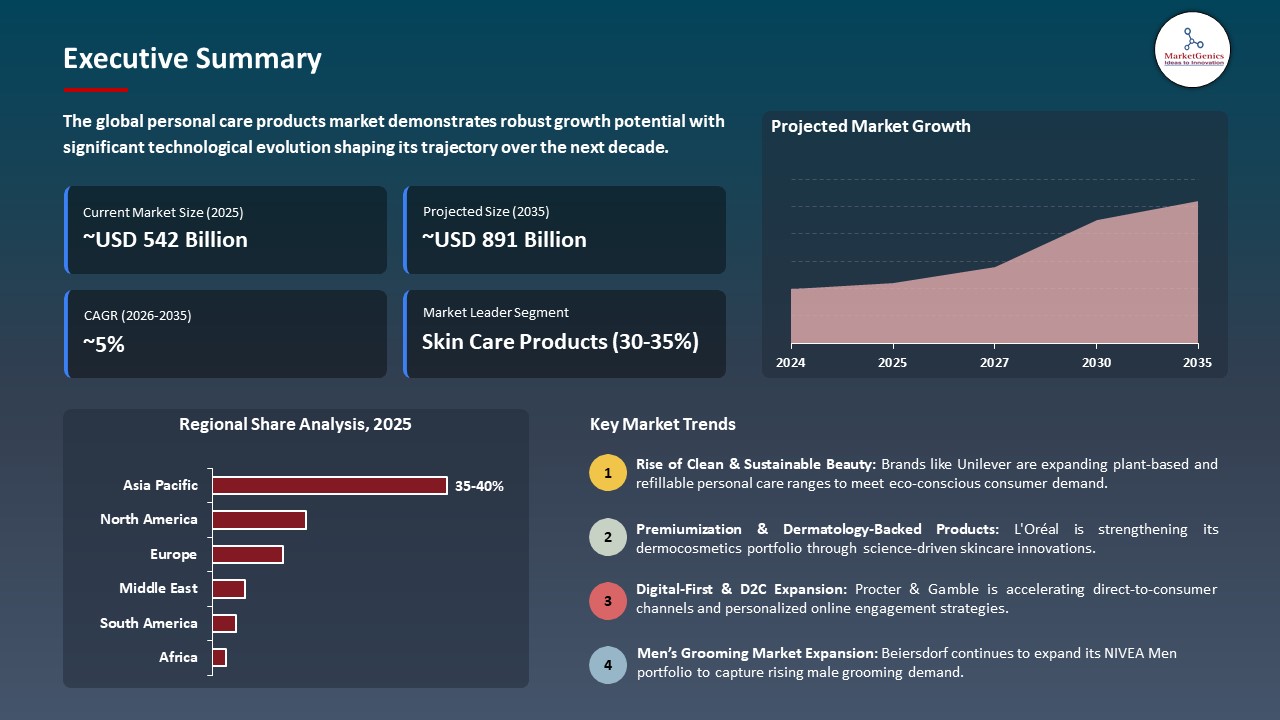
The global personal care products market is exhibiting strong growth, with an estimated value of USD 541.7 billion in 2025 and USD 890.8 billion by 2035, achieving a CAGR of 5.1%, during the forecast period. The global personal care products market is driven by rising health and hygiene awareness, increasing disposable incomes, rapid urbanization, premiumization trends, growing preference for natural and sustainable products, expanding e-commerce penetration, and continuous product innovation in skincare, haircare, and oral care segments.
"Our research shows that 7 in 10 women2 avoid fashion choices that might expose their body skin concerns like dryness or rough and bumpy texture, often letting these insecurities impact their style,” said Kate DiCarlo, Senior Communications Director for Procter & Gamble’s Personal Care Portfolio. “By combining Olay’s skin care expertise with Wantable’s expert styling, this is designed to deliver an unmatched confidence boost—helping women feel empowered to wear what they want.”
Strategic acquisitions in the personal care products market continue to propel portfolios and acquire high-growth niche segments to allow companies to consolidate market presence and respond to changing consumer demands. For instance, in June 2025, Unilever purchased the men personal care brand Dr. Squatch, which further reinforces and diversifies its offer in the high-end natural soaps, deodorants, and grooming products, and its portfolio reflects the increasing demand of consumers in natural and performance-based personal care products. The strategic acquisition will be able to expand the portfolio diversification, market penetration, and growth in niche segments with high demand.
Additionally, the innovation and high-end differentiation of existing product lines are putting the personal care products market on an accelerated path to enable companies provide higher value solutions that not only satisfy the changing consumer preferences but also earn them higher margins. For instance, in September 2025, The Procter & Gamble Company prioritised innovation in better deodorants and grooming products in such brands as Native, Old Spice, and Secret, which led to high single-digit organic sales growth and the solidity of its personal care brands. Premiumization and accelerated innovation enhances brand competitiveness, improves consumer interaction and leads to long-term revenue growth.
The global personal care products market presents adjacent opportunities in male grooming, natural and organic cosmetics, wellness-infused personal care, premium hair care, and sustainable packaging solutions. These industries have the advantage of increasing consumer health awareness, lifestyle consumption and desire of environmentally friendly, multi-purpose and quality products. Adjacent diversification spreads the revenue and creates growth potential in the long term.
 Personal Care Products Market Dynamics and Trends
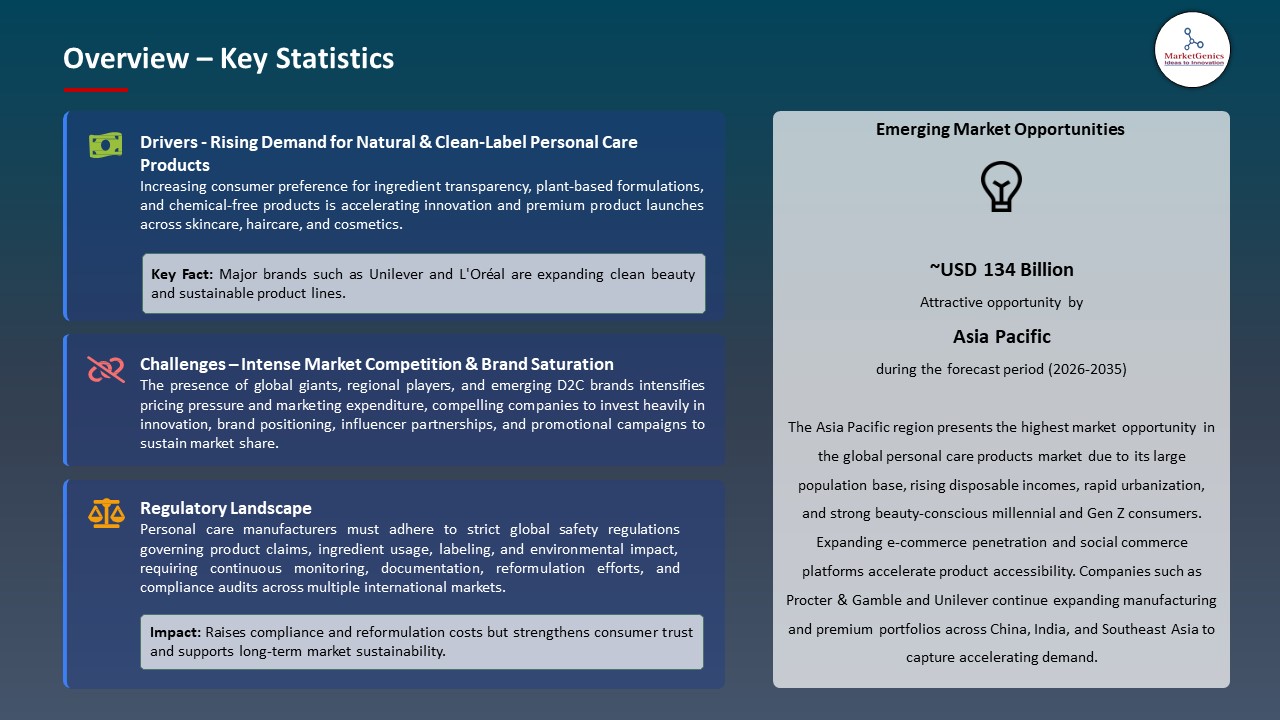
Driver: Strategic Acquisition of High‑Growth Personal Care Brands Enhances Portfolio Positioning
-
Strategic purchases of new and high-end brands drive the personal care products market, as established manufacturers can enter into new segments with high growth rates and adjust to the changing preferences of consumers.
- For instance, in April 2025, Unilever acquired Wild, a UK-based personal care brand, focusing on natural, plant-based, and refillable deodorants, body washes and handwashes as a part of its Growth Action Plan 2030. The acquisition is a strategic addition to Unilever in premium and sustainable personal care segments which can capitalize on the digital-native, eco-conscious Wild positioning to complement the presence of the company in any global market and increase its attractiveness in high-value, high-growth markets.
- Acquisition-based portfolio expansion facilitates market penetration in niche markets, competitive positioning, and sustainable expansion in a market that is becoming progressively focused on high-end and environmentally friendly personal care products.
Restraint: Complex Global Regulatory Compliance Increases Operational Burden
-
Complex regulatory frameworks across numerous jurisdictions limit the personal care products market, leading to increased compliance requirements, delayed product launches, and higher operational expenses. The difference in requirements of ingredients, labelling, safety testing, and the environment requires a lot of resources allocation to guarantee that the regulations are conditional before entering the market.
- For example, in 2025, BASF highlighted its approach to regulatory engagement and formulation transparency through its “climate‑adaptive” and sustainability-oriented formulations showcased at Cosmet’Agora, demonstrating how ingredient suppliers must innovate to meet evolving safety and sustainability requirements.
- These regulatory pressures have an overall effect on the whole supply chain where stringent documentation, testing and quality governance are required to meet the requirements of the authorities in major markets including the EU, U.S. and Asia Pacific.
- Global regulatory environments become more complex, increasing the cost of operations, time-to-market, and requiring well-developed compliance infrastructures, balancing short-term growth, encouraging long-term, strategic planning.
Opportunity: Innovation in Advanced Ingredient Solutions Fuels Product Development
-
Companies may use advanced ingredient advancements in the personal care products market to meet customer needs for performance, sustainability, and multifunctionality.
- The advanced technologies focused on include improvement in hair, skin performance as well as efficacy of formulations of brand partners in the Asia Pacific region. For instance, during the in-cosmetics Asia 2025, the Personal Care business of Dow launched four new personal care ingredients mainly as part of its Beauty in Harmony program, namely, award-winning functional polymers and conditioning agents.
- These innovative technologies in ingredients allow personal care brands to develop high-performance sustainable products, fasten the formulation pipelines, and satisfy the rapidly changing consumer expectations in fast-rising markets.
- Innovated products through advanced ingredient adoption promotes product differentiation, helps in premium positioning and this helps in revenue growth and satisfying the sustainability and performance-focused consumer needs.
Key Trend: Digital and Science‑Led Personal Care Innovation Accelerates Market Evolution
-
The digital and science-driven innovation is influencing the personal care market, altering product development, formulation, and marketing forward. Major manufacturers are using the digital tools of artificial intelligence (AI) and sophisticated analytics to streamline the process of formulation, optimize processes and increase consumer interaction.
- For instance, Unilever has expanded the use of AI across its Personal Care division, integrating it into formulation design, early-stage testing, and content generation workflows to accelerate product development and improve operational efficiency. This proactive embrace of digital technologies can be seen as an example of the larger trend in the industry which is to integrate data science with product innovation as a method of quickly relying on changing consumer preferences and brand interactions driven by digital technologies.
- The digital innovation that is science based improves the operational agility, increases time-to-market speed and responsiveness to consumer trends, which further consolidates competitive positioning in the personal care industry.
 Personal Care Products Market Analysis and Segmental Data
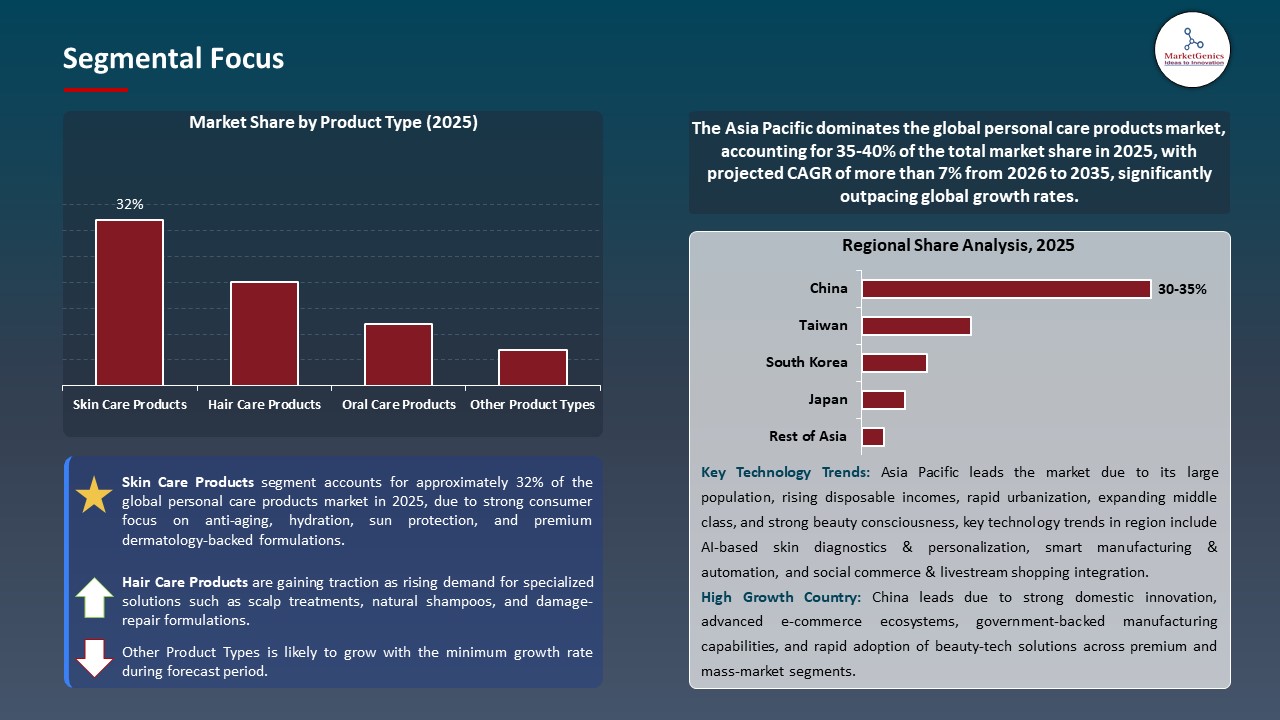
Skin Care Products Dominate Global Personal Care Products Market
-
The skin care products segment dominates the global personal care products market, driven by continued interest of consumers in skin health, anti-aging, hydration, and special dermatological solutions. Science-supported and premium products such as serums, moisturizers, sunscreens and specific treatments become more of an influence in consumer buying depending upon the significance of both health and beauty results.
- Skin care portfolios have remained a key growth area by the leading personal care companies. For instance, in 2025, L’Oréal announced that its dermatological and skincare brands, such as La Roche-Posay, CeraVe, and SkinCeuticals, had a dramatic growth push in total sales performance, which indicates how important skin care is in its global product portfolio.
- The dominance of skin care leads to innovation, premium positioning, consumer engagement and long-term revenue growth in the personal care industry.
Asia Pacific Leads Global Personal Care Products Market Demand
-
Asia Pacific leads the personal care products is due to the rising middle income, rising consumer disposable income and consumer spending on personal grooming and hygiene. The growth of online trade and mobile shopping has increased the level of access to products and brands have opened their doors to a wider audience represented by consumers in both the urban and rising markets.
- Additionally, premiumization and innovation-driven product adoption is also a driver of growth in the region as Unilever is showing growth in the 2025 financial performance with the personal care portfolio delivering underlying sales growth of 4.7% due to its premium innovations and market share gains across key markets in Asia Pacific, such as India and Indonesia.
- Furthermore, regional demand is also enhanced by local marketing and brand engagement based on culture. Unilever personal care approach, based on culturally relevant experiences, has helped it achieve 4.8% underlying sales growth in H1 2025 with Asia Pacific Africa recording some of the highest volume’s growth.
- These factors reinforce Asia Pacific as a key strategic growth region, enabling personal care companies to increase revenue, strengthen market share, and enhance consumer engagement.
Personal Care Products Market Ecosystem
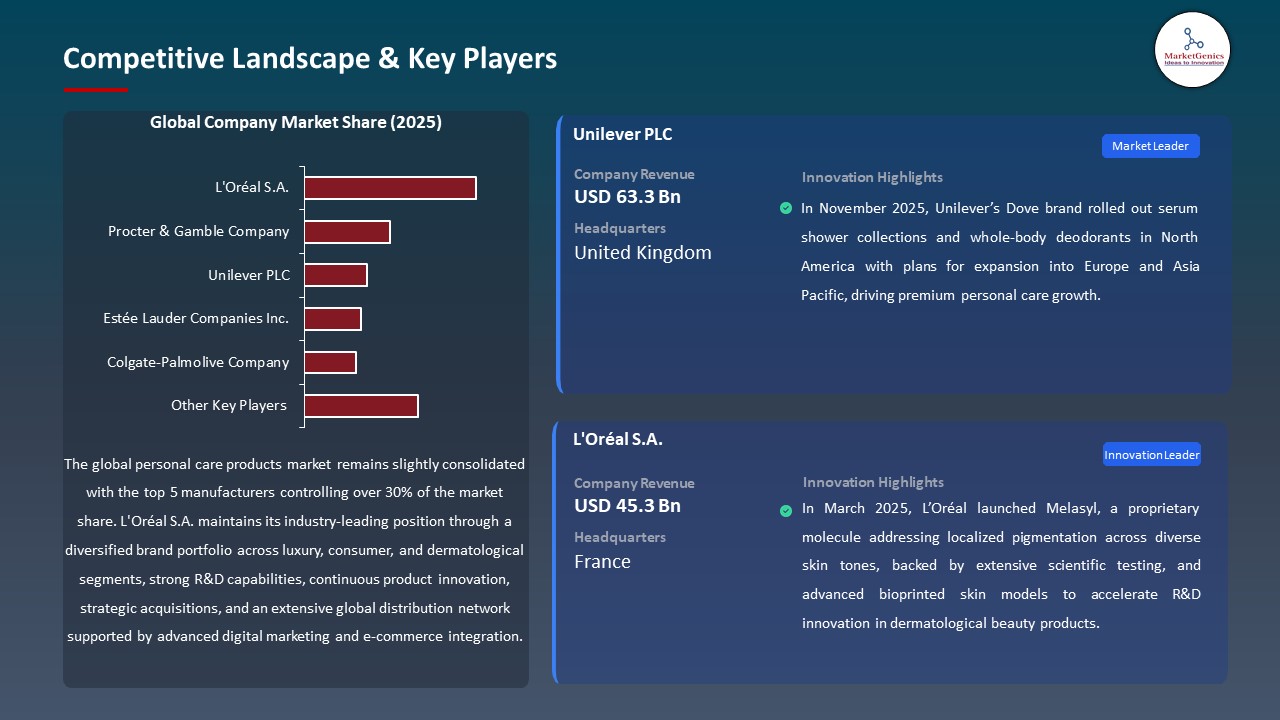
The global personal care products market is highly fragmented, with leading players such as L'Oréal S.A., Procter & Gamble Company, Unilever PLC, Estée Lauder Companies Inc., and Colgate-Palmolive Company dominating through advanced R&D capabilities, digital integration, and global distribution strength. These companies leverage biotechnology, dermatological science, and AI-driven consumer analytics to maintain competitive leadership and scale advantages.
Market leaderships focus on product diversification and a growth of portfolio with integrated beauty-tech ecosystems with the combination of skincare devices, data-driven personalization platforms, and sustainable packaging solutions to improve operational efficiency and environmental performance. The strategic acquisitions and integration of digital commerce also simplify supply chains and enhance the engagement of consumers.
In January 2025, L’Oréal extended its AI-driven skin analysis technology based on deep learning algorithms to increase diagnostic accuracy by improving individual product advice and shortening the time of consultation, and showed quantifiable efficiency benefits of digital beauty service and supported technology-based competitive differentiation.
These are strategic innovations and technology advances that are increasing the pace of premiumization, enhance competitive positioning, and provide revenue growth across the global market of personal care products.
 Recent Development and Strategic Overview:
-
In October 2025, L’Oréal strategically expanded its skincare portfolio with the introduction of Melasyl Serum + Sunscreen SPF 50, integrating proprietary pigment-correcting technology with broad-spectrum UV protection to address hyperpigmentation concerns and strengthen its science-driven dermatological offerings.
- In August 2025, Colgate-Palmolive Company implemented a comprehensive corporate brand identity refresh, introducing a new visual framework and tagline to strengthen its innovation-led growth strategy and enhance brand positioning across its oral and broader personal care portfolio.
Report Scope
|
Detail |
|
|
Market Size in 2025 |
USD 541.7 Bn |
|
Market Forecast Value in 2035 |
USD 890.8 Bn |
|
Growth Rate (CAGR) |
5.1% |
|
Forecast Period |
2026 – 2035 |
|
Historical Data Available for |
2021 – 2024 |
|
Market Size Units |
US$ Billion for Value |
|
Report Format |
Electronic (PDF) + Excel |
|
North America |
Europe |
Asia Pacific |
Middle East |
Africa |
South America |
|
|
|
|
|
|
|
Companies Covered |
|||||
|
|
|
|
|
|
Personal Care Products Market Segmentation and Highlights
|
Segment |
Sub-segment |
|
Personal Care Products Market, By Product Type |
|
|
Personal Care Products Market, By Gender |
|
|
Personal Care Products Market, By Age Group |
|
|
Personal Care Products Market, By Form |
|
|
Personal Care Products Market, By Packaging Type |
|
|
Personal Care Products Market, By Distribution Channel |
|
|
Personal Care Products Market, By Application Frequency |
|
|
Personal Care Products Market, By Price Range |
|
Frequently Asked Questions
Table of Contents
- 1. Research Methodology and Assumptions
- 1.1. Definitions
- 1.2. Research Design and Approach
- 1.3. Data Collection Methods
- 1.4. Base Estimates and Calculations
- 1.5. Forecasting Models
- 1.5.1. Key Forecast Factors & Impact Analysis
- 1.6. Secondary Research
- 1.6.1. Open Sources
- 1.6.2. Paid Databases
- 1.6.3. Associations
- 1.7. Primary Research
- 1.7.1. Primary Sources
- 1.7.2. Primary Interviews with Stakeholders across Ecosystem
- 2. Executive Summary
- 2.1. Global Personal Care Products Market Outlook
- 2.1.1. Personal Care Products Market Size (Value - US$ Bn), and Forecasts, 2021-2035
- 2.1.2. Compounded Annual Growth Rate Analysis
- 2.1.3. Growth Opportunity Analysis
- 2.1.4. Segmental Share Analysis
- 2.1.5. Geographical Share Analysis
- 2.2. Market Analysis and Facts
- 2.3. Supply-Demand Analysis
- 2.4. Competitive Benchmarking
- 2.5. Go-to- Market Strategy
- 2.5.1. Customer/ End-use Industry Assessment
- 2.5.2. Growth Opportunity Data, 2026-2035
- 2.5.2.1. Regional Data
- 2.5.2.2. Country Data
- 2.5.2.3. Segmental Data
- 2.5.3. Identification of Potential Market Spaces
- 2.5.4. GAP Analysis
- 2.5.5. Potential Attractive Price Points
- 2.5.6. Prevailing Market Risks & Challenges
- 2.5.7. Preferred Sales & Marketing Strategies
- 2.5.8. Key Recommendations and Analysis
- 2.5.9. A Way Forward
- 2.1. Global Personal Care Products Market Outlook
- 3. Industry Data and Premium Insights
- 3.1. Global Consumer Goods & Services Industry Overview, 2025
- 3.1.1. Consumer Goods & Services Ecosystem Analysis
- 3.1.2. Key Trends for Consumer Goods & Services Industry
- 3.1.3. Regional Distribution for Consumer Goods & Services Industry
- 3.2. Supplier Customer Data
- 3.3. Technology Roadmap and Developments
- 3.4. Trade Analysis
- 3.4.1. Import & Export Analysis, 2025
- 3.4.2. Top Importing Countries
- 3.4.3. Top Exporting Countries
- 3.5. Trump Tariff Impact Analysis
- 3.5.1. Manufacturer
- 3.5.1.1. Based on the component & Raw material
- 3.5.2. Supply Chain
- 3.5.3. End Consumer
- 3.5.1. Manufacturer
- 3.6. Raw Material Analysis
- 3.1. Global Consumer Goods & Services Industry Overview, 2025
- 4. Market Overview
- 4.1. Market Dynamics
- 4.1.1. Drivers
- 4.1.1.1. Rising consumer awareness regarding health, hygiene, and personal grooming
- 4.1.1.2. Expanding e-commerce platforms and digital marketing accelerating product accessibility and brand reach
- 4.1.1.3. Growing demand for natural, organic, and sustainable personal care formulations
- 4.1.2. Restraints
- 4.1.2.1. Stringent regulatory standards and compliance requirements increasing operational costs
- 4.1.2.2. Intense market competition and brand saturation leading to pricing pressure and reduced margins
- 4.1.1. Drivers
- 4.2. Key Trend Analysis
- 4.3. Regulatory Framework
- 4.3.1. Key Regulations, Norms, and Subsidies, by Key Countries
- 4.3.2. Tariffs and Standards
- 4.3.3. Impact Analysis of Regulations on the Market
- 4.4. Value Chain Analysis
- 4.5. Porter’s Five Forces Analysis
- 4.6. PESTEL Analysis
- 4.7. Global Personal Care Products Market Demand
- 4.7.1. Historical Market Size – in Value (US$ Bn), 2020-2024
- 4.7.2. Current and Future Market Size – in Value (US$ Bn), 2026–2035
- 4.7.2.1. Y-o-Y Growth Trends
- 4.7.2.2. Absolute $ Opportunity Assessment
- 4.1. Market Dynamics
- 5. Competition Landscape
- 5.1. Competition structure
- 5.1.1. Fragmented v/s consolidated
- 5.2. Company Share Analysis, 2025
- 5.2.1. Global Company Market Share
- 5.2.2. By Region
- 5.2.2.1. North America
- 5.2.2.2. Europe
- 5.2.2.3. Asia Pacific
- 5.2.2.4. Middle East
- 5.2.2.5. Africa
- 5.2.2.6. South America
- 5.3. Product Comparison Matrix
- 5.3.1. Specifications
- 5.3.2. Market Positioning
- 5.3.3. Pricing
- 5.1. Competition structure
- 6. Global Personal Care Products Market Analysis, by Product Type
- 6.1. Key Segment Analysis
- 6.2. Personal Care Products Market Size (Value - US$ Bn), Analysis, and Forecasts, by Product Type, 2021-2035
- 6.2.1. Skin Care Products
- 6.2.1.1. Facial Care
- 6.2.1.2. Body Care
- 6.2.1.3. Hand & Foot Care
- 6.2.1.4. Anti-aging Products
- 6.2.1.5. Others
- 6.2.2. Hair Care Products
- 6.2.2.1. Shampoos
- 6.2.2.2. Conditioners
- 6.2.2.3. Hair Styling Products
- 6.2.2.4. Hair Colorants & Dyes
- 6.2.2.5. Hair Treatment & Masks
- 6.2.2.6. Hair Oil
- 6.2.2.7. Others
- 6.2.3. Oral Care Products
- 6.2.3.1. Toothpaste
- 6.2.3.2. Mouthwash & Rinses
- 6.2.3.3. Toothbrushes
- 6.2.3.4. Dental Floss
- 6.2.3.5. Others
- 6.2.4. Cosmetics & Color Cosmetics
- 6.2.4.1. Face Makeup
- 6.2.4.2. Eye Makeup
- 6.2.4.3. Lip Products
- 6.2.4.4. Nail Care Products
- 6.2.4.5. Others
- 6.2.5. Fragrances & Deodorants
- 6.2.6. Bath & Shower Products
- 6.2.6.1. Men's Grooming Products
- 6.2.6.2. Shaving Products
- 6.2.6.3. Beard Care
- 6.2.6.4. Men's Skin Care
- 6.2.6.5. Others
- 6.2.7. Baby Care Products
- 6.2.7.1. Baby Lotions & Oils
- 6.2.7.2. Baby Shampoos
- 6.2.7.3. Diaper Care
- 6.2.7.4. Baby Wipes
- 6.2.7.5. Others
- 6.2.8. Personal Hygiene Products
- 6.2.8.1. Feminine Hygiene
- 6.2.8.1.1. Sanitary Pads
- 6.2.8.1.2. Tampons
- 6.2.8.1.3. Menstrual Cups
- 6.2.8.1.4. Panty Liners
- 6.2.8.1.5. Others
- 6.2.8.2. Adult Hygiene
- 6.2.8.2.1. Adult Diapers & Incontinence Pads
- 6.2.8.2.2. Cleansing Wipes
- 6.2.8.2.3. Others
- 6.2.8.1. Feminine Hygiene
- 6.2.9. Other Product Types
- 6.2.1. Skin Care Products
- 7. Global Personal Care Products Market Analysis, by Gender
- 7.1. Key Segment Analysis
- 7.2. Personal Care Products Market Size (Value - US$ Bn), Analysis, and Forecasts, by Gender, 2021-2035
- 7.2.1. Male
- 7.2.2. Female
- 7.2.3. Unisex
- 8. Global Personal Care Products Market Analysis, by Age Group
- 8.1. Key Segment Analysis
- 8.2. Personal Care Products Market Size (Value - US$ Bn), Analysis, and Forecasts, by Age Group, 2021-2035
- 8.2.1. Baby & Toddlers (0-4 years)
- 8.2.2. Children (5–12 years)
- 8.2.3. Teenagers (13–19 years)
- 8.2.4. Adults (20–59 years)
- 8.2.5. Geriatric (60+ years)
- 9. Global Personal Care Products Market Analysis, by Form
- 9.1. Key Segment Analysis
- 9.2. Personal Care Products Market Size (Value - US$ Bn), Analysis, and Forecasts, by Form, 2021-2035
- 9.2.1. Liquid
- 9.2.2. Cream/Lotion
- 9.2.3. Gel
- 9.2.4. Powder
- 9.2.5. Solid/Bar
- 9.2.6. Aerosol/Spray
- 9.2.7. Foam
- 9.2.8. Others
- 10. Global Personal Care Products Market Analysis, by Packaging Type
- 10.1. Key Segment Analysis
- 10.2. Personal Care Products Market Size (Value - US$ Bn), Analysis, and Forecasts, by Packaging Type, 2021-2035
- 10.2.1. Bottles
- 10.2.2. Tubes
- 10.2.3. Jars
- 10.2.4. Pumps/Dispensers
- 10.2.5. Sachets/Pouches
- 10.2.6. Aerosol Cans
- 10.2.7. Stick Packaging
- 10.2.8. Eco-Friendly Packaging
- 10.2.8.1. Refillable
- 10.2.8.2. Biodegradable
- 10.2.8.3. Recyclable
- 11. Global Personal Care Products Market Analysis, by Distribution Channel
- 11.1. Key Segment Analysis
- 11.2. Personal Care Products Market Size (Value - US$ Bn), Analysis, and Forecasts, by Distribution Channel, 2021-2035
- 11.2.1. Online
- 11.2.1.1. E-commerce Platforms
- 11.2.1.2. Company Websites
- 11.2.1.3. Direct-to-Consumer (D2C)
- 11.2.2. Offline
- 11.2.2.1. Supermarkets/Hypermarkets
- 11.2.2.2. Specialty Stores
- 11.2.2.3. Convenience Stores
- 11.2.2.4. Direct Selling
- 11.2.1. Online
- 12. Global Personal Care Products Market Analysis, by Application Frequency
- 12.1. Key Segment Analysis
- 12.2. Personal Care Products Market Size (Value - US$ Bn), Analysis, and Forecasts, by Application Frequency, 2021-2035
- 12.2.1. Daily Use
- 12.2.2. Weekly/Bi-weekly Use
- 12.2.3. Occasional Use
- 13. Global Personal Care Products Market Analysis, by Price Range
- 13.1. Key Segment Analysis
- 13.2. Personal Care Products Market Size (Value - US$ Bn), Analysis, and Forecasts, by Price Range, 2021-2035
- 13.2.1. Mass Market
- 13.2.2. Premium
- 13.2.3. Luxury
- 14. Global Personal Care Products Market Analysis, by Region
- 14.1. Key Findings
- 14.2. Personal Care Products Market Size (Value - US$ Bn), Analysis, and Forecasts, by Region, 2021-2035
- 14.2.1. North America
- 14.2.2. Europe
- 14.2.3. Asia Pacific
- 14.2.4. Middle East
- 14.2.5. Africa
- 14.2.6. South America
- 15. North America Personal Care Products Market Analysis
- 15.1. Key Segment Analysis
- 15.2. Regional Snapshot
- 15.3. North America Personal Care Products Market Size Value - US$ Bn), Analysis, and Forecasts, 2021-2035
- 15.3.1. Product Type
- 15.3.2. Gender
- 15.3.3. Age Group
- 15.3.4. Form
- 15.3.5. Packaging Type
- 15.3.6. Distribution Channel
- 15.3.7. Application Frequency
- 15.3.8. Price Range
- 15.3.9. Country
- 15.3.9.1. USA
- 15.3.9.2. Canada
- 15.3.9.3. Mexico
- 15.4. USA Personal Care Products Market
- 15.4.1. Country Segmental Analysis
- 15.4.2. Product Type
- 15.4.3. Gender
- 15.4.4. Age Group
- 15.4.5. Form
- 15.4.6. Packaging Type
- 15.4.7. Distribution Channel
- 15.4.8. Application Frequency
- 15.4.9. Price Range
- 15.5. Canada Personal Care Products Market
- 15.5.1. Country Segmental Analysis
- 15.5.2. Product Type
- 15.5.3. Gender
- 15.5.4. Age Group
- 15.5.5. Form
- 15.5.6. Packaging Type
- 15.5.7. Distribution Channel
- 15.5.8. Application Frequency
- 15.5.9. Price Range
- 15.6. Mexico Personal Care Products Market
- 15.6.1. Country Segmental Analysis
- 15.6.2. Product Type
- 15.6.3. Gender
- 15.6.4. Age Group
- 15.6.5. Form
- 15.6.6. Packaging Type
- 15.6.7. Distribution Channel
- 15.6.8. Application Frequency
- 15.6.9. Price Range
- 16. Europe Personal Care Products Market Analysis
- 16.1. Key Segment Analysis
- 16.2. Regional Snapshot
- 16.3. Europe Personal Care Products Market Size (Value - US$ Bn), Analysis, and Forecasts, 2021-2035
- 16.3.1. Product Type
- 16.3.2. Gender
- 16.3.3. Age Group
- 16.3.4. Form
- 16.3.5. Packaging Type
- 16.3.6. Distribution Channel
- 16.3.7. Application Frequency
- 16.3.8. Price Range
- 16.3.9. Country
- 16.3.9.1. Germany
- 16.3.9.2. United Kingdom
- 16.3.9.3. France
- 16.3.9.4. Italy
- 16.3.9.5. Spain
- 16.3.9.6. Netherlands
- 16.3.9.7. Nordic Countries
- 16.3.9.8. Poland
- 16.3.9.9. Russia & CIS
- 16.3.9.10. Rest of Europe
- 16.4. Germany Personal Care Products Market
- 16.4.1. Country Segmental Analysis
- 16.4.2. Product Type
- 16.4.3. Gender
- 16.4.4. Age Group
- 16.4.5. Form
- 16.4.6. Packaging Type
- 16.4.7. Distribution Channel
- 16.4.8. Application Frequency
- 16.4.9. Price Range
- 16.5. United Kingdom Personal Care Products Market
- 16.5.1. Country Segmental Analysis
- 16.5.2. Product Type
- 16.5.3. Gender
- 16.5.4. Age Group
- 16.5.5. Form
- 16.5.6. Packaging Type
- 16.5.7. Distribution Channel
- 16.5.8. Application Frequency
- 16.5.9. Price Range
- 16.6. France Personal Care Products Market
- 16.6.1. Country Segmental Analysis
- 16.6.2. Product Type
- 16.6.3. Gender
- 16.6.4. Age Group
- 16.6.5. Form
- 16.6.6. Packaging Type
- 16.6.7. Distribution Channel
- 16.6.8. Application Frequency
- 16.6.9. Price Range
- 16.7. Italy Personal Care Products Market
- 16.7.1. Country Segmental Analysis
- 16.7.2. Product Type
- 16.7.3. Gender
- 16.7.4. Age Group
- 16.7.5. Form
- 16.7.6. Packaging Type
- 16.7.7. Distribution Channel
- 16.7.8. Application Frequency
- 16.7.9. Price Range
- 16.8. Spain Personal Care Products Market
- 16.8.1. Country Segmental Analysis
- 16.8.2. Product Type
- 16.8.3. Gender
- 16.8.4. Age Group
- 16.8.5. Form
- 16.8.6. Packaging Type
- 16.8.7. Distribution Channel
- 16.8.8. Application Frequency
- 16.8.9. Price Range
- 16.9. Netherlands Personal Care Products Market
- 16.9.1. Country Segmental Analysis
- 16.9.2. Product Type
- 16.9.3. Gender
- 16.9.4. Age Group
- 16.9.5. Form
- 16.9.6. Packaging Type
- 16.9.7. Distribution Channel
- 16.9.8. Application Frequency
- 16.9.9. Price Range
- 16.10. Nordic Countries Personal Care Products Market
- 16.10.1. Country Segmental Analysis
- 16.10.2. Product Type
- 16.10.3. Gender
- 16.10.4. Age Group
- 16.10.5. Form
- 16.10.6. Packaging Type
- 16.10.7. Distribution Channel
- 16.10.8. Application Frequency
- 16.10.9. Price Range
- 16.11. Poland Personal Care Products Market
- 16.11.1. Country Segmental Analysis
- 16.11.2. Product Type
- 16.11.3. Gender
- 16.11.4. Age Group
- 16.11.5. Form
- 16.11.6. Packaging Type
- 16.11.7. Distribution Channel
- 16.11.8. Application Frequency
- 16.11.9. Price Range
- 16.12. Russia & CIS Personal Care Products Market
- 16.12.1. Country Segmental Analysis
- 16.12.2. Product Type
- 16.12.3. Gender
- 16.12.4. Age Group
- 16.12.5. Form
- 16.12.6. Packaging Type
- 16.12.7. Distribution Channel
- 16.12.8. Application Frequency
- 16.12.9. Price Range
- 16.13. Rest of Europe Personal Care Products Market
- 16.13.1. Country Segmental Analysis
- 16.13.2. Product Type
- 16.13.3. Gender
- 16.13.4. Age Group
- 16.13.5. Form
- 16.13.6. Packaging Type
- 16.13.7. Distribution Channel
- 16.13.8. Application Frequency
- 16.13.9. Price Range
- 17. Asia Pacific Personal Care Products Market Analysis
- 17.1. Key Segment Analysis
- 17.2. Regional Snapshot
- 17.3. Asia Pacific Personal Care Products Market Size (Value - US$ Bn), Analysis, and Forecasts, 2021-2035
- 17.3.1. Product Type
- 17.3.2. Gender
- 17.3.3. Age Group
- 17.3.4. Form
- 17.3.5. Packaging Type
- 17.3.6. Distribution Channel
- 17.3.7. Application Frequency
- 17.3.8. Price Range
- 17.3.9. Country
- 17.3.9.1. China
- 17.3.9.2. India
- 17.3.9.3. Japan
- 17.3.9.4. South Korea
- 17.3.9.5. Australia and New Zealand
- 17.3.9.6. Indonesia
- 17.3.9.7. Malaysia
- 17.3.9.8. Thailand
- 17.3.9.9. Vietnam
- 17.3.9.10. Rest of Asia Pacific
- 17.4. China Personal Care Products Market
- 17.4.1. Country Segmental Analysis
- 17.4.2. Product Type
- 17.4.3. Gender
- 17.4.4. Age Group
- 17.4.5. Form
- 17.4.6. Packaging Type
- 17.4.7. Distribution Channel
- 17.4.8. Application Frequency
- 17.4.9. Price Range
- 17.5. India Personal Care Products Market
- 17.5.1. Country Segmental Analysis
- 17.5.2. Product Type
- 17.5.3. Gender
- 17.5.4. Age Group
- 17.5.5. Form
- 17.5.6. Packaging Type
- 17.5.7. Distribution Channel
- 17.5.8. Application Frequency
- 17.5.9. Price Range
- 17.6. Japan Personal Care Products Market
- 17.6.1. Country Segmental Analysis
- 17.6.2. Product Type
- 17.6.3. Gender
- 17.6.4. Age Group
- 17.6.5. Form
- 17.6.6. Packaging Type
- 17.6.7. Distribution Channel
- 17.6.8. Application Frequency
- 17.6.9. Price Range
- 17.7. South Korea Personal Care Products Market
- 17.7.1. Country Segmental Analysis
- 17.7.2. Product Type
- 17.7.3. Gender
- 17.7.4. Age Group
- 17.7.5. Form
- 17.7.6. Packaging Type
- 17.7.7. Distribution Channel
- 17.7.8. Application Frequency
- 17.7.9. Price Range
- 17.8. Australia and New Zealand Personal Care Products Market
- 17.8.1. Country Segmental Analysis
- 17.8.2. Product Type
- 17.8.3. Gender
- 17.8.4. Age Group
- 17.8.5. Form
- 17.8.6. Packaging Type
- 17.8.7. Distribution Channel
- 17.8.8. Application Frequency
- 17.8.9. Price Range
- 17.9. Indonesia Personal Care Products Market
- 17.9.1. Country Segmental Analysis
- 17.9.2. Product Type
- 17.9.3. Gender
- 17.9.4. Age Group
- 17.9.5. Form
- 17.9.6. Packaging Type
- 17.9.7. Distribution Channel
- 17.9.8. Application Frequency
- 17.9.9. Price Range
- 17.10. Malaysia Personal Care Products Market
- 17.10.1. Country Segmental Analysis
- 17.10.2. Product Type
- 17.10.3. Gender
- 17.10.4. Age Group
- 17.10.5. Form
- 17.10.6. Packaging Type
- 17.10.7. Distribution Channel
- 17.10.8. Application Frequency
- 17.10.9. Price Range
- 17.11. Thailand Personal Care Products Market
- 17.11.1. Country Segmental Analysis
- 17.11.2. Product Type
- 17.11.3. Gender
- 17.11.4. Age Group
- 17.11.5. Form
- 17.11.6. Packaging Type
- 17.11.7. Distribution Channel
- 17.11.8. Application Frequency
- 17.11.9. Price Range
- 17.12. Vietnam Personal Care Products Market
- 17.12.1. Country Segmental Analysis
- 17.12.2. Product Type
- 17.12.3. Gender
- 17.12.4. Age Group
- 17.12.5. Form
- 17.12.6. Packaging Type
- 17.12.7. Distribution Channel
- 17.12.8. Application Frequency
- 17.12.9. Price Range
- 17.13. Rest of Asia Pacific Personal Care Products Market
- 17.13.1. Country Segmental Analysis
- 17.13.2. Product Type
- 17.13.3. Gender
- 17.13.4. Age Group
- 17.13.5. Form
- 17.13.6. Packaging Type
- 17.13.7. Distribution Channel
- 17.13.8. Application Frequency
- 17.13.9. Price Range
- 18. Middle East Personal Care Products Market Analysis
- 18.1. Key Segment Analysis
- 18.2. Regional Snapshot
- 18.3. Middle East Personal Care Products Market Size (Value - US$ Bn), Analysis, and Forecasts, 2021-2035
- 18.3.1. Product Type
- 18.3.2. Gender
- 18.3.3. Age Group
- 18.3.4. Form
- 18.3.5. Packaging Type
- 18.3.6. Distribution Channel
- 18.3.7. Application Frequency
- 18.3.8. Price Range
- 18.3.9. Country
- 18.3.9.1. Turkey
- 18.3.9.2. UAE
- 18.3.9.3. Saudi Arabia
- 18.3.9.4. Israel
- 18.3.9.5. Rest of Middle East
- 18.4. Turkey Personal Care Products Market
- 18.4.1. Country Segmental Analysis
- 18.4.2. Product Type
- 18.4.3. Gender
- 18.4.4. Age Group
- 18.4.5. Form
- 18.4.6. Packaging Type
- 18.4.7. Distribution Channel
- 18.4.8. Application Frequency
- 18.4.9. Price Range
- 18.5. UAE Personal Care Products Market
- 18.5.1. Country Segmental Analysis
- 18.5.2. Product Type
- 18.5.3. Gender
- 18.5.4. Age Group
- 18.5.5. Form
- 18.5.6. Packaging Type
- 18.5.7. Distribution Channel
- 18.5.8. Application Frequency
- 18.5.9. Price Range
- 18.6. Saudi Arabia Personal Care Products Market
- 18.6.1. Country Segmental Analysis
- 18.6.2. Product Type
- 18.6.3. Gender
- 18.6.4. Age Group
- 18.6.5. Form
- 18.6.6. Packaging Type
- 18.6.7. Distribution Channel
- 18.6.8. Application Frequency
- 18.6.9. Price Range
- 18.7. Israel Personal Care Products Market
- 18.7.1. Country Segmental Analysis
- 18.7.2. Product Type
- 18.7.3. Gender
- 18.7.4. Age Group
- 18.7.5. Form
- 18.7.6. Packaging Type
- 18.7.7. Distribution Channel
- 18.7.8. Application Frequency
- 18.7.9. Price Range
- 18.8. Rest of Middle East Personal Care Products Market
- 18.8.1. Country Segmental Analysis
- 18.8.2. Product Type
- 18.8.3. Gender
- 18.8.4. Age Group
- 18.8.5. Form
- 18.8.6. Packaging Type
- 18.8.7. Distribution Channel
- 18.8.8. Application Frequency
- 18.8.9. Price Range
- 19. Africa Personal Care Products Market Analysis
- 19.1. Key Segment Analysis
- 19.2. Regional Snapshot
- 19.3. Africa Personal Care Products Market Size (Value - US$ Bn), Analysis, and Forecasts, 2021-2035
- 19.3.1. Product Type
- 19.3.2. Gender
- 19.3.3. Age Group
- 19.3.4. Form
- 19.3.5. Packaging Type
- 19.3.6. Distribution Channel
- 19.3.7. Application Frequency
- 19.3.8. Price Range
- 19.3.9. Country
- 19.3.9.1. South Africa
- 19.3.9.2. Egypt
- 19.3.9.3. Nigeria
- 19.3.9.4. Algeria
- 19.3.9.5. Rest of Africa
- 19.4. South Africa Personal Care Products Market
- 19.4.1. Country Segmental Analysis
- 19.4.2. Product Type
- 19.4.3. Gender
- 19.4.4. Age Group
- 19.4.5. Form
- 19.4.6. Packaging Type
- 19.4.7. Distribution Channel
- 19.4.8. Application Frequency
- 19.4.9. Price Range
- 19.5. Egypt Personal Care Products Market
- 19.5.1. Country Segmental Analysis
- 19.5.2. Product Type
- 19.5.3. Gender
- 19.5.4. Age Group
- 19.5.5. Form
- 19.5.6. Packaging Type
- 19.5.7. Distribution Channel
- 19.5.8. Application Frequency
- 19.5.9. Price Range
- 19.6. Nigeria Personal Care Products Market
- 19.6.1. Country Segmental Analysis
- 19.6.2. Product Type
- 19.6.3. Gender
- 19.6.4. Age Group
- 19.6.5. Form
- 19.6.6. Packaging Type
- 19.6.7. Distribution Channel
- 19.6.8. Application Frequency
- 19.6.9. Price Range
- 19.7. Algeria Personal Care Products Market
- 19.7.1. Country Segmental Analysis
- 19.7.2. Product Type
- 19.7.3. Gender
- 19.7.4. Age Group
- 19.7.5. Form
- 19.7.6. Packaging Type
- 19.7.7. Distribution Channel
- 19.7.8. Application Frequency
- 19.7.9. Price Range
- 19.8. Rest of Africa Personal Care Products Market
- 19.8.1. Country Segmental Analysis
- 19.8.2. Product Type
- 19.8.3. Gender
- 19.8.4. Age Group
- 19.8.5. Form
- 19.8.6. Packaging Type
- 19.8.7. Distribution Channel
- 19.8.8. Application Frequency
- 19.8.9. Price Range
- 20. South America Personal Care Products Market Analysis
- 20.1. Key Segment Analysis
- 20.2. Regional Snapshot
- 20.3. South America Personal Care Products Market Size (Value - US$ Bn), Analysis, and Forecasts, 2021-2035
- 20.3.1. Product Type
- 20.3.2. Gender
- 20.3.3. Age Group
- 20.3.4. Form
- 20.3.5. Packaging Type
- 20.3.6. Distribution Channel
- 20.3.7. Application Frequency
- 20.3.8. Price Range
- 20.3.9. Country
- 20.3.9.1. Brazil
- 20.3.9.2. Argentina
- 20.3.9.3. Rest of South America
- 20.4. Brazil Personal Care Products Market
- 20.4.1. Country Segmental Analysis
- 20.4.2. Product Type
- 20.4.3. Gender
- 20.4.4. Age Group
- 20.4.5. Form
- 20.4.6. Packaging Type
- 20.4.7. Distribution Channel
- 20.4.8. Application Frequency
- 20.4.9. Price Range
- 20.5. Argentina Personal Care Products Market
- 20.5.1. Country Segmental Analysis
- 20.5.2. Product Type
- 20.5.3. Gender
- 20.5.4. Age Group
- 20.5.5. Form
- 20.5.6. Packaging Type
- 20.5.7. Distribution Channel
- 20.5.8. Application Frequency
- 20.5.9. Price Range
- 20.6. Rest of South America Personal Care Products Market
- 20.6.1. Country Segmental Analysis
- 20.6.2. Product Type
- 20.6.3. Gender
- 20.6.4. Age Group
- 20.6.5. Form
- 20.6.6. Packaging Type
- 20.6.7. Distribution Channel
- 20.6.8. Application Frequency
- 20.6.9. Price Range
- 21. Key Players/ Company Profile
- 21.1. Amorepacific Corporation
- 21.1.1. Company Details/ Overview
- 21.1.2. Company Financials
- 21.1.3. Key Customers and Competitors
- 21.1.4. Business/ Industry Portfolio
- 21.1.5. Product Portfolio/ Specification Details
- 21.1.6. Pricing Data
- 21.1.7. Strategic Overview
- 21.1.8. Recent Developments
- 21.2. Avon Products Inc.
- 21.3. Beiersdorf AG
- 21.4. Chanel S.A.
- 21.5. Clorox Company
- 21.6. Colgate-Palmolive Company
- 21.7. Coty Inc.
- 21.8. Edgewell Personal Care Company
- 21.9. Estée Lauder Companies Inc.
- 21.10. Godrej Consumer Products Limited
- 21.11. Groupe Rocher
- 21.12. Henkel AG & Co. KGaA
- 21.13. Johnson & Johnson
- 21.14. Kao Corporation
- 21.15. LG Household & Health Care
- 21.16. L'Oréal S.A.
- 21.17. LVMH Moët Hennessy Louis Vuitton
- 21.18. Mary Kay Inc.
- 21.19. Natura & Co.
- 21.20. Procter & Gamble Company
- 21.21. Puig S.L.
- 21.22. Revlon Inc.
- 21.23. Shiseido Company Limited
- 21.24. Unilever PLC
- 21.25. Other Key Players
- 21.1. Amorepacific Corporation
Note* - This is just tentative list of players. While providing the report, we will cover more number of players based on their revenue and share for each geography
Research Design
Our research design integrates both demand-side and supply-side analysis through a balanced combination of primary and secondary research methodologies. By utilizing both bottom-up and top-down approaches alongside rigorous data triangulation methods, we deliver robust market intelligence that supports strategic decision-making.
MarketGenics' comprehensive research design framework ensures the delivery of accurate, reliable, and actionable market intelligence. Through the integration of multiple research approaches, rigorous validation processes, and expert analysis, we provide our clients with the insights needed to make informed strategic decisions and capitalize on market opportunities.
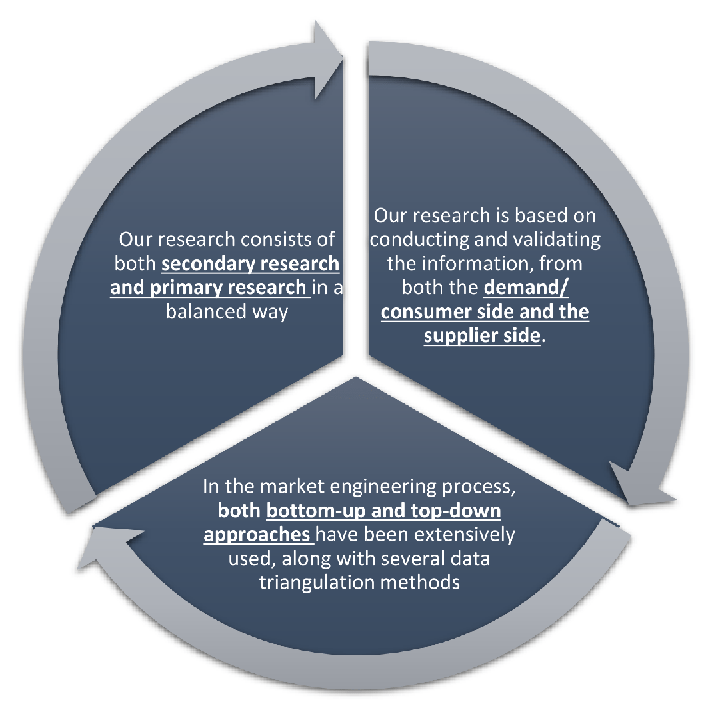
MarketGenics leverages a dedicated industry panel of experts and a comprehensive suite of paid databases to effectively collect, consolidate, and analyze market intelligence.
Our approach has consistently proven to be reliable and effective in generating accurate market insights, identifying key industry trends, and uncovering emerging business opportunities.
Through both primary and secondary research, we capture and analyze critical company-level data such as manufacturing footprints, including technical centers, R&D facilities, sales offices, and headquarters.
Our expert panel further enhances our ability to estimate market size for specific brands based on validated field-level intelligence.
Our data mining techniques incorporate both parametric and non-parametric methods, allowing for structured data collection, sorting, processing, and cleaning.
Demand projections are derived from large-scale data sets analyzed through proprietary algorithms, culminating in robust and reliable market sizing.
Research Approach
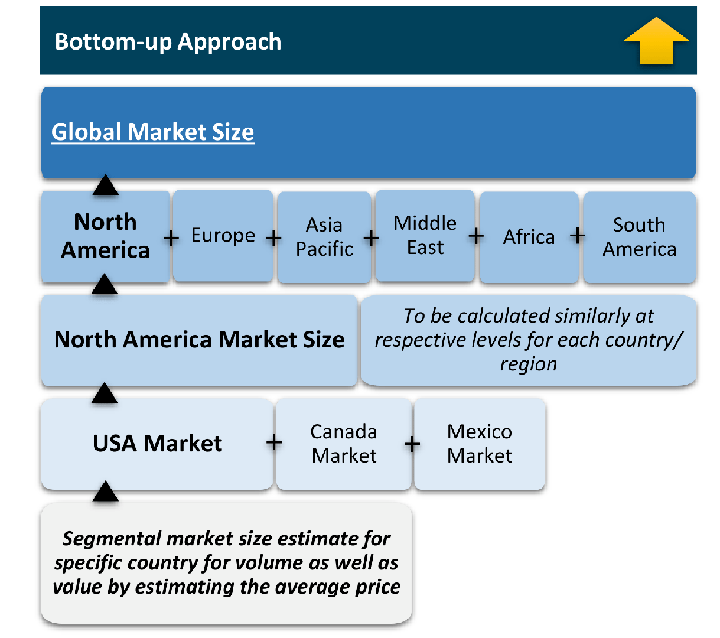
The bottom-up approach builds market estimates by starting with the smallest addressable market units and systematically aggregating them to create comprehensive market size projections.
This method begins with specific, granular data points and builds upward to create the complete market landscape.
Customer Analysis → Segmental Analysis → Geographical Analysis
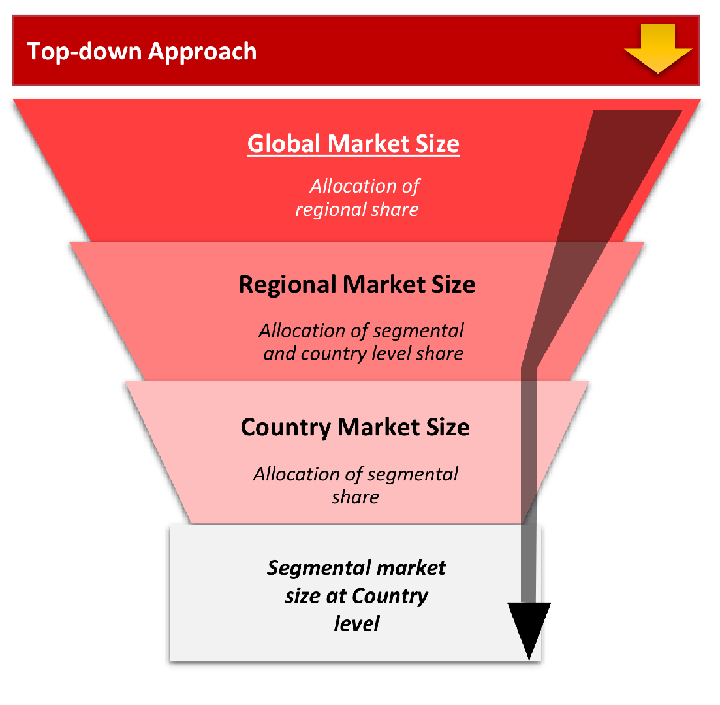
The top-down approach starts with the broadest possible market data and systematically narrows it down through a series of filters and assumptions to arrive at specific market segments or opportunities.
This method begins with the big picture and works downward to increasingly specific market slices.
TAM → SAM → SOM
Research Methods
Desk / Secondary Research
While analysing the market, we extensively study secondary sources, directories, and databases to identify and collect information useful for this technical, market-oriented, and commercial report. Secondary sources that we utilize are not only the public sources, but it is a combination of Open Source, Associations, Paid Databases, MG Repository & Knowledgebase, and others.
- Company websites, annual reports, financial reports, broker reports, and investor presentations
- National government documents, statistical databases and reports
- News articles, press releases and web-casts specific to the companies operating in the market, Magazines, reports, and others
- We gather information from commercial data sources for deriving company specific data such as segmental revenue, share for geography, product revenue, and others
- Internal and external proprietary databases (industry-specific), relevant patent, and regulatory databases
- Governing Bodies, Government Organizations
- Relevant Authorities, Country-specific Associations for Industries
We also employ the model mapping approach to estimate the product level market data through the players' product portfolio
Primary Research
Primary research/ interviews is vital in analyzing the market. Most of the cases involves paid primary interviews. Primary sources include primary interviews through e-mail interactions, telephonic interviews, surveys as well as face-to-face interviews with the different stakeholders across the value chain including several industry experts.
| Type of Respondents | Number of Primaries |
|---|---|
| Tier 2/3 Suppliers | ~20 |
| Tier 1 Suppliers | ~25 |
| End-users | ~25 |
| Industry Expert/ Panel/ Consultant | ~30 |
| Total | ~100 |
MG Knowledgebase
• Repository of industry blog, newsletter and case studies
• Online platform covering detailed market reports, and company profiles
Forecasting Factors and Models
Forecasting Factors
- Historical Trends – Past market patterns, cycles, and major events that shaped how markets behave over time. Understanding past trends helps predict future behavior.
- Industry Factors – Specific characteristics of the industry like structure, regulations, and innovation cycles that affect market dynamics.
- Macroeconomic Factors – Economic conditions like GDP growth, inflation, and employment rates that affect how much money people have to spend.
- Demographic Factors – Population characteristics like age, income, and location that determine who can buy your product.
- Technology Factors – How quickly people adopt new technology and how much technology infrastructure exists.
- Regulatory Factors – Government rules, laws, and policies that can help or restrict market growth.
- Competitive Factors – Analyzing competition structure such as degree of competition and bargaining power of buyers and suppliers.
Forecasting Models / Techniques
Multiple Regression Analysis
- Identify and quantify factors that drive market changes
- Statistical modeling to establish relationships between market drivers and outcomes
Time Series Analysis – Seasonal Patterns
- Understand regular cyclical patterns in market demand
- Advanced statistical techniques to separate trend, seasonal, and irregular components
Time Series Analysis – Trend Analysis
- Identify underlying market growth patterns and momentum
- Statistical analysis of historical data to project future trends
Expert Opinion – Expert Interviews
- Gather deep industry insights and contextual understanding
- In-depth interviews with key industry stakeholders
Multi-Scenario Development
- Prepare for uncertainty by modeling different possible futures
- Creating optimistic, pessimistic, and most likely scenarios
Time Series Analysis – Moving Averages
- Sophisticated forecasting for complex time series data
- Auto-regressive integrated moving average models with seasonal components
Econometric Models
- Apply economic theory to market forecasting
- Sophisticated economic models that account for market interactions
Expert Opinion – Delphi Method
- Harness collective wisdom of industry experts
- Structured, multi-round expert consultation process
Monte Carlo Simulation
- Quantify uncertainty and probability distributions
- Thousands of simulations with varying input parameters
Research Analysis
Our research framework is built upon the fundamental principle of validating market intelligence from both demand and supply perspectives. This dual-sided approach ensures comprehensive market understanding and reduces the risk of single-source bias.
Demand-Side Analysis: We understand end-user/application behavior, preferences, and market needs along with the penetration of the product for specific application.
Supply-Side Analysis: We estimate overall market revenue, analyze the segmental share along with industry capacity, competitive landscape, and market structure.
Validation & Evaluation
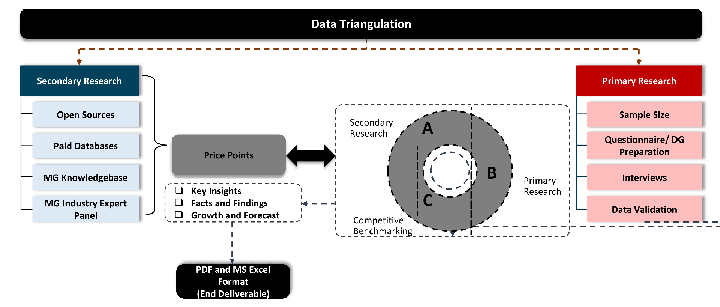
Data triangulation is a validation technique that uses multiple methods, sources, or perspectives to examine the same research question, thereby increasing the credibility and reliability of research findings. In market research, triangulation serves as a quality assurance mechanism that helps identify and minimize bias, validate assumptions, and ensure accuracy in market estimates.
- Data Source Triangulation – Using multiple data sources to examine the same phenomenon
- Methodological Triangulation – Using multiple research methods to study the same research question
- Investigator Triangulation – Using multiple researchers or analysts to examine the same data
- Theoretical Triangulation – Using multiple theoretical perspectives to interpret the same data
Custom Market Research Services
We will customise the research for you, in case the report listed above does not meet your requirements.
Get 10% Free Customisation