Plasma Powder Market Size, Share & Trends Analysis Report by Source Type (Bovine Plasma Powder, Porcine Plasma Powder, Chicken Plasma Powder, Other Animal Sources), Form, Protein Content, Grade, Functionality, Applications, and Geography (North America, Europe, Asia Pacific, Middle East, Africa, and South America) – Global Industry Data, Trends, and Forecasts, 2026–2035
|
|
|
Segmental Data Insights |
|
|
Demand Trends |
|
|
Competitive Landscape |
|
|
Strategic Development |
|
|
Future Outlook & Opportunities |
|
Plasma Powder Market Size, Share, and Growth
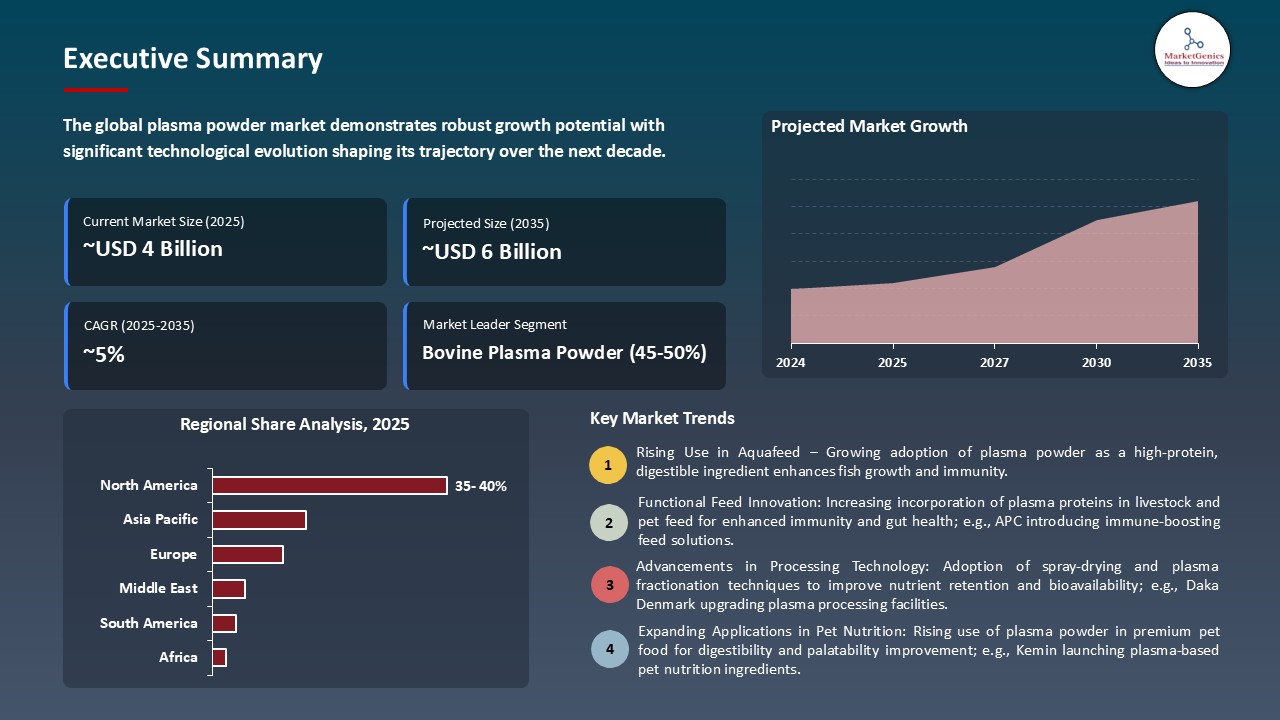
The global plasma powder market is experiencing robust growth, with its estimated value of USD 3.6 billion in the year 2025 and USD 5.8 billion by the period 2035, registering a CAGR of 4.8%, during the forecast period. The global plasma powder market is growing due to demand for functional, high-performance animal nutrition and antibiotic-free production. Rising incomes and large-scale livestock operations fuel adoption, while innovations in processing and distribution support market expansion.
Dr. Daniela Hermelin, Chief Medical Officer of ImpactLife, says, “Early transfusion of blood products saves lives. Spray-dried plasma is a dehydrated product that can be reconstituted on-site without thawing, making it suitable for military or civilian use in treating life-threatening bleeding. ImpactLife looks forward to partnering in the development of this point-of-care treatment.
The plasma powder market is being driven by growing global demand for high-quality protein in animal nutrition and the proven functional benefits of plasma proteins in supporting gut health, immune response, and overall growth performance. Spray-dried plasma, sourced from porcine and bovine blood, contains concentrated immunoglobulins, albumin, and other functional proteins that enhance feed efficiency, reduce mortality, and improve disease resistance. Its role is particularly significant in antibiotic-free and reduced-antibiotic livestock production systems, where nutritional strategies are critical for maintaining animal health and performance.
Market expansion is supported by growing applications beyond swine into poultry, aquaculture, and companion animal nutrition, driven by validation of plasma proteins’ functional benefits across species. Rising consumer and regulatory emphasis on animal welfare and sustainable production further stimulates adoption. The demand for premium, high-performance feed solutions continues to underpin the sector’s growth trajectory.
Technological innovations are strengthening the market by enhancing product functionality and quality. Advanced processing methods such as low-temperature spray-drying, selective membrane filtration, and pathogen-inactivation techniques improve protein concentration and stability. Additionally, complementary opportunities in functional proteins, specialized feed additives, early-life nutrition formulations, pet-food ingredients, and pharmaceutical-grade proteins allow producers to diversify revenue streams and reduce the impact of cyclical fluctuations in livestock production.
Plasma Powder Market Dynamics and Trends
Driver: Growing Demand for Antibiotic Alternatives in Animal Production
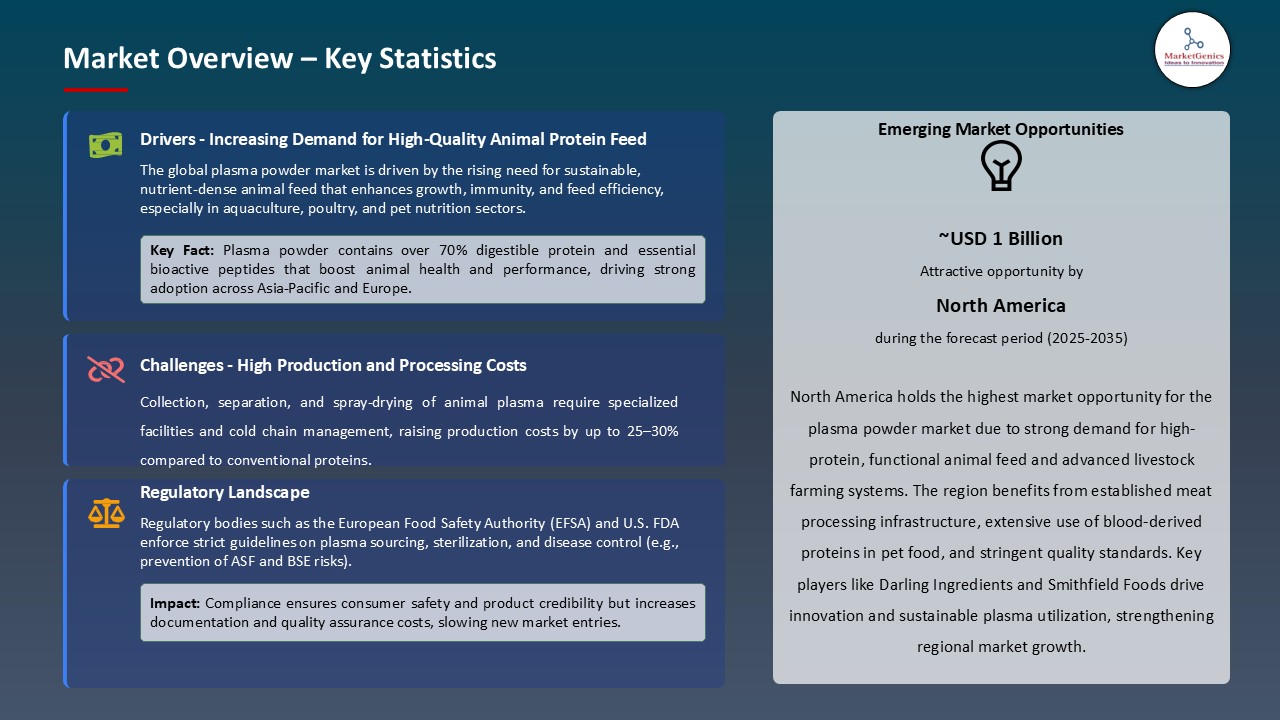
- The plasma powder market is witnessing strong growth driven by the global shift toward antibiotic-free and reduced-antibiotic livestock production. Spray-dried plasma has emerged as a proven nutritional strategy to maintain animal health, performance, and welfare without reliance on prophylactic antimicrobials. Regulatory restrictions on antibiotic growth promoters in major markets, including the EU, U.S., and China, are accelerating the adoption of alternative technologies, with plasma powder demonstrating high efficacy in controlled trials.
- Producers are investing in advanced processing and biosecurity measures to ensure safe and effective alternatives to antibiotics. A risk-assessment study by WUR and Sonac (a subsidiary of Darling Ingredients) demonstrated that UV‑C irradiation, combined with standard spray-drying, reinforces the biosecurity of plasma powders, reducing the risk of pathogen transmission in antibiotic-free systems.
- Rising consumer demand for high-welfare, antibiotic-free animal products, coupled with proven nutritional performance, further drives adoption. Regulatory mandates, market preferences, and validated functional benefits position plasma powder as a key growth driver in sustainable livestock production.
Restraint: Supply Constraints and Price Volatility Linked to Meat Processing Cycles
- The plasma powder market depends on blood collection from slaughter facilities which restricts its operations because it needs to match the blood supply with the amount of meat produced during processing. The market experiences instability because of this system which leads to price fluctuations when herds shrink and diseases appear and when seasonal changes occur and these fluctuations make it difficult for producers and end-users to maintain stable profit margins and fulfill long-term supply contracts.
- The competition between pharmaceutical-grade albumin and diagnostic reagents and premium pet-food formulations for blood resources creates additional supply limitations during times when demand exceeds normal levels. The production of these alternative products at higher profit margins causes raw materials to move away from feed-grade plasma manufacturing which results in elevated costs and restricted market availability.
- Producers face three main challenges which include maintaining stable supply while market demand increases and dealing with price fluctuations and obtaining dependable raw materials. Those who lack vertical integration and multiple sourcing options across different species and geographic locations become more vulnerable to strategic risks which restricts their ability to expand their operations and adapt to market changes.
Opportunity: Expansion into Companion Animal and Specialty Pet Nutrition
- The plasma powder market shows quick expansion through its development of premium dog and cat foods which focus on digestive health and immune support and recovery. The market for functional products has grown because customers now pick plasma proteins even though these proteins cost more than standard animal feed ingredients.
- The integration of spray-dried plasma proteins into premium pet food lines happens through strategic partnerships which create new formulations for digestive health and senior pet nutrition. These products, positioned at a premium price point, offer attractive margins across the value chain while meeting consumer demand for high-quality, functional nutrition.
- The veterinary therapeutic nutrition sector enables pharmaceutical-grade plasma products to develop further for treating patients who need recovery from medical conditions and surgical procedures and digestive system problems. The market segment has expanded due to premiumization and pet owners investing in their animals' health and plasma's proven ability to support gut barriers and immune function which creates high-profit opportunities with less price sensitivity thus enabling manufacturers to improve their product selection and financial returns.
Key Trend: Sustainability, Traceability, and Biosecurity in Blood-Derived Products
- The global plasma powder market has adopted sustainability, traceability solutions and advanced biosecurity systems because retailers and brands together with regulatory authorities need responsible sourcing and environmental protection and animal welfare standards. Producers are investing in transparent operations, digital traceability systems, and certifications that differentiate them in a competitive market.
- The supply chain now uses blockchain-based digital traceability systems to achieve full visibility while confirming animal welfare standards and antibiotic-free status and pathogen testing and environmental impact metrics. These systems enable businesses to fulfill strict documentation standards which help them offer premium products in their main markets of Europe and North America.
- The industry now uses advanced pathogen inactivation technologies together with supplier qualification programs and testing systems which go beyond regulatory requirements. The implemented measures protect biosecurity through elevated market entry requirements which predominantly benefit established producers who create certified products that allow them to charge higher prices.
Plasma-Powder-Market Analysis and Segmental Data
Bovine Plasma Powder Dominate Global Plasma Powder Market
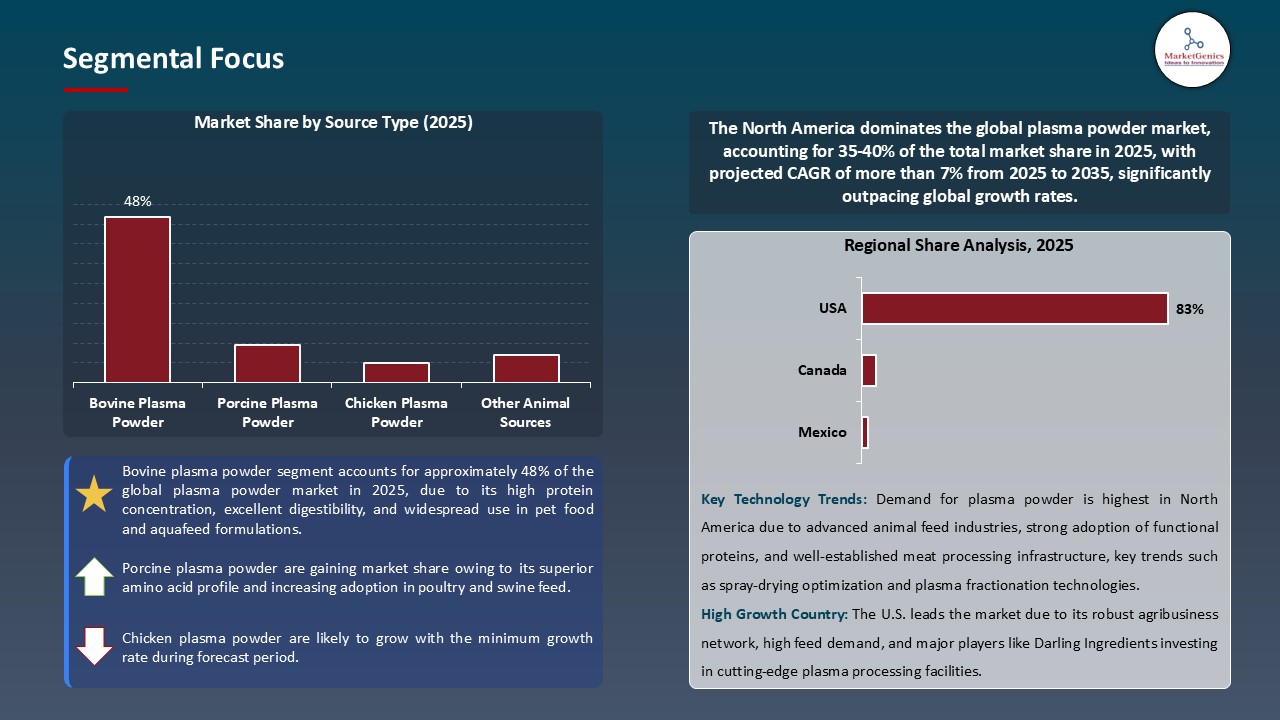
- The bovine plasma powder leads the global plasma powder market, because bovine blood and by-products exist in large quantities and processing techniques are well-established and the industry has extensive knowledge of transforming raw materials into functional powders. The nutritional value of bovine plasma proteins with immunoglobulins and bioactive peptides makes it an excellent choice for animal feed and pet food and specialized applications. The processing techniques which include spray-drying and pathogen testing and protein stabilization methods improve product digestibility and functionality and safety standards.
- The market segment shows ongoing expansion because it fulfills growing needs from feed and pet food and specialty nutrition sectors. The industry shows a growing interest in premium bovine plasma products which develop through scientific methods to create functional items for mass production. The growing interest in gut health and immunity and performance improvement for livestock and pets drives adoption rates while modern processing and fortification methods allow for safe and efficient mass production.
- Strong supply chains together with established regulations and industry knowledge of bovine ingredients allow bovine plasma powders to dominate the market because they enable fast production and quick market entry and worldwide acceptance.
North America Leads Global Plasma Powder Market Demand
- The North American plasma powder market receives its main support from the strong need for scientifically proven nutritional products which include infant formula and pet food and animal feed. The market experiences continuous expansion because people learn more about functional nutrition while their disposable income grows and they choose fortified and specialty ingredients.
- The region operates through its advanced processing infrastructure and established feed and nutrition networks and regulatory systems which protect product safety and performance. The widespread adoption of spray-dried plasma in piglet feed and pet-food formulations highlights its functional advantages in gut health and immunity. The North American market leads in premium plasma powders because Proliant Biologicals and other companies focus on both process optimization and innovative development.
- The North American market position receives additional support through strategic partnerships and vertical integration and strong R&D pipelines. The business expansion through increased production capacity and strategic partnerships with livestock and pet-food companies enables faster market entry and guarantees steady supply of raw materials. The region maintains its ongoing market growth and fast product launches because of these factors which establish a strong environment for innovation.
Plasma-Powder-Market Ecosystem
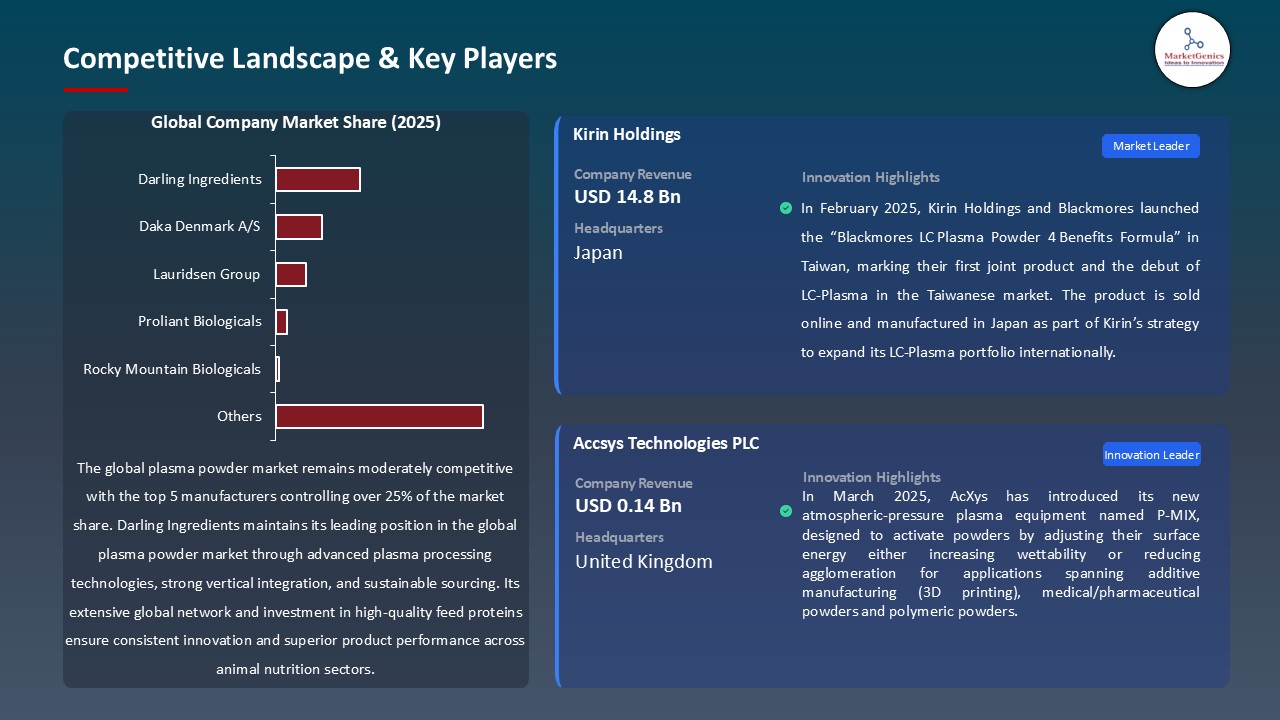
The global plasma powder market is a moderately consolidated market structure which shows distinct regional market focus and different levels of vertical integration. The leading companies Darling Ingredients and Daka Denmark A/S and Lauridsen Group and Proliant Biologicals and Rocky Mountain Biologicals operate through their own ownership of slaughter operations or through long-term partnerships which combine their control of slaughter operations with processing technologies and quality systems and regulatory knowledge and customer networks that serve feed and premix and specialty nutrition markets.
The integrated operations control the entire value chain through blood collection and processing and spray-drying operations and quality control systems and technical support and distribution channels which enable them to achieve competitive advantages by securing raw materials and maintaining consistent quality standards and capturing value at multiple stages. The main focus of Tier 2 and 3 players remains on specialized processing and regional operations but they must compete through price and product differentiation and flexibility while struggling to obtain raw materials during supply chain disruptions.
The value chain includes all stages from slaughter facility collection through anticoagulation and stabilization and spray-drying and powder production and final quality assurance and distribution through animal nutrition channels. Darling Ingredients demonstrates its strategic approach through its joint venture in China which focuses on integrated plasma production to achieve vertical integration and geographic market expansion for raw material acquisition and market penetration in high-demand areas.
Overall, the market’s capital intensity, technical complexity, regulatory requirements, and reliance on raw material relationships create high barriers to entry, sustaining stable market structures despite strong growth potential.
Recent Development and Strategic Overview:
- In August 2024, Octapharma USA secured FDA Emergency Use Authorization for octaplasLG Powder which functions as a lyophilised plasma product to treat hemorrhages when fresh plasma supplies run out. The powder remains stable at room temperature and it serves blood types A and AB. The technology emerged from an April 2024 CRADA with the U.S. Army which enabled its quick deployment for emergency situations and military combat environments.
- In May 2025, Wageningen University & Research (WUR) released findings which demonstrated that spray-dried plasma (SDP) feeding to pigs results in improved gut health through better intestinal barrier strength and beneficial changes in gut microbiota. The research findings demonstrated a decline in dangerous bacteria together with an increase in amino acids that support immune system function and metabolic processes. The study with Darling Ingredients utilized the "FeedOmics" method to show SDP functions as an active feed component. The new solution enables sustainable animal nutrition practices which enhance animal health outcomes.
Report Scope
|
Detail |
|
|
Market Size in 2025 |
USD 3.6 Bn |
|
Market Forecast Value in 2035 |
USD 5.8 Bn |
|
Growth Rate (CAGR) |
4.8% |
|
Forecast Period |
2026 – 2035 |
|
Historical Data Available for |
2021 – 2024 |
|
Market Size Units |
US$ Billion for Value Metric Tons for Volume |
|
Report Format |
Electronic (PDF) + Excel |
|
North America |
Europe |
Asia Pacific |
Middle East |
Africa |
South America |
|
|
|
|
|
|
|
Companies Covered |
|||||
|
|
|
|
|
|
Plasma-Powder-Market Segmentation and Highlights
|
Segment |
Sub-segment |
|
Plasma Powder Market, By Source Type |
|
|
Plasma Powder Market, By Form |
|
|
Plasma Powder Market, By Protein Content |
|
|
Plasma Powder Market, By Grade |
|
|
Plasma Powder Market, Functionality |
|
|
Plasma Powder Market, By Applications |
|
Frequently Asked Questions
Table of Contents
- 1. Research Methodology and Assumptions
- 1.1. Definitions
- 1.2. Research Design and Approach
- 1.3. Data Collection Methods
- 1.4. Base Estimates and Calculations
- 1.5. Forecasting Models
- 1.5.1. Key Forecast Factors & Impact Analysis
- 1.6. Secondary Research
- 1.6.1. Open Sources
- 1.6.2. Paid Databases
- 1.6.3. Associations
- 1.7. Primary Research
- 1.7.1. Primary Sources
- 1.7.2. Primary Interviews with Stakeholders across Ecosystem
- 2. Executive Summary
- 2.1. Global Plasma Powder Market Outlook
- 2.1.1. Plasma Powder Market Size (Volume - Metric Tons and Value - US$ Bn), and Forecasts, 2021-2035
- 2.1.2. Compounded Annual Growth Rate Analysis
- 2.1.3. Growth Opportunity Analysis
- 2.1.4. Segmental Share Analysis
- 2.1.5. Geographical Share Analysis
- 2.2. Market Analysis and Facts
- 2.3. Supply-Demand Analysis
- 2.4. Competitive Benchmarking
- 2.5. Go-to- Market Strategy
- 2.5.1. Customer/ End-use Industry Assessment
- 2.5.2. Growth Opportunity Data, 2026-2035
- 2.5.2.1. Regional Data
- 2.5.2.2. Country Data
- 2.5.2.3. Segmental Data
- 2.5.3. Identification of Potential Market Spaces
- 2.5.4. GAP Analysis
- 2.5.5. Potential Attractive Price Points
- 2.5.6. Prevailing Market Risks & Challenges
- 2.5.7. Preferred Sales & Marketing Strategies
- 2.5.8. Key Recommendations and Analysis
- 2.5.9. A Way Forward
- 2.1. Global Plasma Powder Market Outlook
- 3. Industry Data and Premium Insights
- 3.1. Global Food & Beverages Industry Overview, 2025
- 3.1.1. Food & Beverages Industry Ecosystem Analysis
- 3.1.2. Key Trends for Food & Beverages Industry
- 3.1.3. Regional Distribution for Food & Beverages Industry
- 3.2. Supplier Customer Data
- 3.3. Technology Roadmap and Developments
- 3.4. Trade Analysis
- 3.4.1. Import & Export Analysis, 2025
- 3.4.2. Top Importing Countries
- 3.4.3. Top Exporting Countries
- 3.5. Trump Tariff Impact Analysis
- 3.5.1. Manufacturer
- 3.5.1.1. Based on the component & Raw material
- 3.5.2. Supply Chain
- 3.5.3. End Consumer
- 3.5.1. Manufacturer
- 3.6. Raw Material Analysis
- 3.1. Global Food & Beverages Industry Overview, 2025
- 4. Market Overview
- 4.1. Market Dynamics
- 4.1.1. Drivers
- 4.1.1.1. Rising demand for high-protein functional ingredients in animal feed.
- 4.1.1.2. Growing use of plasma powder in pet food and aquafeed for improved immunity and growth.
- 4.1.1.3. Expansion of livestock and aquaculture industries globally.
- 4.1.2. Restraints
- 4.1.2.1. High processing and preservation costs.
- 4.1.2.2. Stringent regulatory standards and concerns over disease transmission.
- 4.1.1. Drivers
- 4.2. Key Trend Analysis
- 4.3. Regulatory Framework
- 4.3.1. Key Regulations, Norms, and Subsidies, by Key Countries
- 4.3.2. Tariffs and Standards
- 4.3.3. Impact Analysis of Regulations on the Market
- 4.4. Value Chain Analysis
- 4.4.1. Raw Material Suppliers
- 4.4.2. Manufacturers
- 4.4.3. Distributors
- 4.4.4. End-Users/ Customers
- 4.5. Cost Structure Analysis
- 4.5.1. Parameter’s Share for Cost Associated
- 4.5.2. COGP vs COGS
- 4.5.3. Profit Margin Analysis
- 4.6. Pricing Analysis
- 4.6.1. Regional Pricing Analysis
- 4.6.2. Segmental Pricing Trends
- 4.6.3. Factors Influencing Pricing
- 4.7. Porter’s Five Forces Analysis
- 4.8. PESTEL Analysis
- 4.9. Global Plasma Powder Market Demand
- 4.9.1. Historical Market Size – Volume (Metric Tons) and Value (US$ Bn), 2020-2024
- 4.9.2. Current and Future Market Size – Volume (Metric Tons) and Value (US$ Bn), 2026–2035
- 4.9.2.1. Y-o-Y Growth Trends
- 4.9.2.2. Absolute $ Opportunity Assessment
- 4.1. Market Dynamics
- 5. Competition Landscape
- 5.1. Competition structure
- 5.1.1. Fragmented v/s consolidated
- 5.2. Company Share Analysis, 2025
- 5.2.1. Global Company Market Share
- 5.2.2. By Region
- 5.2.2.1. North America
- 5.2.2.2. Europe
- 5.2.2.3. Asia Pacific
- 5.2.2.4. Middle East
- 5.2.2.5. Africa
- 5.2.2.6. South America
- 5.3. Product Comparison Matrix
- 5.3.1. Specifications
- 5.3.2. Market Positioning
- 5.3.3. Pricing
- 5.1. Competition structure
- 6. Global Plasma Powder Market Analysis, by Source/Type
- 6.1. Key Segment Analysis
- 6.2. Plasma Powder Market Size (Volume - Metric Tons and Value - US$ Bn), Analysis, and Forecasts, by Source/Type, 2021-2035
- 6.2.1. Bovine Plasma Powder
- 6.2.2. Porcine Plasma Powder
- 6.2.3. Chicken Plasma Powder
- 6.2.4. Other Animal Sources
- 7. Global Plasma Powder Market Analysis, by Form
- 7.1. Key Segment Analysis
- 7.2. Plasma Powder Market Size (Volume - Metric Tons and Value - US$ Bn), Analysis, and Forecasts, by Form, 2021-2035
- 7.2.1. Spray-Dried
- 7.2.2. Freeze-Dried
- 7.2.3. Drum-Dried
- 8. Global Plasma Powder Market Analysis, by Protein Content
- 8.1. Key Segment Analysis
- 8.2. Plasma Powder Market Size (Volume - Metric Tons and Value - US$ Bn), Analysis, and Forecasts, by Protein Content, 2021-2035
- 8.2.1. High Protein Content (>70%)
- 8.2.2. Medium Protein Content (50-70%)
- 8.2.3. Low Protein Content (<50%)
- 9. Global Plasma Powder Market Analysis, by Grade
- 9.1. Key Segment Analysis
- 9.2. Plasma Powder Market Size (Volume - Metric Tons and Value - US$ Bn), Analysis, and Forecasts, by Grade, 2021-2035
- 9.2.1. Food Grade
- 9.2.2. Pharmaceutical Grade
- 9.2.3. Feed Grade
- 10. Global Plasma Powder Market Analysis, by Functionality
- 10.1. Key Segment Analysis
- 10.2. Plasma Powder Market Size (Volume - Metric Tons and Value - US$ Bn), Analysis, and Forecasts, by Functionality, 2021-2035
- 10.2.1. Emulsifying Agent
- 10.2.2. Binding Agent
- 10.2.3. Nutritional Fortification
- 10.2.4. Texture Enhancement
- 10.2.5. Flavor Enhancement
- 10.2.6. Others
- 11. Global Plasma Powder Market Analysis, by Applications
- 11.1. Key Segment Analysis
- 11.2. Plasma Powder Market Size (Volume - Metric Tons and Value - US$ Bn), Analysis, and Forecasts, by Applications, 2021-2035
- 11.2.1. Meat & Poultry Processing
- 11.2.1.1. Meat Emulsions & Sausages
- 11.2.1.2. Restructured Meat Products
- 11.2.1.3. Meat Coatings & Batters
- 11.2.1.4. Cured Meat Products
- 11.2.1.5. Ready-to-Eat Meat Products
- 11.2.1.6. Others
- 11.2.2. Bakery & Confectionery
- 11.2.2.1. Bread & Baked Goods
- 11.2.2.2. Cakes & Pastries
- 11.2.2.3. Protein-Enriched Bakery Products
- 11.2.2.4. Specialty Confectionery
- 11.2.2.5. Others
- 11.2.3. Dairy & Dairy Alternatives
- 11.2.3.1. Protein-Fortified Beverages
- 11.2.3.2. Yogurt & Fermented Products
- 11.2.3.3. Cheese Analogs
- 11.2.3.4. Ice Cream & Frozen Desserts
- 11.2.3.5. Others
- 11.2.4. Nutraceuticals & Dietary Supplements
- 11.2.4.1. Protein Supplements
- 11.2.4.2. Sports Nutrition Products
- 11.2.4.3. Meal Replacement Products
- 11.2.4.4. Functional Food Additives
- 11.2.4.5. Others
- 11.2.5. Beverages
- 11.2.5.1. Protein Drinks
- 11.2.5.2. Sports & Energy Drinks
- 11.2.5.3. Functional Beverages
- 11.2.5.4. Nutritional Shakes
- 11.2.5.5. Others
- 11.2.6. Pet Food
- 11.2.6.1. Premium Pet Food Products
- 11.2.6.2. Nutritional Pet Supplements
- 11.2.6.3. Wet Pet Food
- 11.2.6.4. Specialty Pet Treats
- 11.2.6.5. Others
- 11.2.7. Snacks & Convenience Foods
- 11.2.8. Infant & Baby Food
- 11.2.9. Other Applications
- 11.2.1. Meat & Poultry Processing
- 12. Global Plasma Powder Market Analysis and Forecasts, by Region
- 12.1. Key Findings
- 12.2. Plasma Powder Market Size (Volume - Metric Tons and Value - US$ Bn), Analysis, and Forecasts, by Region, 2021-2035
- 12.2.1. North America
- 12.2.2. Europe
- 12.2.3. Asia Pacific
- 12.2.4. Middle East
- 12.2.5. Africa
- 12.2.6. South America
- 13. North America Plasma Powder Market Analysis
- 13.1. Key Segment Analysis
- 13.2. Regional Snapshot
- 13.3. North America Plasma Powder Market Size Volume - Metric Tons and Value - US$ Bn), Analysis, and Forecasts, 2021-2035
- 13.3.1. Source Type
- 13.3.2. Form
- 13.3.3. Protein Content
- 13.3.4. Grade
- 13.3.5. Functionality
- 13.3.6. Applications
- 13.3.7. Country
- 13.3.7.1. USA
- 13.3.7.2. Canada
- 13.3.7.3. Mexico
- 13.4. USA Plasma Powder Market
- 13.4.1. Country Segmental Analysis
- 13.4.2. Source Type
- 13.4.3. Form
- 13.4.4. Protein Content
- 13.4.5. Grade
- 13.4.6. Functionality
- 13.4.7. Applications
- 13.5. Canada Plasma Powder Market
- 13.5.1. Country Segmental Analysis
- 13.5.2. Source Type
- 13.5.3. Form
- 13.5.4. Protein Content
- 13.5.5. Grade
- 13.5.6. Functionality
- 13.5.7. Applications
- 13.6. Mexico Plasma Powder Market
- 13.6.1. Country Segmental Analysis
- 13.6.2. Source Type
- 13.6.3. Form
- 13.6.4. Protein Content
- 13.6.5. Grade
- 13.6.6. Functionality
- 13.6.7. Applications
- 14. Europe Plasma Powder Market Analysis
- 14.1. Key Segment Analysis
- 14.2. Regional Snapshot
- 14.3. Europe Plasma Powder Market Size (Volume - Metric Tons and Value - US$ Bn), Analysis, and Forecasts, 2021-2035
- 14.3.1. Source Type
- 14.3.2. Form
- 14.3.3. Protein Content
- 14.3.4. Grade
- 14.3.5. Functionality
- 14.3.6. Applications
- 14.3.7. Country
- 14.3.7.1. Germany
- 14.3.7.2. United Kingdom
- 14.3.7.3. France
- 14.3.7.4. Italy
- 14.3.7.5. Spain
- 14.3.7.6. Netherlands
- 14.3.7.7. Nordic Countries
- 14.3.7.8. Poland
- 14.3.7.9. Russia & CIS
- 14.3.7.10. Rest of Europe
- 14.4. Germany Plasma Powder Market
- 14.4.1. Country Segmental Analysis
- 14.4.2. Source Type
- 14.4.3. Form
- 14.4.4. Protein Content
- 14.4.5. Grade
- 14.4.6. Functionality
- 14.4.7. Applications
- 14.5. United Kingdom Plasma Powder Market
- 14.5.1. Country Segmental Analysis
- 14.5.2. Source Type
- 14.5.3. Form
- 14.5.4. Protein Content
- 14.5.5. Grade
- 14.5.6. Functionality
- 14.5.7. Applications
- 14.6. France Plasma Powder Market
- 14.6.1. Country Segmental Analysis
- 14.6.2. Source Type
- 14.6.3. Form
- 14.6.4. Protein Content
- 14.6.5. Grade
- 14.6.6. Functionality
- 14.6.7. Applications
- 14.7. Italy Plasma Powder Market
- 14.7.1. Country Segmental Analysis
- 14.7.2. Source Type
- 14.7.3. Form
- 14.7.4. Protein Content
- 14.7.5. Grade
- 14.7.6. Functionality
- 14.7.7. Applications
- 14.8. Spain Plasma Powder Market
- 14.8.1. Country Segmental Analysis
- 14.8.2. Source Type
- 14.8.3. Form
- 14.8.4. Protein Content
- 14.8.5. Grade
- 14.8.6. Functionality
- 14.8.7. Applications
- 14.9. Netherlands Plasma Powder Market
- 14.9.1. Country Segmental Analysis
- 14.9.2. Source Type
- 14.9.3. Form
- 14.9.4. Protein Content
- 14.9.5. Grade
- 14.9.6. Functionality
- 14.9.7. Applications
- 14.10. Nordic Countries Plasma Powder Market
- 14.10.1. Country Segmental Analysis
- 14.10.2. Source Type
- 14.10.3. Form
- 14.10.4. Protein Content
- 14.10.5. Grade
- 14.10.6. Functionality
- 14.10.7. Applications
- 14.11. Poland Plasma Powder Market
- 14.11.1. Country Segmental Analysis
- 14.11.2. Source Type
- 14.11.3. Form
- 14.11.4. Protein Content
- 14.11.5. Grade
- 14.11.6. Functionality
- 14.11.7. Applications
- 14.12. Russia & CIS Plasma Powder Market
- 14.12.1. Country Segmental Analysis
- 14.12.2. Source Type
- 14.12.3. Form
- 14.12.4. Protein Content
- 14.12.5. Grade
- 14.12.6. Functionality
- 14.12.7. Applications
- 14.13. Rest of Europe Plasma Powder Market
- 14.13.1. Country Segmental Analysis
- 14.13.2. Source Type
- 14.13.3. Form
- 14.13.4. Protein Content
- 14.13.5. Grade
- 14.13.6. Functionality
- 14.13.7. Applications
- 15. Asia Pacific Plasma Powder Market Analysis
- 15.1. Key Segment Analysis
- 15.2. Regional Snapshot
- 15.3. Asia Pacific Plasma Powder Market Size (Volume - Metric Tons and Value - US$ Bn), Analysis, and Forecasts, 2021-2035
- 15.3.1. Source Type
- 15.3.2. Form
- 15.3.3. Protein Content
- 15.3.4. Grade
- 15.3.5. Functionality
- 15.3.6. Applications
- 15.3.7. Country
- 15.3.7.1. China
- 15.3.7.2. India
- 15.3.7.3. Japan
- 15.3.7.4. South Korea
- 15.3.7.5. Australia and New Zealand
- 15.3.7.6. Indonesia
- 15.3.7.7. Malaysia
- 15.3.7.8. Thailand
- 15.3.7.9. Vietnam
- 15.3.7.10. Rest of Asia Pacific
- 15.4. China Plasma Powder Market
- 15.4.1. Country Segmental Analysis
- 15.4.2. Source Type
- 15.4.3. Form
- 15.4.4. Protein Content
- 15.4.5. Grade
- 15.4.6. Functionality
- 15.4.7. Applications
- 15.5. India Plasma Powder Market
- 15.5.1. Country Segmental Analysis
- 15.5.2. Source Type
- 15.5.3. Form
- 15.5.4. Protein Content
- 15.5.5. Grade
- 15.5.6. Functionality
- 15.5.7. Applications
- 15.6. Japan Plasma Powder Market
- 15.6.1. Country Segmental Analysis
- 15.6.2. Source Type
- 15.6.3. Form
- 15.6.4. Protein Content
- 15.6.5. Grade
- 15.6.6. Functionality
- 15.6.7. Applications
- 15.7. South Korea Plasma Powder Market
- 15.7.1. Country Segmental Analysis
- 15.7.2. Source Type
- 15.7.3. Form
- 15.7.4. Protein Content
- 15.7.5. Grade
- 15.7.6. Functionality
- 15.7.7. Applications
- 15.8. Australia and New Zealand Plasma Powder Market
- 15.8.1. Country Segmental Analysis
- 15.8.2. Source Type
- 15.8.3. Form
- 15.8.4. Protein Content
- 15.8.5. Grade
- 15.8.6. Functionality
- 15.8.7. Applications
- 15.9. Indonesia Plasma Powder Market
- 15.9.1. Country Segmental Analysis
- 15.9.2. Source Type
- 15.9.3. Form
- 15.9.4. Protein Content
- 15.9.5. Grade
- 15.9.6. Functionality
- 15.9.7. Applications
- 15.10. Malaysia Plasma Powder Market
- 15.10.1. Country Segmental Analysis
- 15.10.2. Source Type
- 15.10.3. Form
- 15.10.4. Protein Content
- 15.10.5. Grade
- 15.10.6. Functionality
- 15.10.7. Applications
- 15.11. Thailand Plasma Powder Market
- 15.11.1. Country Segmental Analysis
- 15.11.2. Source Type
- 15.11.3. Form
- 15.11.4. Protein Content
- 15.11.5. Grade
- 15.11.6. Functionality
- 15.11.7. Applications
- 15.12. Vietnam Plasma Powder Market
- 15.12.1. Country Segmental Analysis
- 15.12.2. Source Type
- 15.12.3. Form
- 15.12.4. Protein Content
- 15.12.5. Grade
- 15.12.6. Functionality
- 15.12.7. Applications
- 15.13. Rest of Asia Pacific Plasma Powder Market
- 15.13.1. Country Segmental Analysis
- 15.13.2. Source Type
- 15.13.3. Form
- 15.13.4. Protein Content
- 15.13.5. Grade
- 15.13.6. Functionality
- 15.13.7. Applications
- 16. Middle East Plasma Powder Market Analysis
- 16.1. Key Segment Analysis
- 16.2. Regional Snapshot
- 16.3. Middle East Plasma Powder Market Size (Volume - Metric Tons and Value - US$ Bn), Analysis, and Forecasts, 2021-2035
- 16.3.1. Source Type
- 16.3.2. Form
- 16.3.3. Protein Content
- 16.3.4. Grade
- 16.3.5. Functionality
- 16.3.6. Applications
- 16.3.7. Country
- 16.3.7.1. Turkey
- 16.3.7.2. UAE
- 16.3.7.3. Saudi Arabia
- 16.3.7.4. Israel
- 16.3.7.5. Rest of Middle East
- 16.4. Turkey Plasma Powder Market
- 16.4.1. Country Segmental Analysis
- 16.4.2. Source Type
- 16.4.3. Form
- 16.4.4. Protein Content
- 16.4.5. Grade
- 16.4.6. Functionality
- 16.4.7. Applications
- 16.5. UAE Plasma Powder Market
- 16.5.1. Country Segmental Analysis
- 16.5.2. Source Type
- 16.5.3. Form
- 16.5.4. Protein Content
- 16.5.5. Grade
- 16.5.6. Functionality
- 16.5.7. Applications
- 16.6. Saudi Arabia Plasma Powder Market
- 16.6.1. Country Segmental Analysis
- 16.6.2. Source Type
- 16.6.3. Form
- 16.6.4. Protein Content
- 16.6.5. Grade
- 16.6.6. Functionality
- 16.6.7. Applications
- 16.7. Israel Plasma Powder Market
- 16.7.1. Country Segmental Analysis
- 16.7.2. Source Type
- 16.7.3. Form
- 16.7.4. Protein Content
- 16.7.5. Grade
- 16.7.6. Functionality
- 16.7.7. Applications
- 16.8. Rest of Middle East Plasma Powder Market
- 16.8.1. Country Segmental Analysis
- 16.8.2. Source Type
- 16.8.3. Form
- 16.8.4. Protein Content
- 16.8.5. Grade
- 16.8.6. Functionality
- 16.8.7. Applications
- 17. Africa Plasma Powder Market Analysis
- 17.1. Key Segment Analysis
- 17.2. Regional Snapshot
- 17.3. Africa Plasma Powder Market Size (Volume - Metric Tons and Value - US$ Bn), Analysis, and Forecasts, 2021-2035
- 17.3.1. Source Type
- 17.3.2. Form
- 17.3.3. Protein Content
- 17.3.4. Grade
- 17.3.5. Functionality
- 17.3.6. Applications
- 17.3.7. Country
- 17.3.7.1. South Africa
- 17.3.7.2. Egypt
- 17.3.7.3. Nigeria
- 17.3.7.4. Algeria
- 17.3.7.5. Rest of Africa
- 17.4. South Africa Plasma Powder Market
- 17.4.1. Country Segmental Analysis
- 17.4.2. Source Type
- 17.4.3. Form
- 17.4.4. Protein Content
- 17.4.5. Grade
- 17.4.6. Functionality
- 17.4.7. Applications
- 17.5. Egypt Plasma Powder Market
- 17.5.1. Country Segmental Analysis
- 17.5.2. Source Type
- 17.5.3. Form
- 17.5.4. Protein Content
- 17.5.5. Grade
- 17.5.6. Functionality
- 17.5.7. Applications
- 17.6. Nigeria Plasma Powder Market
- 17.6.1. Country Segmental Analysis
- 17.6.2. Source Type
- 17.6.3. Form
- 17.6.4. Protein Content
- 17.6.5. Grade
- 17.6.6. Functionality
- 17.6.7. Applications
- 17.7. Algeria Plasma Powder Market
- 17.7.1. Country Segmental Analysis
- 17.7.2. Source Type
- 17.7.3. Form
- 17.7.4. Protein Content
- 17.7.5. Grade
- 17.7.6. Functionality
- 17.7.7. Applications
- 17.8. Rest of Africa Plasma Powder Market
- 17.8.1. Country Segmental Analysis
- 17.8.2. Source Type
- 17.8.3. Form
- 17.8.4. Protein Content
- 17.8.5. Grade
- 17.8.6. Functionality
- 17.8.7. Applications
- 18. South America Plasma Powder Market Analysis
- 18.1. Key Segment Analysis
- 18.2. Regional Snapshot
- 18.3. South America Plasma Powder Market Size (Volume - Metric Tons and Value - US$ Bn), Analysis, and Forecasts, 2021-2035
- 18.3.1. Source Type
- 18.3.2. Form
- 18.3.3. Protein Content
- 18.3.4. Grade
- 18.3.5. Functionality
- 18.3.6. Applications
- 18.3.7. Country
- 18.3.7.1. Brazil
- 18.3.7.2. Argentina
- 18.3.7.3. Rest of South America
- 18.4. Brazil Plasma Powder Market
- 18.4.1. Country Segmental Analysis
- 18.4.2. Source Type
- 18.4.3. Form
- 18.4.4. Protein Content
- 18.4.5. Grade
- 18.4.6. Functionality
- 18.4.7. Applications
- 18.5. Argentina Plasma Powder Market
- 18.5.1. Country Segmental Analysis
- 18.5.2. Source Type
- 18.5.3. Form
- 18.5.4. Protein Content
- 18.5.5. Grade
- 18.5.6. Functionality
- 18.5.7. Applications
- 18.6. Rest of South America Plasma Powder Market
- 18.6.1. Country Segmental Analysis
- 18.6.2. Source Type
- 18.6.3. Form
- 18.6.4. Protein Content
- 18.6.5. Grade
- 18.6.6. Functionality
- 18.6.7. Applications
- 19. Key Players/ Company Profile
- 19.1. Arla Foods Ingredients.
- 19.1.1. Company Details/ Overview
- 19.1.2. Company Financials
- 19.1.3. Key Customers and Competitors
- 19.1.4. Business/ Industry Portfolio
- 19.1.5. Product Portfolio/ Specification Details
- 19.1.6. Pricing Data
- 19.1.7. Strategic Overview
- 19.1.8. Recent Developments
- 19.2. Custom Blending Inc.
- 19.3. Daka Denmark A/S
- 19.4. Darling Ingredients Inc.
- 19.5. FASA Group
- 19.6. Foodchem International Corporation
- 19.7. Hilmar Ingredients
- 19.8. Kraeber & Co GmbH
- 19.9. Lauridsen Group
- 19.10. Lican Food S.A.
- 19.11. Pel-Freez, LLC
- 19.12. Proliant Biologicals
- 19.13. Rocky Mountain Biologicals
- 19.14. SARIA SE & Co. KG
- 19.15. Sigma-Aldrich
- 19.16. VEOS Group
- 19.17. Weishardt Group
- 19.18. Yeruvá S.A.
- 19.19. Other Key Players
- 19.1. Arla Foods Ingredients.
Note* - This is just tentative list of players. While providing the report, we will cover more number of players based on their revenue and share for each geography
Research Design
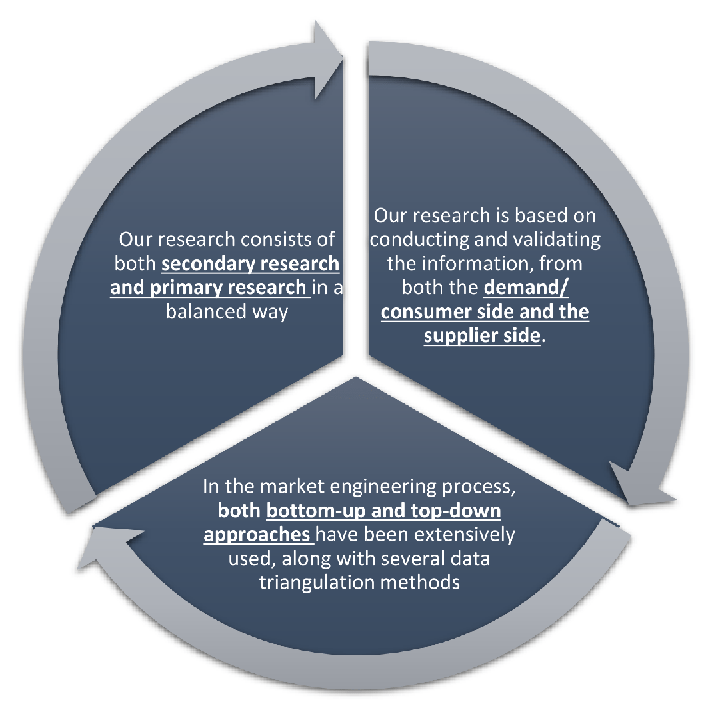
Our research design integrates both demand-side and supply-side analysis through a balanced combination of primary and secondary research methodologies. By utilizing both bottom-up and top-down approaches alongside rigorous data triangulation methods, we deliver robust market intelligence that supports strategic decision-making.
MarketGenics' comprehensive research design framework ensures the delivery of accurate, reliable, and actionable market intelligence. Through the integration of multiple research approaches, rigorous validation processes, and expert analysis, we provide our clients with the insights needed to make informed strategic decisions and capitalize on market opportunities.
MarketGenics leverages a dedicated industry panel of experts and a comprehensive suite of paid databases to effectively collect, consolidate, and analyze market intelligence.
Our approach has consistently proven to be reliable and effective in generating accurate market insights, identifying key industry trends, and uncovering emerging business opportunities.
Through both primary and secondary research, we capture and analyze critical company-level data such as manufacturing footprints, including technical centers, R&D facilities, sales offices, and headquarters.
Our expert panel further enhances our ability to estimate market size for specific brands based on validated field-level intelligence.
Our data mining techniques incorporate both parametric and non-parametric methods, allowing for structured data collection, sorting, processing, and cleaning.
Demand projections are derived from large-scale data sets analyzed through proprietary algorithms, culminating in robust and reliable market sizing.
Research Approach
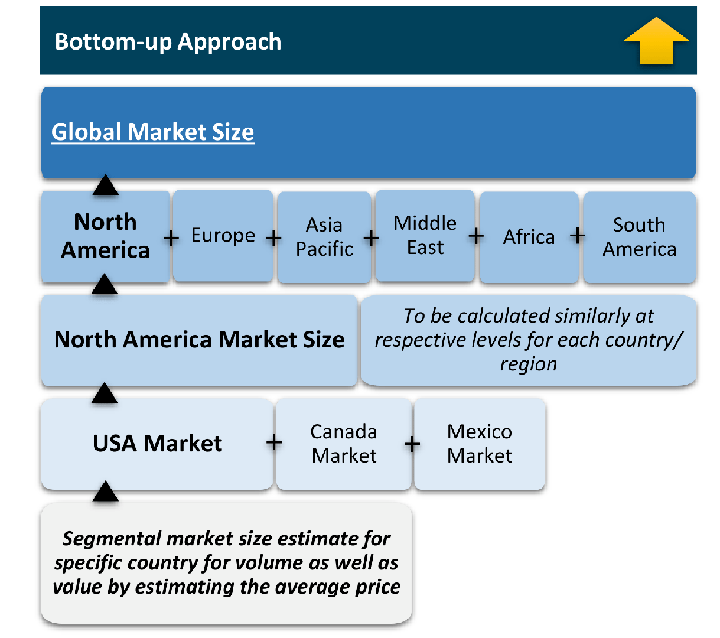
The bottom-up approach builds market estimates by starting with the smallest addressable market units and systematically aggregating them to create comprehensive market size projections.
This method begins with specific, granular data points and builds upward to create the complete market landscape.
Customer Analysis → Segmental Analysis → Geographical Analysis
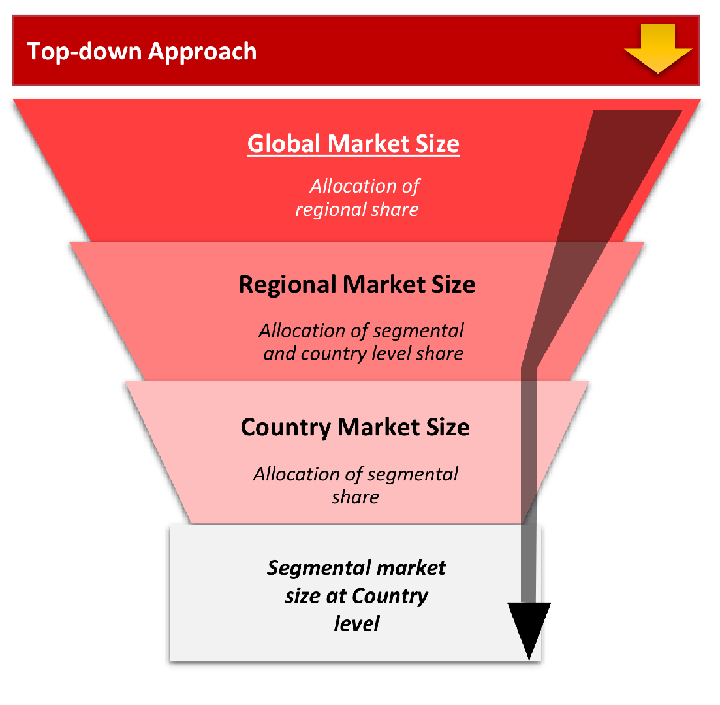
The top-down approach starts with the broadest possible market data and systematically narrows it down through a series of filters and assumptions to arrive at specific market segments or opportunities.
This method begins with the big picture and works downward to increasingly specific market slices.
TAM → SAM → SOM
Research Methods
Desk / Secondary Research
While analysing the market, we extensively study secondary sources, directories, and databases to identify and collect information useful for this technical, market-oriented, and commercial report. Secondary sources that we utilize are not only the public sources, but it is a combination of Open Source, Associations, Paid Databases, MG Repository & Knowledgebase, and others.
- Company websites, annual reports, financial reports, broker reports, and investor presentations
- National government documents, statistical databases and reports
- News articles, press releases and web-casts specific to the companies operating in the market, Magazines, reports, and others
- We gather information from commercial data sources for deriving company specific data such as segmental revenue, share for geography, product revenue, and others
- Internal and external proprietary databases (industry-specific), relevant patent, and regulatory databases
- Governing Bodies, Government Organizations
- Relevant Authorities, Country-specific Associations for Industries
We also employ the model mapping approach to estimate the product level market data through the players' product portfolio
Primary Research
Primary research/ interviews is vital in analyzing the market. Most of the cases involves paid primary interviews. Primary sources include primary interviews through e-mail interactions, telephonic interviews, surveys as well as face-to-face interviews with the different stakeholders across the value chain including several industry experts.
| Type of Respondents | Number of Primaries |
|---|---|
| Tier 2/3 Suppliers | ~20 |
| Tier 1 Suppliers | ~25 |
| End-users | ~25 |
| Industry Expert/ Panel/ Consultant | ~30 |
| Total | ~100 |
MG Knowledgebase
• Repository of industry blog, newsletter and case studies
• Online platform covering detailed market reports, and company profiles
Forecasting Factors and Models
Forecasting Factors
- Historical Trends – Past market patterns, cycles, and major events that shaped how markets behave over time. Understanding past trends helps predict future behavior.
- Industry Factors – Specific characteristics of the industry like structure, regulations, and innovation cycles that affect market dynamics.
- Macroeconomic Factors – Economic conditions like GDP growth, inflation, and employment rates that affect how much money people have to spend.
- Demographic Factors – Population characteristics like age, income, and location that determine who can buy your product.
- Technology Factors – How quickly people adopt new technology and how much technology infrastructure exists.
- Regulatory Factors – Government rules, laws, and policies that can help or restrict market growth.
- Competitive Factors – Analyzing competition structure such as degree of competition and bargaining power of buyers and suppliers.
Forecasting Models / Techniques
Multiple Regression Analysis
- Identify and quantify factors that drive market changes
- Statistical modeling to establish relationships between market drivers and outcomes
Time Series Analysis – Seasonal Patterns
- Understand regular cyclical patterns in market demand
- Advanced statistical techniques to separate trend, seasonal, and irregular components
Time Series Analysis – Trend Analysis
- Identify underlying market growth patterns and momentum
- Statistical analysis of historical data to project future trends
Expert Opinion – Expert Interviews
- Gather deep industry insights and contextual understanding
- In-depth interviews with key industry stakeholders
Multi-Scenario Development
- Prepare for uncertainty by modeling different possible futures
- Creating optimistic, pessimistic, and most likely scenarios
Time Series Analysis – Moving Averages
- Sophisticated forecasting for complex time series data
- Auto-regressive integrated moving average models with seasonal components
Econometric Models
- Apply economic theory to market forecasting
- Sophisticated economic models that account for market interactions
Expert Opinion – Delphi Method
- Harness collective wisdom of industry experts
- Structured, multi-round expert consultation process
Monte Carlo Simulation
- Quantify uncertainty and probability distributions
- Thousands of simulations with varying input parameters
Research Analysis
Our research framework is built upon the fundamental principle of validating market intelligence from both demand and supply perspectives. This dual-sided approach ensures comprehensive market understanding and reduces the risk of single-source bias.
Demand-Side Analysis: We understand end-user/application behavior, preferences, and market needs along with the penetration of the product for specific application.
Supply-Side Analysis: We estimate overall market revenue, analyze the segmental share along with industry capacity, competitive landscape, and market structure.
Validation & Evaluation
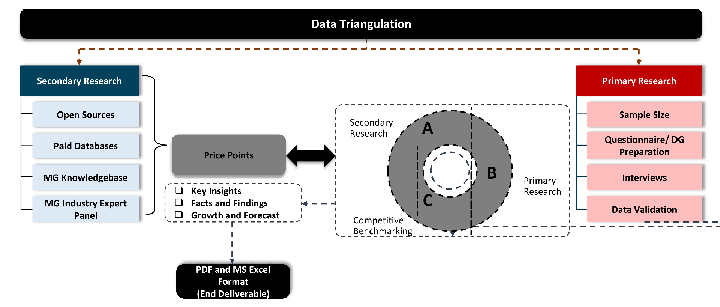
Data triangulation is a validation technique that uses multiple methods, sources, or perspectives to examine the same research question, thereby increasing the credibility and reliability of research findings. In market research, triangulation serves as a quality assurance mechanism that helps identify and minimize bias, validate assumptions, and ensure accuracy in market estimates.
- Data Source Triangulation – Using multiple data sources to examine the same phenomenon
- Methodological Triangulation – Using multiple research methods to study the same research question
- Investigator Triangulation – Using multiple researchers or analysts to examine the same data
- Theoretical Triangulation – Using multiple theoretical perspectives to interpret the same data
Custom Market Research Services
We will customise the research for you, in case the report listed above does not meet your requirements.
Get 10% Free Customisation