Raw Microgreens Market Size, Share & Trends Analysis Report by Product Type (Broccoli Microgreens, Cabbage Microgreens, Cauliflower Microgreens, Radish Microgreens, Mustard Microgreens, Kale Microgreens, Others), Farming Method, Nature, Distribution Channel, Packaging Type, End-User Type, Shelf Life, Sales Format, Seed Type, and Geography (North America, Europe, Asia Pacific, Middle East, Africa, and South America) – Global Industry Data, Trends, and Forecasts, 2026–2035
|
|
|
Segmental Data Insights |
|
|
Demand Trends |
|
|
Competitive Landscape |
|
|
Strategic Development |
|
|
Future Outlook & Opportunities |
|
Raw Microgreens Market Size, Share, and Growth
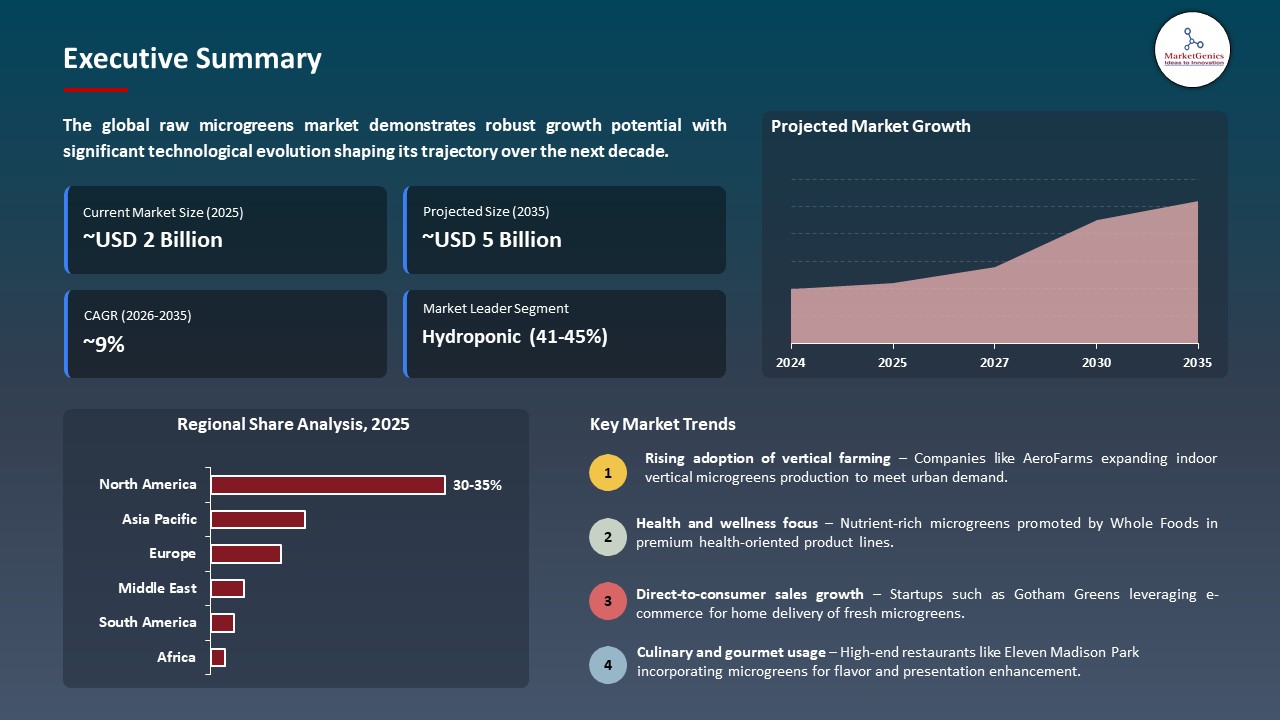
The global raw microgreens market is experiencing robust growth, with its estimated value of USD 2.2 billion in the year 2025 and USD 5.1 billion by the period 2035, registering a CAGR of 8.7%, during the forecast period. The global raw microgreens market demand is driven by growing consumer preference for nutrient-rich functional foods, rising health and wellness trends, expanding use in gourmet and meal-kit applications, and the steady year-round availability enabled by advanced indoor and vertical farming systems.
Dane Almassy, SVP of Sales & Marketing at AeroFarms said, "We are thrilled to collaborate with Costco to bring our innovative, flavorful, and highly nutritious microgreens to Costco members as a new staple for a healthy eating lifestyle, Costco has been a tremendous partner in building this high-growth microgreens segment within the leafy greens category. We are proud to offer Costco year-round supply of our microgreens from a farm that is weather-resilient and uses 90% less water and 230x less land than traditional field farming."
The global microgreens market growth due to increased health awareness around the world, and the growing farm-to-table movement in the food industry. These vegetable and herb seedlings are at an early growth stage and as such, their vitamins, antioxidant and phytonutrients are highly concentrated, even more so than their mature counterparts, and enhances their nutritional and marketing value. As an example, in March 2024, Ro-Gro and major research partners launched the first vitamin B12-biofortified pea-shoot microgreens made with an ultrasonic aeroponic system. The innovation enhances the growth of nutrient-rich microgreens and promotes indoor farming of high-value and sustainability.
Moreover, the global raw microgreens market can be supported by advanced vertical farming, Hydroponic and controlled-environments that allow the production of microgreens all year round, near-urban production, lower logistics, and consistent quality production, and reduce weather impacts on supply. As an example, in January 2025, AeroFarms unveiled a climate-independent, patented vertical farming system to scale production of microgreens to enable year-long production with much resource efficiency. The system increases scalability of production, efficiency on resource utilization and reliability of supply of microgreens.
Adjacent opportunities include functional foods enriched with microgreen extracts, premium salad kits integrating fresh microgreens, nutraceutical powders from dehydrated microgreens, indoor farming equipment tailored for microgreen cultivation, and AI-enabled controlled-environment systems. These categories can be leveraged by the fact that the nutrient-rich, clean-label production is under increased demand, which boosts the growth of the market, in general.
 Raw Microgreens Market Dynamics and Trends
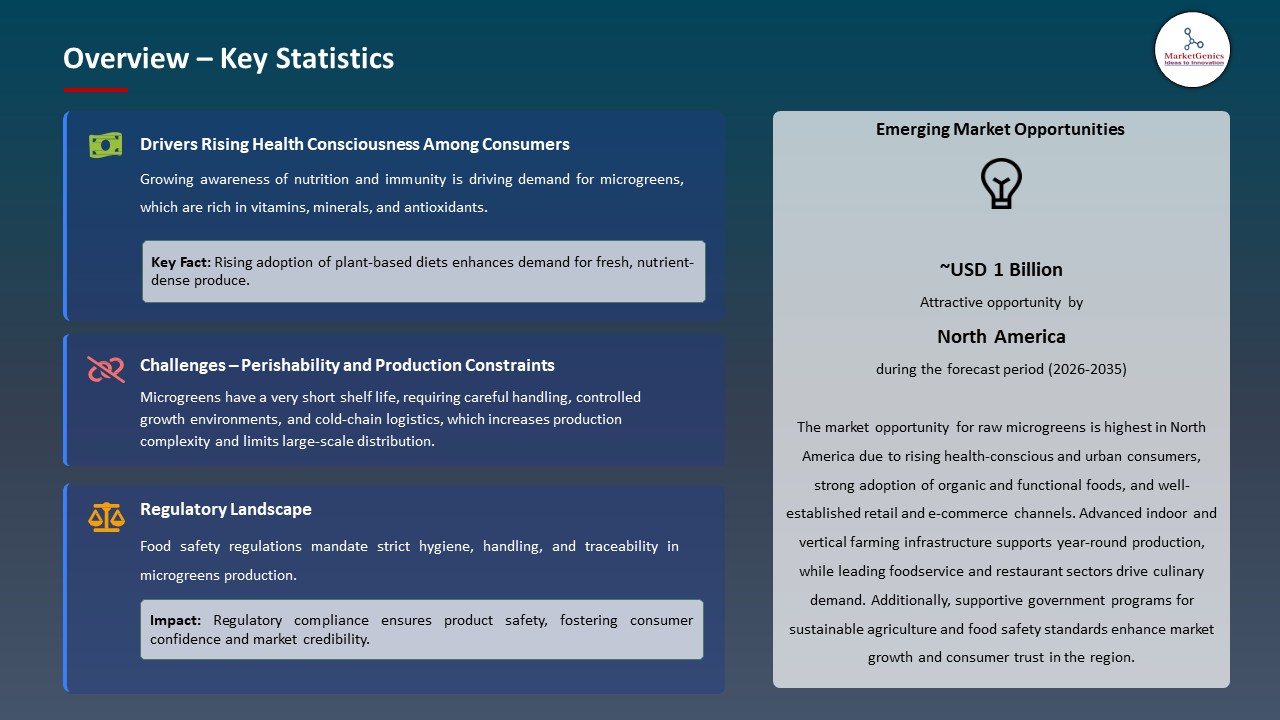
Driver: Urban Vertical Farming and Local Food Production
-
The global raw microgreens market is expanding rapidly, facilitated by vertical farming and controlled-environment agriculture that allows cost-effective and commercially scalable production around the urban demand centers. These models offer high levels of freshness, efficient supply chains, and consistent with the emerging consumer demands of food with origin as locally sourced and sustainably produced foodstuffs.
- For instance, in June 2024, iFarm opened the first vertical farm in Dubai, where the Multigreens technology was used to produce microgreens, baby leaves, and full-cycle greens in an ebb-and-flow production system. The project enhances scalable production of high-quality microgreens and leafy greens in urban areas that are resource-saving.
- Moreover, the water-saving aspect of vertical farming, the absence of pesticides, and lower transportation requirements present a solid sustainability value case that appeals to environmentally-aware consumers, allowing microgreens producers to distinguish other than nutritional value.
- The development of vertical farming, urban proximity advantages, sustainability advantages, and better economics have now established structural conditions that enable the growth of microgreens in the market that could not have been attained with conventional agriculture.
Restraint: High Production Costs and Limited Mainstream Consumer Awareness
-
The global raw microgreens market is constrained the high cost of production compared with traditional vegetables, which leads to high retail prices that limit the demand to the high-end segments of the health-conscious customer and higher end foodservice outlets. This economics will establish a growth ceiling in structure such that it will not be adopted mainstream even with high nutritional and sustainability benefits.
- Additionally, consumer demand in the external segments outside niche culinary and health-conscious remains a limitation. Most of the consumers are not familiar with microgreens or are confused about their use or discouraged because they do not understand their nutritional content or culinary adaptability with premium pricing.
- High costs of production, low level of consumer awareness, and high premium pricing makes microgreens only be adopted in affluent urban and foodservice segments, too large to be adopted on a mass-market scale.
Opportunity: Foodservice and Restaurant Menu Integration
-
The global raw microgreens market is driven by solid foodservice demand, with chefs appreciating its taste, looks, and nutritional content and can then charge a high price to make a profit to the producer. The exposure also develops consumer familiarity which aids in stimulating subsequent retail adoption.
- For instance, in March 2025, Stacked Farm announced a proposed large-scale vertical farm with an output capacity of 3.4 million kg of fresh greens including microgreens to improve supply capacity of large foodservice chains. The project increases scalable and reliable supply of microgreens to large foodservice clients.
- Additionally, health-focused restaurant models like salad bars, smoothie chains, and clean-eating ideas heavily feature microgreens into their concepts to provide real-world usage experiences that educate the consumer on both nutritional and culinary value and reduce the barriers to use at home.
- The foodservice channel creates scalable demand, maintains a premium price and uses the influence of the chef to create consumer familiarity which creates a feedback loop that rapidly enters microgreens into larger retail markets.
Key Trend: Functional Nutrition Positioning and Wellness Integration
-
The global raw microgreens market is moving away on a garnish-related usage toward a functional nutritional profile of immune-enhancing, antioxidant density, and anti-inflammatory utilization with premium positioning opportunities and attracting healthier-dining customers outside the traditional food industries.
- For instance, in January 2025, Full Nature Farms in Hong Kong launched the Rocket 2.0 AI-driven irrigation system, which improves the microgreens and other nutrient-rich crops production by means of water and nutrient optimization. The start-up reinforces the productivity of production, and maintains high quality and uniform output of the microgreens of high quality.
- Moreover, the inclusion of microgreens in the corporate wellness programs along with nutrition counseling and channels of functional medicine expands the reach of health-oriented consumers, who are in search of specific nutritional solutions beyond the traditional retail setting.
- The trend of functional nutrition is increasing microgreens demand among health-conscious customers and placing the product category at the edge of the wellness economy, allowing to charge higher prices, create additional differentiation, and acquire brand loyalty.
 Raw-Microgreens-Market Analysis and Segmental Data
Hydroponic Dominate Global Raw Microgreens Market
-
The hydroponic segment dominates the global raw microgreens market supports offers a high level of resource efficiency, high-level nutrient control, and uniform production, saving money and effort. Its efficiency leads it to be a highly viable model in large scale and high-quality production of microgreens on large scale in urban and controlled-environment facilities.
- For instance, Eden Green Technology that produces hydroponic vertical growing systems that are designed specifically to produce high-density greens and microgreens and allow production all year round with strict environmental regulation.
- The high-quality microgreens that are provided by producers aiming at efficient supply are the reason why hydroponics is the best choice in this regard as it is highly economical and technically scalable.
North America Leads Global Raw Microgreens Market Demand
-
North America leads the global raw microgreens market, because of the regions more affluent, health-conscious market, an established farm-to-table food environment, and well-developed vertical farming system that guarantees a steady supply. The high demand of organic and locally grown foods continues to support the fact that microgreens are in line with the regional sustainability and high-quality produce tastes.
- For instance, in November 2025, GoodLeaf Farms raised CAD 52 million to increase the vertical farming capacity in Alberta and Quebec and create an R&D Centre of Excellence in Ontario, which would increase its capacity to supply high-quality microgreens on a large-scale basis throughout the year.
- Furthermore, the huge investment in vertical-farming helps consolidate the North American leadership, and innovators like AeroFarms, Bowery Farming, Plenty, and Gotham Greens are the leaders in terms of setting technological and functional standards. This initial leadership created good consumer awareness, distribution channels, and production strengths that create competitiveness that is long term.
- The area experiences a high foodservice penetration, with the top chefs and restaurants with a microgreen on high profile menus. This publicity increases customer awareness, creates aspiration demand, and expands knowledge on the culinary and nutrimental benefits of microgreens.
- North America’s highly developed consumer market, well-established specialty retail business environment, robust farm-to-table culture, leadership in vertical farming, and powerful foodservice industry make the region the biggest market and the greatest source of world microgreens innovation and consumer adoption.
Raw-Microgreens-Market Ecosystem
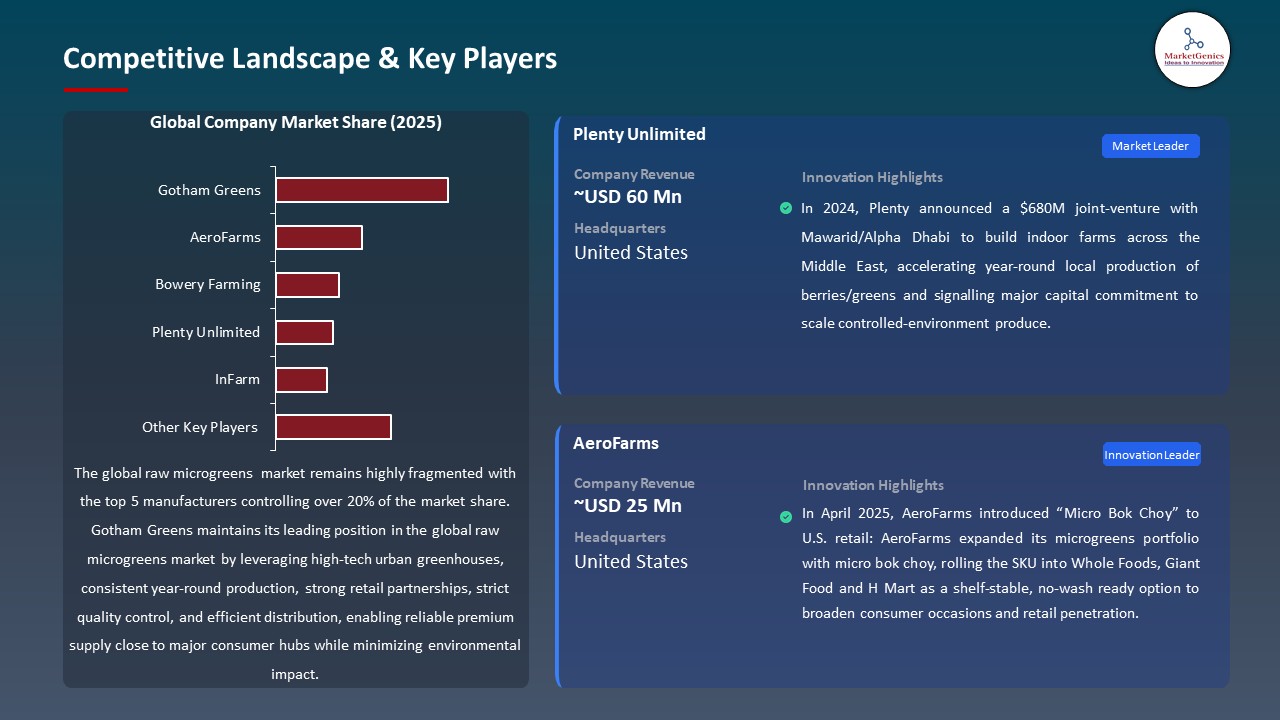
The global raw microgreens market is moderately fragmented, with high concentration among key players such as Gotham Greens, AeroFarms, Bowery Farming, Plenty Unlimited, and InFarm, who dominate through high concentration in controlled-environment technologies, good distribution relationship, stable product quality, and year-round production capacity. For example, in 2024 AeroFarms strengthened its leadership through a flawless SQF food-safety audit, which confirmed its developed CEA operations and quality assurance.
This development enhances the market leadership of major microgreens producers with the use of CEA and enhances competitive differentiation.
 Recent Development and Strategic Overview:
-
In February 2025, GoodLeaf declared a national expansion strategy, expanding its three Canadian vertical farms (Guelph, Calgary, Montreal) and using its platform based on controlled-environment ag to grow its capacity of microgreens and baby greens significantly with institutional support.
- In January 2025, AeroFarms declared that it has patented a technology that allows large-scale cultivation of extremely nutritious microgreens in its Danville vertical farm, which makes its business climate-agnostic and use of resources more efficient.
Report Scope
|
Detail |
|
|
Market Size in 2025 |
USD 2.2 Bn |
|
Market Forecast Value in 2035 |
USD 5.1 Bn |
|
Growth Rate (CAGR) |
8.7% |
|
Forecast Period |
2026 – 2035 |
|
Historical Data Available for |
2021 – 2024 |
|
Market Size Units |
US$ Billion for Value Tons for Volume |
|
Report Format |
Electronic (PDF) + Excel |
|
North America |
Europe |
Asia Pacific |
Middle East |
Africa |
South America |
|
|
|
|
|
|
|
Companies Covered |
|||||
|
|
|
|
|
|
Raw-Microgreens-Market Segmentation and Highlights
|
Segment |
Sub-segment |
|
Raw Microgreens Market, By Product Type |
|
|
Raw Microgreens Market, By Farming Method |
|
|
Raw Microgreens Market, By Nature |
|
|
Raw Microgreens Market, By Distribution Channel |
|
|
Raw Microgreens Market, By Packaging Type
|
|
|
Raw Microgreens Market, By End-User Type
|
|
|
Raw Microgreens Market, By Shelf Life |
|
|
Raw Microgreens Market, By Sales Format |
|
|
Raw Microgreens Market, By Seed Type |
|
Frequently Asked Questions
Table of Contents
- 1. Research Methodology and Assumptions
- 1.1. Definitions
- 1.2. Research Design and Approach
- 1.3. Data Collection Methods
- 1.4. Base Estimates and Calculations
- 1.5. Forecasting Models
- 1.5.1. Key Forecast Factors & Impact Analysis
- 1.6. Secondary Research
- 1.6.1. Open Sources
- 1.6.2. Paid Databases
- 1.6.3. Associations
- 1.7. Primary Research
- 1.7.1. Primary Sources
- 1.7.2. Primary Interviews with Stakeholders across Ecosystem
- 2. Executive Summary
- 2.1. Global Raw Microgreens Market Outlook
- 2.1.1. Raw Microgreens Market Size (Volume - Tons and Value - US$ Bn), and Forecasts, 2021-2035
- 2.1.2. Compounded Annual Growth Rate Analysis
- 2.1.3. Growth Opportunity Analysis
- 2.1.4. Segmental Share Analysis
- 2.1.5. Geographical Share Analysis
- 2.2. Market Analysis and Facts
- 2.3. Supply-Demand Analysis
- 2.4. Competitive Benchmarking
- 2.5. Go-to- Market Strategy
- 2.5.1. Customer/ End-use Industry Assessment
- 2.5.2. Growth Opportunity Data, 2026-2035
- 2.5.2.1. Regional Data
- 2.5.2.2. Country Data
- 2.5.2.3. Segmental Data
- 2.5.3. Identification of Potential Market Spaces
- 2.5.4. GAP Analysis
- 2.5.5. Potential Attractive Price Points
- 2.5.6. Prevailing Market Risks & Challenges
- 2.5.7. Preferred Sales & Marketing Strategies
- 2.5.8. Key Recommendations and Analysis
- 2.5.9. A Way Forward
- 2.1. Global Raw Microgreens Market Outlook
- 3. Industry Data and Premium Insights
- 3.1. Global Agriculture Industry Overview, 2025
- 3.1.1. Agriculture Industry Ecosystem Analysis
- 3.1.2. Key Trends for Agriculture Industry
- 3.1.3. Regional Distribution for Agriculture Industry
- 3.2. Supplier Customer Data
- 3.3. Technology Roadmap and Developments
- 3.4. Trade Analysis
- 3.4.1. Import & Export Analysis, 2025
- 3.4.2. Top Importing Countries
- 3.4.3. Top Exporting Countries
- 3.5. Trump Tariff Impact Analysis
- 3.5.1. Manufacturer
- 3.5.1.1. Based on the component & Raw material
- 3.5.2. Supply Chain
- 3.5.3. End Consumer
- 3.5.1. Manufacturer
- 3.6. Raw Material Analysis
- 3.1. Global Agriculture Industry Overview, 2025
- 4. Market Overview
- 4.1. Market Dynamics
- 4.1.1. Drivers
- 4.1.1.1. Rising demand for nutrient-dense, health-oriented foods
- 4.1.1.2. Growth of indoor and vertical farming enabling efficient, year-round production
- 4.1.1.3. Increasing culinary adoption in upscale restaurants for flavor and presentation
- 4.1.2. Restraints
- 4.1.2.1. Very short shelf life and high perishability
- 4.1.2.2. Limited skilled workforce and constrained crop variety for controlled-environment farming
- 4.1.1. Drivers
- 4.2. Key Trend Analysis
- 4.3. Regulatory Framework
- 4.3.1. Key Regulations, Norms, and Subsidies, by Key Countries
- 4.3.2. Tariffs and Standards
- 4.3.3. Impact Analysis of Regulations on the Market
- 4.4. Value Chain Analysis
- 4.4.1. Raw Material Suppliers
- 4.4.2. Raw Microgreens Manufacturers
- 4.4.3. Dealers/ Distributors
- 4.4.4. End-Users/ Customers
- 4.5. Cost Structure Analysis
- 4.5.1. Parameter’s Share for Cost Associated
- 4.5.2. COGP vs COGS
- 4.5.3. Profit Margin Analysis
- 4.6. Pricing Analysis
- 4.6.1. Regional Pricing Analysis
- 4.6.2. Segmental Pricing Trends
- 4.6.3. Factors Influencing Pricing
- 4.7. Porter’s Five Forces Analysis
- 4.8. PESTEL Analysis
- 4.9. Global Raw Microgreens Market Demand
- 4.9.1. Historical Market Size – Volume (Tons) and Value (US$ Bn), 2020-2024
- 4.9.2. Current and Future Market Size – Volume (Tons) and Value (US$ Bn), 2026–2035
- 4.9.2.1. Y-o-Y Growth Trends
- 4.9.2.2. Absolute $ Opportunity Assessment
- 4.1. Market Dynamics
- 5. Competition Landscape
- 5.1. Competition structure
- 5.1.1. Fragmented v/s consolidated
- 5.2. Company Share Analysis, 2025
- 5.2.1. Global Company Market Share
- 5.2.2. By Region
- 5.2.2.1. North America
- 5.2.2.2. Europe
- 5.2.2.3. Asia Pacific
- 5.2.2.4. Middle East
- 5.2.2.5. Africa
- 5.2.2.6. South America
- 5.3. Product Comparison Matrix
- 5.3.1. Specifications
- 5.3.2. Market Positioning
- 5.3.3. Pricing
- 5.1. Competition structure
- 6. Global Raw Microgreens Market Analysis, by Product Type
- 6.1. Key Segment Analysis
- 6.2. Raw Microgreens Market Size (Volume - Tons and Value - US$ Bn), Analysis, and Forecasts, by Product Type, 2021-2035
- 6.2.1. Broccoli Microgreens
- 6.2.2. Cabbage Microgreens
- 6.2.3. Cauliflower Microgreens
- 6.2.4. Radish Microgreens
- 6.2.5. Mustard Microgreens
- 6.2.6. Kale Microgreens
- 6.2.7. Others (Beetroot, Amaranth, Wheatgrass, etc.)
- 7. Global Raw Microgreens Market Analysis, by Farming Method
- 7.1. Key Segment Analysis
- 7.2. Raw Microgreens Market Size (Volume - Tons and Value - US$ Bn), Analysis, and Forecasts, by Farming Method, 2021-2035
- 7.2.1. Hydroponic
- 7.2.2. Soil-Based
- 7.2.3. Aquaponic
- 7.2.4. Aeroponic
- 7.2.5. Vertical Farming
- 8. Global Raw Microgreens Market Analysis, by Nature
- 8.1. Key Segment Analysis
- 8.2. Raw Microgreens Market Size (Volume - Tons and Value - US$ Bn), Analysis, and Forecasts, by Nature, 2021-2035
- 8.2.1. Organic
- 8.2.2. Conventional
- 9. Global Raw Microgreens Market Analysis, by Distribution Channel
- 9.1. Key Segment Analysis
- 9.2. Raw Microgreens Market Size (Volume - Tons and Value - US$ Bn), Analysis, and Forecasts, by Distribution Channel, 2021-2035
- 9.2.1. Direct Sales
- 9.2.1.1. Farm-to-Consumer
- 9.2.1.2. Farmers Markets
- 9.2.2. Indirect Sales
- 9.2.2.1. Supermarkets/Hypermarkets
- 9.2.2.2. Specialty Stores
- 9.2.2.3. Online Retail
- 9.2.2.4. Food Service Distributors
- 9.2.2.5. Wholesale Distributors
- 9.2.2.6. Others
- 9.2.1. Direct Sales
- 10. Global Raw Microgreens Market Analysis, by Packaging Type
- 10.1. Key Segment Analysis
- 10.2. Raw Microgreens Market Size (Volume - Tons and Value - US$ Bn), Analysis, and Forecasts, by Packaging Type, 2021-2035
- 10.2.1. Clamshell Containers
- 10.2.2. Plastic Bags
- 10.2.3. Trays
- 10.2.4. Bulk Packaging
- 10.2.5. Modified Atmosphere Packaging (MAP)
- 11. Global Raw Microgreens Market Analysis, by End-User Type
- 11.1. Key Segment Analysis
- 11.2. Raw Microgreens Market Size (Volume - Tons and Value - US$ Bn), Analysis, and Forecasts, by End-User Type, 2021-2035
- 11.2.1. Individual Consumers/Households
- 11.2.2. Commercial Users
- 11.2.2.1. Restaurants
- 11.2.2.2. Hotels
- 11.2.2.3. Catering Services
- 11.2.2.4. Others
- 11.2.3. Institutional Users
- 11.2.3.1. Healthcare Facilities
- 11.2.3.2. Schools/Universities
- 11.2.3.3. Others
- 11.2.4. Food Processing Companies
- 11.2.5. Other End-users
- 12. Global Raw Microgreens Market Analysis, by Shelf Life
- 12.1. Key Segment Analysis
- 12.2. Raw Microgreens Market Size (Volume - Tons and Value - US$ Bn), Analysis, and Forecasts, by Shelf Life, 2021-2035
- 12.2.1. Short Shelf Life (1-3 days)
- 12.2.2. Medium Shelf Life (4-7 days)
- 12.2.3. Extended Shelf Life (8-14 days)
- 13. Global Raw Microgreens Market Analysis, by Sales Format
- 13.1. Key Segment Analysis
- 13.2. Raw Microgreens Market Size (Volume - Tons and Value - US$ Bn), Analysis, and Forecasts, by Sales Format, 2021-2035
- 13.2.1. Fresh Cut
- 13.2.2. Living/Growing Microgreens
- 13.2.3. Pre-washed
- 13.2.4. Ready-to-Eat
- 13.2.5. Others
- 14. Global Raw Microgreens Market Analysis, by Seed Type
- 14.1. Key Segment Analysis
- 14.2. Raw Microgreens Market Size (Volume - Tons and Value - US$ Bn), Analysis, and Forecasts, by Seed Type, 2021-2035
- 14.2.1. Cruciferous Seeds
- 14.2.2. Leafy Greens Seeds
- 14.2.3. Herbs Seeds
- 14.2.4. Grain/Legume Seeds
- 14.2.5. Root Vegetable Seeds
- 14.2.6. Others
- 15. Global Raw Microgreens Market Analysis and Forecasts, by Region
- 15.1. Key Findings
- 15.2. Raw Microgreens Market Size (Volume - Tons and Value - US$ Bn), Analysis, and Forecasts, by Region, 2021-2035
- 15.2.1. North America
- 15.2.2. Europe
- 15.2.3. Asia Pacific
- 15.2.4. Middle East
- 15.2.5. Africa
- 15.2.6. South America
- 16. North America Raw Microgreens Market Analysis
- 16.1. Key Segment Analysis
- 16.2. Regional Snapshot
- 16.3. North America Raw Microgreens Market Size (Volume - Tons and Value - US$ Bn), Analysis, and Forecasts, 2021-2035
- 16.3.1. Product Type
- 16.3.2. Farming Method
- 16.3.3. Nature
- 16.3.4. Distribution Channel
- 16.3.5. Packaging Type
- 16.3.6. End-User Type
- 16.3.7. Shelf Life
- 16.3.8. Sales Format
- 16.3.9. Seed Type
- 16.3.10. Country
- 16.3.10.1. USA
- 16.3.10.2. Canada
- 16.3.10.3. Mexico
- 16.4. USA Raw Microgreens Market
- 16.4.1. Country Segmental Analysis
- 16.4.2. Product Type
- 16.4.3. Farming Method
- 16.4.4. Nature
- 16.4.5. Distribution Channel
- 16.4.6. Packaging Type
- 16.4.7. End-User Type
- 16.4.8. Shelf Life
- 16.4.9. Sales Format
- 16.4.10. Seed Type
- 16.5. Canada Raw Microgreens Market
- 16.5.1. Country Segmental Analysis
- 16.5.2. Product Type
- 16.5.3. Farming Method
- 16.5.4. Nature
- 16.5.5. Distribution Channel
- 16.5.6. Packaging Type
- 16.5.7. End-User Type
- 16.5.8. Shelf Life
- 16.5.9. Sales Format
- 16.5.10. Seed Type
- 16.6. Mexico Raw Microgreens Market
- 16.6.1. Country Segmental Analysis
- 16.6.2. Product Type
- 16.6.3. Farming Method
- 16.6.4. Nature
- 16.6.5. Distribution Channel
- 16.6.6. Packaging Type
- 16.6.7. End-User Type
- 16.6.8. Shelf Life
- 16.6.9. Sales Format
- 16.6.10. Seed Type
- 17. Europe Raw Microgreens Market Analysis
- 17.1. Key Segment Analysis
- 17.2. Regional Snapshot
- 17.3. Europe Raw Microgreens Market Size (Volume - Tons and Value - US$ Bn), Analysis, and Forecasts, 2021-2035
- 17.3.1. Product Type
- 17.3.2. Farming Method
- 17.3.3. Nature
- 17.3.4. Distribution Channel
- 17.3.5. Packaging Type
- 17.3.6. End-User Type
- 17.3.7. Shelf Life
- 17.3.8. Sales Format
- 17.3.9. Seed Type
- 17.3.10. Country
- 17.3.10.1. Germany
- 17.3.10.2. United Kingdom
- 17.3.10.3. France
- 17.3.10.4. Italy
- 17.3.10.5. Spain
- 17.3.10.6. Netherlands
- 17.3.10.7. Nordic Countries
- 17.3.10.8. Poland
- 17.3.10.9. Russia & CIS
- 17.3.10.10. Rest of Europe
- 17.4. Germany Raw Microgreens Market
- 17.4.1. Country Segmental Analysis
- 17.4.2. Product Type
- 17.4.3. Farming Method
- 17.4.4. Nature
- 17.4.5. Distribution Channel
- 17.4.6. Packaging Type
- 17.4.7. End-User Type
- 17.4.8. Shelf Life
- 17.4.9. Sales Format
- 17.4.10. Seed Type
- 17.5. United Kingdom Raw Microgreens Market
- 17.5.1. Country Segmental Analysis
- 17.5.2. Product Type
- 17.5.3. Farming Method
- 17.5.4. Nature
- 17.5.5. Distribution Channel
- 17.5.6. Packaging Type
- 17.5.7. End-User Type
- 17.5.8. Shelf Life
- 17.5.9. Sales Format
- 17.5.10. Seed Type
- 17.6. France Raw Microgreens Market
- 17.6.1. Country Segmental Analysis
- 17.6.2. Product Type
- 17.6.3. Farming Method
- 17.6.4. Nature
- 17.6.5. Distribution Channel
- 17.6.6. Packaging Type
- 17.6.7. End-User Type
- 17.6.8. Shelf Life
- 17.6.9. Sales Format
- 17.6.10. Seed Type
- 17.7. Italy Raw Microgreens Market
- 17.7.1. Country Segmental Analysis
- 17.7.2. Product Type
- 17.7.3. Farming Method
- 17.7.4. Nature
- 17.7.5. Distribution Channel
- 17.7.6. Packaging Type
- 17.7.7. End-User Type
- 17.7.8. Shelf Life
- 17.7.9. Sales Format
- 17.7.10. Seed Type
- 17.8. Spain Raw Microgreens Market
- 17.8.1. Country Segmental Analysis
- 17.8.2. Product Type
- 17.8.3. Farming Method
- 17.8.4. Nature
- 17.8.5. Distribution Channel
- 17.8.6. Packaging Type
- 17.8.7. End-User Type
- 17.8.8. Shelf Life
- 17.8.9. Sales Format
- 17.8.10. Seed Type
- 17.9. Netherlands Raw Microgreens Market
- 17.9.1. Country Segmental Analysis
- 17.9.2. Product Type
- 17.9.3. Farming Method
- 17.9.4. Nature
- 17.9.5. Distribution Channel
- 17.9.6. Packaging Type
- 17.9.7. End-User Type
- 17.9.8. Shelf Life
- 17.9.9. Sales Format
- 17.9.10. Seed Type
- 17.10. Nordic Countries Raw Microgreens Market
- 17.10.1. Country Segmental Analysis
- 17.10.2. Product Type
- 17.10.3. Farming Method
- 17.10.4. Nature
- 17.10.5. Distribution Channel
- 17.10.6. Packaging Type
- 17.10.7. End-User Type
- 17.10.8. Shelf Life
- 17.10.9. Sales Format
- 17.10.10. Seed Type
- 17.11. Poland Raw Microgreens Market
- 17.11.1. Country Segmental Analysis
- 17.11.2. Product Type
- 17.11.3. Farming Method
- 17.11.4. Nature
- 17.11.5. Distribution Channel
- 17.11.6. Packaging Type
- 17.11.7. End-User Type
- 17.11.8. Shelf Life
- 17.11.9. Sales Format
- 17.11.10. Seed Type
- 17.12. Russia & CIS Raw Microgreens Market
- 17.12.1. Country Segmental Analysis
- 17.12.2. Product Type
- 17.12.3. Farming Method
- 17.12.4. Nature
- 17.12.5. Distribution Channel
- 17.12.6. Packaging Type
- 17.12.7. End-User Type
- 17.12.8. Shelf Life
- 17.12.9. Sales Format
- 17.12.10. Seed Type
- 17.13. Rest of Europe Raw Microgreens Market
- 17.13.1. Country Segmental Analysis
- 17.13.2. Product Type
- 17.13.3. Farming Method
- 17.13.4. Nature
- 17.13.5. Distribution Channel
- 17.13.6. Packaging Type
- 17.13.7. End-User Type
- 17.13.8. Shelf Life
- 17.13.9. Sales Format
- 17.13.10. Seed Type
- 18. Asia Pacific Raw Microgreens Market Analysis
- 18.1. Key Segment Analysis
- 18.2. Regional Snapshot
- 18.3. Asia Pacific Raw Microgreens Market Size (Volume - Tons and Value - US$ Bn), Analysis, and Forecasts, 2021-2035
- 18.3.1. Product Type
- 18.3.2. Farming Method
- 18.3.3. Nature
- 18.3.4. Distribution Channel
- 18.3.5. Packaging Type
- 18.3.6. End-User Type
- 18.3.7. Shelf Life
- 18.3.8. Sales Format
- 18.3.9. Seed Type
- 18.3.10. Country
- 18.3.10.1. China
- 18.3.10.2. India
- 18.3.10.3. Japan
- 18.3.10.4. South Korea
- 18.3.10.5. Australia and New Zealand
- 18.3.10.6. Indonesia
- 18.3.10.7. Malaysia
- 18.3.10.8. Thailand
- 18.3.10.9. Vietnam
- 18.3.10.10. Rest of Asia Pacific
- 18.4. China Raw Microgreens Market
- 18.4.1. Country Segmental Analysis
- 18.4.2. Product Type
- 18.4.3. Farming Method
- 18.4.4. Nature
- 18.4.5. Distribution Channel
- 18.4.6. Packaging Type
- 18.4.7. End-User Type
- 18.4.8. Shelf Life
- 18.4.9. Sales Format
- 18.4.10. Seed Type
- 18.5. India Raw Microgreens Market
- 18.5.1. Country Segmental Analysis
- 18.5.2. Product Type
- 18.5.3. Farming Method
- 18.5.4. Nature
- 18.5.5. Distribution Channel
- 18.5.6. Packaging Type
- 18.5.7. End-User Type
- 18.5.8. Shelf Life
- 18.5.9. Sales Format
- 18.5.10. Seed Type
- 18.6. Japan Raw Microgreens Market
- 18.6.1. Country Segmental Analysis
- 18.6.2. Product Type
- 18.6.3. Farming Method
- 18.6.4. Nature
- 18.6.5. Distribution Channel
- 18.6.6. Packaging Type
- 18.6.7. End-User Type
- 18.6.8. Shelf Life
- 18.6.9. Sales Format
- 18.6.10. Seed Type
- 18.7. South Korea Raw Microgreens Market
- 18.7.1. Country Segmental Analysis
- 18.7.2. Product Type
- 18.7.3. Farming Method
- 18.7.4. Nature
- 18.7.5. Distribution Channel
- 18.7.6. Packaging Type
- 18.7.7. End-User Type
- 18.7.8. Shelf Life
- 18.7.9. Sales Format
- 18.7.10. Seed Type
- 18.8. Australia and New Zealand Raw Microgreens Market
- 18.8.1. Country Segmental Analysis
- 18.8.2. Product Type
- 18.8.3. Farming Method
- 18.8.4. Nature
- 18.8.5. Distribution Channel
- 18.8.6. Packaging Type
- 18.8.7. End-User Type
- 18.8.8. Shelf Life
- 18.8.9. Sales Format
- 18.8.10. Seed Type
- 18.9. Indonesia Raw Microgreens Market
- 18.9.1. Country Segmental Analysis
- 18.9.2. Product Type
- 18.9.3. Farming Method
- 18.9.4. Nature
- 18.9.5. Distribution Channel
- 18.9.6. Packaging Type
- 18.9.7. End-User Type
- 18.9.8. Shelf Life
- 18.9.9. Sales Format
- 18.9.10. Seed Type
- 18.10. Malaysia Raw Microgreens Market
- 18.10.1. Country Segmental Analysis
- 18.10.2. Product Type
- 18.10.3. Farming Method
- 18.10.4. Nature
- 18.10.5. Distribution Channel
- 18.10.6. Packaging Type
- 18.10.7. End-User Type
- 18.10.8. Shelf Life
- 18.10.9. Sales Format
- 18.10.10. Seed Type
- 18.11. Thailand Raw Microgreens Market
- 18.11.1. Country Segmental Analysis
- 18.11.2. Product Type
- 18.11.3. Farming Method
- 18.11.4. Nature
- 18.11.5. Distribution Channel
- 18.11.6. Packaging Type
- 18.11.7. End-User Type
- 18.11.8. Shelf Life
- 18.11.9. Sales Format
- 18.11.10. Seed Type
- 18.12. Vietnam Raw Microgreens Market
- 18.12.1. Country Segmental Analysis
- 18.12.2. Product Type
- 18.12.3. Farming Method
- 18.12.4. Nature
- 18.12.5. Distribution Channel
- 18.12.6. Packaging Type
- 18.12.7. End-User Type
- 18.12.8. Shelf Life
- 18.12.9. Sales Format
- 18.12.10. Seed Type
- 18.13. Rest of Asia Pacific Raw Microgreens Market
- 18.13.1. Country Segmental Analysis
- 18.13.2. Product Type
- 18.13.3. Farming Method
- 18.13.4. Nature
- 18.13.5. Distribution Channel
- 18.13.6. Packaging Type
- 18.13.7. End-User Type
- 18.13.8. Shelf Life
- 18.13.9. Sales Format
- 18.13.10. Seed Type
- 19. Middle East Raw Microgreens Market Analysis
- 19.1. Key Segment Analysis
- 19.2. Regional Snapshot
- 19.3. Middle East Raw Microgreens Market Size (Volume - Tons and Value - US$ Bn), Analysis, and Forecasts, 2021-2035
- 19.3.1. Product Type
- 19.3.2. Farming Method
- 19.3.3. Nature
- 19.3.4. Distribution Channel
- 19.3.5. Packaging Type
- 19.3.6. End-User Type
- 19.3.7. Shelf Life
- 19.3.8. Sales Format
- 19.3.9. Seed Type
- 19.3.10. Country
- 19.3.10.1. Turkey
- 19.3.10.2. UAE
- 19.3.10.3. Saudi Arabia
- 19.3.10.4. Israel
- 19.3.10.5. Rest of Middle East
- 19.4. Turkey Raw Microgreens Market
- 19.4.1. Country Segmental Analysis
- 19.4.2. Product Type
- 19.4.3. Farming Method
- 19.4.4. Nature
- 19.4.5. Distribution Channel
- 19.4.6. Packaging Type
- 19.4.7. End-User Type
- 19.4.8. Shelf Life
- 19.4.9. Sales Format
- 19.4.10. Seed Type
- 19.5. UAE Raw Microgreens Market
- 19.5.1. Country Segmental Analysis
- 19.5.2. Product Type
- 19.5.3. Farming Method
- 19.5.4. Nature
- 19.5.5. Distribution Channel
- 19.5.6. Packaging Type
- 19.5.7. End-User Type
- 19.5.8. Shelf Life
- 19.5.9. Sales Format
- 19.5.10. Seed Type
- 19.6. Saudi Arabia Raw Microgreens Market
- 19.6.1. Country Segmental Analysis
- 19.6.2. Product Type
- 19.6.3. Farming Method
- 19.6.4. Nature
- 19.6.5. Distribution Channel
- 19.6.6. Packaging Type
- 19.6.7. End-User Type
- 19.6.8. Shelf Life
- 19.6.9. Sales Format
- 19.6.10. Seed Type
- 19.7. Israel Raw Microgreens Market
- 19.7.1. Country Segmental Analysis
- 19.7.2. Product Type
- 19.7.3. Farming Method
- 19.7.4. Nature
- 19.7.5. Distribution Channel
- 19.7.6. Packaging Type
- 19.7.7. End-User Type
- 19.7.8. Shelf Life
- 19.7.9. Sales Format
- 19.7.10. Seed Type
- 19.8. Rest of Middle East Raw Microgreens Market
- 19.8.1. Country Segmental Analysis
- 19.8.2. Product Type
- 19.8.3. Farming Method
- 19.8.4. Nature
- 19.8.5. Distribution Channel
- 19.8.6. Packaging Type
- 19.8.7. End-User Type
- 19.8.8. Shelf Life
- 19.8.9. Sales Format
- 19.8.10. Seed Type
- 20. Africa Raw Microgreens Market Analysis
- 20.1. Key Segment Analysis
- 20.2. Regional Snapshot
- 20.3. Africa Raw Microgreens Market Size (Volume - Tons and Value - US$ Bn), Analysis, and Forecasts, 2021-2035
- 20.3.1. Product Type
- 20.3.2. Farming Method
- 20.3.3. Nature
- 20.3.4. Distribution Channel
- 20.3.5. Packaging Type
- 20.3.6. End-User Type
- 20.3.7. Shelf Life
- 20.3.8. Sales Format
- 20.3.9. Seed Type
- 20.3.10. Country
- 20.3.10.1. South Africa
- 20.3.10.2. Egypt
- 20.3.10.3. Nigeria
- 20.3.10.4. Algeria
- 20.3.10.5. Rest of Africa
- 20.4. South Africa Raw Microgreens Market
- 20.4.1. Country Segmental Analysis
- 20.4.2. Product Type
- 20.4.3. Farming Method
- 20.4.4. Nature
- 20.4.5. Distribution Channel
- 20.4.6. Packaging Type
- 20.4.7. End-User Type
- 20.4.8. Shelf Life
- 20.4.9. Sales Format
- 20.4.10. Seed Type
- 20.5. Egypt Raw Microgreens Market
- 20.5.1. Country Segmental Analysis
- 20.5.2. Product Type
- 20.5.3. Farming Method
- 20.5.4. Nature
- 20.5.5. Distribution Channel
- 20.5.6. Packaging Type
- 20.5.7. End-User Type
- 20.5.8. Shelf Life
- 20.5.9. Sales Format
- 20.5.10. Seed Type
- 20.6. Nigeria Raw Microgreens Market
- 20.6.1. Country Segmental Analysis
- 20.6.2. Product Type
- 20.6.3. Farming Method
- 20.6.4. Nature
- 20.6.5. Distribution Channel
- 20.6.6. Packaging Type
- 20.6.7. End-User Type
- 20.6.8. Shelf Life
- 20.6.9. Sales Format
- 20.6.10. Seed Type
- 20.7. Algeria Raw Microgreens Market
- 20.7.1. Country Segmental Analysis
- 20.7.2. Product Type
- 20.7.3. Farming Method
- 20.7.4. Nature
- 20.7.5. Distribution Channel
- 20.7.6. Packaging Type
- 20.7.7. End-User Type
- 20.7.8. Shelf Life
- 20.7.9. Sales Format
- 20.7.10. Seed Type
- 20.8. Rest of Africa Raw Microgreens Market
- 20.8.1. Country Segmental Analysis
- 20.8.2. Product Type
- 20.8.3. Farming Method
- 20.8.4. Nature
- 20.8.5. Distribution Channel
- 20.8.6. Packaging Type
- 20.8.7. End-User Type
- 20.8.8. Shelf Life
- 20.8.9. Sales Format
- 20.8.10. Seed Type
- 21. South America Raw Microgreens Market Analysis
- 21.1. Key Segment Analysis
- 21.2. Regional Snapshot
- 21.3. South America Raw Microgreens Market Size (Volume - Tons and Value - US$ Bn), Analysis, and Forecasts, 2021-2035
- 21.3.1. Components
- 21.3.2. Product Type
- 21.3.3. Farming Method
- 21.3.4. Nature
- 21.3.5. Distribution Channel
- 21.3.6. Packaging Type
- 21.3.7. End-User Type
- 21.3.8. Shelf Life
- 21.3.9. Sales Format
- 21.3.10. Seed Type
- 21.3.11. Country
- 21.3.11.1. Brazil
- 21.3.11.2. Argentina
- 21.3.11.3. Rest of South America
- 21.4. Brazil Raw Microgreens Market
- 21.4.1. Country Segmental Analysis
- 21.4.2. Product Type
- 21.4.3. Farming Method
- 21.4.4. Nature
- 21.4.5. Distribution Channel
- 21.4.6. Packaging Type
- 21.4.7. End-User Type
- 21.4.8. Shelf Life
- 21.4.9. Sales Format
- 21.4.10. Seed Type
- 21.5. Argentina Raw Microgreens Market
- 21.5.1. Country Segmental Analysis
- 21.5.2. Product Type
- 21.5.3. Farming Method
- 21.5.4. Nature
- 21.5.5. Distribution Channel
- 21.5.6. Packaging Type
- 21.5.7. End-User Type
- 21.5.8. Shelf Life
- 21.5.9. Sales Format
- 21.5.10. Seed Type
- 21.6. Rest of South America Raw Microgreens Market
- 21.6.1. Country Segmental Analysis
- 21.6.2. Product Type
- 21.6.3. Farming Method
- 21.6.4. Nature
- 21.6.5. Distribution Channel
- 21.6.6. Packaging Type
- 21.6.7. End-User Type
- 21.6.8. Shelf Life
- 21.6.9. Sales Format
- 21.6.10. Seed Type
- 22. Key Players/ Company Profile
- 22.1. 2BFresh
- 22.1.1. Company Details/ Overview
- 22.1.2. Company Financials
- 22.1.3. Key Customers and Competitors
- 22.1.4. Business/ Industry Portfolio
- 22.1.5. Product Portfolio/ Specification Details
- 22.1.6. Pricing Data
- 22.1.7. Strategic Overview
- 22.1.8. Recent Developments
- 22.2. AeroFarms
- 22.3. Bowery Farming
- 22.4. Chef's Garden
- 22.5. Farmbox Greens
- 22.6. Fresh Origins
- 22.7. Good Leaf Farms
- 22.8. Gotham Greens
- 22.9. Green Zebra
- 22.10. Greenbelt Microgreens
- 22.11. Hamama
- 22.12. Hippo Harvest
- 22.13. InFarm
- 22.14. Jones Food Company
- 22.15. Koppert Cress
- 22.16. Littleaf Farms
- 22.17. Living Earth Farm
- 22.18. Madar Farms
- 22.19. Metro Microgreens
- 22.20. Plenty Unlimited
- 22.21. Other Key Players
- 22.1. 2BFresh
Note* - This is just tentative list of players. While providing the report, we will cover more number of players based on their revenue and share for each geography
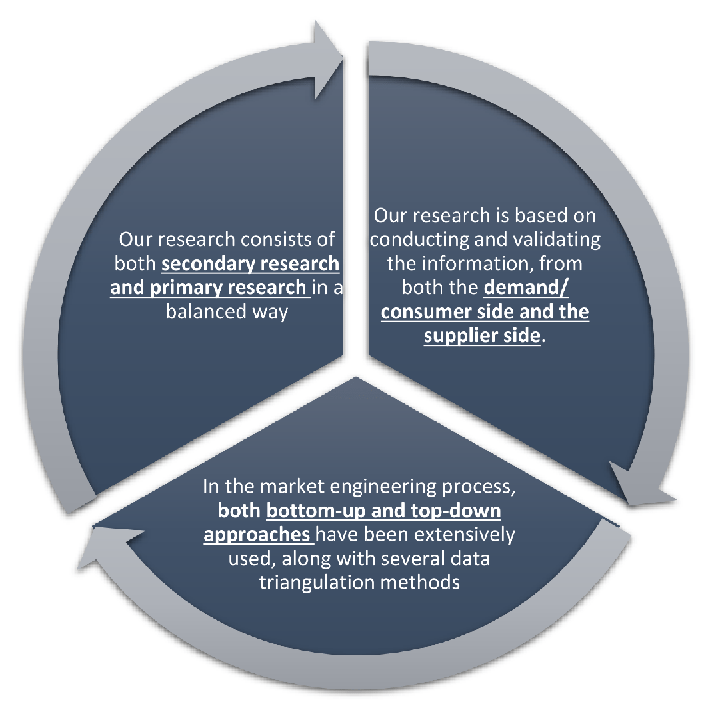
Research Design
Our research design integrates both demand-side and supply-side analysis through a balanced combination of primary and secondary research methodologies. By utilizing both bottom-up and top-down approaches alongside rigorous data triangulation methods, we deliver robust market intelligence that supports strategic decision-making.
MarketGenics' comprehensive research design framework ensures the delivery of accurate, reliable, and actionable market intelligence. Through the integration of multiple research approaches, rigorous validation processes, and expert analysis, we provide our clients with the insights needed to make informed strategic decisions and capitalize on market opportunities.
MarketGenics leverages a dedicated industry panel of experts and a comprehensive suite of paid databases to effectively collect, consolidate, and analyze market intelligence.
Our approach has consistently proven to be reliable and effective in generating accurate market insights, identifying key industry trends, and uncovering emerging business opportunities.
Through both primary and secondary research, we capture and analyze critical company-level data such as manufacturing footprints, including technical centers, R&D facilities, sales offices, and headquarters.
Our expert panel further enhances our ability to estimate market size for specific brands based on validated field-level intelligence.
Our data mining techniques incorporate both parametric and non-parametric methods, allowing for structured data collection, sorting, processing, and cleaning.
Demand projections are derived from large-scale data sets analyzed through proprietary algorithms, culminating in robust and reliable market sizing.
Research Approach
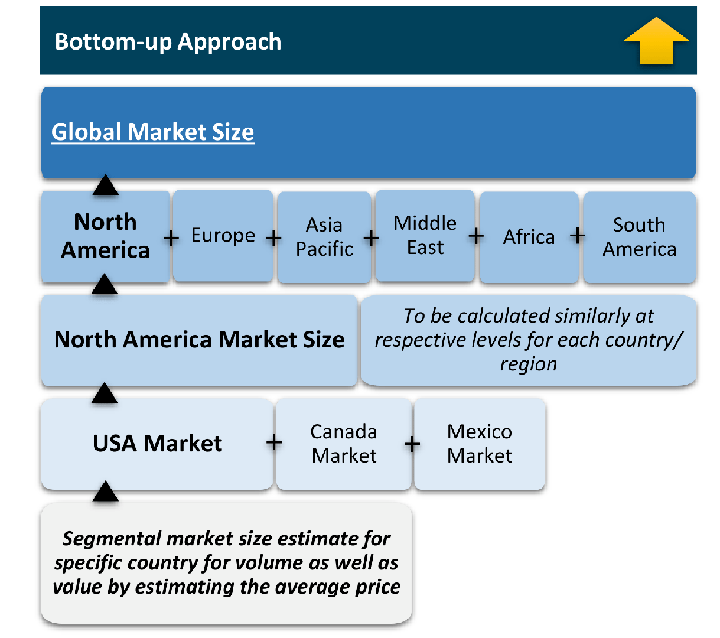
The bottom-up approach builds market estimates by starting with the smallest addressable market units and systematically aggregating them to create comprehensive market size projections.
This method begins with specific, granular data points and builds upward to create the complete market landscape.
Customer Analysis → Segmental Analysis → Geographical Analysis
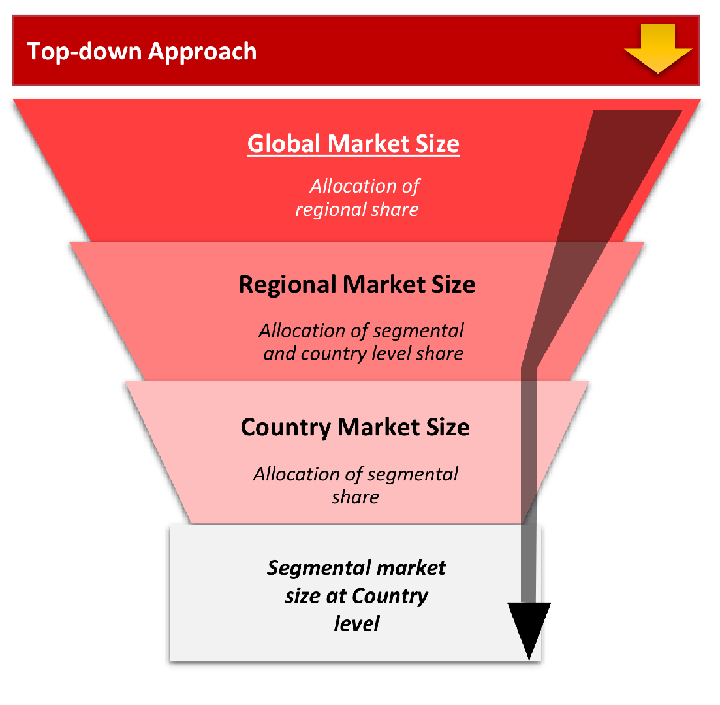
The top-down approach starts with the broadest possible market data and systematically narrows it down through a series of filters and assumptions to arrive at specific market segments or opportunities.
This method begins with the big picture and works downward to increasingly specific market slices.
TAM → SAM → SOM
Research Methods
Desk / Secondary Research
While analysing the market, we extensively study secondary sources, directories, and databases to identify and collect information useful for this technical, market-oriented, and commercial report. Secondary sources that we utilize are not only the public sources, but it is a combination of Open Source, Associations, Paid Databases, MG Repository & Knowledgebase, and others.
- Company websites, annual reports, financial reports, broker reports, and investor presentations
- National government documents, statistical databases and reports
- News articles, press releases and web-casts specific to the companies operating in the market, Magazines, reports, and others
- We gather information from commercial data sources for deriving company specific data such as segmental revenue, share for geography, product revenue, and others
- Internal and external proprietary databases (industry-specific), relevant patent, and regulatory databases
- Governing Bodies, Government Organizations
- Relevant Authorities, Country-specific Associations for Industries
We also employ the model mapping approach to estimate the product level market data through the players' product portfolio
Primary Research
Primary research/ interviews is vital in analyzing the market. Most of the cases involves paid primary interviews. Primary sources include primary interviews through e-mail interactions, telephonic interviews, surveys as well as face-to-face interviews with the different stakeholders across the value chain including several industry experts.
| Type of Respondents | Number of Primaries |
|---|---|
| Tier 2/3 Suppliers | ~20 |
| Tier 1 Suppliers | ~25 |
| End-users | ~25 |
| Industry Expert/ Panel/ Consultant | ~30 |
| Total | ~100 |
MG Knowledgebase
• Repository of industry blog, newsletter and case studies
• Online platform covering detailed market reports, and company profiles
Forecasting Factors and Models
Forecasting Factors
- Historical Trends – Past market patterns, cycles, and major events that shaped how markets behave over time. Understanding past trends helps predict future behavior.
- Industry Factors – Specific characteristics of the industry like structure, regulations, and innovation cycles that affect market dynamics.
- Macroeconomic Factors – Economic conditions like GDP growth, inflation, and employment rates that affect how much money people have to spend.
- Demographic Factors – Population characteristics like age, income, and location that determine who can buy your product.
- Technology Factors – How quickly people adopt new technology and how much technology infrastructure exists.
- Regulatory Factors – Government rules, laws, and policies that can help or restrict market growth.
- Competitive Factors – Analyzing competition structure such as degree of competition and bargaining power of buyers and suppliers.
Forecasting Models / Techniques
Multiple Regression Analysis
- Identify and quantify factors that drive market changes
- Statistical modeling to establish relationships between market drivers and outcomes
Time Series Analysis – Seasonal Patterns
- Understand regular cyclical patterns in market demand
- Advanced statistical techniques to separate trend, seasonal, and irregular components
Time Series Analysis – Trend Analysis
- Identify underlying market growth patterns and momentum
- Statistical analysis of historical data to project future trends
Expert Opinion – Expert Interviews
- Gather deep industry insights and contextual understanding
- In-depth interviews with key industry stakeholders
Multi-Scenario Development
- Prepare for uncertainty by modeling different possible futures
- Creating optimistic, pessimistic, and most likely scenarios
Time Series Analysis – Moving Averages
- Sophisticated forecasting for complex time series data
- Auto-regressive integrated moving average models with seasonal components
Econometric Models
- Apply economic theory to market forecasting
- Sophisticated economic models that account for market interactions
Expert Opinion – Delphi Method
- Harness collective wisdom of industry experts
- Structured, multi-round expert consultation process
Monte Carlo Simulation
- Quantify uncertainty and probability distributions
- Thousands of simulations with varying input parameters
Research Analysis
Our research framework is built upon the fundamental principle of validating market intelligence from both demand and supply perspectives. This dual-sided approach ensures comprehensive market understanding and reduces the risk of single-source bias.
Demand-Side Analysis: We understand end-user/application behavior, preferences, and market needs along with the penetration of the product for specific application.
Supply-Side Analysis: We estimate overall market revenue, analyze the segmental share along with industry capacity, competitive landscape, and market structure.
Validation & Evaluation
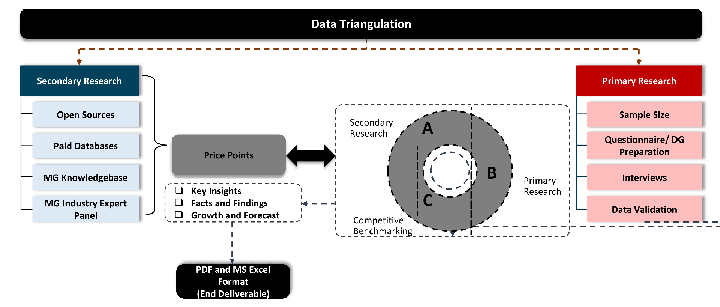
Data triangulation is a validation technique that uses multiple methods, sources, or perspectives to examine the same research question, thereby increasing the credibility and reliability of research findings. In market research, triangulation serves as a quality assurance mechanism that helps identify and minimize bias, validate assumptions, and ensure accuracy in market estimates.
- Data Source Triangulation – Using multiple data sources to examine the same phenomenon
- Methodological Triangulation – Using multiple research methods to study the same research question
- Investigator Triangulation – Using multiple researchers or analysts to examine the same data
- Theoretical Triangulation – Using multiple theoretical perspectives to interpret the same data
Custom Market Research Services
We will customise the research for you, in case the report listed above does not meet your requirements.
Get 10% Free Customisation