Regenerative Agriculture Market Size, Share & Trends Analysis Report by Practice Type (Cover Cropping, Crop Rotation, No-Till/Reduced Tillage Farming, Composting, Green Manuring, Agroforestry, Silvopasture, Holistic Grazing Management, Integrated Pest Management, Conservation Tillage, Mulching, Permaculture, Others), Technology/Input Type, Farm Size, Crop Type, and Geography (North America, Europe, Asia Pacific, Middle East, Africa, and South America) – Global Industry Data, Trends, and Forecasts, 2026–2035
Market Overview:
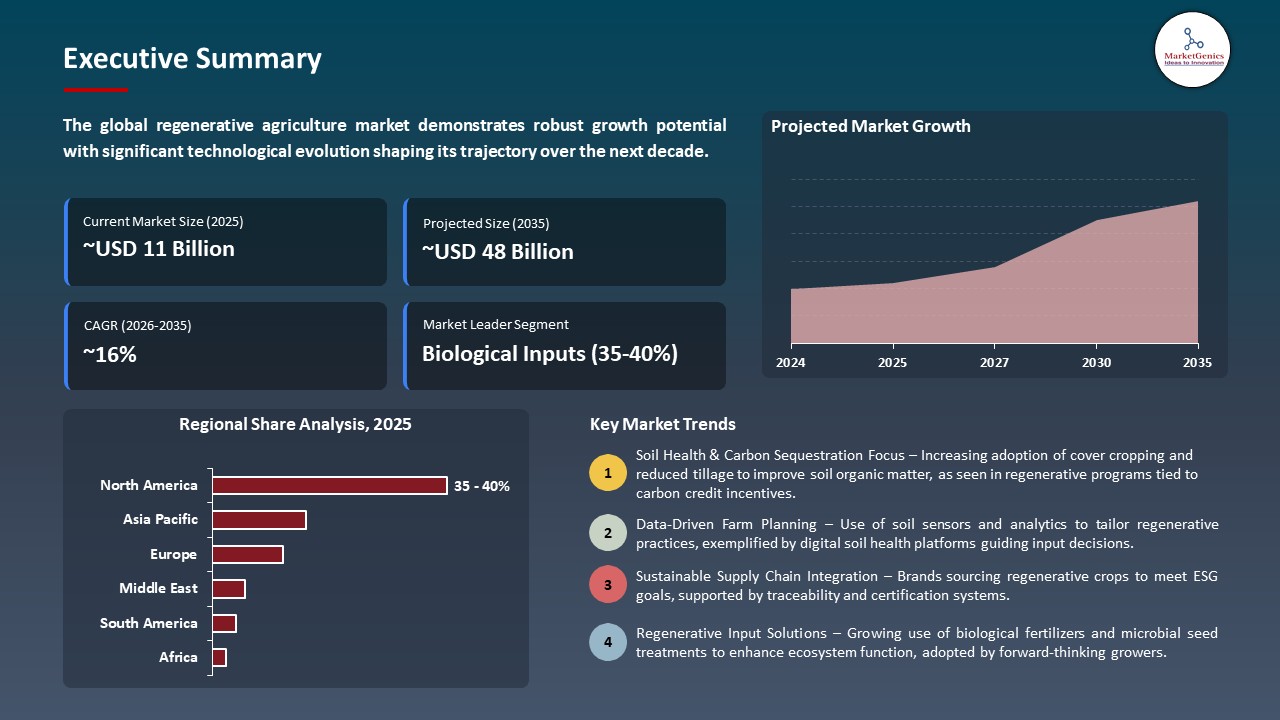
According to MarketGenics Analysis, the global Regenerative Agriculture Market is experiencing robust growth, with its valuation estimated at USD 10.5 billion in 2025 and expected to reach approximately USD 47.9 billion by 2035, expanding at a CAGR of 16.4% during the forecast period.
|
|
|
Segmental Data Insights |
|
|
Demand Trends |
|
|
Competitive Landscape |
|
|
Strategic Development |
|
|
Future Outlook & Opportunities |
|
Regenerative Agriculture Market Size, Share, and Growth
High-tech digital and biological technologies, such as AI-enabled soil and crop sensors, IoT-connected sensors, and real-time analytics have contributed to the appearance of the regenerative agriculture market.
Mariale Álvarez, Head Sustainability & Corporate Affairs LATAM at Syngenta: At Syngenta, sustainability is embedded in the business. Regenerating soil and nature through practices that aim to leave the system better than we found it, is a commitment we assume every day. This time, together with a strategic partner like PepsiCo, with whom we share this same vision, we are taking this commitment one step further: farmers who join our Sustainable Sourcing Program receive an economic benefit by demonstrating the adoption of regenerative farming practices in their production process, which has a positive impact not only on the environment but also on their profitability.
The regenerative agriculture market Size is shifting towards a paradigm shift in the sense that the demand in the ecosystem restoration, soil carbon sequestration, and climate-resilient food systems is growing. The development of advanced digital and biological technologies allowing farmers to practice regenerative agriculture with quantifiable effects is based on the use of data on soil microbiome profiling, remote sensing, and AI-based analytics to customize cover cropping, reduced tillage, and organic amendments at the field level.
Advanced investment in measuring, reporting, and verifying (MRV) services and satellite-based monitoring is developing performance based revenue models specifically associated with carbon credit markets and sustainability certifications which involve paying farmers money based on environmental performance other than the agricultural output. This integration of digital agritech, carbon markets, and ESGs is growing regenerative practices not only on niche projects but also on mainstream systems with policies, corporate commitments, and incentives to reverse land degradation and agricultural emissions.
The adjacent opportunities in bio-based inputs and agro forestry systems are improving soil biology and ecosystem services as well as decreasing synthetic inputs. Collaborations between technology, environmental funds, and agribusinesses are rapidly increasing adoption by various geographies enabling farmers to have accessible data and regenerative outcomes that enhance soil health, farm resilience, and long-term sustainability on the global scale.
 Regenerative Agriculture Market Dynamics and Trends
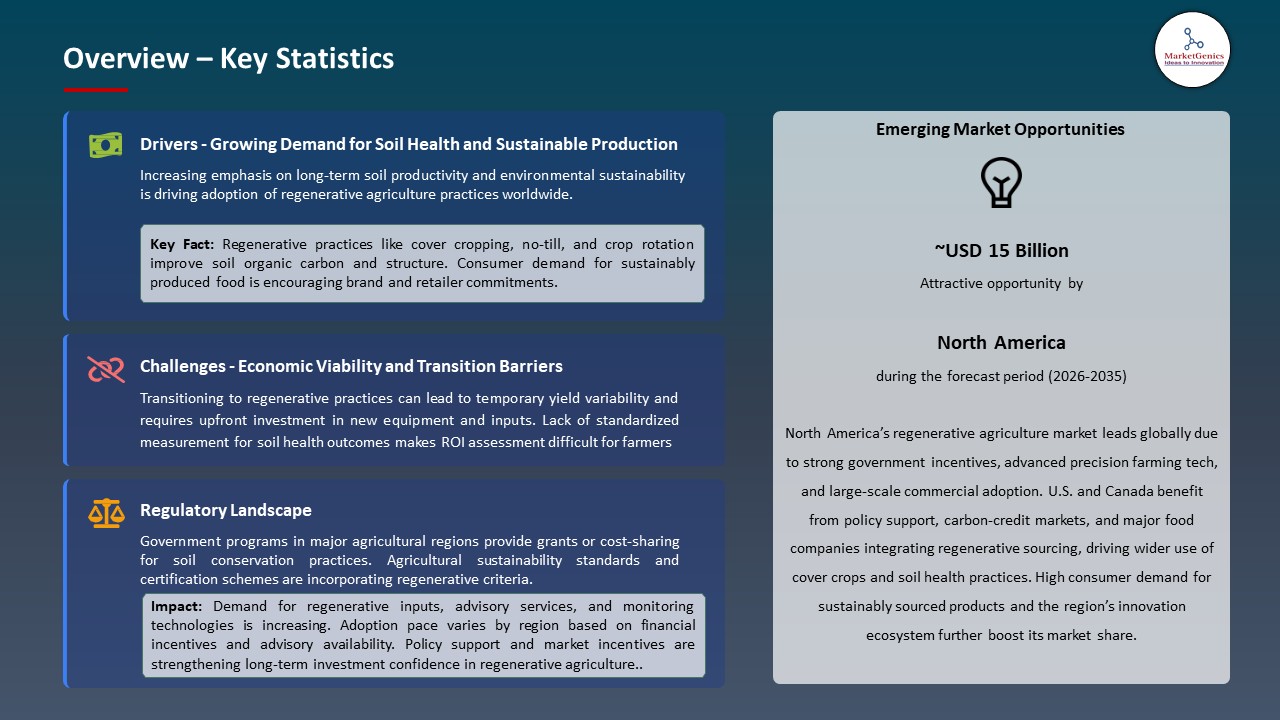
Driver: Rising demand for sustainable and soil-health–centric farming practices
-
Regenerative agriculture systems are being adopted due to the trend of growing focus on climate-smart agriculture and soil carbon sequestration, which farmers are seeking to enhance the fertility of their soils, boost biodiversity and continue to produce sustainably without increasing acreage.
- Sensors on the ground, artificial intelligence models of nutrients, and precision irrigation will enable the optimization of water and nutrient application. In March 2025, Syngenta and PepsiCo extended a multi-year partnership to help farmers through traceable regenerative sunflower oil and profitability incentives.
- Regenerative farming technologies enable field-wide monitoring and predictive soil controls, which assist farms to improve their productivity and sustainability standards across the globe.
Restraint: High implementation costs and knowledge barriers
-
The large initial investment in sensor-based regenerative systems, autonomous machines and digital monitoring platforms restrict its use in small and medium-sized farms compared to traditional farming.
- Repeat costs on cloud analytics, AI-powered soil and crop prediction, system life cycle and specialist maintenance continue to pressure the financial capabilities of farm operators.
- Low technical skills and lack of rural digital infrastructure will impede mass adoption, especially in developing economies, reduce the rate of market penetration in spite of the excellent sustainability motives.
Opportunity: Integration with smart farm technologies and renewable power sources
-
The renewable energy systems combined with innovative farm technologies are establishing a large potential in the regenerative agriculture marketplace by allowing energy independent sensor systems, data intensive monitoring, and automated regenerative practice management of remote areas or areas with resource constraints.
- Nanotechnology sensor and power synergies provide real-time soil and ecosystem availability. For instance, in August 2025, SunCulture collaborated with Nuru Energy to roll out solar-powered regenerative sensor nodes that integrate soil moisture, nutrient, and biodiversity sensors with AI analytics to make adaptive decisions on cover-cropping and organic amendments on smallholder farms.
- Renewable powered, scalable, and sustainable regenerative agriculture can be achieved in a smart farm across the globe.
Key Trend: Shift toward biological inputs and soil microbiome management
-
Use of microbial inoculants, biofertilizers and compost based soil modifications are gaining traction in the regenerative agriculture market across the world, which allows better nutrient cycling, soil fertility and less reliance on synthetic chemicals.
- Digital soil microbiome monitoring technologies are now used to streamline soil health. For instance, in July 2025, Miraterra purchased the technology of Trace Genomics to make faster and correct profiles to make microbial amendments.
- Data-driven management in combination with the introduction of biological inputs can provide scalable, efficient, and measurable regenerative practices on the global scale.
 Regenerative Agriculture Market Analysis and Segmental Data
Biological Inputs Dominate Global Regenerative Agriculture Market
-
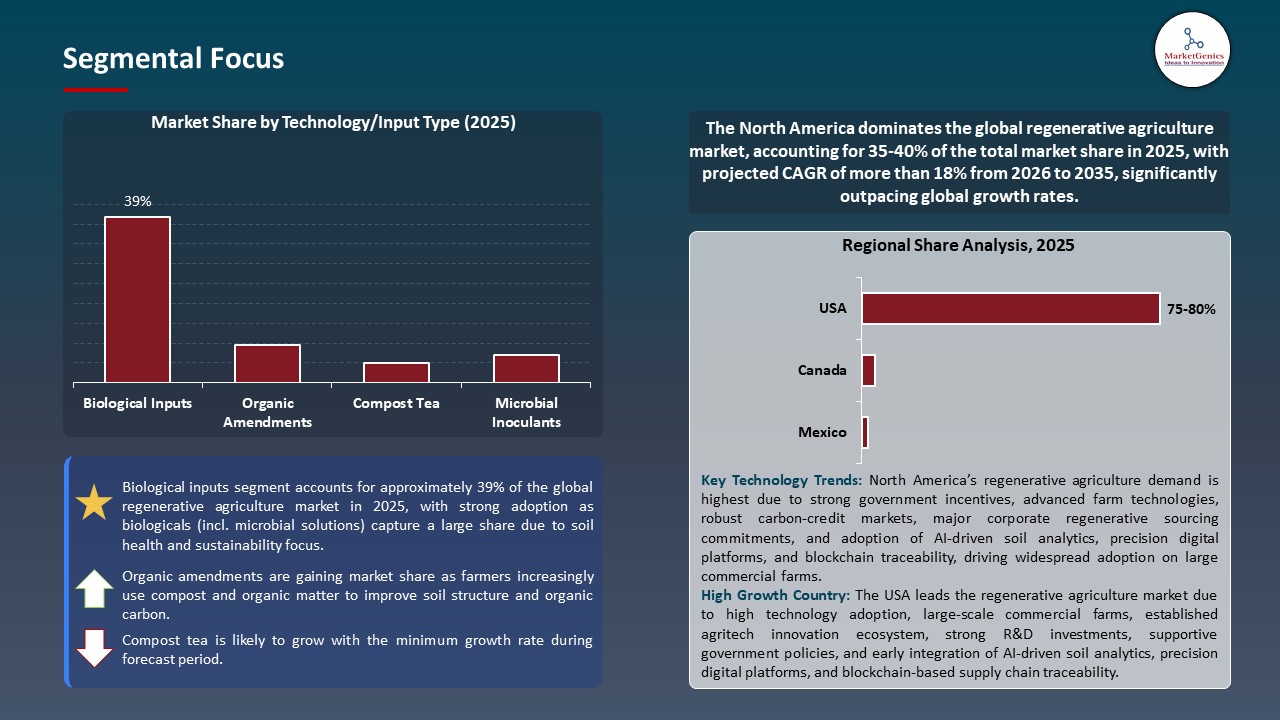
The global regenerative agriculture market is dominated by biological inputs due to the increased usage of biofertilizers, microbial inoculants and plant-growth-promoting organisms to improve the health of soil, nutrient cycling, and crop resilience and to reduce reliance on synthetic chemicals.
- The effectiveness and implementation are being improved by innovations in the formulation and delivery. For instance, in March 2025, Pivot Bio introduced its second generation nitrogen-fixing microbial product on corn and wheat, which provides greater consistency and the ability to integrate into digital farm applications in optimizing nitrogen availability and improving yield in regenerative agricultural settings across the globe.
- Separable, high-scale bio-inputs enhance quicker adoption and integration with precision farming, which further enhances their leadership in world regenerative farming.
North America Leads Global Regenerative Agriculture Market Demand
-
North America controls the regenerative agriculture market globally through the extensive farming operations, the adoption of soil health methods early and robust regenerative sourcing promises of the food producers in the U.S. and Canada.
- Regenerative agriculture is going to become data-enabled more rapidly, with the aid of soil health and carbon measurement applications aligned to sustainability goals. For instance, in October 2025, CANZA introduced the Million Acre Challenge, which is USD 7 million contribution to Weston family to scale regenerative practices by incentivizing farmers.
- Powerful R&D ecosystems, corporate-based regenerative sourcing initiatives, and public-private collaborations still help to support the leadership of North America in achieving the scaling of regenerative agriculture adoption.
Regenerative Agriculture Market Ecosystem
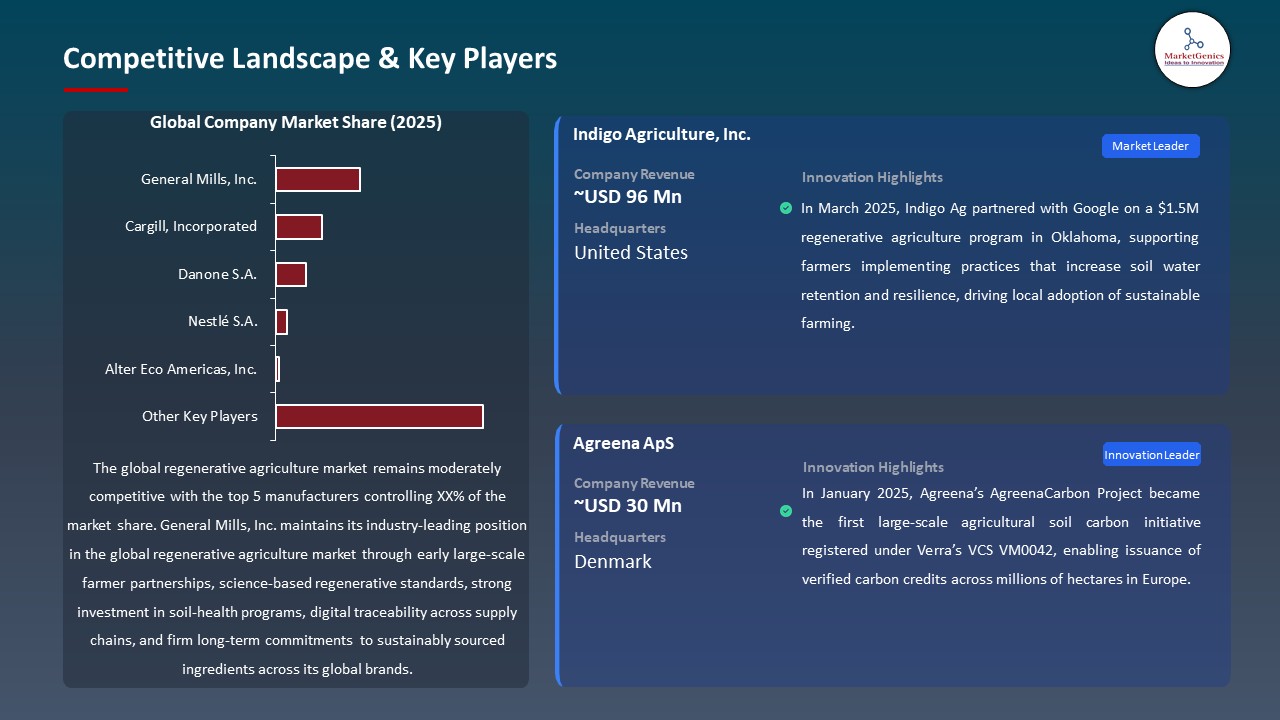
The regenerative agriculture market is moderately consolidated, and the degree of competition revolves around the soil health restoration initiatives, regenerative sourcing initiatives, digital traceability solutions as well as sustainable data measurements along the agricultural value chains. The existence of General Mills, Inc., Cargill, Incorporated, Danone S.A., Nestle S.A., and Alter Eco Americas, Inc. explains why they have a significant market share due to the creation of end-to-end regenerative-based agriculture systems, which combine farmer engagement programmes, regenerative input practices, supply chain traceability, result measurement systems, and incentive-based sustainability models.
General Mills, Inc. is enhancing the adoption of regenerative agriculture by supporting large-scale farmer transition programs, building soil health, using digital measurement tools in key crops including wheat and oats. Cargill, Incorporated is building regenerative supply chains by implementing cover-cropping, reduced-tillage, nutrient-optimization, and carbon-based measurement systems throughout its sourcing network.
The sustainability programs supported by the government, agricultural policies centered around climate change, partnerships with NGOs, research facilities, and regenerative measurement systems based on outcomes have contributed to the rapid innovation in soil carbon sequestration, biodiversity restoration, and regenerative measurement systems. These ecological processes make it easier to compete differently, allow scalable adoption of regenerative farming, and expedite the shift to climate-resilient and sustainable food systems, placing the global regenerative agriculture market to serve increased food demand and restore ecosystems and increase long-term agricultural resilience.
 Recent Development and Strategic Overview
-
In November 2025, Regenagri launched its new Carbon Insetting Platform, a regenerative agriculture standard tool that enables companies and supply chain operators to quantify, verify, and monetise carbon outcomes directly generated on farms practicing regenerative techniques, providing an additional financial incentive while advancing environmental integrity and Scope 3 emissions reporting across agricultural supply chains.
- In September 2025, Bayer launched its global regenerative agriculture initiative “ForwardFarming” in India, establishing a ForwardFarm in Panipat, Haryana to demonstrate and scale regenerative practices such as Direct Seeded Rice (DSR), innovative weed and nutrient management, carbon farming, IoT-enabled monitoring, vermicompost use, and advanced agronomy techniques tailored for smallholder farmers.
Report Scope
|
Detail |
|
|
Market Size in 2025 |
USD 10.5 Bn |
|
Market Forecast Value in 2035 |
USD 47.9 Bn |
|
Growth Rate (CAGR) |
16.4% |
|
Forecast Period |
2026 – 2035 |
|
Historical Data Available for |
2021 – 2024 |
|
Market Size Units |
US$ Billion for Value |
|
Report Format |
Electronic (PDF) + Excel |
|
North America |
Europe |
Asia Pacific |
Middle East |
Africa |
South America |
|
|
|
|
|
|
|
Companies Covered |
|||||
|
|
|
|
|
|
Regenerative Agriculture Market Segmentation and Highlights
|
Segment |
Sub-segment |
|
Regenerative Agriculture Market, By Practice Type |
|
|
Regenerative Agriculture Market, By Technology/Input Type |
|
|
Regenerative Agriculture Market, By Farm Size |
|
|
Regenerative Agriculture Market, By Crop Type |
|
Frequently Asked Questions
Table of Contents
- 1. Research Methodology and Assumptions
- 1.1. Definitions
- 1.2. Research Design and Approach
- 1.3. Data Collection Methods
- 1.4. Base Estimates and Calculations
- 1.5. Forecasting Models
- 1.5.1. Key Forecast Factors & Impact Analysis
- 1.6. Secondary Research
- 1.6.1. Open Sources
- 1.6.2. Paid Databases
- 1.6.3. Associations
- 1.7. Primary Research
- 1.7.1. Primary Sources
- 1.7.2. Primary Interviews with Stakeholders across Ecosystem
- 2. Executive Summary
- 2.1. Global Regenerative Agriculture Market Outlook
- 2.1.1. Regenerative Agriculture Market Size (Value - US$ Bn), and Forecasts, 2021-2035
- 2.1.2. Compounded Annual Growth Rate Analysis
- 2.1.3. Growth Opportunity Analysis
- 2.1.4. Segmental Share Analysis
- 2.1.5. Geographical Share Analysis
- 2.2. Market Analysis and Facts
- 2.3. Supply-Demand Analysis
- 2.4. Competitive Benchmarking
- 2.5. Go-to- Market Strategy
- 2.5.1. Customer/ End-use Industry Assessment
- 2.5.2. Growth Opportunity Data, 2026-2035
- 2.5.2.1. Regional Data
- 2.5.2.2. Country Data
- 2.5.2.3. Segmental Data
- 2.5.3. Identification of Potential Market Spaces
- 2.5.4. GAP Analysis
- 2.5.5. Potential Attractive Price Points
- 2.5.6. Prevailing Market Risks & Challenges
- 2.5.7. Preferred Sales & Marketing Strategies
- 2.5.8. Key Recommendations and Analysis
- 2.5.9. A Way Forward
- 2.1. Global Regenerative Agriculture Market Outlook
- 3. Industry Data and Premium Insights
- 3.1. Global Agriculture Industry Overview, 2025
- 3.1.1. Agriculture Industry Ecosystem Analysis
- 3.1.2. Key Trends for Agriculture Industry
- 3.1.3. Regional Distribution for Agriculture Industry
- 3.2. Supplier Customer Data
- 3.3. Technology Roadmap and Developments
- 3.4. Trade Analysis
- 3.4.1. Import & Export Analysis, 2025
- 3.4.2. Top Importing Countries
- 3.4.3. Top Exporting Countries
- 3.5. Trump Tariff Impact Analysis
- 3.5.1. Manufacturer
- 3.5.1.1. Based on the component & Raw material
- 3.5.2. Supply Chain
- 3.5.3. End Consumer
- 3.5.1. Manufacturer
- 3.6. Raw Material Analysis
- 3.1. Global Agriculture Industry Overview, 2025
- 4. Market Overview
- 4.1. Market Dynamics
- 4.1.1. Drivers
- 4.1.1.1. Increasing focus on soil health restoration and long-term land productivity to support sustainable agricultural output
- 4.1.1.2. Growing demand from food processors and consumers for environmentally responsible and traceable agricultural practices
- 4.1.1.3. Rising support from governments and private organizations through incentives, carbon credit programs, and sustainability-linked financing
- 4.1.2. Restraints
- 4.1.2.1. Limited short-term financial returns and transition costs during the shift from conventional to regenerative farming practices
- 4.1.2.2. Lack of standardized measurement frameworks to quantify outcomes such as soil carbon sequestration and ecosystem benefits
- 4.1.1. Drivers
- 4.2. Key Trend Analysis
- 4.3. Regulatory Framework
- 4.3.1. Key Regulations, Norms, and Subsidies, by Key Countries
- 4.3.2. Tariffs and Standards
- 4.3.3. Impact Analysis of Regulations on the Market
- 4.4. Value Chain Analysis
- 4.5. Porter’s Five Forces Analysis
- 4.6. PESTEL Analysis
- 4.7. Global Regenerative Agriculture Market Demand
- 4.7.1. Historical Market Size – Value (US$ Bn), 2020-2024
- 4.7.2. Current and Future Market Size – Value (US$ Bn), 2026–2035
- 4.7.2.1. Y-o-Y Growth Trends
- 4.7.2.2. Absolute $ Opportunity Assessment
- 4.1. Market Dynamics
- 5. Competition Landscape
- 5.1. Competition structure
- 5.1.1. Fragmented v/s consolidated
- 5.2. Company Share Analysis, 2025
- 5.2.1. Global Company Market Share
- 5.2.2. By Region
- 5.2.2.1. North America
- 5.2.2.2. Europe
- 5.2.2.3. Asia Pacific
- 5.2.2.4. Middle East
- 5.2.2.5. Africa
- 5.2.2.6. South America
- 5.3. Product Comparison Matrix
- 5.3.1. Specifications
- 5.3.2. Market Positioning
- 5.3.3. Pricing
- 5.1. Competition structure
- 6. Global Regenerative Agriculture Market Analysis, by Practice Type
- 6.1. Key Segment Analysis
- 6.2. Regenerative Agriculture Market Size (Value - US$ Bn), Analysis, and Forecasts, by Practice Type, 2021-2035
- 6.2.1. Cover Cropping
- 6.2.2. Crop Rotation
- 6.2.3. No-Till/Reduced Tillage Farming
- 6.2.4. Composting
- 6.2.5. Green Manuring
- 6.2.6. Agroforestry
- 6.2.7. Silvopasture
- 6.2.8. Holistic Grazing Management
- 6.2.9. Integrated Pest Management
- 6.2.10. Conservation Tillage
- 6.2.11. Mulching
- 6.2.12. Permaculture
- 6.2.13. Others
- 7. Global Regenerative Agriculture Market Analysis, by Technology/Input Type
- 7.1. Key Segment Analysis
- 7.2. Regenerative Agriculture Market Size (Value - US$ Bn), Analysis, and Forecasts, by Technology/Input Type, 2021-2035
- 7.2.1. Biological Inputs
- 7.2.2. Organic Amendments
- 7.2.3. Microbial Inoculants
- 7.2.4. Compost Tea
- 7.2.5. Biochar
- 7.2.6. Natural Minerals
- 7.2.7. Soil Amendments
- 7.2.8. Monitoring & Analytics Software
- 7.2.9. Drone Technology
- 7.2.10. Precision Agriculture Tools
- 7.2.11. Others
- 8. Global Regenerative Agriculture Market Analysis, by Farm Size
- 8.1. Key Segment Analysis
- 8.2. Regenerative Agriculture Market Size (Value - US$ Bn), Analysis, and Forecasts, by Farm Size, 2021-2035
- 8.2.1. Below 50 acres
- 8.2.2. 50-500 acres
- 8.2.3. 500-2000 acres
- 8.2.4. Above 2000 acres
- 9. Global Regenerative Agriculture Market Analysis, by Crop Type
- 9.1. Key Segment Analysis
- 9.2. Regenerative Agriculture Market Size (Value - US$ Bn), Analysis, and Forecasts, by Crop Type, 2021-2035
- 9.2.1. Cereal Grains
- 9.2.2. Legumes
- 9.2.3. Vegetables
- 9.2.4. Fruits & Nuts
- 9.2.5. Root Crops
- 9.2.6. Oilseeds
- 9.2.7. Fiber Crops
- 9.2.8. Others
- 10. Global Regenerative Agriculture Market Analysis and Forecasts, by Region
- 10.1. Key Findings
- 10.2. Regenerative Agriculture Market Size (Value - US$ Bn), Analysis, and Forecasts, by Region, 2021-2035
- 10.2.1. North America
- 10.2.2. Europe
- 10.2.3. Asia Pacific
- 10.2.4. Middle East
- 10.2.5. Africa
- 10.2.6. South America
- 11. North America Regenerative Agriculture Market Analysis
- 11.1. Key Segment Analysis
- 11.2. Regional Snapshot
- 11.3. North America Regenerative Agriculture Market Size (Value - US$ Bn), Analysis, and Forecasts, 2021-2035
- 11.3.1. Practice Type
- 11.3.2. Technology/Input Type
- 11.3.3. Farm Size
- 11.3.4. Crop Type
- 11.3.5. Country
- 11.3.5.1. USA
- 11.3.5.2. Canada
- 11.3.5.3. Mexico
- 11.4. USA Regenerative Agriculture Market
- 11.4.1. Country Segmental Analysis
- 11.4.2. Practice Type
- 11.4.3. Technology/Input Type
- 11.4.4. Farm Size
- 11.4.5. Crop Type
- 11.5. Canada Regenerative Agriculture Market
- 11.5.1. Country Segmental Analysis
- 11.5.2. Practice Type
- 11.5.3. Technology/Input Type
- 11.5.4. Farm Size
- 11.5.5. Crop Type
- 11.6. Mexico Regenerative Agriculture Market
- 11.6.1. Country Segmental Analysis
- 11.6.2. Practice Type
- 11.6.3. Technology/Input Type
- 11.6.4. Farm Size
- 11.6.5. Crop Type
- 12. Europe Regenerative Agriculture Market Analysis
- 12.1. Key Segment Analysis
- 12.2. Regional Snapshot
- 12.3. Europe Regenerative Agriculture Market Size (Value - US$ Bn), Analysis, and Forecasts, 2021-2035
- 12.3.1. Practice Type
- 12.3.2. Technology/Input Type
- 12.3.3. Farm Size
- 12.3.4. Crop Type
- 12.3.5. Country
- 12.3.5.1. Germany
- 12.3.5.2. United Kingdom
- 12.3.5.3. France
- 12.3.5.4. Italy
- 12.3.5.5. Spain
- 12.3.5.6. Netherlands
- 12.3.5.7. Nordic Countries
- 12.3.5.8. Poland
- 12.3.5.9. Russia & CIS
- 12.3.5.10. Rest of Europe
- 12.4. Germany Regenerative Agriculture Market
- 12.4.1. Country Segmental Analysis
- 12.4.2. Practice Type
- 12.4.3. Technology/Input Type
- 12.4.4. Farm Size
- 12.4.5. Crop Type
- 12.5. United Kingdom Regenerative Agriculture Market
- 12.5.1. Country Segmental Analysis
- 12.5.2. Practice Type
- 12.5.3. Technology/Input Type
- 12.5.4. Farm Size
- 12.5.5. Crop Type
- 12.6. France Regenerative Agriculture Market
- 12.6.1. Country Segmental Analysis
- 12.6.2. Practice Type
- 12.6.3. Technology/Input Type
- 12.6.4. Farm Size
- 12.6.5. Crop Type
- 12.7. Italy Regenerative Agriculture Market
- 12.7.1. Country Segmental Analysis
- 12.7.2. Practice Type
- 12.7.3. Technology/Input Type
- 12.7.4. Farm Size
- 12.7.5. Crop Type
- 12.8. Spain Regenerative Agriculture Market
- 12.8.1. Country Segmental Analysis
- 12.8.2. Practice Type
- 12.8.3. Technology/Input Type
- 12.8.4. Farm Size
- 12.8.5. Crop Type
- 12.9. Netherlands Regenerative Agriculture Market
- 12.9.1. Country Segmental Analysis
- 12.9.2. Practice Type
- 12.9.3. Technology/Input Type
- 12.9.4. Farm Size
- 12.9.5. Crop Type
- 12.10. Nordic Countries Regenerative Agriculture Market
- 12.10.1. Country Segmental Analysis
- 12.10.2. Practice Type
- 12.10.3. Technology/Input Type
- 12.10.4. Farm Size
- 12.10.5. Crop Type
- 12.11. Poland Regenerative Agriculture Market
- 12.11.1. Country Segmental Analysis
- 12.11.2. Practice Type
- 12.11.3. Technology/Input Type
- 12.11.4. Farm Size
- 12.11.5. Crop Type
- 12.12. Russia & CIS Regenerative Agriculture Market
- 12.12.1. Country Segmental Analysis
- 12.12.2. Practice Type
- 12.12.3. Technology/Input Type
- 12.12.4. Farm Size
- 12.12.5. Crop Type
- 12.13. Rest of Europe Regenerative Agriculture Market
- 12.13.1. Country Segmental Analysis
- 12.13.2. Practice Type
- 12.13.3. Technology/Input Type
- 12.13.4. Farm Size
- 12.13.5. Crop Type
- 13. Asia Pacific Regenerative Agriculture Market Analysis
- 13.1. Key Segment Analysis
- 13.2. Regional Snapshot
- 13.3. Asia Pacific Regenerative Agriculture Market Size (Value - US$ Bn), Analysis, and Forecasts, 2021-2035
- 13.3.1. Practice Type
- 13.3.2. Technology/Input Type
- 13.3.3. Farm Size
- 13.3.4. Crop Type
- 13.3.5. Country
- 13.3.5.1. China
- 13.3.5.2. India
- 13.3.5.3. Japan
- 13.3.5.4. South Korea
- 13.3.5.5. Australia and New Zealand
- 13.3.5.6. Indonesia
- 13.3.5.7. Malaysia
- 13.3.5.8. Thailand
- 13.3.5.9. Vietnam
- 13.3.5.10. Rest of Asia Pacific
- 13.4. China Regenerative Agriculture Market
- 13.4.1. Country Segmental Analysis
- 13.4.2. Practice Type
- 13.4.3. Technology/Input Type
- 13.4.4. Farm Size
- 13.4.5. Crop Type
- 13.5. India Regenerative Agriculture Market
- 13.5.1. Country Segmental Analysis
- 13.5.2. Practice Type
- 13.5.3. Technology/Input Type
- 13.5.4. Farm Size
- 13.5.5. Crop Type
- 13.6. Japan Regenerative Agriculture Market
- 13.6.1. Country Segmental Analysis
- 13.6.2. Practice Type
- 13.6.3. Technology/Input Type
- 13.6.4. Farm Size
- 13.6.5. Crop Type
- 13.7. South Korea Regenerative Agriculture Market
- 13.7.1. Country Segmental Analysis
- 13.7.2. Practice Type
- 13.7.3. Technology/Input Type
- 13.7.4. Farm Size
- 13.7.5. Crop Type
- 13.8. Australia and New Zealand Regenerative Agriculture Market
- 13.8.1. Country Segmental Analysis
- 13.8.2. Practice Type
- 13.8.3. Technology/Input Type
- 13.8.4. Farm Size
- 13.8.5. Crop Type
- 13.9. Indonesia Regenerative Agriculture Market
- 13.9.1. Country Segmental Analysis
- 13.9.2. Practice Type
- 13.9.3. Technology/Input Type
- 13.9.4. Farm Size
- 13.9.5. Crop Type
- 13.10. Malaysia Regenerative Agriculture Market
- 13.10.1. Country Segmental Analysis
- 13.10.2. Practice Type
- 13.10.3. Technology/Input Type
- 13.10.4. Farm Size
- 13.10.5. Crop Type
- 13.11. Thailand Regenerative Agriculture Market
- 13.11.1. Country Segmental Analysis
- 13.11.2. Practice Type
- 13.11.3. Technology/Input Type
- 13.11.4. Farm Size
- 13.11.5. Crop Type
- 13.12. Vietnam Regenerative Agriculture Market
- 13.12.1. Country Segmental Analysis
- 13.12.2. Practice Type
- 13.12.3. Technology/Input Type
- 13.12.4. Farm Size
- 13.12.5. Crop Type
- 13.13. Rest of Asia Pacific Regenerative Agriculture Market
- 13.13.1. Country Segmental Analysis
- 13.13.2. Practice Type
- 13.13.3. Technology/Input Type
- 13.13.4. Farm Size
- 13.13.5. Crop Type
- 14. Middle East Regenerative Agriculture Market Analysis
- 14.1. Key Segment Analysis
- 14.2. Regional Snapshot
- 14.3. Middle East Regenerative Agriculture Market Size (Value - US$ Bn), Analysis, and Forecasts, 2021-2035
- 14.3.1. Practice Type
- 14.3.2. Technology/Input Type
- 14.3.3. Farm Size
- 14.3.4. Crop Type
- 14.3.5. Country
- 14.3.5.1. Turkey
- 14.3.5.2. UAE
- 14.3.5.3. Saudi Arabia
- 14.3.5.4. Israel
- 14.3.5.5. Rest of Middle East
- 14.4. Turkey Regenerative Agriculture Market
- 14.4.1. Country Segmental Analysis
- 14.4.2. Practice Type
- 14.4.3. Technology/Input Type
- 14.4.4. Farm Size
- 14.4.5. Crop Type
- 14.5. UAE Regenerative Agriculture Market
- 14.5.1. Country Segmental Analysis
- 14.5.2. Practice Type
- 14.5.3. Technology/Input Type
- 14.5.4. Farm Size
- 14.5.5. Crop Type
- 14.6. Saudi Arabia Regenerative Agriculture Market
- 14.6.1. Country Segmental Analysis
- 14.6.2. Practice Type
- 14.6.3. Technology/Input Type
- 14.6.4. Farm Size
- 14.6.5. Crop Type
- 14.7. Israel Regenerative Agriculture Market
- 14.7.1. Country Segmental Analysis
- 14.7.2. Practice Type
- 14.7.3. Technology/Input Type
- 14.7.4. Farm Size
- 14.7.5. Crop Type
- 14.8. Rest of Middle East Regenerative Agriculture Market
- 14.8.1. Country Segmental Analysis
- 14.8.2. Practice Type
- 14.8.3. Technology/Input Type
- 14.8.4. Farm Size
- 14.8.5. Crop Type
- 15. Africa Regenerative Agriculture Market Analysis
- 15.1. Key Segment Analysis
- 15.2. Regional Snapshot
- 15.3. Africa Regenerative Agriculture Market Size (Value - US$ Bn), Analysis, and Forecasts, 2021-2035
- 15.3.1. Practice Type
- 15.3.2. Technology/Input Type
- 15.3.3. Farm Size
- 15.3.4. Crop Type
- 15.3.5. Country
- 15.3.5.1. South Africa
- 15.3.5.2. Egypt
- 15.3.5.3. Nigeria
- 15.3.5.4. Algeria
- 15.3.5.5. Rest of Africa
- 15.4. South Africa Regenerative Agriculture Market
- 15.4.1. Country Segmental Analysis
- 15.4.2. Practice Type
- 15.4.3. Technology/Input Type
- 15.4.4. Farm Size
- 15.4.5. Crop Type
- 15.5. Egypt Regenerative Agriculture Market
- 15.5.1. Country Segmental Analysis
- 15.5.2. Practice Type
- 15.5.3. Technology/Input Type
- 15.5.4. Farm Size
- 15.5.5. Crop Type
- 15.6. Nigeria Regenerative Agriculture Market
- 15.6.1. Country Segmental Analysis
- 15.6.2. Practice Type
- 15.6.3. Technology/Input Type
- 15.6.4. Farm Size
- 15.6.5. Crop Type
- 15.7. Algeria Regenerative Agriculture Market
- 15.7.1. Country Segmental Analysis
- 15.7.2. Practice Type
- 15.7.3. Technology/Input Type
- 15.7.4. Farm Size
- 15.7.5. Crop Type
- 15.8. Rest of Africa Regenerative Agriculture Market
- 15.8.1. Country Segmental Analysis
- 15.8.2. Practice Type
- 15.8.3. Technology/Input Type
- 15.8.4. Farm Size
- 15.8.5. Crop Type
- 16. South America Regenerative Agriculture Market Analysis
- 16.1. Key Segment Analysis
- 16.2. Regional Snapshot
- 16.3. South America Regenerative Agriculture Market Size (Value - US$ Bn), Analysis, and Forecasts, 2021-2035
- 16.3.1. Practice Type
- 16.3.2. Technology/Input Type
- 16.3.3. Farm Size
- 16.3.4. Crop Type
- 16.3.5. Country
- 16.3.5.1. Brazil
- 16.3.5.2. Argentina
- 16.3.5.3. Rest of South America
- 16.4. Brazil Regenerative Agriculture Market
- 16.4.1. Country Segmental Analysis
- 16.4.2. Practice Type
- 16.4.3. Technology/Input Type
- 16.4.4. Farm Size
- 16.4.5. Crop Type
- 16.5. Argentina Regenerative Agriculture Market
- 16.5.1. Country Segmental Analysis
- 16.5.2. Practice Type
- 16.5.3. Technology/Input Type
- 16.5.4. Farm Size
- 16.5.5. Crop Type
- 16.6. Rest of South America Regenerative Agriculture Market
- 16.6.1. Country Segmental Analysis
- 16.6.2. Practice Type
- 16.6.3. Technology/Input Type
- 16.6.4. Farm Size
- 16.6.5. Crop Type
- 17. Key Players/ Company Profile
- 17.1. Agreena.
- 17.1.1. Company Details/ Overview
- 17.1.2. Company Financials
- 17.1.3. Key Customers and Competitors
- 17.1.4. Business/ Industry Portfolio
- 17.1.5. Product Portfolio/ Specification Details
- 17.1.6. Pricing Data
- 17.1.7. Strategic Overview
- 17.1.8. Recent Developments
- 17.2. Applegate Farms
- 17.3. Cargill, Incorporated
- 17.4. Danone S.A.
- 17.5. Dr. Bronner's
- 17.6. Fibershed
- 17.7. General Mills, Inc.
- 17.8. Indigo Agriculture
- 17.9. Kiss the Ground
- 17.10. Maple Hill Creamery
- 17.11. Nestlé S.A.
- 17.12. Nori
- 17.13. Patagonia Provisions
- 17.14. Patagonia, Inc.
- 17.15. Regrow Agriculture
- 17.16. Rodale Institute
- 17.17. Soil Capital
- 17.18. The Nature Conservancy
- 17.19. Understanding Ag
- 17.20. Unilever PLC
- 17.21. White Oak Pastures
- 17.22. Other Key Players
- 17.1. Agreena.
Note* - This is just tentative list of players. While providing the report, we will cover more number of players based on their revenue and share for each geography
Research Design
Our research design integrates both demand-side and supply-side analysis through a balanced combination of primary and secondary research methodologies. By utilizing both bottom-up and top-down approaches alongside rigorous data triangulation methods, we deliver robust market intelligence that supports strategic decision-making.
MarketGenics' comprehensive research design framework ensures the delivery of accurate, reliable, and actionable market intelligence. Through the integration of multiple research approaches, rigorous validation processes, and expert analysis, we provide our clients with the insights needed to make informed strategic decisions and capitalize on market opportunities.
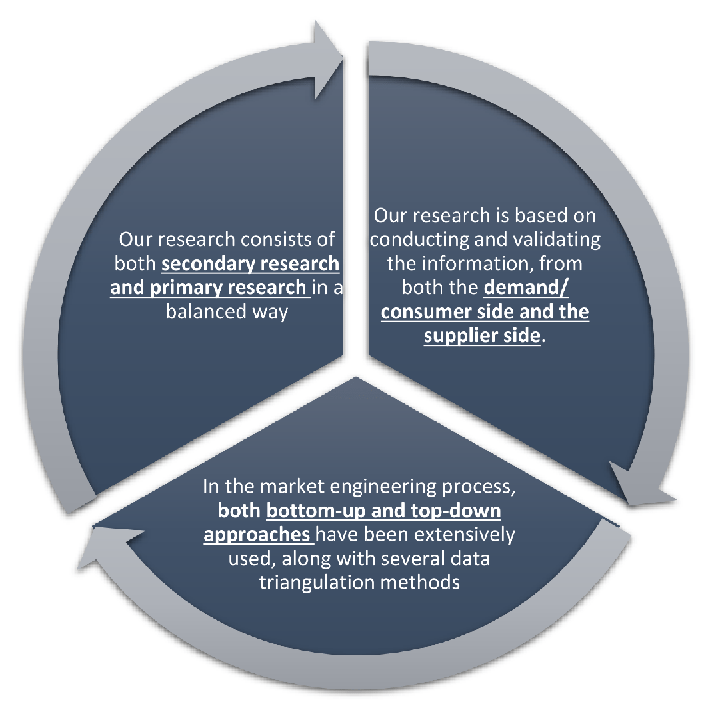
MarketGenics leverages a dedicated industry panel of experts and a comprehensive suite of paid databases to effectively collect, consolidate, and analyze market intelligence.
Our approach has consistently proven to be reliable and effective in generating accurate market insights, identifying key industry trends, and uncovering emerging business opportunities.
Through both primary and secondary research, we capture and analyze critical company-level data such as manufacturing footprints, including technical centers, R&D facilities, sales offices, and headquarters.
Our expert panel further enhances our ability to estimate market size for specific brands based on validated field-level intelligence.
Our data mining techniques incorporate both parametric and non-parametric methods, allowing for structured data collection, sorting, processing, and cleaning.
Demand projections are derived from large-scale data sets analyzed through proprietary algorithms, culminating in robust and reliable market sizing.
Research Approach
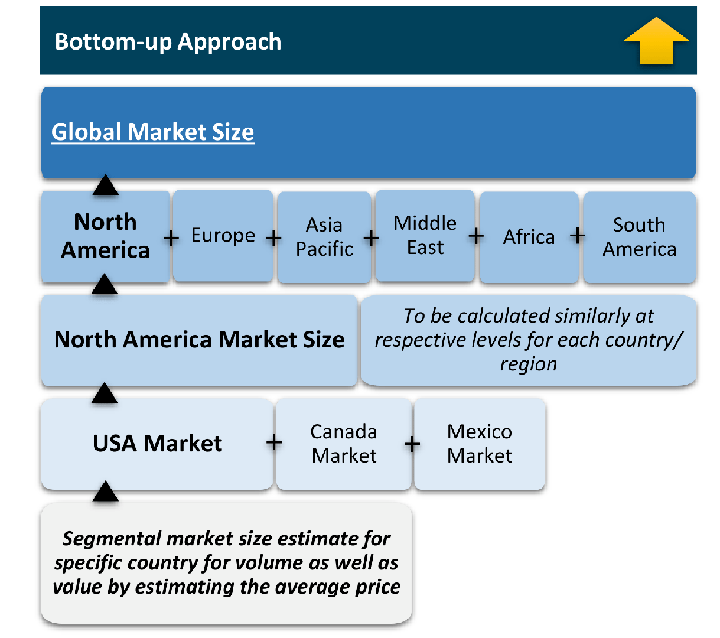
The bottom-up approach builds market estimates by starting with the smallest addressable market units and systematically aggregating them to create comprehensive market size projections.
This method begins with specific, granular data points and builds upward to create the complete market landscape.
Customer Analysis → Segmental Analysis → Geographical Analysis
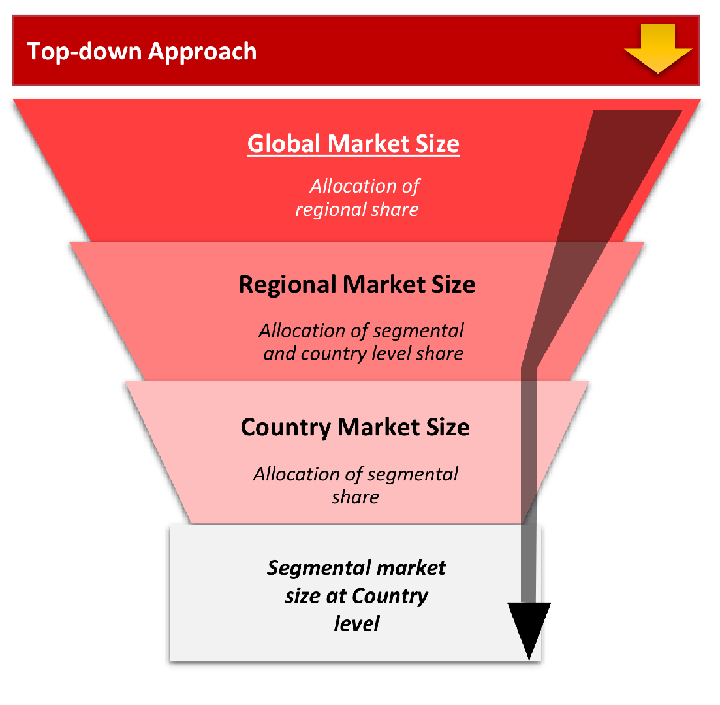
The top-down approach starts with the broadest possible market data and systematically narrows it down through a series of filters and assumptions to arrive at specific market segments or opportunities.
This method begins with the big picture and works downward to increasingly specific market slices.
TAM → SAM → SOM
Research Methods
Desk / Secondary Research
While analysing the market, we extensively study secondary sources, directories, and databases to identify and collect information useful for this technical, market-oriented, and commercial report. Secondary sources that we utilize are not only the public sources, but it is a combination of Open Source, Associations, Paid Databases, MG Repository & Knowledgebase, and others.
- Company websites, annual reports, financial reports, broker reports, and investor presentations
- National government documents, statistical databases and reports
- News articles, press releases and web-casts specific to the companies operating in the market, Magazines, reports, and others
- We gather information from commercial data sources for deriving company specific data such as segmental revenue, share for geography, product revenue, and others
- Internal and external proprietary databases (industry-specific), relevant patent, and regulatory databases
- Governing Bodies, Government Organizations
- Relevant Authorities, Country-specific Associations for Industries
We also employ the model mapping approach to estimate the product level market data through the players' product portfolio
Primary Research
Primary research/ interviews is vital in analyzing the market. Most of the cases involves paid primary interviews. Primary sources include primary interviews through e-mail interactions, telephonic interviews, surveys as well as face-to-face interviews with the different stakeholders across the value chain including several industry experts.
| Type of Respondents | Number of Primaries |
|---|---|
| Tier 2/3 Suppliers | ~20 |
| Tier 1 Suppliers | ~25 |
| End-users | ~25 |
| Industry Expert/ Panel/ Consultant | ~30 |
| Total | ~100 |
MG Knowledgebase
• Repository of industry blog, newsletter and case studies
• Online platform covering detailed market reports, and company profiles
Forecasting Factors and Models
Forecasting Factors
- Historical Trends – Past market patterns, cycles, and major events that shaped how markets behave over time. Understanding past trends helps predict future behavior.
- Industry Factors – Specific characteristics of the industry like structure, regulations, and innovation cycles that affect market dynamics.
- Macroeconomic Factors – Economic conditions like GDP growth, inflation, and employment rates that affect how much money people have to spend.
- Demographic Factors – Population characteristics like age, income, and location that determine who can buy your product.
- Technology Factors – How quickly people adopt new technology and how much technology infrastructure exists.
- Regulatory Factors – Government rules, laws, and policies that can help or restrict market growth.
- Competitive Factors – Analyzing competition structure such as degree of competition and bargaining power of buyers and suppliers.
Forecasting Models / Techniques
Multiple Regression Analysis
- Identify and quantify factors that drive market changes
- Statistical modeling to establish relationships between market drivers and outcomes
Time Series Analysis – Seasonal Patterns
- Understand regular cyclical patterns in market demand
- Advanced statistical techniques to separate trend, seasonal, and irregular components
Time Series Analysis – Trend Analysis
- Identify underlying market growth patterns and momentum
- Statistical analysis of historical data to project future trends
Expert Opinion – Expert Interviews
- Gather deep industry insights and contextual understanding
- In-depth interviews with key industry stakeholders
Multi-Scenario Development
- Prepare for uncertainty by modeling different possible futures
- Creating optimistic, pessimistic, and most likely scenarios
Time Series Analysis – Moving Averages
- Sophisticated forecasting for complex time series data
- Auto-regressive integrated moving average models with seasonal components
Econometric Models
- Apply economic theory to market forecasting
- Sophisticated economic models that account for market interactions
Expert Opinion – Delphi Method
- Harness collective wisdom of industry experts
- Structured, multi-round expert consultation process
Monte Carlo Simulation
- Quantify uncertainty and probability distributions
- Thousands of simulations with varying input parameters
Research Analysis
Our research framework is built upon the fundamental principle of validating market intelligence from both demand and supply perspectives. This dual-sided approach ensures comprehensive market understanding and reduces the risk of single-source bias.
Demand-Side Analysis: We understand end-user/application behavior, preferences, and market needs along with the penetration of the product for specific application.
Supply-Side Analysis: We estimate overall market revenue, analyze the segmental share along with industry capacity, competitive landscape, and market structure.
Validation & Evaluation
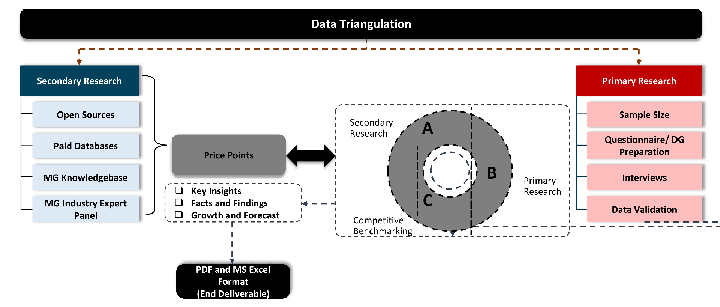
Data triangulation is a validation technique that uses multiple methods, sources, or perspectives to examine the same research question, thereby increasing the credibility and reliability of research findings. In market research, triangulation serves as a quality assurance mechanism that helps identify and minimize bias, validate assumptions, and ensure accuracy in market estimates.
- Data Source Triangulation – Using multiple data sources to examine the same phenomenon
- Methodological Triangulation – Using multiple research methods to study the same research question
- Investigator Triangulation – Using multiple researchers or analysts to examine the same data
- Theoretical Triangulation – Using multiple theoretical perspectives to interpret the same data
Custom Market Research Services
We will customise the research for you, in case the report listed above does not meet your requirements.
Get 10% Free Customisation