Smart Baby Monitor Market Size, Share & Trends Analysis Report by Product Type (Audio Baby Monitors, Video Baby Monitors, Movement/Breathing Monitors, Wearable Baby Monitors, Others), Technology, Connectivity, Distribution Channel, Display Type, Camera Resolution, Smart Features, End-users, and Geography (North America, Europe, Asia Pacific, Middle East, Africa, and South America) – Global Industry Data, Trends, and Forecasts, 2026–2035
|
|
|
Segmental Data Insights |
|
|
Demand Trends |
|
|
Competitive Landscape |
|
|
Strategic Development |
|
|
Future Outlook & Opportunities |
|
Smart Baby Monitor Market Size, Share, and Growth
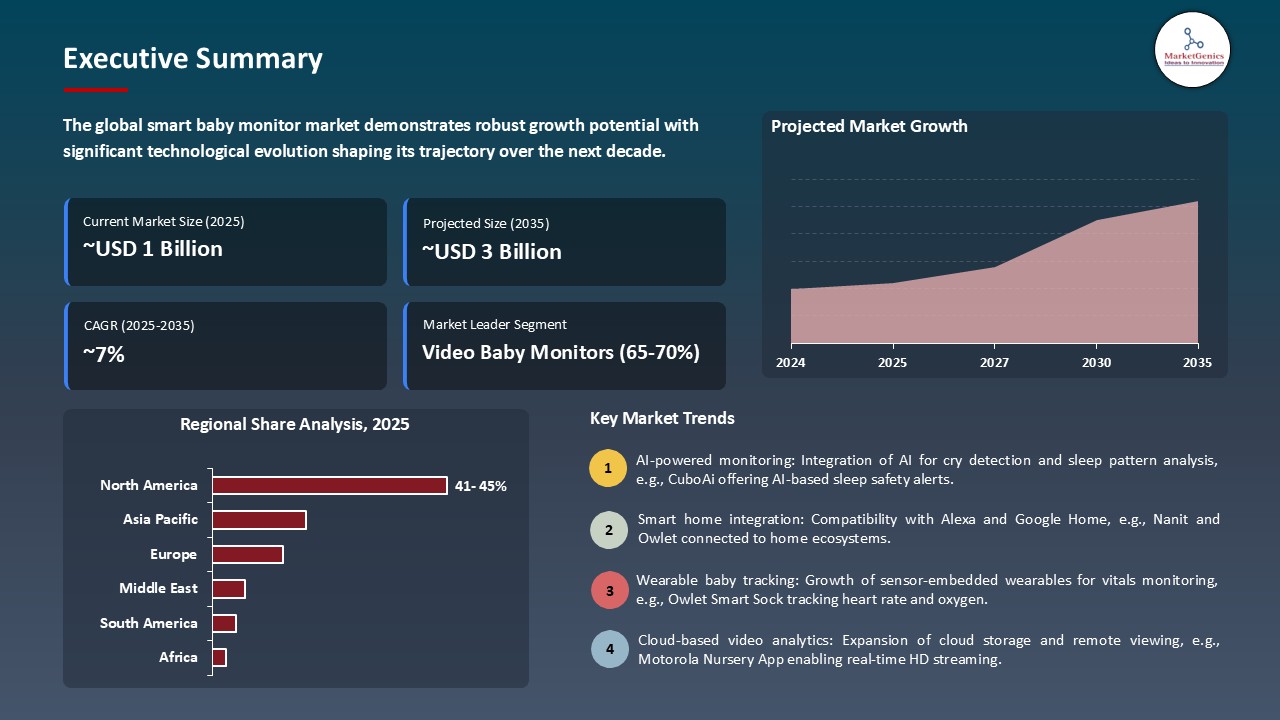
The global smart baby monitor market is experiencing robust growth, with its estimated value of USD 1.4 billion in the year 2025 and USD 2.7 billion by 2035, registering a CAGR of 6.9%, during the forecast period. The global smart baby monitor market is growing due to the increased interest in infant safety concerns and the use of AI- and IoT-based monitoring systems. Predictive cry, non-contact vital tracking, and smart home integration are some of the innovations that are increasing consumer acceptance. The market is further changing with expansion of e-commerce, subscriptions services and energy efficient and privacy oriented devices.
Joe Tham, President of Ellie, said,
"The Ellie Baby Plus baby monitor is perfect for parents who seeking advanced AI features without the privacy concerns that come with traditional WiFi-based monitors. With Ellie Baby Plus, parents can receive alerts, track sleep, and access other AI functions on the separate screen without needing WiFi. Plus, it also supports phone app connection for extra convenience."
The global smart baby monitors market is fueled by increased awareness of infant safety and the increasing functionality of AI and IoT. The emergence of nuclear families, dual-income families, and the growing disposable incomes in emerging economies are helping in the adoption, as parents are demanding solutions that will be connected to provide real-time monitoring solutions. For instance, in February 2025, Momcozy released its 5 inch 2-Mode Smart Baby Monitor, which supports both WiFi and non-WiFi connectivity with flexible choice and privacy, monitors temperature, humidity and baby movement to bring complete information about real-time and parental security.
The market is growing rapidly due to technological innovation whereby products with predictive capability of cry detection, two-way communications, HD video streaming, ambient lighting, and built-in white noise are integrated. For instance, in September 2025, Simsky released its Smart Baby Monitor, with a 7-inch touchscreen and a dual-lens design, cry detection with AI, face-cover notifications, gesture-controlled control, and offline/non-WiFi connectivity to improve the privacy of the device and the convenience of the parent. All these features will give timely notification, enhance infant safety, and facilitate proactive childcare management.
The market is further extended with adjacent opportunities such as wearable health trackers with biometric monitoring on infants, AI-based sleep coaching apps, and automation systems in the nursery combining temperature, humidity, and environmental regulation. These integrative resolutions form holistic childcare ecosystems, allow data-driven parenting insights, and facilitate easy interoperability with smart home platforms. The intersection of convenience, safety and technological innovation makes the global smart baby monitor market poised to grow consistently in the segments of health-conscious, technology-conscious, and eco-conscious consumers.

Smart Baby Monitor Market Dynamics and Trends
Driver: Growing Nuclear Family Structures and Working Parent Demographics
- The changing family patterns in the world are creating persistent needs of intelligent baby monitors, alongside broader demand for connected childcare solutions such as toddler products & accessories. Nuclear and dual-income families demand an increasing level of connected monitoring to keep them aware of infants wellbeing real-time in the workplace and throughout the day. HD video streaming, two way communication, and instant alerts are some of the features that allow parents to monitor infants even in their absence.
- Manufacturers are retaliating with highly developed safety solutions. For instance, in October 2025, CuboAi launched its Plus Smart Baby Monitor which offers covered-face and rollover detection and sends notifications when the face of the infant is covered or the infant rolls over. This indicates the rising significance of real-time alerts on safety and the artificial intelligence-based surveillance in contemporary childcare.
- The convergence of changing family lifestyles and technological improvements is redefining baby care practices, making smart monitors a valuable asset for safety, convenience, and knowledge in today's households.
Restraint: Privacy Concerns and Cybersecurity Vulnerabilities
- The smart baby monitor market has serious threats associated with data protection and confidentiality. Video streaming with cloud-connected devices opens the possibility of unauthorized access, data breaches, and privacy breaches, and is of concern to security-conscious consumers.
- Strict regulatory schemes, such as the California Consumer Privacy Act (CCPA) and the General Data Protection Regulation (GDPR) of Europe, introduce the costs of compliance and can limit some features. Smaller manufacturers do not have the technical skill or the financial ability to deploy enterprise-level security, which puts a barrier to entry. The conflict between ease of connection and super high security demands constant advancement in encryption, authentication and safeguarding of data.
- Those limitations could hamper the adoption of such products by traditionalist consumer groups, as well as the market's overall growth, therefore efficient and safe monitoring mechanisms are necessary.
Opportunity: Integration with Telehealth and Pediatric Care Platforms
- The integration of smart baby monitors and telehealth platforms has a great growth potential. Permanent health tracking simplifies remote consultations with a pediatrician, which contributes to the popularity of medical-level sensors in consumer gadgets. These systems enable healthcare providers to monitor the progress of infants, early health complications, and provide caregivers with evidence-based advice.
- Major companies are pursuing integration in the clinical field to increase market application. For instance, in April 2024, when Owlet Baby Care Inc. and Wheel Health Inc. collaborated to create a virtual telehealth platform using clinicians could order Owlet BabySat pulse oximeter through the portal of Wheel. This integration enables the caregiver to receive medical-grade monitoring at little or no charge through insurance reimbursement, which presents the possibility of clinical-grade usage in consumer-oriented devices.
- Insurance schemes in the developed markets are also starting to cover such devices, allowing cost savings and establishing new avenues of distribution. Practices through manufacturers, and healthcare systems, such as program pilot programs, increase uses of convenience into medical necessity.
- Recurring revenue streams associated with subscription-based monitoring services provide better market potential.
Key Trend: AI-Powered Predictive Analytics and Personalized Sleep Coaching
- AI integration with smart baby monitors will be an active childcare aid rather than a passive device. The sleep patterns, crying patterns, and the environment of the infant are all studied to make customized recommendations that maximize infant rest and growth. The abilities of predicting needs in advance contribute to making the babies more comfortable and enhancing the quality of sleep of the family.
- Innovation and new product launches are still experienced in the market. For instance, in July 2024, Jartoo introduced its No -WiFi baby monitor with 2K video and an AI-based crying sensor, which provides high-quality video without relying on the internet. It shows how the field of predictive analytics and tailored sleep advice is moving towards real-time tracking and real-time action-based advice on caregivers.
- Manufacturers are also using natural language processing to understand cry patterns, thus being able to differentiate between hunger, discomfort, fatigue, or illness. These behavioral profiles develop along with the infant, being complemented by visual monitoring, which makes them increasingly predictive.
- Integration of ecosystem and privacy-preserving federated learning improve the algorithms among users and enhance the understanding and protect data security.
Smart-Baby-Monitor-Market Analysis and Segmental Data
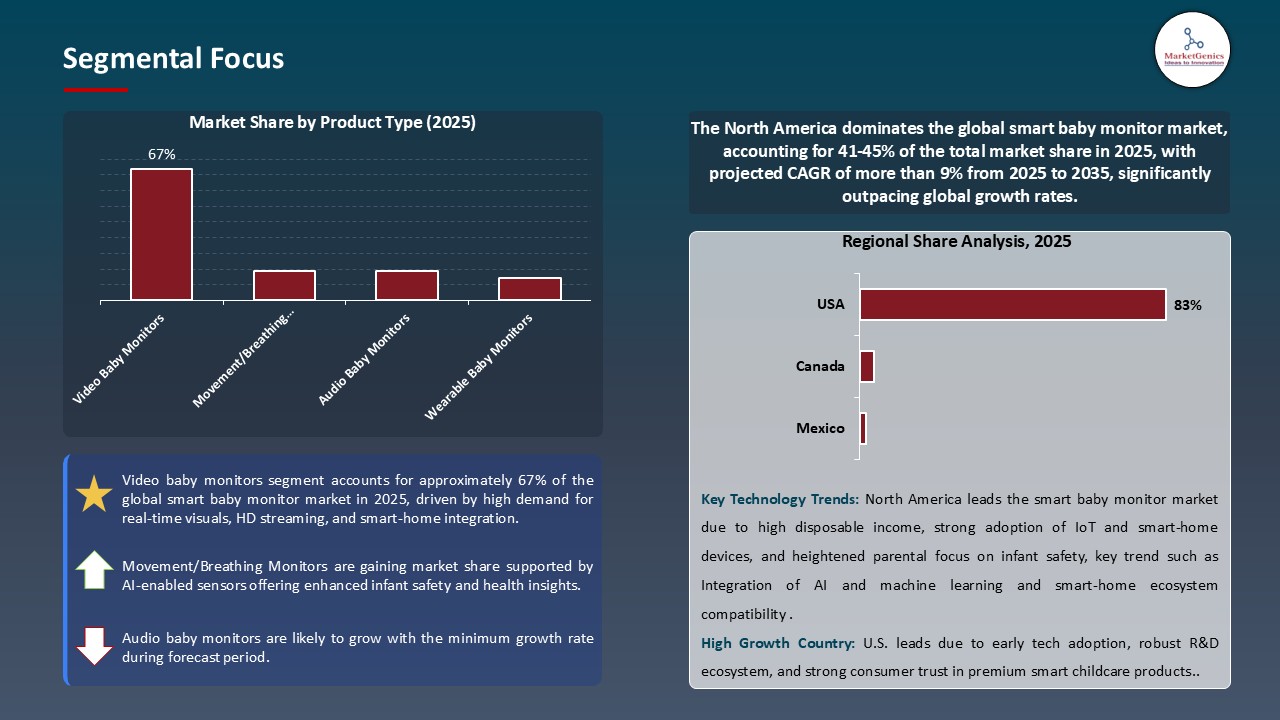
Video Baby Monitors Dominate Global Smart Baby Monitor Market
- The video baby monitor segment holds the largest share in the global smart baby monitor market, due to the desire of parents to view their babies and other advanced features like night vision, pan-tilt-zoom, and two-way audio. Video systems are capable of giving the full situational awareness that allows caregivers to observe infant comfort, sleep position and room conditions better than audio-only solutions.
- The segment has been experiencing innovation and product growth. In June 2024, Ellie released the Ellie Baby Plus, the first non-WiFi smart baby monitor with AI-driven cry detection, face-cover alerts, and 2.5K HD video, which provides strong monitoring without depending on an internet connection. This shows the continued focus on safety, AI, and availability in the market.
- The falling HD camera prices and the extensive use of the internet have enhanced affordability and accessibility. Pediatric consultation and developmental monitoring is supported by cloud-enabled recording and instant replay.
- New premium features like augmented reality overlays, multi-camera 3D spatial mapping, and AI-assisted sleep analytics are driving growth and solidifying video monitors' place in the smart infant monitoring market.
North America Leads Global Smart Baby Monitor Market Demand
- North America leads the smart baby monitor market due to high disposable income, technological consumers, and good knowledge of infant safety solutions. Parents are starting to prefer more connected devices which offer real-time feedback, automatic notifications, and compatibility with larger smart home-based systems as well as adjacent categories such as kids smartwatch. Regional manufacturers are in close proximity to innovation centers, well established retail systems, and advanced R and D, and therefore can develop products fast and gain market share.
- The area is still experiencing strategic development and expansion overseas. For instance, in October 2025, Owlet Baby Care Inc. was authorized to sell its Dream Sock in India by CDSCO, indicating its intention to expand internationally as it establishes the reputation of its sophisticated monitoring solution at home. This trend underscores the regulatory compliance and international market approach in the dynamic smart baby monitor industry.
- E-commerce and direct-to-consumer platforms will also improve accessibility, as well as create valuable usage data to be used to constantly improve the products. Large retailers help to make informed purchases, increased use of high-quality solutions AI-based monitoring, integrated nursery control, and non-contact sensors represent a transition to holistic and data-driven experiences in childcare.
Smart-Baby-Monitor-Market Ecosystem
The smart baby monitor market is moderately consolidated with the major players being Owlet Baby Care Inc., Nanit, Infant Optics, Philips Avent and Arlo Technologies, which dominate with sophisticated technology platform, high brand awareness, and wide distribution channels. The competitors in the mid-tier orient on the value positioning and selective feature distinction, and regional specialists and own-label manufacturers are used by price-sensitive segments.
The market value chain incorporates sensor creation, AI training, secure cloud system, application creation, and regulatory conformity. The most popular companies use vertical integration in hardware, software, and cloud services to provide users with a smooth experience and fasten the introduction of features. In April 2025, release of the contactless breathing motion monitoring by Nanit, which uses computer vision algorithms that have been trained on million video hours to identify minute chest motions, providing medical-quality respiratory monitoring without wearables.
This ecosystem also encourages ongoing innovation and has substantial barriers to entry by proprietary AI datasets, parental trust and extensive patent portfolios securing important technologies.
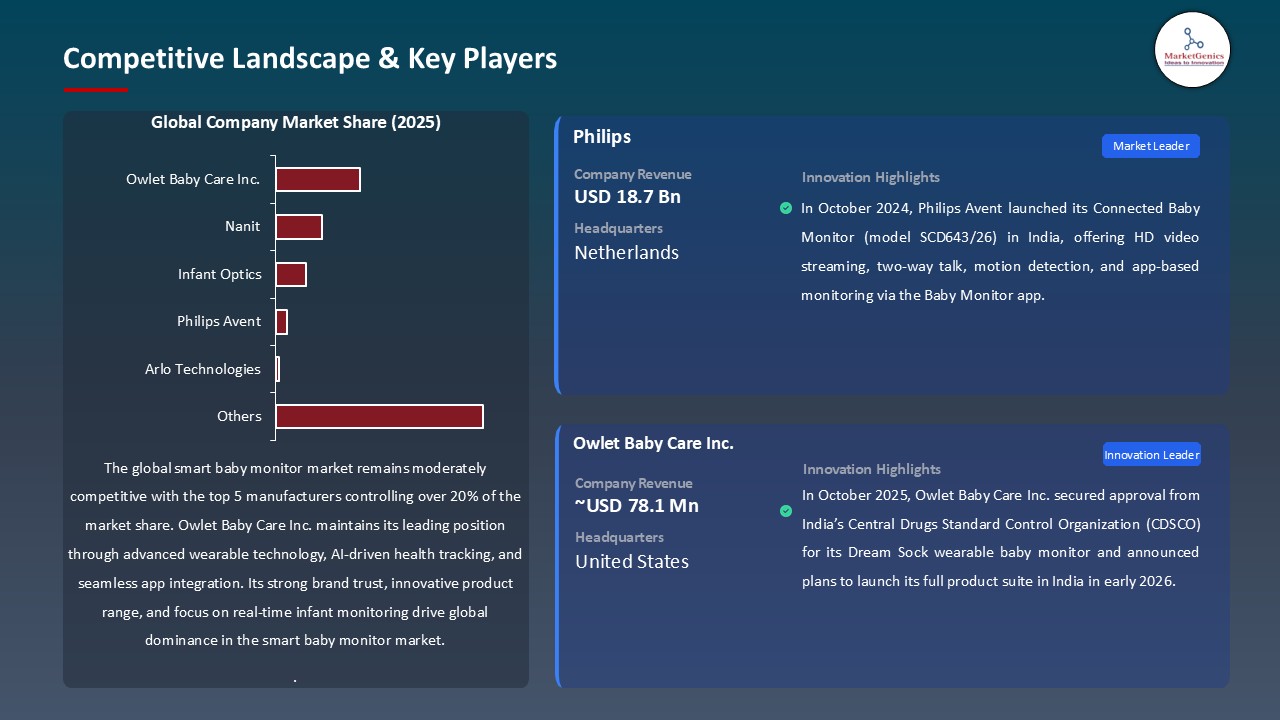
Recent Development and Strategic Overview:
- In October 2024, Philips Avent released its Premium Connected Baby Monitor, which includes proprietary SenseIQ wearable-free sleep and breathing monitoring, AI-based Cry Translation technology, a 5 inch parent unit with or without WiFi access and Secure Connect encrypted devices.
- In September 2025, Bosch launched the “Revol” intelligent baby crib, equipped with sensors to monitor vital signs such as heart rate and breathing, using AI to enhance infant rest and safety.
Report Scope
|
Detail |
|
|
Market Size in 2025 |
USD 1.4 Bn |
|
Market Forecast Value in 2035 |
USD 2.7 Bn |
|
Growth Rate (CAGR) |
6.9% |
|
Forecast Period |
2026 – 2035 |
|
Historical Data Available for |
2021 – 2024 |
|
Market Size Units |
US$ Billion for Value Thousand Units |
|
Report Format |
Electronic (PDF) + Excel |
|
North America |
Europe |
Asia Pacific |
Middle East |
Africa |
South America |
|
|
|
|
|
|
|
Companies Covered |
|||||
|
|
|
|
|
|
Smart-Baby-Monitor-Market Segmentation and Highlights
|
Segment |
Sub-segment |
|
Smart Baby Monitor Market, By Product Type |
|
|
Smart Baby Monitor Market, By Technology |
|
|
Smart Baby Monitor Market, By Connectivity |
|
|
Smart Baby Monitor Market, By Distribution Channel |
|
|
Smart Baby Monitor Market, Display Type |
|
|
Smart Baby Monitor Market, By Camera Resolution |
|
|
Smart Baby Monitor Market, By Smart Features |
|
|
Smart Baby Monitor Market, By End-users |
|
Frequently Asked Questions
Table of Contents
- 1. Research Methodology and Assumptions
- 1.1. Definitions
- 1.2. Research Design and Approach
- 1.3. Data Collection Methods
- 1.4. Base Estimates and Calculations
- 1.5. Forecasting Models
- 1.5.1. Key Forecast Factors & Impact Analysis
- 1.6. Secondary Research
- 1.6.1. Open Sources
- 1.6.2. Paid Databases
- 1.6.3. Associations
- 1.7. Primary Research
- 1.7.1. Primary Sources
- 1.7.2. Primary Interviews with Stakeholders across Ecosystem
- 2. Executive Summary
- 2.1. Global Smart Baby Monitor Market Outlook
- 2.1.1. Smart Baby Monitor Market Size Volume (Thousand Units) and Value (US$ Bn), and Forecasts, 2021-2035
- 2.1.2. Compounded Annual Growth Rate Analysis
- 2.1.3. Growth Opportunity Analysis
- 2.1.4. Segmental Share Analysis
- 2.1.5. Geographical Share Analysis
- 2.2. Market Analysis and Facts
- 2.3. Supply-Demand Analysis
- 2.4. Competitive Benchmarking
- 2.5. Go-to- Market Strategy
- 2.5.1. Customer/ End-use Industry Assessment
- 2.5.2. Growth Opportunity Data, 2026-2035
- 2.5.2.1. Regional Data
- 2.5.2.2. Country Data
- 2.5.2.3. Segmental Data
- 2.5.3. Identification of Potential Market Spaces
- 2.5.4. GAP Analysis
- 2.5.5. Potential Attractive Price Points
- 2.5.6. Prevailing Market Risks & Challenges
- 2.5.7. Preferred Sales & Marketing Strategies
- 2.5.8. Key Recommendations and Analysis
- 2.5.9. A Way Forward
- 2.1. Global Smart Baby Monitor Market Outlook
- 3. Industry Data and Premium Insights
- 3.1. Global Consumer Goods & Services Industry Overview, 2025
- 3.1.1. Consumer Goods & Services Industry Ecosystem Analysis
- 3.1.2. Key Trends for Consumer Goods & Services Industry
- 3.1.3. Regional Distribution for Consumer Goods & Services Industry
- 3.2. Supplier Customer Data
- 3.3. Technology Roadmap and Developments
- 3.4. Trade Analysis
- 3.4.1. Import & Export Analysis, 2025
- 3.4.2. Top Importing Countries
- 3.4.3. Top Exporting Countries
- 3.5. Trump Tariff Impact Analysis
- 3.5.1. Manufacturer
- 3.5.1.1. Based on the component & Raw material
- 3.5.2. Supply Chain
- 3.5.3. End Consumer
- 3.5.1. Manufacturer
- 3.6. Raw Material Analysis
- 3.1. Global Consumer Goods & Services Industry Overview, 2025
- 4. Market Overview
- 4.1. Market Dynamics
- 4.1.1. Drivers
- 4.1.1.1. Rapid adoption of IoT and smart-home integration enabling remote, real-time monitoring.
- 4.1.1.2. Rising parental safety awareness and prevalence of dual-income households increasing demand.
- 4.1.1.3. Advances in AI/ML (cry detection, sleep analytics, video processing) and improved sensor tech.
- 4.1.2. Restraints
- 4.1.2.1. Privacy and data-security concerns (camera hacking, cloud data breaches).
- 4.1.2.2. High device prices and interoperability/compatibility issues across platforms and networks.
- 4.1.1. Drivers
- 4.2. Key Trend Analysis
- 4.3. Regulatory Framework
- 4.3.1. Key Regulations, Norms, and Subsidies, by Key Countries
- 4.3.2. Tariffs and Standards
- 4.3.3. Impact Analysis of Regulations on the Market
- 4.4. Value Chain Analysis
- 4.4.1. Component Suppliers
- 4.4.2. Manufacturers
- 4.4.3. Distributors
- 4.4.4. End-Users
- 4.5. Cost Structure Analysis
- 4.5.1. Parameter’s Share for Cost Associated
- 4.5.2. COGP vs COGS
- 4.5.3. Profit Margin Analysis
- 4.6. Pricing Analysis
- 4.6.1. Regional Pricing Analysis
- 4.6.2. Segmental Pricing Trends
- 4.6.3. Factors Influencing Pricing
- 4.7. Porter’s Five Forces Analysis
- 4.8. PESTEL Analysis
- 4.9. Global Smart Baby Monitor Market Demand
- 4.9.1. Historical Market Size – Volume (Thousand Units) and Value (US$ Bn), 2020-2024
- 4.9.2. Current and Future Market Size – Volume (Thousand Units) and Value (US$ Bn), 2026–2035
- 4.9.2.1. Y-o-Y Growth Trends
- 4.9.2.2. Absolute $ Opportunity Assessment
- 4.1. Market Dynamics
- 5. Competition Landscape
- 5.1. Competition structure
- 5.1.1. Fragmented v/s consolidated
- 5.2. Company Share Analysis, 2025
- 5.2.1. Global Company Market Share
- 5.2.2. By Region
- 5.2.2.1. North America
- 5.2.2.2. Europe
- 5.2.2.3. Asia Pacific
- 5.2.2.4. Middle East
- 5.2.2.5. Africa
- 5.2.2.6. South America
- 5.3. Product Comparison Matrix
- 5.3.1. Specifications
- 5.3.2. Market Positioning
- 5.3.3. Pricing
- 5.1. Competition structure
- 6. Global Smart Baby Monitor Market Analysis, by Product Type
- 6.1. Key Segment Analysis
- 6.2. Smart Baby Monitor Market Size Volume (Thousand Units) and Value (US$ Bn), Analysis, and Forecasts, by Product Type, 2021-2035
- 6.2.1. Audio Baby Monitors
- 6.2.2. Video Baby Monitors
- 6.2.3. Movement/Breathing Monitors
- 6.2.4. Wearable Baby Monitors
- 6.2.5. Others
- 7. Global Smart Baby Monitor Market Analysis, by Technology
- 7.1. Key Segment Analysis
- 7.2. Smart Baby Monitor Market Size Volume (Thousand Units) and Value (US$ Bn), Analysis, and Forecasts, by Technology, 2021-2035
- 7.2.1. Wi-Fi Enabled Monitors
- 7.2.2. Bluetooth Enabled Monitors
- 7.2.3. DECT (Digital Enhanced Cordless Telecommunications)
- 7.2.4. FHSS (Frequency-Hopping Spread Spectrum)
- 7.2.5. Cellular/4G/5G Connected Monitors
- 7.2.6. Others
- 8. Global Smart Baby Monitor Market Analysis, by Connectivity
- 8.1. Key Segment Analysis
- 8.2. Smart Baby Monitor Market Size Volume (Thousand Units) and Value (US$ Bn), Analysis, and Forecasts, by Connectivity, 2021-2035
- 8.2.1. Wireless Baby Monitors
- 8.2.2. Wired Baby Monitors
- 8.2.3. Hybrid Connectivity Monitors
- 9. Global Smart Baby Monitor Market Analysis, by Distribution Channel
- 9.1. Key Segment Analysis
- 9.2. Smart Baby Monitor Market Size Volume (Thousand Units) and Value (US$ Bn), Analysis, and Forecasts, by Distribution Channel, 2021-2035
- 9.2.1. Online Channels
- 9.2.1.1. E-commerce Platforms
- 9.2.1.2. Company Websites
- 9.2.1.3. Online Specialty Stores
- 9.2.1.4. Others
- 9.2.2. Offline Channels
- 9.2.2.1. Supermarkets/Hypermarkets
- 9.2.2.2. Specialty Baby Stores
- 9.2.2.3. Electronics Stores
- 9.2.2.4. Pharmacy/Drugstores
- 9.2.2.5. Others
- 9.2.1. Online Channels
- 10. Global Smart Baby Monitor Market Analysis, by Display Type
- 10.1. Key Segment Analysis
- 10.2. Smart Baby Monitor Market Size Volume (Thousand Units) and Value (US$ Bn), Analysis, and Forecasts, by Display Type, 2021-2035
- 10.2.1. Handheld Monitor with Screen
- 10.2.2. Smartphone/Tablet Display
- 10.2.3. Smart TV Compatible
- 10.2.4. No Display (Audio Only)
- 11. Global Smart Baby Monitor Market Analysis, by Camera Resolution
- 11.1. Key Segment Analysis
- 11.2. Smart Baby Monitor Market Size Volume (Thousand Units) and Value (US$ Bn), Analysis, and Forecasts, by Camera Resolution, 2021-2035
- 11.2.1. Standard Definition (SD)
- 11.2.2. High Definition (HD - 720p)
- 11.2.3. Full HD (1080p)
- 11.2.4. Ultra HD/4K
- 12. Global Smart Baby Monitor Market Analysis, by Smart Features
- 12.1. Key Segment Analysis
- 12.2. Smart Baby Monitor Market Size Volume (Thousand Units) and Value (US$ Bn), Analysis, and Forecasts, by Smart Features, 2021-2035
- 12.2.1. Basic Monitoring
- 12.2.2. AI-Powered Cry Analysis
- 12.2.3. Predictive Analytics & Insights
- 12.2.4. Sleep Pattern Recognition
- 12.2.5. Face Recognition
- 12.2.6. Anomaly Detection
- 12.2.7. Others
- 13. Global Smart Baby Monitor Market Analysis, by End-users
- 13.1. Key Segment Analysis
- 13.2. Smart Baby Monitor Market Size Volume (Thousand Units) and Value (US$ Bn), Analysis, and Forecasts, by End-users, 2021-2035
- 13.2.1. Residential/Household Use
- 13.2.2. Commercial Use
- 13.2.2.1. Daycare Centers
- 13.2.2.2. Nurseries
- 13.2.2.3. Hospitals/Healthcare Facilities
- 13.2.2.4. Hotels/Hospitality
- 13.2.2.5. Others
- 14. Global Smart Baby Monitor Market Analysis and Forecasts, by Region
- 14.1. Key Findings
- 14.2. Smart Baby Monitor Market Size Volume (Thousand Units) and Value (US$ Bn), Analysis, and Forecasts, by Region, 2021-2035
- 14.2.1. North America
- 14.2.2. Europe
- 14.2.3. Asia Pacific
- 14.2.4. Middle East
- 14.2.5. Africa
- 14.2.6. South America
- 15. North America Smart Baby Monitor Market Analysis
- 15.1. Key Segment Analysis
- 15.2. Regional Snapshot
- 15.3. North America Smart Baby Monitor Market Size- Volume (Thousand Units) and Value (US$ Bn), Analysis, and Forecasts, 2021-2035
- 15.3.1. Product Type
- 15.3.2. Technology
- 15.3.3. Connectivity
- 15.3.4. Distribution Channel
- 15.3.5. Display Type
- 15.3.6. Camera Resolution
- 15.3.7. Smart Features
- 15.3.8. End-users
- 15.3.9. Country
- 15.3.9.1. USA
- 15.3.9.2. Canada
- 15.3.9.3. Mexico
- 15.4. USA Smart Baby Monitor Market
- 15.4.1. Country Segmental Analysis
- 15.4.2. Product Type
- 15.4.3. Technology
- 15.4.4. Connectivity
- 15.4.5. Distribution Channel
- 15.4.6. Display Type
- 15.4.7. Camera Resolution
- 15.4.8. Smart Features
- 15.4.9. End-users
- 15.5. Canada Smart Baby Monitor Market
- 15.5.1. Country Segmental Analysis
- 15.5.2. Product Type
- 15.5.3. Technology
- 15.5.4. Connectivity
- 15.5.5. Distribution Channel
- 15.5.6. Display Type
- 15.5.7. Camera Resolution
- 15.5.8. Smart Features
- 15.5.9. End-users
- 15.6. Mexico Smart Baby Monitor Market
- 15.6.1. Country Segmental Analysis
- 15.6.2. Product Type
- 15.6.3. Technology
- 15.6.4. Connectivity
- 15.6.5. Distribution Channel
- 15.6.6. Display Type
- 15.6.7. Camera Resolution
- 15.6.8. Smart Features
- 15.6.9. End-users
- 16. Europe Smart Baby Monitor Market Analysis
- 16.1. Key Segment Analysis
- 16.2. Regional Snapshot
- 16.3. Europe Smart Baby Monitor Market Size Volume (Thousand Units) and Value (US$ Bn), Analysis, and Forecasts, 2021-2035
- 16.3.1. Product Type
- 16.3.2. Technology
- 16.3.3. Connectivity
- 16.3.4. Distribution Channel
- 16.3.5. Display Type
- 16.3.6. Camera Resolution
- 16.3.7. Smart Features
- 16.3.8. End-users
- 16.3.9. Country
- 16.3.9.1. Germany
- 16.3.9.2. United Kingdom
- 16.3.9.3. France
- 16.3.9.4. Italy
- 16.3.9.5. Spain
- 16.3.9.6. Netherlands
- 16.3.9.7. Nordic Countries
- 16.3.9.8. Poland
- 16.3.9.9. Russia & CIS
- 16.3.9.10. Rest of Europe
- 16.4. Germany Smart Baby Monitor Market
- 16.4.1. Country Segmental Analysis
- 16.4.2. Product Type
- 16.4.3. Technology
- 16.4.4. Connectivity
- 16.4.5. Distribution Channel
- 16.4.6. Display Type
- 16.4.7. Camera Resolution
- 16.4.8. Smart Features
- 16.4.9. End-users
- 16.5. United Kingdom Smart Baby Monitor Market
- 16.5.1. Country Segmental Analysis
- 16.5.2. Product Type
- 16.5.3. Technology
- 16.5.4. Connectivity
- 16.5.5. Distribution Channel
- 16.5.6. Display Type
- 16.5.7. Camera Resolution
- 16.5.8. Smart Features
- 16.5.9. End-users
- 16.6. France Smart Baby Monitor Market
- 16.6.1. Country Segmental Analysis
- 16.6.2. Product Type
- 16.6.3. Technology
- 16.6.4. Connectivity
- 16.6.5. Distribution Channel
- 16.6.6. Display Type
- 16.6.7. Camera Resolution
- 16.6.8. Smart Features
- 16.6.9. End-users
- 16.7. Italy Smart Baby Monitor Market
- 16.7.1. Country Segmental Analysis
- 16.7.2. Product Type
- 16.7.3. Technology
- 16.7.4. Connectivity
- 16.7.5. Distribution Channel
- 16.7.6. Display Type
- 16.7.7. Camera Resolution
- 16.7.8. Smart Features
- 16.7.9. End-users
- 16.8. Spain Smart Baby Monitor Market
- 16.8.1. Country Segmental Analysis
- 16.8.2. Product Type
- 16.8.3. Technology
- 16.8.4. Connectivity
- 16.8.5. Distribution Channel
- 16.8.6. Display Type
- 16.8.7. Camera Resolution
- 16.8.8. Smart Features
- 16.8.9. End-users
- 16.9. Netherlands Smart Baby Monitor Market
- 16.9.1. Country Segmental Analysis
- 16.9.2. Product Type
- 16.9.3. Technology
- 16.9.4. Connectivity
- 16.9.5. Distribution Channel
- 16.9.6. Display Type
- 16.9.7. Camera Resolution
- 16.9.8. Smart Features
- 16.9.9. End-users
- 16.10. Nordic Countries Smart Baby Monitor Market
- 16.10.1. Country Segmental Analysis
- 16.10.2. Product Type
- 16.10.3. Technology
- 16.10.4. Connectivity
- 16.10.5. Distribution Channel
- 16.10.6. Display Type
- 16.10.7. Camera Resolution
- 16.10.8. Smart Features
- 16.10.9. End-users
- 16.11. Poland Smart Baby Monitor Market
- 16.11.1. Country Segmental Analysis
- 16.11.2. Product Type
- 16.11.3. Technology
- 16.11.4. Connectivity
- 16.11.5. Distribution Channel
- 16.11.6. Display Type
- 16.11.7. Camera Resolution
- 16.11.8. Smart Features
- 16.11.9. End-users
- 16.12. Russia & CIS Smart Baby Monitor Market
- 16.12.1. Country Segmental Analysis
- 16.12.2. Product Type
- 16.12.3. Technology
- 16.12.4. Connectivity
- 16.12.5. Distribution Channel
- 16.12.6. Display Type
- 16.12.7. Camera Resolution
- 16.12.8. Smart Features
- 16.12.9. End-users
- 16.13. Rest of Europe Smart Baby Monitor Market
- 16.13.1. Country Segmental Analysis
- 16.13.2. Product Type
- 16.13.3. Technology
- 16.13.4. Connectivity
- 16.13.5. Distribution Channel
- 16.13.6. Display Type
- 16.13.7. Camera Resolution
- 16.13.8. Smart Features
- 16.13.9. End-users
- 17. Asia Pacific Smart Baby Monitor Market Analysis
- 17.1. Key Segment Analysis
- 17.2. Regional Snapshot
- 17.3. Asia Pacific Smart Baby Monitor Market Size Volume (Thousand Units) and Value (US$ Bn), Analysis, and Forecasts, 2021-2035
- 17.3.1. Product Type
- 17.3.2. Technology
- 17.3.3. Connectivity
- 17.3.4. Distribution Channel
- 17.3.5. Display Type
- 17.3.6. Camera Resolution
- 17.3.7. Smart Features
- 17.3.8. End-users
- 17.3.9. Country
- 17.3.9.1. China
- 17.3.9.2. India
- 17.3.9.3. Japan
- 17.3.9.4. South Korea
- 17.3.9.5. Australia and New Zealand
- 17.3.9.6. Indonesia
- 17.3.9.7. Malaysia
- 17.3.9.8. Thailand
- 17.3.9.9. Vietnam
- 17.3.9.10. Rest of Asia Pacific
- 17.4. China Smart Baby Monitor Market
- 17.4.1. Country Segmental Analysis
- 17.4.2. Product Type
- 17.4.3. Technology
- 17.4.4. Connectivity
- 17.4.5. Distribution Channel
- 17.4.6. Display Type
- 17.4.7. Camera Resolution
- 17.4.8. Smart Features
- 17.4.9. End-users
- 17.5. India Smart Baby Monitor Market
- 17.5.1. Country Segmental Analysis
- 17.5.2. Product Type
- 17.5.3. Technology
- 17.5.4. Connectivity
- 17.5.5. Distribution Channel
- 17.5.6. Display Type
- 17.5.7. Camera Resolution
- 17.5.8. Smart Features
- 17.5.9. End-users
- 17.6. Japan Smart Baby Monitor Market
- 17.6.1. Country Segmental Analysis
- 17.6.2. Product Type
- 17.6.3. Technology
- 17.6.4. Connectivity
- 17.6.5. Distribution Channel
- 17.6.6. Display Type
- 17.6.7. Camera Resolution
- 17.6.8. Smart Features
- 17.6.9. End-users
- 17.7. South Korea Smart Baby Monitor Market
- 17.7.1. Country Segmental Analysis
- 17.7.2. Product Type
- 17.7.3. Technology
- 17.7.4. Connectivity
- 17.7.5. Distribution Channel
- 17.7.6. Display Type
- 17.7.7. Camera Resolution
- 17.7.8. Smart Features
- 17.7.9. End-users
- 17.8. Australia and New Zealand Smart Baby Monitor Market
- 17.8.1. Country Segmental Analysis
- 17.8.2. Product Type
- 17.8.3. Technology
- 17.8.4. Connectivity
- 17.8.5. Distribution Channel
- 17.8.6. Display Type
- 17.8.7. Camera Resolution
- 17.8.8. Smart Features
- 17.8.9. End-users
- 17.9. Indonesia Smart Baby Monitor Market
- 17.9.1. Country Segmental Analysis
- 17.9.2. Product Type
- 17.9.3. Technology
- 17.9.4. Connectivity
- 17.9.5. Distribution Channel
- 17.9.6. Display Type
- 17.9.7. Camera Resolution
- 17.9.8. Smart Features
- 17.9.9. End-users
- 17.10. Malaysia Smart Baby Monitor Market
- 17.10.1. Country Segmental Analysis
- 17.10.2. Product Type
- 17.10.3. Technology
- 17.10.4. Connectivity
- 17.10.5. Distribution Channel
- 17.10.6. Display Type
- 17.10.7. Camera Resolution
- 17.10.8. Smart Features
- 17.10.9. End-users
- 17.11. Thailand Smart Baby Monitor Market
- 17.11.1. Country Segmental Analysis
- 17.11.2. Product Type
- 17.11.3. Technology
- 17.11.4. Connectivity
- 17.11.5. Distribution Channel
- 17.11.6. Display Type
- 17.11.7. Camera Resolution
- 17.11.8. Smart Features
- 17.11.9. End-users
- 17.12. Vietnam Smart Baby Monitor Market
- 17.12.1. Country Segmental Analysis
- 17.12.2. Product Type
- 17.12.3. Technology
- 17.12.4. Connectivity
- 17.12.5. Distribution Channel
- 17.12.6. Display Type
- 17.12.7. Camera Resolution
- 17.12.8. Smart Features
- 17.12.9. End-users
- 17.13. Rest of Asia Pacific Smart Baby Monitor Market
- 17.13.1. Country Segmental Analysis
- 17.13.2. Product Type
- 17.13.3. Technology
- 17.13.4. Connectivity
- 17.13.5. Distribution Channel
- 17.13.6. Display Type
- 17.13.7. Camera Resolution
- 17.13.8. Smart Features
- 17.13.9. End-users
- 18. Middle East Smart Baby Monitor Market Analysis
- 18.1. Key Segment Analysis
- 18.2. Regional Snapshot
- 18.3. Middle East Smart Baby Monitor Market Size Volume (Thousand Units) and Value (US$ Bn), Analysis, and Forecasts, 2021-2035
- 18.3.1. Product Type
- 18.3.2. Technology
- 18.3.3. Connectivity
- 18.3.4. Distribution Channel
- 18.3.5. Display Type
- 18.3.6. Camera Resolution
- 18.3.7. Smart Features
- 18.3.8. End-users
- 18.3.9. Country
- 18.3.9.1. Turkey
- 18.3.9.2. UAE
- 18.3.9.3. Saudi Arabia
- 18.3.9.4. Israel
- 18.3.9.5. Rest of Middle East
- 18.4. Turkey Smart Baby Monitor Market
- 18.4.1. Country Segmental Analysis
- 18.4.2. Product Type
- 18.4.3. Technology
- 18.4.4. Connectivity
- 18.4.5. Distribution Channel
- 18.4.6. Display Type
- 18.4.7. Camera Resolution
- 18.4.8. Smart Features
- 18.4.9. End-users
- 18.5. UAE Smart Baby Monitor Market
- 18.5.1. Country Segmental Analysis
- 18.5.2. Product Type
- 18.5.3. Technology
- 18.5.4. Connectivity
- 18.5.5. Distribution Channel
- 18.5.6. Display Type
- 18.5.7. Camera Resolution
- 18.5.8. Smart Features
- 18.5.9. End-users
- 18.6. Saudi Arabia Smart Baby Monitor Market
- 18.6.1. Country Segmental Analysis
- 18.6.2. Product Type
- 18.6.3. Technology
- 18.6.4. Connectivity
- 18.6.5. Distribution Channel
- 18.6.6. Display Type
- 18.6.7. Camera Resolution
- 18.6.8. Smart Features
- 18.6.9. End-users
- 18.7. Israel Smart Baby Monitor Market
- 18.7.1. Country Segmental Analysis
- 18.7.2. Product Type
- 18.7.3. Technology
- 18.7.4. Connectivity
- 18.7.5. Distribution Channel
- 18.7.6. Display Type
- 18.7.7. Camera Resolution
- 18.7.8. Smart Features
- 18.7.9. End-users
- 18.8. Rest of Middle East Smart Baby Monitor Market
- 18.8.1. Country Segmental Analysis
- 18.8.2. Product Type
- 18.8.3. Technology
- 18.8.4. Connectivity
- 18.8.5. Distribution Channel
- 18.8.6. Display Type
- 18.8.7. Camera Resolution
- 18.8.8. Smart Features
- 18.8.9. End-users
- 19. Africa Smart Baby Monitor Market Analysis
- 19.1. Key Segment Analysis
- 19.2. Regional Snapshot
- 19.3. Africa Smart Baby Monitor Market Size Volume (Thousand Units) and Value (US$ Bn), Analysis, and Forecasts, 2021-2035
- 19.3.1. Product Type
- 19.3.2. Technology
- 19.3.3. Connectivity
- 19.3.4. Distribution Channel
- 19.3.5. Display Type
- 19.3.6. Camera Resolution
- 19.3.7. Smart Features
- 19.3.8. End-users
- 19.3.9. Country
- 19.3.9.1. South Africa
- 19.3.9.2. Egypt
- 19.3.9.3. Nigeria
- 19.3.9.4. Algeria
- 19.3.9.5. Rest of Africa
- 19.4. South Africa Smart Baby Monitor Market
- 19.4.1. Country Segmental Analysis
- 19.4.2. Product Type
- 19.4.3. Technology
- 19.4.4. Connectivity
- 19.4.5. Distribution Channel
- 19.4.6. Display Type
- 19.4.7. Camera Resolution
- 19.4.8. Smart Features
- 19.4.9. End-users
- 19.5. Egypt Smart Baby Monitor Market
- 19.5.1. Country Segmental Analysis
- 19.5.2. Product Type
- 19.5.3. Technology
- 19.5.4. Connectivity
- 19.5.5. Distribution Channel
- 19.5.6. Display Type
- 19.5.7. Camera Resolution
- 19.5.8. Smart Features
- 19.5.9. End-users
- 19.6. Nigeria Smart Baby Monitor Market
- 19.6.1. Country Segmental Analysis
- 19.6.2. Product Type
- 19.6.3. Technology
- 19.6.4. Connectivity
- 19.6.5. Distribution Channel
- 19.6.6. Display Type
- 19.6.7. Camera Resolution
- 19.6.8. Smart Features
- 19.6.9. End-users
- 19.7. Algeria Smart Baby Monitor Market
- 19.7.1. Country Segmental Analysis
- 19.7.2. Product Type
- 19.7.3. Technology
- 19.7.4. Connectivity
- 19.7.5. Distribution Channel
- 19.7.6. Display Type
- 19.7.7. Camera Resolution
- 19.7.8. Smart Features
- 19.7.9. End-users
- 19.8. Rest of Africa Smart Baby Monitor Market
- 19.8.1. Country Segmental Analysis
- 19.8.2. Product Type
- 19.8.3. Technology
- 19.8.4. Connectivity
- 19.8.5. Distribution Channel
- 19.8.6. Display Type
- 19.8.7. Camera Resolution
- 19.8.8. Smart Features
- 19.8.9. End-users
- 20. South America Smart Baby Monitor Market Analysis
- 20.1. Key Segment Analysis
- 20.2. Regional Snapshot
- 20.3. South America Smart Baby Monitor Market Size Volume (Thousand Units) and Value (US$ Bn), Analysis, and Forecasts, 2021-2035
- 20.3.1. Product Type
- 20.3.2. Technology
- 20.3.3. Connectivity
- 20.3.4. Distribution Channel
- 20.3.5. Display Type
- 20.3.6. Camera Resolution
- 20.3.7. Smart Features
- 20.3.8. End-users
- 20.3.9. Country
- 20.3.9.1. Brazil
- 20.3.9.2. Argentina
- 20.3.9.3. Rest of South America
- 20.4. Brazil Smart Baby Monitor Market
- 20.4.1. Country Segmental Analysis
- 20.4.2. Product Type
- 20.4.3. Technology
- 20.4.4. Connectivity
- 20.4.5. Distribution Channel
- 20.4.6. Display Type
- 20.4.7. Camera Resolution
- 20.4.8. Smart Features
- 20.4.9. End-users
- 20.5. Argentina Smart Baby Monitor Market
- 20.5.1. Country Segmental Analysis
- 20.5.2. Product Type
- 20.5.3. Technology
- 20.5.4. Connectivity
- 20.5.5. Distribution Channel
- 20.5.6. Display Type
- 20.5.7. Camera Resolution
- 20.5.8. Smart Features
- 20.5.9. End-users
- 20.6. Rest of South America Smart Baby Monitor Market
- 20.6.1. Country Segmental Analysis
- 20.6.2. Product Type
- 20.6.3. Technology
- 20.6.4. Connectivity
- 20.6.5. Distribution Channel
- 20.6.6. Display Type
- 20.6.7. Camera Resolution
- 20.6.8. Smart Features
- 20.6.9. End-users
- 21. Key Players/ Company Profile
- 21.1. Angelcare Monitor Inc.
- 21.1.1. Company Details/ Overview
- 21.1.2. Company Financials
- 21.1.3. Key Customers and Competitors
- 21.1.4. Business/ Industry Portfolio
- 21.1.5. Product Portfolio/ Specification Details
- 21.1.6. Pricing Data
- 21.1.7. Strategic Overview
- 21.1.8. Recent Developments
- 21.2. Arlo Technologies
- 21.3. Babysense
- 21.4. Cubo AI
- 21.5. Graco Children’s Products Inc.
- 21.6. Hubble Connected
- 21.7. iBaby Labs Inc.
- 21.8. Infant Optics
- 21.9. Levana
- 21.10. Lorex Technology
- 21.11. Miku
- 21.12. Nanit
- 21.13. Owlet Baby Care Inc.
- 21.14. Philips Avent
- 21.15. Samsung Electronics
- 21.16. Sense-U
- 21.17. Summer Infant
- 21.18. VTech Communications
- 21.19. Other Key Players
- 21.1. Angelcare Monitor Inc.
Note* - This is just tentative list of players. While providing the report, we will cover more number of players based on their revenue and share for each geography
Research Design
Our research design integrates both demand-side and supply-side analysis through a balanced combination of primary and secondary research methodologies. By utilizing both bottom-up and top-down approaches alongside rigorous data triangulation methods, we deliver robust market intelligence that supports strategic decision-making.
MarketGenics' comprehensive research design framework ensures the delivery of accurate, reliable, and actionable market intelligence. Through the integration of multiple research approaches, rigorous validation processes, and expert analysis, we provide our clients with the insights needed to make informed strategic decisions and capitalize on market opportunities.
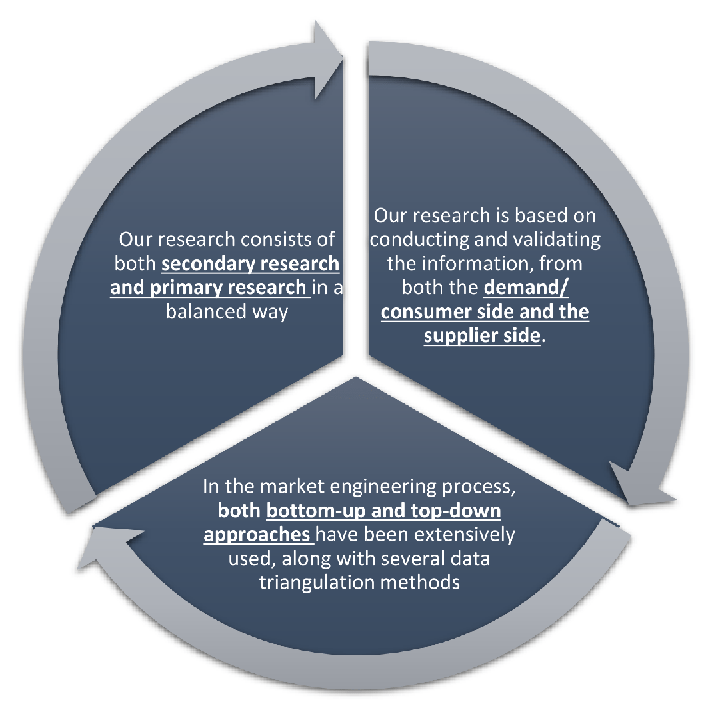
MarketGenics leverages a dedicated industry panel of experts and a comprehensive suite of paid databases to effectively collect, consolidate, and analyze market intelligence.
Our approach has consistently proven to be reliable and effective in generating accurate market insights, identifying key industry trends, and uncovering emerging business opportunities.
Through both primary and secondary research, we capture and analyze critical company-level data such as manufacturing footprints, including technical centers, R&D facilities, sales offices, and headquarters.
Our expert panel further enhances our ability to estimate market size for specific brands based on validated field-level intelligence.
Our data mining techniques incorporate both parametric and non-parametric methods, allowing for structured data collection, sorting, processing, and cleaning.
Demand projections are derived from large-scale data sets analyzed through proprietary algorithms, culminating in robust and reliable market sizing.
Research Approach
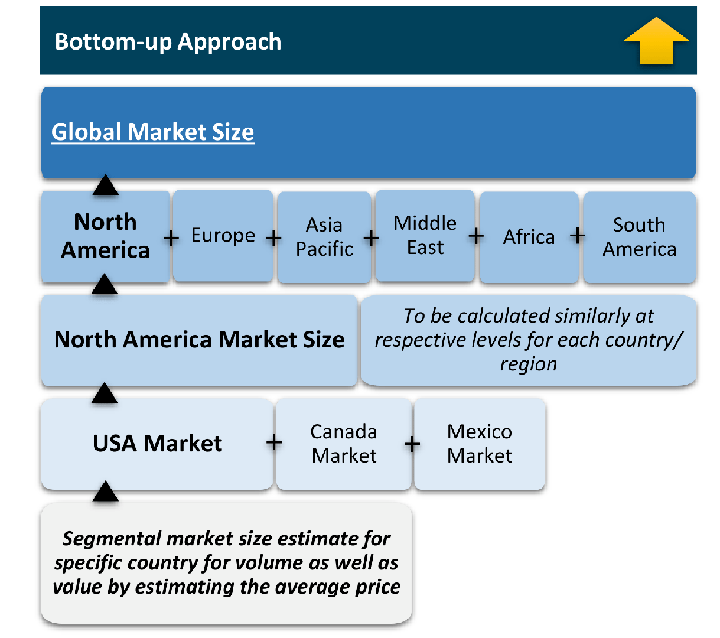
The bottom-up approach builds market estimates by starting with the smallest addressable market units and systematically aggregating them to create comprehensive market size projections.
This method begins with specific, granular data points and builds upward to create the complete market landscape.
Customer Analysis → Segmental Analysis → Geographical Analysis
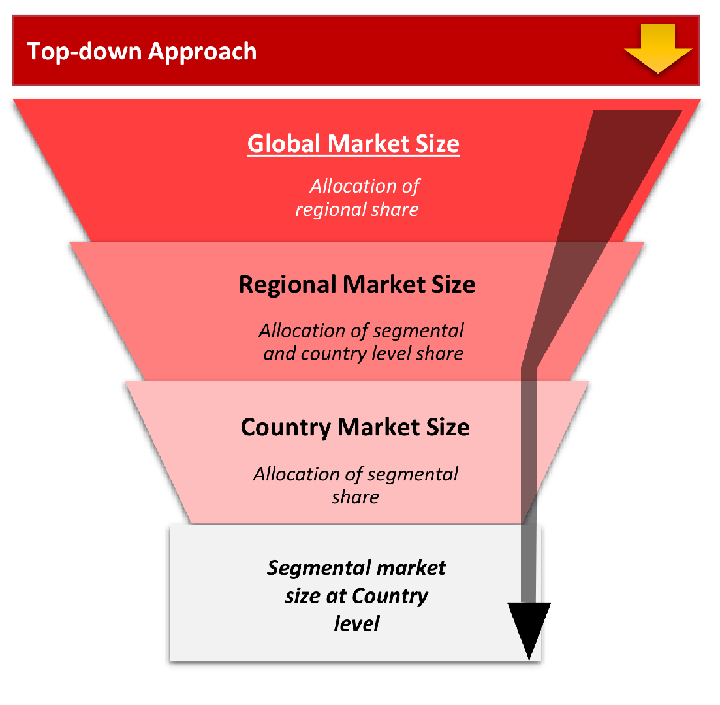
The top-down approach starts with the broadest possible market data and systematically narrows it down through a series of filters and assumptions to arrive at specific market segments or opportunities.
This method begins with the big picture and works downward to increasingly specific market slices.
TAM → SAM → SOM
Research Methods
Desk / Secondary Research
While analysing the market, we extensively study secondary sources, directories, and databases to identify and collect information useful for this technical, market-oriented, and commercial report. Secondary sources that we utilize are not only the public sources, but it is a combination of Open Source, Associations, Paid Databases, MG Repository & Knowledgebase, and others.
- Company websites, annual reports, financial reports, broker reports, and investor presentations
- National government documents, statistical databases and reports
- News articles, press releases and web-casts specific to the companies operating in the market, Magazines, reports, and others
- We gather information from commercial data sources for deriving company specific data such as segmental revenue, share for geography, product revenue, and others
- Internal and external proprietary databases (industry-specific), relevant patent, and regulatory databases
- Governing Bodies, Government Organizations
- Relevant Authorities, Country-specific Associations for Industries
We also employ the model mapping approach to estimate the product level market data through the players' product portfolio
Primary Research
Primary research/ interviews is vital in analyzing the market. Most of the cases involves paid primary interviews. Primary sources include primary interviews through e-mail interactions, telephonic interviews, surveys as well as face-to-face interviews with the different stakeholders across the value chain including several industry experts.
| Type of Respondents | Number of Primaries |
|---|---|
| Tier 2/3 Suppliers | ~20 |
| Tier 1 Suppliers | ~25 |
| End-users | ~25 |
| Industry Expert/ Panel/ Consultant | ~30 |
| Total | ~100 |
MG Knowledgebase
• Repository of industry blog, newsletter and case studies
• Online platform covering detailed market reports, and company profiles
Forecasting Factors and Models
Forecasting Factors
- Historical Trends – Past market patterns, cycles, and major events that shaped how markets behave over time. Understanding past trends helps predict future behavior.
- Industry Factors – Specific characteristics of the industry like structure, regulations, and innovation cycles that affect market dynamics.
- Macroeconomic Factors – Economic conditions like GDP growth, inflation, and employment rates that affect how much money people have to spend.
- Demographic Factors – Population characteristics like age, income, and location that determine who can buy your product.
- Technology Factors – How quickly people adopt new technology and how much technology infrastructure exists.
- Regulatory Factors – Government rules, laws, and policies that can help or restrict market growth.
- Competitive Factors – Analyzing competition structure such as degree of competition and bargaining power of buyers and suppliers.
Forecasting Models / Techniques
Multiple Regression Analysis
- Identify and quantify factors that drive market changes
- Statistical modeling to establish relationships between market drivers and outcomes
Time Series Analysis – Seasonal Patterns
- Understand regular cyclical patterns in market demand
- Advanced statistical techniques to separate trend, seasonal, and irregular components
Time Series Analysis – Trend Analysis
- Identify underlying market growth patterns and momentum
- Statistical analysis of historical data to project future trends
Expert Opinion – Expert Interviews
- Gather deep industry insights and contextual understanding
- In-depth interviews with key industry stakeholders
Multi-Scenario Development
- Prepare for uncertainty by modeling different possible futures
- Creating optimistic, pessimistic, and most likely scenarios
Time Series Analysis – Moving Averages
- Sophisticated forecasting for complex time series data
- Auto-regressive integrated moving average models with seasonal components
Econometric Models
- Apply economic theory to market forecasting
- Sophisticated economic models that account for market interactions
Expert Opinion – Delphi Method
- Harness collective wisdom of industry experts
- Structured, multi-round expert consultation process
Monte Carlo Simulation
- Quantify uncertainty and probability distributions
- Thousands of simulations with varying input parameters
Research Analysis
Our research framework is built upon the fundamental principle of validating market intelligence from both demand and supply perspectives. This dual-sided approach ensures comprehensive market understanding and reduces the risk of single-source bias.
Demand-Side Analysis: We understand end-user/application behavior, preferences, and market needs along with the penetration of the product for specific application.
Supply-Side Analysis: We estimate overall market revenue, analyze the segmental share along with industry capacity, competitive landscape, and market structure.
Validation & Evaluation
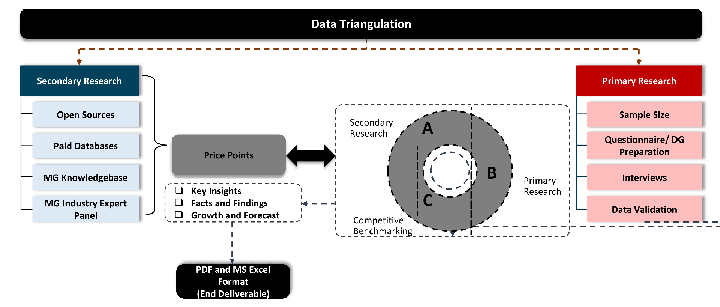
Data triangulation is a validation technique that uses multiple methods, sources, or perspectives to examine the same research question, thereby increasing the credibility and reliability of research findings. In market research, triangulation serves as a quality assurance mechanism that helps identify and minimize bias, validate assumptions, and ensure accuracy in market estimates.
- Data Source Triangulation – Using multiple data sources to examine the same phenomenon
- Methodological Triangulation – Using multiple research methods to study the same research question
- Investigator Triangulation – Using multiple researchers or analysts to examine the same data
- Theoretical Triangulation – Using multiple theoretical perspectives to interpret the same data
Custom Market Research Services
We will customise the research for you, in case the report listed above does not meet your requirements.
Get 10% Free Customisation