Smart Wearables Market Size, Share & Trends Analysis Report by Product Type (Smartwatches, Fitness Trackers, Smart Glasses, Smart Clothing, Wearable Cameras, Medical Wearables, Hearables, Smart Jewelry, Others), Technology, Operating System, Display Type, Application, End-use, Distribution Channel, Battery Life, and Geography (North America, Europe, Asia Pacific, Middle East, Africa, and South America) – Global Industry Data, Trends, and Forecasts, 2026–2035
Market Overview:
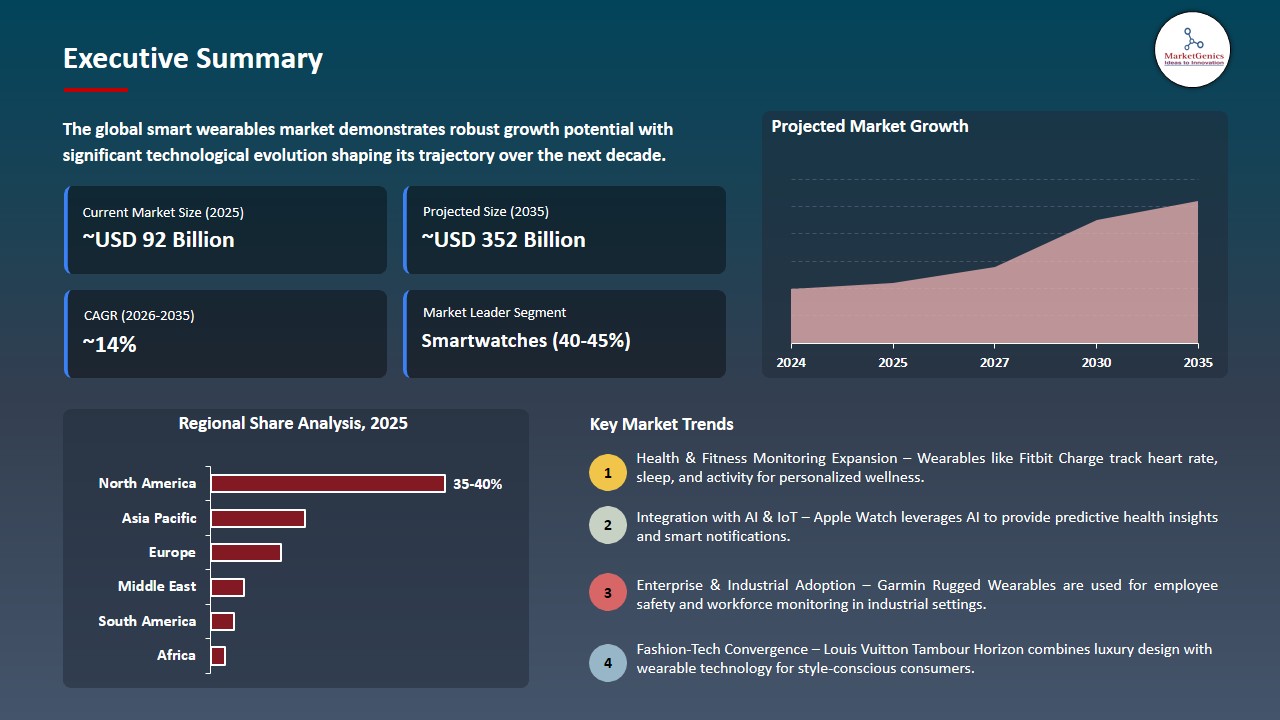
According to MarketGenics analysis, the global Smart Wearables Market is witnessing strong growth and is projected to expand from approximately USD 91.7 billion in 2025 to nearly USD 352.1 billion by 2035, registering a robust CAGR of 14.4% during the forecast period.
|
|
|
Segmental Data Insights |
|
|
Demand Trends |
|
|
Competitive Landscape |
|
|
Strategic Development |
|
|
Future Outlook & Opportunities |
|
Smart Wearables Market Size, Share, and Growth
Asia Pacific is the fastest-growing Smart Wearables market due to rapid expansion of e-commerce and logistics activities, increasing vehicle fleets, and rising adoption of digital telematics solutions across emerging economies.
Jaeyeon Jung, Executive Vice President and Head of SmartThings at Samsung Electronics, said, “SmartThings’ latest update represents our ongoing efforts to make the smart home more intuitive, connected and personalized, they are excited to continue pushing the boundaries of smart home innovation by empowering users though enhanced personalization and automation, including sleep wellness”
Wearables are evolving quickly with the development of sensor technologies, component miniaturization, and rising consumer demand in health and fitness tracking to be considered the smart wearables market. The increase in prevalence of lifestyle diseases has accelerated the use of wearable devices in real-time tracking of vital signs, heart rate, and SpO2 as well as ECG and AI-based and cloud-based integration improves predictive health outcomes.
In 2025, Apple released the Apple Watch Series 10 that features improved body temperature, and superior health sensors, which enhance early abnormality detection. In the same regard, Samsung also launched the Galaxy Watch 7 that has enhanced BioActive sensors and better battery life, which will increase the level of attractiveness across the fitness and wellness markets.
Cross industry alliances are facilitating the smooth interoperability with healthcare providers, insurance and telehealth solutions, which continue to push the utility to levels beyond conventional consumer uses. The wearables are also becoming more convenient and richer in features by constant advancements in battery efficiency, display technology, and voice/gesture interfaces. The world is becoming smarter with wearables, and it is increasing more rapidly due to its functionality and health integration.
The smart wearables market presents adjacent opportunities in telemedicine integration, AI-powered health analytics, fitness and wellness subscription services, IoT-enabled smart home connectivity, and corporate wellness programs. These sectors leverage wearable data to enhance personalization, monitoring, and engagement, creating cross-industry growth potential. Expansion into adjacent sectors strengthens adoption, diversifies revenue streams, and drives innovation across healthcare and consumer technology.
Smart Wearables Market Dynamics and Trends
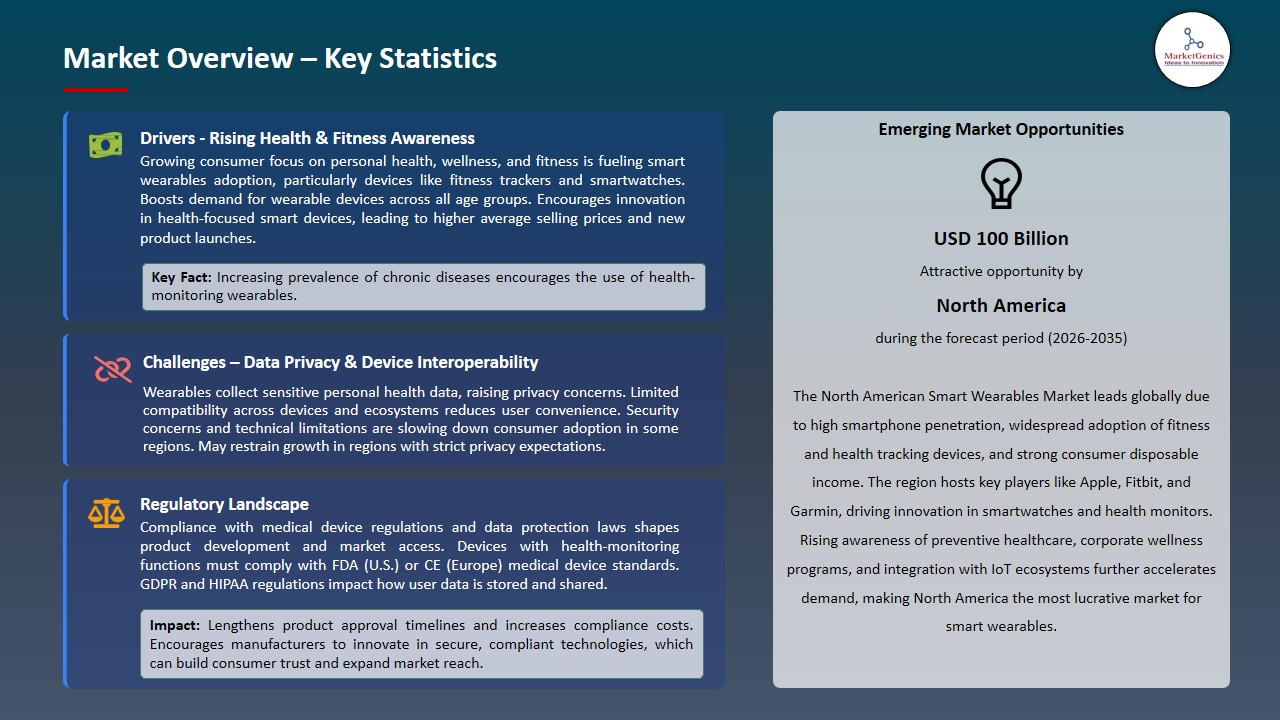
Driver: Rapid Integration of Advanced Biometric and AI Capabilities in Wearable Devices
-
The development of smart wearables market is driven by the rapid adoption of sophisticated biometric sensors and artificial intelligence. Devices have begun to provide real-time tracking of key indicators of health, such as heart rate, ECG, blood oxygen, sleep, and stress, and AI can offer self-centered information and future health suggestions.
- These features not only improve consumer engagement and wellness management but also target preventative care, fitness management, and early disease diagnosis, making wearables the essential tool of personal health and lifestyle management.
- Fitbit, with the help of Google Gemini AI, extended its AI-based health coach to a wider iOS audience in 2026, offering personalized advice on fitness, sleep, and wellness. The application examines the metrics related to the health of the user, provides the client with daily insights and suggests a tailor-made workout and sleep habits, which further expand its high-priced services to the UK, Canada, Australia, New Zealand, and Singapore.
- The combination of AI and high-tech biometrics is changing the wearables into the necessary, active health management devices that have global coverage and individual customers experience.
Restraint: High Cost and Perceived Complexity Limiting Broader Consumer Adoption
-
Advanced price and alleged complexity of smart wearables are also noteworthy market inhibitors, restricting the uptake by price-sensitive buyers. State-of-the-art devices with superior technologies, including multi-sensor biometric tracking, AI-based analytics, and connectivity capabilities, may be accompanied by a high initial price, which renders them more affordable to a wider audience.
- Moreover, the learning curve of setting up the device, integrating with various apps, and analyzing health and fitness data may discourage consumers who are afraid of more complex and demanding solutions. Issues with data privacy, battery life and regular software updates also contribute to the perceived complexity.
- The combination of the factors slows down penetration of the mass market, especially in emerging economies and older demographics where ease-of-use and cost-effectiveness are the key decision factors, limiting the overall growth of the smart wearables market.
Opportunity: Expansion of Wearable‑Enabled Telehealth and Remote Patient Monitoring Services
-
The wearable-enabled telehealth and remote patient monitoring services are rapidly developing, which creates a good prospect of the smart wearables market. Wearables would be able to constantly monitor the vital signs, sleeping habits and activity levels and relay real time information to the healthcare professionals to initiate preventive measures.
- Combination with telemedicine services enables better patient interaction, pre-disease diagnosis, decreases the number of hospital appointments, and helps to address chronic conditions. Based on this trend, the manufacturers and health care providers can provide more personalized and data-based care options, which increases the market expansion of the connected wearable devices.
- In March 2025, Remote patient monitoring became possible using Garmin smartwatches that were connected to the Garmin Health ecosystem to take 24/7 health and activities data. This helped in providing customized care by using Medixine and the SaniQ platform of Qurasoft that helped in managing chronic diseases and increased interaction between the patient and the healthcare facility.
- The trend drives the use of connected wearables faster, as a vital means of personalized, data-driven healthcare delivery and a growing market.
Key Trend: Convergence of Wearables with Smart Home and IoT Ecosystems for Seamless Connectivity
-
The merger of wearable devices and smart home and IoT ecosystems is also becoming a massive trend in the smart wearables market. The wearables can also be combined with other connected devices, home automation systems, and IoT-enabled solutions to ensure the wearable can easily communicate with the lights, thermostats, security systems, and other smart appliances.
- This cohesive functionality allows the consumer to have convenience in the lifestyle, monitoring of health and automated responses and coordinated data-based actions. This type of ecosystem integration enhances consumer interaction, cross-platform buying, and innovation in multifunctional, connected wearable devices.
- In April 2025, Samsung revised its SmartThings platform and combined it with Samsung Health to refine the sleep environments and support personalised automation. The update also increased the range of devices supported and introduced Matter 1.4 compatibility, which improved a smooth connection of wearables with smart home ecosystems.
- The combination of wearables and smart home, as well as, IoT ecosystems would enable the increased convenience of users, cross-platform usage, and the expansion of connected and multifunctional wearable platforms.
Smart-Wearables-Market Analysis and Segmental Data
Smartwatches Dominate Global Smart Wearables Market
-
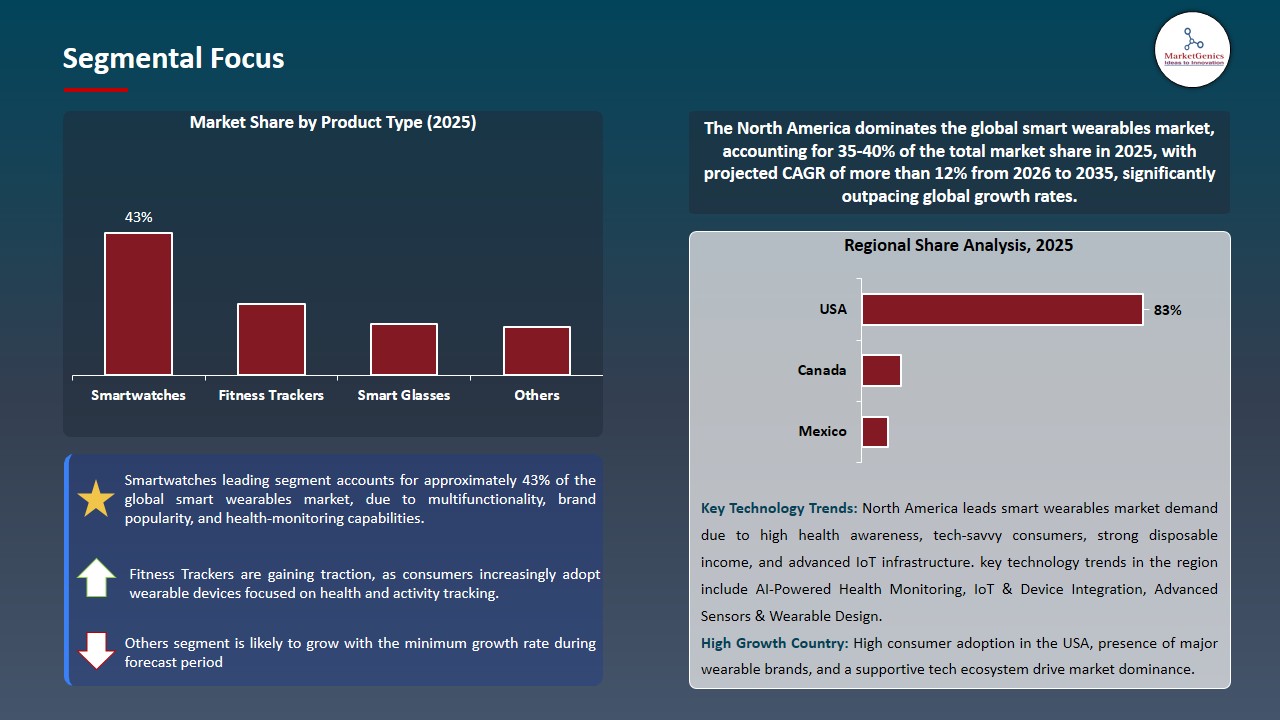
Smartwatches occupy the first place in the smart wearables market around the world since their functionality is multifunctional, integrating health monitoring, communication, fitness trackers, and entertainment features into one device. The constant development of biometric sensors, ECG trackers, blood oxygen sensors, as well as AI-based insights have enhanced their value proposition beyond counting steps.
- Close ecosystem connectivity with smartphones, cloud platforms, and IoT-enabled devices further increase the ease of use and interaction of its users. The positioning of premium product, regular product releases and increased use in preventive healthcare and enterprise wellness programs are still contributing to increased adoption rates over other types of wearables.
- The growth of the market is based on long-term growth and strategic investments due to the constant advancement of technology and the growth of the cross-industry application.
North America Leads Global Smart Wearables Market Demand
-
North America leads the global smart wearables market due to high consumer awareness of health and fitness, strong purchasing power, and early adoption of advanced technologies. The region benefits from widespread smartphone penetration, well-established digital infrastructure, and growing demand for connected health monitoring devices across diverse age groups.
- Market leadership is also enhanced by the presence of large players in the wearable technology sector, robust research and development, and the integration of AI-driven health analytics. Also, the growth of corporate wellness initiatives, telehealth usage, and more emphasis on preventive care all contribute to the ever-growing demand that makes North America the most developed and, in terms of revenue-generating operations, the most profitable region in the global smart wearables market.
- North America has been leading technologically and has had high rates of adoption, which have remained as the standard in terms of innovation and revenue growth in the world smart wearables market.
Smart-Wearables-Market Ecosystem
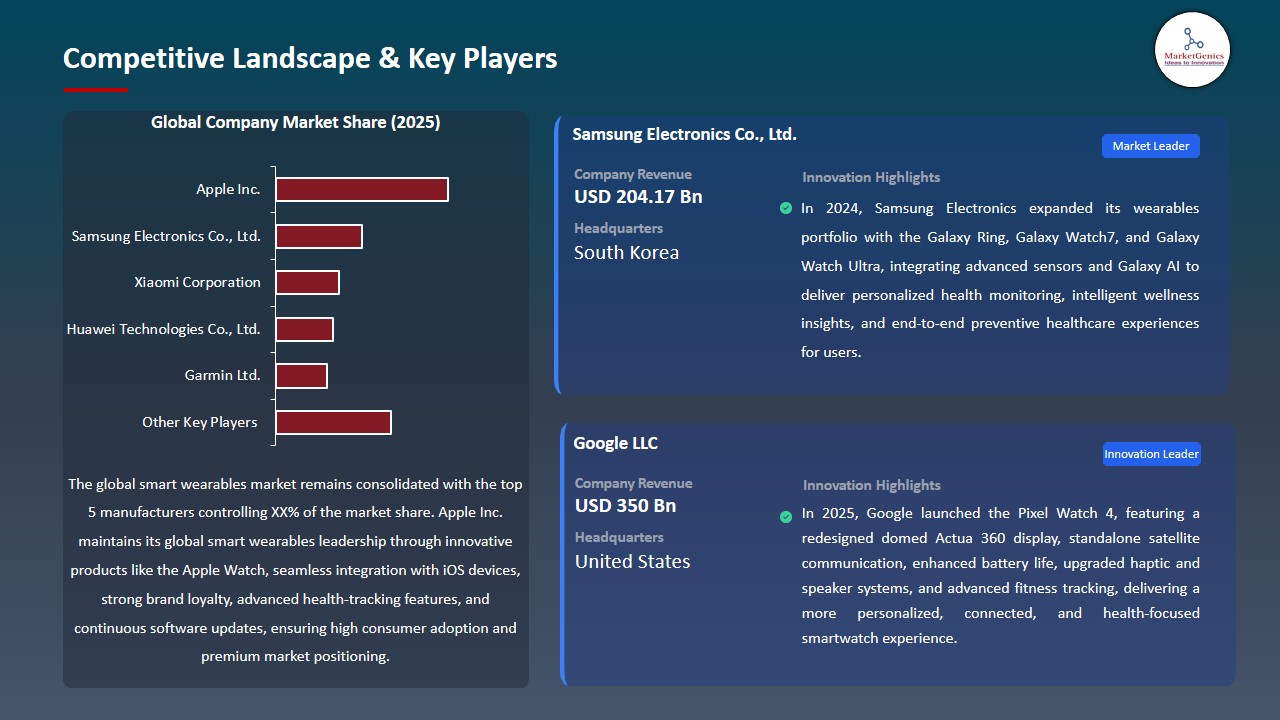
The global smart wearables market is consolidated, with key players including Apple Inc., Samsung Electronics Co., Ltd., Xiaomi Corporation, Huawei Technologies Co., Ltd., and Garmin Ltd. They are all vertically integrated hardware-software ecosystems, proprietary operating systems, advanced health-monitoring technologies, and extensive global distribution networks, which allow these companies to maintain a strong competitive position. Their leadership is anchored by their constant investments in AI-powered health analytics, sensor innovation, chipset optimization, and strategic partnerships with healthcare, telecom, and fitness service providers.
The smart wearables value chain consists of component sourcing (sensors, semiconductors, displays), device design and manufacture, operating system design, application ecosystem connectivity, cloud connectivity, retail distribution, and after sales maintenance. The long-term customer engagement is promoted by the post-purchase services (health data analytics, subscription-based fitness platforms, software updates, and ecosystem synchronization). The combination of these interrelated phases allows smooth functionality of the devices, greater accuracy in health tracking as well as user experience in both consumer and enterprise apps.
The barriers to entry are high, there is high brand loyalty, high R&D needs, patent portfolio, health features compliance and high scale capacity of manufacturing. The differentiation is being driven by continuous innovations including the AI-based diagnostics, non-invasive biometric sensing, satellite connectivity, and cross-gadget ecosystem integration. These innovations reinforce the high-end positioning, repeat business and long-term expansion of the Smart Wearables market across the globe.
Recent Development and Strategic Overview:
-
In September 2025, Apple Inc. introduced Apple Watch Ultra 3, featuring built-in satellite communications, 5G connectivity, the largest Apple Watch display, up to 42-hour battery life, hypertension notifications, sleep score insights, and AI-powered Workout Buddy
- In September 2025, Garmin Ltd. revealed a patent for HbA1c estimation using optical sensors in its smartwatches, enabling long-term blood glucose trend analysis via LED light absorption. The innovation provides periodic insights through Garmin Connect+ but does not replace continuous glucose monitoring systems (CGMs).
Report Scope
|
Detail |
|
|
Market Size in 2025 |
USD 91.7 Bn |
|
Market Forecast Value in 2035 |
USD 352.1 Bn |
|
Growth Rate (CAGR) |
14.4% |
|
Forecast Period |
2026 – 2035 |
|
Historical Data Available for |
2021 – 2024 |
|
Market Size Units |
US$ Billion for Value Million Units for Volume |
|
Report Format |
Electronic (PDF) + Excel |
|
North America |
Europe |
Asia Pacific |
Middle East |
Africa |
South America |
|
|
|
|
|
|
|
Companies Covered |
|||||
|
|
|
|
|
|
Smart-Wearables-Market Segmentation and Highlights
|
Segment |
Sub-segment |
|
Smart Wearables Market, By Product Type |
|
|
Smart Wearables Market, By Technology |
|
|
Smart Wearables Market, By Fleet Operating System |
|
|
Smart Wearables Market, By Display Type |
|
|
Smart Wearables Market, By Application |
|
|
Smart Wearables Market, By End-use |
|
|
Smart Wearables Market, By Distribution Channel |
|
|
Smart Wearables Market, By Battery Life |
|
Frequently Asked Questions
Table of Contents
- 1. Research Methodology and Assumptions
- 1.1. Definitions
- 1.2. Research Design and Approach
- 1.3. Data Collection Methods
- 1.4. Base Estimates and Calculations
- 1.5. Forecasting Models
- 1.5.1. Key Forecast Factors & Impact Analysis
- 1.6. Secondary Research
- 1.6.1. Open Sources
- 1.6.2. Paid Databases
- 1.6.3. Associations
- 1.7. Primary Research
- 1.7.1. Primary Sources
- 1.7.2. Primary Interviews with Stakeholders across Ecosystem
- 2. Executive Summary
- 2.1. Global Smart Wearables Market Outlook
- 2.1.1. Smart Wearables Market Size Volume (Million Units) and Value (US$ Bn), and Forecasts, 2021-2035
- 2.1.2. Compounded Annual Growth Rate Analysis
- 2.1.3. Growth Opportunity Analysis
- 2.1.4. Segmental Share Analysis
- 2.1.5. Geographical Share Analysis
- 2.2. Market Analysis and Facts
- 2.3. Supply-Demand Analysis
- 2.4. Competitive Benchmarking
- 2.5. Go-to- Market Strategy
- 2.5.1. Customer/ End-use Industry Assessment
- 2.5.2. Growth Opportunity Data, 2026-2035
- 2.5.2.1. Regional Data
- 2.5.2.2. Country Data
- 2.5.2.3. Segmental Data
- 2.5.3. Identification of Potential Market Spaces
- 2.5.4. GAP Analysis
- 2.5.5. Potential Attractive Price Points
- 2.5.6. Prevailing Market Risks & Challenges
- 2.5.7. Preferred Sales & Marketing Strategies
- 2.5.8. Key Recommendations and Analysis
- 2.5.9. A Way Forward
- 2.1. Global Smart Wearables Market Outlook
- 3. Industry Data and Premium Insights
- 3.1. Global Consumer Goods & Services Industry Overview, 2025
- 3.1.1. Consumer Goods & Services Industry Ecosystem Analysis
- 3.1.2. Key Trends for Consumer Goods & Services Industry
- 3.1.3. Regional Distribution for Consumer Goods & Services Industry
- 3.2. Supplier Customer Data
- 3.3. Technology Roadmap and Developments
- 3.4. Trade Analysis
- 3.4.1. Import & Export Analysis, 2025
- 3.4.2. Top Importing Countries
- 3.4.3. Top Exporting Countries
- 3.5. Trump Tariff Impact Analysis
- 3.5.1. Manufacturer
- 3.5.1.1. Based on the component
- 3.5.2. Supply Chain
- 3.5.3. End Consumer
- 3.5.1. Manufacturer
- 3.6. Raw Material Analysis
- 3.1. Global Consumer Goods & Services Industry Overview, 2025
- 4. Market Overview
- 4.1. Market Dynamics
- 4.1.1. Drivers
- 4.1.1.1. Rising health and fitness awareness driving demand for health-monitoring wearables.
- 4.1.1.2. Integration of AI and IoT enabling advanced features and personalized experiences.
- 4.1.1.3. Growing adoption in enterprise, healthcare, and sports for productivity and safety monitoring.
- 4.1.2. Restraints
- 4.1.2.1. High device costs limiting affordability in emerging markets.
- 4.1.2.2. Privacy and data security concerns hindering user adoption.
- 4.1.1. Drivers
- 4.2. Key Trend Analysis
- 4.3. Regulatory Framework
- 4.3.1. Key Regulations, Norms, and Subsidies, by Key Countries
- 4.3.2. Tariffs and Standards
- 4.3.3. Impact Analysis of Regulations on the Market
- 4.4. Value Chain Analysis/ Ecosystem Analysis
- 4.4.1. Component Suppliers
- 4.4.2. System Integartors/ Technology Providers
- 4.4.3. Smart Wearable Devices Manufacturers
- 4.4.4. Distributors/ Channel Partners
- 4.4.5. End Users/ Customers
- 4.5. Cost Structure Analysis
- 4.5.1. Parameter’s Share for Cost Associated
- 4.5.2. COGP vs COGS
- 4.5.3. Profit Margin Analysis
- 4.6. Pricing Analysis
- 4.6.1. Regional Pricing Analysis
- 4.6.2. Segmental Pricing Trends
- 4.6.3. Factors Influencing Pricing
- 4.7. Porter’s Five Forces Analysis
- 4.8. PESTEL Analysis
- 4.9. Global Smart Wearables Market Demand
- 4.9.1. Historical Market Size – Volume (Million Units) and Value (US$ Bn), 2020-2024
- 4.9.2. Current and Future Market Size - Volume (Million Units) and Value (US$ Bn), 2026–2035
- 4.9.2.1. Y-o-Y Growth Trends
- 4.9.2.2. Absolute $ Opportunity Assessment
- 4.1. Market Dynamics
- 5. Competition Landscape
- 5.1. Competition structure
- 5.1.1. Fragmented v/s consolidated
- 5.2. Company Share Analysis, 2025
- 5.2.1. Global Company Market Share
- 5.2.2. By Region
- 5.2.2.1. North America
- 5.2.2.2. Europe
- 5.2.2.3. Asia Pacific
- 5.2.2.4. Middle East
- 5.2.2.5. Africa
- 5.2.2.6. South America
- 5.3. Product Comparison Matrix
- 5.3.1. Specifications
- 5.3.2. Market Positioning
- 5.3.3. Pricing
- 5.1. Competition structure
- 6. Global Smart Wearables Market Analysis, by Product Type
- 6.1. Key Segment Analysis
- 6.2. Smart Wearables Market Size Volume (Million Units) and Value (US$ Bn), Analysis, and Forecasts, by Product Type, 2021-2035
- 6.2.1. Smartwatches
- 6.2.2. Fitness Trackers
- 6.2.3. Smart Glasses
- 6.2.3.1. AR Smart Glasses
- 6.2.3.2. VR Smart Glasses
- 6.2.3.3. Mixed Reality Glasses
- 6.2.4. Smart Clothing
- 6.2.5. Wearable Cameras
- 6.2.5.1. Body-worn Cameras
- 6.2.5.2. Head-mounted Cameras
- 6.2.6. Medical Wearables
- 6.2.7. Hearables
- 6.2.8. Smart Jewelry
- 6.2.9. Others
- 7. Global Smart Wearables Market Analysis, by Technology
- 7.1. Key Segment Analysis
- 7.2. Smart Wearables Market Size Volume (Million Units) and Value (US$ Bn), Analysis, and Forecasts, by Technology, 2021-2035
- 7.2.1. Computing Technology
- 7.2.2. Display Technology
- 7.2.3. Networking Technology
- 7.2.4. Positioning Technology
- 7.2.4.1. GPS
- 7.2.4.2. GLONASS
- 7.2.4.3. Galileo
- 7.2.5. Sensor Technology
- 7.2.5.1. Accelerometer
- 7.2.5.2. Gyroscope
- 7.2.5.3. Heart Rate Sensor
- 7.2.5.4. SpO2 Sensor
- 7.2.5.5. Others
- 8. Global Smart Wearables Market Analysis, by Operating System
- 8.1. Key Segment Analysis
- 8.2. Smart Wearables Market Size Volume (Million Units) and Value (US$ Bn), Analysis, and Forecasts, by Operating System, 2021-2035
- 8.2.1. watchOS
- 8.2.2. Wear OS (Google)
- 8.2.3. Tizen OS
- 8.2.4. Fitbit OS
- 8.2.5. Proprietary OS
- 8.2.6. Others
- 9. Global Smart Wearables Market Analysis, by Display Type
- 9.1. Key Segment Analysis
- 9.2. Smart Wearables Market Size Volume (Million Units) and Value (US$ Bn), Analysis, and Forecasts, by Display Type, 2021-2035
- 9.2.1. OLED Display
- 9.2.2. LCD Display
- 9.2.3. AMOLED Display
- 9.2.4. LED Display
- 9.2.5. No Display
- 10. Global Smart Wearables Market Analysis, by Application
- 10.1. Key Segment Analysis
- 10.2. Smart Wearables Market Size Volume (Million Units) and Value (US$ Bn), Analysis, and Forecasts, by Application, 2021-2035
- 10.2.1. Fitness & Wellness
- 10.2.1.1. Activity Tracking
- 10.2.1.2. Sleep Monitoring
- 10.2.1.3. Calorie Tracking
- 10.2.1.4. Workout Guidance
- 10.2.1.5. Others
- 10.2.2. Healthcare & Medical
- 10.2.2.1. Patient Monitoring
- 10.2.2.2. Clinical Diagnostics
- 10.2.2.3. Chronic Disease Management
- 10.2.2.4. Rehabilitation
- 10.2.2.5. Others
- 10.2.3. Infotainment
- 10.2.3.1. Music & Audio
- 10.2.3.2. Gaming
- 10.2.3.3. Social Media Integration
- 10.2.3.4. Others
- 10.2.4. Communication
- 10.2.4.1. Calling & Messaging
- 10.2.4.2. Email & Notifications
- 10.2.5. Navigation & Location
- 10.2.6. Payment & Banking
- 10.2.7. Workplace Productivity
- 10.2.8. Safety & Security
- 10.2.9. Others
- 10.2.1. Fitness & Wellness
- 11. Global Smart Wearables Market Analysis, by End-use
- 11.1. Key Segment Analysis
- 11.2. Smart Wearables Market Size Volume (Million Units) and Value (US$ Bn), Analysis, and Forecasts, by End-use, 2021-2035
- 11.2.1. Healthcare & Medical
- 11.2.2. Sports & Fitness
- 11.2.3. Consumer Electronics
- 11.2.4. Enterprise & Industrial
- 11.2.5. Military & Defense
- 11.2.6. Fashion & Lifestyle
- 11.2.7. Gaming & Entertainment
- 11.2.8. Others
- 12. Global Smart Wearables Market Analysis, by Distribution Channel
- 12.1. Key Segment Analysis
- 12.2. Smart Wearables Market Size Volume (Million Units) and Value (US$ Bn), Analysis, and Forecasts, by Distribution Channel, 2021-2035
- 12.2.1. Online
- 12.2.2. Offline
- 13. Global Smart Wearables Market Analysis and Forecasts, by Battery Life
- 13.1. Key Findings
- 13.2. Smart Wearables Market Size Volume (Million Units) and Value (US$ Bn), Analysis, and Forecasts, by Battery Life, 2021-2035
- 13.2.1. Less than 1 Day
- 13.2.2. 1-3 Days
- 13.2.3. 4-7 Days
- 13.2.4. More than 7 Days
- 14. Global Smart Wearables Market Analysis and Forecasts, by Region
- 14.1. Key Findings
- 14.2. Smart Wearables Market Size Volume (Million Units) and Value (US$ Bn), Analysis, and Forecasts, by Region, 2021-2035
- 14.2.1. North America
- 14.2.2. Europe
- 14.2.3. Asia Pacific
- 14.2.4. Middle East
- 14.2.5. Africa
- 14.2.6. South America
- 15. North America Smart Wearables Market Analysis
- 15.1. Key Segment Analysis
- 15.2. Regional Snapshot
- 15.3. North America Smart Wearables Market Size- Volume (Million Units) and Value (US$ Bn), Analysis, and Forecasts, 2021-2035
- 15.3.1. Product Type
- 15.3.2. Technology
- 15.3.3. Operating System
- 15.3.4. Display Type
- 15.3.5. Application
- 15.3.6. End-use
- 15.3.7. Distribution Channel
- 15.3.8. Battery Life
- 15.3.9. Country
- 15.3.9.1. USA
- 15.3.9.2. Canada
- 15.3.9.3. Mexico
- 15.4. USA Smart Wearables Market
- 15.4.1. Country Segmental Analysis
- 15.4.2. Product Type
- 15.4.3. Technology
- 15.4.4. Operating System
- 15.4.5. Display Type
- 15.4.6. Application
- 15.4.7. End-use
- 15.4.8. Distribution Channel
- 15.4.9. Battery Life
- 15.5. Canada Smart Wearables Market
- 15.5.1. Country Segmental Analysis
- 15.5.2. Product Type
- 15.5.3. Technology
- 15.5.4. Operating System
- 15.5.5. Display Type
- 15.5.6. Application
- 15.5.7. End-use
- 15.5.8. Distribution Channel
- 15.5.9. Battery Life
- 15.6. Mexico Smart Wearables Market
- 15.6.1. Country Segmental Analysis
- 15.6.2. Product Type
- 15.6.3. Technology
- 15.6.4. Operating System
- 15.6.5. Display Type
- 15.6.6. Application
- 15.6.7. End-use
- 15.6.8. Distribution Channel
- 15.6.9. Battery Life
- 16. Europe Smart Wearables Market Analysis
- 16.1. Key Segment Analysis
- 16.2. Regional Snapshot
- 16.3. Europe Smart Wearables Market Size Volume (Million Units) and Value (US$ Bn), Analysis, and Forecasts, 2021-2035
- 16.3.1. Product Type
- 16.3.2. Technology
- 16.3.3. Operating System
- 16.3.4. Display Type
- 16.3.5. Application
- 16.3.6. End-use
- 16.3.7. Distribution Channel
- 16.3.8. Battery Life
- 16.3.9. Country
- 16.3.9.1. Germany
- 16.3.9.2. United Kingdom
- 16.3.9.3. France
- 16.3.9.4. Italy
- 16.3.9.5. Spain
- 16.3.9.6. Netherlands
- 16.3.9.7. Nordic Countries
- 16.3.9.8. Poland
- 16.3.9.9. Russia & CIS
- 16.3.9.10. Rest of Europe
- 16.4. Germany Smart Wearables Market
- 16.4.1. Country Segmental Analysis
- 16.4.2. Product Type
- 16.4.3. Technology
- 16.4.4. Operating System
- 16.4.5. Display Type
- 16.4.6. Application
- 16.4.7. End-use
- 16.4.8. Distribution Channel
- 16.4.9. Battery Life
- 16.5. United Kingdom Smart Wearables Market
- 16.5.1. Country Segmental Analysis
- 16.5.2. Product Type
- 16.5.3. Technology
- 16.5.4. Operating System
- 16.5.5. Display Type
- 16.5.6. Application
- 16.5.7. End-use
- 16.5.8. Distribution Channel
- 16.5.9. Battery Life
- 16.6. France Smart Wearables Market
- 16.6.1. Country Segmental Analysis
- 16.6.2. Product Type
- 16.6.3. Technology
- 16.6.4. Operating System
- 16.6.5. Display Type
- 16.6.6. Application
- 16.6.7. End-use
- 16.6.8. Distribution Channel
- 16.6.9. Battery Life
- 16.7. Italy Smart Wearables Market
- 16.7.1. Country Segmental Analysis
- 16.7.2. Product Type
- 16.7.3. Technology
- 16.7.4. Operating System
- 16.7.5. Display Type
- 16.7.6. Application
- 16.7.7. End-use
- 16.7.8. Distribution Channel
- 16.7.9. Battery Life
- 16.8. Spain Smart Wearables Market
- 16.8.1. Country Segmental Analysis
- 16.8.2. Product Type
- 16.8.3. Technology
- 16.8.4. Operating System
- 16.8.5. Display Type
- 16.8.6. Application
- 16.8.7. End-use
- 16.8.8. Distribution Channel
- 16.8.9. Battery Life
- 16.9. Netherlands Smart Wearables Market
- 16.9.1. Country Segmental Analysis
- 16.9.2. Product Type
- 16.9.3. Technology
- 16.9.4. Operating System
- 16.9.5. Display Type
- 16.9.6. Application
- 16.9.7. End-use
- 16.9.8. Distribution Channel
- 16.9.9. Battery Life
- 16.10. Nordic Countries Smart Wearables Market
- 16.10.1. Country Segmental Analysis
- 16.10.2. Product Type
- 16.10.3. Technology
- 16.10.4. Operating System
- 16.10.5. Display Type
- 16.10.6. Application
- 16.10.7. End-use
- 16.10.8. Distribution Channel
- 16.10.9. Battery Life
- 16.11. Poland Smart Wearables Market
- 16.11.1. Country Segmental Analysis
- 16.11.2. Product Type
- 16.11.3. Technology
- 16.11.4. Operating System
- 16.11.5. Display Type
- 16.11.6. Application
- 16.11.7. End-use
- 16.11.8. Distribution Channel
- 16.11.9. Battery Life
- 16.12. Russia & CIS Smart Wearables Market
- 16.12.1. Country Segmental Analysis
- 16.12.2. Product Type
- 16.12.3. Technology
- 16.12.4. Operating System
- 16.12.5. Display Type
- 16.12.6. Application
- 16.12.7. End-use
- 16.12.8. Distribution Channel
- 16.12.9. Battery Life
- 16.13. Rest of Europe Smart Wearables Market
- 16.13.1. Country Segmental Analysis
- 16.13.2. Product Type
- 16.13.3. Technology
- 16.13.4. Operating System
- 16.13.5. Display Type
- 16.13.6. Application
- 16.13.7. End-use
- 16.13.8. Distribution Channel
- 16.13.9. Battery Life
- 17. Asia Pacific Smart Wearables Market Analysis
- 17.1. Key Segment Analysis
- 17.2. Regional Snapshot
- 17.3. Asia Pacific Smart Wearables Market Size Volume (Million Units) and Value (US$ Bn), Analysis, and Forecasts, 2021-2035
- 17.3.1. Product Type
- 17.3.2. Technology
- 17.3.3. Operating System
- 17.3.4. Display Type
- 17.3.5. Application
- 17.3.6. End-use
- 17.3.7. Distribution Channel
- 17.3.8. Battery Life
- 17.3.9. Country
- 17.3.9.1. China
- 17.3.9.2. India
- 17.3.9.3. Japan
- 17.3.9.4. South Korea
- 17.3.9.5. Australia and New Zealand
- 17.3.9.6. Indonesia
- 17.3.9.7. Malaysia
- 17.3.9.8. Thailand
- 17.3.9.9. Vietnam
- 17.3.9.10. Rest of Asia Pacific
- 17.4. China Smart Wearables Market
- 17.4.1. Country Segmental Analysis
- 17.4.2. Product Type
- 17.4.3. Technology
- 17.4.4. Operating System
- 17.4.5. Display Type
- 17.4.6. Application
- 17.4.7. End-use
- 17.4.8. Distribution Channel
- 17.4.9. Battery Life
- 17.5. India Smart Wearables Market
- 17.5.1. Country Segmental Analysis
- 17.5.2. Product Type
- 17.5.3. Technology
- 17.5.4. Operating System
- 17.5.5. Display Type
- 17.5.6. Application
- 17.5.7. End-use
- 17.5.8. Distribution Channel
- 17.5.9. Battery Life
- 17.6. Japan Smart Wearables Market
- 17.6.1. Country Segmental Analysis
- 17.6.2. Product Type
- 17.6.3. Technology
- 17.6.4. Operating System
- 17.6.5. Display Type
- 17.6.6. Application
- 17.6.7. End-use
- 17.6.8. Distribution Channel
- 17.6.9. Battery Life
- 17.7. South Korea Smart Wearables Market
- 17.7.1. Country Segmental Analysis
- 17.7.2. Product Type
- 17.7.3. Technology
- 17.7.4. Operating System
- 17.7.5. Display Type
- 17.7.6. Application
- 17.7.7. End-use
- 17.7.8. Distribution Channel
- 17.7.9. Battery Life
- 17.8. Australia and New Zealand Smart Wearables Market
- 17.8.1. Country Segmental Analysis
- 17.8.2. Product Type
- 17.8.3. Technology
- 17.8.4. Operating System
- 17.8.5. Display Type
- 17.8.6. Application
- 17.8.7. End-use
- 17.8.8. Distribution Channel
- 17.8.9. Battery Life
- 17.9. Indonesia Smart Wearables Market
- 17.9.1. Country Segmental Analysis
- 17.9.2. Product Type
- 17.9.3. Technology
- 17.9.4. Operating System
- 17.9.5. Display Type
- 17.9.6. Application
- 17.9.7. End-use
- 17.9.8. Distribution Channel
- 17.9.9. Battery Life
- 17.10. Malaysia Smart Wearables Market
- 17.10.1. Country Segmental Analysis
- 17.10.2. Product Type
- 17.10.3. Technology
- 17.10.4. Operating System
- 17.10.5. Display Type
- 17.10.6. Application
- 17.10.7. End-use
- 17.10.8. Distribution Channel
- 17.10.9. Battery Life
- 17.11. Thailand Smart Wearables Market
- 17.11.1. Country Segmental Analysis
- 17.11.2. Product Type
- 17.11.3. Technology
- 17.11.4. Operating System
- 17.11.5. Display Type
- 17.11.6. Application
- 17.11.7. End-use
- 17.11.8. Distribution Channel
- 17.11.9. Battery Life
- 17.12. Vietnam Smart Wearables Market
- 17.12.1. Country Segmental Analysis
- 17.12.2. Product Type
- 17.12.3. Technology
- 17.12.4. Operating System
- 17.12.5. Display Type
- 17.12.6. Application
- 17.12.7. End-use
- 17.12.8. Distribution Channel
- 17.12.9. Battery Life
- 17.13. Rest of Asia Pacific Smart Wearables Market
- 17.13.1. Country Segmental Analysis
- 17.13.2. Product Type
- 17.13.3. Technology
- 17.13.4. Operating System
- 17.13.5. Display Type
- 17.13.6. Application
- 17.13.7. End-use
- 17.13.8. Distribution Channel
- 17.13.9. Battery Life
- 18. Middle East Smart Wearables Market Analysis
- 18.1. Key Segment Analysis
- 18.2. Regional Snapshot
- 18.3. Middle East Smart Wearables Market Size Volume (Million Units) and Value (US$ Bn), Analysis, and Forecasts, 2021-2035
- 18.3.1. Product Type
- 18.3.2. Technology
- 18.3.3. Operating System
- 18.3.4. Display Type
- 18.3.5. Application
- 18.3.6. End-use
- 18.3.7. Distribution Channel
- 18.3.8. Battery Life
- 18.3.9. Country
- 18.3.9.1. Turkey
- 18.3.9.2. UAE
- 18.3.9.3. Saudi Arabia
- 18.3.9.4. Israel
- 18.3.9.5. Rest of Middle East
- 18.4. Turkey Smart Wearables Market
- 18.4.1. Country Segmental Analysis
- 18.4.2. Product Type
- 18.4.3. Technology
- 18.4.4. Operating System
- 18.4.5. Display Type
- 18.4.6. Application
- 18.4.7. End-use
- 18.4.8. Distribution Channel
- 18.4.9. Battery Life
- 18.5. UAE Smart Wearables Market
- 18.5.1. Country Segmental Analysis
- 18.5.2. Product Type
- 18.5.3. Technology
- 18.5.4. Operating System
- 18.5.5. Display Type
- 18.5.6. Application
- 18.5.7. End-use
- 18.5.8. Distribution Channel
- 18.5.9. Battery Life
- 18.6. Saudi Arabia Smart Wearables Market
- 18.6.1. Country Segmental Analysis
- 18.6.2. Product Type
- 18.6.3. Technology
- 18.6.4. Operating System
- 18.6.5. Display Type
- 18.6.6. Application
- 18.6.7. End-use
- 18.6.8. Distribution Channel
- 18.6.9. Battery Life
- 18.7. Israel Smart Wearables Market
- 18.7.1. Country Segmental Analysis
- 18.7.2. Product Type
- 18.7.3. Technology
- 18.7.4. Operating System
- 18.7.5. Display Type
- 18.7.6. Application
- 18.7.7. End-use
- 18.7.8. Distribution Channel
- 18.7.9. Battery Life
- 18.8. Rest of Middle East Smart Wearables Market
- 18.8.1. Country Segmental Analysis
- 18.8.2. Product Type
- 18.8.3. Technology
- 18.8.4. Operating System
- 18.8.5. Display Type
- 18.8.6. Application
- 18.8.7. End-use
- 18.8.8. Distribution Channel
- 18.8.9. Battery Life
- 19. Africa Smart Wearables Market Analysis
- 19.1. Key Segment Analysis
- 19.2. Regional Snapshot
- 19.3. Africa Smart Wearables Market Size Volume (Million Units) and Value (US$ Bn), Analysis, and Forecasts, 2021-2035
- 19.3.1. Product Type
- 19.3.2. Technology
- 19.3.3. Operating System
- 19.3.4. Display Type
- 19.3.5. Application
- 19.3.6. End-use
- 19.3.7. Distribution Channel
- 19.3.8. Battery Life
- 19.3.9. Country
- 19.3.9.1. South Africa
- 19.3.9.2. Egypt
- 19.3.9.3. Nigeria
- 19.3.9.4. Algeria
- 19.3.9.5. Rest of Africa
- 19.4. South Africa Smart Wearables Market
- 19.4.1. Country Segmental Analysis
- 19.4.2. Product Type
- 19.4.3. Technology
- 19.4.4. Operating System
- 19.4.5. Display Type
- 19.4.6. Application
- 19.4.7. End-use
- 19.4.8. Distribution Channel
- 19.4.9. Battery Life
- 19.5. Egypt Smart Wearables Market
- 19.5.1. Country Segmental Analysis
- 19.5.2. Product Type
- 19.5.3. Technology
- 19.5.4. Operating System
- 19.5.5. Display Type
- 19.5.6. Application
- 19.5.7. End-use
- 19.5.8. Distribution Channel
- 19.5.9. Battery Life
- 19.6. Nigeria Smart Wearables Market
- 19.6.1. Country Segmental Analysis
- 19.6.2. Product Type
- 19.6.3. Technology
- 19.6.4. Operating System
- 19.6.5. Display Type
- 19.6.6. Application
- 19.6.7. End-use
- 19.6.8. Distribution Channel
- 19.6.9. Battery Life
- 19.7. Algeria Smart Wearables Market
- 19.7.1. Country Segmental Analysis
- 19.7.2. Product Type
- 19.7.3. Technology
- 19.7.4. Operating System
- 19.7.5. Display Type
- 19.7.6. Application
- 19.7.7. End-use
- 19.7.8. Distribution Channel
- 19.7.9. Battery Life
- 19.8. Rest of Africa Smart Wearables Market
- 19.8.1. Country Segmental Analysis
- 19.8.2. Product Type
- 19.8.3. Technology
- 19.8.4. Operating System
- 19.8.5. Display Type
- 19.8.6. Application
- 19.8.7. End-use
- 19.8.8. Distribution Channel
- 19.8.9. Battery Life
- 20. South America Smart Wearables Market Analysis
- 20.1. Key Segment Analysis
- 20.2. Regional Snapshot
- 20.3. South America Smart Wearables Market Size Volume (Million Units) and Value (US$ Bn), Analysis, and Forecasts, 2021-2035
- 20.3.1. Product Type
- 20.3.2. Technology
- 20.3.3. Operating System
- 20.3.4. Display Type
- 20.3.5. Application
- 20.3.6. End-use
- 20.3.7. Distribution Channel
- 20.3.8. Battery Life
- 20.3.9. Country
- 20.3.9.1. Brazil
- 20.3.9.2. Argentina
- 20.3.9.3. Rest of South America
- 20.4. Brazil Smart Wearables Market
- 20.4.1. Country Segmental Analysis
- 20.4.2. Product Type
- 20.4.3. Technology
- 20.4.4. Operating System
- 20.4.5. Display Type
- 20.4.6. Application
- 20.4.7. End-use
- 20.4.8. Distribution Channel
- 20.4.9. Battery Life
- 20.5. Argentina Smart Wearables Market
- 20.5.1. Country Segmental Analysis
- 20.5.2. Product Type
- 20.5.3. Technology
- 20.5.4. Operating System
- 20.5.5. Display Type
- 20.5.6. Application
- 20.5.7. End-use
- 20.5.8. Distribution Channel
- 20.5.9. Battery Life
- 20.6. Rest of South America Smart Wearables Market
- 20.6.1. Country Segmental Analysis
- 20.6.2. Product Type
- 20.6.3. Technology
- 20.6.4. Operating System
- 20.6.5. Display Type
- 20.6.6. Application
- 20.6.7. End-use
- 20.6.8. Distribution Channel
- 20.6.9. Battery Life
- 21. Key Players/ Company Profile
- 21.1. Apple Inc.
- 21.1.1. Company Details/ Overview
- 21.1.2. Company Financials
- 21.1.3. Key Customers and Competitors
- 21.1.4. Business/ Industry Portfolio
- 21.1.5. Product Portfolio/ Specification Details
- 21.1.6. Pricing Data
- 21.1.7. Strategic Overview
- 21.1.8. Recent Developments
- 21.2. Asus
- 21.3. Bellabeat
- 21.4. Fitbit Inc. (Google LLC)
- 21.5. Fossil Group, Inc.
- 21.6. Garmin Ltd.
- 21.7. Honor Device Co., Ltd.
- 21.8. Huami Corporation
- 21.9. Huawei Technologies Co., Ltd.
- 21.10. LG Electronics Inc.
- 21.11. Motorola Solutions, Inc.
- 21.12. OPPO Electronics Corp.
- 21.13. Oura Health Ltd.
- 21.14. Polar Electro
- 21.15. Samsung Electronics Co., Ltd.
- 21.16. Sony Corporation
- 21.17. TicWatch (Mobvoi)
- 21.18. Whoop
- 21.19. Xiaomi Corporation
- 21.20. Other Key Players
- 21.1. Apple Inc.
Note* - This is just tentative list of players. While providing the report, we will cover more number of players based on their revenue and share for each geography
Research Design
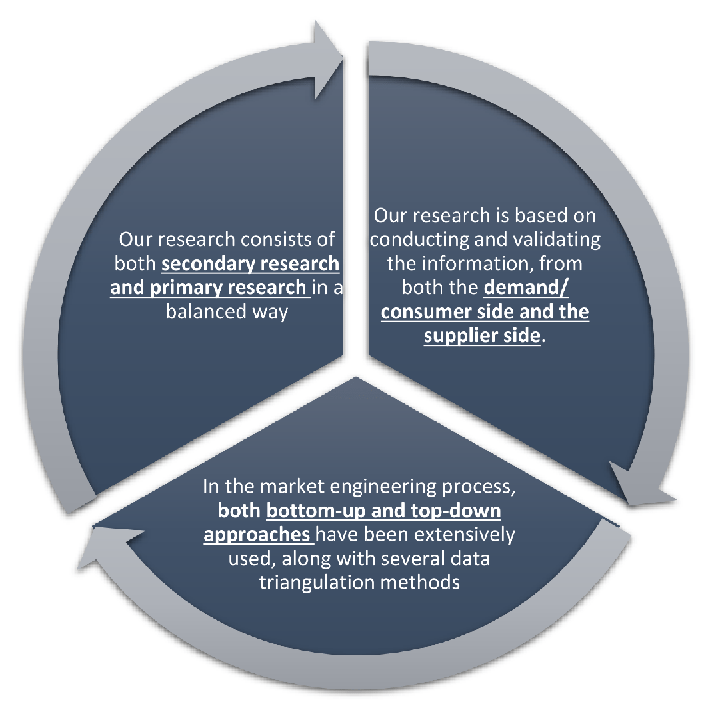
Our research design integrates both demand-side and supply-side analysis through a balanced combination of primary and secondary research methodologies. By utilizing both bottom-up and top-down approaches alongside rigorous data triangulation methods, we deliver robust market intelligence that supports strategic decision-making.
MarketGenics' comprehensive research design framework ensures the delivery of accurate, reliable, and actionable market intelligence. Through the integration of multiple research approaches, rigorous validation processes, and expert analysis, we provide our clients with the insights needed to make informed strategic decisions and capitalize on market opportunities.
MarketGenics leverages a dedicated industry panel of experts and a comprehensive suite of paid databases to effectively collect, consolidate, and analyze market intelligence.
Our approach has consistently proven to be reliable and effective in generating accurate market insights, identifying key industry trends, and uncovering emerging business opportunities.
Through both primary and secondary research, we capture and analyze critical company-level data such as manufacturing footprints, including technical centers, R&D facilities, sales offices, and headquarters.
Our expert panel further enhances our ability to estimate market size for specific brands based on validated field-level intelligence.
Our data mining techniques incorporate both parametric and non-parametric methods, allowing for structured data collection, sorting, processing, and cleaning.
Demand projections are derived from large-scale data sets analyzed through proprietary algorithms, culminating in robust and reliable market sizing.
Research Approach
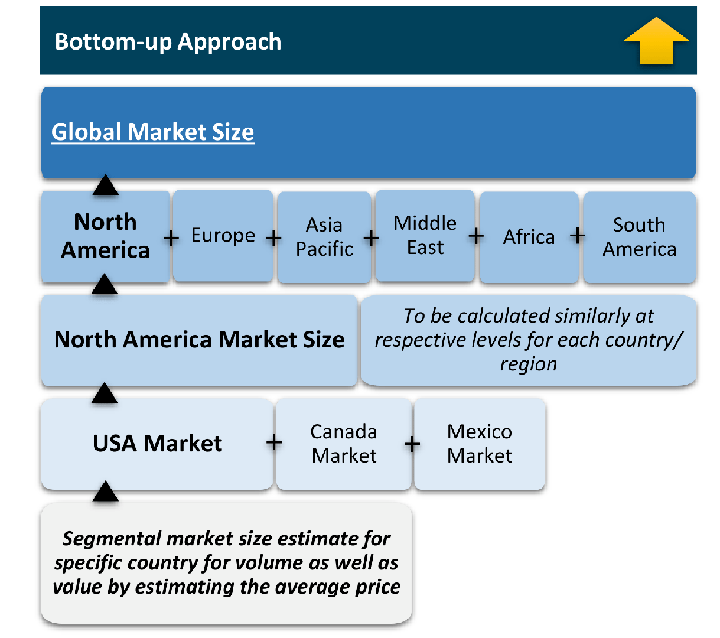
The bottom-up approach builds market estimates by starting with the smallest addressable market units and systematically aggregating them to create comprehensive market size projections.
This method begins with specific, granular data points and builds upward to create the complete market landscape.
Customer Analysis → Segmental Analysis → Geographical Analysis
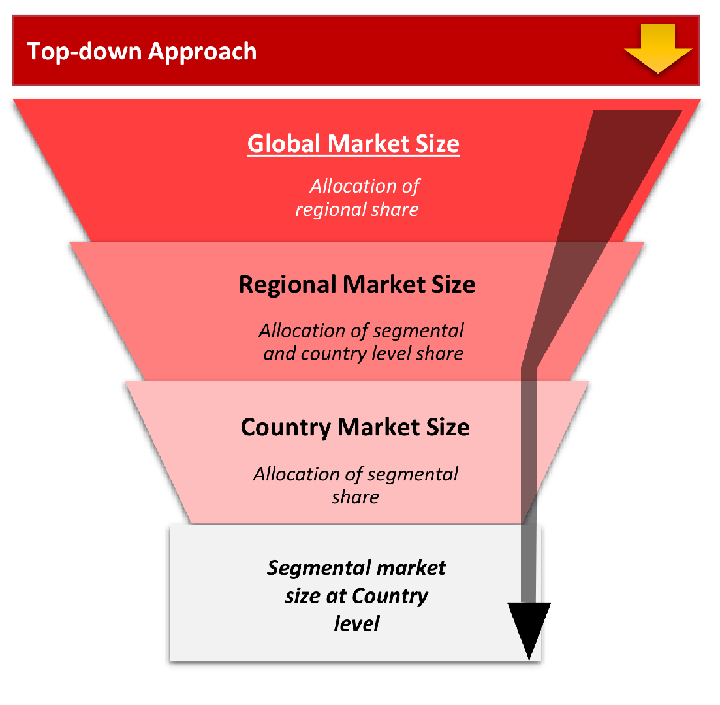
The top-down approach starts with the broadest possible market data and systematically narrows it down through a series of filters and assumptions to arrive at specific market segments or opportunities.
This method begins with the big picture and works downward to increasingly specific market slices.
TAM → SAM → SOM
Research Methods
Desk / Secondary Research
While analysing the market, we extensively study secondary sources, directories, and databases to identify and collect information useful for this technical, market-oriented, and commercial report. Secondary sources that we utilize are not only the public sources, but it is a combination of Open Source, Associations, Paid Databases, MG Repository & Knowledgebase, and others.
- Company websites, annual reports, financial reports, broker reports, and investor presentations
- National government documents, statistical databases and reports
- News articles, press releases and web-casts specific to the companies operating in the market, Magazines, reports, and others
- We gather information from commercial data sources for deriving company specific data such as segmental revenue, share for geography, product revenue, and others
- Internal and external proprietary databases (industry-specific), relevant patent, and regulatory databases
- Governing Bodies, Government Organizations
- Relevant Authorities, Country-specific Associations for Industries
We also employ the model mapping approach to estimate the product level market data through the players' product portfolio
Primary Research
Primary research/ interviews is vital in analyzing the market. Most of the cases involves paid primary interviews. Primary sources include primary interviews through e-mail interactions, telephonic interviews, surveys as well as face-to-face interviews with the different stakeholders across the value chain including several industry experts.
| Type of Respondents | Number of Primaries |
|---|---|
| Tier 2/3 Suppliers | ~20 |
| Tier 1 Suppliers | ~25 |
| End-users | ~25 |
| Industry Expert/ Panel/ Consultant | ~30 |
| Total | ~100 |
MG Knowledgebase
• Repository of industry blog, newsletter and case studies
• Online platform covering detailed market reports, and company profiles
Forecasting Factors and Models
Forecasting Factors
- Historical Trends – Past market patterns, cycles, and major events that shaped how markets behave over time. Understanding past trends helps predict future behavior.
- Industry Factors – Specific characteristics of the industry like structure, regulations, and innovation cycles that affect market dynamics.
- Macroeconomic Factors – Economic conditions like GDP growth, inflation, and employment rates that affect how much money people have to spend.
- Demographic Factors – Population characteristics like age, income, and location that determine who can buy your product.
- Technology Factors – How quickly people adopt new technology and how much technology infrastructure exists.
- Regulatory Factors – Government rules, laws, and policies that can help or restrict market growth.
- Competitive Factors – Analyzing competition structure such as degree of competition and bargaining power of buyers and suppliers.
Forecasting Models / Techniques
Multiple Regression Analysis
- Identify and quantify factors that drive market changes
- Statistical modeling to establish relationships between market drivers and outcomes
Time Series Analysis – Seasonal Patterns
- Understand regular cyclical patterns in market demand
- Advanced statistical techniques to separate trend, seasonal, and irregular components
Time Series Analysis – Trend Analysis
- Identify underlying market growth patterns and momentum
- Statistical analysis of historical data to project future trends
Expert Opinion – Expert Interviews
- Gather deep industry insights and contextual understanding
- In-depth interviews with key industry stakeholders
Multi-Scenario Development
- Prepare for uncertainty by modeling different possible futures
- Creating optimistic, pessimistic, and most likely scenarios
Time Series Analysis – Moving Averages
- Sophisticated forecasting for complex time series data
- Auto-regressive integrated moving average models with seasonal components
Econometric Models
- Apply economic theory to market forecasting
- Sophisticated economic models that account for market interactions
Expert Opinion – Delphi Method
- Harness collective wisdom of industry experts
- Structured, multi-round expert consultation process
Monte Carlo Simulation
- Quantify uncertainty and probability distributions
- Thousands of simulations with varying input parameters
Research Analysis
Our research framework is built upon the fundamental principle of validating market intelligence from both demand and supply perspectives. This dual-sided approach ensures comprehensive market understanding and reduces the risk of single-source bias.
Demand-Side Analysis: We understand end-user/application behavior, preferences, and market needs along with the penetration of the product for specific application.
Supply-Side Analysis: We estimate overall market revenue, analyze the segmental share along with industry capacity, competitive landscape, and market structure.
Validation & Evaluation
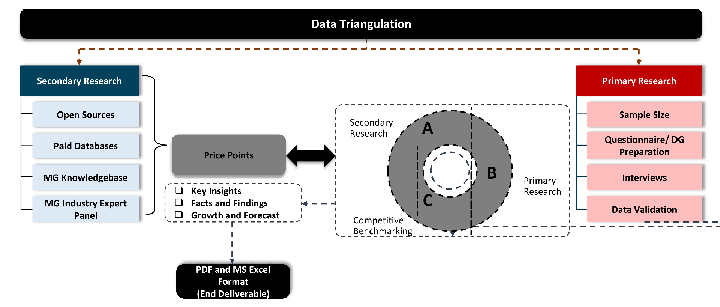
Data triangulation is a validation technique that uses multiple methods, sources, or perspectives to examine the same research question, thereby increasing the credibility and reliability of research findings. In market research, triangulation serves as a quality assurance mechanism that helps identify and minimize bias, validate assumptions, and ensure accuracy in market estimates.
- Data Source Triangulation – Using multiple data sources to examine the same phenomenon
- Methodological Triangulation – Using multiple research methods to study the same research question
- Investigator Triangulation – Using multiple researchers or analysts to examine the same data
- Theoretical Triangulation – Using multiple theoretical perspectives to interpret the same data
Custom Market Research Services
We will customise the research for you, in case the report listed above does not meet your requirements.
Get 10% Free Customisation