Biomedical Refrigerators and Freezers Market Size, Share & Trends Analysis Report by Product Type (Blood Bank Refrigerators, Pharmacy Refrigerators, Laboratory Refrigerators, Plasma Freezers, Ultra-Low Temperature Freezers, Cryogenic Freezers, Enzyme Freezers, Explosion-Proof Refrigerators and Freezers), Temperature Range, Rated Capacity, Configuration Type, Technology, Application, End-Users, and Geography (North America, Europe, Asia Pacific, Middle East, Africa, and South America) – Global Industry Data, Trends, and Forecasts, 2026–2035
Market Overview:
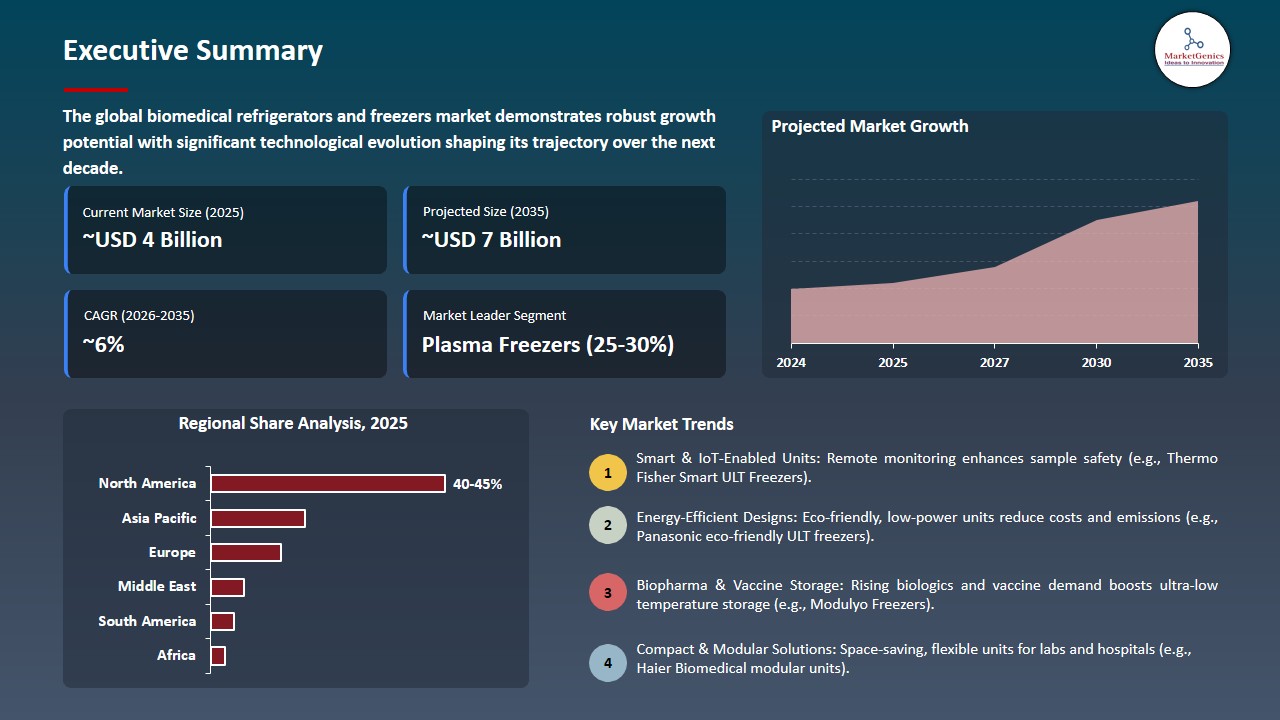
According to MarketGenics, the global biomedical refrigerators and freezers market is demonstrating steady growth, with a market size estimated at USD 3.9 billion in 2025 and projected to reach USD 6.9 billion by 2035, registering a CAGR of 5.9% during the forecast period.
|
|
|
Segmental Data Insights |
|
|
Demand Trends |
|
|
Competitive Landscape |
|
|
Strategic Development |
|
|
Future Outlook & Opportunities |
|
Biomedical Refrigerators and Freezers Market Size, Share, and Growth
Asia Pacific is the fastest-growing region in the biomedical refrigerators and freezers market due to rapid expansion of healthcare infrastructure, rising pharmaceutical and biotechnology research activities, increasing vaccine production and immunization programs, and growing investments in medical cold-chain systems across emerging economies.
Hans Brok, President of PHCNA, said, "The VIP ECO SMART series has already pushed the envelope with technical advances that support pharmaceutical companies and healthcare institutions in achieving their energy efficiency goals, enhancing security of cold storage, and increasing lab performance efficiency. Now with power source flexibility, the PHCbi brand is eliminating barriers so laboratories focus on critical research and patient outcomes instead of which power outlet they happen to have available."
The biomedical refrigerators and freezers market is experiencing growth owing to technological innovations in the field of refrigeration that provide better reliability, efficiency and safety. The innovation of real-time temperature controls, computerized control interfaces, automatic warnings, and improved insulation materials keep the ultra-low temperatures exactly at the right spot, minimizes the risk of product deterioration, and makes the management of operations easier. These make it more widely used in hospitals, blood banks, research labs, and vaccine storage facilities.
The growth of cold chain logistics in the pharmaceutical sector presents a significant opportunity for the biomedical refrigerators and freezers market. As the demand for temperature-sensitive pharmaceuticals, vaccines, and biologics increases, it becomes essential to maintain stable ultra-low temperature storage during transport and final delivery. Further biomedical refrigerators and freezers will also be able to maintain the integrity of products, regulatory standards and efficient distribution channels to facilitate development of pharmaceutical supply chain globally.
The adjacent opportunities in the biomedical refrigerators and freezers market include the incorporation of smart IoT-driven monitoring systems, energy-saving and environmentally friendly refrigeration technologies, modularized and portable refrigeration storage units in the field or in cases of emergency, the expansion of vaccine and biologics storage options, and collaboration with pharmaceutical and research institutes in providing end-to-end cold chain management, all of which improve operational efficiency, safety, and scalability.
Biomedical Refrigerators and Freezers Market Dynamics and Trends
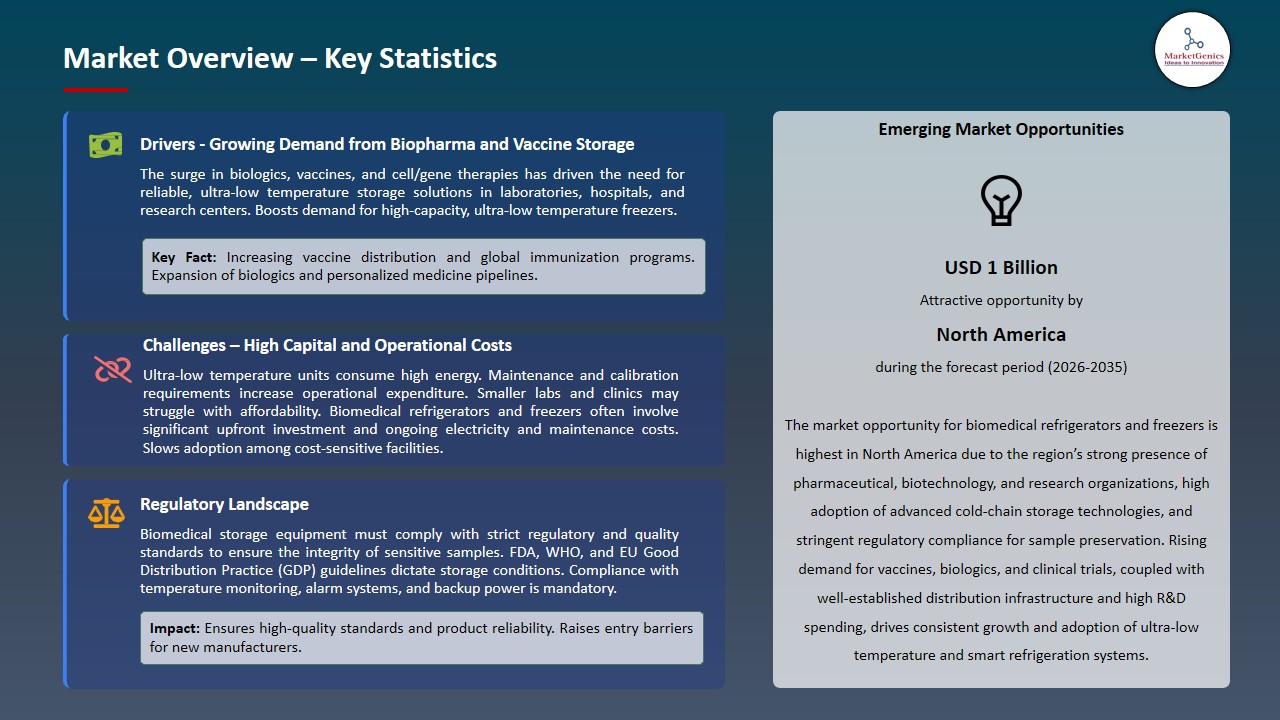
Driver: Demand for Vaccine and Biologics Storage
-
The increase in the requirement of storing vaccines and biologics is one of the driving factors behind the global market of biomedical refrigerators and freezers. More production and distribution of vaccines, biologics, and cell- and gene-based therapies necessitate ultra-low temperature storage, which must be accurate to preserve stability, potency and efficacy. Tough regulatory standards have to be strict temperature monitoring, backup, and compliance features, which is a push towards the utilization of advanced refrigeration solutions.
- The increased immunization, outbreak preparedness and the increased emphasis on personalized medicine increase the demand on reliable cold chain infrastructure in hospitals, research laboratories, biobanks, and clinical trial centers.
- Haier biomedical delivered 100 HYC-61 and 10 HYC-361 vaccine refrigerators, 10 vaccine scanning cabinets in December 2025 to Nakhchivan, Azerbaijan. This implementation created an intelligent, fully tracked vaccine management system combining superior storage devices with a sophisticated system to monitor real time temperatures, manage inventory and oversee the cold-chain.
- Consistently, forecasts of biomedical refrigerators and freezers are experiencing continued demand to facilitate long-term and safe storage of the essential biologic and vaccine products.
Restraint: Energy Consumption and Operational Challenges
-
The high energy absorption rates of running the refrigeration and the freezers is also a major limitation to the Biomedical Refrigerators and Freezers market. Biomedical refrigeration used especially ultra-low temperature (ULT) freezers and plasma freezers need continuous power to maintain accurate temperature conditions. This is a continuous power requirement and thus increases the electricity bills incurred by hospitals, research labs, blood banks, and pharmaceutical plants and this also affects the operation budgets.
- Environmental issues regarding the use of refrigerants also contribute to increased operational difficulty. A large number of conventional refrigeration systems use hydrofluorocarbon (HFC) refrigerants, which have high rates of global warming (GWP), which brings them to the regulatory spotlight along with other compliance issues. Refrigerants require appropriate handling, monitoring and disposal which in turn increase the complexity of the operation of the facilities to reduce environmental effects.
- In addition, it has been observed that regular repairs and possible system malfunction in critical cold storage units can interfere with storage integrity, which endangers delicate biological samples, vaccines, and blood products.
- The combination of these reasons limits uptake, especially by smaller healthcare facilities and research centers, which slows growth in the market despite increased demand of biomedical refrigeration solutions worldwide.
Opportunity: Integration of IoT and Smart Monitoring Technologies
-
The introduction of IoT and smart monitoring technologies into the biomedical refrigerators and freezers market is a considerable opportunity. The use of advanced systems allows checking the temperature, humidity, and equipment parameters remotely in real-time to guarantee the existence of the most optimal conditions in storing the sensitive biological materials.
- The automated warning mechanisms will inform the operators of the deviations or other possible malfunctions and minimize the risk of losing products and increase the ability to comply with the regulatory standards. Predictive maintenance functions are used to evaluate operational data to predict equipment failures and reduce the downtime and maintenance costs. The technologies also enable smooth data logging, traceability, reporting and aid in quality assurance and audit preparedness.
- PHC Corporation of North America announced the MDF-DU703VHA-PA model of its PHCbi VIP ECO SMART ultra-low temperature (ULT) freezer line, which provides two-voltage use (115 V / 220 V), SMART power savings, and electronic security with several authentication options and a big LCD touchscreen.
- Thus, the performance of the refrigerator systems with IoT, combined with efficiency, safety, and adherence to regulations, leads to the proliferation of these systems in hospitals, blood banks, research facilities, and pharmaceutical plants worldwide.
Key Trend: Customized Refrigeration Solutions
-
The most significant current trends on the biomedical refrigerators and freezers market is the increased attention to custom and specialized refrigeration solutions that suit the particular needs of the specific end-use segment. Manufacturers are also coming up with units that are designed to be used in blood banks, in plasma storage, in ultra-low temperature (ULT) sample preservation, in vaccine storage, and in pharmacy cold chains, with optimum temperature stability, precision control, and meeting regulatory requirements.
- Specialized systems can overcome issues like degradation of samples (and immunogenic stability), sensitive biologics manipulation, and can provide capabilities like programmable temperature profiles, compartmentalization and intelligent monitoring. Through providing application-based solutions, businesses can improve on operational efficiency, safety, and reliability, which respond to the increase of demand in hospitals, research centers, and pharmaceutical plants.
- In April 2024, Thermo Fisher scientific introduced its TSX Universal Series Ultra-Low Temperature (ULT) Freezers aimed at the laboratories as well as the GMP facilities and frozen blood and blood product storage (long-term). These new generation freezers have 33 percent of energy savings, automatic temperature control, universal voltage, and ISO Class 5.5 certified cleanroom.
- This trend encourages market differentiation and use of improved refrigeration methods across the world.
Biomedical-Refrigerators-and-Freezers-Market Analysis and Segmental Data
Plasma Freezers Dominate Global Biomedical Refrigerators and Freezers Market
-
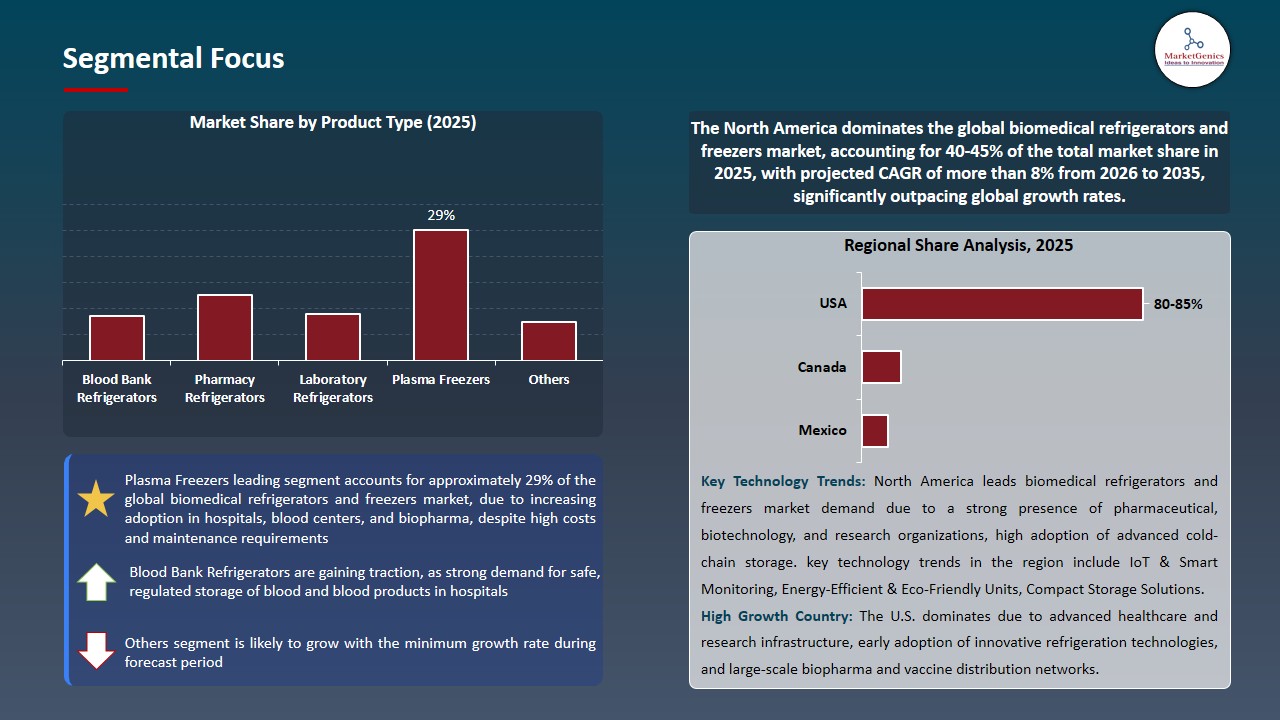
The Plasma Freezers segment dominates the global biomedical refrigerators and freezers market due to the critical need for safe, long-term storage of plasma and blood-derived products at ultra-low and highly stable temperatures. Plasma freezers are essential in blood banks, hospitals, transfusion centers, and research laboratories to preserve plasma quality, coagulation factors, and therapeutic proteins.
- Rising demand for blood transfusions, trauma care, surgical procedures, and plasma-based therapies significantly supports segment growth. Additionally, stringent regulatory requirements for plasma storage temperature accuracy and continuous monitoring drive the adoption of advanced plasma freezers equipped with alarms, backup systems, and compliance features.
- Haier Biomedical developed its Plasma Blast Freezer, designed for rapid and efficient plasma freezing in blood and plasma stations. The system features direct contact freezing to –50°C, IoT-enabled data management for real-time traceability, high-efficiency compressors with dual-stage cooling, and precise temperature control to ±1°C, enhancing plasma safety, energy efficiency, and operational workflow.
- The expanding use of plasma in immunology, hemophilia treatment, and vaccine research further reinforces the leadership of the plasma freezers segment globally.
North America Leads Global Biomedical Refrigerators and Freezers Market Demand
-
North America leads the global biomedical refrigerators and freezers market due to its well-established healthcare infrastructure and strong concentration of hospitals, diagnostic laboratories, research institutes, and biopharmaceutical companies. High volumes of clinical research, vaccine development, blood banking, and biologics storage create consistent demand for reliable and precise temperature-controlled refrigeration systems across the region.
- Additionally, strict regulatory standards for the storage of vaccines, blood products, and pharmaceuticals drive the adoption of advanced biomedical refrigerators and freezers with continuous temperature monitoring, alarm systems, and compliance features. The region also benefits from higher healthcare spending, rapid adoption of technologically advanced equipment, and ongoing investments in life sciences research and cold-chain logistics. Growing focus on biobanking, personalized medicine, and large-scale immunization programs further strengthens market demand.
- These factors position North America as a dominant contributor to revenue and technological advancement in the global biomedical refrigerators and freezers market.
Biomedical-Refrigerators-and-Freezers-Market Ecosystem
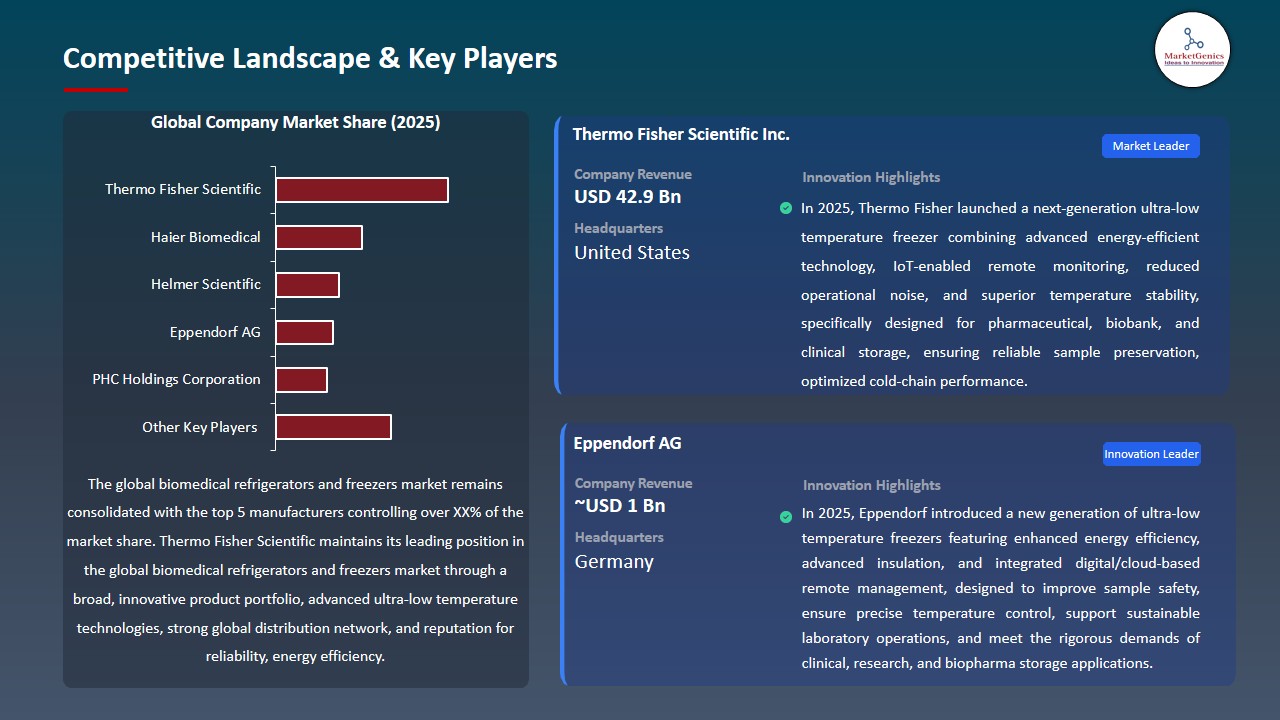
The global biomedical refrigerators and freezers market is consolidated, with key players focusing on temperature-controlled storage solutions for vaccines, blood, plasma, biologics, and laboratory samples. These companies maintain competitive strength through continuous investment in research and development, advanced cooling technologies such as ultra-low temperature systems and smart monitoring features, broad product portfolios, strong compliance with international quality standards, and well-established relationships with hospitals, laboratories, blood banks, biobanks, and research institutions supported by robust distribution and service networks.
The biomedical refrigerators and freezers value chain includes raw material sourcing and component manufacturing, product design and assembly under strict regulatory and safety requirements, quality testing and certification, branding and packaging, distribution through medical equipment suppliers and direct hospital sales, and post-sales services such as installation, calibration, maintenance, and temperature validation support.
Entry barriers are high due to stringent regulatory approvals, the need for precision engineering and reliability, high capital investment, and strong competition from established manufacturers. Ongoing innovations in energy-efficient systems, digital temperature monitoring, remote alarms, and sustainable refrigerants continue to drive differentiation and adoption across the global market.
Recent Development and Strategic Overview:
-
In September 2025, Krish Biomedicals inaugurated its first manufacturing unit at the Medical Device Park, marking a significant development in domestic production of critical healthcare equipment. The facility will manufacture ultra‑low temperature deep freezers capable of maintaining –86°C, essential for preserving plasma, vaccines, human cells, and laboratory samples, along with other blood bank and cold‑chain refrigeration systems.
- In November 2025, Haier Biomedical launched India’s first Smart Hospital Biobank, integrating specialized refrigeration solutions including UltraEco ULT Freezers, -30°C Biomedical Freezers, Pharmacy Refrigerators, Liquid Nitrogen Containers, and Benchtop Low-Speed Centrifuges. The smart system features IoT-enabled monitoring, real-time alerts, precise temperature control, and energy-efficient operation.
Report Scope
|
Detail |
|
|
Market Size in 2025 |
USD 4.8 Bn |
|
Market Forecast Value in 2035 |
USD 11.5 Bn |
|
Growth Rate (CAGR) |
9.8% |
|
Forecast Period |
2026 – 2035 |
|
Historical Data Available for |
2021 – 2024 |
|
Market Size Units |
US$ Billion for Value Thousand Units for Volume |
|
Report Format |
Electronic (PDF) + Excel |
|
North America |
Europe |
Asia Pacific |
Middle East |
Africa |
South America |
|
|
|
|
|
|
|
Companies Covered |
|||||
|
|
|
|
|
|
Biomedical-Refrigerators-and-Freezers-Market Segmentation and Highlights
|
Segment |
Sub-segment |
|
Biomedical Refrigerators and Freezers Market, By Product Type |
|
|
Biomedical Refrigerators and Freezers Market, By Temperature Range |
|
|
Biomedical Refrigerators and Freezers Market, By Rated Capacity |
|
|
Biomedical Refrigerators and Freezers Market, By Configuration Type |
|
|
Biomedical Refrigerators and Freezers Market, By Technology |
|
|
Biomedical Refrigerators and Freezers Market, By Application |
|
|
Biomedical Refrigerators and Freezers Market, By End-Users |
|
Frequently Asked Questions
Table of Contents
- 1. Research Methodology and Assumptions
- 1.1. Definitions
- 1.2. Research Design and Approach
- 1.3. Data Collection Methods
- 1.4. Base Estimates and Calculations
- 1.5. Forecasting Models
- 1.5.1. Key Forecast Factors & Impact Analysis
- 1.6. Secondary Research
- 1.6.1. Open Sources
- 1.6.2. Paid Databases
- 1.6.3. Associations
- 1.7. Primary Research
- 1.7.1. Primary Sources
- 1.7.2. Primary Interviews with Stakeholders across Ecosystem
- 2. Executive Summary
- 2.1. Global Biomedical Refrigerators and Freezers Market Outlook
- 2.1.1. Biomedical Refrigerators and Freezers Market Size Volume (Thousand Units) and Value (US$ Bn), and Forecasts, 2021-2035
- 2.1.2. Compounded Annual Growth Rate Analysis
- 2.1.3. Growth Opportunity Analysis
- 2.1.4. Segmental Share Analysis
- 2.1.5. Geographical Share Analysis
- 2.2. Market Analysis and Facts
- 2.3. Supply-Demand Analysis
- 2.4. Competitive Benchmarking
- 2.5. Go-to- Market Strategy
- 2.5.1. Customer/ End-use Industry Assessment
- 2.5.2. Growth Opportunity Data, 2026-2035
- 2.5.2.1. Regional Data
- 2.5.2.2. Country Data
- 2.5.2.3. Segmental Data
- 2.5.3. Identification of Potential Market Spaces
- 2.5.4. GAP Analysis
- 2.5.5. Potential Attractive Price Points
- 2.5.6. Prevailing Market Risks & Challenges
- 2.5.7. Preferred Sales & Marketing Strategies
- 2.5.8. Key Recommendations and Analysis
- 2.5.9. A Way Forward
- 2.1. Global Biomedical Refrigerators and Freezers Market Outlook
- 3. Industry Data and Premium Insights
- 3.1. Global Healthcare & Pharmaceutical Industry Overview, 2025
- 3.1.1. Healthcare & Pharmaceutical Industry Ecosystem Analysis
- 3.1.2. Key Trends for Healthcare & Pharmaceutical Industry
- 3.1.3. Regional Distribution for Healthcare & Pharmaceutical Industry
- 3.2. Supplier Customer Data
- 3.3. Technology Roadmap and Developments
- 3.4. Trade Analysis
- 3.4.1. Import & Export Analysis, 2025
- 3.4.2. Top Importing Countries
- 3.4.3. Top Exporting Countries
- 3.5. Trump Tariff Impact Analysis
- 3.5.1. Manufacturer
- 3.5.1.1. Based on the component & Raw material
- 3.5.2. Supply Chain
- 3.5.3. End Consumer
- 3.5.1. Manufacturer
- 3.6. Raw Material Analysis
- 3.1. Global Healthcare & Pharmaceutical Industry Overview, 2025
- 4. Market Overview
- 4.1. Market Dynamics
- 4.1.1. Drivers
- 4.1.1.1. Growing demand for temperature‑sensitive storage in healthcare and research sectors
- 4.1.1.2. Increasing need for vaccines, biologics, and pharmaceutical preservation
- 4.1.1.3. Expansion of biotechnology and clinical diagnostics industries
- 4.1.2. Restraints
- 4.1.2.1. High initial investment and maintenance costs
- 4.1.2.2. Stringent regulatory requirements for quality and compliance
- 4.1.1. Drivers
- 4.2. Key Trend Analysis
- 4.3. Regulatory Framework
- 4.3.1. Key Regulations, Norms, and Subsidies, by Key Countries
- 4.3.2. Tariffs and Standards
- 4.3.3. Impact Analysis of Regulations on the Market
- 4.4. Value Chain Analysis
- 4.4.1. Raw Material Suppliers
- 4.4.2. Manufacturers
- 4.4.3. Distribution & Wholesalers
- 4.4.4. End Users
- 4.5. Porter’s Five Forces Analysis
- 4.6. PESTEL Analysis
- 4.7. Global Biomedical Refrigerators and Freezers Market Demand
- 4.7.1. Historical Market Size – Volume (Thousand Units) and Value (US$ Bn), 2020-2024
- 4.7.2. Current and Future Market Size – Volume (Thousand Units) and Value (US$ Bn), 2026–2035
- 4.7.2.1. Y-o-Y Growth Trends
- 4.7.2.2. Absolute $ Opportunity Assessment
- 4.1. Market Dynamics
- 5. Competition Landscape
- 5.1. Competition structure
- 5.1.1. Fragmented v/s consolidated
- 5.2. Company Share Analysis, 2025
- 5.2.1. Global Company Market Share
- 5.2.2. By Region
- 5.2.2.1. North America
- 5.2.2.2. Europe
- 5.2.2.3. Asia Pacific
- 5.2.2.4. Middle East
- 5.2.2.5. Africa
- 5.2.2.6. South America
- 5.3. Product Comparison Matrix
- 5.3.1. Specifications
- 5.3.2. Market Positioning
- 5.3.3. Pricing
- 5.1. Competition structure
- 6. Global Biomedical Refrigerators and Freezers Market Analysis, by Product Type
- 6.1. Key Segment Analysis
- 6.2. Biomedical Refrigerators and Freezers Market Size Volume (Thousand Units) and Value (US$ Bn), Analysis, and Forecasts, by Product Type, 2021-2035
- 6.2.1. Blood Bank Refrigerators
- 6.2.2. Pharmacy Refrigerators
- 6.2.3. Laboratory Refrigerators
- 6.2.4. Plasma Freezers
- 6.2.5. Ultra-Low Temperature Freezers
- 6.2.6. Cryogenic Freezers
- 6.2.7. Enzyme Freezers
- 6.2.8. Explosion-Proof Refrigerators and Freezers
- 7. Global Biomedical Refrigerators and Freezers Market Analysis, by Temperature Range
- 7.1. Key Segment Analysis
- 7.2. Biomedical Refrigerators and Freezers Market Size Volume (Thousand Units) and Value (US$ Bn), Analysis, and Forecasts, by Temperature Range, 2021-2035
- 7.2.1. 2°C to 8°C (Standard Refrigeration)
- 7.2.2. -20°C to -30°C (Low Temperature Freezers)
- 7.2.3. -40°C to -86°C (Ultra-Low Temperature Freezers)
- 7.2.4. Below -150°C (Cryogenic Storage)
- 8. Global Biomedical Refrigerators and Freezers Market Analysis, by Rated Capacity
- 8.1. Key Segment Analysis
- 8.2. Biomedical Refrigerators and Freezers Market Size Volume (Thousand Units) and Value (US$ Bn), Analysis, and Forecasts, by Rated Capacity, 2021-2035
- 8.2.1. Below 200 Liters
- 8.2.2. 200-500 Liters
- 8.2.3. 500-1000 Liters
- 8.2.4. Above 1000 Liters
- 9. Global Biomedical Refrigerators and Freezers Market Analysis, by Configuration Type
- 9.1. Key Segment Analysis
- 9.2. Biomedical Refrigerators and Freezers Market Size Volume (Thousand Units) and Value (US$ Bn), Analysis, and Forecasts, by Configuration Type, 2021-2035
- 9.2.1. Upright/Vertical Refrigerators and Freezers
- 9.2.2. Chest/Horizontal Refrigerators and Freezers
- 9.2.3. Under-Counter Units
- 9.2.4. Portable/Compact Units
- 10. Global Biomedical Refrigerators and Freezers Market Analysis, by Technology
- 10.1. Key Segment Analysis
- 10.2. Biomedical Refrigerators and Freezers Market Size Volume (Thousand Units) and Value (US$ Bn), Analysis, and Forecasts, by Technology, 2021-2035
- 10.2.1. Direct Cooling
- 10.2.2. Forced Air Cooling
- 10.2.3. Vapor Compression
- 10.2.4. Stirling Cooling Technology
- 10.2.5. Cascade Refrigeration Systems
- 11. Global Biomedical Refrigerators and Freezers Market Analysis, by Application
- 11.1. Key Segment Analysis
- 11.2. Biomedical Refrigerators and Freezers Market Size Volume (Thousand Units) and Value (US$ Bn), Analysis, and Forecasts, by Application, 2021-2035
- 11.2.1. Blood and Blood Component Storage
- 11.2.2. Vaccine Storage
- 11.2.3. Drug and Pharmaceutical Storage
- 11.2.4. Biological Sample Storage
- 11.2.5. Tissue and Organ Preservation
- 11.2.6. DNA/RNA Sample Storage
- 11.2.7. Enzyme and Reagent Storage
- 11.2.8. Others
- 12. Global Biomedical Refrigerators and Freezers Market Analysis and Forecasts, by End-Users
- 12.1. Key Findings
- 12.2. Biomedical Refrigerators and Freezers Market Size Volume (Thousand Units) and Value (US$ Bn), Analysis, and Forecasts, by End-Users, 2021-2035
- 12.2.1. Hospitals and Clinics
- 12.2.2. Pharmaceutical and Biotechnology Companies
- 12.2.3. Blood Banks
- 12.2.4. Research and Academic Institutes
- 12.2.5. Diagnostic Centers
- 12.2.6. Tissue Banks
- 12.2.7. Others
- 13. Global Biomedical Refrigerators and Freezers Market Analysis and Forecasts, by Region
- 13.1. Key Findings
- 13.2. Biomedical Refrigerators and Freezers Market Size Volume (Thousand Units) and Value (US$ Bn), Analysis, and Forecasts, by Region, 2021-2035
- 13.2.1. North America
- 13.2.2. Europe
- 13.2.3. Asia Pacific
- 13.2.4. Middle East
- 13.2.5. Africa
- 13.2.6. South America
- 14. North America Biomedical Refrigerators and Freezers Market Analysis
- 14.1. Key Segment Analysis
- 14.2. Regional Snapshot
- 14.3. North America Biomedical Refrigerators and Freezers Market Size Volume (Thousand Units) and Value (US$ Bn), Analysis, and Forecasts, 2021-2035
- 14.3.1. Product Type
- 14.3.2. Temperature Range
- 14.3.3. Rated Capacity
- 14.3.4. Configuration Type
- 14.3.5. Technology
- 14.3.6. Application
- 14.3.7. End-Users
- 14.3.8. Country
- 14.3.8.1. USA
- 14.3.8.2. Canada
- 14.3.8.3. Mexico
- 14.4. USA Biomedical Refrigerators and Freezers Market
- 14.4.1. Country Segmental Analysis
- 14.4.2. Product Type
- 14.4.3. Temperature Range
- 14.4.4. Rated Capacity
- 14.4.5. Configuration Type
- 14.4.6. Technology
- 14.4.7. Application
- 14.4.8. End-Users
- 14.5. Canada Biomedical Refrigerators and Freezers Market
- 14.5.1. Country Segmental Analysis
- 14.5.2. Product Type
- 14.5.3. Temperature Range
- 14.5.4. Rated Capacity
- 14.5.5. Configuration Type
- 14.5.6. Technology
- 14.5.7. Application
- 14.5.8. End-Users
- 14.6. Mexico Biomedical Refrigerators and Freezers Market
- 14.6.1. Country Segmental Analysis
- 14.6.2. Product Type
- 14.6.3. Temperature Range
- 14.6.4. Rated Capacity
- 14.6.5. Configuration Type
- 14.6.6. Technology
- 14.6.7. Application
- 14.6.8. End-Users
- 15. Europe Biomedical Refrigerators and Freezers Market Analysis
- 15.1. Key Segment Analysis
- 15.2. Regional Snapshot
- 15.3. Europe Biomedical Refrigerators and Freezers Market Size Volume (Thousand Units) and Value (US$ Bn), Analysis, and Forecasts, 2021-2035
- 15.3.1. Product Type
- 15.3.2. Temperature Range
- 15.3.3. Rated Capacity
- 15.3.4. Configuration Type
- 15.3.5. Technology
- 15.3.6. Application
- 15.3.7. End-Users
- 15.3.8. Country
- 15.3.8.1. Germany
- 15.3.8.2. United Kingdom
- 15.3.8.3. France
- 15.3.8.4. Italy
- 15.3.8.5. Spain
- 15.3.8.6. Netherlands
- 15.3.8.7. Nordic Countries
- 15.3.8.8. Poland
- 15.3.8.9. Russia & CIS
- 15.3.8.10. Rest of Europe
- 15.4. Germany Biomedical Refrigerators and Freezers Market
- 15.4.1. Country Segmental Analysis
- 15.4.2. Product Type
- 15.4.3. Temperature Range
- 15.4.4. Rated Capacity
- 15.4.5. Configuration Type
- 15.4.6. Technology
- 15.4.7. Application
- 15.4.8. End-Users
- 15.5. United Kingdom Biomedical Refrigerators and Freezers Market
- 15.5.1. Country Segmental Analysis
- 15.5.2. Product Type
- 15.5.3. Temperature Range
- 15.5.4. Rated Capacity
- 15.5.5. Configuration Type
- 15.5.6. Technology
- 15.5.7. Application
- 15.5.8. End-Users
- 15.6. France Biomedical Refrigerators and Freezers Market
- 15.6.1. Country Segmental Analysis
- 15.6.2. Product Type
- 15.6.3. Temperature Range
- 15.6.4. Rated Capacity
- 15.6.5. Configuration Type
- 15.6.6. Technology
- 15.6.7. Application
- 15.6.8. End-Users
- 15.7. Italy Biomedical Refrigerators and Freezers Market
- 15.7.1. Country Segmental Analysis
- 15.7.2. Product Type
- 15.7.3. Temperature Range
- 15.7.4. Rated Capacity
- 15.7.5. Configuration Type
- 15.7.6. Technology
- 15.7.7. Application
- 15.7.8. End-Users
- 15.8. Spain Biomedical Refrigerators and Freezers Market
- 15.8.1. Country Segmental Analysis
- 15.8.2. Product Type
- 15.8.3. Temperature Range
- 15.8.4. Rated Capacity
- 15.8.5. Configuration Type
- 15.8.6. Technology
- 15.8.7. Application
- 15.8.8. End-Users
- 15.9. Netherlands Biomedical Refrigerators and Freezers Market
- 15.9.1. Country Segmental Analysis
- 15.9.2. Product Type
- 15.9.3. Temperature Range
- 15.9.4. Rated Capacity
- 15.9.5. Configuration Type
- 15.9.6. Technology
- 15.9.7. Application
- 15.9.8. End-Users
- 15.10. Nordic Countries Biomedical Refrigerators and Freezers Market
- 15.10.1. Country Segmental Analysis
- 15.10.2. Product Type
- 15.10.3. Temperature Range
- 15.10.4. Rated Capacity
- 15.10.5. Configuration Type
- 15.10.6. Technology
- 15.10.7. Application
- 15.10.8. End-Users
- 15.11. Poland Biomedical Refrigerators and Freezers Market
- 15.11.1. Country Segmental Analysis
- 15.11.2. Product Type
- 15.11.3. Temperature Range
- 15.11.4. Rated Capacity
- 15.11.5. Configuration Type
- 15.11.6. Technology
- 15.11.7. Application
- 15.11.8. End-Users
- 15.12. Russia & CIS Biomedical Refrigerators and Freezers Market
- 15.12.1. Country Segmental Analysis
- 15.12.2. Product Type
- 15.12.3. Temperature Range
- 15.12.4. Rated Capacity
- 15.12.5. Configuration Type
- 15.12.6. Technology
- 15.12.7. Application
- 15.12.8. End-Users
- 15.13. Rest of Europe Biomedical Refrigerators and Freezers Market
- 15.13.1. Country Segmental Analysis
- 15.13.2. Product Type
- 15.13.3. Temperature Range
- 15.13.4. Rated Capacity
- 15.13.5. Configuration Type
- 15.13.6. Technology
- 15.13.7. Application
- 15.13.8. End-Users
- 16. Asia Pacific Biomedical Refrigerators and Freezers Market Analysis
- 16.1. Key Segment Analysis
- 16.2. Regional Snapshot
- 16.3. Asia Pacific Biomedical Refrigerators and Freezers Market Size Volume (Thousand Units) and Value (US$ Bn), Analysis, and Forecasts, 2021-2035
- 16.3.1. Product Type
- 16.3.2. Temperature Range
- 16.3.3. Rated Capacity
- 16.3.4. Configuration Type
- 16.3.5. Technology
- 16.3.6. Application
- 16.3.7. End-Users
- 16.3.8. Country
- 16.3.8.1. China
- 16.3.8.2. India
- 16.3.8.3. Japan
- 16.3.8.4. South Korea
- 16.3.8.5. Australia and New Zealand
- 16.3.8.6. Indonesia
- 16.3.8.7. Malaysia
- 16.3.8.8. Thailand
- 16.3.8.9. Vietnam
- 16.3.8.10. Rest of Asia Pacific
- 16.4. China Biomedical Refrigerators and Freezers Market
- 16.4.1. Country Segmental Analysis
- 16.4.2. Product Type
- 16.4.3. Temperature Range
- 16.4.4. Rated Capacity
- 16.4.5. Configuration Type
- 16.4.6. Technology
- 16.4.7. Application
- 16.4.8. End-Users
- 16.5. India Biomedical Refrigerators and Freezers Market
- 16.5.1. Country Segmental Analysis
- 16.5.2. Product Type
- 16.5.3. Temperature Range
- 16.5.4. Rated Capacity
- 16.5.5. Configuration Type
- 16.5.6. Technology
- 16.5.7. Application
- 16.5.8. End-Users
- 16.6. Japan Biomedical Refrigerators and Freezers Market
- 16.6.1. Country Segmental Analysis
- 16.6.2. Product Type
- 16.6.3. Temperature Range
- 16.6.4. Rated Capacity
- 16.6.5. Configuration Type
- 16.6.6. Technology
- 16.6.7. Application
- 16.6.8. End-Users
- 16.7. South Korea Biomedical Refrigerators and Freezers Market
- 16.7.1. Country Segmental Analysis
- 16.7.2. Product Type
- 16.7.3. Temperature Range
- 16.7.4. Rated Capacity
- 16.7.5. Configuration Type
- 16.7.6. Technology
- 16.7.7. Application
- 16.7.8. End-Users
- 16.8. Australia and New Zealand Biomedical Refrigerators and Freezers Market
- 16.8.1. Country Segmental Analysis
- 16.8.2. Product Type
- 16.8.3. Temperature Range
- 16.8.4. Rated Capacity
- 16.8.5. Configuration Type
- 16.8.6. Technology
- 16.8.7. Application
- 16.8.8. End-Users
- 16.9. Indonesia Biomedical Refrigerators and Freezers Market
- 16.9.1. Country Segmental Analysis
- 16.9.2. Product Type
- 16.9.3. Temperature Range
- 16.9.4. Rated Capacity
- 16.9.5. Configuration Type
- 16.9.6. Technology
- 16.9.7. Application
- 16.9.8. End-Users
- 16.10. Malaysia Biomedical Refrigerators and Freezers Market
- 16.10.1. Country Segmental Analysis
- 16.10.2. Product Type
- 16.10.3. Temperature Range
- 16.10.4. Rated Capacity
- 16.10.5. Configuration Type
- 16.10.6. Technology
- 16.10.7. Application
- 16.10.8. End-Users
- 16.11. Thailand Biomedical Refrigerators and Freezers Market
- 16.11.1. Country Segmental Analysis
- 16.11.2. Product Type
- 16.11.3. Temperature Range
- 16.11.4. Rated Capacity
- 16.11.5. Configuration Type
- 16.11.6. Technology
- 16.11.7. Application
- 16.11.8. End-Users
- 16.12. Vietnam Biomedical Refrigerators and Freezers Market
- 16.12.1. Country Segmental Analysis
- 16.12.2. Product Type
- 16.12.3. Temperature Range
- 16.12.4. Rated Capacity
- 16.12.5. Configuration Type
- 16.12.6. Technology
- 16.12.7. Application
- 16.12.8. End-Users
- 16.13. Rest of Asia Pacific Biomedical Refrigerators and Freezers Market
- 16.13.1. Country Segmental Analysis
- 16.13.2. Product Type
- 16.13.3. Temperature Range
- 16.13.4. Rated Capacity
- 16.13.5. Configuration Type
- 16.13.6. Technology
- 16.13.7. Application
- 16.13.8. End-Users
- 17. Middle East Biomedical Refrigerators and Freezers Market Analysis
- 17.1. Key Segment Analysis
- 17.2. Regional Snapshot
- 17.3. Middle East Biomedical Refrigerators and Freezers Market Size Volume (Thousand Units) and Value (US$ Bn), Analysis, and Forecasts, 2021-2035
- 17.3.1. Product Type
- 17.3.2. Temperature Range
- 17.3.3. Rated Capacity
- 17.3.4. Configuration Type
- 17.3.5. Technology
- 17.3.6. Application
- 17.3.7. End-Users
- 17.3.8. Country
- 17.3.8.1. Turkey
- 17.3.8.2. UAE
- 17.3.8.3. Saudi Arabia
- 17.3.8.4. Israel
- 17.3.8.5. Rest of Middle East
- 17.4. Turkey Biomedical Refrigerators and Freezers Market
- 17.4.1. Country Segmental Analysis
- 17.4.2. Product Type
- 17.4.3. Temperature Range
- 17.4.4. Rated Capacity
- 17.4.5. Configuration Type
- 17.4.6. Technology
- 17.4.7. Application
- 17.4.8. End-Users
- 17.5. UAE Biomedical Refrigerators and Freezers Market
- 17.5.1. Country Segmental Analysis
- 17.5.2. Product Type
- 17.5.3. Temperature Range
- 17.5.4. Rated Capacity
- 17.5.5. Configuration Type
- 17.5.6. Technology
- 17.5.7. Application
- 17.5.8. End-Users
- 17.6. Saudi Arabia Biomedical Refrigerators and Freezers Market
- 17.6.1. Country Segmental Analysis
- 17.6.2. Product Type
- 17.6.3. Temperature Range
- 17.6.4. Rated Capacity
- 17.6.5. Configuration Type
- 17.6.6. Technology
- 17.6.7. Application
- 17.6.8. End-Users
- 17.7. Israel Biomedical Refrigerators and Freezers Market
- 17.7.1. Country Segmental Analysis
- 17.7.2. Product Type
- 17.7.3. Temperature Range
- 17.7.4. Rated Capacity
- 17.7.5. Configuration Type
- 17.7.6. Technology
- 17.7.7. Application
- 17.7.8. End-Users
- 17.8. Rest of Middle East Biomedical Refrigerators and Freezers Market
- 17.8.1. Country Segmental Analysis
- 17.8.2. Product Type
- 17.8.3. Temperature Range
- 17.8.4. Rated Capacity
- 17.8.5. Configuration Type
- 17.8.6. Technology
- 17.8.7. Application
- 17.8.8. End-Users
- 18. Africa Biomedical Refrigerators and Freezers Market Analysis
- 18.1. Key Segment Analysis
- 18.2. Regional Snapshot
- 18.3. Africa Biomedical Refrigerators and Freezers Market Size Volume (Thousand Units) and Value (US$ Bn), Analysis, and Forecasts, 2021-2035
- 18.3.1. Product Type
- 18.3.2. Temperature Range
- 18.3.3. Rated Capacity
- 18.3.4. Configuration Type
- 18.3.5. Technology
- 18.3.6. Application
- 18.3.7. End-Users
- 18.3.8. Country
- 18.3.8.1. South Africa
- 18.3.8.2. Egypt
- 18.3.8.3. Nigeria
- 18.3.8.4. Algeria
- 18.3.8.5. Rest of Africa
- 18.4. South Africa Biomedical Refrigerators and Freezers Market
- 18.4.1. Country Segmental Analysis
- 18.4.2. Product Type
- 18.4.3. Temperature Range
- 18.4.4. Rated Capacity
- 18.4.5. Configuration Type
- 18.4.6. Technology
- 18.4.7. Application
- 18.4.8. End-Users
- 18.5. Egypt Biomedical Refrigerators and Freezers Market
- 18.5.1. Country Segmental Analysis
- 18.5.2. Product Type
- 18.5.3. Temperature Range
- 18.5.4. Rated Capacity
- 18.5.5. Configuration Type
- 18.5.6. Technology
- 18.5.7. Application
- 18.5.8. End-Users
- 18.6. Nigeria Biomedical Refrigerators and Freezers Market
- 18.6.1. Country Segmental Analysis
- 18.6.2. Product Type
- 18.6.3. Temperature Range
- 18.6.4. Rated Capacity
- 18.6.5. Configuration Type
- 18.6.6. Technology
- 18.6.7. Application
- 18.6.8. End-Users
- 18.7. Algeria Biomedical Refrigerators and Freezers Market
- 18.7.1. Country Segmental Analysis
- 18.7.2. Product Type
- 18.7.3. Temperature Range
- 18.7.4. Rated Capacity
- 18.7.5. Configuration Type
- 18.7.6. Technology
- 18.7.7. Application
- 18.7.8. End-Users
- 18.8. Rest of Africa Biomedical Refrigerators and Freezers Market
- 18.8.1. Country Segmental Analysis
- 18.8.2. Product Type
- 18.8.3. Temperature Range
- 18.8.4. Rated Capacity
- 18.8.5. Configuration Type
- 18.8.6. Technology
- 18.8.7. Application
- 18.8.8. End-Users
- 19. South America Biomedical Refrigerators and Freezers Market Analysis
- 19.1. Key Segment Analysis
- 19.2. Regional Snapshot
- 19.3. South America Biomedical Refrigerators and Freezers Market Size Volume (Thousand Units) and Value (US$ Bn), Analysis, and Forecasts, 2021-2035
- 19.3.1. Product Type
- 19.3.2. Temperature Range
- 19.3.3. Rated Capacity
- 19.3.4. Configuration Type
- 19.3.5. Technology
- 19.3.6. Application
- 19.3.7. End-Users
- 19.3.8. Country
- 19.3.8.1. Brazil
- 19.3.8.2. Argentina
- 19.3.8.3. Rest of South America
- 19.4. Brazil Biomedical Refrigerators and Freezers Market
- 19.4.1. Country Segmental Analysis
- 19.4.2. Product Type
- 19.4.3. Temperature Range
- 19.4.4. Rated Capacity
- 19.4.5. Configuration Type
- 19.4.6. Technology
- 19.4.7. Application
- 19.4.8. End-Users
- 19.5. Argentina Biomedical Refrigerators and Freezers Market
- 19.5.1. Country Segmental Analysis
- 19.5.2. Product Type
- 19.5.3. Temperature Range
- 19.5.4. Rated Capacity
- 19.5.5. Configuration Type
- 19.5.6. Technology
- 19.5.7. Application
- 19.5.8. End-Users
- 19.6. Rest of South America Biomedical Refrigerators and Freezers Market
- 19.6.1. Country Segmental Analysis
- 19.6.2. Product Type
- 19.6.3. Temperature Range
- 19.6.4. Rated Capacity
- 19.6.5. Configuration Type
- 19.6.6. Technology
- 19.6.7. Application
- 19.6.8. End-Users
- 20. Key Players/ Company Profile
- 20.1. Thermo Fisher Scientific
- 20.1.1. Company Details/ Overview
- 20.1.2. Company Financials
- 20.1.3. Key Customers and Competitors
- 20.1.4. Business/ Industry Portfolio
- 20.1.5. Product Portfolio/ Specification Details
- 20.1.6. Pricing Data
- 20.1.7. Strategic Overview
- 20.1.8. Recent Developments
- 20.2. PHC Holdings Corporation
- 20.3. Haier Biomedical
- 20.4. Helmer Scientific
- 20.5. Eppendorf AG
- 20.6. Liebherr Group
- 20.7. Arctiko A/S
- 20.8. Binder GmbH
- 20.9. Vestfrost Solutions
- 20.10. Bionics Scientific Technologies
- 20.11. Zhongke Meiling Cryogenics Company Limited
- 20.12. LABCOLD
- 20.13. Philipp Kirsch GmbH
- 20.14. Follett LLC
- 20.15. Glen Dimplex Medical Appliances
- 20.16. Gram Commercial A/S
- 20.17. Biobase Biodustry (Shandong) Co., Ltd.
- 20.18. Labcaire Systems Limited
- 20.19. Fiocchetti & C. S.r.l.
- 20.20. Tritec Systems Inc.
- 20.21. Other Key Players
- 20.1. Thermo Fisher Scientific
Note* - This is just tentative list of players. While providing the report, we will cover more number of players based on their revenue and share for each geography
Research Design
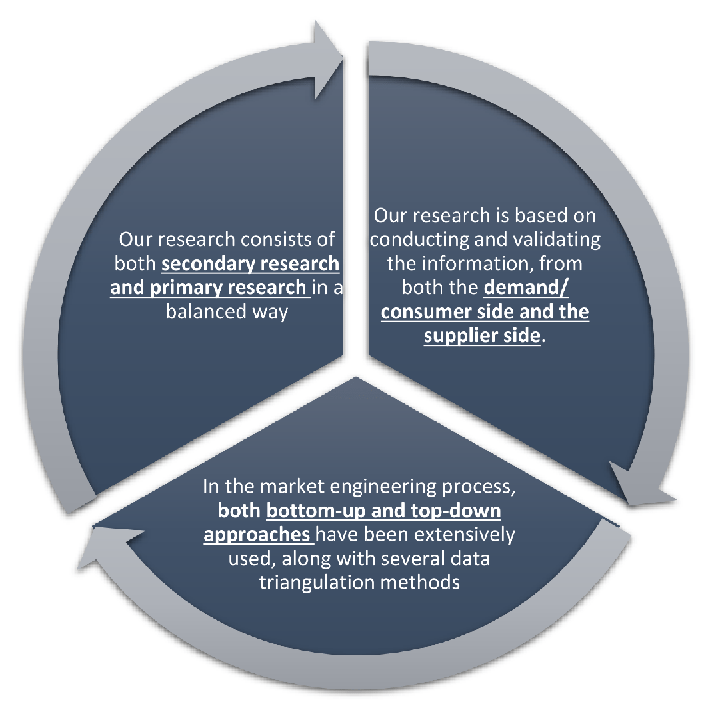
Our research design integrates both demand-side and supply-side analysis through a balanced combination of primary and secondary research methodologies. By utilizing both bottom-up and top-down approaches alongside rigorous data triangulation methods, we deliver robust market intelligence that supports strategic decision-making.
MarketGenics' comprehensive research design framework ensures the delivery of accurate, reliable, and actionable market intelligence. Through the integration of multiple research approaches, rigorous validation processes, and expert analysis, we provide our clients with the insights needed to make informed strategic decisions and capitalize on market opportunities.
MarketGenics leverages a dedicated industry panel of experts and a comprehensive suite of paid databases to effectively collect, consolidate, and analyze market intelligence.
Our approach has consistently proven to be reliable and effective in generating accurate market insights, identifying key industry trends, and uncovering emerging business opportunities.
Through both primary and secondary research, we capture and analyze critical company-level data such as manufacturing footprints, including technical centers, R&D facilities, sales offices, and headquarters.
Our expert panel further enhances our ability to estimate market size for specific brands based on validated field-level intelligence.
Our data mining techniques incorporate both parametric and non-parametric methods, allowing for structured data collection, sorting, processing, and cleaning.
Demand projections are derived from large-scale data sets analyzed through proprietary algorithms, culminating in robust and reliable market sizing.
Research Approach
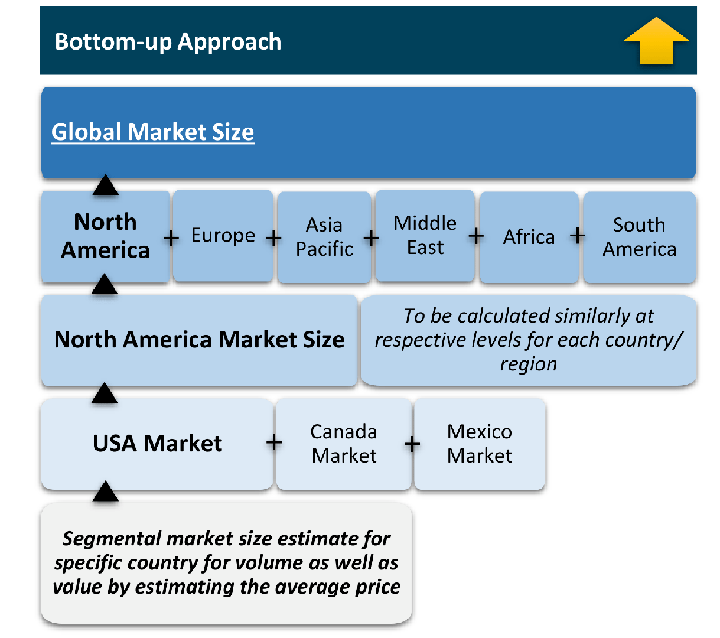
The bottom-up approach builds market estimates by starting with the smallest addressable market units and systematically aggregating them to create comprehensive market size projections.
This method begins with specific, granular data points and builds upward to create the complete market landscape.
Customer Analysis → Segmental Analysis → Geographical Analysis
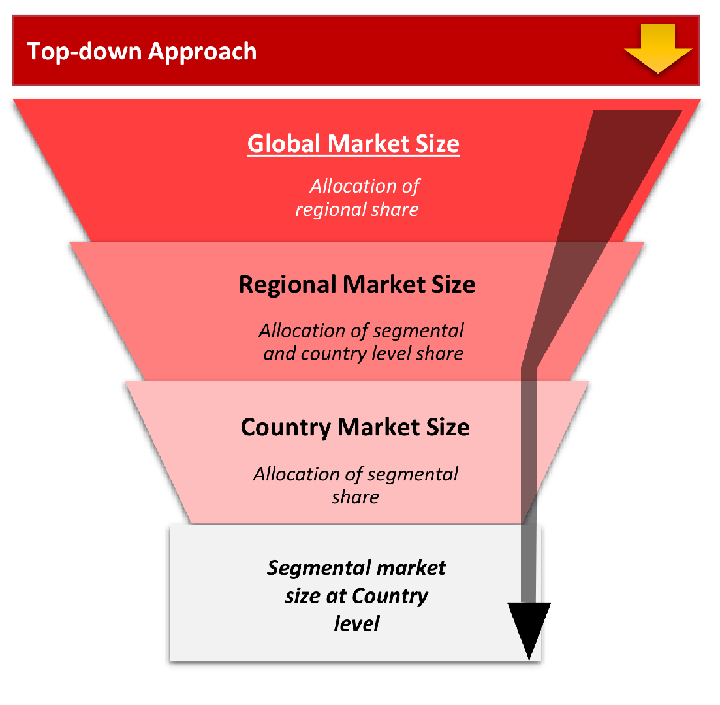
The top-down approach starts with the broadest possible market data and systematically narrows it down through a series of filters and assumptions to arrive at specific market segments or opportunities.
This method begins with the big picture and works downward to increasingly specific market slices.
TAM → SAM → SOM
Research Methods
Desk / Secondary Research
While analysing the market, we extensively study secondary sources, directories, and databases to identify and collect information useful for this technical, market-oriented, and commercial report. Secondary sources that we utilize are not only the public sources, but it is a combination of Open Source, Associations, Paid Databases, MG Repository & Knowledgebase, and others.
- Company websites, annual reports, financial reports, broker reports, and investor presentations
- National government documents, statistical databases and reports
- News articles, press releases and web-casts specific to the companies operating in the market, Magazines, reports, and others
- We gather information from commercial data sources for deriving company specific data such as segmental revenue, share for geography, product revenue, and others
- Internal and external proprietary databases (industry-specific), relevant patent, and regulatory databases
- Governing Bodies, Government Organizations
- Relevant Authorities, Country-specific Associations for Industries
We also employ the model mapping approach to estimate the product level market data through the players' product portfolio
Primary Research
Primary research/ interviews is vital in analyzing the market. Most of the cases involves paid primary interviews. Primary sources include primary interviews through e-mail interactions, telephonic interviews, surveys as well as face-to-face interviews with the different stakeholders across the value chain including several industry experts.
| Type of Respondents | Number of Primaries |
|---|---|
| Tier 2/3 Suppliers | ~20 |
| Tier 1 Suppliers | ~25 |
| End-users | ~25 |
| Industry Expert/ Panel/ Consultant | ~30 |
| Total | ~100 |
MG Knowledgebase
• Repository of industry blog, newsletter and case studies
• Online platform covering detailed market reports, and company profiles
Forecasting Factors and Models
Forecasting Factors
- Historical Trends – Past market patterns, cycles, and major events that shaped how markets behave over time. Understanding past trends helps predict future behavior.
- Industry Factors – Specific characteristics of the industry like structure, regulations, and innovation cycles that affect market dynamics.
- Macroeconomic Factors – Economic conditions like GDP growth, inflation, and employment rates that affect how much money people have to spend.
- Demographic Factors – Population characteristics like age, income, and location that determine who can buy your product.
- Technology Factors – How quickly people adopt new technology and how much technology infrastructure exists.
- Regulatory Factors – Government rules, laws, and policies that can help or restrict market growth.
- Competitive Factors – Analyzing competition structure such as degree of competition and bargaining power of buyers and suppliers.
Forecasting Models / Techniques
Multiple Regression Analysis
- Identify and quantify factors that drive market changes
- Statistical modeling to establish relationships between market drivers and outcomes
Time Series Analysis – Seasonal Patterns
- Understand regular cyclical patterns in market demand
- Advanced statistical techniques to separate trend, seasonal, and irregular components
Time Series Analysis – Trend Analysis
- Identify underlying market growth patterns and momentum
- Statistical analysis of historical data to project future trends
Expert Opinion – Expert Interviews
- Gather deep industry insights and contextual understanding
- In-depth interviews with key industry stakeholders
Multi-Scenario Development
- Prepare for uncertainty by modeling different possible futures
- Creating optimistic, pessimistic, and most likely scenarios
Time Series Analysis – Moving Averages
- Sophisticated forecasting for complex time series data
- Auto-regressive integrated moving average models with seasonal components
Econometric Models
- Apply economic theory to market forecasting
- Sophisticated economic models that account for market interactions
Expert Opinion – Delphi Method
- Harness collective wisdom of industry experts
- Structured, multi-round expert consultation process
Monte Carlo Simulation
- Quantify uncertainty and probability distributions
- Thousands of simulations with varying input parameters
Research Analysis
Our research framework is built upon the fundamental principle of validating market intelligence from both demand and supply perspectives. This dual-sided approach ensures comprehensive market understanding and reduces the risk of single-source bias.
Demand-Side Analysis: We understand end-user/application behavior, preferences, and market needs along with the penetration of the product for specific application.
Supply-Side Analysis: We estimate overall market revenue, analyze the segmental share along with industry capacity, competitive landscape, and market structure.
Validation & Evaluation
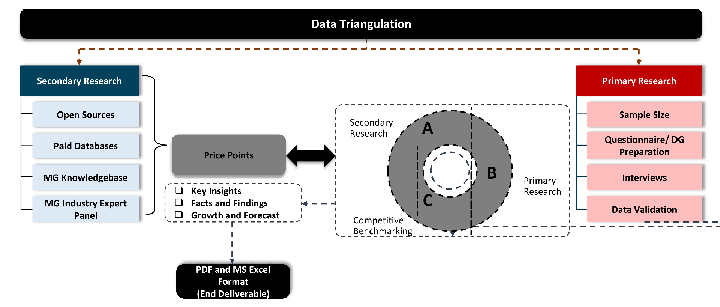
Data triangulation is a validation technique that uses multiple methods, sources, or perspectives to examine the same research question, thereby increasing the credibility and reliability of research findings. In market research, triangulation serves as a quality assurance mechanism that helps identify and minimize bias, validate assumptions, and ensure accuracy in market estimates.
- Data Source Triangulation – Using multiple data sources to examine the same phenomenon
- Methodological Triangulation – Using multiple research methods to study the same research question
- Investigator Triangulation – Using multiple researchers or analysts to examine the same data
- Theoretical Triangulation – Using multiple theoretical perspectives to interpret the same data
Custom Market Research Services
We will customise the research for you, in case the report listed above does not meet your requirements.
Get 10% Free Customisation