Healthcare Cybersecurity Market Size, Share & Trends Analysis Report by Components (Solutions, Services), Security Type, Deployment Mode, Security Function, Healthcare Delivery Mode, Organization Size, Integration Type, Application, End User and Geography (North America, Europe, Asia Pacific, Middle East, Africa, and South America) – Global Industry Data, Trends, and Forecasts, 2025–2035
|
Market Structure & Evolution |
|
|
Segmental Data Insights |
|
|
Demand Trends |
|
|
Competitive Landscape |
|
|
Strategic Development |
|
|
Future Outlook & Opportunities |
|
Healthcare Cybersecurity Market Size, Share, and Growth
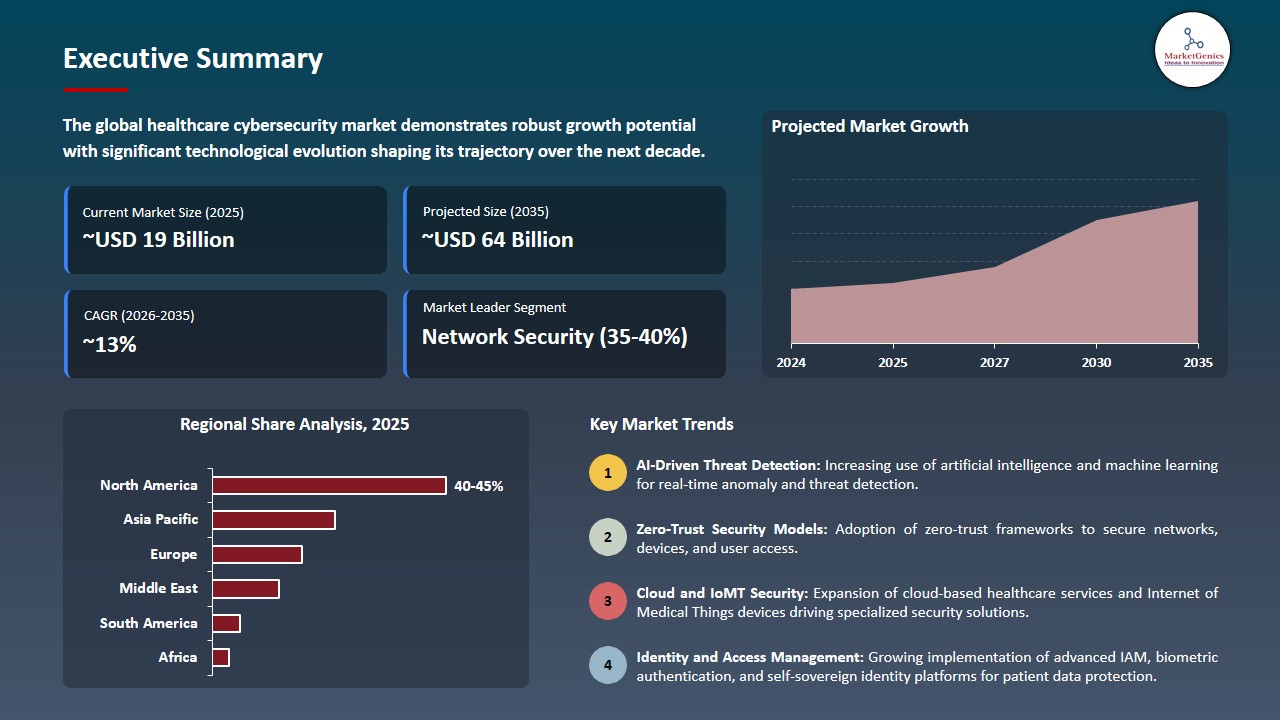
The global healthcare cybersecurity market is experiencing robust growth, with its estimated value of USD 19.4 billion in the year 2025 and USD 64 billion by 2035, registering a CAGR of 12.7% during the forecast period.
Manuel Nedbal who serves as SecurITe CEO declared that patient data theft has reached its highest level in history. The introduction of artificial intelligence together with cloud technology and the development of diverse IT systems across health organizations has created new security risks for healthcare facilities. Our solutions are designed to give healthcare organizations the comprehensive protection and resilience they need to secure sensitive patient records and critical operational systems.
The healthcare cybersecurity market shows rapid growth because healthcare organizations need to protect their patient data and safeguard their interconnected medical systems. Palo Alto Networks introduced Prisma Cloud for Healthcare on February 2025 which includes AI-based threat detection and behavioral analysis and real-time compliance monitoring to improve security for hospitals and clinics.
Healthcare facilities now require better cybersecurity systems because telehealth virtual medical records and wireless health equipment use has become more common. Fortinet's Healthcare Security Fabric system was implemented by a major North American hospital network in March 2025 to protect its essential systems from rising cyber threats.
Healthcare organizations must implement advanced security frameworks because strict regulations such as HIPAA and the HITECH Act require them to achieve compliance and protect their sensitive data. The market expansion results from technological progress and regulatory demands and the growth of digital health services which enables better patient data security and stronger operational defense.
Healthcare organizations can build secure medical device systems which include cloud protection and incident response capabilities and threat intelligence systems and cybersecurity training for their staff members. The vendors can enhance healthcare security by using these areas while creating new ways to generate income for their business.
Healthcare Cybersecurity Market Dynamics and Trends
Driver: Increasing Threat Landscape and Regulatory Pressure Driving Healthcare Cybersecurity Adoption
-
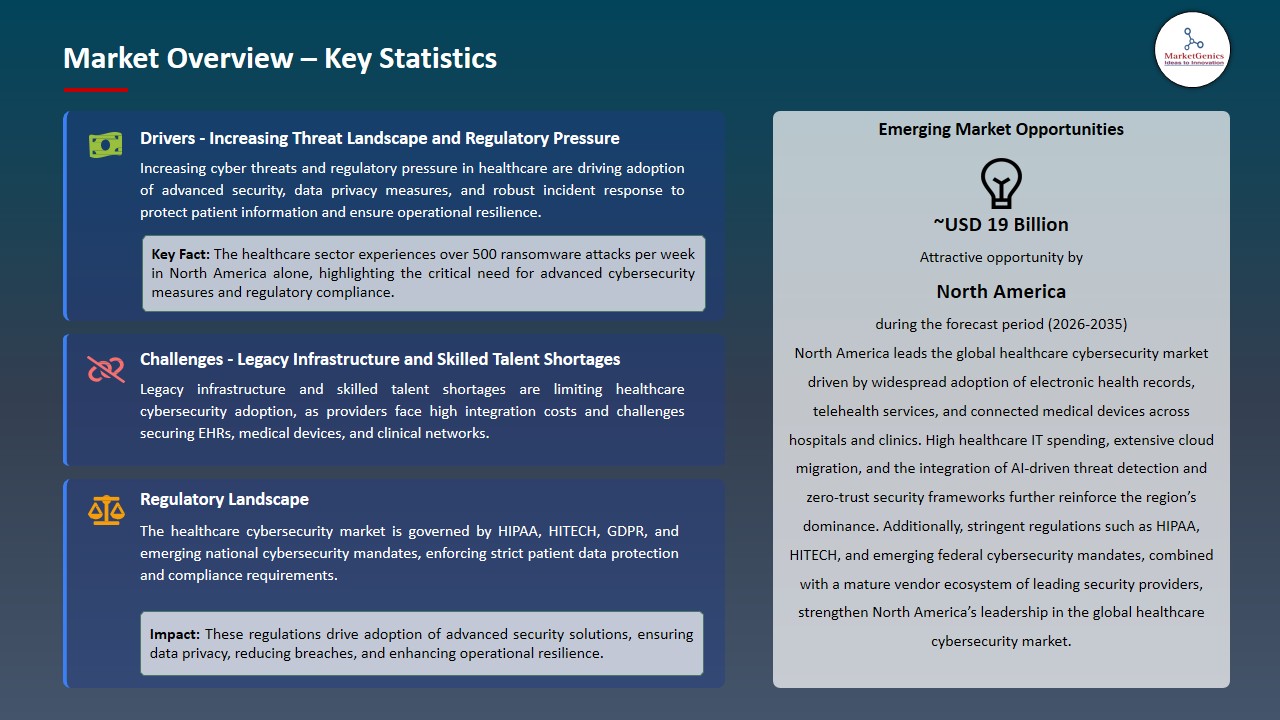
The healthcare cybersecurity market currently experiences accelerated growth because hospitals and patient portals and insurers and third-party providers face an extraordinary increase in cyberattacks which include ransomware and data theft and DDoS threats that become more common throughout the world. The period between January and April 2025 experienced a significant increase in ransomware attacks which resulted in the detection of thousands of security breaches while major organizations like Frederick Health and other organizations encountered extensive data breaches that impacted more than 100000 patients.
- Health systems must implement advanced security controls and compliance tools because strict regulatory frameworks like U.S. HIPAA and European GDPR and new national cybersecurity regulations for medical software and devices require compliance to avoid penalties and service interruptions.
- Leading vendors are responding, Fortinet established a multi-year partnership with HCA Healthcare in 2025 to create integrated systems for threat detection and regulatory compliance while Cisco worked with Mayo Clinic to develop zero-trust networking systems which shared security information throughout their entire network. All these factors are likely to continue to escalate the growth of the healthcare cybersecurity market.
Restraint: Legacy Infrastructure and Skilled Talent Shortages Hindering Deployment
-
The widespread adoption of technology faces a major obstacle because current systems depend on legacy IT systems and medical devices which use outdated operating systems and possess insufficient security features. The combination of unsecured medical devices and improperly set up cloud systems creates security vulnerabilities that lead to numerous data breaches.
- The ongoing lack of cybersecurity experts who possess healthcare knowledge prevents many hospitals and clinics from effectively implementing advanced security systems which need specialized skilled experts. The industry experiences a delay in implementing 24/7 monitoring and incident response and zero-trust security measures because of this talent shortage.
- The urgent need for patient care combined with expensive infrastructure upgrades and staff training costs prevents some organizations from making necessary security investments at required levels. All these elements are expected to restrict the expansion of the healthcare cybersecurity market.
Opportunity: Cloud Security, AI, and Managed Services Expansion
-
Technological advancement faces its greatest challenge because existing systems are built on outdated IT infrastructure and medical equipment that operates with security-deficient operating systems. Unsecured medical devices together with incorrectly configured cloud systems create security weaknesses which result in multiple data breaches.
- The healthcare sector faces difficulties because there is currently a shortage of cybersecurity professionals who have specialized knowledge about healthcare systems which leads to security implementation failures at hospitals and clinics. The industry experiences a delay in implementing 24/7 monitoring and incident response and zero-trust security measures because of this talent shortage.
- The urgent need for patient care combined with expensive infrastructure upgrades and staff training costs prevents some organizations from making necessary security investments at required levels. And thus, is expected to create more opportunities in future for healthcare cybersecurity market.
Key Trend: AI, Zero‑Trust, and Identity‑Centric Security Models
-
AI‑driven cybersecurity solutions are rapidly becoming mainstream in healthcare: surveys from 2025 indicate that nearly nine out of ten providers plan to integrate AI into threat detection, risk assessment, and incident response workflows which shows widespread acceptance of automated defense systems.
- Organizations use zero-trust architectures together with identity and access management systems and behavioral analytics to defend their sensitive patient information and medical equipment and clinical systems from advanced threats that standard security perimeters fail to protect against.
- The ongoing development of secure device onboarding systems together with real-time monitoring capabilities and resilience-focused technologies demonstrates that healthcare organizations now give priority to security solutions which protect against data breaches while supporting quick recovery and ongoing patient care during security incidents. Therefore, is expected to influence significant trends in the healthcare cybersecurity market.
Healthcare Cybersecurity Market Analysis and Segmental Data
Network Security Dominates Global Healthcare Cybersecurity Market amid Rising Cyber Threats and Regulatory Pressure
-
The rise in ransomware and data-exfiltration attacks which target hospitals and insurance companies and telehealth services has created an urgent need for advanced network security systems.
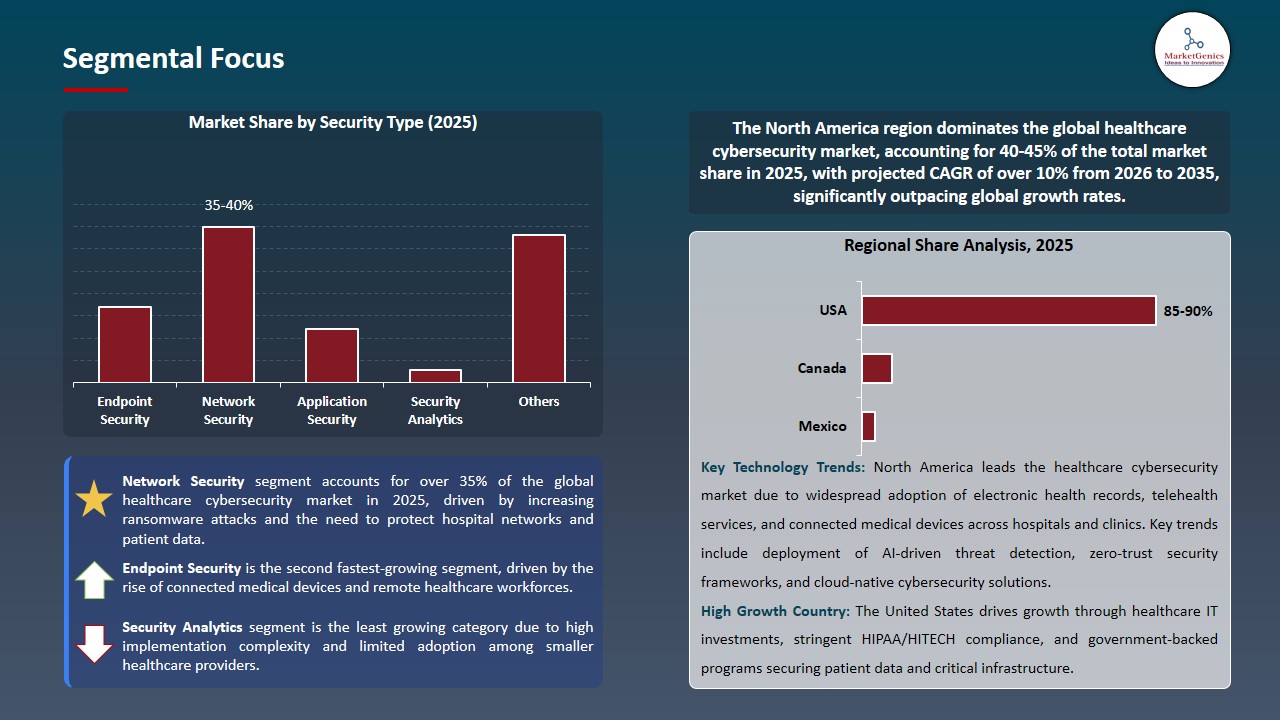
- The security market has allocated approximately 35% of its resources to network security because organizations need to protect their networks against attacks which exploit SD-WAN configuration errors and traditional system vulnerabilities. The Aflac insurance breaches of 2025 demonstrated the need for improved network security when hackers gained access to critical systems which led to increased security funding.
- Health organizations must establish complete network security systems because strict regulations such as HIPAA and GDPR and upcoming cybersecurity laws require them to maintain regulatory compliance and prevent monetary fines, resulting in Network Security as the leading segment in healthcare cybersecurity market.
North America Dominates Healthcare Cybersecurity Market amid Advanced Digital Health Adoption and Stringent Regulations
-
The global healthcare cybersecurity market is predominantly controlled by North America because this region has established advanced digital systems for its healthcare facilities which use electronic health records and telemedicine services and Internet of Medical Things devices to create new security requirements.
- The region's stringent regulatory frameworks such as HIPAA and recent HIPAA Security Rule enhancements compel robust data protection and compliance practices. The Central Maine Healthcare incident of 2025 which resulted in a data breach that disclosed confidential information about 145000 patients demonstrates the need for better security systems.
- The region demonstrate its market leadership through their substantial investment in cybersecurity and their widespread adoption of cloud security solutions and their collaborative partnerships with major technology companies. Furthermore, ongoing advancements in artificial intelligence which protect against cyber threats and automate compliance processes position North America as the leader within healthcare cybersecurity market.
Healthcare Cybersecurity Market Ecosystem
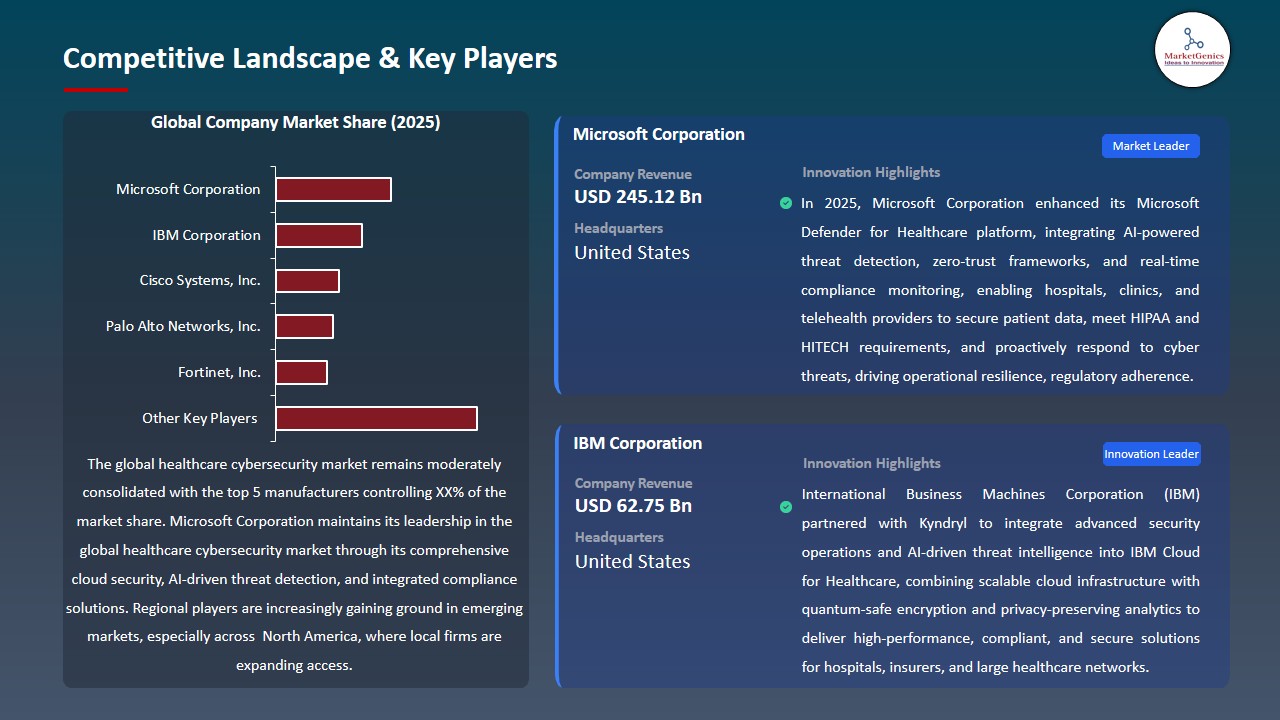
The global healthcare cybersecurity market shows moderate consolidation because Tier 1 companies Cisco IBM Microsoft and Palo Alto Networks control most of the market while Tier 2 companies Fortinet and Trend Micro deliver specialized products and Tier 3 companies Cynerio and Armis develop specialized IoMT security solutions.
The market demonstrates moderate concentration because companies pursue strategic partnerships and make acquisitions. The main value chain components for business operations include solution development and integration for AI‑enhanced EDR/SIEM systems and managed detection and response services. ServiceNow made a public announcement about its planned acquisition of Armis for USD 7.75 billion which would enhance its ability to discover healthcare assets and manage risks.
Recent Development and Strategic Overview:
-
In October 2025, OpenText Cybersecurity introduced enhanced security features that use artificial intelligence through the Core Identity Foundation and Core Threat Detection and Response systems which provide organizations with complete control over their identity management systems and access security through which their users interact with their systems.
- In December 2024, Cyware launched its Healthcare Threat Intelligence Platform (HC‑TIP) which protects healthcare organizations through its specialized threat feeds and automated response playbooks and real-time dashboards that help security teams identify and stop ransomware attacks and medical device exploits and compliance violations.
Report Scope
|
Attribute |
Detail |
|
Market Size in 2025 |
USD 19.4 Bn |
|
Market Forecast Value in 2035 |
USD 64 Bn |
|
Growth Rate (CAGR) |
12.7% |
|
Forecast Period |
2025 – 2035 |
|
Historical Data Available for |
2020 – 2024 |
|
Market Size Units |
USD Billion for Value |
|
Report Format |
Electronic (PDF) + Excel |
|
Regions and Countries Covered |
|||||
|
North America |
Europe |
Asia Pacific |
Middle East |
Africa |
South America |
|
|
|
|
|
|
|
Companies Covered |
|||||
|
|
|
|
|
|
Healthcare Cybersecurity Market Segmentation and Highlights
|
Segment |
Sub-segment |
|
Healthcare Cybersecurity Market, By Component |
|
|
Healthcare Cybersecurity Market, By Security Type |
|
|
Healthcare Cybersecurity Market, By Deployment Mode |
|
|
Healthcare Cybersecurity Market, By Security Function |
|
|
Healthcare Cybersecurity Market, By Healthcare Delivery Mode |
|
|
Healthcare Cybersecurity Market, By Organization Size |
|
|
Healthcare Cybersecurity Market, By Integration Type |
|
|
Healthcare Cybersecurity Market, By Application |
|
|
Healthcare Cybersecurity Market, By End User |
|
Frequently Asked Questions
Table of Contents
- 1. Research Methodology and Assumptions
- 1.1. Definitions
- 1.2. Research Design and Approach
- 1.3. Data Collection Methods
- 1.4. Base Estimates and Calculations
- 1.5. Forecasting Models
- 1.5.1. Key Forecast Factors & Impact Analysis
- 1.6. Secondary Research
- 1.6.1. Open Natures
- 1.6.2. Paid Databases
- 1.6.3. Associations
- 1.7. Primary Research
- 1.7.1. Primary Natures
- 1.7.2. Primary Interviews with Stakeholders across Ecosystem
- 2. Executive Summary
- 2.1. Global Healthcare Cybersecurity Market Outlook
- 2.1.1. Healthcare Cybersecurity Market Size (Value - US$ Bn), and Forecasts, 2021-2035
- 2.1.2. Compounded Annual Growth Rate Analysis
- 2.1.3. Growth Opportunity Analysis
- 2.1.4. Segmental Share Analysis
- 2.1.5. Geographical Share Analysis
- 2.2. Market Analysis and Facts
- 2.3. Supply-Demand Analysis
- 2.4. Competitive Benchmarking
- 2.5. Go-to- Market Strategy
- 2.5.1. Customer/ End-use Industry Assessment
- 2.5.2. Growth Opportunity Data, 2026-2035
- 2.5.2.1. Regional Data
- 2.5.2.2. Country Data
- 2.5.2.3. Segmental Data
- 2.5.3. Identification of Potential Market Spaces
- 2.5.4. GAP Analysis
- 2.5.5. Potential Attractive Price Points
- 2.5.6. Prevailing Market Risks & Challenges
- 2.5.7. Preferred Sales & Marketing Strategies
- 2.5.8. Key Recommendations and Analysis
- 2.5.9. A Way Forward
- 2.1. Global Healthcare Cybersecurity Market Outlook
- 3. Industry Data and Premium Insights
- 3.1. Global Healthcare & Pharmaceutical Industry Overview, 2025
- 3.1.1. Healthcare & Pharmaceutical Industry Analysis
- 3.1.2. Key Trends for Healthcare & Pharmaceutical Industry
- 3.1.3. Regional Distribution for Healthcare & Pharmaceutical Industry
- 3.2. Supplier Customer Data
- 3.3. Technology Roadmap and Developments
- 3.1. Global Healthcare & Pharmaceutical Industry Overview, 2025
- 4. Market Overview
- 4.1. Market Dynamics
- 4.1.1. Drivers
- 4.1.1.1. Rising cyberattacks targeting hospitals, clinics, and telehealth platforms.
- 4.1.1.2. Increasing adoption of electronic health records (EHRs), IoMT devices, and digital health services.
- 4.1.1.3. Stringent regulatory compliance requirements such as HIPAA, HITECH, and GDPR.
- 4.1.2. Restraints
- 4.1.2.1. Legacy IT infrastructure and interoperability challenges in healthcare facilities.
- 4.1.2.2. Shortage of skilled cybersecurity professionals with healthcare expertise.
- 4.1.1. Drivers
- 4.2. Key Trend Analysis
- 4.3. Regulatory Framework
- 4.3.1. Key Regulations, Norms, and Subsidies, by Key Countries
- 4.3.2. Tariffs and Standards
- 4.3.3. Impact Analysis of Regulations on the Market
- 4.4. Value Chain Analysis
- 4.5. Porter’s Five Forces Analysis
- 4.6. PESTEL Analysis
- 4.7. Global Healthcare Cybersecurity Market Demand
- 4.7.1. Historical Market Size – Value (US$ Bn), 2020-2024
- 4.7.2. Current and Future Market Size – Value (US$ Bn), 2026–2035
- 4.7.2.1. Y-o-Y Growth Trends
- 4.7.2.2. Absolute $ Opportunity Assessment
- 4.1. Market Dynamics
- 5. Competition Landscape
- 5.1. Competition structure
- 5.1.1. Fragmented v/s consolidated
- 5.2. Company Share Analysis, 2025
- 5.2.1. Global Company Market Share
- 5.2.2. By Region
- 5.2.2.1. North America
- 5.2.2.2. Europe
- 5.2.2.3. Asia Pacific
- 5.2.2.4. Middle East
- 5.2.2.5. Africa
- 5.2.2.6. South America
- 5.3. Product Comparison Matrix
- 5.3.1. Specifications
- 5.3.2. Market Positioning
- 5.3.3. Pricing
- 5.1. Competition structure
- 6. Global Healthcare Cybersecurity Market Analysis, by Component
- 6.1. Key Segment Analysis
- 6.2. Healthcare Cybersecurity Market Size (Value - US$ Bn), Analysis, and Forecasts, by Component, 2021-2035
- 6.2.1. Solutions
- 6.2.1.1. Network Security Solutions
- 6.2.1.1.1. Firewalls
- 6.2.1.1.2. Intrusion Detection Systems (IDS) / Intrusion Prevention Systems (IPS)
- 6.2.1.1.3. Virtual Private Network (VPN) Solutions
- 6.2.1.1.4. Unified Threat Management (UTM)
- 6.2.1.1.5. Others
- 6.2.1.2. Endpoint Security Solutions
- 6.2.1.2.1. Antivirus / Antimalware
- 6.2.1.2.2. Endpoint Detection & Response (EDR)
- 6.2.1.2.3. Mobile Device Management (MDM)
- 6.2.1.2.4. Patch Management Solutions
- 6.2.1.2.5. Others
- 6.2.1.3. Application Security Solutions
- 6.2.1.3.1. Web Application Firewalls (WAF)
- 6.2.1.3.2. Secure Application Development Tools
- 6.2.1.3.3. Application Vulnerability Scanning
- 6.2.1.3.4. Others
- 6.2.1.4. Cloud Security Solutions
- 6.2.1.4.1. Cloud Access Security Brokers (CASB)
- 6.2.1.4.2. Cloud Encryption & Key Management
- 6.2.1.4.3. Cloud Workload Protection Platforms (CWPP)
- 6.2.1.4.4. Others
- 6.2.1.5. Data Security & Encryption Solutions
- 6.2.1.5.1. Database Security
- 6.2.1.5.2. File & Data Encryption
- 6.2.1.5.3. Tokenization
- 6.2.1.5.4. Data Loss Prevention (DLP)
- 6.2.1.5.5. Others
- 6.2.1.6. Identity & Access Management (IAM) Solutions
- 6.2.1.6.1. Single Sign-On (SSO)
- 6.2.1.6.2. Multi-Factor Authentication (MFA)
- 6.2.1.6.3. Privileged Access Management (PAM)
- 6.2.1.6.4. Identity Governance & Administration (IGA)
- 6.2.1.6.5. Others
- 6.2.1.7. Risk & Compliance Management Solutions
- 6.2.1.7.1. Governance, Risk, and Compliance (GRC) Platforms
- 6.2.1.7.2. Policy Management
- 6.2.1.7.3. Audit & Reporting Tool
- 6.2.1.7.4. Others
- 6.2.1.8. Security Analytics & Operations
- 6.2.1.8.1. Security Information & Event Management (SIEM)
- 6.2.1.8.2. Threat Intelligence Platforms
- 6.2.1.8.3. Security Orchestration, Automation & Response (SOAR)
- 6.2.1.8.4. Others
- 6.2.1.1. Network Security Solutions
- 6.2.2. Services
- 6.2.2.1. Managed Security Services (MSS)
- 6.2.2.2. Threat Monitoring & Detection
- 6.2.2.3. Incident Response & Recovery
- 6.2.2.4. Vulnerability Management
- 6.2.2.5. Professional Services
- 6.2.2.6. Consulting & Risk Assessment
- 6.2.2.7. Integration & Deployment
- 6.2.2.8. Training & Support
- 6.2.2.9. Others
- 6.2.1. Solutions
- 7. Global Healthcare Cybersecurity Market Analysis, by Security Type
- 7.1. Key Segment Analysis
- 7.2. Healthcare Cybersecurity Market Size (Value - US$ Bn), Analysis, and Forecasts, by Security Type, 2021-2035
- 7.2.1. Network Security
- 7.2.2. Endpoint Security
- 7.2.3. Application Security
- 7.2.4. Cloud Security
- 7.2.5. Data Security & Encryption
- 7.2.6. Identity & Access Management (IAM)
- 7.2.7. Risk & Compliance Management
- 7.2.8. Security Analytics
- 7.2.9. Others
- 8. Global Healthcare Cybersecurity Market Analysis, by Deployment Mode
- 8.1. Key Segment Analysis
- 8.2. Healthcare Cybersecurity Market Size (Value - US$ Bn), Analysis, and Forecasts, by Deployment Mode, 2021-2035
- 8.2.1. On-Premise
- 8.2.2. Cloud-Based
- 8.2.3. Hybrid
- 9. Global Healthcare Cybersecurity Market Analysis, by Security Function
- 9.1. Key Segment Analysis
- 9.2. Healthcare Cybersecurity Market Size (Value - US$ Bn), Analysis, and Forecasts, by Security Function, 2021-2035
- 9.2.1. Threat Detection
- 9.2.2. Threat Prevention
- 9.2.3. Threat Response
- 9.2.4. Vulnerability Management
- 9.2.5. Security Monitoring
- 9.2.6. Incident Management
- 9.2.7. Encryption & Data Protection
- 9.2.8. Access Control
- 9.2.9. Others
- 10. Global Healthcare Cybersecurity Market Analysis, by Healthcare Delivery Mode
- 10.1. Key Segment Analysis
- 10.2. Healthcare Cybersecurity Market Size (Value - US$ Bn), Analysis, and Forecasts, by Healthcare Delivery Mode, 2021-2035
- 10.2.1. Traditional Healthcare Facilities
- 10.2.2. Digital Healthcare Platforms
- 10.2.3. Telemedicine & Remote Patient Monitoring
- 10.2.4. Mobile Health Applications
- 10.2.5. Electronic Health Records (EHR/EMR) Systems
- 10.2.6. Medical IoT/IoMT Devices
- 10.2.7. Patient Portals & Web Platforms
- 10.2.8. Cloud Health Platforms
- 10.2.9. Others
- 11. Global Healthcare Cybersecurity Market Analysis, by Organization Size
- 11.1. Key Segment Analysis
- 11.2. Healthcare Cybersecurity Market Size (Value - US$ Bn), Analysis, and Forecasts, by Organization Size, 2021-2035
- 11.2.1. Small & Medium-Sized Enterprises (SMEs)
- 11.2.2. Large Enterprises
- 12. Global Healthcare Cybersecurity Market Analysis, by Integration Type
- 12.1. Key Segment Analysis
- 12.2. Healthcare Cybersecurity Market Size (Value - US$ Bn), Analysis, and Forecasts, by Integration Type, 2021-2035
- 12.2.1. Standalone Security Solutions
- 12.2.2. Integrated Security Suites
- 13. Global Healthcare Cybersecurity Market Analysis, by Application
- 13.1. Key Segment Analysis
- 13.2. Healthcare Cybersecurity Market Size (Value - US$ Bn), Analysis, and Forecasts, by Application, 2021-2035
- 13.2.1. Network Security Protection
- 13.2.2. Data Protection & Privacy
- 13.2.3. Endpoint Security
- 13.2.4. Cloud Security
- 13.2.5. Identity & Access Management
- 13.2.6. Risk and Compliance Management
- 13.2.7. Security Analytics & Operations
- 13.2.8. Managed Security Services
- 13.2.9. Others
- 14. Global Healthcare Cybersecurity Market Analysis and Forecasts, by End User
- 14.1. Key Findings
- 14.2. Healthcare Cybersecurity Market Size (Value - US$ Bn), Analysis, and Forecasts, by End User, 2021-2035
- 14.2.1. Hospitals & Clinics
- 14.2.2. Diagnostic Centers
- 14.2.3. Ambulatory Care Centers
- 14.2.4. Pharmaceutical & Biotechnology Companies
- 14.2.5. Payers & Insurance Providers
- 14.2.6. Medical Device Manufacturers
- 14.2.7. Telehealth Service Providers
- 14.2.8. Research Institutions
- 14.2.9. Others
- 15. Global Healthcare Cybersecurity Market Analysis and Forecasts, by Region
- 15.1. Key Findings
- 15.2. Healthcare Cybersecurity Market Size (Value - US$ Bn), Analysis, and Forecasts, by Region, 2021-2035
- 15.2.1. North America
- 15.2.2. Europe
- 15.2.3. Asia Pacific
- 15.2.4. Middle East
- 15.2.5. Africa
- 15.2.6. South America
- 16. North America Healthcare Cybersecurity Market Analysis
- 16.1. Key Segment Analysis
- 16.2. Regional Snapshot
- 16.3. North America Healthcare Cybersecurity Market Size (Value - US$ Bn), Analysis, and Forecasts, 2021-2035
- 16.3.1. Component
- 16.3.2. Security Type
- 16.3.3. Deployment Mode
- 16.3.4. Security Function
- 16.3.5. Healthcare Delivery Mode
- 16.3.6. Organization Size
- 16.3.7. Integration Type
- 16.3.8. Application
- 16.3.9. End User
- 16.3.10. Country
- 16.3.10.1. USA
- 16.3.10.2. Canada
- 16.3.10.3. Mexico
- 16.4. USA Healthcare Cybersecurity Market
- 16.4.1. Country Segmental Analysis
- 16.4.2. Component
- 16.4.3. Security Type
- 16.4.4. Deployment Mode
- 16.4.5. Security Function
- 16.4.6. Healthcare Delivery Mode
- 16.4.7. Organization Size
- 16.4.8. Integration Type
- 16.4.9. Application
- 16.4.10. End User
- 16.5. Canada Healthcare Cybersecurity Market
- 16.5.1. Country Segmental Analysis
- 16.5.2. Component
- 16.5.3. Security Type
- 16.5.4. Deployment Mode
- 16.5.5. Security Function
- 16.5.6. Healthcare Delivery Mode
- 16.5.7. Organization Size
- 16.5.8. Integration Type
- 16.5.9. Application
- 16.5.10. End User
- 16.6. Mexico Healthcare Cybersecurity Market
- 16.6.1. Country Segmental Analysis
- 16.6.2. Component
- 16.6.3. Security Type
- 16.6.4. Deployment Mode
- 16.6.5. Security Function
- 16.6.6. Healthcare Delivery Mode
- 16.6.7. Organization Size
- 16.6.8. Integration Type
- 16.6.9. Application
- 16.6.10. End User
- 17. Europe Healthcare Cybersecurity Market Analysis
- 17.1. Key Segment Analysis
- 17.2. Regional Snapshot
- 17.3. Europe Healthcare Cybersecurity Market Size (Value - US$ Bn), Analysis, and Forecasts, 2021-2035
- 17.3.1. Component
- 17.3.2. Security Type
- 17.3.3. Deployment Mode
- 17.3.4. Security Function
- 17.3.5. Healthcare Delivery Mode
- 17.3.6. Organization Size
- 17.3.7. Integration Type
- 17.3.8. Application
- 17.3.9. End User
- 17.3.10. Country
- 17.3.10.1. Germany
- 17.3.10.2. United Kingdom
- 17.3.10.3. France
- 17.3.10.4. Italy
- 17.3.10.5. Spain
- 17.3.10.6. Netherlands
- 17.3.10.7. Nordic Countries
- 17.3.10.8. Poland
- 17.3.10.9. Russia & CIS
- 17.3.10.10. Rest of Europe
- 17.4. Germany Healthcare Cybersecurity Market
- 17.4.1. Country Segmental Analysis
- 17.4.2. Component
- 17.4.3. Security Type
- 17.4.4. Deployment Mode
- 17.4.5. Security Function
- 17.4.6. Healthcare Delivery Mode
- 17.4.7. Organization Size
- 17.4.8. Integration Type
- 17.4.9. Application
- 17.4.10. End User
- 17.5. United Kingdom Healthcare Cybersecurity Market
- 17.5.1. Country Segmental Analysis
- 17.5.2. Component
- 17.5.3. Security Type
- 17.5.4. Deployment Mode
- 17.5.5. Security Function
- 17.5.6. Healthcare Delivery Mode
- 17.5.7. Organization Size
- 17.5.8. Integration Type
- 17.5.9. Application
- 17.5.10. End User
- 17.6. France Healthcare Cybersecurity Market
- 17.6.1. Country Segmental Analysis
- 17.6.2. Component
- 17.6.3. Security Type
- 17.6.4. Deployment Mode
- 17.6.5. Security Function
- 17.6.6. Healthcare Delivery Mode
- 17.6.7. Organization Size
- 17.6.8. Integration Type
- 17.6.9. Application
- 17.6.10. End User
- 17.7. Italy Healthcare Cybersecurity Market
- 17.7.1. Country Segmental Analysis
- 17.7.2. Component
- 17.7.3. Security Type
- 17.7.4. Deployment Mode
- 17.7.5. Security Function
- 17.7.6. Healthcare Delivery Mode
- 17.7.7. Organization Size
- 17.7.8. Integration Type
- 17.7.9. Application
- 17.7.10. End User
- 17.8. Spain Healthcare Cybersecurity Market
- 17.8.1. Country Segmental Analysis
- 17.8.2. Component
- 17.8.3. Security Type
- 17.8.4. Deployment Mode
- 17.8.5. Security Function
- 17.8.6. Healthcare Delivery Mode
- 17.8.7. Organization Size
- 17.8.8. Integration Type
- 17.8.9. Application
- 17.8.10. End User
- 17.9. Netherlands Healthcare Cybersecurity Market
- 17.9.1. Country Segmental Analysis
- 17.9.2. Component
- 17.9.3. Security Type
- 17.9.4. Deployment Mode
- 17.9.5. Security Function
- 17.9.6. Healthcare Delivery Mode
- 17.9.7. Organization Size
- 17.9.8. Integration Type
- 17.9.9. Application
- 17.9.10. End User
- 17.10. Nordic Countries Healthcare Cybersecurity Market
- 17.10.1. Country Segmental Analysis
- 17.10.2. Component
- 17.10.3. Security Type
- 17.10.4. Deployment Mode
- 17.10.5. Security Function
- 17.10.6. Healthcare Delivery Mode
- 17.10.7. Organization Size
- 17.10.8. Integration Type
- 17.10.9. Application
- 17.10.10. End User
- 17.11. Poland Healthcare Cybersecurity Market
- 17.11.1. Country Segmental Analysis
- 17.11.2. Component
- 17.11.3. Security Type
- 17.11.4. Deployment Mode
- 17.11.5. Security Function
- 17.11.6. Healthcare Delivery Mode
- 17.11.7. Organization Size
- 17.11.8. Integration Type
- 17.11.9. Application
- 17.11.10. End User
- 17.12. Russia & CIS Healthcare Cybersecurity Market
- 17.12.1. Country Segmental Analysis
- 17.12.2. Component
- 17.12.3. Security Type
- 17.12.4. Deployment Mode
- 17.12.5. Security Function
- 17.12.6. Healthcare Delivery Mode
- 17.12.7. Organization Size
- 17.12.8. Integration Type
- 17.12.9. Application
- 17.12.10. End User
- 17.13. Rest of Europe Healthcare Cybersecurity Market
- 17.13.1. Country Segmental Analysis
- 17.13.2. Component
- 17.13.3. Security Type
- 17.13.4. Deployment Mode
- 17.13.5. Security Function
- 17.13.6. Healthcare Delivery Mode
- 17.13.7. Organization Size
- 17.13.8. Integration Type
- 17.13.9. Application
- 17.13.10. End User
- 18. Asia Pacific Healthcare Cybersecurity Market Analysis
- 18.1. Key Segment Analysis
- 18.2. Regional Snapshot
- 18.3. Asia Pacific Healthcare Cybersecurity Market Size (Value - US$ Bn), Analysis, and Forecasts, 2021-2035
- 18.3.1. Component
- 18.3.2. Security Type
- 18.3.3. Deployment Mode
- 18.3.4. Security Function
- 18.3.5. Healthcare Delivery Mode
- 18.3.6. Organization Size
- 18.3.7. Integration Type
- 18.3.8. Application
- 18.3.9. End User
- 18.3.10. Country
- 18.3.10.1. China
- 18.3.10.2. India
- 18.3.10.3. Japan
- 18.3.10.4. South Korea
- 18.3.10.5. Australia and New Zealand
- 18.3.10.6. Indonesia
- 18.3.10.7. Malaysia
- 18.3.10.8. Thailand
- 18.3.10.9. Vietnam
- 18.3.10.10. Rest of Asia Pacific
- 18.4. China Healthcare Cybersecurity Market
- 18.4.1. Country Segmental Analysis
- 18.4.2. Component
- 18.4.3. Security Type
- 18.4.4. Deployment Mode
- 18.4.5. Security Function
- 18.4.6. Healthcare Delivery Mode
- 18.4.7. Organization Size
- 18.4.8. Integration Type
- 18.4.9. Application
- 18.4.10. End User
- 18.5. India Healthcare Cybersecurity Market
- 18.5.1. Country Segmental Analysis
- 18.5.2. Component
- 18.5.3. Security Type
- 18.5.4. Deployment Mode
- 18.5.5. Security Function
- 18.5.6. Healthcare Delivery Mode
- 18.5.7. Organization Size
- 18.5.8. Integration Type
- 18.5.9. Application
- 18.5.10. End User
- 18.6. Japan Healthcare Cybersecurity Market
- 18.6.1. Country Segmental Analysis
- 18.6.2. Component
- 18.6.3. Security Type
- 18.6.4. Deployment Mode
- 18.6.5. Security Function
- 18.6.6. Healthcare Delivery Mode
- 18.6.7. Organization Size
- 18.6.8. Integration Type
- 18.6.9. Application
- 18.6.10. End User
- 18.7. South Korea Healthcare Cybersecurity Market
- 18.7.1. Country Segmental Analysis
- 18.7.2. Component
- 18.7.3. Security Type
- 18.7.4. Deployment Mode
- 18.7.5. Security Function
- 18.7.6. Healthcare Delivery Mode
- 18.7.7. Organization Size
- 18.7.8. Integration Type
- 18.7.9. Application
- 18.7.10. End User
- 18.8. Australia and New Zealand Healthcare Cybersecurity Market
- 18.8.1. Country Segmental Analysis
- 18.8.2. Component
- 18.8.3. Security Type
- 18.8.4. Deployment Mode
- 18.8.5. Security Function
- 18.8.6. Healthcare Delivery Mode
- 18.8.7. Organization Size
- 18.8.8. Integration Type
- 18.8.9. Application
- 18.8.10. End User
- 18.9. Indonesia Healthcare Cybersecurity Market
- 18.9.1. Country Segmental Analysis
- 18.9.2. Component
- 18.9.3. Security Type
- 18.9.4. Deployment Mode
- 18.9.5. Security Function
- 18.9.6. Healthcare Delivery Mode
- 18.9.7. Organization Size
- 18.9.8. Integration Type
- 18.9.9. Application
- 18.9.10. End User
- 18.10. Malaysia Healthcare Cybersecurity Market
- 18.10.1. Country Segmental Analysis
- 18.10.2. Component
- 18.10.3. Security Type
- 18.10.4. Deployment Mode
- 18.10.5. Security Function
- 18.10.6. Healthcare Delivery Mode
- 18.10.7. Organization Size
- 18.10.8. Integration Type
- 18.10.9. Application
- 18.10.10. End User
- 18.11. Thailand Healthcare Cybersecurity Market
- 18.11.1. Country Segmental Analysis
- 18.11.2. Component
- 18.11.3. Security Type
- 18.11.4. Deployment Mode
- 18.11.5. Security Function
- 18.11.6. Healthcare Delivery Mode
- 18.11.7. Organization Size
- 18.11.8. Integration Type
- 18.11.9. Application
- 18.11.10. End User
- 18.12. Vietnam Healthcare Cybersecurity Market
- 18.12.1. Country Segmental Analysis
- 18.12.2. Component
- 18.12.3. Security Type
- 18.12.4. Deployment Mode
- 18.12.5. Security Function
- 18.12.6. Healthcare Delivery Mode
- 18.12.7. Organization Size
- 18.12.8. Integration Type
- 18.12.9. Application
- 18.12.10. End User
- 18.13. Rest of Asia Pacific Healthcare Cybersecurity Market
- 18.13.1. Country Segmental Analysis
- 18.13.2. Component
- 18.13.3. Security Type
- 18.13.4. Deployment Mode
- 18.13.5. Security Function
- 18.13.6. Healthcare Delivery Mode
- 18.13.7. Organization Size
- 18.13.8. Integration Type
- 18.13.9. Application
- 18.13.10. End User
- 19. Middle East Healthcare Cybersecurity Market Analysis
- 19.1. Key Segment Analysis
- 19.2. Regional Snapshot
- 19.3. Middle East Healthcare Cybersecurity Market Size (Value - US$ Bn), Analysis, and Forecasts, 2021-2035
- 19.3.1. Component
- 19.3.2. Security Type
- 19.3.3. Deployment Mode
- 19.3.4. Security Function
- 19.3.5. Healthcare Delivery Mode
- 19.3.6. Organization Size
- 19.3.7. Integration Type
- 19.3.8. Application
- 19.3.9. End User
- 19.3.10. Country
- 19.3.10.1. Turkey
- 19.3.10.2. UAE
- 19.3.10.3. Saudi Arabia
- 19.3.10.4. Israel
- 19.3.10.5. Rest of Middle East
- 19.4. Turkey Healthcare Cybersecurity Market
- 19.4.1. Country Segmental Analysis
- 19.4.2. Component
- 19.4.3. Security Type
- 19.4.4. Deployment Mode
- 19.4.5. Security Function
- 19.4.6. Healthcare Delivery Mode
- 19.4.7. Organization Size
- 19.4.8. Integration Type
- 19.4.9. Application
- 19.4.10. End User
- 19.5. UAE Healthcare Cybersecurity Market
- 19.5.1. Country Segmental Analysis
- 19.5.2. Component
- 19.5.3. Security Type
- 19.5.4. Deployment Mode
- 19.5.5. Security Function
- 19.5.6. Healthcare Delivery Mode
- 19.5.7. Organization Size
- 19.5.8. Integration Type
- 19.5.9. Application
- 19.5.10. End User
- 19.6. Saudi Arabia Healthcare Cybersecurity Market
- 19.6.1. Country Segmental Analysis
- 19.6.2. Component
- 19.6.3. Security Type
- 19.6.4. Deployment Mode
- 19.6.5. Security Function
- 19.6.6. Healthcare Delivery Mode
- 19.6.7. Organization Size
- 19.6.8. Integration Type
- 19.6.9. Application
- 19.6.10. End User
- 19.7. Israel Healthcare Cybersecurity Market
- 19.7.1. Country Segmental Analysis
- 19.7.2. Component
- 19.7.3. Security Type
- 19.7.4. Deployment Mode
- 19.7.5. Security Function
- 19.7.6. Healthcare Delivery Mode
- 19.7.7. Organization Size
- 19.7.8. Integration Type
- 19.7.9. Application
- 19.7.10. End User
- 19.8. Rest of Middle East Healthcare Cybersecurity Market
- 19.8.1. Country Segmental Analysis
- 19.8.2. Component
- 19.8.3. Security Type
- 19.8.4. Deployment Mode
- 19.8.5. Security Function
- 19.8.6. Healthcare Delivery Mode
- 19.8.7. Organization Size
- 19.8.8. Integration Type
- 19.8.9. Application
- 19.8.10. End User
- 20. Africa Healthcare Cybersecurity Market Analysis
- 20.1. Key Segment Analysis
- 20.2. Regional Snapshot
- 20.3. Africa Healthcare Cybersecurity Market Size (Value - US$ Bn), Analysis, and Forecasts, 2021-2035
- 20.3.1. Component
- 20.3.2. Security Type
- 20.3.3. Deployment Mode
- 20.3.4. Security Function
- 20.3.5. Healthcare Delivery Mode
- 20.3.6. Organization Size
- 20.3.7. Integration Type
- 20.3.8. Application
- 20.3.9. End User
- 20.3.10. Country
- 20.3.10.1. South Africa
- 20.3.10.2. Egypt
- 20.3.10.3. Nigeria
- 20.3.10.4. Algeria
- 20.3.10.5. Rest of Africa
- 20.4. South Africa Healthcare Cybersecurity Market
- 20.4.1. Country Segmental Analysis
- 20.4.2. Component
- 20.4.3. Security Type
- 20.4.4. Deployment Mode
- 20.4.5. Security Function
- 20.4.6. Healthcare Delivery Mode
- 20.4.7. Organization Size
- 20.4.8. Integration Type
- 20.4.9. Application
- 20.4.10. End User
- 20.5. Egypt Healthcare Cybersecurity Market
- 20.5.1. Country Segmental Analysis
- 20.5.2. Component
- 20.5.3. Security Type
- 20.5.4. Deployment Mode
- 20.5.5. Security Function
- 20.5.6. Healthcare Delivery Mode
- 20.5.7. Organization Size
- 20.5.8. Integration Type
- 20.5.9. Application
- 20.5.10. End User
- 20.6. Nigeria Healthcare Cybersecurity Market
- 20.6.1. Country Segmental Analysis
- 20.6.2. Component
- 20.6.3. Security Type
- 20.6.4. Deployment Mode
- 20.6.5. Security Function
- 20.6.6. Healthcare Delivery Mode
- 20.6.7. Organization Size
- 20.6.8. Integration Type
- 20.6.9. Application
- 20.6.10. End User
- 20.7. Algeria Healthcare Cybersecurity Market
- 20.7.1. Country Segmental Analysis
- 20.7.2. Component
- 20.7.3. Security Type
- 20.7.4. Deployment Mode
- 20.7.5. Security Function
- 20.7.6. Healthcare Delivery Mode
- 20.7.7. Organization Size
- 20.7.8. Integration Type
- 20.7.9. Application
- 20.7.10. End User
- 20.8. Rest of Africa Healthcare Cybersecurity Market
- 20.8.1. Country Segmental Analysis
- 20.8.2. Component
- 20.8.3. Security Type
- 20.8.4. Deployment Mode
- 20.8.5. Security Function
- 20.8.6. Healthcare Delivery Mode
- 20.8.7. Organization Size
- 20.8.8. Integration Type
- 20.8.9. Application
- 20.8.10. End User
- 21. South America Healthcare Cybersecurity Market Analysis
- 21.1. Key Segment Analysis
- 21.2. Regional Snapshot
- 21.2.1. South America Healthcare Cybersecurity Market Size (Value - US$ Bn), Analysis, and Forecasts, 2021-2035
- 21.2.2. Component
- 21.2.3. Security Type
- 21.2.4. Deployment Mode
- 21.2.5. Security Function
- 21.2.6. Healthcare Delivery Mode
- 21.2.7. Organization Size
- 21.2.8. Integration Type
- 21.2.9. Application
- 21.2.10. End User
- 21.2.11. Country
- 21.2.11.1. Brazil
- 21.2.11.2. Argentina
- 21.2.11.3. Rest of South America
- 21.3. Brazil Healthcare Cybersecurity Market
- 21.3.1. Country Segmental Analysis
- 21.3.2. Component
- 21.3.3. Security Type
- 21.3.4. Deployment Mode
- 21.3.5. Security Function
- 21.3.6. Healthcare Delivery Mode
- 21.3.7. Organization Size
- 21.3.8. Integration Type
- 21.3.9. Application
- 21.3.10. End User
- 21.4. Argentina Healthcare Cybersecurity Market
- 21.4.1. Country Segmental Analysis
- 21.4.2. Component
- 21.4.3. Security Type
- 21.4.4. Deployment Mode
- 21.4.5. Security Function
- 21.4.6. Healthcare Delivery Mode
- 21.4.7. Organization Size
- 21.4.8. Integration Type
- 21.4.9. Application
- 21.4.10. End User
- 21.5. Rest of South America Healthcare Cybersecurity Market
- 21.5.1. Country Segmental Analysis
- 21.5.2. Component
- 21.5.3. Security Type
- 21.5.4. Deployment Mode
- 21.5.5. Security Function
- 21.5.6. Healthcare Delivery Mode
- 21.5.7. Organization Size
- 21.5.8. Integration Type
- 21.5.9. Application
- 21.5.10. End User
- 22. Key Players/ Company Profile
- 22.1. Barracuda Networks, Inc.
- 22.1.1. Company Details/ Overview
- 22.1.2. Company Financials
- 22.1.3. Key Customers and Competitors
- 22.1.4. Business/ Industry Portfolio
- 22.1.5. Product Portfolio/ Specification Details
- 22.1.6. Pricing Data
- 22.1.7. Strategic Overview
- 22.1.8. Recent Developments
- 22.2. Check Point Software Technologies Ltd.
- 22.3. Cisco Systems, Inc.
- 22.4. CrowdStrike Holdings, Inc.
- 22.5. F5 Networks, Inc.
- 22.6. FireEye, Inc.
- 22.7. Fortinet, Inc.
- 22.8. IBM Security
- 22.9. Juniper Networks, Inc.
- 22.10. McAfee, LLC
- 22.11. Microsoft Corporation
- 22.12. Palo Alto Networks, Inc.
- 22.13. Proofpoint, Inc.
- 22.14. Rapid7, Inc.
- 22.15. RSA Security LLC
- 22.16. Sophos Ltd.
- 22.17. Splunk Inc.
- 22.18. Symantec Corporation (Broadcom)
- 22.19. Trend Micro Incorporated
- 22.20. VMware, Inc.
- 22.21. Other Key Players
- 22.1. Barracuda Networks, Inc.
Note* - This is just tentative list of players. While providing the report, we will cover more number of players based on their revenue and share for each geography
Research Design
Our research design integrates both demand-side and supply-side analysis through a balanced combination of primary and secondary research methodologies. By utilizing both bottom-up and top-down approaches alongside rigorous data triangulation methods, we deliver robust market intelligence that supports strategic decision-making.
MarketGenics' comprehensive research design framework ensures the delivery of accurate, reliable, and actionable market intelligence. Through the integration of multiple research approaches, rigorous validation processes, and expert analysis, we provide our clients with the insights needed to make informed strategic decisions and capitalize on market opportunities.

MarketGenics leverages a dedicated industry panel of experts and a comprehensive suite of paid databases to effectively collect, consolidate, and analyze market intelligence.
Our approach has consistently proven to be reliable and effective in generating accurate market insights, identifying key industry trends, and uncovering emerging business opportunities.
Through both primary and secondary research, we capture and analyze critical company-level data such as manufacturing footprints, including technical centers, R&D facilities, sales offices, and headquarters.
Our expert panel further enhances our ability to estimate market size for specific brands based on validated field-level intelligence.
Our data mining techniques incorporate both parametric and non-parametric methods, allowing for structured data collection, sorting, processing, and cleaning.
Demand projections are derived from large-scale data sets analyzed through proprietary algorithms, culminating in robust and reliable market sizing.
Research Approach
The bottom-up approach builds market estimates by starting with the smallest addressable market units and systematically aggregating them to create comprehensive market size projections.
This method begins with specific, granular data points and builds upward to create the complete market landscape.
Customer Analysis → Segmental Analysis → Geographical Analysis
The top-down approach starts with the broadest possible market data and systematically narrows it down through a series of filters and assumptions to arrive at specific market segments or opportunities.
This method begins with the big picture and works downward to increasingly specific market slices.
TAM → SAM → SOM


Research Methods
Desk / Secondary Research
While analysing the market, we extensively study secondary sources, directories, and databases to identify and collect information useful for this technical, market-oriented, and commercial report. Secondary sources that we utilize are not only the public sources, but it is a combination of Open Source, Associations, Paid Databases, MG Repository & Knowledgebase, and others.
- Company websites, annual reports, financial reports, broker reports, and investor presentations
- National government documents, statistical databases and reports
- News articles, press releases and web-casts specific to the companies operating in the market, Magazines, reports, and others
- We gather information from commercial data sources for deriving company specific data such as segmental revenue, share for geography, product revenue, and others
- Internal and external proprietary databases (industry-specific), relevant patent, and regulatory databases
- Governing Bodies, Government Organizations
- Relevant Authorities, Country-specific Associations for Industries
We also employ the model mapping approach to estimate the product level market data through the players' product portfolio
Primary Research
Primary research/ interviews is vital in analyzing the market. Most of the cases involves paid primary interviews. Primary sources include primary interviews through e-mail interactions, telephonic interviews, surveys as well as face-to-face interviews with the different stakeholders across the value chain including several industry experts.
| Type of Respondents | Number of Primaries |
|---|---|
| Tier 2/3 Suppliers | ~20 |
| Tier 1 Suppliers | ~25 |
| End-users | ~25 |
| Industry Expert/ Panel/ Consultant | ~30 |
| Total | ~100 |
MG Knowledgebase
• Repository of industry blog, newsletter and case studies
• Online platform covering detailed market reports, and company profiles
Forecasting Factors and Models
Forecasting Factors
- Historical Trends – Past market patterns, cycles, and major events that shaped how markets behave over time. Understanding past trends helps predict future behavior.
- Industry Factors – Specific characteristics of the industry like structure, regulations, and innovation cycles that affect market dynamics.
- Macroeconomic Factors – Economic conditions like GDP growth, inflation, and employment rates that affect how much money people have to spend.
- Demographic Factors – Population characteristics like age, income, and location that determine who can buy your product.
- Technology Factors – How quickly people adopt new technology and how much technology infrastructure exists.
- Regulatory Factors – Government rules, laws, and policies that can help or restrict market growth.
- Competitive Factors – Analyzing competition structure such as degree of competition and bargaining power of buyers and suppliers.
Forecasting Models / Techniques
Multiple Regression Analysis
- Identify and quantify factors that drive market changes
- Statistical modeling to establish relationships between market drivers and outcomes
Time Series Analysis – Seasonal Patterns
- Understand regular cyclical patterns in market demand
- Advanced statistical techniques to separate trend, seasonal, and irregular components
Time Series Analysis – Trend Analysis
- Identify underlying market growth patterns and momentum
- Statistical analysis of historical data to project future trends
Expert Opinion – Expert Interviews
- Gather deep industry insights and contextual understanding
- In-depth interviews with key industry stakeholders
Multi-Scenario Development
- Prepare for uncertainty by modeling different possible futures
- Creating optimistic, pessimistic, and most likely scenarios
Time Series Analysis – Moving Averages
- Sophisticated forecasting for complex time series data
- Auto-regressive integrated moving average models with seasonal components
Econometric Models
- Apply economic theory to market forecasting
- Sophisticated economic models that account for market interactions
Expert Opinion – Delphi Method
- Harness collective wisdom of industry experts
- Structured, multi-round expert consultation process
Monte Carlo Simulation
- Quantify uncertainty and probability distributions
- Thousands of simulations with varying input parameters
Research Analysis
Our research framework is built upon the fundamental principle of validating market intelligence from both demand and supply perspectives. This dual-sided approach ensures comprehensive market understanding and reduces the risk of single-source bias.
Demand-Side Analysis: We understand end-user/application behavior, preferences, and market needs along with the penetration of the product for specific application.
Supply-Side Analysis: We estimate overall market revenue, analyze the segmental share along with industry capacity, competitive landscape, and market structure.
Validation & Evaluation
Data triangulation is a validation technique that uses multiple methods, sources, or perspectives to examine the same research question, thereby increasing the credibility and reliability of research findings. In market research, triangulation serves as a quality assurance mechanism that helps identify and minimize bias, validate assumptions, and ensure accuracy in market estimates.
- Data Source Triangulation – Using multiple data sources to examine the same phenomenon
- Methodological Triangulation – Using multiple research methods to study the same research question
- Investigator Triangulation – Using multiple researchers or analysts to examine the same data
- Theoretical Triangulation – Using multiple theoretical perspectives to interpret the same data

Custom Market Research Services
We will customise the research for you, in case the report listed above does not meet your requirements.
Get 10% Free Customisation