Industrial Exoskeleton Market Size, Share & Trends Analysis Report by Type/Configuration (Full Body Exoskeletons, Upper Body Exoskeletons, Lower Body Exoskeletons, Partial/Modular Exoskeletons), Power Source, Rated Power (for Powered Exoskeletons), Rated Capacity/Load Bearing, Mobility Type, Technology, Material, Application, End-Use Industry, Distribution Channel, End-User Size, and Geography (North America, Europe, Asia Pacific, Middle East, Africa, and South America) – Global Industry Data, Trends, and Forecasts, 2026–2035
|
|
|
Segmental Data Insights |
|
|
Demand Trends |
|
|
Competitive Landscape |
|
|
Strategic Development |
|
|
Future Outlook & Opportunities |
|
Industrial-Exoskeleton-Market Size, Share, and Growth
The global industrial exoskeleton market is witnessing strong growth, valued at USD 0.5 billion in 2025 and projected to reach USD 3.5 billion by 2035, expanding at a CAGR of 21.6% during the forecast period. Asia Pacific is the fastest-growing region in the industrial exoskeleton market due to rapid industrialization, expanding manufacturing and construction activities, increasing labor-intensive operations, and rising awareness of workplace safety, driving strong adoption of exoskeleton solutions.

Armin G. Schmidt, CEO and co-founder of German Bionic, stated, “Exia represents a breakthrough in human augmentation, It’s built not only on years of engineering excellence and the lived experiences of countless workers who already rely on our technology, but also on a foundation of billions of real-world data points. Exia doesn’t merely respond or even just think – it actually learns. With every movement, it grows alongside its user, continuously adapting and evolving to meet the demands of the person and the task at hand”.
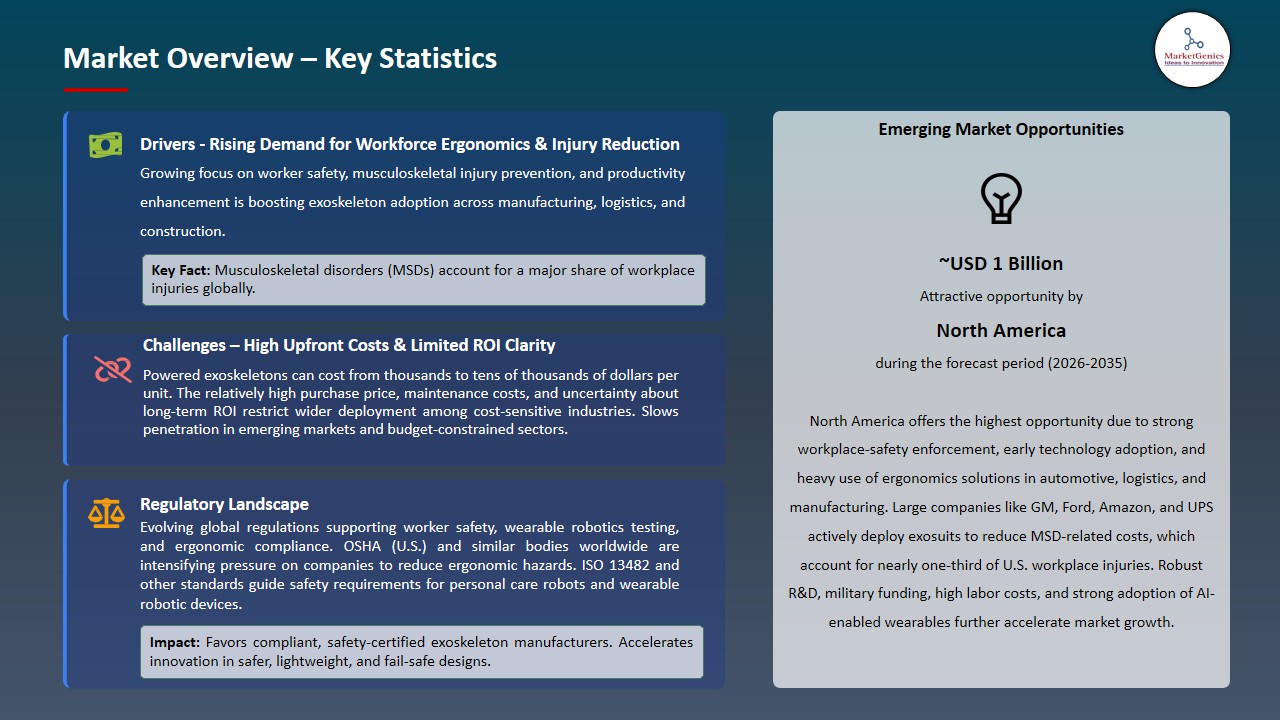
The industrial exoskeleton market is being fuelled by the growing interest in the field of workplace safety because the exoskeletons are effective in alleviating musculoskeletal strain and risk of injury in physically demanding and repetitive work. Exoskeletons offload the heavy loads, promote the right posture, and reduce lower workplace injury rates, employee well-being, and increase productivity and, therefore, constitute a vital investment in the manufacturing, logistics, construction, as well as maintenance business.
Exoskeleton-as-a-Service (EaaS) and rental models are emerging opportunities in the industrial exoskeleton market by reducing adoption costs among small and medium-sized enterprises (SMEs). Companies do not need to make high initial capital investments in exoskeletons as it is available on a subscription or short-term rental basis, which allows it to be deployed flexibly during seasonal peaks, special projects, or pilot programs. With this model, organizations are able to estimate the performance, ergonomics and productivity benefits prior to long-term purchases, as well as fewer responsibilities in terms of maintenance and upgrade.
Adjacent opportunities in the industrial exoskeleton market include extending technology to healthcare and rehabilitation for patient mobility and physiotherapy, construction and heavy industries for ergonomic support, logistics and warehousing for enhanced material handling, military applications for load carriage and endurance, human-machine collaboration with cobots and AI systems, and training or simulation platforms using VR/AR to improve skills and workplace safety, creating cross-industry growth potential.
Industrial Exoskeleton Market Dynamics and Trends
Driver: Advances in sensors, AI and materials
-
The sensors, AI and materials are also making significant improvements in the industrial exoskeleton market through faster adoption of this technology, improving the performance, comfort, and operational value of the devices. Modern exoskeletons currently incorporate high-precision motioning sensors, IMUs, pressure-mapping and real-time AI programming that continuously adjusts assistance according to the posture of a worker and the workload provides more natural, safer and more maneuverable movement.
- Lightweight composites, soft-robotics materials and better battery chemistries make the devices lightweight and increase the working hours that were previously problematic due to fatigue, overheating, and short wear times. Such technological advances enhance ergonomics, increase worker acceptance and yield quantifiable productivity, rendering exoskeleton in the next generation highly feasible on assembly lines, logistics systems, construction sites and industrial settings where a lot of maintenance is necessary.
- German Bionic released Exia in May 2025, the first Augmented AI-controlled industrial exoskeleton that had been trained on billions of motion data points. Exia also provides 38 kg adaptive lift support, real-time learning, lighter hardware and built-in ergonomic analytics, making it the new standard of smart universal exoskeletons in the workplace.
- Industrial exoskeletons are quickly becoming smarter, lighter, and more flexible to meet the needs of workers, ensuring their safety, efficiency, and resilience to work over the long term.
Restraint: Battery Life, Weight, and Mobility Trade-Offs
-
In the industrial exoskeleton market, active exoskeletons have problems based on the trade-off between the battery life, mass of the device, and its mobility. Such systems are powerful lift aids, however, they depend on high capacity batteries and motors, further adding weight to the user, and those that may be cumbersome when worn over long periods.
- The increased weight may restrict the natural mobility, comfort and affect the long-term use. The batteries have to be charged or changed frequently, disrupting the workflow and preventing working at all times in a challenging field, such as a manufacturing floor, warehouse, or a construction site. Such practical constraints result in the fact that companies do not have the ability to implement exoskeletons during entire shifts, particularly in high-intensity work.
- The trade-offs between support and ease of operation therefore delay adoption because the organizations have to weigh the gains against the issues concerning the worker comfort, mobility and productivity of the industrial exoskeleton market.
- These problems highlight the point that the issues of battery, weight and mobility limitations are key to expanding to the industrial exoskeleton market.
Opportunity: Advancements in Exoskeleton Technology Enable Expansion into Healthcare, Rehabilitation, and High-Value Industrial Applications
-
Exoskeleton technology is developing new growth opportunities in the industrial exoskeleton market as it can be used in non-conventional manufacturing and logistics. Current exoskeletons are also more functional, with such capabilities as adaptive assistance, real-time analytics, motion aid delivered by AI, and ergonomic optimization.
- The advancements enable devices to be used in healthcare and rehabilitation to aid patient mobility, physiotherapy, and spinal cord injury recovery and in environments with high value such as the industrial sector that demand precision, safety, and heavy-lift assistance. With cross-overs to both industrial and medical, manufacturers are able to reach out to new sectors of consumers, enhance workforce productivity and safety, and justify investment with quantifiable results, broadening market coverage and inducing cross-sector adoption.
- In 2025, CYBERDYNE was found to recognize the only exoskeleton that could induce neuroplasticity and provide extensive therapeutic recovery to the patient with spinal cord injury, which enhances mobility, pain, and quality of life, which reflects the unique promise of the exoskeleton in healthcare and rehabilitation practices.
- The developments put the market of industrial exoskeletons in a position to grow both in healthcare and rehabilitation and high-value industrial domains, leading to cross-sector expansion and adoption.
Key Trend: Convergence with PPE & Collaborative Robots
-
Integration of ergonomics programs with exoskeletons, collaborative robots (cobots), and personal protective equipment (PPE) is also emerging as a trend in the industry exoskeleton market as a means to create a complete, human-centered safety ecosystem. Taking wearable robotics and integrating them with the conventional safety equipment and automated assistance systems, the companies will be able to protect their workers better, minimize the possibility of harm, and streamline the workflow.
- Exoskeletons complement cobots by distributing workload, aiding the repetitive or heavy-lifting tasks, and ensuring the proper posture, whereas ergonomic interventions are informed by analytics collected through wearable devices. This intersection allows people and machines to work together without conflicts, increases the level of safety at work, and enhances the productivity of operations, facilitating the further implementation of exoskeleton technology as one of the components of the integrated automation of industry and the welfare of the employees.
- The Airbus experimented with a pilot project of 118 exoskeletons in France, Spain and Canada in 2025 to alleviate operator fatigue and musculoskeletal stress on aircraft assemblers. Initial findings revealed that there was a reduction in muscle load (shoulder and upper back) in activities such as overhead sanding by 10-40%. The program brings together exoskeletons and collaborative robots and more ergonomic solutions, which points out the trend of human-friendly safety stacks based on wearable robotics, personal protective equipment, and automation at the industrial level.
- The developmental trend of combining exoskeletons with PPE, collaborative robots, and ergonomics programs is improving the safety, performance, and productivity of workers in the industrial setting.
Industrial-Exoskeleton-Market Analysis and Segmental Data
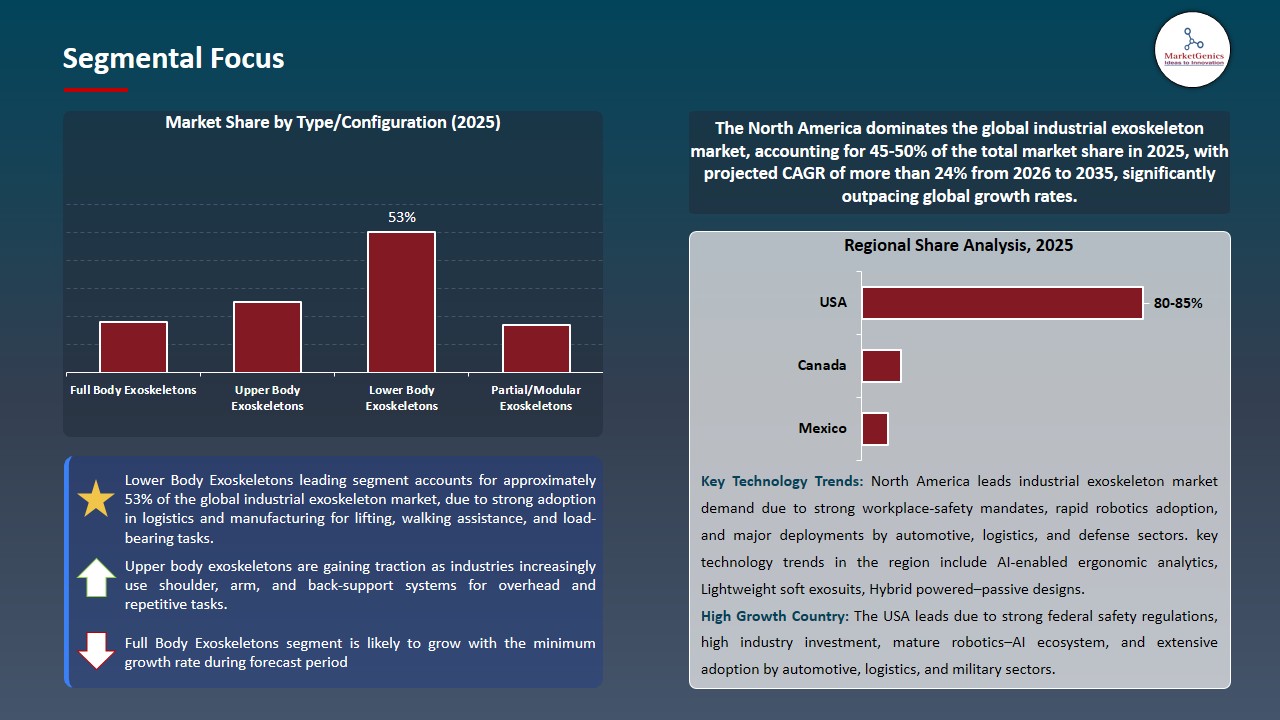
Lower Body Exoskeletons Dominate Global Industrial Exoskeleton Market
-
In the industrial exoskeleton market, lower body exoskeletons dominate due to their critical role in supporting workers engaged in physically demanding tasks such as lifting, squatting, bending, and prolonged standing. These devices provide targeted assistance to the hips, knees, and legs, reducing musculoskeletal strain, fatigue, and injury risk, while improving posture and operational efficiency.
- Lower body exoskeletons have been embraced by industries like manufacturing, logistics, construction, and warehousing due to the repetitive stress it exerts to the lower limbs that is the main source of work-related injuries. The ergonomic advantages coupled with the growing concern over employee safety and regulatory standards and concerns have made lower body exoskeleton the most successful category that has been fueling market growth in nearly every country worldwide.
- In November 2025, Ottobock created SUITX released the IX BACK VOLTON, a lightweight (4.8 3.5 kg) lower body exoskeleton which is intended to be used in industrial operations, such as lifting and order picking. It has smart sensors and an 8-hour battery, which help prevent bad back load up to 17 kg per lift, which is ideal to work full shifts.
- Lower body exoskeletons are the most popular category in the industrial exoskeleton market, and led to growth by improving worker support, ergonomics, and productivity.
North America Leads Global Industrial Exoskeleton Market Demand
-
North America continues to lead the global industrial exoskeleton market due to a combination of technological, regulatory, and operational factors. The region has a high concentration of advanced manufacturing, logistics, and construction industries that are increasingly adopting exoskeleton solutions to enhance worker safety, reduce musculoskeletal disorders, and improve operational efficiency.
- Strong regulatory frameworks, including OSHA guidelines and industry-specific safety standards, encourage employers to implement ergonomic interventions and invest in wearable robotics. The growing emphasis on employee well-being, combined with awareness of the high costs associated with workplace injuries, drives adoption of exoskeletons across both large enterprises and SMEs.
- Moreover, North American companies are early adopters of Industry 4.0 technologies, integrating exoskeletons with IoT, AI-driven analytics, and collaborative robots to optimize workflow and monitor ergonomics in real time. Government incentives, pilot programs, and substantial R&D investments by leading exoskeleton manufacturers further bolster market growth. These factors collectively position North America as the primary hub for innovation, deployment, and demand in the global industrial exoskeleton market.
- North America’s advanced industries, regulatory support, and technology adoption firmly establish it as the leading hub driving global industrial exoskeleton market growth.
Industrial-Exoskeleton-Market Ecosystem
The global industrial exoskeleton market is consolidated, with leading players including Ekso Bionics Holdings, Sarcos Technology and Robotics Corporation, Hyundai Motor Company, Ottobock SE & Co. KGaA, and German Bionic Systems GmbH. These companies maintain competitive advantages through advanced exoskeleton designs, integration with wearable sensors and AI-driven control systems, IoT-enabled monitoring, collaborative robot compatibility, ergonomics-focused solutions, and comprehensive after-sales support including software updates, maintenance, and operator training.
The market value chain encompasses design and R&D of exoskeleton systems, manufacturing of actuators and wearable components, sensor calibration and testing, integration with industrial or rehabilitation workflows, installation and commissioning, adherence to safety and quality standards, and after-sales services such as usage analytics, predictive maintenance, and software upgrades.
Entry barriers are high due to capital-intensive development, technical expertise in robotics and biomechanics, stringent safety and regulatory standards, and the need for seamless integration with industrial operations or medical applications. The market continues to evolve through technological innovations, including AI-driven adaptive support, lightweight composites, energy-efficient power systems, and connected analytics platforms, driving differentiation and adoption globally.
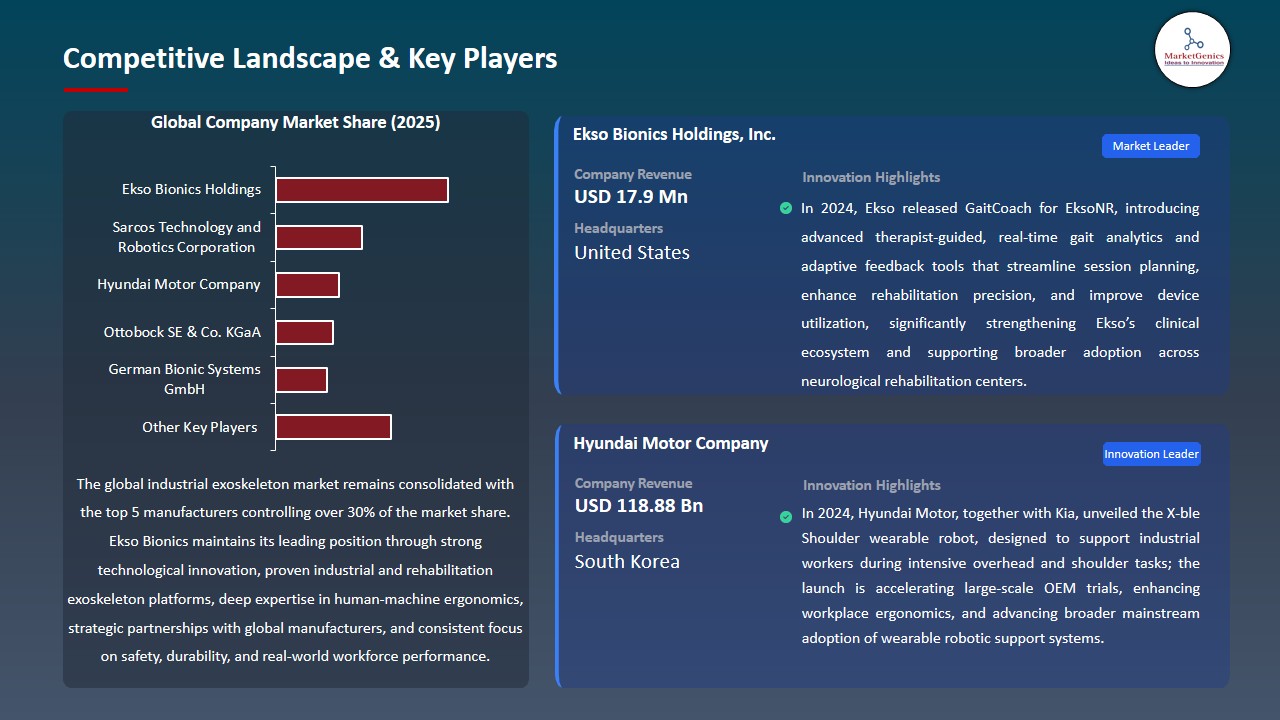
Recent Development and Strategic Overview:
-
In April 2025, KULR Technology Group partnered with German Bionic to expand the U.S. market for the Apogee ULTRA AI-powered exoskeleton, focusing on large-scale deployment across logistics, manufacturing, construction, and healthcare. The collaboration includes technology enhancements, AI integration, and exclusive North American marketing and distribution, aiming to boost worker productivity, reduce injuries, and support domestic manufacturing and supply chain resilience.
- In May 2025, Ekso Bionics joined the NVIDIA Connect program to develop the industry’s first proprietary foundation model for human motion, integrating advanced AI into its exoskeleton platforms for medical and industrial applications. This collaboration aims to enhance human mobility, strength, and rehabilitation outcomes while accelerating AI-driven innovation across Ekso Bionics’ Enterprise and Personal Health devices.
Report Scope
|
Detail |
|
|
Market Size in 2025 |
USD 0.5 Bn |
|
Market Forecast Value in 2035 |
USD 3.5 Bn |
|
Growth Rate (CAGR) |
21.6% |
|
Forecast Period |
2026 – 2035 |
|
Historical Data Available for |
2021 – 2024 |
|
Market Size Units |
US$ Billion for Value Units for Volume |
|
Report Format |
Electronic (PDF) + Excel |
|
North America |
Europe |
Asia Pacific |
Middle East |
Africa |
South America |
|
|
|
|
|
|
|
Companies Covered |
|||||
|
|
|
|
|
|
Industrial-Exoskeleton-Market Segmentation and Highlights
|
Segment |
Sub-segment |
|
Industrial Exoskeleton Market, By Type/Configuration |
|
|
Industrial Exoskeleton Market, By Power Source |
|
|
Industrial Exoskeleton Market, By Rated Power (for Powered Exoskeletons) |
|
|
Industrial Exoskeleton Market, By Rated Capacity/Load Bearing |
|
|
Industrial Exoskeleton Market, By Mobility Type |
|
|
Industrial Exoskeleton Market, By Technology |
|
|
Industrial Exoskeleton Market, By Material |
|
|
Industrial Exoskeleton Market, By Application |
|
|
Industrial Exoskeleton Market, By End-Use Industry |
|
|
Industrial Exoskeleton Market, By Distribution Channel |
|
|
Industrial Exoskeleton Market, By End-User Size |
|
Frequently Asked Questions
Table of Contents
- 1. Research Methodology and Assumptions
- 1.1. Definitions
- 1.2. Research Design and Approach
- 1.3. Data Collection Methods
- 1.4. Base Estimates and Calculations
- 1.5. Forecasting Models
- 1.5.1. Key Forecast Factors & Impact Analysis
- 1.6. Secondary Research
- 1.6.1. Open Sources
- 1.6.2. Paid Databases
- 1.6.3. Associations
- 1.7. Primary Research
- 1.7.1. Primary Sources
- 1.7.2. Primary Interviews with Stakeholders across Ecosystem
- 2. Executive Summary
- 2.1. Global Industrial Exoskeleton Market Outlook
- 2.1.1. Industrial Exoskeleton Market Size Volume (Units) and Value (US$ Bn), and Forecasts, 2021-2035
- 2.1.2. Compounded Annual Growth Rate Analysis
- 2.1.3. Growth Opportunity Analysis
- 2.1.4. Segmental Share Analysis
- 2.1.5. Geographical Share Analysis
- 2.2. Market Analysis and Facts
- 2.3. Supply-Demand Analysis
- 2.4. Competitive Benchmarking
- 2.5. Go-to- Market Strategy
- 2.5.1. Customer/ End-use Industry Assessment
- 2.5.2. Growth Opportunity Data, 2026-2035
- 2.5.2.1. Regional Data
- 2.5.2.2. Country Data
- 2.5.2.3. Segmental Data
- 2.5.3. Identification of Potential Market Spaces
- 2.5.4. GAP Analysis
- 2.5.5. Potential Attractive Price Points
- 2.5.6. Prevailing Market Risks & Challenges
- 2.5.7. Preferred Sales & Marketing Strategies
- 2.5.8. Key Recommendations and Analysis
- 2.5.9. A Way Forward
- 2.1. Global Industrial Exoskeleton Market Outlook
- 3. Industry Data and Premium Insights
- 3.1. Global Industrial Machinery Overview, 2025
- 3.1.1. Industrial Machinery Ecosystem Analysis
- 3.1.2. Key Trends for Industrial Machinery
- 3.1.3. Regional Distribution for Industrial Machinery
- 3.2. Supplier Customer Data
- 3.3. Technology Roadmap and Developments
- 3.4. Trade Analysis
- 3.4.1. Import & Export Analysis, 2025
- 3.4.2. Top Importing Countries
- 3.4.3. Top Exporting Countries
- 3.5. Trump Tariff Impact Analysis
- 3.5.1. Manufacturer
- 3.5.1.1. Based on the component & Raw material
- 3.5.2. Supply Chain
- 3.5.3. End Consumer
- 3.5.1. Manufacturer
- 3.6. Raw Material Analysis
- 3.1. Global Industrial Machinery Overview, 2025
- 4. Market Overview
- 4.1. Market Dynamics
- 4.1.1. Drivers
- 4.1.1.1. Increasing focus on workplace safety and reduction of musculoskeletal injuries.
- 4.1.1.2. Rising demand for productivity enhancement in labor-intensive industries.
- 4.1.1.3. Advancements in lightweight materials, sensors, and AI-assisted motion support.
- 4.1.2. Restraints
- 4.1.2.1. High initial cost and investment required for deployment.
- 4.1.2.2. Limited user awareness and acceptance in traditional industrial environments.
- 4.1.1. Drivers
- 4.2. Key Trend Analysis
- 4.3. Regulatory Framework
- 4.3.1. Key Regulations, Norms, and Subsidies, by Key Countries
- 4.3.2. Tariffs and Standards
- 4.3.3. Impact Analysis of Regulations on the Market
- 4.4. Value Chain Analysis
- 4.4.1. Component Manufacturers
- 4.4.2. System Assembly & Integration
- 4.4.3. Distribution & Supply Chain
- 4.4.4. End Use Industry
- 4.5. Porter’s Five Forces Analysis
- 4.6. PESTEL Analysis
- 4.7. Global Industrial Exoskeleton Market Demand
- 4.7.1. Historical Market Size – Volume (Units) and Value (US$ Bn), 2020-2024
- 4.7.2. Current and Future Market Size – Volume (Units) and Value (US$ Bn), 2026–2035
- 4.7.2.1. Y-o-Y Growth Trends
- 4.7.2.2. Absolute $ Opportunity Assessment
- 4.1. Market Dynamics
- 5. Competition Landscape
- 5.1. Competition structure
- 5.1.1. Fragmented v/s consolidated
- 5.2. Company Share Analysis, 2025
- 5.2.1. Global Company Market Share
- 5.2.2. By Region
- 5.2.2.1. North America
- 5.2.2.2. Europe
- 5.2.2.3. Asia Pacific
- 5.2.2.4. Middle East
- 5.2.2.5. Africa
- 5.2.2.6. South America
- 5.3. Product Comparison Matrix
- 5.3.1. Specifications
- 5.3.2. Market Positioning
- 5.3.3. Pricing
- 5.1. Competition structure
- 6. Global Industrial Exoskeleton Market Analysis, by Type/Configuration
- 6.1. Key Segment Analysis
- 6.2. Industrial Exoskeleton Market Size (Volume (Units) and Value (US$ Bn), Analysis, and Forecasts, by Type/Configuration, 2021-2035
- 6.2.1. Full Body Exoskeletons
- 6.2.2. Upper Body Exoskeletons
- 6.2.2.1. Shoulder Support
- 6.2.2.2. Arm Support
- 6.2.2.3. Back Support
- 6.2.2.4. Others
- 6.2.3. Lower Body Exoskeletons
- 6.2.3.1. Hip Support
- 6.2.3.2. Knee Support
- 6.2.3.3. Ankle Support
- 6.2.3.4. Others
- 6.2.4. Partial/Modular Exoskeletons
- 7. Global Industrial Exoskeleton Market Analysis, by Power Source
- 7.1. Key Segment Analysis
- 7.2. Industrial Exoskeleton Market Size (Volume (Units) and Value (US$ Bn), Analysis, and Forecasts, by Power Source, 2021-2035
- 7.2.1. Powered/Active Exoskeletons
- 7.2.1.1. Electric Powered
- 7.2.1.2. Pneumatic Powered
- 7.2.1.3. Hydraulic Powered
- 7.2.1.4. Hybrid Systems
- 7.2.2. Passive/Unpowered Exoskeletons
- 7.2.2.1. Spring-based
- 7.2.2.2. Counterbalance Systems
- 7.2.2.3. Mechanical Assist
- 7.2.1. Powered/Active Exoskeletons
- 8. Global Industrial Exoskeleton Market Analysis, by Rated Power (for Powered Exoskeletons)
- 8.1. Key Segment Analysis
- 8.2. Industrial Exoskeleton Market Size (Volume (Units) and Value (US$ Bn), Analysis, and Forecasts, by Rated Power (for Powered Exoskeletons), 2021-2035
- 8.2.1. <100W
- 8.2.2. 100W-500W
- 8.2.3. 500W-1000W
- 8.2.4. >1000W
- 9. Global Industrial Exoskeleton Market Analysis, by Rated Capacity/Load Bearing
- 9.1. Key Segment Analysis
- 9.2. Industrial Exoskeleton Market Size (Volume (Units) and Value (US$ Bn), Analysis, and Forecasts, by Rated Capacity/Load Bearing, 2021-2035
- 9.2.1. <10 kg assistance
- 9.2.2. 10-25 kg assistance
- 9.2.3. 25-50 kg assistance
- 9.2.4. >50 kg assistance
- 10. Global Industrial Exoskeleton Market Analysis, by Mobility Type
- 10.1. Key Segment Analysis
- 10.2. Industrial Exoskeleton Market Size (Volume (Units) and Value (US$ Bn), Analysis, and Forecasts, by Mobility Type, 2021-2035
- 10.2.1. Stationary Exoskeletons
- 10.2.2. Mobile Exoskeletons
- 10.2.3. Semi-Mobile Exoskeletons
- 11. Global Industrial Exoskeleton Market Analysis, by Technology
- 11.1. Key Segment Analysis
- 11.2. Industrial Exoskeleton Market Size (Volume (Units) and Value (US$ Bn), Analysis, and Forecasts, by Technology, 2021-2035
- 11.2.1. Rigid Exoskeletons
- 11.2.2. Soft Exoskeletons
- 11.2.3. Hybrid Exoskeletons
- 11.2.4. Smart/IoT-Enabled Exoskeletons
- 11.2.4.1. Sensor Integrated
- 11.2.4.2. AI-Powered
- 11.2.4.3. Data Analytics Enabled
- 11.2.4.4. Others
- 12. Global Industrial Exoskeleton Market Analysis, by Material
- 12.1. Key Segment Analysis
- 12.2. Industrial Exoskeleton Market Size (Volume (Units) and Value (US$ Bn), Analysis, and Forecasts, by Torch Type, 2021-2035
- 12.2.1. Carbon Fiber
- 12.2.2. Aluminum Alloy
- 12.2.3. Steel
- 12.2.4. Composite Materials
- 12.2.5. Textile-based
- 13. Global Industrial Exoskeleton Market Analysis, by Application
- 13.1. Key Segment Analysis
- 13.2. Industrial Exoskeleton Market Size (Volume (Units) and Value (US$ Bn), Analysis, and Forecasts, by Application, 2021-2035
- 13.2.1. Material Handling
- 13.2.1.1. Lifting
- 13.2.1.2. Carrying
- 13.2.1.3. Pushing/Pulling
- 13.2.1.4. Others
- 13.2.2. Assembly Line Operations
- 13.2.3. Overhead Work
- 13.2.4. Repetitive Tasks
- 13.2.5. Heavy Tool Operation
- 13.2.6. Precision Work
- 13.2.7. Logistics and Warehousing
- 13.2.8. Other Applications
- 13.2.1. Material Handling
- 14. Global Industrial Exoskeleton Market Analysis and Forecasts, by End-Use Industry
- 14.1. Key Findings
- 14.2. Industrial Exoskeleton Market Size (Volume (Units) and Value (US$ Bn), Analysis, and Forecasts, by End-Use Industry, 2021-2035
- 14.2.1. Manufacturing
- 14.2.1.1. General Manufacturing
- 14.2.1.1.1. Material Handling
- 14.2.1.1.2. Assembly Operations
- 14.2.1.1.3. Repetitive Tasks
- 14.2.1.1.4. Others
- 14.2.1.2. Heavy Manufacturing
- 14.2.1.2.1. Lifting Operations
- 14.2.1.2.2. Tool Operation
- 14.2.1.2.3. Others
- 14.2.1.3. Electronics Manufacturing
- 14.2.1.3.1. Precision Work
- 14.2.1.3.2. Assembly Operations
- 14.2.1.3.3. Others
- 14.2.1.1. General Manufacturing
- 14.2.2. Logistics and Warehousing
- 14.2.2.1. Material Handling
- 14.2.2.2. Lifting and Carrying
- 14.2.2.3. Loading/Unloading Operations
- 14.2.2.4. Order Picking
- 14.2.2.5. Others
- 14.2.3. Construction
- 14.2.3.1. Material Handling
- 14.2.3.2. Overhead Work
- 14.2.3.3. Heavy Tool Operation
- 14.2.3.4. Lifting Operations
- 14.2.3.5. Others
- 14.2.4. Healthcare and Medical
- 14.2.4.1. Patient Handling
- 14.2.4.2. Rehabilitation Support
- 14.2.4.3. Surgical Assistance
- 14.2.4.4. Long-duration Procedures
- 14.2.4.5. Others
- 14.2.5. Mining
- 14.2.5.1. Material Handling
- 14.2.5.2. Heavy Tool Operation
- 14.2.5.3. Lifting Operations
- 14.2.5.4. Repetitive Tasks
- 14.2.5.5. Others
- 14.2.6. Chemical and Pharmaceutical
- 14.2.6.1. Material Handling
- 14.2.6.2. Precision Work
- 14.2.6.3. Repetitive Tasks
- 14.2.6.4. Assembly Operations
- 14.2.6.5. Others
- 14.2.7. Other Industries
- 14.2.1. Manufacturing
- 15. Global Industrial Exoskeleton Market Analysis and Forecasts, by Distribution Channel
- 15.1. Key Findings
- 15.2. Industrial Exoskeleton Market Size (Volume (Units) and Value (US$ Bn), Analysis, and Forecasts, by Distribution Channel, 2021-2035
- 15.2.1. Direct Sales
- 15.2.2. Distributors
- 15.2.3. Online Channels
- 15.2.4. Rental/Leasing Services
- 16. Global Industrial Exoskeleton Market Analysis and Forecasts, by End-User Size
- 16.1. Key Findings
- 16.2. Industrial Exoskeleton Market Size (Volume (Units) and Value (US$ Bn), Analysis, and Forecasts, by End-User Size, 2021-2035
- 16.2.1. Small Enterprises
- 16.2.2. Medium Enterprises
- 16.2.3. Large Enterprises
- 17. Global Industrial Exoskeleton Market Analysis and Forecasts, by Region
- 17.1. Key Findings
- 17.2. Industrial Exoskeleton Market Size (Volume (Units) and Value (US$ Bn), Analysis, and Forecasts, by Region, 2021-2035
- 17.2.1. North America
- 17.2.2. Europe
- 17.2.3. Asia Pacific
- 17.2.4. Middle East
- 17.2.5. Africa
- 17.2.6. South America
- 18. North America Industrial Exoskeleton Market Analysis
- 18.1. Key Segment Analysis
- 18.2. Regional Snapshot
- 18.3. North America Industrial Exoskeleton Market Size- Volume (Units) and Value (US$ Bn), Analysis, and Forecasts, 2021-2035
- 18.3.1. Type/Configuration
- 18.3.2. Power Source
- 18.3.3. Rated Power (for Powered Exoskeletons)
- 18.3.4. Rated Capacity/Load Bearing
- 18.3.5. Mobility Type
- 18.3.6. Technology
- 18.3.7. Material
- 18.3.8. Application
- 18.3.9. End-Use Industry
- 18.3.10. Distribution Channel
- 18.3.11. End-User Size
- 18.3.12. Country
- 18.3.12.1. USA
- 18.3.12.2. Canada
- 18.3.12.3. Mexico
- 18.4. USA Industrial Exoskeleton Market
- 18.4.1. Country Segmental Analysis
- 18.4.2. Type/Configuration
- 18.4.3. Power Source
- 18.4.4. Rated Power (for Powered Exoskeletons)
- 18.4.5. Rated Capacity/Load Bearing
- 18.4.6. Mobility Type
- 18.4.7. Technology
- 18.4.8. Material
- 18.4.9. Application
- 18.4.10. End-Use Industry
- 18.4.11. Distribution Channel
- 18.4.12. End-User Size
- 18.5. Canada Industrial Exoskeleton Market
- 18.5.1. Country Segmental Analysis
- 18.5.2. Type/Configuration
- 18.5.3. Power Source
- 18.5.4. Rated Power (for Powered Exoskeletons)
- 18.5.5. Rated Capacity/Load Bearing
- 18.5.6. Mobility Type
- 18.5.7. Technology
- 18.5.8. Material
- 18.5.9. Application
- 18.5.10. End-Use Industry
- 18.5.11. Distribution Channel
- 18.5.12. End-User Size
- 18.6. Mexico Industrial Exoskeleton Market
- 18.6.1. Country Segmental Analysis
- 18.6.2. Type/Configuration
- 18.6.3. Power Source
- 18.6.4. Rated Power (for Powered Exoskeletons)
- 18.6.5. Rated Capacity/Load Bearing
- 18.6.6. Mobility Type
- 18.6.7. Technology
- 18.6.8. Material
- 18.6.9. Application
- 18.6.10. End-Use Industry
- 18.6.11. Distribution Channel
- 18.6.12. End-User Size
- 19. Europe Industrial Exoskeleton Market Analysis
- 19.1. Key Segment Analysis
- 19.2. Regional Snapshot
- 19.3. Europe Industrial Exoskeleton Market Size (Volume (Units) and Value (US$ Bn), Analysis, and Forecasts, 2021-2035
- 19.3.1. Type/Configuration
- 19.3.2. Power Source
- 19.3.3. Rated Power (for Powered Exoskeletons)
- 19.3.4. Rated Capacity/Load Bearing
- 19.3.5. Mobility Type
- 19.3.6. Technology
- 19.3.7. Material
- 19.3.8. Application
- 19.3.9. End-Use Industry
- 19.3.10. Distribution Channel
- 19.3.11. End-User Size
- 19.3.12. Country
- 19.3.12.1. Germany
- 19.3.12.2. United Kingdom
- 19.3.12.3. France
- 19.3.12.4. Italy
- 19.3.12.5. Spain
- 19.3.12.6. Netherlands
- 19.3.12.7. Nordic Countries
- 19.3.12.8. Poland
- 19.3.12.9. Russia & CIS
- 19.3.12.10. Rest of Europe
- 19.4. Germany Industrial Exoskeleton Market
- 19.4.1. Country Segmental Analysis
- 19.4.2. Type/Configuration
- 19.4.3. Power Source
- 19.4.4. Rated Power (for Powered Exoskeletons)
- 19.4.5. Rated Capacity/Load Bearing
- 19.4.6. Mobility Type
- 19.4.7. Technology
- 19.4.8. Material
- 19.4.9. Application
- 19.4.10. End-Use Industry
- 19.4.11. Distribution Channel
- 19.4.12. End-User Size
- 19.5. United Kingdom Industrial Exoskeleton Market
- 19.5.1. Country Segmental Analysis
- 19.5.2. Type/Configuration
- 19.5.3. Power Source
- 19.5.4. Rated Power (for Powered Exoskeletons)
- 19.5.5. Rated Capacity/Load Bearing
- 19.5.6. Mobility Type
- 19.5.7. Technology
- 19.5.8. Material
- 19.5.9. Application
- 19.5.10. End-Use Industry
- 19.5.11. Distribution Channel
- 19.5.12. End-User Size
- 19.6. France Industrial Exoskeleton Market
- 19.6.1. Country Segmental Analysis
- 19.6.2. Type/Configuration
- 19.6.3. Power Source
- 19.6.4. Rated Power (for Powered Exoskeletons)
- 19.6.5. Rated Capacity/Load Bearing
- 19.6.6. Mobility Type
- 19.6.7. Technology
- 19.6.8. Material
- 19.6.9. Application
- 19.6.10. End-Use Industry
- 19.6.11. Distribution Channel
- 19.6.12. End-User Size
- 19.7. Italy Industrial Exoskeleton Market
- 19.7.1. Country Segmental Analysis
- 19.7.2. Type/Configuration
- 19.7.3. Power Source
- 19.7.4. Rated Power (for Powered Exoskeletons)
- 19.7.5. Rated Capacity/Load Bearing
- 19.7.6. Mobility Type
- 19.7.7. Technology
- 19.7.8. Material
- 19.7.9. Application
- 19.7.10. End-Use Industry
- 19.7.11. Distribution Channel
- 19.7.12. End-User Size
- 19.8. Spain Industrial Exoskeleton Market
- 19.8.1. Country Segmental Analysis
- 19.8.2. Type/Configuration
- 19.8.3. Power Source
- 19.8.4. Rated Power (for Powered Exoskeletons)
- 19.8.5. Rated Capacity/Load Bearing
- 19.8.6. Mobility Type
- 19.8.7. Technology
- 19.8.8. Material
- 19.8.9. Application
- 19.8.10. End-Use Industry
- 19.8.11. Distribution Channel
- 19.8.12. End-User Size
- 19.9. Netherlands Industrial Exoskeleton Market
- 19.9.1. Country Segmental Analysis
- 19.9.2. Type/Configuration
- 19.9.3. Power Source
- 19.9.4. Rated Power (for Powered Exoskeletons)
- 19.9.5. Rated Capacity/Load Bearing
- 19.9.6. Mobility Type
- 19.9.7. Technology
- 19.9.8. Material
- 19.9.9. Application
- 19.9.10. End-Use Industry
- 19.9.11. Distribution Channel
- 19.9.12. End-User Size
- 19.10. Nordic Countries Industrial Exoskeleton Market
- 19.10.1. Country Segmental Analysis
- 19.10.2. Type/Configuration
- 19.10.3. Power Source
- 19.10.4. Rated Power (for Powered Exoskeletons)
- 19.10.5. Rated Capacity/Load Bearing
- 19.10.6. Mobility Type
- 19.10.7. Technology
- 19.10.8. Material
- 19.10.9. Application
- 19.10.10. End-Use Industry
- 19.10.11. Distribution Channel
- 19.10.12. End-User Size
- 19.11. Poland Industrial Exoskeleton Market
- 19.11.1. Country Segmental Analysis
- 19.11.2. Type/Configuration
- 19.11.3. Power Source
- 19.11.4. Rated Power (for Powered Exoskeletons)
- 19.11.5. Rated Capacity/Load Bearing
- 19.11.6. Mobility Type
- 19.11.7. Technology
- 19.11.8. Material
- 19.11.9. Application
- 19.11.10. End-Use Industry
- 19.11.11. Distribution Channel
- 19.11.12. End-User Size
- 19.12. Russia & CIS Industrial Exoskeleton Market
- 19.12.1. Country Segmental Analysis
- 19.12.2. Type/Configuration
- 19.12.3. Power Source
- 19.12.4. Rated Power (for Powered Exoskeletons)
- 19.12.5. Rated Capacity/Load Bearing
- 19.12.6. Mobility Type
- 19.12.7. Technology
- 19.12.8. Material
- 19.12.9. Application
- 19.12.10. End-Use Industry
- 19.12.11. Distribution Channel
- 19.12.12. End-User Size
- 19.13. Rest of Europe Industrial Exoskeleton Market
- 19.13.1. Country Segmental Analysis
- 19.13.2. Type/Configuration
- 19.13.3. Power Source
- 19.13.4. Rated Power (for Powered Exoskeletons)
- 19.13.5. Rated Capacity/Load Bearing
- 19.13.6. Mobility Type
- 19.13.7. Technology
- 19.13.8. Material
- 19.13.9. Application
- 19.13.10. End-Use Industry
- 19.13.11. Distribution Channel
- 19.13.12. End-User Size
- 20. Asia Pacific Industrial Exoskeleton Market Analysis
- 20.1. Key Segment Analysis
- 20.2. Regional Snapshot
- 20.3. Asia Pacific Industrial Exoskeleton Market Size (Volume (Units) and Value (US$ Bn), Analysis, and Forecasts, 2021-2035
- 20.3.1. Type/Configuration
- 20.3.2. Power Source
- 20.3.3. Rated Power (for Powered Exoskeletons)
- 20.3.4. Rated Capacity/Load Bearing
- 20.3.5. Mobility Type
- 20.3.6. Technology
- 20.3.7. Material
- 20.3.8. Application
- 20.3.9. End-Use Industry
- 20.3.10. Distribution Channel
- 20.3.11. End-User Size
- 20.3.12. Country
- 20.3.12.1. China
- 20.3.12.2. India
- 20.3.12.3. Japan
- 20.3.12.4. South Korea
- 20.3.12.5. Australia and New Zealand
- 20.3.12.6. Indonesia
- 20.3.12.7. Malaysia
- 20.3.12.8. Thailand
- 20.3.12.9. Vietnam
- 20.3.12.10. Rest of Asia Pacific
- 20.4. China Industrial Exoskeleton Market
- 20.4.1. Country Segmental Analysis
- 20.4.2. Type/Configuration
- 20.4.3. Power Source
- 20.4.4. Rated Power (for Powered Exoskeletons)
- 20.4.5. Rated Capacity/Load Bearing
- 20.4.6. Mobility Type
- 20.4.7. Technology
- 20.4.8. Material
- 20.4.9. Application
- 20.4.10. End-Use Industry
- 20.4.11. Distribution Channel
- 20.4.12. End-User Size
- 20.5. India Industrial Exoskeleton Market
- 20.5.1. Country Segmental Analysis
- 20.5.2. Type/Configuration
- 20.5.3. Power Source
- 20.5.4. Rated Power (for Powered Exoskeletons)
- 20.5.5. Rated Capacity/Load Bearing
- 20.5.6. Mobility Type
- 20.5.7. Technology
- 20.5.8. Material
- 20.5.9. Application
- 20.5.10. End-Use Industry
- 20.5.11. Distribution Channel
- 20.5.12. End-User Size
- 20.6. Japan Industrial Exoskeleton Market
- 20.6.1. Country Segmental Analysis
- 20.6.2. Type/Configuration
- 20.6.3. Power Source
- 20.6.4. Rated Power (for Powered Exoskeletons)
- 20.6.5. Rated Capacity/Load Bearing
- 20.6.6. Mobility Type
- 20.6.7. Technology
- 20.6.8. Material
- 20.6.9. Application
- 20.6.10. End-Use Industry
- 20.6.11. Distribution Channel
- 20.6.12. End-User Size
- 20.7. South Korea Industrial Exoskeleton Market
- 20.7.1. Country Segmental Analysis
- 20.7.2. Type/Configuration
- 20.7.3. Power Source
- 20.7.4. Rated Power (for Powered Exoskeletons)
- 20.7.5. Rated Capacity/Load Bearing
- 20.7.6. Mobility Type
- 20.7.7. Technology
- 20.7.8. Material
- 20.7.9. Application
- 20.7.10. End-Use Industry
- 20.7.11. Distribution Channel
- 20.7.12. End-User Size
- 20.8. Australia and New Zealand Industrial Exoskeleton Market
- 20.8.1. Country Segmental Analysis
- 20.8.2. Type/Configuration
- 20.8.3. Power Source
- 20.8.4. Rated Power (for Powered Exoskeletons)
- 20.8.5. Rated Capacity/Load Bearing
- 20.8.6. Mobility Type
- 20.8.7. Technology
- 20.8.8. Material
- 20.8.9. Application
- 20.8.10. End-Use Industry
- 20.8.11. Distribution Channel
- 20.8.12. End-User Size
- 20.9. Indonesia Industrial Exoskeleton Market
- 20.9.1. Country Segmental Analysis
- 20.9.2. Type/Configuration
- 20.9.3. Power Source
- 20.9.4. Rated Power (for Powered Exoskeletons)
- 20.9.5. Rated Capacity/Load Bearing
- 20.9.6. Mobility Type
- 20.9.7. Technology
- 20.9.8. Material
- 20.9.9. Application
- 20.9.10. End-Use Industry
- 20.9.11. Distribution Channel
- 20.9.12. End-User Size
- 20.10. Malaysia Industrial Exoskeleton Market
- 20.10.1. Country Segmental Analysis
- 20.10.2. Type/Configuration
- 20.10.3. Power Source
- 20.10.4. Rated Power (for Powered Exoskeletons)
- 20.10.5. Rated Capacity/Load Bearing
- 20.10.6. Mobility Type
- 20.10.7. Technology
- 20.10.8. Material
- 20.10.9. Application
- 20.10.10. End-Use Industry
- 20.10.11. Distribution Channel
- 20.10.12. End-User Size
- 20.11. Thailand Industrial Exoskeleton Market
- 20.11.1. Country Segmental Analysis
- 20.11.2. Type/Configuration
- 20.11.3. Power Source
- 20.11.4. Rated Power (for Powered Exoskeletons)
- 20.11.5. Rated Capacity/Load Bearing
- 20.11.6. Mobility Type
- 20.11.7. Technology
- 20.11.8. Material
- 20.11.9. Application
- 20.11.10. End-Use Industry
- 20.11.11. Distribution Channel
- 20.11.12. End-User Size
- 20.12. Vietnam Industrial Exoskeleton Market
- 20.12.1. Country Segmental Analysis
- 20.12.2. Type/Configuration
- 20.12.3. Power Source
- 20.12.4. Rated Power (for Powered Exoskeletons)
- 20.12.5. Rated Capacity/Load Bearing
- 20.12.6. Mobility Type
- 20.12.7. Technology
- 20.12.8. Material
- 20.12.9. Application
- 20.12.10. End-Use Industry
- 20.12.11. Distribution Channel
- 20.12.12. End-User Size
- 20.13. Rest of Asia Pacific Industrial Exoskeleton Market
- 20.13.1. Country Segmental Analysis
- 20.13.2. Type/Configuration
- 20.13.3. Power Source
- 20.13.4. Rated Power (for Powered Exoskeletons)
- 20.13.5. Rated Capacity/Load Bearing
- 20.13.6. Mobility Type
- 20.13.7. Technology
- 20.13.8. Material
- 20.13.9. Application
- 20.13.10. End-Use Industry
- 20.13.11. Distribution Channel
- 20.13.12. End-User Size
- 21. Middle East Industrial Exoskeleton Market Analysis
- 21.1. Key Segment Analysis
- 21.2. Regional Snapshot
- 21.3. Middle East Industrial Exoskeleton Market Size (Volume (Units) and Value (US$ Bn), Analysis, and Forecasts, 2021-2035
- 21.3.1. Type/Configuration
- 21.3.2. Power Source
- 21.3.3. Rated Power (for Powered Exoskeletons)
- 21.3.4. Rated Capacity/Load Bearing
- 21.3.5. Mobility Type
- 21.3.6. Technology
- 21.3.7. Material
- 21.3.8. Application
- 21.3.9. End-Use Industry
- 21.3.10. Distribution Channel
- 21.3.11. End-User Size
- 21.3.12. Country
- 21.3.12.1. Turkey
- 21.3.12.2. UAE
- 21.3.12.3. Saudi Arabia
- 21.3.12.4. Israel
- 21.3.12.5. Rest of Middle East
- 21.4. Turkey Industrial Exoskeleton Market
- 21.4.1. Country Segmental Analysis
- 21.4.2. Type/Configuration
- 21.4.3. Power Source
- 21.4.4. Rated Power (for Powered Exoskeletons)
- 21.4.5. Rated Capacity/Load Bearing
- 21.4.6. Mobility Type
- 21.4.7. Technology
- 21.4.8. Material
- 21.4.9. Application
- 21.4.10. End-Use Industry
- 21.4.11. Distribution Channel
- 21.4.12. End-User Size
- 21.5. UAE Industrial Exoskeleton Market
- 21.5.1. Country Segmental Analysis
- 21.5.2. Type/Configuration
- 21.5.3. Power Source
- 21.5.4. Rated Power (for Powered Exoskeletons)
- 21.5.5. Rated Capacity/Load Bearing
- 21.5.6. Mobility Type
- 21.5.7. Technology
- 21.5.8. Material
- 21.5.9. Application
- 21.5.10. End-Use Industry
- 21.5.11. Distribution Channel
- 21.5.12. End-User Size
- 21.6. Saudi Arabia Industrial Exoskeleton Market
- 21.6.1. Country Segmental Analysis
- 21.6.2. Type/Configuration
- 21.6.3. Power Source
- 21.6.4. Rated Power (for Powered Exoskeletons)
- 21.6.5. Rated Capacity/Load Bearing
- 21.6.6. Mobility Type
- 21.6.7. Technology
- 21.6.8. Material
- 21.6.9. Application
- 21.6.10. End-Use Industry
- 21.6.11. Distribution Channel
- 21.6.12. End-User Size
- 21.7. Israel Industrial Exoskeleton Market
- 21.7.1. Country Segmental Analysis
- 21.7.2. Type/Configuration
- 21.7.3. Power Source
- 21.7.4. Rated Power (for Powered Exoskeletons)
- 21.7.5. Rated Capacity/Load Bearing
- 21.7.6. Mobility Type
- 21.7.7. Technology
- 21.7.8. Material
- 21.7.9. Application
- 21.7.10. End-Use Industry
- 21.7.11. Distribution Channel
- 21.7.12. End-User Size
- 21.8. Rest of Middle East Industrial Exoskeleton Market
- 21.8.1. Country Segmental Analysis
- 21.8.2. Type/Configuration
- 21.8.3. Power Source
- 21.8.4. Rated Power (for Powered Exoskeletons)
- 21.8.5. Rated Capacity/Load Bearing
- 21.8.6. Mobility Type
- 21.8.7. Technology
- 21.8.8. Material
- 21.8.9. Application
- 21.8.10. End-Use Industry
- 21.8.11. Distribution Channel
- 21.8.12. End-User Size
- 22. Africa Industrial Exoskeleton Market Analysis
- 22.1. Key Segment Analysis
- 22.2. Regional Snapshot
- 22.3. Africa Industrial Exoskeleton Market Size (Volume (Units) and Value (US$ Bn), Analysis, and Forecasts, 2021-2035
- 22.3.1. Type/Configuration
- 22.3.2. Power Source
- 22.3.3. Rated Power (for Powered Exoskeletons)
- 22.3.4. Rated Capacity/Load Bearing
- 22.3.5. Mobility Type
- 22.3.6. Technology
- 22.3.7. Material
- 22.3.8. Application
- 22.3.9. End-Use Industry
- 22.3.10. Distribution Channel
- 22.3.11. End-User Size
- 22.3.12. Country
- 22.3.12.1. South Africa
- 22.3.12.2. Egypt
- 22.3.12.3. Nigeria
- 22.3.12.4. Algeria
- 22.3.12.5. Rest of Africa
- 22.4. South Africa Industrial Exoskeleton Market
- 22.4.1. Country Segmental Analysis
- 22.4.2. Type/Configuration
- 22.4.3. Power Source
- 22.4.4. Rated Power (for Powered Exoskeletons)
- 22.4.5. Rated Capacity/Load Bearing
- 22.4.6. Mobility Type
- 22.4.7. Technology
- 22.4.8. Material
- 22.4.9. Application
- 22.4.10. End-Use Industry
- 22.4.11. Distribution Channel
- 22.4.12. End-User Size
- 22.5. Egypt Industrial Exoskeleton Market
- 22.5.1. Country Segmental Analysis
- 22.5.2. Type/Configuration
- 22.5.3. Power Source
- 22.5.4. Rated Power (for Powered Exoskeletons)
- 22.5.5. Rated Capacity/Load Bearing
- 22.5.6. Mobility Type
- 22.5.7. Technology
- 22.5.8. Material
- 22.5.9. Application
- 22.5.10. End-Use Industry
- 22.5.11. Distribution Channel
- 22.5.12. End-User Size
- 22.6. Nigeria Industrial Exoskeleton Market
- 22.6.1. Country Segmental Analysis
- 22.6.2. Type/Configuration
- 22.6.3. Power Source
- 22.6.4. Rated Power (for Powered Exoskeletons)
- 22.6.5. Rated Capacity/Load Bearing
- 22.6.6. Mobility Type
- 22.6.7. Technology
- 22.6.8. Material
- 22.6.9. Application
- 22.6.10. End-Use Industry
- 22.6.11. Distribution Channel
- 22.6.12. End-User Size
- 22.7. Algeria Industrial Exoskeleton Market
- 22.7.1. Country Segmental Analysis
- 22.7.2. Type/Configuration
- 22.7.3. Power Source
- 22.7.4. Rated Power (for Powered Exoskeletons)
- 22.7.5. Rated Capacity/Load Bearing
- 22.7.6. Mobility Type
- 22.7.7. Technology
- 22.7.8. Material
- 22.7.9. Application
- 22.7.10. End-Use Industry
- 22.7.11. Distribution Channel
- 22.7.12. End-User Size
- 22.8. Rest of Africa Industrial Exoskeleton Market
- 22.8.1. Country Segmental Analysis
- 22.8.2. Type/Configuration
- 22.8.3. Power Source
- 22.8.4. Rated Power (for Powered Exoskeletons)
- 22.8.5. Rated Capacity/Load Bearing
- 22.8.6. Mobility Type
- 22.8.7. Technology
- 22.8.8. Material
- 22.8.9. Application
- 22.8.10. End-Use Industry
- 22.8.11. Distribution Channel
- 22.8.12. End-User Size
- 23. South America Industrial Exoskeleton Market Analysis
- 23.1. Key Segment Analysis
- 23.2. Regional Snapshot
- 23.3. South America Industrial Exoskeleton Market Size (Volume (Units) and Value (US$ Bn), Analysis, and Forecasts, 2021-2035
- 23.3.1. Type/Configuration
- 23.3.2. Power Source
- 23.3.3. Rated Power (for Powered Exoskeletons)
- 23.3.4. Rated Capacity/Load Bearing
- 23.3.5. Mobility Type
- 23.3.6. Technology
- 23.3.7. Material
- 23.3.8. Application
- 23.3.9. End-Use Industry
- 23.3.10. Distribution Channel
- 23.3.11. End-User Size
- 23.3.12. Country
- 23.3.12.1. Brazil
- 23.3.12.2. Argentina
- 23.3.12.3. Rest of South America
- 23.4. Brazil Industrial Exoskeleton Market
- 23.4.1. Country Segmental Analysis
- 23.4.2. Type/Configuration
- 23.4.3. Power Source
- 23.4.4. Rated Power (for Powered Exoskeletons)
- 23.4.5. Rated Capacity/Load Bearing
- 23.4.6. Mobility Type
- 23.4.7. Technology
- 23.4.8. Material
- 23.4.9. Application
- 23.4.10. End-Use Industry
- 23.4.11. Distribution Channel
- 23.4.12. End-User Size
- 23.5. Argentina Industrial Exoskeleton Market
- 23.5.1. Country Segmental Analysis
- 23.5.2. Type/Configuration
- 23.5.3. Power Source
- 23.5.4. Rated Power (for Powered Exoskeletons)
- 23.5.5. Rated Capacity/Load Bearing
- 23.5.6. Mobility Type
- 23.5.7. Technology
- 23.5.8. Material
- 23.5.9. Application
- 23.5.10. End-Use Industry
- 23.5.11. Distribution Channel
- 23.5.12. End-User Size
- 23.6. Rest of South America Industrial Exoskeleton Market
- 23.6.1. Country Segmental Analysis
- 23.6.2. Type/Configuration
- 23.6.3. Power Source
- 23.6.4. Rated Power (for Powered Exoskeletons)
- 23.6.5. Rated Capacity/Load Bearing
- 23.6.6. Mobility Type
- 23.6.7. Technology
- 23.6.8. Material
- 23.6.9. Application
- 23.6.10. End-Use Industry
- 23.6.11. Distribution Channel
- 23.6.12. End-User Size
- 24. Key Players/ Company Profile
- 24.1. Atoun Inc.
- 24.1.1. Company Details/ Overview
- 24.1.2. Company Financials
- 24.1.3. Key Customers and Competitors
- 24.1.4. Business/ Industry Portfolio
- 24.1.5. Product Portfolio/ Specification Details
- 24.1.6. Pricing Data
- 24.1.7. Strategic Overview
- 24.1.8. Recent Developments
- 24.2. Auxivo AG
- 24.3. Bioservo Technologies AB
- 24.4. Comau SpA
- 24.5. Cyberdyne Inc.
- 24.6. Ekso Bionics Holdings
- 24.7. German Bionic Systems GmbH
- 24.8. Hocoma AG
- 24.9. Honda Motor Co. Ltd.
- 24.10. Hyundai Motor Company
- 24.11. Innophys Co. Ltd.
- 24.12. Japet Medical
- 24.13. Laevo
- 24.14. Lockheed Martin Corporation
- 24.15. Noonee
- 24.16. Ottobock SE & Co. KGaA
- 24.17. Panasonic Corporation
- 24.18. Parker Hannifin Corporation
- 24.19. ReWalk Robotics
- 24.20. Roam Robotics
- 24.21. Samsung Electronics
- 24.22. Sarcos Technology and Robotics Corporation
- 24.23. Skelex
- 24.24. SuitX (US Bionics)
- 24.25. Verve Motion (HeroWear)
- 24.26. Other Key Players
- 24.1. Atoun Inc.
Note* - This is just tentative list of players. While providing the report, we will cover more number of players based on their revenue and share for each geography
Research Design
Our research design integrates both demand-side and supply-side analysis through a balanced combination of primary and secondary research methodologies. By utilizing both bottom-up and top-down approaches alongside rigorous data triangulation methods, we deliver robust market intelligence that supports strategic decision-making.
MarketGenics' comprehensive research design framework ensures the delivery of accurate, reliable, and actionable market intelligence. Through the integration of multiple research approaches, rigorous validation processes, and expert analysis, we provide our clients with the insights needed to make informed strategic decisions and capitalize on market opportunities.
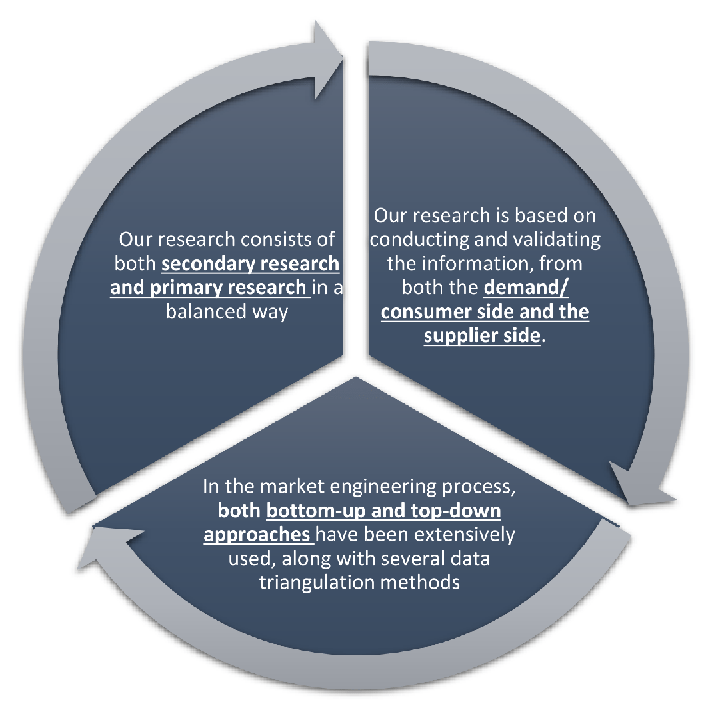
MarketGenics leverages a dedicated industry panel of experts and a comprehensive suite of paid databases to effectively collect, consolidate, and analyze market intelligence.
Our approach has consistently proven to be reliable and effective in generating accurate market insights, identifying key industry trends, and uncovering emerging business opportunities.
Through both primary and secondary research, we capture and analyze critical company-level data such as manufacturing footprints, including technical centers, R&D facilities, sales offices, and headquarters.
Our expert panel further enhances our ability to estimate market size for specific brands based on validated field-level intelligence.
Our data mining techniques incorporate both parametric and non-parametric methods, allowing for structured data collection, sorting, processing, and cleaning.
Demand projections are derived from large-scale data sets analyzed through proprietary algorithms, culminating in robust and reliable market sizing.
Research Approach
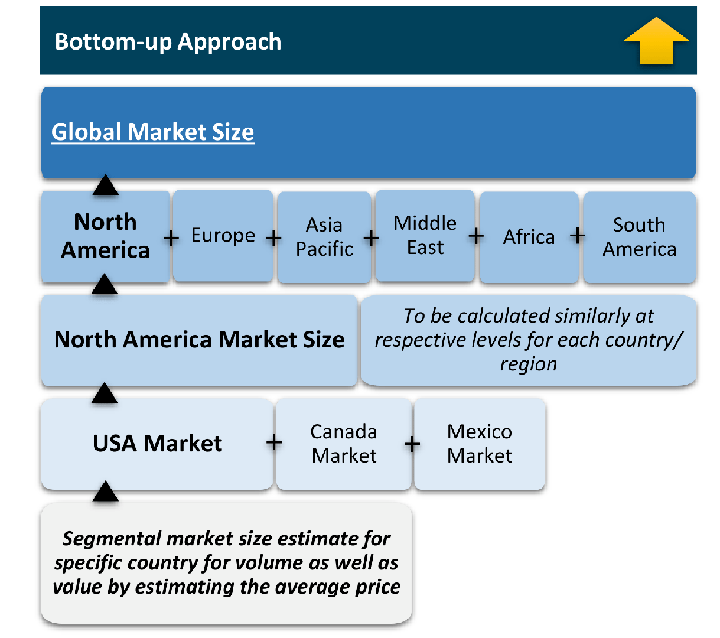
The bottom-up approach builds market estimates by starting with the smallest addressable market units and systematically aggregating them to create comprehensive market size projections.
This method begins with specific, granular data points and builds upward to create the complete market landscape.
Customer Analysis → Segmental Analysis → Geographical Analysis
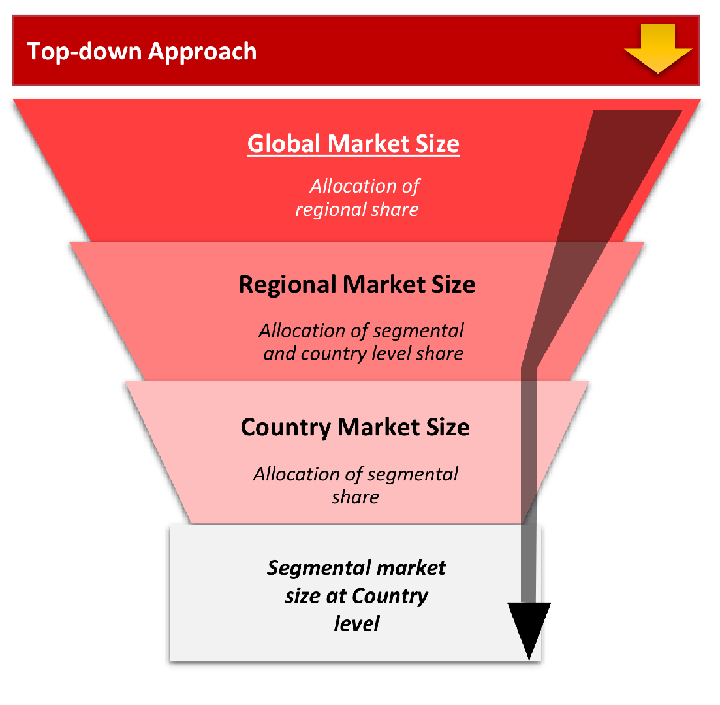
The top-down approach starts with the broadest possible market data and systematically narrows it down through a series of filters and assumptions to arrive at specific market segments or opportunities.
This method begins with the big picture and works downward to increasingly specific market slices.
TAM → SAM → SOM
Research Methods
Desk / Secondary Research
While analysing the market, we extensively study secondary sources, directories, and databases to identify and collect information useful for this technical, market-oriented, and commercial report. Secondary sources that we utilize are not only the public sources, but it is a combination of Open Source, Associations, Paid Databases, MG Repository & Knowledgebase, and others.
- Company websites, annual reports, financial reports, broker reports, and investor presentations
- National government documents, statistical databases and reports
- News articles, press releases and web-casts specific to the companies operating in the market, Magazines, reports, and others
- We gather information from commercial data sources for deriving company specific data such as segmental revenue, share for geography, product revenue, and others
- Internal and external proprietary databases (industry-specific), relevant patent, and regulatory databases
- Governing Bodies, Government Organizations
- Relevant Authorities, Country-specific Associations for Industries
We also employ the model mapping approach to estimate the product level market data through the players' product portfolio
Primary Research
Primary research/ interviews is vital in analyzing the market. Most of the cases involves paid primary interviews. Primary sources include primary interviews through e-mail interactions, telephonic interviews, surveys as well as face-to-face interviews with the different stakeholders across the value chain including several industry experts.
| Type of Respondents | Number of Primaries |
|---|---|
| Tier 2/3 Suppliers | ~20 |
| Tier 1 Suppliers | ~25 |
| End-users | ~25 |
| Industry Expert/ Panel/ Consultant | ~30 |
| Total | ~100 |
MG Knowledgebase
• Repository of industry blog, newsletter and case studies
• Online platform covering detailed market reports, and company profiles
Forecasting Factors and Models
Forecasting Factors
- Historical Trends – Past market patterns, cycles, and major events that shaped how markets behave over time. Understanding past trends helps predict future behavior.
- Industry Factors – Specific characteristics of the industry like structure, regulations, and innovation cycles that affect market dynamics.
- Macroeconomic Factors – Economic conditions like GDP growth, inflation, and employment rates that affect how much money people have to spend.
- Demographic Factors – Population characteristics like age, income, and location that determine who can buy your product.
- Technology Factors – How quickly people adopt new technology and how much technology infrastructure exists.
- Regulatory Factors – Government rules, laws, and policies that can help or restrict market growth.
- Competitive Factors – Analyzing competition structure such as degree of competition and bargaining power of buyers and suppliers.
Forecasting Models / Techniques
Multiple Regression Analysis
- Identify and quantify factors that drive market changes
- Statistical modeling to establish relationships between market drivers and outcomes
Time Series Analysis – Seasonal Patterns
- Understand regular cyclical patterns in market demand
- Advanced statistical techniques to separate trend, seasonal, and irregular components
Time Series Analysis – Trend Analysis
- Identify underlying market growth patterns and momentum
- Statistical analysis of historical data to project future trends
Expert Opinion – Expert Interviews
- Gather deep industry insights and contextual understanding
- In-depth interviews with key industry stakeholders
Multi-Scenario Development
- Prepare for uncertainty by modeling different possible futures
- Creating optimistic, pessimistic, and most likely scenarios
Time Series Analysis – Moving Averages
- Sophisticated forecasting for complex time series data
- Auto-regressive integrated moving average models with seasonal components
Econometric Models
- Apply economic theory to market forecasting
- Sophisticated economic models that account for market interactions
Expert Opinion – Delphi Method
- Harness collective wisdom of industry experts
- Structured, multi-round expert consultation process
Monte Carlo Simulation
- Quantify uncertainty and probability distributions
- Thousands of simulations with varying input parameters
Research Analysis
Our research framework is built upon the fundamental principle of validating market intelligence from both demand and supply perspectives. This dual-sided approach ensures comprehensive market understanding and reduces the risk of single-source bias.
Demand-Side Analysis: We understand end-user/application behavior, preferences, and market needs along with the penetration of the product for specific application.
Supply-Side Analysis: We estimate overall market revenue, analyze the segmental share along with industry capacity, competitive landscape, and market structure.
Validation & Evaluation
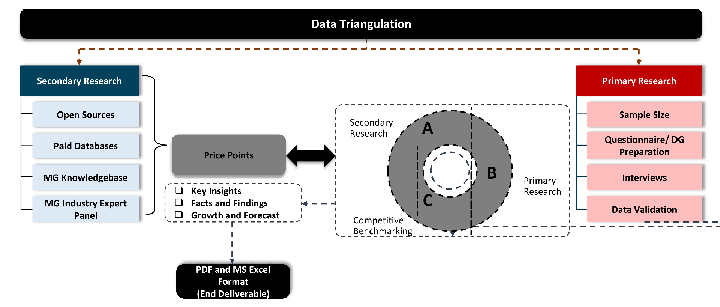
Data triangulation is a validation technique that uses multiple methods, sources, or perspectives to examine the same research question, thereby increasing the credibility and reliability of research findings. In market research, triangulation serves as a quality assurance mechanism that helps identify and minimize bias, validate assumptions, and ensure accuracy in market estimates.
- Data Source Triangulation – Using multiple data sources to examine the same phenomenon
- Methodological Triangulation – Using multiple research methods to study the same research question
- Investigator Triangulation – Using multiple researchers or analysts to examine the same data
- Theoretical Triangulation – Using multiple theoretical perspectives to interpret the same data
Custom Market Research Services
We will customise the research for you, in case the report listed above does not meet your requirements.
Get 10% Free Customisation