Liquefied Petroleum Gas (LPG) Storage Market Size, Share & Trends Analysis Report by Storage Type (Above-ground Storage, Underground Storage, Semi-buried Storage), Storage Capacity, Material Type, Pressure Rating, Design Configuration, Application Type, Technology Type, Ownership Model, Installation Type, End-Use, and Geography (North America, Europe, Asia Pacific, Middle East, Africa, and South America) – Global Industry Data, Trends, and Forecasts, 2026–2035
|
|
|
Segmental Data Insights |
|
|
Demand Trends |
|
|
Competitive Landscape |
|
|
Strategic Development |
|
|
Future Outlook & Opportunities |
|
Liquefied-Petroleum-Gas-LPG-Storage-Market Size, Share, and Growth
The global liquefied petroleum gas (LPG) storage market is experiencing robust growth, with its estimated value of USD 79.8 billion in the year 2025 and USD 98.2 billion by the period 2035, registering a CAGR of 2.1%, during the forecast period. The global liquefied petroleum gas (LPG) storage market, driven by rising residential and industrial LPG consumption, growth in autogas usage, expanding export-import activities, and investments in safe, large-scale storage infrastructure to ensure reliable supply and meet energy security needs.

Jimmy Bowes, president, Building Products, Worthington Enterprises, said, “Now for more than 20 years, they’ve been bringing innovative products to the market that are raising expectations of the performance, quality and capabilities of an LPG cylinder. We’ve followed their growth closely and believe that their composite cylinders are a great complement to our existing cylinder business. We can’t wait to get started with the exceptional team at Hexagon Ragasco.”
The liquefied petroleum gas (LPG) storage market primarily driven by the increase of international trading of LPG and the growth of export-based storage and logistic facilities. For instance, in June 2025, ORLEN Paliwa increased the Szczecin LPG Terminal twofold with its capacity of 400,000 tons/year and installed large-scale storage tanks, enhancing the export-driven LPG storage and logistics of international trade. This growth is driving the world to invest in large-scale LPG storage terminals, enhancing security of supply, trade efficiency and cross-border distribution of LPG.
Additionally, the liquefied petroleum gas (LPG) storage market is also propelled by increasing domestic and industrial LPG demand, especially clean cooking, heating, and distributed energy. For instance, in 2025, Worthington Enterprises increased its LPG cylinder and storage production capacity in line with the increasing domestic and commercial LPG demand. This driver enhances investment in decentralized storage infrastructure, enhancing the reliability of supply in the last mile LPG.
Adjacent opportunities to the global LPG storage market include LNG and cryogenic gas storage, bulk fuel terminal development, pressurized gas cylinder manufacturing, industrial energy storage systems, and digital safety and monitoring solutions. These adjacencies open up an opportunity to diversify, share technologies and enhance rapid revenue generation throughout the LPG storage ecosystem.

Liquefied Petroleum Gas (LPG) Storage Market Dynamics and Trends
Driver: Rapid Expansion of Industrial and Residential LPG Consumption Infrastructure
-
The increased pace of industrial and residential LPG consumption is driving force of the global LPG storage market. The growing use of LPG in residential, commercial and industries must be supported by dependable storage infrastructure that is expandable to ensure a continuous supply as well as enhance efficiency in distribution.
- For instance, in April 2024, Petregaz India has ordered a state-of-the-art Krishnapatnam, Andhra Pradesh LPG import and storage terminal. The facility has two huge refrigerated storage tanks with a yearly handling capacity over 1.5 million tonnes which will serve residential, commercial, industrial and automotive LPG clients and optimize the logistics to the hinterland markets.
- Additionally, the terminal is optimizing the logistics to hinterland locations to provide a steady supply of LPG in all areas and help to minimize the disruptions of supply. This large-scale storage combined with effective distribution networks underscores the need to increase infrastructure in the face of an increasing consumption.
- The increased storage infrastructure directly contributes to the expanding demand in LPG and improves regional supply chains, which increases market resilience and augers more investments into storage capacity in the global market.
Restraint: High Capital Investment and Stringent Safety Compliance Requirements
-
The liquefied petroleum gas (LPG) storage market faces significant challenges because of the capital investments and strict safety standards because in order to develop the facilities, it is necessary to invest a lot of money in pressurized tanks, special materials, land, fire protection system, and high-tech monitoring facilities.
- Additionally, the strict adherence to local, national, and international safety standards, including API, NFPA, and environmental standards, will further complicate and increase the cost of the implementation of the project. These requirements are critical to achieve the operational safety and avoid accidents in the high-pressure LPG conditions.
- For instance, in 2024, Everest Kanto Cylinder Ltd. emphasized the financial and operational problems related to the response to the increase in the scale of high-pressure LPG cylinder production and storage rooms. This company had to incur extra costs on high grades of steel, tough testing, and certifications in order to comply with the high standards of safety.
- These are the high capital and compliance requirements which may stretch project schedules, add financial risk and cause barriers to smaller or regional players.
- High project costs and regulatory requirements slow down project implementation and restrict the ability to grow rapidly in the market.
Opportunity: Development of Large-Scale Export Terminals and Strategic Storage Hubs
-
The liquefied petroleum gas (LPG) storage market, driven by the establishment of large-scale export terminals and strategic storage centers, which allow any producer and midstream operator to effectively supply the growing international demand at an optimal logistics network. These plants combine huge storage facilities with marine loading and inland transportation facility, which ensure dependable supply to the lucrative foreign markets.
- Investment in large-scale export terminal and strategic storage hub design has increased. For instance, in 2025, Trigon Pacific Terminals granted Final Investment Decision (FID) approval of a new LPG export terminal at Prince Rupert, British Columbia, with 2.5 million ton per year export and sophisticated storage facilities.
- These innovations are effective in improving efficiency of the global LPG supply chain, have enhanced export capacities and promote sustainable increase in international trade.
Key Trend: Adoption of Advanced Engineering and Digital Safety Systems
-
The implementation of new engineering and digital safety systems is changing the LPG storage market by increasing the efficiency of operations, safety, and compliance with the regulations. The use of automated monitoring and predictive maintenance technologies is becoming a part of modern facilities.
- These technologies will provide the possibility of tracking pressure, temperature, and leakage in real-time, decreasing the possibility of accidents and decreasing downtime. They also facilitate compliance to high standards of international safety standards including API, NFPA and local environmental standards that are imperative to high pressure LPG storage.
- There has been increased innovation of sophisticated digital monitoring and automated safety systems. For instance, in April 2024, Hexagon Composites ASA recently implemented next-generation LPG pressure vessels with IoT-based sensors that track the real-time and predictive maintenance for improved operational safety, efficiency, and compliance in its storage solutions.
- The digital and engineering innovations in the LPG storage enhance reliability, the life cycle of the assets, and the augmented regulatory compliance throughout the market.

Liquefied-Petroleum-Gas-Storage-Market Analysis and Segmental Data
Above-ground Storage Dominate Global Liquefied Petroleum Gas (LPG) Storage Market
-
The above-ground storage segment dominates the global liquefied petroleum gas (LPG) storage market, due to it is cost effective, easily installed, maintained and can be easily monitored as opposed to underground or semi buried storage.
- Above-ground tanks and spheres enable operators to quickly install storage capacity around terminals, depots, and industrial locations and to be able to access the storage capacity to carry out inspections and safety checks. They are also suitable in addressing as well as sustain the increasing LPG demand in the residential, commercial, and industrial markets due to their flexibility and scalability.
- The increase of the above-ground LPG storage level has become faster. For instance, in March 2025, Worthington Industries added more capacity to its above-ground LPG cylinder and tank manufacturability in North America to supply growing domestic and industrial LPG demand. The expansion featured large pressurized storage tanks that were easy to install and efficient in operation.
- The above-ground storage is more beneficial to promoting infrastructure development, increasing flexibility of operations, and reinforcing the global LPG supply chain.
North America Leads Global Liquefied Petroleum Gas (LPG) Storage Market Demand
-
North America leads the liquefied petroleum gas (LPG) storage market, because of the unique combination of large LPG supplies, well-established infrastructure, and robust domestic consumption and export. The area is at advantage of massive production of shale gas producing high quantities of propane and butane, therefore, necessitating high storage facilities at terminals, depots, and bottling stations.
- High residential propane consumption, large-scale industrial use, and the use of auto gas also increase the storage demand, which ramps up the need to obtain high-quality and scalable LPG storage capacity in the area.
- Additionally, North American midstream and logistics infrastructure is also mature, including pipeline, rail, and marine terminals, which provide efficient distribution and export. The United States and other countries have invested heavily in strategic storage centers to even out the peaks and slumps in demand to aid their export-based operations.
- The growth in the capacity of LPG storage in the region has been boosted. For instance, in 2024, Chart Industries exported high capacity LPG storage tanks to the U.S., a move that could improve infrastructure in bulk storage to serve the local and international markets in LPG.
- North America has a strong infrastructure and consumption trends that make it the most demanding region in the storage of LPG which generates investment and adoption of technology.
Liquefied-Petroleum-Gas-Storage-Market Ecosystem
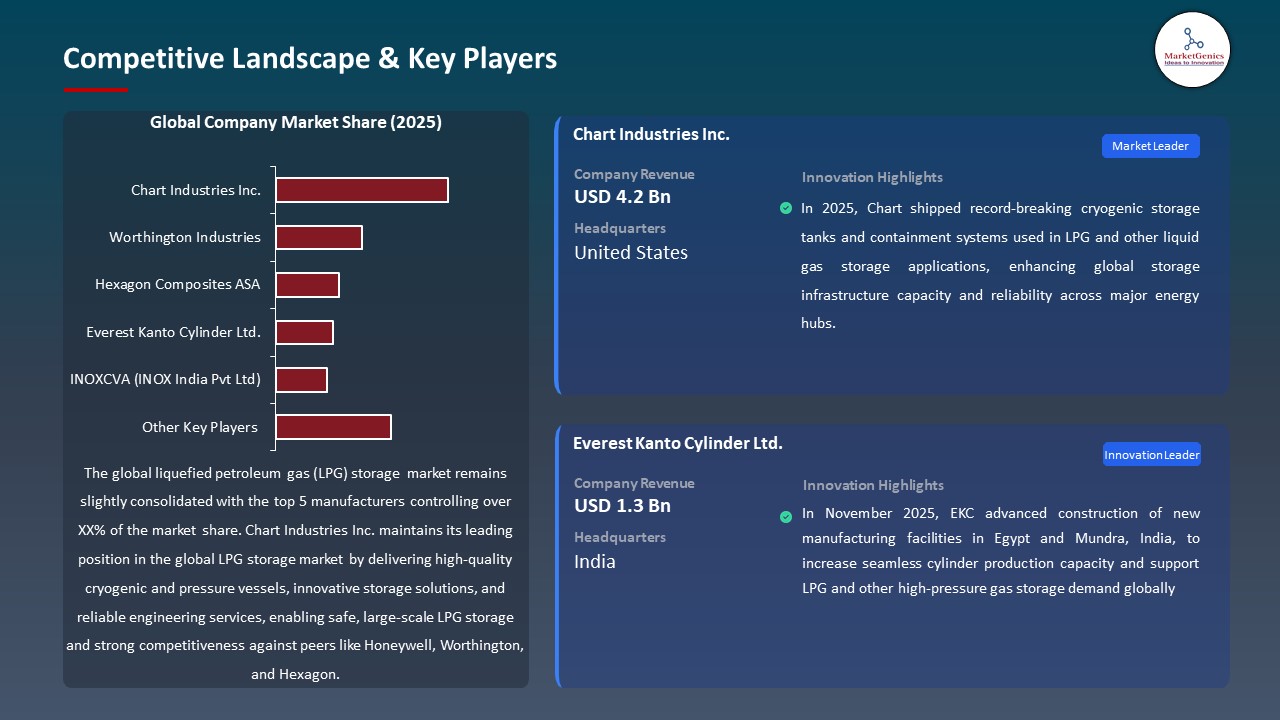
The global liquefied petroleum gas (LPG) storage market is slightly consolidated, with high concentration among key players such as Chart Industries Inc., Worthington Industries, Hexagon Composites ASA, Everest Kanto Cylinder Ltd., and INOXCVA (INOX India Pvt Ltd), who dominate through high strategic expansions, high usage of new technology, high distribution channels and long-term supply agreements that augment their market shares and efficiency in operations.
Competitive advantages are intensified, leading to technological innovation and high barriers to new entries, in the overall development and stability of the global LPG storage market by market consolidation between major players.
Recent Development and Strategic Overview:
- In October 2025, Ragasco announced a circular recycling initiative for composite LPG cylinder manufacturing waste to be reused in new product value chains, showing sustainable storage tech advancement.
- In May 2024, Hexagon Composites completed the sale of its Hexagon Ragasco LPG composite cylinder business to Worthington Enterprises, reshaping global LPG storage manufacturing portfolios.
Report Scope
|
Detail |
|
|
Market Size in 2025 |
USD 79.8 Bn |
|
Market Forecast Value in 2035 |
USD 98.2 Bn |
|
Growth Rate (CAGR) |
2.1% |
|
Forecast Period |
2026 – 2035 |
|
Historical Data Available for |
2021 – 2024 |
|
Market Size Units |
US$ Billion for Value Thousand Units for Volume |
|
Report Format |
Electronic (PDF) + Excel |
|
North America |
Europe |
Asia Pacific |
Middle East |
Africa |
South America |
|
|
|
|
|
|
|
Companies Covered |
|||||
|
|
|
|
|
|
Liquefied-Petroleum-Gas-Storage-Market Segmentation and Highlights
|
Segment |
Sub-segment |
|
Liquefied Petroleum Gas (LPG) Storage Market, By Storage Type |
|
|
Liquefied Petroleum Gas (LPG) Storage Market, By Storage Capacity |
|
|
Liquefied Petroleum Gas (LPG) Storage Market, By Material Type |
|
|
Liquefied Petroleum Gas (LPG) Storage Market, By Pressure Rating |
|
|
Liquefied Petroleum Gas (LPG) Storage Market, By Design Configuration
|
|
|
Liquefied Petroleum Gas (LPG) Storage Market, By Application Type
|
|
|
Liquefied Petroleum Gas (LPG) Storage Market, By Technology Type |
|
|
Liquefied Petroleum Gas (LPG) Storage Market, By Ownership Model |
|
|
Liquefied Petroleum Gas (LPG) Storage Market, By Installation Type |
|
|
Liquefied Petroleum Gas (LPG) Storage Market, By End-Use |
|
Frequently Asked Questions
Table of Contents
- 1. Research Methodology and Assumptions
- 1.1. Definitions
- 1.2. Research Design and Approach
- 1.3. Data Collection Methods
- 1.4. Base Estimates and Calculations
- 1.5. Forecasting Models
- 1.5.1. Key Forecast Factors & Impact Analysis
- 1.6. Secondary Research
- 1.6.1. Open Sources
- 1.6.2. Paid Databases
- 1.6.3. Associations
- 1.7. Primary Research
- 1.7.1. Primary Sources
- 1.7.2. Primary Interviews with Stakeholders across Ecosystem
- 2. Executive Summary
- 2.1. Global Liquefied Petroleum Gas (LPG) Storage Market Outlook
- 2.1.1. Liquefied Petroleum Gas (LPG) Storage Market Size (Volume – Thousand Units and Value – US$ Bn), and Forecasts, 2021-2035
- 2.1.2. Compounded Annual Growth Rate Analysis
- 2.1.3. Growth Opportunity Analysis
- 2.1.4. Segmental Share Analysis
- 2.1.5. Geographical Share Analysis
- 2.2. Market Analysis and Facts
- 2.3. Supply-Demand Analysis
- 2.4. Competitive Benchmarking
- 2.5. Go-to- Market Strategy
- 2.5.1. Customer/ End-use Industry Assessment
- 2.5.2. Growth Opportunity Data, 2026-2035
- 2.5.2.1. Regional Data
- 2.5.2.2. Country Data
- 2.5.2.3. Segmental Data
- 2.5.3. Identification of Potential Market Spaces
- 2.5.4. GAP Analysis
- 2.5.5. Potential Attractive Price Points
- 2.5.6. Prevailing Market Risks & Challenges
- 2.5.7. Preferred Sales & Marketing Strategies
- 2.5.8. Key Recommendations and Analysis
- 2.5.9. A Way Forward
- 2.1. Global Liquefied Petroleum Gas (LPG) Storage Market Outlook
- 3. Industry Data and Premium Insights
- 3.1. Global Energy & Power Industry Overview, 2025
- 3.1.1. Energy & Power Industry Ecosystem Analysis
- 3.1.2. Key Trends for Energy & Power Industry
- 3.1.3. Regional Distribution for Energy & Power Industry
- 3.2. Supplier Customer Data
- 3.3. Technology Roadmap and Developments
- 3.4. Trade Analysis
- 3.4.1. Import & Export Analysis, 2025
- 3.4.2. Top Importing Countries
- 3.4.3. Top Exporting Countries
- 3.5. Trump Tariff Impact Analysis
- 3.5.1. Manufacturer
- 3.5.1.1. Based on the component & Raw material
- 3.5.2. Supply Chain
- 3.5.3. End Consumer
- 3.5.1. Manufacturer
- 3.6. Raw Material Analysis
- 3.1. Global Energy & Power Industry Overview, 2025
- 4. Market Overview
- 4.1. Market Dynamics
- 4.1.1. Drivers
- 4.1.1.1. Rising residential & commercial demand for clean cooking/heating and auto gas adoption
- 4.1.1.2. Growth in petrochemical and industrial feedstock requirements increasing bulk LPG storage needs
- 4.1.1.3. Investments in distribution networks and strategic storage for energy security and seasonal supply balancing
- 4.1.2. Restraints
- 4.1.2.1. High capital expenditure and strict safety/environmental regulations for storage facilities
- 4.1.2.2. LPG price volatility and competition from natural gas, electrification, and renewable fuels
- 4.1.1. Drivers
- 4.2. Key Trend Analysis
- 4.3. Regulatory Framework
- 4.3.1. Key Regulations, Norms, and Subsidies, by Key Countries
- 4.3.2. Tariffs and Standards
- 4.3.3. Impact Analysis of Regulations on the Market
- 4.4. Value Chain Analysis
- 4.4.1. LPG production & recovery
- 4.4.2. Storage infrastructure manufacturing
- 4.4.3. Transportation & logistics
- 4.4.4. Distribution & wholesale marketers
- 4.4.5. End-use sectors
- 4.5. Cost Structure Analysis
- 4.5.1. Parameter’s Share for Cost Associated
- 4.5.2. COGP vs COGS
- 4.5.3. Profit Margin Analysis
- 4.6. Pricing Analysis
- 4.6.1. Regional Pricing Analysis
- 4.6.2. Segmental Pricing Trends
- 4.6.3. Factors Influencing Pricing
- 4.7. Porter’s Five Forces Analysis
- 4.8. PESTEL Analysis
- 4.9. Global Liquefied Petroleum Gas (LPG) Storage Market Demand
- 4.9.1. Historical Market Size – Volume (Thousand Units) and Value (US$ Bn), 2020-2024
- 4.9.2. Current and Future Market Size – Volume (Thousand Units) and Value (US$ Bn), 2026–2035
- 4.9.2.1. Y-o-Y Growth Trends
- 4.9.2.2. Absolute $ Opportunity Assessment
- 4.1. Market Dynamics
- 5. Competition Landscape
- 5.1. Competition structure
- 5.1.1. Fragmented v/s consolidated
- 5.2. Company Share Analysis, 2025
- 5.2.1. Global Company Market Share
- 5.2.2. By Region
- 5.2.2.1. North America
- 5.2.2.2. Europe
- 5.2.2.3. Asia Pacific
- 5.2.2.4. Middle East
- 5.2.2.5. Africa
- 5.2.2.6. South America
- 5.3. Product Comparison Matrix
- 5.3.1. Specifications
- 5.3.2. Market Positioning
- 5.3.3. Pricing
- 5.1. Competition structure
- 6. Global Liquefied Petroleum Gas (LPG) Storage Market Analysis, by Storage Type
- 6.1. Key Segment Analysis
- 6.2. Liquefied Petroleum Gas (LPG) Storage Market Size (Volume – Thousand Units and Value – US$ Bn), Analysis, and Forecasts, by Storage Type, 2021-2035
- 6.2.1. Above-ground Storage
- 6.2.1.1. Mounded bullets
- 6.2.1.2. Horizontal cylinders
- 6.2.1.3. Spherical tanks (Horton spheres)
- 6.2.1.4. Refrigerated storage tanks
- 6.2.1.5. Others
- 6.2.2. Underground Storage
- 6.2.2.1. Buried tanks
- 6.2.2.2. Rock caverns
- 6.2.2.3. Salt caverns
- 6.2.2.4. Aquifer storage
- 6.2.2.5. Others
- 6.2.3. Semi-buried Storage
- 6.2.1. Above-ground Storage
- 7. Global Liquefied Petroleum Gas (LPG) Storage Market Analysis, by Storage Capacity
- 7.1. Key Segment Analysis
- 7.2. Liquefied Petroleum Gas (LPG) Storage Market Size (Volume – Thousand Units and Value – US$ Bn), Analysis, and Forecasts, by Storage Capacity, 2021-2035
- 7.2.1. Less than 500 tons
- 7.2.2. 500-5,000 tons
- 7.2.3. 5,000-50,000 tons
- 7.2.4. Above 50,000 tons
- 8. Global Liquefied Petroleum Gas (LPG) Storage Market Analysis, by Material Type
- 8.1. Key Segment Analysis
- 8.2. Liquefied Petroleum Gas (LPG) Storage Market Size (Volume – Thousand Units and Value – US$ Bn), Analysis, and Forecasts, by Material Type, 2021-2035
- 8.2.1. Carbon Steel
- 8.2.1.1. Low-temperature carbon steel
- 8.2.1.2. Standard carbon steel
- 8.2.1.3. Others
- 8.2.2. Stainless Steel
- 8.2.2.1. Austenitic stainless steel
- 8.2.2.2. Duplex stainless steel
- 8.2.2.3. Others
- 8.2.3. Composite Materials
- 8.2.3.1. Fiber-reinforced plastic (FRP)
- 8.2.3.2. Composite-wrapped tanks
- 8.2.3.3. Others
- 8.2.4. Aluminum Alloys
- 8.2.1. Carbon Steel
- 9. Global Liquefied Petroleum Gas (LPG) Storage Market Analysis, by Pressure Rating
- 9.1. Key Segment Analysis
- 9.2. Liquefied Petroleum Gas (LPG) Storage Market Size (Volume – Thousand Units and Value – US$ Bn), Analysis, and Forecasts, by Pressure Rating, 2021-2035
- 9.2.1. Below 2 bar
- 9.2.2. 2-18 bar
- 9.2.3. Above 18 bar
- 10. Global Liquefied Petroleum Gas (LPG) Storage Market Analysis, by Design Configuration
- 10.1. Key Segment Analysis
- 10.2. Liquefied Petroleum Gas (LPG) Storage Market Size (Volume – Thousand Units and Value – US$ Bn), Analysis, and Forecasts, by Design Configuration, 2021-2035
- 10.2.1. Vertical Orientation
- 10.2.1.1. Vertical bullets
- 10.2.1.2. Vertical cylindrical tanks
- 10.2.1.3. Others
- 10.2.2. Horizontal Orientation
- 10.2.2.1. Horizontal bullets
- 10.2.2.2. Horizontal cylindrical tanks
- 10.2.2.3. Others
- 10.2.3. Spherical Configuration
- 10.2.4. Custom Designs
- 10.2.1. Vertical Orientation
- 11. Global Liquefied Petroleum Gas (LPG) Storage Market Analysis, by Application Type
- 11.1. Key Segment Analysis
- 11.2. Liquefied Petroleum Gas (LPG) Storage Market Size (Volume – Thousand Units and Value – US$ Bn), Analysis, and Forecasts, by Application Type, 2021-2035
- 11.2.1. Bulk Storage
- 11.2.1.1. Primary storage
- 11.2.1.2. Buffer storage
- 11.2.1.3. Others
- 11.2.2. Distribution & Retail
- 11.2.2.1. Bottling plants
- 11.2.2.2. Cylinder filling stations
- 11.2.2.3. Auto LPG dispensing
- 11.2.2.4. Others
- 11.2.3. Import/Export Terminals
- 11.2.3.1. Marine terminals
- 11.2.3.2. Pipeline terminals
- 11.2.3.3. Others
- 11.2.4. Peak Shaving Facilities
- 11.2.5. Strategic Reserves
- 11.2.1. Bulk Storage
- 12. Global Liquefied Petroleum Gas (LPG) Storage Market Analysis, by Technology Type
- 12.1. Key Segment Analysis
- 12.2. Liquefied Petroleum Gas (LPG) Storage Market Size (Volume – Thousand Units and Value – US$ Bn), Analysis, and Forecasts, by Technology Type, 2021-2035
- 12.2.1. Conventional Storage Systems
- 12.2.1.1. Automated Storage Systems
- 12.2.1.2. SCADA-integrated systems
- 12.2.1.3. IoT-enabled monitoring
- 12.2.1.4. Others
- 12.2.2. Smart Storage Solutions
- 12.2.2.1. Real-time monitoring
- 12.2.2.2. Predictive maintenance systems
- 12.2.2.3. Digital twin technology
- 12.2.2.4. Others
- 12.2.3. Safety-Enhanced Systems
- 12.2.4. Advanced leak detection
- 12.2.5. Fire suppression integration
- 12.2.6. Others
- 12.2.1. Conventional Storage Systems
- 13. Global Liquefied Petroleum Gas (LPG) Storage Market Analysis, by Ownership Model
- 13.1. Key Segment Analysis
- 13.2. Liquefied Petroleum Gas (LPG) Storage Market Size (Volume – Thousand Units and Value – US$ Bn), Analysis, and Forecasts, by Ownership Model, 2021-2035
- 13.2.1. Owned Storage
- 13.2.2. Leased Storage
- 13.2.3. Third-Party Logistics (3PL)
- 14. Global Liquefied Petroleum Gas (LPG) Storage Market Analysis, by Installation Type
- 14.1. Key Segment Analysis
- 14.2. Liquefied Petroleum Gas (LPG) Storage Market Size (Volume – Thousand Units and Value – US$ Bn), Analysis, and Forecasts, by Installation Type, 2021-2035
- 14.2.1. Fixed Installation
- 14.2.2. Modular/Portable Installation
- 14.2.3. Mobile Storage Units
- 14.2.4. Temporary Storage Facilities
- 15. Global Liquefied Petroleum Gas (LPG) Storage Market Analysis, by End-Use
- 15.1. Key Segment Analysis
- 15.2. Liquefied Petroleum Gas (LPG) Storage Market Size (Volume – Thousand Units and Value – US$ Bn), Analysis, and Forecasts, by End-Use, 2021-2035
- 15.2.1. Residential Sector
- 15.2.1.1. Cooking Applications
- 15.2.1.2. Space Heating
- 15.2.1.3. Water Heating
- 15.2.1.4. Backup Power Generation
- 15.2.1.5. Off-grid Applications
- 15.2.1.6. Others
- 15.2.2. Commercial Sector
- 15.2.2.1. Hospitality & Restaurants
- 15.2.2.2. Hotels & Resorts
- 15.2.2.3. Shopping Malls & Retail
- 15.2.2.4. Office Buildings
- 15.2.2.5. Institutional Buildings
- 15.2.2.6. Others
- 15.2.3. Industrial Sector
- 15.2.3.1. Chemical Manufacturing
- 15.2.3.2. Petrochemical Processing
- 15.2.3.3. Metal Processing & Fabrication
- 15.2.3.4. Food & Beverage Processing
- 15.2.3.5. Pharmaceutical Manufacturing
- 15.2.3.6. Glass & Ceramics Production
- 15.2.3.7. Automotive Manufacturing
- 15.2.3.8. Others
- 15.2.4. Agricultural Sector
- 15.2.4.1. Crop Drying
- 15.2.4.2. Greenhouse Heating
- 15.2.4.3. Irrigation Systems
- 15.2.4.4. Poultry & Livestock Farming
- 15.2.4.5. Pest Control Applications
- 15.2.4.6. Others
- 15.2.5. Transportation Sector
- 15.2.5.1. Autogas (Vehicle Fuel)
- 15.2.5.2. Marine Transportation
- 15.2.5.3. Railway Applications
- 15.2.5.4. Forklift Operations
- 15.2.5.5. Fleet Management
- 15.2.5.6. Others
- 15.2.6. Power Generation
- 15.2.6.1. Distributed Generation
- 15.2.6.2. Peak Load Management
- 15.2.6.3. Emergency Backup Power
- 15.2.6.4. Off-grid Power Systems
- 15.2.6.5. Co-generation Plants
- 15.2.6.6. Others
- 15.2.7. Refining & Petrochemical
- 15.2.7.1. Refinery Operations
- 15.2.7.2. Petrochemical Feedstock
- 15.2.7.3. Processing & Blending
- 15.2.7.4. Terminal Operations
- 15.2.7.5. Others
- 15.2.8. Cylinder Filling & Distribution
- 15.2.8.1. Filling Stations
- 15.2.8.2. Distribution Centers
- 15.2.8.3. Retail Outlets
- 15.2.8.4. Bottling Plants
- 15.2.8.5. Others
- 15.2.1. Residential Sector
- 16. Global Liquefied Petroleum Gas (LPG) Storage Market Analysis and Forecasts, by Region
- 16.1. Key Findings
- 16.2. Liquefied Petroleum Gas (LPG) Storage Market Size (Volume – Thousand Units and Value – US$ Bn), Analysis, and Forecasts, by Region, 2021-2035
- 16.2.1. North America
- 16.2.2. Europe
- 16.2.3. Asia Pacific
- 16.2.4. Middle East
- 16.2.5. Africa
- 16.2.6. South America
- 17. North America Liquefied Petroleum Gas (LPG) Storage Market Analysis
- 17.1. Key Segment Analysis
- 17.2. Regional Snapshot
- 17.3. North America Liquefied Petroleum Gas (LPG) Storage Market Size (Volume – Thousand Units and Value – US$ Bn), Analysis, and Forecasts, 2021-2035
- 17.3.1. Storage Type
- 17.3.2. Storage Capacity
- 17.3.3. Material Type
- 17.3.4. Pressure Rating
- 17.3.5. Design Configuration
- 17.3.6. Application Type
- 17.3.7. Technology Type
- 17.3.8. Ownership Model
- 17.3.9. Installation Type
- 17.3.10. End-Use
- 17.3.11. Country
- 17.3.11.1. USA
- 17.3.11.2. Canada
- 17.3.11.3. Mexico
- 17.4. USA Liquefied Petroleum Gas (LPG) Storage Market
- 17.4.1. Country Segmental Analysis
- 17.4.2. Storage Type
- 17.4.3. Storage Capacity
- 17.4.4. Material Type
- 17.4.5. Pressure Rating
- 17.4.6. Design Configuration
- 17.4.7. Application Type
- 17.4.8. Technology Type
- 17.4.9. Ownership Model
- 17.4.10. Installation Type
- 17.4.11. End-Use
- 17.5. Canada Liquefied Petroleum Gas (LPG) Storage Market
- 17.5.1. Country Segmental Analysis
- 17.5.2. Storage Type
- 17.5.3. Storage Capacity
- 17.5.4. Material Type
- 17.5.5. Pressure Rating
- 17.5.6. Design Configuration
- 17.5.7. Application Type
- 17.5.8. Technology Type
- 17.5.9. Ownership Model
- 17.5.10. Installation Type
- 17.5.11. End-Use
- 17.6. Mexico Liquefied Petroleum Gas (LPG) Storage Market
- 17.6.1. Country Segmental Analysis
- 17.6.2. Storage Type
- 17.6.3. Storage Capacity
- 17.6.4. Material Type
- 17.6.5. Pressure Rating
- 17.6.6. Design Configuration
- 17.6.7. Application Type
- 17.6.8. Technology Type
- 17.6.9. Ownership Model
- 17.6.10. Installation Type
- 17.6.11. End-Use
- 18. Europe Liquefied Petroleum Gas (LPG) Storage Market Analysis
- 18.1. Key Segment Analysis
- 18.2. Regional Snapshot
- 18.3. Europe Liquefied Petroleum Gas (LPG) Storage Market Size (Volume – Thousand Units and Value – US$ Bn), Analysis, and Forecasts, 2021-2035
- 18.3.1. Storage Type
- 18.3.2. Storage Capacity
- 18.3.3. Material Type
- 18.3.4. Pressure Rating
- 18.3.5. Design Configuration
- 18.3.6. Application Type
- 18.3.7. Technology Type
- 18.3.8. Ownership Model
- 18.3.9. Installation Type
- 18.3.10. End-Use
- 18.3.11. Country
- 18.3.11.1. Germany
- 18.3.11.2. United Kingdom
- 18.3.11.3. France
- 18.3.11.4. Italy
- 18.3.11.5. Spain
- 18.3.11.6. Netherlands
- 18.3.11.7. Nordic Countries
- 18.3.11.8. Poland
- 18.3.11.9. Russia & CIS
- 18.3.11.10. Rest of Europe
- 18.4. Germany Liquefied Petroleum Gas (LPG) Storage Market
- 18.4.1. Country Segmental Analysis
- 18.4.2. Storage Type
- 18.4.3. Storage Capacity
- 18.4.4. Material Type
- 18.4.5. Pressure Rating
- 18.4.6. Design Configuration
- 18.4.7. Application Type
- 18.4.8. Technology Type
- 18.4.9. Ownership Model
- 18.4.10. Installation Type
- 18.4.11. End-Use
- 18.5. United Kingdom Liquefied Petroleum Gas (LPG) Storage Market
- 18.5.1. Country Segmental Analysis
- 18.5.2. Storage Type
- 18.5.3. Storage Capacity
- 18.5.4. Material Type
- 18.5.5. Pressure Rating
- 18.5.6. Design Configuration
- 18.5.7. Application Type
- 18.5.8. Technology Type
- 18.5.9. Ownership Model
- 18.5.10. Installation Type
- 18.5.11. End-Use
- 18.6. France Liquefied Petroleum Gas (LPG) Storage Market
- 18.6.1. Country Segmental Analysis
- 18.6.2. Storage Type
- 18.6.3. Storage Capacity
- 18.6.4. Material Type
- 18.6.5. Pressure Rating
- 18.6.6. Design Configuration
- 18.6.7. Application Type
- 18.6.8. Technology Type
- 18.6.9. Ownership Model
- 18.6.10. Installation Type
- 18.6.11. End-Use
- 18.7. Italy Liquefied Petroleum Gas (LPG) Storage Market
- 18.7.1. Country Segmental Analysis
- 18.7.2. Storage Type
- 18.7.3. Storage Capacity
- 18.7.4. Material Type
- 18.7.5. Pressure Rating
- 18.7.6. Design Configuration
- 18.7.7. Application Type
- 18.7.8. Technology Type
- 18.7.9. Ownership Model
- 18.7.10. Installation Type
- 18.7.11. End-Use
- 18.8. Spain Liquefied Petroleum Gas (LPG) Storage Market
- 18.8.1. Country Segmental Analysis
- 18.8.2. Storage Type
- 18.8.3. Storage Capacity
- 18.8.4. Material Type
- 18.8.5. Pressure Rating
- 18.8.6. Design Configuration
- 18.8.7. Application Type
- 18.8.8. Technology Type
- 18.8.9. Ownership Model
- 18.8.10. Installation Type
- 18.8.11. End-Use
- 18.9. Netherlands Liquefied Petroleum Gas (LPG) Storage Market
- 18.9.1. Country Segmental Analysis
- 18.9.2. Storage Type
- 18.9.3. Storage Capacity
- 18.9.4. Material Type
- 18.9.5. Pressure Rating
- 18.9.6. Design Configuration
- 18.9.7. Application Type
- 18.9.8. Technology Type
- 18.9.9. Ownership Model
- 18.9.10. Installation Type
- 18.9.11. End-Use
- 18.10. Nordic Countries Liquefied Petroleum Gas (LPG) Storage Market
- 18.10.1. Country Segmental Analysis
- 18.10.2. Storage Type
- 18.10.3. Storage Capacity
- 18.10.4. Material Type
- 18.10.5. Pressure Rating
- 18.10.6. Design Configuration
- 18.10.7. Application Type
- 18.10.8. Technology Type
- 18.10.9. Ownership Model
- 18.10.10. Installation Type
- 18.10.11. End-Use
- 18.11. Poland Liquefied Petroleum Gas (LPG) Storage Market
- 18.11.1. Country Segmental Analysis
- 18.11.2. Storage Type
- 18.11.3. Storage Capacity
- 18.11.4. Material Type
- 18.11.5. Pressure Rating
- 18.11.6. Design Configuration
- 18.11.7. Application Type
- 18.11.8. Technology Type
- 18.11.9. Ownership Model
- 18.11.10. Installation Type
- 18.11.11. End-Use
- 18.12. Russia & CIS Liquefied Petroleum Gas (LPG) Storage Market
- 18.12.1. Country Segmental Analysis
- 18.12.2. Storage Type
- 18.12.3. Storage Capacity
- 18.12.4. Material Type
- 18.12.5. Pressure Rating
- 18.12.6. Design Configuration
- 18.12.7. Application Type
- 18.12.8. Technology Type
- 18.12.9. Ownership Model
- 18.12.10. Installation Type
- 18.12.11. End-Use
- 18.13. Rest of Europe Liquefied Petroleum Gas (LPG) Storage Market
- 18.13.1. Country Segmental Analysis
- 18.13.2. Storage Type
- 18.13.3. Storage Capacity
- 18.13.4. Material Type
- 18.13.5. Pressure Rating
- 18.13.6. Design Configuration
- 18.13.7. Application Type
- 18.13.8. Technology Type
- 18.13.9. Ownership Model
- 18.13.10. Installation Type
- 18.13.11. End-Use
- 19. Asia Pacific Liquefied Petroleum Gas (LPG) Storage Market Analysis
- 19.1. Key Segment Analysis
- 19.2. Regional Snapshot
- 19.3. Asia Pacific Liquefied Petroleum Gas (LPG) Storage Market Size (Volume – Thousand Units and Value – US$ Bn), Analysis, and Forecasts, 2021-2035
- 19.3.1. Storage Type
- 19.3.2. Storage Capacity
- 19.3.3. Material Type
- 19.3.4. Pressure Rating
- 19.3.5. Design Configuration
- 19.3.6. Application Type
- 19.3.7. Technology Type
- 19.3.8. Ownership Model
- 19.3.9. Installation Type
- 19.3.10. End-Use
- 19.3.11. Country
- 19.3.11.1. China
- 19.3.11.2. India
- 19.3.11.3. Japan
- 19.3.11.4. South Korea
- 19.3.11.5. Australia and New Zealand
- 19.3.11.6. Indonesia
- 19.3.11.7. Malaysia
- 19.3.11.8. Thailand
- 19.3.11.9. Vietnam
- 19.3.11.10. Rest of Asia Pacific
- 19.4. China Liquefied Petroleum Gas (LPG) Storage Market
- 19.4.1. Country Segmental Analysis
- 19.4.2. Storage Type
- 19.4.3. Storage Capacity
- 19.4.4. Material Type
- 19.4.5. Pressure Rating
- 19.4.6. Design Configuration
- 19.4.7. Application Type
- 19.4.8. Technology Type
- 19.4.9. Ownership Model
- 19.4.10. Installation Type
- 19.4.11. End-Use
- 19.5. India Liquefied Petroleum Gas (LPG) Storage Market
- 19.5.1. Country Segmental Analysis
- 19.5.2. Storage Type
- 19.5.3. Storage Capacity
- 19.5.4. Material Type
- 19.5.5. Pressure Rating
- 19.5.6. Design Configuration
- 19.5.7. Application Type
- 19.5.8. Technology Type
- 19.5.9. Ownership Model
- 19.5.10. Installation Type
- 19.5.11. End-Use
- 19.6. Japan Liquefied Petroleum Gas (LPG) Storage Market
- 19.6.1. Country Segmental Analysis
- 19.6.2. Storage Type
- 19.6.3. Storage Capacity
- 19.6.4. Material Type
- 19.6.5. Pressure Rating
- 19.6.6. Design Configuration
- 19.6.7. Application Type
- 19.6.8. Technology Type
- 19.6.9. Ownership Model
- 19.6.10. Installation Type
- 19.6.11. End-Use
- 19.7. South Korea Liquefied Petroleum Gas (LPG) Storage Market
- 19.7.1. Country Segmental Analysis
- 19.7.2. Storage Type
- 19.7.3. Storage Capacity
- 19.7.4. Material Type
- 19.7.5. Pressure Rating
- 19.7.6. Design Configuration
- 19.7.7. Application Type
- 19.7.8. Technology Type
- 19.7.9. Ownership Model
- 19.7.10. Installation Type
- 19.7.11. End-Use
- 19.8. Australia and New Zealand Liquefied Petroleum Gas (LPG) Storage Market
- 19.8.1. Country Segmental Analysis
- 19.8.2. Storage Type
- 19.8.3. Storage Capacity
- 19.8.4. Material Type
- 19.8.5. Pressure Rating
- 19.8.6. Design Configuration
- 19.8.7. Application Type
- 19.8.8. Technology Type
- 19.8.9. Ownership Model
- 19.8.10. Installation Type
- 19.8.11. End-Use
- 19.9. Indonesia Liquefied Petroleum Gas (LPG) Storage Market
- 19.9.1. Country Segmental Analysis
- 19.9.2. Storage Type
- 19.9.3. Storage Capacity
- 19.9.4. Material Type
- 19.9.5. Pressure Rating
- 19.9.6. Design Configuration
- 19.9.7. Application Type
- 19.9.8. Technology Type
- 19.9.9. Ownership Model
- 19.9.10. Installation Type
- 19.9.11. End-Use
- 19.10. Malaysia Liquefied Petroleum Gas (LPG) Storage Market
- 19.10.1. Country Segmental Analysis
- 19.10.2. Storage Type
- 19.10.3. Storage Capacity
- 19.10.4. Material Type
- 19.10.5. Pressure Rating
- 19.10.6. Design Configuration
- 19.10.7. Application Type
- 19.10.8. Technology Type
- 19.10.9. Ownership Model
- 19.10.10. Installation Type
- 19.10.11. End-Use
- 19.11. Thailand Liquefied Petroleum Gas (LPG) Storage Market
- 19.11.1. Country Segmental Analysis
- 19.11.2. Storage Type
- 19.11.3. Storage Capacity
- 19.11.4. Material Type
- 19.11.5. Pressure Rating
- 19.11.6. Design Configuration
- 19.11.7. Application Type
- 19.11.8. Technology Type
- 19.11.9. Ownership Model
- 19.11.10. Installation Type
- 19.11.11. End-Use
- 19.12. Vietnam Liquefied Petroleum Gas (LPG) Storage Market
- 19.12.1. Country Segmental Analysis
- 19.12.2. Storage Type
- 19.12.3. Storage Capacity
- 19.12.4. Material Type
- 19.12.5. Pressure Rating
- 19.12.6. Design Configuration
- 19.12.7. Application Type
- 19.12.8. Technology Type
- 19.12.9. Ownership Model
- 19.12.10. Installation Type
- 19.12.11. End-Use
- 19.13. Rest of Asia Pacific Liquefied Petroleum Gas (LPG) Storage Market
- 19.13.1. Country Segmental Analysis
- 19.13.2. Storage Type
- 19.13.3. Storage Capacity
- 19.13.4. Material Type
- 19.13.5. Pressure Rating
- 19.13.6. Design Configuration
- 19.13.7. Application Type
- 19.13.8. Technology Type
- 19.13.9. Ownership Model
- 19.13.10. Installation Type
- 19.13.11. End-Use
- 20. Middle East Liquefied Petroleum Gas (LPG) Storage Market Analysis
- 20.1. Key Segment Analysis
- 20.2. Regional Snapshot
- 20.3. Middle East Liquefied Petroleum Gas (LPG) Storage Market Size (Volume – Thousand Units and Value – US$ Bn), Analysis, and Forecasts, 2021-2035
- 20.3.1. Storage Type
- 20.3.2. Storage Capacity
- 20.3.3. Material Type
- 20.3.4. Pressure Rating
- 20.3.5. Design Configuration
- 20.3.6. Application Type
- 20.3.7. Technology Type
- 20.3.8. Ownership Model
- 20.3.9. Installation Type
- 20.3.10. End-Use
- 20.3.11. Country
- 20.3.11.1. Turkey
- 20.3.11.2. UAE
- 20.3.11.3. Saudi Arabia
- 20.3.11.4. Israel
- 20.3.11.5. Rest of Middle East
- 20.4. Turkey Liquefied Petroleum Gas (LPG) Storage Market
- 20.4.1. Country Segmental Analysis
- 20.4.2. Storage Type
- 20.4.3. Storage Capacity
- 20.4.4. Material Type
- 20.4.5. Pressure Rating
- 20.4.6. Design Configuration
- 20.4.7. Application Type
- 20.4.8. Technology Type
- 20.4.9. Ownership Model
- 20.4.10. Installation Type
- 20.4.11. End-Use
- 20.5. UAE Liquefied Petroleum Gas (LPG) Storage Market
- 20.5.1. Country Segmental Analysis
- 20.5.2. Storage Type
- 20.5.3. Storage Capacity
- 20.5.4. Material Type
- 20.5.5. Pressure Rating
- 20.5.6. Design Configuration
- 20.5.7. Application Type
- 20.5.8. Technology Type
- 20.5.9. Ownership Model
- 20.5.10. Installation Type
- 20.5.11. End-Use
- 20.6. Saudi Arabia Liquefied Petroleum Gas (LPG) Storage Market
- 20.6.1. Country Segmental Analysis
- 20.6.2. Storage Type
- 20.6.3. Storage Capacity
- 20.6.4. Material Type
- 20.6.5. Pressure Rating
- 20.6.6. Design Configuration
- 20.6.7. Application Type
- 20.6.8. Technology Type
- 20.6.9. Ownership Model
- 20.6.10. Installation Type
- 20.6.11. End-Use
- 20.7. Israel Liquefied Petroleum Gas (LPG) Storage Market
- 20.7.1. Country Segmental Analysis
- 20.7.2. Storage Type
- 20.7.3. Storage Capacity
- 20.7.4. Material Type
- 20.7.5. Pressure Rating
- 20.7.6. Design Configuration
- 20.7.7. Application Type
- 20.7.8. Technology Type
- 20.7.9. Ownership Model
- 20.7.10. Installation Type
- 20.7.11. End-Use
- 20.8. Rest of Middle East Liquefied Petroleum Gas (LPG) Storage Market
- 20.8.1. Country Segmental Analysis
- 20.8.2. Storage Type
- 20.8.3. Storage Capacity
- 20.8.4. Material Type
- 20.8.5. Pressure Rating
- 20.8.6. Design Configuration
- 20.8.7. Application Type
- 20.8.8. Technology Type
- 20.8.9. Ownership Model
- 20.8.10. Installation Type
- 20.8.11. End-Use
- 21. Africa Liquefied Petroleum Gas (LPG) Storage Market Analysis
- 21.1. Key Segment Analysis
- 21.2. Regional Snapshot
- 21.3. Africa Liquefied Petroleum Gas (LPG) Storage Market Size (Volume – Thousand Units and Value – US$ Bn), Analysis, and Forecasts, 2021-2035
- 21.3.1. Storage Type
- 21.3.2. Storage Capacity
- 21.3.3. Material Type
- 21.3.4. Pressure Rating
- 21.3.5. Design Configuration
- 21.3.6. Application Type
- 21.3.7. Technology Type
- 21.3.8. Ownership Model
- 21.3.9. Installation Type
- 21.3.10. End-Use
- 21.3.11. Country
- 21.3.11.1. South Africa
- 21.3.11.2. Egypt
- 21.3.11.3. Nigeria
- 21.3.11.4. Algeria
- 21.3.11.5. Rest of Africa
- 21.4. South Africa Liquefied Petroleum Gas (LPG) Storage Market
- 21.4.1. Country Segmental Analysis
- 21.4.2. Storage Type
- 21.4.3. Storage Capacity
- 21.4.4. Material Type
- 21.4.5. Pressure Rating
- 21.4.6. Design Configuration
- 21.4.7. Application Type
- 21.4.8. Technology Type
- 21.4.9. Ownership Model
- 21.4.10. Installation Type
- 21.4.11. End-Use
- 21.5. Egypt Liquefied Petroleum Gas (LPG) Storage Market
- 21.5.1. Country Segmental Analysis
- 21.5.2. Storage Type
- 21.5.3. Storage Capacity
- 21.5.4. Material Type
- 21.5.5. Pressure Rating
- 21.5.6. Design Configuration
- 21.5.7. Application Type
- 21.5.8. Technology Type
- 21.5.9. Ownership Model
- 21.5.10. Installation Type
- 21.5.11. End-Use
- 21.6. Nigeria Liquefied Petroleum Gas (LPG) Storage Market
- 21.6.1. Country Segmental Analysis
- 21.6.2. Storage Type
- 21.6.3. Storage Capacity
- 21.6.4. Material Type
- 21.6.5. Pressure Rating
- 21.6.6. Design Configuration
- 21.6.7. Application Type
- 21.6.8. Technology Type
- 21.6.9. Ownership Model
- 21.6.10. Installation Type
- 21.6.11. End-Use
- 21.7. Algeria Liquefied Petroleum Gas (LPG) Storage Market
- 21.7.1. Country Segmental Analysis
- 21.7.2. Storage Type
- 21.7.3. Storage Capacity
- 21.7.4. Material Type
- 21.7.5. Pressure Rating
- 21.7.6. Design Configuration
- 21.7.7. Application Type
- 21.7.8. Technology Type
- 21.7.9. Ownership Model
- 21.7.10. Installation Type
- 21.7.11. End-Use
- 21.8. Rest of Africa Liquefied Petroleum Gas (LPG) Storage Market
- 21.8.1. Country Segmental Analysis
- 21.8.2. Storage Type
- 21.8.3. Storage Capacity
- 21.8.4. Material Type
- 21.8.5. Pressure Rating
- 21.8.6. Design Configuration
- 21.8.7. Application Type
- 21.8.8. Technology Type
- 21.8.9. Ownership Model
- 21.8.10. Installation Type
- 21.8.11. End-Use
- 22. South America Liquefied Petroleum Gas (LPG) Storage Market Analysis
- 22.1. Key Segment Analysis
- 22.2. Regional Snapshot
- 22.3. South America Liquefied Petroleum Gas (LPG) Storage Market Size (Volume – Thousand Units and Value – US$ Bn), Analysis, and Forecasts, 2021-2035
- 22.3.1. Rated Power/Capacity
- 22.3.2. Storage Type
- 22.3.3. Storage Capacity
- 22.3.4. Material Type
- 22.3.5. Pressure Rating
- 22.3.6. Design Configuration
- 22.3.7. Application Type
- 22.3.8. Technology Type
- 22.3.9. Ownership Model
- 22.3.10. Installation Type
- 22.3.11. End-Use
- 22.3.12. Country
- 22.3.12.1. Brazil
- 22.3.12.2. Argentina
- 22.3.12.3. Rest of South America
- 22.4. Brazil Liquefied Petroleum Gas (LPG) Storage Market
- 22.4.1. Country Segmental Analysis
- 22.4.2. Storage Type
- 22.4.3. Storage Capacity
- 22.4.4. Material Type
- 22.4.5. Pressure Rating
- 22.4.6. Design Configuration
- 22.4.7. Application Type
- 22.4.8. Technology Type
- 22.4.9. Ownership Model
- 22.4.10. Installation Type
- 22.4.11. End-Use
- 22.5. Argentina Liquefied Petroleum Gas (LPG) Storage Market
- 22.5.1. Country Segmental Analysis
- 22.5.2. Storage Type
- 22.5.3. Storage Capacity
- 22.5.4. Material Type
- 22.5.5. Pressure Rating
- 22.5.6. Design Configuration
- 22.5.7. Application Type
- 22.5.8. Technology Type
- 22.5.9. Ownership Model
- 22.5.10. Installation Type
- 22.5.11. End-Use
- 22.6. Rest of South America Liquefied Petroleum Gas (LPG) Storage Market
- 22.6.1. Country Segmental Analysis
- 22.6.2. Storage Type
- 22.6.3. Storage Capacity
- 22.6.4. Material Type
- 22.6.5. Pressure Rating
- 22.6.6. Design Configuration
- 22.6.7. Application Type
- 22.6.8. Technology Type
- 22.6.9. Ownership Model
- 22.6.10. Installation Type
- 22.6.11. End-Use
- 23. Key Players/ Company Profile
- 23.1. Beijing Tianhai Industry Co. Ltd.
- 23.1.1. Company Details/ Overview
- 23.1.2. Company Financials
- 23.1.3. Key Customers and Competitors
- 23.1.4. Business/ Industry Portfolio
- 23.1.5. Product Portfolio/ Specification Details
- 23.1.6. Pricing Data
- 23.1.7. Strategic Overview
- 23.1.8. Recent Developments
- 23.2. Blasch Precision Ceramics
- 23.3. Chart Industries Inc.
- 23.4. Cryolor
- 23.5. Everest Kanto Cylinder Ltd.
- 23.6. Faber Industrie SpA
- 23.7. Gaz Liquid Industrie (GLI)
- 23.8. Hebei Baota Petrochemical Group
- 23.9. Hexagon Composites ASA
- 23.10. INOXCVA (INOX India Pvt Ltd)
- 23.11. Luxfer Holdings PLC
- 23.12. Mauria Udyog Limited
- 23.13. Metal Mate Co. Ltd.
- 23.14. NPROXX
- 23.15. Praxair Technology Inc.
- 23.16. Quantum Fuel Systems
- 23.17. Shandong Auyan New Energy Technology
- 23.18. Sinoma Science & Technology
- 23.19. Supreme Industries Limited
- 23.20. VRV SpA
- 23.21. Worthington Industries
- 23.22. Other Key Players
- 23.1. Beijing Tianhai Industry Co. Ltd.
Note* - This is just tentative list of players. While providing the report, we will cover more number of players based on their revenue and share for each geography
Research Design
Our research design integrates both demand-side and supply-side analysis through a balanced combination of primary and secondary research methodologies. By utilizing both bottom-up and top-down approaches alongside rigorous data triangulation methods, we deliver robust market intelligence that supports strategic decision-making.
MarketGenics' comprehensive research design framework ensures the delivery of accurate, reliable, and actionable market intelligence. Through the integration of multiple research approaches, rigorous validation processes, and expert analysis, we provide our clients with the insights needed to make informed strategic decisions and capitalize on market opportunities.

MarketGenics leverages a dedicated industry panel of experts and a comprehensive suite of paid databases to effectively collect, consolidate, and analyze market intelligence.
Our approach has consistently proven to be reliable and effective in generating accurate market insights, identifying key industry trends, and uncovering emerging business opportunities.
Through both primary and secondary research, we capture and analyze critical company-level data such as manufacturing footprints, including technical centers, R&D facilities, sales offices, and headquarters.
Our expert panel further enhances our ability to estimate market size for specific brands based on validated field-level intelligence.
Our data mining techniques incorporate both parametric and non-parametric methods, allowing for structured data collection, sorting, processing, and cleaning.
Demand projections are derived from large-scale data sets analyzed through proprietary algorithms, culminating in robust and reliable market sizing.
Research Approach
The bottom-up approach builds market estimates by starting with the smallest addressable market units and systematically aggregating them to create comprehensive market size projections.
This method begins with specific, granular data points and builds upward to create the complete market landscape.
Customer Analysis → Segmental Analysis → Geographical Analysis
The top-down approach starts with the broadest possible market data and systematically narrows it down through a series of filters and assumptions to arrive at specific market segments or opportunities.
This method begins with the big picture and works downward to increasingly specific market slices.
TAM → SAM → SOM


Research Methods
Desk / Secondary Research
While analysing the market, we extensively study secondary sources, directories, and databases to identify and collect information useful for this technical, market-oriented, and commercial report. Secondary sources that we utilize are not only the public sources, but it is a combination of Open Source, Associations, Paid Databases, MG Repository & Knowledgebase, and others.
- Company websites, annual reports, financial reports, broker reports, and investor presentations
- National government documents, statistical databases and reports
- News articles, press releases and web-casts specific to the companies operating in the market, Magazines, reports, and others
- We gather information from commercial data sources for deriving company specific data such as segmental revenue, share for geography, product revenue, and others
- Internal and external proprietary databases (industry-specific), relevant patent, and regulatory databases
- Governing Bodies, Government Organizations
- Relevant Authorities, Country-specific Associations for Industries
We also employ the model mapping approach to estimate the product level market data through the players' product portfolio
Primary Research
Primary research/ interviews is vital in analyzing the market. Most of the cases involves paid primary interviews. Primary sources include primary interviews through e-mail interactions, telephonic interviews, surveys as well as face-to-face interviews with the different stakeholders across the value chain including several industry experts.
| Type of Respondents | Number of Primaries |
|---|---|
| Tier 2/3 Suppliers | ~20 |
| Tier 1 Suppliers | ~25 |
| End-users | ~25 |
| Industry Expert/ Panel/ Consultant | ~30 |
| Total | ~100 |
MG Knowledgebase
• Repository of industry blog, newsletter and case studies
• Online platform covering detailed market reports, and company profiles
Forecasting Factors and Models
Forecasting Factors
- Historical Trends – Past market patterns, cycles, and major events that shaped how markets behave over time. Understanding past trends helps predict future behavior.
- Industry Factors – Specific characteristics of the industry like structure, regulations, and innovation cycles that affect market dynamics.
- Macroeconomic Factors – Economic conditions like GDP growth, inflation, and employment rates that affect how much money people have to spend.
- Demographic Factors – Population characteristics like age, income, and location that determine who can buy your product.
- Technology Factors – How quickly people adopt new technology and how much technology infrastructure exists.
- Regulatory Factors – Government rules, laws, and policies that can help or restrict market growth.
- Competitive Factors – Analyzing competition structure such as degree of competition and bargaining power of buyers and suppliers.
Forecasting Models / Techniques
Multiple Regression Analysis
- Identify and quantify factors that drive market changes
- Statistical modeling to establish relationships between market drivers and outcomes
Time Series Analysis – Seasonal Patterns
- Understand regular cyclical patterns in market demand
- Advanced statistical techniques to separate trend, seasonal, and irregular components
Time Series Analysis – Trend Analysis
- Identify underlying market growth patterns and momentum
- Statistical analysis of historical data to project future trends
Expert Opinion – Expert Interviews
- Gather deep industry insights and contextual understanding
- In-depth interviews with key industry stakeholders
Multi-Scenario Development
- Prepare for uncertainty by modeling different possible futures
- Creating optimistic, pessimistic, and most likely scenarios
Time Series Analysis – Moving Averages
- Sophisticated forecasting for complex time series data
- Auto-regressive integrated moving average models with seasonal components
Econometric Models
- Apply economic theory to market forecasting
- Sophisticated economic models that account for market interactions
Expert Opinion – Delphi Method
- Harness collective wisdom of industry experts
- Structured, multi-round expert consultation process
Monte Carlo Simulation
- Quantify uncertainty and probability distributions
- Thousands of simulations with varying input parameters
Research Analysis
Our research framework is built upon the fundamental principle of validating market intelligence from both demand and supply perspectives. This dual-sided approach ensures comprehensive market understanding and reduces the risk of single-source bias.
Demand-Side Analysis: We understand end-user/application behavior, preferences, and market needs along with the penetration of the product for specific application.
Supply-Side Analysis: We estimate overall market revenue, analyze the segmental share along with industry capacity, competitive landscape, and market structure.
Validation & Evaluation
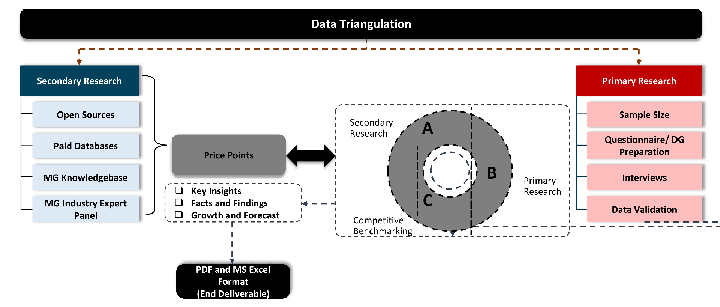
Data triangulation is a validation technique that uses multiple methods, sources, or perspectives to examine the same research question, thereby increasing the credibility and reliability of research findings. In market research, triangulation serves as a quality assurance mechanism that helps identify and minimize bias, validate assumptions, and ensure accuracy in market estimates.
- Data Source Triangulation – Using multiple data sources to examine the same phenomenon
- Methodological Triangulation – Using multiple research methods to study the same research question
- Investigator Triangulation – Using multiple researchers or analysts to examine the same data
- Theoretical Triangulation – Using multiple theoretical perspectives to interpret the same data
Custom Market Research Services
We will customise the research for you, in case the report listed above does not meet your requirements.
Get 10% Free Customisation