Livestock Monitoring Robot Market Size, Share & Trends Analysis Report by Product Type (Automated Milking Robots, Feeding Robots, Cleaning & Waste Management Robots, Health Monitoring Robots, Herding & Guidance Robots, Multi-functional Livestock Robots), Technology, Rated Power, Rated Capacity, Livestock Type, Monitoring Parameters, Mobility Type, Power Source, Operation Mode, Connectivity, End-users, Deployment Type, and Geography (North America, Europe, Asia Pacific, Middle East, Africa, and South America) – Global Industry Data, Trends, and Forecasts, 2026–2035
Market Overview:
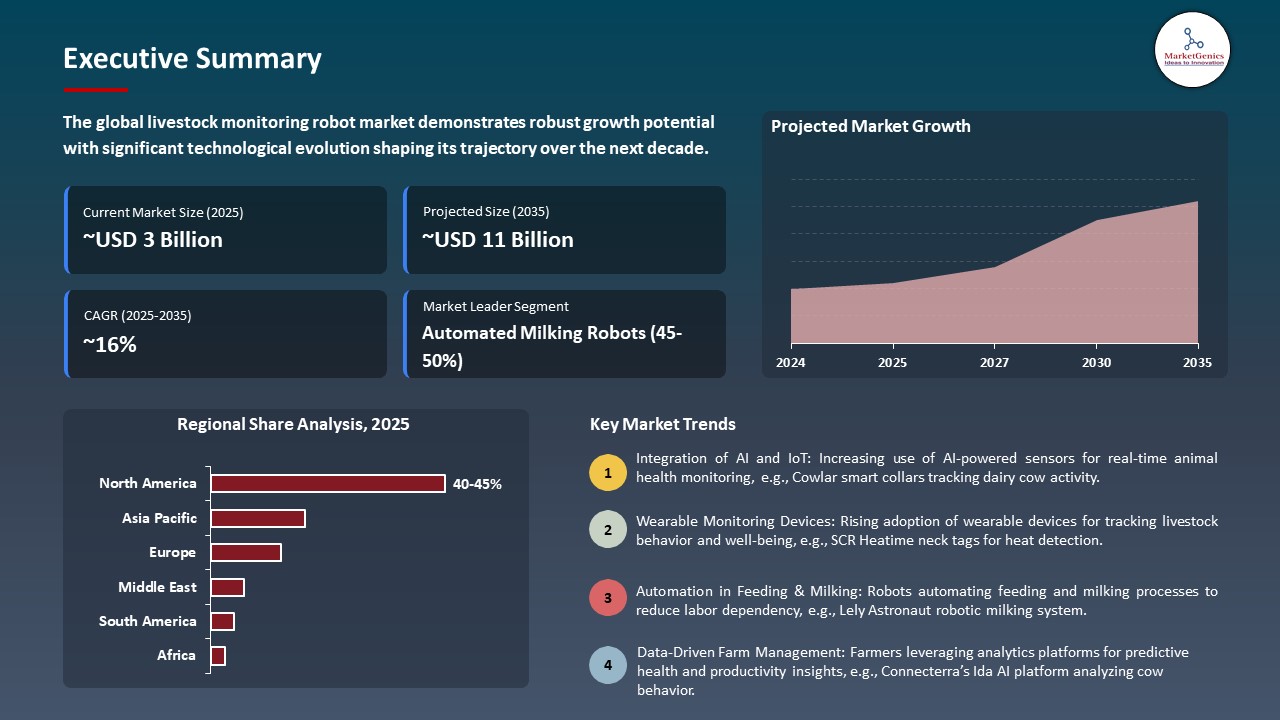
According to MarketGenics analysis only, the global livestock monitoring robot market is witnessing strong growth, with an estimated valuation of USD 2.6 billion in 2025 and projected to reach USD 11.3 billion by 2035, expanding at a CAGR of 15.8% during the forecast period.
|
|
|
Segmental Data Insights |
|
|
Demand Trends |
|
|
Competitive Landscape |
|
|
Strategic Development |
|
|
Future Outlook & Opportunities |
|
Livestock Monitoring Robot Market Size, Share, and Growth
Asia Pacific is the fastest-growing region in the livestock-monitoring-robot-market due to rising demand for modernized livestock management, increasing labor costs, and government initiatives promoting smart and sustainable farming practices.
Thibault Burg, EMEA Solution Manager for VMS, DeLaval, said “With the introduction of the VMS V300 2025 model, DeLaval takes another significant step forward in milking technology. This new model addresses the critical needs of modern dairy farmers by enhancing productivity, animal welfare, and supporting sustainable farming practices. Farmers can use the extra capacity for more milkings per cow, more cows per station, or more idle time for a stress-free operation. Overall, it allows customers to milk better than ever – that’s what we call milking without compromise.”
The primary force behind the livestock monitoring robot market is the rapid growth of large scale commercial dairy and livestock farms, which expand the necessity of automation and real time monitoring as the size of the herd grows. Big farms need robotic devices to milk, feed, monitor their health and manage their herds, to enhance the efficiency of operations, decrease the labor dependence, and provide the rate of productivity and well-being of animals.
The increased use of virtual fencing and GPS cattle tracking applications are also presenting a good opportunity to the livestock monitoring robot market, as real time location tracking and automated grazing control is possible, and more efficient use of pastures. These technologies minimize the use of fencing and manual livestock rounding, increase the efficiency of labor, improve animal safety, and facilitate herd and land management decisions that are data-driven.
The livestock tracking robot market is generating robust adjacent opportunity in precision livestock software, wearable animal sensors, farm management software, IoT connectivity solution, cloud analytics and autonomous feeding and manure software systems as farms transition to fully integrated smart-farm ecosystems to optimize their livestock.
Livestock Monitoring Robot Market Dynamics and Trends
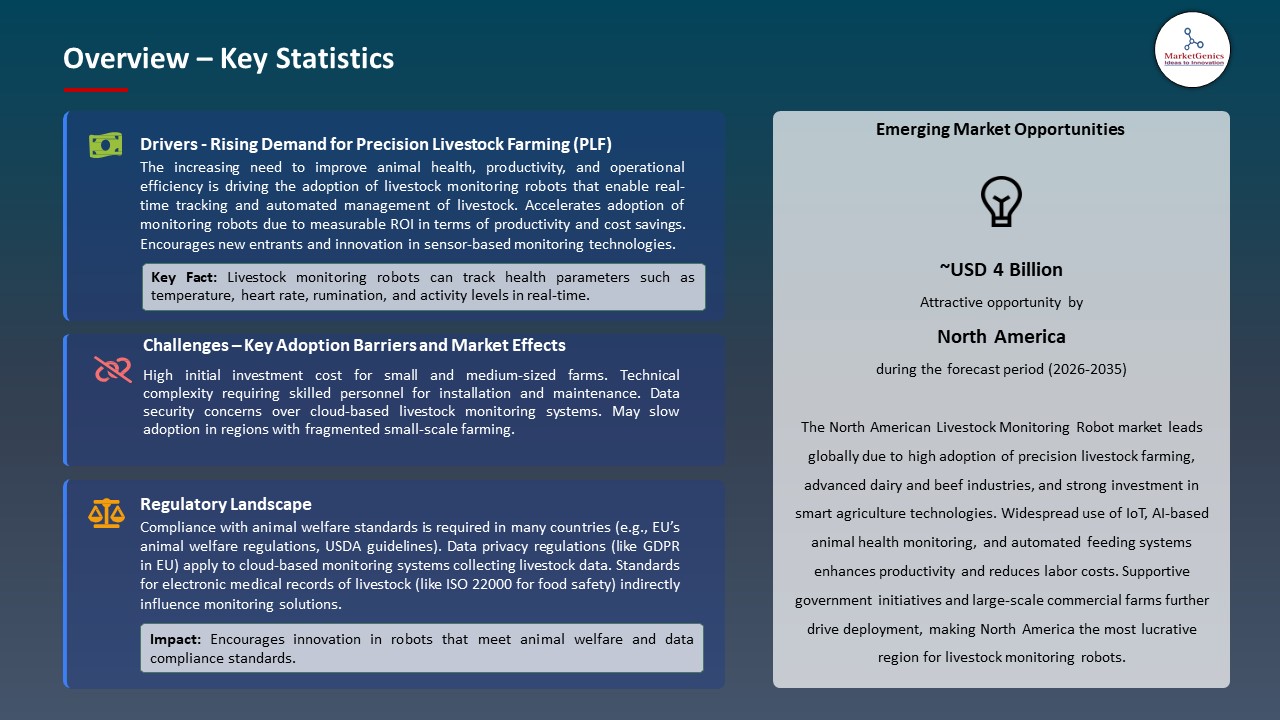
Driver: Rising Demand for Dairy and Meat Products
-
The gradual rise in the consumption of dairy and meat products worldwide is pushing livestock breeders to raise their productivity and manage larger herds effectively. In order to satisfy this growing demand, farmers are resolving to scalable livestock monitoring systems in the livestock monitoring robot market, which provides accurate monitoring of animal health, feeding behavior, and reproduction.
- AI-powered robot systems, sensors, and automated analytics, are used to maximize the amount of milk produced, the quality of meat, and the performance of the herd in general and reduce the losses caused by disease or stress. These technologies enable farms to cater to the increased market demands as well as comply with regulatory requirements by enhancing their herd management and efficiency, and this phenomenon will be major in driving the global livestock monitoring robot market.
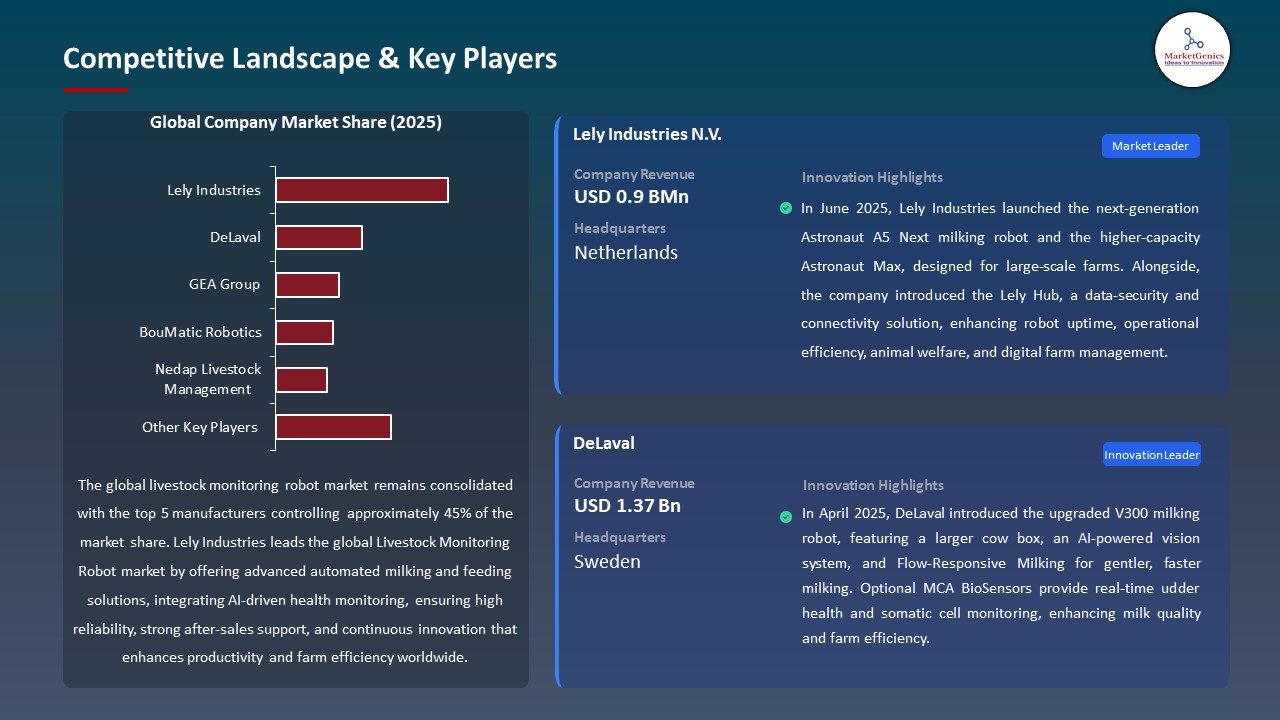
- DeLaval recently introduced the VMS V300 2025, which is fitted with a larger milking box to keep the cows comfortable, Flow-Responsive Milking to minimize the time taken to milk the cows, and an AI-powered InSight vision technology to analyze the herd more accurately. Additional BioSensors MCA and DeLaval Plus can be used to track the health of the udder and the quality of milk in real-time. These inventions aid farmers with the ease of handling big herds, maximizing production, and satisfying the increasing world dairy requirements, which exemplifies the increased use of livestock surveillance robots.
- Technological breakthroughs in livestock monitoring robots are directly giving farms the capacity to scale up their operations, enhance their productivity and satisfy the rising global demand effectively.
Restraint: Limited Adoption in Small-Scale Operations
-
Small- and medium-sized farms have not yet adopted livestock monitoring robots because of high initial investment costs, maintenance costs, and technical expertise. The large numbers of small-scale farmers have limited budgets and therefore they find it hard to afford to invest in sophisticated robotic systems especially in areas where there is a relatively low cost of labor.
- The installation and integration process, including the need to train constantly also is a challenge to the operators who lack technological expertise. This caution is particularly notable in the developing world and the rural regions where farms are not consolidated and infrastructure might not be adequate enough to accommodate smart livestock technologies.
- Large and commercial farms are also moving towards robotic monitoring systems to boost productivity and control of herds as compared to small scale operations that still use traditional manual operations which narrow down the market penetration and potential growth of the global livestock monitoring robot market.
- All these issues are barriers to the extensive use of livestock monitoring robots, limiting the development of small and resource-restricted farm units.
Opportunity: Integration with Precision Livestock Farming Platforms
-
Precision livestock farming (PLF) is becoming increasingly popular, which has presented tremendous prospects to the livestock monitoring robot market. The current robotic systems can be easily integrated into the PLF systems which allow real time data collection, analysis and visualization of the data concerning the animal health, behavior, feeding patterns and productivity. The integration enables farmers to make well-informed decisions, maximize the use of resources, manage their herds better, and increase the efficiency of farms.
- Incorporating robotics and accuracy farming solutions, farms will be able to increase their yields, enhance the quality of milk and meat, and detect diseases early, minimizing losses and working expenses. Scability, as well as meeting the welfare and sustainability requirements since livestock robots could be connected to the PLF software, will contribute to the further integration of robotic monitoring solutions in the world.
- Halter announced its virtual fencing technology to the U.S. ranchers, who have more than 200,000 cattle worldwide. The system is a combination of solar-powered collars and the Halter app that makes it possible to have virtual fences, real-time herd monitoring and accurate pasture management. This can enhance productivity, herd performance, and sustainability, which shows livestock monitoring robots can cooperate with precision livestock farming platforms to streamline farm work.
- This proves that the combination of livestock monitoring robots and precision livestock farming platforms are efficient, productive, and sustainable to improve farm productivity and fuels market development.
Key Trend: Development of Multi-Function Autonomous Herd Management Systems
-
The livestock monitoring robot market is experiencing a major trend in the creation of multi-purpose autonomous systems that can execute numerous related functions at one time, including feeding, milking, health monitoring and movement tracking. Such high-tech robots use AI, IoT and sensor technology to offer real-time data on animal behavior, health and productivity.
- Automating several functions of herd management, farmers will be able to decrease labor dependence, increase the efficiency of operations, and animal welfare. The integration of capabilities on a single autonomous platform also facilitates the enhancement of data integration, predictive analytics, and scalable farm operations, which are proving to be more desirable to commercial and large-scale livestock activities worldwide.
- Lely introduced in March 2025 the Vector MFR Next, a high-technology mixing/feeding robot with a capacity of 800kg. It allows automated precision feeding 24 hours a day, is linked to an app to monitor the herd in real time, minimizes the labor force, enhances herd performance and enables a sustainable operation in the farm. This is the direction of increased multi-function autonomous herd management systems in the livestock monitoring robot market.
- Efficiency, productivity and sustainability of the global livestock monitoring robot market is being driven by multi-function autonomous herd management systems.
Livestock-Monitoring-Robot-Market Analysis and Segmental Data
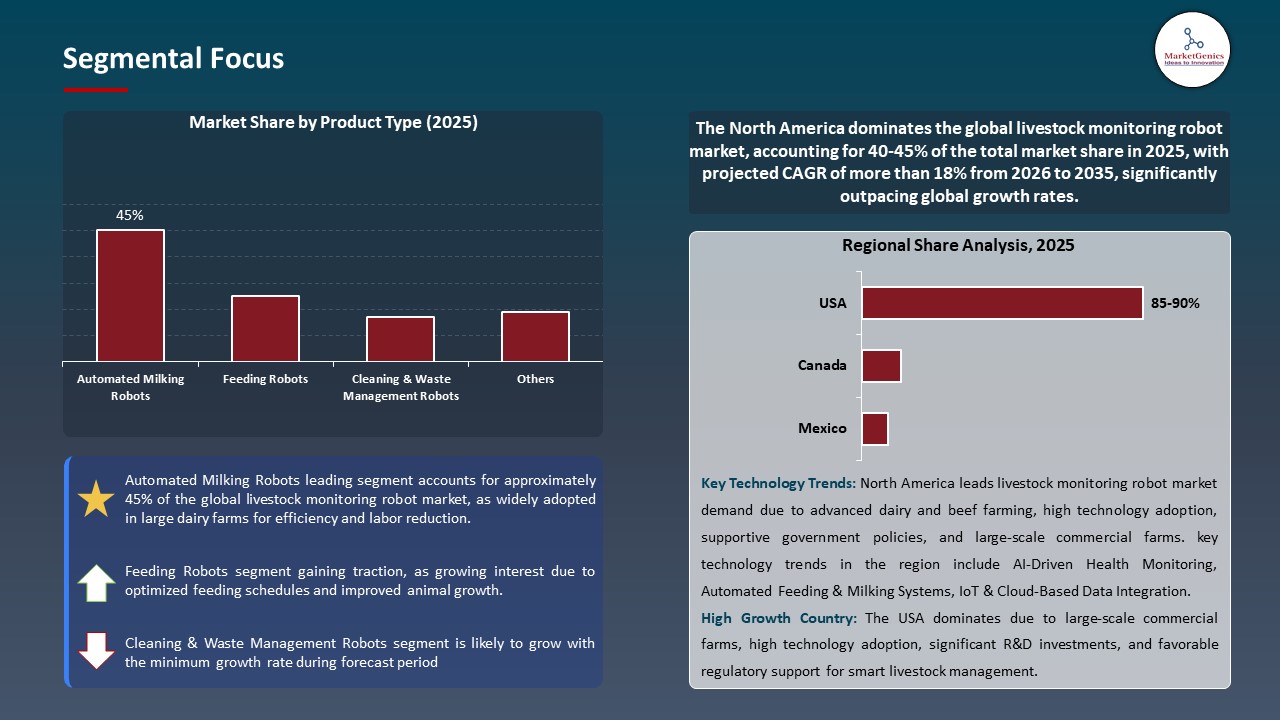
Automated Milking Robots Dominate Global Livestock Monitoring Robot Market
-
Automated milking robots (AMRs) continue to hold a dominant position in the global livestock monitoring robot market due to their ability to enhance milking efficiency, improve milk quality, and reduce labor dependency. These robots leverage AI, sensors, and real-time monitoring to identify cow health issues, optimize milking schedules, and maintain consistent hygiene standards.
- The extensive use is being stimulated by the increasing use of large-scale dairy production and rising market demands of high-quality milk. Further models can also be integrated with farm management, which allows making decisions regarding herd health, reproduction, and nutrition based on data. Consequently, the key segment is still automated milking robots that are boosting market growth in most countries around the world.
- BouMatic introduced the Gemini UP, the next generation milking robot, in single and double box configurations. It uses automated milking, real-time herd supervision through the OneView app, environmentally sustainable cleaning, and animal-friendly design, which improve productivity, animal welfare, and operating efficiency, which underscores the prevalence of automated milking robots in the worldwide livestock monitoring robot sector.
- Automated milking robots still lead the efficiency, productivity and animal welfare in the global livestock monitoring robot market, and this fact strengthens their leadership in the livestock monitoring robot business.
North America Leads Global Livestock Monitoring Robot Market Demand
-
North America is the leading region for livestock monitoring robotsmarkwt, driven by the region’s large-scale commercial dairy and meat farming operations. The high labour costs, growing value on animal welfare and the growing need of high-quality dairy and meat products are encouraging farmers to implement more advanced robotic systems to carry out the milking, feeding, health and herd management processes.
- The availability of established technology vendors, excellent infrastructure, and supportive government initiatives in the favor of the use of precision livestock farming also speed up adoption. Also, North American farmers are becoming more attractive to automated systems in combination with farm management software, which allows real-time data processing and more effective operation, which makes the region one of the most developed regions in the demand of livestock monitoring robots in the world.
- AMS Galaxy USA and Fullwood JOZ promoted their M²erlin / Merlin²G robotic milking system in the U.S., offering automated milking with cow comfort, efficient cycles, and real-time herd monitoring, reflecting North America’s strong adoption of livestock monitoring robots.
- This proves that North America remains dominant and grows very fast in the international livestock monitoring robot market.
Livestock-Monitoring-Robot-Market Ecosystem
The global livestock monitoring robot market is consolidated, with a high concentration among key players such as Lely Industries, DeLaval, GEA Group, BouMatic Robotics, Nedap Livestock Management", and that maintain leadership through extensive distribution networks, advanced automation solutions, and integrated platforms combining IIoT, AI-based analytics, digital twins, and robotics to optimize herd management, animal health monitoring, and operational efficiency.
Market value chain consists of software and platform development, IIoT device integration, cloud and edge computing infrastructure, system implementation, employee training and after-deployment services such as predictive maintenance, performance monitoring and lifecycle analytics.
Entrance barriers are high because of the need to have secure, scalable robotic solutions, high technological skills and specialized farm clients. Current innovations in AI, edge computing, and cloud-enabled robotics are also keeping the market going, with the advancement of automation, better animal welfare, and enabled efficient and sustainable livestock production across the globe.
Recent Development and Strategic Overview:
-
In May 2025, GEA introduced the DairyRobot R9600 series for automated batch milking with fixed milking times, enabling predictable operations, reduced labor, and consistent milk quality for medium-to-large herds. The system features a subway solution for uninterrupted maintenance, 3D camera-based gentle attachment, real-time cell count monitoring, and integration with GEA DairyNet and CowScout for intelligent herd, health, and fertility management—strengthening advanced livestock automation adoption.
Report Scope
|
Detail |
|
|
Market Size in 2025 |
USD 2.6 Bn |
|
Market Forecast Value in 2035 |
USD 11.3 Bn |
|
Growth Rate (CAGR) |
15.8% |
|
Forecast Period |
2026 – 2035 |
|
Historical Data Available for |
2021 – 2024 |
|
Market Size Units |
US$ Billion for Value Thousand Units for Volume |
|
Report Format |
Electronic (PDF) + Excel |
|
North America |
Europe |
Asia Pacific |
Middle East |
Africa |
South America |
|
|
|
|
|
|
|
Companies Covered |
|||||
|
|
|
|
|
|
Livestock-Monitoring-Robot-Market Segmentation and Highlights
|
Segment |
Sub-segment |
|
Livestock Monitoring Robot Market, By Product Type |
|
|
Livestock Monitoring Robot Market, By Technology |
|
|
Livestock Monitoring Robot Market, By Rated Power |
|
|
Livestock Monitoring Robot Market, By Rated Capacity |
|
|
Livestock Monitoring Robot Market, By Livestock Type |
|
|
Livestock Monitoring Robot Market, By Monitoring Parameters |
|
|
Livestock Monitoring Robot Market, By Mobility Type |
|
|
Livestock Monitoring Robot Market, By Power Source |
|
|
Livestock Monitoring Robot Market, By Operation Mode |
|
|
Livestock Monitoring Robot Market, By Connectivity |
|
|
Livestock Monitoring Robot Market, By End-users |
|
|
Livestock Monitoring Robot Market, By Deployment Type |
|
Frequently Asked Questions
Table of Contents
- 1. Research Methodology and Assumptions
- 1.1. Definitions
- 1.2. Research Design and Approach
- 1.3. Data Collection Methods
- 1.4. Base Estimates and Calculations
- 1.5. Forecasting Models
- 1.5.1. Key Forecast Factors & Impact Analysis
- 1.6. Secondary Research
- 1.6.1. Open Sources
- 1.6.2. Paid Databases
- 1.6.3. AssociationsLivestock Monitoring Robot Market
- 1.7. Primary Research
- 1.7.1. Primary Sources
- 1.7.2. Primary Interviews with Stakeholders across Ecosystem
- 2. Executive Summary
- 2.1. Global Livestock Monitoring Robot Market Outlook
- 2.1.1. Livestock Monitoring Robot Market Size Volume (Thousand Units) and Value (US$ Bn), and Forecasts, 2021-2035
- 2.1.2. Compounded Annual Growth Rate Analysis
- 2.1.3. Growth Opportunity Analysis
- 2.1.4. Segmental Share Analysis
- 2.1.5. Geographical Share Analysis
- 2.2. Market Analysis and Facts
- 2.3. Supply-Demand Analysis
- 2.4. Competitive Benchmarking
- 2.5. Go-to- Market Strategy
- 2.5.1. Customer/ End-use Industry Assessment
- 2.5.2. Growth Opportunity Data, 2026-2035
- 2.5.2.1. Regional Data
- 2.5.2.2. Country Data
- 2.5.2.3. Segmental Data
- 2.5.3. Identification of Potential Market Spaces
- 2.5.4. GAP Analysis
- 2.5.5. Potential Attractive Price Points
- 2.5.6. Prevailing Market Risks & Challenges
- 2.5.7. Preferred Sales & Marketing Strategies
- 2.5.8. Key Recommendations and Analysis
- 2.5.9. A Way Forward
- 2.1. Global Livestock Monitoring Robot Market Outlook
- 3. Industry Data and Premium Insights
- 3.1. Global Automation & Process Control Industry Overview, 2025
- 3.1.1. Automation & Process Control Industry Ecosystem Analysis
- 3.1.2. Key Trends for Automation & Process Control Industry
- 3.1.3. Regional Distribution for Automation & Process Control Industry
- 3.2. Supplier Customer Data
- 3.3. Technology Roadmap and Developments
- 3.4. Trade Analysis
- 3.4.1. Import & Export Analysis, 2025
- 3.4.2. Top Importing Countries
- 3.4.3. Top Exporting Countries
- 3.5. Trump Tariff Impact Analysis
- 3.5.1. Manufacturer
- 3.5.1.1. Based on the component & Raw material
- 3.5.2. Supply Chain
- 3.5.3. End Consumer
- 3.5.1. Manufacturer
- 3.6. Raw Material Analysis
- 3.1. Global Automation & Process Control Industry Overview, 2025
- 4. Market Overview
- 4.1. Market Dynamics
- 4.1.1. Drivers
- 4.1.1.1. Increasing demand for precision livestock farming to improve animal health and productivity.
- 4.1.1.2. Rising adoption of IoT and AI-based monitoring systems in agriculture.
- 4.1.1.3. Labor shortage in the livestock sector driving automation adoption.
- 4.1.2. Restraints
- 4.1.2.1. High initial investment and maintenance costs of monitoring robots.
- 4.1.2.2. Technical challenges in adapting robots to diverse farm environments and livestock types.
- 4.1.1. Drivers
- 4.2. Key Trend Analysis
- 4.3. Regulatory Framework
- 4.3.1. Key Regulations, Norms, and Subsidies, by Key Countries
- 4.3.2. Tariffs and Standards
- 4.3.3. Impact Analysis of Regulations on the Market
- 4.4. Value Chain Analysis
- 4.4.1. Component Suppliers
- 4.4.2. Manufacturers
- 4.4.3. Software & AI Platform Providers
- 4.4.4. Distribution & Logistics
- 4.4.5. End-Users
- 4.5. Cost Structure Analysis
- 4.5.1. Parameter’s Share for Cost Associated
- 4.5.2. COGP vs COGS
- 4.5.3. Profit Margin Analysis
- 4.6. Pricing Analysis
- 4.6.1. Regional Pricing Analysis
- 4.6.2. Segmental Pricing Trends
- 4.6.3. Factors Influencing Pricing
- 4.7. Porter’s Five Forces Analysis
- 4.8. PESTEL Analysis
- 4.9. Global Livestock Monitoring Robot Market Demand
- 4.9.1. Historical Market Size – Volume (Thousand Units) and Value (US$ Bn), 2020-2024
- 4.9.2. Current and Future Market Size – Volume (Thousand Units) and Value (US$ Bn), 2026–2035
- 4.9.2.1. Y-o-Y Growth Trends
- 4.9.2.2. Absolute $ Opportunity Assessment
- 4.1. Market Dynamics
- 5. Competition Landscape
- 5.1. Competition structure
- 5.1.1. Fragmented v/s consolidated
- 5.2. Company Share Analysis, 2025
- 5.2.1. Global Company Market Share
- 5.2.2. By Region
- 5.2.2.1. North America
- 5.2.2.2. Europe
- 5.2.2.3. Asia Pacific
- 5.2.2.4. Middle East
- 5.2.2.5. Africa
- 5.2.2.6. South America
- 5.3. Product Comparison Matrix
- 5.3.1. Specifications
- 5.3.2. Market Positioning
- 5.3.3. Pricing
- 5.1. Competition structure
- 6. Global Livestock Monitoring Robot Market Analysis, by Product Type
- 6.1. Key Segment Analysis
- 6.2. Livestock Monitoring Robot Market Size Volume (Thousand Units) and Value (US$ Bn), Analysis, and Forecasts, by Product Type, 2021-2035
- 6.2.1. Automated Milking Robots
- 6.2.2. Feeding Robots
- 6.2.3. Cleaning & Waste Management Robots
- 6.2.4. Health Monitoring Robots
- 6.2.5. Herding & Guidance Robots
- 6.2.6. Multi-functional Livestock Robots
- 7. Global Livestock Monitoring Robot Market Analysis, by Technology
- 7.1. Key Segment Analysis
- 7.2. Livestock Monitoring Robot Market Size Volume (Thousand Units) and Value (US$ Bn), Analysis, and Forecasts, by Technology, 2021-2035
- 7.2.1. Autonomous Navigation Systems
- 7.2.1.1. GPS-based Navigation
- 7.2.1.2. SLAM (Simultaneous Localization and Mapping)
- 7.2.1.3. Vision-based Navigation
- 7.2.1.4. Others
- 7.2.2. Sensor Technology
- 7.2.2.1. RFID Sensors
- 7.2.2.2. Thermal Imaging Sensors
- 7.2.2.3. Acoustic Sensors
- 7.2.2.4. Motion Sensors
- 7.2.2.5. Others
- 7.2.3. Artificial Intelligence & Machine Learning
- 7.2.4. IoT-enabled Systems
- 7.2.5. Computer Vision Systems
- 7.2.1. Autonomous Navigation Systems
- 8. Global Livestock Monitoring Robot Market Analysis, by Rated Power
- 8.1. Key Segment Analysis
- 8.2. Livestock Monitoring Robot Market Size Volume (Thousand Units) and Value (US$ Bn), Analysis, and Forecasts, by Rated Power, 2021-2035
- 8.2.1. Below 500W
- 8.2.2. 500W - 2kW
- 8.2.3. 2kW - 5kW
- 8.2.4. Above 5kW
- 9. Global Livestock Monitoring Robot Market Analysis, by Rated Capacity
- 9.1. Key Segment Analysis
- 9.2. Livestock Monitoring Robot Market Size Volume (Thousand Units) and Value (US$ Bn), Analysis, and Forecasts, by Rated Capacity, 2021-2035
- 9.2.1. Small Scale (1-50 Animals)
- 9.2.2. Medium Scale (51-200 Animals)
- 9.2.3. Large Scale (201-500 Animals)
- 9.2.4. Industrial Scale (Above 500 Animals)
- 10. Global Livestock Monitoring Robot Market Analysis, by Livestock Type
- 10.1. Key Segment Analysis
- 10.2. Livestock Monitoring Robot Market Size Volume (Thousand Units) and Value (US$ Bn), Analysis, and Forecasts, by Livestock Type, 2021-2035
- 10.2.1. Dairy Cattle
- 10.2.2. Beef Cattle
- 10.2.3. Swine/Pigs
- 10.2.4. Poultry
- 10.2.5. Sheep
- 10.2.6. Goats
- 10.2.7. Other Livestock
- 11. Global Livestock Monitoring Robot Market Analysis, by Monitoring Parameters
- 11.1. Key Segment Analysis
- 11.2. Livestock Monitoring Robot Market Size Volume (Thousand Units) and Value (US$ Bn), Analysis, and Forecasts, by Monitoring Parameters, 2021-2035
- 11.2.1. Health Monitoring
- 11.2.1.1. Body Temperature Tracking
- 11.2.1.2. Heart Rate Monitoring
- 11.2.1.3. Respiratory Rate Monitoring
- 11.2.1.4. Disease Detection
- 11.2.1.5. Others
- 11.2.2. Behavioral Monitoring
- 11.2.2.1. Movement Patterns
- 11.2.2.2. Feeding Behavior
- 11.2.2.3. Mating Behavior
- 11.2.2.4. Social Interaction
- 11.2.2.5. Others
- 11.2.3. Production Monitoring
- 11.2.3.1. Milk Yield Tracking
- 11.2.3.2. Weight Monitoring
- 11.2.3.3. Feed Intake Measurement
- 11.2.3.4. Reproduction Cycle Tracking
- 11.2.3.5. Others
- 11.2.1. Health Monitoring
- 12. Global Livestock Monitoring Robot Market Analysis, by Mobility Type
- 12.1. Key Segment Analysis
- 12.2. Livestock Monitoring Robot Market Size Volume (Thousand Units) and Value (US$ Bn), Analysis, and Forecasts, by Mobility Type, 2021-2035
- 12.2.1. Fully Autonomous Mobile Robots
- 12.2.2. Semi-Autonomous Robots
- 12.2.3. Stationary/Fixed Robots
- 12.2.4. Rail-mounted Robots
- 12.2.5. Aerial Drones
- 13. Global Livestock Monitoring Robot Market Analysis, by Power Source
- 13.1. Key Segment Analysis
- 13.2. Livestock Monitoring Robot Market Size Volume (Thousand Units) and Value (US$ Bn), Analysis, and Forecasts, by Power Source, 2021-2035
- 13.2.1. Battery-powered
- 13.2.1.1. Lithium-ion Battery
- 13.2.1.2. Lead-acid Battery
- 13.2.2. Electric Grid-powered
- 13.2.3. Hybrid Power Systems
- 13.2.4. Solar-powered
- 13.2.1. Battery-powered
- 14. Global Livestock Monitoring Robot Market Analysis, by Operation Mode
- 14.1. Key Segment Analysis
- 14.2. Livestock Monitoring Robot Market Size Volume (Thousand Units) and Value (US$ Bn), Analysis, and Forecasts, by Operation Mode, 2021-2035
- 14.2.1. Continuous Operation (24/7)
- 14.2.2. Scheduled Operation
- 14.2.3. On-demand Operation
- 14.2.4. Remote-controlled Operation
- 15. Global Livestock Monitoring Robot Market Analysis, by Connectivity
- 15.1. Key Segment Analysis
- 15.2. Livestock Monitoring Robot Market Size Volume (Thousand Units) and Value (US$ Bn), Analysis, and Forecasts, by Connectivity, 2021-2035
- 15.2.1. Wired Connectivity
- 15.2.2. Wireless Connectivity
- 15.2.2.1. Wi-Fi
- 15.2.2.2. Bluetooth
- 15.2.2.3. 4G/5G
- 15.2.2.4. LoRaWAN
- 15.2.2.5. Others
- 15.2.3. Standalone Systems
- 16. Global Livestock Monitoring Robot Market Analysis, by End-users
- 16.1. Key Segment Analysis
- 16.2. Livestock Monitoring Robot Market Size Volume (Thousand Units) and Value (US$ Bn), Analysis, and Forecasts, by End-users, 2021-2035
- 16.2.1. Dairy Farms
- 16.2.1.1. Automated Milking Applications
- 16.2.1.2. Milk Quality Monitoring
- 16.2.1.3. Udder Health Monitoring
- 16.2.1.4. Feed Distribution
- 16.2.1.5. Waste Management
- 16.2.1.6. Others
- 16.2.2. Livestock Breeding Farms
- 16.2.2.1. Reproduction Cycle Tracking
- 16.2.2.2. Genetic Health Monitoring
- 16.2.2.3. Weight Gain Monitoring
- 16.2.2.4. Environmental Control
- 16.2.2.5. Others
- 16.2.3. Meat Production Facilities
- 16.2.3.1. Growth Rate Monitoring
- 16.2.3.2. Feed Optimization
- 16.2.3.3. Disease Prevention
- 16.2.3.4. Slaughter Readiness Assessment
- 16.2.3.5. Others
- 16.2.4. Poultry Farms
- 16.2.4.1. Egg Collection Automation
- 16.2.4.2. Climate Control Monitoring
- 16.2.4.3. Feed & Water Distribution
- 16.2.4.4. Bird Health Assessment
- 16.2.4.5. Others
- 16.2.5. Research & Academic Institutions
- 16.2.5.1. Behavioral Research
- 16.2.5.2. Productivity Studies
- 16.2.5.3. Animal Welfare Research
- 16.2.5.4. Technology Development
- 16.2.5.5. Others
- 16.2.6. Veterinary Services
- 16.2.6.1. Remote Health Diagnostics
- 16.2.6.2. Treatment Monitoring
- 16.2.6.3. Vaccination Tracking
- 16.2.6.4. Emergency Response
- 16.2.6.5. Others
- 16.2.7. Agricultural Cooperatives
- 16.2.7.1. Collective Farm Management
- 16.2.7.2. Standardization of Practices
- 16.2.7.3. Data Sharing & Analytics
- 16.2.7.4. Resource Optimization
- 16.2.7.5. Others
- 16.2.1. Dairy Farms
- 17. Global Livestock Monitoring Robot Market Analysis and Forecasts, by Deployment Type
- 17.1. Key Findings
- 17.2. Livestock Monitoring Robot Market Size Volume (Thousand Units) and Value (US$ Bn), Analysis, and Forecasts, by Deployment Type, 2021-2035
- 17.2.1. On-premise Deployment
- 17.2.2. Cloud-based Deployment
- 17.2.3. Hybrid Deployment
- 18. Global Livestock Monitoring Robot Market Analysis and Forecasts, by Region
- 18.1. Key Findings
- 18.2. Livestock Monitoring Robot Market Size Volume (Thousand Units) and Value (US$ Bn), Analysis, and Forecasts, by Region, 2021-2035
- 18.2.1. North America
- 18.2.2. Europe
- 18.2.3. Asia Pacific
- 18.2.4. Middle East
- 18.2.5. Africa
- 18.2.6. South America
- 19. North America Livestock Monitoring Robot Market Analysis
- 19.1. Key Segment Analysis
- 19.2. Regional Snapshot
- 19.3. North America Livestock Monitoring Robot Market Size Volume (Thousand Units) and Value (US$ Bn), Analysis, and Forecasts, 2021-2035
- 19.3.1. Product Type
- 19.3.2. Technology
- 19.3.3. Rated Power
- 19.3.4. Rated Capacity
- 19.3.5. Livestock Type
- 19.3.6. Monitoring Parameters
- 19.3.7. Mobility Type
- 19.3.8. Power Source
- 19.3.9. Operation Mode
- 19.3.10. Connectivity
- 19.3.11. End-users
- 19.3.12. Deployment Type
- 19.3.13. Country
- 19.3.13.1. USA
- 19.3.13.2. Canada
- 19.3.13.3. Mexico
- 19.4. USA Livestock Monitoring Robot Market
- 19.4.1. Country Segmental Analysis
- 19.4.2. Product Type
- 19.4.3. Technology
- 19.4.4. Rated Power
- 19.4.5. Rated Capacity
- 19.4.6. Livestock Type
- 19.4.7. Monitoring Parameters
- 19.4.8. Mobility Type
- 19.4.9. Power Source
- 19.4.10. Operation Mode
- 19.4.11. Connectivity
- 19.4.12. End-users
- 19.4.13. Deployment Type
- 19.5. Canada Livestock Monitoring Robot Market
- 19.5.1. Country Segmental Analysis
- 19.5.2. Product Type
- 19.5.3. Technology
- 19.5.4. Rated Power
- 19.5.5. Rated Capacity
- 19.5.6. Livestock Type
- 19.5.7. Monitoring Parameters
- 19.5.8. Mobility Type
- 19.5.9. Power Source
- 19.5.10. Operation Mode
- 19.5.11. Connectivity
- 19.5.12. End-users
- 19.5.13. Deployment Type
- 19.6. Mexico Livestock Monitoring Robot Market
- 19.6.1. Country Segmental Analysis
- 19.6.2. Product Type
- 19.6.3. Technology
- 19.6.4. Rated Power
- 19.6.5. Rated Capacity
- 19.6.6. Livestock Type
- 19.6.7. Monitoring Parameters
- 19.6.8. Mobility Type
- 19.6.9. Power Source
- 19.6.10. Operation Mode
- 19.6.11. Connectivity
- 19.6.12. End-users
- 19.6.13. Deployment Type
- 20. Europe Livestock Monitoring Robot Market Analysis
- 20.1. Key Segment Analysis
- 20.2. Regional Snapshot
- 20.3. Europe Livestock Monitoring Robot Market Size Volume (Thousand Units) and Value (US$ Bn), Analysis, and Forecasts, 2021-2035
- 20.3.1. Product Type
- 20.3.2. Technology
- 20.3.3. Rated Power
- 20.3.4. Rated Capacity
- 20.3.5. Livestock Type
- 20.3.6. Monitoring Parameters
- 20.3.7. Mobility Type
- 20.3.8. Power Source
- 20.3.9. Operation Mode
- 20.3.10. Connectivity
- 20.3.11. End-users
- 20.3.12. Deployment Type
- 20.3.13. Country
- 20.3.13.1. Germany
- 20.3.13.2. United Kingdom
- 20.3.13.3. France
- 20.3.13.4. Italy
- 20.3.13.5. Spain
- 20.3.13.6. Netherlands
- 20.3.13.7. Nordic Countries
- 20.3.13.8. Poland
- 20.3.13.9. Russia & CIS
- 20.3.13.10. Rest of Europe
- 20.4. Germany Livestock Monitoring Robot Market
- 20.4.1. Country Segmental Analysis
- 20.4.2. Product Type
- 20.4.3. Technology
- 20.4.4. Rated Power
- 20.4.5. Rated Capacity
- 20.4.6. Livestock Type
- 20.4.7. Monitoring Parameters
- 20.4.8. Mobility Type
- 20.4.9. Power Source
- 20.4.10. Operation Mode
- 20.4.11. Connectivity
- 20.4.12. End-users
- 20.4.13. Deployment Type
- 20.5. United Kingdom Livestock Monitoring Robot Market
- 20.5.1. Country Segmental Analysis
- 20.5.2. Product Type
- 20.5.3. Technology
- 20.5.4. Rated Power
- 20.5.5. Rated Capacity
- 20.5.6. Livestock Type
- 20.5.7. Monitoring Parameters
- 20.5.8. Mobility Type
- 20.5.9. Power Source
- 20.5.10. Operation Mode
- 20.5.11. Connectivity
- 20.5.12. End-users
- 20.5.13. Deployment Type
- 20.6. France Livestock Monitoring Robot Market
- 20.6.1. Country Segmental Analysis
- 20.6.2. Product Type
- 20.6.3. Technology
- 20.6.4. Rated Power
- 20.6.5. Rated Capacity
- 20.6.6. Livestock Type
- 20.6.7. Monitoring Parameters
- 20.6.8. Mobility Type
- 20.6.9. Power Source
- 20.6.10. Operation Mode
- 20.6.11. Connectivity
- 20.6.12. End-users
- 20.6.13. Deployment Type
- 20.7. Italy Livestock Monitoring Robot Market
- 20.7.1. Country Segmental Analysis
- 20.7.2. Product Type
- 20.7.3. Technology
- 20.7.4. Rated Power
- 20.7.5. Rated Capacity
- 20.7.6. Livestock Type
- 20.7.7. Monitoring Parameters
- 20.7.8. Mobility Type
- 20.7.9. Power Source
- 20.7.10. Operation Mode
- 20.7.11. Connectivity
- 20.7.12. End-users
- 20.7.13. Deployment Type
- 20.8. Spain Livestock Monitoring Robot Market
- 20.8.1. Country Segmental Analysis
- 20.8.2. Product Type
- 20.8.3. Technology
- 20.8.4. Rated Power
- 20.8.5. Rated Capacity
- 20.8.6. Livestock Type
- 20.8.7. Monitoring Parameters
- 20.8.8. Mobility Type
- 20.8.9. Power Source
- 20.8.10. Operation Mode
- 20.8.11. Connectivity
- 20.8.12. End-users
- 20.8.13. Deployment Type
- 20.9. Netherlands Livestock Monitoring Robot Market
- 20.9.1. Country Segmental Analysis
- 20.9.2. Product Type
- 20.9.3. Technology
- 20.9.4. Rated Power
- 20.9.5. Rated Capacity
- 20.9.6. Livestock Type
- 20.9.7. Monitoring Parameters
- 20.9.8. Mobility Type
- 20.9.9. Power Source
- 20.9.10. Operation Mode
- 20.9.11. Connectivity
- 20.9.12. End-users
- 20.9.13. Deployment Type
- 20.10. Nordic Countries Livestock Monitoring Robot Market
- 20.10.1. Country Segmental Analysis
- 20.10.2. Product Type
- 20.10.3. Technology
- 20.10.4. Rated Power
- 20.10.5. Rated Capacity
- 20.10.6. Livestock Type
- 20.10.7. Monitoring Parameters
- 20.10.8. Mobility Type
- 20.10.9. Power Source
- 20.10.10. Operation Mode
- 20.10.11. Connectivity
- 20.10.12. End-users
- 20.10.13. Deployment Type
- 20.11. Poland Livestock Monitoring Robot Market
- 20.11.1. Country Segmental Analysis
- 20.11.2. Product Type
- 20.11.3. Technology
- 20.11.4. Rated Power
- 20.11.5. Rated Capacity
- 20.11.6. Livestock Type
- 20.11.7. Monitoring Parameters
- 20.11.8. Mobility Type
- 20.11.9. Power Source
- 20.11.10. Operation Mode
- 20.11.11. Connectivity
- 20.11.12. End-users
- 20.11.13. Deployment Type
- 20.12. Russia & CIS Livestock Monitoring Robot Market
- 20.12.1. Country Segmental Analysis
- 20.12.2. Product Type
- 20.12.3. Technology
- 20.12.4. Rated Power
- 20.12.5. Rated Capacity
- 20.12.6. Livestock Type
- 20.12.7. Monitoring Parameters
- 20.12.8. Mobility Type
- 20.12.9. Power Source
- 20.12.10. Operation Mode
- 20.12.11. Connectivity
- 20.12.12. End-users
- 20.12.13. Deployment Type
- 20.13. Rest of Europe Livestock Monitoring Robot Market
- 20.13.1. Country Segmental Analysis
- 20.13.2. Product Type
- 20.13.3. Technology
- 20.13.4. Rated Power
- 20.13.5. Rated Capacity
- 20.13.6. Livestock Type
- 20.13.7. Monitoring Parameters
- 20.13.8. Mobility Type
- 20.13.9. Power Source
- 20.13.10. Operation Mode
- 20.13.11. Connectivity
- 20.13.12. End-users
- 20.13.13. Deployment Type
- 21. Asia Pacific Livestock Monitoring Robot Market Analysis
- 21.1. Key Segment Analysis
- 21.2. Regional Snapshot
- 21.3. Asia Pacific Livestock Monitoring Robot Market Size Volume (Thousand Units) and Value (US$ Bn), Analysis, and Forecasts, 2021-2035
- 21.3.1. Product Type
- 21.3.2. Technology
- 21.3.3. Rated Power
- 21.3.4. Rated Capacity
- 21.3.5. Livestock Type
- 21.3.6. Monitoring Parameters
- 21.3.7. Mobility Type
- 21.3.8. Power Source
- 21.3.9. Operation Mode
- 21.3.10. Connectivity
- 21.3.11. End-users
- 21.3.12. Deployment Type
- 21.3.13. Country
- 21.3.13.1. China
- 21.3.13.2. India
- 21.3.13.3. Japan
- 21.3.13.4. South Korea
- 21.3.13.5. Australia and New Zealand
- 21.3.13.6. Indonesia
- 21.3.13.7. Malaysia
- 21.3.13.8. Thailand
- 21.3.13.9. Vietnam
- 21.3.13.10. Rest of Asia Pacific
- 21.4. China Livestock Monitoring Robot Market
- 21.4.1. Country Segmental Analysis
- 21.4.2. Product Type
- 21.4.3. Technology
- 21.4.4. Rated Power
- 21.4.5. Rated Capacity
- 21.4.6. Livestock Type
- 21.4.7. Monitoring Parameters
- 21.4.8. Mobility Type
- 21.4.9. Power Source
- 21.4.10. Operation Mode
- 21.4.11. Connectivity
- 21.4.12. End-users
- 21.4.13. Deployment Type
- 21.5. India Livestock Monitoring Robot Market
- 21.5.1. Country Segmental Analysis
- 21.5.2. Product Type
- 21.5.3. Technology
- 21.5.4. Rated Power
- 21.5.5. Rated Capacity
- 21.5.6. Livestock Type
- 21.5.7. Monitoring Parameters
- 21.5.8. Mobility Type
- 21.5.9. Power Source
- 21.5.10. Operation Mode
- 21.5.11. Connectivity
- 21.5.12. End-users
- 21.5.13. Deployment Type
- 21.6. Japan Livestock Monitoring Robot Market
- 21.6.1. Country Segmental Analysis
- 21.6.2. Product Type
- 21.6.3. Technology
- 21.6.4. Rated Power
- 21.6.5. Rated Capacity
- 21.6.6. Livestock Type
- 21.6.7. Monitoring Parameters
- 21.6.8. Mobility Type
- 21.6.9. Power Source
- 21.6.10. Operation Mode
- 21.6.11. Connectivity
- 21.6.12. End-users
- 21.6.13. Deployment Type
- 21.7. South Korea Livestock Monitoring Robot Market
- 21.7.1. Country Segmental Analysis
- 21.7.2. Product Type
- 21.7.3. Technology
- 21.7.4. Rated Power
- 21.7.5. Rated Capacity
- 21.7.6. Livestock Type
- 21.7.7. Monitoring Parameters
- 21.7.8. Mobility Type
- 21.7.9. Power Source
- 21.7.10. Operation Mode
- 21.7.11. Connectivity
- 21.7.12. End-users
- 21.7.13. Deployment Type
- 21.8. Australia and New Zealand Livestock Monitoring Robot Market
- 21.8.1. Country Segmental Analysis
- 21.8.2. Product Type
- 21.8.3. Technology
- 21.8.4. Rated Power
- 21.8.5. Rated Capacity
- 21.8.6. Livestock Type
- 21.8.7. Monitoring Parameters
- 21.8.8. Mobility Type
- 21.8.9. Power Source
- 21.8.10. Operation Mode
- 21.8.11. Connectivity
- 21.8.12. End-users
- 21.8.13. Deployment Type
- 21.9. Indonesia Livestock Monitoring Robot Market
- 21.9.1. Country Segmental Analysis
- 21.9.2. Product Type
- 21.9.3. Technology
- 21.9.4. Rated Power
- 21.9.5. Rated Capacity
- 21.9.6. Livestock Type
- 21.9.7. Monitoring Parameters
- 21.9.8. Mobility Type
- 21.9.9. Power Source
- 21.9.10. Operation Mode
- 21.9.11. Connectivity
- 21.9.12. End-users
- 21.9.13. Deployment Type
- 21.10. Malaysia Livestock Monitoring Robot Market
- 21.10.1. Country Segmental Analysis
- 21.10.2. Product Type
- 21.10.3. Technology
- 21.10.4. Rated Power
- 21.10.5. Rated Capacity
- 21.10.6. Livestock Type
- 21.10.7. Monitoring Parameters
- 21.10.8. Mobility Type
- 21.10.9. Power Source
- 21.10.10. Operation Mode
- 21.10.11. Connectivity
- 21.10.12. End-users
- 21.10.13. Deployment Type
- 21.11. Thailand Livestock Monitoring Robot Market
- 21.11.1. Country Segmental Analysis
- 21.11.2. Product Type
- 21.11.3. Technology
- 21.11.4. Rated Power
- 21.11.5. Rated Capacity
- 21.11.6. Livestock Type
- 21.11.7. Monitoring Parameters
- 21.11.8. Mobility Type
- 21.11.9. Power Source
- 21.11.10. Operation Mode
- 21.11.11. Connectivity
- 21.11.12. End-users
- 21.11.13. Deployment Type
- 21.12. Vietnam Livestock Monitoring Robot Market
- 21.12.1. Country Segmental Analysis
- 21.12.2. Product Type
- 21.12.3. Technology
- 21.12.4. Rated Power
- 21.12.5. Rated Capacity
- 21.12.6. Livestock Type
- 21.12.7. Monitoring Parameters
- 21.12.8. Mobility Type
- 21.12.9. Power Source
- 21.12.10. Operation Mode
- 21.12.11. Connectivity
- 21.12.12. End-users
- 21.12.13. Deployment Type
- 21.13. Rest of Asia Pacific Livestock Monitoring Robot Market
- 21.13.1. Country Segmental Analysis
- 21.13.2. Product Type
- 21.13.3. Technology
- 21.13.4. Rated Power
- 21.13.5. Rated Capacity
- 21.13.6. Livestock Type
- 21.13.7. Monitoring Parameters
- 21.13.8. Mobility Type
- 21.13.9. Power Source
- 21.13.10. Operation Mode
- 21.13.11. Connectivity
- 21.13.12. End-users
- 21.13.13. Deployment Type
- 22. Middle East Livestock Monitoring Robot Market Analysis
- 22.1. Key Segment Analysis
- 22.2. Regional Snapshot
- 22.3. Middle East Livestock Monitoring Robot Market Size Volume (Thousand Units) and Value (US$ Bn), Analysis, and Forecasts, 2021-2035
- 22.3.1. Product Type
- 22.3.2. Technology
- 22.3.3. Rated Power
- 22.3.4. Rated Capacity
- 22.3.5. Livestock Type
- 22.3.6. Monitoring Parameters
- 22.3.7. Mobility Type
- 22.3.8. Power Source
- 22.3.9. Operation Mode
- 22.3.10. Connectivity
- 22.3.11. End-users
- 22.3.12. Deployment Type
- 22.3.13. Country
- 22.3.13.1. Turkey
- 22.3.13.2. UAE
- 22.3.13.3. Saudi Arabia
- 22.3.13.4. Israel
- 22.3.13.5. Rest of Middle East
- 22.4. Turkey Livestock Monitoring Robot Market
- 22.4.1. Country Segmental Analysis
- 22.4.2. Product Type
- 22.4.3. Technology
- 22.4.4. Rated Power
- 22.4.5. Rated Capacity
- 22.4.6. Livestock Type
- 22.4.7. Monitoring Parameters
- 22.4.8. Mobility Type
- 22.4.9. Power Source
- 22.4.10. Operation Mode
- 22.4.11. Connectivity
- 22.4.12. End-users
- 22.4.13. Deployment Type
- 22.5. UAE Livestock Monitoring Robot Market
- 22.5.1. Country Segmental Analysis
- 22.5.2. Product Type
- 22.5.3. Technology
- 22.5.4. Rated Power
- 22.5.5. Rated Capacity
- 22.5.6. Livestock Type
- 22.5.7. Monitoring Parameters
- 22.5.8. Mobility Type
- 22.5.9. Power Source
- 22.5.10. Operation Mode
- 22.5.11. Connectivity
- 22.5.12. End-users
- 22.5.13. Deployment Type
- 22.6. Saudi Arabia Livestock Monitoring Robot Market
- 22.6.1. Country Segmental Analysis
- 22.6.2. Product Type
- 22.6.3. Technology
- 22.6.4. Rated Power
- 22.6.5. Rated Capacity
- 22.6.6. Livestock Type
- 22.6.7. Monitoring Parameters
- 22.6.8. Mobility Type
- 22.6.9. Power Source
- 22.6.10. Operation Mode
- 22.6.11. Connectivity
- 22.6.12. End-users
- 22.6.13. Deployment Type
- 22.7. Israel Livestock Monitoring Robot Market
- 22.7.1. Country Segmental Analysis
- 22.7.2. Product Type
- 22.7.3. Technology
- 22.7.4. Rated Power
- 22.7.5. Rated Capacity
- 22.7.6. Livestock Type
- 22.7.7. Monitoring Parameters
- 22.7.8. Mobility Type
- 22.7.9. Power Source
- 22.7.10. Operation Mode
- 22.7.11. Connectivity
- 22.7.12. End-users
- 22.7.13. Deployment Type
- 22.8. Rest of Middle East Livestock Monitoring Robot Market
- 22.8.1. Country Segmental Analysis
- 22.8.2. Product Type
- 22.8.3. Technology
- 22.8.4. Rated Power
- 22.8.5. Rated Capacity
- 22.8.6. Livestock Type
- 22.8.7. Monitoring Parameters
- 22.8.8. Mobility Type
- 22.8.9. Power Source
- 22.8.10. Operation Mode
- 22.8.11. Connectivity
- 22.8.12. End-users
- 22.8.13. Deployment Type
- 23. Africa Livestock Monitoring Robot Market Analysis
- 23.1. Key Segment Analysis
- 23.2. Regional Snapshot
- 23.3. Africa Livestock Monitoring Robot Market Size Volume (Thousand Units) and Value (US$ Bn), Analysis, and Forecasts, 2021-2035
- 23.3.1. Product Type
- 23.3.2. Technology
- 23.3.3. Rated Power
- 23.3.4. Rated Capacity
- 23.3.5. Livestock Type
- 23.3.6. Monitoring Parameters
- 23.3.7. Mobility Type
- 23.3.8. Power Source
- 23.3.9. Operation Mode
- 23.3.10. Connectivity
- 23.3.11. End-users
- 23.3.12. Deployment Type
- 23.3.13. Country
- 23.3.13.1. South Africa
- 23.3.13.2. Egypt
- 23.3.13.3. Nigeria
- 23.3.13.4. Algeria
- 23.3.13.5. Rest of Africa
- 23.4. South Africa Livestock Monitoring Robot Market
- 23.4.1. Country Segmental Analysis
- 23.4.2. Product Type
- 23.4.3. Technology
- 23.4.4. Rated Power
- 23.4.5. Rated Capacity
- 23.4.6. Livestock Type
- 23.4.7. Monitoring Parameters
- 23.4.8. Mobility Type
- 23.4.9. Power Source
- 23.4.10. Operation Mode
- 23.4.11. Connectivity
- 23.4.12. End-users
- 23.4.13. Deployment Type
- 23.5. Egypt Livestock Monitoring Robot Market
- 23.5.1. Country Segmental Analysis
- 23.5.2. Product Type
- 23.5.3. Technology
- 23.5.4. Rated Power
- 23.5.5. Rated Capacity
- 23.5.6. Livestock Type
- 23.5.7. Monitoring Parameters
- 23.5.8. Mobility Type
- 23.5.9. Power Source
- 23.5.10. Operation Mode
- 23.5.11. Connectivity
- 23.5.12. End-users
- 23.5.13. Deployment Type
- 23.6. Nigeria Livestock Monitoring Robot Market
- 23.6.1. Country Segmental Analysis
- 23.6.2. Product Type
- 23.6.3. Technology
- 23.6.4. Rated Power
- 23.6.5. Rated Capacity
- 23.6.6. Livestock Type
- 23.6.7. Monitoring Parameters
- 23.6.8. Mobility Type
- 23.6.9. Power Source
- 23.6.10. Operation Mode
- 23.6.11. Connectivity
- 23.6.12. End-users
- 23.6.13. Deployment Type
- 23.7. Algeria Livestock Monitoring Robot Market
- 23.7.1. Country Segmental Analysis
- 23.7.2. Product Type
- 23.7.3. Technology
- 23.7.4. Rated Power
- 23.7.5. Rated Capacity
- 23.7.6. Livestock Type
- 23.7.7. Monitoring Parameters
- 23.7.8. Mobility Type
- 23.7.9. Power Source
- 23.7.10. Operation Mode
- 23.7.11. Connectivity
- 23.7.12. End-users
- 23.7.13. Deployment Type
- 23.8. Rest of Africa Livestock Monitoring Robot Market
- 23.8.1. Country Segmental Analysis
- 23.8.2. Product Type
- 23.8.3. Technology
- 23.8.4. Rated Power
- 23.8.5. Rated Capacity
- 23.8.6. Livestock Type
- 23.8.7. Monitoring Parameters
- 23.8.8. Mobility Type
- 23.8.9. Power Source
- 23.8.10. Operation Mode
- 23.8.11. Connectivity
- 23.8.12. End-users
- 23.8.13. Deployment Type
- 24. South America Livestock Monitoring Robot Market Analysis
- 24.1. Key Segment Analysis
- 24.2. Regional Snapshot
- 24.3. South America Livestock Monitoring Robot Market Size Volume (Thousand Units) and Value (US$ Bn), Analysis, and Forecasts, 2021-2035
- 24.3.1. Product Type
- 24.3.2. Technology
- 24.3.3. Rated Power
- 24.3.4. Rated Capacity
- 24.3.5. Livestock Type
- 24.3.6. Monitoring Parameters
- 24.3.7. Mobility Type
- 24.3.8. Power Source
- 24.3.9. Operation Mode
- 24.3.10. Connectivity
- 24.3.11. End-users
- 24.3.12. Deployment Type
- 24.3.13. Country
- 24.3.13.1. Brazil
- 24.3.13.2. Argentina
- 24.3.13.3. Rest of South America
- 24.4. Brazil Livestock Monitoring Robot Market
- 24.4.1. Country Segmental Analysis
- 24.4.2. Product Type
- 24.4.3. Technology
- 24.4.4. Rated Power
- 24.4.5. Rated Capacity
- 24.4.6. Livestock Type
- 24.4.7. Monitoring Parameters
- 24.4.8. Mobility Type
- 24.4.9. Power Source
- 24.4.10. Operation Mode
- 24.4.11. Connectivity
- 24.4.12. End-users
- 24.4.13. Deployment Type
- 24.5. Argentina Livestock Monitoring Robot Market
- 24.5.1. Country Segmental Analysis
- 24.5.2. Product Type
- 24.5.3. Technology
- 24.5.4. Rated Power
- 24.5.5. Rated Capacity
- 24.5.6. Livestock Type
- 24.5.7. Monitoring Parameters
- 24.5.8. Mobility Type
- 24.5.9. Power Source
- 24.5.10. Operation Mode
- 24.5.11. Connectivity
- 24.5.12. End-users
- 24.5.13. Deployment Type
- 24.6. Rest of South America Livestock Monitoring Robot Market
- 24.6.1. Country Segmental Analysis
- 24.6.2. Product Type
- 24.6.3. Technology
- 24.6.4. Rated Power
- 24.6.5. Rated Capacity
- 24.6.6. Livestock Type
- 24.6.7. Monitoring Parameters
- 24.6.8. Mobility Type
- 24.6.9. Power Source
- 24.6.10. Operation Mode
- 24.6.11. Connectivity
- 24.6.12. End-users
- 24.6.13. Deployment Type
- 25. Key Players/ Company Profile
- 25.1. AfiMilk MCS
- 25.1.1. Company Details/ Overview
- 25.1.2. Company Financials
- 25.1.3. Key Customers and Competitors
- 25.1.4. Business/ Industry Portfolio
- 25.1.5. Product Portfolio/ Specification Details
- 25.1.6. Pricing Data
- 25.1.7. Strategic Overview
- 25.1.8. Recent Developments
- 25.2. Agrologic Ltd
- 25.3. BouMatic Robotics
- 25.4. Dairymaster
- 25.5. DeLaval
- 25.6. Fancom
- 25.7. Fullwood Packo
- 25.8. GEA Group
- 25.9. Hokofarm Group
- 25.10. Insentec
- 25.11. Lely Industries
- 25.12. Lemmer-Fullwood
- 25.13. Nedap Livestock Management
- 25.14. Pellon Group
- 25.15. SAC Christensen
- 25.16. SCR Dairy (Allflex)
- 25.17. Sum-It Computer Systems
- 25.18. VAS Dairy
- 25.19. Waikato Milking Systems
- 25.20. Other Key Players
- 25.1. AfiMilk MCS
Note* - This is just tentative list of players. While providing the report, we will cover more number of players based on their revenue and share for each geography
Research Design
Our research design integrates both demand-side and supply-side analysis through a balanced combination of primary and secondary research methodologies. By utilizing both bottom-up and top-down approaches alongside rigorous data triangulation methods, we deliver robust market intelligence that supports strategic decision-making.
MarketGenics' comprehensive research design framework ensures the delivery of accurate, reliable, and actionable market intelligence. Through the integration of multiple research approaches, rigorous validation processes, and expert analysis, we provide our clients with the insights needed to make informed strategic decisions and capitalize on market opportunities.

MarketGenics leverages a dedicated industry panel of experts and a comprehensive suite of paid databases to effectively collect, consolidate, and analyze market intelligence.
Our approach has consistently proven to be reliable and effective in generating accurate market insights, identifying key industry trends, and uncovering emerging business opportunities.
Through both primary and secondary research, we capture and analyze critical company-level data such as manufacturing footprints, including technical centers, R&D facilities, sales offices, and headquarters.
Our expert panel further enhances our ability to estimate market size for specific brands based on validated field-level intelligence.
Our data mining techniques incorporate both parametric and non-parametric methods, allowing for structured data collection, sorting, processing, and cleaning.
Demand projections are derived from large-scale data sets analyzed through proprietary algorithms, culminating in robust and reliable market sizing.
Research Approach
The bottom-up approach builds market estimates by starting with the smallest addressable market units and systematically aggregating them to create comprehensive market size projections.
This method begins with specific, granular data points and builds upward to create the complete market landscape.
Customer Analysis → Segmental Analysis → Geographical Analysis
The top-down approach starts with the broadest possible market data and systematically narrows it down through a series of filters and assumptions to arrive at specific market segments or opportunities.
This method begins with the big picture and works downward to increasingly specific market slices.
TAM → SAM → SOM


Research Methods
Desk / Secondary Research
While analysing the market, we extensively study secondary sources, directories, and databases to identify and collect information useful for this technical, market-oriented, and commercial report. Secondary sources that we utilize are not only the public sources, but it is a combination of Open Source, Associations, Paid Databases, MG Repository & Knowledgebase, and others.
- Company websites, annual reports, financial reports, broker reports, and investor presentations
- National government documents, statistical databases and reports
- News articles, press releases and web-casts specific to the companies operating in the market, Magazines, reports, and others
- We gather information from commercial data sources for deriving company specific data such as segmental revenue, share for geography, product revenue, and others
- Internal and external proprietary databases (industry-specific), relevant patent, and regulatory databases
- Governing Bodies, Government Organizations
- Relevant Authorities, Country-specific Associations for Industries
We also employ the model mapping approach to estimate the product level market data through the players' product portfolio
Primary Research
Primary research/ interviews is vital in analyzing the market. Most of the cases involves paid primary interviews. Primary sources include primary interviews through e-mail interactions, telephonic interviews, surveys as well as face-to-face interviews with the different stakeholders across the value chain including several industry experts.
| Type of Respondents | Number of Primaries |
|---|---|
| Tier 2/3 Suppliers | ~20 |
| Tier 1 Suppliers | ~25 |
| End-users | ~25 |
| Industry Expert/ Panel/ Consultant | ~30 |
| Total | ~100 |
MG Knowledgebase
• Repository of industry blog, newsletter and case studies
• Online platform covering detailed market reports, and company profiles
Forecasting Factors and Models
Forecasting Factors
- Historical Trends – Past market patterns, cycles, and major events that shaped how markets behave over time. Understanding past trends helps predict future behavior.
- Industry Factors – Specific characteristics of the industry like structure, regulations, and innovation cycles that affect market dynamics.
- Macroeconomic Factors – Economic conditions like GDP growth, inflation, and employment rates that affect how much money people have to spend.
- Demographic Factors – Population characteristics like age, income, and location that determine who can buy your product.
- Technology Factors – How quickly people adopt new technology and how much technology infrastructure exists.
- Regulatory Factors – Government rules, laws, and policies that can help or restrict market growth.
- Competitive Factors – Analyzing competition structure such as degree of competition and bargaining power of buyers and suppliers.
Forecasting Models / Techniques
Multiple Regression Analysis
- Identify and quantify factors that drive market changes
- Statistical modeling to establish relationships between market drivers and outcomes
Time Series Analysis – Seasonal Patterns
- Understand regular cyclical patterns in market demand
- Advanced statistical techniques to separate trend, seasonal, and irregular components
Time Series Analysis – Trend Analysis
- Identify underlying market growth patterns and momentum
- Statistical analysis of historical data to project future trends
Expert Opinion – Expert Interviews
- Gather deep industry insights and contextual understanding
- In-depth interviews with key industry stakeholders
Multi-Scenario Development
- Prepare for uncertainty by modeling different possible futures
- Creating optimistic, pessimistic, and most likely scenarios
Time Series Analysis – Moving Averages
- Sophisticated forecasting for complex time series data
- Auto-regressive integrated moving average models with seasonal components
Econometric Models
- Apply economic theory to market forecasting
- Sophisticated economic models that account for market interactions
Expert Opinion – Delphi Method
- Harness collective wisdom of industry experts
- Structured, multi-round expert consultation process
Monte Carlo Simulation
- Quantify uncertainty and probability distributions
- Thousands of simulations with varying input parameters
Research Analysis
Our research framework is built upon the fundamental principle of validating market intelligence from both demand and supply perspectives. This dual-sided approach ensures comprehensive market understanding and reduces the risk of single-source bias.
Demand-Side Analysis: We understand end-user/application behavior, preferences, and market needs along with the penetration of the product for specific application.
Supply-Side Analysis: We estimate overall market revenue, analyze the segmental share along with industry capacity, competitive landscape, and market structure.
Validation & Evaluation
Data triangulation is a validation technique that uses multiple methods, sources, or perspectives to examine the same research question, thereby increasing the credibility and reliability of research findings. In market research, triangulation serves as a quality assurance mechanism that helps identify and minimize bias, validate assumptions, and ensure accuracy in market estimates.
- Data Source Triangulation – Using multiple data sources to examine the same phenomenon
- Methodological Triangulation – Using multiple research methods to study the same research question
- Investigator Triangulation – Using multiple researchers or analysts to examine the same data
- Theoretical Triangulation – Using multiple theoretical perspectives to interpret the same data

Custom Market Research Services
We will customise the research for you, in case the report listed above does not meet your requirements.
Get 10% Free Customisation