Pet Arthritis Treatment Market Size, Share & Trends Analysis Report by Product Type (Non-Steroidal Anti-Inflammatory Drugs (NSAIDs), Disease-Modifying Osteoarthritis Drugs (DMOADs), Nutraceuticals & Supplements, Corticosteroids, Visco supplementation Products, Physical Therapy Devices), Animal Type, Route of Administration, Distribution Channel, Treatment Stage, Therapy Type, Prescription Type, End-use, and Geography (North America, Europe, Asia Pacific, Middle East, Africa, and South America) – Global Industry Data, Trends, and Forecasts, 2026–2035
|
|
|
Segmental Data Insights |
|
|
Demand Trends |
|
|
Competitive Landscape |
|
|
Strategic Development |
|
|
Future Outlook & Opportunities |
|
Pet Arthritis Treatment Market Size, Share, and Growth
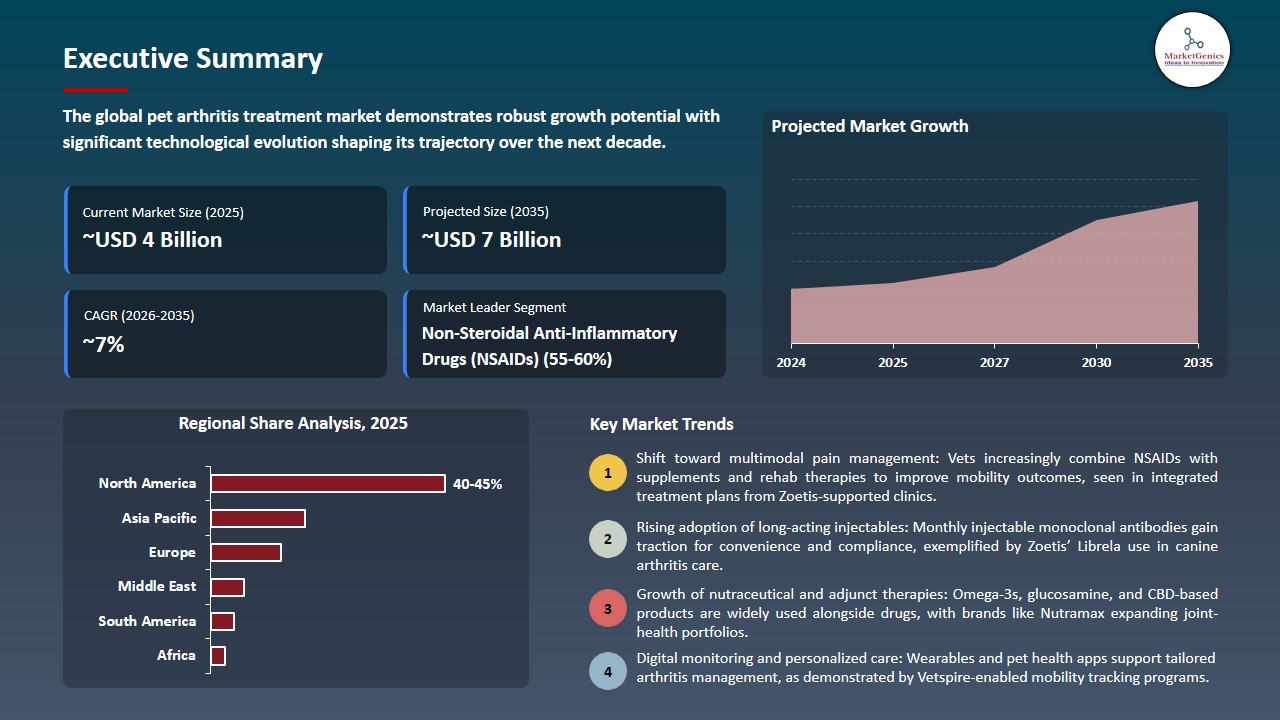
The global pet arthritis treatment market is witnessing strong growth, valued at USD 3.5 billion in 2025 and projected to reach USD 7.1 billion by 2035, expanding at a CAGR of 7.4% during the forecast period. Asia Pacific is the fastest-growing region in the pet arthritis treatment market due to increasing pet adoption, rising awareness of pet health and wellness, expanding veterinary infrastructure, and growing prevalence of arthritis in aging pets.
Richard Goldstein, Global Chief Medical Officer and Head of Medical Affairs at Zoetis, said, “We are pleased to introduce Lenivia as our first long-acting therapy that reduces OA pain in dogs, leading to improved quality of life and mobility. It also provides added convenience for pet owners who want to bring their dogs in for an injection just once every three months”.
The progress in the veterinary care, nutrition and preventive healthcare has greatly contributed to the longevity of pets, which has led to the higher number of aging pets. This population change has created an increased need in osteoarthritis and joint degeneration, which in turn creates a sustained need in pain control products, mobility supporting therapies and long-term disease controlling products in the pet arthritis treatment industry.
The increased concern about the health and wellness of pets is creating a demand towards the use of natural and alternative medicines in the pet arthritis treatment market. Some of the nutraceuticals, herbs, hydrotherapy, and acupuncture are becoming more popular as safer alternatives because they are holistic to conventional pharmaceuticals. Such treatments do not only assist the health and mobility of the joints but also become the preferred choice of the pet owners who want non-invasive and complementary therapies, which offer a big growth potential to the firms that provide integrated solutions to arthritis.
The adjacent opportunities to pet arthritis treatment market are expansion of telemedicine and digital monitoring to treat arthritis remotely, creation of long-acting and sustained-release formulations of various drugs to enhance compliance with treatment, partnerships and licensing dealings to expand market regionally, and the utilization of e-commerce and direct-to-consumer platforms to enhance accessibility and convenience to pet owners.
Pet Arthritis Treatment Market Dynamics and Trends
Driver: Advancements in Veterinary Medicine & Technology
-
The pet arthritis treatment market is experiencing tremendous growth due to the sustained development in veterinary care and technology. New drug formulations that can be taken more safely, long-acting pain management therapy, and biologics have already been invented to improve treatment adherence and efficacy.
- Moreover, the development of regenerative therapies such as stem cell therapy and platelet-rich plasma (PRP), provides promising tissue regeneration and disease modification as opposed to symptom management. Better methods of diagnosing and monitoring treatments also allow detection of diseases early and customization of treatment methods, improving the uptake of high-tech arthritis therapies by veterinarians and owners.
- In November 2025, Zoetis granted European Commission marketing authorization to Lenivia (izenivetmab) a long-acting monoclonal antibody treatment to reduce pain in osteoarthritis in dogs. Henvia targets nerve growth factor (NGF) and can be used to offer up to three months of pain relief by only getting a single injection.
- The treatment outcomes, convenience, and adherence are being improved by ongoing innovation in veterinary medicine and therapeutic technology, while the market for pet arthritis treatments is experiencing steady growth as a result.
Restraint: Limited Pet Insurance Coverage and Regulatory Barriers
-
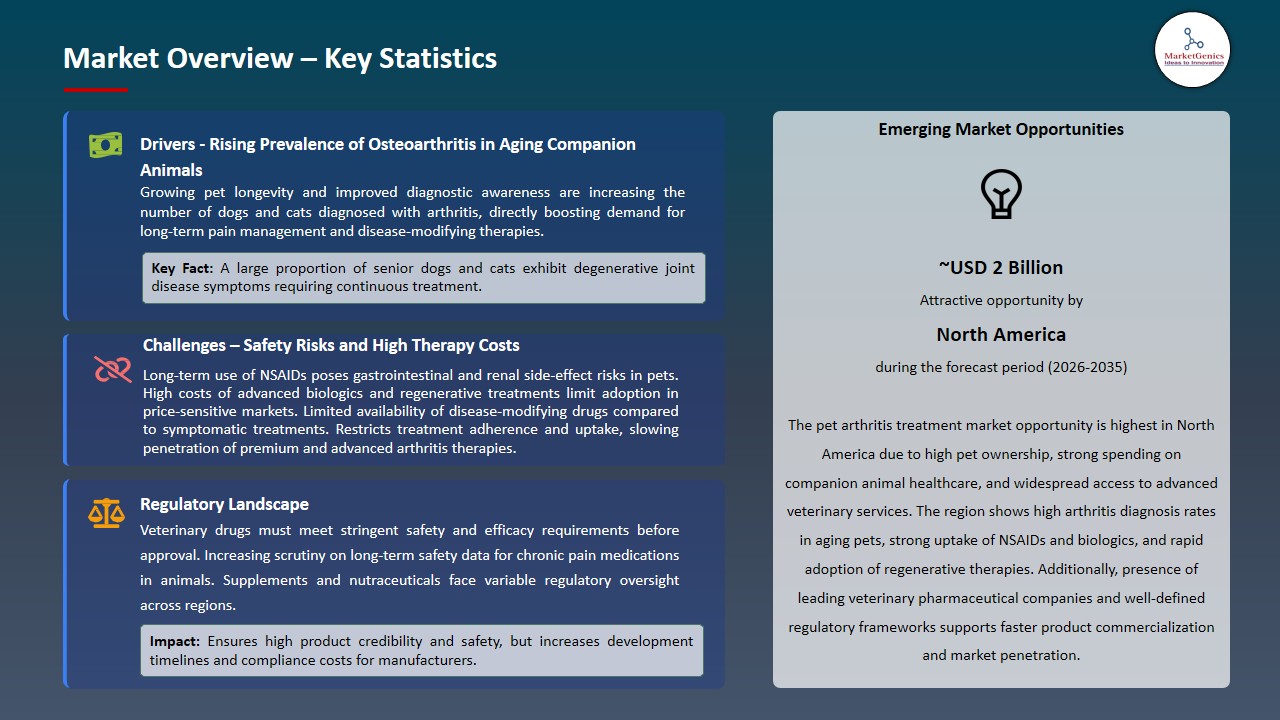
The penetration of pet health insurance is quite low with many owners having to incur the cost of treatment themselves which is a major constraint to the pet arthritis treatment market. Lack of proper coverage of chronic conditions such as arthritis reduces adherence to long term treatment and the use of advanced treatment options with many owners choosing to use simple or temporary treatment of pain rather than the holistic management of arthritis.
- Besides that, there are Strict regulatory demands on veterinary drug and biologic approvals which are considered as a major limitation to the pet arthritis therapeutic market. Long development periods and procedures, geographic compliance requirements, and substantial safety and efficacy data requirements make development more expensive and time consuming. Such regulatory complications may slow down the process of commercialization of innovative arthritis therapies, reduce the speed of launching products, and deter the entry of smaller firms into the market.
- The combination of limited insurance coverage and complex regulatory frameworks restricts affordability, innovation, and timely adoption of new therapies in the pet arthritis treatment market.
Opportunity: Development of Biologics & Regenerative Medicine
-
The pet arthritis treatment market has a great growth potential in the development of biologics and regenerative medicine. New treatment options like monoclonal antibodies, stem cell therapy and platelet-rich plasma (PRP) are disease-modifying, as they are aimed to address the causes of osteoarthritis, and not just treat it by relieving the symptoms.
- These are some of the high-tech therapies that are capable of repairing joints, decreasing inflammation, and improving mobility whose long-term effects will benefit the pets. Veterinary is expected to embrace the use of these therapies as more clinical evidence is provided to prove their safety and efficacy.
- Bioceltix is forecasted to gain its earliest marketing approvals of canine and equine osteoarthritis therapies following successful clinical study of BCX-CM-J and BCX-EM initiatives in 2025. The treatments were very safe and effective and BCX-CM-J is under approval of the EMA. Bioceltix envisions commercializing using strategic distribution agreements, focusing on the increased contribution of regenerative medicine and high-quality biologics to the pet arthritis treatment market.
- This provides business with a chance to diversify their portfolio and win an increasing number of customers need advanced, efficient arthritis care solutions.
Key Trend: Telehealth & Digital Monitoring Tools
-
The use of telehealth and digital monitoring technologies is becoming one of the trends in the market of pet treatment of arthritis. The telemedicine platforms also allow veterinarians to consult with pets remotely, track disease progression, and prescribe treatment plans, without necessarily having to visit the pet owner regularly, which enhances the accessibility of veterinarians.
- Digital tools, such as wearable devices and mobile apps, can track mobility, activity levels, and pain symptoms in pets continuously to give real-time information to streamline the therapy. This is a technology-based intervention that improves early disease detection of exacerbations and allows individualized treatment decisions, fosters the participation of owners, and the further implementation of care plans, which ultimately leads to better clinical outcomes and overall quality of life of pets.
- PetPace grew its AI-powered smart collar system that monitored the vital signs and mobility of cats and pain levels in real time, as well as its collaboration with TelmyVet in Canada allowing Canadians to monitor the vital signs and mobility of their cats remotely. This is combined with the use of telemedicine platforms, which can enable veterinarians to monitor arthritis symptoms, manage treatment plans, and intervene in time.
- Telehealth and AI-driven digital monitoring solutions are revolutionizing pet arthritis care, as these technologies offer ongoing monitoring, patient-centered care, and better treatment results.
Pet-Arthritis-Treatment-Market Analysis and Segmental Data
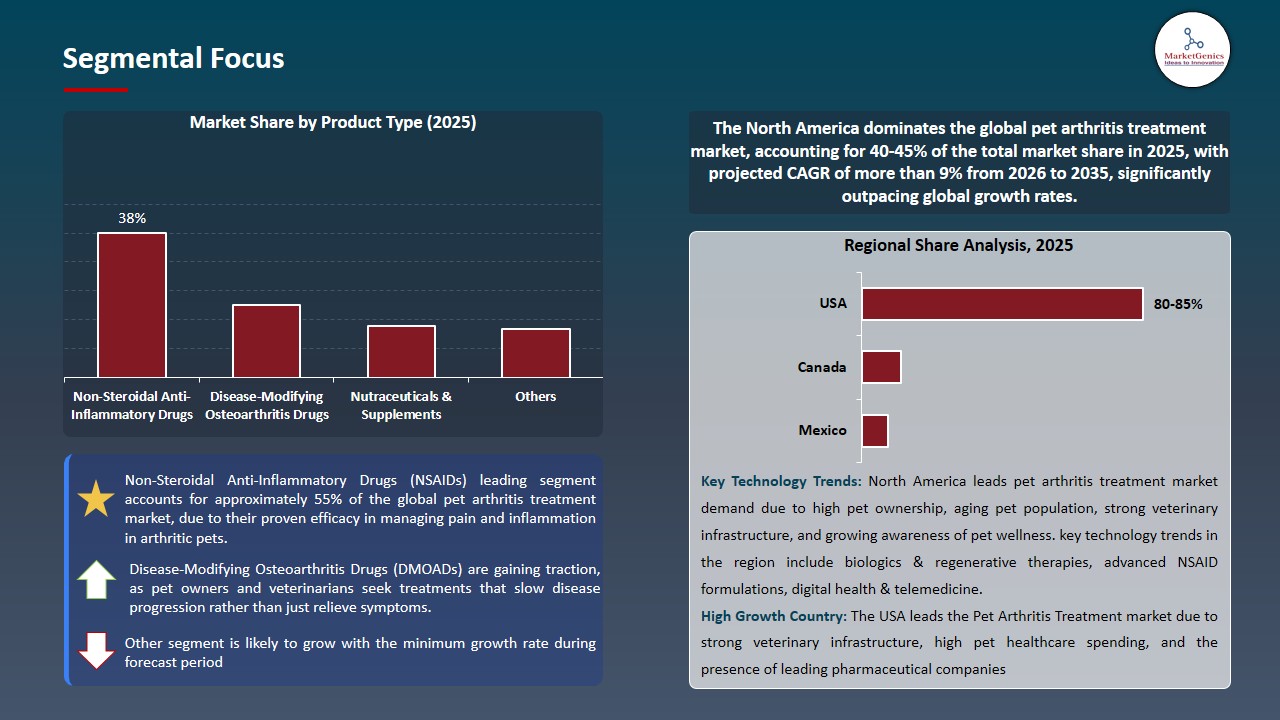
Non-Steroidal Anti-Inflammatory Drugs (NSAIDs) Dominate Global Pet Arthritis Treatment Market
-
Non-steroidal anti-inflammatory drugs (NSAIDs) continue to dominate the global pet arthritis treatment market due to their well-documented efficacy in alleviating pain, reducing inflammation, and improving joint function in both dogs and cats. Veterinarians widely prescribe NSAIDs for managing acute arthritis flare-ups as well as for long-term treatment of chronic conditions like osteoarthritis and other degenerative joint diseases.
- Their proven safety profiles, combined with availability in multiple convenient formulations—including oral tablets, injectables, and topical applications make them highly accessible and adaptable to varying treatment regimens. Compared to advanced biologics or regenerative therapies, NSAIDs are more cost-effective, enhancing their adoption among pet owners globally.
- Furthermore, decades of clinical experience have established NSAIDs as a reliable first-line therapy, reinforcing their central role in companion animal arthritis management. Their sustained clinical use and broad accessibility ensure that NSAIDs remain the cornerstone of pet arthritis care worldwide.
North America Leads Global Pet Arthritis Treatment Market Demand
-
North America remains the largest and most influential region in the global pet arthritis treatment market, driven by high pet ownership rates, increased awareness of animal health, and widespread availability of advanced veterinary care.
- Pet owners in the region increasingly view pets as family members, prompting greater investment in their health and well-being, including early diagnosis and effective management of arthritis. This cultural shift has boosted demand for a range of arthritis treatments, from traditional NSAIDs to advanced biologics and regenerative therapies.
- Additionally, well-established veterinary infrastructure, high disposable incomes, and strong adoption of innovative treatment solutions contribute to North America’s leadership in the market. Advanced awareness campaigns and educational initiatives by veterinarians and animal health companies further encourage proactive arthritis management.
- With increasing prevalence of osteoarthritis among aging pets and growing emphasis on improving quality of life, North America continues to represent the most significant market for pet arthritis therapies, setting trends that influence adoption patterns globally.
- North America’s high pet ownership, advanced veterinary infrastructure, and proactive pet care culture solidify its position as the leading market for pet arthritis treatments globally.
Pet-Arthritis-Treatment-Market Ecosystem
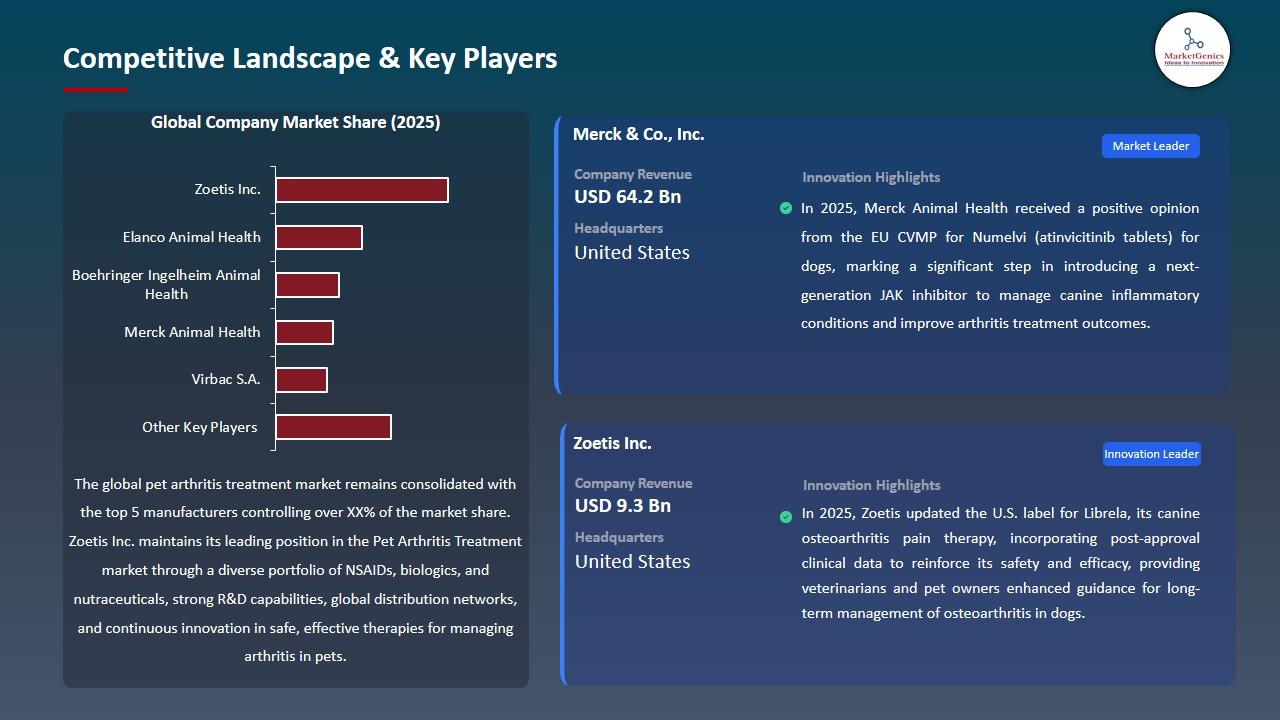
The global pet arthritis treatment market is consolidated, with leading players including Zoetis Inc., Elanco Animal Health, Boehringer Ingelheim Animal Health, Merck Animal Health, and Virbac S.A. These companies maintain competitive advantages through extensive research and development of novel drug formulations, biologics, regenerative therapies, monoclonal antibodies, long-acting pain management solutions, and integrated treatment protocols, as well as through strategic partnerships, robust distribution networks, and veterinary support programs.
The market value chain encompasses discovery and R&D of arthritis therapies, clinical trials and regulatory approvals, manufacturing of pharmaceuticals, biologics, and supplements, development of delivery mechanisms (injectables, oral formulations, or topical treatments), distribution to veterinary clinics and pharmacies, and post-market support including pharmacovigilance, veterinary training, and client education.
Entry barriers are high due to the need for advanced R&D capabilities, extensive clinical testing, compliance with stringent veterinary drug regulations, and investment in distribution and marketing to veterinary professionals and pet owners.
Ongoing innovations such as regenerative medicine, monoclonal antibody therapies, AI-assisted diagnostic and monitoring tools, and personalized integrated treatment plans continue to drive differentiation, adoption, and market growth globally.
Recent Development and Strategic Overview:
-
In February 2025, Zoetis updated the U.S. label for Librela (bedinvetmab injection), a monthly monoclonal antibody therapy for controlling canine osteoarthritis pain, based on post-approval real-world data from over one million treated dogs. The update reflects continued confidence in its safety and effectiveness, highlighting Zoetis’ commitment to supporting veterinarians and pet owners, and exemplifying how biologic therapies are enhancing long-term pain management in the pet arthritis treatment market.
- In November 2025, Allegro NV and American Regent entered an exclusive licensing agreement for Synoglide, a novel injectable hydrogel for treating equine osteoarthritis. Under the deal, American Regent will commercialize Synoglide in the veterinary market globally, with product availability planned for early 2026. The partnership highlights the growing role of innovative nanotechnology-based therapies in advancing arthritis care and expanding treatment options within the pet and equine arthritis treatment market.
Report Scope
|
Detail |
|
|
Market Size in 2025 |
USD 3.5 Bn |
|
Market Forecast Value in 2035 |
USD 7.1 Bn |
|
Growth Rate (CAGR) |
7.4% |
|
Forecast Period |
2026 – 2035 |
|
Historical Data Available for |
2021 – 2024 |
|
Market Size Units |
US$ Billion for Value |
|
Report Format |
Electronic (PDF) + Excel |
|
North America |
Europe |
Asia Pacific |
Middle East |
Africa |
South America |
|
|
|
|
|
|
|
Companies Covered |
|||||
|
|
|
|
|
|
Pet-Arthritis-Treatment-Market Segmentation and Highlights
|
Segment |
Sub-segment |
|
Pet Arthritis Treatment Market, By Product Type |
|
|
Pet Arthritis Treatment Market, By Animal Type |
|
|
Pet Arthritis Treatment Market, By Route of Administration |
|
|
Pet Arthritis Treatment Market, By Distribution Channel |
|
|
Pet Arthritis Treatment Market, By Treatment Stage |
|
|
Pet Arthritis Treatment Market, By Therapy Type |
|
|
Pet Arthritis Treatment Market, By Prescription Type |
|
|
Pet Arthritis Treatment Market, By End-use |
|
Frequently Asked Questions
Table of Contents
- 1. Research Methodology and Assumptions
- 1.1. Definitions
- 1.2. Research Design and Approach
- 1.3. Data Collection Methods
- 1.4. Base Estimates and Calculations
- 1.5. Forecasting Models
- 1.5.1. Key Forecast Factors & Impact Analysis
- 1.6. Secondary Research
- 1.6.1. Open Sources
- 1.6.2. Paid Databases
- 1.6.3. Associations
- 1.7. Primary Research
- 1.7.1. Primary Sources
- 1.7.2. Primary Interviews with Stakeholders across Ecosystem
- 2. Executive Summary
- 2.1. Global Pet Arthritis Treatment Market Outlook
- 2.1.1. Pet Arthritis Treatment Market Size Value (US$ Bn), and Forecasts, 2021-2035
- 2.1.2. Compounded Annual Growth Rate Analysis
- 2.1.3. Growth Opportunity Analysis
- 2.1.4. Segmental Share Analysis
- 2.1.5. Geographical Share Analysis
- 2.2. Market Analysis and Facts
- 2.3. Supply-Demand Analysis
- 2.4. Competitive Benchmarking
- 2.5. Go-to- Market Strategy
- 2.5.1. Customer/ End-use Industry Assessment
- 2.5.2. Growth Opportunity Data, 2026-2035
- 2.5.2.1. Regional Data
- 2.5.2.2. Country Data
- 2.5.2.3. Segmental Data
- 2.5.3. Identification of Potential Market Spaces
- 2.5.4. GAP Analysis
- 2.5.5. Potential Attractive Price Points
- 2.5.6. Prevailing Market Risks & Challenges
- 2.5.7. Preferred Sales & Marketing Strategies
- 2.5.8. Key Recommendations and Analysis
- 2.5.9. A Way Forward
- 2.1. Global Pet Arthritis Treatment Market Outlook
- 3. Industry Data and Premium Insights
- 3.1. Global Healthcare & Pharmaceutical Industry Overview, 2025
- 3.1.1. Healthcare & Pharmaceutical Industry Ecosystem Analysis
- 3.1.2. Key Trends for Healthcare & Pharmaceutical Industry
- 3.1.3. Regional Distribution for Healthcare & Pharmaceutical Industry
- 3.2. Supplier Customer Data
- 3.3. Technology Roadmap and Developments
- 3.4. Trade Analysis
- 3.4.1. Import & Export Analysis, 2025
- 3.4.2. Top Importing Countries
- 3.4.3. Top Exporting Countries
- 3.5. Trump Tariff Impact Analysis
- 3.5.1. Manufacturer
- 3.5.1.1. Based on the component & Raw material
- 3.5.2. Supply Chain
- 3.5.3. End Consumer
- 3.5.1. Manufacturer
- 3.6. Raw Material Analysis
- 3.1. Global Healthcare & Pharmaceutical Industry Overview, 2025
- 4. Market Overview
- 4.1. Market Dynamics
- 4.1.1. Drivers
- 4.1.1.1. Rising prevalence of osteoarthritis in aging companion animals
- 4.1.1.2. Increasing pet healthcare spending and humanization of pets
- 4.1.1.3. Growing availability of advanced therapies such as biologics and regenerative treatments
- 4.1.2. Restraints
- 4.1.2.1. Safety concerns associated with long-term NSAID use
- 4.1.2.2. High cost of advanced and regenerative arthritis therapies
- 4.1.1. Drivers
- 4.2. Key Trend Analysis
- 4.3. Regulatory Framework
- 4.3.1. Key Regulations, Norms, and Subsidies, by Key Countries
- 4.3.2. Tariffs and Standards
- 4.3.3. Impact Analysis of Regulations on the Market
- 4.4. Value Chain Analysis
- 4.4.1. Raw Material Suppliers
- 4.4.2. Active Pharmaceutical Ingredient (API) Manufacturers
- 4.4.3. Distribution Channels
- 4.4.4. Pet Owners / End Users
- 4.5. Porter’s Five Forces Analysis
- 4.6. PESTEL Analysis
- 4.7. Global Pet Arthritis Treatment Market Demand
- 4.7.1. Historical Market Size – Value (US$ Bn), 2020-2024
- 4.7.2. Current and Future Market Size – Value (US$ Bn), 2026–2035
- 4.7.2.1. Y-o-Y Growth Trends
- 4.7.2.2. Absolute $ Opportunity Assessment
- 4.1. Market Dynamics
- 5. Competition Landscape
- 5.1. Competition structure
- 5.1.1. Fragmented v/s consolidated
- 5.2. Company Share Analysis, 2025
- 5.2.1. Global Company Market Share
- 5.2.2. By Region
- 5.2.2.1. North America
- 5.2.2.2. Europe
- 5.2.2.3. Asia Pacific
- 5.2.2.4. Middle East
- 5.2.2.5. Africa
- 5.2.2.6. South America
- 5.3. Product Comparison Matrix
- 5.3.1. Specifications
- 5.3.2. Market Positioning
- 5.3.3. Pricing
- 5.1. Competition structure
- 6. Global Pet Arthritis Treatment Market Analysis, by Product Type
- 6.1. Key Segment Analysis
- 6.2. Pet Arthritis Treatment Market Size Value (US$ Bn), Analysis, and Forecasts, by Product Type, 2021-2035
- 6.2.1. Non-Steroidal Anti-Inflammatory Drugs (NSAIDs)
- 6.2.1.1. COX-2 Selective Inhibitors
- 6.2.1.2. Non-Selective NSAIDs
- 6.2.2. Disease-Modifying Osteoarthritis Drugs (DMOADs)
- 6.2.2.1. Chondroprotective Agents
- 6.2.2.2. Regenerative Medicine Products
- 6.2.3. Nutraceuticals & Supplements
- 6.2.3.1. Glucosamine-based Products
- 6.2.3.2. Chondroitin Sulfate Products
- 6.2.3.3. Omega-3 Fatty Acids
- 6.2.3.4. Combination Supplements
- 6.2.4. Corticosteroids
- 6.2.4.1. Injectable Formulations
- 6.2.4.2. Oral Formulations
- 6.2.5. Viscosupplementation Products
- 6.2.5.1. Hyaluronic Acid Injections
- 6.2.5.2. Polysulfated Glycosaminoglycans
- 6.2.6. Physical Therapy Devices
- 6.2.6.1. Laser Therapy Equipment
- 6.2.6.2. Ultrasound Therapy Devices
- 6.2.6.3. Electromagnetic Field Therapy Devices
- 6.2.1. Non-Steroidal Anti-Inflammatory Drugs (NSAIDs)
- 7. Global Pet Arthritis Treatment Market Analysis, by Animal Type
- 7.1. Key Segment Analysis
- 7.2. Pet Arthritis Treatment Market Size Value (US$ Bn), Analysis, and Forecasts, by Animal Type, 2021-2035
- 7.2.1. Dogs
- 7.2.1.1. Small Breeds (<25 lbs)
- 7.2.1.2. Medium Breeds (25-50 lbs)
- 7.2.1.3. Large Breeds (>50 lbs)
- 7.2.2. Cats
- 7.2.3. Horses
- 7.2.4. Other Companion Animals
- 7.2.1. Dogs
- 8. Global Pet Arthritis Treatment Market Analysis, by Route of Administration
- 8.1. Key Segment Analysis
- 8.2. Pet Arthritis Treatment Market Size Value (US$ Bn), Analysis, and Forecasts, by Route of Administration, 2021-2035
- 8.2.1. Oral
- 8.2.1.1. Tablets
- 8.2.1.2. Capsules
- 8.2.1.3. Chewables
- 8.2.1.4. Liquids/Suspensions
- 8.2.1.5. Others
- 8.2.2. Injectable
- 8.2.2.1. Intravenous
- 8.2.2.2. Intramuscular
- 8.2.2.3. Intra-articular
- 8.2.2.4. Subcutaneous
- 8.2.3. Topical
- 8.2.3.1. Creams
- 8.2.3.2. Gels
- 8.2.3.3. Sprays
- 8.2.3.4. Others
- 8.2.1. Oral
- 9. Global Pet Arthritis Treatment Market Analysis, by Distribution Channel
- 9.1. Key Segment Analysis
- 9.2. Pet Arthritis Treatment Market Size Value (US$ Bn), Analysis, and Forecasts, by Distribution Channel, 2021-2035
- 9.2.1. Veterinary Hospitals & Clinics
- 9.2.1.1. Specialty Veterinary Centers
- 9.2.1.2. General Practice Clinics
- 9.2.2. Veterinary Pharmacies
- 9.2.2.1. Independent Pharmacies
- 9.2.2.2. Chain Pharmacies
- 9.2.3. Online Pharmacies & E-commerce Platforms
- 9.2.4. Retail Stores
- 9.2.4.1. Pet Specialty Stores
- 9.2.4.2. Mass Merchandisers
- 9.2.4.3. Supermarkets
- 9.2.1. Veterinary Hospitals & Clinics
- 10. Global Pet Arthritis Treatment Market Analysis, by Treatment Stage
- 10.1. Key Segment Analysis
- 10.2. Pet Arthritis Treatment Market Size Value (US$ Bn), Analysis, and Forecasts, by Treatment Stage, 2021-2035
- 10.2.1. Acute Treatment
- 10.2.2. Chronic Management
- 10.2.3. Preventive Care
- 10.2.4. Post-Surgical Recovery
- 11. Global Pet Arthritis Treatment Market Analysis, by Therapy Type
- 11.1. Key Segment Analysis
- 11.2. Pet Arthritis Treatment Market Size Value (US$ Bn), Analysis, and Forecasts, by Therapy Type, 2021-2035
- 11.2.1. Monotherapy
- 11.2.2. Combination Therapy
- 11.2.2.1. Drug-Drug Combinations
- 11.2.2.2. Drug-Device Combinations
- 11.2.2.3. Integrative Therapy Approaches
- 12. Global Pet Arthritis Treatment Market Analysis, by Prescription Type
- 12.1. Key Segment Analysis
- 12.2. Pet Arthritis Treatment Market Size Value (US$ Bn), Analysis, and Forecasts, by Prescription Type, 2021-2035
- 12.2.1. Prescription-Only Medications
- 12.2.2. Over-the-Counter (OTC) Products
- 12.2.3. Veterinary Feed Directive (VFD) Products
- 13. Global Pet Arthritis Treatment Market Analysis and Forecasts, by Distribution Channel
- 13.1. Key Findings
- 13.2. Pet Arthritis Treatment Market Size Value (US$ Bn), Analysis, and Forecasts, by End-use, 2021-2035
- 13.2.1. Veterinary Healthcare Services
- 13.2.2. Veterinary Pharmaceuticals
- 13.2.3. Animal Nutrition & Supplement
- 13.2.4. Veterinary Medical Devices
- 13.2.5. Pet Insurance
- 13.2.6. Animal Research & Development
- 13.2.7. Others
- 14. Global Pet Arthritis Treatment Market Analysis and Forecasts, by Region
- 14.1. Key Findings
- 14.2. Pet Arthritis Treatment Market Size Value (US$ Bn), Analysis, and Forecasts, by Region, 2021-2035
- 14.2.1. North America
- 14.2.2. Europe
- 14.2.3. Asia Pacific
- 14.2.4. Middle East
- 14.2.5. Africa
- 14.2.6. South America
- 15. North America Pet Arthritis Treatment Market Analysis
- 15.1. Key Segment Analysis
- 15.2. Regional Snapshot
- 15.3. North America Pet Arthritis Treatment Market Size Value (US$ Bn), Analysis, and Forecasts, 2021-2035
- 15.3.1. Product Type
- 15.3.2. Animal Type
- 15.3.3. Route of Administration
- 15.3.4. Distribution Channel
- 15.3.5. Treatment Stage
- 15.3.6. Therapy Type
- 15.3.7. Prescription Type
- 15.3.8. End-use
- 15.3.9. Country
- 15.3.9.1. USA
- 15.3.9.2. Canada
- 15.3.9.3. Mexico
- 15.4. USA Pet Arthritis Treatment Market
- 15.4.1. Country Segmental Analysis
- 15.4.2. Product Type
- 15.4.3. Animal Type
- 15.4.4. Route of Administration
- 15.4.5. Distribution Channel
- 15.4.6. Treatment Stage
- 15.4.7. Therapy Type
- 15.4.8. Prescription Type
- 15.4.9. End-use
- 15.5. Canada Pet Arthritis Treatment Market
- 15.5.1. Country Segmental Analysis
- 15.5.2. Product Type
- 15.5.3. Animal Type
- 15.5.4. Route of Administration
- 15.5.5. Distribution Channel
- 15.5.6. Treatment Stage
- 15.5.7. Therapy Type
- 15.5.8. Prescription Type
- 15.5.9. End-use
- 15.6. Mexico Pet Arthritis Treatment Market
- 15.6.1. Country Segmental Analysis
- 15.6.2. Product Type
- 15.6.3. Animal Type
- 15.6.4. Route of Administration
- 15.6.5. Distribution Channel
- 15.6.6. Treatment Stage
- 15.6.7. Therapy Type
- 15.6.8. Prescription Type
- 15.6.9. End-use
- 16. Europe Pet Arthritis Treatment Market Analysis
- 16.1. Key Segment Analysis
- 16.2. Regional Snapshot
- 16.3. Europe Pet Arthritis Treatment Market Size Value (US$ Bn), Analysis, and Forecasts, 2021-2035
- 16.3.1. Monitoring Type
- 16.3.2. Product Type
- 16.3.3. Animal Type
- 16.3.4. Route of Administration
- 16.3.5. Distribution Channel
- 16.3.6. Treatment Stage
- 16.3.7. Therapy Type
- 16.3.8. Prescription Type
- 16.3.9. End-use
- 16.3.10. Country
- 16.3.10.1. Germany
- 16.3.10.2. United Kingdom
- 16.3.10.3. France
- 16.3.10.4. Italy
- 16.3.10.5. Spain
- 16.3.10.6. Netherlands
- 16.3.10.7. Nordic Countries
- 16.3.10.8. Poland
- 16.3.10.9. Russia & CIS
- 16.3.10.10. Rest of Europe
- 16.4. Germany Pet Arthritis Treatment Market
- 16.4.1. Country Segmental Analysis
- 16.4.2. Product Type
- 16.4.3. Animal Type
- 16.4.4. Route of Administration
- 16.4.5. Distribution Channel
- 16.4.6. Treatment Stage
- 16.4.7. Therapy Type
- 16.4.8. Prescription Type
- 16.4.9. End-use
- 16.5. United Kingdom Pet Arthritis Treatment Market
- 16.5.1. Country Segmental Analysis
- 16.5.2. Product Type
- 16.5.3. Animal Type
- 16.5.4. Route of Administration
- 16.5.5. Distribution Channel
- 16.5.6. Treatment Stage
- 16.5.7. Therapy Type
- 16.5.8. Prescription Type
- 16.5.9. End-use
- 16.6. France Pet Arthritis Treatment Market
- 16.6.1. Country Segmental Analysis
- 16.6.2. Product Type
- 16.6.3. Animal Type
- 16.6.4. Route of Administration
- 16.6.5. Distribution Channel
- 16.6.6. Treatment Stage
- 16.6.7. Therapy Type
- 16.6.8. Prescription Type
- 16.6.9. End-use
- 16.7. Italy Pet Arthritis Treatment Market
- 16.7.1. Country Segmental Analysis
- 16.7.2. Product Type
- 16.7.3. Animal Type
- 16.7.4. Route of Administration
- 16.7.5. Distribution Channel
- 16.7.6. Treatment Stage
- 16.7.7. Therapy Type
- 16.7.8. Prescription Type
- 16.7.9. End-use
- 16.8. Spain Pet Arthritis Treatment Market
- 16.8.1. Country Segmental Analysis
- 16.8.2. Product Type
- 16.8.3. Animal Type
- 16.8.4. Route of Administration
- 16.8.5. Distribution Channel
- 16.8.6. Treatment Stage
- 16.8.7. Therapy Type
- 16.8.8. Prescription Type
- 16.8.9. End-use
- 16.9. Netherlands Pet Arthritis Treatment Market
- 16.9.1. Country Segmental Analysis
- 16.9.2. Product Type
- 16.9.3. Animal Type
- 16.9.4. Route of Administration
- 16.9.5. Distribution Channel
- 16.9.6. Treatment Stage
- 16.9.7. Therapy Type
- 16.9.8. Prescription Type
- 16.9.9. End-use
- 16.10. Nordic Countries Pet Arthritis Treatment Market
- 16.10.1. Country Segmental Analysis
- 16.10.2. Product Type
- 16.10.3. Animal Type
- 16.10.4. Route of Administration
- 16.10.5. Distribution Channel
- 16.10.6. Treatment Stage
- 16.10.7. Therapy Type
- 16.10.8. Prescription Type
- 16.10.9. End-use
- 16.11. Poland Pet Arthritis Treatment Market
- 16.11.1. Country Segmental Analysis
- 16.11.2. Product Type
- 16.11.3. Animal Type
- 16.11.4. Route of Administration
- 16.11.5. Distribution Channel
- 16.11.6. Treatment Stage
- 16.11.7. Therapy Type
- 16.11.8. Prescription Type
- 16.11.9. End-use
- 16.12. Russia & CIS Pet Arthritis Treatment Market
- 16.12.1. Country Segmental Analysis
- 16.12.2. Product Type
- 16.12.3. Animal Type
- 16.12.4. Route of Administration
- 16.12.5. Distribution Channel
- 16.12.6. Treatment Stage
- 16.12.7. Therapy Type
- 16.12.8. Prescription Type
- 16.12.9. End-use
- 16.13. Rest of Europe Pet Arthritis Treatment Market
- 16.13.1. Country Segmental Analysis
- 16.13.2. Product Type
- 16.13.3. Animal Type
- 16.13.4. Route of Administration
- 16.13.5. Distribution Channel
- 16.13.6. Treatment Stage
- 16.13.7. Therapy Type
- 16.13.8. Prescription Type
- 16.13.9. End-use
- 17. Asia Pacific Pet Arthritis Treatment Market Analysis
- 17.1. Key Segment Analysis
- 17.2. Regional Snapshot
- 17.3. Asia Pacific Pet Arthritis Treatment Market Size Value (US$ Bn), Analysis, and Forecasts, 2021-2035
- 17.3.1. Product Type
- 17.3.2. Animal Type
- 17.3.3. Route of Administration
- 17.3.4. Distribution Channel
- 17.3.5. Treatment Stage
- 17.3.6. Therapy Type
- 17.3.7. Prescription Type
- 17.3.8. End-use
- 17.3.9. Country
- 17.3.9.1. China
- 17.3.9.2. India
- 17.3.9.3. Japan
- 17.3.9.4. South Korea
- 17.3.9.5. Australia and New Zealand
- 17.3.9.6. Indonesia
- 17.3.9.7. Malaysia
- 17.3.9.8. Thailand
- 17.3.9.9. Vietnam
- 17.3.9.10. Rest of Asia Pacific
- 17.4. China Pet Arthritis Treatment Market
- 17.4.1. Country Segmental Analysis
- 17.4.2. Product Type
- 17.4.3. Animal Type
- 17.4.4. Route of Administration
- 17.4.5. Distribution Channel
- 17.4.6. Treatment Stage
- 17.4.7. Therapy Type
- 17.4.8. Prescription Type
- 17.4.9. End-use
- 17.5. India Pet Arthritis Treatment Market
- 17.5.1. Country Segmental Analysis
- 17.5.2. Product Type
- 17.5.3. Animal Type
- 17.5.4. Route of Administration
- 17.5.5. Distribution Channel
- 17.5.6. Treatment Stage
- 17.5.7. Therapy Type
- 17.5.8. Prescription Type
- 17.5.9. End-use
- 17.6. Japan Pet Arthritis Treatment Market
- 17.6.1. Country Segmental Analysis
- 17.6.2. Product Type
- 17.6.3. Animal Type
- 17.6.4. Route of Administration
- 17.6.5. Distribution Channel
- 17.6.6. Treatment Stage
- 17.6.7. Therapy Type
- 17.6.8. Prescription Type
- 17.6.9. End-use
- 17.7. South Korea Pet Arthritis Treatment Market
- 17.7.1. Country Segmental Analysis
- 17.7.2. Product Type
- 17.7.3. Animal Type
- 17.7.4. Route of Administration
- 17.7.5. Distribution Channel
- 17.7.6. Treatment Stage
- 17.7.7. Therapy Type
- 17.7.8. Prescription Type
- 17.7.9. End-use
- 17.8. Australia and New Zealand Pet Arthritis Treatment Market
- 17.8.1. Country Segmental Analysis
- 17.8.2. Product Type
- 17.8.3. Animal Type
- 17.8.4. Route of Administration
- 17.8.5. Distribution Channel
- 17.8.6. Treatment Stage
- 17.8.7. Therapy Type
- 17.8.8. Prescription Type
- 17.8.9. End-use
- 17.9. Indonesia Pet Arthritis Treatment Market
- 17.9.1. Country Segmental Analysis
- 17.9.2. Product Type
- 17.9.3. Animal Type
- 17.9.4. Route of Administration
- 17.9.5. Distribution Channel
- 17.9.6. Treatment Stage
- 17.9.7. Therapy Type
- 17.9.8. Prescription Type
- 17.9.9. End-use
- 17.10. Malaysia Pet Arthritis Treatment Market
- 17.10.1. Country Segmental Analysis
- 17.10.2. Product Type
- 17.10.3. Animal Type
- 17.10.4. Route of Administration
- 17.10.5. Distribution Channel
- 17.10.6. Treatment Stage
- 17.10.7. Therapy Type
- 17.10.8. Prescription Type
- 17.10.9. End-use
- 17.11. Thailand Pet Arthritis Treatment Market
- 17.11.1. Country Segmental Analysis
- 17.11.2. Product Type
- 17.11.3. Animal Type
- 17.11.4. Route of Administration
- 17.11.5. Distribution Channel
- 17.11.6. Treatment Stage
- 17.11.7. Therapy Type
- 17.11.8. Prescription Type
- 17.11.9. End-use
- 17.12. Vietnam Pet Arthritis Treatment Market
- 17.12.1. Country Segmental Analysis
- 17.12.2. Product Type
- 17.12.3. Animal Type
- 17.12.4. Route of Administration
- 17.12.5. Distribution Channel
- 17.12.6. Treatment Stage
- 17.12.7. Therapy Type
- 17.12.8. Prescription Type
- 17.12.9. End-use
- 17.13. Rest of Asia Pacific Pet Arthritis Treatment Market
- 17.13.1. Country Segmental Analysis
- 17.13.2. Product Type
- 17.13.3. Animal Type
- 17.13.4. Route of Administration
- 17.13.5. Distribution Channel
- 17.13.6. Treatment Stage
- 17.13.7. Therapy Type
- 17.13.8. Prescription Type
- 17.13.9. End-use
- 18. Middle East Pet Arthritis Treatment Market Analysis
- 18.1. Key Segment Analysis
- 18.2. Regional Snapshot
- 18.3. Middle East Pet Arthritis Treatment Market Size Value (US$ Bn), Analysis, and Forecasts, 2021-2035
- 18.3.1. Product Type
- 18.3.2. Animal Type
- 18.3.3. Route of Administration
- 18.3.4. Distribution Channel
- 18.3.5. Treatment Stage
- 18.3.6. Therapy Type
- 18.3.7. Prescription Type
- 18.3.8. End-use
- 18.3.9. Country
- 18.3.9.1. Turkey
- 18.3.9.2. UAE
- 18.3.9.3. Saudi Arabia
- 18.3.9.4. Israel
- 18.3.9.5. Rest of Middle East
- 18.4. Turkey Pet Arthritis Treatment Market
- 18.4.1. Country Segmental Analysis
- 18.4.2. Product Type
- 18.4.3. Animal Type
- 18.4.4. Route of Administration
- 18.4.5. Distribution Channel
- 18.4.6. Treatment Stage
- 18.4.7. Therapy Type
- 18.4.8. Prescription Type
- 18.4.9. End-use
- 18.5. UAE Pet Arthritis Treatment Market
- 18.5.1. Country Segmental Analysis
- 18.5.2. Product Type
- 18.5.3. Animal Type
- 18.5.4. Route of Administration
- 18.5.5. Distribution Channel
- 18.5.6. Treatment Stage
- 18.5.7. Therapy Type
- 18.5.8. Prescription Type
- 18.5.9. End-use
- 18.6. Saudi Arabia Pet Arthritis Treatment Market
- 18.6.1. Country Segmental Analysis
- 18.6.2. Product Type
- 18.6.3. Animal Type
- 18.6.4. Route of Administration
- 18.6.5. Distribution Channel
- 18.6.6. Treatment Stage
- 18.6.7. Therapy Type
- 18.6.8. Prescription Type
- 18.6.9. End-use
- 18.7. Israel Pet Arthritis Treatment Market
- 18.7.1. Country Segmental Analysis
- 18.7.2. Product Type
- 18.7.3. Animal Type
- 18.7.4. Route of Administration
- 18.7.5. Distribution Channel
- 18.7.6. Treatment Stage
- 18.7.7. Therapy Type
- 18.7.8. Prescription Type
- 18.7.9. End-use
- 18.8. Rest of Middle East Pet Arthritis Treatment Market
- 18.8.1. Country Segmental Analysis
- 18.8.2. Product Type
- 18.8.3. Animal Type
- 18.8.4. Route of Administration
- 18.8.5. Distribution Channel
- 18.8.6. Treatment Stage
- 18.8.7. Therapy Type
- 18.8.8. Prescription Type
- 18.8.9. End-use
- 19. Africa Pet Arthritis Treatment Market Analysis
- 19.1. Key Segment Analysis
- 19.2. Regional Snapshot
- 19.3. Africa Pet Arthritis Treatment Market Size Value (US$ Bn), Analysis, and Forecasts, 2021-2035
- 19.3.1. Product Type
- 19.3.2. Animal Type
- 19.3.3. Route of Administration
- 19.3.4. Distribution Channel
- 19.3.5. Treatment Stage
- 19.3.6. Therapy Type
- 19.3.7. Prescription Type
- 19.3.8. End-use
- 19.3.9. Country
- 19.3.9.1. South Africa
- 19.3.9.2. Egypt
- 19.3.9.3. Nigeria
- 19.3.9.4. Algeria
- 19.3.9.5. Rest of Africa
- 19.4. South Africa Pet Arthritis Treatment Market
- 19.4.1. Country Segmental Analysis
- 19.4.2. Product Type
- 19.4.3. Animal Type
- 19.4.4. Route of Administration
- 19.4.5. Distribution Channel
- 19.4.6. Treatment Stage
- 19.4.7. Therapy Type
- 19.4.8. Prescription Type
- 19.4.9. End-use
- 19.5. Egypt Pet Arthritis Treatment Market
- 19.5.1. Country Segmental Analysis
- 19.5.2. Product Type
- 19.5.3. Animal Type
- 19.5.4. Route of Administration
- 19.5.5. Distribution Channel
- 19.5.6. Treatment Stage
- 19.5.7. Therapy Type
- 19.5.8. Prescription Type
- 19.5.9. End-use
- 19.6. Nigeria Pet Arthritis Treatment Market
- 19.6.1. Country Segmental Analysis
- 19.6.2. Product Type
- 19.6.3. Animal Type
- 19.6.4. Route of Administration
- 19.6.5. Distribution Channel
- 19.6.6. Treatment Stage
- 19.6.7. Therapy Type
- 19.6.8. Prescription Type
- 19.6.9. End-use
- 19.7. Algeria Pet Arthritis Treatment Market
- 19.7.1. Country Segmental Analysis
- 19.7.2. Product Type
- 19.7.3. Animal Type
- 19.7.4. Route of Administration
- 19.7.5. Distribution Channel
- 19.7.6. Treatment Stage
- 19.7.7. Therapy Type
- 19.7.8. Prescription Type
- 19.7.9. End-use
- 19.8. Rest of Africa Pet Arthritis Treatment Market
- 19.8.1. Country Segmental Analysis
- 19.8.2. Product Type
- 19.8.3. Animal Type
- 19.8.4. Route of Administration
- 19.8.5. Distribution Channel
- 19.8.6. Treatment Stage
- 19.8.7. Therapy Type
- 19.8.8. Prescription Type
- 19.8.9. End-use
- 20. South America Pet Arthritis Treatment Market Analysis
- 20.1. Key Segment Analysis
- 20.2. Regional Snapshot
- 20.3. South America Pet Arthritis Treatment Market Size Value (US$ Bn), Analysis, and Forecasts, 2021-2035
- 20.3.1. Product Type
- 20.3.2. Animal Type
- 20.3.3. Route of Administration
- 20.3.4. Distribution Channel
- 20.3.5. Treatment Stage
- 20.3.6. Therapy Type
- 20.3.7. Prescription Type
- 20.3.8. End-use
- 20.3.9. Country
- 20.3.9.1. Brazil
- 20.3.9.2. Argentina
- 20.3.9.3. Rest of South America
- 20.4. Brazil Pet Arthritis Treatment Market
- 20.4.1. Country Segmental Analysis
- 20.4.2. Product Type
- 20.4.3. Animal Type
- 20.4.4. Route of Administration
- 20.4.5. Distribution Channel
- 20.4.6. Treatment Stage
- 20.4.7. Therapy Type
- 20.4.8. Prescription Type
- 20.4.9. End-use
- 20.5. Argentina Pet Arthritis Treatment Market
- 20.5.1. Country Segmental Analysis
- 20.5.2. Product Type
- 20.5.3. Animal Type
- 20.5.4. Route of Administration
- 20.5.5. Distribution Channel
- 20.5.6. Treatment Stage
- 20.5.7. Therapy Type
- 20.5.8. Prescription Type
- 20.5.9. End-use
- 20.6. Rest of South America Pet Arthritis Treatment Market
- 20.6.1. Country Segmental Analysis
- 20.6.2. Product Type
- 20.6.3. Animal Type
- 20.6.4. Route of Administration
- 20.6.5. Distribution Channel
- 20.6.6. Treatment Stage
- 20.6.7. Therapy Type
- 20.6.8. Prescription Type
- 20.6.9. End-use
- 21. Key Players/ Company Profile
- 21.1. Adequan (American Regent Animal Health)
- 21.1.1. Company Details/ Overview
- 21.1.2. Company Financials
- 21.1.3. Key Customers and Competitors
- 21.1.4. Business/ Industry Portfolio
- 21.1.5. Product Portfolio/ Specification Details
- 21.1.6. Pricing Data
- 21.1.7. Strategic Overview
- 21.1.8. Recent Developments
- 21.2. Boehringer Ingelheim Animal Health
- 21.3. Ceva Santé Animale
- 21.4. Chanelle Pharma
- 21.5. Dechra Pharmaceuticals PLC
- 21.6. Elanco Animal Health
- 21.7. Kindred Biosciences Inc.
- 21.8. Merck Animal Health
- 21.9. Nexvet Biopharma
- 21.10. Norbrook Laboratories Limited
- 21.11. Nutramax Laboratories Veterinary Sciences
- 21.12. VetGen Pharmaceuticals
- 21.13. Vetoquinol S.A.
- 21.14. Virbac S.A.
- 21.15. Zoetis Inc.
- 21.16. Other Key Players
- 21.1. Adequan (American Regent Animal Health)
Note* - This is just tentative list of players. While providing the report, we will cover more number of players based on their revenue and share for each geography
Research Design
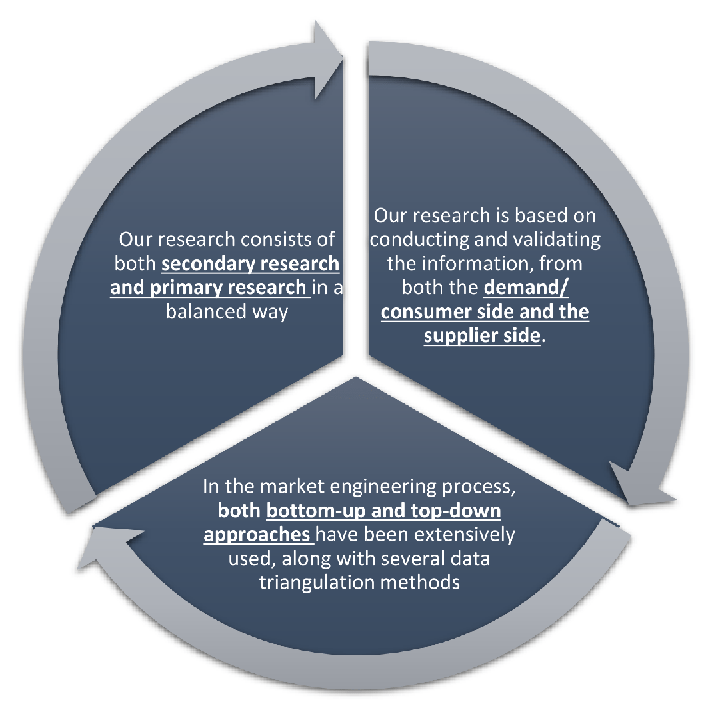
Our research design integrates both demand-side and supply-side analysis through a balanced combination of primary and secondary research methodologies. By utilizing both bottom-up and top-down approaches alongside rigorous data triangulation methods, we deliver robust market intelligence that supports strategic decision-making.
MarketGenics' comprehensive research design framework ensures the delivery of accurate, reliable, and actionable market intelligence. Through the integration of multiple research approaches, rigorous validation processes, and expert analysis, we provide our clients with the insights needed to make informed strategic decisions and capitalize on market opportunities.
MarketGenics leverages a dedicated industry panel of experts and a comprehensive suite of paid databases to effectively collect, consolidate, and analyze market intelligence.
Our approach has consistently proven to be reliable and effective in generating accurate market insights, identifying key industry trends, and uncovering emerging business opportunities.
Through both primary and secondary research, we capture and analyze critical company-level data such as manufacturing footprints, including technical centers, R&D facilities, sales offices, and headquarters.
Our expert panel further enhances our ability to estimate market size for specific brands based on validated field-level intelligence.
Our data mining techniques incorporate both parametric and non-parametric methods, allowing for structured data collection, sorting, processing, and cleaning.
Demand projections are derived from large-scale data sets analyzed through proprietary algorithms, culminating in robust and reliable market sizing.
Research Approach
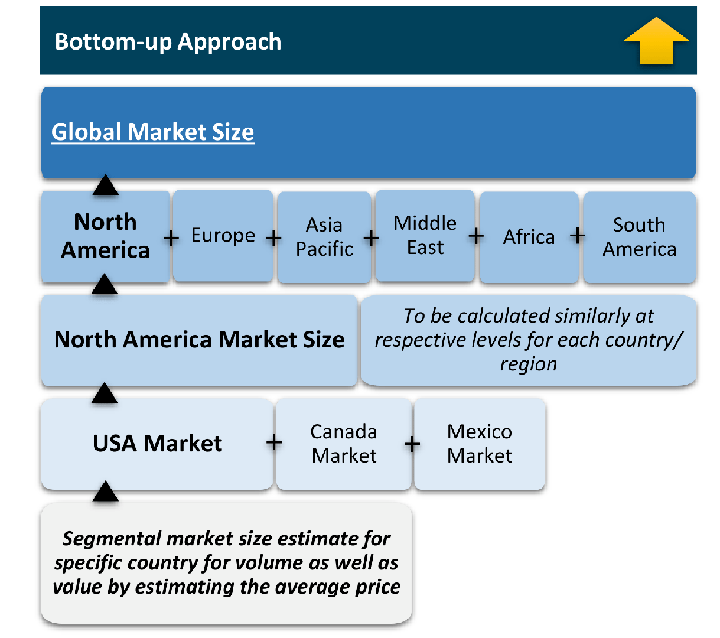
The bottom-up approach builds market estimates by starting with the smallest addressable market units and systematically aggregating them to create comprehensive market size projections.
This method begins with specific, granular data points and builds upward to create the complete market landscape.
Customer Analysis → Segmental Analysis → Geographical Analysis
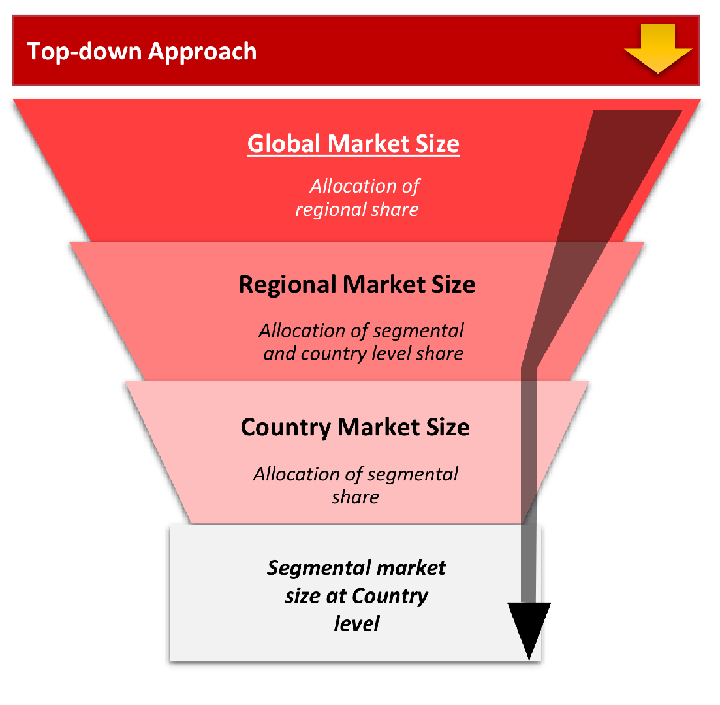
The top-down approach starts with the broadest possible market data and systematically narrows it down through a series of filters and assumptions to arrive at specific market segments or opportunities.
This method begins with the big picture and works downward to increasingly specific market slices.
TAM → SAM → SOM
Research Methods
Desk / Secondary Research
While analysing the market, we extensively study secondary sources, directories, and databases to identify and collect information useful for this technical, market-oriented, and commercial report. Secondary sources that we utilize are not only the public sources, but it is a combination of Open Source, Associations, Paid Databases, MG Repository & Knowledgebase, and others.
- Company websites, annual reports, financial reports, broker reports, and investor presentations
- National government documents, statistical databases and reports
- News articles, press releases and web-casts specific to the companies operating in the market, Magazines, reports, and others
- We gather information from commercial data sources for deriving company specific data such as segmental revenue, share for geography, product revenue, and others
- Internal and external proprietary databases (industry-specific), relevant patent, and regulatory databases
- Governing Bodies, Government Organizations
- Relevant Authorities, Country-specific Associations for Industries
We also employ the model mapping approach to estimate the product level market data through the players' product portfolio
Primary Research
Primary research/ interviews is vital in analyzing the market. Most of the cases involves paid primary interviews. Primary sources include primary interviews through e-mail interactions, telephonic interviews, surveys as well as face-to-face interviews with the different stakeholders across the value chain including several industry experts.
| Type of Respondents | Number of Primaries |
|---|---|
| Tier 2/3 Suppliers | ~20 |
| Tier 1 Suppliers | ~25 |
| End-users | ~25 |
| Industry Expert/ Panel/ Consultant | ~30 |
| Total | ~100 |
MG Knowledgebase
• Repository of industry blog, newsletter and case studies
• Online platform covering detailed market reports, and company profiles
Forecasting Factors and Models
Forecasting Factors
- Historical Trends – Past market patterns, cycles, and major events that shaped how markets behave over time. Understanding past trends helps predict future behavior.
- Industry Factors – Specific characteristics of the industry like structure, regulations, and innovation cycles that affect market dynamics.
- Macroeconomic Factors – Economic conditions like GDP growth, inflation, and employment rates that affect how much money people have to spend.
- Demographic Factors – Population characteristics like age, income, and location that determine who can buy your product.
- Technology Factors – How quickly people adopt new technology and how much technology infrastructure exists.
- Regulatory Factors – Government rules, laws, and policies that can help or restrict market growth.
- Competitive Factors – Analyzing competition structure such as degree of competition and bargaining power of buyers and suppliers.
Forecasting Models / Techniques
Multiple Regression Analysis
- Identify and quantify factors that drive market changes
- Statistical modeling to establish relationships between market drivers and outcomes
Time Series Analysis – Seasonal Patterns
- Understand regular cyclical patterns in market demand
- Advanced statistical techniques to separate trend, seasonal, and irregular components
Time Series Analysis – Trend Analysis
- Identify underlying market growth patterns and momentum
- Statistical analysis of historical data to project future trends
Expert Opinion – Expert Interviews
- Gather deep industry insights and contextual understanding
- In-depth interviews with key industry stakeholders
Multi-Scenario Development
- Prepare for uncertainty by modeling different possible futures
- Creating optimistic, pessimistic, and most likely scenarios
Time Series Analysis – Moving Averages
- Sophisticated forecasting for complex time series data
- Auto-regressive integrated moving average models with seasonal components
Econometric Models
- Apply economic theory to market forecasting
- Sophisticated economic models that account for market interactions
Expert Opinion – Delphi Method
- Harness collective wisdom of industry experts
- Structured, multi-round expert consultation process
Monte Carlo Simulation
- Quantify uncertainty and probability distributions
- Thousands of simulations with varying input parameters
Research Analysis
Our research framework is built upon the fundamental principle of validating market intelligence from both demand and supply perspectives. This dual-sided approach ensures comprehensive market understanding and reduces the risk of single-source bias.
Demand-Side Analysis: We understand end-user/application behavior, preferences, and market needs along with the penetration of the product for specific application.
Supply-Side Analysis: We estimate overall market revenue, analyze the segmental share along with industry capacity, competitive landscape, and market structure.
Validation & Evaluation
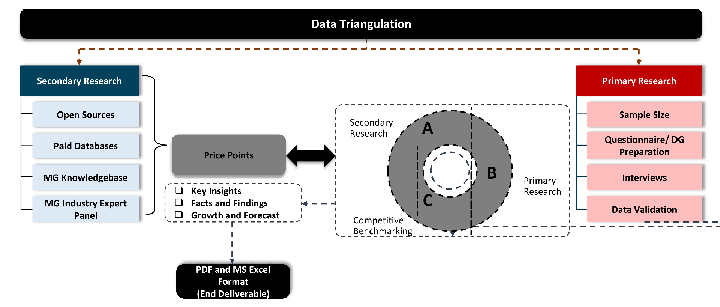
Data triangulation is a validation technique that uses multiple methods, sources, or perspectives to examine the same research question, thereby increasing the credibility and reliability of research findings. In market research, triangulation serves as a quality assurance mechanism that helps identify and minimize bias, validate assumptions, and ensure accuracy in market estimates.
- Data Source Triangulation – Using multiple data sources to examine the same phenomenon
- Methodological Triangulation – Using multiple research methods to study the same research question
- Investigator Triangulation – Using multiple researchers or analysts to examine the same data
- Theoretical Triangulation – Using multiple theoretical perspectives to interpret the same data
Custom Market Research Services
We will customise the research for you, in case the report listed above does not meet your requirements.
Get 10% Free Customisation