Pet Vaccines Market Size, Share & Trends Analysis Report by Animal Type (Dogs, Cats, Horses, Livestock, Other companion animals), Vaccine Type, Disease Indication, Route of Administration, Product Form, Valency, Age Group, Distribution Channel, Prescription Type, and Geography (North America, Europe, Asia Pacific, Middle East, Africa, and South America) – Global Industry Data, Trends, and Forecasts, 2026–2035
|
|
|
Segmental Data Insights |
|
|
Demand Trends |
|
|
Competitive Landscape |
|
|
Strategic Development |
|
|
Future Outlook & Opportunities |
|
Pet Vaccines Market Size, Share, and Growth
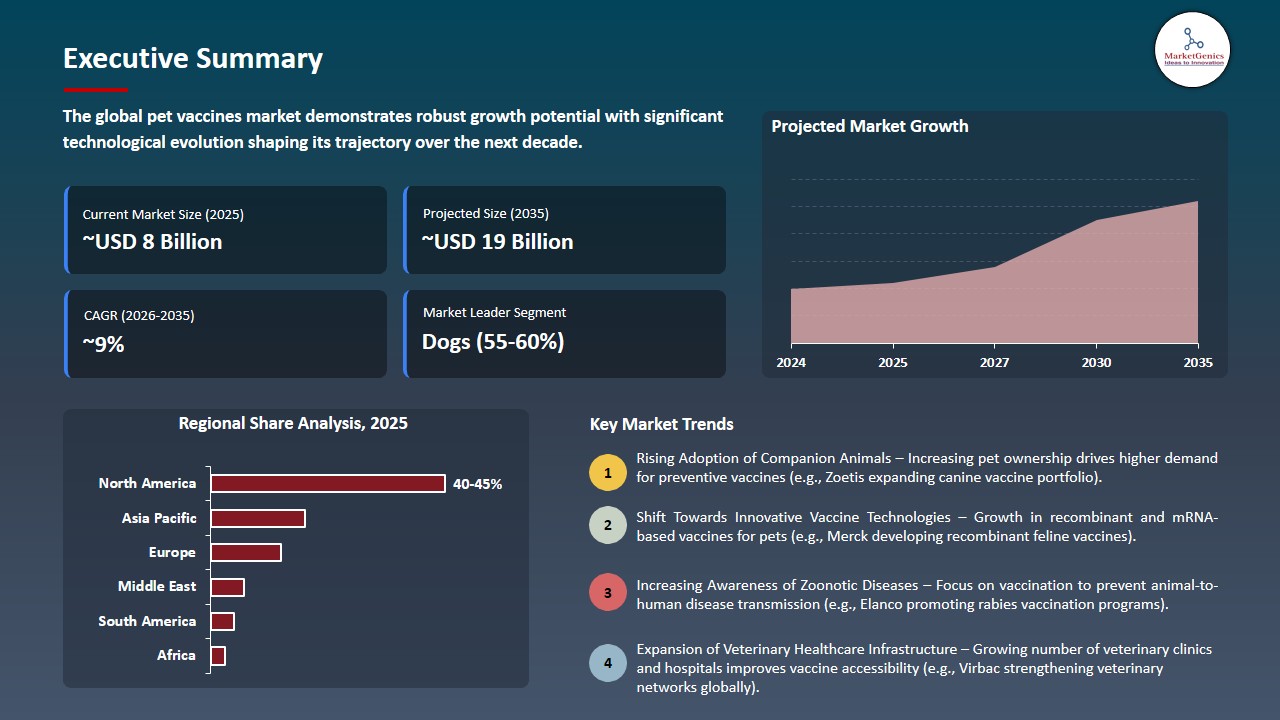
The global pet vaccines market is witnessing strong growth, valued at USD 8.3 billion in 2025 and projected to reach USD 19.1 billion by 2035, expanding at a CAGR of 8.7% during the forecast period. Asia Pacific is the fastest-growing region in the pet vaccines market due to rising pet adoption, increasing awareness of pet health, expanding veterinary infrastructure, and growing demand for preventive care and advanced vaccines.
Tara Bidgood, Vice President, Head of Veterinary Professional Services and Medical Affairs, Independent Petcare at Zoetis, said, “Protecting our pets’ health starts with preventative care, and vaccination is an effective way to safeguard your dog from a preventable illness like kennel cough, We are pleased to offer this new formulation of our trusted Vanguard B Intranasal vaccine to provide early protection for dogs as young as three weeks old”.
The move towards the adoption of preventive healthcare is due to the increase in education and awareness among pet owners and veterinary professionals on the relevance of vaccination schedules. With the owners becoming aware of the importance of vaccines in the prevention of infectious diseases and the long-term well-being of pets, the pet vaccines market is steadily growing, and the need to develop comprehensive, safe, and effective vaccination against the diseases specific to pets is increasing.
Innovative vaccine platform, such as DNA, vector-based and recombinant technologies, is a important growth opportunity in the pet vaccines market. These sophisticated systems facilitate greater effectiveness, increased coverage, and accelerated creation of vaccines opposing new and complicated illnesses. Using such technologies, manufacturers can launch new, next-generation products, distinguish between their products, and satisfy the growing need of safer and more effective preventive healthcare products to pets.
Adjacent opportunities in the pet vaccines market would include the growth of combination vaccines and multi-pathogen vaccines, integration of vaccines into pet insurance and wellness products, the creation of enhanced platforms, including recombinant vaccines and DNA-based vaccines, the growth of digital vaccination reminders and tele-veterinary services to enhance compliance, and the need to expand region-specific vaccines against emerging and zoonotic diseases, all contributing to the larger adoption of preventive care in pets.
Pet Vaccines Market Dynamics and Trends
Driver: Increasing Prevalence of Infectious & Zoonotic Diseases
-
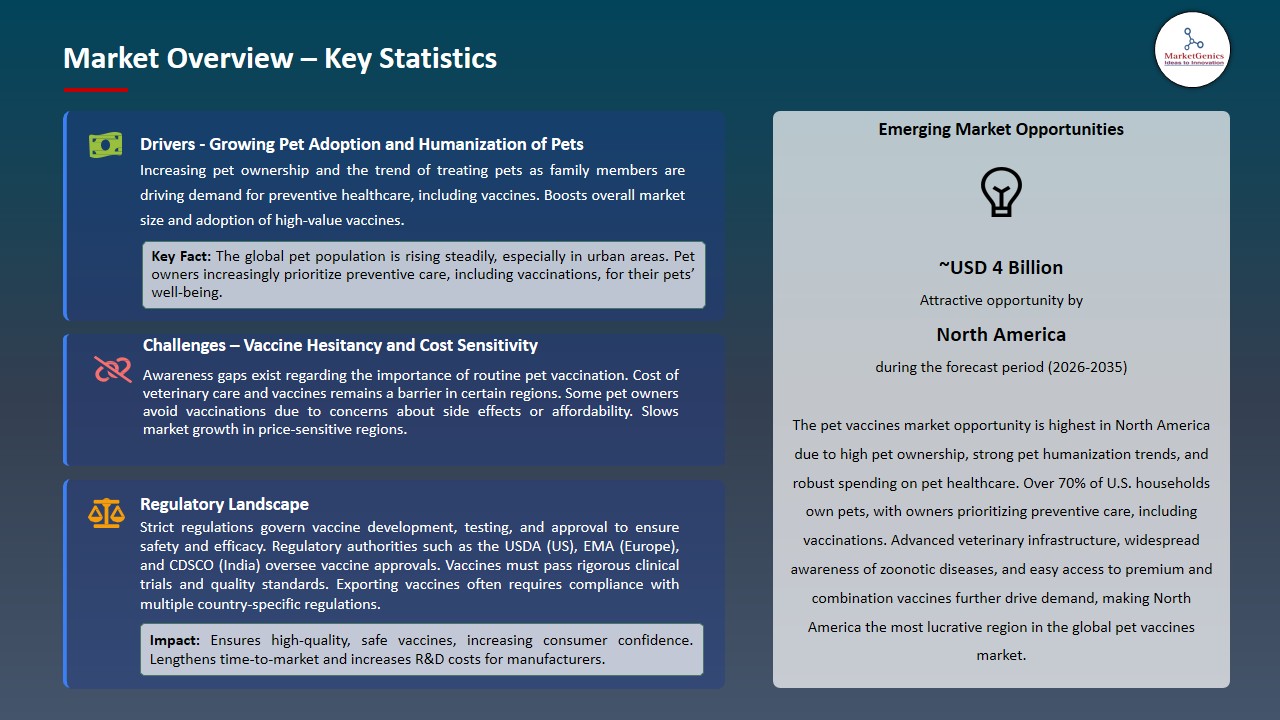
Large numbers of infectious and zoonotic diseases including rabies, canine distemper, leptospirosis, and parvovirus are also a significant push in the pet vaccines market. They are not only dangerous to the health of the pets but can be passed to humans thereby becoming a matter of public health concern.
- With the increased number and spread of outbreaks, the management of pets and veterinarians is paying increased attention to routine vaccination programs to avoid disease transmission and secure animal safety. This increased awareness is creating a need of multi pathogen and highly effective vaccines that are comprehensive.
- In March 2025, Zoetis released a new 0.5mL version of its Vanguard B Intranasal vaccine against Bordetella bronchiseptica (kennel cough) in dogs. The new vaccine can be given to dogs as young as three weeks old and allows a single nostril delivery, which simplifies and makes the vaccine easier and more comfortable to administer, as well as provides strong protection.
- The market is in its vigorous development, and manufacturers are interested in creating highly advanced solutions that protect both the health of the pets and people.
Restraint: Regulatory Complexity & Approval Barriers
-
Pet vaccines market is highly competitive in terms of the difficulties of complex regulation systems in the various countries. The stringent requirements of vaccine approval are also specific to each region, and they entail a lot of safety and efficacy testing, clinical trials and documentation procedure. The differences in such regulations may cause significant delays in the introduction of products, which may not make vaccines available to pets in time.
- Adherence to these regulatory requirements also adds to the cost of operation of manufacturers, as they are forced to invest more resources, employee training and infrastructure to satisfy the needs of different regulation jurisdictions. These barriers can be extremely restrictive especially to smaller and mid-sized companies as they can only compete with the established ones.
- In addition to that, the developing regulations and constant adjustments to approval procedures may confuse manufacturers, hindering innovation and product development. Consequently, the pet vaccines industry has suffered in some parts of the world where there is limited growth of pet vaccines with delays in new or better vaccination immunizations that could respond to new infectious diseases and the new pet healthcare requirements.
- The complexity of regulations and approval hurdles remains as the limiting factor to the expansion and prompt advancement of the pet vaccines market across the globe.
Opportunity: Combination & Multi-pathogen Vaccine Development
-
The growth opportunity in the pet vaccines market is the development of combination and multi-pathogen vaccines. These are vaccines that are developed to prevent several infectious diseases in a single injection and are more convenient to pet owners as well as help them reduce the number of visits they are required to make to the veterinary clinics. This is not just effective in increasing adherence to prescribed vaccination timelines but also becomes a cost-efficient measure, and preventative healthcare becomes more affordable.
- Additionally, multi-pathogen vaccines make the work of veterinarians easier since it reduces storage, handling, and administration procedures. The manufactures that pay attention to innovative methods of solving the problem of vaccination in the form of a combination can also take advantage of increased interest among pet owners who are more concerned with full coverage and convenient treatment.
- Elanco Animal Health in July 2025 got the USDA approval of their TruCan Ultra CIV H3N2/H3N8, a 0.5ml bivalent canine influenza vaccine that has a wide range of coverage against the H3N2 and H3N8 strains. The vaccine offers convenient, effective and safer protection against respiratory diseases due to its ability to neutralize 100 percent of the virus and its absence of lung lesions in vaccinated dogs.
- The trend is projected to be effective in terms of adoption and market penetration, especially in the areas where the percentage of pet ownership is high, and understanding of preventive pet care is on the rise.
Key Trend: Shift Toward Recombinant and Next-Generation Vaccines
-
A significant change in emphasis in the pet vaccines market is the transition of recombinant, subunit and DNA-based vaccine technologies as manufacturers strive to improve safety, efficacy and long-term immunity. Next generation platforms allow more accurate targeting of the antigen and lower the chances of adverse reactions as well as provide superior and more reliable immune responses.
- Recombinant and DNA-based solutions have better stability and versatility to respond to changing and emerging pathogens unlike traditional vaccines. These new innovative vaccine technologies are being adopted at a faster rate as owners of pets and veterinarians are increasingly focusing on safer and more scientifically advanced preventive care.
- In January 2025, Ceva Animal Health signed a long term partnership with Touchlight to develop and produce next generation DNA vaccines and therapeutics with Touchlight using their dbDNA technology. The system allows a quick and high-quality production of DNA without antibiotic resistance genes that facilitates the development of vaccines in a safer and more effective way.
- This is leading to innovation of its products, the diversification of its portfolios and development of the premium vaccines, further enhancing future growth in the pet vaccines market in the long term.
Pet-Vaccines-Market Analysis and Segmental Data
Dogs Dominate Global Pet Vaccines Market
-
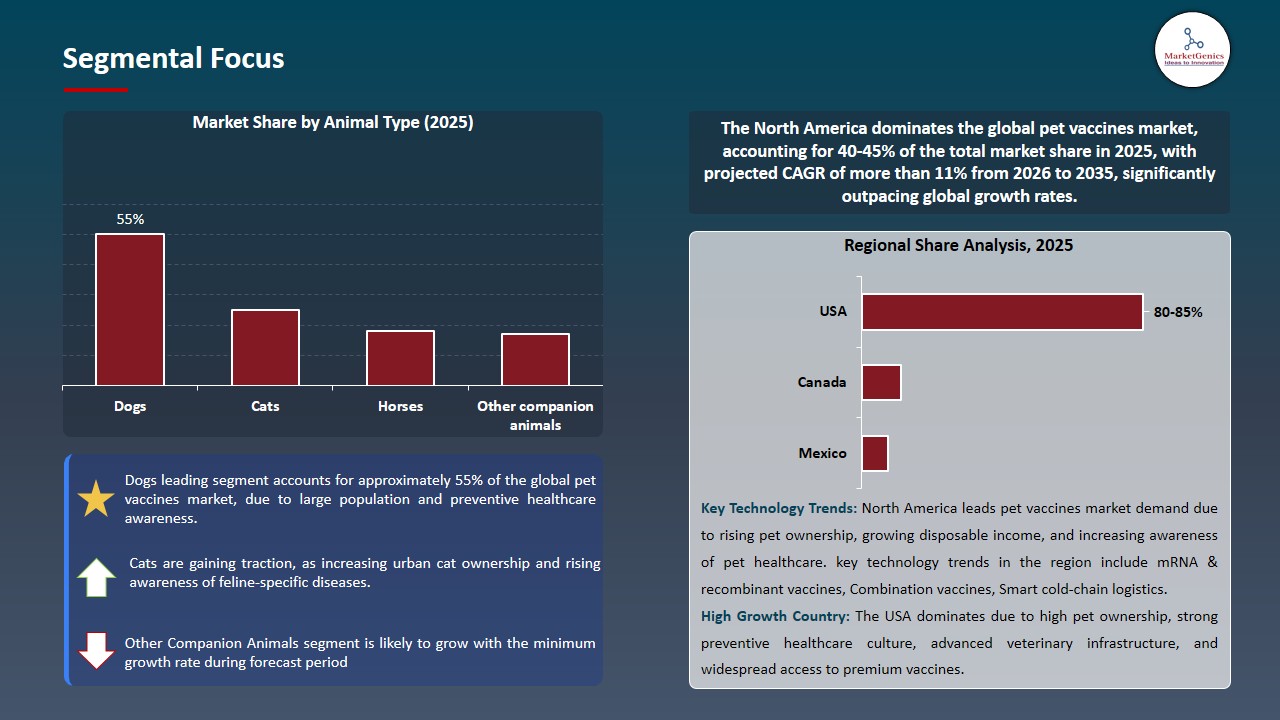
Dogs represent the leading segment in the global pet vaccines market, driven by their high adoption rates and greater exposure to infectious and zoonotic diseases compared to other companion animals. Canines require a broader range of core and non-core vaccinations, including those for rabies, distemper, parvovirus, leptospirosis, and respiratory infections, contributing to higher vaccine demand.
- Additionally, dogs are more likely to participate in social activities such as boarding, grooming, and outdoor recreation, increasing the need for routine immunization. Strong veterinary recommendations, updated vaccination guidelines, and higher owner willingness to invest in preventive healthcare further reinforce dogs’ dominance, making this segment a key revenue contributor to the pet vaccines market.
- Building on its initial launch in France in late 2024, Boehringer Ingelheim continued the rollout of EURICAN L4 across additional European countries in 2025. The non-adjuvanted vaccine provides rapid and robust protection against four key leptospirosis serogroups in dogs, reflecting rising disease risk linked to climate change and reinforcing dogs’ dominance in the Pet Vaccines Market through advanced, targeted vaccination solutions.
- Collectively, higher disease risk, extensive vaccination needs, strong owner compliance, and continuous product innovation firmly establish dogs as the leading and most commercially significant segment in the global pet vaccines market.
North America Leads Global Pet Vaccines Market Demand
-
North America leads global demand in the pet vaccines market, driven by high pet ownership levels and a strong culture of preventive companion animal healthcare. Pet owners in the region increasingly view vaccination as a routine and essential component of responsible pet care, supported by growing awareness of zoonotic disease risks and long-term health outcomes.
- The region benefits from a well-established veterinary ecosystem, including advanced clinics, specialty hospitals, and efficient cold-chain distribution networks that ensure broad vaccine accessibility. Strong regulatory oversight, routine disease monitoring, and clearly defined vaccination guidelines further support high adoption rates across both core and non-core pet vaccines. Additionally, higher disposable incomes and widespread penetration of pet insurance and wellness programs encourage consistent spending on preventive healthcare services.
- Continuous product innovation, early adoption of next-generation vaccines, and close collaboration between veterinarians and manufacturers reinforce North America’s leadership position in the global pet vaccines market.
Pet-Vaccines-Market Ecosystem
The global pet vaccines market is consolidated, with leading players including Zoetis Inc., Merck Animal Health (MSD Animal Health), Boehringer Ingelheim Animal Health, Elanco Animal Health, and Virbac. These companies maintain competitive advantages through extensive R&D capabilities, robust vaccine portfolios covering core and non-core diseases, advanced recombinant and DNA-based vaccine platforms, proprietary adjuvant technologies, and strong global distribution networks. Strategic partnerships, regulatory expertise, and continuous innovation in vaccine formulations and delivery methods further strengthen their market positions.
The market value chain encompasses the research and development of vaccines, formulation and production of safe and effective immunizations, clinical trials and testing for efficacy and safety, regulatory approvals, manufacturing at scale under stringent quality controls, distribution through veterinary channels, and post-market support including pharmacovigilance, customer education, and vaccination compliance programs.
High entry barriers persist due to the capital-intensive nature of vaccine development, regulatory compliance across multiple regions, technical expertise required for advanced platforms, and the need for established veterinary networks. Ongoing innovations, such as combination vaccines, recombinant and vector-based platforms, and digital tools for vaccination tracking, continue to drive differentiation and adoption globally.

Recent Development and Strategic Overview:
-
In June 2025, MSD Animal Health received a positive opinion from the European Medicines Agency’s CVMP for its NOBIVAC L6 and LoVo L6 canine vaccines, which protect dogs against six leptospirosis serovars. If approved by the European Commission, these will be the first vaccines offering broad protection against mortality, clinical signs, renal lesions, urinary excretion, and infection from multiple serovars. This launch highlights the growing emphasis on comprehensive, multi-serovar vaccines in the pet vaccines market, addressing rising disease prevalence and advancing preventive pet healthcare.
- In July 2025, Bioveta, in partnership with Venezuelan company Seprogan, launched its Biocan (dog) and Biofel (cat) vaccine lines in Venezuela, supported by professional seminars across four major cities. Having previously established a presence in Mexico, Colombia, and Brazil, Bioveta’s vaccines quickly gained trust for their quality, safety, and efficacy. The company aims to expand further into countries like Chile and Bolivia in 2026, strengthening its footprint in Latin America.
Report Scope
|
Detail |
|
|
Market Size in 2025 |
USD 8.3 Bn |
|
Market Forecast Value in 2035 |
USD 19.1 Bn |
|
Growth Rate (CAGR) |
8.7% |
|
Forecast Period |
2026 – 2035 |
|
Historical Data Available for |
2021 – 2024 |
|
Market Size Units |
US$ Billion for Value |
|
Report Format |
Electronic (PDF) + Excel |
|
North America |
Europe |
Asia Pacific |
Middle East |
Africa |
South America |
|
|
|
|
|
|
|
Companies Covered |
|||||
|
|
|
|
|
|
Pet-Vaccines-Market Segmentation and Highlights
|
Segment |
Sub-segment |
|
Pet Vaccines Market, By Animal Type |
|
|
Pet Vaccines Market, By Vaccine Type |
|
|
Pet Vaccines Market, By Technology |
|
|
Pet Vaccines Market, By Disease Indication |
|
|
Pet Vaccines Market, By Route of Administration |
|
|
Pet Vaccines Market, By Product Form |
|
|
Pet Vaccines Market, By Valency |
|
|
Pet Vaccines Market, By Age Group |
|
|
Pet Vaccines Market, By Distribution Channel |
|
|
Pet Vaccines Market, By Prescription Type |
|
Frequently Asked Questions
Table of Contents
- 1. Research Methodology and Assumptions
- 1.1. Definitions
- 1.2. Research Design and Approach
- 1.3. Data Collection Methods
- 1.4. Base Estimates and Calculations
- 1.5. Forecasting Models
- 1.5.1. Key Forecast Factors & Impact Analysis
- 1.6. Secondary Research
- 1.6.1. Open Sources
- 1.6.2. Paid Databases
- 1.6.3. Associations
- 1.7. Primary Research
- 1.7.1. Primary Sources
- 1.7.2. Primary Interviews with Stakeholders across Ecosystem
- 2. Executive Summary
- 2.1. Global Pet Vaccines Market Outlook
- 2.1.1. Pet Vaccines Market Size Value (US$ Bn), and Forecasts, 2021-2035
- 2.1.2. Compounded Annual Growth Rate Analysis
- 2.1.3. Growth Opportunity Analysis
- 2.1.4. Segmental Share Analysis
- 2.1.5. Geographical Share Analysis
- 2.2. Market Analysis and Facts
- 2.3. Supply-Demand Analysis
- 2.4. Competitive Benchmarking
- 2.5. Go-to- Market Strategy
- 2.5.1. Customer/ End-use Industry Assessment
- 2.5.2. Growth Opportunity Data, 2026-2035
- 2.5.2.1. Regional Data
- 2.5.2.2. Country Data
- 2.5.2.3. Segmental Data
- 2.5.3. Identification of Potential Market Spaces
- 2.5.4. GAP Analysis
- 2.5.5. Potential Attractive Price Points
- 2.5.6. Prevailing Market Risks & Challenges
- 2.5.7. Preferred Sales & Marketing Strategies
- 2.5.8. Key Recommendations and Analysis
- 2.5.9. A Way Forward
- 2.1. Global Pet Vaccines Market Outlook
- 3. Industry Data and Premium Insights
- 3.1. Global Healthcare & Pharmaceutical Industry Overview, 2025
- 3.1.1. Healthcare & Pharmaceutical Industry Ecosystem Analysis
- 3.1.2. Key Trends for Healthcare & Pharmaceutical Industry
- 3.1.3. Regional Distribution for Healthcare & Pharmaceutical Industry
- 3.2. Supplier Customer Data
- 3.3. Technology Roadmap and Developments
- 3.4. Trade Analysis
- 3.4.1. Import & Export Analysis, 2025
- 3.4.2. Top Importing Countries
- 3.4.3. Top Exporting Countries
- 3.5. Trump Tariff Impact Analysis
- 3.5.1. Manufacturer
- 3.5.1.1. Based on the component & Raw material
- 3.5.2. Supply Chain
- 3.5.3. End Consumer
- 3.5.1. Manufacturer
- 3.6. Raw Material Analysis
- 3.1. Global Healthcare & Pharmaceutical Industry Overview, 2025
- 4. Market Overview
- 4.1. Market Dynamics
- 4.1.1. Drivers
- 4.1.1.1. Rising pet ownership and growing demand for preventive pet healthcare worldwide.
- 4.1.1.2. Increasing prevalence of zoonotic and infectious diseases in companion animals, boosting vaccination adoption.
- 4.1.1.3. Technological advancements and innovations in vaccine development improving efficacy and accessibility.
- 4.1.2. Restraints
- 4.1.2.1. High cost of vaccines and limited access to veterinary care, especially in lower‑income or rural regions.
- 4.1.2.2. Vaccine hesitancy among pet owners due to safety concerns and lack of awareness.
- 4.1.1. Drivers
- 4.2. Key Trend Analysis
- 4.3. Regulatory Framework
- 4.3.1. Key Regulations, Norms, and Subsidies, by Key Countries
- 4.3.2. Tariffs and Standards
- 4.3.3. Impact Analysis of Regulations on the Market
- 4.4. Value Chain Analysis
- 4.4.1. Raw Material Suppliers
- 4.4.2. Manufacturing & Production
- 4.4.3. Distribution & Logistics
- 4.4.4. Marketing & Sales
- 4.5. Porter’s Five Forces Analysis
- 4.6. PESTEL Analysis
- 4.7. Global Pet Vaccines Market Demand
- 4.7.1. Historical Market Size – Value (US$ Bn), 2020-2024
- 4.7.2. Current and Future Market Size – Value (US$ Bn), 2026–2035
- 4.7.2.1. Y-o-Y Growth Trends
- 4.7.2.2. Absolute $ Opportunity Assessment
- 4.1. Market Dynamics
- 5. Competition Landscape
- 5.1. Competition structure
- 5.1.1. Fragmented v/s consolidated
- 5.2. Company Share Analysis, 2025
- 5.2.1. Global Company Market Share
- 5.2.2. By Region
- 5.2.2.1. North America
- 5.2.2.2. Europe
- 5.2.2.3. Asia Pacific
- 5.2.2.4. Middle East
- 5.2.2.5. Africa
- 5.2.2.6. South America
- 5.3. Product Comparison Matrix
- 5.3.1. Specifications
- 5.3.2. Market Positioning
- 5.3.3. Pricing
- 5.1. Competition structure
- 6. Global Pet Vaccines Market Analysis, by Animal Type
- 6.1. Key Segment Analysis
- 6.2. Pet Vaccines Market Size Value (US$ Bn), Analysis, and Forecasts, by Animal Type, 2021-2035
- 6.2.1. Dogs
- 6.2.1.1. Small breeds
- 6.2.1.2. Medium breeds
- 6.2.1.3. Large breeds
- 6.2.2. Cats
- 6.2.2.1. Indoor cats
- 6.2.2.2. Outdoor cats
- 6.2.3. Horses
- 6.2.4. Livestock
- 6.2.4.1. Cattle
- 6.2.4.2. Swine
- 6.2.4.3. Poultry
- 6.2.4.4. Others
- 6.2.5. Other companion animals
- 6.2.5.1. Rabbits
- 6.2.5.2. Ferrets
- 6.2.5.3. Guinea pigs
- 6.2.1. Dogs
- 7. Global Pet Vaccines Market Analysis, by Vaccine Type
- 7.1. Key Segment Analysis
- 7.2. Pet Vaccines Market Size Value (US$ Bn), Analysis, and Forecasts, by Vaccine Type, 2021-2035
- 7.2.1. Attenuated (Live) Vaccines
- 7.2.2. Inactivated (Killed) Vaccines
- 7.2.3. Recombinant Vaccines
- 7.2.4. Subunit Vaccines
- 7.2.5. Toxoid Vaccines
- 7.2.6. DNA Vaccines
- 7.2.7. Conjugate Vaccines
- 8. Global Pet Vaccines Market Analysis, by Disease Indication
- 8.1. Key Segment Analysis
- 8.2. Pet Vaccines Market Size Value (US$ Bn), Analysis, and Forecasts, by Disease Indication, 2021-2035
- 8.2.1. Rabies
- 8.2.2. Distemper
- 8.2.3. Parvovirus
- 8.2.4. Adenovirus
- 8.2.5. Leptospirosis
- 8.2.6. Bordetella (Kennel Cough)
- 8.2.7. Feline Leukemia Virus (FeLV)
- 8.2.8. Feline Immunodeficiency Virus (FIV)
- 8.2.9. Canine Influenza
- 8.2.10. Lyme Disease
- 8.2.11. Feline Panleukopenia
- 8.2.12. Equine Influenza
- 8.2.13. West Nile Virus
- 8.2.14. Others
- 9. Global Pet Vaccines Market Analysis, by Route of Administration
- 9.1. Key Segment Analysis
- 9.2. Pet Vaccines Market Size Value (US$ Bn), Analysis, and Forecasts, by Route of Administration, 2021-2035
- 9.2.1. Injectable
- 9.2.1.1. Intramuscular
- 9.2.1.2. Subcutaneous
- 9.2.1.3. Intradermal
- 9.2.2. Oral
- 9.2.3. Intranasal
- 9.2.4. Transdermal
- 9.2.1. Injectable
- 10. Global Pet Vaccines Market Analysis, by Product Form
- 10.1. Key Segment Analysis
- 10.2. Pet Vaccines Market Size Value (US$ Bn), Analysis, and Forecasts, by Product Form, 2021-2035
- 10.2.1. Liquid Vaccines
- 10.2.2. Freeze-dried (Lyophilized) Vaccines
- 10.2.3. Ready-to-use Formulations
- 10.2.4. Reconstitutable Formulations
- 11. Global Pet Vaccines Market Analysis, by Valency
- 11.1. Key Segment Analysis
- 11.2. Pet Vaccines Market Size Value (US$ Bn), Analysis, and Forecasts, by Valency, 2021-2035
- 11.2.1. Monovalent Vaccines
- 11.2.2. Multivalent (Combination) Vaccines
- 11.2.2.1. Bivalent
- 11.2.2.2. Trivalent
- 11.2.2.3. Tetravalent
- 11.2.2.4. Pentavalent and above
- 12. Global Pet Vaccines Market Analysis, by Age Group
- 12.1. Key Segment Analysis
- 12.2. Pet Vaccines Market Size Value (US$ Bn), Analysis, and Forecasts, by Age Group, 2021-2035
- 12.2.1. Puppy/Kitten (Pediatric)
- 12.2.2. Adult
- 12.2.3. Geriatric/Senior
- 12.2.4. All age groups
- 13. Global Pet Vaccines Market Analysis and Forecasts, by Distribution Channel
- 13.1. Key Findings
- 13.2. Pet Vaccines Market Size Value (US$ Bn), Analysis, and Forecasts, by Distribution Channel, 2021-2035
- 13.2.1. Veterinary Hospitals
- 13.2.2. Veterinary Clinics
- 13.2.3. Veterinary Pharmacies
- 13.2.4. Animal Shelters
- 13.2.5. Pet Specialty Stores
- 13.2.6. Others
- 14. Global Pet Vaccines Market Analysis and Forecasts, by Prescription Type
- 14.1. Key Findings
- 14.2. Pet Vaccines Market Size Value (US$ Bn), Analysis, and Forecasts, by Prescription Type, 2021-2035
- 14.2.1. Prescription-based Vaccines
- 14.2.2. Over-the-counter (OTC) Vaccines
- 14.2.3. Veterinarian-administered Only
- 15. Global Pet Vaccines Market Analysis and Forecasts, by Region
- 15.1. Key Findings
- 15.2. Pet Vaccines Market Size Value (US$ Bn), Analysis, and Forecasts, by Region, 2021-2035
- 15.2.1. North America
- 15.2.2. Europe
- 15.2.3. Asia Pacific
- 15.2.4. Middle East
- 15.2.5. Africa
- 15.2.6. South America
- 16. North America Pet Vaccines Market Analysis
- 16.1. Key Segment Analysis
- 16.2. Regional Snapshot
- 16.3. North America Pet Vaccines Market Size Value (US$ Bn), Analysis, and Forecasts, 2021-2035
- 16.3.1. Animal Type
- 16.3.2. Vaccine Type
- 16.3.3. Disease Indication
- 16.3.4. Route of Administration
- 16.3.5. Product Form
- 16.3.6. Valency
- 16.3.7. Age Group
- 16.3.8. Distribution Channel
- 16.3.9. Prescription Type
- 16.3.10. Country
- 16.3.10.1. USA
- 16.3.10.2. Canada
- 16.3.10.3. Mexico
- 16.4. USA Pet Vaccines Market
- 16.4.1. Country Segmental Analysis
- 16.4.2. Animal Type
- 16.4.3. Vaccine Type
- 16.4.4. Disease Indication
- 16.4.5. Route of Administration
- 16.4.6. Product Form
- 16.4.7. Valency
- 16.4.8. Age Group
- 16.4.9. Distribution Channel
- 16.4.10. Prescription Type
- 16.5. Canada Pet Vaccines Market
- 16.5.1. Country Segmental Analysis
- 16.5.2. Animal Type
- 16.5.3. Vaccine Type
- 16.5.4. Disease Indication
- 16.5.5. Route of Administration
- 16.5.6. Product Form
- 16.5.7. Valency
- 16.5.8. Age Group
- 16.5.9. Distribution Channel
- 16.5.10. Prescription Type
- 16.6. Mexico Pet Vaccines Market
- 16.6.1. Country Segmental Analysis
- 16.6.2. Animal Type
- 16.6.3. Vaccine Type
- 16.6.4. Disease Indication
- 16.6.5. Route of Administration
- 16.6.6. Product Form
- 16.6.7. Valency
- 16.6.8. Age Group
- 16.6.9. Distribution Channel
- 16.6.10. Prescription Type
- 17. Europe Pet Vaccines Market Analysis
- 17.1. Key Segment Analysis
- 17.2. Regional Snapshot
- 17.3. Europe Pet Vaccines Market Size Value (US$ Bn), Analysis, and Forecasts, 2021-2035
- 17.3.1. Monitoring Type
- 17.3.2. Animal Type
- 17.3.3. Vaccine Type
- 17.3.4. Disease Indication
- 17.3.5. Route of Administration
- 17.3.6. Product Form
- 17.3.7. Valency
- 17.3.8. Age Group
- 17.3.9. Distribution Channel
- 17.3.10. Prescription Type
- 17.3.11. Country
- 17.3.11.1. Germany
- 17.3.11.2. United Kingdom
- 17.3.11.3. France
- 17.3.11.4. Italy
- 17.3.11.5. Spain
- 17.3.11.6. Netherlands
- 17.3.11.7. Nordic Countries
- 17.3.11.8. Poland
- 17.3.11.9. Russia & CIS
- 17.3.11.10. Rest of Europe
- 17.4. Germany Pet Vaccines Market
- 17.4.1. Country Segmental Analysis
- 17.4.2. Animal Type
- 17.4.3. Vaccine Type
- 17.4.4. Disease Indication
- 17.4.5. Route of Administration
- 17.4.6. Product Form
- 17.4.7. Valency
- 17.4.8. Age Group
- 17.4.9. Distribution Channel
- 17.4.10. Prescription Type
- 17.5. United Kingdom Pet Vaccines Market
- 17.5.1. Country Segmental Analysis
- 17.5.2. Animal Type
- 17.5.3. Vaccine Type
- 17.5.4. Disease Indication
- 17.5.5. Route of Administration
- 17.5.6. Product Form
- 17.5.7. Valency
- 17.5.8. Age Group
- 17.5.9. Distribution Channel
- 17.5.10. Prescription Type
- 17.6. France Pet Vaccines Market
- 17.6.1. Country Segmental Analysis
- 17.6.2. Animal Type
- 17.6.3. Vaccine Type
- 17.6.4. Disease Indication
- 17.6.5. Route of Administration
- 17.6.6. Product Form
- 17.6.7. Valency
- 17.6.8. Age Group
- 17.6.9. Distribution Channel
- 17.6.10. Prescription Type
- 17.7. Italy Pet Vaccines Market
- 17.7.1. Country Segmental Analysis
- 17.7.2. Animal Type
- 17.7.3. Vaccine Type
- 17.7.4. Disease Indication
- 17.7.5. Route of Administration
- 17.7.6. Product Form
- 17.7.7. Valency
- 17.7.8. Age Group
- 17.7.9. Distribution Channel
- 17.7.10. Prescription Type
- 17.8. Spain Pet Vaccines Market
- 17.8.1. Country Segmental Analysis
- 17.8.2. Animal Type
- 17.8.3. Vaccine Type
- 17.8.4. Disease Indication
- 17.8.5. Route of Administration
- 17.8.6. Product Form
- 17.8.7. Valency
- 17.8.8. Age Group
- 17.8.9. Distribution Channel
- 17.8.10. Prescription Type
- 17.9. Netherlands Pet Vaccines Market
- 17.9.1. Country Segmental Analysis
- 17.9.2. Animal Type
- 17.9.3. Vaccine Type
- 17.9.4. Disease Indication
- 17.9.5. Route of Administration
- 17.9.6. Product Form
- 17.9.7. Valency
- 17.9.8. Age Group
- 17.9.9. Distribution Channel
- 17.9.10. Prescription Type
- 17.10. Nordic Countries Pet Vaccines Market
- 17.10.1. Country Segmental Analysis
- 17.10.2. Animal Type
- 17.10.3. Vaccine Type
- 17.10.4. Disease Indication
- 17.10.5. Route of Administration
- 17.10.6. Product Form
- 17.10.7. Valency
- 17.10.8. Age Group
- 17.10.9. Distribution Channel
- 17.10.10. Prescription Type
- 17.11. Poland Pet Vaccines Market
- 17.11.1. Country Segmental Analysis
- 17.11.2. Animal Type
- 17.11.3. Vaccine Type
- 17.11.4. Disease Indication
- 17.11.5. Route of Administration
- 17.11.6. Product Form
- 17.11.7. Valency
- 17.11.8. Age Group
- 17.11.9. Distribution Channel
- 17.11.10. Prescription Type
- 17.11.11. End-use Industry
- 17.12. Russia & CIS Pet Vaccines Market
- 17.12.1. Country Segmental Analysis
- 17.12.2. Animal Type
- 17.12.3. Vaccine Type
- 17.12.4. Disease Indication
- 17.12.5. Route of Administration
- 17.12.6. Product Form
- 17.12.7. Valency
- 17.12.8. Age Group
- 17.12.9. Distribution Channel
- 17.12.10. Prescription Type
- 17.13. Rest of Europe Pet Vaccines Market
- 17.13.1. Country Segmental Analysis
- 17.13.2. Animal Type
- 17.13.3. Vaccine Type
- 17.13.4. Disease Indication
- 17.13.5. Route of Administration
- 17.13.6. Product Form
- 17.13.7. Valency
- 17.13.8. Age Group
- 17.13.9. Distribution Channel
- 17.13.10. Prescription Type
- 18. Asia Pacific Pet Vaccines Market Analysis
- 18.1. Key Segment Analysis
- 18.2. Regional Snapshot
- 18.3. Asia Pacific Pet Vaccines Market Size Value (US$ Bn), Analysis, and Forecasts, 2021-2035
- 18.3.1. Animal Type
- 18.3.2. Vaccine Type
- 18.3.3. Disease Indication
- 18.3.4. Route of Administration
- 18.3.5. Product Form
- 18.3.6. Valency
- 18.3.7. Age Group
- 18.3.8. Distribution Channel
- 18.3.9. Prescription Type
- 18.3.10. Country
- 18.3.10.1. China
- 18.3.10.2. India
- 18.3.10.3. Japan
- 18.3.10.4. South Korea
- 18.3.10.5. Australia and New Zealand
- 18.3.10.6. Indonesia
- 18.3.10.7. Malaysia
- 18.3.10.8. Thailand
- 18.3.10.9. Vietnam
- 18.3.10.10. Rest of Asia Pacific
- 18.4. China Pet Vaccines Market
- 18.4.1. Country Segmental Analysis
- 18.4.2. Animal Type
- 18.4.3. Vaccine Type
- 18.4.4. Disease Indication
- 18.4.5. Route of Administration
- 18.4.6. Product Form
- 18.4.7. Valency
- 18.4.8. Age Group
- 18.4.9. Distribution Channel
- 18.4.10. Prescription Type
- 18.5. India Pet Vaccines Market
- 18.5.1. Country Segmental Analysis
- 18.5.2. Animal Type
- 18.5.3. Vaccine Type
- 18.5.4. Disease Indication
- 18.5.5. Route of Administration
- 18.5.6. Product Form
- 18.5.7. Valency
- 18.5.8. Age Group
- 18.5.9. Distribution Channel
- 18.5.10. Prescription Type
- 18.6. Japan Pet Vaccines Market
- 18.6.1. Country Segmental Analysis
- 18.6.2. Animal Type
- 18.6.3. Vaccine Type
- 18.6.4. Disease Indication
- 18.6.5. Route of Administration
- 18.6.6. Product Form
- 18.6.7. Valency
- 18.6.8. Age Group
- 18.6.9. Distribution Channel
- 18.6.10. Prescription Type
- 18.7. South Korea Pet Vaccines Market
- 18.7.1. Country Segmental Analysis
- 18.7.2. Animal Type
- 18.7.3. Vaccine Type
- 18.7.4. Disease Indication
- 18.7.5. Route of Administration
- 18.7.6. Product Form
- 18.7.7. Valency
- 18.7.8. Age Group
- 18.7.9. Distribution Channel
- 18.7.10. Prescription Type
- 18.8. Australia and New Zealand Pet Vaccines Market
- 18.8.1. Country Segmental Analysis
- 18.8.2. Animal Type
- 18.8.3. Vaccine Type
- 18.8.4. Disease Indication
- 18.8.5. Route of Administration
- 18.8.6. Product Form
- 18.8.7. Valency
- 18.8.8. Age Group
- 18.8.9. Distribution Channel
- 18.8.10. Prescription Type
- 18.9. Indonesia Pet Vaccines Market
- 18.9.1. Country Segmental Analysis
- 18.9.2. Animal Type
- 18.9.3. Vaccine Type
- 18.9.4. Disease Indication
- 18.9.5. Route of Administration
- 18.9.6. Product Form
- 18.9.7. Valency
- 18.9.8. Age Group
- 18.9.9. Distribution Channel
- 18.9.10. Prescription Type
- 18.10. Malaysia Pet Vaccines Market
- 18.10.1. Country Segmental Analysis
- 18.10.2. Animal Type
- 18.10.3. Vaccine Type
- 18.10.4. Disease Indication
- 18.10.5. Route of Administration
- 18.10.6. Product Form
- 18.10.7. Valency
- 18.10.8. Age Group
- 18.10.9. Distribution Channel
- 18.10.10. Prescription Type
- 18.11. Thailand Pet Vaccines Market
- 18.11.1. Country Segmental Analysis
- 18.11.2. Animal Type
- 18.11.3. Vaccine Type
- 18.11.4. Disease Indication
- 18.11.5. Route of Administration
- 18.11.6. Product Form
- 18.11.7. Valency
- 18.11.8. Age Group
- 18.11.9. Distribution Channel
- 18.11.10. Prescription Type
- 18.12. Vietnam Pet Vaccines Market
- 18.12.1. Country Segmental Analysis
- 18.12.2. Animal Type
- 18.12.3. Vaccine Type
- 18.12.4. Disease Indication
- 18.12.5. Route of Administration
- 18.12.6. Product Form
- 18.12.7. Valency
- 18.12.8. Age Group
- 18.12.9. Distribution Channel
- 18.12.10. Prescription Type
- 18.13. Rest of Asia Pacific Pet Vaccines Market
- 18.13.1. Country Segmental Analysis
- 18.13.2. Animal Type
- 18.13.3. Vaccine Type
- 18.13.4. Disease Indication
- 18.13.5. Route of Administration
- 18.13.6. Product Form
- 18.13.7. Valency
- 18.13.8. Age Group
- 18.13.9. Distribution Channel
- 18.13.10. Prescription Type
- 19. Middle East Pet Vaccines Market Analysis
- 19.1. Key Segment Analysis
- 19.2. Regional Snapshot
- 19.3. Middle East Pet Vaccines Market Size Value (US$ Bn), Analysis, and Forecasts, 2021-2035
- 19.3.1. Animal Type
- 19.3.2. Vaccine Type
- 19.3.3. Disease Indication
- 19.3.4. Route of Administration
- 19.3.5. Product Form
- 19.3.6. Valency
- 19.3.7. Age Group
- 19.3.8. Distribution Channel
- 19.3.9. Prescription Type
- 19.3.10. Country
- 19.3.10.1. Turkey
- 19.3.10.2. UAE
- 19.3.10.3. Saudi Arabia
- 19.3.10.4. Israel
- 19.3.10.5. Rest of Middle East
- 19.4. Turkey Pet Vaccines Market
- 19.4.1. Country Segmental Analysis
- 19.4.2. Animal Type
- 19.4.3. Vaccine Type
- 19.4.4. Disease Indication
- 19.4.5. Route of Administration
- 19.4.6. Product Form
- 19.4.7. Valency
- 19.4.8. Age Group
- 19.4.9. Distribution Channel
- 19.4.10. Prescription Type
- 19.5. UAE Pet Vaccines Market
- 19.5.1. Country Segmental Analysis
- 19.5.2. Animal Type
- 19.5.3. Vaccine Type
- 19.5.4. Disease Indication
- 19.5.5. Route of Administration
- 19.5.6. Product Form
- 19.5.7. Valency
- 19.5.8. Age Group
- 19.5.9. Distribution Channel
- 19.5.10. Prescription Type
- 19.6. Saudi Arabia Pet Vaccines Market
- 19.6.1. Country Segmental Analysis
- 19.6.2. Animal Type
- 19.6.3. Vaccine Type
- 19.6.4. Disease Indication
- 19.6.5. Route of Administration
- 19.6.6. Product Form
- 19.6.7. Valency
- 19.6.8. Age Group
- 19.6.9. Distribution Channel
- 19.6.10. Prescription Type
- 19.7. Israel Pet Vaccines Market
- 19.7.1. Country Segmental Analysis
- 19.7.2. Animal Type
- 19.7.3. Vaccine Type
- 19.7.4. Disease Indication
- 19.7.5. Route of Administration
- 19.7.6. Product Form
- 19.7.7. Valency
- 19.7.8. Age Group
- 19.7.9. Distribution Channel
- 19.7.10. Prescription Type
- 19.8. Rest of Middle East Pet Vaccines Market
- 19.8.1. Country Segmental Analysis
- 19.8.2. Animal Type
- 19.8.3. Vaccine Type
- 19.8.4. Disease Indication
- 19.8.5. Route of Administration
- 19.8.6. Product Form
- 19.8.7. Valency
- 19.8.8. Age Group
- 19.8.9. Distribution Channel
- 19.8.10. Prescription Type
- 20. Africa Pet Vaccines Market Analysis
- 20.1. Key Segment Analysis
- 20.2. Regional Snapshot
- 20.3. Africa Pet Vaccines Market Size Value (US$ Bn), Analysis, and Forecasts, 2021-2035
- 20.3.1. Animal Type
- 20.3.2. Vaccine Type
- 20.3.3. Disease Indication
- 20.3.4. Route of Administration
- 20.3.5. Product Form
- 20.3.6. Valency
- 20.3.7. Age Group
- 20.3.8. Distribution Channel
- 20.3.9. Prescription Type
- 20.3.10. Country
- 20.3.10.1. South Africa
- 20.3.10.2. Egypt
- 20.3.10.3. Nigeria
- 20.3.10.4. Algeria
- 20.3.10.5. Rest of Africa
- 20.4. South Africa Pet Vaccines Market
- 20.4.1. Country Segmental Analysis
- 20.4.2. Animal Type
- 20.4.3. Vaccine Type
- 20.4.4. Disease Indication
- 20.4.5. Route of Administration
- 20.4.6. Product Form
- 20.4.7. Valency
- 20.4.8. Age Group
- 20.4.9. Distribution Channel
- 20.4.10. Prescription Type
- 20.5. Egypt Pet Vaccines Market
- 20.5.1. Country Segmental Analysis
- 20.5.2. Animal Type
- 20.5.3. Vaccine Type
- 20.5.4. Disease Indication
- 20.5.5. Route of Administration
- 20.5.6. Product Form
- 20.5.7. Valency
- 20.5.8. Age Group
- 20.5.9. Distribution Channel
- 20.5.10. Prescription Type
- 20.6. Nigeria Pet Vaccines Market
- 20.6.1. Country Segmental Analysis
- 20.6.2. Animal Type
- 20.6.3. Vaccine Type
- 20.6.4. Disease Indication
- 20.6.5. Route of Administration
- 20.6.6. Product Form
- 20.6.7. Valency
- 20.6.8. Age Group
- 20.6.9. Distribution Channel
- 20.6.10. Prescription Type
- 20.7. Algeria Pet Vaccines Market
- 20.7.1. Country Segmental Analysis
- 20.7.2. Animal Type
- 20.7.3. Vaccine Type
- 20.7.4. Disease Indication
- 20.7.5. Route of Administration
- 20.7.6. Product Form
- 20.7.7. Valency
- 20.7.8. Age Group
- 20.7.9. Distribution Channel
- 20.7.10. Prescription Type
- 20.8. Rest of Africa Pet Vaccines Market
- 20.8.1. Country Segmental Analysis
- 20.8.2. Animal Type
- 20.8.3. Vaccine Type
- 20.8.4. Disease Indication
- 20.8.5. Route of Administration
- 20.8.6. Product Form
- 20.8.7. Valency
- 20.8.8. Age Group
- 20.8.9. Distribution Channel
- 20.8.10. Prescription Type
- 21. South America Pet Vaccines Market Analysis
- 21.1. Key Segment Analysis
- 21.2. Regional Snapshot
- 21.3. South America Pet Vaccines Market Size Value (US$ Bn), Analysis, and Forecasts, 2021-2035
- 21.3.1. Animal Type
- 21.3.2. Vaccine Type
- 21.3.3. Disease Indication
- 21.3.4. Route of Administration
- 21.3.5. Product Form
- 21.3.6. Valency
- 21.3.7. Age Group
- 21.3.8. Distribution Channel
- 21.3.9. Prescription Type
- 21.3.10. Country
- 21.3.10.1. Brazil
- 21.3.10.2. Argentina
- 21.3.10.3. Rest of South America
- 21.4. Brazil Pet Vaccines Market
- 21.4.1. Country Segmental Analysis
- 21.4.2. Animal Type
- 21.4.3. Vaccine Type
- 21.4.4. Disease Indication
- 21.4.5. Route of Administration
- 21.4.6. Product Form
- 21.4.7. Valency
- 21.4.8. Age Group
- 21.4.9. Distribution Channel
- 21.4.10. Prescription Type
- 21.5. Argentina Pet Vaccines Market
- 21.5.1. Country Segmental Analysis
- 21.5.2. Animal Type
- 21.5.3. Vaccine Type
- 21.5.4. Disease Indication
- 21.5.5. Route of Administration
- 21.5.6. Product Form
- 21.5.7. Valency
- 21.5.8. Age Group
- 21.5.9. Distribution Channel
- 21.5.10. Prescription Type
- 21.6. Rest of South America Pet Vaccines Market
- 21.6.1. Country Segmental Analysis
- 21.6.2. Animal Type
- 21.6.3. Vaccine Type
- 21.6.4. Disease Indication
- 21.6.5. Route of Administration
- 21.6.6. Product Form
- 21.6.7. Valency
- 21.6.8. Age Group
- 21.6.9. Distribution Channel
- 21.6.10. Prescription Type
- 22. Key Players/ Company Profile
- 22.1. Bimeda Holdings
- 22.1.1. Company Details/ Overview
- 22.1.2. Company Financials
- 22.1.3. Key Customers and Competitors
- 22.1.4. Business/ Industry Portfolio
- 22.1.5. Product Portfolio/ Specification Details
- 22.1.6. Pricing Data
- 22.1.7. Strategic Overview
- 22.1.8. Recent Developments
- 22.2. Biovac
- 22.3. Boehringer Ingelheim Animal Health
- 22.4. Brilliant Bio Pharma
- 22.5. Ceva Santé Animale
- 22.6. ChengDu Tecbond Biological Products Co.
- 22.7. Colorado Serum Company
- 22.8. Dechra Pharmaceuticals
- 22.9. Elanco Animal Health
- 22.10. Hester Biosciences Limited
- 22.11. IDT Biologika GmbH
- 22.12. Indian Immunologicals Limited
- 22.13. Laboratorios Hipra S.A.
- 22.14. Merck Animal Health (MSD Animal Health)
- 22.15. Neogen Corporation
- 22.16. Phibro Animal Health Corporation
- 22.17. Vaxxinova International
- 22.18. Vetoquinol
- 22.19. Virbac
- 22.20. Yebio Bioengineering Co.
- 22.21. Zoetis Inc.
- 22.22. Other Key Players
- 22.1. Bimeda Holdings
Note* - This is just tentative list of players. While providing the report, we will cover more number of players based on their revenue and share for each geography
Research Design
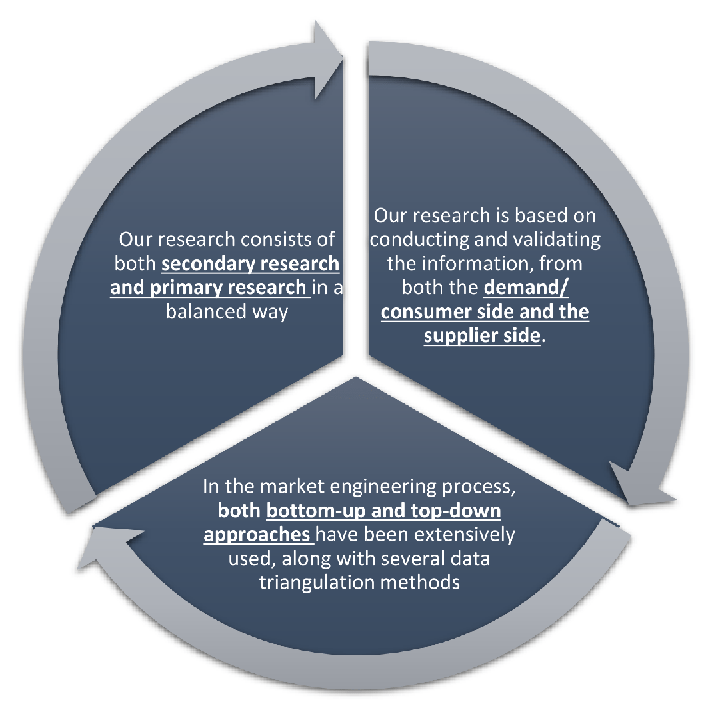
Our research design integrates both demand-side and supply-side analysis through a balanced combination of primary and secondary research methodologies. By utilizing both bottom-up and top-down approaches alongside rigorous data triangulation methods, we deliver robust market intelligence that supports strategic decision-making.
MarketGenics' comprehensive research design framework ensures the delivery of accurate, reliable, and actionable market intelligence. Through the integration of multiple research approaches, rigorous validation processes, and expert analysis, we provide our clients with the insights needed to make informed strategic decisions and capitalize on market opportunities.
MarketGenics leverages a dedicated industry panel of experts and a comprehensive suite of paid databases to effectively collect, consolidate, and analyze market intelligence.
Our approach has consistently proven to be reliable and effective in generating accurate market insights, identifying key industry trends, and uncovering emerging business opportunities.
Through both primary and secondary research, we capture and analyze critical company-level data such as manufacturing footprints, including technical centers, R&D facilities, sales offices, and headquarters.
Our expert panel further enhances our ability to estimate market size for specific brands based on validated field-level intelligence.
Our data mining techniques incorporate both parametric and non-parametric methods, allowing for structured data collection, sorting, processing, and cleaning.
Demand projections are derived from large-scale data sets analyzed through proprietary algorithms, culminating in robust and reliable market sizing.
Research Approach
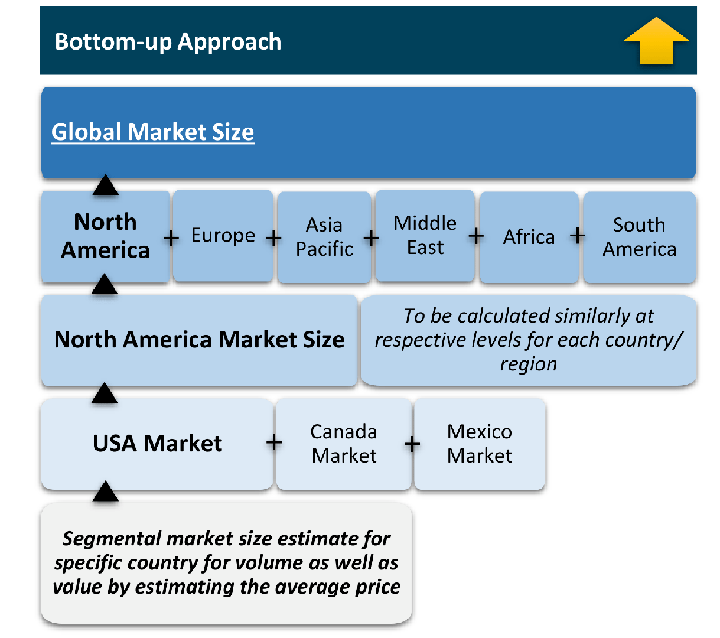
The bottom-up approach builds market estimates by starting with the smallest addressable market units and systematically aggregating them to create comprehensive market size projections.
This method begins with specific, granular data points and builds upward to create the complete market landscape.
Customer Analysis → Segmental Analysis → Geographical Analysis
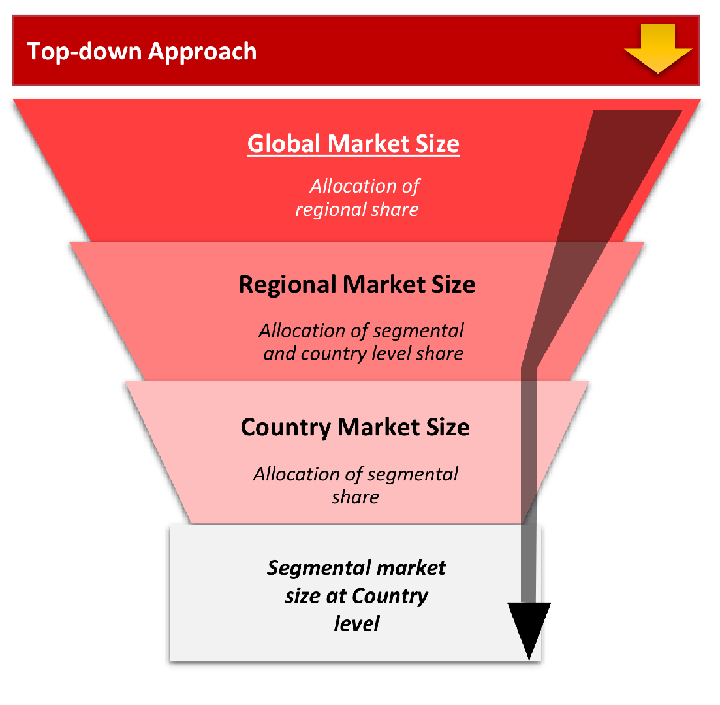
The top-down approach starts with the broadest possible market data and systematically narrows it down through a series of filters and assumptions to arrive at specific market segments or opportunities.
This method begins with the big picture and works downward to increasingly specific market slices.
TAM → SAM → SOM
Research Methods
Desk / Secondary Research
While analysing the market, we extensively study secondary sources, directories, and databases to identify and collect information useful for this technical, market-oriented, and commercial report. Secondary sources that we utilize are not only the public sources, but it is a combination of Open Source, Associations, Paid Databases, MG Repository & Knowledgebase, and others.
- Company websites, annual reports, financial reports, broker reports, and investor presentations
- National government documents, statistical databases and reports
- News articles, press releases and web-casts specific to the companies operating in the market, Magazines, reports, and others
- We gather information from commercial data sources for deriving company specific data such as segmental revenue, share for geography, product revenue, and others
- Internal and external proprietary databases (industry-specific), relevant patent, and regulatory databases
- Governing Bodies, Government Organizations
- Relevant Authorities, Country-specific Associations for Industries
We also employ the model mapping approach to estimate the product level market data through the players' product portfolio
Primary Research
Primary research/ interviews is vital in analyzing the market. Most of the cases involves paid primary interviews. Primary sources include primary interviews through e-mail interactions, telephonic interviews, surveys as well as face-to-face interviews with the different stakeholders across the value chain including several industry experts.
| Type of Respondents | Number of Primaries |
|---|---|
| Tier 2/3 Suppliers | ~20 |
| Tier 1 Suppliers | ~25 |
| End-users | ~25 |
| Industry Expert/ Panel/ Consultant | ~30 |
| Total | ~100 |
MG Knowledgebase
• Repository of industry blog, newsletter and case studies
• Online platform covering detailed market reports, and company profiles
Forecasting Factors and Models
Forecasting Factors
- Historical Trends – Past market patterns, cycles, and major events that shaped how markets behave over time. Understanding past trends helps predict future behavior.
- Industry Factors – Specific characteristics of the industry like structure, regulations, and innovation cycles that affect market dynamics.
- Macroeconomic Factors – Economic conditions like GDP growth, inflation, and employment rates that affect how much money people have to spend.
- Demographic Factors – Population characteristics like age, income, and location that determine who can buy your product.
- Technology Factors – How quickly people adopt new technology and how much technology infrastructure exists.
- Regulatory Factors – Government rules, laws, and policies that can help or restrict market growth.
- Competitive Factors – Analyzing competition structure such as degree of competition and bargaining power of buyers and suppliers.
Forecasting Models / Techniques
Multiple Regression Analysis
- Identify and quantify factors that drive market changes
- Statistical modeling to establish relationships between market drivers and outcomes
Time Series Analysis – Seasonal Patterns
- Understand regular cyclical patterns in market demand
- Advanced statistical techniques to separate trend, seasonal, and irregular components
Time Series Analysis – Trend Analysis
- Identify underlying market growth patterns and momentum
- Statistical analysis of historical data to project future trends
Expert Opinion – Expert Interviews
- Gather deep industry insights and contextual understanding
- In-depth interviews with key industry stakeholders
Multi-Scenario Development
- Prepare for uncertainty by modeling different possible futures
- Creating optimistic, pessimistic, and most likely scenarios
Time Series Analysis – Moving Averages
- Sophisticated forecasting for complex time series data
- Auto-regressive integrated moving average models with seasonal components
Econometric Models
- Apply economic theory to market forecasting
- Sophisticated economic models that account for market interactions
Expert Opinion – Delphi Method
- Harness collective wisdom of industry experts
- Structured, multi-round expert consultation process
Monte Carlo Simulation
- Quantify uncertainty and probability distributions
- Thousands of simulations with varying input parameters
Research Analysis
Our research framework is built upon the fundamental principle of validating market intelligence from both demand and supply perspectives. This dual-sided approach ensures comprehensive market understanding and reduces the risk of single-source bias.
Demand-Side Analysis: We understand end-user/application behavior, preferences, and market needs along with the penetration of the product for specific application.
Supply-Side Analysis: We estimate overall market revenue, analyze the segmental share along with industry capacity, competitive landscape, and market structure.
Validation & Evaluation
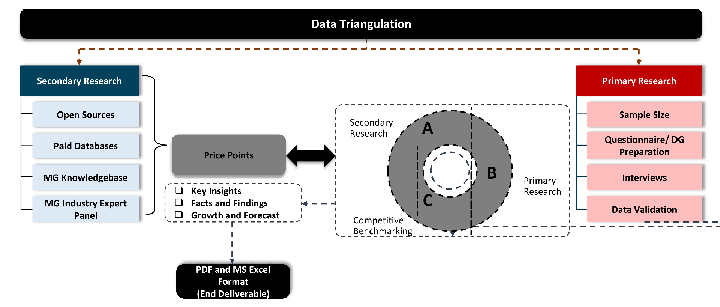
Data triangulation is a validation technique that uses multiple methods, sources, or perspectives to examine the same research question, thereby increasing the credibility and reliability of research findings. In market research, triangulation serves as a quality assurance mechanism that helps identify and minimize bias, validate assumptions, and ensure accuracy in market estimates.
- Data Source Triangulation – Using multiple data sources to examine the same phenomenon
- Methodological Triangulation – Using multiple research methods to study the same research question
- Investigator Triangulation – Using multiple researchers or analysts to examine the same data
- Theoretical Triangulation – Using multiple theoretical perspectives to interpret the same data
Custom Market Research Services
We will customise the research for you, in case the report listed above does not meet your requirements.
Get 10% Free Customisation