Precision Agriculture Drone Market Size, Share & Trends Analysis Report by Drone Type (Fixed-Wing Drones, Rotary-Wing Drones, Hybrid Drones), Rated Power, Rated Capacity (Payload Capacity), Flight Time/Endurance, Technology, Component, Range, Farm Size Application, End-Use Industry, Distribution Channel, Geography (North America, Europe, Asia Pacific, Middle East, Africa, and South America) – Global Industry Data, Trends, and Forecasts, 2026–2035
|
|
|
Segmental Data Insights |
|
|
Demand Trends |
|
|
Competitive Landscape |
|
|
Strategic Development |
|
|
Future Outlook & Opportunities |
|
Precision-Agriculture-Drone-Market Size, Share, and Growth
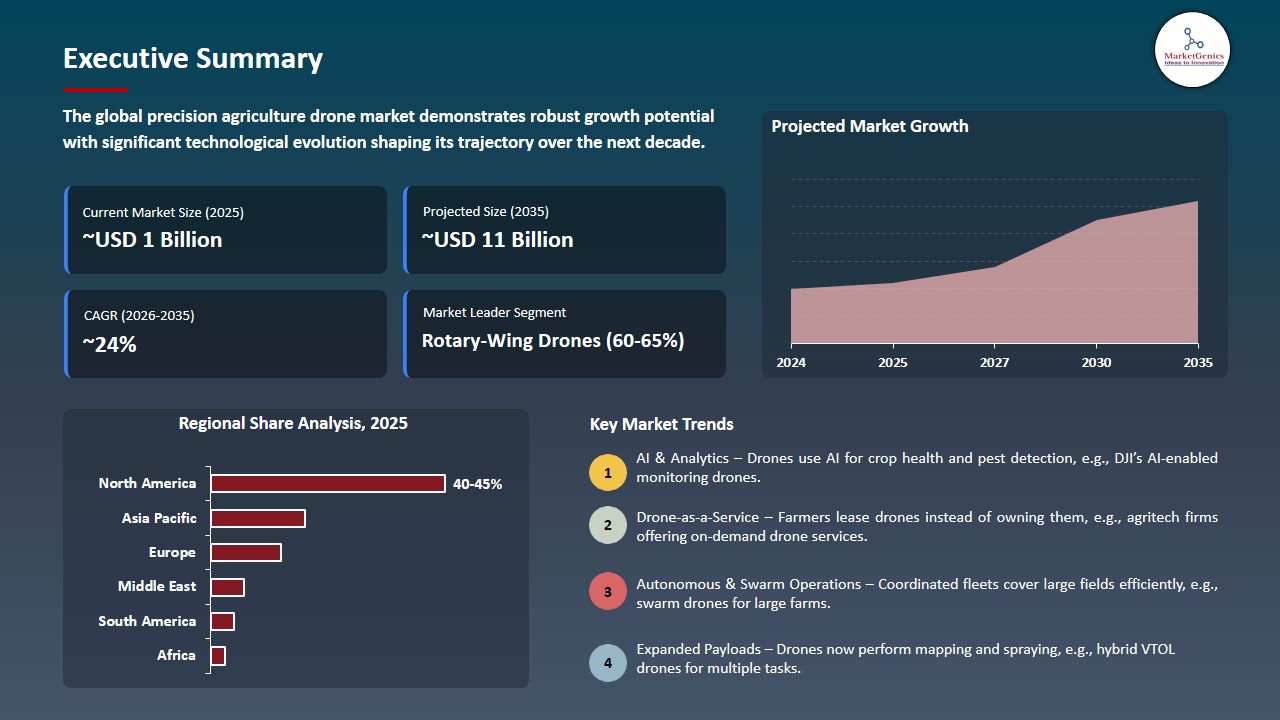
The global precision agriculture drone market is witnessing strong growth, valued at USD 1.3 billion in 2025 and projected to reach USD 10.9 billion by 2035, expanding at a CAGR of 23.7% during the forecast period. Asia Pacific is the fastest-growing region in the precision agriculture drone market due to rising adoption of smart farming technologies, increasing agricultural mechanization, supportive government initiatives, and growing demand for higher crop productivity and resource efficiency.
Shaun Passley, Ph.D., CEO of ZenaTech, said, “This proposed acquisition is more than just our first Southwest region location — it’s a strategic foothold into a high-value, high-growth state for precision agriculture, The firm is a natural fit to help execute our growth strategy for crop health monitoring and precision spraying to serve viticulture, large estates, and commercial farming operations across California”.
Governments in diverse regions are implementing incentives, regulatory changes, and financial incentives to bring about the uptake of smart farming technologies. These programs reduce the cost of entry to farmers, encourage the use of precision agriculture, and speed up the use of drones in farms. Such policies promote the development of the market by sponsoring research, pilot programs, and the introduction of new technological solutions, thus making the use of drones in precision agriculture more acceptable.
AI-based predictive modeling and analytics combined with IoT connectivity has identified a great potential in the precision agriculture drone market. The use of these technologies makes it possible to monitor the situation in real time, make decisions based on the data, and conduct farming processes (irrigation, fertilizing, pest control, etc.) automatically. The result of the IoT and AI integration is that it assists the farmer to optimize the yield, minimize resources waste, and increase sustainability of the farm of any size.
Adjacent opportunities in the precision agriculture drone market include the adoption of Drone‑as‑a‑Service (DaaS) models, deployment of hybrid VTOL and swarm drone technologies for large-area coverage, expansion into emerging markets, and the development of specialized applications such as precision spraying, irrigation monitoring, seed distribution, and vineyard or orchard management, all of which enhance efficiency, sustainability, and market reach.
Precision Agriculture Drone Market Dynamics and Trends
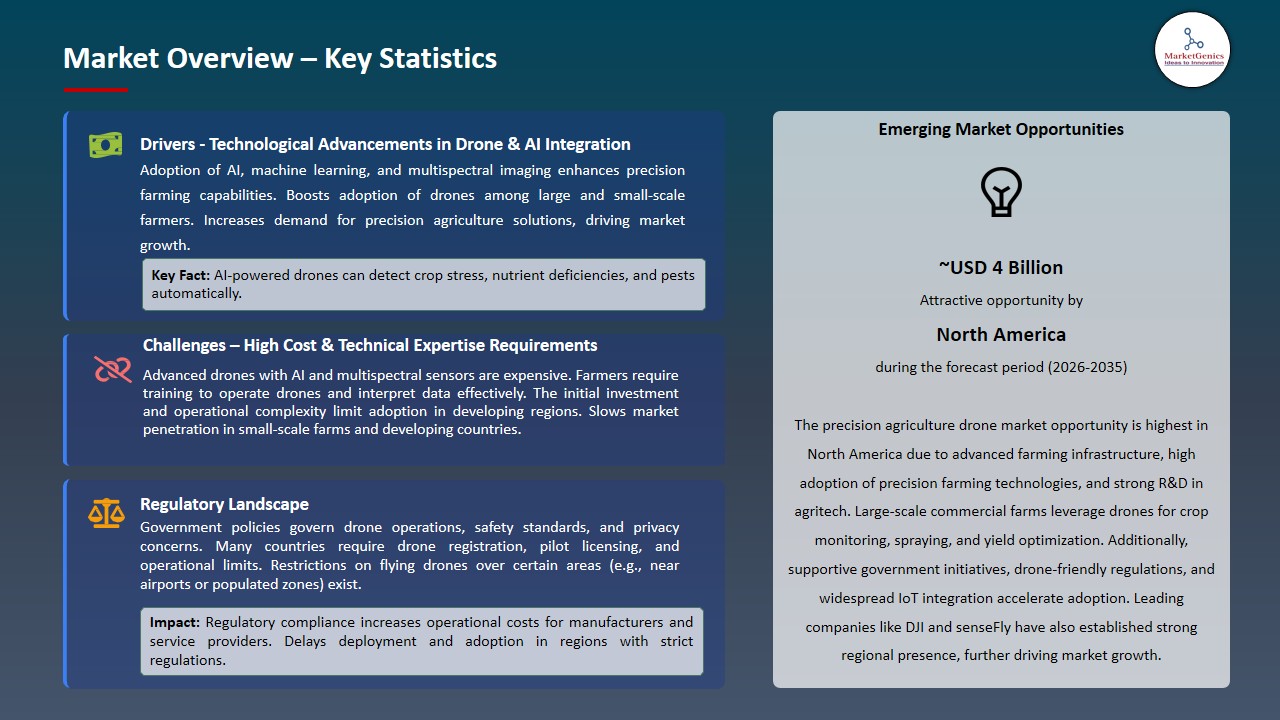
Driver: Increasing Adoption of Precision Agriculture
-
The increasing worldwide attention to sustainable agriculture and effective management of the resources is also playing a significant role in the shift to the use of precision agriculture practices which is increasing the precision agriculture drone market. Farmers are also demanding technologies that would give comprehensive information about the health of crops, soil status, irrigation requirements, and nutrient requirements.
- Precision agriculture drones are characterized by high-resolution imaging, real-time data collection system and advanced analytics which help make informed decisions, minimize resource wastage and improve crop yields. They can also cover large farm areas within a short time and with high accuracy meaning that farmers can have a target intervention and can make their operations more efficient, which is driving the expansion of the precision agriculture drone industry in large and small-scale farms globally.
- DJI Agriculture has claimed, in 2025, 400,000 drones deployed in the world, with 300 crops being used in 100 countries. The drones, which were featured at Agrishow 2025 in Brazil, have helped coffee growers to save 70 percent of their operational costs, saved 222 million tons of water, and lowered carbon emissions of 30.87 million tons, proving highly efficient and effective in precision agriculture.
- These advancements highlight that precision agriculture drones are becoming an essential resource in the sustainable, efficient, and high-yield agriculture practices around the globe.
Restraint: Data Privacy and Security Concerns
-
Precision agriculture drones are associated with gathering large volumes of sensitive data, such as the specifics on crop health, soil composition, irrigation patterns, and farm management practices. Although such data can be priceless to enhance yields and the efficiency of operations, it also creates serious issues of data ownership, privacy, and cybersecurity.
- Farmers and agribusinesses might not readily embrace the use of drone technology in case of doubt about who has access to the data obtained, where it is stored and who can use it. Besides, the threat of cyberattacks, data breach, or sharing proprietary information on agriculture without authorization is a significant threat to stakeholders. The small and medium-sized farms might be too impoverished in terms of infrastructure or experience to adopt strong data protection strategies, which makes them more vulnerable. Laws governing data security and privacy in agriculture are still changing in most areas, which may cause inconsistencies and legal ambiguities.
- All these elements work together as a restraint that may stall the adoption of precision agriculture drones and may prevent the expansion of the market despite the benefits of their operation.
Opportunity: Drone‑as‑a‑Service (DaaS) Models
-
Precision agriculture drone market is experiencing tremendous growth opportunities through the introduction of Drone-as-a-Service (DaaS) models. The service-based products will enable farmers to use sophisticated drone technology, such as imaging, spraying, and data analytics, without investing in equipment. Subs and renting business models can lower the financial barrier, and precision agriculture drones will become more available to the smallholder and medium-sized farms.
- Moreover, additional services are usually provided by DaaS providers, including pilot training, interpreting data, and maintenance services, which can further increase the value of farmers. DaaS models are helping to reduce the barriers to entry, increase market penetration, and scale up drone technology, enabling large-scale agricultural practices to be applied and of lower cost across various regions and on large and small farms alike.
- ZenaTech, Inc. acquired a local engineering company in California in 2025, extending its Drone-as-a-Service (DaaS) to the state, where local drones will be serviced through AI to provide precision spraying, irrigation analytics, and crop monitoring. The relocation will give the farmers the opportunity to utilize improved drone technology without the need of investing in hardware, increasing efficiency and sustainability in agriculture and viticulture sectors in the state.
- Drones in agriculture are becoming increasingly adopted through Drone-as-a-Service (DaaS) models that are affordable, scalable, and accessible to offer an efficient and sustainable farming model.
Key Trend: Smart and Automated Drones
-
Adoption of fully autonomous drones with advanced sensors, onboard processing and AI-controlled decision-making capabilities are becoming one of the major trends in the precision agriculture drone market. Crop monitoring, precision spraying, and data collection are some of the tasks that can be done using these drones with minimum human engagement to enhance efficiency in operations, as well as to limit reliance on labor. Onboard analytics enable the processing of high-resolution images in real time, which can be used to detect stress, pest infestations and nutrient deficiencies faster.
- Scalability and consistency of farm management practices is increased through the capability to work independently over extensive areas of farms. With the growth of technology, automated and intelligent drones will become the backbone of precision agriculture that will lead to increased productivity, sustainability, and resource usage optimization in various farming processes.
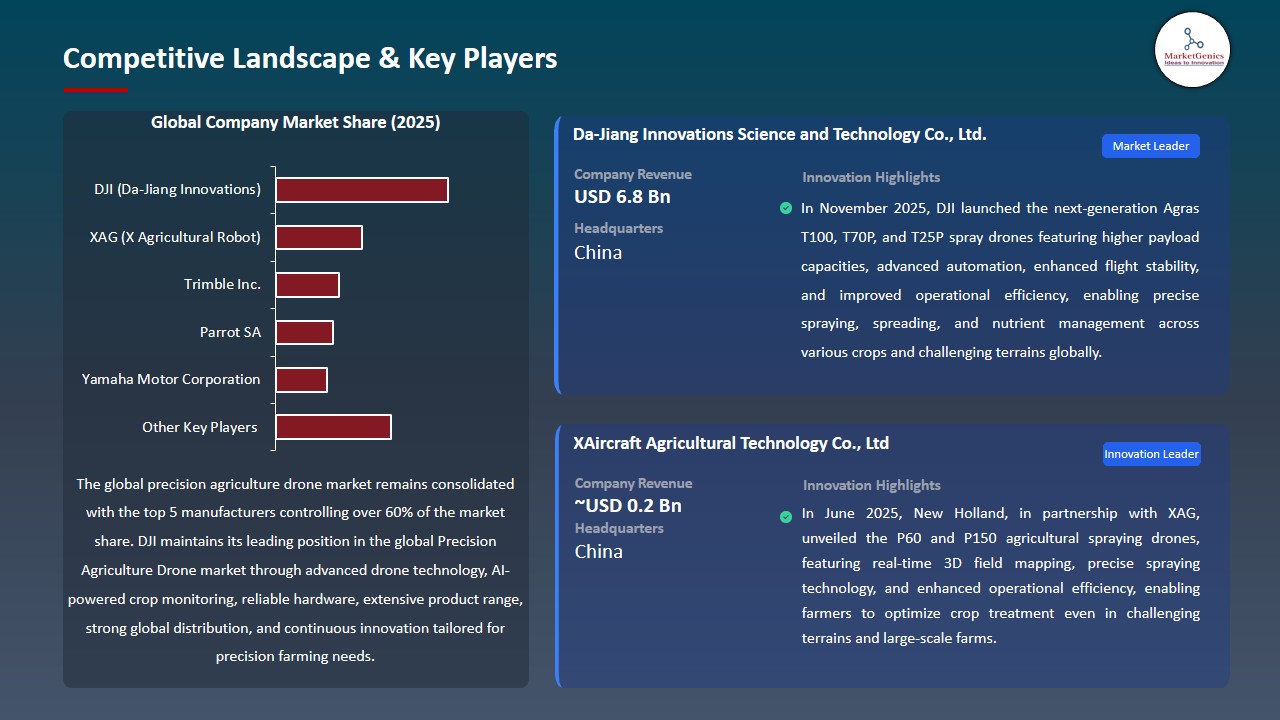
- XAG introduced the P150 Max Agricultural Drone and R Series Agricultural Rover to Agritechnica in 2025, which had the characteristics of full autonomy, high payload capacity, and AI-oriented operations. The P150 Max enjoys accuracy in spraying, spreading, field mapping, and logistic having a payload of 80 kg and the R Series allows intelligent operations on the ground in orchards and greenhouses.
- These developments point to the increased use of smart and automated drones to increase efficiency, resource optimization, and operational safety in precision agriculture across the globe.
Precision-Agriculture-Drone-Market Analysis and Segmental Data
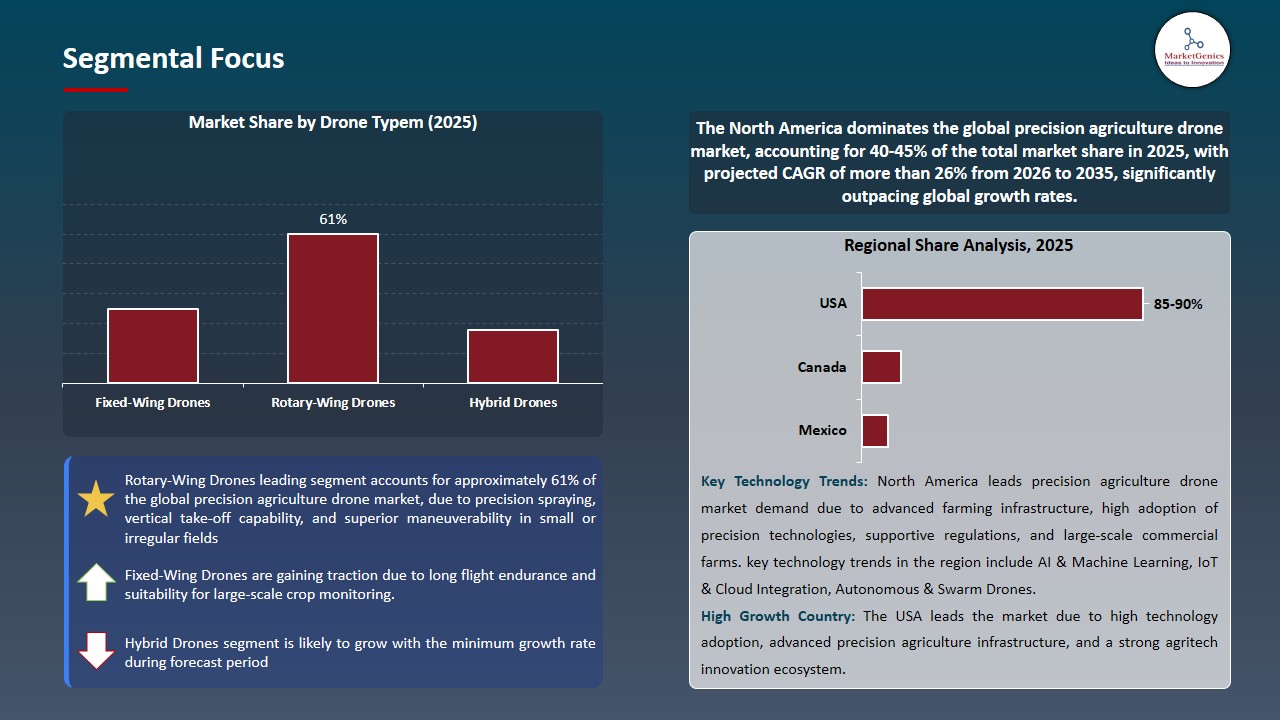
Rotary-Wing Drones Dominate Global Precision Agriculture Drone Market
-
Rotary-wing drones are the leading segment in the precision agriculture drone market, due to their versatility, maneuverability, and ability to operate in diverse farm conditions. Unlike fixed-wing drones, rotary-wing designs can hover, take off, and land vertically, making them ideal for tasks requiring precision, such as spraying, seeding, and crop monitoring in small to medium-sized fields or areas with uneven terrain.
- Their capability to transport variable payloads, combine multispectral sensors and offer real-time images improves plant health monitoring and the optimization of resources. Therefore, rotary-wing drones are extensively used in the world to assure efficiency, sustainability and productivity in precision agriculture, and ensure that they continue to lead in the number of drone types preferred by farmers and agribusinesses.
- In 2025, DJI Agriculture released the Agras T100, T70P, and T25P in the worldwide market, providing rotary-wing drones with greater payloads, greater spraying and spreading functions, and complete autonomy of operation. The T100 is capable of supporting up to 100L spraying and 100Kg lifting whereas the T70P and T25P have medium and small-scale requirements respectively.
- These drones, along with more sophisticated safety systems, and AI-controlled capabilities, show that rotary-wing drones will remain dominant and provide more innovations to more areas of the world and enhance efficiency, productivity, and resource optimization.
North America Leads Global Precision Agriculture Drone Market Demand
-
The North America is the leading region for precision agriculture drone market, driven by a combination of advanced technological adoption, large-scale commercial farming, and strong regulatory support for precision agriculture practices. Farmers in the United States and Canada are increasingly integrating drones for crop monitoring, precision spraying, and field mapping to improve efficiency and optimize resource use. High levels of awareness about sustainable farming, coupled with government incentives and favorable policies for drone operations, have accelerated adoption across both large commercial farms and medium-sized operations.
- The presence of leading drone manufacturers, such as DJI, XAG, and Parrot, offering innovative rotary-wing and hybrid drone solutions, further strengthens market growth. Additionally, the region benefits from robust infrastructure, reliable connectivity, and skilled personnel capable of operating and maintaining advanced drone systems.
- Collectively, these factors position North America as a key demand driver in the precision agriculture drone market.
Precision-Agriculture-Drone-Market Ecosystem
The global precision agriculture drone market is consolidated, with leading players including DJI (Da-Jiang Innovations), XAG (X Agricultural Robot), Trimble Inc., Parrot SA, and Yamaha Motor Corporation. These companies maintain competitive advantages through advanced drone technologies, AI-powered analytics, IoT-enabled monitoring, autonomous spraying and seeding systems, precision mapping capabilities, and operator-friendly software interfaces.
The market value chain spans the design and R&D of drones, manufacturing of UAV platforms and sensor systems, software development and AI integration, field calibration and autonomous operation testing, deployment across farms, adherence to agricultural and aviation safety regulations, and after-sales services such as remote monitoring, predictive maintenance, fleet optimization, and software updates.
Entry barriers are high due to the capital-intensive nature of drone manufacturing, technical expertise required for AI and autonomy, integration with diverse farming environments, and compliance with regulatory and safety standards.
The market continues to evolve through technological innovations, including AI-driven crop monitoring, autonomous flight planning, swarm and hybrid drone operations, advanced multispectral and hyperspectral sensor integration, and compatibility with farm management platforms, driving differentiation and adoption globally.
Recent Development and Strategic Overview:
-
In July 2025, Optiemus Unmanned Systems (OUS) launched a new range of indigenously designed agricultural and mapping drones in India and announced plans for a Drone-as-a-Service (DaaS) model. The company aims to deploy a fleet of 5,000 drones and train 6,000 pilots by the end of 2025, targeting service revenues of ₹600–₹900 crore. This initiative enhances accessibility to precision agriculture technology, supporting large-scale adoption, operational efficiency, and sustainable farming practices in the region.
- In January 2025, XAG, through its Philippine partner Agridom, collaborated with the International Rice Research Institute (IRRI) to advance digital agriculture and precision farming in the Philippines. Under this partnership, XAG donated agricultural drones to support research and practical applications in rice-based cropping systems, including crop monitoring, precision spraying, and data-driven decision-making.
Report Scope
|
Detail |
|
|
Market Size in 2025 |
USD 1.3 Bn |
|
Market Forecast Value in 2035 |
USD 10.9 Bn |
|
Growth Rate (CAGR) |
23.7% |
|
Forecast Period |
2026 – 2035 |
|
Historical Data Available for |
2021 – 2024 |
|
Market Size Units |
US$ Billion for Value Thousand Units for Volume |
|
Report Format |
Electronic (PDF) + Excel |
|
North America |
Europe |
Asia Pacific |
Middle East |
Africa |
South America |
|
|
|
|
|
|
|
Companies Covered |
|||||
|
|
|
|
|
|
Precision-Agriculture-Drone-Market Segmentation and Highlights
|
Segment |
Sub-segment |
|
Precision Agriculture Drone Market, By Drone Type |
|
|
Precision Agriculture Drone Market, By Rated Power |
|
|
Precision Agriculture Drone Market, By Rated Capacity (Payload Capacity) |
|
|
Precision Agriculture Drone Market, By Flight Time/Endurance |
|
|
Precision Agriculture Drone Market, By Technology |
|
|
Precision Agriculture Drone Market, By Component |
|
|
Precision Agriculture Drone Market, By Range |
|
|
Precision Agriculture Drone Market, By Farm Size Application |
|
|
Precision Agriculture Drone Market, By End-Use Industry |
|
|
Precision Agriculture Drone Market, By Distribution Channel |
|
Frequently Asked Questions
Table of Contents
- 1. Research Methodology and Assumptions
- 1.1. Definitions
- 1.2. Research Design and Approach
- 1.3. Data Collection Methods
- 1.4. Base Estimates and Calculations
- 1.5. Forecasting Models
- 1.5.1. Key Forecast Factors & Impact Analysis
- 1.6. Secondary Research
- 1.6.1. Open Sources
- 1.6.2. Paid Databases
- 1.6.3. Associations
- 1.7. Primary Research
- 1.7.1. Primary Sources
- 1.7.2. Primary Interviews with Stakeholders across Ecosystem
- 2. Executive Summary
- 2.1. Global Precision Agriculture Drone Market Outlook
- 2.1.1. Precision Agriculture Drone Market Size Volume (Thousand Units) and Value (US$ Bn), and Forecasts, 2021-2035
- 2.1.2. Compounded Annual Growth Rate Analysis
- 2.1.3. Growth Opportunity Analysis
- 2.1.4. Segmental Share Analysis
- 2.1.5. Geographical Share Analysis
- 2.2. Market Analysis and Facts
- 2.3. Supply-Demand Analysis
- 2.4. Competitive Benchmarking
- 2.5. Go-to- Market Strategy
- 2.5.1. Customer/ End-use Industry Assessment
- 2.5.2. Growth Opportunity Data, 2026-2035
- 2.5.2.1. Regional Data
- 2.5.2.2. Country Data
- 2.5.2.3. Segmental Data
- 2.5.3. Identification of Potential Market Spaces
- 2.5.4. GAP Analysis
- 2.5.5. Potential Attractive Price Points
- 2.5.6. Prevailing Market Risks & Challenges
- 2.5.7. Preferred Sales & Marketing Strategies
- 2.5.8. Key Recommendations and Analysis
- 2.5.9. A Way Forward
- 2.1. Global Precision Agriculture Drone Market Outlook
- 3. Industry Data and Premium Insights
- 3.1. Global Industrial Machinery Overview, 2025
- 3.1.1. Industrial Machinery Ecosystem Analysis
- 3.1.2. Key Trends for Industrial Machinery
- 3.1.3. Regional Distribution for Industrial Machinery
- 3.2. Supplier Customer Data
- 3.3. Technology Roadmap and Developments
- 3.4. Trade Analysis
- 3.4.1. Import & Export Analysis, 2025
- 3.4.2. Top Importing Countries
- 3.4.3. Top Exporting Countries
- 3.5. Trump Tariff Impact Analysis
- 3.5.1. Manufacturer
- 3.5.1.1. Based on the component & Raw material
- 3.5.2. Supply Chain
- 3.5.3. End Consumer
- 3.5.1. Manufacturer
- 3.6. Raw Material Analysis
- 3.1. Global Industrial Machinery Overview, 2025
- 4. Market Overview
- 4.1. Market Dynamics
- 4.1.1. Drivers
- 4.1.1.1. Rising adoption of precision farming to improve yields and reduce input costs
- 4.1.1.2. Advancements in drone sensors, AI, and analytics with declining hardware costs
- 4.1.1.3. Expansion of drone-as-a-service models and commercial farming applications
- 4.1.2. Restraints
- 4.1.2.1. High initial investment and limited technical expertise among farmers
- 4.1.2.2. Regulatory restrictions and airspace limitations on drone operations
- 4.1.1. Drivers
- 4.2. Key Trend Analysis
- 4.3. Regulatory Framework
- 4.3.1. Key Regulations, Norms, and Subsidies, by Key Countries
- 4.3.2. Tariffs and Standards
- 4.3.3. Impact Analysis of Regulations on the Market
- 4.4. Value Chain Analysis
- 4.4.1. Component Suppliers
- 4.4.2. Drone Manufacturing & Assembly
- 4.4.3. Distributors & Sales Channels
- 4.4.4. Drone-as-a-Service (DaaS) Providers
- 4.4.5. End-Users
- 4.5. Cost Structure Analysis
- 4.6. Pricing Analysis
- 4.7. Porter’s Five Forces Analysis
- 4.8. PESTEL Analysis
- 4.9. Global Precision Agriculture Drone Market Demand
- 4.9.1. Historical Market Size – Volume (Thousand Units) and Value (US$ Bn), 2020-2024
- 4.9.2. Current and Future Market Size – Volume (Thousand Units) and Value (US$ Bn), 2026–2035
- 4.9.2.1. Y-o-Y Growth Trends
- 4.9.2.2. Absolute $ Opportunity Assessment
- 4.1. Market Dynamics
- 5. Competition Landscape
- 5.1. Competition structure
- 5.1.1. Fragmented v/s consolidated
- 5.2. Company Share Analysis, 2025
- 5.2.1. Global Company Market Share
- 5.2.2. By Region
- 5.2.2.1. North America
- 5.2.2.2. Europe
- 5.2.2.3. Asia Pacific
- 5.2.2.4. Middle East
- 5.2.2.5. Africa
- 5.2.2.6. South America
- 5.3. Product Comparison Matrix
- 5.3.1. Specifications
- 5.3.2. Market Positioning
- 5.3.3. Pricing
- 5.1. Competition structure
- 6. Global Precision Agriculture Drone Market Analysis, by Drone Type
- 6.1. Key Segment Analysis
- 6.2. Precision Agriculture Drone Market Size Volume (Thousand Units) and Value (US$ Bn), Analysis, and Forecasts, by Drone Type, 2021-2035
- 6.2.1. Fixed-Wing Drones
- 6.2.2. Rotary-Wing Drones
- 6.2.2.1. Single Rotor
- 6.2.2.2. Multi-Rotor
- 6.2.2.3. Quadcopter
- 6.2.2.4. Hexacopter
- 6.2.2.5. Octocopter
- 6.2.3. Hybrid Drones
- 7. Global Precision Agriculture Drone Market Analysis, by Rated Power
- 7.1. Key Segment Analysis
- 7.2. Precision Agriculture Drone Market Size Volume (Thousand Units) and Value (US$ Bn), Analysis, and Forecasts, by Rated Power, 2021-2035
- 7.2.1. Below 5 HP
- 7.2.2. 5-10 HP
- 7.2.3. 10-15 HP
- 7.2.4. 15-20 HP
- 7.2.5. Above 20 HP
- 8. Global Precision Agriculture Drone Market Analysis, by Rated Capacity (Payload Capacity)
- 8.1. Key Segment Analysis
- 8.2. Precision Agriculture Drone Market Size Volume (Thousand Units) and Value (US$ Bn), Analysis, and Forecasts, by Rated Capacity (Payload Capacity), 2021-2035
- 8.2.1. Less than 5 kg
- 8.2.2. 5-10 kg
- 8.2.3. 10-20 kg
- 8.2.4. 20-30 kg
- 8.2.5. Above 30 kg
- 9. Global Precision Agriculture Drone Market Analysis, by Flight Time/Endurance
- 9.1. Key Segment Analysis
- 9.2. Precision Agriculture Drone Market Size Volume (Thousand Units) and Value (US$ Bn), Analysis, and Forecasts, by Flight Time/Endurance, 2021-2035
- 9.2.1. Less than 30 minutes
- 9.2.2. 30-60 minutes
- 9.2.3. 60-90 minutes
- 9.2.4. Above 90 minutes
- 10. Global Precision Agriculture Drone Market Analysis, by Technology
- 10.1. Key Segment Analysis
- 10.2. Precision Agriculture Drone Market Size Volume (Thousand Units) and Value (US$ Bn), Analysis, and Forecasts, by Technology, 2021-2035
- 10.2.1. Remote Sensing Technology
- 10.2.1.1. Multispectral Imaging
- 10.2.1.2. Hyperspectral Imaging
- 10.2.1.3. Thermal Imaging
- 10.2.1.4. RGB Imaging
- 10.2.2. Others
- 10.2.3. GPS/GNSS Navigation
- 10.2.4. LiDAR Technology
- 10.2.5. AI and Machine Learning Integration
- 10.2.6. IoT-Enabled Systems
- 10.2.7. Others Technologies
- 10.2.1. Remote Sensing Technology
- 11. Global Precision Agriculture Drone Market Analysis, by Component
- 11.1. Key Segment Analysis
- 11.2. Precision Agriculture Drone Market Size Volume (Thousand Units) and Value (US$ Bn), Analysis, and Forecasts, by Component, 2021-2035
- 11.2.1. Hardware
- 11.2.1.1. Frame/Airframe
- 11.2.1.2. Propulsion System
- 11.2.1.3. Battery
- 11.2.1.4. Controller System
- 11.2.1.5. Camera/Sensors
- 11.2.1.6. GPS Module
- 11.2.1.7. Others
- 11.2.2. Software
- 11.2.2.1. Data Analytics Software
- 11.2.2.2. Flight Control Software
- 11.2.2.3. Mapping Software
- 11.2.2.4. Farm Management Software
- 11.2.2.5. Others
- 11.2.1. Hardware
- 12. Global Precision Agriculture Drone Market Analysis, by Range
- 12.1. Key Segment Analysis
- 12.2. Precision Agriculture Drone Market Size Volume (Thousand Units) and Value (US$ Bn), Analysis, and Forecasts, by Range, 2021-2035
- 12.2.1. Visual Line of Sight (VLOS) - Up to 500m
- 12.2.2. Extended Visual Line of Sight (EVLOS) - 500m to 2km
- 12.2.3. Beyond Visual Line of Sight (BVLOS) - Above 2km
- 13. Global Precision Agriculture Drone Market Analysis and Forecasts, by Farm Size Application
- 13.1. Key Findings
- 13.2. Precision Agriculture Drone Market Size Volume (Thousand Units) and Value (US$ Bn), Analysis, and Forecasts, by Farm Size Application, 2021-2035
- 13.2.1. Less than 50 acres
- 13.2.2. 50-500 acres
- 13.2.3. 500-2,000 acres
- 13.2.4. Above 2,000 acres
- 14. Global Precision Agriculture Drone Market Analysis and Forecasts, by End-Use Industry
- 14.1. Key Findings
- 14.2. Precision Agriculture Drone Market Size Volume (Thousand Units) and Value (US$ Bn), Analysis, and Forecasts, by End-Use Industry, 2021-2035
- 14.2.1. Agriculture
- 14.2.1.1. Crop Monitoring and Health Assessment
- 14.2.1.2. Soil Analysis and Field Mapping
- 14.2.1.3. Irrigation Management
- 14.2.1.4. Pest and Disease Detection
- 14.2.1.5. Crop Spraying and Fertilization
- 14.2.1.6. Yield Estimation and Forecasting
- 14.2.1.7. Others
- 14.2.2. Horticulture
- 14.2.2.1. Vineyard Management
- 14.2.2.2. Orchard Monitoring
- 14.2.2.3. Greenhouse Operations
- 14.2.2.4. Nursery Management
- 14.2.2.5. Others
- 14.2.3. Forestry
- 14.2.3.1. Forest Health Monitoring
- 14.2.3.2. Tree Counting and Classification
- 14.2.3.3. Fire Detection and Prevention
- 14.2.3.4. Reforestation Planning
- 14.2.3.5. Others
- 14.2.4. Research and Academic Institutions
- 14.2.4.1. Agricultural Research
- 14.2.4.2. Precision Farming Studies
- 14.2.4.3. Technology Development
- 14.2.4.4. Training and Education
- 14.2.4.5. Others
- 14.2.5. Government and Regulatory Bodies
- 14.2.5.1. Agricultural Surveys
- 14.2.5.2. Land Use Planning
- 14.2.5.3. Subsidy Verification
- 14.2.5.4. Crop Insurance Assessment
- 14.2.5.5. Others
- 14.2.1. Agriculture
- 15. Global Precision Agriculture Drone Market Analysis and Forecasts, by Distribution Channel
- 15.1. Key Findings
- 15.2. Precision Agriculture Drone Market Size Volume (Thousand Units) and Value (US$ Bn), Analysis, and Forecasts, by Distribution Channel, 2021-2035
- 15.2.1. Direct Sales
- 15.2.2. Distributors and Dealers
- 15.2.3. Online Retail
- 15.2.4. Rental/Leasing Services
- 16. Global Precision Agriculture Drone Market Analysis and Forecasts, by Region
- 16.1. Key Findings
- 16.2. Precision Agriculture Drone Market Size Volume (Thousand Units) and Value (US$ Bn), Analysis, and Forecasts, by Region, 2021-2035
- 16.2.1. North America
- 16.2.2. Europe
- 16.2.3. Asia Pacific
- 16.2.4. Middle East
- 16.2.5. Africa
- 16.2.6. South America
- 17. North America Precision Agriculture Drone Market Analysis
- 17.1. Key Segment Analysis
- 17.2. Regional Snapshot
- 17.3. North America Precision Agriculture Drone Market Size- Volume (Thousand Units) and Value (US$ Bn), Analysis, and Forecasts, 2021-2035
- 17.3.1. Drone Type
- 17.3.2. Rated Power
- 17.3.3. Rated Capacity (Payload Capacity)
- 17.3.4. Flight Time/Endurance
- 17.3.5. Technology
- 17.3.6. Component
- 17.3.7. Range
- 17.3.8. Farm Size Application
- 17.3.9. End-Use Industry
- 17.3.10. Distribution Channel
- 17.3.11. Country
- 17.3.11.1. USA
- 17.3.11.2. Canada
- 17.3.11.3. Mexico
- 17.4. USA Precision Agriculture Drone Market
- 17.4.1. Country Segmental Analysis
- 17.4.2. Drone Type
- 17.4.3. Rated Power
- 17.4.4. Rated Capacity (Payload Capacity)
- 17.4.5. Flight Time/Endurance
- 17.4.6. Technology
- 17.4.7. Component
- 17.4.8. Range
- 17.4.9. Farm Size Application
- 17.4.10. End-Use Industry
- 17.4.11. Distribution Channel
- 17.5. Canada Precision Agriculture Drone Market
- 17.5.1. Country Segmental Analysis
- 17.5.2. Drone Type
- 17.5.3. Rated Power
- 17.5.4. Rated Capacity (Payload Capacity)
- 17.5.5. Flight Time/Endurance
- 17.5.6. Technology
- 17.5.7. Component
- 17.5.8. Range
- 17.5.9. Farm Size Application
- 17.5.10. End-Use Industry
- 17.5.11. Distribution Channel
- 17.6. Mexico Precision Agriculture Drone Market
- 17.6.1. Country Segmental Analysis
- 17.6.2. Drone Type
- 17.6.3. Rated Power
- 17.6.4. Rated Capacity (Payload Capacity)
- 17.6.5. Flight Time/Endurance
- 17.6.6. Technology
- 17.6.7. Component
- 17.6.8. Range
- 17.6.9. Farm Size Application
- 17.6.10. End-Use Industry
- 17.6.11. Distribution Channel
- 18. Europe Precision Agriculture Drone Market Analysis
- 18.1. Key Segment Analysis
- 18.2. Regional Snapshot
- 18.3. Europe Precision Agriculture Drone Market Size Volume (Thousand Units) and Value (US$ Bn), Analysis, and Forecasts, 2021-2035
- 18.3.1. Drone Type
- 18.3.2. Rated Power
- 18.3.3. Rated Capacity (Payload Capacity)
- 18.3.4. Flight Time/Endurance
- 18.3.5. Technology
- 18.3.6. Component
- 18.3.7. Range
- 18.3.8. Farm Size Application
- 18.3.9. End-Use Industry
- 18.3.10. Distribution Channel
- 18.3.11. Country
- 18.3.11.1. Germany
- 18.3.11.2. United Kingdom
- 18.3.11.3. France
- 18.3.11.4. Italy
- 18.3.11.5. Spain
- 18.3.11.6. Netherlands
- 18.3.11.7. Nordic Countries
- 18.3.11.8. Poland
- 18.3.11.9. Russia & CIS
- 18.3.11.10. Rest of Europe
- 18.4. Germany Precision Agriculture Drone Market
- 18.4.1. Country Segmental Analysis
- 18.4.2. Drone Type
- 18.4.3. Rated Power
- 18.4.4. Rated Capacity (Payload Capacity)
- 18.4.5. Flight Time/Endurance
- 18.4.6. Technology
- 18.4.7. Component
- 18.4.8. Range
- 18.4.9. Farm Size Application
- 18.4.10. End-Use Industry
- 18.4.11. Distribution Channel
- 18.5. United Kingdom Precision Agriculture Drone Market
- 18.5.1. Country Segmental Analysis
- 18.5.2. Drone Type
- 18.5.3. Rated Power
- 18.5.4. Rated Capacity (Payload Capacity)
- 18.5.5. Flight Time/Endurance
- 18.5.6. Technology
- 18.5.7. Component
- 18.5.8. Range
- 18.5.9. Farm Size Application
- 18.5.10. End-Use Industry
- 18.5.11. Distribution Channel
- 18.6. France Precision Agriculture Drone Market
- 18.6.1. Country Segmental Analysis
- 18.6.2. Drone Type
- 18.6.3. Rated Power
- 18.6.4. Rated Capacity (Payload Capacity)
- 18.6.5. Flight Time/Endurance
- 18.6.6. Technology
- 18.6.7. Component
- 18.6.8. Range
- 18.6.9. Farm Size Application
- 18.6.10. End-Use Industry
- 18.6.11. Distribution Channel
- 18.7. Italy Precision Agriculture Drone Market
- 18.7.1. Country Segmental Analysis
- 18.7.2. Drone Type
- 18.7.3. Rated Power
- 18.7.4. Rated Capacity (Payload Capacity)
- 18.7.5. Flight Time/Endurance
- 18.7.6. Technology
- 18.7.7. Component
- 18.7.8. Range
- 18.7.9. Farm Size Application
- 18.7.10. End-Use Industry
- 18.7.11. Distribution Channel
- 18.8. Spain Precision Agriculture Drone Market
- 18.8.1. Country Segmental Analysis
- 18.8.2. Drone Type
- 18.8.3. Rated Power
- 18.8.4. Rated Capacity (Payload Capacity)
- 18.8.5. Flight Time/Endurance
- 18.8.6. Technology
- 18.8.7. Component
- 18.8.8. Range
- 18.8.9. Farm Size Application
- 18.8.10. End-Use Industry
- 18.8.11. Distribution Channel
- 18.9. Netherlands Precision Agriculture Drone Market
- 18.9.1. Country Segmental Analysis
- 18.9.2. Drone Type
- 18.9.3. Rated Power
- 18.9.4. Rated Capacity (Payload Capacity)
- 18.9.5. Flight Time/Endurance
- 18.9.6. Technology
- 18.9.7. Component
- 18.9.8. Range
- 18.9.9. Farm Size Application
- 18.9.10. End-Use Industry
- 18.9.11. Distribution Channel
- 18.10. Nordic Countries Precision Agriculture Drone Market
- 18.10.1. Country Segmental Analysis
- 18.10.2. Drone Type
- 18.10.3. Rated Power
- 18.10.4. Rated Capacity (Payload Capacity)
- 18.10.5. Flight Time/Endurance
- 18.10.6. Technology
- 18.10.7. Component
- 18.10.8. Range
- 18.10.9. Farm Size Application
- 18.10.10. End-Use Industry
- 18.10.11. Distribution Channel
- 18.11. Poland Precision Agriculture Drone Market
- 18.11.1. Country Segmental Analysis
- 18.11.2. Drone Type
- 18.11.3. Rated Power
- 18.11.4. Rated Capacity (Payload Capacity)
- 18.11.5. Flight Time/Endurance
- 18.11.6. Technology
- 18.11.7. Component
- 18.11.8. Range
- 18.11.9. Farm Size Application
- 18.11.10. End-Use Industry
- 18.11.11. Distribution Channel
- 18.12. Russia & CIS Precision Agriculture Drone Market
- 18.12.1. Country Segmental Analysis
- 18.12.2. Drone Type
- 18.12.3. Rated Power
- 18.12.4. Rated Capacity (Payload Capacity)
- 18.12.5. Flight Time/Endurance
- 18.12.6. Technology
- 18.12.7. Component
- 18.12.8. Range
- 18.12.9. Farm Size Application
- 18.12.10. End-Use Industry
- 18.12.11. Distribution Channel
- 18.13. Rest of Europe Precision Agriculture Drone Market
- 18.13.1. Country Segmental Analysis
- 18.13.2. Drone Type
- 18.13.3. Rated Power
- 18.13.4. Rated Capacity (Payload Capacity)
- 18.13.5. Flight Time/Endurance
- 18.13.6. Technology
- 18.13.7. Component
- 18.13.8. Range
- 18.13.9. Farm Size Application
- 18.13.10. End-Use Industry
- 18.13.11. Distribution Channel
- 19. Asia Pacific Precision Agriculture Drone Market Analysis
- 19.1. Key Segment Analysis
- 19.2. Regional Snapshot
- 19.3. Asia Pacific Precision Agriculture Drone Market Size Volume (Thousand Units) and Value (US$ Bn), Analysis, and Forecasts, 2021-2035
- 19.3.1. Drone Type
- 19.3.2. Rated Power
- 19.3.3. Rated Capacity (Payload Capacity)
- 19.3.4. Flight Time/Endurance
- 19.3.5. Technology
- 19.3.6. Component
- 19.3.7. Range
- 19.3.8. Farm Size Application
- 19.3.9. End-Use Industry
- 19.3.10. Distribution Channel
- 19.3.11. Country
- 19.3.11.1. China
- 19.3.11.2. India
- 19.3.11.3. Japan
- 19.3.11.4. South Korea
- 19.3.11.5. Australia and New Zealand
- 19.3.11.6. Indonesia
- 19.3.11.7. Malaysia
- 19.3.11.8. Thailand
- 19.3.11.9. Vietnam
- 19.3.11.10. Rest of Asia Pacific
- 19.4. China Precision Agriculture Drone Market
- 19.4.1. Country Segmental Analysis
- 19.4.2. Drone Type
- 19.4.3. Rated Power
- 19.4.4. Rated Capacity (Payload Capacity)
- 19.4.5. Flight Time/Endurance
- 19.4.6. Technology
- 19.4.7. Component
- 19.4.8. Range
- 19.4.9. Farm Size Application
- 19.4.10. End-Use Industry
- 19.4.11. Distribution Channel
- 19.5. India Precision Agriculture Drone Market
- 19.5.1. Country Segmental Analysis
- 19.5.2. Drone Type
- 19.5.3. Rated Power
- 19.5.4. Rated Capacity (Payload Capacity)
- 19.5.5. Flight Time/Endurance
- 19.5.6. Technology
- 19.5.7. Component
- 19.5.8. Range
- 19.5.9. Farm Size Application
- 19.5.10. End-Use Industry
- 19.5.11. Distribution Channel
- 19.6. Japan Precision Agriculture Drone Market
- 19.6.1. Country Segmental Analysis
- 19.6.2. Drone Type
- 19.6.3. Rated Power
- 19.6.4. Rated Capacity (Payload Capacity)
- 19.6.5. Flight Time/Endurance
- 19.6.6. Technology
- 19.6.7. Component
- 19.6.8. Range
- 19.6.9. Farm Size Application
- 19.6.10. End-Use Industry
- 19.6.11. Distribution Channel
- 19.7. South Korea Precision Agriculture Drone Market
- 19.7.1. Country Segmental Analysis
- 19.7.2. Drone Type
- 19.7.3. Rated Power
- 19.7.4. Rated Capacity (Payload Capacity)
- 19.7.5. Flight Time/Endurance
- 19.7.6. Technology
- 19.7.7. Component
- 19.7.8. Range
- 19.7.9. Farm Size Application
- 19.7.10. End-Use Industry
- 19.7.11. Distribution Channel
- 19.8. Australia and New Zealand Precision Agriculture Drone Market
- 19.8.1. Country Segmental Analysis
- 19.8.2. Drone Type
- 19.8.3. Rated Power
- 19.8.4. Rated Capacity (Payload Capacity)
- 19.8.5. Flight Time/Endurance
- 19.8.6. Technology
- 19.8.7. Component
- 19.8.8. Range
- 19.8.9. Farm Size Application
- 19.8.10. End-Use Industry
- 19.8.11. Distribution Channel
- 19.9. Indonesia Precision Agriculture Drone Market
- 19.9.1. Country Segmental Analysis
- 19.9.2. Drone Type
- 19.9.3. Rated Power
- 19.9.4. Rated Capacity (Payload Capacity)
- 19.9.5. Flight Time/Endurance
- 19.9.6. Technology
- 19.9.7. Component
- 19.9.8. Range
- 19.9.9. Farm Size Application
- 19.9.10. End-Use Industry
- 19.9.11. Distribution Channel
- 19.10. Malaysia Precision Agriculture Drone Market
- 19.10.1. Country Segmental Analysis
- 19.10.2. Drone Type
- 19.10.3. Rated Power
- 19.10.4. Rated Capacity (Payload Capacity)
- 19.10.5. Flight Time/Endurance
- 19.10.6. Technology
- 19.10.7. Component
- 19.10.8. Range
- 19.10.9. Farm Size Application
- 19.10.10. End-Use Industry
- 19.10.11. Distribution Channel
- 19.11. Thailand Precision Agriculture Drone Market
- 19.11.1. Country Segmental Analysis
- 19.11.2. Drone Type
- 19.11.3. Rated Power
- 19.11.4. Rated Capacity (Payload Capacity)
- 19.11.5. Flight Time/Endurance
- 19.11.6. Technology
- 19.11.7. Component
- 19.11.8. Range
- 19.11.9. Farm Size Application
- 19.11.10. End-Use Industry
- 19.11.11. Distribution Channel
- 19.12. Vietnam Precision Agriculture Drone Market
- 19.12.1. Country Segmental Analysis
- 19.12.2. Drone Type
- 19.12.3. Rated Power
- 19.12.4. Rated Capacity (Payload Capacity)
- 19.12.5. Flight Time/Endurance
- 19.12.6. Technology
- 19.12.7. Component
- 19.12.8. Range
- 19.12.9. Farm Size Application
- 19.12.10. End-Use Industry
- 19.12.11. Distribution Channel
- 19.13. Rest of Asia Pacific Precision Agriculture Drone Market
- 19.13.1. Country Segmental Analysis
- 19.13.2. Drone Type
- 19.13.3. Rated Power
- 19.13.4. Rated Capacity (Payload Capacity)
- 19.13.5. Flight Time/Endurance
- 19.13.6. Technology
- 19.13.7. Component
- 19.13.8. Range
- 19.13.9. Farm Size Application
- 19.13.10. End-Use Industry
- 19.13.11. Distribution Channel
- 20. Middle East Precision Agriculture Drone Market Analysis
- 20.1. Key Segment Analysis
- 20.2. Regional Snapshot
- 20.3. Middle East Precision Agriculture Drone Market Size Volume (Thousand Units) and Value (US$ Bn), Analysis, and Forecasts, 2021-2035
- 20.3.1. Drone Type
- 20.3.2. Rated Power
- 20.3.3. Rated Capacity (Payload Capacity)
- 20.3.4. Flight Time/Endurance
- 20.3.5. Technology
- 20.3.6. Component
- 20.3.7. Range
- 20.3.8. Farm Size Application
- 20.3.9. End-Use Industry
- 20.3.10. Distribution Channel
- 20.3.11. Country
- 20.3.11.1. Turkey
- 20.3.11.2. UAE
- 20.3.11.3. Saudi Arabia
- 20.3.11.4. Israel
- 20.3.11.5. Rest of Middle East
- 20.4. Turkey Precision Agriculture Drone Market
- 20.4.1. Country Segmental Analysis
- 20.4.2. Drone Type
- 20.4.3. Rated Power
- 20.4.4. Rated Capacity (Payload Capacity)
- 20.4.5. Flight Time/Endurance
- 20.4.6. Technology
- 20.4.7. Component
- 20.4.8. Range
- 20.4.9. Farm Size Application
- 20.4.10. End-Use Industry
- 20.4.11. Distribution Channel
- 20.5. UAE Precision Agriculture Drone Market
- 20.5.1. Country Segmental Analysis
- 20.5.2. Drone Type
- 20.5.3. Rated Power
- 20.5.4. Rated Capacity (Payload Capacity)
- 20.5.5. Flight Time/Endurance
- 20.5.6. Technology
- 20.5.7. Component
- 20.5.8. Range
- 20.5.9. Farm Size Application
- 20.5.10. End-Use Industry
- 20.5.11. Distribution Channel
- 20.6. Saudi Arabia Precision Agriculture Drone Market
- 20.6.1. Country Segmental Analysis
- 20.6.2. Drone Type
- 20.6.3. Rated Power
- 20.6.4. Rated Capacity (Payload Capacity)
- 20.6.5. Flight Time/Endurance
- 20.6.6. Technology
- 20.6.7. Component
- 20.6.8. Range
- 20.6.9. Farm Size Application
- 20.6.10. End-Use Industry
- 20.6.11. Distribution Channel
- 20.7. Israel Precision Agriculture Drone Market
- 20.7.1. Country Segmental Analysis
- 20.7.2. Drone Type
- 20.7.3. Rated Power
- 20.7.4. Rated Capacity (Payload Capacity)
- 20.7.5. Flight Time/Endurance
- 20.7.6. Technology
- 20.7.7. Component
- 20.7.8. Range
- 20.7.9. Farm Size Application
- 20.7.10. End-Use Industry
- 20.7.11. Distribution Channel
- 20.8. Rest of Middle East Precision Agriculture Drone Market
- 20.8.1. Country Segmental Analysis
- 20.8.2. Drone Type
- 20.8.3. Rated Power
- 20.8.4. Rated Capacity (Payload Capacity)
- 20.8.5. Flight Time/Endurance
- 20.8.6. Technology
- 20.8.7. Component
- 20.8.8. Range
- 20.8.9. Farm Size Application
- 20.8.10. End-Use Industry
- 20.8.11. Distribution Channel
- 21. Africa Precision Agriculture Drone Market Analysis
- 21.1. Key Segment Analysis
- 21.2. Regional Snapshot
- 21.3. Africa Precision Agriculture Drone Market Size Volume (Thousand Units) and Value (US$ Bn), Analysis, and Forecasts, 2021-2035
- 21.3.1. Drone Type
- 21.3.2. Rated Power
- 21.3.3. Rated Capacity (Payload Capacity)
- 21.3.4. Flight Time/Endurance
- 21.3.5. Technology
- 21.3.6. Component
- 21.3.7. Range
- 21.3.8. Farm Size Application
- 21.3.9. End-Use Industry
- 21.3.10. Distribution Channel
- 21.3.11. Country
- 21.3.11.1. South Africa
- 21.3.11.2. Egypt
- 21.3.11.3. Nigeria
- 21.3.11.4. Algeria
- 21.3.11.5. Rest of Africa
- 21.4. South Africa Precision Agriculture Drone Market
- 21.4.1. Country Segmental Analysis
- 21.4.2. Drone Type
- 21.4.3. Rated Power
- 21.4.4. Rated Capacity (Payload Capacity)
- 21.4.5. Flight Time/Endurance
- 21.4.6. Technology
- 21.4.7. Component
- 21.4.8. Range
- 21.4.9. Farm Size Application
- 21.4.10. End-Use Industry
- 21.4.11. Distribution Channel
- 21.5. Egypt Precision Agriculture Drone Market
- 21.5.1. Country Segmental Analysis
- 21.5.2. Drone Type
- 21.5.3. Rated Power
- 21.5.4. Rated Capacity (Payload Capacity)
- 21.5.5. Flight Time/Endurance
- 21.5.6. Technology
- 21.5.7. Component
- 21.5.8. Range
- 21.5.9. Farm Size Application
- 21.5.10. End-Use Industry
- 21.5.11. Distribution Channel
- 21.6. Nigeria Precision Agriculture Drone Market
- 21.6.1. Country Segmental Analysis
- 21.6.2. Drone Type
- 21.6.3. Rated Power
- 21.6.4. Rated Capacity (Payload Capacity)
- 21.6.5. Flight Time/Endurance
- 21.6.6. Technology
- 21.6.7. Component
- 21.6.8. Range
- 21.6.9. Farm Size Application
- 21.6.10. End-Use Industry
- 21.6.11. Distribution Channel
- 21.7. Algeria Precision Agriculture Drone Market
- 21.7.1. Country Segmental Analysis
- 21.7.2. Drone Type
- 21.7.3. Rated Power
- 21.7.4. Rated Capacity (Payload Capacity)
- 21.7.5. Flight Time/Endurance
- 21.7.6. Technology
- 21.7.7. Component
- 21.7.8. Range
- 21.7.9. Farm Size Application
- 21.7.10. End-Use Industry
- 21.7.11. Distribution Channel
- 21.8. Rest of Africa Precision Agriculture Drone Market
- 21.8.1. Country Segmental Analysis
- 21.8.2. Drone Type
- 21.8.3. Rated Power
- 21.8.4. Rated Capacity (Payload Capacity)
- 21.8.5. Flight Time/Endurance
- 21.8.6. Technology
- 21.8.7. Component
- 21.8.8. Range
- 21.8.9. Farm Size Application
- 21.8.10. End-Use Industry
- 21.8.11. Distribution Channel
- 22. South America Precision Agriculture Drone Market Analysis
- 22.1. Key Segment Analysis
- 22.2. Regional Snapshot
- 22.3. South America Precision Agriculture Drone Market Size Volume (Thousand Units) and Value (US$ Bn), Analysis, and Forecasts, 2021-2035
- 22.3.1. Drone Type
- 22.3.2. Rated Power
- 22.3.3. Rated Capacity (Payload Capacity)
- 22.3.4. Flight Time/Endurance
- 22.3.5. Technology
- 22.3.6. Component
- 22.3.7. Range
- 22.3.8. Farm Size Application
- 22.3.9. End-Use Industry
- 22.3.10. Distribution Channel
- 22.3.11. Country
- 22.3.11.1. Brazil
- 22.3.11.2. Argentina
- 22.3.11.3. Rest of South America
- 22.4. Brazil Precision Agriculture Drone Market
- 22.4.1. Country Segmental Analysis
- 22.4.2. Drone Type
- 22.4.3. Rated Power
- 22.4.4. Rated Capacity (Payload Capacity)
- 22.4.5. Flight Time/Endurance
- 22.4.6. Technology
- 22.4.7. Component
- 22.4.8. Range
- 22.4.9. Farm Size Application
- 22.4.10. End-Use Industry
- 22.4.11. Distribution Channel
- 22.5. Argentina Precision Agriculture Drone Market
- 22.5.1. Country Segmental Analysis
- 22.5.2. Drone Type
- 22.5.3. Rated Power
- 22.5.4. Rated Capacity (Payload Capacity)
- 22.5.5. Flight Time/Endurance
- 22.5.6. Technology
- 22.5.7. Component
- 22.5.8. Range
- 22.5.9. Farm Size Application
- 22.5.10. End-Use Industry
- 22.5.11. Distribution Channel
- 22.6. Rest of South America Precision Agriculture Drone Market
- 22.6.1. Country Segmental Analysis
- 22.6.2. Drone Type
- 22.6.3. Rated Power
- 22.6.4. Rated Capacity (Payload Capacity)
- 22.6.5. Flight Time/Endurance
- 22.6.6. Technology
- 22.6.7. Component
- 22.6.8. Range
- 22.6.9. Farm Size Application
- 22.6.10. End-Use Industry
- 22.6.11. Distribution Channel
- 23. Key Players/ Company Profile
- 23.1. 3D Robotics
- 23.1.1. Company Details/ Overview
- 23.1.2. Company Financials
- 23.1.3. Key Customers and Competitors
- 23.1.4. Business/ Industry Portfolio
- 23.1.5. Product Portfolio/ Specification Details
- 23.1.6. Pricing Data
- 23.1.7. Strategic Overview
- 23.1.8. Recent Developments
- 23.2. AeroVironment Inc.
- 23.3. AgEagle Aerial Systems Inc.
- 23.4. AirMap Inc.
- 23.5. American Robotics
- 23.6. Deere & Company
- 23.7. DJI (Da-Jiang Innovations)
- 23.8. DroneDeploy
- 23.9. Honeycomb Corporation
- 23.10. ideaForge Technology
- 23.11. Kray Technologies
- 23.12. Microdrones
- 23.13. Parrot SA
- 23.14. Pix4D
- 23.15. PrecisionHawk (Now Part of Droneup)
- 23.16. senseFly (Parrot Group)
- 23.17. Sentera Inc.
- 23.18. Trimble Inc.
- 23.19. XAG (X Agricultural Robot)
- 23.20. Yamaha Motor Corporation
- 23.21. Yuneec International
- 23.22. Other Key Players
- 23.1. 3D Robotics
Note* - This is just tentative list of players. While providing the report, we will cover more number of players based on their revenue and share for each geography
Research Design
Our research design integrates both demand-side and supply-side analysis through a balanced combination of primary and secondary research methodologies. By utilizing both bottom-up and top-down approaches alongside rigorous data triangulation methods, we deliver robust market intelligence that supports strategic decision-making.
MarketGenics' comprehensive research design framework ensures the delivery of accurate, reliable, and actionable market intelligence. Through the integration of multiple research approaches, rigorous validation processes, and expert analysis, we provide our clients with the insights needed to make informed strategic decisions and capitalize on market opportunities.
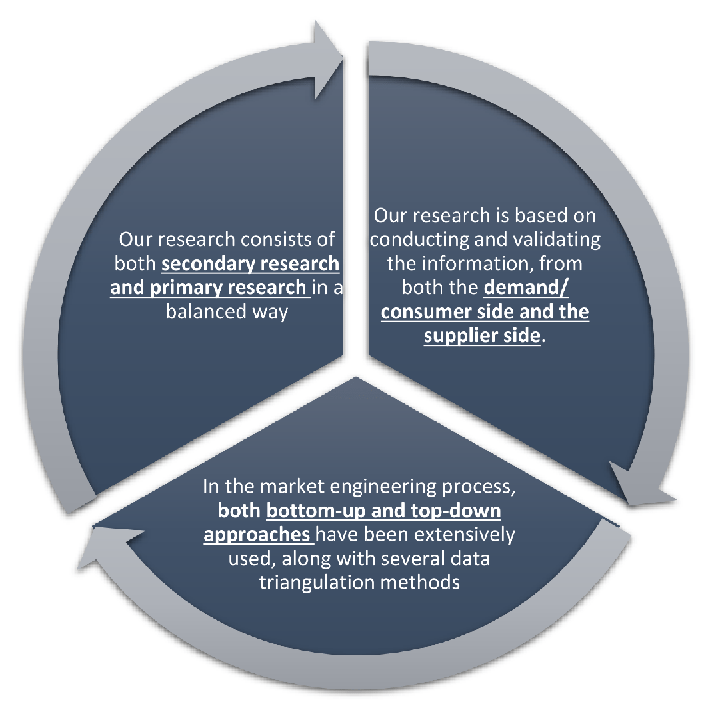
MarketGenics leverages a dedicated industry panel of experts and a comprehensive suite of paid databases to effectively collect, consolidate, and analyze market intelligence.
Our approach has consistently proven to be reliable and effective in generating accurate market insights, identifying key industry trends, and uncovering emerging business opportunities.
Through both primary and secondary research, we capture and analyze critical company-level data such as manufacturing footprints, including technical centers, R&D facilities, sales offices, and headquarters.
Our expert panel further enhances our ability to estimate market size for specific brands based on validated field-level intelligence.
Our data mining techniques incorporate both parametric and non-parametric methods, allowing for structured data collection, sorting, processing, and cleaning.
Demand projections are derived from large-scale data sets analyzed through proprietary algorithms, culminating in robust and reliable market sizing.
Research Approach
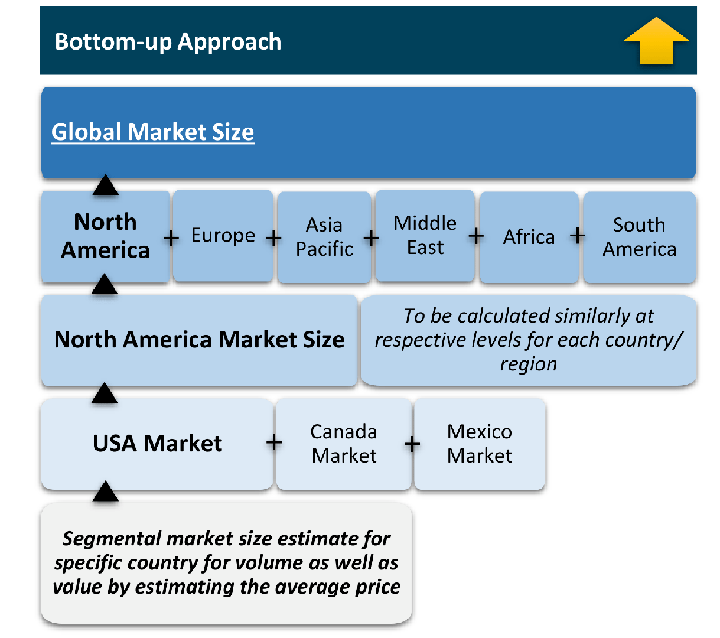
The bottom-up approach builds market estimates by starting with the smallest addressable market units and systematically aggregating them to create comprehensive market size projections.
This method begins with specific, granular data points and builds upward to create the complete market landscape.
Customer Analysis → Segmental Analysis → Geographical Analysis
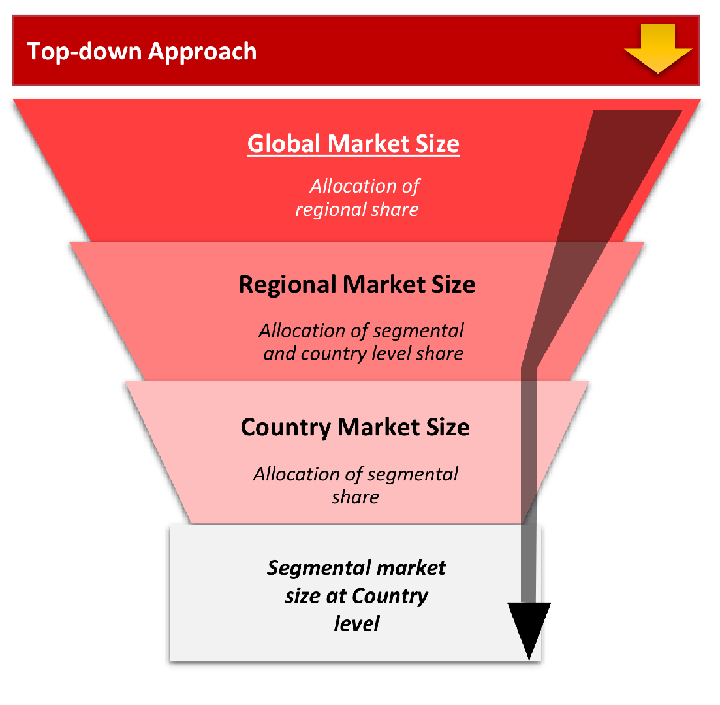
The top-down approach starts with the broadest possible market data and systematically narrows it down through a series of filters and assumptions to arrive at specific market segments or opportunities.
This method begins with the big picture and works downward to increasingly specific market slices.
TAM → SAM → SOM
Research Methods
Desk / Secondary Research
While analysing the market, we extensively study secondary sources, directories, and databases to identify and collect information useful for this technical, market-oriented, and commercial report. Secondary sources that we utilize are not only the public sources, but it is a combination of Open Source, Associations, Paid Databases, MG Repository & Knowledgebase, and others.
- Company websites, annual reports, financial reports, broker reports, and investor presentations
- National government documents, statistical databases and reports
- News articles, press releases and web-casts specific to the companies operating in the market, Magazines, reports, and others
- We gather information from commercial data sources for deriving company specific data such as segmental revenue, share for geography, product revenue, and others
- Internal and external proprietary databases (industry-specific), relevant patent, and regulatory databases
- Governing Bodies, Government Organizations
- Relevant Authorities, Country-specific Associations for Industries
We also employ the model mapping approach to estimate the product level market data through the players' product portfolio
Primary Research
Primary research/ interviews is vital in analyzing the market. Most of the cases involves paid primary interviews. Primary sources include primary interviews through e-mail interactions, telephonic interviews, surveys as well as face-to-face interviews with the different stakeholders across the value chain including several industry experts.
| Type of Respondents | Number of Primaries |
|---|---|
| Tier 2/3 Suppliers | ~20 |
| Tier 1 Suppliers | ~25 |
| End-users | ~25 |
| Industry Expert/ Panel/ Consultant | ~30 |
| Total | ~100 |
MG Knowledgebase
• Repository of industry blog, newsletter and case studies
• Online platform covering detailed market reports, and company profiles
Forecasting Factors and Models
Forecasting Factors
- Historical Trends – Past market patterns, cycles, and major events that shaped how markets behave over time. Understanding past trends helps predict future behavior.
- Industry Factors – Specific characteristics of the industry like structure, regulations, and innovation cycles that affect market dynamics.
- Macroeconomic Factors – Economic conditions like GDP growth, inflation, and employment rates that affect how much money people have to spend.
- Demographic Factors – Population characteristics like age, income, and location that determine who can buy your product.
- Technology Factors – How quickly people adopt new technology and how much technology infrastructure exists.
- Regulatory Factors – Government rules, laws, and policies that can help or restrict market growth.
- Competitive Factors – Analyzing competition structure such as degree of competition and bargaining power of buyers and suppliers.
Forecasting Models / Techniques
Multiple Regression Analysis
- Identify and quantify factors that drive market changes
- Statistical modeling to establish relationships between market drivers and outcomes
Time Series Analysis – Seasonal Patterns
- Understand regular cyclical patterns in market demand
- Advanced statistical techniques to separate trend, seasonal, and irregular components
Time Series Analysis – Trend Analysis
- Identify underlying market growth patterns and momentum
- Statistical analysis of historical data to project future trends
Expert Opinion – Expert Interviews
- Gather deep industry insights and contextual understanding
- In-depth interviews with key industry stakeholders
Multi-Scenario Development
- Prepare for uncertainty by modeling different possible futures
- Creating optimistic, pessimistic, and most likely scenarios
Time Series Analysis – Moving Averages
- Sophisticated forecasting for complex time series data
- Auto-regressive integrated moving average models with seasonal components
Econometric Models
- Apply economic theory to market forecasting
- Sophisticated economic models that account for market interactions
Expert Opinion – Delphi Method
- Harness collective wisdom of industry experts
- Structured, multi-round expert consultation process
Monte Carlo Simulation
- Quantify uncertainty and probability distributions
- Thousands of simulations with varying input parameters
Research Analysis
Our research framework is built upon the fundamental principle of validating market intelligence from both demand and supply perspectives. This dual-sided approach ensures comprehensive market understanding and reduces the risk of single-source bias.
Demand-Side Analysis: We understand end-user/application behavior, preferences, and market needs along with the penetration of the product for specific application.
Supply-Side Analysis: We estimate overall market revenue, analyze the segmental share along with industry capacity, competitive landscape, and market structure.
Validation & Evaluation
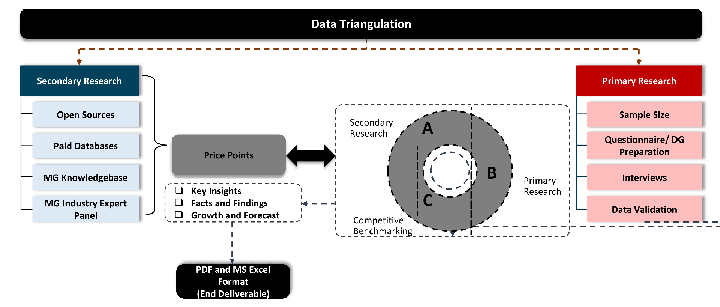
Data triangulation is a validation technique that uses multiple methods, sources, or perspectives to examine the same research question, thereby increasing the credibility and reliability of research findings. In market research, triangulation serves as a quality assurance mechanism that helps identify and minimize bias, validate assumptions, and ensure accuracy in market estimates.
- Data Source Triangulation – Using multiple data sources to examine the same phenomenon
- Methodological Triangulation – Using multiple research methods to study the same research question
- Investigator Triangulation – Using multiple researchers or analysts to examine the same data
- Theoretical Triangulation – Using multiple theoretical perspectives to interpret the same data
Custom Market Research Services
We will customise the research for you, in case the report listed above does not meet your requirements.
Get 10% Free Customisation