Rotating Nozzle Market Size, Share & Trends Analysis Report by Product Type (High-Pressure Rotating Nozzles, Low-Pressure Rotating Nozzles, Turbo/Spinning Nozzles, Rotary Jet Nozzles, Rotary Pulse Nozzles, Multi-Orifice Rotating Nozzles, Others), Material, Pressure Rating, Flow Rate, Nozzle Mechanism, Mobility/ Installation Type, Spray Pattern/ Angle, Application, End-User Industry, Sales Channel and Geography (North America, Europe, Asia Pacific, Middle East, Africa, and South America) – Global Industry Data, Trends, and Forecasts, 2026–2035
|
Market Structure & Evolution |
|
|
Segmental Data Insights |
|
|
Demand Trends |
|
|
Competitive Landscape |
|
|
Strategic Development |
|
|
Future Outlook & Opportunities |
|
Rotating-Nozzle-Market Size, Share, and Growth
The global rotating nozzle market is experiencing robust growth, with its estimated value of USD 0.8 billion in the year 2025 and USD 1.5 billion by the period 2035, registering a CAGR of 6.2% during the forecast period. Rotating nozzle market is spreading very fast globally.
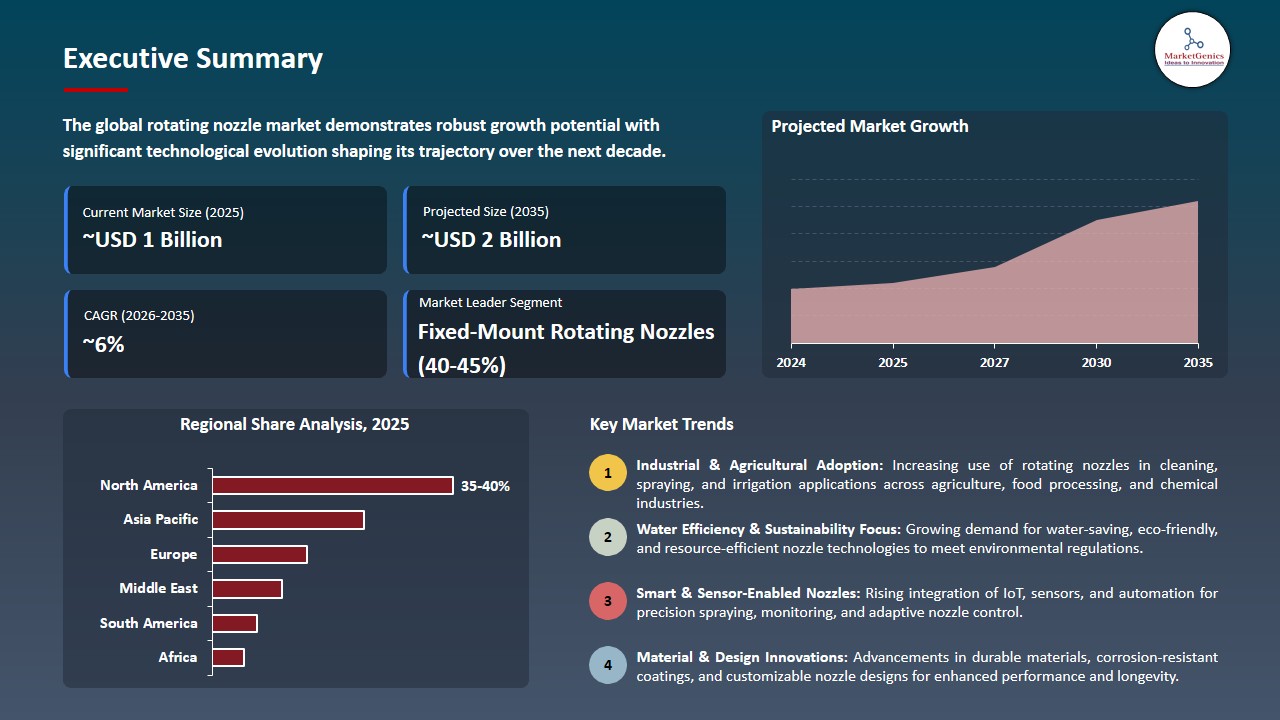
“Our new rotating nozzle setups, in a very short time, enable industrial users to do the whole 360° cleaning of tanks and pipes with much less water and cleaning, cycle time,” said a spokesperson at SCHMIDT EHS. “We are helping customers to upgrade their hygiene standard, to reduce their downtime and to increase their productivity by using our technology in fluid, driven turbine rotation and by jet impact optimization in the food processing, chemical and wastewater sectors.”
This growth is mainly because the demand for high, efficiency cleaning systems has increased in the food processing, pharmaceuticals, chemicals, and wastewater treatment industries. For instance, many manufacturers are launching new rotating spray heads that can provide 360, degree coverage, higher jet impact, and less water usage. In particular, Alfa Laval, BETE Spray Technology, and Lechler are some of the companies that offer hygienic rotary jet heads certified, which improve CIP (Clean, in, Place) efficiency by optimized flow paths and self, cleaning/no, dead, zone designs, mechanisms that are becoming more and more popular in places where hygiene compliance is a must.
The expansion of regulated industries has contributed to the adoption of automated and sanitary cleaning devices at a faster pace. Food and beverage manufacturers, who have to meet ever more stringent sanitation standards set by rules such as FDA FSMA and EHEDG, are gradually phasing out static spray balls for rotary jet nozzles in their facilities to lower the contamination risk and cleaning cycle times.
Moreover, the worldwide rotating nozzle market contains strong adjacent openings to be grasped such as automated CIP skids, hygienic flow, control valves, CIP monitoring sensors, high, pressure cleaning systems, and digital cleaning, efficiency analytics. By taking advantage of these supplemental markets, the producers of equipment can provide the customers with factory, integrated solutions, improve plant sanitation levels, and accomplish the operational productivity growth in the different industrial sectors.
Rotating Nozzle Market Dynamics and Trends
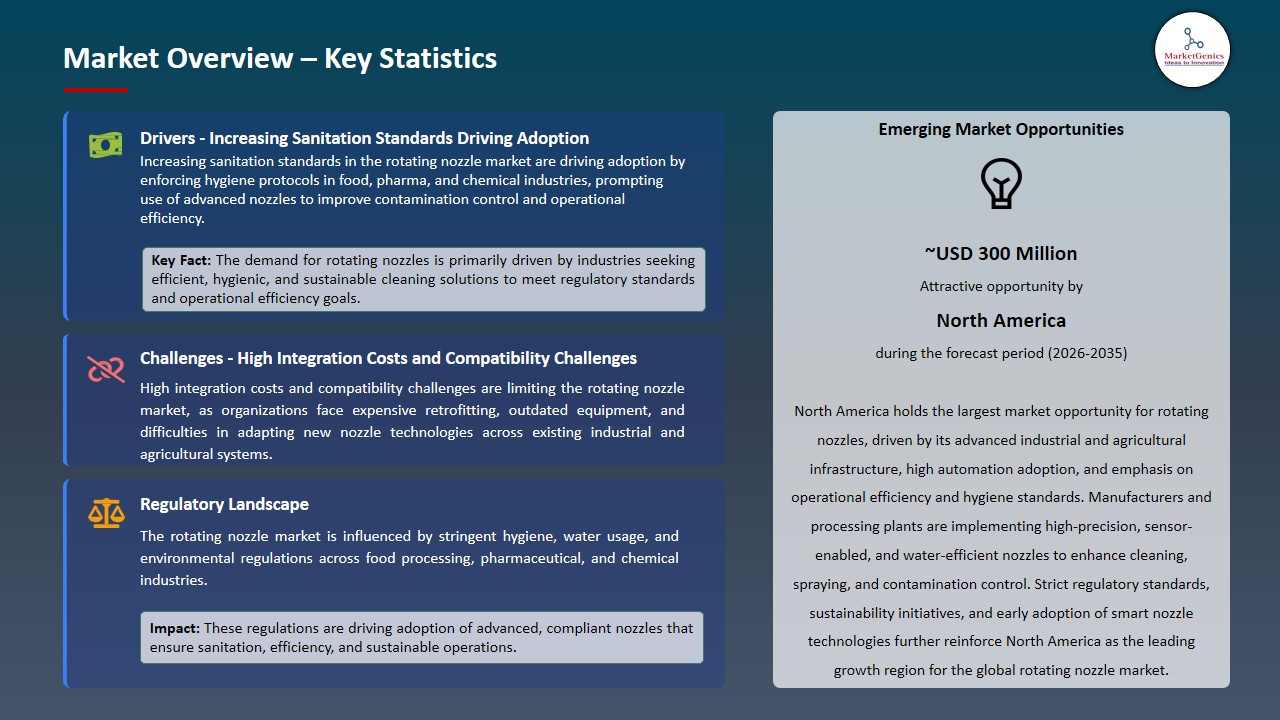
Driver: Increasing Sanitation Standards Driving Adoption of Advanced Rotating Nozzle Systems
-
The fast expansion of the rotating nozzle market is largely a result of tough regulations related to hygiene and cleaning in the food processing, pharmaceuticals, and beverage industries. Standards like FDA FSMA, EHEDG, and 3, A Sanitary Standards require performance of cleaning to be validated, thus they are encouraging facilities to abandon static spray devices in favor of rotary jet nozzles which can provide full 360° coverage and have the cleaning cycle time significantly reduced.
- Rotating nozzles are more and more used in regulated environments to guarantee CIP (Clean, in, Place) compliance by lessening water consumption, providing residue, free cleaning, and allowing sanitation performance that can be repeated. As an instance, hygienic rotary jet heads from the top manufacturers such as Alfa Laval, Lechler, and TANKO® serve as the compliance, enabling tools for high, purity production lines.
- The demand for automated, self, cleaning rotating nozzle systems is elevated by the worldwide market attention focusing on product contamination, allergen control, and water conservation.
Restraint: High Integration Costs and Compatibility Challenges with Legacy CIP Systems
-
While the cleaning performance has been verified, the adoption is still limited due to the higher initial investment that is needed to retrofit rotary jet nozzles into older tanks and CIP loops, especially in facilities that operate at lower pressures or with outdated pumping systems.
- Most of the heritage installations are running at lower flow rates and lack the necessary automation controls to maintain optimal rotation speeds, hence they get uneven spray patterns and ineffective cleaning due to the fact that the rotation speed is not stable. To upgrade such systems, it is necessary to do extensive modifications of the piping, increase the pump capacity and carry out the validation testing.
- Therefore, small and mid, sized processors in developing markets are postponing modernization because of the costs associated with it, production downtime, and the need for operator training on automated CIP procedures. Moreover, the absence of standard tank designs for different industries makes the integration more difficult, thus it requires the customized nozzle mapping and performance calibration which in turn leads to higher engineering costs.
Opportunity: Expansion in Emerging Food & Beverage Processing Hubs and Water-Efficient Cleaning Programs
-
These regions comprising the food, processing industries in the next, decade Southeast Asia, India, Brazil, and parts of Africa are heavily investing in a modern hygienic production infrastructure, thus, they are the chief engines of a strong demand for advanced CIP and rotating nozzle technologies.
- Governments and industry bodies that promote water conservation, energy, efficient cleaning, and hygienic modernization are facilitating the pace of adoption. As an example, the clean manufacturing standard, promoting initiatives in ASEAN together with India's food safety modernization efforts are the main reasons that processors become willing to take up resource, efficient sanitation technologies.
- Rotating nozzle producers providing modular CIP skids, high, impact low, flow jet heads, and digital performance monitoring tools have a good opportunity to be the major beneficiaries of this increasing demand.
- Besides that, there is a considerable potential in such high, growth verticals as craft breweries, nutraceuticals, dairy expansions, and ready, to, eat food plants that hygiene standards and batch integrity being vital, thus, they are the most attractive ones.
Key Trend: Adoption of Smart, Sensor-Integrated, and Automation-Ready Rotating Nozzles
-
The leading, edge IoT, enabled rotating nozzle products combine sensor data, auto flow control, and on, board diagnostics to allow uninterrupted reading of spray pressure, coverage, and rpm. Hence, these devices eliminate the need for manual checks, facilitate documentation for audit purposes, and provide a verifying cleaning standard throughout different batches. AI, and CFD, based engineering tools are opening ways for the creation of extremely efficient fluid distribution patterns resulting in the lowered water consumption and consequently the fulfilling of environmental pledges in the food and biopharma industries.
- Adoption of predictive maintenance is being supported by a growing sensor array that detects vibration anomalies, partial rotations, or obstructed nozzles, thus enabling processors to lessen their downtime and prolong the life of their equipment.
- Further, automation vendor and CIP system integrators are enthusiastic about the opportunities of combining rotating nozzles with SCADA control panels, PLC, based cleaning cycles, and digital twins. In this way, processors get the chance to not only enhance cleaning performance but also cut down on chemical usage and have more traceable sanitation workflows.
Rotating-Nozzle-Market Analysis and Segmental Data
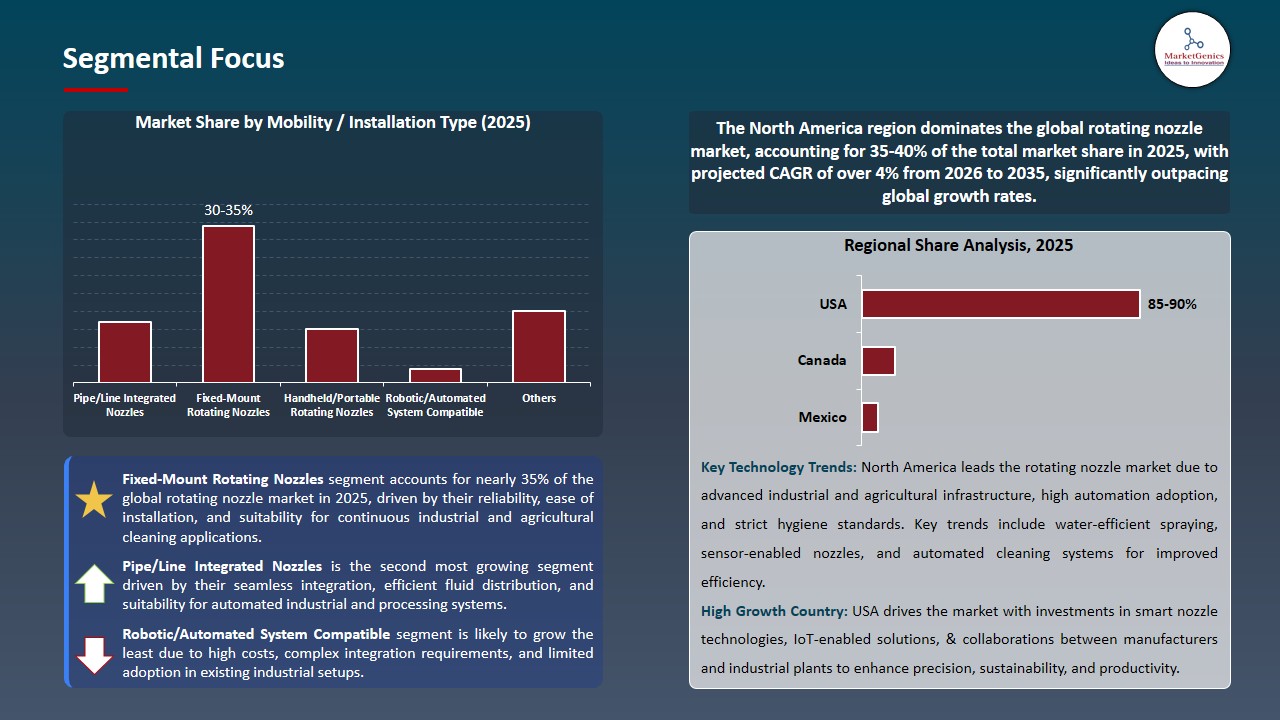
“Fixed-Mount Rotating Nozzles Dominate Global Rotating Nozzle Market amid Rising Demand for High-Impact CIP Cleaning Efficiency”
-
The fixed, mount rotating nozzles sub, segment is the main contributor to the global rotating nozzle market growth as a result of the increased demand for high, impact Clean, in, Place (CIP) cleaning efficiency in food, beverage, pharmaceutical, and chemical industries.
- While hygiene regulations and sanitation standards get stricter all over the world, rotating nozzles are increasingly preferred to static spray balls since they offer thorough 360° interior tank coverage, stronger mechanical impact, and shorter cleaning cycles, very important for facilities that need continuous sanitation while at the same time reducing their downtime and resource usage.
- The recent industry adoption is a strong signal for the direction of this trend. Several processors have moved towards self, rotating stainless, steel nozzles that provide enhanced cleaning force and water, saving performance, thus allowing the cleaning of vats, silos, and reactors at high throughput with a very low chemical consumption level. For instance, rotary cleaning devices have achieved up to 35% savings in water, time, and cleaning media compared to traditional static nozzles, thus highlighting their operational and environmental advantages.
- In the light of the increasing regulatory scrutiny over product purity and environmental compliance, fixed, mount rotating nozzles are no longer considered as optional upgrades but have been integrated into standard sanitation infrastructure in many industries. Their broad effectiveness, compatibility with automation, and resource efficiency make them very valuable in modern CIP systems that aim at achieving high, impact cleaning with a low resource footprint.
“North America Dominates Rotating Nozzle Market Amid Strong Demand for High-Pressure Cleaning Technologies”
-
North America is the top leader in rotating nozzle market worldwide, which is mainly attributed to the huge demand for high, pressure cleaning technologies in the food & beverage, pharmaceutical, chemical, and oil & gas industries the region is full of advanced processing facilities, automated sanitation systems, and hygiene, critical operations, thus, making it an early adopter of high, impact, fixed, mount and rotary CIP (Clean, in, Place) solutions. Regulatory frameworks such as FDA FSMA, EHEDG, and 3, A Sanitary Standards tightly, knit the market and push more radical solutions to be used by manufacturers in order to secure validated, repeatable cleaning performance.
- The major examples of such implementations are Alfa Laval’s wall, mounted rotating jet heads for tank cleaning in dairy and beverage facilities, BETE Spray Technology’s self, rotating nozzles for chemical reactors, and Lechler’s high, pressure rotary devices in biopharma production lines, emphasizing the technological leadership of North American operators in industrial sanitation solutions.
- Moreover, the industrial cleaning sector's focus on water and energy, saving measures has resulted in the adoption of automated, sensor, integrated nozzles by processors. These nozzles help in reducing water consumption and cleaning time, while at the same time ensuring compliance with standards. To cite a case, the use of fixed, mount rotary nozzles in 2025 led to a reduction of water usage and cleaning cycles by up to 35% in pilot implementations that took place across U.S. beverage plants, thus, demonstrating regulation, compliant, resource, efficient sanitation adoption.
Rotating-Nozzle-Market Ecosystem
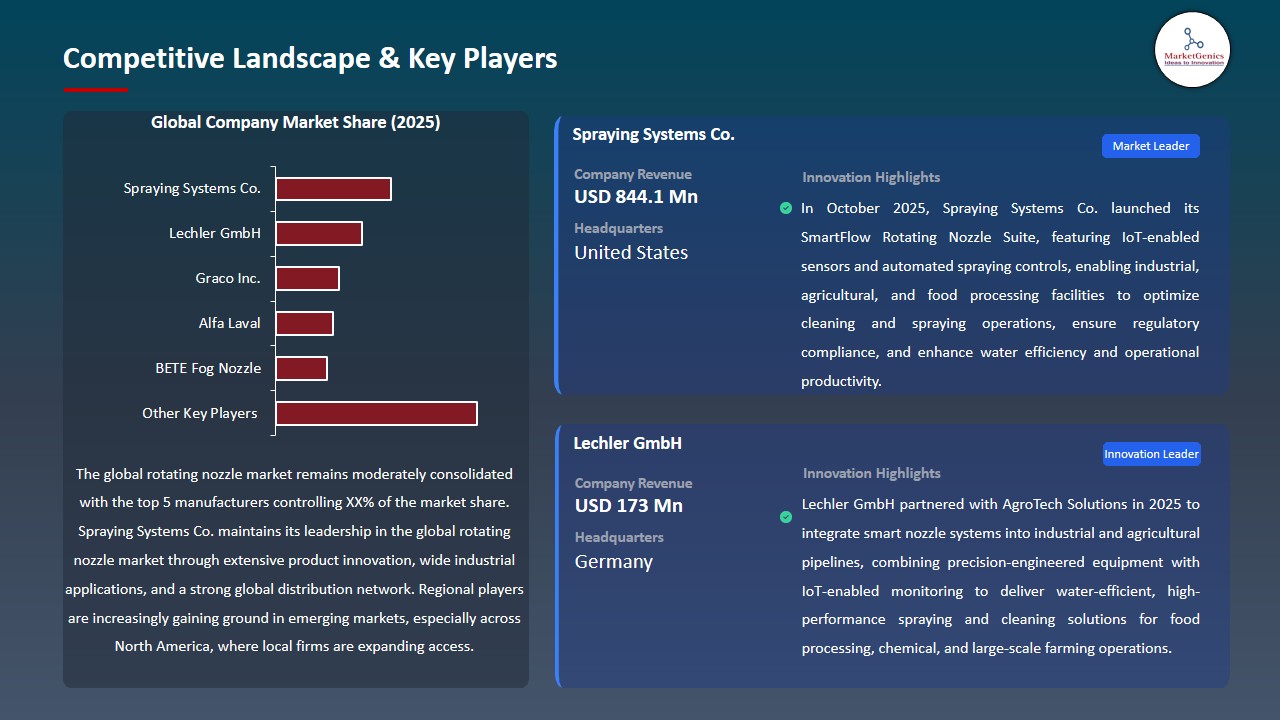
The global rotating nozzle market is a consolidated one with major players like Alfa Laval, BETE Fog Nozzle, Lechler GmbH, Graco Inc., Comet Spa, and Karcher dominating the market by employing advanced high, pressure and CIP (Clean, in, Place) cleaning technologies. These firms keep their competitive position by using innovation in fluid dynamics, rotary jet design, and hygienic compliance.
The leading companies concentrate on niche issues to foster the industry and thus have the ability to provide such specialized products as wall, mounted rotary jet heads, sensor, integrated rotary nozzles, and high, impact low, flow cleaning devices. These devices improve the performance of the cleaning process and at the same time, they lower the consumption of water and chemicals, which makes it possible to use them in the food & beverage, pharmaceutical, chemical, and oil & gas industries.
Government bodies, regulatory agencies, and R&D institutions are actively involved in supporting innovation in the market. For example, Alfa Laval in March 2025 launched a next, generation self, rotating nozzle with optimized spray patterns that were validated for FDA FSMA and EHEDG compliance, thereby improving cleaning efficiency and shortening cycle times.
Market players concentrate on portfolio expansion and integrated solutions as their main goal. They do this by combining automated CIP systems with IoT, enabled monitoring to improve productivity and sustainability. Among the recent cases is that of Lechler GmbH sensor, enabled rotary nozzles in August 2025, which brought about up to 35% water savings and accelerated cleaning cycles, thus promoting efficiency and regulatory compliance across industrial cleaning applications.
Recent Development and Strategic Overview:
-
In July 2025, Alfa Laval unveiled its next, generation Tornado Jet CIP nozzle that comes with optimized self, rotating heads and IoT, enabled monitoring for real, time cleaning validation. The system helps processors in food, beverage, and dairy facilities to guarantee 360° coverage of tanks and silos while at the same time, reducing water and chemical consumption, thus, elevating both hygiene compliance and operational efficiency.
- In September 2025, Lechler GmbH presented its SensorJet, high impact rotating nozzle with integrated flow and rotation sensors. The innovation offers automated feedback on spraying performance, thus enabling predictive maintenance and accurate cleaning validation in pharmaceutical and chemical plants. By using mechanical cleaning force along with digital monitoring, the company is able to meet regulatory requirements, reduce the time when the plant is not in use (downtime), and increase the efficiency of the whole CIP process in large, scale industrial operations.
Report Scope
|
Attribute |
Detail |
|
Market Size in 2025 |
USD 0.8 Bn |
|
Market Forecast Value in 2035 |
USD 1.5 Bn |
|
Growth Rate (CAGR) |
6.2% |
|
Forecast Period |
2026 – 2035 |
|
Historical Data Available for |
2021 – 2024 |
|
Market Size Units |
USD Bn for Value Thousand Units for Volume |
|
Report Format |
Electronic (PDF) + Excel |
|
Regions and Countries Covered |
|||||
|
North America |
Europe |
Asia Pacific |
Middle East |
Africa |
South America |
|
|
|
|
|
|
|
Companies Covered |
|||||
|
|
|
|
|
|
Rotating-Nozzle-Market Segmentation and Highlights
|
Segment |
Sub-segment |
|
Rotating Nozzle Market, By Product Type |
|
|
Rotating Nozzle Market, By Material |
|
|
Rotating Nozzle Market, By Heating Technology |
|
|
Rotating Nozzle Market, By Pressure Rating |
|
|
Rotating Nozzle Market, By Flow Rate |
|
|
Rotating Nozzle Market, By Nozzle Mechanism |
|
|
Rotating Nozzle Market, By Mobility / Installation Type |
|
|
Rotating Nozzle Market, By Spray Pattern/ Angle |
|
|
Rotating Nozzle Market, By Application |
|
|
Rotating Nozzle Market, By End-User Industry |
|
|
Rotating Nozzle Market, By Sales Channel |
|
Frequently Asked Questions
Table of Contents
- 1. Research Methodology and Assumptions
- 1.1. Definitions
- 1.2. Research Design and Approach
- 1.3. Data Collection Methods
- 1.4. Base Estimates and Calculations
- 1.5. Forecasting Models
- 1.5.1. Key Forecast Factors & Impact Analysis
- 1.6. Secondary Research
- 1.6.1. Open Sources
- 1.6.2. Paid Databases
- 1.6.3. Associations
- 1.7. Primary Research
- 1.7.1. Primary Sources
- 1.7.2. Primary Interviews with Stakeholders across Ecosystem
- 2. Executive Summary
- 2.1. Global Rotating Nozzle Market Outlook
- 2.1.1. Rotating Nozzle Market Size (Value - US$ Bn and Volume - Thousand Units), and Forecasts, 2021-2035
- 2.1.2. Compounded Annual Growth Rate Analysis
- 2.1.3. Growth Opportunity Analysis
- 2.1.4. Segmental Share Analysis
- 2.1.5. Geographical Share Analysis
- 2.2. Market Analysis and Facts
- 2.3. Supply-Demand Analysis
- 2.4. Competitive Benchmarking
- 2.5. Go-to- Market Strategy
- 2.5.1. Customer/ End-use Industry Assessment
- 2.5.2. Growth Opportunity Data, 2026-2035
- 2.5.2.1. Regional Data
- 2.5.2.2. Country Data
- 2.5.2.3. Segmental Data
- 2.5.3. Identification of Potential Market Spaces
- 2.5.4. GAP Analysis
- 2.5.5. Potential Attractive Price Points
- 2.5.6. Prevailing Market Risks & Challenges
- 2.5.7. Preferred Sales & Marketing Strategies
- 2.5.8. Key Recommendations and Analysis
- 2.5.9. A Way Forward
- 2.1. Global Rotating Nozzle Market Outlook
- 3. Industry Data and Premium Insights
- 3.1. Global Industrial Machinery Ecosystem Overview, 2025
- 3.1.1. Industrial Machinery Industry Analysis
- 3.1.2. Key Trends for Industrial Machinery Industry
- 3.1.3. Regional Distribution for Industrial Machinery Industry
- 3.2. Supplier Customer Data
- 3.3. Technology Roadmap and Developments
- 3.4. Trade Analysis
- 3.4.1. Import & Export Analysis, 2025
- 3.4.2. Top Importing Countries
- 3.4.3. Top Exporting Countries
- 3.5. Trump Tariff Impact Analysis
- 3.5.1. Manufacturer
- 3.5.1.1. Based on the Component & Raw material
- 3.5.2. Supply Chain
- 3.5.3. End Consumer
- 3.5.1. Manufacturer
- 3.6. Raw Material Analysis
- 3.1. Global Industrial Machinery Ecosystem Overview, 2025
- 4. Market Overview
- 4.1. Market Dynamics
- 4.1.1. Drivers
- 4.1.1.1. Rising demand for high-pressure cleaning efficiency and improved spray coverage in industrial and municipal applications.
- 4.1.1.2. Growing adoption of precision rotating nozzles with adjustable spray patterns and clog-resistant designs.
- 4.1.1.3. Increasing investments in advanced materials and flow-optimization technologies to boost reliability.
- 4.1.2. Restraints
- 4.1.2.1. High costs of premium rotating nozzles, maintenance, and frequent replacements.
- 4.1.2.2. Integration challenges with legacy pumps, pipelines, and mixed industrial cleaning systems.
- 4.1.1. Drivers
- 4.2. Key Trend Analysis
- 4.3. Regulatory Framework
- 4.3.1. Key Regulations, Norms, and Subsidies, by Key Countries
- 4.3.2. Tariffs and Standards
- 4.3.3. Impact Analysis of Regulations on the Market
- 4.4. Value Chain Analysis
- 4.4.1. Raw Material Suppliers
- 4.4.2. System Integrators
- 4.4.3. Rotating Nozzle Manufacturers
- 4.4.4. Distributors/ Dealers
- 4.4.5. End Users/ Customers
- 4.5. Cost Structure Analysis
- 4.5.1. Parameter’s Share for Cost Associated
- 4.5.2. COGP vs COGS
- 4.5.3. Profit Margin Analysis
- 4.6. Pricing Analysis
- 4.6.1. Regional Pricing Analysis
- 4.6.2. Segmental Pricing Trends
- 4.6.3. Factors Influencing Pricing
- 4.7. Porter’s Five Forces Analysis
- 4.8. PESTEL Analysis
- 4.9. Global Rotating Nozzle Market Demand
- 4.9.1. Historical Market Size –Value (US$ Bn) and Volume – (Thousand Units), 2020-2024
- 4.9.2. Current and Future Market Size –Value (US$ Bn) and Volume – (Thousand Units), 2026–2035
- 4.9.2.1. Y-o-Y Growth Trends
- 4.9.2.2. Absolute $ Opportunity Assessment
- 4.1. Market Dynamics
- 5. Competition Landscape
- 5.1. Competition structure
- 5.1.1. Fragmented v/s consolidated
- 5.2. Company Share Analysis, 2025
- 5.2.1. Global Company Market Share
- 5.2.2. By Region
- 5.2.2.1. North America
- 5.2.2.2. Europe
- 5.2.2.3. Asia Pacific
- 5.2.2.4. Middle East
- 5.2.2.5. Africa
- 5.2.2.6. South America
- 5.3. Product Comparison Matrix
- 5.3.1. Specifications
- 5.3.2. Market Positioning
- 5.3.3. Pricing
- 5.1. Competition structure
- 6. Global Rotating Nozzle Market Analysis, by Product Type
- 6.1. Key Segment Analysis
- 6.2. Rotating Nozzle Market Size (Value - US$ Bn and Volume - Thousand Units), Analysis, and Forecasts, by Product Type, 2021-2035
- 6.2.1. High-Pressure Rotating Nozzles
- 6.2.2. Low-Pressure Rotating Nozzles
- 6.2.3. Turbo/Spinning Nozzles
- 6.2.4. Rotary Jet Nozzles
- 6.2.5. Rotary Pulse Nozzles
- 6.2.6. Multi-Orifice Rotating Nozzles
- 6.2.7. Others
- 7. Global Rotating Nozzle Market Analysis, by Material
- 7.1. Key Segment Analysis
- 7.2. Rotating Nozzle Market Size (Value - US$ Bn and Volume - Thousand Units), Analysis, and Forecasts, by Material, 2021-2035
- 7.2.1. Stainless Steel
- 7.2.2. Brass
- 7.2.3. Plastic/Polymer (PP, PTFE)
- 7.2.4. Aluminum
- 7.2.5. Alloy/Composite Materials
- 7.2.6. Others
- 8. Global Rotating Nozzle Market Analysis, by Pressure Rating
- 8.1. Key Segment Analysis
- 8.2. Rotating Nozzle Market Size (Value - US$ Bn and Volume - Thousand Units), Analysis, and Forecasts, by Pressure Rating, 2021-2035
- 8.2.1. Up To 100 Bar
- 8.2.2. 100–250 Bar
- 8.2.3. 250–500 Bar
- 8.2.4. Above 500 Bar
- 9. Global Rotating Nozzle Market Analysis, by Flow Rate
- 9.1. Key Segment Analysis
- 9.2. Rotating Nozzle Market Size (Value - US$ Bn and Volume - Thousand Units), Analysis, and Forecasts, by Flow Rate, 2021-2035
- 9.2.1. Low Flow
- 9.2.2. Medium Flow
- 9.2.3. High Flow
- 9.2.4. Variable/Adjustable Flow
- 10. Global Rotating Nozzle Market Analysis, by Nozzle Mechanism
- 10.1. Key Segment Analysis
- 10.2. Rotating Nozzle Market Size (Value - US$ Bn and Volume - Thousand Units), Analysis, and Forecasts, by Nozzle Mechanism, 2021-2035
- 10.2.1. Gear-Driven
- 10.2.2. Turbine-Driven
- 10.2.3. Bearing-Mounted
- 10.2.4. Fluid-Driven Rotation
- 10.2.5. Magnetic Drive
- 10.2.6. Others
- 11. Global Rotating Nozzle Market Analysis, by Mobility / Installation Type
- 11.1. Key Segment Analysis
- 11.2. Rotating Nozzle Market Size (Value - US$ Bn and Volume - Thousand Units), Analysis, and Forecasts, by Mobility / Installation Type, 2021-2035
- 11.2.1. Fixed-Mount Rotating Nozzles
- 11.2.2. Pipe/Line Integrated Nozzles
- 11.2.3. Handheld/Portable Rotating Nozzles
- 11.2.4. Robotic/Automated System Compatible
- 11.2.5. Others
- 12. Global Rotating Nozzle Market Analysis, by Spray Pattern/ Angle
- 12.1. Key Segment Analysis
- 12.2. Rotating Nozzle Market Size (Value - US$ Bn and Volume - Thousand Units), Analysis, and Forecasts, by Spray Pattern/ Angle, 2021-2035
- 12.2.1. Narrow Angle
- 12.2.2. Medium Angle
- 12.2.3. Wide Angle
- 12.2.4. Full-Cone
- 12.2.5. Fan Pattern
- 12.2.6. Others
- 13. Global Rotating Nozzle Market Analysis, by Application
- 13.1. Key Segment Analysis
- 13.2. Rotating Nozzle Market Size (Value - US$ Bn and Volume - Thousand Units), Analysis, and Forecasts, by Application, 2021-2035
- 13.2.1. Industrial Cleaning
- 13.2.2. Tank/Container Cleaning
- 13.2.3. Surface Preparation
- 13.2.4. Sewer & Drain Cleaning
- 13.2.5. Agricultural Spraying
- 13.2.6. Food & Beverage Processing
- 13.2.7. Automotive & Machinery Cleaning
- 13.2.8. Marine & Ship Cleaning
- 13.2.9. Others
- 14. Global Rotating Nozzle Market Analysis, by End- User Industry
- 14.1. Key Segment Analysis
- 14.2. Rotating Nozzle Market Size (Value - US$ Bn and Volume - Thousand Units), Analysis, and Forecasts, by End- User Industry, 2021-2035
- 14.2.1. Chemicals & Petrochemicals
- 14.2.2. Oil & Gas
- 14.2.3. Food & Beverage
- 14.2.4. Pharmaceuticals
- 14.2.5. Automotive
- 14.2.6. Agriculture
- 14.2.7. Water & Wastewater Management
- 14.2.8. Marine & Offshore
- 14.2.9. Manufacturing & Industrial
- 14.2.10. Others
- 15. Global Rotating Nozzle Market Analysis, by Sales Channel
- 15.1. Key Segment Analysis
- 15.2. Rotating Nozzle Market Size (Value - US$ Bn and Volume - Thousand Units), Analysis, and Forecasts, by Sales Channel, 2021-2035
- 15.2.1. OEM Direct Sales
- 15.2.2. Distributors & Dealers
- 15.2.3. Industrial Suppliers
- 15.2.4. Online/E-Commerce Channels
- 16. Global Rotating Nozzle Market Analysis and Forecasts, by Region
- 16.1. Key Findings
- 16.2. Rotating Nozzle Market Size (Value - US$ Bn and Volume - Thousand Units), Analysis, and Forecasts, by Region, 2021-2035
- 16.2.1. North America
- 16.2.2. Europe
- 16.2.3. Asia Pacific
- 16.2.4. Middle East
- 16.2.5. Africa
- 16.2.6. South America
- 17. North America Rotating Nozzle Market Analysis
- 17.1. Key Segment Analysis
- 17.2. Regional Snapshot
- 17.3. North America Rotating Nozzle Market Size Value - US$ Bn and Volume - Thousand Units), Analysis, and Forecasts, 2021-2035
- 17.3.1. Product Type
- 17.3.2. Material
- 17.3.3. Pressure Rating
- 17.3.4. Flow Rate
- 17.3.5. Nozzle Mechanism
- 17.3.6. Mobility / Installation Type
- 17.3.7. Spray Pattern/ Angle
- 17.3.8. Application
- 17.3.9. End-User Industry
- 17.3.10. Sales Channel
- 17.3.11. Country
- 17.3.11.1. USA
- 17.3.11.2. Canada
- 17.3.11.3. Mexico
- 17.4. USA Rotating Nozzle Market
- 17.4.1. Country Segmental Analysis
- 17.4.2. Product Type
- 17.4.3. Material
- 17.4.4. Pressure Rating
- 17.4.5. Flow Rate
- 17.4.6. Nozzle Mechanism
- 17.4.7. Mobility / Installation Type
- 17.4.8. Spray Pattern/ Angle
- 17.4.9. Application
- 17.4.10. End-User Industry
- 17.4.11. Sales Channel
- 17.5. Canada Rotating Nozzle Market
- 17.5.1. Country Segmental Analysis
- 17.5.2. Product Type
- 17.5.3. Material
- 17.5.4. Pressure Rating
- 17.5.5. Flow Rate
- 17.5.6. Nozzle Mechanism
- 17.5.7. Mobility / Installation Type
- 17.5.8. Spray Pattern/ Angle
- 17.5.9. Application
- 17.5.10. End-User Industry
- 17.5.11. Sales Channel
- 17.6. Mexico Rotating Nozzle Market
- 17.6.1. Country Segmental Analysis
- 17.6.2. Product Type
- 17.6.3. Material
- 17.6.4. Pressure Rating
- 17.6.5. Flow Rate
- 17.6.6. Nozzle Mechanism
- 17.6.7. Mobility / Installation Type
- 17.6.8. Spray Pattern/ Angle
- 17.6.9. Application
- 17.6.10. End-User Industry
- 17.6.11. Sales Channel
- 18. Europe Rotating Nozzle Market Analysis
- 18.1. Key Segment Analysis
- 18.2. Regional Snapshot
- 18.3. Europe Rotating Nozzle Market Size (Value - US$ Bn and Volume - Thousand Units), Analysis, and Forecasts, 2021-2035
- 18.3.1. Product Type
- 18.3.2. Material
- 18.3.3. Pressure Rating
- 18.3.4. Flow Rate
- 18.3.5. Nozzle Mechanism
- 18.3.6. Mobility / Installation Type
- 18.3.7. Spray Pattern/ Angle
- 18.3.8. Application
- 18.3.9. End-User Industry
- 18.3.10. Sales Channel
- 18.3.11. Country
- 18.3.11.1. Germany
- 18.3.11.2. United Kingdom
- 18.3.11.3. France
- 18.3.11.4. Italy
- 18.3.11.5. Spain
- 18.3.11.6. Netherlands
- 18.3.11.7. Nordic Countries
- 18.3.11.8. Poland
- 18.3.11.9. Russia & CIS
- 18.3.11.10. Rest of Europe
- 18.4. Germany Rotating Nozzle Market
- 18.4.1. Country Segmental Analysis
- 18.4.2. Product Type
- 18.4.3. Material
- 18.4.4. Pressure Rating
- 18.4.5. Flow Rate
- 18.4.6. Nozzle Mechanism
- 18.4.7. Mobility / Installation Type
- 18.4.8. Spray Pattern/ Angle
- 18.4.9. Application
- 18.4.10. End-User Industry
- 18.4.11. Sales Channel
- 18.5. United Kingdom Rotating Nozzle Market
- 18.5.1. Country Segmental Analysis
- 18.5.2. Product Type
- 18.5.3. Material
- 18.5.4. Pressure Rating
- 18.5.5. Flow Rate
- 18.5.6. Nozzle Mechanism
- 18.5.7. Mobility / Installation Type
- 18.5.8. Spray Pattern/ Angle
- 18.5.9. Application
- 18.5.10. End-User Industry
- 18.5.11. Sales Channel
- 18.6. France Rotating Nozzle Market
- 18.6.1. Country Segmental Analysis
- 18.6.2. Product Type
- 18.6.3. Material
- 18.6.4. Pressure Rating
- 18.6.5. Flow Rate
- 18.6.6. Nozzle Mechanism
- 18.6.7. Mobility / Installation Type
- 18.6.8. Spray Pattern/ Angle
- 18.6.9. Application
- 18.6.10. End-User Industry
- 18.6.11. Sales Channel
- 18.7. Italy Rotating Nozzle Market
- 18.7.1. Country Segmental Analysis
- 18.7.2. Product Type
- 18.7.3. Material
- 18.7.4. Pressure Rating
- 18.7.5. Flow Rate
- 18.7.6. Nozzle Mechanism
- 18.7.7. Mobility / Installation Type
- 18.7.8. Spray Pattern/ Angle
- 18.7.9. Application
- 18.7.10. End-User Industry
- 18.7.11. Sales Channel
- 18.8. Spain Rotating Nozzle Market
- 18.8.1. Country Segmental Analysis
- 18.8.2. Product Type
- 18.8.3. Material
- 18.8.4. Pressure Rating
- 18.8.5. Flow Rate
- 18.8.6. Nozzle Mechanism
- 18.8.7. Mobility / Installation Type
- 18.8.8. Spray Pattern/ Angle
- 18.8.9. Application
- 18.8.10. End-User Industry
- 18.8.11. Sales Channel
- 18.9. Netherlands Rotating Nozzle Market
- 18.9.1. Country Segmental Analysis
- 18.9.2. Product Type
- 18.9.3. Material
- 18.9.4. Pressure Rating
- 18.9.5. Flow Rate
- 18.9.6. Nozzle Mechanism
- 18.9.7. Mobility / Installation Type
- 18.9.8. Spray Pattern/ Angle
- 18.9.9. Application
- 18.9.10. End-User Industry
- 18.9.11. Sales Channel
- 18.10. Nordic Countries Rotating Nozzle Market
- 18.10.1. Country Segmental Analysis
- 18.10.2. Product Type
- 18.10.3. Material
- 18.10.4. Pressure Rating
- 18.10.5. Flow Rate
- 18.10.6. Nozzle Mechanism
- 18.10.7. Mobility / Installation Type
- 18.10.8. Spray Pattern/ Angle
- 18.10.9. Application
- 18.10.10. End-User Industry
- 18.10.11. Sales Channel
- 18.11. Poland Rotating Nozzle Market
- 18.11.1. Country Segmental Analysis
- 18.11.2. Product Type
- 18.11.3. Material
- 18.11.4. Pressure Rating
- 18.11.5. Flow Rate
- 18.11.6. Nozzle Mechanism
- 18.11.7. Mobility / Installation Type
- 18.11.8. Spray Pattern/ Angle
- 18.11.9. Application
- 18.11.10. End-User Industry
- 18.11.11. Sales Channel
- 18.12. Russia & CIS Rotating Nozzle Market
- 18.12.1. Country Segmental Analysis
- 18.12.2. Product Type
- 18.12.3. Material
- 18.12.4. Pressure Rating
- 18.12.5. Flow Rate
- 18.12.6. Nozzle Mechanism
- 18.12.7. Mobility / Installation Type
- 18.12.8. Spray Pattern/ Angle
- 18.12.9. Application
- 18.12.10. End-User Industry
- 18.12.11. Sales Channel
- 18.13. Rest of Europe Rotating Nozzle Market
- 18.13.1. Country Segmental Analysis
- 18.13.2. Product Type
- 18.13.3. Material
- 18.13.4. Pressure Rating
- 18.13.5. Flow Rate
- 18.13.6. Nozzle Mechanism
- 18.13.7. Mobility / Installation Type
- 18.13.8. Spray Pattern/ Angle
- 18.13.9. Application
- 18.13.10. End-User Industry
- 18.13.11. Sales Channel
- 19. Asia Pacific Rotating Nozzle Market Analysis
- 19.1. Key Segment Analysis
- 19.2. Regional Snapshot
- 19.3. Asia Pacific Rotating Nozzle Market Size (Value - US$ Bn and Volume - Thousand Units), Analysis, and Forecasts, 2021-2035
- 19.3.1. Product Type
- 19.3.2. Material
- 19.3.3. Pressure Rating
- 19.3.4. Flow Rate
- 19.3.5. Nozzle Mechanism
- 19.3.6. Mobility / Installation Type
- 19.3.7. Spray Pattern/ Angle
- 19.3.8. Application
- 19.3.9. End-User Industry
- 19.3.10. Sales Channel
- 19.3.11. Country
- 19.3.11.1. China
- 19.3.11.2. India
- 19.3.11.3. Japan
- 19.3.11.4. South Korea
- 19.3.11.5. Australia and New Zealand
- 19.3.11.6. Indonesia
- 19.3.11.7. Malaysia
- 19.3.11.8. Thailand
- 19.3.11.9. Vietnam
- 19.3.11.10. Rest of Asia Pacific
- 19.4. China Rotating Nozzle Market
- 19.4.1. Country Segmental Analysis
- 19.4.2. Product Type
- 19.4.3. Material
- 19.4.4. Pressure Rating
- 19.4.5. Flow Rate
- 19.4.6. Nozzle Mechanism
- 19.4.7. Mobility / Installation Type
- 19.4.8. Spray Pattern/ Angle
- 19.4.9. Application
- 19.4.10. End-User Industry
- 19.4.11. Sales Channel
- 19.5. India Rotating Nozzle Market
- 19.5.1. Country Segmental Analysis
- 19.5.2. Product Type
- 19.5.3. Material
- 19.5.4. Pressure Rating
- 19.5.5. Flow Rate
- 19.5.6. Nozzle Mechanism
- 19.5.7. Mobility / Installation Type
- 19.5.8. Spray Pattern/ Angle
- 19.5.9. Application
- 19.5.10. End-User Industry
- 19.5.11. Sales Channel
- 19.6. Japan Rotating Nozzle Market
- 19.6.1. Country Segmental Analysis
- 19.6.2. Product Type
- 19.6.3. Material
- 19.6.4. Pressure Rating
- 19.6.5. Flow Rate
- 19.6.6. Nozzle Mechanism
- 19.6.7. Mobility / Installation Type
- 19.6.8. Spray Pattern/ Angle
- 19.6.9. Application
- 19.6.10. End-User Industry
- 19.6.11. Sales Channel
- 19.7. South Korea Rotating Nozzle Market
- 19.7.1. Country Segmental Analysis
- 19.7.2. Product Type
- 19.7.3. Material
- 19.7.4. Pressure Rating
- 19.7.5. Flow Rate
- 19.7.6. Nozzle Mechanism
- 19.7.7. Mobility / Installation Type
- 19.7.8. Spray Pattern/ Angle
- 19.7.9. Application
- 19.7.10. End-User Industry
- 19.7.11. Sales Channel
- 19.8. Australia and New Zealand Rotating Nozzle Market
- 19.8.1. Country Segmental Analysis
- 19.8.2. Product Type
- 19.8.3. Material
- 19.8.4. Pressure Rating
- 19.8.5. Flow Rate
- 19.8.6. Nozzle Mechanism
- 19.8.7. Mobility / Installation Type
- 19.8.8. Spray Pattern/ Angle
- 19.8.9. Application
- 19.8.10. End-User Industry
- 19.8.11. Sales Channel
- 19.9. Indonesia Rotating Nozzle Market
- 19.9.1. Country Segmental Analysis
- 19.9.2. Product Type
- 19.9.3. Material
- 19.9.4. Pressure Rating
- 19.9.5. Flow Rate
- 19.9.6. Nozzle Mechanism
- 19.9.7. Mobility / Installation Type
- 19.9.8. Spray Pattern/ Angle
- 19.9.9. Application
- 19.9.10. End-User Industry
- 19.9.11. Sales Channel
- 19.10. Malaysia Rotating Nozzle Market
- 19.10.1. Country Segmental Analysis
- 19.10.2. Product Type
- 19.10.3. Material
- 19.10.4. Pressure Rating
- 19.10.5. Flow Rate
- 19.10.6. Nozzle Mechanism
- 19.10.7. Mobility / Installation Type
- 19.10.8. Spray Pattern/ Angle
- 19.10.9. Application
- 19.10.10. End-User Industry
- 19.10.11. Sales Channel
- 19.11. Thailand Rotating Nozzle Market
- 19.11.1. Country Segmental Analysis
- 19.11.2. Product Type
- 19.11.3. Material
- 19.11.4. Pressure Rating
- 19.11.5. Flow Rate
- 19.11.6. Nozzle Mechanism
- 19.11.7. Mobility / Installation Type
- 19.11.8. Spray Pattern/ Angle
- 19.11.9. Application
- 19.11.10. End-User Industry
- 19.11.11. Sales Channel
- 19.12. Vietnam Rotating Nozzle Market
- 19.12.1. Country Segmental Analysis
- 19.12.2. Product Type
- 19.12.3. Material
- 19.12.4. Pressure Rating
- 19.12.5. Flow Rate
- 19.12.6. Nozzle Mechanism
- 19.12.7. Mobility / Installation Type
- 19.12.8. Spray Pattern/ Angle
- 19.12.9. Application
- 19.12.10. End-User Industry
- 19.12.11. Sales Channel
- 19.13. Rest of Asia Pacific Rotating Nozzle Market
- 19.13.1. Country Segmental Analysis
- 19.13.2. Product Type
- 19.13.3. Material
- 19.13.4. Pressure Rating
- 19.13.5. Flow Rate
- 19.13.6. Nozzle Mechanism
- 19.13.7. Mobility / Installation Type
- 19.13.8. Spray Pattern/ Angle
- 19.13.9. Application
- 19.13.10. End-User Industry
- 19.13.11. Sales Channel
- 20. Middle East Rotating Nozzle Market Analysis
- 20.1. Key Segment Analysis
- 20.2. Regional Snapshot
- 20.3. Middle East Rotating Nozzle Market Size (Value - US$ Bn and Volume - Thousand Units), Analysis, and Forecasts, 2021-2035
- 20.3.1. Product Type
- 20.3.2. Material
- 20.3.3. Pressure Rating
- 20.3.4. Flow Rate
- 20.3.5. Nozzle Mechanism
- 20.3.6. Mobility / Installation Type
- 20.3.7. Spray Pattern/ Angle
- 20.3.8. Application
- 20.3.9. End-User Industry
- 20.3.10. Sales Channel
- 20.3.11. Country
- 20.3.11.1. Turkey
- 20.3.11.2. UAE
- 20.3.11.3. Saudi Arabia
- 20.3.11.4. Israel
- 20.3.11.5. Rest of Middle East
- 20.4. Turkey Rotating Nozzle Market
- 20.4.1. Country Segmental Analysis
- 20.4.2. Product Type
- 20.4.3. Material
- 20.4.4. Pressure Rating
- 20.4.5. Flow Rate
- 20.4.6. Nozzle Mechanism
- 20.4.7. Mobility / Installation Type
- 20.4.8. Spray Pattern/ Angle
- 20.4.9. Application
- 20.4.10. End-User Industry
- 20.4.11. Sales Channel
- 20.5. UAE Rotating Nozzle Market
- 20.5.1. Country Segmental Analysis
- 20.5.2. Product Type
- 20.5.3. Material
- 20.5.4. Pressure Rating
- 20.5.5. Flow Rate
- 20.5.6. Nozzle Mechanism
- 20.5.7. Mobility / Installation Type
- 20.5.8. Spray Pattern/ Angle
- 20.5.9. Application
- 20.5.10. End-User Industry
- 20.5.11. Sales Channel
- 20.6. Saudi Arabia Rotating Nozzle Market
- 20.6.1. Country Segmental Analysis
- 20.6.2. Product Type
- 20.6.3. Material
- 20.6.4. Pressure Rating
- 20.6.5. Flow Rate
- 20.6.6. Nozzle Mechanism
- 20.6.7. Mobility / Installation Type
- 20.6.8. Spray Pattern/ Angle
- 20.6.9. Application
- 20.6.10. End-User Industry
- 20.6.11. Sales Channel
- 20.7. Israel Rotating Nozzle Market
- 20.7.1. Country Segmental Analysis
- 20.7.2. Product Type
- 20.7.3. Material
- 20.7.4. Pressure Rating
- 20.7.5. Flow Rate
- 20.7.6. Nozzle Mechanism
- 20.7.7. Mobility / Installation Type
- 20.7.8. Spray Pattern/ Angle
- 20.7.9. Application
- 20.7.10. End-User Industry
- 20.7.11. Sales Channel
- 20.8. Rest of Middle East Rotating Nozzle Market
- 20.8.1. Country Segmental Analysis
- 20.8.2. Product Type
- 20.8.3. Material
- 20.8.4. Pressure Rating
- 20.8.5. Flow Rate
- 20.8.6. Nozzle Mechanism
- 20.8.7. Mobility / Installation Type
- 20.8.8. Spray Pattern/ Angle
- 20.8.9. Application
- 20.8.10. End-User Industry
- 20.8.11. Sales Channel
- 21. Africa Rotating Nozzle Market Analysis
- 21.1. Key Segment Analysis
- 21.2. Regional Snapshot
- 21.3. Africa Rotating Nozzle Market Size (Value - US$ Bn and Volume - Thousand Units), Analysis, and Forecasts, 2021-2035
- 21.3.1. Product Type
- 21.3.2. Material
- 21.3.3. Pressure Rating
- 21.3.4. Flow Rate
- 21.3.5. Nozzle Mechanism
- 21.3.6. Mobility / Installation Type
- 21.3.7. Spray Pattern/ Angle
- 21.3.8. Application
- 21.3.9. End-User Industry
- 21.3.10. Sales Channel
- 21.3.11. Country
- 21.3.11.1. South Africa
- 21.3.11.2. Egypt
- 21.3.11.3. Nigeria
- 21.3.11.4. Algeria
- 21.3.11.5. Rest of Africa
- 21.4. South Africa Rotating Nozzle Market
- 21.4.1. Country Segmental Analysis
- 21.4.2. Product Type
- 21.4.3. Material
- 21.4.4. Pressure Rating
- 21.4.5. Flow Rate
- 21.4.6. Nozzle Mechanism
- 21.4.7. Mobility / Installation Type
- 21.4.8. Spray Pattern/ Angle
- 21.4.9. Application
- 21.4.10. End-User Industry
- 21.4.11. Sales Channel
- 21.5. Egypt Rotating Nozzle Market
- 21.5.1. Country Segmental Analysis
- 21.5.2. Product Type
- 21.5.3. Material
- 21.5.4. Pressure Rating
- 21.5.5. Flow Rate
- 21.5.6. Nozzle Mechanism
- 21.5.7. Mobility / Installation Type
- 21.5.8. Spray Pattern/ Angle
- 21.5.9. Application
- 21.5.10. End-User Industry
- 21.5.11. Sales Channel
- 21.6. Nigeria Rotating Nozzle Market
- 21.6.1. Country Segmental Analysis
- 21.6.2. Product Type
- 21.6.3. Material
- 21.6.4. Pressure Rating
- 21.6.5. Flow Rate
- 21.6.6. Nozzle Mechanism
- 21.6.7. Mobility / Installation Type
- 21.6.8. Spray Pattern/ Angle
- 21.6.9. Application
- 21.6.10. End-User Industry
- 21.6.11. Sales Channel
- 21.7. Algeria Rotating Nozzle Market
- 21.7.1. Country Segmental Analysis
- 21.7.2. Product Type
- 21.7.3. Material
- 21.7.4. Pressure Rating
- 21.7.5. Flow Rate
- 21.7.6. Nozzle Mechanism
- 21.7.7. Mobility / Installation Type
- 21.7.8. Spray Pattern/ Angle
- 21.7.9. Application
- 21.7.10. End-User Industry
- 21.7.11. Sales Channel
- 21.8. Rest of Africa Rotating Nozzle Market
- 21.8.1. Country Segmental Analysis
- 21.8.2. Product Type
- 21.8.3. Material
- 21.8.4. Pressure Rating
- 21.8.5. Flow Rate
- 21.8.6. Nozzle Mechanism
- 21.8.7. Mobility / Installation Type
- 21.8.8. Spray Pattern/ Angle
- 21.8.9. Application
- 21.8.10. End-User Industry
- 21.8.11. Sales Channel
- 22. South America Rotating Nozzle Market Analysis
- 22.1. Key Segment Analysis
- 22.2. Regional Snapshot
- 22.3. South America Rotating Nozzle Market Size (Value - US$ Bn and Volume - Thousand Units), Analysis, and Forecasts, 2021-2035
- 22.3.1. Product Type
- 22.3.2. Material
- 22.3.3. Pressure Rating
- 22.3.4. Flow Rate
- 22.3.5. Nozzle Mechanism
- 22.3.6. Mobility / Installation Type
- 22.3.7. Spray Pattern/ Angle
- 22.3.8. Application
- 22.3.9. End-User Industry
- 22.3.10. Sales Channel
- 22.3.11. Country
- 22.3.11.1. Brazil
- 22.3.11.2. Argentina
- 22.3.11.3. Rest of South America
- 22.4. Brazil Rotating Nozzle Market
- 22.4.1. Country Segmental Analysis
- 22.4.2. Product Type
- 22.4.3. Material
- 22.4.4. Pressure Rating
- 22.4.5. Flow Rate
- 22.4.6. Nozzle Mechanism
- 22.4.7. Mobility / Installation Type
- 22.4.8. Spray Pattern/ Angle
- 22.4.9. Application
- 22.4.10. End-User Industry
- 22.4.11. Sales Channel
- 22.5. Argentina Rotating Nozzle Market
- 22.5.1. Country Segmental Analysis
- 22.5.2. Product Type
- 22.5.3. Material
- 22.5.4. Pressure Rating
- 22.5.5. Flow Rate
- 22.5.6. Nozzle Mechanism
- 22.5.7. Mobility / Installation Type
- 22.5.8. Spray Pattern/ Angle
- 22.5.9. Application
- 22.5.10. End-User Industry
- 22.5.11. Sales Channel
- 22.6. Rest of South America Rotating Nozzle Market
- 22.6.1. Country Segmental Analysis
- 22.6.2. Product Type
- 22.6.3. Material
- 22.6.4. Pressure Rating
- 22.6.5. Flow Rate
- 22.6.6. Nozzle Mechanism
- 22.6.7. Mobility / Installation Type
- 22.6.8. Spray Pattern/ Angle
- 22.6.9. Application
- 22.6.10. End-User Industry
- 22.6.11. Sales Channel
- 23. Key Players/ Company Profile
- 23.1. A.R. North America
- 23.1.1. Company Details/ Overview
- 23.1.2. Company Financials
- 23.1.3. Key Customers and Competitors
- 23.1.4. Business/ Industry Portfolio
- 23.1.5. Product Portfolio/ Specification Details
- 23.1.6. Pricing Data
- 23.1.7. Strategic Overview
- 23.1.8. Recent Developments
- 23.2. Alfa Laval
- 23.3. BETE Fog Nozzle
- 23.4. Comet Spa
- 23.5. CYCO Nozzle Group
- 23.6. Danfoss
- 23.7. Graco Inc.
- 23.8. H. IKEUCHI & Co., Ltd.
- 23.9. Hammelmann GmbH
- 23.10. Jetstream of Houston
- 23.11. KAMAT GmbH
- 23.12. Karcher
- 23.13. Lechler GmbH
- 23.14. MTM Hydro
- 23.15. PNR Italia
- 23.16. Schlick GmbH
- 23.17. Spraying Systems Co.
- 23.18. TBH Technischer Bedarf Handel
- 23.19. URACA GmbH
- 23.20. Vactors Equipment/Cleaning Systems Group
- 23.21. Other Key Players
- 23.1. A.R. North America
Note* - This is just tentative list of players. While providing the report, we will cover more number of players based on their revenue and share for each geography
Research Design
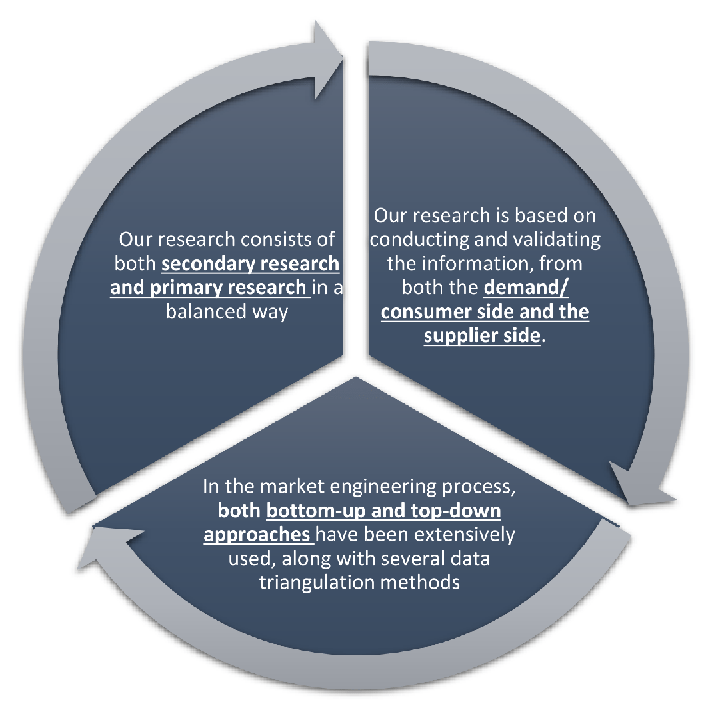
Our research design integrates both demand-side and supply-side analysis through a balanced combination of primary and secondary research methodologies. By utilizing both bottom-up and top-down approaches alongside rigorous data triangulation methods, we deliver robust market intelligence that supports strategic decision-making.
MarketGenics' comprehensive research design framework ensures the delivery of accurate, reliable, and actionable market intelligence. Through the integration of multiple research approaches, rigorous validation processes, and expert analysis, we provide our clients with the insights needed to make informed strategic decisions and capitalize on market opportunities.
MarketGenics leverages a dedicated industry panel of experts and a comprehensive suite of paid databases to effectively collect, consolidate, and analyze market intelligence.
Our approach has consistently proven to be reliable and effective in generating accurate market insights, identifying key industry trends, and uncovering emerging business opportunities.
Through both primary and secondary research, we capture and analyze critical company-level data such as manufacturing footprints, including technical centers, R&D facilities, sales offices, and headquarters.
Our expert panel further enhances our ability to estimate market size for specific brands based on validated field-level intelligence.
Our data mining techniques incorporate both parametric and non-parametric methods, allowing for structured data collection, sorting, processing, and cleaning.
Demand projections are derived from large-scale data sets analyzed through proprietary algorithms, culminating in robust and reliable market sizing.
Research Approach
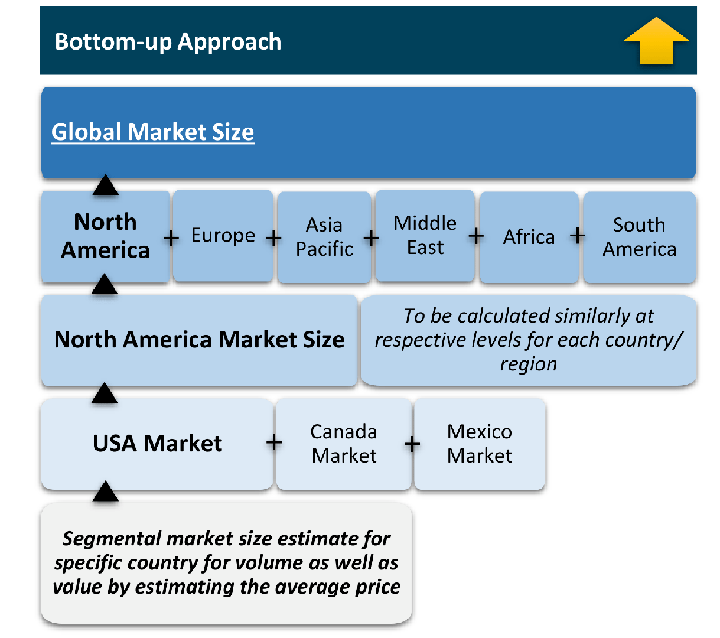
The bottom-up approach builds market estimates by starting with the smallest addressable market units and systematically aggregating them to create comprehensive market size projections.
This method begins with specific, granular data points and builds upward to create the complete market landscape.
Customer Analysis → Segmental Analysis → Geographical Analysis
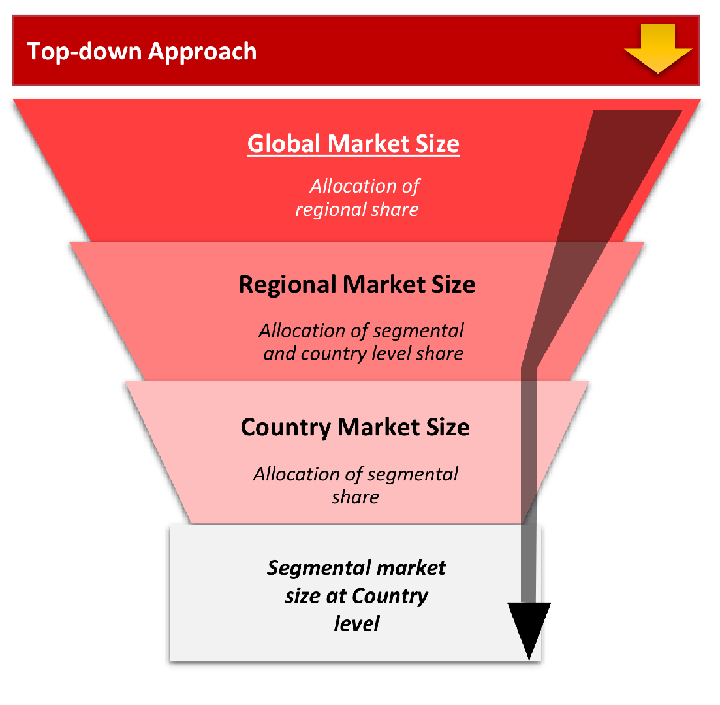
The top-down approach starts with the broadest possible market data and systematically narrows it down through a series of filters and assumptions to arrive at specific market segments or opportunities.
This method begins with the big picture and works downward to increasingly specific market slices.
TAM → SAM → SOM
Research Methods
Desk / Secondary Research
While analysing the market, we extensively study secondary sources, directories, and databases to identify and collect information useful for this technical, market-oriented, and commercial report. Secondary sources that we utilize are not only the public sources, but it is a combination of Open Source, Associations, Paid Databases, MG Repository & Knowledgebase, and others.
- Company websites, annual reports, financial reports, broker reports, and investor presentations
- National government documents, statistical databases and reports
- News articles, press releases and web-casts specific to the companies operating in the market, Magazines, reports, and others
- We gather information from commercial data sources for deriving company specific data such as segmental revenue, share for geography, product revenue, and others
- Internal and external proprietary databases (industry-specific), relevant patent, and regulatory databases
- Governing Bodies, Government Organizations
- Relevant Authorities, Country-specific Associations for Industries
We also employ the model mapping approach to estimate the product level market data through the players' product portfolio
Primary Research
Primary research/ interviews is vital in analyzing the market. Most of the cases involves paid primary interviews. Primary sources include primary interviews through e-mail interactions, telephonic interviews, surveys as well as face-to-face interviews with the different stakeholders across the value chain including several industry experts.
| Type of Respondents | Number of Primaries |
|---|---|
| Tier 2/3 Suppliers | ~20 |
| Tier 1 Suppliers | ~25 |
| End-users | ~25 |
| Industry Expert/ Panel/ Consultant | ~30 |
| Total | ~100 |
MG Knowledgebase
• Repository of industry blog, newsletter and case studies
• Online platform covering detailed market reports, and company profiles
Forecasting Factors and Models
Forecasting Factors
- Historical Trends – Past market patterns, cycles, and major events that shaped how markets behave over time. Understanding past trends helps predict future behavior.
- Industry Factors – Specific characteristics of the industry like structure, regulations, and innovation cycles that affect market dynamics.
- Macroeconomic Factors – Economic conditions like GDP growth, inflation, and employment rates that affect how much money people have to spend.
- Demographic Factors – Population characteristics like age, income, and location that determine who can buy your product.
- Technology Factors – How quickly people adopt new technology and how much technology infrastructure exists.
- Regulatory Factors – Government rules, laws, and policies that can help or restrict market growth.
- Competitive Factors – Analyzing competition structure such as degree of competition and bargaining power of buyers and suppliers.
Forecasting Models / Techniques
Multiple Regression Analysis
- Identify and quantify factors that drive market changes
- Statistical modeling to establish relationships between market drivers and outcomes
Time Series Analysis – Seasonal Patterns
- Understand regular cyclical patterns in market demand
- Advanced statistical techniques to separate trend, seasonal, and irregular components
Time Series Analysis – Trend Analysis
- Identify underlying market growth patterns and momentum
- Statistical analysis of historical data to project future trends
Expert Opinion – Expert Interviews
- Gather deep industry insights and contextual understanding
- In-depth interviews with key industry stakeholders
Multi-Scenario Development
- Prepare for uncertainty by modeling different possible futures
- Creating optimistic, pessimistic, and most likely scenarios
Time Series Analysis – Moving Averages
- Sophisticated forecasting for complex time series data
- Auto-regressive integrated moving average models with seasonal components
Econometric Models
- Apply economic theory to market forecasting
- Sophisticated economic models that account for market interactions
Expert Opinion – Delphi Method
- Harness collective wisdom of industry experts
- Structured, multi-round expert consultation process
Monte Carlo Simulation
- Quantify uncertainty and probability distributions
- Thousands of simulations with varying input parameters
Research Analysis
Our research framework is built upon the fundamental principle of validating market intelligence from both demand and supply perspectives. This dual-sided approach ensures comprehensive market understanding and reduces the risk of single-source bias.
Demand-Side Analysis: We understand end-user/application behavior, preferences, and market needs along with the penetration of the product for specific application.
Supply-Side Analysis: We estimate overall market revenue, analyze the segmental share along with industry capacity, competitive landscape, and market structure.
Validation & Evaluation
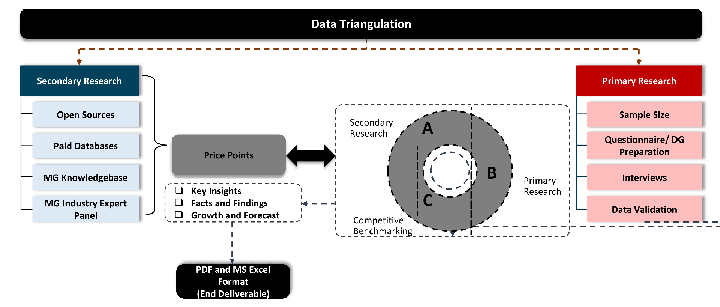
Data triangulation is a validation technique that uses multiple methods, sources, or perspectives to examine the same research question, thereby increasing the credibility and reliability of research findings. In market research, triangulation serves as a quality assurance mechanism that helps identify and minimize bias, validate assumptions, and ensure accuracy in market estimates.
- Data Source Triangulation – Using multiple data sources to examine the same phenomenon
- Methodological Triangulation – Using multiple research methods to study the same research question
- Investigator Triangulation – Using multiple researchers or analysts to examine the same data
- Theoretical Triangulation – Using multiple theoretical perspectives to interpret the same data
Custom Market Research Services
We will customise the research for you, in case the report listed above does not meet your requirements.
Get 10% Free Customisation