Rubber Hose Market Size, Share & Trends Analysis Report by Type of Rubber Hose (Natural Rubber Hose, EPDM Rubber Hose, NBR (Nitrile) Rubber Hose, SBR Rubber Hose, Neoprene Rubber Hose, Silicone Rubber Hose, Butyl Rubber Hose, Fluoroelastomer (FKM/Viton) Rubber Hose, Synthetic Rubber Hose, Others), Reinforcement Type, Pressure Rating, Hose Structure, Application, End-Use Industry, Sales Channel and Geography (North America, Europe, Asia Pacific, Middle East, Africa, and South America) – Global Industry Data, Trends, and Forecasts, 2026–2035
|
Market Structure & Evolution |
|
|
Segmental Data Insights |
|
|
Demand Trends |
|
|
Competitive Landscape |
|
|
Strategic Development |
|
|
Future Outlook & Opportunities |
|
Rubber-Hose-Market Size, Share, and Growth
The global rubber hose market is experiencing robust growth, with its estimated value of USD 2.0 billion in the year 2025 and USD 2.7 billion by the period 2035, registering a CAGR of 3.0% during the forecast period. The global rubber hose market is undergoing robust worldwide expansion.
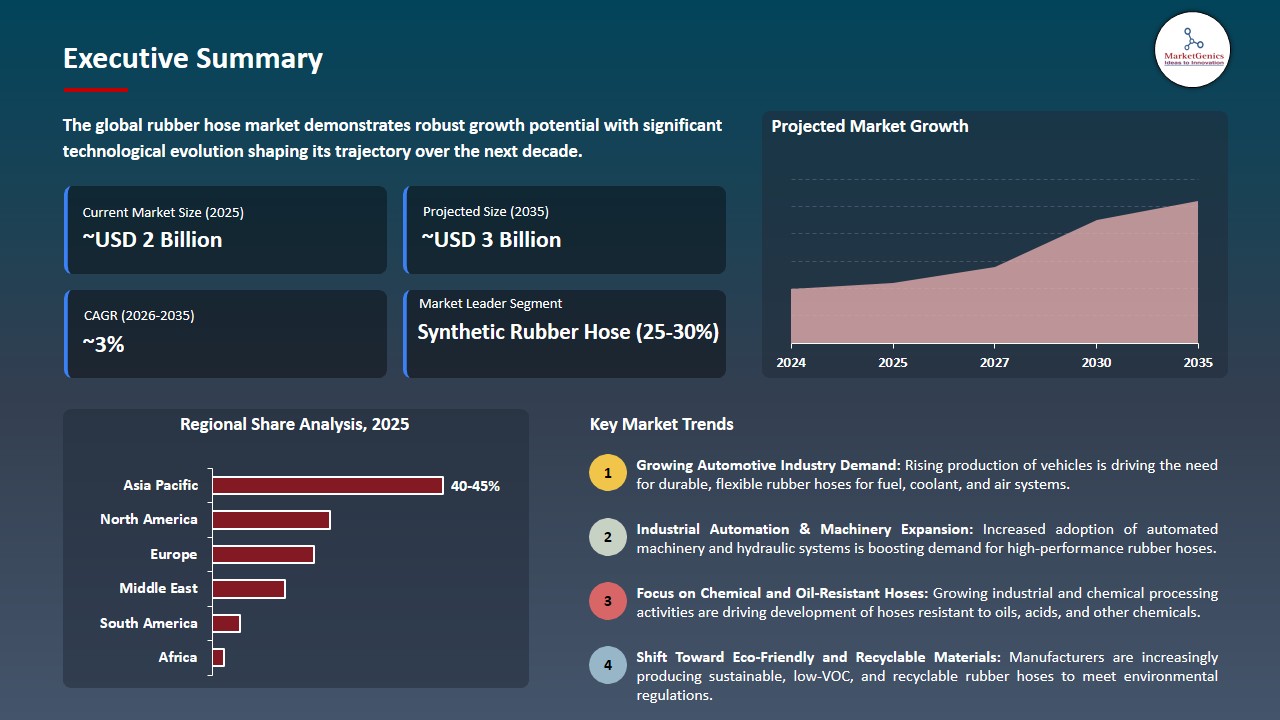
The newly hose designs from Gates Corporation, as an example, are a publicly documented development how modern hoses reduce installation effort and improve ergonomics: their newer hose designs require much less force to bend, enabling easier routing and faster assembly compared to legacy hoses. In short, these hoses need considerably less strength to be bent, thus simplifying the routing and speeding up the assembly as compared to the old hoses.
Key factors such as increased demand for durable, high-performance fluid-transfer products and the continuous application of advanced technology in materials engineering. For instance, in 2025, Parker Hannifin upgraded its high-pressure hydraulic hose product range by introducing the new generation concept with the reinforced multi-layer steel-wire and easy to use synthetic rubber compound, which is meant to increase the flexibility and allow the hoses to withstand extreme conditions in the field of construction and industrial equipment.
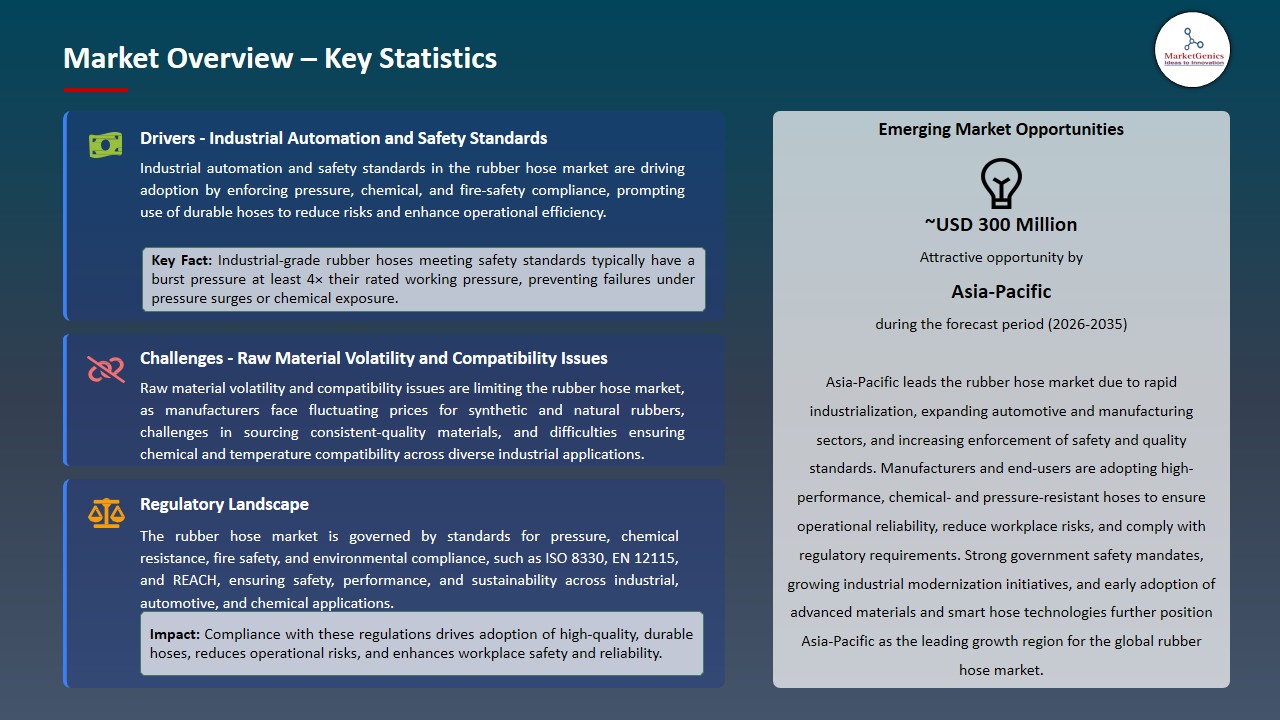
Moreover, the accelerated global spread of construction, material-handling, and agriculture has put a heavy demand for robust and efficient fluid-conveyance solutions. Besides that, the regulatory and industry standards like ISO 18752 and SAE J517 compel manufacturers to comply with the requirements in terms performance, pressure-rating and endurance benchmarks, thus, leading to a faster innovation rate in hose-design, reinforcement structures, and elastomer formulations.
The expansion of the industries, the need to comply with regulations and the advancement in reinforcement and extrusion technologies are the main factors behind the growth of rubber hose market worldwide. The rubber hose market worldwide is also accompanied by several adjacent opportunities such as the manufacturing of hydraulic fittings and couplings, hose-crimping and assembly machines, fluid-system monitoring sensors, industrial sealing solutions, as well as predictive-maintenance platforms. By engaging with these adjacent segments, manufacturers can not only consolidate their integrated fluid-handling portfolios but also accelerate the value they create within the industrial equipment ecosystem.
Rubber Hose Market Dynamics and Trends
Driver: Increasing Industrial Automation and Safety Standards Driving Adoption of Advanced Rubber Hose Solutions
-
The fast automation of industries such as manufacturing, construction, and material-handling is the major reason for the strong demand for top-quality rubber hoses that facilitate precise, high-pressure fluid transmission. As a result, the use of automated hydraulic equipment, such as robotic arms and smart excavators, has increased so manufacturers are now required to use hoses with higher pressure ratings and better fatigue resistance.
- More and more strict safety regulations in the workplace, such as conformity to ISO 18752 and SAE J517 performance standards, are the main reasons why equipment OEMs are forced to replace their current hoses with those that have better burst strength, abrasion resistance, and thermal stability.
- The increase of heavy-duty machinery in the mining and agricultural sectors, especially in China, India, and Southeast Asia, is the main factor that causes continuous demand for synthetic-rubber hoses that can withstand severe weather and load conditions while ensuring productivity and operator safety.
Restraint: Raw Material Volatility and Compatibility Issues Limiting Widespread Hose Replacement
-
The changes in price of natural rubber, synthetic elastomers (like NBR, EPDM, SBR), and steel wire reinforcement materials that are used for the production of commodity have a direct influence on the production cost and thus, limit the possibilities of large capital investments in cost-sensitive markets.
- The largest single barrier the users for a next-generation hose can be found in the abandoned many of the legacy hydraulic installations use of outdated hose fittings and couplings. The incompatibility of older connectors with new hose materials has reduced the turnover rate of industrial plants that have decided to replace the old hose products with new ones.
- In the developing regions of the world, users are generally not conscious of preventive maintenance practices and there is no local availability of certified hose-assembly facilities. As a result, many users will have their hose products fail prematurely, hence, they will be hesitant to buy sophisticated hose systems that require strict installation conditions.
Opportunity: Growth in Energy, Infrastructure, and Renewables Driving New Hose Requirements
-
One of the results of oil & gas pipelines expanding, petrochemical plants growing, offshore drilling operations becoming more intensive, and LNG facilities development is a strong demand for specialized hoses that are resistant to chemicals, hydrocarbons, and corrosive fluids. Consequently, opportunities are opened for the manufacturers of flame-resistant and API-certified hoses.
- The increase in global infrastructure projects such as road-building and urban construction is speeding up the demand for hydraulic hoses that are used in excavators, concrete pumps, wheel loaders, and cranes.
- The growth of renewable energy, mainly the wind-turbine hydraulic pitch systems and hydroelectric equipment, is leading to the creation of new ways for high-flexibility, low-temperature rubber hoses to be used in continuous-load applications. These are niches that suppliers of engineered hoses with advanced reinforcement technologies can benefit from in terms of strong margins.
Key Trend: Adoption of Smart Hoses, Eco-Friendly Materials, and Lightweight Reinforcement Technologies
-
Manufacturers are progressively equipping their smart hoses with an array of embedded sensors that autonomously keep track of pressure, temperature, leakage, and wear in near real-time, thus allowing predictive maintenance to be carried out and the resultant lowering of equipment downtime all over mines, factories, and construction sites.
- The shift toward the use of eco-friendly elastomer formulations and recyclable reinforcement layers is very evident and is mainly caused by the setting of sustainability targets and regulatory pressures that aim at reducing the environmental impact without compromising the hose durability. The use of advanced reinforcement technologies, such as aramid fiber braiding, hybrid wire-mesh structures, and multi-spiral designs, is becoming more popular as they provide high strength, lower weight, and a better bend radius, thus satisfying the requirements of small next-generation hydraulic machinery.
- OEMs are using digital hose-assembly tracking systems along with QR-based certification and lifecycle monitoring tools as a measure of quality assurance, traceability, and compliance with global fluid-power standards, thus becoming their usual routine.
Rubber-Hose-Market Analysis and Segmental Data

“Synthetic Rubber Hose Dominate Global Rubber Hose Market amid Rising Demand for High-Performance Fluid Transfer Solutions"
-
The dominance of synthetic rubber hoses has been one of the most talked-about phenomena in the global rubber hose market in recent years. The world industrial hose market, which practically consists of synthetic rubber-lined hoses, is expected to be on a steady growth path by mid-2025 due to demand increases in manufacturing, oil & gas, chemicals, agriculture, and construction sectors.
- A significant trend driving that demand is the ever-increasing use of nitrile-rubber (synthetic) hoses for oil- and chemical-resistant applications in automotive, heavy-machinery, and industrial fluid-transfer systems. Expansion of construction, mining and energy projects has, in particular, the Asia–Pacific region, led to the consumption of hydraulic and industrial hoses to skyrocket.
- Major hose manufacturers, on the other hand, have reacted: new product lines have come into existence offering lighter-weight, more chemical- and abrasion-resistant synthetic rubber hoses, developed just for high-pressure, high-temperature operations. The synthesis of strong end-market demand, the wider application of the product across various sectors, and the material innovation is making synthetic rubber hoses the firm leaders of the global market, thus, they are the most dependable and efficient fluid-handling solutions even under tough conditions.
“Asia Pacific Dominates Rubber Hose Market amid Rapid Industrialization and Expanding Infrastructure Investments”
-
Asia Pacific is at the forefront of the worldwide rubber hose market. The region’s industrialization process in the major four countries, namely China, India, Indonesia, and Vietnam, is the primary driver of the market. These countries are the places where the large-scale construction, mining, automotive production, and oil & gas operations activities are taking place, thus calling for the utilization of high-performance fluid-transfer and hydraulic hose systems.
- Besides the abovementioned, massive government-backed infrastructure programs, such as transport corridors, smart-city developments, and energy-sector expansions are major contributors to the escalating demand for synthetic rubber and hydraulic hoses capable of withstanding high pressure, wear, and extreme operating conditions.
- The regional automotive and heavy-machinery manufacturing sectors are the main contributors to the industrial leadership of the region. The major manufacturers in China, Japan, South Korea, and India keep on increasing their production capacity to a large extent, thus leading to the rise in the use of fuel hoses, air-conditioning hoses, brake hoses, and hydraulic assemblies.
- Moreover, the fast-tracked construction machinery deployment, examples being excavators, loaders, concrete pumps, and cranes has greatly influenced the purchasing of state-of-the-art multi-layer reinforced rubber hoses for high-load operations safety and reliability.
- Several prominent hose manufacturers decided to widen their production as well as distribution capabilities in the Asia Pacific to cater to the escalating demand for synthetic rubber hoses and high-pressure hydraulic lines. All these, as well as other factors, have led to Asia Pacific having the strongest industrial expansion as the key driver of the global rubber hose market, which is, in turn, bolstered by widespread application areas and continuous modernization of fluid-transfer infrastructure.
Rubber-Hose-Market Ecosystem
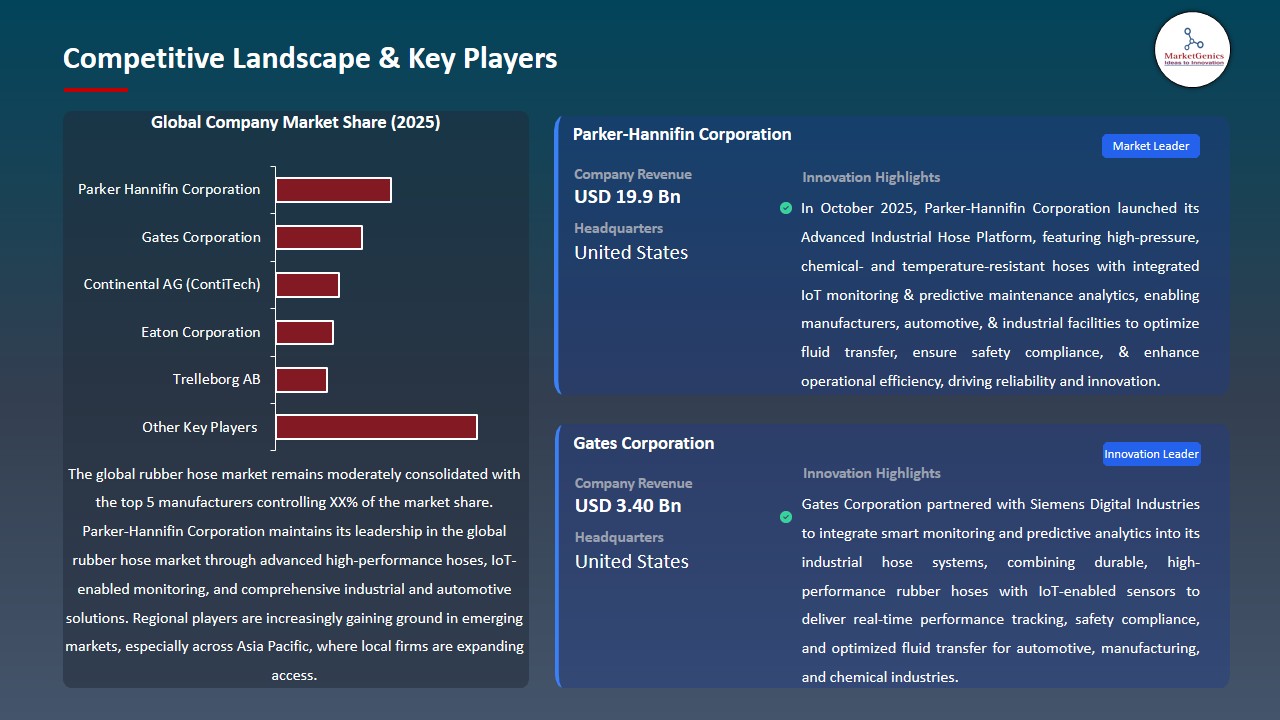
The rubber hose market is a moderately consolidated one, where global leaders such as Parker Hannifin, Gates Corporation, Eaton, Manuli Hydraulics, Sumitomo Riko, and Trelleborg are controlling a significant share by using advanced materials engineering, reinforcement architectures, and digitally enabled manufacturing to maintain their scale and service networks.
These incumbents are progressively moving towards niche and specialized solutions, like chemical-resistant nitrile and EPDM blends, aramid- or steel-reinforced high-pressure hydraulic lines, and lightweight bend-radius-optimized assemblies-along with calibration, crimping, and testing services to facilitate the uptake in mining, construction, oil & gas, and automotive sectors. Manuli’s recent launches and refreshed 2025 industrial-hose and assembly catalogues are a case in point of this product-and-service orientation.
Government bodies and R&D institutions are not sitting idle either; they are funding materials science and safety testing programs. For instance, Sumitomo Riko’s involvement in hydrogen and fuel-cell exhibitions and the reporting in February 2025 is about the development of durable, infrastructure-grade elastomers for energy applications.
Companies are on the move to diversify their portfolios and offer integrated solutions, by combining hoses, fittings, sensors, and lifecycle services, to increase uptime, lessen leak incidents, and achieve sustainability targets. As an industry pioneer, Gates’ MXT line (launched in April 2021) was one of the first to show real progress in weight reduction and installation ergonomics, thereby pointing to the market’s gradual and continuous shift toward engineered, performance-driven products.
Recent Development and Strategic Overview:
-
In July 2025, Gates Corporation unveiled the new MXT Extreme Duty hydraulic hose series that are specially made for high-pressure industrial and mining applications. The hoses are constructed with new synthetic rubber compounds and multi-layer reinforcement; thus, they are more flexible, resistant to chemicals, and have a longer service life. This resolves the problem of safety and efficiency at operations and also lessens the downtime of heavy machinery.
- In September 2025, Parker Hannifin introduced its SmartTrack sensor-integrated hose system, enabling real-time monitoring of pressure, temperature, and wear in hydraulic systems. This technology allows predictive maintenance and early leak detection without operational interruptions, thus reliability and productivity in the manufacturing and construction sectors are increased.
Report Scope
|
Attribute |
Detail |
|
Market Size in 2025 |
USD 2.0 Bn |
|
Market Forecast Value in 2035 |
USD 2.7 Bn |
|
Growth Rate (CAGR) |
3.0% |
|
Forecast Period |
2026 – 2035 |
|
Historical Data Available for |
2021 – 2024 |
|
Market Size Units |
USD Bn for Value Million Units for Volume |
|
Report Format |
Electronic (PDF) + Excel |
|
Regions and Countries Covered |
|||||
|
North America |
Europe |
Asia Pacific |
Middle East |
Africa |
South America |
|
|
|
|
|
|
|
Companies Covered |
|||||
|
|
|
|
|
|
Rubber-Hose-Market Segmentation and Highlights
|
Segment |
Sub-segment |
|
Rubber Hose Market, By Type of Rubber Hose |
|
|
Rubber Hose Market, By Reinforcement Type |
|
|
Rubber Hose Market, By Pressure Rating |
|
|
Rubber Hose Market, By Hose Structure |
|
|
Rubber Hose Market, By Application |
|
|
Rubber Hose Market, By Application / Industry End-Use Industry |
|
|
Rubber Hose Market, By Sales Channel |
|
Frequently Asked Questions
Table of Contents
- 1. Research Methodology and Assumptions
- 1.1. Definitions
- 1.2. Research Design and Approach
- 1.3. Data Collection Methods
- 1.4. Base Estimates and Calculations
- 1.5. Forecasting Models
- 1.5.1. Key Forecast Factors & Impact Analysis
- 1.6. Secondary Research
- 1.6.1. Open Sources
- 1.6.2. Paid Databases
- 1.6.3. Associations
- 1.7. Primary Research
- 1.7.1. Primary Sources
- 1.7.2. Primary Interviews with Stakeholders across Ecosystem
- 2. Executive Summary
- 2.1. Global Rubber Hose Market Outlook
- 2.1.1. Rubber Hose Market Size (Value - US$ Bn and Volume - Million Units), and Forecasts, 2021-2035
- 2.1.2. Compounded Annual Growth Rate Analysis
- 2.1.3. Growth Opportunity Analysis
- 2.1.4. Segmental Share Analysis
- 2.1.5. Geographical Share Analysis
- 2.2. Market Analysis and Facts
- 2.3. Supply-Demand Analysis
- 2.4. Competitive Benchmarking
- 2.5. Go-to- Market Strategy
- 2.5.1. Customer/ End-use Industry Assessment
- 2.5.2. Growth Opportunity Data, 2026-2035
- 2.5.2.1. Regional Data
- 2.5.2.2. Country Data
- 2.5.2.3. Segmental Data
- 2.5.3. Identification of Potential Market Spaces
- 2.5.4. GAP Analysis
- 2.5.5. Potential Attractive Price Points
- 2.5.6. Prevailing Market Risks & Challenges
- 2.5.7. Preferred Sales & Marketing Strategies
- 2.5.8. Key Recommendations and Analysis
- 2.5.9. A Way Forward
- 2.1. Global Rubber Hose Market Outlook
- 3. Industry Data and Premium Insights
- 3.1. Global Industrial Machinery Ecosystem Overview, 2025
- 3.1.1. Industrial Machinery Industry Analysis
- 3.1.2. Key Trends for Industrial Machinery Industry
- 3.1.3. Regional Distribution for Industrial Machinery Industry
- 3.2. Supplier Customer Data
- 3.3. Technology Roadmap and Developments
- 3.4. Trade Analysis
- 3.4.1. Import & Export Analysis, 2025
- 3.4.2. Top Importing Countries
- 3.4.3. Top Exporting Countries
- 3.5. Trump Tariff Impact Analysis
- 3.5.1. Manufacturer
- 3.5.1.1. Based on the component & Raw material
- 3.5.2. Supply Chain
- 3.5.3. End Consumer
- 3.5.1. Manufacturer
- 3.6. Raw Material Analysis
- 3.1. Global Industrial Machinery Ecosystem Overview, 2025
- 4. Market Overview
- 4.1. Market Dynamics
- 4.1.1. Drivers
- 4.1.1.1. Rising demand for durable, high-pressure rubber hoses for industrial automation, fluid transfer, and construction applications.
- 4.1.1.2. Growing adoption of reinforced, heat-resistant, and chemical-resistant hose technologies to support manufacturing, oil & gas, and agriculture.
- 4.1.1.3. Increasing investments in advanced materials, lightweight composites, and automated hose production systems.
- 4.1.2. Restraints
- 4.1.2.1. High costs associated with specialized rubber compounds and reinforcement materials.
- 4.1.2.2. Challenges integrating modern hose designs with older machinery, fittings, and varied industrial operating environments.
- 4.1.1. Drivers
- 4.2. Key Trend Analysis
- 4.3. Regulatory Framework
- 4.3.1. Key Regulations, Norms, and Subsidies, by Key Countries
- 4.3.2. Tariffs and Standards
- 4.3.3. Impact Analysis of Regulations on the Market
- 4.4. Value Chain Analysis
- 4.4.1. Raw Material Suppliers
- 4.4.2. System Integrators
- 4.4.3. Rubber Hose Manufacturers
- 4.4.4. Distributors
- 4.4.5. End Users/ Customers
- 4.5. Cost Structure Analysis
- 4.5.1. Parameter’s Share for Cost Associated
- 4.5.2. COGP vs COGS
- 4.5.3. Profit Margin Analysis
- 4.6. Pricing Analysis
- 4.6.1. Regional Pricing Analysis
- 4.6.2. Segmental Pricing Trends
- 4.6.3. Factors Influencing Pricing
- 4.7. Porter’s Five Forces Analysis
- 4.8. PESTEL Analysis
- 4.9. Global Rubber Hose Market Demand
- 4.9.1. Historical Market Size –Value (US$ Bn) and Volume (Million Units), 2020-2024
- 4.9.2. Current and Future Market Size –Value (US$ Bn) and Volume (Million Units), 2026–2035
- 4.9.2.1. Y-o-Y Growth Trends
- 4.9.2.2. Absolute $ Opportunity Assessment
- 4.1. Market Dynamics
- 5. Competition Landscape
- 5.1. Competition structure
- 5.1.1. Fragmented v/s consolidated
- 5.2. Company Share Analysis, 2025
- 5.2.1. Global Company Market Share
- 5.2.2. By Region
- 5.2.2.1. North America
- 5.2.2.2. Europe
- 5.2.2.3. Asia Pacific
- 5.2.2.4. Middle East
- 5.2.2.5. Africa
- 5.2.2.6. South America
- 5.3. Product Comparison Matrix
- 5.3.1. Specifications
- 5.3.2. Market Positioning
- 5.3.3. Pricing
- 5.1. Competition structure
- 6. Global Rubber Hose Market Analysis, by Type of Rubber Hose
- 6.1. Key Segment Analysis
- 6.2. Rubber Hose Market Size (Value - US$ Bn and Volume - Million Units), Analysis, and Forecasts, by Type of Rubber Hose, 2021-2035
- 6.2.1. Natural Rubber Hose
- 6.2.2. EPDM Rubber Hose
- 6.2.3. NBR (Nitrile) Rubber Hose
- 6.2.4. SBR Rubber Hose
- 6.2.5. Neoprene Rubber Hose
- 6.2.6. Silicone Rubber Hose
- 6.2.7. Butyl Rubber Hose
- 6.2.8. Fluoroelastomer (FKM/Viton) Rubber Hose
- 6.2.9. Synthetic Rubber Hose
- 6.2.10. Others
- 7. Global Rubber Hose Market Analysis, by Reinforcement Type
- 7.1. Key Segment Analysis
- 7.2. Rubber Hose Market Size (Value - US$ Bn and Volume - Million Units), Analysis, and Forecasts, by Reinforcement Type, 2021-2035
- 7.2.1. Non-Reinforced Rubber Hose
- 7.2.2. Textile-Reinforced Rubber Hose
- 7.2.3. Wire-Reinforced Rubber Hose
- 7.2.4. Spiral-Reinforced Rubber Hose
- 7.2.5. Braided-Reinforced Rubber Hose
- 7.2.6. Composite-Reinforced Rubber Hose
- 7.2.7. Others
- 8. Global Rubber Hose Market Analysis, by Pressure Rating
- 8.1. Key Segment Analysis
- 8.2. Rubber Hose Market Size (Value - US$ Bn and Volume - Million Units), Analysis, and Forecasts, by Pressure Rating, 2021-2035
- 8.2.1. Low-Pressure Rubber Hose
- 8.2.2. Medium-Pressure Rubber Hose
- 8.2.3. High-Pressure Rubber Hose
- 8.2.4. Ultra-High Pressure Rubber Hose
- 9. Global Rubber Hose Market Analysis, by Hose Structure
- 9.1. Key Segment Analysis
- 9.2. Rubber Hose Market Size (Value - US$ Bn and Volume - Million Units), Analysis, and Forecasts, by Hose Structure, 2021-2035
- 9.2.1. Single-Layer Hose
- 9.2.2. Multi-Layer Hose
- 9.2.3. Corrugated Rubber Hose
- 9.2.4. Smooth Bore Hose
- 9.2.5. Coiled Rubber Hose
- 10. Global Rubber Hose Market Analysis, by Application
- 10.1. Key Segment Analysis
- 10.2. Rubber Hose Market Size (Value - US$ Bn and Volume - Million Units), Analysis, and Forecasts, by Application, 2021-2035
- 10.2.1. Hydraulic Systems
- 10.2.2. Pneumatic Systems
- 10.2.3. Air & Gas Transfer
- 10.2.4. Water & Fluid Transfer
- 10.2.5. Chemical Transfer
- 10.2.6. Fuel & Oil Transfer
- 10.2.7. Steam Transfer
- 10.2.8. Vacuum & Suction Applications
- 10.2.9. Others
- 11. Global Rubber Hose Market Analysis, by End-Use Industry
- 11.1. Key Segment Analysis
- 11.2. Rubber Hose Market Size (Value - US$ Bn and Volume - Million Units), Analysis, and Forecasts, by End-Use Industry, 2021-2035
- 11.2.1. Automotive & Transportation
- 11.2.2. Oil & Gas
- 11.2.3. Construction & Mining
- 11.2.4. Agriculture
- 11.2.5. Manufacturing & Industrial Equipment
- 11.2.6. Chemical & Petrochemical
- 11.2.7. Food & Beverage
- 11.2.8. HVAC & Refrigeration
- 11.2.9. Marine Industry
- 11.2.10. Others
- 12. Global Rubber Hose Market Analysis and Forecasts, by Sales Channel
- 12.1. Key Findings
- 12.2. Rubber Hose Market Size (Value - US$ Bn and Volume - Million Units), Analysis, and Forecasts, by Sales Channel, 2021-2035
- 12.2.1. OEM
- 12.2.2. Aftermarket
- 13. Global Rubber Hose Market Analysis and Forecasts, by Region
- 13.1. Key Findings
- 13.2. Rubber Hose Market Size (Value - US$ Bn and Volume - Million Units), Analysis, and Forecasts, by Region, 2021-2035
- 13.2.1. North America
- 13.2.2. Europe
- 13.2.3. Asia Pacific
- 13.2.4. Middle East
- 13.2.5. Africa
- 13.2.6. South America
- 14. North America Rubber Hose Market Analysis
- 14.1. Key Segment Analysis
- 14.2. Regional Snapshot
- 14.3. North America Rubber Hose Market Size Value - US$ Bn and Volume - Million Units), Analysis, and Forecasts, 2021-2035
- 14.3.1. Type of Rubber Hose
- 14.3.2. Reinforcement Type
- 14.3.3. Pressure Rating
- 14.3.4. Hose Structure
- 14.3.5. Application
- 14.3.6. End-Use Industry
- 14.3.7. Sales Channel
- 14.3.8. Country
- 14.3.8.1. USA
- 14.3.8.2. Canada
- 14.3.8.3. Mexico
- 14.4. USA Rubber Hose Market
- 14.4.1. Country Segmental Analysis
- 14.4.2. Type of Rubber Hose
- 14.4.3. Reinforcement Type
- 14.4.4. Pressure Rating
- 14.4.5. Hose Structure
- 14.4.6. Application
- 14.4.7. End-Use Industry
- 14.4.8. Sales Channel
- 14.5. Canada Rubber Hose Market
- 14.5.1. Country Segmental Analysis
- 14.5.2. Type of Rubber Hose
- 14.5.3. Reinforcement Type
- 14.5.4. Pressure Rating
- 14.5.5. Hose Structure
- 14.5.6. Application
- 14.5.7. End-Use Industry
- 14.5.8. Sales Channel
- 14.6. Mexico Rubber Hose Market
- 14.6.1. Country Segmental Analysis
- 14.6.2. Type of Rubber Hose
- 14.6.3. Reinforcement Type
- 14.6.4. Pressure Rating
- 14.6.5. Hose Structure
- 14.6.6. Application
- 14.6.7. End-Use Industry
- 14.6.8. Sales Channel
- 15. Europe Rubber Hose Market Analysis
- 15.1. Key Segment Analysis
- 15.2. Regional Snapshot
- 15.3. Europe Rubber Hose Market Size (Value - US$ Bn and Volume - Million Units), Analysis, and Forecasts, 2021-2035
- 15.3.1. Type of Rubber Hose
- 15.3.2. Reinforcement Type
- 15.3.3. Pressure Rating
- 15.3.4. Hose Structure
- 15.3.5. Application
- 15.3.6. End-Use Industry
- 15.3.7. Sales Channel
- 15.3.8. Country
- 15.3.8.1. Germany
- 15.3.8.2. United Kingdom
- 15.3.8.3. France
- 15.3.8.4. Italy
- 15.3.8.5. Spain
- 15.3.8.6. Netherlands
- 15.3.8.7. Nordic Countries
- 15.3.8.8. Poland
- 15.3.8.9. Russia & CIS
- 15.3.8.10. Rest of Europe
- 15.4. Germany Rubber Hose Market
- 15.4.1. Country Segmental Analysis
- 15.4.2. Type of Rubber Hose
- 15.4.3. Reinforcement Type
- 15.4.4. Pressure Rating
- 15.4.5. Hose Structure
- 15.4.6. Application
- 15.4.7. End-Use Industry
- 15.4.8. Sales Channel
- 15.5. United Kingdom Rubber Hose Market
- 15.5.1. Country Segmental Analysis
- 15.5.2. Type of Rubber Hose
- 15.5.3. Reinforcement Type
- 15.5.4. Pressure Rating
- 15.5.5. Hose Structure
- 15.5.6. Application
- 15.5.7. End-Use Industry
- 15.5.8. Sales Channel
- 15.6. France Rubber Hose Market
- 15.6.1. Country Segmental Analysis
- 15.6.2. Type of Rubber Hose
- 15.6.3. Reinforcement Type
- 15.6.4. Pressure Rating
- 15.6.5. Hose Structure
- 15.6.6. Application
- 15.6.7. End-Use Industry
- 15.6.8. Sales Channel
- 15.7. Italy Rubber Hose Market
- 15.7.1. Country Segmental Analysis
- 15.7.2. Type of Rubber Hose
- 15.7.3. Reinforcement Type
- 15.7.4. Pressure Rating
- 15.7.5. Hose Structure
- 15.7.6. Application
- 15.7.7. End-Use Industry
- 15.7.8. Sales Channel
- 15.8. Spain Rubber Hose Market
- 15.8.1. Country Segmental Analysis
- 15.8.2. Type of Rubber Hose
- 15.8.3. Reinforcement Type
- 15.8.4. Pressure Rating
- 15.8.5. Hose Structure
- 15.8.6. Application
- 15.8.7. End-Use Industry
- 15.8.8. Sales Channel
- 15.9. Netherlands Rubber Hose Market
- 15.9.1. Country Segmental Analysis
- 15.9.2. Type of Rubber Hose
- 15.9.3. Reinforcement Type
- 15.9.4. Pressure Rating
- 15.9.5. Hose Structure
- 15.9.6. Application
- 15.9.7. End-Use Industry
- 15.9.8. Sales Channel
- 15.10. Nordic Countries Rubber Hose Market
- 15.10.1. Country Segmental Analysis
- 15.10.2. Type of Rubber Hose
- 15.10.3. Reinforcement Type
- 15.10.4. Pressure Rating
- 15.10.5. Hose Structure
- 15.10.6. Application
- 15.10.7. End-Use Industry
- 15.10.8. Sales Channel
- 15.11. Poland Rubber Hose Market
- 15.11.1. Country Segmental Analysis
- 15.11.2. Type of Rubber Hose
- 15.11.3. Reinforcement Type
- 15.11.4. Pressure Rating
- 15.11.5. Hose Structure
- 15.11.6. Application
- 15.11.7. End-Use Industry
- 15.11.8. Sales Channel
- 15.12. Russia & CIS Rubber Hose Market
- 15.12.1. Country Segmental Analysis
- 15.12.2. Type of Rubber Hose
- 15.12.3. Reinforcement Type
- 15.12.4. Pressure Rating
- 15.12.5. Hose Structure
- 15.12.6. Application
- 15.12.7. End-Use Industry
- 15.12.8. Sales Channel
- 15.13. Rest of Europe Rubber Hose Market
- 15.13.1. Country Segmental Analysis
- 15.13.2. Type of Rubber Hose
- 15.13.3. Reinforcement Type
- 15.13.4. Pressure Rating
- 15.13.5. Hose Structure
- 15.13.6. Application
- 15.13.7. End-Use Industry
- 15.13.8. Sales Channel
- 16. Asia Pacific Rubber Hose Market Analysis
- 16.1. Key Segment Analysis
- 16.2. Regional Snapshot
- 16.3. Asia Pacific Rubber Hose Market Size (Value - US$ Bn and Volume - Million Units), Analysis, and Forecasts, 2021-2035
- 16.3.1. Type of Rubber Hose
- 16.3.2. Reinforcement Type
- 16.3.3. Pressure Rating
- 16.3.4. Hose Structure
- 16.3.5. Application
- 16.3.6. End-Use Industry
- 16.3.7. Sales Channel
- 16.3.8. Country
- 16.3.8.1. China
- 16.3.8.2. India
- 16.3.8.3. Japan
- 16.3.8.4. South Korea
- 16.3.8.5. Australia and New Zealand
- 16.3.8.6. Indonesia
- 16.3.8.7. Malaysia
- 16.3.8.8. Thailand
- 16.3.8.9. Vietnam
- 16.3.8.10. Rest of Asia Pacific
- 16.4. China Rubber Hose Market
- 16.4.1. Country Segmental Analysis
- 16.4.2. Type of Rubber Hose
- 16.4.3. Reinforcement Type
- 16.4.4. Pressure Rating
- 16.4.5. Hose Structure
- 16.4.6. Application
- 16.4.7. End-Use Industry
- 16.4.8. Sales Channel
- 16.5. India Rubber Hose Market
- 16.5.1. Country Segmental Analysis
- 16.5.2. Type of Rubber Hose
- 16.5.3. Reinforcement Type
- 16.5.4. Pressure Rating
- 16.5.5. Hose Structure
- 16.5.6. Application
- 16.5.7. End-Use Industry
- 16.5.8. Sales Channel
- 16.6. Japan Rubber Hose Market
- 16.6.1. Country Segmental Analysis
- 16.6.2. Type of Rubber Hose
- 16.6.3. Reinforcement Type
- 16.6.4. Pressure Rating
- 16.6.5. Hose Structure
- 16.6.6. Application
- 16.6.7. End-Use Industry
- 16.6.8. Sales Channel
- 16.7. South Korea Rubber Hose Market
- 16.7.1. Country Segmental Analysis
- 16.7.2. Type of Rubber Hose
- 16.7.3. Reinforcement Type
- 16.7.4. Pressure Rating
- 16.7.5. Hose Structure
- 16.7.6. Application
- 16.7.7. End-Use Industry
- 16.7.8. Sales Channel
- 16.8. Australia and New Zealand Rubber Hose Market
- 16.8.1. Country Segmental Analysis
- 16.8.2. Type of Rubber Hose
- 16.8.3. Reinforcement Type
- 16.8.4. Pressure Rating
- 16.8.5. Hose Structure
- 16.8.6. Application
- 16.8.7. End-Use Industry
- 16.8.8. Sales Channel
- 16.9. Indonesia Rubber Hose Market
- 16.9.1. Country Segmental Analysis
- 16.9.2. Type of Rubber Hose
- 16.9.3. Reinforcement Type
- 16.9.4. Pressure Rating
- 16.9.5. Hose Structure
- 16.9.6. Application
- 16.9.7. End-Use Industry
- 16.9.8. Sales Channel
- 16.10. Malaysia Rubber Hose Market
- 16.10.1. Country Segmental Analysis
- 16.10.2. Type of Rubber Hose
- 16.10.3. Reinforcement Type
- 16.10.4. Pressure Rating
- 16.10.5. Hose Structure
- 16.10.6. Application
- 16.10.7. End-Use Industry
- 16.10.8. Sales Channel
- 16.11. Thailand Rubber Hose Market
- 16.11.1. Country Segmental Analysis
- 16.11.2. Type of Rubber Hose
- 16.11.3. Reinforcement Type
- 16.11.4. Pressure Rating
- 16.11.5. Hose Structure
- 16.11.6. Application
- 16.11.7. End-Use Industry
- 16.11.8. Sales Channel
- 16.12. Vietnam Rubber Hose Market
- 16.12.1. Country Segmental Analysis
- 16.12.2. Type of Rubber Hose
- 16.12.3. Reinforcement Type
- 16.12.4. Pressure Rating
- 16.12.5. Hose Structure
- 16.12.6. Application
- 16.12.7. End-Use Industry
- 16.12.8. Sales Channel
- 16.13. Rest of Asia Pacific Rubber Hose Market
- 16.13.1. Country Segmental Analysis
- 16.13.2. Type of Rubber Hose
- 16.13.3. Reinforcement Type
- 16.13.4. Pressure Rating
- 16.13.5. Hose Structure
- 16.13.6. Application
- 16.13.7. End-Use Industry
- 16.13.8. Sales Channel
- 17. Middle East Rubber Hose Market Analysis
- 17.1. Key Segment Analysis
- 17.2. Regional Snapshot
- 17.3. Middle East Rubber Hose Market Size (Value - US$ Bn and Volume - Million Units), Analysis, and Forecasts, 2021-2035
- 17.3.1. Type of Rubber Hose
- 17.3.2. Reinforcement Type
- 17.3.3. Pressure Rating
- 17.3.4. Hose Structure
- 17.3.5. Application
- 17.3.6. End-Use Industry
- 17.3.7. Sales Channel
- 17.3.8. Country
- 17.3.8.1. Turkey
- 17.3.8.2. UAE
- 17.3.8.3. Saudi Arabia
- 17.3.8.4. Israel
- 17.3.8.5. Rest of Middle East
- 17.4. Turkey Rubber Hose Market
- 17.4.1. Country Segmental Analysis
- 17.4.2. Type of Rubber Hose
- 17.4.3. Reinforcement Type
- 17.4.4. Pressure Rating
- 17.4.5. Hose Structure
- 17.4.6. Application
- 17.4.7. End-Use Industry
- 17.4.8. Sales Channel
- 17.5. UAE Rubber Hose Market
- 17.5.1. Country Segmental Analysis
- 17.5.2. Type of Rubber Hose
- 17.5.3. Reinforcement Type
- 17.5.4. Pressure Rating
- 17.5.5. Hose Structure
- 17.5.6. Application
- 17.5.7. End-Use Industry
- 17.5.8. Sales Channel
- 17.6. Saudi Arabia Rubber Hose Market
- 17.6.1. Country Segmental Analysis
- 17.6.2. Type of Rubber Hose
- 17.6.3. Reinforcement Type
- 17.6.4. Pressure Rating
- 17.6.5. Hose Structure
- 17.6.6. Application
- 17.6.7. End-Use Industry
- 17.6.8. Sales Channel
- 17.7. Israel Rubber Hose Market
- 17.7.1. Country Segmental Analysis
- 17.7.2. Type of Rubber Hose
- 17.7.3. Reinforcement Type
- 17.7.4. Pressure Rating
- 17.7.5. Hose Structure
- 17.7.6. Application
- 17.7.7. End-Use Industry
- 17.7.8. Sales Channel
- 17.8. Rest of Middle East Rubber Hose Market
- 17.8.1. Country Segmental Analysis
- 17.8.2. Type of Rubber Hose
- 17.8.3. Reinforcement Type
- 17.8.4. Pressure Rating
- 17.8.5. Hose Structure
- 17.8.6. Application
- 17.8.7. End-Use Industry
- 17.8.8. Sales Channel
- 18. Africa Rubber Hose Market Analysis
- 18.1. Key Segment Analysis
- 18.2. Regional Snapshot
- 18.3. Africa Rubber Hose Market Size (Value - US$ Bn and Volume - Million Units), Analysis, and Forecasts, 2021-2035
- 18.3.1. Type of Rubber Hose
- 18.3.2. Reinforcement Type
- 18.3.3. Pressure Rating
- 18.3.4. Hose Structure
- 18.3.5. Application
- 18.3.6. End-Use Industry
- 18.3.7. Sales Channel
- 18.3.8. Country
- 18.3.8.1. South Africa
- 18.3.8.2. Egypt
- 18.3.8.3. Nigeria
- 18.3.8.4. Algeria
- 18.3.8.5. Rest of Africa
- 18.4. South Africa Rubber Hose Market
- 18.4.1. Country Segmental Analysis
- 18.4.2. Type of Rubber Hose
- 18.4.3. Reinforcement Type
- 18.4.4. Pressure Rating
- 18.4.5. Hose Structure
- 18.4.6. Application
- 18.4.7. End-Use Industry
- 18.4.8. Sales Channel
- 18.5. Egypt Rubber Hose Market
- 18.5.1. Country Segmental Analysis
- 18.5.2. Type of Rubber Hose
- 18.5.3. Reinforcement Type
- 18.5.4. Pressure Rating
- 18.5.5. Hose Structure
- 18.5.6. Application
- 18.5.7. End-Use Industry
- 18.5.8. Sales Channel
- 18.6. Nigeria Rubber Hose Market
- 18.6.1. Country Segmental Analysis
- 18.6.2. Type of Rubber Hose
- 18.6.3. Reinforcement Type
- 18.6.4. Pressure Rating
- 18.6.5. Hose Structure
- 18.6.6. Application
- 18.6.7. End-Use Industry
- 18.6.8. Sales Channel
- 18.7. Algeria Rubber Hose Market
- 18.7.1. Country Segmental Analysis
- 18.7.2. Type of Rubber Hose
- 18.7.3. Reinforcement Type
- 18.7.4. Pressure Rating
- 18.7.5. Hose Structure
- 18.7.6. Application
- 18.7.7. End-Use Industry
- 18.7.8. Sales Channel
- 18.8. Rest of Africa Rubber Hose Market
- 18.8.1. Country Segmental Analysis
- 18.8.2. Type of Rubber Hose
- 18.8.3. Reinforcement Type
- 18.8.4. Pressure Rating
- 18.8.5. Hose Structure
- 18.8.6. Application
- 18.8.7. End-Use Industry
- 18.8.8. Sales Channel
- 19. South America Rubber Hose Market Analysis
- 19.1. Key Segment Analysis
- 19.2. Regional Snapshot
- 19.3. South America Rubber Hose Market Size (Value - US$ Bn and Volume - Million Units), Analysis, and Forecasts, 2021-2035
- 19.3.1. Type of Rubber Hose
- 19.3.2. Reinforcement Type
- 19.3.3. Pressure Rating
- 19.3.4. Hose Structure
- 19.3.5. Application
- 19.3.6. End-Use Industry
- 19.3.7. Sales Channel
- 19.3.8. Country
- 19.3.8.1. Brazil
- 19.3.8.2. Argentina
- 19.3.8.3. Rest of South America
- 19.4. Brazil Rubber Hose Market
- 19.4.1. Country Segmental Analysis
- 19.4.2. Type of Rubber Hose
- 19.4.3. Reinforcement Type
- 19.4.4. Pressure Rating
- 19.4.5. Hose Structure
- 19.4.6. Application
- 19.4.7. End-Use Industry
- 19.4.8. Sales Channel
- 19.5. Argentina Rubber Hose Market
- 19.5.1. Country Segmental Analysis
- 19.5.2. Type of Rubber Hose
- 19.5.3. Reinforcement Type
- 19.5.4. Pressure Rating
- 19.5.5. Hose Structure
- 19.5.6. Application
- 19.5.7. End-Use Industry
- 19.5.8. Sales Channel
- 19.6. Rest of South America Rubber Hose Market
- 19.6.1. Country Segmental Analysis
- 19.6.2. Type of Rubber Hose
- 19.6.3. Reinforcement Type
- 19.6.4. Pressure Rating
- 19.6.5. Hose Structure
- 19.6.6. Application
- 19.6.7. End-Use Industry
- 19.6.8. Sales Channel
- 20. Key Players/ Company Profile
- 20.1. Alfagomma Group
- 20.1.1. Company Details/ Overview
- 20.1.2. Company Financials
- 20.1.3. Key Customers and Competitors
- 20.1.4. Business/ Industry Portfolio
- 20.1.5. Product Portfolio/ Specification Details
- 20.1.6. Pricing Data
- 20.1.7. Strategic Overview
- 20.1.8. Recent Developments
- 20.2. Bridgestone Corporation
- 20.3. Colex International Ltd.
- 20.4. Continental AG
- 20.5. Eaton Corporation
- 20.6. Flexaust Inc.
- 20.7. Gates Corporation
- 20.8. Kanaflex Corporation
- 20.9. Kuriyama of America, Inc.
- 20.10. Manuli Hydraulics
- 20.11. NORRES Group
- 20.12. Parker Hannifin Corporation
- 20.13. Polyhose India Pvt. Ltd.
- 20.14. Ryco Hydraulics
- 20.15. Saint-Gobain Performance Plastics
- 20.16. Semperit AG Holding
- 20.17. Sumitomo Riko Company Limited
- 20.18. Trelleborg AB
- 20.19. Tudertechnica SpA
- 20.20. Weir Group
- 20.21. Other Key Players
- 20.1. Alfagomma Group
Note* - This is just tentative list of players. While providing the report, we will cover more number of players based on their revenue and share for each geography
Research Design
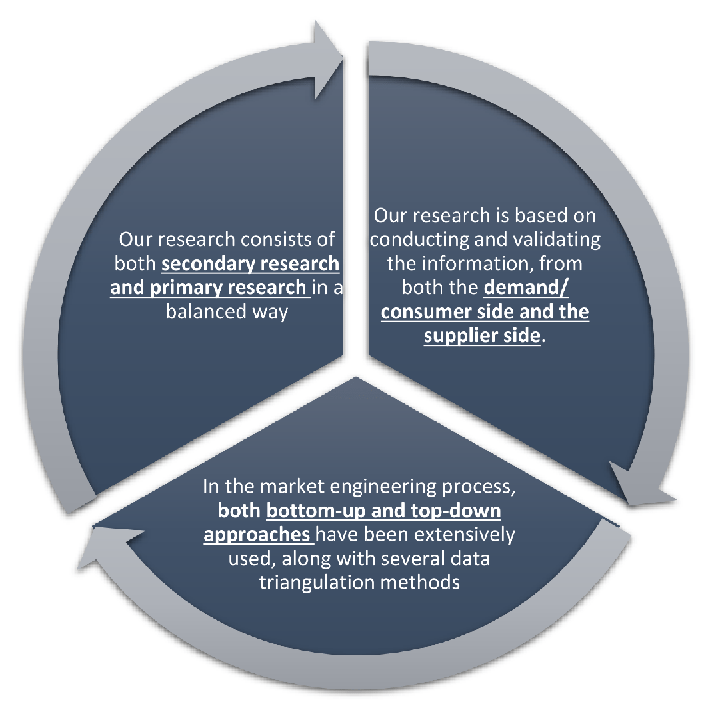
Our research design integrates both demand-side and supply-side analysis through a balanced combination of primary and secondary research methodologies. By utilizing both bottom-up and top-down approaches alongside rigorous data triangulation methods, we deliver robust market intelligence that supports strategic decision-making.
MarketGenics' comprehensive research design framework ensures the delivery of accurate, reliable, and actionable market intelligence. Through the integration of multiple research approaches, rigorous validation processes, and expert analysis, we provide our clients with the insights needed to make informed strategic decisions and capitalize on market opportunities.
MarketGenics leverages a dedicated industry panel of experts and a comprehensive suite of paid databases to effectively collect, consolidate, and analyze market intelligence.
Our approach has consistently proven to be reliable and effective in generating accurate market insights, identifying key industry trends, and uncovering emerging business opportunities.
Through both primary and secondary research, we capture and analyze critical company-level data such as manufacturing footprints, including technical centers, R&D facilities, sales offices, and headquarters.
Our expert panel further enhances our ability to estimate market size for specific brands based on validated field-level intelligence.
Our data mining techniques incorporate both parametric and non-parametric methods, allowing for structured data collection, sorting, processing, and cleaning.
Demand projections are derived from large-scale data sets analyzed through proprietary algorithms, culminating in robust and reliable market sizing.
Research Approach
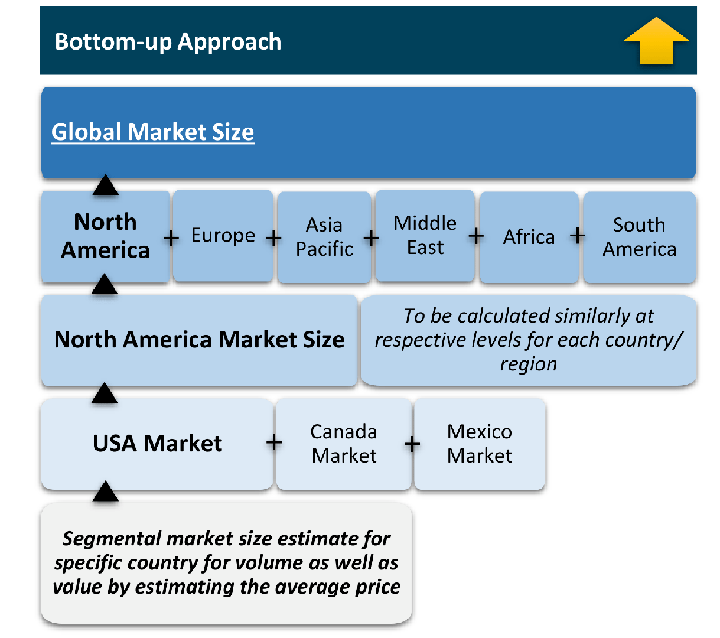
The bottom-up approach builds market estimates by starting with the smallest addressable market units and systematically aggregating them to create comprehensive market size projections.
This method begins with specific, granular data points and builds upward to create the complete market landscape.
Customer Analysis → Segmental Analysis → Geographical Analysis
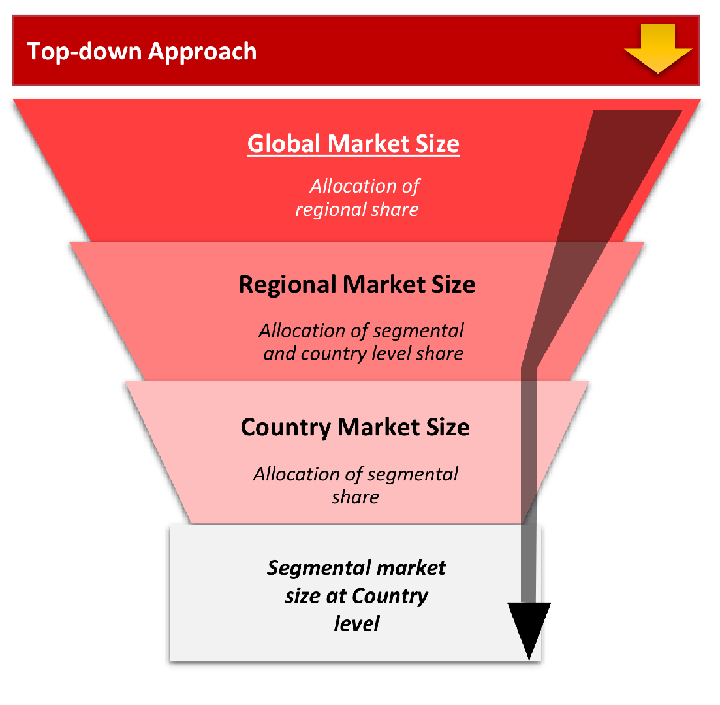
The top-down approach starts with the broadest possible market data and systematically narrows it down through a series of filters and assumptions to arrive at specific market segments or opportunities.
This method begins with the big picture and works downward to increasingly specific market slices.
TAM → SAM → SOM
Research Methods
Desk / Secondary Research
While analysing the market, we extensively study secondary sources, directories, and databases to identify and collect information useful for this technical, market-oriented, and commercial report. Secondary sources that we utilize are not only the public sources, but it is a combination of Open Source, Associations, Paid Databases, MG Repository & Knowledgebase, and others.
- Company websites, annual reports, financial reports, broker reports, and investor presentations
- National government documents, statistical databases and reports
- News articles, press releases and web-casts specific to the companies operating in the market, Magazines, reports, and others
- We gather information from commercial data sources for deriving company specific data such as segmental revenue, share for geography, product revenue, and others
- Internal and external proprietary databases (industry-specific), relevant patent, and regulatory databases
- Governing Bodies, Government Organizations
- Relevant Authorities, Country-specific Associations for Industries
We also employ the model mapping approach to estimate the product level market data through the players' product portfolio
Primary Research
Primary research/ interviews is vital in analyzing the market. Most of the cases involves paid primary interviews. Primary sources include primary interviews through e-mail interactions, telephonic interviews, surveys as well as face-to-face interviews with the different stakeholders across the value chain including several industry experts.
| Type of Respondents | Number of Primaries |
|---|---|
| Tier 2/3 Suppliers | ~20 |
| Tier 1 Suppliers | ~25 |
| End-users | ~25 |
| Industry Expert/ Panel/ Consultant | ~30 |
| Total | ~100 |
MG Knowledgebase
• Repository of industry blog, newsletter and case studies
• Online platform covering detailed market reports, and company profiles
Forecasting Factors and Models
Forecasting Factors
- Historical Trends – Past market patterns, cycles, and major events that shaped how markets behave over time. Understanding past trends helps predict future behavior.
- Industry Factors – Specific characteristics of the industry like structure, regulations, and innovation cycles that affect market dynamics.
- Macroeconomic Factors – Economic conditions like GDP growth, inflation, and employment rates that affect how much money people have to spend.
- Demographic Factors – Population characteristics like age, income, and location that determine who can buy your product.
- Technology Factors – How quickly people adopt new technology and how much technology infrastructure exists.
- Regulatory Factors – Government rules, laws, and policies that can help or restrict market growth.
- Competitive Factors – Analyzing competition structure such as degree of competition and bargaining power of buyers and suppliers.
Forecasting Models / Techniques
Multiple Regression Analysis
- Identify and quantify factors that drive market changes
- Statistical modeling to establish relationships between market drivers and outcomes
Time Series Analysis – Seasonal Patterns
- Understand regular cyclical patterns in market demand
- Advanced statistical techniques to separate trend, seasonal, and irregular components
Time Series Analysis – Trend Analysis
- Identify underlying market growth patterns and momentum
- Statistical analysis of historical data to project future trends
Expert Opinion – Expert Interviews
- Gather deep industry insights and contextual understanding
- In-depth interviews with key industry stakeholders
Multi-Scenario Development
- Prepare for uncertainty by modeling different possible futures
- Creating optimistic, pessimistic, and most likely scenarios
Time Series Analysis – Moving Averages
- Sophisticated forecasting for complex time series data
- Auto-regressive integrated moving average models with seasonal components
Econometric Models
- Apply economic theory to market forecasting
- Sophisticated economic models that account for market interactions
Expert Opinion – Delphi Method
- Harness collective wisdom of industry experts
- Structured, multi-round expert consultation process
Monte Carlo Simulation
- Quantify uncertainty and probability distributions
- Thousands of simulations with varying input parameters
Research Analysis
Our research framework is built upon the fundamental principle of validating market intelligence from both demand and supply perspectives. This dual-sided approach ensures comprehensive market understanding and reduces the risk of single-source bias.
Demand-Side Analysis: We understand end-user/application behavior, preferences, and market needs along with the penetration of the product for specific application.
Supply-Side Analysis: We estimate overall market revenue, analyze the segmental share along with industry capacity, competitive landscape, and market structure.
Validation & Evaluation
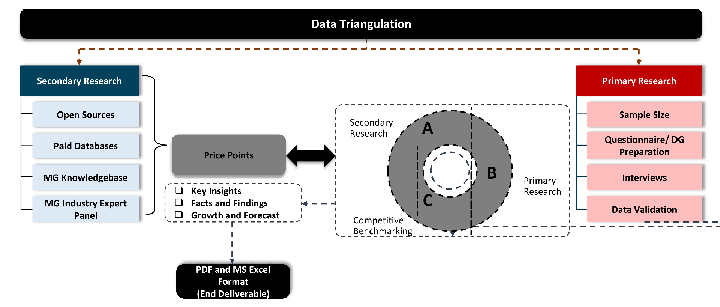
Data triangulation is a validation technique that uses multiple methods, sources, or perspectives to examine the same research question, thereby increasing the credibility and reliability of research findings. In market research, triangulation serves as a quality assurance mechanism that helps identify and minimize bias, validate assumptions, and ensure accuracy in market estimates.
- Data Source Triangulation – Using multiple data sources to examine the same phenomenon
- Methodological Triangulation – Using multiple research methods to study the same research question
- Investigator Triangulation – Using multiple researchers or analysts to examine the same data
- Theoretical Triangulation – Using multiple theoretical perspectives to interpret the same data
Custom Market Research Services
We will customise the research for you, in case the report listed above does not meet your requirements.
Get 10% Free Customisation