Silent Medical Alarms Market Size, Share & Trends Analysis Report by Product Type (Wired Silent Medical Alarms, Wireless Silent Medical Alarms, and Hybrid Silent Medical Alarms), Technology, Alert Mechanism, Rated Capacity, Communication Range, Integration Capability, Installation Type, End-use, and Geography (North America, Europe, Asia Pacific, Middle East, Africa, and South America) – Global Industry Data, Trends, and Forecasts, 2026–2035
Market Overview:
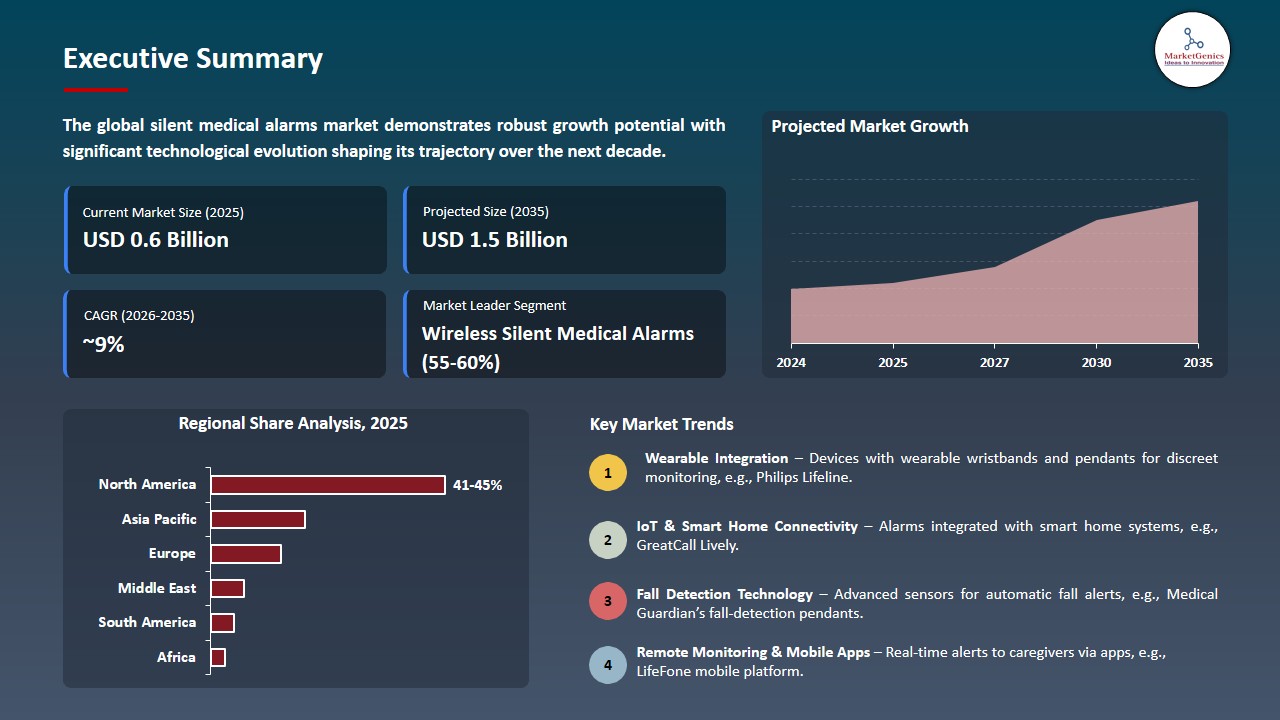
According to MarketGenics, the global silent medical alarms market is witnessing steady growth, with its market value estimated at USD 0.6 billion in 2025 and projected to reach USD 1.5 billion by 2035, registering a CAGR of 9.4% during the forecast period.
|
|
|
Segmental Data Insights |
|
|
Demand Trends |
|
|
Competitive Landscape |
|
|
Strategic Development |
|
|
Future Outlook & Opportunities |
|
Silent Medical Alarms Market Size, Share, and Growth
The market is driven by the rising need to reduce alarm fatigue in hospitals, improve patient safety, and enhance clinical workflow efficiency, coupled with increasing adoption of wireless and smart monitoring systems in ICUs and patient care units.
Michael Reitermann, interim CEO of Ascom, said, “Overcoming capacity bottlenecks in patient care while improving care outcomes can only be achieved through innovative digitization measures. Ascom is proud of the collaboration with Dräger and B. Braun, since we can significantly improve both staff shortages and patient care. The Silent ICU is a great example for bringing data to life to provide better outcomes for patients and caregivers.”
The silent medical alarms market growth, due to the increasing concerns about alarm fatigue and related patient-safety issues caused by large amounts of non-actionable alerts. As an example, in 2024, Philips launched its Philips Sounds update that lowered the amount of noise produced by patient-monitor alarms by up to 66 percent, thus, causing minimal acoustic noise and improving the clinician’s capacity to focus on clinically significant alerts. The trend is driving the implementation of sophisticated alarm-management solutions in healthcare institutions.
Additionally, the silent medical alarms market propelling, due to increased regulatory and accreditation demands on patient safety and noise suppression in the healthcare facility. As an example, in 2025, Honeywell introduced its integrated hospital life-safety and alarm system which is a unification of fire, security and clinical alarms and is designed to comply with the safety regulations and to minimize the cluttering of alarms. This trend is increasing market demand of compliant, centralized alarm-management solutions.
The global silent medical alarms market presents adjacent opportunities include smart nurse-call systems, wireless patient monitoring, wearable health devices, hospital automation platforms, and IoT-enabled clinical workflow solutions. These technologies are complementary to alarm management, because they improve patient monitoring, care coordination and operational efficiency. The combination with these fields is promoting the expanded usage and market growth.
Silent Medical Alarms Market Dynamics and Trends
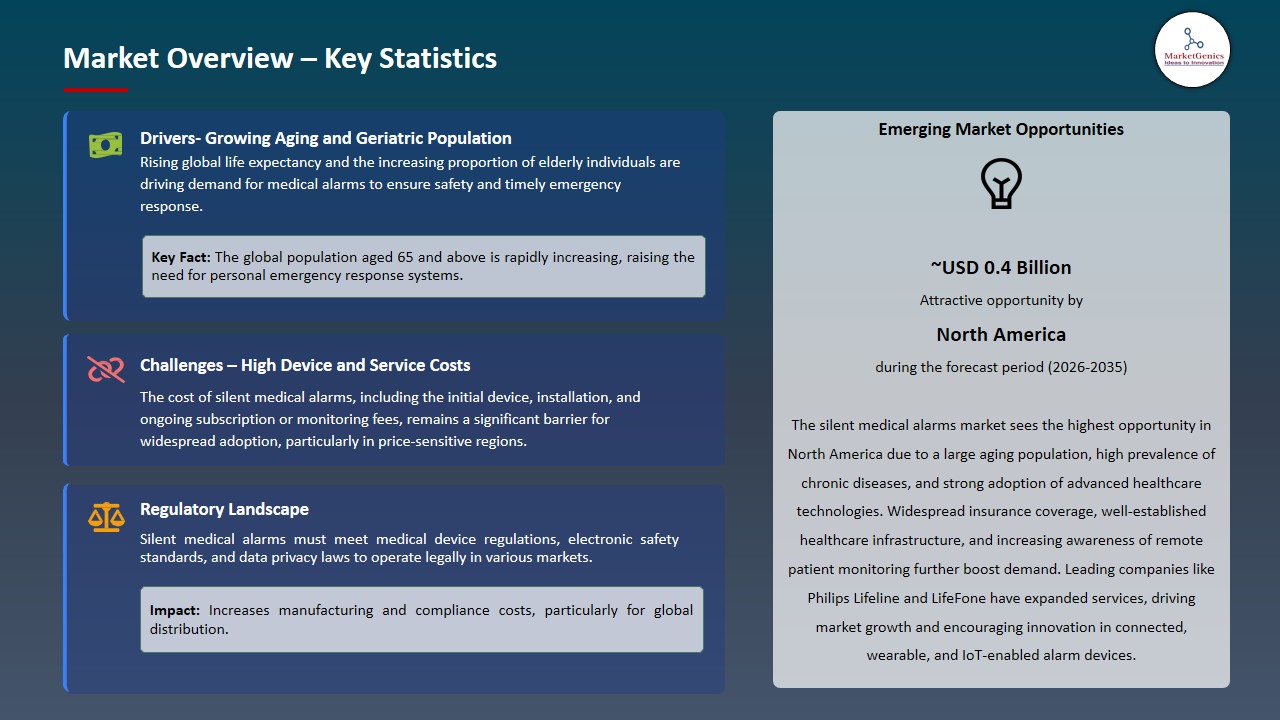
Driver: Rise in Demand for Smart, Interoperable Alarm‑Management Systems
-
The silent medical alarms market booming, because of growth in using integrated alarm-management platforms, which integrate the alerts issued by a variety of medical devices into a single platform. The conventional hospital setting tends to use several devices of various manufacturers, each producing its own alarms, creating redundant alerts and desensitizing staff.
- For instance, in 2025, Philips partnered with major device manufacturers such as Dräger, Hamilton medical and B. Braun Melsungen AG, to deploy the open Service-Oriented Device Connectivity (SDC) standard. SDC standard facilitates ease of communication with other vendors, dependable alarms, and noise mitigation, and minimization of non-actionable alerts, to improve patient care.
- Integrated alarm-management systems do not only improve the efficiency of workflow, but also strengthen patient safety because of alarm fatigue mitigation. The trend is leading to increased adoption of silent alarm solutions in healthcare institutions around the globe, which allows clinical personnel to concentrate on vital incidents and enhances overall quality care.
Restraint: Persistent Interoperability Challenges Among Heterogeneous Hospital Devices
-
The silent medical alarms market growth limited by the constant interoperability issues between heterogeneous hospital equipment. Most healthcare institutions use a combination of old medical and new medical devices, possibly of various manufacturers, that have proprietary protocols and communication standards.
- This disintegration makes it challenging to integrate alarm systems into a centralized environment to restrict the capability of routing alerts effectively through clinical processes. The middleware solutions or device upgrades needed to ensure interoperability can add to the costs incurred by hospitals, thus slowing the adoption of silent alarm solutions. In addition, compromising patient safety and decreasing the success of alarm-management efforts, inconsistent communication with devices also increases the risk of missed or delayed alerts.
- These obstacles, in turn, hinder the adoption of unified alarm systems, preventing the growth of the market despite the increasing demand on the solutions, which will reduce the alarm fatigue and accelerate the workflow and patient care.
Opportunity: Expansion of Wireless and Remote Patient Monitoring Beyond ICUs
-
The silent medical alarms market growing with the growing number of wireless and remote patient monitoring outside the traditional ICUs. For instance, in November 2024, a pilot study of GE HealthCare’s Portrait Mobile showed that post-surgery wearable wireless monitoring in the wards could give clinically actionable alarms and enable timely response.
- This system enables hospitals to monitor beyond the intensive care unit to general wards or step-down units, or even the post-discharge environment, through wearable devices to identify patient deterioration quickly and eliminate the use of high-acuity beds. These solutions are effective in enhancing the workflow efficiency of patients and staff by offering real-time actionable alerts that do not produce a lot of noise.
- Extending monitoring to ICUs will create a larger market to sell to with silent alarm systems, and it enables flexible and patient-centered care models and creates demand for interoperable and low-noise alarm-management solutions in healthcare settings.
Key Trend: Growing Emphasis on Data‑Driven Alarm Filtering and Prioritization Using Analytics
-
The silent medical alarms market growth affected by the increasing popularity of data-driven alarm filtering and prioritization with the help of sophisticated analytics. The healthcare institutions of the present era are implementing smart alarm-management solutions that use real-time information, prediction algorithms, and adjustable thresholds to differentiate serious scenarios and non-alarm situations.
- These systems can also block unnecessary or low-priority alarms by examining the vital signs and the historical and contextual data of the patient, which will minimize noise and decrease caregiver alarm fatigue. For instance, in 2024, Drägerwerk AG’s Infinity Acute Care System employs “Alarm History Analytics” to monitor alarm patterns and enable threshold adjustments, helping hospitals reduce alarm overload and focus on critical alerts.
- The clinical efficiency, alarm fatigue reduction, and increased demand in the silent medical alarm solution are increasing in healthcare facilities due to the adoption of data-driven alarm analytics.
Silent-Medical-Alarms-Market Analysis and Segmental Data

Wireless Silent Medical Alarms Dominate Global Silent Medical Alarms Market
-
The wireless silent medical alarms segment dominates the global silent medical alarms market, because of their flexibility, mobility, and integration capabilities with centralized monitoring systems. Wireless solutions enable the smooth exchange of information between bedside solutions, wearable and mobile devices unlike the traditional wired alarms.
- The systems allow real-time delivery of alerts without making patients tied to fixed devices that contaminate the atmosphere at the hospital, enhancing responsiveness and efficiency of the work of clinical staff.
- For instance, in 2024, Siemens Healthineers has assisted hospitals to install large-scale wireless IoT systems featuring real-time location sensors and networked monitoring to improve tracking of patients and alerts given to clinical staff in non-ICU wards. The system allows clinicians to get actionable alerts and also reduces non-essential alarms thus decreasing alarm fatigue.
- Wireless silent alarm solutions are increasingly becoming the desired option, by removing physical barriers and allowing more patient-focused monitoring, stimulating rapid increase and further implementation in hospitals and medical institutions around globally.
North America Leads Global Silent Medical Alarms Market Demand
-
North America leads the global silent medical alarms market, due to high rates of uptake of sophisticated healthcare equipment, rigorous regulatory guidelines, and emphasis over patient safety. To minimize the noise and alarm fatigue during clinical practice, hospitals in the region are migrating to an integrated alarm-management system, wireless monitoring, and data-driven alarm analytics.
- The strong market growth is further strengthened by the presence of major manufacturers like Philips, GE HealthCare, and Honeywell and strong R&D investments. These firms also offer the most advanced alarm systems that can be easily incorporated into the daily workflow of any hospital to improve the efficiency of its operations and patient care.
- In March 2025, Hill-Rom introduced its Nurse Communication and Bedside Alarm Integration system in hospitals throughout North America. This system wirelessly directs all alerts from patient beds and devices to mobile dashboards. In addition, government initiatives aimed at patient safety and the digitalization of healthcare promote the adoption of silent alarm systems in both critical care and general wards.
- The healthcare infrastructure in North America is very advanced, and its technological readiness positions the region as the largest and most developed for silent medical alarms adoption.
Silent-Medical-Alarms-Market Ecosystem
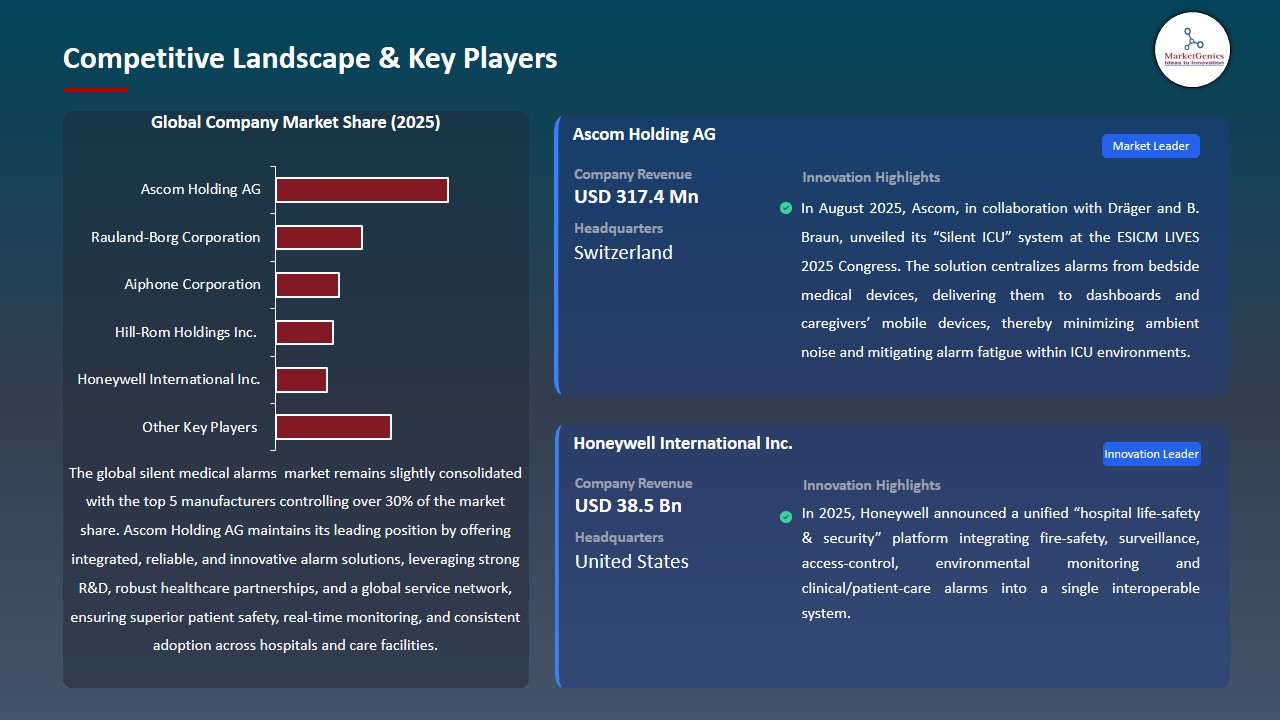
The global silent medical alarms market is moderately consolidated, with high concentration among key players such as Ascom Holding AG, Rauland-Borg Corporation, Aiphone Corporation, Hill-Rom Holdings Inc., and Honeywell International Inc., who dominate through large product portfolio, strategic alliance, constant technological development, and well-organized distribution networks that allow them to provide integrated, reliable and scalable alarm-management solutions to hospitals and healthcare facilities worldwide.
Their leadership is supported by a considerable investment in R&D, acquisitions, and partnerships with medical device manufacturers enabling both easy interoperability and efficient workflow of clinical personnel.
The market leaders can sustain a high brand awareness, comply with regulatory standards, and secure a large portion of a potential rise in demand in the silent, data-driven, and wireless alarm systems in the critical care and general hospital environments.
Recent Development and Strategic Overview:
-
In July 2025, Philips established partnerships with leading critical-care device manufacturers, including Dräger and B. Braun Melsungen AG, to advance adoption of the open Service-Oriented Device Connectivity (SDC) standard. This initiative enables consolidated, cross-vendor alarm notifications within a unified clinical workflow, supporting the development of fully integrated “silent hospital” environments.
- In February 2024, Philips introduced its Philips Sounds alarm package on the IntelliVue patient monitors, including redesigned alarm sounds and alarm timing that, in partnership with acoustic experts and clinicians, were designed to lower the levels of noise and provide a more therapeutic care setting that was more of a quiet environment.
Report Scope
|
Detail |
|
|
Market Size in 2025 |
USD 0.6 Bn |
|
Market Forecast Value in 2035 |
USD 1.5 Bn |
|
Growth Rate (CAGR) |
9.4% |
|
Forecast Period |
2026 – 2035 |
|
Historical Data Available for |
2021 – 2024 |
|
Market Size Units |
US$ Billion for Value Thousand Units for Volume |
|
Report Format |
Electronic (PDF) + Excel |
|
North America |
Europe |
Asia Pacific |
Middle East |
Africa |
South America |
|
|
|
|
|
|
|
Companies Covered |
|||||
|
|
|
|
|
|
Silent-Medical-Alarms-Market Segmentation and Highlights
|
Segment |
Sub-segment |
|
Silent Medical Alarms Market, By Product Type |
|
|
Silent Medical Alarms Market, By Technology |
|
|
Silent Medical Alarms Market, By Alert Mechanism |
|
|
Silent Medical Alarms Market, By Rated Capacity |
|
|
Silent Medical Alarms Market, By Communication Range
|
|
|
Silent Medical Alarms Market, By Integration Capability
|
|
|
Silent Medical Alarms Market, By Installation Type |
|
|
Silent Medical Alarms Market, By End-use |
|
Frequently Asked Questions
Table of Contents
- 1. Research Methodology and Assumptions
- 1.1. Definitions
- 1.2. Research Design and Approach
- 1.3. Data Collection Methods
- 1.4. Base Estimates and Calculations
- 1.5. Forecasting Models
- 1.5.1. Key Forecast Factors & Impact Analysis
- 1.6. Secondary Research
- 1.6.1. Open Sources
- 1.6.2. Paid Databases
- 1.6.3. Associations
- 1.7. Primary Research
- 1.7.1. Primary Sources
- 1.7.2. Primary Interviews with Stakeholders across Ecosystem
- 2. Executive Summary
- 2.1. Global Silent Medical Alarms Market Outlook
- 2.1.1. Silent Medical Alarms Market Size (Volume - Thousand Units and Value - US$ Bn), and Forecasts, 2021-2035
- 2.1.2. Compounded Annual Growth Rate Analysis
- 2.1.3. Growth Opportunity Analysis
- 2.1.4. Segmental Share Analysis
- 2.1.5. Geographical Share Analysis
- 2.2. Market Analysis and Facts
- 2.3. Supply-Demand Analysis
- 2.4. Competitive Benchmarking
- 2.5. Go-to- Market Strategy
- 2.5.1. Customer/ End-use Industry Assessment
- 2.5.2. Growth Opportunity Data, 2026-2035
- 2.5.2.1. Regional Data
- 2.5.2.2. Country Data
- 2.5.2.3. Segmental Data
- 2.5.3. Identification of Potential Market Spaces
- 2.5.4. GAP Analysis
- 2.5.5. Potential Attractive Price Points
- 2.5.6. Prevailing Market Risks & Challenges
- 2.5.7. Preferred Sales & Marketing Strategies
- 2.5.8. Key Recommendations and Analysis
- 2.5.9. A Way Forward
- 2.1. Global Silent Medical Alarms Market Outlook
- 3. Industry Data and Premium Insights
- 3.1. Global Healthcare & Pharmaceutical Industry Overview, 2025
- 3.1.1. Healthcare & Pharmaceutical Industry Ecosystem Analysis
- 3.1.2. Key Trends for Healthcare & Pharmaceutical Industry
- 3.1.3. Regional Distribution for Healthcare & Pharmaceutical Industry
- 3.2. Supplier Customer Data
- 3.3. Technology Roadmap and Developments
- 3.4. Trade Analysis
- 3.4.1. Import & Export Analysis, 2025
- 3.4.2. Top Importing Countries
- 3.4.3. Top Exporting Countries
- 3.5. Trump Tariff Impact Analysis
- 3.5.1. Manufacturer
- 3.5.1.1. Based on the component & Raw material
- 3.5.2. Supply Chain
- 3.5.3. End Consumer
- 3.5.1. Manufacturer
- 3.6. Raw Material Analysis
- 3.1. Global Healthcare & Pharmaceutical Industry Overview, 2025
- 4. Market Overview
- 4.1. Market Dynamics
- 4.1.1. Drivers
- 4.1.1.1. Growing aging/geriatric population globally
- 4.1.1.2. Increase in prevalence of chronic diseases requiring emergency monitoring
- 4.1.1.3. Technological advancements such as wearable alarms and IoT integration
- 4.1.2. Restraints
- 4.1.2.1. High cost of devices and subscription/maintenance fees
- 4.1.2.2. Privacy and data security concerns with connected alarm systems
- 4.1.1. Drivers
- 4.2. Key Trend Analysis
- 4.3. Regulatory Framework
- 4.3.1. Key Regulations, Norms, and Subsidies, by Key Countries
- 4.3.2. Tariffs and Standards
- 4.3.3. Impact Analysis of Regulations on the Market
- 4.4. Value Chain Analysis
- 4.4.1. Component Suppliers
- 4.4.2. Silent Medical Alarms Manufacturers
- 4.4.3. System Integrators
- 4.4.4. Distribution & Logistics
- 4.4.5. End Users
- 4.5. Porter’s Five Forces Analysis
- 4.6. PESTEL Analysis
- 4.7. Global Silent Medical Alarms Market Demand
- 4.7.1. Historical Market Size – Volume (Thousand Units) and Value (US$ Bn), 2020-2024
- 4.7.2. Current and Future Market Size – Volume (Thousand Units) and Value (US$ Bn), 2026–2035
- 4.7.2.1. Y-o-Y Growth Trends
- 4.7.2.2. Absolute $ Opportunity Assessment
- 4.1. Market Dynamics
- 5. Competition Landscape
- 5.1. Competition structure
- 5.1.1. Fragmented v/s consolidated
- 5.2. Company Share Analysis, 2025
- 5.2.1. Global Company Market Share
- 5.2.2. By Region
- 5.2.2.1. North America
- 5.2.2.2. Europe
- 5.2.2.3. Asia Pacific
- 5.2.2.4. Middle East
- 5.2.2.5. Africa
- 5.2.2.6. South America
- 5.3. Product Comparison Matrix
- 5.3.1. Specifications
- 5.3.2. Market Positioning
- 5.3.3. Pricing
- 5.1. Competition structure
- 6. Global Silent Medical Alarms Market Analysis, by Product Type
- 6.1. Key Segment Analysis
- 6.2. Silent Medical Alarms Market Size (Volume - Thousand Units and Value - US$ Bn), Analysis, and Forecasts, by Product Type, 2021-2035
- 6.2.1. Wired Silent Medical Alarms
- 6.2.2. Wireless Silent Medical Alarms
- 6.2.3. Hybrid Silent Medical Alarms
- 7. Global Silent Medical Alarms Market Analysis, by Technology
- 7.1. Key Segment Analysis
- 7.2. Silent Medical Alarms Market Size (Volume - Thousand Units and Value - US$ Bn), Analysis, and Forecasts, by Technology, 2021-2035
- 7.2.1. Radio Frequency (RF) Based
- 7.2.2. Infrared (IR) Based
- 7.2.3. Wi-Fi Enabled
- 7.2.4. Bluetooth Enabled
- 7.2.5. GSM/GPRS Based
- 7.2.6. IoT-Enabled Smart Alarms
- 7.2.7. Zigbee Protocol Based
- 7.2.8. Others
- 8. Global Silent Medical Alarms Market Analysis, by Alert Mechanism
- 8.1. Key Segment Analysis
- 8.2. Silent Medical Alarms Market Size (Volume - Thousand Units and Value - US$ Bn), Analysis, and Forecasts, by Alert Mechanism, 2021-2035
- 8.2.1. Visual Alert Systems
- 8.2.1.1. LED Indicators
- 8.2.1.2. Display Panel Alerts
- 8.2.1.3. Others
- 8.2.2. Vibration-Based Alerts
- 8.2.3. Pager-Based Systems
- 8.2.4. Mobile/Smartphone Notifications
- 8.2.5. Computer/Workstation Alerts
- 8.2.6. Wearable Device Alerts
- 8.2.1. Visual Alert Systems
- 9. Global Silent Medical Alarms Market Analysis, by Rated Capacity
- 9.1. Key Segment Analysis
- 9.2. Silent Medical Alarms Market Size (Volume - Thousand Units and Value - US$ Bn), Analysis, and Forecasts, by Rated Capacity, 2021-2035
- 9.2.1. Single Bed Monitoring
- 9.2.2. Multi-Bed Monitoring (2-10 Beds)
- 9.2.3. Ward Level Monitoring (10-30 Beds)
- 9.2.4. Department Level Monitoring (30-100 Beds)
- 9.2.5. Hospital-Wide Systems (100+ Beds)
- 10. Global Silent Medical Alarms Market Analysis, by Communication Range
- 10.1. Key Segment Analysis
- 10.2. Silent Medical Alarms Market Size (Volume - Thousand Units and Value - US$ Bn), Analysis, and Forecasts, by Communication Range, 2021-2035
- 10.2.1. Up to 50 meters
- 10.2.2. 50-200 meters
- 10.2.3. 200-500 meters
- 10.2.4. Above 500 meters
- 11. Global Silent Medical Alarms Market Analysis, by Integration Capability
- 11.1. Key Segment Analysis
- 11.2. Silent Medical Alarms Market Size (Volume - Thousand Units and Value - US$ Bn), Analysis, and Forecasts, by Integration Capability, 2021-2035
- 11.2.1. Standalone Systems
- 11.2.2. Nurse Call System Integrated
- 11.2.3. EMR/EHR Integrated
- 11.2.4. Building Management System (BMS) Integrated
- 11.2.5. Hospital Information System (HIS) Integrated
- 11.2.6. Multi-System Integration
- 12. Global Silent Medical Alarms Market Analysis, by Installation Type
- 12.1. Key Segment Analysis
- 12.2. Silent Medical Alarms Market Size (Volume - Thousand Units and Value - US$ Bn), Analysis, and Forecasts, by Installation Type, 2021-2035
- 12.2.1. Wall-Mounted
- 12.2.2. Ceiling-Mounted
- 12.2.3. Desktop/Portable
- 12.2.4. Wearable
- 12.2.5. Bedside Mounted
- 12.2.6. Central Station Based
- 13. Global Silent Medical Alarms Market Analysis and Forecasts, by End-use
- 13.1. Key Findings
- 13.2. Silent Medical Alarms Market Size (Volume - Thousand Units and Value - US$ Bn), Analysis, and Forecasts, by End-use, 2021-2035
- 13.2.1. Hospitals
- 13.2.1.1. Intensive Care Units (ICU)
- 13.2.1.2. Emergency Departments
- 13.2.1.3. Operating Rooms
- 13.2.1.4. Recovery Rooms
- 13.2.1.5. General Wards
- 13.2.1.6. Pediatric Units
- 13.2.1.7. Others
- 13.2.2. Clinics
- 13.2.2.1. Outpatient Departments
- 13.2.2.2. Diagnostic Centers
- 13.2.2.3. Specialty Clinics
- 13.2.2.4. Surgical Centers
- 13.2.2.5. Rehabilitation Centers
- 13.2.2.6. Others
- 13.2.3. Nursing Homes
- 13.2.3.1. Assisted Living Facilities
- 13.2.3.2. Long-Term Care Facilities
- 13.2.3.3. Memory Care Units
- 13.2.3.4. Skilled Nursing Facilities
- 13.2.3.5. Others
- 13.2.4. Home Healthcare
- 13.2.4.1. Elderly Care at Home
- 13.2.4.2. Post-Operative Home Care
- 13.2.4.3. Chronic Disease Management
- 13.2.4.4. Palliative Care at Home
- 13.2.4.5. Others
- 13.2.5. Ambulatory Surgical Centers
- 13.2.5.1. Same-Day Surgery Units
- 13.2.5.2. Pre-Operative Areas
- 13.2.5.3. Post-Anesthesia Care Units
- 13.2.5.4. Others
- 13.2.6. Mental Health Facilities
- 13.2.7. Rehabilitation Centers
- 13.2.8. Research & Academic Institutions
- 13.2.9. Other End-use
- 13.2.1. Hospitals
- 14. Global Silent Medical Alarms Market Analysis and Forecasts, by Region
- 14.1. Key Findings
- 14.2. Silent Medical Alarms Market Size (Volume - Thousand Units and Value - US$ Bn), Analysis, and Forecasts, by Region, 2021-2035
- 14.2.1. North America
- 14.2.2. Europe
- 14.2.3. Asia Pacific
- 14.2.4. Middle East
- 14.2.5. Africa
- 14.2.6. South America
- 15. North America Silent Medical Alarms Market Analysis
- 15.1. Key Segment Analysis
- 15.2. Regional Snapshot
- 15.3. North America Silent Medical Alarms Market Size (Volume - Thousand Units and Value - US$ Bn), Analysis, and Forecasts, 2021-2035
- 15.3.1. Product Type
- 15.3.2. Technology
- 15.3.3. Alert Mechanism
- 15.3.4. Rated Capacity
- 15.3.5. Communication Range
- 15.3.6. Integration Capability
- 15.3.7. Installation Type
- 15.3.8. End-use
- 15.3.9. Country
- 15.3.9.1. USA
- 15.3.9.2. Canada
- 15.3.9.3. Mexico
- 15.4. USA Silent Medical Alarms Market
- 15.4.1. Country Segmental Analysis
- 15.4.2. Product Type
- 15.4.3. Technology
- 15.4.4. Alert Mechanism
- 15.4.5. Rated Capacity
- 15.4.6. Communication Range
- 15.4.7. Integration Capability
- 15.4.8. Installation Type
- 15.4.9. End-use
- 15.5. Canada Silent Medical Alarms Market
- 15.5.1. Country Segmental Analysis
- 15.5.2. Product Type
- 15.5.3. Technology
- 15.5.4. Alert Mechanism
- 15.5.5. Rated Capacity
- 15.5.6. Communication Range
- 15.5.7. Integration Capability
- 15.5.8. Installation Type
- 15.5.9. End-use
- 15.6. Mexico Silent Medical Alarms Market
- 15.6.1. Country Segmental Analysis
- 15.6.2. Product Type
- 15.6.3. Technology
- 15.6.4. Alert Mechanism
- 15.6.5. Rated Capacity
- 15.6.6. Communication Range
- 15.6.7. Integration Capability
- 15.6.8. Installation Type
- 15.6.9. End-use
- 16. Europe Silent Medical Alarms Market Analysis
- 16.1. Key Segment Analysis
- 16.2. Regional Snapshot
- 16.3. Europe Silent Medical Alarms Market Size (Volume - Thousand Units and Value - US$ Bn), Analysis, and Forecasts, 2021-2035
- 16.3.1. Product Type
- 16.3.2. Technology
- 16.3.3. Alert Mechanism
- 16.3.4. Rated Capacity
- 16.3.5. Communication Range
- 16.3.6. Integration Capability
- 16.3.7. Installation Type
- 16.3.8. End-use
- 16.3.9. Country
- 16.3.9.1. Germany
- 16.3.9.2. United Kingdom
- 16.3.9.3. France
- 16.3.9.4. Italy
- 16.3.9.5. Spain
- 16.3.9.6. Netherlands
- 16.3.9.7. Nordic Countries
- 16.3.9.8. Poland
- 16.3.9.9. Russia & CIS
- 16.3.9.10. Rest of Europe
- 16.4. Germany Silent Medical Alarms Market
- 16.4.1. Country Segmental Analysis
- 16.4.2. Product Type
- 16.4.3. Technology
- 16.4.4. Alert Mechanism
- 16.4.5. Rated Capacity
- 16.4.6. Communication Range
- 16.4.7. Integration Capability
- 16.4.8. Installation Type
- 16.4.9. End-use
- 16.5. United Kingdom Silent Medical Alarms Market
- 16.5.1. Country Segmental Analysis
- 16.5.2. Product Type
- 16.5.3. Technology
- 16.5.4. Alert Mechanism
- 16.5.5. Rated Capacity
- 16.5.6. Communication Range
- 16.5.7. Integration Capability
- 16.5.8. Installation Type
- 16.5.9. End-use
- 16.6. France Silent Medical Alarms Market
- 16.6.1. Country Segmental Analysis
- 16.6.2. Product Type
- 16.6.3. Technology
- 16.6.4. Alert Mechanism
- 16.6.5. Rated Capacity
- 16.6.6. Communication Range
- 16.6.7. Integration Capability
- 16.6.8. Installation Type
- 16.6.9. End-use
- 16.7. Italy Silent Medical Alarms Market
- 16.7.1. Country Segmental Analysis
- 16.7.2. Product Type
- 16.7.3. Technology
- 16.7.4. Alert Mechanism
- 16.7.5. Rated Capacity
- 16.7.6. Communication Range
- 16.7.7. Integration Capability
- 16.7.8. Installation Type
- 16.7.9. End-use
- 16.8. Spain Silent Medical Alarms Market
- 16.8.1. Country Segmental Analysis
- 16.8.2. Product Type
- 16.8.3. Technology
- 16.8.4. Alert Mechanism
- 16.8.5. Rated Capacity
- 16.8.6. Communication Range
- 16.8.7. Integration Capability
- 16.8.8. Installation Type
- 16.8.9. End-use
- 16.9. Netherlands Silent Medical Alarms Market
- 16.9.1. Country Segmental Analysis
- 16.9.2. Product Type
- 16.9.3. Technology
- 16.9.4. Alert Mechanism
- 16.9.5. Rated Capacity
- 16.9.6. Communication Range
- 16.9.7. Integration Capability
- 16.9.8. Installation Type
- 16.9.9. End-use
- 16.10. Nordic Countries Silent Medical Alarms Market
- 16.10.1. Country Segmental Analysis
- 16.10.2. Product Type
- 16.10.3. Technology
- 16.10.4. Alert Mechanism
- 16.10.5. Rated Capacity
- 16.10.6. Communication Range
- 16.10.7. Integration Capability
- 16.10.8. Installation Type
- 16.10.9. End-use
- 16.11. Poland Silent Medical Alarms Market
- 16.11.1. Country Segmental Analysis
- 16.11.2. Product Type
- 16.11.3. Technology
- 16.11.4. Alert Mechanism
- 16.11.5. Rated Capacity
- 16.11.6. Communication Range
- 16.11.7. Integration Capability
- 16.11.8. Installation Type
- 16.11.9. End-use
- 16.12. Russia & CIS Silent Medical Alarms Market
- 16.12.1. Country Segmental Analysis
- 16.12.2. Product Type
- 16.12.3. Technology
- 16.12.4. Alert Mechanism
- 16.12.5. Rated Capacity
- 16.12.6. Communication Range
- 16.12.7. Integration Capability
- 16.12.8. Installation Type
- 16.12.9. End-use
- 16.13. Rest of Europe Silent Medical Alarms Market
- 16.13.1. Country Segmental Analysis
- 16.13.2. Product Type
- 16.13.3. Technology
- 16.13.4. Alert Mechanism
- 16.13.5. Rated Capacity
- 16.13.6. Communication Range
- 16.13.7. Integration Capability
- 16.13.8. Installation Type
- 16.13.9. End-use
- 17. Asia Pacific Silent Medical Alarms Market Analysis
- 17.1. Key Segment Analysis
- 17.2. Regional Snapshot
- 17.3. Asia Pacific Silent Medical Alarms Market Size (Volume - Thousand Units and Value - US$ Bn), Analysis, and Forecasts, 2021-2035
- 17.3.1. Product Type
- 17.3.2. Technology
- 17.3.3. Alert Mechanism
- 17.3.4. Rated Capacity
- 17.3.5. Communication Range
- 17.3.6. Integration Capability
- 17.3.7. Installation Type
- 17.3.8. End-use
- 17.3.9. Country
- 17.3.9.1. China
- 17.3.9.2. India
- 17.3.9.3. Japan
- 17.3.9.4. South Korea
- 17.3.9.5. Australia and New Zealand
- 17.3.9.6. Indonesia
- 17.3.9.7. Malaysia
- 17.3.9.8. Thailand
- 17.3.9.9. Vietnam
- 17.3.9.10. Rest of Asia Pacific
- 17.4. China Silent Medical Alarms Market
- 17.4.1. Country Segmental Analysis
- 17.4.2. Product Type
- 17.4.3. Technology
- 17.4.4. Alert Mechanism
- 17.4.5. Rated Capacity
- 17.4.6. Communication Range
- 17.4.7. Integration Capability
- 17.4.8. Installation Type
- 17.4.9. End-use
- 17.5. India Silent Medical Alarms Market
- 17.5.1. Country Segmental Analysis
- 17.5.2. Product Type
- 17.5.3. Technology
- 17.5.4. Alert Mechanism
- 17.5.5. Rated Capacity
- 17.5.6. Communication Range
- 17.5.7. Integration Capability
- 17.5.8. Installation Type
- 17.5.9. End-use
- 17.6. Japan Silent Medical Alarms Market
- 17.6.1. Country Segmental Analysis
- 17.6.2. Product Type
- 17.6.3. Technology
- 17.6.4. Alert Mechanism
- 17.6.5. Rated Capacity
- 17.6.6. Communication Range
- 17.6.7. Integration Capability
- 17.6.8. Installation Type
- 17.6.9. End-use
- 17.7. South Korea Silent Medical Alarms Market
- 17.7.1. Country Segmental Analysis
- 17.7.2. Product Type
- 17.7.3. Technology
- 17.7.4. Alert Mechanism
- 17.7.5. Rated Capacity
- 17.7.6. Communication Range
- 17.7.7. Integration Capability
- 17.7.8. Installation Type
- 17.7.9. End-use
- 17.8. Australia and New Zealand Silent Medical Alarms Market
- 17.8.1. Country Segmental Analysis
- 17.8.2. Product Type
- 17.8.3. Technology
- 17.8.4. Alert Mechanism
- 17.8.5. Rated Capacity
- 17.8.6. Communication Range
- 17.8.7. Integration Capability
- 17.8.8. Installation Type
- 17.8.9. End-use
- 17.9. Indonesia Silent Medical Alarms Market
- 17.9.1. Country Segmental Analysis
- 17.9.2. Product Type
- 17.9.3. Technology
- 17.9.4. Alert Mechanism
- 17.9.5. Rated Capacity
- 17.9.6. Communication Range
- 17.9.7. Integration Capability
- 17.9.8. Installation Type
- 17.9.9. End-use
- 17.10. Malaysia Silent Medical Alarms Market
- 17.10.1. Country Segmental Analysis
- 17.10.2. Product Type
- 17.10.3. Technology
- 17.10.4. Alert Mechanism
- 17.10.5. Rated Capacity
- 17.10.6. Communication Range
- 17.10.7. Integration Capability
- 17.10.8. Installation Type
- 17.10.9. End-use
- 17.11. Thailand Silent Medical Alarms Market
- 17.11.1. Country Segmental Analysis
- 17.11.2. Product Type
- 17.11.3. Technology
- 17.11.4. Alert Mechanism
- 17.11.5. Rated Capacity
- 17.11.6. Communication Range
- 17.11.7. Integration Capability
- 17.11.8. Installation Type
- 17.11.9. End-use
- 17.12. Vietnam Silent Medical Alarms Market
- 17.12.1. Country Segmental Analysis
- 17.12.2. Product Type
- 17.12.3. Technology
- 17.12.4. Alert Mechanism
- 17.12.5. Rated Capacity
- 17.12.6. Communication Range
- 17.12.7. Integration Capability
- 17.12.8. Installation Type
- 17.12.9. End-use
- 17.13. Rest of Asia Pacific Silent Medical Alarms Market
- 17.13.1. Country Segmental Analysis
- 17.13.2. Product Type
- 17.13.3. Technology
- 17.13.4. Alert Mechanism
- 17.13.5. Rated Capacity
- 17.13.6. Communication Range
- 17.13.7. Integration Capability
- 17.13.8. Installation Type
- 17.13.9. End-use
- 18. Middle East Silent Medical Alarms Market Analysis
- 18.1. Key Segment Analysis
- 18.2. Regional Snapshot
- 18.3. Middle East Silent Medical Alarms Market Size (Volume - Thousand Units and Value - US$ Bn), Analysis, and Forecasts, 2021-2035
- 18.3.1. Product Type
- 18.3.2. Technology
- 18.3.3. Alert Mechanism
- 18.3.4. Rated Capacity
- 18.3.5. Communication Range
- 18.3.6. Integration Capability
- 18.3.7. Installation Type
- 18.3.8. End-use
- 18.3.9. Country
- 18.3.9.1. Turkey
- 18.3.9.2. UAE
- 18.3.9.3. Saudi Arabia
- 18.3.9.4. Israel
- 18.3.9.5. Rest of Middle East
- 18.4. Turkey Silent Medical Alarms Market
- 18.4.1. Country Segmental Analysis
- 18.4.2. Product Type
- 18.4.3. Technology
- 18.4.4. Alert Mechanism
- 18.4.5. Rated Capacity
- 18.4.6. Communication Range
- 18.4.7. Integration Capability
- 18.4.8. Installation Type
- 18.4.9. End-use
- 18.5. UAE Silent Medical Alarms Market
- 18.5.1. Country Segmental Analysis
- 18.5.2. Product Type
- 18.5.3. Technology
- 18.5.4. Alert Mechanism
- 18.5.5. Rated Capacity
- 18.5.6. Communication Range
- 18.5.7. Integration Capability
- 18.5.8. Installation Type
- 18.5.9. End-use
- 18.6. Saudi Arabia Silent Medical Alarms Market
- 18.6.1. Country Segmental Analysis
- 18.6.2. Product Type
- 18.6.3. Technology
- 18.6.4. Alert Mechanism
- 18.6.5. Rated Capacity
- 18.6.6. Communication Range
- 18.6.7. Integration Capability
- 18.6.8. Installation Type
- 18.6.9. End-use
- 18.7. Israel Silent Medical Alarms Market
- 18.7.1. Country Segmental Analysis
- 18.7.2. Product Type
- 18.7.3. Technology
- 18.7.4. Alert Mechanism
- 18.7.5. Rated Capacity
- 18.7.6. Communication Range
- 18.7.7. Integration Capability
- 18.7.8. Installation Type
- 18.7.9. End-use
- 18.8. Rest of Middle East Silent Medical Alarms Market
- 18.8.1. Country Segmental Analysis
- 18.8.2. Product Type
- 18.8.3. Technology
- 18.8.4. Alert Mechanism
- 18.8.5. Rated Capacity
- 18.8.6. Communication Range
- 18.8.7. Integration Capability
- 18.8.8. Installation Type
- 18.8.9. End-use
- 19. Africa Silent Medical Alarms Market Analysis
- 19.1. Key Segment Analysis
- 19.2. Regional Snapshot
- 19.3. Africa Silent Medical Alarms Market Size (Volume - Thousand Units and Value - US$ Bn), Analysis, and Forecasts, 2021-2035
- 19.3.1. Product Type
- 19.3.2. Technology
- 19.3.3. Alert Mechanism
- 19.3.4. Rated Capacity
- 19.3.5. Communication Range
- 19.3.6. Integration Capability
- 19.3.7. Installation Type
- 19.3.8. End-use
- 19.3.9. Country
- 19.3.9.1. South Africa
- 19.3.9.2. Egypt
- 19.3.9.3. Nigeria
- 19.3.9.4. Algeria
- 19.3.9.5. Rest of Africa
- 19.4. South Africa Silent Medical Alarms Market
- 19.4.1. Country Segmental Analysis
- 19.4.2. Product Type
- 19.4.3. Technology
- 19.4.4. Alert Mechanism
- 19.4.5. Rated Capacity
- 19.4.6. Communication Range
- 19.4.7. Integration Capability
- 19.4.8. Installation Type
- 19.4.9. End-use
- 19.5. Egypt Silent Medical Alarms Market
- 19.5.1. Country Segmental Analysis
- 19.5.2. Product Type
- 19.5.3. Technology
- 19.5.4. Alert Mechanism
- 19.5.5. Rated Capacity
- 19.5.6. Communication Range
- 19.5.7. Integration Capability
- 19.5.8. Installation Type
- 19.5.9. End-use
- 19.6. Nigeria Silent Medical Alarms Market
- 19.6.1. Country Segmental Analysis
- 19.6.2. Product Type
- 19.6.3. Technology
- 19.6.4. Alert Mechanism
- 19.6.5. Rated Capacity
- 19.6.6. Communication Range
- 19.6.7. Integration Capability
- 19.6.8. Installation Type
- 19.6.9. End-use
- 19.7. Algeria Silent Medical Alarms Market
- 19.7.1. Country Segmental Analysis
- 19.7.2. Product Type
- 19.7.3. Technology
- 19.7.4. Alert Mechanism
- 19.7.5. Rated Capacity
- 19.7.6. Communication Range
- 19.7.7. Integration Capability
- 19.7.8. Installation Type
- 19.7.9. End-use
- 19.8. Rest of Africa Silent Medical Alarms Market
- 19.8.1. Country Segmental Analysis
- 19.8.2. Product Type
- 19.8.3. Technology
- 19.8.4. Alert Mechanism
- 19.8.5. Rated Capacity
- 19.8.6. Communication Range
- 19.8.7. Integration Capability
- 19.8.8. Installation Type
- 19.8.9. End-use
- 20. South America Silent Medical Alarms Market Analysis
- 20.1. Key Segment Analysis
- 20.2. Regional Snapshot
- 20.3. South America Silent Medical Alarms Market Size (Volume - Thousand Units and Value - US$ Bn), Analysis, and Forecasts, 2021-2035
- 20.3.1. Product Type
- 20.3.2. Technology
- 20.3.3. Alert Mechanism
- 20.3.4. Rated Capacity
- 20.3.5. Communication Range
- 20.3.6. Integration Capability
- 20.3.7. Installation Type
- 20.3.8. End-use
- 20.3.9. Country
- 20.3.9.1. Brazil
- 20.3.9.2. Argentina
- 20.3.9.3. Rest of South America
- 20.4. Brazil Silent Medical Alarms Market
- 20.4.1. Country Segmental Analysis
- 20.4.2. Product Type
- 20.4.3. Technology
- 20.4.4. Alert Mechanism
- 20.4.5. Rated Capacity
- 20.4.6. Communication Range
- 20.4.7. Integration Capability
- 20.4.8. Installation Type
- 20.4.9. End-use
- 20.5. Argentina Silent Medical Alarms Market
- 20.5.1. Country Segmental Analysis
- 20.5.2. Product Type
- 20.5.3. Technology
- 20.5.4. Alert Mechanism
- 20.5.5. Rated Capacity
- 20.5.6. Communication Range
- 20.5.7. Integration Capability
- 20.5.8. Installation Type
- 20.5.9. End-use
- 20.6. Rest of South America Silent Medical Alarms Market
- 20.6.1. Country Segmental Analysis
- 20.6.2. Product Type
- 20.6.3. Technology
- 20.6.4. Alert Mechanism
- 20.6.5. Rated Capacity
- 20.6.6. Communication Range
- 20.6.7. Integration Capability
- 20.6.8. Installation Type
- 20.6.9. End-use
- 21. Key Players/ Company Profile
- 21.1. Aiphone Corporation
- 21.1.1. Company Details/ Overview
- 21.1.2. Company Financials
- 21.1.3. Key Customers and Competitors
- 21.1.4. Business/ Industry Portfolio
- 21.1.5. Product Portfolio/ Specification Details
- 21.1.6. Pricing Data
- 21.1.7. Strategic Overview
- 21.1.8. Recent Developments
- 21.2. Ascom Holding AG
- 21.3. Austco Healthcare
- 21.4. Azure Healthcare Limited
- 21.5. Cornell Communications
- 21.6. Critical Alert Systems LLC
- 21.7. GE Healthcare
- 21.8. Hill-Rom Holdings Inc.
- 21.9. Honeywell International Inc.
- 21.10. Intercall Systems Inc.
- 21.11. Jeron Electronic Systems Inc.
- 21.12. Johnson Controls International
- 21.13. Koninklijke Philips N.V.
- 21.14. Mircom Group of Companies
- 21.15. Rauland-Borg Corporation
- 21.16. Schrack Seconet AG
- 21.17. Siemens Healthineers AG
- 21.18. Stanley Healthcare
- 21.19. TekTone Sound & Signal Mfg., Inc.
- 21.20. Tyco SimplexGrinnell (Johnson Controls)
- 21.21. Vigil Health Solutions Inc.
- 21.22. West-Com Nurse Call Systems Inc.
- 21.23. Other Key Players
- 21.1. Aiphone Corporation
Note* - This is just tentative list of players. While providing the report, we will cover more number of players based on their revenue and share for each geography
Research Design
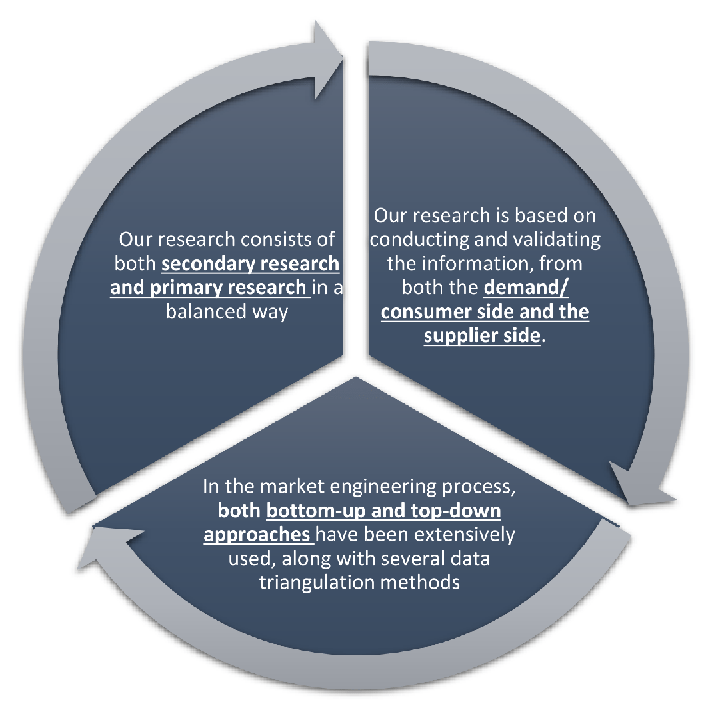
Our research design integrates both demand-side and supply-side analysis through a balanced combination of primary and secondary research methodologies. By utilizing both bottom-up and top-down approaches alongside rigorous data triangulation methods, we deliver robust market intelligence that supports strategic decision-making.
MarketGenics' comprehensive research design framework ensures the delivery of accurate, reliable, and actionable market intelligence. Through the integration of multiple research approaches, rigorous validation processes, and expert analysis, we provide our clients with the insights needed to make informed strategic decisions and capitalize on market opportunities.
MarketGenics leverages a dedicated industry panel of experts and a comprehensive suite of paid databases to effectively collect, consolidate, and analyze market intelligence.
Our approach has consistently proven to be reliable and effective in generating accurate market insights, identifying key industry trends, and uncovering emerging business opportunities.
Through both primary and secondary research, we capture and analyze critical company-level data such as manufacturing footprints, including technical centers, R&D facilities, sales offices, and headquarters.
Our expert panel further enhances our ability to estimate market size for specific brands based on validated field-level intelligence.
Our data mining techniques incorporate both parametric and non-parametric methods, allowing for structured data collection, sorting, processing, and cleaning.
Demand projections are derived from large-scale data sets analyzed through proprietary algorithms, culminating in robust and reliable market sizing.
Research Approach
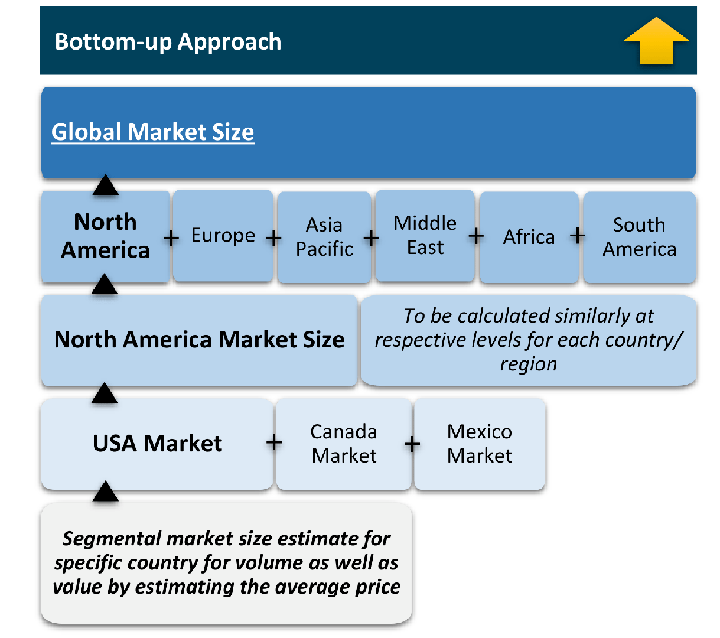
The bottom-up approach builds market estimates by starting with the smallest addressable market units and systematically aggregating them to create comprehensive market size projections.
This method begins with specific, granular data points and builds upward to create the complete market landscape.
Customer Analysis → Segmental Analysis → Geographical Analysis
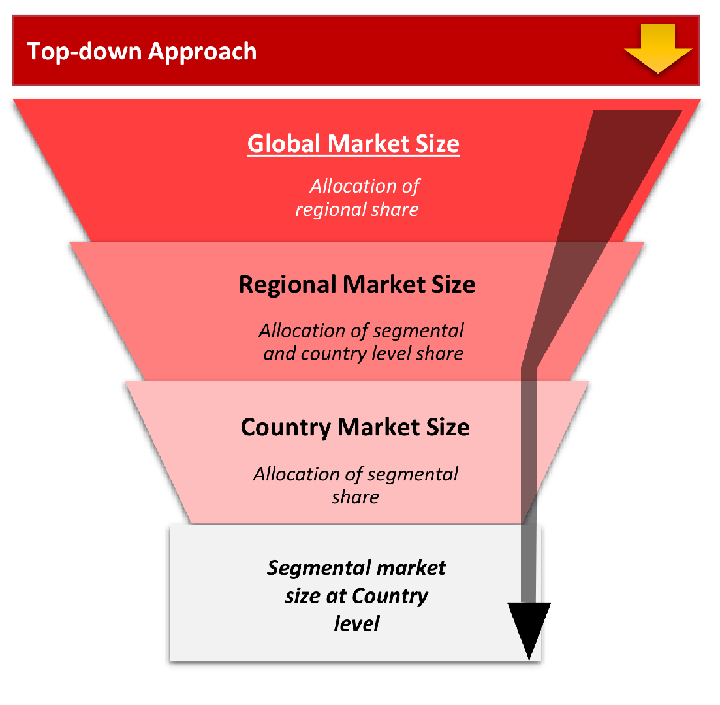
The top-down approach starts with the broadest possible market data and systematically narrows it down through a series of filters and assumptions to arrive at specific market segments or opportunities.
This method begins with the big picture and works downward to increasingly specific market slices.
TAM → SAM → SOM
Research Methods
Desk / Secondary Research
While analysing the market, we extensively study secondary sources, directories, and databases to identify and collect information useful for this technical, market-oriented, and commercial report. Secondary sources that we utilize are not only the public sources, but it is a combination of Open Source, Associations, Paid Databases, MG Repository & Knowledgebase, and others.
- Company websites, annual reports, financial reports, broker reports, and investor presentations
- National government documents, statistical databases and reports
- News articles, press releases and web-casts specific to the companies operating in the market, Magazines, reports, and others
- We gather information from commercial data sources for deriving company specific data such as segmental revenue, share for geography, product revenue, and others
- Internal and external proprietary databases (industry-specific), relevant patent, and regulatory databases
- Governing Bodies, Government Organizations
- Relevant Authorities, Country-specific Associations for Industries
We also employ the model mapping approach to estimate the product level market data through the players' product portfolio
Primary Research
Primary research/ interviews is vital in analyzing the market. Most of the cases involves paid primary interviews. Primary sources include primary interviews through e-mail interactions, telephonic interviews, surveys as well as face-to-face interviews with the different stakeholders across the value chain including several industry experts.
| Type of Respondents | Number of Primaries |
|---|---|
| Tier 2/3 Suppliers | ~20 |
| Tier 1 Suppliers | ~25 |
| End-users | ~25 |
| Industry Expert/ Panel/ Consultant | ~30 |
| Total | ~100 |
MG Knowledgebase
• Repository of industry blog, newsletter and case studies
• Online platform covering detailed market reports, and company profiles
Forecasting Factors and Models
Forecasting Factors
- Historical Trends – Past market patterns, cycles, and major events that shaped how markets behave over time. Understanding past trends helps predict future behavior.
- Industry Factors – Specific characteristics of the industry like structure, regulations, and innovation cycles that affect market dynamics.
- Macroeconomic Factors – Economic conditions like GDP growth, inflation, and employment rates that affect how much money people have to spend.
- Demographic Factors – Population characteristics like age, income, and location that determine who can buy your product.
- Technology Factors – How quickly people adopt new technology and how much technology infrastructure exists.
- Regulatory Factors – Government rules, laws, and policies that can help or restrict market growth.
- Competitive Factors – Analyzing competition structure such as degree of competition and bargaining power of buyers and suppliers.
Forecasting Models / Techniques
Multiple Regression Analysis
- Identify and quantify factors that drive market changes
- Statistical modeling to establish relationships between market drivers and outcomes
Time Series Analysis – Seasonal Patterns
- Understand regular cyclical patterns in market demand
- Advanced statistical techniques to separate trend, seasonal, and irregular components
Time Series Analysis – Trend Analysis
- Identify underlying market growth patterns and momentum
- Statistical analysis of historical data to project future trends
Expert Opinion – Expert Interviews
- Gather deep industry insights and contextual understanding
- In-depth interviews with key industry stakeholders
Multi-Scenario Development
- Prepare for uncertainty by modeling different possible futures
- Creating optimistic, pessimistic, and most likely scenarios
Time Series Analysis – Moving Averages
- Sophisticated forecasting for complex time series data
- Auto-regressive integrated moving average models with seasonal components
Econometric Models
- Apply economic theory to market forecasting
- Sophisticated economic models that account for market interactions
Expert Opinion – Delphi Method
- Harness collective wisdom of industry experts
- Structured, multi-round expert consultation process
Monte Carlo Simulation
- Quantify uncertainty and probability distributions
- Thousands of simulations with varying input parameters
Research Analysis
Our research framework is built upon the fundamental principle of validating market intelligence from both demand and supply perspectives. This dual-sided approach ensures comprehensive market understanding and reduces the risk of single-source bias.
Demand-Side Analysis: We understand end-user/application behavior, preferences, and market needs along with the penetration of the product for specific application.
Supply-Side Analysis: We estimate overall market revenue, analyze the segmental share along with industry capacity, competitive landscape, and market structure.
Validation & Evaluation
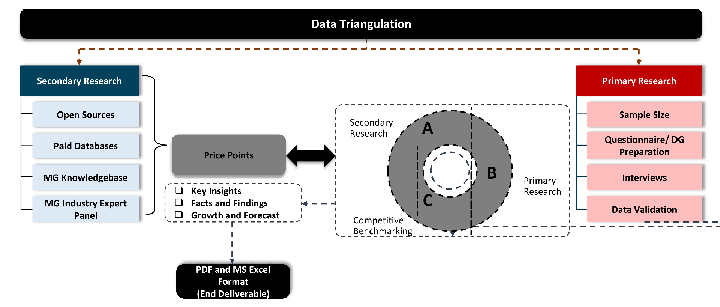
Data triangulation is a validation technique that uses multiple methods, sources, or perspectives to examine the same research question, thereby increasing the credibility and reliability of research findings. In market research, triangulation serves as a quality assurance mechanism that helps identify and minimize bias, validate assumptions, and ensure accuracy in market estimates.
- Data Source Triangulation – Using multiple data sources to examine the same phenomenon
- Methodological Triangulation – Using multiple research methods to study the same research question
- Investigator Triangulation – Using multiple researchers or analysts to examine the same data
- Theoretical Triangulation – Using multiple theoretical perspectives to interpret the same data
Custom Market Research Services
We will customise the research for you, in case the report listed above does not meet your requirements.
Get 10% Free Customisation