Smart Flow Meter Market Size, Share & Trends Analysis Report by Technology Type (Electromagnetic Flow Meters, Ultrasonic Flow Meters, Coriolis Flow Meters, Vortex Flow Meters, Turbine Flow Meters, Differential Pressure Flow Meters, Positive Displacement Flow Meters, Thermal Mass Flow Meters, Others), Rated Power, Rated Capacity, Fluid Type, Connectivity, Mounting Type, Output Signal, End-Use Industry, and Geography (North America, Europe, Asia Pacific, Middle East, Africa, and South America) – Global Industry Data, Trends, and Forecasts, 2026–2035
|
|
|
Segmental Data Insights |
|
|
Demand Trends |
|
|
Competitive Landscape |
|
|
Strategic Development |
|
|
Future Outlook & Opportunities |
|
Smart Flow Meter Market Size, Share, and Growth
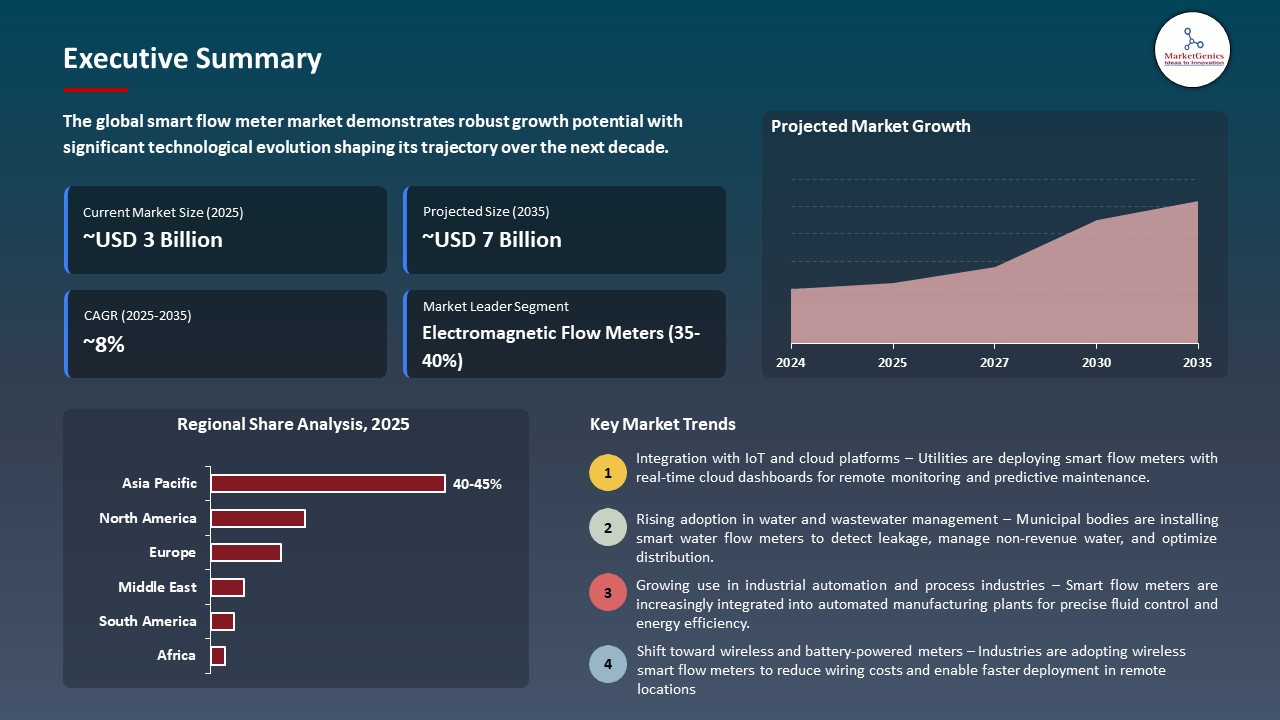
The global smart flow meter market is witnessing strong growth, valued at USD 3.3 billion in 2025 and projected to reach USD 7.2 billion by 2035, expanding at a CAGR of 8.1% during the forecast period. North America is the fastest-growing region in the smart flow meter market due to rapid adoption of industrial automation, shale oil & gas expansion, and strong investments in smart water and energy infrastructure.
Josateki Sivo, head of customer metering and installation at Water Authority of Fiji, said, “We have a long-term vision for the future of water in Fiji. Step by step, we are striving to improve water operations and create a resilient and reliable water network. One key benefit of deploying Itron’s Cyble module is that it’s scalable. This allows us to expand our smart metering program gradually, based on our priorities and budget”.
The high pace of industrialization and the growth of business structures is causing a significant rise in water demand in various industries, including manufacturing, electricity production, food processing, and hospitality. This influx demands proper water metering and effective distribution, which is why the smart flow meter market is embraced. Smart flow meters offer real time monitoring, accurate consumption information and automatic reporting, so that the industries and commercial establishments can streamline their operations, minimize wastage and attain sustainable use of water.
The increasing implementation of artificial intelligence (AI) in water management is a major business opportunity in the smart flow meter market. The inspection of smart flow meters can identify the leakage, anomalies, forecasts water demand, and optimizes the distribution networks in real time by use of AI. Utilizing AI-based solutions can assist utilities to minimize non-revenue water, decrease costs of operation, and improve the reliability of the service.
The smart flow meter market presents neighboring opportunities in the AI-based predictive maintenance, IoT-based real-time monitoring, increasing industrial and commercial adoption, and government-backed smart city projects, all of which lead to efficient, sustainable, and data-driven water management.
Smart Flow Meter Market Dynamics and Trends
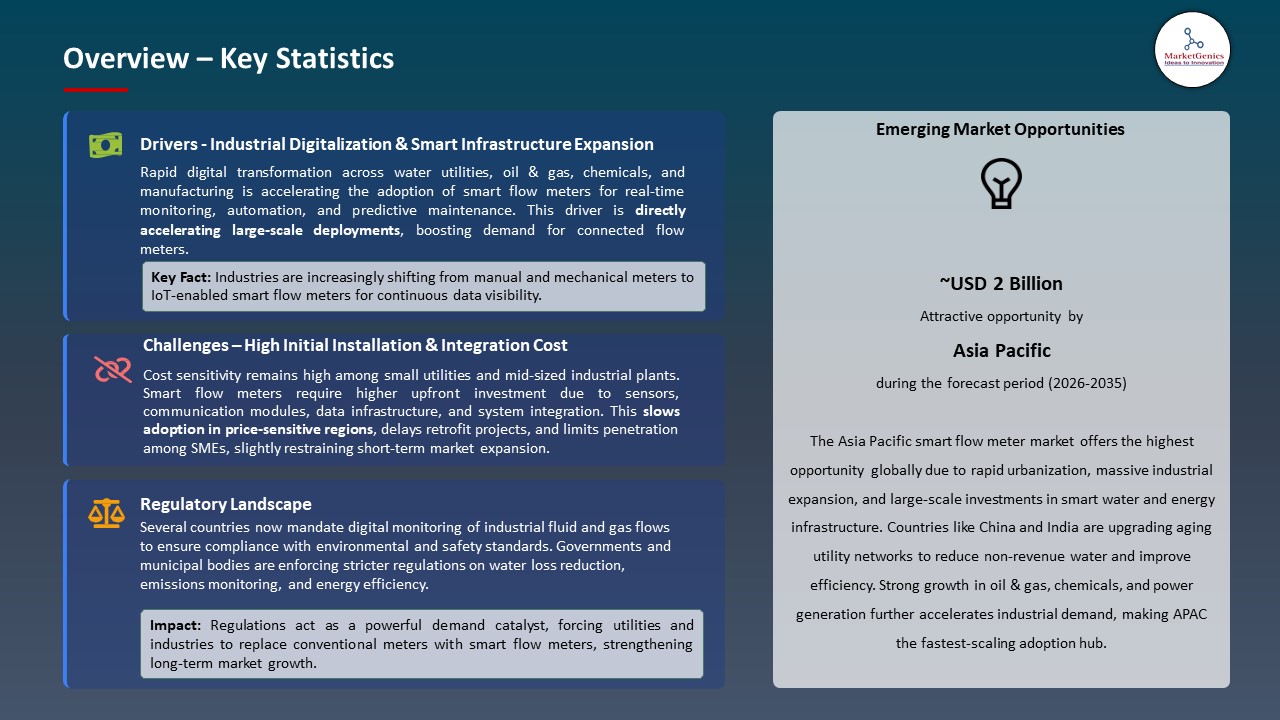
Driver: Rising Water Scarcity and Infrastructure Modernization Needs
-
Increasing water scarcity and ageing distribution systems are some of the major factors that are increasing the pace at which the smart flow meter market is growing. The growing freshwater demand is caused by rapid urbanization, climate changes, and growing industrial water requirements which put a lot of strain on the available freshwater resources and compel utilities to reduce losses and enhance efficiency. Meanwhile, having old pipelines and manual metering system also contributes to high non-revenue water as a result of leakage, theft, and misreading.
- Smart flow meters can measure water consumption in real-time, identify leaks early, and provide increased accuracy in consumption and remote data relay, thus facilitating utility optimization of water distribution, waste prevention, and enhancing revenue collection, which makes them critical in updating water infrastructure today.
- Thane Municipal Corporation (TMC) became partners with Thane Smart City Limited and installed more than 105,000 smart water meters in the city in its water infrastructure modernization program that encompassed residential and slum neighborhoods. The project allowed the city to achieve an accurate billing of volumetric, real-time consumption, and the identification of the leakage early on, which allowed the city to reduce its non-revenue water, regulate the wastage, and enhance the efficiency of water-use overall in the face of increased urban water shortage.
- The smart flow meters will be essential to minimize the water loss and enhance the efficiency under the conditions of increasing scarcity and degrading infrastructure.
Restraint: High Initial Costs Compared to Mechanical Meters
-
The implementation of smart flow meters is commonly inhibited by the expensive initial prices which are associated with them compared to the traditional mechanical or electromechanical meters. Such devices have sophisticated sensors, internet of things (IoT), and analytics, which considerably raise the costs of manufacturing and installation. Large-scale deployment can be expensive especially to utilities, especially those in developing areas or smaller municipalities with small budgets.
- Installation often involves the need to upgrade the existing infrastructure such as pipelines and communication networks, which further increases capital requirements. Though long-term advantages including the decrease of non-revenue water, better operation efficiency, and correct billing can cover initial expenses, most organizations are reluctant because of the budget constraints and extended payback periods.
- In the areas, where water tariffs are not so high, the economic payback of investments in smart flow meters is more gradual, and this does not help to scale its use even though there is a growing demand to use modern and efficient water management products.
- The initial high cost and upgrade of infrastructure still present an obstacle towards the expedited deployment of smart flow meters even though the benefits of smart flow meters can be long term in terms of its operations and efficiency.
Opportunity: Expansion in Smart City Water Management Systems
-
The market of smart flow meters is experiencing great opportunities due to the global trend towards smart city projects. Digital water infrastructure is becoming a significant investment in municipalities to guarantee optimization of their water infrastructure, decrease non-revenue water and provide urban water sustainability. Smart flow meters are very important in such systems as they allow viewing the real-time flow, automatic leakage detection capabilities, accurate consumption measurements, and remotely handling data.
- Connection to IoT systems and central water management tools will enable the authorities to streamline the distribution networks, enhance accuracy of billing, and proactively plan maintenance. With cities all over the world becoming oriented towards sustainable management of resources and infrastructures being updated, smart flow meters will undoubtedly acquire a significantly larger demand, making them the indispensable elements of the new urban water management models.
- In 2025, Itron, Inc. in collaboration with Pacific technologies partnered with Water authority of Fiji (WAF) to implement the first smart water metering system in the Fiji Islands. Itron installed its Cyble communication modules on top of the existing meters to enable them to become smart meters, which can collect data in real-time through the Temetra cloud-based system. This installation should minimize non-revenue water (47% of treated water), enhance efficiency of operation and offer sustainable, cost effective water management to meet the WAF long term Water Sector Strategy 2050 objectives.
- The growth of urban water management programs in smart cities is resulting in a sharp rise in smart flow meters to create efficient, sustainable, and data-driven urban water systems.
Key Trend: Integration of IIoT and Advanced Process Analytics
-
The use of the Industrial Internet of Things (IIoT) technology in combination with advanced process analytics is a forefront trend in the Smart Flow Meter Market. The trend toward connecting modern smart flow meters to IIoT networks is increasingly allowing the use of modern smart flow meters to collect real-time data, monitor remotely, and predictive maintenance across water distribution systems.
- This data is then processed by advanced analytics platforms that expose inefficiencies, leaks, predict the consumption trends, and optimize operations. The integration is not only increasing operational efficiency, but also assists in enabling utilities and industrial users to minimize water losses, save on energy expenditures, and meet regulatory mandates.
- In February 2025, Itron collaborated with Publiacqua in Tuscany, Italy, to roll out the Intelis wSource smart water meters with IoT connectivity to provide real-time monitoring, detect leaks, and receive the right billing to reduce non-revenue water, improve customer engagement, and promote sustainable, data-driven water management.
- The smart flow meters comprising IIoT and advanced analytics are leading to efficient, data-driven, and sustainable water management ideas worldwide.
Smart-Flow-Meter-Market Analysis and Segmental Data
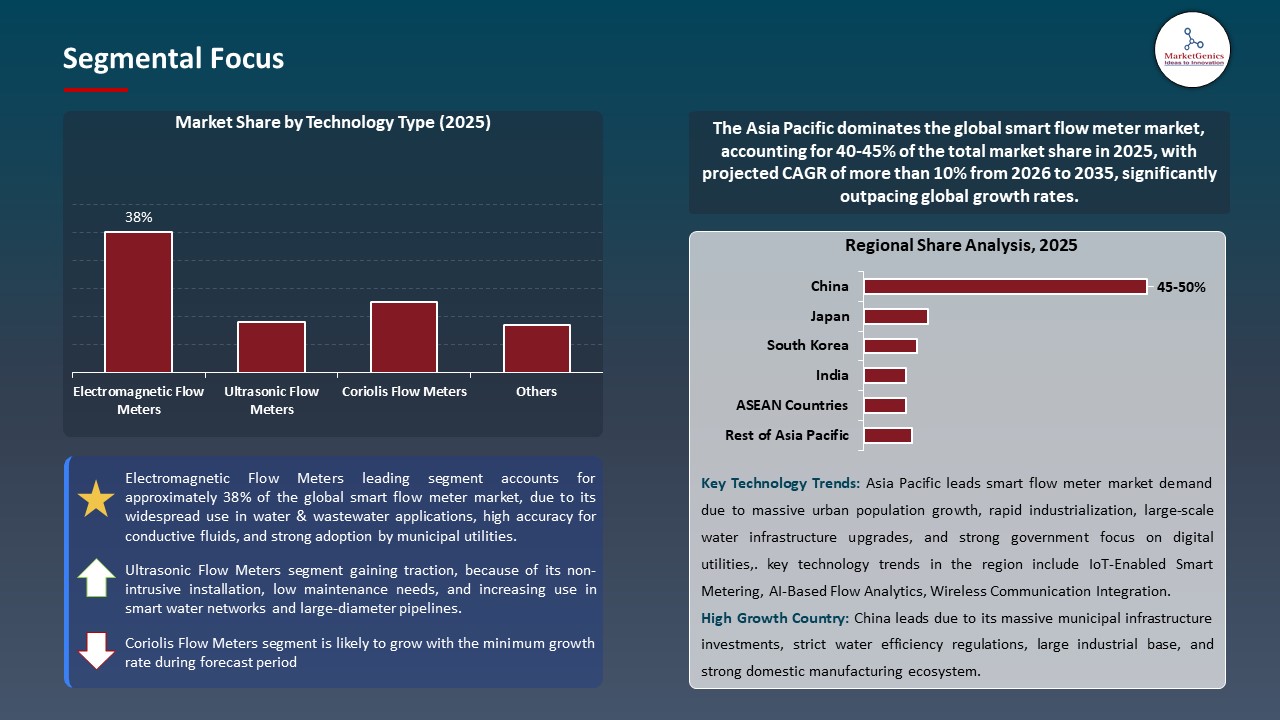
Electromagnetic Flow Meters Dominate Global Smart Flow Meter Market
-
The electromagnetic flow meter segment dominates the smart flow meter market due to its accuracy, reliability, and versatility across various applications. These meters operate without moving parts, minimizing wear and maintenance while providing precise measurements for conductive liquids, making them ideal for municipal water supply, industrial processes, and wastewater management.
- The ability to work with IoT and digital platforms will enable real-time data collection, monitoring the flow, and connecting with sophisticated analytics to detect leaks and maximize operational efficiency. Also, electromagnetic flow meters favor large-diameter pipelines and extreme operating environments, an added impetus to use them.
- In May 2025, KROHNE presented its recent innovations in the field of electromagnetic flowmeters (magmeters), which have excellent diagnostics and field verification solutions to reduce the reliability and efficiency of the process. These magmeters improve real time monitoring of the health of the devices and processes, predictive maintenance and early warning of problems like sensor erosion or material build up.
- The accuracy, durability and digital integration of electromagnetic flow meters makes them the preferred utility and industry meter of choice in the global market and this has remained the case up to date.
Asia Pacific Leads Global Smart Flow Meter Market Demand
-
The Asia Pacific (APAC) region is emerging as the dominant market for smart flow meters, driven by rapid urbanization, industrialization, and growing water demand. Countries such as China, India, Japan, and South Korea are investing heavily in modern water infrastructure to address challenges like water scarcity, aging pipelines, and rising non-revenue water (NRW). The increasing adoption of smart city initiatives, government regulations on water conservation, and incentives for digital infrastructure modernization are further propelling market growth in the region.
- Industries in the APAC, such as power generation, food processing, and pharmaceuticals are integrating smart flow meters to track the use of water, streamline operations, and cut operational costs. The combination of IoT and AI-power analytics in these meters will enable utilities and industrial users to conduct real-time monitoring and predictive maintenance and leak detection, improving operational productivity and resource utilization.
- In addition, the increased environmental awareness and the need to develop sustainable water management practices are promoting the need to adopt more sophisticated flow measurement solutions by both municipal and industrial users.
- The fast urbanization, industrialization, and orientation on smart and sustainable water management in Asia Pacific are contributing to the high demand of smart flow meters in the region.
Smart-Flow-Meter-Market Ecosystem
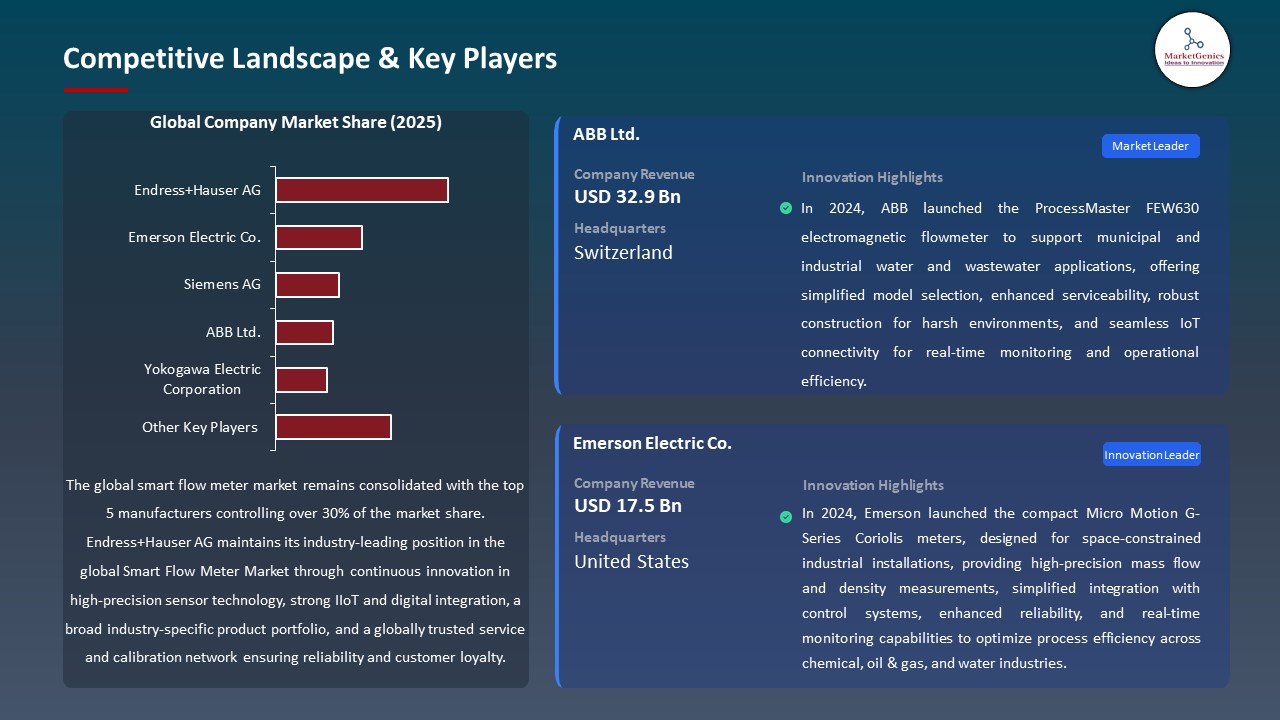
The smart flow meter market in the world is consolidated with the prevailing players being the Endress+Hauser AG, Emerson Electric Company, Siemens AG, ABB Ltd, and Yokogawa electric corporation. The companies have led the market with the latest technologies of measuring flows, IoT- and AI-enabled smart meters, real-time diagnostics, the interconnection with industrial automation and smart water management systems. They have a solid foundation due to their wide network of distribution and excellent services capacity around the globe.
The smart flow meter market value chain comprises sensor design and manufacture, calibration and testing, system integration, installation and commissioning, compliance and certification and after sales services, which consist of predictive maintenance, remote monitoring, real-time consumption analytics, and operational optimization.
Entry barriers are high because of capital-intensive research and development, compliance with regulations, technical skills of flow measurement and electronic integration, and client loyalty. The growth of the market is driven by continuous technological innovation, such as IoT-enabled monitoring, AI-based predictive maintenance, and cloud-connected smart water management solutions, which has been necessary to guarantee efficient, reliable, and sustainable water distribution and consumption management globally.
Recent Development and Strategic Overview:
-
In November 2025, Wessex Water in the UK declared a long-term partnership with Honeywell to install smart water meters in its area of service in a bid to modernize its water supply and distribution systems. The smart meters can be connected to the IoT-enabled communication and data management infrastructure, which will allow real-time monitoring, leak identification and consumptions to be accurately tracked.
- In August 2024, Endress+Hauser AG and SICK AG formed a joint venture to control the production and development of process analyzers and gas flowmeters, with Endress+Hauser assuming global sales and service. The partnership will work to utilize the technological capabilities of the two organizations to increase automation of processes, energy and resource efficiency, and sustainable industrial operations as part of strategic initiatives to increase the availability of smart flow meters and provide integrated and high-performance solutions in various industries worldwide.
Report Scope
|
Detail |
|
|
Market Size in 2025 |
USD 3.3 Bn |
|
Market Forecast Value in 2035 |
USD 7.2 Bn |
|
Growth Rate (CAGR) |
8.1% |
|
Forecast Period |
2026 – 2035 |
|
Historical Data Available for |
2021 – 2024 |
|
Market Size Units |
US$ Billion for Value Million Units for Volume |
|
Report Format |
Electronic (PDF) + Excel |
|
North America |
Europe |
Asia Pacific |
Middle East |
Africa |
South America |
|
|
|
|
|
|
|
Companies Covered |
|||||
|
|
|
|
|
|
Smart-Flow-Meter-Market Segmentation and Highlights
|
Segment |
Sub-segment |
|
Smart Flow Meter Market, By Technology Type |
|
|
Smart Flow Meter Market, By Rated Power |
|
|
Smart Flow Meter Market, By Rated Capacity |
|
|
Smart Flow Meter Market, By Fluid Type |
|
|
Smart Flow Meter Market, By Connectivity |
|
|
Smart Flow Meter Market, By Mounting Type |
|
|
Smart Flow Meter Market, By Output Signal |
|
|
Smart Flow Meter Market, By End-Use Industry |
|
Frequently Asked Questions
Table of Contents
- 1. Research Methodology and Assumptions
- 1.1. Definitions
- 1.2. Research Design and Approach
- 1.3. Data Collection Methods
- 1.4. Base Estimates and Calculations
- 1.5. Forecasting Models
- 1.5.1. Key Forecast Factors & Impact Analysis
- 1.6. Secondary Research
- 1.6.1. Open Sources
- 1.6.2. Paid Databases
- 1.6.3. Associations
- 1.7. Primary Research
- 1.7.1. Primary Sources
- 1.7.2. Primary Interviews with Stakeholders across Ecosystem
- 2. Executive Summary
- 2.1. Global Smart Flow Meter Market Outlook
- 2.1.1. Smart Flow Meter Market Size Volume (Million Units) and Value (US$ Bn), and Forecasts, 2021-2035
- 2.1.2. Compounded Annual Growth Rate Analysis
- 2.1.3. Growth Opportunity Analysis
- 2.1.4. Segmental Share Analysis
- 2.1.5. Geographical Share Analysis
- 2.2. Market Analysis and Facts
- 2.3. Supply-Demand Analysis
- 2.4. Competitive Benchmarking
- 2.5. Go-to- Market Strategy
- 2.5.1. Customer/ End-use Industry Assessment
- 2.5.2. Growth Opportunity Data, 2026-2035
- 2.5.2.1. Regional Data
- 2.5.2.2. Country Data
- 2.5.2.3. Segmental Data
- 2.5.3. Identification of Potential Market Spaces
- 2.5.4. GAP Analysis
- 2.5.5. Potential Attractive Price Points
- 2.5.6. Prevailing Market Risks & Challenges
- 2.5.7. Preferred Sales & Marketing Strategies
- 2.5.8. Key Recommendations and Analysis
- 2.5.9. A Way Forward
- 2.1. Global Smart Flow Meter Market Outlook
- 3. Industry Data and Premium Insights
- 3.1. Global Automation & Process Control Industry Overview, 2025
- 3.1.1. Automation & Process Control Industry Ecosystem Analysis
- 3.1.2. Key Trends for Automation & Process Control Industry
- 3.1.3. Regional Distribution for Automation & Process Control Industry
- 3.2. Supplier Customer Data
- 3.3. Technology Roadmap and Developments
- 3.4. Trade Analysis
- 3.4.1. Import & Export Analysis, 2025
- 3.4.2. Top Importing Countries
- 3.4.3. Top Exporting Countries
- 3.5. Trump Tariff Impact Analysis
- 3.5.1. Manufacturer
- 3.5.1.1. Based on the component & Raw material
- 3.5.2. Supply Chain
- 3.5.3. End Consumer
- 3.5.1. Manufacturer
- 3.6. Raw Material Analysis
- 3.1. Global Automation & Process Control Industry Overview, 2025
- 4. Market Overview
- 4.1. Market Dynamics
- 4.1.1. Drivers
- 4.1.1.1. Growing industrial automation and process optimization demand.
- 4.1.1.2. Stricter regulatory/environmental and safety compliance.
- 4.1.1.3. IoT/IIoT adoption for remote monitoring and analytics.
- 4.1.2. Restraints
- 4.1.2.1. High upfront costs and complex system integration.
- 4.1.2.2. Cybersecurity and data-privacy concerns.
- 4.1.1. Drivers
- 4.2. Key Trend Analysis
- 4.3. Regulatory Framework
- 4.3.1. Key Regulations, Norms, and Subsidies, by Key Countries
- 4.3.2. Tariffs and Standards
- 4.3.3. Impact Analysis of Regulations on the Market
- 4.4. Value Chain Analysis
- 4.4.1. Component Suppliers
- 4.4.2. Manufacturers
- 4.4.3. System Integrators
- 4.4.4. Distributors & Channel Partners
- 4.4.5. End-Users
- 4.5. Cost Structure Analysis
- 4.5.1. Parameter’s Share for Cost Associated
- 4.5.2. COGP vs COGS
- 4.5.3. Profit Margin Analysis
- 4.6. Pricing Analysis
- 4.6.1. Regional Pricing Analysis
- 4.6.2. Segmental Pricing Trends
- 4.6.3. Factors Influencing Pricing
- 4.7. Porter’s Five Forces Analysis
- 4.8. PESTEL Analysis
- 4.9. Global Smart Flow Meter Market Demand
- 4.9.1. Historical Market Size – Volume (Million Units) and Value (US$ Bn), 2020-2024
- 4.9.2. Current and Future Market Size – Volume (Million Units) and Value (US$ Bn), 2026–2035
- 4.9.2.1. Y-o-Y Growth Trends
- 4.9.2.2. Absolute $ Opportunity Assessment
- 4.1. Market Dynamics
- 5. Competition Landscape
- 5.1. Competition structure
- 5.1.1. Fragmented v/s consolidated
- 5.2. Company Share Analysis, 2025
- 5.2.1. Global Company Market Share
- 5.2.2. By Region
- 5.2.2.1. North America
- 5.2.2.2. Europe
- 5.2.2.3. Asia Pacific
- 5.2.2.4. Middle East
- 5.2.2.5. Africa
- 5.2.2.6. South America
- 5.3. Product Comparison Matrix
- 5.3.1. Specifications
- 5.3.2. Market Positioning
- 5.3.3. Pricing
- 5.1. Competition structure
- 6. Global Smart Flow Meter Market Analysis, by Technology Type
- 6.1. Key Segment Analysis
- 6.2. Smart Flow Meter Market Size Volume (Million units) and Value (US$ Bn), Analysis, and Forecasts, by Technology Type, 2021-2035
- 6.2.1. Electromagnetic Flow Meters
- 6.2.2. Ultrasonic Flow Meters
- 6.2.2.1. Transit-Time Ultrasonic
- 6.2.2.2. Doppler Ultrasonic
- 6.2.3. Coriolis Flow Meters
- 6.2.4. Vortex Flow Meters
- 6.2.5. Turbine Flow Meters
- 6.2.6. Differential Pressure Flow Meters
- 6.2.7. Positive Displacement Flow Meters
- 6.2.8. Thermal Mass Flow Meters
- 6.2.9. Others
- 7. Global Smart Flow Meter Market Analysis, by Rated Power
- 7.1. Key Segment Analysis
- 7.2. Smart Flow Meter Market Size Volume (Million units) and Value (US$ Bn), Analysis, and Forecasts, by Rated Power, 2021-2035
- 7.2.1. Up to 5W
- 7.2.2. 5W - 15W
- 7.2.3. Above 15W
- 8. Global Smart Flow Meter Market Analysis, by Rated Capacity
- 8.1. Key Segment Analysis
- 8.2. Smart Flow Meter Market Size Volume (Million units) and Value (US$ Bn), Analysis, and Forecasts, by Rated Capacity, 2021-2035
- 8.2.1. Small Capacity (< 50 L/min)
- 8.2.2. Medium Capacity (50 - 500 L/min)
- 8.2.3. Large Capacity (500 - 5000 L/min)
- 8.2.4. Very Large Capacity (> 5000 L/min)
- 9. Global Smart Flow Meter Market Analysis, by Fluid Type
- 9.1. Key Segment Analysis
- 9.2. Smart Flow Meter Market Size Volume (Million units) and Value (US$ Bn), Analysis, and Forecasts, by Fluid Type, 2021-2035
- 9.2.1. Liquid Flow Meters
- 9.2.1.1. Clean Liquids
- 9.2.1.2. Viscous Liquids
- 9.2.1.3. Slurry/Dirty Liquids
- 9.2.1.4. Others
- 9.2.2. Gas Flow Meters
- 9.2.2.1. Natural Gas
- 9.2.2.2. Compressed Air
- 9.2.2.3. Steam
- 9.2.2.4. Others
- 9.2.3. Multiphase Flow Meters
- 9.2.1. Liquid Flow Meters
- 10. Global Smart Flow Meter Market Analysis, by Connectivity
- 10.1. Key Segment Analysis
- 10.2. Smart Flow Meter Market Size Volume (Million units) and Value (US$ Bn), Analysis, and Forecasts, by Connectivity, 2021-2035
- 10.2.1. Wired Communication
- 10.2.1.1. HART Protocol
- 10.2.1.2. Modbus
- 10.2.1.3. Profibus
- 10.2.1.4. Foundation Fieldbus
- 10.2.1.5. Others
- 10.2.2. Wireless Communication
- 10.2.2.1. LoRaWAN
- 10.2.2.2. NB-IoT
- 10.2.2.3. Wi-Fi
- 10.2.2.4. Bluetooth
- 10.2.2.5. Zigbee
- 10.2.2.6. Others
- 10.2.1. Wired Communication
- 11. Global Smart Flow Meter Market Analysis, by Mounting Type
- 11.1. Key Segment Analysis
- 11.2. Smart Flow Meter Market Size Volume (Million units) and Value (US$ Bn), Analysis, and Forecasts, by Mounting Type, 2021-2035
- 11.2.1. Inline/In-Line Mount
- 11.2.2. Insertion Mount
- 11.2.3. Clamp-On/Non-Invasive
- 11.2.4. Flanged Mount
- 12. Global Smart Flow Meter Market Analysis, by Output Signal
- 12.1. Key Segment Analysis
- 12.2. Smart Flow Meter Market Size Volume (Million units) and Value (US$ Bn), Analysis, and Forecasts, by Output Signal, 2021-2035
- 12.2.1. Analog Output (4-20mA)
- 12.2.2. Digital Output (Pulse/Frequency)
- 12.2.3. Combined Analog & Digital Output
- 13. Global Smart Flow Meter Market Analysis, by End-Use Industry
- 13.1. Key Segment Analysis
- 13.2. Smart Flow Meter Market Size Volume (Million units) and Value (US$ Bn), Analysis, and Forecasts, by End-Use Industry, 2021-2035
- 13.2.1. Water & Wastewater Industry
- 13.2.1.1. Potable Water Distribution
- 13.2.1.2. Wastewater Treatment
- 13.2.1.3. Irrigation Management
- 13.2.1.4. Leak Detection
- 13.2.1.5. Others
- 13.2.2. Oil & Gas Industry
- 13.2.2.1. Upstream Exploration & Production
- 13.2.2.2. Midstream Transportation & Storage
- 13.2.2.3. Downstream Refining
- 13.2.2.4. Custody Transfer
- 13.2.2.5. Others
- 13.2.3. Chemical & Petrochemical Industry
- 13.2.3.1. Chemical Processing
- 13.2.3.2. Blending & Mixing
- 13.2.3.3. Batch Control
- 13.2.3.4. Custody Transfer
- 13.2.3.5. Others
- 13.2.4. Food & Beverage Industry
- 13.2.4.1. Beverage Production
- 13.2.4.2. Dairy Processing
- 13.2.4.3. Food Processing
- 13.2.4.4. Sanitary Applications
- 13.2.4.5. Others
- 13.2.5. Pharmaceutical Industry
- 13.2.5.1. Drug Manufacturing
- 13.2.5.2. Sterile Processing
- 13.2.5.3. Quality Control
- 13.2.5.4. Clean-in-Place (CIP) Systems
- 13.2.5.5. Others
- 13.2.6. Power Generation Industry
- 13.2.6.1. Thermal Power Plants
- 13.2.6.2. Nuclear Power Plants
- 13.2.6.3. Renewable Energy Plants
- 13.2.6.4. Cooling Water Management
- 13.2.6.5. Others
- 13.2.7. Pulp & Paper Industry
- 13.2.7.1. Pulp Processing
- 13.2.7.2. Paper Manufacturing
- 13.2.7.3. Chemical Recovery
- 13.2.7.4. Water Treatment
- 13.2.7.5. Others
- 13.2.8. Metal & Mining Industry
- 13.2.8.1. Mineral Processing
- 13.2.8.2. Slurry Handling
- 13.2.8.3. Cooling Systems
- 13.2.8.4. Wastewater Management
- 13.2.8.5. Others
- 13.2.9. HVAC Industry
- 13.2.9.1. Building Automation
- 13.2.9.2. Energy Monitoring
- 13.2.9.3. Chilled Water Systems
- 13.2.9.4. District Heating/Cooling
- 13.2.9.5. Others
- 13.2.10. Agriculture Industry
- 13.2.10.1. Precision Irrigation
- 13.2.10.2. Fertilizer Application
- 13.2.10.3. Livestock Management
- 13.2.10.4. Greenhouse Automation
- 13.2.10.5. Others
- 13.2.11. Municipal & Utilities
- 13.2.11.1. Smart City Infrastructure
- 13.2.11.2. District Metering Areas (DMA)
- 13.2.11.3. Billing & Revenue Management
- 13.2.11.4. Network Monitoring
- 13.2.11.5. Others
- 13.2.12. Manufacturing Industry
- 13.2.12.1. Process Automation
- 13.2.12.2. Quality Control
- 13.2.12.3. Energy Management
- 13.2.12.4. Cooling Systems
- 13.2.12.5. Others
- 13.2.1. Water & Wastewater Industry
- 14. Global Smart Flow Meter Market Analysis and Forecasts, by Region
- 14.1. Key Findings
- 14.2. Smart Flow Meter Market Size Volume (Million units) and Value (US$ Bn), Analysis, and Forecasts, by Region, 2021-2035
- 14.2.1. North America
- 14.2.2. Europe
- 14.2.3. Asia Pacific
- 14.2.4. Middle East
- 14.2.5. Africa
- 14.2.6. South America
- 15. North America Smart Flow Meter Market Analysis
- 15.1. Key Segment Analysis
- 15.2. Regional Snapshot
- 15.3. North America Smart Flow Meter Market Size- Volume (Million units) and Value (US$ Bn), Analysis, and Forecasts, 2021-2035
- 15.3.1. Technology Type
- 15.3.2. Rated Power
- 15.3.3. Rated Capacity
- 15.3.4. Fluid Type
- 15.3.5. Connectivity
- 15.3.6. Mounting Type
- 15.3.7. Output Signal
- 15.3.8. End-Use Industry
- 15.3.9. Country
- 15.3.9.1. USA
- 15.3.9.2. Canada
- 15.3.9.3. Mexico
- 15.4. USA Smart Flow Meter Market
- 15.4.1. Country Segmental Analysis
- 15.4.2. Technology Type
- 15.4.3. Rated Power
- 15.4.4. Rated Capacity
- 15.4.5. Fluid Type
- 15.4.6. Connectivity
- 15.4.7. Mounting Type
- 15.4.8. Output Signal
- 15.4.9. End-Use Industry
- 15.5. Canada Smart Flow Meter Market
- 15.5.1. Country Segmental Analysis
- 15.5.2. Technology Type
- 15.5.3. Rated Power
- 15.5.4. Rated Capacity
- 15.5.5. Fluid Type
- 15.5.6. Connectivity
- 15.5.7. Mounting Type
- 15.5.8. Output Signal
- 15.5.9. End-Use Industry
- 15.6. Mexico Smart Flow Meter Market
- 15.6.1. Country Segmental Analysis
- 15.6.2. Technology Type
- 15.6.3. Rated Power
- 15.6.4. Rated Capacity
- 15.6.5. Fluid Type
- 15.6.6. Connectivity
- 15.6.7. Mounting Type
- 15.6.8. Output Signal
- 15.6.9. End-Use Industry
- 16. Europe Smart Flow Meter Market Analysis
- 16.1. Key Segment Analysis
- 16.2. Regional Snapshot
- 16.3. Europe Smart Flow Meter Market Size Volume (Million units) and Value (US$ Bn), Analysis, and Forecasts, 2021-2035
- 16.3.1. Technology Type
- 16.3.2. Rated Power
- 16.3.3. Rated Capacity
- 16.3.4. Fluid Type
- 16.3.5. Connectivity
- 16.3.6. Mounting Type
- 16.3.7. Output Signal
- 16.3.8. End-Use Industry
- 16.3.9. Country
- 16.3.9.1. Germany
- 16.3.9.2. United Kingdom
- 16.3.9.3. France
- 16.3.9.4. Italy
- 16.3.9.5. Spain
- 16.3.9.6. Netherlands
- 16.3.9.7. Nordic Countries
- 16.3.9.8. Poland
- 16.3.9.9. Russia & CIS
- 16.3.9.10. Rest of Europe
- 16.4. Germany Smart Flow Meter Market
- 16.4.1. Country Segmental Analysis
- 16.4.2. Technology Type
- 16.4.3. Rated Power
- 16.4.4. Rated Capacity
- 16.4.5. Fluid Type
- 16.4.6. Connectivity
- 16.4.7. Mounting Type
- 16.4.8. Output Signal
- 16.4.9. End-Use Industry
- 16.5. United Kingdom Smart Flow Meter Market
- 16.5.1. Country Segmental Analysis
- 16.5.2. Technology Type
- 16.5.3. Rated Power
- 16.5.4. Rated Capacity
- 16.5.5. Fluid Type
- 16.5.6. Connectivity
- 16.5.7. Mounting Type
- 16.5.8. Output Signal
- 16.5.9. End-Use Industry
- 16.6. France Smart Flow Meter Market
- 16.6.1. Country Segmental Analysis
- 16.6.2. Technology Type
- 16.6.3. Rated Power
- 16.6.4. Rated Capacity
- 16.6.5. Fluid Type
- 16.6.6. Connectivity
- 16.6.7. Mounting Type
- 16.6.8. Output Signal
- 16.6.9. End-Use Industry
- 16.7. Italy Smart Flow Meter Market
- 16.7.1. Country Segmental Analysis
- 16.7.2. Technology Type
- 16.7.3. Rated Power
- 16.7.4. Rated Capacity
- 16.7.5. Fluid Type
- 16.7.6. Connectivity
- 16.7.7. Mounting Type
- 16.7.8. Output Signal
- 16.7.9. End-Use Industry
- 16.8. Spain Smart Flow Meter Market
- 16.8.1. Country Segmental Analysis
- 16.8.2. Technology Type
- 16.8.3. Rated Power
- 16.8.4. Rated Capacity
- 16.8.5. Fluid Type
- 16.8.6. Connectivity
- 16.8.7. Mounting Type
- 16.8.8. Output Signal
- 16.8.9. End-Use Industry
- 16.9. Netherlands Smart Flow Meter Market
- 16.9.1. Country Segmental Analysis
- 16.9.2. Technology Type
- 16.9.3. Rated Power
- 16.9.4. Rated Capacity
- 16.9.5. Fluid Type
- 16.9.6. Connectivity
- 16.9.7. Mounting Type
- 16.9.8. Output Signal
- 16.9.9. End-Use Industry
- 16.10. Nordic Countries Smart Flow Meter Market
- 16.10.1. Country Segmental Analysis
- 16.10.2. Technology Type
- 16.10.3. Rated Power
- 16.10.4. Rated Capacity
- 16.10.5. Fluid Type
- 16.10.6. Connectivity
- 16.10.7. Mounting Type
- 16.10.8. Output Signal
- 16.10.9. End-Use Industry
- 16.11. Poland Smart Flow Meter Market
- 16.11.1. Country Segmental Analysis
- 16.11.2. Technology Type
- 16.11.3. Rated Power
- 16.11.4. Rated Capacity
- 16.11.5. Fluid Type
- 16.11.6. Connectivity
- 16.11.7. Mounting Type
- 16.11.8. Output Signal
- 16.11.9. End-Use Industry
- 16.12. Russia & CIS Smart Flow Meter Market
- 16.12.1. Country Segmental Analysis
- 16.12.2. Technology Type
- 16.12.3. Rated Power
- 16.12.4. Rated Capacity
- 16.12.5. Fluid Type
- 16.12.6. Connectivity
- 16.12.7. Mounting Type
- 16.12.8. Output Signal
- 16.12.9. End-Use Industry
- 16.13. Rest of Europe Smart Flow Meter Market
- 16.13.1. Country Segmental Analysis
- 16.13.2. Technology Type
- 16.13.3. Rated Power
- 16.13.4. Rated Capacity
- 16.13.5. Fluid Type
- 16.13.6. Connectivity
- 16.13.7. Mounting Type
- 16.13.8. Output Signal
- 16.13.9. End-Use Industry
- 17. Asia Pacific Smart Flow Meter Market Analysis
- 17.1. Key Segment Analysis
- 17.2. Regional Snapshot
- 17.3. Asia Pacific Smart Flow Meter Market Size Volume (Million units) and Value (US$ Bn), Analysis, and Forecasts, 2021-2035
- 17.3.1. Technology Type
- 17.3.2. Rated Power
- 17.3.3. Rated Capacity
- 17.3.4. Fluid Type
- 17.3.5. Connectivity
- 17.3.6. Mounting Type
- 17.3.7. Output Signal
- 17.3.8. End-Use Industry
- 17.3.9. Country
- 17.3.9.1. China
- 17.3.9.2. India
- 17.3.9.3. Japan
- 17.3.9.4. South Korea
- 17.3.9.5. Australia and New Zealand
- 17.3.9.6. Indonesia
- 17.3.9.7. Malaysia
- 17.3.9.8. Thailand
- 17.3.9.9. Vietnam
- 17.3.9.10. Rest of Asia Pacific
- 17.4. China Smart Flow Meter Market
- 17.4.1. Country Segmental Analysis
- 17.4.2. Technology Type
- 17.4.3. Rated Power
- 17.4.4. Rated Capacity
- 17.4.5. Fluid Type
- 17.4.6. Connectivity
- 17.4.7. Mounting Type
- 17.4.8. Output Signal
- 17.4.9. End-Use Industry
- 17.5. India Smart Flow Meter Market
- 17.5.1. Country Segmental Analysis
- 17.5.2. Technology Type
- 17.5.3. Rated Power
- 17.5.4. Rated Capacity
- 17.5.5. Fluid Type
- 17.5.6. Connectivity
- 17.5.7. Mounting Type
- 17.5.8. Output Signal
- 17.5.9. End-Use Industry
- 17.6. Japan Smart Flow Meter Market
- 17.6.1. Country Segmental Analysis
- 17.6.2. Technology Type
- 17.6.3. Rated Power
- 17.6.4. Rated Capacity
- 17.6.5. Fluid Type
- 17.6.6. Connectivity
- 17.6.7. Mounting Type
- 17.6.8. Output Signal
- 17.6.9. End-Use Industry
- 17.7. South Korea Smart Flow Meter Market
- 17.7.1. Country Segmental Analysis
- 17.7.2. Technology Type
- 17.7.3. Rated Power
- 17.7.4. Rated Capacity
- 17.7.5. Fluid Type
- 17.7.6. Connectivity
- 17.7.7. Mounting Type
- 17.7.8. Output Signal
- 17.7.9. End-Use Industry
- 17.8. Australia and New Zealand Smart Flow Meter Market
- 17.8.1. Country Segmental Analysis
- 17.8.2. Technology Type
- 17.8.3. Rated Power
- 17.8.4. Rated Capacity
- 17.8.5. Fluid Type
- 17.8.6. Connectivity
- 17.8.7. Mounting Type
- 17.8.8. Output Signal
- 17.8.9. End-Use Industry
- 17.9. Indonesia Smart Flow Meter Market
- 17.9.1. Country Segmental Analysis
- 17.9.2. Technology Type
- 17.9.3. Rated Power
- 17.9.4. Rated Capacity
- 17.9.5. Fluid Type
- 17.9.6. Connectivity
- 17.9.7. Mounting Type
- 17.9.8. Output Signal
- 17.9.9. End-Use Industry
- 17.10. Malaysia Smart Flow Meter Market
- 17.10.1. Country Segmental Analysis
- 17.10.2. Technology Type
- 17.10.3. Rated Power
- 17.10.4. Rated Capacity
- 17.10.5. Fluid Type
- 17.10.6. Connectivity
- 17.10.7. Mounting Type
- 17.10.8. Output Signal
- 17.10.9. End-Use Industry
- 17.11. Thailand Smart Flow Meter Market
- 17.11.1. Country Segmental Analysis
- 17.11.2. Technology Type
- 17.11.3. Rated Power
- 17.11.4. Rated Capacity
- 17.11.5. Fluid Type
- 17.11.6. Connectivity
- 17.11.7. Mounting Type
- 17.11.8. Output Signal
- 17.11.9. End-Use Industry
- 17.12. Vietnam Smart Flow Meter Market
- 17.12.1. Country Segmental Analysis
- 17.12.2. Technology Type
- 17.12.3. Rated Power
- 17.12.4. Rated Capacity
- 17.12.5. Fluid Type
- 17.12.6. Connectivity
- 17.12.7. Mounting Type
- 17.12.8. Output Signal
- 17.12.9. End-Use Industry
- 17.13. Rest of Asia Pacific Smart Flow Meter Market
- 17.13.1. Country Segmental Analysis
- 17.13.2. Technology Type
- 17.13.3. Rated Power
- 17.13.4. Rated Capacity
- 17.13.5. Fluid Type
- 17.13.6. Connectivity
- 17.13.7. Mounting Type
- 17.13.8. Output Signal
- 17.13.9. End-Use Industry
- 18. Middle East Smart Flow Meter Market Analysis
- 18.1. Key Segment Analysis
- 18.2. Regional Snapshot
- 18.3. Middle East Smart Flow Meter Market Size Volume (Million units) and Value (US$ Bn), Analysis, and Forecasts, 2021-2035
- 18.3.1. Technology Type
- 18.3.2. Rated Power
- 18.3.3. Rated Capacity
- 18.3.4. Fluid Type
- 18.3.5. Connectivity
- 18.3.6. Mounting Type
- 18.3.7. Output Signal
- 18.3.8. End-Use Industry
- 18.3.9. Country
- 18.3.9.1. Turkey
- 18.3.9.2. UAE
- 18.3.9.3. Saudi Arabia
- 18.3.9.4. Israel
- 18.3.9.5. Rest of Middle East
- 18.4. Turkey Smart Flow Meter Market
- 18.4.1. Country Segmental Analysis
- 18.4.2. Technology Type
- 18.4.3. Rated Power
- 18.4.4. Rated Capacity
- 18.4.5. Fluid Type
- 18.4.6. Connectivity
- 18.4.7. Mounting Type
- 18.4.8. Output Signal
- 18.4.9. End-Use Industry
- 18.5. UAE Smart Flow Meter Market
- 18.5.1. Country Segmental Analysis
- 18.5.2. Technology Type
- 18.5.3. Rated Power
- 18.5.4. Rated Capacity
- 18.5.5. Fluid Type
- 18.5.6. Connectivity
- 18.5.7. Mounting Type
- 18.5.8. Output Signal
- 18.5.9. End-Use Industry
- 18.6. Saudi Arabia Smart Flow Meter Market
- 18.6.1. Country Segmental Analysis
- 18.6.2. Technology Type
- 18.6.3. Rated Power
- 18.6.4. Rated Capacity
- 18.6.5. Fluid Type
- 18.6.6. Connectivity
- 18.6.7. Mounting Type
- 18.6.8. Output Signal
- 18.6.9. End-Use Industry
- 18.7. Israel Smart Flow Meter Market
- 18.7.1. Country Segmental Analysis
- 18.7.2. Technology Type
- 18.7.3. Rated Power
- 18.7.4. Rated Capacity
- 18.7.5. Fluid Type
- 18.7.6. Connectivity
- 18.7.7. Mounting Type
- 18.7.8. Output Signal
- 18.7.9. End-Use Industry
- 18.8. Rest of Middle East Smart Flow Meter Market
- 18.8.1. Country Segmental Analysis
- 18.8.2. Technology Type
- 18.8.3. Rated Power
- 18.8.4. Rated Capacity
- 18.8.5. Fluid Type
- 18.8.6. Connectivity
- 18.8.7. Mounting Type
- 18.8.8. Output Signal
- 18.8.9. End-Use Industry
- 19. Africa Smart Flow Meter Market Analysis
- 19.1. Key Segment Analysis
- 19.2. Regional Snapshot
- 19.3. Africa Smart Flow Meter Market Size Volume (Million units) and Value (US$ Bn), Analysis, and Forecasts, 2021-2035
- 19.3.1. Technology Type
- 19.3.2. Rated Power
- 19.3.3. Rated Capacity
- 19.3.4. Fluid Type
- 19.3.5. Connectivity
- 19.3.6. Mounting Type
- 19.3.7. Output Signal
- 19.3.8. End-Use Industry
- 19.3.9. Country
- 19.3.9.1. South Africa
- 19.3.9.2. Egypt
- 19.3.9.3. Nigeria
- 19.3.9.4. Algeria
- 19.3.9.5. Rest of Africa
- 19.4. South Africa Smart Flow Meter Market
- 19.4.1. Country Segmental Analysis
- 19.4.2. Technology Type
- 19.4.3. Rated Power
- 19.4.4. Rated Capacity
- 19.4.5. Fluid Type
- 19.4.6. Connectivity
- 19.4.7. Mounting Type
- 19.4.8. Output Signal
- 19.4.9. End-Use Industry
- 19.5. Egypt Smart Flow Meter Market
- 19.5.1. Country Segmental Analysis
- 19.5.2. Technology Type
- 19.5.3. Rated Power
- 19.5.4. Rated Capacity
- 19.5.5. Fluid Type
- 19.5.6. Connectivity
- 19.5.7. Mounting Type
- 19.5.8. Output Signal
- 19.5.9. End-Use Industry
- 19.6. Nigeria Smart Flow Meter Market
- 19.6.1. Country Segmental Analysis
- 19.6.2. Technology Type
- 19.6.3. Rated Power
- 19.6.4. Rated Capacity
- 19.6.5. Fluid Type
- 19.6.6. Connectivity
- 19.6.7. Mounting Type
- 19.6.8. Output Signal
- 19.6.9. End-Use Industry
- 19.7. Algeria Smart Flow Meter Market
- 19.7.1. Country Segmental Analysis
- 19.7.2. Technology Type
- 19.7.3. Rated Power
- 19.7.4. Rated Capacity
- 19.7.5. Fluid Type
- 19.7.6. Connectivity
- 19.7.7. Mounting Type
- 19.7.8. Output Signal
- 19.7.9. End-Use Industry
- 19.8. Rest of Africa Smart Flow Meter Market
- 19.8.1. Country Segmental Analysis
- 19.8.2. Technology Type
- 19.8.3. Rated Power
- 19.8.4. Rated Capacity
- 19.8.5. Fluid Type
- 19.8.6. Connectivity
- 19.8.7. Mounting Type
- 19.8.8. Output Signal
- 19.8.9. End-Use Industry
- 20. South America Smart Flow Meter Market Analysis
- 20.1. Key Segment Analysis
- 20.2. Regional Snapshot
- 20.3. South America Smart Flow Meter Market Size Volume (Million units) and Value (US$ Bn), Analysis, and Forecasts, 2021-2035
- 20.3.1. Sensor Type
- 20.3.2. Gas Technology Type
- 20.3.3. Rated Power
- 20.3.4. Rated Capacity
- 20.3.5. Fluid Type
- 20.3.6. Connectivity
- 20.3.7. Mounting Type
- 20.3.8. Output Signal
- 20.3.9. End-Use Industry
- 20.3.10. Country
- 20.3.10.1. Brazil
- 20.3.10.2. Argentina
- 20.3.10.3. Rest of South America
- 20.4. Brazil Smart Flow Meter Market
- 20.4.1. Country Segmental Analysis
- 20.4.2. Technology Type
- 20.4.3. Rated Power
- 20.4.4. Rated Capacity
- 20.4.5. Fluid Type
- 20.4.6. Connectivity
- 20.4.7. Mounting Type
- 20.4.8. Output Signal
- 20.4.9. End-Use Industry
- 20.5. Argentina Smart Flow Meter Market
- 20.5.1. Country Segmental Analysis
- 20.5.2. Technology Type
- 20.5.3. Rated Power
- 20.5.4. Rated Capacity
- 20.5.5. Fluid Type
- 20.5.6. Connectivity
- 20.5.7. Mounting Type
- 20.5.8. Output Signal
- 20.5.9. End-Use Industry
- 20.6. Rest of South America Smart Flow Meter Market
- 20.6.1. Country Segmental Analysis
- 20.6.2. Technology Type
- 20.6.3. Rated Power
- 20.6.4. Rated Capacity
- 20.6.5. Fluid Type
- 20.6.6. Connectivity
- 20.6.7. Mounting Type
- 20.6.8. Output Signal
- 20.6.9. End-Use Industry
- 21. Key Players/ Company Profile
- 21.1. ABB Ltd.
- 21.1.1. Company Details/ Overview
- 21.1.2. Company Financials
- 21.1.3. Key Customers and Competitors
- 21.1.4. Business/ Industry Portfolio
- 21.1.5. Product Portfolio/ Specification Details
- 21.1.6. Pricing Data
- 21.1.7. Strategic Overview
- 21.1.8. Recent Developments
- 21.2. Alicat Scientific Inc.
- 21.3. Azbil Corporation
- 21.4. Badger Meter Inc.
- 21.5. Bronkhorst High-Tech B.V.
- 21.6. Brooks Instrument
- 21.7. Burkert Fluid Control Systems
- 21.8. Emerson Electric Co.
- 21.9. Endress+Hauser AG
- 21.10. GE Sensing & Inspection Technologies
- 21.11. Honeywell International Inc.
- 21.12. Keyence Corporation
- 21.13. KROHNE Messtechnik GmbH
- 21.14. McCrometer Inc.
- 21.15. Omega Engineering Inc.
- 21.16. Schneider Electric SE
- 21.17. SICK AG
- 21.18. Siemens AG
- 21.19. Sierra Instruments Inc.
- 21.20. Yokogawa Electric Corporation
- 21.21. Other Key Players
- 21.1. ABB Ltd.
Note* - This is just tentative list of players. While providing the report, we will cover more number of players based on their revenue and share for each geography
Research Design
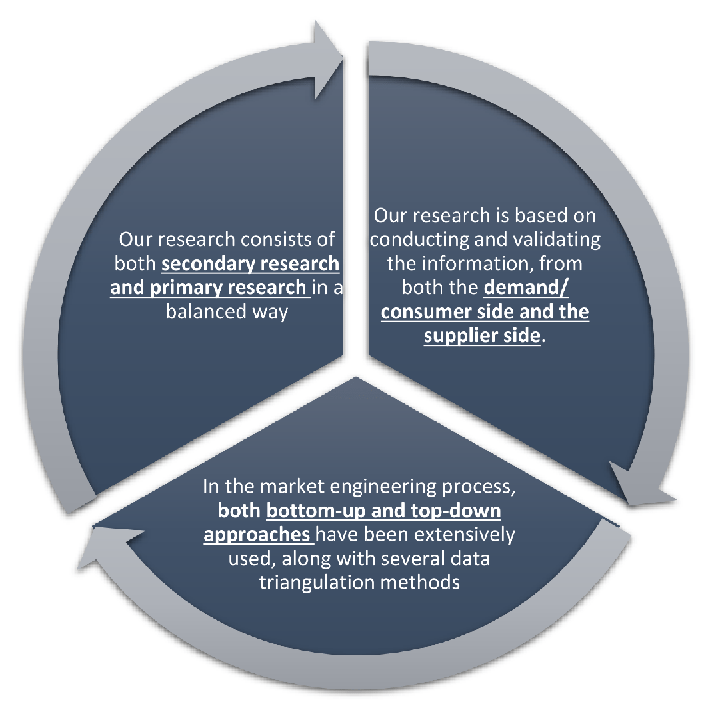
Our research design integrates both demand-side and supply-side analysis through a balanced combination of primary and secondary research methodologies. By utilizing both bottom-up and top-down approaches alongside rigorous data triangulation methods, we deliver robust market intelligence that supports strategic decision-making.
MarketGenics' comprehensive research design framework ensures the delivery of accurate, reliable, and actionable market intelligence. Through the integration of multiple research approaches, rigorous validation processes, and expert analysis, we provide our clients with the insights needed to make informed strategic decisions and capitalize on market opportunities.
MarketGenics leverages a dedicated industry panel of experts and a comprehensive suite of paid databases to effectively collect, consolidate, and analyze market intelligence.
Our approach has consistently proven to be reliable and effective in generating accurate market insights, identifying key industry trends, and uncovering emerging business opportunities.
Through both primary and secondary research, we capture and analyze critical company-level data such as manufacturing footprints, including technical centers, R&D facilities, sales offices, and headquarters.
Our expert panel further enhances our ability to estimate market size for specific brands based on validated field-level intelligence.
Our data mining techniques incorporate both parametric and non-parametric methods, allowing for structured data collection, sorting, processing, and cleaning.
Demand projections are derived from large-scale data sets analyzed through proprietary algorithms, culminating in robust and reliable market sizing.
Research Approach
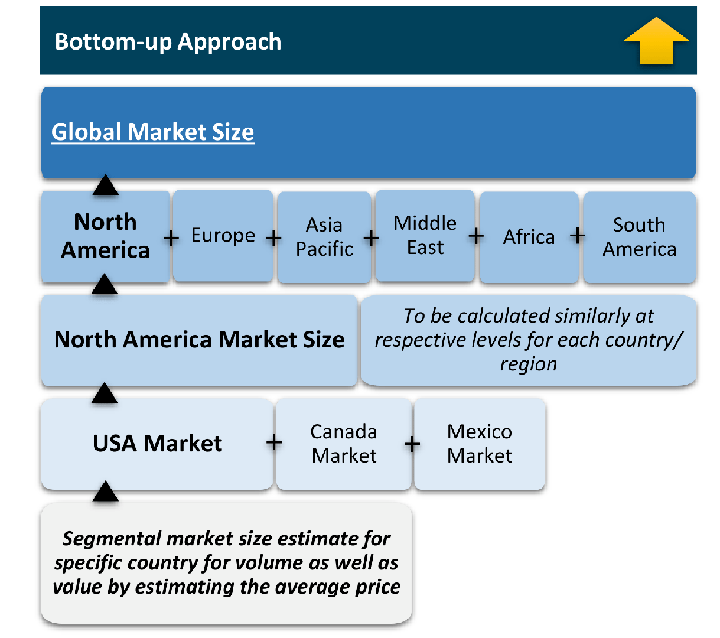
The bottom-up approach builds market estimates by starting with the smallest addressable market units and systematically aggregating them to create comprehensive market size projections.
This method begins with specific, granular data points and builds upward to create the complete market landscape.
Customer Analysis → Segmental Analysis → Geographical Analysis
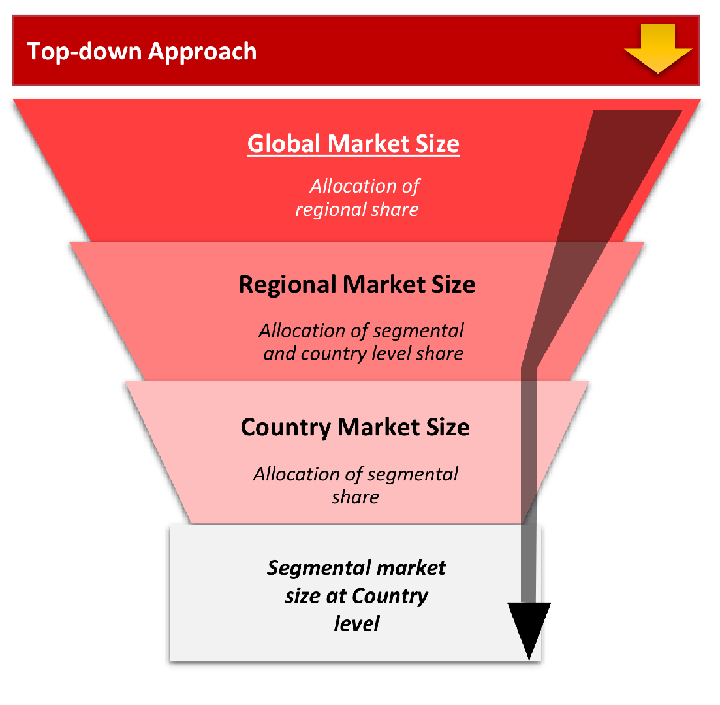
The top-down approach starts with the broadest possible market data and systematically narrows it down through a series of filters and assumptions to arrive at specific market segments or opportunities.
This method begins with the big picture and works downward to increasingly specific market slices.
TAM → SAM → SOM
Research Methods
Desk / Secondary Research
While analysing the market, we extensively study secondary sources, directories, and databases to identify and collect information useful for this technical, market-oriented, and commercial report. Secondary sources that we utilize are not only the public sources, but it is a combination of Open Source, Associations, Paid Databases, MG Repository & Knowledgebase, and others.
- Company websites, annual reports, financial reports, broker reports, and investor presentations
- National government documents, statistical databases and reports
- News articles, press releases and web-casts specific to the companies operating in the market, Magazines, reports, and others
- We gather information from commercial data sources for deriving company specific data such as segmental revenue, share for geography, product revenue, and others
- Internal and external proprietary databases (industry-specific), relevant patent, and regulatory databases
- Governing Bodies, Government Organizations
- Relevant Authorities, Country-specific Associations for Industries
We also employ the model mapping approach to estimate the product level market data through the players' product portfolio
Primary Research
Primary research/ interviews is vital in analyzing the market. Most of the cases involves paid primary interviews. Primary sources include primary interviews through e-mail interactions, telephonic interviews, surveys as well as face-to-face interviews with the different stakeholders across the value chain including several industry experts.
| Type of Respondents | Number of Primaries |
|---|---|
| Tier 2/3 Suppliers | ~20 |
| Tier 1 Suppliers | ~25 |
| End-users | ~25 |
| Industry Expert/ Panel/ Consultant | ~30 |
| Total | ~100 |
MG Knowledgebase
• Repository of industry blog, newsletter and case studies
• Online platform covering detailed market reports, and company profiles
Forecasting Factors and Models
Forecasting Factors
- Historical Trends – Past market patterns, cycles, and major events that shaped how markets behave over time. Understanding past trends helps predict future behavior.
- Industry Factors – Specific characteristics of the industry like structure, regulations, and innovation cycles that affect market dynamics.
- Macroeconomic Factors – Economic conditions like GDP growth, inflation, and employment rates that affect how much money people have to spend.
- Demographic Factors – Population characteristics like age, income, and location that determine who can buy your product.
- Technology Factors – How quickly people adopt new technology and how much technology infrastructure exists.
- Regulatory Factors – Government rules, laws, and policies that can help or restrict market growth.
- Competitive Factors – Analyzing competition structure such as degree of competition and bargaining power of buyers and suppliers.
Forecasting Models / Techniques
Multiple Regression Analysis
- Identify and quantify factors that drive market changes
- Statistical modeling to establish relationships between market drivers and outcomes
Time Series Analysis – Seasonal Patterns
- Understand regular cyclical patterns in market demand
- Advanced statistical techniques to separate trend, seasonal, and irregular components
Time Series Analysis – Trend Analysis
- Identify underlying market growth patterns and momentum
- Statistical analysis of historical data to project future trends
Expert Opinion – Expert Interviews
- Gather deep industry insights and contextual understanding
- In-depth interviews with key industry stakeholders
Multi-Scenario Development
- Prepare for uncertainty by modeling different possible futures
- Creating optimistic, pessimistic, and most likely scenarios
Time Series Analysis – Moving Averages
- Sophisticated forecasting for complex time series data
- Auto-regressive integrated moving average models with seasonal components
Econometric Models
- Apply economic theory to market forecasting
- Sophisticated economic models that account for market interactions
Expert Opinion – Delphi Method
- Harness collective wisdom of industry experts
- Structured, multi-round expert consultation process
Monte Carlo Simulation
- Quantify uncertainty and probability distributions
- Thousands of simulations with varying input parameters
Research Analysis
Our research framework is built upon the fundamental principle of validating market intelligence from both demand and supply perspectives. This dual-sided approach ensures comprehensive market understanding and reduces the risk of single-source bias.
Demand-Side Analysis: We understand end-user/application behavior, preferences, and market needs along with the penetration of the product for specific application.
Supply-Side Analysis: We estimate overall market revenue, analyze the segmental share along with industry capacity, competitive landscape, and market structure.
Validation & Evaluation
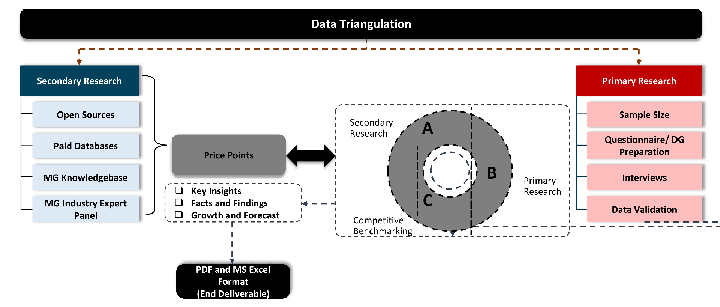
Data triangulation is a validation technique that uses multiple methods, sources, or perspectives to examine the same research question, thereby increasing the credibility and reliability of research findings. In market research, triangulation serves as a quality assurance mechanism that helps identify and minimize bias, validate assumptions, and ensure accuracy in market estimates.
- Data Source Triangulation – Using multiple data sources to examine the same phenomenon
- Methodological Triangulation – Using multiple research methods to study the same research question
- Investigator Triangulation – Using multiple researchers or analysts to examine the same data
- Theoretical Triangulation – Using multiple theoretical perspectives to interpret the same data
Custom Market Research Services
We will customise the research for you, in case the report listed above does not meet your requirements.
Get 10% Free Customisation