Stir Welding Equipment Market Size, Share & Trends Analysis Report by Technology Type (Friction Stir Welding (FSW), Conventional FSW, Stationary Shoulder FSW, Self-Reacting FSW, Friction Stir Spot Welding (FSSW), Friction Stir Processing (FSP), Bobbin Tool Friction Stir Welding, Others), Equipment Type, Automation Level, Material Type, Spindle Speed Capacity, Force Capacity, Tool Configuration, Weld Joint Configuration, Cooling System, End-Use Industry and Geography (North America, Europe, Asia Pacific, Middle East, Africa, and South America) – Global Industry Data, Trends, and Forecasts, 2026–2035
|
|
|
Segmental Data Insights |
|
|
Demand Trends |
|
|
Competitive Landscape |
|
|
Strategic Development |
|
|
Future Outlook & Opportunities |
|
Stir-Welding-Equipment-Market Size, Share, and Growth
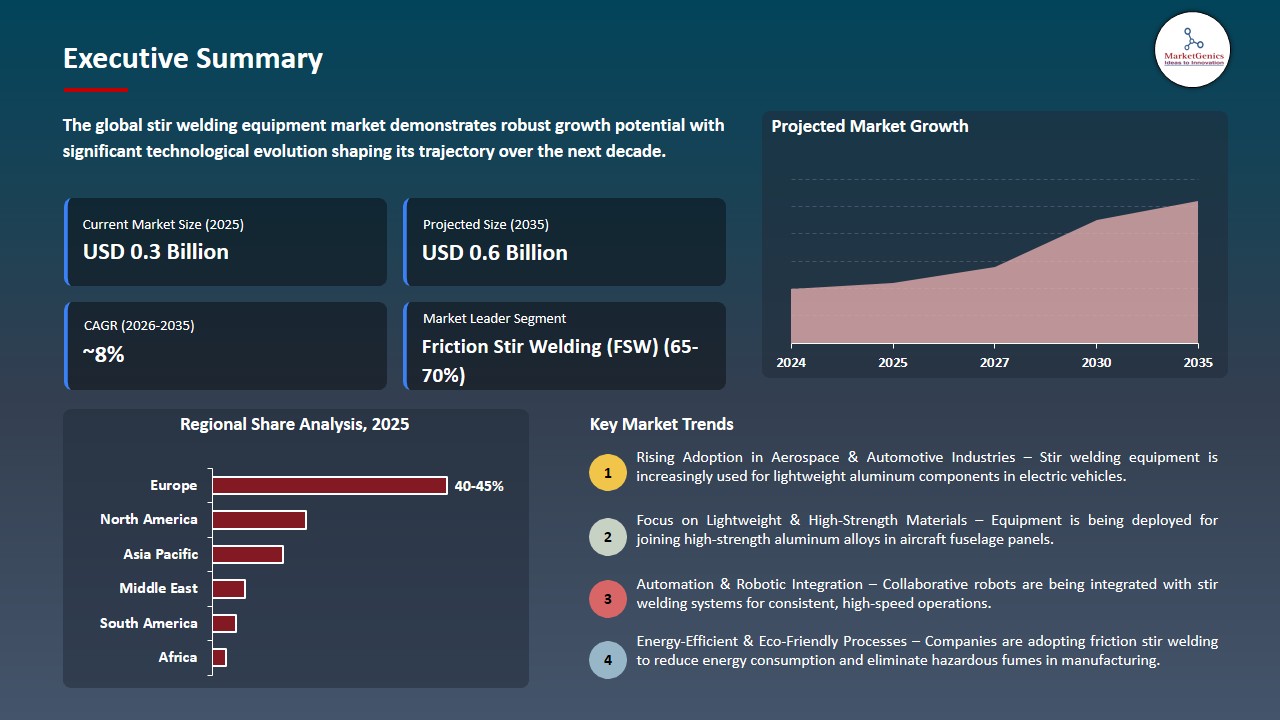
The global stir welding equipment market is witnessing strong growth, valued at USD 0.3 billion in 2025 and projected to reach USD 0.6 billion by 2035, expanding at a CAGR of 7.7% during the forecast period. Asia Pacific is the fastest-growing region in the stir welding equipment market due to rapid industrialization, expanding automotive and aerospace manufacturing, rising infrastructure development, and increasing adoption of advanced welding technologies.
Dan Adams, President & CEO of MTI, said, “MTI chose to partner with STIRTEC because they are leading the way in FSW innovation. With this partnership, MTI will immediately be able to leverage the latest FSW technology advancements to deliver an expanded portfolio of machines for a wide range of industries and applications”.
Stir welding equipment market has been propelled by the growing automation with OEMs adding FSW systems to robotic production lines. Automated FSW is more reliable in repeatability, uniformity of the quality of the weld, and the speed of the cycle, which means less human error and less labor expense. This renders friction welding the best choice in products such as automotive, aerospace, and e-mobility that require large-volume welding, where it is possible to promote large-scale adoption and market expansion.
The stir welding machinery market has been positively affected by the fact that FSW can create long and high-quality welds with minimal distortion in big structures like ships, trains and industrial structures. The feature minimizes redundancy, increases structural integrity, and maximizes efficiency in the production process. With industries requiring longer lasting, more accurate and larger scale metal assemblies, FSW usage is a major production growth prospect to the industry.
The adjacent growth opportunities in the stir welding equipment market are in the aerospace components of lightweight fuselage and wing assemblies, the defense and military sectors of high strength and robustness joints, renewable energy systems such as wind turbine blades, and bespoke industrial machinery with complicated geometries. The capacity of FSW to unite different metals, improve defect minimization, and aid automated manufacturing, positions market on the momentum in these new opportunities.
Stir Welding Equipment Market Dynamics and Trends
Driver: Superior Weld Quality & Joining of Similar/Dissimilar Metals in the Stir Welding Equipment Market
-
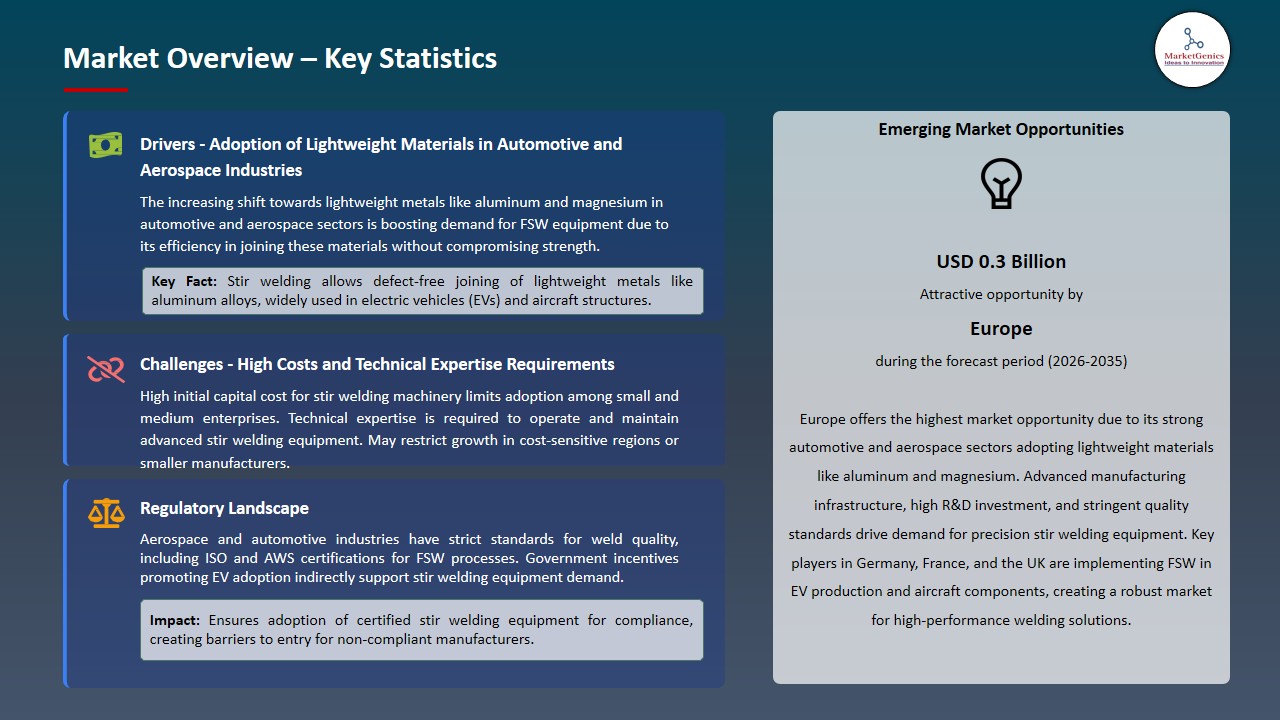
The stir welding equipment market is motivated by the fact that the technology has been able to produce high quality and defect free welds. Friction stir welding in the solid-state applies to joining metals without melting which greatly minimizes the usual problems of porosity, cracking and distortion. It allows the consistent welding of similar and dissimilar metals such as aluminum metals, magnesium metals and steel metals, which are commonly applied in the aerospace sector, in the automotive sector, and in shipbuilding sectors.
- The process guarantees high-quality joint strength, high fatigue resistance and low post-weld finishing needs. Such benefits have made stir welding equipment very desirable among manufacturers with interests in high-performance and robust assembly that is leading to its uptake and expansion in various manufacturing industries.
- In July 2025, KUKA was given a follow-up order by a large U.S. automaker of 12 more friction stir welding (FSW) cells to increase the production of electric vehicles. Welded battery cases and cooling jackets are done on the FSW cells which carry KR FORTEC robots and special tooling and combine dissimilar metals, such as aluminum and magnesium with high accuracy.
- This application shows that FSW can provide high quality of weld, energy savings and environmentally friendly production on scale production of e-mobility.
Restraint: Limited retrofit options for some legacy lines
-
The stir welding equipment market faces a major limitation in the complexity of integration with older manufacturing configurations. Several old production lines were setup to be welded using the traditional fusion welding technology and it would be hard to implement friction stir welding (FSW) equipment without making any major changes. This may necessitate a redesign of fixtures, process controls, and training that may add to the downtime and initial expenses.
- Older facilities might also be insufficient in space, structural support, and precision of robotic FSW cells, making retrofitting less feasible. These difficulties might be prohibitive to smaller manufacturers especially who decide to continue with the old ways of welding instead of undergoing expensive upgrades.
- Although there are obvious advantages of FSW such as quality of the weld, energy saving, and defects reduction, few retrofit opportunities and a high level of integration of existing lines are considered obstacles that decrease the rate of its introduction to other industries with old infrastructure and influences the expansion of the entire market.
Opportunity: Electric Vehicle (EV) Structures & Battery Housings
-
The electric vehicle (EV) industry is growing at a high rate, and this would be a huge opportunity to the stir welding equipment market. Automobile companies are shifting to the use of lightweight aluminum and aluminum alloy assemblies in battery housings, chassis and structural parts to enhance efficiency and range.
- Friction stir welding (FSW) can provide precise and high-strength joints of these materials, with dissimilar metal combinations, and reduce defects and distortion. Its sustainable and eco-efficient process correlates with the sustainability of the EV-manufacturing. With the increase in the number of EVs produced by automakers and the development of sophisticated battery and structural layouts, the FSW equipment will be in high demand, and the manufacturing of EVs will become one of the key growth drivers and opportunities to expand the market.
- In November 2025, apt Group, with the support of RRS Schilling GmbH, applied friction stir welding (FSW) in its battery housing manufacturing process of the agricultural machinery market. This application made precise, durable joints in lightweight aluminum structures and made it more efficient and set new standards in the industry. The project also emphasizes the increasing use of FSW in lightweight, high-performance EV and machinery parts, which show that this material has a potential in the market and it is technologically relevant.
- The friction stir welding is a substantial growth opportunity as it will allow to provide high-quality, efficient, and sustainable metal joining in various industrial applications.
Key Trend: Hybrid Welding Solutions
-
The integration of friction stir welding (FSW) with other welding methods or additive manufacturing processes to produce hybrid solutions is a current trend in the stir welding equipment market. This strategy promotes the flexibility of FSW, which enables manufacturers to meet sophisticated assembly needs that cannot be met solely by single welding techniques.
- Hybrid systems allow the creation of superior parts in the aerospace, automotive and industrial machinery industries as the capability of FSW to make high-strength and defect-free joints is combined with the precision and flexibility of additive or fusion processes. The pattern favors shorter production cycles, decreased material wastage, and capability to bond dissimilar or complicated geometries, making hybrid FSW solutions a significant source of novelty and development of the market.
- In July 2025, Mazak MegaStir showcased its high-speed Instrumented Tool Holder (ITH) for friction stir welding (FSW) at FABTECH 2025. The ITH, integrated into Mazak’s HYBRID Multi-Tasking machines, combines FSW with subtractive machining, enabling precise, high-strength joins with minimal distortion on aluminum assemblies.
- The system features real-time monitoring, ultra-hard diamond-tipped tools for longer life, improved weld quality, and higher productivity, illustrating the market’s move toward hybrid FSW solutions for efficient, versatile manufacturing.
Stir-Welding-Equipment-Market Analysis and Segmental Data

Friction Stir Welding (FSW) Dominate Global Stir Welding Equipment Market
-
Friction stir welding (FSW) has emerged as the dominant technology in the global Stir Welding Equipment Market due to its ability to produce high-strength, defect-free joints in both similar and dissimilar metals without melting. Its solid-state process minimizes porosity, cracking, and distortion, making it ideal for critical applications in aerospace, automotive, shipbuilding, and e-mobility sectors.
- The increasing demand for lightweight aluminum assemblies, EV battery housings, and large-structure joining further boosts FSW adoption. Additionally, FSW’s energy efficiency, environmental benefits, and compatibility with robotic and hybrid systems reinforce its position as the preferred choice for manufacturers worldwide, driving significant market growth and technological advancement in welding equipment.
- In 2025, Honda’s Anna Engine Plant in Ohio implemented friction stir welding (FSW) to join the two halves of cast aluminum battery cases for EVs. As the largest Honda engine plant globally, it now produces megacast EV battery housings for Honda and Acura electric vehicles, demonstrating FSW’s effectiveness in creating high-strength, precise, and defect-free assemblies for large-scale automotive production.
- Friction stir welding is increasingly recognized as a critical technology enabling high-quality, efficient, and reliable metal joining across a wide range of industries globally.
Europe Leads Global Stir Welding Equipment Market Demand
-
Europe has emerged as a leading region in the global stir welding equipment market, driven by strong demand across automotive, aerospace, and shipbuilding sectors. The region’s focus on lightweight construction, high-strength components, and sustainable manufacturing has accelerated the adoption of stir welding equipment.
- European manufacturers are increasingly integrating FSW into production lines for electric vehicles, aluminum-intensive structural parts, and critical aerospace assemblies, taking advantage of its ability to produce defect-free, high-quality welds in both similar and dissimilar metals.
- The presence of advanced manufacturing technologies, well-established industrial infrastructure, and supportive regulations in Europe further strengthens market growth. Additionally, European OEMs and suppliers are investing in robotic and hybrid FSW systems, which enhance productivity, process repeatability, and energy efficiency.
- These factors, combined with the region’s commitment to sustainability and lightweighting, position Europe at the forefront of the Stir Welding Equipment Market, driving innovation and adoption of cutting-edge welding solutions across multiple industrial applications.
Stir-Welding-Equipment-Market Ecosystem
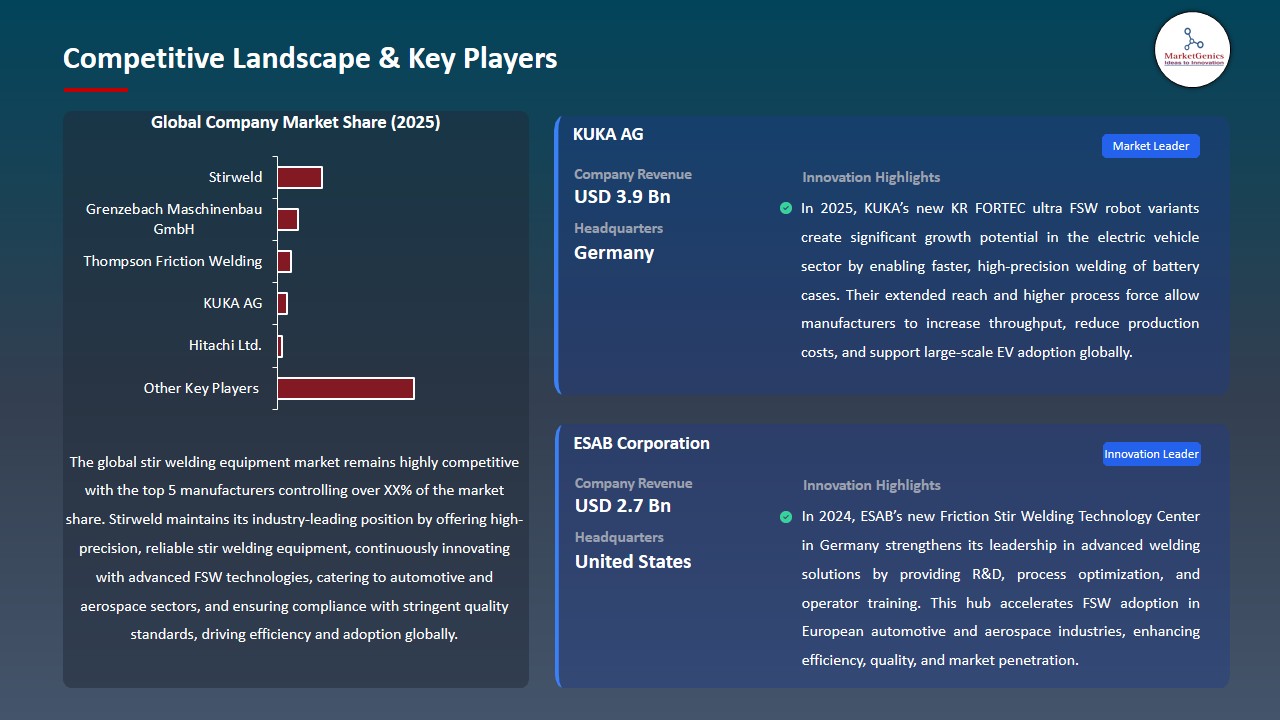
The global stir welding equipment market is consolidated, with key players including Stirweld, Grenzebach Maschinenbau GmbH, Thompson Friction Welding, KUKA AG, and Hitachi Ltd. These companies maintain competitive advantages through advanced friction stir welding (FSW) technologies, robotic automation, precision tooling, hybrid multi-tasking systems, and software-enabled process monitoring, which enhance weld quality, operational efficiency, and repeatability across industrial applications.
The market value chain spans research and development of FSW tools and robotic systems, manufacturing of welding equipment, software development for process control and monitoring, calibration and field testing, deployment across automotive, aerospace, shipbuilding, and e-mobility sectors, compliance with industrial standards, and after-sales services including training, maintenance, and system upgrades.
Entry barriers remain high due to the capital-intensive nature of FSW equipment, specialized expertise required for tool design and robotic integration, adaptation to diverse materials and thicknesses, and strict industrial and safety regulations.
The market continues to evolve through innovations including robotic and mobile FSW systems, hybrid welding solutions combining FSW with additive or subtractive processes, real-time process monitoring, instrumented tooling, and high-speed precision welding, driving differentiation and adoption across global industrial sectors.
Recent Development and Strategic Overview:
-
In June 2025, Grenzebach strengthened its position in the friction stir welding equipment market by securing an €8 million order from leading automotive manufacturers for specialized FSW machines used in EV battery tray production, alongside a €2 million retrofit project. The orders highlight strong customer confidence in Grenzebach’s high-speed, precision FSW solutions and underscore its role as a long-term systems partner supporting sustainable mobility and lifecycle-driven manufacturing.
- In 2024, Manufacturing Technology, Inc. (MTI) and STIRTEC GmbH formed a strategic global partnership to expand friction stir welding (FSW) machine production and regional delivery. The collaboration combines MTI’s global manufacturing footprint with STIRTEC’s advanced FSW technology to serve growing demand from EV, aerospace, and automotive applications across the Americas, India, Australia, and New Zealand through a co-branded FSW machine portfolio.
Report Scope
|
Detail |
|
|
Market Size in 2025 |
USD 0.3 Bn |
|
Market Forecast Value in 2035 |
USD 0.6 Bn |
|
Growth Rate (CAGR) |
7.7% |
|
Forecast Period |
2026 – 2035 |
|
Historical Data Available for |
2021 – 2024 |
|
Market Size Units |
US$ Billion for Value Thousand Units for Volume |
|
Report Format |
Electronic (PDF) + Excel |
|
North America |
Europe |
Asia Pacific |
Middle East |
Africa |
South America |
|
|
|
|
|
|
|
Companies Covered |
|||||
|
|
|
|
|
|
Stir-Welding-Equipment-Market Segmentation and Highlights
|
Segment |
Sub-segment |
|
Stir Welding Equipment Market, By Technology Type |
|
|
Stir Welding Equipment Market, By Equipment Type |
|
|
Stir Welding Equipment Market, By Automation Level |
|
|
Stir Welding Equipment Market, By Material Type |
|
|
Stir Welding Equipment Market, By Spindle Speed Capacity |
|
|
Stir Welding Equipment Market, By Force Capacity |
|
|
Stir Welding Equipment Market, By Tool Configuration |
|
|
Stir Welding Equipment Market, By Weld Joint Configuration |
|
|
Stir Welding Equipment Market, By Cooling System |
|
|
Stir Welding Equipment Market, By End-Use Industry |
|
Frequently Asked Questions
Table of Contents
- 1. Research Methodology and Assumptions
- 1.1. Definitions
- 1.2. Research Design and Approach
- 1.3. Data Collection Methods
- 1.4. Base Estimates and Calculations
- 1.5. Forecasting Models
- 1.5.1. Key Forecast Factors & Impact Analysis
- 1.6. Secondary Research
- 1.6.1. Open Sources
- 1.6.2. Paid Databases
- 1.6.3. Associations
- 1.7. Primary Research
- 1.7.1. Primary Sources
- 1.7.2. Primary Interviews with Stakeholders across Ecosystem
- 2. Executive Summary
- 2.1. Global Stir Welding Equipment Market Outlook
- 2.1.1. Stir Welding Equipment Market Size Volume (Thousand Units) and Value (US$ Bn), and Forecasts, 2021-2035
- 2.1.2. Compounded Annual Growth Rate Analysis
- 2.1.3. Growth Opportunity Analysis
- 2.1.4. Segmental Share Analysis
- 2.1.5. Geographical Share Analysis
- 2.2. Market Analysis and Facts
- 2.3. Supply-Demand Analysis
- 2.4. Competitive Benchmarking
- 2.5. Go-to- Market Strategy
- 2.5.1. Customer/ End-use Industry Assessment
- 2.5.2. Growth Opportunity Data, 2026-2035
- 2.5.2.1. Regional Data
- 2.5.2.2. Country Data
- 2.5.2.3. Segmental Data
- 2.5.3. Identification of Potential Market Spaces
- 2.5.4. GAP Analysis
- 2.5.5. Potential Attractive Price Points
- 2.5.6. Prevailing Market Risks & Challenges
- 2.5.7. Preferred Sales & Marketing Strategies
- 2.5.8. Key Recommendations and Analysis
- 2.5.9. A Way Forward
- 2.1. Global Stir Welding Equipment Market Outlook
- 3. Industry Data and Premium Insights
- 3.1. Global Industrial Machinery Overview, 2025
- 3.1.1. Industrial Machinery Ecosystem Analysis
- 3.1.2. Key Trends for Industrial Machinery
- 3.1.3. Regional Distribution for Industrial Machinery
- 3.2. Supplier Customer Data
- 3.3. Technology Roadmap and Developments
- 3.4. Trade Analysis
- 3.4.1. Import & Export Analysis, 2025
- 3.4.2. Top Importing Countries
- 3.4.3. Top Exporting Countries
- 3.5. Trump Tariff Impact Analysis
- 3.5.1. Manufacturer
- 3.5.1.1. Based on the component & Raw material
- 3.5.2. Supply Chain
- 3.5.3. End Consumer
- 3.5.1. Manufacturer
- 3.6. Raw Material Analysis
- 3.1. Global Industrial Machinery Overview, 2025
- 4. Market Overview
- 4.1. Market Dynamics
- 4.1.1. Drivers
- 4.1.1.1. Increasing use of lightweight metals in automotive and aerospace industries.
- 4.1.1.2. Rising demand for electric vehicles requiring high-precision battery welding.
- 4.1.1.3. Adoption of automated and high-throughput manufacturing systems.
- 4.1.2. Restraints
- 4.1.2.1. High initial cost of stir welding equipment.
- 4.1.2.2. Need for skilled operators and technical expertise.
- 4.1.1. Drivers
- 4.2. Key Trend Analysis
- 4.3. Regulatory Framework
- 4.3.1. Key Regulations, Norms, and Subsidies, by Key Countries
- 4.3.2. Tariffs and Standards
- 4.3.3. Impact Analysis of Regulations on the Market
- 4.4. Value Chain Analysis
- 4.4.1. Component Suppliers
- 4.4.2. Equipment Manufacturers
- 4.4.3. Distributors & Sales Channels
- 4.4.4. End-Users
- 4.5. Cost Structure Analysis
- 4.6. Pricing Analysis
- 4.7. Porter’s Five Forces Analysis
- 4.8. PESTEL Analysis
- 4.9. Global Stir Welding Equipment Market Demand
- 4.9.1. Historical Market Size – Volume (Thousand Units) and Value (US$ Bn), 2020-2024
- 4.9.2. Current and Future Market Size – Volume (Thousand Units) and Value (US$ Bn), 2026–2035
- 4.9.2.1. Y-o-Y Growth Trends
- 4.9.2.2. Absolute $ Opportunity Assessment
- 4.1. Market Dynamics
- 5. Competition Landscape
- 5.1. Competition structure
- 5.1.1. Fragmented v/s consolidated
- 5.2. Company Share Analysis, 2025
- 5.2.1. Global Company Market Share
- 5.2.2. By Region
- 5.2.2.1. North America
- 5.2.2.2. Europe
- 5.2.2.3. Asia Pacific
- 5.2.2.4. Middle East
- 5.2.2.5. Africa
- 5.2.2.6. South America
- 5.3. Product Comparison Matrix
- 5.3.1. Specifications
- 5.3.2. Market Positioning
- 5.3.3. Pricing
- 5.1. Competition structure
- 6. Global Stir Welding Equipment Market Analysis, by Technology Type
- 6.1. Key Segment Analysis
- 6.2. Stir Welding Equipment Market Size Volume (Thousand Units) and Value (US$ Bn), Analysis, and Forecasts, by Technology Type, 2021-2035
- 6.2.1. Friction Stir Welding (FSW)
- 6.2.2. Conventional FSW
- 6.2.3. Stationary Shoulder FSW
- 6.2.4. Self-Reacting FSW
- 6.2.5. Friction Stir Spot Welding (FSSW)
- 6.2.6. Friction Stir Processing (FSP)
- 6.2.7. Bobbin Tool Friction Stir Welding
- 6.2.8. Others
- 7. Global Stir Welding Equipment Market Analysis, by Equipment Type
- 7.1. Key Segment Analysis
- 7.2. Stir Welding Equipment Market Size Volume (Thousand Units) and Value (US$ Bn), Analysis, and Forecasts, by Equipment Type, 2021-2035
- 7.2.1. Desktop Friction Machines
- 7.2.2. Gantry-Type Friction Machines
- 7.2.3. Robotic Friction Systems
- 7.2.4. Portable Friction Equipment
- 7.2.5. Custom-Built Friction Systems
- 8. Global Stir Welding Equipment Market Analysis, by Automation Level
- 8.1. Key Segment Analysis
- 8.2. Stir Welding Equipment Market Size Volume (Thousand Units) and Value (US$ Bn), Analysis, and Forecasts, by Automation Level, 2021-2035
- 8.2.1. Manual
- 8.2.2. Semi-Automatic
- 8.2.3. Fully Automatic
- 8.2.4. Robotic Integrated Systems
- 9. Global Stir Welding Equipment Market Analysis, by Material Type
- 9.1. Key Segment Analysis
- 9.2. Stir Welding Equipment Market Size Volume (Thousand Units) and Value (US$ Bn), Analysis, and Forecasts, by Material Type, 2021-2035
- 9.2.1. Aluminum Alloys
- 9.2.1.1. 2XXX Series
- 9.2.1.2. 5XXX Series
- 9.2.1.3. 6XXX Series
- 9.2.1.4. 7XXX Series
- 9.2.2. Magnesium Alloys
- 9.2.3. Copper Alloys
- 9.2.4. Steel and Stainless Steel
- 9.2.5. Titanium Alloys
- 9.2.6. Dissimilar Material Welding
- 9.2.1. Aluminum Alloys
- 10. Global Stir Welding Equipment Market Analysis, by Spindle Speed Capacity
- 10.1. Key Segment Analysis
- 10.2. Stir Welding Equipment Market Size Volume (Thousand Units) and Value (US$ Bn), Analysis, and Forecasts, by Spindle Speed Capacity, 2021-2035
- 10.2.1. Low Speed (< 500 RPM)
- 10.2.2. Medium Speed (500-1500 RPM)
- 10.2.3. High Speed (1500-3000 RPM)
- 10.2.4. Ultra-High Speed (> 3000 RPM)
- 11. Global Stir Welding Equipment Market Analysis, by Force Capacity
- 11.1. Key Segment Analysis
- 11.2. Stir Welding Equipment Market Size Volume (Thousand Units) and Value (US$ Bn), Analysis, and Forecasts, by Force Capacity, 2021-2035
- 11.2.1. < 10 kN
- 11.2.2. 10-30 kN
- 11.2.3. 30-60 kN
- 11.2.4. > 60 kN
- 12. Global Stir Welding Equipment Market Analysis, by Tool Configuration
- 12.1. Key Segment Analysis
- 12.2. Stir Welding Equipment Market Size Volume (Thousand Units) and Value (US$ Bn), Analysis, and Forecasts, by Tool Configuration, 2021-2035
- 12.2.1. Fixed Pin Tools
- 12.2.2. Retractable Pin Tools
- 12.2.3. Adjustable Pin Tools
- 12.2.4. Multi-Pin Tools
- 12.2.5. Scrolled Shoulder Tools
- 12.2.6. Whorl Design Tools
- 12.2.7. Others
- 13. Global Stir Welding Equipment Market Analysis and Forecasts, by Weld Joint Configuration
- 13.1. Key Findings
- 13.2. Stir Welding Equipment Market Size Volume (Thousand Units) and Value (US$ Bn), Analysis, and Forecasts, by Weld Joint Configuration, 2021-2035
- 13.2.1. Butt Joint Welding
- 13.2.2. Lap Joint Welding
- 13.2.3. T-Joint Welding
- 13.2.4. Fillet Welding
- 13.2.5. Corner Joint Welding
- 13.2.6. Others
- 14. Global Stir Welding Equipment Market Analysis and Forecasts, by Cooling System
- 14.1. Key Findings
- 14.2. Stir Welding Equipment Market Size Volume (Thousand Units) and Value (US$ Bn), Analysis, and Forecasts, by Cooling System, 2021-2035
- 14.2.1. Air-Cooled Systems
- 14.2.2. Water-Cooled Systems
- 14.2.3. Cryogenic Cooling Systems
- 14.2.4. No External Cooling
- 15. Global Stir Welding Equipment Market Analysis and Forecasts, by End-Use Industry
- 15.1. Key Findings
- 15.2. Stir Welding Equipment Market Size Volume (Thousand Units) and Value (US$ Bn), Analysis, and Forecasts, by End-Use Industry, 2021-2035
- 15.2.1. Aerospace & Defense
- 15.2.2. Automotive
- 15.2.3. Railway & Transportation
- 15.2.4. Marine & Shipbuilding
- 15.2.5. Electronics & Electrical
- 15.2.6. Construction & Building
- 15.2.7. Energy & Power
- 15.2.8. General Manufacturing
- 16. Global Stir Welding Equipment Market Analysis and Forecasts, by Region
- 16.1. Key Findings
- 16.2. Stir Welding Equipment Market Size Volume (Thousand Units) and Value (US$ Bn), Analysis, and Forecasts, by Region, 2021-2035
- 16.2.1. North America
- 16.2.2. Europe
- 16.2.3. Asia Pacific
- 16.2.4. Middle East
- 16.2.5. Africa
- 16.2.6. South America
- 17. North America Stir Welding Equipment Market Analysis
- 17.1. Key Segment Analysis
- 17.2. Regional Snapshot
- 17.3. North America Stir Welding Equipment Market Size- Volume (Thousand Units) and Value (US$ Bn), Analysis, and Forecasts, 2021-2035
- 17.3.1. Technology Type
- 17.3.2. Equipment Type
- 17.3.3. Automation Level
- 17.3.4. Material Type
- 17.3.5. Spindle Speed Capacity
- 17.3.6. Force Capacity
- 17.3.7. Tool Configuration
- 17.3.8. Weld Joint Configuration
- 17.3.9. Cooling System
- 17.3.10. End-Use Industry
- 17.3.11. Country
- 17.3.11.1. USA
- 17.3.11.2. Canada
- 17.3.11.3. Mexico
- 17.4. USA Stir Welding Equipment Market
- 17.4.1. Country Segmental Analysis
- 17.4.2. Technology Type
- 17.4.3. Equipment Type
- 17.4.4. Automation Level
- 17.4.5. Material Type
- 17.4.6. Spindle Speed Capacity
- 17.4.7. Force Capacity
- 17.4.8. Tool Configuration
- 17.4.9. Weld Joint Configuration
- 17.4.10. Cooling System
- 17.4.11. End-Use Industry
- 17.5. Canada Stir Welding Equipment Market
- 17.5.1. Country Segmental Analysis
- 17.5.2. Technology Type
- 17.5.3. Equipment Type
- 17.5.4. Automation Level
- 17.5.5. Material Type
- 17.5.6. Spindle Speed Capacity
- 17.5.7. Force Capacity
- 17.5.8. Tool Configuration
- 17.5.9. Weld Joint Configuration
- 17.5.10. Cooling System
- 17.5.11. End-Use Industry
- 17.6. Mexico Stir Welding Equipment Market
- 17.6.1. Country Segmental Analysis
- 17.6.2. Technology Type
- 17.6.3. Equipment Type
- 17.6.4. Automation Level
- 17.6.5. Material Type
- 17.6.6. Spindle Speed Capacity
- 17.6.7. Force Capacity
- 17.6.8. Tool Configuration
- 17.6.9. Weld Joint Configuration
- 17.6.10. Cooling System
- 17.6.11. End-Use Industry
- 18. Europe Stir Welding Equipment Market Analysis
- 18.1. Key Segment Analysis
- 18.2. Regional Snapshot
- 18.3. Europe Stir Welding Equipment Market Size Volume (Thousand Units) and Value (US$ Bn), Analysis, and Forecasts, 2021-2035
- 18.3.1. Technology Type
- 18.3.2. Equipment Type
- 18.3.3. Automation Level
- 18.3.4. Material Type
- 18.3.5. Spindle Speed Capacity
- 18.3.6. Force Capacity
- 18.3.7. Tool Configuration
- 18.3.8. Weld Joint Configuration
- 18.3.9. Cooling System
- 18.3.10. End-Use Industry
- 18.3.11. Country
- 18.3.11.1. Germany
- 18.3.11.2. United Kingdom
- 18.3.11.3. France
- 18.3.11.4. Italy
- 18.3.11.5. Spain
- 18.3.11.6. Netherlands
- 18.3.11.7. Nordic Countries
- 18.3.11.8. Poland
- 18.3.11.9. Russia & CIS
- 18.3.11.10. Rest of Europe
- 18.4. Germany Stir Welding Equipment Market
- 18.4.1. Country Segmental Analysis
- 18.4.2. Technology Type
- 18.4.3. Equipment Type
- 18.4.4. Automation Level
- 18.4.5. Material Type
- 18.4.6. Spindle Speed Capacity
- 18.4.7. Force Capacity
- 18.4.8. Tool Configuration
- 18.4.9. Weld Joint Configuration
- 18.4.10. Cooling System
- 18.4.11. End-Use Industry
- 18.5. United Kingdom Stir Welding Equipment Market
- 18.5.1. Country Segmental Analysis
- 18.5.2. Technology Type
- 18.5.3. Equipment Type
- 18.5.4. Automation Level
- 18.5.5. Material Type
- 18.5.6. Spindle Speed Capacity
- 18.5.7. Force Capacity
- 18.5.8. Tool Configuration
- 18.5.9. Weld Joint Configuration
- 18.5.10. Cooling System
- 18.5.11. End-Use Industry
- 18.6. France Stir Welding Equipment Market
- 18.6.1. Country Segmental Analysis
- 18.6.2. Technology Type
- 18.6.3. Equipment Type
- 18.6.4. Automation Level
- 18.6.5. Material Type
- 18.6.6. Spindle Speed Capacity
- 18.6.7. Force Capacity
- 18.6.8. Tool Configuration
- 18.6.9. Weld Joint Configuration
- 18.6.10. Cooling System
- 18.6.11. End-Use Industry
- 18.7. Italy Stir Welding Equipment Market
- 18.7.1. Country Segmental Analysis
- 18.7.2. Technology Type
- 18.7.3. Equipment Type
- 18.7.4. Automation Level
- 18.7.5. Material Type
- 18.7.6. Spindle Speed Capacity
- 18.7.7. Force Capacity
- 18.7.8. Tool Configuration
- 18.7.9. Weld Joint Configuration
- 18.7.10. Cooling System
- 18.7.11. End-Use Industry
- 18.8. Spain Stir Welding Equipment Market
- 18.8.1. Country Segmental Analysis
- 18.8.2. Technology Type
- 18.8.3. Equipment Type
- 18.8.4. Automation Level
- 18.8.5. Material Type
- 18.8.6. Spindle Speed Capacity
- 18.8.7. Force Capacity
- 18.8.8. Tool Configuration
- 18.8.9. Weld Joint Configuration
- 18.8.10. Cooling System
- 18.8.11. End-Use Industry
- 18.9. Netherlands Stir Welding Equipment Market
- 18.9.1. Country Segmental Analysis
- 18.9.2. Technology Type
- 18.9.3. Equipment Type
- 18.9.4. Automation Level
- 18.9.5. Material Type
- 18.9.6. Spindle Speed Capacity
- 18.9.7. Force Capacity
- 18.9.8. Tool Configuration
- 18.9.9. Weld Joint Configuration
- 18.9.10. Cooling System
- 18.9.11. End-Use Industry
- 18.10. Nordic Countries Stir Welding Equipment Market
- 18.10.1. Country Segmental Analysis
- 18.10.2. Technology Type
- 18.10.3. Equipment Type
- 18.10.4. Automation Level
- 18.10.5. Material Type
- 18.10.6. Spindle Speed Capacity
- 18.10.7. Force Capacity
- 18.10.8. Tool Configuration
- 18.10.9. Weld Joint Configuration
- 18.10.10. Cooling System
- 18.10.11. End-Use Industry
- 18.11. Poland Stir Welding Equipment Market
- 18.11.1. Country Segmental Analysis
- 18.11.2. Technology Type
- 18.11.3. Equipment Type
- 18.11.4. Automation Level
- 18.11.5. Material Type
- 18.11.6. Spindle Speed Capacity
- 18.11.7. Force Capacity
- 18.11.8. Tool Configuration
- 18.11.9. Weld Joint Configuration
- 18.11.10. Cooling System
- 18.11.11. End-Use Industry
- 18.12. Russia & CIS Stir Welding Equipment Market
- 18.12.1. Country Segmental Analysis
- 18.12.2. Technology Type
- 18.12.3. Equipment Type
- 18.12.4. Automation Level
- 18.12.5. Material Type
- 18.12.6. Spindle Speed Capacity
- 18.12.7. Force Capacity
- 18.12.8. Tool Configuration
- 18.12.9. Weld Joint Configuration
- 18.12.10. Cooling System
- 18.12.11. End-Use Industry
- 18.13. Rest of Europe Stir Welding Equipment Market
- 18.13.1. Country Segmental Analysis
- 18.13.2. Technology Type
- 18.13.3. Equipment Type
- 18.13.4. Automation Level
- 18.13.5. Material Type
- 18.13.6. Spindle Speed Capacity
- 18.13.7. Force Capacity
- 18.13.8. Tool Configuration
- 18.13.9. Weld Joint Configuration
- 18.13.10. Cooling System
- 18.13.11. End-Use Industry
- 19. Asia Pacific Stir Welding Equipment Market Analysis
- 19.1. Key Segment Analysis
- 19.2. Regional Snapshot
- 19.3. Asia Pacific Stir Welding Equipment Market Size Volume (Thousand Units) and Value (US$ Bn), Analysis, and Forecasts, 2021-2035
- 19.3.1. Technology Type
- 19.3.2. Equipment Type
- 19.3.3. Automation Level
- 19.3.4. Material Type
- 19.3.5. Spindle Speed Capacity
- 19.3.6. Force Capacity
- 19.3.7. Tool Configuration
- 19.3.8. Weld Joint Configuration
- 19.3.9. Cooling System
- 19.3.10. End-Use Industry
- 19.3.11. Country
- 19.3.11.1. China
- 19.3.11.2. India
- 19.3.11.3. Japan
- 19.3.11.4. South Korea
- 19.3.11.5. Australia and New Zealand
- 19.3.11.6. Indonesia
- 19.3.11.7. Malaysia
- 19.3.11.8. Thailand
- 19.3.11.9. Vietnam
- 19.3.11.10. Rest of Asia Pacific
- 19.4. China Stir Welding Equipment Market
- 19.4.1. Country Segmental Analysis
- 19.4.2. Technology Type
- 19.4.3. Equipment Type
- 19.4.4. Automation Level
- 19.4.5. Material Type
- 19.4.6. Spindle Speed Capacity
- 19.4.7. Force Capacity
- 19.4.8. Tool Configuration
- 19.4.9. Weld Joint Configuration
- 19.4.10. Cooling System
- 19.4.11. End-Use Industry
- 19.5. India Stir Welding Equipment Market
- 19.5.1. Country Segmental Analysis
- 19.5.2. Technology Type
- 19.5.3. Equipment Type
- 19.5.4. Automation Level
- 19.5.5. Material Type
- 19.5.6. Spindle Speed Capacity
- 19.5.7. Force Capacity
- 19.5.8. Tool Configuration
- 19.5.9. Weld Joint Configuration
- 19.5.10. Cooling System
- 19.5.11. End-Use Industry
- 19.6. Japan Stir Welding Equipment Market
- 19.6.1. Country Segmental Analysis
- 19.6.2. Technology Type
- 19.6.3. Equipment Type
- 19.6.4. Automation Level
- 19.6.5. Material Type
- 19.6.6. Spindle Speed Capacity
- 19.6.7. Force Capacity
- 19.6.8. Tool Configuration
- 19.6.9. Weld Joint Configuration
- 19.6.10. Cooling System
- 19.6.11. End-Use Industry
- 19.7. South Korea Stir Welding Equipment Market
- 19.7.1. Country Segmental Analysis
- 19.7.2. Technology Type
- 19.7.3. Equipment Type
- 19.7.4. Automation Level
- 19.7.5. Material Type
- 19.7.6. Spindle Speed Capacity
- 19.7.7. Force Capacity
- 19.7.8. Tool Configuration
- 19.7.9. Weld Joint Configuration
- 19.7.10. Cooling System
- 19.7.11. End-Use Industry
- 19.8. Australia and New Zealand Stir Welding Equipment Market
- 19.8.1. Country Segmental Analysis
- 19.8.2. Technology Type
- 19.8.3. Equipment Type
- 19.8.4. Automation Level
- 19.8.5. Material Type
- 19.8.6. Spindle Speed Capacity
- 19.8.7. Force Capacity
- 19.8.8. Tool Configuration
- 19.8.9. Weld Joint Configuration
- 19.8.10. Cooling System
- 19.8.11. End-Use Industry
- 19.9. Indonesia Stir Welding Equipment Market
- 19.9.1. Country Segmental Analysis
- 19.9.2. Technology Type
- 19.9.3. Equipment Type
- 19.9.4. Automation Level
- 19.9.5. Material Type
- 19.9.6. Spindle Speed Capacity
- 19.9.7. Force Capacity
- 19.9.8. Tool Configuration
- 19.9.9. Weld Joint Configuration
- 19.9.10. Cooling System
- 19.9.11. End-Use Industry
- 19.10. Malaysia Stir Welding Equipment Market
- 19.10.1. Country Segmental Analysis
- 19.10.2. Technology Type
- 19.10.3. Equipment Type
- 19.10.4. Automation Level
- 19.10.5. Material Type
- 19.10.6. Spindle Speed Capacity
- 19.10.7. Force Capacity
- 19.10.8. Tool Configuration
- 19.10.9. Weld Joint Configuration
- 19.10.10. Cooling System
- 19.10.11. End-Use Industry
- 19.11. Thailand Stir Welding Equipment Market
- 19.11.1. Country Segmental Analysis
- 19.11.2. Technology Type
- 19.11.3. Equipment Type
- 19.11.4. Automation Level
- 19.11.5. Material Type
- 19.11.6. Spindle Speed Capacity
- 19.11.7. Force Capacity
- 19.11.8. Tool Configuration
- 19.11.9. Weld Joint Configuration
- 19.11.10. Cooling System
- 19.11.11. End-Use Industry
- 19.12. Vietnam Stir Welding Equipment Market
- 19.12.1. Country Segmental Analysis
- 19.12.2. Technology Type
- 19.12.3. Equipment Type
- 19.12.4. Automation Level
- 19.12.5. Material Type
- 19.12.6. Spindle Speed Capacity
- 19.12.7. Force Capacity
- 19.12.8. Tool Configuration
- 19.12.9. Weld Joint Configuration
- 19.12.10. Cooling System
- 19.12.11. End-Use Industry
- 19.13. Rest of Asia Pacific Stir Welding Equipment Market
- 19.13.1. Country Segmental Analysis
- 19.13.2. Technology Type
- 19.13.3. Equipment Type
- 19.13.4. Automation Level
- 19.13.5. Material Type
- 19.13.6. Spindle Speed Capacity
- 19.13.7. Force Capacity
- 19.13.8. Tool Configuration
- 19.13.9. Weld Joint Configuration
- 19.13.10. Cooling System
- 19.13.11. End-Use Industry
- 20. Middle East Stir Welding Equipment Market Analysis
- 20.1. Key Segment Analysis
- 20.2. Regional Snapshot
- 20.3. Middle East Stir Welding Equipment Market Size Volume (Thousand Units) and Value (US$ Bn), Analysis, and Forecasts, 2021-2035
- 20.3.1. Technology Type
- 20.3.2. Equipment Type
- 20.3.3. Automation Level
- 20.3.4. Material Type
- 20.3.5. Spindle Speed Capacity
- 20.3.6. Force Capacity
- 20.3.7. Tool Configuration
- 20.3.8. Weld Joint Configuration
- 20.3.9. Cooling System
- 20.3.10. End-Use Industry
- 20.3.11. Country
- 20.3.11.1. Turkey
- 20.3.11.2. UAE
- 20.3.11.3. Saudi Arabia
- 20.3.11.4. Israel
- 20.3.11.5. Rest of Middle East
- 20.4. Turkey Stir Welding Equipment Market
- 20.4.1. Country Segmental Analysis
- 20.4.2. Technology Type
- 20.4.3. Equipment Type
- 20.4.4. Automation Level
- 20.4.5. Material Type
- 20.4.6. Spindle Speed Capacity
- 20.4.7. Force Capacity
- 20.4.8. Tool Configuration
- 20.4.9. Weld Joint Configuration
- 20.4.10. Cooling System
- 20.4.11. End-Use Industry
- 20.5. UAE Stir Welding Equipment Market
- 20.5.1. Country Segmental Analysis
- 20.5.2. Technology Type
- 20.5.3. Equipment Type
- 20.5.4. Automation Level
- 20.5.5. Material Type
- 20.5.6. Spindle Speed Capacity
- 20.5.7. Force Capacity
- 20.5.8. Tool Configuration
- 20.5.9. Weld Joint Configuration
- 20.5.10. Cooling System
- 20.5.11. End-Use Industry
- 20.6. Saudi Arabia Stir Welding Equipment Market
- 20.6.1. Country Segmental Analysis
- 20.6.2. Technology Type
- 20.6.3. Equipment Type
- 20.6.4. Automation Level
- 20.6.5. Material Type
- 20.6.6. Spindle Speed Capacity
- 20.6.7. Force Capacity
- 20.6.8. Tool Configuration
- 20.6.9. Weld Joint Configuration
- 20.6.10. Cooling System
- 20.6.11. End-Use Industry
- 20.7. Israel Stir Welding Equipment Market
- 20.7.1. Country Segmental Analysis
- 20.7.2. Technology Type
- 20.7.3. Equipment Type
- 20.7.4. Automation Level
- 20.7.5. Material Type
- 20.7.6. Spindle Speed Capacity
- 20.7.7. Force Capacity
- 20.7.8. Tool Configuration
- 20.7.9. Weld Joint Configuration
- 20.7.10. Cooling System
- 20.7.11. End-Use Industry
- 20.8. Rest of Middle East Stir Welding Equipment Market
- 20.8.1. Country Segmental Analysis
- 20.8.2. Technology Type
- 20.8.3. Equipment Type
- 20.8.4. Automation Level
- 20.8.5. Material Type
- 20.8.6. Spindle Speed Capacity
- 20.8.7. Force Capacity
- 20.8.8. Tool Configuration
- 20.8.9. Weld Joint Configuration
- 20.8.10. Cooling System
- 20.8.11. End-Use Industry
- 21. Africa Stir Welding Equipment Market Analysis
- 21.1. Key Segment Analysis
- 21.2. Regional Snapshot
- 21.3. Africa Stir Welding Equipment Market Size Volume (Thousand Units) and Value (US$ Bn), Analysis, and Forecasts, 2021-2035
- 21.3.1. Technology Type
- 21.3.2. Equipment Type
- 21.3.3. Automation Level
- 21.3.4. Material Type
- 21.3.5. Spindle Speed Capacity
- 21.3.6. Force Capacity
- 21.3.7. Tool Configuration
- 21.3.8. Weld Joint Configuration
- 21.3.9. Cooling System
- 21.3.10. End-Use Industry
- 21.3.11. Country
- 21.3.11.1. South Africa
- 21.3.11.2. Egypt
- 21.3.11.3. Nigeria
- 21.3.11.4. Algeria
- 21.3.11.5. Rest of Africa
- 21.4. South Africa Stir Welding Equipment Market
- 21.4.1. Country Segmental Analysis
- 21.4.2. Technology Type
- 21.4.3. Equipment Type
- 21.4.4. Automation Level
- 21.4.5. Material Type
- 21.4.6. Spindle Speed Capacity
- 21.4.7. Force Capacity
- 21.4.8. Tool Configuration
- 21.4.9. Weld Joint Configuration
- 21.4.10. Cooling System
- 21.4.11. End-Use Industry
- 21.5. Egypt Stir Welding Equipment Market
- 21.5.1. Country Segmental Analysis
- 21.5.2. Technology Type
- 21.5.3. Equipment Type
- 21.5.4. Automation Level
- 21.5.5. Material Type
- 21.5.6. Spindle Speed Capacity
- 21.5.7. Force Capacity
- 21.5.8. Tool Configuration
- 21.5.9. Weld Joint Configuration
- 21.5.10. Cooling System
- 21.5.11. End-Use Industry
- 21.6. Nigeria Stir Welding Equipment Market
- 21.6.1. Country Segmental Analysis
- 21.6.2. Technology Type
- 21.6.3. Equipment Type
- 21.6.4. Automation Level
- 21.6.5. Material Type
- 21.6.6. Spindle Speed Capacity
- 21.6.7. Force Capacity
- 21.6.8. Tool Configuration
- 21.6.9. Weld Joint Configuration
- 21.6.10. Cooling System
- 21.6.11. End-Use Industry
- 21.7. Algeria Stir Welding Equipment Market
- 21.7.1. Country Segmental Analysis
- 21.7.2. Technology Type
- 21.7.3. Equipment Type
- 21.7.4. Automation Level
- 21.7.5. Material Type
- 21.7.6. Spindle Speed Capacity
- 21.7.7. Force Capacity
- 21.7.8. Tool Configuration
- 21.7.9. Weld Joint Configuration
- 21.7.10. Cooling System
- 21.7.11. End-Use Industry
- 21.8. Rest of Africa Stir Welding Equipment Market
- 21.8.1. Country Segmental Analysis
- 21.8.2. Technology Type
- 21.8.3. Equipment Type
- 21.8.4. Automation Level
- 21.8.5. Material Type
- 21.8.6. Spindle Speed Capacity
- 21.8.7. Force Capacity
- 21.8.8. Tool Configuration
- 21.8.9. Weld Joint Configuration
- 21.8.10. Cooling System
- 21.8.11. End-Use Industry
- 22. South America Stir Welding Equipment Market Analysis
- 22.1. Key Segment Analysis
- 22.2. Regional Snapshot
- 22.3. South America Stir Welding Equipment Market Size Volume (Thousand Units) and Value (US$ Bn), Analysis, and Forecasts, 2021-2035
- 22.3.1. Technology Type
- 22.3.2. Equipment Type
- 22.3.3. Automation Level
- 22.3.4. Material Type
- 22.3.5. Spindle Speed Capacity
- 22.3.6. Force Capacity
- 22.3.7. Tool Configuration
- 22.3.8. Weld Joint Configuration
- 22.3.9. Cooling System
- 22.3.10. End-Use Industry
- 22.3.11. Country
- 22.3.11.1. Brazil
- 22.3.11.2. Argentina
- 22.3.11.3. Rest of South America
- 22.4. Brazil Stir Welding Equipment Market
- 22.4.1. Country Segmental Analysis
- 22.4.2. Technology Type
- 22.4.3. Equipment Type
- 22.4.4. Automation Level
- 22.4.5. Material Type
- 22.4.6. Spindle Speed Capacity
- 22.4.7. Force Capacity
- 22.4.8. Tool Configuration
- 22.4.9. Weld Joint Configuration
- 22.4.10. Cooling System
- 22.4.11. End-Use Industry
- 22.5. Argentina Stir Welding Equipment Market
- 22.5.1. Country Segmental Analysis
- 22.5.2. Technology Type
- 22.5.3. Equipment Type
- 22.5.4. Automation Level
- 22.5.5. Material Type
- 22.5.6. Spindle Speed Capacity
- 22.5.7. Force Capacity
- 22.5.8. Tool Configuration
- 22.5.9. Weld Joint Configuration
- 22.5.10. Cooling System
- 22.5.11. End-Use Industry
- 22.6. Rest of South America Stir Welding Equipment Market
- 22.6.1. Country Segmental Analysis
- 22.6.2. Technology Type
- 22.6.3. Equipment Type
- 22.6.4. Automation Level
- 22.6.5. Material Type
- 22.6.6. Spindle Speed Capacity
- 22.6.7. Force Capacity
- 22.6.8. Tool Configuration
- 22.6.9. Weld Joint Configuration
- 22.6.10. Cooling System
- 22.6.11. End-Use Industry
- 23. Key Players/ Company Profile
- 23.1. Beijing FSW Technology Co., Ltd.
- 23.1.1. Company Details/ Overview
- 23.1.2. Company Financials
- 23.1.3. Key Customers and Competitors
- 23.1.4. Business/ Industry Portfolio
- 23.1.5. Product Portfolio/ Specification Details
- 23.1.6. Pricing Data
- 23.1.7. Strategic Overview
- 23.1.8. Recent Developments
- 23.2. Branson Ultrasonics
- 23.3. Cyril Bath Company
- 23.4. General Tool Company
- 23.5. Grenzebach Maschinenbau GmbH
- 23.6. Harms & Wende GmbH & Co. KG
- 23.7. Hitachi Ltd.
- 23.8. Hufschmied Zerspanungssysteme GmbH
- 23.9. Kawada Industries Inc.
- 23.10. Kawasaki Heavy Industries
- 23.11. KUKA AG
- 23.12. Manufacturing Technology Inc.
- 23.13. Mazak Corporation
- 23.14. Nitto Seiki Co., Ltd.
- 23.15. Nova-Tech Engineering
- 23.16. Production Technology Group
- 23.17. Sooncable
- 23.18. Stirtec GmbH
- 23.19. Stirweld
- 23.20. Thompson Friction Welding
- 23.21. Tracto-Technik GmbH & Co. KG
- 23.22. Transformation Technologies Inc.
- 23.23. Other Key Players
- 23.1. Beijing FSW Technology Co., Ltd.
Note* - This is just tentative list of players. While providing the report, we will cover more number of players based on their revenue and share for each geography
Research Design
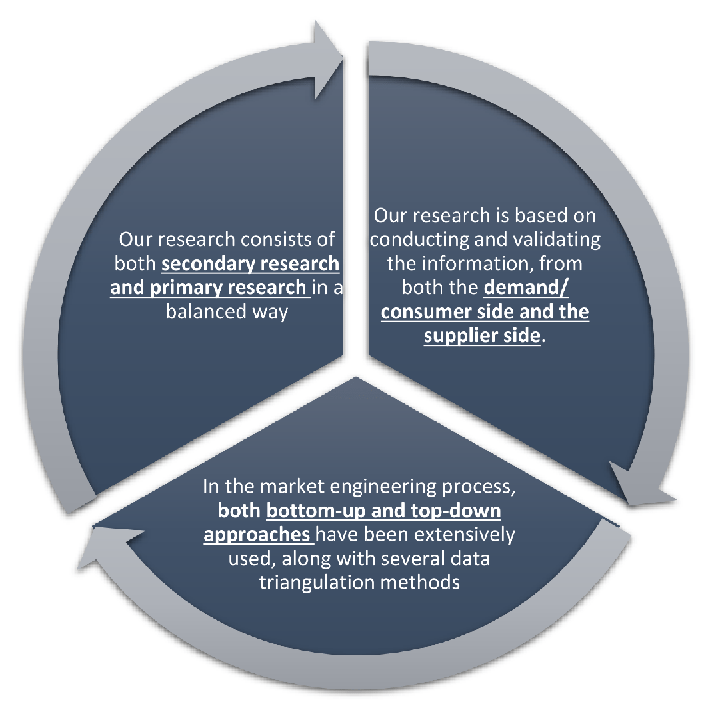
Our research design integrates both demand-side and supply-side analysis through a balanced combination of primary and secondary research methodologies. By utilizing both bottom-up and top-down approaches alongside rigorous data triangulation methods, we deliver robust market intelligence that supports strategic decision-making.
MarketGenics' comprehensive research design framework ensures the delivery of accurate, reliable, and actionable market intelligence. Through the integration of multiple research approaches, rigorous validation processes, and expert analysis, we provide our clients with the insights needed to make informed strategic decisions and capitalize on market opportunities.
MarketGenics leverages a dedicated industry panel of experts and a comprehensive suite of paid databases to effectively collect, consolidate, and analyze market intelligence.
Our approach has consistently proven to be reliable and effective in generating accurate market insights, identifying key industry trends, and uncovering emerging business opportunities.
Through both primary and secondary research, we capture and analyze critical company-level data such as manufacturing footprints, including technical centers, R&D facilities, sales offices, and headquarters.
Our expert panel further enhances our ability to estimate market size for specific brands based on validated field-level intelligence.
Our data mining techniques incorporate both parametric and non-parametric methods, allowing for structured data collection, sorting, processing, and cleaning.
Demand projections are derived from large-scale data sets analyzed through proprietary algorithms, culminating in robust and reliable market sizing.
Research Approach
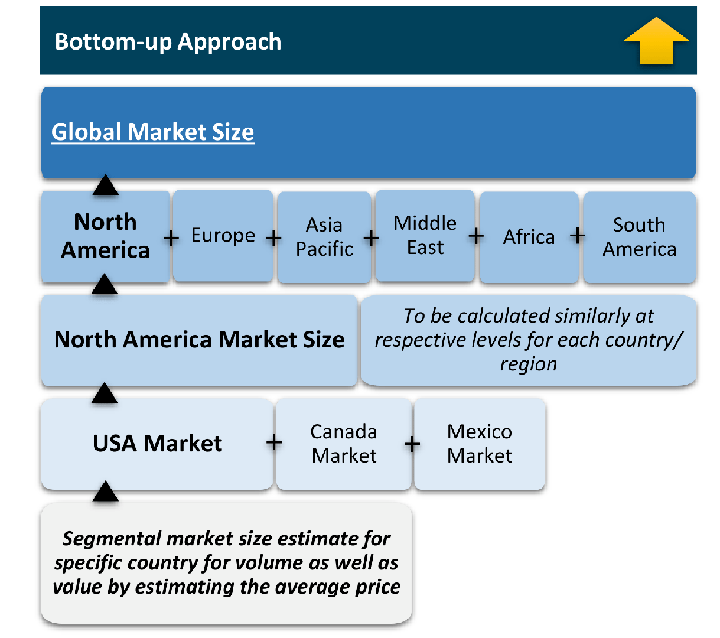
The bottom-up approach builds market estimates by starting with the smallest addressable market units and systematically aggregating them to create comprehensive market size projections.
This method begins with specific, granular data points and builds upward to create the complete market landscape.
Customer Analysis → Segmental Analysis → Geographical Analysis
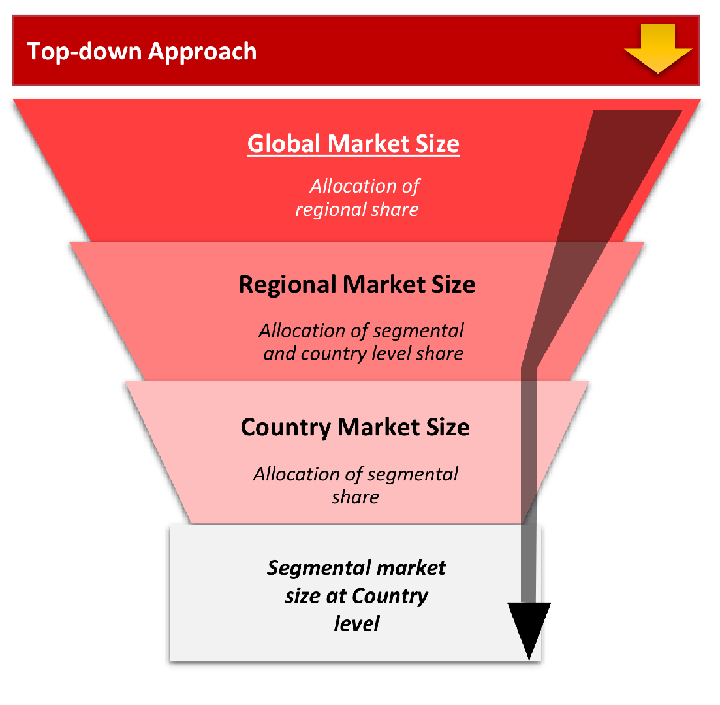
The top-down approach starts with the broadest possible market data and systematically narrows it down through a series of filters and assumptions to arrive at specific market segments or opportunities.
This method begins with the big picture and works downward to increasingly specific market slices.
TAM → SAM → SOM
Research Methods
Desk / Secondary Research
While analysing the market, we extensively study secondary sources, directories, and databases to identify and collect information useful for this technical, market-oriented, and commercial report. Secondary sources that we utilize are not only the public sources, but it is a combination of Open Source, Associations, Paid Databases, MG Repository & Knowledgebase, and others.
- Company websites, annual reports, financial reports, broker reports, and investor presentations
- National government documents, statistical databases and reports
- News articles, press releases and web-casts specific to the companies operating in the market, Magazines, reports, and others
- We gather information from commercial data sources for deriving company specific data such as segmental revenue, share for geography, product revenue, and others
- Internal and external proprietary databases (industry-specific), relevant patent, and regulatory databases
- Governing Bodies, Government Organizations
- Relevant Authorities, Country-specific Associations for Industries
We also employ the model mapping approach to estimate the product level market data through the players' product portfolio
Primary Research
Primary research/ interviews is vital in analyzing the market. Most of the cases involves paid primary interviews. Primary sources include primary interviews through e-mail interactions, telephonic interviews, surveys as well as face-to-face interviews with the different stakeholders across the value chain including several industry experts.
| Type of Respondents | Number of Primaries |
|---|---|
| Tier 2/3 Suppliers | ~20 |
| Tier 1 Suppliers | ~25 |
| End-users | ~25 |
| Industry Expert/ Panel/ Consultant | ~30 |
| Total | ~100 |
MG Knowledgebase
• Repository of industry blog, newsletter and case studies
• Online platform covering detailed market reports, and company profiles
Forecasting Factors and Models
Forecasting Factors
- Historical Trends – Past market patterns, cycles, and major events that shaped how markets behave over time. Understanding past trends helps predict future behavior.
- Industry Factors – Specific characteristics of the industry like structure, regulations, and innovation cycles that affect market dynamics.
- Macroeconomic Factors – Economic conditions like GDP growth, inflation, and employment rates that affect how much money people have to spend.
- Demographic Factors – Population characteristics like age, income, and location that determine who can buy your product.
- Technology Factors – How quickly people adopt new technology and how much technology infrastructure exists.
- Regulatory Factors – Government rules, laws, and policies that can help or restrict market growth.
- Competitive Factors – Analyzing competition structure such as degree of competition and bargaining power of buyers and suppliers.
Forecasting Models / Techniques
Multiple Regression Analysis
- Identify and quantify factors that drive market changes
- Statistical modeling to establish relationships between market drivers and outcomes
Time Series Analysis – Seasonal Patterns
- Understand regular cyclical patterns in market demand
- Advanced statistical techniques to separate trend, seasonal, and irregular components
Time Series Analysis – Trend Analysis
- Identify underlying market growth patterns and momentum
- Statistical analysis of historical data to project future trends
Expert Opinion – Expert Interviews
- Gather deep industry insights and contextual understanding
- In-depth interviews with key industry stakeholders
Multi-Scenario Development
- Prepare for uncertainty by modeling different possible futures
- Creating optimistic, pessimistic, and most likely scenarios
Time Series Analysis – Moving Averages
- Sophisticated forecasting for complex time series data
- Auto-regressive integrated moving average models with seasonal components
Econometric Models
- Apply economic theory to market forecasting
- Sophisticated economic models that account for market interactions
Expert Opinion – Delphi Method
- Harness collective wisdom of industry experts
- Structured, multi-round expert consultation process
Monte Carlo Simulation
- Quantify uncertainty and probability distributions
- Thousands of simulations with varying input parameters
Research Analysis
Our research framework is built upon the fundamental principle of validating market intelligence from both demand and supply perspectives. This dual-sided approach ensures comprehensive market understanding and reduces the risk of single-source bias.
Demand-Side Analysis: We understand end-user/application behavior, preferences, and market needs along with the penetration of the product for specific application.
Supply-Side Analysis: We estimate overall market revenue, analyze the segmental share along with industry capacity, competitive landscape, and market structure.
Validation & Evaluation
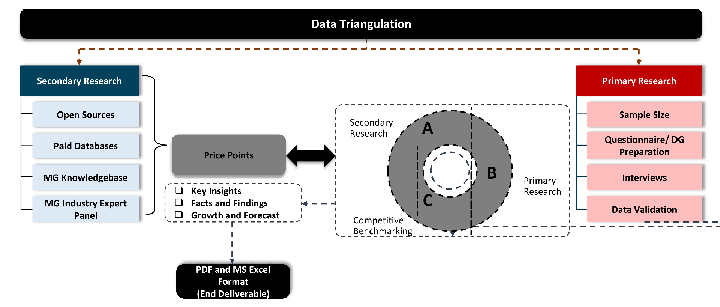
Data triangulation is a validation technique that uses multiple methods, sources, or perspectives to examine the same research question, thereby increasing the credibility and reliability of research findings. In market research, triangulation serves as a quality assurance mechanism that helps identify and minimize bias, validate assumptions, and ensure accuracy in market estimates.
- Data Source Triangulation – Using multiple data sources to examine the same phenomenon
- Methodological Triangulation – Using multiple research methods to study the same research question
- Investigator Triangulation – Using multiple researchers or analysts to examine the same data
- Theoretical Triangulation – Using multiple theoretical perspectives to interpret the same data
Custom Market Research Services
We will customise the research for you, in case the report listed above does not meet your requirements.
Get 10% Free Customisation