UPS Market Size, Share & Trends Analysis Report by Type/Topology (Standby/Offline UPS, Line-Interactive UPS, Online/Double Conversion UPS, Delta Conversion Online UPS, Ferro-Resonant UPS), Rated Power/Capacity, Phase, Component, Technology, Installation Type, Voltage Rating, Mounting Type, End-Use Industry × Application, Distribution Channel, Service Type, and Geography (North America, Europe, Asia Pacific, Middle East, Africa, and South America) – Global Industry Data, Trends, and Forecasts, 2026–2035
|
|
|
Segmental Data Insights |
|
|
Demand Trends |
|
|
Competitive Landscape |
|
|
Strategic Development |
|
|
Future Outlook & Opportunities |
|
UPS-Market Size, Share, and Growth
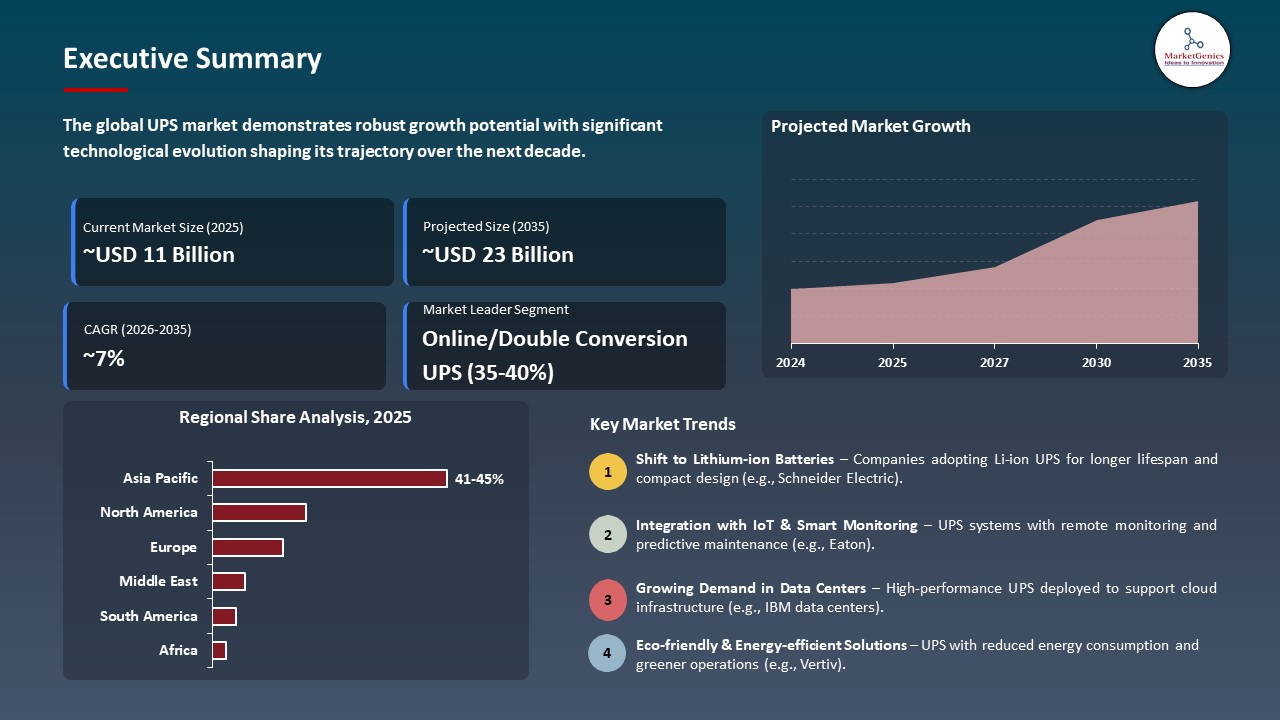
The global UPS market is experiencing robust growth, with its estimated value of USD 11.5 billion in the year 2025 and USD 23.3 billion by the period 2035, registering a CAGR of 7.3%, during the forecast period. The global UPS market is driven by rapid data-center expansion, increasing digitalization, rising power instability, and the need for uninterrupted operations across IT, telecom, manufacturing, healthcare, and BFSI sectors. Growth in cloud computing, AI workloads, and critical infrastructure modernization further accelerates adoption of high-efficiency, scalable UPS solutions.
Sébastien Surply, Head of Power Protection, ABB Electrification said, “It delivers a high-efficiency solution specifically tailored for the UL market. The MegaFlex UL UPS exemplifies our commitment to innovation and engineering excellence by delivering robust, AI-integrated power continuity. It empowers our customers to run smarter, more efficient data center operations.”
The global UPS market growth is driven by high development of AI and hyperscale data centers that require the use of high-density, high-frequency, AI-optimized power protection systems, which can resist high-varying and more and more intensive electrical loads. As examples, in December 2024, Galaxy VXL by Schneider Electric is a small, modular UPS (1.25 MW scalable to 5 MW) in a high-density AI and data-center location. The development increases the competitiveness of the market as it is compatible with increasing market demand of scalable and high-density power protection in AI-intensive data-centers.
Moreover, the UPS market growth is expanding due to a growing desire to focus on energy efficiency and footprint optimization, which has been aided by silicon-carbide conversion of power, increased power density, and modular system design. Through an example, Eaton 9395X UPS which boasts of smaller footprint and silicon-carbide-enhanced efficiency improvements in the data centers that are greener. This trend enhances the UPS solutions that are greener, more space-efficient, reduce operating costs and enhance sustainability in the data-centers.
The global UPS market presents adjacent opportunities include energy-storage systems, power-distribution units, data-center cooling, edge-computing infrastructure, and battery-management solutions, all benefiting from rising digitalization and power-reliability needs. These segments gain with UPS deployments, developing cross-selling opportunities and demands based on power-infrastructure. These opportunities enhance the growth of ecosystems, as well as increasing long-term value of power-infrastructure suppliers.

UPS Market Dynamics and Trends
Driver: Rising Demand for Resilient Power in Digital Infrastructure Expansion
-
The global UPS market growth is driven by increasing need of resilient and continuous energy in fast growing digital infrastructure systems. With the growth in cloud computing, AI workloads, and hyperscale data centers globally, operators need to have very reliable power-conditioning and backup facilities to ensure that availability is not affected and has a way of ensuring that mission-critical equipment has not been brought down by outages, voltage variations and grid instability.
- The proliferation of edge computing, colocation center, and high-density servers is driving up the need to have UPS systems that assure high capacity and reliable power. Industries such as telecom, banking, health services, and e-commerce are moving toward digital transformation and continuous, resilient power is now a key demand of contemporary business.
- As an example, in August 2024, Vertiv released the Trinergy UPS, an adjustable 500 kW system that supports high capacity AI/HPC data centers with 99.9999998 availability. The Trinergy UPS release supports the market need of high-availability, modular and AI-ready power solutions.
- The adoption of modular, high capacity UPS systems is increasing at an accelerated pace switching digital resilience in infrastructure, and expanding and advancing the global UPS market.
Restraint: High Total Cost and Infrastructure Integration Barriers for Advanced UPS
-
The global UPS market growth faces significant limited by the fact that the total cost of advanced UPS systems is high, and the integration of the new systems into the existing electrical infrastructures is rather complicated. State-of-the-art technologies like Lithium-ion batteries, silicon-carbide converters and modular architectures are also more efficient and more scalable without cost but have high initial capital requirements, which are prohibitive to small and medium-sized businesses.
- Additionally, installation of these advanced UPS solutions may require installation and maintenance people of high qualification and power distribution systems of facilities, as well as compliance with rigorous regulatory and safety requirements. These technical and financial obstacles reduce adoption especially in cost-conscious areas or a legacy infrastructure organization. Thus, the strong price and integration are the factors that limit the expansion of the global UPS market.
- The advanced UPS systems are limit adopted due to high costs and complexity of integration, which hinders market penetration of cost-sensitive and legacy-infrastructure segments.
Opportunity: Growing Adoption of Hybrid Renewable-Energy Integrated UPS Solutions Worldwide
-
The global UPS market is expanding as companies move towards implementing the hybrid renewable-energy UPS systems in order to combine solar, wind, and other sources and guarantee a consistent supply of power, without being so grid-dependent.
- The hybrid UPS solutions are a product of integrating energy storage, sophisticated power conditioning, and intelligent management systems to ensure constant and reliable power and the maximum energy efficiency and minimum operation costs. Also, deployment is being expedited by regulatory incentives and corporate sustainability targets.
- This renewable integration plus UPS technology convergence is a strategic business opportunity to vendors to suggest more sustainable, more secure, and future-resilient power solutions in a market with a swift development progress. For instance, in 2024, UnitronicPower announced a high-tech UPS with built-in solar-ready inverters, including backup power and the ability to use renewable energy.
- The adoption of renewable energy in UPS systems is also necessitating the creation of sustainable, efficient, and resilient power supplies, which is generating new markets across the global.
Key Trend: Shift Toward Modular, Lithium-Ion and Smart-Monitored UPS Deployments Globally
-
The global UPS market growth is increasingly influenced by which is shifting towards modular, lithium-ion, and smart-monitored UPS systems. The modular designs allow the ability to scale the power capacity, and the incremental upgrades are possible without huge upfront investment. Lithium-ion batteries are more efficient and cost-effective because they provide higher energy density and longer service life than the traditional lead-acid batteries, and have less footprint.
- Smart monitoring capabilities provide real-time diagnostics, predictive maintenance, and remote management, enhancing reliability and reducing downtime. These innovations are also most essential to data centers, telecom facilities, and industrial operations that cannot be without constant power.
- For instance, in 2024, Eaton launched the 9PX Lithium-Ion UPS, featuring modular scalability, smart monitoring, and lithium-ion batteries for longer life, reduced maintenance, and adaptable load management. The 9PX Lithium-Ion UPS delivers a higher operational efficiency and reliability that is inspiring people to adopt modular, smart and energy efficient power solutions.
- The shift toward modular, lithium-ion, and smart-monitored UPS systems is accelerating market adoption of efficient, scalable, and reliable power solutions across data centers and critical infrastructure.
UPS-Market Analysis and Segmental Data
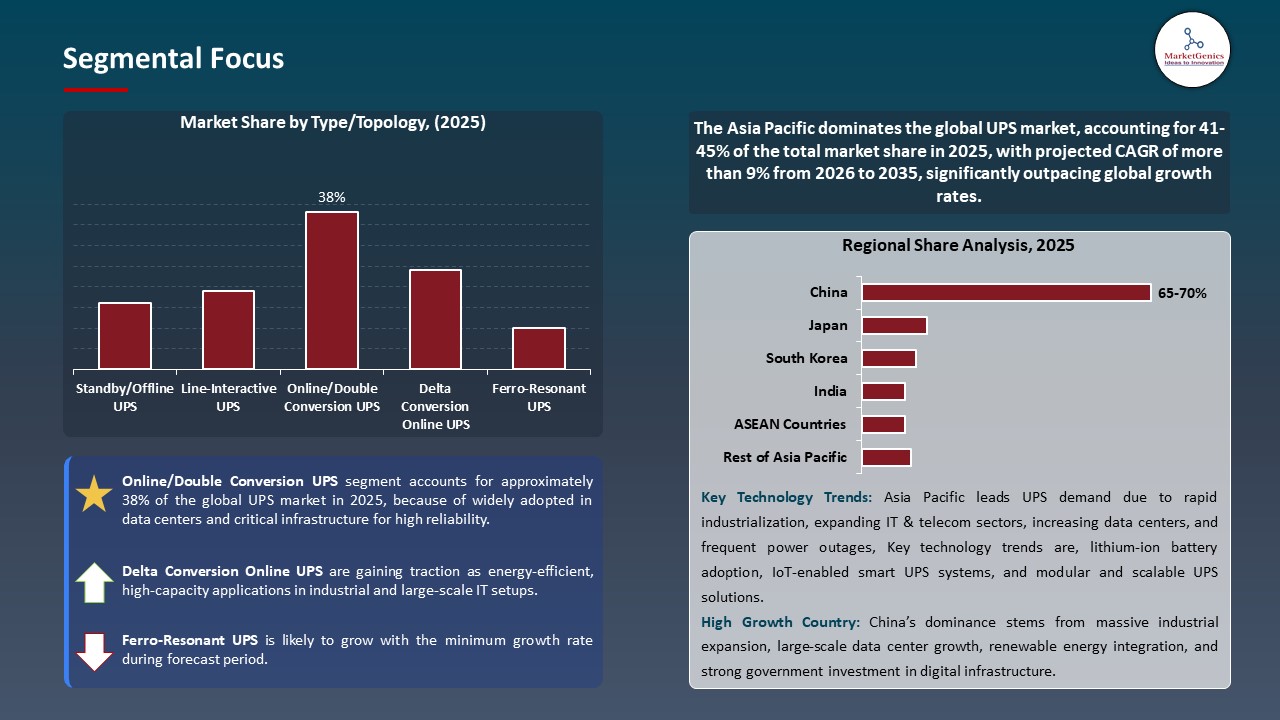
Online/Double Conversion UPS Dominate Global UPS Market
-
The online/double conversion UPS segment dominates the UPS market, because of the capability to offer continuous and high-quality power with no waiting time in case of outages. The types of UPS are the complete isolation of sensitive equipment against variations in input power, voltage sags and frequency changes, thus suited in highly sensitive applications like in data centers, medical treatment facilities, and industries.
- Their high reliability, scalability and capacity to support high capacity loads mean that the mission critical systems are operated without interruption. With the growing use of digital infrastructures and high-performance computing by organizations, online/ double conversion UPS solutions are requested in reinforcing stable power quality and continuity of operations.
- For instance, in August 2024, Riello UPS launched the Multi Power2 series, offering 98.1% efficiency in online double-conversion mode with modular, hot-swappable 67 kW power modules for data centers and critical applications.
- The dominance of online/ double conversion UPS can provide a reliable high-quality power and can achieve adoption at data centers and other mission-critical locations.
Asia Pacific Leads Global UPS Market Demand
-
Asia Pacific leads the global UPS market is due to the significant increase in cloud infrastructure, the fast growth of data centres and digitalization. As hyperscale and co-location data-center projects increase in countries such as China, India, and Southeast-Asia, the need to have a consistent power backup power supply has astutely taken a rise thus necessitating the use of UPS systems that ensure that the continuity of operations.
- For instance, in 2024, the Asia-Pacific region had an estimated 12.2 GW of data-center capacity in operation in over 1,800 facilities and a significant number of other projects were underway or 3 in the planning stage.
- Additionally, the rapid industrialization, urbanization and growth of the region in industries like manufacturing, telecom and IT, that tend to experience power grid instability or power outage, is also a booster in this demand. With corporations automating systems and installing vulnerable electronic appliances, adoption of UPS is essential as a means of preventing downtimes and loss of data.
- The rapid expansion of the data centers and industrial digitalization in Asia-Pacific is leading to intense uptake of UPS which is making the region a major investor in the global market growth.
UPS-Market Ecosystem
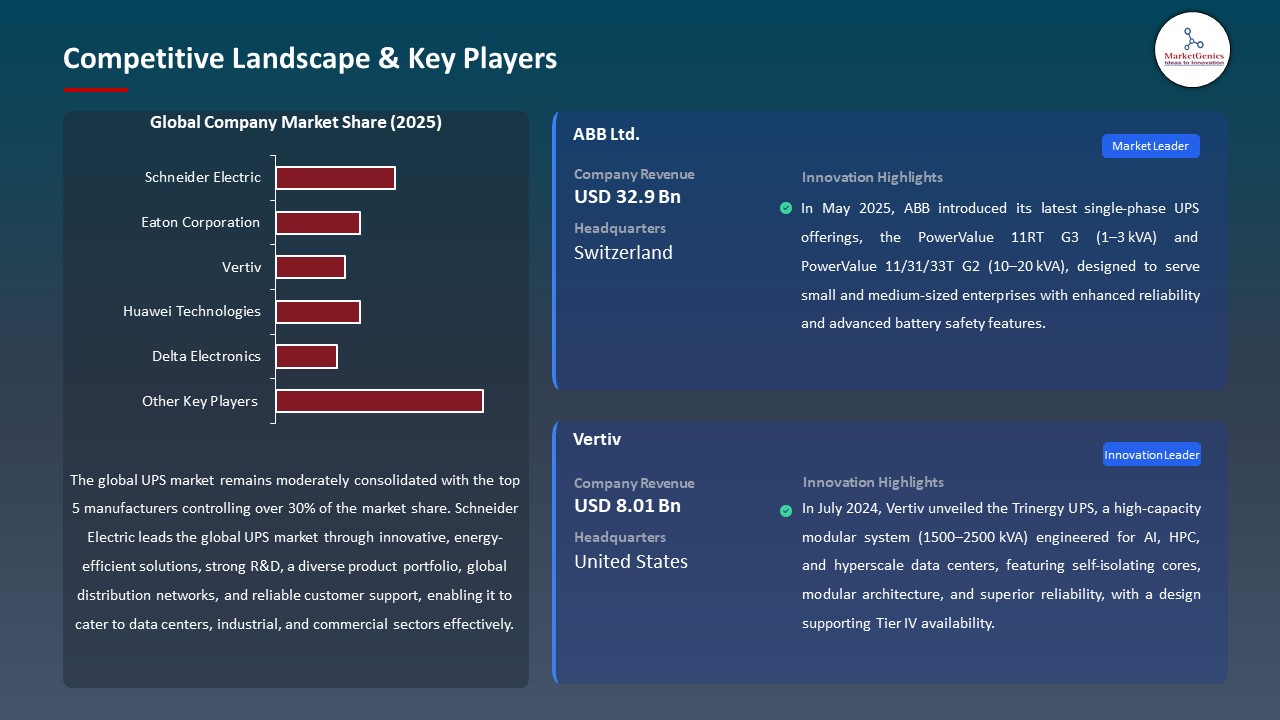
The global UPS market is moderately consolidated, with high concentration among key players such as Schneider Electric, Eaton Corporation, Vertiv, Huawei Technologies, and Delta Electronics, who dominate through advanced technology products, well established globally distribution channels, and established brand names as well as strategic partnerships or acquisitions that make their products and services portfolios bigger.
The consolidation of the market allows the main UPS providers to use scale, technology and global presence and increases the level of competition, creating high industry standards of reliability and innovation.
Recent Development and Strategic Overview:
-
June 2025, ABB launched the MegaFlex UL 415 V 3-phase UPS, which is designed to accommodate large-scale data centers associated with AI and cloud workloads, is scalable, has high operational efficiency, and provides future-proof power protection to the requirements of the changing mission-critical infrastructure.
- In July 2024, Vertiv unveiled the Trinergy UPS, a high-capacity modular system (1500–2500 kVA) engineered for AI, HPC, and hyperscale data centers, featuring self-isolating cores, modular architecture, and superior reliability, with a design supporting Tier IV availability.
Report Scope
|
Detail |
|
|
Market Size in 2025 |
USD 11.5 Bn |
|
Market Forecast Value in 2035 |
USD 23.3 Bn |
|
Growth Rate (CAGR) |
7.3% |
|
Forecast Period |
2026 – 2035 |
|
Historical Data Available for |
2021 – 2024 |
|
Market Size Units |
US$ Billion for Value Thousand Units for Volume |
|
Report Format |
Electronic (PDF) + Excel |
|
North America |
Europe |
Asia Pacific |
Middle East |
Africa |
South America |
|
|
|
|
|
|
|
Companies Covered |
|||||
|
|
|
|
|
|
UPS-Market Segmentation and Highlights
|
Segment |
Sub-segment |
|
UPS Market, By Type/Topology |
|
|
UPS Market, By Rated Power/Capacity |
|
|
UPS Market, By Phase |
|
|
UPS Market, By Component |
|
|
UPS Market, By Technology
|
|
|
UPS Market, By Installation Type
|
|
|
UPS Market, By Voltage Rating |
|
|
UPS Market, By Mounting Type |
|
|
UPS Market, By End-Use Industry × Application |
|
|
UPS Market, By Distribution Channel |
|
|
UPS Market, By Service Type |
|
Frequently Asked Questions
Table of Contents
- 1. Research Methodology and Assumptions
- 1.1. Definitions
- 1.2. Research Design and Approach
- 1.3. Data Collection Methods
- 1.4. Base Estimates and Calculations
- 1.5. Forecasting Models
- 1.5.1. Key Forecast Factors & Impact Analysis
- 1.6. Secondary Research
- 1.6.1. Open Sources
- 1.6.2. Paid Databases
- 1.6.3. Associations
- 1.7. Primary Research
- 1.7.1. Primary Sources
- 1.7.2. Primary Interviews with Stakeholders across Ecosystem
- 2. Executive Summary
- 2.1. Global UPS Market Outlook
- 2.1.1. UPS Market Size (Volume – Thousand Units and Value - US$ Bn), and Forecasts, 2021-2035
- 2.1.2. Compounded Annual Growth Rate Analysis
- 2.1.3. Growth Opportunity Analysis
- 2.1.4. Segmental Share Analysis
- 2.1.5. Geographical Share Analysis
- 2.2. Market Analysis and Facts
- 2.3. Supply-Demand Analysis
- 2.4. Competitive Benchmarking
- 2.5. Go-to- Market Strategy
- 2.5.1. Customer/ End-use Industry Assessment
- 2.5.2. Growth Opportunity Data, 2026-2035
- 2.5.2.1. Regional Data
- 2.5.2.2. Country Data
- 2.5.2.3. Segmental Data
- 2.5.3. Identification of Potential Market Spaces
- 2.5.4. GAP Analysis
- 2.5.5. Potential Attractive Price Points
- 2.5.6. Prevailing Market Risks & Challenges
- 2.5.7. Preferred Sales & Marketing Strategies
- 2.5.8. Key Recommendations and Analysis
- 2.5.9. A Way Forward
- 2.1. Global UPS Market Outlook
- 3. Industry Data and Premium Insights
- 3.1. Global Energy & Power Industry Overview, 2025
- 3.1.1. Energy & Power Industry Ecosystem Analysis
- 3.1.2. Key Trends for Energy & Power Industry
- 3.1.3. Regional Distribution for Energy & Power Industry
- 3.2. Supplier Customer Data
- 3.3. Technology Roadmap and Developments
- 3.4. Trade Analysis
- 3.4.1. Import & Export Analysis, 2025
- 3.4.2. Top Importing Countries
- 3.4.3. Top Exporting Countries
- 3.5. Trump Tariff Impact Analysis
- 3.5.1. Manufacturer
- 3.5.1.1. Based on the component & Raw material
- 3.5.2. Supply Chain
- 3.5.3. End Consumer
- 3.5.1. Manufacturer
- 3.6. Raw Material Analysis
- 3.1. Global Energy & Power Industry Overview, 2025
- 4. Market Overview
- 4.1. Market Dynamics
- 4.1.1. Drivers
- Expansion of digital infrastructure & data4.1.1.1. ‑center growth
- 4.1.1.2. Rising frequency of power outages and energy supply instability
- 4.1.1.3. Growing adoption of industrial automation / IoT and critical infrastructure demand
- 4.1.2. Restraints
- 4.1.2.1. High initial cost and high installation/maintenance costs of UPS systems
- Supply4.1.2.2. ‑chain/component shortages and battery-related limitations
- 4.1.1. Drivers
- 4.2. Key Trend Analysis
- 4.3. Regulatory Framework
- 4.3.1. Key Regulations, Norms, and Subsidies, by Key Countries
- 4.3.2. Tariffs and Standards
- 4.3.3. Impact Analysis of Regulations on the Market
- 4.4. Value Chain Analysis
- 4.4.1. Component Suppliers
- 4.4.2. UPS Manufacturers
- 4.4.3. Distributors / Retailers
- 4.4.4. End-Users/Consumers
- 4.5. Porter’s Five Forces Analysis
- 4.6. PESTEL Analysis
- 4.7. Global UPS Market Demand
- 4.7.1. Historical Market Size – Volume (Thousand Units) and Value (US$ Bn), 2020-2024
- 4.7.2. Current and Future Market Size – Volume (Thousand Units) and Value (US$ Bn), 2026–2035
- 4.7.2.1. Y-o-Y Growth Trends
- 4.7.2.2. Absolute $ Opportunity Assessment
- 4.1. Market Dynamics
- 5. Competition Landscape
- 5.1. Competition structure
- 5.1.1. Fragmented v/s consolidated
- 5.2. Company Share Analysis, 2025
- 5.2.1. Global Company Market Share
- 5.2.2. By Region
- 5.2.2.1. North America
- 5.2.2.2. Europe
- 5.2.2.3. Asia Pacific
- 5.2.2.4. Middle East
- 5.2.2.5. Africa
- 5.2.2.6. South America
- 5.3. Product Comparison Matrix
- 5.3.1. Specifications
- 5.3.2. Market Positioning
- 5.3.3. Pricing
- 5.1. Competition structure
- 6. Global UPS Market Analysis, by Type/Topology
- 6.1. Key Segment Analysis
- 6.2. UPS Market Size (Volume – Thousand Units and Value - US$ Bn), Analysis, and Forecasts, by Type/Topology, 2021-2035
- 6.2.1. Standby/Offline UPS
- 6.2.2. Line-Interactive UPS
- 6.2.3. Online/Double Conversion UPS
- 6.2.4. Delta Conversion Online UPS
- 6.2.5. Ferro-Resonant UPS
- 7. Global UPS Market Analysis, by Rated Power/Capacity
- 7.1. Key Segment Analysis
- 7.2. UPS Market Size (Volume – Thousand Units and Value - US$ Bn), Analysis, and Forecasts, by Rated Power/Capacity, 2021-2035
- 7.2.1. Small UPS (Less than 5 kVA)
- 7.2.2. Medium UPS (5-100 kVA)
- 7.2.3. Large UPS (100-500 kVA)
- 7.2.4. Extra Large UPS (Above 500 kVA)
- 8. Global UPS Market Analysis, by Phase
- 8.1. Key Segment Analysis
- 8.2. UPS Market Size (Volume – Thousand Units and Value - US$ Bn), Analysis, and Forecasts, by Phase, 2021-2035
- 8.2.1. Single-Phase UPS
- 8.2.2. Three-Phase UPS
- 9. Global UPS Market Analysis, by Component
- 9.1. Key Segment Analysis
- 9.2. UPS Market Size (Volume – Thousand Units and Value - US$ Bn), Analysis, and Forecasts, by Component, 2021-2035
- 9.2.1. Battery
- 9.2.1.1. Lead-Acid Batteries
- 9.2.1.2. Lithium-Ion Batteries
- 9.2.1.3. Nickel-Cadmium Batteries
- 9.2.1.4. Others
- 9.2.2. Inverter
- 9.2.3. Charger
- 9.2.4. Static Switch
- 9.2.5. Control Unit
- 9.2.6. Others (Filters, Transformers, etc.)
- 9.2.1. Battery
- 10. Global UPS Market Analysis, by Technology
- 10.1. Key Segment Analysis
- 10.2. UPS Market Size (Volume – Thousand Units and Value - US$ Bn), Analysis, and Forecasts, by Technology, 2021-2035
- 10.2.1. Static UPS
- 10.2.2. Rotary UPS
- 10.2.3. Hybrid UPS
- 11. Global UPS Market Analysis, by Installation Type
- 11.1. Key Segment Analysis
- 11.2. UPS Market Size (Volume – Thousand Units and Value - US$ Bn), Analysis, and Forecasts, by Installation Type, 2021-2035
- 11.2.1. Rack-Mounted UPS
- 11.2.2. Floor-Standing/Tower UPS
- 11.2.3. Wall-Mounted UPS
- 11.2.4. Modular UPS
- 12. Global UPS Market Analysis, by Voltage Rating
- 12.1. Key Segment Analysis
- 12.2. UPS Market Size (Volume – Thousand Units and Value - US$ Bn), Analysis, and Forecasts, by Voltage Rating, 2021-2035
- 12.2.1. Low Voltage (Below 1 kV)
- 12.2.2. Medium Voltage (1-35 kV)
- 12.2.3. High Voltage (Above 35 kV)
- 13. Global UPS Market Analysis, by Mounting Type
- 13.1. Key Segment Analysis
- 13.2. UPS Market Size (Volume – Thousand Units and Value - US$ Bn), Analysis, and Forecasts, by Mounting Type, 2021-2035
- 13.2.1. Indoor UPS
- 13.2.2. Outdoor UPS
- 14. Global UPS Market Analysis and Forecasts, by End-Use Industry × Application
- 14.1. Key Findings
- 14.2. UPS Market Size (Volume – Thousand Units and Value - US$ Bn), Analysis, and Forecasts, by End-Use Industry × Application, 2021-2035
- 14.2.1. IT & Telecommunications
- 14.2.1.1. Data Center Power Backup
- 14.2.1.2. Server Room Protection
- 14.2.1.3. Network Infrastructure
- 14.2.1.4. Telecom Towers
- 14.2.1.5. Cloud Computing Facilities
- 14.2.1.6. Others
- 14.2.2. Healthcare
- 14.2.2.1. Hospital Critical Care Units
- 14.2.2.2. Medical Imaging Equipment
- 14.2.2.3. Laboratory Equipment
- 14.2.2.4. Surgical Equipment
- 14.2.2.5. Patient Monitoring Systems
- 14.2.2.6. Others
- 14.2.3. Manufacturing
- 14.2.3.1. Process Control Systems
- 14.2.3.2. Automated Production Lines
- 14.2.3.3. Quality Control Equipment
- 14.2.3.4. CNC Machines
- 14.2.3.5. Robotics Systems
- 14.2.3.6. Others
- 14.2.4. BFSI (Banking, Financial Services & Insurance)
- 14.2.4.1. ATM Networks
- 14.2.4.2. Trading Floors
- 14.2.4.3. Banking Servers
- 14.2.4.4. Payment Processing Systems
- 14.2.4.5. Data Centers
- 14.2.4.6. Others
- 14.2.5. Government & Defense
- 14.2.5.1. Military Installations
- 14.2.5.2. Government Data Centers
- 14.2.5.3. Emergency Services
- 14.2.5.4. Security Systems
- 14.2.5.5. Command Centers
- 14.2.5.6. Others
- 14.2.6. Energy & Utilities
- 14.2.6.1. Power Generation Facilities
- 14.2.6.2. Distribution Control Systems
- 14.2.6.3. Renewable Energy Systems
- 14.2.6.4. Oil & Gas Operations
- 14.2.6.5. Smart Grid Infrastructure
- 14.2.6.6. Others
- 14.2.7. Transportation
- 14.2.7.1. Airport Systems
- 14.2.7.2. Railway Signaling
- 14.2.7.3. Traffic Control Systems
- 14.2.7.4. Port Operations
- 14.2.7.5. Metro & Underground Systems
- 14.2.7.6. Others
- 14.2.8. Retail & E-commerce
- 14.2.8.1. Point-of-Sale Systems
- 14.2.8.2. Warehousing & Distribution
- 14.2.8.3. E-commerce Data Centers
- 14.2.8.4. Inventory Management Systems
- 14.2.8.5. Cold Chain Storage
- 14.2.8.6. Others
- 14.2.9. Education & Research
- 14.2.9.1. University Data Centers
- 14.2.9.2. Research Laboratories
- 14.2.9.3. Computer Labs
- 14.2.9.4. Library Systems
- 14.2.9.5. Campus Networks
- 14.2.9.6. Others
- 14.2.10. Residential
- 14.2.10.1. Home Offices
- 14.2.10.2. Entertainment Systems
- 14.2.10.3. Smart Home Devices
- 14.2.10.4. Home Security Systems
- 14.2.10.5. Personal Computers
- 14.2.10.6. Others
- 14.2.1. IT & Telecommunications
- 15. Global UPS Market Analysis and Forecasts, by Distribution Channel
- 15.1. Key Findings
- 15.2. UPS Market Size (Volume – Thousand Units and Value - US$ Bn), Analysis, and Forecasts, by Distribution Channel, 2021-2035
- 15.2.1. Direct Sales
- 15.2.2. Distributors
- 15.2.3. Online Retail
- 16. Global UPS Market Analysis and Forecasts, by Service Type
- 16.1. Key Findings
- 16.2. UPS Market Size (Volume – Thousand Units and Value - US$ Bn), Analysis, and Forecasts, by Service Type, 2021-2035
- 16.2.1. Installation Services
- 16.2.2. Maintenance & Support
- 16.2.3. Monitoring Services
- 16.2.4. Rental/Leasing Services
- 17. Global UPS Market Analysis and Forecasts, by Region
- 17.1. Key Findings
- 17.2. UPS Market Size (Volume – Thousand Units and Value - US$ Bn), Analysis, and Forecasts, by Region, 2021-2035
- 17.2.1. North America
- 17.2.2. Europe
- 17.2.3. Asia Pacific
- 17.2.4. Middle East
- 17.2.5. Africa
- 17.2.6. South America
- 18. North America UPS Market Analysis
- 18.1. Key Segment Analysis
- 18.2. Regional Snapshot
- 18.3. North America UPS Market Size (Volume – Thousand Units and Value - US$ Bn), Analysis, and Forecasts, 2021-2035
- 18.3.1. Type/Topology
- 18.3.2. Rated Power/Capacity
- 18.3.3. Phase
- 18.3.4. Component
- 18.3.5. Technology
- 18.3.6. Installation Type
- 18.3.7. Voltage Rating
- 18.3.8. Mounting Type
- 18.3.9. End-Use Industry × Application
- 18.3.10. Distribution Channel
- 18.3.11. Service Type
- 18.3.12. Country
- 18.3.12.1. USA
- 18.3.12.2. Canada
- 18.3.12.3. Mexico
- 18.4. USA UPS Market
- 18.4.1. Country Segmental Analysis
- 18.4.2. Type/Topology
- 18.4.3. Rated Power/Capacity
- 18.4.4. Phase
- 18.4.5. Component
- 18.4.6. Technology
- 18.4.7. Installation Type
- 18.4.8. Voltage Rating
- 18.4.9. Mounting Type
- 18.4.10. End-Use Industry × Application
- 18.4.11. Distribution Channel
- 18.4.12. Service Type
- 18.5. Canada UPS Market
- 18.5.1. Country Segmental Analysis
- 18.5.2. Type/Topology
- 18.5.3. Rated Power/Capacity
- 18.5.4. Phase
- 18.5.5. Component
- 18.5.6. Technology
- 18.5.7. Installation Type
- 18.5.8. Voltage Rating
- 18.5.9. Mounting Type
- 18.5.10. End-Use Industry × Application
- 18.5.11. Distribution Channel
- 18.5.12. Service Type
- 18.6. Mexico UPS Market
- 18.6.1. Country Segmental Analysis
- 18.6.2. Type/Topology
- 18.6.3. Rated Power/Capacity
- 18.6.4. Phase
- 18.6.5. Component
- 18.6.6. Technology
- 18.6.7. Installation Type
- 18.6.8. Voltage Rating
- 18.6.9. Mounting Type
- 18.6.10. End-Use Industry × Application
- 18.6.11. Distribution Channel
- 18.6.12. Service Type
- 19. Europe UPS Market Analysis
- 19.1. Key Segment Analysis
- 19.2. Regional Snapshot
- 19.3. Europe UPS Market Size (Volume – Thousand Units and Value - US$ Bn), Analysis, and Forecasts, 2021-2035
- 19.3.1. Type/Topology
- 19.3.2. Rated Power/Capacity
- 19.3.3. Phase
- 19.3.4. Component
- 19.3.5. Technology
- 19.3.6. Installation Type
- 19.3.7. Voltage Rating
- 19.3.8. Mounting Type
- 19.3.9. End-Use Industry × Application
- 19.3.10. Distribution Channel
- 19.3.11. Service Type
- 19.3.12. Country
- 19.3.12.1. Germany
- 19.3.12.2. United Kingdom
- 19.3.12.3. France
- 19.3.12.4. Italy
- 19.3.12.5. Spain
- 19.3.12.6. Netherlands
- 19.3.12.7. Nordic Countries
- 19.3.12.8. Poland
- 19.3.12.9. Russia & CIS
- 19.3.12.10. Rest of Europe
- 19.4. Germany UPS Market
- 19.4.1. Country Segmental Analysis
- 19.4.2. Type/Topology
- 19.4.3. Rated Power/Capacity
- 19.4.4. Phase
- 19.4.5. Component
- 19.4.6. Technology
- 19.4.7. Installation Type
- 19.4.8. Voltage Rating
- 19.4.9. Mounting Type
- 19.4.10. End-Use Industry × Application
- 19.4.11. Distribution Channel
- 19.4.12. Service Type
- 19.5. United Kingdom UPS Market
- 19.5.1. Country Segmental Analysis
- 19.5.2. Type/Topology
- 19.5.3. Rated Power/Capacity
- 19.5.4. Phase
- 19.5.5. Component
- 19.5.6. Technology
- 19.5.7. Installation Type
- 19.5.8. Voltage Rating
- 19.5.9. Mounting Type
- 19.5.10. End-Use Industry × Application
- 19.5.11. Distribution Channel
- 19.5.12. Service Type
- 19.6. France UPS Market
- 19.6.1. Country Segmental Analysis
- 19.6.2. Type/Topology
- 19.6.3. Rated Power/Capacity
- 19.6.4. Phase
- 19.6.5. Component
- 19.6.6. Technology
- 19.6.7. Installation Type
- 19.6.8. Voltage Rating
- 19.6.9. Mounting Type
- 19.6.10. End-Use Industry × Application
- 19.6.11. Distribution Channel
- 19.6.12. Service Type
- 19.7. Italy UPS Market
- 19.7.1. Country Segmental Analysis
- 19.7.2. Type/Topology
- 19.7.3. Rated Power/Capacity
- 19.7.4. Phase
- 19.7.5. Component
- 19.7.6. Technology
- 19.7.7. Installation Type
- 19.7.8. Voltage Rating
- 19.7.9. Mounting Type
- 19.7.10. End-Use Industry × Application
- 19.7.11. Distribution Channel
- 19.7.12. Service Type
- 19.8. Spain UPS Market
- 19.8.1. Country Segmental Analysis
- 19.8.2. Type/Topology
- 19.8.3. Rated Power/Capacity
- 19.8.4. Phase
- 19.8.5. Component
- 19.8.6. Technology
- 19.8.7. Installation Type
- 19.8.8. Voltage Rating
- 19.8.9. Mounting Type
- 19.8.10. End-Use Industry × Application
- 19.8.11. Distribution Channel
- 19.8.12. Service Type
- 19.9. Netherlands UPS Market
- 19.9.1. Country Segmental Analysis
- 19.9.2. Type/Topology
- 19.9.3. Rated Power/Capacity
- 19.9.4. Phase
- 19.9.5. Component
- 19.9.6. Technology
- 19.9.7. Installation Type
- 19.9.8. Voltage Rating
- 19.9.9. Mounting Type
- 19.9.10. End-Use Industry × Application
- 19.9.11. Distribution Channel
- 19.9.12. Service Type
- 19.10. Nordic Countries UPS Market
- 19.10.1. Country Segmental Analysis
- 19.10.2. Type/Topology
- 19.10.3. Rated Power/Capacity
- 19.10.4. Phase
- 19.10.5. Component
- 19.10.6. Technology
- 19.10.7. Installation Type
- 19.10.8. Voltage Rating
- 19.10.9. Mounting Type
- 19.10.10. End-Use Industry × Application
- 19.10.11. Distribution Channel
- 19.10.12. Service Type
- 19.11. Poland UPS Market
- 19.11.1. Country Segmental Analysis
- 19.11.2. Type/Topology
- 19.11.3. Rated Power/Capacity
- 19.11.4. Phase
- 19.11.5. Component
- 19.11.6. Technology
- 19.11.7. Installation Type
- 19.11.8. Voltage Rating
- 19.11.9. Mounting Type
- 19.11.10. End-Use Industry × Application
- 19.11.11. Distribution Channel
- 19.11.12. Service Type
- 19.12. Russia & CIS UPS Market
- 19.12.1. Country Segmental Analysis
- 19.12.2. Type/Topology
- 19.12.3. Rated Power/Capacity
- 19.12.4. Phase
- 19.12.5. Component
- 19.12.6. Technology
- 19.12.7. Installation Type
- 19.12.8. Voltage Rating
- 19.12.9. Mounting Type
- 19.12.10. End-Use Industry × Application
- 19.12.11. Distribution Channel
- 19.12.12. Service Type
- 19.13. Rest of Europe UPS Market
- 19.13.1. Country Segmental Analysis
- 19.13.2. Type/Topology
- 19.13.3. Rated Power/Capacity
- 19.13.4. Phase
- 19.13.5. Component
- 19.13.6. Technology
- 19.13.7. Installation Type
- 19.13.8. Voltage Rating
- 19.13.9. Mounting Type
- 19.13.10. End-Use Industry × Application
- 19.13.11. Distribution Channel
- 19.13.12. Service Type
- 20. Asia Pacific UPS Market Analysis
- 20.1. Key Segment Analysis
- 20.2. Regional Snapshot
- 20.3. Asia Pacific UPS Market Size (Volume – Thousand Units and Value - US$ Bn), Analysis, and Forecasts, 2021-2035
- 20.3.1. Type/Topology
- 20.3.2. Rated Power/Capacity
- 20.3.3. Phase
- 20.3.4. Component
- 20.3.5. Technology
- 20.3.6. Installation Type
- 20.3.7. Voltage Rating
- 20.3.8. Mounting Type
- 20.3.9. End-Use Industry × Application
- 20.3.10. Distribution Channel
- 20.3.11. Service Type
- 20.3.12. Country
- 20.3.12.1. China
- 20.3.12.2. India
- 20.3.12.3. Japan
- 20.3.12.4. South Korea
- 20.3.12.5. Australia and New Zealand
- 20.3.12.6. Indonesia
- 20.3.12.7. Malaysia
- 20.3.12.8. Thailand
- 20.3.12.9. Vietnam
- 20.3.12.10. Rest of Asia Pacific
- 20.4. China UPS Market
- 20.4.1. Country Segmental Analysis
- 20.4.2. Type/Topology
- 20.4.3. Rated Power/Capacity
- 20.4.4. Phase
- 20.4.5. Component
- 20.4.6. Technology
- 20.4.7. Installation Type
- 20.4.8. Voltage Rating
- 20.4.9. Mounting Type
- 20.4.10. End-Use Industry × Application
- 20.4.11. Distribution Channel
- 20.4.12. Service Type
- 20.5. India UPS Market
- 20.5.1. Country Segmental Analysis
- 20.5.2. Type/Topology
- 20.5.3. Rated Power/Capacity
- 20.5.4. Phase
- 20.5.5. Component
- 20.5.6. Technology
- 20.5.7. Installation Type
- 20.5.8. Voltage Rating
- 20.5.9. Mounting Type
- 20.5.10. End-Use Industry × Application
- 20.5.11. Distribution Channel
- 20.5.12. Service Type
- 20.6. Japan UPS Market
- 20.6.1. Country Segmental Analysis
- 20.6.2. Type/Topology
- 20.6.3. Rated Power/Capacity
- 20.6.4. Phase
- 20.6.5. Component
- 20.6.6. Technology
- 20.6.7. Installation Type
- 20.6.8. Voltage Rating
- 20.6.9. Mounting Type
- 20.6.10. End-Use Industry × Application
- 20.6.11. Distribution Channel
- 20.6.12. Service Type
- 20.7. South Korea UPS Market
- 20.7.1. Country Segmental Analysis
- 20.7.2. Type/Topology
- 20.7.3. Rated Power/Capacity
- 20.7.4. Phase
- 20.7.5. Component
- 20.7.6. Technology
- 20.7.7. Installation Type
- 20.7.8. Voltage Rating
- 20.7.9. Mounting Type
- 20.7.10. End-Use Industry × Application
- 20.7.11. Distribution Channel
- 20.7.12. Service Type
- 20.8. Australia and New Zealand UPS Market
- 20.8.1. Country Segmental Analysis
- 20.8.2. Type/Topology
- 20.8.3. Rated Power/Capacity
- 20.8.4. Phase
- 20.8.5. Component
- 20.8.6. Technology
- 20.8.7. Installation Type
- 20.8.8. Voltage Rating
- 20.8.9. Mounting Type
- 20.8.10. End-Use Industry × Application
- 20.8.11. Distribution Channel
- 20.8.12. Service Type
- 20.9. Indonesia UPS Market
- 20.9.1. Country Segmental Analysis
- 20.9.2. Type/Topology
- 20.9.3. Rated Power/Capacity
- 20.9.4. Phase
- 20.9.5. Component
- 20.9.6. Technology
- 20.9.7. Installation Type
- 20.9.8. Voltage Rating
- 20.9.9. Mounting Type
- 20.9.10. End-Use Industry × Application
- 20.9.11. Distribution Channel
- 20.9.12. Service Type
- 20.10. Malaysia UPS Market
- 20.10.1. Country Segmental Analysis
- 20.10.2. Type/Topology
- 20.10.3. Rated Power/Capacity
- 20.10.4. Phase
- 20.10.5. Component
- 20.10.6. Technology
- 20.10.7. Installation Type
- 20.10.8. Voltage Rating
- 20.10.9. Mounting Type
- 20.10.10. End-Use Industry × Application
- 20.10.11. Distribution Channel
- 20.10.12. Service Type
- 20.11. Thailand UPS Market
- 20.11.1. Country Segmental Analysis
- 20.11.2. Type/Topology
- 20.11.3. Rated Power/Capacity
- 20.11.4. Phase
- 20.11.5. Component
- 20.11.6. Technology
- 20.11.7. Installation Type
- 20.11.8. Voltage Rating
- 20.11.9. Mounting Type
- 20.11.10. End-Use Industry × Application
- 20.11.11. Distribution Channel
- 20.11.12. Service Type
- 20.12. Vietnam UPS Market
- 20.12.1. Country Segmental Analysis
- 20.12.2. Type/Topology
- 20.12.3. Rated Power/Capacity
- 20.12.4. Phase
- 20.12.5. Component
- 20.12.6. Technology
- 20.12.7. Installation Type
- 20.12.8. Voltage Rating
- 20.12.9. Mounting Type
- 20.12.10. End-Use Industry × Application
- 20.12.11. Distribution Channel
- 20.12.12. Service Type
- 20.13. Rest of Asia Pacific UPS Market
- 20.13.1. Country Segmental Analysis
- 20.13.2. Type/Topology
- 20.13.3. Rated Power/Capacity
- 20.13.4. Phase
- 20.13.5. Component
- 20.13.6. Technology
- 20.13.7. Installation Type
- 20.13.8. Voltage Rating
- 20.13.9. Mounting Type
- 20.13.10. End-Use Industry × Application
- 20.13.11. Distribution Channel
- 20.13.12. Service Type
- 21. Middle East UPS Market Analysis
- 21.1. Key Segment Analysis
- 21.2. Regional Snapshot
- 21.3. Middle East UPS Market Size (Volume – Thousand Units and Value - US$ Bn), Analysis, and Forecasts, 2021-2035
- 21.3.1. Type/Topology
- 21.3.2. Rated Power/Capacity
- 21.3.3. Phase
- 21.3.4. Component
- 21.3.5. Technology
- 21.3.6. Installation Type
- 21.3.7. Voltage Rating
- 21.3.8. Mounting Type
- 21.3.9. End-Use Industry × Application
- 21.3.10. Distribution Channel
- 21.3.11. Service Type
- 21.3.12. Country
- 21.3.12.1. Turkey
- 21.3.12.2. UAE
- 21.3.12.3. Saudi Arabia
- 21.3.12.4. Israel
- 21.3.12.5. Rest of Middle East
- 21.4. Turkey UPS Market
- 21.4.1. Country Segmental Analysis
- 21.4.2. Type/Topology
- 21.4.3. Rated Power/Capacity
- 21.4.4. Phase
- 21.4.5. Component
- 21.4.6. Technology
- 21.4.7. Installation Type
- 21.4.8. Voltage Rating
- 21.4.9. Mounting Type
- 21.4.10. End-Use Industry × Application
- 21.4.11. Distribution Channel
- 21.4.12. Service Type
- 21.5. UAE UPS Market
- 21.5.1. Country Segmental Analysis
- 21.5.2. Type/Topology
- 21.5.3. Rated Power/Capacity
- 21.5.4. Phase
- 21.5.5. Component
- 21.5.6. Technology
- 21.5.7. Installation Type
- 21.5.8. Voltage Rating
- 21.5.9. Mounting Type
- 21.5.10. End-Use Industry × Application
- 21.5.11. Distribution Channel
- 21.5.12. Service Type
- 21.6. Saudi Arabia UPS Market
- 21.6.1. Country Segmental Analysis
- 21.6.2. Type/Topology
- 21.6.3. Rated Power/Capacity
- 21.6.4. Phase
- 21.6.5. Component
- 21.6.6. Technology
- 21.6.7. Installation Type
- 21.6.8. Voltage Rating
- 21.6.9. Mounting Type
- 21.6.10. End-Use Industry × Application
- 21.6.11. Distribution Channel
- 21.6.12. Service Type
- 21.7. Israel UPS Market
- 21.7.1. Country Segmental Analysis
- 21.7.2. Type/Topology
- 21.7.3. Rated Power/Capacity
- 21.7.4. Phase
- 21.7.5. Component
- 21.7.6. Technology
- 21.7.7. Installation Type
- 21.7.8. Voltage Rating
- 21.7.9. Mounting Type
- 21.7.10. End-Use Industry × Application
- 21.7.11. Distribution Channel
- 21.7.12. Service Type
- 21.8. Rest of Middle East UPS Market
- 21.8.1. Country Segmental Analysis
- 21.8.2. Type/Topology
- 21.8.3. Rated Power/Capacity
- 21.8.4. Phase
- 21.8.5. Component
- 21.8.6. Technology
- 21.8.7. Installation Type
- 21.8.8. Voltage Rating
- 21.8.9. Mounting Type
- 21.8.10. End-Use Industry × Application
- 21.8.11. Distribution Channel
- 21.8.12. Service Type
- 22. Africa UPS Market Analysis
- 22.1. Key Segment Analysis
- 22.2. Regional Snapshot
- 22.3. Africa UPS Market Size (Volume – Thousand Units and Value - US$ Bn), Analysis, and Forecasts, 2021-2035
- 22.3.1. Type/Topology
- 22.3.2. Rated Power/Capacity
- 22.3.3. Phase
- 22.3.4. Component
- 22.3.5. Technology
- 22.3.6. Installation Type
- 22.3.7. Voltage Rating
- 22.3.8. Mounting Type
- 22.3.9. End-Use Industry × Application
- 22.3.10. Distribution Channel
- 22.3.11. Service Type
- 22.3.12. Country
- 22.3.12.1. South Africa
- 22.3.12.2. Egypt
- 22.3.12.3. Nigeria
- 22.3.12.4. Algeria
- 22.3.12.5. Rest of Africa
- 22.4. South Africa UPS Market
- 22.4.1. Country Segmental Analysis
- 22.4.2. Type/Topology
- 22.4.3. Rated Power/Capacity
- 22.4.4. Phase
- 22.4.5. Component
- 22.4.6. Technology
- 22.4.7. Installation Type
- 22.4.8. Voltage Rating
- 22.4.9. Mounting Type
- 22.4.10. End-Use Industry × Application
- 22.4.11. Distribution Channel
- 22.4.12. Service Type
- 22.5. Egypt UPS Market
- 22.5.1. Country Segmental Analysis
- 22.5.2. Type/Topology
- 22.5.3. Rated Power/Capacity
- 22.5.4. Phase
- 22.5.5. Component
- 22.5.6. Technology
- 22.5.7. Installation Type
- 22.5.8. Voltage Rating
- 22.5.9. Mounting Type
- 22.5.10. End-Use Industry × Application
- 22.5.11. Distribution Channel
- 22.5.12. Service Type
- 22.6. Nigeria UPS Market
- 22.6.1. Country Segmental Analysis
- 22.6.2. Type/Topology
- 22.6.3. Rated Power/Capacity
- 22.6.4. Phase
- 22.6.5. Component
- 22.6.6. Technology
- 22.6.7. Installation Type
- 22.6.8. Voltage Rating
- 22.6.9. Mounting Type
- 22.6.10. End-Use Industry × Application
- 22.6.11. Distribution Channel
- 22.6.12. Service Type
- 22.7. Algeria UPS Market
- 22.7.1. Country Segmental Analysis
- 22.7.2. Type/Topology
- 22.7.3. Rated Power/Capacity
- 22.7.4. Phase
- 22.7.5. Component
- 22.7.6. Technology
- 22.7.7. Installation Type
- 22.7.8. Voltage Rating
- 22.7.9. Mounting Type
- 22.7.10. End-Use Industry × Application
- 22.7.11. Distribution Channel
- 22.7.12. Service Type
- 22.8. Rest of Africa UPS Market
- 22.8.1. Country Segmental Analysis
- 22.8.2. Type/Topology
- 22.8.3. Rated Power/Capacity
- 22.8.4. Phase
- 22.8.5. Component
- 22.8.6. Technology
- 22.8.7. Installation Type
- 22.8.8. Voltage Rating
- 22.8.9. Mounting Type
- 22.8.10. End-Use Industry × Application
- 22.8.11. Distribution Channel
- 22.8.12. Service Type
- 23. South America UPS Market Analysis
- 23.1. Key Segment Analysis
- 23.2. Regional Snapshot
- 23.3. South America UPS Market Size (Volume – Thousand Units and Value - US$ Bn), Analysis, and Forecasts, 2021-2035
- 23.3.1. Type/Topology
- 23.3.2. Rated Power/Capacity
- 23.3.3. Phase
- 23.3.4. Component
- 23.3.5. Technology
- 23.3.6. Installation Type
- 23.3.7. Voltage Rating
- 23.3.8. Mounting Type
- 23.3.9. End-Use Industry × Application
- 23.3.10. Distribution Channel
- 23.3.11. Service Type
- 23.3.12. Country
- 23.3.12.1. Brazil
- 23.3.12.2. Argentina
- 23.3.12.3. Rest of South America
- 23.4. Brazil UPS Market
- 23.4.1. Country Segmental Analysis
- 23.4.2. Type/Topology
- 23.4.3. Rated Power/Capacity
- 23.4.4. Phase
- 23.4.5. Component
- 23.4.6. Technology
- 23.4.7. Installation Type
- 23.4.8. Voltage Rating
- 23.4.9. Mounting Type
- 23.4.10. End-Use Industry × Application
- 23.4.11. Distribution Channel
- 23.4.12. Service Type
- 23.5. Argentina UPS Market
- 23.5.1. Country Segmental Analysis
- 23.5.2. Type/Topology
- 23.5.3. Rated Power/Capacity
- 23.5.4. Phase
- 23.5.5. Component
- 23.5.6. Technology
- 23.5.7. Installation Type
- 23.5.8. Voltage Rating
- 23.5.9. Mounting Type
- 23.5.10. End-Use Industry × Application
- 23.5.11. Distribution Channel
- 23.5.12. Service Type
- 23.6. Rest of South America UPS Market
- 23.6.1. Country Segmental Analysis
- 23.6.2. Type/Topology
- 23.6.3. Rated Power/Capacity
- 23.6.4. Phase
- 23.6.5. Component
- 23.6.6. Technology
- 23.6.7. Installation Type
- 23.6.8. Voltage Rating
- 23.6.9. Mounting Type
- 23.6.10. End-Use Industry × Application
- 23.6.11. Distribution Channel
- 23.6.12. Service Type
- 24. Key Players/ Company Profile
- 24.1. ABB Ltd.
- 24.1.1. Company Details/ Overview
- 24.1.2. Company Financials
- 24.1.3. Key Customers and Competitors
- 24.1.4. Business/ Industry Portfolio
- 24.1.5. Product Portfolio/ Specification Details
- 24.1.6. Pricing Data
- 24.1.7. Strategic Overview
- 24.1.8. Recent Developments
- 24.2. Active Power (Langley Holdings)
- 24.3. APC by Schneider Electric
- 24.4. Borri Industrial Power Solutions
- 24.5. CyberPower Systems
- 24.6. Delta Electronics
- 24.7. Eaton Corporation
- 24.8. Fuji Electric
- 24.9. Gamatronic Electronic Industries
- 24.10. General Electric (GE)
- 24.11. Huawei Technologies
- 24.12. IntelliPower (Lite-On Technology)
- 24.13. Legrand
- 24.14. Luminous Power Technologies
- 24.15. Microtek International
- 24.16. Mitsubishi Electric Corporation
- 24.17. Numeric Power Systems
- 24.18. Piller Power Systems
- 24.19. Riello Elettronica (Riello UPS)
- 24.20. Santak (Eaton)
- 24.21. Schneider Electric
- 24.22. Shenzhen KSTAR Science & Technology
- 24.23. SL Power Electronics (Advanced Energy)
- 24.24. Socomec
- 24.25. Staco Energy Products
- 24.26. Thycon
- 24.27. Toshiba Corporation
- 24.28. Tripp Lite (Eaton)
- 24.29. Vertiv
- 24.30. Other Key Players
- 24.1. ABB Ltd.
Note* - This is just tentative list of players. While providing the report, we will cover more number of players based on their revenue and share for each geography
Research Design
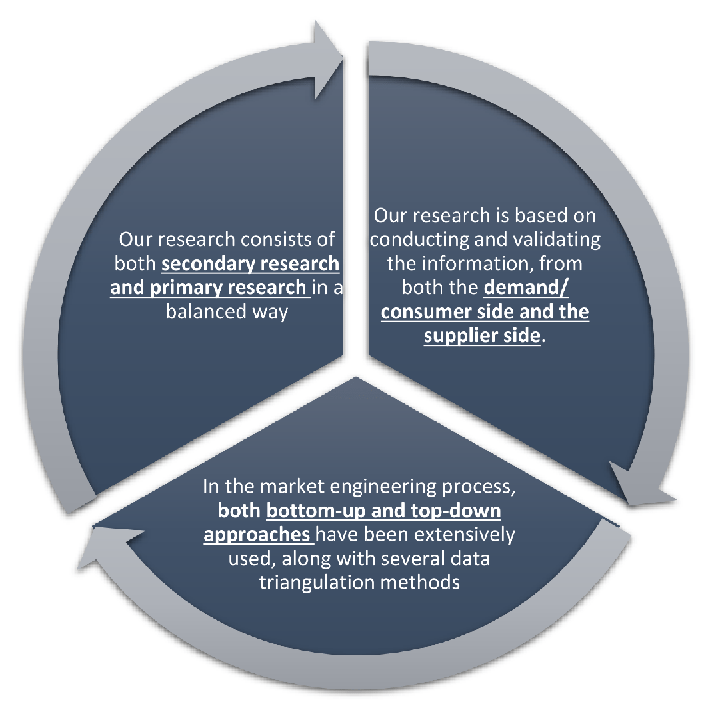
Our research design integrates both demand-side and supply-side analysis through a balanced combination of primary and secondary research methodologies. By utilizing both bottom-up and top-down approaches alongside rigorous data triangulation methods, we deliver robust market intelligence that supports strategic decision-making.
MarketGenics' comprehensive research design framework ensures the delivery of accurate, reliable, and actionable market intelligence. Through the integration of multiple research approaches, rigorous validation processes, and expert analysis, we provide our clients with the insights needed to make informed strategic decisions and capitalize on market opportunities.
MarketGenics leverages a dedicated industry panel of experts and a comprehensive suite of paid databases to effectively collect, consolidate, and analyze market intelligence.
Our approach has consistently proven to be reliable and effective in generating accurate market insights, identifying key industry trends, and uncovering emerging business opportunities.
Through both primary and secondary research, we capture and analyze critical company-level data such as manufacturing footprints, including technical centers, R&D facilities, sales offices, and headquarters.
Our expert panel further enhances our ability to estimate market size for specific brands based on validated field-level intelligence.
Our data mining techniques incorporate both parametric and non-parametric methods, allowing for structured data collection, sorting, processing, and cleaning.
Demand projections are derived from large-scale data sets analyzed through proprietary algorithms, culminating in robust and reliable market sizing.
Research Approach
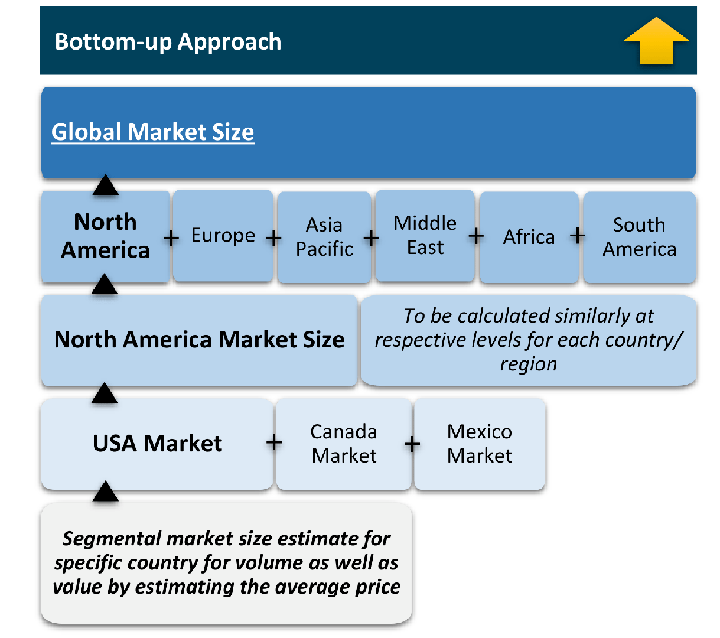
The bottom-up approach builds market estimates by starting with the smallest addressable market units and systematically aggregating them to create comprehensive market size projections.
This method begins with specific, granular data points and builds upward to create the complete market landscape.
Customer Analysis → Segmental Analysis → Geographical Analysis
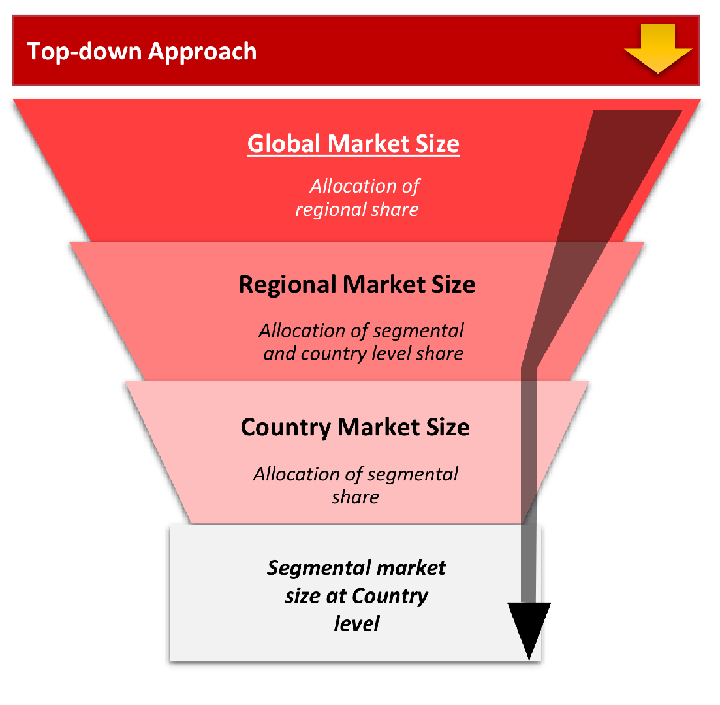
The top-down approach starts with the broadest possible market data and systematically narrows it down through a series of filters and assumptions to arrive at specific market segments or opportunities.
This method begins with the big picture and works downward to increasingly specific market slices.
TAM → SAM → SOM
Research Methods
Desk / Secondary Research
While analysing the market, we extensively study secondary sources, directories, and databases to identify and collect information useful for this technical, market-oriented, and commercial report. Secondary sources that we utilize are not only the public sources, but it is a combination of Open Source, Associations, Paid Databases, MG Repository & Knowledgebase, and others.
- Company websites, annual reports, financial reports, broker reports, and investor presentations
- National government documents, statistical databases and reports
- News articles, press releases and web-casts specific to the companies operating in the market, Magazines, reports, and others
- We gather information from commercial data sources for deriving company specific data such as segmental revenue, share for geography, product revenue, and others
- Internal and external proprietary databases (industry-specific), relevant patent, and regulatory databases
- Governing Bodies, Government Organizations
- Relevant Authorities, Country-specific Associations for Industries
We also employ the model mapping approach to estimate the product level market data through the players' product portfolio
Primary Research
Primary research/ interviews is vital in analyzing the market. Most of the cases involves paid primary interviews. Primary sources include primary interviews through e-mail interactions, telephonic interviews, surveys as well as face-to-face interviews with the different stakeholders across the value chain including several industry experts.
| Type of Respondents | Number of Primaries |
|---|---|
| Tier 2/3 Suppliers | ~20 |
| Tier 1 Suppliers | ~25 |
| End-users | ~25 |
| Industry Expert/ Panel/ Consultant | ~30 |
| Total | ~100 |
MG Knowledgebase
• Repository of industry blog, newsletter and case studies
• Online platform covering detailed market reports, and company profiles
Forecasting Factors and Models
Forecasting Factors
- Historical Trends – Past market patterns, cycles, and major events that shaped how markets behave over time. Understanding past trends helps predict future behavior.
- Industry Factors – Specific characteristics of the industry like structure, regulations, and innovation cycles that affect market dynamics.
- Macroeconomic Factors – Economic conditions like GDP growth, inflation, and employment rates that affect how much money people have to spend.
- Demographic Factors – Population characteristics like age, income, and location that determine who can buy your product.
- Technology Factors – How quickly people adopt new technology and how much technology infrastructure exists.
- Regulatory Factors – Government rules, laws, and policies that can help or restrict market growth.
- Competitive Factors – Analyzing competition structure such as degree of competition and bargaining power of buyers and suppliers.
Forecasting Models / Techniques
Multiple Regression Analysis
- Identify and quantify factors that drive market changes
- Statistical modeling to establish relationships between market drivers and outcomes
Time Series Analysis – Seasonal Patterns
- Understand regular cyclical patterns in market demand
- Advanced statistical techniques to separate trend, seasonal, and irregular components
Time Series Analysis – Trend Analysis
- Identify underlying market growth patterns and momentum
- Statistical analysis of historical data to project future trends
Expert Opinion – Expert Interviews
- Gather deep industry insights and contextual understanding
- In-depth interviews with key industry stakeholders
Multi-Scenario Development
- Prepare for uncertainty by modeling different possible futures
- Creating optimistic, pessimistic, and most likely scenarios
Time Series Analysis – Moving Averages
- Sophisticated forecasting for complex time series data
- Auto-regressive integrated moving average models with seasonal components
Econometric Models
- Apply economic theory to market forecasting
- Sophisticated economic models that account for market interactions
Expert Opinion – Delphi Method
- Harness collective wisdom of industry experts
- Structured, multi-round expert consultation process
Monte Carlo Simulation
- Quantify uncertainty and probability distributions
- Thousands of simulations with varying input parameters
Research Analysis
Our research framework is built upon the fundamental principle of validating market intelligence from both demand and supply perspectives. This dual-sided approach ensures comprehensive market understanding and reduces the risk of single-source bias.
Demand-Side Analysis: We understand end-user/application behavior, preferences, and market needs along with the penetration of the product for specific application.
Supply-Side Analysis: We estimate overall market revenue, analyze the segmental share along with industry capacity, competitive landscape, and market structure.
Validation & Evaluation
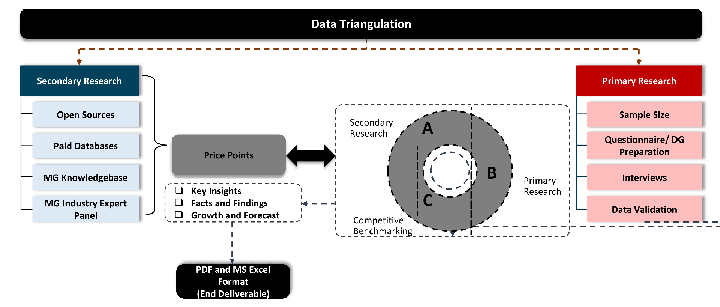
Data triangulation is a validation technique that uses multiple methods, sources, or perspectives to examine the same research question, thereby increasing the credibility and reliability of research findings. In market research, triangulation serves as a quality assurance mechanism that helps identify and minimize bias, validate assumptions, and ensure accuracy in market estimates.
- Data Source Triangulation – Using multiple data sources to examine the same phenomenon
- Methodological Triangulation – Using multiple research methods to study the same research question
- Investigator Triangulation – Using multiple researchers or analysts to examine the same data
- Theoretical Triangulation – Using multiple theoretical perspectives to interpret the same data
Custom Market Research Services
We will customise the research for you, in case the report listed above does not meet your requirements.
Get 10% Free Customisation