AI in Public Safety Market Size, Share & Trends Analysis Report by Technology (Machine Learning, Natural Language Processing (NLP), Computer Vision, Predictive Analytics, Deep Learning, Others), Deployment Mode, Component, Functionality, AI Capability Level, Application, End User and Geography (North America, Europe, Asia Pacific, Middle East, Africa, and South America) – Global Industry Data, Trends, and Forecasts, 2026–2035
Market Overview:
The global AI in public services market was valued at approximately USD 3.4 billion in 2025 and is projected to reach around USD 8.4 billion by 2035, growing at a CAGR of 9.3% during the forecast period.
According to MarketGenics, this growth is driven by the increasing adoption of AI technologies by government agencies and public sector organizations to enhance operational efficiency, automate service delivery, and enable data-driven decision-making. The rising focus on digital transformation, citizen-centric services, and improved governance is further accelerating market expansion worldwide.
|
Market Structure & Evolution |
|
|
Segmental Data Insights |
|
|
Demand Trends |
|
|
Competitive Landscape |
|
|
Strategic Development |
|
|
Future Outlook & Opportunities |
|
AI in Public Safety Market Size, Share, and Growth
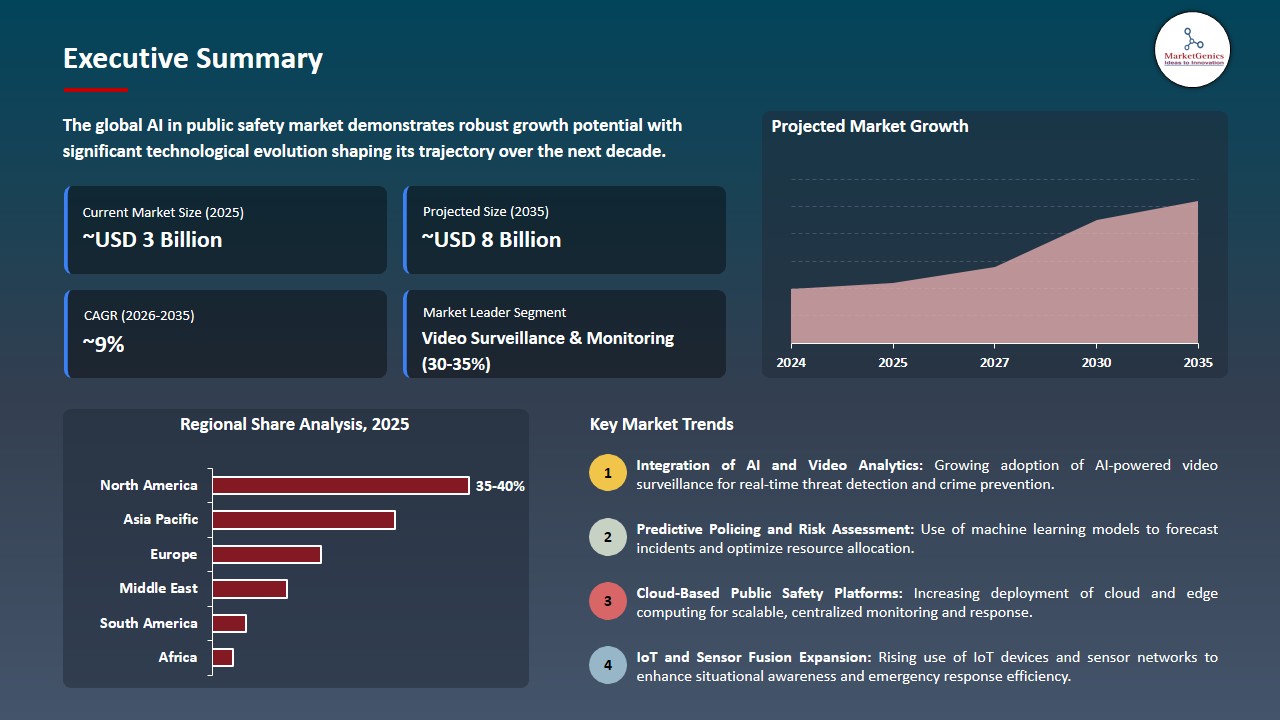
Sean McCarthy, Vice President of Product at Oracle Local Government, said that leading edge police departments and law enforcement agencies are, in a growing number, resorting to AI powered systems for creating situational awareness, bettering proactive policing, and making their operations more efficient. By collaborating with us on the rollout of this AI technology driven public safety solution, we are enabling organizations to ensure every significant moment is documented and that the real time information can assist both responders and the communities that they serve.
Several factors are expected to accelerate adoption. For instance, advanced AI-powered surveillance, real-time threat detection, and data-driven emergency response systems will prove operationally reliable. Take Axon Enterprise – the company has been expanding the AI-enabled capabilities in its public safety ecosystem, including automated video review, real-time transcription, and situational analysis tools to help agencies improve decision-making and case efficiency.
Simultaneously, there is growing demand for intelligent public safety infrastructure due to rising incidents of urban crime, concerns of terrorism, and large public events. Government funding of smart cities has fast-tracked the use of AI-driven video cameras, facial recognition (where permissible) and predictive policing at transport hubs, critical infrastructure and public places. In addition, the public accountability requirements, evidence retention requirements, and emergency response performance standards are making it necessary for agencies to upgrade legacy systems and deploy AI-enabled systems.
Furthermore, the AI in public safety market will also offer opportunities for the growth of associated intelligent video management systems, emergency command-and-control platforms, digital evidence management system, body-worn camera system analytics, predictive analytics software, and AI-enabled disaster management system. Aiding new public safety portfolios, cross-agency synchronization, and revenue generation in national security and smart governance ecosystems can be achieved by solution providers capitalizing on these adjacent markets.
AI in Public Safety Market Dynamics and Trends
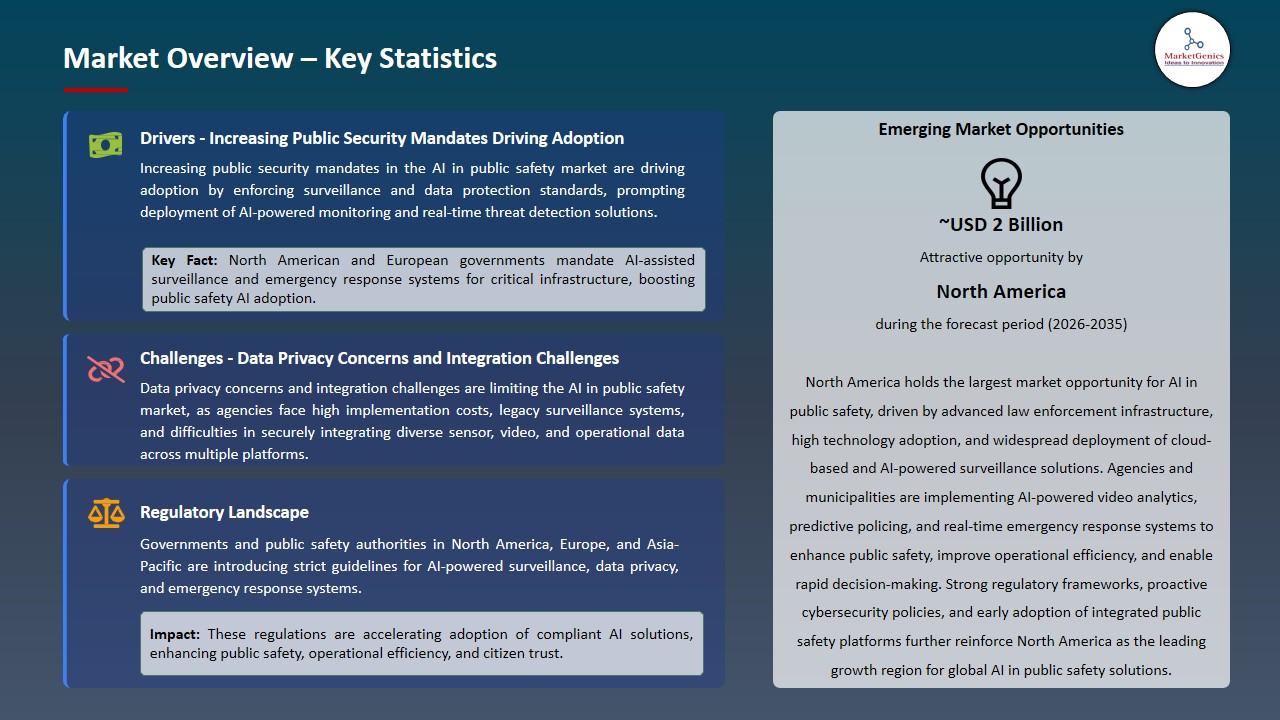
Driver: Increasing Public Security Mandates Driving Adoption of AI-Enabled Public Safety Systems
-
The rapid expansion of the AI in public safety sector is largely influenced by the implementation of more rigorous government regulations aimed at crime prevention, emergency response performance, and protection of vital infrastructure. As a result, public safety modernization programs at the national level in North America, Europe, and parts of Asia are pushing law enforcement and emergency agencies to use AI, driven video analytics, digital evidence management, and real, time command, and, control systems to not only enhance accountability but also to make the response more efficient.
- Besides that, regulations related to public surveillance governance, data retention, and incident reporting are facilitating the pace of adoption. Taking smart city frameworks as an example, most of them impose the requirement of automated incident detection and centralized data integration for police, fire, and medical services, thus giving rise to AI, powered public safety platforms.
- The extensive use of digital public services and mass transit systems has led to a further increase in the need for AI, enabled monitoring and threat detection systems that would guarantee the safety of citizens in densely populated urban areas.
Restraint: Data Privacy Concerns and Integration Challenges Limiting Widespread Deployment
-
Although there are regulations in place to support the use of AI technology and increase its use in Public Safety, many agencies have been reluctant to adopt this technology due to concerns regarding Data Privacy, Algorithmic Bias and a lack of Public Trust when using AI based Facial Recognition and Predictive Policing (PP) technologies. The GDPR, along with other regional Data Protection Laws have added additional complexity to the implementation of AI systems.
- In many cases, these agencies continue to be reliant on Legacy Systems, which means they will need to invest significantly in Integrating AI solutions with their existing systems and also purchase new hardware that is compatible with AI systems.
- The inability to Integrate Legacy Systems/Applications has created a fragmented environment for Public Safety Agencies, which is leading to difficulties Modernizing their Systems and take advantage of the capabilities offered by AI.
- Budgetary Constraints are a continuing obstacle for many smaller cities and developing regions in their efforts to Incorporate AI Technology, as they will need to pay for ongoing Model Validation and different levels of AI Expertise.
Opportunity: Expansion of Smart City Initiatives and Disaster Management Programs
-
Worldwide, government authorities in regions like Asia, Pacific, the Middle East, and Latin America are heavily investing in smart city and disaster resilience projects. Such a move has led to a huge demand for AI, driven solutions in public safety, which otherwise was difficult to find. This has led to many large, scale deployments of intelligent traffic monitoring, emergency response optimization, and crowd management systems that require the use of scalable AI platforms to meet the needs of such operations.
- One of the major features that have triggered the developments in the public safety sector is the collaboration between technology providers and public agencies where cloud, based solutions are being utilized to reduce the cost of infrastructure that is frontal. Public safety portfolios based on AI continue to be expanded by companies such as Axon, Motorola Solutions, and Huawei to provide support for these initiatives.
- Such developments generate growth possibilities for AI video analytics providers, emergency communications software, predictive risk assessment tools, and integrated public safety platforms.
Key Trend: Convergence of AI Analytics, Real-Time Data Fusion, and Cloud-Based Command Platforms
-
The growing trend in AI within Public Safety has been the use of real-time data through the integration of AI Analytics seamlessly with the use of Camera's, Sensors, Drones, and Emergency Calling. The effect of this integration has given Law Enforcement a unified view, which is essential to Provide effective response times.
- The development of Cloud Native Command and Control Platforms with AI and Machine Learning (ML) based priority ranking, as well as automated reporting, has provided Law Enforcement the ability to work together to improve coordination of Responses Amongst Departments.
- Due to this convergence, police are becoming more proactive, emergency response times are improving, and data-driven decision making is being made at a faster rate, resulting in higher rates of acceptance of AI deployment globally throughout the public safety ecosystem over the long term.
AI-in-Public-Safety-Market Analysis and Segmental Data
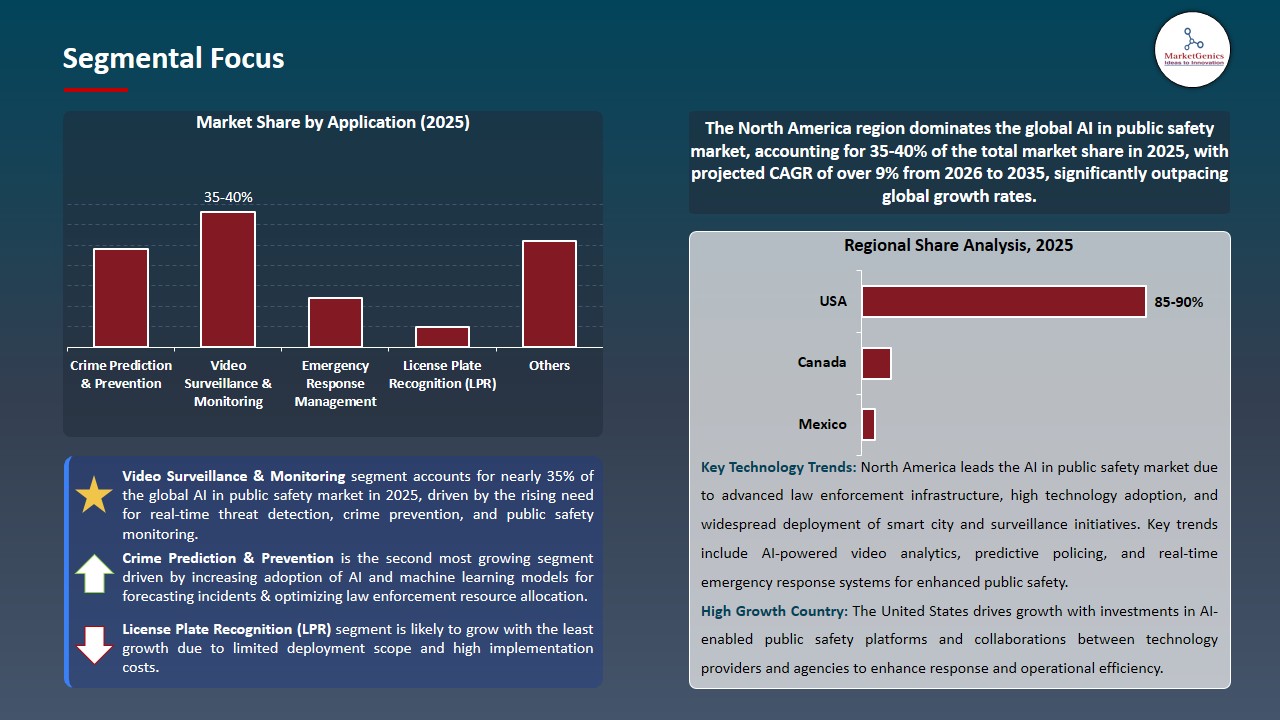
“Video Surveillance & Monitoring Maintain Dominance in Global AI in Public Safety Market amid Rising Smart City Investments and Real-Time Threat Detection Needs”
-
The video surveillance & monitoring segment is holding the lead in the global AI in public safety market as a result of the significant investments in smart cities and the increased need for real, time threat detection. To this end, governments and cities deploy AI, enabled cameras in public areas, transport hubs, and vital infrastructure in order to raise situational awareness, crime prevention and emergency response. Functions like anomaly detection, crowd analysis, and automated alerts allow the public safety agencies to be more friendly, reach the scene faster, and be more in control at all times.
- Recent changes strengthen this dominance. NEC Corporation has broadened AI, based video analytics and biometric solutions for public transport and public facilities to not only improve security but also for access control. BriefCam, a Canon subsidiary, is increasingly being utilized by law enforcement agencies for quick video review and forensic investigation, thereby, enabling the detectives to get the actionable insights from voluminous surveillance videos quite fast.
- Simultaneously, Hanwha Vision has upgraded the AI, powered edge cameras with which in real, time the object and behavior identification is done right at the source thereby greatly reducing the response time and network requirements. When combined these factors serve as guarantees for the sustained predominance of video surveillance and monitoring in the global AI in public safety market.
“North American Dominancy in AI in Public Safety Market amid Advanced Smart City Adoption and Strong Public Safety Technology Investments”
-
North America is the global leader in the AI in public safety market as a result of widespread adoption of smart city initiatives; significant funding for Public Safety initiatives; and early adoption of new technologies by law enforcement / emergency service providers.
- North America's Federal, State, and Local Government initiatives focus on enabling real-time crime prevention, optimizing emergency response, and protecting critical infrastructure. As a result, AI-enabled surveillance and Command & Control Platforms have been deployed widely.
- North America has established itself as an industry leader when it comes to AI Public Safety; through collaborations among Government Entities, Cloud Service Providers (CSPs), and Research Institutions; AI applications such as Gunshot Detection, Real-Time Incident Analysis, and Predictive Resource Allocation have been developed to support Data-Driven Policing and Faster Emergency Response. A clear regulatory environment, continued investment, and a strong public safety tech ecosystem further ensure North America's continued dominance in the global AI in public safety market.
AI-in-Public-Safety-Market Ecosystem
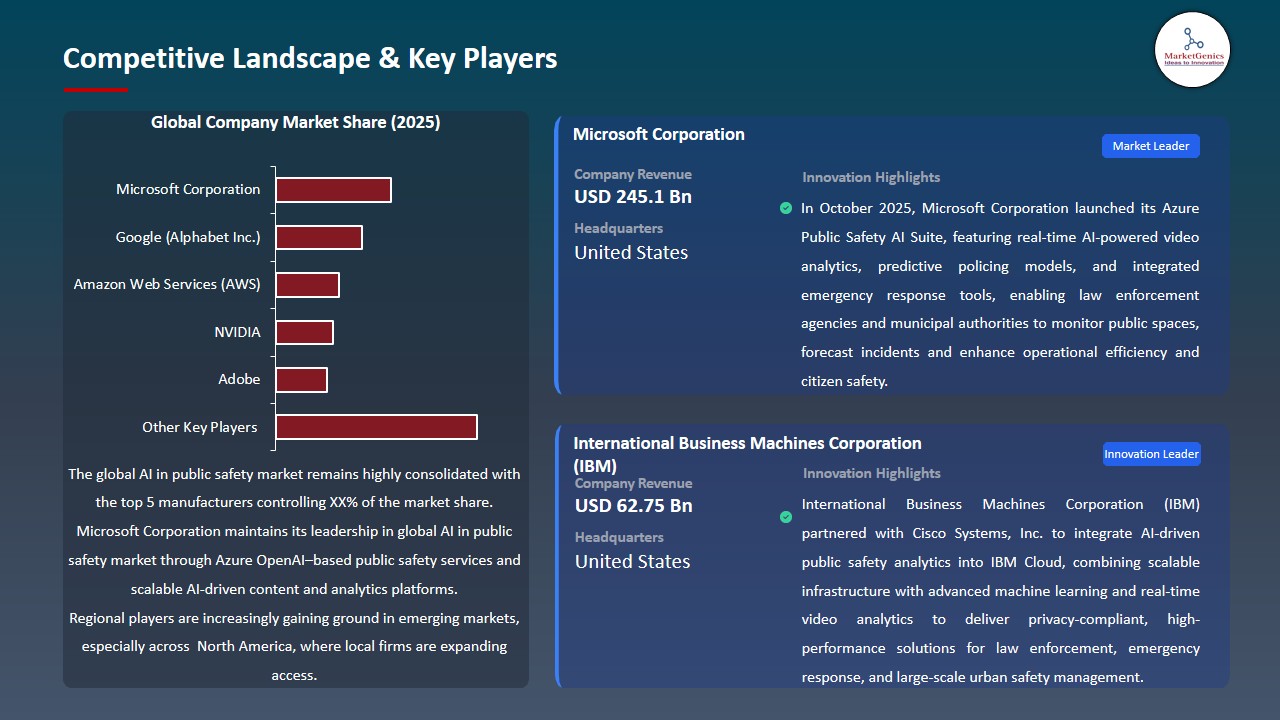
The AI in the public safety market is about midway between fully consolidated and entirely fragmented. The top players, for instance, Motorola Solutions, Microsoft Corporation, Amazon Web Services, Inc., Genetec Inc., NEC Corporation, and Palantir Technologies Inc. are driving the market in terms of AI advancements, cloud computing, and data analytics capabilities, utilizing deep learning, edge AI, and large, scale data integration to provide public safety solutions that are indispensable.
Concurrently, these major industry players place an increasing emphasis on highly specialized and niche technologies as a primary source of next innovations. As an illustration, Genetec is heavily invested in AI, powered video management and on, the, fly incident correlation; NEC Corporation is committed to the development of biometric identification and facial recognition systems tailored for expansive public infrastructures; while Palantir is focused on delivering sophisticated AI, driven intelligence platforms for law enforcement and emergency response units.
Such advancement would be impossible without government and research sectors contributions and support. These entities are not only providing the funds but are also the first to adopt these next, generation public safety technologies. For example, in March 2024, the U.S. Department of Transportation, expanded AI, based traffic and incident detection pilots employing computer vision and real, time analytics aimed at urban safety and rapid emergency response coordination.
Moreover, market leaders are also turning their attention towards product diversification and integrated platform features as a priority. This would enable the combination of surveillance, command, and, control, digital evidence management, and analytics to streamline the operational efficiency further. Microsoft upgraded its Azure AI Vision capabilities for public safety applications in October 2024 to enable quicker video analysis and to enhance the accuracy of incident detection, thus helping public safety operations to be more responsive and data, driven worldwide.
Recent Development and Strategic Overview:
-
In September 2025, Motorola Solutions released the AI-Driven Command Hub Platform, which integrates predictive crime modelling, automated incident prioritization and real-time video analytics. This new platform allows law enforcement agencies to improve coordination of responses across multiple jurisdictions while also enhancing the situational awareness of their response teams and decreasing the need for human monitoring of incidents.
- In July 2025, NEC Corporation expanded the NeoFace AI System for use in public safety applications. The expansion allows for large-scale, live identification of individuals across urban public transit systems and major events. As a result, public safety agencies will have the ability to quickly locate individuals of interest to improve threat detection and informed operational decision-making, while also maintaining compliance with citizen privacy regulations.
Report Scope
|
Attribute |
Detail |
|
Market Size in 2025 |
USD 3.4 Bn |
|
Market Forecast Value in 2035 |
USD 8.4 Bn |
|
Growth Rate (CAGR) |
9.3% |
|
Forecast Period |
2026 – 2035 |
|
Historical Data Available for |
2021 – 2024 |
|
Market Size Units |
USD Bn for Value |
|
Report Format |
Electronic (PDF) + Excel |
|
Regions and Countries Covered |
|||||
|
North America |
Europe |
Asia Pacific |
Middle East |
Africa |
South America |
|
|
|
|
|
|
|
Companies Covered |
|||||
|
|
|
|
|
|
AI-in-Public-Safety-Market Segmentation and Highlights
|
Segment |
Sub-segment |
|
AI In Public Safety Market, By Technology |
|
|
AI In Public Safety Market, By Deployment Mode |
|
|
AI In Public Safety Market, By Component |
|
|
AI In Public Safety Market, By Functionality |
|
|
AI In Public Safety Market, By AI Capability Level |
|
|
AI In Public Safety Market, By Application |
|
|
AI In Public Safety Market, By End User |
|
Frequently Asked Questions
Table of Contents
- 1. Research Methodology and Assumptions
- 1.1. Definitions
- 1.2. Research Design and Approach
- 1.3. Data Collection Methods
- 1.4. Base Estimates and Calculations
- 1.5. Forecasting Models
- 1.5.1. Key Forecast Factors & Impact Analysis
- 1.6. Secondary Research
- 1.6.1. Open Sources
- 1.6.2. Paid Databases
- 1.6.3. Associations
- 1.7. Primary Research
- 1.7.1. Primary Sources
- 1.7.2. Primary Interviews with Stakeholders across Ecosystem
- 2. Executive Summary
- 2.1. Global AI in Public Safety Market Outlook
- 2.1.1. AI in Public Safety Market Size (Value - US$ Bn), and Forecasts, 2021-2035
- 2.1.2. Compounded Annual Growth Rate Analysis
- 2.1.3. Growth Opportunity Analysis
- 2.1.4. Segmental Share Analysis
- 2.1.5. Geographical Share Analysis
- 2.2. Market Analysis and Facts
- 2.3. Supply-Demand Analysis
- 2.4. Competitive Benchmarking
- 2.5. Go-to- Market Strategy
- 2.5.1. Customer/ End-use Industry Assessment
- 2.5.2. Growth Opportunity Data, 2026-2035
- 2.5.2.1. Regional Data
- 2.5.2.2. Country Data
- 2.5.2.3. Segmental Data
- 2.5.3. Identification of Potential Market Spaces
- 2.5.4. GAP Analysis
- 2.5.5. Potential Attractive Price Points
- 2.5.6. Prevailing Market Risks & Challenges
- 2.5.7. Preferred Sales & Marketing Strategies
- 2.5.8. Key Recommendations and Analysis
- 2.5.9. A Way Forward
- 2.1. Global AI in Public Safety Market Outlook
- 3. Industry Data and Premium Insights
- 3.1. Global Information Technology & Media Ecosystem Overview, 2025
- 3.1.1. Information Technology & Media Ecosystem Analysis
- 3.1.2. Key Trends for Information Technology & Media Industry
- 3.1.3. Regional Distribution for Information Technology & Media Industry
- 3.2. Supplier Customer Data
- 3.3. Technology Roadmap and Developments
- 3.4. Trade Analysis
- 3.4.1. Import & Export Analysis, 2025
- 3.4.2. Top Importing Countries
- 3.4.3. Top Exporting Countries
- 3.5. Trump Tariff Impact Analysis
- 3.5.1. Manufacturer
- 3.5.1.1. Based on the component & Raw material
- 3.5.2. Supply Chain
- 3.5.3. End Consumer
- 3.5.1. Manufacturer
- 3.6. Raw Material Analysis
- 3.1. Global Information Technology & Media Ecosystem Overview, 2025
- 4. Market Overview
- 4.1. Market Dynamics
- 4.1.1. Drivers
- 4.1.1.1. Rising demand for AI-powered video analytics, real-time surveillance, and predictive threat detection to enhance public safety and crime prevention.
- 4.1.1.2. Growing adoption of AI- and machine learning-driven decision support systems for emergency response, traffic management, and disaster risk mitigation.
- 4.1.1.3. Increasing government investments in smart city initiatives, public safety infrastructure, and AI-enabled command-and-control platforms.
- 4.1.2. Restraints
- 4.1.2.1. High implementation, maintenance, and data management costs associated with deploying AI-based public safety systems at scale.
- 4.1.2.2. Challenges in integrating AI solutions with legacy surveillance infrastructure, fragmented data sources, and existing law-enforcement and emergency response workflows.
- 4.1.1. Drivers
- 4.2. Key Trend Analysis
- 4.3. Regulatory Framework
- 4.3.1. Key Regulations, Norms, and Subsidies, by Key Countries
- 4.3.2. Tariffs and Standards
- 4.3.3. Impact Analysis of Regulations on the Market
- 4.4. Value Chain Analysis
- 4.4.1. Data Acquisition & Component Suppliers
- 4.4.2. System Integrators/ Technology Providers
- 4.4.3. AI in Public Safety Solution Providers
- 4.4.4. End Users
- 4.5. Cost Structure Analysis
- 4.5.1. Parameter’s Share for Cost Associated
- 4.5.2. COGP vs COGS
- 4.5.3. Profit Margin Analysis
- 4.6. Pricing Analysis
- 4.6.1. Regional Pricing Analysis
- 4.6.2. Segmental Pricing Trends
- 4.6.3. Factors Influencing Pricing
- 4.7. Porter’s Five Forces Analysis
- 4.8. PESTEL Analysis
- 4.9. Global AI in Public Safety Market Demand
- 4.9.1. Historical Market Size –Value (US$ Bn), 2020-2024
- 4.9.2. Current and Future Market Size –Value (US$ Bn), 2026–2035
- 4.9.2.1. Y-o-Y Growth Trends
- 4.9.2.2. Absolute $ Opportunity Assessment
- 4.1. Market Dynamics
- 5. Competition Landscape
- 5.1. Competition structure
- 5.1.1. Fragmented v/s consolidated
- 5.2. Company Share Analysis, 2025
- 5.2.1. Global Company Market Share
- 5.2.2. By Region
- 5.2.2.1. North America
- 5.2.2.2. Europe
- 5.2.2.3. Asia Pacific
- 5.2.2.4. Middle East
- 5.2.2.5. Africa
- 5.2.2.6. South America
- 5.3. Product Comparison Matrix
- 5.3.1. Specifications
- 5.3.2. Market Positioning
- 5.3.3. Pricing
- 5.1. Competition structure
- 6. Global AI in Public Safety Market Analysis, by Technology
- 6.1. Key Segment Analysis
- 6.2. AI in Public Safety Market Size (Value - US$ Bn), Analysis, and Forecasts, by Technology, 2021-2035
- 6.2.1. Machine Learning
- 6.2.2. Natural Language Processing (NLP)
- 6.2.3. Computer Vision
- 6.2.4. Predictive Analytics
- 6.2.5. Deep Learning
- 6.2.6. Others
- 7. Global AI in Public Safety Market Analysis, by Deployment Mode
- 7.1. Key Segment Analysis
- 7.2. AI in Public Safety Market Size (Value - US$ Bn), Analysis, and Forecasts, by Deployment Mode, 2021-2035
- 7.2.1. On-Premises
- 7.2.2. Cloud-Based
- 7.2.3. Hybrid
- 8. Global AI in Public Safety Market Analysis, by Component
- 8.1. Key Segment Analysis
- 8.2. AI in Public Safety Market Size (Value - US$ Bn), Analysis, and Forecasts, by Component, 2021-2035
- 8.2.1. Software
- 8.2.1.1. AI Platforms & Frameworks
- 8.2.1.2. Computer Vision Software
- 8.2.1.3. Predictive Analytics Software
- 8.2.1.4. Natural Language Processing (NLP) Software
- 8.2.1.5. Decision Support & Command Software
- 8.2.1.6. Video Analytics Software
- 8.2.1.7. Pattern Recognition & Anomaly Detection Software
- 8.2.1.8. Others
- 8.2.2. Hardware
- 8.2.2.1. AI Processors (GPU, TPU, ASIC)
- 8.2.2.2. Edge AI Devices
- 8.2.2.3. Smart Surveillance Cameras
- 8.2.2.4. IoT Sensors & Wearables
- 8.2.2.5. Communication & Networking Equipment
- 8.2.2.6. Data Storage Systems
- 8.2.2.7. Others
- 8.2.3. Services
- 8.2.3.1. Consulting & Advisory
- 8.2.3.2. System Integration
- 8.2.3.3. Deployment & Implementation
- 8.2.3.4. Customization Services
- 8.2.3.5. Support & Maintenance
- 8.2.3.6. Training & Skill Development
- 8.2.3.7. Others
- 8.2.1. Software
- 9. Global AI in Public Safety Market Analysis, by Functionality
- 9.1. Key Segment Analysis
- 9.2. AI in Public Safety Market Size (Value - US$ Bn), Analysis, and Forecasts, by Functionality, 2021-2035
- 9.2.1. Real-Time Threat Detection
- 9.2.2. Data Analytics & Reporting
- 9.2.3. Incident Management
- 9.2.4. Pattern Recognition
- 9.2.5. Resource Optimization
- 9.2.6. Others
- 10. Global AI in Public Safety Market Analysis, by AI Capability Level
- 10.1. Key Segment Analysis
- 10.2. AI in Public Safety Market Size (Value - US$ Bn), Analysis, and Forecasts, by AI Capability Level, 2021-2035
- 10.2.1. Assisted Intelligence
- 10.2.2. Augmented Intelligence
- 10.2.3. Autonomous Intelligence
- 11. Global AI in Public Safety Market Analysis, by Application
- 11.1. Key Segment Analysis
- 11.2. AI in Public Safety Market Size (Value - US$ Bn), Analysis, and Forecasts, by Application, 2021-2035
- 11.2.1. Video Surveillance & Monitoring
- 11.2.2. Crime Prediction & Prevention
- 11.2.3. Emergency Response Management
- 11.2.4. Automated Dispatch Systems
- 11.2.5. Facial Recognition
- 11.2.6. License Plate Recognition (LPR)
- 11.2.7. Others
- 12. Global AI in Public Safety Market Analysis, by End User
- 12.1. Key Segment Analysis
- 12.2. AI in Public Safety Market Size (Value - US$ Bn), Analysis, and Forecasts, by End User, 2021-2035
- 12.2.1. Law Enforcement Agencies
- 12.2.2. Fire Departments
- 12.2.3. Emergency Medical Services (EMS)
- 12.2.4. Government & Public Safety Bodies
- 12.2.5. Private Security Organizations
- 12.2.6. Others
- 13. Global AI in Public Safety Market Analysis and Forecasts, by Region
- 13.1. Key Findings
- 13.2. AI in Public Safety Market Size (Value - US$ Bn), Analysis, and Forecasts, by Region, 2021-2035
- 13.2.1. North America
- 13.2.2. Europe
- 13.2.3. Asia Pacific
- 13.2.4. Middle East
- 13.2.5. Africa
- 13.2.6. South America
- 14. North America AI in Public Safety Market Analysis
- 14.1. Key Segment Analysis
- 14.2. Regional Snapshot
- 14.3. North America AI in Public Safety Market Size Value - US$ Bn), Analysis, and Forecasts, 2021-2035
- 14.3.1. Technology
- 14.3.2. Deployment Mode
- 14.3.3. Component
- 14.3.4. Functionality
- 14.3.5. AI Capability Level
- 14.3.6. Application
- 14.3.7. End User
- 14.3.8. Country
- 14.3.8.1. USA
- 14.3.8.2. Canada
- 14.3.8.3. Mexico
- 14.4. USA AI in Public Safety Market
- 14.4.1. Country Segmental Analysis
- 14.4.2. Technology
- 14.4.3. Deployment Mode
- 14.4.4. Component
- 14.4.5. Functionality
- 14.4.6. AI Capability Level
- 14.4.7. Application
- 14.4.8. End User
- 14.5. Canada AI in Public Safety Market
- 14.5.1. Country Segmental Analysis
- 14.5.2. Technology
- 14.5.3. Deployment Mode
- 14.5.4. Component
- 14.5.5. Functionality
- 14.5.6. AI Capability Level
- 14.5.7. Application
- 14.5.8. End User
- 14.6. Mexico AI in Public Safety Market
- 14.6.1. Country Segmental Analysis
- 14.6.2. Technology
- 14.6.3. Deployment Mode
- 14.6.4. Component
- 14.6.5. Functionality
- 14.6.6. AI Capability Level
- 14.6.7. Application
- 14.6.8. End User
- 15. Europe AI in Public Safety Market Analysis
- 15.1. Key Segment Analysis
- 15.2. Regional Snapshot
- 15.3. Europe AI in Public Safety Market Size (Value - US$ Bn), Analysis, and Forecasts, 2021-2035
- 15.3.1. Technology
- 15.3.2. Deployment Mode
- 15.3.3. Component
- 15.3.4. Functionality
- 15.3.5. AI Capability Level
- 15.3.6. Application
- 15.3.7. End User
- 15.3.8. Country
- 15.3.8.1. Germany
- 15.3.8.2. United Kingdom
- 15.3.8.3. France
- 15.3.8.4. Italy
- 15.3.8.5. Spain
- 15.3.8.6. Netherlands
- 15.3.8.7. Nordic Countries
- 15.3.8.8. Poland
- 15.3.8.9. Russia & CIS
- 15.3.8.10. Rest of Europe
- 15.4. Germany AI in Public Safety Market
- 15.4.1. Country Segmental Analysis
- 15.4.2. Technology
- 15.4.3. Deployment Mode
- 15.4.4. Component
- 15.4.5. Functionality
- 15.4.6. AI Capability Level
- 15.4.7. Application
- 15.4.8. End User
- 15.5. United Kingdom AI in Public Safety Market
- 15.5.1. Country Segmental Analysis
- 15.5.2. Technology
- 15.5.3. Deployment Mode
- 15.5.4. Component
- 15.5.5. Functionality
- 15.5.6. AI Capability Level
- 15.5.7. Application
- 15.5.8. End User
- 15.6. France AI in Public Safety Market
- 15.6.1. Country Segmental Analysis
- 15.6.2. Technology
- 15.6.3. Deployment Mode
- 15.6.4. Component
- 15.6.5. Functionality
- 15.6.6. AI Capability Level
- 15.6.7. Application
- 15.6.8. End User
- 15.7. Italy AI in Public Safety Market
- 15.7.1. Country Segmental Analysis
- 15.7.2. Technology
- 15.7.3. Deployment Mode
- 15.7.4. Component
- 15.7.5. Functionality
- 15.7.6. AI Capability Level
- 15.7.7. Application
- 15.7.8. End User
- 15.8. Spain AI in Public Safety Market
- 15.8.1. Country Segmental Analysis
- 15.8.2. Technology
- 15.8.3. Deployment Mode
- 15.8.4. Component
- 15.8.5. Functionality
- 15.8.6. AI Capability Level
- 15.8.7. Application
- 15.8.8. End User
- 15.9. Netherlands AI in Public Safety Market
- 15.9.1. Country Segmental Analysis
- 15.9.2. Technology
- 15.9.3. Deployment Mode
- 15.9.4. Component
- 15.9.5. Functionality
- 15.9.6. AI Capability Level
- 15.9.7. Application
- 15.9.8. End User
- 15.10. Nordic Countries AI in Public Safety Market
- 15.10.1. Country Segmental Analysis
- 15.10.2. Technology
- 15.10.3. Deployment Mode
- 15.10.4. Component
- 15.10.5. Functionality
- 15.10.6. AI Capability Level
- 15.10.7. Application
- 15.10.8. End User
- 15.11. Poland AI in Public Safety Market
- 15.11.1. Country Segmental Analysis
- 15.11.2. Technology
- 15.11.3. Deployment Mode
- 15.11.4. Component
- 15.11.5. Functionality
- 15.11.6. AI Capability Level
- 15.11.7. Application
- 15.11.8. End User
- 15.12. Russia & CIS AI in Public Safety Market
- 15.12.1. Country Segmental Analysis
- 15.12.2. Technology
- 15.12.3. Deployment Mode
- 15.12.4. Component
- 15.12.5. Functionality
- 15.12.6. AI Capability Level
- 15.12.7. Application
- 15.12.8. End User
- 15.13. Rest of Europe AI in Public Safety Market
- 15.13.1. Country Segmental Analysis
- 15.13.2. Technology
- 15.13.3. Deployment Mode
- 15.13.4. Component
- 15.13.5. Functionality
- 15.13.6. AI Capability Level
- 15.13.7. Application
- 15.13.8. End User
- 16. Asia Pacific AI in Public Safety Market Analysis
- 16.1. Key Segment Analysis
- 16.2. Regional Snapshot
- 16.3. Asia Pacific AI in Public Safety Market Size (Value - US$ Bn), Analysis, and Forecasts, 2021-2035
- 16.3.1. Technology
- 16.3.2. Deployment Mode
- 16.3.3. Component
- 16.3.4. Functionality
- 16.3.5. AI Capability Level
- 16.3.6. Application
- 16.3.7. End User
- 16.3.8. Country
- 16.3.8.1. China
- 16.3.8.2. India
- 16.3.8.3. Japan
- 16.3.8.4. South Korea
- 16.3.8.5. Australia and New Zealand
- 16.3.8.6. Indonesia
- 16.3.8.7. Malaysia
- 16.3.8.8. Thailand
- 16.3.8.9. Vietnam
- 16.3.8.10. Rest of Asia Pacific
- 16.4. China AI in Public Safety Market
- 16.4.1. Country Segmental Analysis
- 16.4.2. Technology
- 16.4.3. Deployment Mode
- 16.4.4. Component
- 16.4.5. Functionality
- 16.4.6. AI Capability Level
- 16.4.7. Application
- 16.4.8. End User
- 16.5. India AI in Public Safety Market
- 16.5.1. Country Segmental Analysis
- 16.5.2. Technology
- 16.5.3. Deployment Mode
- 16.5.4. Component
- 16.5.5. Functionality
- 16.5.6. AI Capability Level
- 16.5.7. Application
- 16.5.8. End User
- 16.6. Japan AI in Public Safety Market
- 16.6.1. Country Segmental Analysis
- 16.6.2. Technology
- 16.6.3. Deployment Mode
- 16.6.4. Component
- 16.6.5. Functionality
- 16.6.6. AI Capability Level
- 16.6.7. Application
- 16.6.8. End User
- 16.7. South Korea AI in Public Safety Market
- 16.7.1. Country Segmental Analysis
- 16.7.2. Technology
- 16.7.3. Deployment Mode
- 16.7.4. Component
- 16.7.5. Functionality
- 16.7.6. AI Capability Level
- 16.7.7. Application
- 16.7.8. End User
- 16.8. Australia and New Zealand AI in Public Safety Market
- 16.8.1. Country Segmental Analysis
- 16.8.2. Technology
- 16.8.3. Deployment Mode
- 16.8.4. Component
- 16.8.5. Functionality
- 16.8.6. AI Capability Level
- 16.8.7. Application
- 16.8.8. End User
- 16.9. Indonesia AI in Public Safety Market
- 16.9.1. Country Segmental Analysis
- 16.9.2. Technology
- 16.9.3. Deployment Mode
- 16.9.4. Component
- 16.9.5. Functionality
- 16.9.6. AI Capability Level
- 16.9.7. Application
- 16.9.8. End User
- 16.10. Malaysia AI in Public Safety Market
- 16.10.1. Country Segmental Analysis
- 16.10.2. Technology
- 16.10.3. Deployment Mode
- 16.10.4. Component
- 16.10.5. Functionality
- 16.10.6. AI Capability Level
- 16.10.7. Application
- 16.10.8. End User
- 16.11. Thailand AI in Public Safety Market
- 16.11.1. Country Segmental Analysis
- 16.11.2. Technology
- 16.11.3. Deployment Mode
- 16.11.4. Component
- 16.11.5. Functionality
- 16.11.6. AI Capability Level
- 16.11.7. Application
- 16.11.8. End User
- 16.12. Vietnam AI in Public Safety Market
- 16.12.1. Country Segmental Analysis
- 16.12.2. Technology
- 16.12.3. Deployment Mode
- 16.12.4. Component
- 16.12.5. Functionality
- 16.12.6. AI Capability Level
- 16.12.7. Application
- 16.12.8. End User
- 16.13. Rest of Asia Pacific AI in Public Safety Market
- 16.13.1. Country Segmental Analysis
- 16.13.2. Technology
- 16.13.3. Deployment Mode
- 16.13.4. Component
- 16.13.5. Functionality
- 16.13.6. AI Capability Level
- 16.13.7. Application
- 16.13.8. End User
- 17. Middle East AI in Public Safety Market Analysis
- 17.1. Key Segment Analysis
- 17.2. Regional Snapshot
- 17.3. Middle East AI in Public Safety Market Size (Value - US$ Bn), Analysis, and Forecasts, 2021-2035
- 17.3.1. Technology
- 17.3.2. Deployment Mode
- 17.3.3. Component
- 17.3.4. Functionality
- 17.3.5. AI Capability Level
- 17.3.6. Application
- 17.3.7. End User
- 17.3.8. Country
- 17.3.8.1. Turkey
- 17.3.8.2. UAE
- 17.3.8.3. Saudi Arabia
- 17.3.8.4. Israel
- 17.3.8.5. Rest of Middle East
- 17.4. Turkey AI in Public Safety Market
- 17.4.1. Country Segmental Analysis
- 17.4.2. Technology
- 17.4.3. Deployment Mode
- 17.4.4. Component
- 17.4.5. Functionality
- 17.4.6. AI Capability Level
- 17.4.7. Application
- 17.4.8. End User
- 17.5. UAE AI in Public Safety Market
- 17.5.1. Country Segmental Analysis
- 17.5.2. Technology
- 17.5.3. Deployment Mode
- 17.5.4. Component
- 17.5.5. Functionality
- 17.5.6. AI Capability Level
- 17.5.7. Application
- 17.5.8. End User
- 17.6. Saudi Arabia AI in Public Safety Market
- 17.6.1. Country Segmental Analysis
- 17.6.2. Technology
- 17.6.3. Deployment Mode
- 17.6.4. Component
- 17.6.5. Functionality
- 17.6.6. AI Capability Level
- 17.6.7. Application
- 17.6.8. End User l
- 17.7. Israel AI in Public Safety Market
- 17.7.1. Country Segmental Analysis
- 17.7.2. Technology
- 17.7.3. Deployment Mode
- 17.7.4. Component
- 17.7.5. Functionality
- 17.7.6. AI Capability Level
- 17.7.7. Application
- 17.7.8. End User
- 17.8. Rest of Middle East AI in Public Safety Market
- 17.8.1. Country Segmental Analysis
- 17.8.2. Technology
- 17.8.3. Deployment Mode
- 17.8.4. Component
- 17.8.5. Functionality
- 17.8.6. AI Capability Level
- 17.8.7. Application
- 17.8.8. End User
- 18. Africa AI in Public Safety Market Analysis
- 18.1. Key Segment Analysis
- 18.2. Regional Snapshot
- 18.3. Africa AI in Public Safety Market Size (Value - US$ Bn), Analysis, and Forecasts, 2021-2035
- 18.3.1. Technology
- 18.3.2. Deployment Mode
- 18.3.3. Component
- 18.3.4. Functionality
- 18.3.5. AI Capability Level
- 18.3.6. Application
- 18.3.7. End User
- 18.3.8. Country
- 18.3.8.1. South Africa
- 18.3.8.2. Egypt
- 18.3.8.3. Nigeria
- 18.3.8.4. Algeria
- 18.3.8.5. Rest of Africa
- 18.4. South Africa AI in Public Safety Market
- 18.4.1. Country Segmental Analysis
- 18.4.2. Technology
- 18.4.3. Deployment Mode
- 18.4.4. Component
- 18.4.5. Functionality
- 18.4.6. AI Capability Level
- 18.4.7. Application
- 18.4.8. End User
- 18.5. Egypt AI in Public Safety Market
- 18.5.1. Country Segmental Analysis
- 18.5.2. Technology
- 18.5.3. Deployment Mode
- 18.5.4. Component
- 18.5.5. Functionality
- 18.5.6. AI Capability Level
- 18.5.7. Application
- 18.5.8. End User
- 18.6. Nigeria AI in Public Safety Market
- 18.6.1. Country Segmental Analysis
- 18.6.2. Technology
- 18.6.3. Deployment Mode
- 18.6.4. Component
- 18.6.5. Functionality
- 18.6.6. AI Capability Level
- 18.6.7. Application
- 18.6.8. End User
- 18.7. Algeria AI in Public Safety Market
- 18.7.1. Country Segmental Analysis
- 18.7.2. Technology
- 18.7.3. Deployment Mode
- 18.7.4. Component
- 18.7.5. Functionality
- 18.7.6. AI Capability Level
- 18.7.7. Application
- 18.7.8. End User
- 18.8. Rest of Africa AI in Public Safety Market
- 18.8.1. Country Segmental Analysis
- 18.8.2. Technology
- 18.8.3. Deployment Mode
- 18.8.4. Component
- 18.8.5. Functionality
- 18.8.6. AI Capability Level
- 18.8.7. Application
- 18.8.8. End User
- 19. South America AI in Public Safety Market Analysis
- 19.1. Key Segment Analysis
- 19.2. Regional Snapshot
- 19.3. South America AI in Public Safety Market Size (Value - US$ Bn), Analysis, and Forecasts, 2021-2035
- 19.3.1. Technology
- 19.3.2. Deployment Mode
- 19.3.3. Component
- 19.3.4. Functionality
- 19.3.5. AI Capability Level
- 19.3.6. Application
- 19.3.7. End User
- 19.3.8. Country
- 19.3.8.1. Brazil
- 19.3.8.2. Argentina
- 19.3.8.3. Rest of South America
- 19.4. Brazil AI in Public Safety Market
- 19.4.1. Country Segmental Analysis
- 19.4.2. Technology
- 19.4.3. Deployment Mode
- 19.4.4. Component
- 19.4.5. Functionality
- 19.4.6. AI Capability Level
- 19.4.7. Application
- 19.4.8. End User
- 19.5. Argentina AI in Public Safety Market
- 19.5.1. Country Segmental Analysis
- 19.5.2. Technology
- 19.5.3. Deployment Mode
- 19.5.4. Component
- 19.5.5. Functionality
- 19.5.6. AI Capability Level
- 19.5.7. Application
- 19.5.8. End User
- 19.6. Rest of South America AI in Public Safety Market
- 19.6.1. Country Segmental Analysis
- 19.6.2. Technology
- 19.6.3. Deployment Mode
- 19.6.4. Component
- 19.6.5. Functionality
- 19.6.6. AI Capability Level
- 19.6.7. Application
- 19.6.8. End User
- 20. Key Players/ Company Profile
- 20.1. Amazon Web Services, Inc.
- 20.1.1. Company Details/ Overview
- 20.1.2. Company Financials
- 20.1.3. Key Customers and Competitors
- 20.1.4. Business/ Industry Portfolio
- 20.1.5. Product Portfolio/ Specification Details
- 20.1.6. Pricing Data
- 20.1.7. Strategic Overview
- 20.1.8. Recent Developments
- 20.2. Cisco Systems, Inc.
- 20.3. Dell Technologies Inc.
- 20.4. Genetec Inc.
- 20.5. Google LLC
- 20.6. Hexagon AB
- 20.7. Honeywell International Inc.
- 20.8. Huawei Technologies Co., Ltd.
- 20.9. International Business Machines Corporation (IBM)
- 20.10. Microsoft Corporation
- 20.11. Motorola Solutions, Inc.
- 20.12. NEC Corporation
- 20.13. NVIDIA Corporation
- 20.14. Oracle Corporation
- 20.15. Palantir Technologies Inc.
- 20.16. Robert Bosch GmbH (Bosch Security Systems)
- 20.17. SAP SE
- 20.18. SenseTime Group Inc.
- 20.19. Siemens Aktiengesellschaft (Siemens AG)
- 20.20. Verint Systems Inc.
- 20.21. Other Key Players
- 20.1. Amazon Web Services, Inc.
Note* - This is just tentative list of players. While providing the report, we will cover more number of players based on their revenue and share for each geography
Research Design
Our research design integrates both demand-side and supply-side analysis through a balanced combination of primary and secondary research methodologies. By utilizing both bottom-up and top-down approaches alongside rigorous data triangulation methods, we deliver robust market intelligence that supports strategic decision-making.
MarketGenics' comprehensive research design framework ensures the delivery of accurate, reliable, and actionable market intelligence. Through the integration of multiple research approaches, rigorous validation processes, and expert analysis, we provide our clients with the insights needed to make informed strategic decisions and capitalize on market opportunities.

MarketGenics leverages a dedicated industry panel of experts and a comprehensive suite of paid databases to effectively collect, consolidate, and analyze market intelligence.
Our approach has consistently proven to be reliable and effective in generating accurate market insights, identifying key industry trends, and uncovering emerging business opportunities.
Through both primary and secondary research, we capture and analyze critical company-level data such as manufacturing footprints, including technical centers, R&D facilities, sales offices, and headquarters.
Our expert panel further enhances our ability to estimate market size for specific brands based on validated field-level intelligence.
Our data mining techniques incorporate both parametric and non-parametric methods, allowing for structured data collection, sorting, processing, and cleaning.
Demand projections are derived from large-scale data sets analyzed through proprietary algorithms, culminating in robust and reliable market sizing.
Research Approach
The bottom-up approach builds market estimates by starting with the smallest addressable market units and systematically aggregating them to create comprehensive market size projections.
This method begins with specific, granular data points and builds upward to create the complete market landscape.
Customer Analysis → Segmental Analysis → Geographical Analysis
The top-down approach starts with the broadest possible market data and systematically narrows it down through a series of filters and assumptions to arrive at specific market segments or opportunities.
This method begins with the big picture and works downward to increasingly specific market slices.
TAM → SAM → SOM


Research Methods
Desk / Secondary Research
While analysing the market, we extensively study secondary sources, directories, and databases to identify and collect information useful for this technical, market-oriented, and commercial report. Secondary sources that we utilize are not only the public sources, but it is a combination of Open Source, Associations, Paid Databases, MG Repository & Knowledgebase, and others.
- Company websites, annual reports, financial reports, broker reports, and investor presentations
- National government documents, statistical databases and reports
- News articles, press releases and web-casts specific to the companies operating in the market, Magazines, reports, and others
- We gather information from commercial data sources for deriving company specific data such as segmental revenue, share for geography, product revenue, and others
- Internal and external proprietary databases (industry-specific), relevant patent, and regulatory databases
- Governing Bodies, Government Organizations
- Relevant Authorities, Country-specific Associations for Industries
We also employ the model mapping approach to estimate the product level market data through the players' product portfolio
Primary Research
Primary research/ interviews is vital in analyzing the market. Most of the cases involves paid primary interviews. Primary sources include primary interviews through e-mail interactions, telephonic interviews, surveys as well as face-to-face interviews with the different stakeholders across the value chain including several industry experts.
| Type of Respondents | Number of Primaries |
|---|---|
| Tier 2/3 Suppliers | ~20 |
| Tier 1 Suppliers | ~25 |
| End-users | ~25 |
| Industry Expert/ Panel/ Consultant | ~30 |
| Total | ~100 |
MG Knowledgebase
• Repository of industry blog, newsletter and case studies
• Online platform covering detailed market reports, and company profiles
Forecasting Factors and Models
Forecasting Factors
- Historical Trends – Past market patterns, cycles, and major events that shaped how markets behave over time. Understanding past trends helps predict future behavior.
- Industry Factors – Specific characteristics of the industry like structure, regulations, and innovation cycles that affect market dynamics.
- Macroeconomic Factors – Economic conditions like GDP growth, inflation, and employment rates that affect how much money people have to spend.
- Demographic Factors – Population characteristics like age, income, and location that determine who can buy your product.
- Technology Factors – How quickly people adopt new technology and how much technology infrastructure exists.
- Regulatory Factors – Government rules, laws, and policies that can help or restrict market growth.
- Competitive Factors – Analyzing competition structure such as degree of competition and bargaining power of buyers and suppliers.
Forecasting Models / Techniques
Multiple Regression Analysis
- Identify and quantify factors that drive market changes
- Statistical modeling to establish relationships between market drivers and outcomes
Time Series Analysis – Seasonal Patterns
- Understand regular cyclical patterns in market demand
- Advanced statistical techniques to separate trend, seasonal, and irregular components
Time Series Analysis – Trend Analysis
- Identify underlying market growth patterns and momentum
- Statistical analysis of historical data to project future trends
Expert Opinion – Expert Interviews
- Gather deep industry insights and contextual understanding
- In-depth interviews with key industry stakeholders
Multi-Scenario Development
- Prepare for uncertainty by modeling different possible futures
- Creating optimistic, pessimistic, and most likely scenarios
Time Series Analysis – Moving Averages
- Sophisticated forecasting for complex time series data
- Auto-regressive integrated moving average models with seasonal components
Econometric Models
- Apply economic theory to market forecasting
- Sophisticated economic models that account for market interactions
Expert Opinion – Delphi Method
- Harness collective wisdom of industry experts
- Structured, multi-round expert consultation process
Monte Carlo Simulation
- Quantify uncertainty and probability distributions
- Thousands of simulations with varying input parameters
Research Analysis
Our research framework is built upon the fundamental principle of validating market intelligence from both demand and supply perspectives. This dual-sided approach ensures comprehensive market understanding and reduces the risk of single-source bias.
Demand-Side Analysis: We understand end-user/application behavior, preferences, and market needs along with the penetration of the product for specific application.
Supply-Side Analysis: We estimate overall market revenue, analyze the segmental share along with industry capacity, competitive landscape, and market structure.
Validation & Evaluation
Data triangulation is a validation technique that uses multiple methods, sources, or perspectives to examine the same research question, thereby increasing the credibility and reliability of research findings. In market research, triangulation serves as a quality assurance mechanism that helps identify and minimize bias, validate assumptions, and ensure accuracy in market estimates.
- Data Source Triangulation – Using multiple data sources to examine the same phenomenon
- Methodological Triangulation – Using multiple research methods to study the same research question
- Investigator Triangulation – Using multiple researchers or analysts to examine the same data
- Theoretical Triangulation – Using multiple theoretical perspectives to interpret the same data

Custom Market Research Services
We will customise the research for you, in case the report listed above does not meet your requirements.
Get 10% Free Customisation