AI-Powered Code Review and Security Tools Market Size, Share & Trends Analysis Report by Component (AI Code Review Engines, Static Application Security Testing (SAST) Modules, Software Composition Analysis (SCA)/ Dependency Scanning, Dynamic Application Security Testing (DAST) Integrations, Interactive Application Security Testing (IAST), Vulnerability Triage & Prioritization, Fix-Guidance/ Remediation Assistants, Reporting & Compliance Dashboards, Others), Deployment Mode, AI Capability/ Technique, Analysis Type, Integration, Target Use/ Organization Size, Use Case, End User and Geography (North America, Europe, Asia Pacific, Middle East, Africa, and South America) – Global Industry Data, Trends, and Forecasts, 2026–2035
|
Market Structure & Evolution |
|
|
Segmental Data Insights |
|
|
Demand Trends |
|
|
Competitive Landscape |
|
|
Strategic Development |
|
|
Future Outlook & Opportunities |
|
AI-Powered Code Review and Security Tools Market Size, Share, and Growth
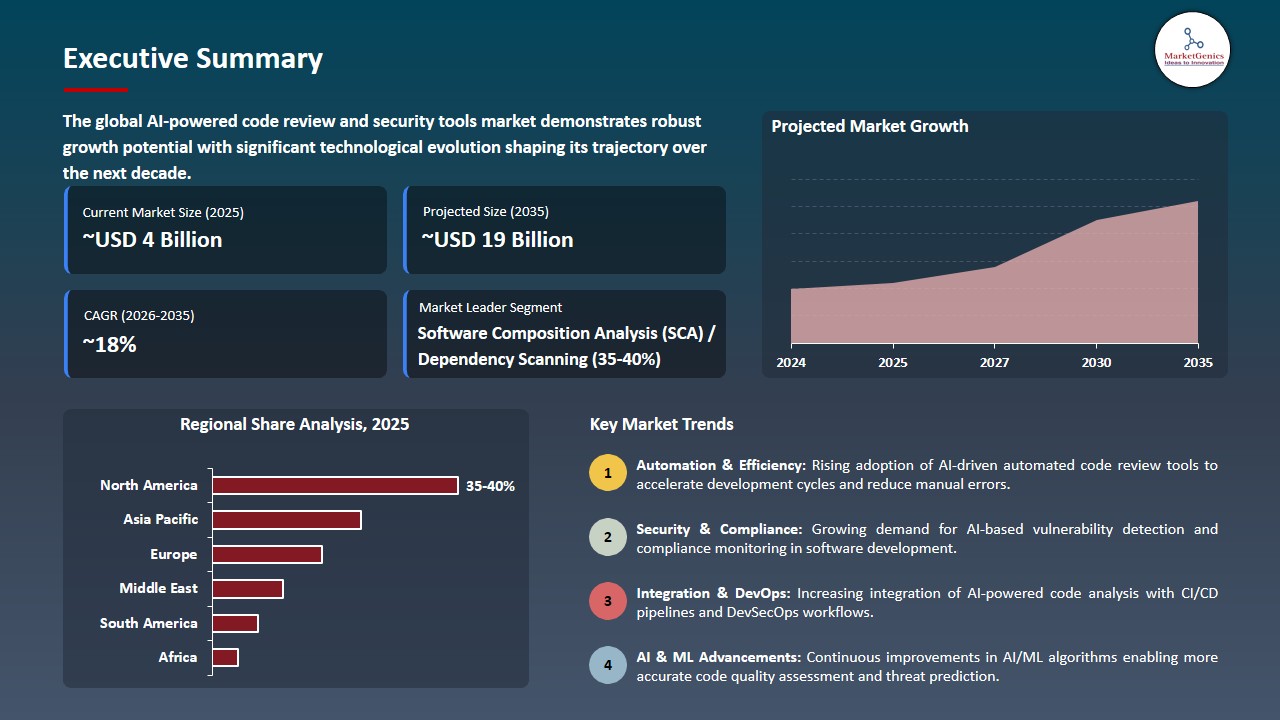
The global AI-powered code review and security tools market is experiencing robust growth, with its estimated value of USD 3.6 billion in the year 2025 and USD 18.5 billion by the period 2035, registering a CAGR of 17.8% during the forecast period.
According to Jens Wessling, CTO of Veracode, "One of the most significant changes in software construction is the increasing use of vibe-coding, a method in which developers ask AI for code and usually do not give security requirements explicitly. Our study uncovers that GenAI models are incorrect in their decisions almost 50% of the time - and the trend isn't getting better."
The AI-powered code review and security tools market is expanding rapidly worldwide, sustained by a variety of factors such as the creation of advanced, reliable, and automated code analysis platforms. For instance, in September 2025, Snyk introduced its next-generation AI-driven vulnerability detection suite that applies machine learning to effortlessly pinpoint and fix security issues in open-source and proprietary code, thus, making the development process more efficient and less risky.
The adoption of DevSecOps practices and cloud-native architectures has, however, increased the demand for advanced code security solutions. It is also worth noting the launch of Veracode’s AI-augmented code review platform, which took place in August 2025, that enables enterprises to detect complex vulnerabilities and obtain security standard compliance with less effort. Besides that, strict regulatory frameworks like ISO/IEC 27001 and NIST are pushing organizations to spend more on cutting-edge code security tools. Tech innovation, adherence to regulation, and the upsurge of AI-generated code are the three main factors fueling the market growth, thus, leading to safer and more efficient software development.
The global AI-powered code review and security tools market opportunities like dependency scanning, static and dynamic analysis, secure software supply chain management, API security, and real-time CI/CD integration that providers can leverage to not only improve software security solutions but also increase their revenue in the broader application security ecosystem.
AI-Powered Code Review and Security Tools Market Dynamics and Trends
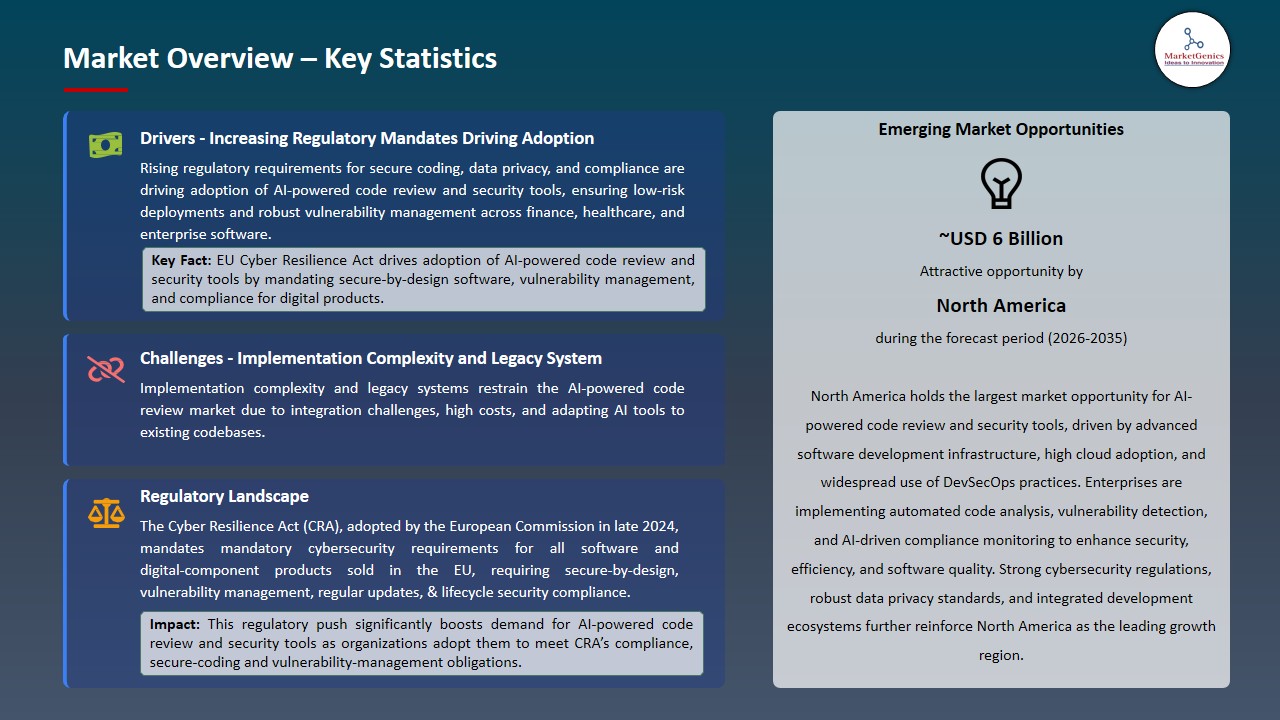
Driver: Increasing Regulatory Mandates Driving Adoption of AI-Powered Code Review and Security Tools
-
The worldwide AI-powered code review and security tools market is growing rapidly and the main factor for this growth is the changing global regulatory frameworks. One example is the U.S. Executive Order on Improving the Nation’s Cybersecurity (EO 14028). Another example is the European Union’s NIS2 Directive. Both regulations require stricter software security standards and also vulnerability management practices. As a result of these new regulations, companies are obliged to introduce automated security tools in their development pipelines.
- Further, the adoption of AI-based code review solutions is additionally promoted by different industry-specific standards like PCI DSS for finance, HIPAA for healthcare and ISO/IEC 27001 for general enterprise security. These solutions are implemented not only for compliance but also as a measure against breach risks. In September 2025, Veracode launched AI-powered static and dynamic analysis instruments that could be seamlessly integrated with DevSecOps workflows thus exemplifying the movement towards automated, compliance-driven software security.
- The increasing use of cloud-native applications, DevOps pipelines, and AI-generated code is the main reason why there is a need for automated vulnerability detection, secure coding guidance, and real-time threat prevention.
Restraint: Implementation Complexity and Legacy System Integration
-
The most significant factors holding back the massive use of AI-powered code review tools are old development environments and fragmented CI/CD pipelines which make it difficult to integrate them smoothly. To be able to use these advanced AI-driven solutions, there is a need for investment in secure infrastructure, APIs, and developer training, especially for small- and medium-sized enterprises (SMEs).
- Globally, the main factor that prevents a fast adoption of the AI technology in security is the problem of finding a balance between ensuring comprehensive security coverage and speeding up the development process and keeping the operational cost at a reasonable level. Furthermore, organizations can also encounter difficulties in aligning AI-powered tools with existing security policies and compliance requirements, which in turn can cause delays in implementation and reduction of the tools' effectiveness.
Opportunity: Expansion in Emerging Regions and Cloud Security Adoption
-
Cloud-native applications in the Asia-Pacific, Latin America, and Africa regions have been rapidly increasing over the last few quarters, hence the demand for automated code security solutions has risen significantly in these geographies. To prevent potential cyber-attacks, governments and enterprises are investing heavily in secure software development. Owing to which, globally-based technology companies such as Snyk, Checkmarx, and SonarQube are collaborating with cloud providers to facilitate the implementation of AI-driven security platforms that are developer-friendly and hence, easier to be adopted in the regions with a burgeoning digital infrastructure.
- The accomplishment of these projects constitutes a good starting point for the vendors of AI-driven vulnerability detection, the providers of DevSecOps platforms, and SaaS security companies willing to expand their business in the regions where the markets are not yet saturated. The increasing concentration on digital transformation programs as well as cybersecurity initiatives funded by the government are two factors that have helped the pace of adoption and have contributed to the long-term market growth.
Key Trend: Integration of AI, ML, and DevSecOps for Real-Time Software Security
-
Contemporary AI-powered code review methodologies employ a combination of machine learning, deep learning, and natural language processing techniques to identify security weaknesses and to give the suggestions for the fixes and risk prioritization. The coupling of DevSecOps pipelines, cloud-based CI/CD, and API-driven automation is accelerating the secure software delivery flow, while AI-powered dependency scanning, license compliance checks, and anomaly detection enhance the operational efficiency.
- The integration of predictive analytics, code composition analysis, and automated remediation is fundamentally changing software security, thus making AI-powered solutions a must-have for modern software development.
- The amplified utilization of generative AI for the automated creation of code and its subsequent review is, likewise, a factor in the increased adoption as the organizations desire rapid development cycles while ensuring security is not compromised.
AI-Powered-Code-Review-and-Security-Tools-Market Analysis and Segmental Data
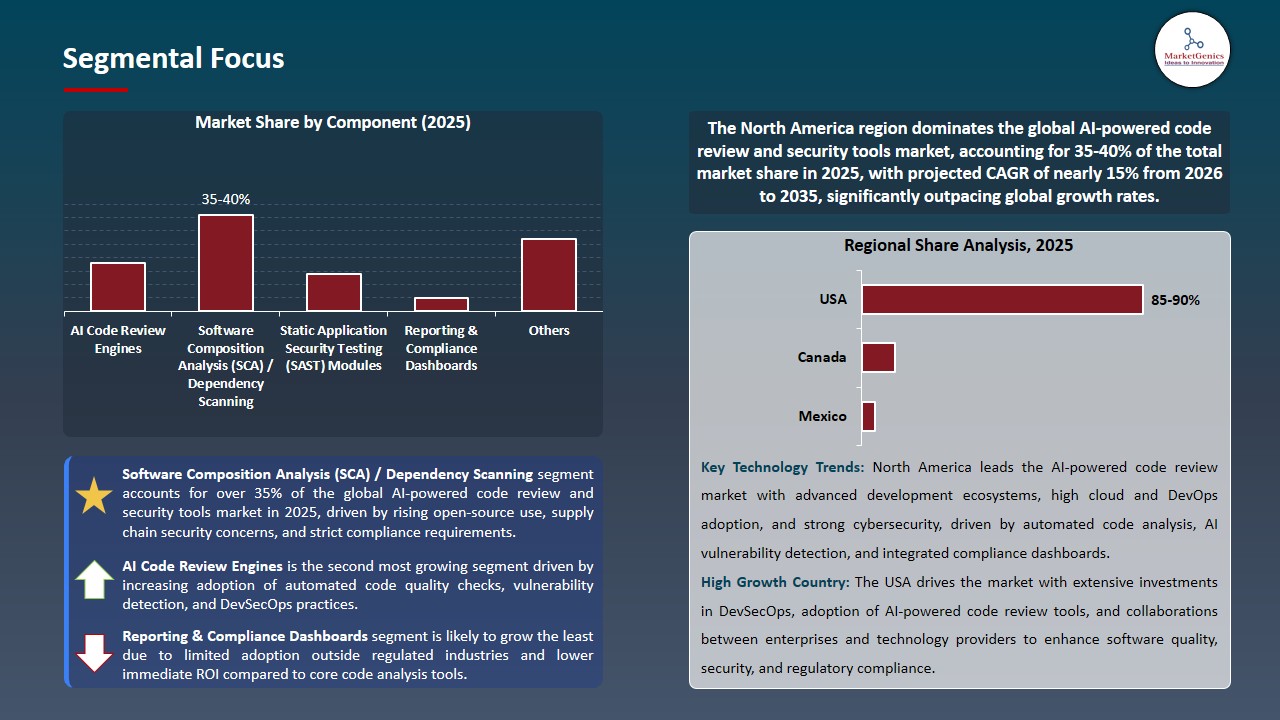
“Software Composition Analysis (SCA) / Dependency Scanning Leads Global AI-Powered Code Review and Security Tools Market"
-
Various industries which include banking, healthcare and e-commerce are turning to AI-powered code review and security tools to automate the process of detecting security weaknesses in open-source and third-party components. Taking Snyk's SCA platform as an example, it aids enterprises in spotting and fixing the issues of dependencies instantly. This serves as a proof of how dependency checking has been established as a baseline standard for secure software development in different industries.
- The use of AI and machine-learning strategies in combination with static and dynamic code analysis instruments has opened up new possibilities in vulnerability detection, license compliance verification, and anomaly identification. In an effort to provide customers with faster, more efficient, and error-free security solutions, companies such as SonarQube, Checkmarx, and Veracode are going the extra mile by developing security solutions that are edge-enabled and IDE-integrated.
- The newly introduced regulatory and compliance frameworks, such as EU’s NIS2 Directive and Cybersecurity-related Executive Orders in the U.S., acknowledge the role of automated vulnerability detection and dependency scanning in ensuring the security of software supply chains. This recognition is the main reason behind the increased use of AI-powered code review tools by enterprises and governments.
- The development of scalable SCA and dependency scanning tools has opened up opportunities for developers and DevOps teams to embed security in CI/CD pipelines without interruption. The platform like WhiteSource and FOSSA are good examples of how these tools can become the core elements that allow the building of interoperable, secure, and compliant software ecosystems at large by organizations.
“North America Leads the AI-Powered Code Review and Security Tools Market"
-
Artificial intelligence-enabled automated code review and security tools have their largest market in North America. The main factors behind this are a mature IT infrastructure, widespread adoption of DevOps, and a strong focus on cybersecurity. Large-scale software development pipelines are secured by U.S. and Canadian enterprises through automated vulnerability detection and dependency scanning, and thus they are the primary users of these technologies. The presence of major technology vendors such as Snyk, SonarQube, Checkmarx, and Veracode, who are issuing cutting-edge AI and machine learning-based code analysis platforms, is the source of the demand for the market as well.
- Additionally, tight regulatory frameworks like the U.S. Executive Order on Improving the Nation’s Cybersecurity (EO 14028) and NIST guidelines compel organizations to implement AI-driven security measures in order to be compliant and at the same time safeguard the critical data. Moreover, substantial private-sector investments in generative AI, cloud-native architectures, and DevSecOps practices are what make the rapid deployment of code review tools possible.
- North America is the leading regional for AI-powered software security solutions market due to its emphasis on research, innovation, and the early adoption of emerging technologies.
AI-Powered-Code-Review-and-Security-Tools-Market Ecosystem
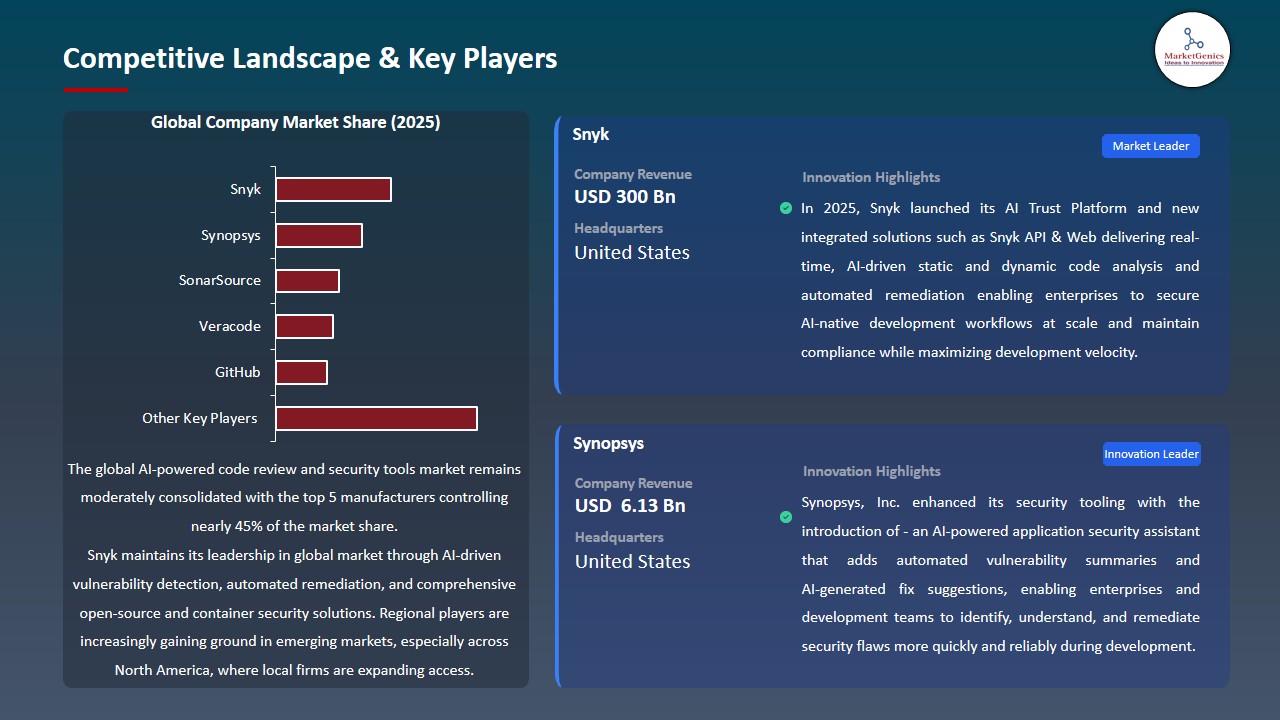
Top-tier companies like Snyk, Veracode, Checkmarx, SonarQube, GitHub, and Synopsys largely define the AI-driven code review and security tools arena that is technology-wise advancing and moderately consolidated. The said companies are relying on state-of-the-art techs like machine learning, NLP, and deep learning for remote automated vulnerability detection, dependency scanning, and secure code analysis.
Leading players are intensively investing in niche products to keep the wheel of innovation turning: Snyk is dedicating its efforts to open-source vulnerability remediation; Checkmarx is the provider of AI-augmented Static and Interactive Application Security Testing solutions; GitHub equips CI/CD pipelines with AI-powered code scanning for seamless integration; and Veracode is the source of risk-based vulnerability prioritization. These particular instruments evolve the development floor the pace checking the security standard compliance.
Companies are putting the accent on product diversification and integrated solutions to make use of AI-powered scanning, DevSecOps integration, cloud support, and license compliance analysis in a single flow. SonarSource unveiled an AI-assisted platform employing deep learning to unearth intricate vulnerabilities and thus they claimed that the detection accuracy was improved by 30% and the manual code review workload was lowered substantially in September 2025.
Recent Development and Strategic Overview:
-
In July 2025, Snyk unveiled its Snyk AI Remediation platform that utilizes machine learning to automatically locate the vulnerabilities of open-source dependencies and create secure code fixes in real-time. With this platform, developers can continuously secure CI/CD pipelines without software delivery being delayed, thus compliance and risk management get improved as well.
- In September 2025, Veracode launched its AI-Powered Application Security Insights tool, which combines deep learning and static analysis to prioritize vulnerabilities exploitability and business impact-wise. With this solution, enterprises can focus on remediation activities more efficiently, improve their operational effectiveness and ensure the security of software supply chains in complex development environments.
Report Scope
|
Attribute |
Detail |
|
Market Size in 2025 |
USD 3.6 Bn |
|
Market Forecast Value in 2035 |
USD 18.5 Bn |
|
Growth Rate (CAGR) |
17.8% |
|
Forecast Period |
2026 – 2035 |
|
Historical Data Available for |
2021 – 2024 |
|
Market Size Units |
USD Bn for Value |
|
Report Format |
Electronic (PDF) + Excel |
|
Regions and Countries Covered |
|||||
|
North America |
Europe |
Asia Pacific |
Middle East |
Africa |
South America |
|
|
|
|
|
|
|
Companies Covered |
|||||
|
|
|
|
|
|
AI-Powered-Code-Review-and-Security-Tools-Market Segmentation and Highlights
|
Segment |
Sub-segment |
|
AI-Powered Code Review And Security Tools Market, By Component |
|
|
AI-Powered Code Review And Security Tools Market, By Deployment Mode |
|
|
AI-Powered Code Review And Security Tools Market, By AI Capability/ Technique |
|
|
AI-Powered Code Review And Security Tools Market, By Analysis Type |
|
|
AI-Powered Code Review And Security Tools Market, By Integration |
|
|
AI-Powered Code Review And Security Tools Market, By Target Use/ Organization Size |
|
|
AI-Powered Code Review And Security Tools Market, By Use Case |
|
|
AI-Powered Code Review And Security Tools Market, By End User |
|
Frequently Asked Questions
Table of Contents
- 1. Research Methodology and Assumptions
- 1.1. Definitions
- 1.2. Research Design and Approach
- 1.3. Data Collection Methods
- 1.4. Base Estimates and Calculations
- 1.5. Forecasting Models
- 1.5.1. Key Forecast Factors & Impact Analysis
- 1.6. Secondary Research
- 1.6.1. Open Sources
- 1.6.2. Paid Databases
- 1.6.3. Associations
- 1.7. Primary Research
- 1.7.1. Primary Sources
- 1.7.2. Primary Interviews with Stakeholders across Ecosystem
- 2. Executive Summary
- 2.1. Global AI-Powered Code Review and Security Tools Market Outlook
- 2.1.1. AI-Powered Code Review and Security Tools Market Size (Value - US$ Bn), and Forecasts, 2021-2035
- 2.1.2. Compounded Annual Growth Rate Analysis
- 2.1.3. Growth Opportunity Analysis
- 2.1.4. Segmental Share Analysis
- 2.1.5. Geographical Share Analysis
- 2.2. Market Analysis and Facts
- 2.3. Supply-Demand Analysis
- 2.4. Competitive Benchmarking
- 2.5. Go-to- Market Strategy
- 2.5.1. Customer/ End-use Industry Assessment
- 2.5.2. Growth Opportunity Data, 2026-2035
- 2.5.2.1. Regional Data
- 2.5.2.2. Country Data
- 2.5.2.3. Segmental Data
- 2.5.3. Identification of Potential Market Spaces
- 2.5.4. GAP Analysis
- 2.5.5. Potential Attractive Price Points
- 2.5.6. Prevailing Market Risks & Challenges
- 2.5.7. Preferred Sales & Marketing Strategies
- 2.5.8. Key Recommendations and Analysis
- 2.5.9. A Way Forward
- 2.1. Global AI-Powered Code Review and Security Tools Market Outlook
- 3. Industry Data and Premium Insights
- 3.1. Global Information Technology & Media Ecosystem Overview, 2025
- 3.1.1. Information Technology & Media Industry Analysis
- 3.1.2. Key Trends for Information Technology & Media Industry
- 3.1.3. Regional Distribution for Information Technology & Media Industry
- 3.2. Supplier Customer Data
- 3.3. Technology Roadmap and Developments
- 3.1. Global Information Technology & Media Ecosystem Overview, 2025
- 4. Market Overview
- 4.1. Market Dynamics
- 4.1.1. Drivers
- 4.1.1.1. Rising demand for automated code quality and vulnerability detection.
- 4.1.1.2. Growing adoption of AI-driven code analysis and DevSecOps integration.
- 4.1.1.3. Increasing investments in cloud-native development and security platforms.
- 4.1.2. Restraints
- 4.1.2.1. High costs of implementation and operation.
- 4.1.2.2. Challenges integrating AI tools with legacy code and existing workflows.
- 4.1.1. Drivers
- 4.2. Key Trend Analysis
- 4.3. Regulatory Framework
- 4.3.1. Key Regulations, Norms, and Subsidies, by Key Countries
- 4.3.2. Tariffs and Standards
- 4.3.3. Impact Analysis of Regulations on the Market
- 4.4. Value Chain Analysis
- 4.4.1. AI Model Development & Data Infrastructure
- 4.4.2. Software Platform & Product Integrators
- 4.4.3. Distribution, Sales & Partner Ecosystem
- 4.4.4. End Users
- 4.5. Cost Structure Analysis
- 4.5.1. Parameter’s Share for Cost Associated
- 4.5.2. COGP vs COGS
- 4.5.3. Profit Margin Analysis
- 4.6. Pricing Analysis
- 4.6.1. Regional Pricing Analysis
- 4.6.2. Segmental Pricing Trends
- 4.6.3. Factors Influencing Pricing
- 4.7. Porter’s Five Forces Analysis
- 4.8. PESTEL Analysis
- 4.9. Global AI-Powered Code Review and Security Tools Market Demand
- 4.9.1. Historical Market Size –Value (US$ Bn), 2020-2024
- 4.9.2. Current and Future Market Size –Value (US$ Bn), 2026–2035
- 4.9.2.1. Y-o-Y Growth Trends
- 4.9.2.2. Absolute $ Opportunity Assessment
- 4.1. Market Dynamics
- 5. Competition Landscape
- 5.1. Competition structure
- 5.1.1. Fragmented v/s consolidated
- 5.2. Company Share Analysis, 2025
- 5.2.1. Global Company Market Share
- 5.2.2. By Region
- 5.2.2.1. North America
- 5.2.2.2. Europe
- 5.2.2.3. Asia Pacific
- 5.2.2.4. Middle East
- 5.2.2.5. Africa
- 5.2.2.6. South America
- 5.3. Product Comparison Matrix
- 5.3.1. Specifications
- 5.3.2. Market Positioning
- 5.3.3. Pricing
- 5.1. Competition structure
- 6. Global AI-Powered Code Review and Security Tools Market Analysis, by Component
- 6.1. Key Segment Analysis
- 6.2. AI-Powered Code Review and Security Tools Market Size (Value - US$ Bn), Analysis, and Forecasts, by Component, 2021-2035
- 6.2.1. AI Code Review Engines
- 6.2.2. Static Application Security Testing (SAST) Modules
- 6.2.3. Software Composition Analysis (SCA) / Dependency Scanning
- 6.2.4. Dynamic Application Security Testing (DAST) Integrations
- 6.2.5. Interactive Application Security Testing (IAST)
- 6.2.6. Vulnerability Triage & Prioritization
- 6.2.7. Fix-Guidance / Remediation Assistants
- 6.2.8. Reporting & Compliance Dashboards
- 6.2.9. Others
- 7. Global AI-Powered Code Review and Security Tools Market Analysis, by Deployment Mode
- 7.1. Key Segment Analysis
- 7.2. AI-Powered Code Review and Security Tools Market Size (Value - US$ Bn), Analysis, and Forecasts, by Deployment Mode, 2021-2035
- 7.2.1. Cloud-Based
- 7.2.2. On-Premises
- 7.2.3. Hybrid
- 8. Global AI-Powered Code Review and Security Tools Market Analysis, by AI Capability/ Technique
- 8.1. Key Segment Analysis
- 8.2. AI-Powered Code Review and Security Tools Market Size (Value - US$ Bn), Analysis, and Forecasts, by AI Capability/ Technique, 2021-2035
- 8.2.1. Rule-based / Heuristic Augmentation
- 8.2.2. Supervised ML (classification & detection)
- 8.2.3. Large Language Model (LLM)-based Code Understanding
- 8.2.4. Graph-based Code Analysis (AST/CFG embeddings)
- 8.2.5. Hybrid (ML + Symbolic / Formal methods)
- 8.2.6. Others
- 9. Global AI-Powered Code Review and Security Tools Market Analysis, by Analysis Type
- 9.1. Key Segment Analysis
- 9.2. AI-Powered Code Review and Security Tools Market Size (Value - US$ Bn), Analysis, and Forecasts, by Analysis Type, 2021-2035
- 9.2.1. Syntax & Style Review
- 9.2.2. Security Vulnerability Detection (SAST)
- 9.2.3. Dependency & License Risk Analysis (SCA)
- 9.2.4. Secret & Credential Detection
- 9.2.5. Vulnerability Exploitability & Risk Scoring
- 9.2.6. Architectural / Design Flaw Detection
- 9.2.7. Performance & Resource-usage Anti-patterns
- 9.2.8. Others
- 10. Global AI-Powered Code Review and Security Tools Market Analysis, by Integration
- 10.1. Key Segment Analysis
- 10.2. AI-Powered Code Review and Security Tools Market Size (Value - US$ Bn), Analysis, and Forecasts, by Integration, 2021-2035
- 10.2.1. IDE Plugins
- 10.2.2. CI/CD Pipeline Integrations
- 10.2.3. SCM / PR Automation
- 10.2.4. Issue Trackers / Ticketing
- 10.2.5. DevSecOps Orchestration Platforms
- 10.2.6. Others
- 11. Global AI-Powered Code Review and Security Tools Market Analysis, by Target Use/ Organization Size
- 11.1. Key Segment Analysis
- 11.2. AI-Powered Code Review and Security Tools Market Size (Value - US$ Bn), Analysis, and Forecasts, by Target Use/ Organization Size, 2021-2035
- 11.2.1. Individual Developers / Freelancers
- 11.2.2. SMB Development Teams
- 11.2.3. Enterprise / Global DevOps Organizations
- 11.2.4. Security / AppSec Teams
- 11.2.5. Managed Security Service Providers (MSSPs)
- 11.2.6. Others
- 12. Global AI-Powered Code Review and Security Tools Market Analysis, by Use Case
- 12.1. Key Segment Analysis
- 12.2. AI-Powered Code Review and Security Tools Market Size (Value - US$ Bn), Analysis, and Forecasts, by Use Case, 2021-2035
- 12.2.1. Pull Request / Pre-merge Scanning
- 12.2.2. Commit-time / Pre-commit Hook Analysis
- 12.2.3. Scheduled Repository-wide Audits
- 12.2.4. Runtime/Telemetry-driven Feedback Loops
- 12.2.5. Security Governance & Compliance Evidence Collection
- 12.2.6. Others
- 13. Global AI-Powered Code Review and Security Tools Market Analysis, by Use User
- 13.1. Key Segment Analysis
- 13.2. AI-Powered Code Review and Security Tools Market Size (Value - US$ Bn), Analysis, and Forecasts, by Use User, 2021-2035
- 13.2.1. Financial Services & FinTech
- 13.2.2. Healthcare & Life Sciences
- 13.2.3. Government & Defense / Critical Infrastructure
- 13.2.4. E-commerce & Retail
- 13.2.5. Gaming & Embedded Systems
- 13.2.6. Others
- 14. Global AI-Powered Code Review and Security Tools Market Analysis and Forecasts, by Region
- 14.1. Key Findings
- 14.2. AI-Powered Code Review and Security Tools Market Size (Value - US$ Bn), Analysis, and Forecasts, by Region, 2021-2035
- 14.2.1. North America
- 14.2.2. Europe
- 14.2.3. Asia Pacific
- 14.2.4. Middle East
- 14.2.5. Africa
- 14.2.6. South America
- 15. North America AI-Powered Code Review and Security Tools Market Analysis
- 15.1. Key Segment Analysis
- 15.2. Regional Snapshot
- 15.3. North America AI-Powered Code Review and Security Tools Market Size Value - US$ Bn), Analysis, and Forecasts, 2021-2035
- 15.3.1. Component
- 15.3.2. Deployment Mode
- 15.3.3. AI Capability/ Technique
- 15.3.4. Analysis Type
- 15.3.5. Integration
- 15.3.6. Target Use/ Organization Size
- 15.3.7. Use Case
- 15.3.8. End User
- 15.3.9. Country
- 15.3.9.1. USA
- 15.3.9.2. Canada
- 15.3.9.3. Mexico
- 15.4. USA AI-Powered Code Review and Security Tools Market
- 15.4.1. Country Segmental Analysis
- 15.4.2. Component
- 15.4.3. Deployment Mode
- 15.4.4. AI Capability/ Technique
- 15.4.5. Analysis Type
- 15.4.6. Integration
- 15.4.7. Target Use/ Organization Size
- 15.4.8. Use Case
- 15.4.9. End User
- 15.5. Canada AI-Powered Code Review and Security Tools Market
- 15.5.1. Country Segmental Analysis
- 15.5.2. Component
- 15.5.3. Deployment Mode
- 15.5.4. AI Capability/ Technique
- 15.5.5. Analysis Type
- 15.5.6. Integration
- 15.5.7. Target Use/ Organization Size
- 15.5.8. Use Case
- 15.5.9. End User
- 15.6. Mexico AI-Powered Code Review and Security Tools Market
- 15.6.1. Country Segmental Analysis
- 15.6.2. Component
- 15.6.3. Deployment Mode
- 15.6.4. AI Capability/ Technique
- 15.6.5. Analysis Type
- 15.6.6. Integration
- 15.6.7. Target Use/ Organization Size
- 15.6.8. Use Case
- 15.6.9. End User
- 16. Europe AI-Powered Code Review and Security Tools Market Analysis
- 16.1. Key Segment Analysis
- 16.2. Regional Snapshot
- 16.3. Europe AI-Powered Code Review and Security Tools Market Size (Value - US$ Bn), Analysis, and Forecasts, 2021-2035
- 16.3.1. Component
- 16.3.2. Deployment Mode
- 16.3.3. AI Capability/ Technique
- 16.3.4. Analysis Type
- 16.3.5. Integration
- 16.3.6. Target Use/ Organization Size
- 16.3.7. Use Case
- 16.3.8. End User
- 16.3.9. Country
- 16.3.9.1. Germany
- 16.3.9.2. United Kingdom
- 16.3.9.3. France
- 16.3.9.4. Italy
- 16.3.9.5. Spain
- 16.3.9.6. Netherlands
- 16.3.9.7. Nordic Countries
- 16.3.9.8. Poland
- 16.3.9.9. Russia & CIS
- 16.3.9.10. Rest of Europe
- 16.4. Germany AI-Powered Code Review and Security Tools Market
- 16.4.1. Country Segmental Analysis
- 16.4.2. Component
- 16.4.3. Deployment Mode
- 16.4.4. AI Capability/ Technique
- 16.4.5. Analysis Type
- 16.4.6. Integration
- 16.4.7. Target Use/ Organization Size
- 16.4.8. Use Case
- 16.4.9. End User
- 16.5. United Kingdom AI-Powered Code Review and Security Tools Market
- 16.5.1. Country Segmental Analysis
- 16.5.2. Component
- 16.5.3. Deployment Mode
- 16.5.4. AI Capability/ Technique
- 16.5.5. Analysis Type
- 16.5.6. Integration
- 16.5.7. Target Use/ Organization Size
- 16.5.8. Use Case
- 16.5.9. End User
- 16.6. France AI-Powered Code Review and Security Tools Market
- 16.6.1. Country Segmental Analysis
- 16.6.2. Component
- 16.6.3. Deployment Mode
- 16.6.4. AI Capability/ Technique
- 16.6.5. Analysis Type
- 16.6.6. Integration
- 16.6.7. Target Use/ Organization Size
- 16.6.8. Use Case
- 16.6.9. End User
- 16.7. Italy AI-Powered Code Review and Security Tools Market
- 16.7.1. Country Segmental Analysis
- 16.7.2. Component
- 16.7.3. Deployment Mode
- 16.7.4. AI Capability/ Technique
- 16.7.5. Analysis Type
- 16.7.6. Integration
- 16.7.7. Target Use/ Organization Size
- 16.7.8. Use Case
- 16.7.9. End User
- 16.8. Spain AI-Powered Code Review and Security Tools Market
- 16.8.1. Country Segmental Analysis
- 16.8.2. Component
- 16.8.3. Deployment Mode
- 16.8.4. AI Capability/ Technique
- 16.8.5. Analysis Type
- 16.8.6. Integration
- 16.8.7. Target Use/ Organization Size
- 16.8.8. Use Case
- 16.8.9. End User
- 16.9. Netherlands AI-Powered Code Review and Security Tools Market
- 16.9.1. Country Segmental Analysis
- 16.9.2. Component
- 16.9.3. Deployment Mode
- 16.9.4. AI Capability/ Technique
- 16.9.5. Analysis Type
- 16.9.6. Integration
- 16.9.7. Target Use/ Organization Size
- 16.9.8. Use Case
- 16.9.9. End User
- 16.10. Nordic Countries AI-Powered Code Review and Security Tools Market
- 16.10.1. Country Segmental Analysis
- 16.10.2. Component
- 16.10.3. Deployment Mode
- 16.10.4. AI Capability/ Technique
- 16.10.5. Analysis Type
- 16.10.6. Integration
- 16.10.7. Target Use/ Organization Size
- 16.10.8. Use Case
- 16.10.9. End User
- 16.11. Poland AI-Powered Code Review and Security Tools Market
- 16.11.1. Country Segmental Analysis
- 16.11.2. Component
- 16.11.3. Deployment Mode
- 16.11.4. AI Capability/ Technique
- 16.11.5. Analysis Type
- 16.11.6. Integration
- 16.11.7. Target Use/ Organization Size
- 16.11.8. Use Case
- 16.11.9. End User
- 16.12. Russia & CIS AI-Powered Code Review and Security Tools Market
- 16.12.1. Country Segmental Analysis
- 16.12.2. Component
- 16.12.3. Deployment Mode
- 16.12.4. AI Capability/ Technique
- 16.12.5. Analysis Type
- 16.12.6. Integration
- 16.12.7. Target Use/ Organization Size
- 16.12.8. Use Case
- 16.12.9. End User
- 16.13. Rest of Europe AI-Powered Code Review and Security Tools Market
- 16.13.1. Country Segmental Analysis
- 16.13.2. Component
- 16.13.3. Deployment Mode
- 16.13.4. AI Capability/ Technique
- 16.13.5. Analysis Type
- 16.13.6. Integration
- 16.13.7. Target Use/ Organization Size
- 16.13.8. Use Case
- 16.13.9. End User
- 17. Asia Pacific AI-Powered Code Review and Security Tools Market Analysis
- 17.1. Key Segment Analysis
- 17.2. Regional Snapshot
- 17.3. Asia Pacific AI-Powered Code Review and Security Tools Market Size (Value - US$ Bn), Analysis, and Forecasts, 2021-2035
- 17.3.1. Component
- 17.3.2. Deployment Mode
- 17.3.3. AI Capability/ Technique
- 17.3.4. Analysis Type
- 17.3.5. Integration
- 17.3.6. Target Use/ Organization Size
- 17.3.7. Use Case
- 17.3.8. End User
- 17.3.9. Country
- 17.3.9.1. China
- 17.3.9.2. India
- 17.3.9.3. Japan
- 17.3.9.4. South Korea
- 17.3.9.5. Australia and New Zealand
- 17.3.9.6. Indonesia
- 17.3.9.7. Malaysia
- 17.3.9.8. Thailand
- 17.3.9.9. Vietnam
- 17.3.9.10. Rest of Asia Pacific
- 17.4. China AI-Powered Code Review and Security Tools Market
- 17.4.1. Country Segmental Analysis
- 17.4.2. Component
- 17.4.3. Deployment Mode
- 17.4.4. AI Capability/ Technique
- 17.4.5. Analysis Type
- 17.4.6. Integration
- 17.4.7. Target Use/ Organization Size
- 17.4.8. Use Case
- 17.4.9. End User
- 17.5. India AI-Powered Code Review and Security Tools Market
- 17.5.1. Country Segmental Analysis
- 17.5.2. Component
- 17.5.3. Deployment Mode
- 17.5.4. AI Capability/ Technique
- 17.5.5. Analysis Type
- 17.5.6. Integration
- 17.5.7. Target Use/ Organization Size
- 17.5.8. Use Case
- 17.5.9. End User
- 17.6. Japan AI-Powered Code Review and Security Tools Market
- 17.6.1. Country Segmental Analysis
- 17.6.2. Component
- 17.6.3. Deployment Mode
- 17.6.4. AI Capability/ Technique
- 17.6.5. Analysis Type
- 17.6.6. Integration
- 17.6.7. Target Use/ Organization Size
- 17.6.8. Use Case
- 17.6.9. End User
- 17.7. South Korea AI-Powered Code Review and Security Tools Market
- 17.7.1. Country Segmental Analysis
- 17.7.2. Component
- 17.7.3. Deployment Mode
- 17.7.4. AI Capability/ Technique
- 17.7.5. Analysis Type
- 17.7.6. Integration
- 17.7.7. Target Use/ Organization Size
- 17.7.8. Use Case
- 17.7.9. End User
- 17.8. Australia and New Zealand AI-Powered Code Review and Security Tools Market
- 17.8.1. Country Segmental Analysis
- 17.8.2. Component
- 17.8.3. Deployment Mode
- 17.8.4. AI Capability/ Technique
- 17.8.5. Analysis Type
- 17.8.6. Integration
- 17.8.7. Target Use/ Organization Size
- 17.8.8. Use Case
- 17.8.9. End User
- 17.9. Indonesia AI-Powered Code Review and Security Tools Market
- 17.9.1. Country Segmental Analysis
- 17.9.2. Component
- 17.9.3. Deployment Mode
- 17.9.4. AI Capability/ Technique
- 17.9.5. Analysis Type
- 17.9.6. Integration
- 17.9.7. Target Use/ Organization Size
- 17.9.8. Use Case
- 17.9.9. End User
- 17.10. Malaysia AI-Powered Code Review and Security Tools Market
- 17.10.1. Country Segmental Analysis
- 17.10.2. Component
- 17.10.3. Deployment Mode
- 17.10.4. AI Capability/ Technique
- 17.10.5. Analysis Type
- 17.10.6. Integration
- 17.10.7. Target Use/ Organization Size
- 17.10.8. Use Case
- 17.10.9. End User
- 17.11. Thailand AI-Powered Code Review and Security Tools Market
- 17.11.1. Country Segmental Analysis
- 17.11.2. Component
- 17.11.3. Deployment Mode
- 17.11.4. AI Capability/ Technique
- 17.11.5. Analysis Type
- 17.11.6. Integration
- 17.11.7. Target Use/ Organization Size
- 17.11.8. Use Case
- 17.11.9. End User
- 17.12. Vietnam AI-Powered Code Review and Security Tools Market
- 17.12.1. Country Segmental Analysis
- 17.12.2. Component
- 17.12.3. Deployment Mode
- 17.12.4. AI Capability/ Technique
- 17.12.5. Analysis Type
- 17.12.6. Integration
- 17.12.7. Target Use/ Organization Size
- 17.12.8. Use Case
- 17.12.9. End User
- 17.13. Rest of Asia Pacific AI-Powered Code Review and Security Tools Market
- 17.13.1. Country Segmental Analysis
- 17.13.2. Component
- 17.13.3. Deployment Mode
- 17.13.4. AI Capability/ Technique
- 17.13.5. Analysis Type
- 17.13.6. Integration
- 17.13.7. Target Use/ Organization Size
- 17.13.8. Use Case
- 17.13.9. End User
- 18. Middle East AI-Powered Code Review and Security Tools Market Analysis
- 18.1. Key Segment Analysis
- 18.2. Regional Snapshot
- 18.3. Middle East AI-Powered Code Review and Security Tools Market Size (Value - US$ Bn), Analysis, and Forecasts, 2021-2035
- 18.3.1. Component
- 18.3.2. Deployment Mode
- 18.3.3. AI Capability/ Technique
- 18.3.4. Analysis Type
- 18.3.5. Integration
- 18.3.6. Target Use/ Organization Size
- 18.3.7. Use Case
- 18.3.8. End User
- 18.3.9. Country
- 18.3.9.1. Turkey
- 18.3.9.2. UAE
- 18.3.9.3. Saudi Arabia
- 18.3.9.4. Israel
- 18.3.9.5. Rest of Middle East
- 18.4. Turkey AI-Powered Code Review and Security Tools Market
- 18.4.1. Country Segmental Analysis
- 18.4.2. Component
- 18.4.3. Deployment Mode
- 18.4.4. AI Capability/ Technique
- 18.4.5. Analysis Type
- 18.4.6. Integration
- 18.4.7. Target Use/ Organization Size
- 18.4.8. Use Case
- 18.4.9. End User
- 18.5. UAE AI-Powered Code Review and Security Tools Market
- 18.5.1. Country Segmental Analysis
- 18.5.2. Component
- 18.5.3. Deployment Mode
- 18.5.4. AI Capability/ Technique
- 18.5.5. Analysis Type
- 18.5.6. Integration
- 18.5.7. Target Use/ Organization Size
- 18.5.8. Use Case
- 18.5.9. End User
- 18.6. Saudi Arabia AI-Powered Code Review and Security Tools Market
- 18.6.1. Country Segmental Analysis
- 18.6.2. Component
- 18.6.3. Deployment Mode
- 18.6.4. AI Capability/ Technique
- 18.6.5. Analysis Type
- 18.6.6. Integration
- 18.6.7. Target Use/ Organization Size
- 18.6.8. Use Case
- 18.6.9. End User
- 18.7. Israel AI-Powered Code Review and Security Tools Market
- 18.7.1. Country Segmental Analysis
- 18.7.2. Component
- 18.7.3. Deployment Mode
- 18.7.4. AI Capability/ Technique
- 18.7.5. Analysis Type
- 18.7.6. Integration
- 18.7.7. Target Use/ Organization Size
- 18.7.8. Use Case
- 18.7.9. End User
- 18.8. Rest of Middle East AI-Powered Code Review and Security Tools Market
- 18.8.1. Country Segmental Analysis
- 18.8.2. Component
- 18.8.3. Deployment Mode
- 18.8.4. AI Capability/ Technique
- 18.8.5. Analysis Type
- 18.8.6. Integration
- 18.8.7. Target Use/ Organization Size
- 18.8.8. Use Case
- 18.8.9. End User
- 19. Africa AI-Powered Code Review and Security Tools Market Analysis
- 19.1. Key Segment Analysis
- 19.2. Regional Snapshot
- 19.3. Africa AI-Powered Code Review and Security Tools Market Size (Value - US$ Bn), Analysis, and Forecasts, 2021-2035
- 19.3.1. Component
- 19.3.2. Deployment Mode
- 19.3.3. AI Capability/ Technique
- 19.3.4. Analysis Type
- 19.3.5. Integration
- 19.3.6. Target Use/ Organization Size
- 19.3.7. Use Case
- 19.3.8. End User
- 19.3.9. Country
- 19.3.9.1. South Africa
- 19.3.9.2. Egypt
- 19.3.9.3. Nigeria
- 19.3.9.4. Algeria
- 19.3.9.5. Rest of Africa
- 19.4. South Africa AI-Powered Code Review and Security Tools Market
- 19.4.1. Country Segmental Analysis
- 19.4.2. Component
- 19.4.3. Deployment Mode
- 19.4.4. AI Capability/ Technique
- 19.4.5. Analysis Type
- 19.4.6. Integration
- 19.4.7. Target Use/ Organization Size
- 19.4.8. Use Case
- 19.4.9. End User
- 19.5. Egypt AI-Powered Code Review and Security Tools Market
- 19.5.1. Country Segmental Analysis
- 19.5.2. Component
- 19.5.3. Deployment Mode
- 19.5.4. AI Capability/ Technique
- 19.5.5. Analysis Type
- 19.5.6. Integration
- 19.5.7. Target Use/ Organization Size
- 19.5.8. Use Case
- 19.5.9. End User
- 19.6. Nigeria AI-Powered Code Review and Security Tools Market
- 19.6.1. Country Segmental Analysis
- 19.6.2. Component
- 19.6.3. Deployment Mode
- 19.6.4. AI Capability/ Technique
- 19.6.5. Analysis Type
- 19.6.6. Integration
- 19.6.7. Target Use/ Organization Size
- 19.6.8. Use Case
- 19.6.9. End User
- 19.7. Algeria AI-Powered Code Review and Security Tools Market
- 19.7.1. Country Segmental Analysis
- 19.7.2. Component
- 19.7.3. Deployment Mode
- 19.7.4. AI Capability/ Technique
- 19.7.5. Analysis Type
- 19.7.6. Integration
- 19.7.7. Target Use/ Organization Size
- 19.7.8. Use Case
- 19.7.9. End User
- 19.8. Rest of Africa AI-Powered Code Review and Security Tools Market
- 19.8.1. Country Segmental Analysis
- 19.8.2. Component
- 19.8.3. Deployment Mode
- 19.8.4. AI Capability/ Technique
- 19.8.5. Analysis Type
- 19.8.6. Integration
- 19.8.7. Target Use/ Organization Size
- 19.8.8. Use Case
- 19.8.9. End User
- 20. South America AI-Powered Code Review and Security Tools Market Analysis
- 20.1. Key Segment Analysis
- 20.2. Regional Snapshot
- 20.3. South America AI-Powered Code Review and Security Tools Market Size (Value - US$ Bn), Analysis, and Forecasts, 2021-2035
- 20.3.1. Component
- 20.3.2. Deployment Mode
- 20.3.3. AI Capability/ Technique
- 20.3.4. Analysis Type
- 20.3.5. Integration
- 20.3.6. Target Use/ Organization Size
- 20.3.7. Use Case
- 20.3.8. End User
- 20.3.9. Country
- 20.3.9.1. Brazil
- 20.3.9.2. Argentina
- 20.3.9.3. Rest of South America
- 20.4. Brazil AI-Powered Code Review and Security Tools Market
- 20.4.1. Country Segmental Analysis
- 20.4.2. Component
- 20.4.3. Deployment Mode
- 20.4.4. AI Capability/ Technique
- 20.4.5. Analysis Type
- 20.4.6. Integration
- 20.4.7. Target Use/ Organization Size
- 20.4.8. Use Case
- 20.4.9. End User
- 20.5. Argentina AI-Powered Code Review and Security Tools Market
- 20.5.1. Country Segmental Analysis
- 20.5.2. Component
- 20.5.3. Deployment Mode
- 20.5.4. AI Capability/ Technique
- 20.5.5. Analysis Type
- 20.5.6. Integration
- 20.5.7. Target Use/ Organization Size
- 20.5.8. Use Case
- 20.5.9. End User
- 20.6. Rest of South America AI-Powered Code Review and Security Tools Market
- 20.6.1. Country Segmental Analysis
- 20.6.2. Component
- 20.6.3. Deployment Mode
- 20.6.4. AI Capability/ Technique
- 20.6.5. Analysis Type
- 20.6.6. Integration
- 20.6.7. Target Use/ Organization Size
- 20.6.8. Use Case
- 20.6.9. End User
- 21. Key Players/ Company Profile
- 21.1. AWS
- 21.1.1. Company Details/ Overview
- 21.1.2. Company Financials
- 21.1.3. Key Customers and Competitors
- 21.1.4. Business/ Industry Portfolio
- 21.1.5. Product Portfolio/ Specification Details
- 21.1.6. Pricing Data
- 21.1.7. Strategic Overview
- 21.1.8. Recent Developments
- 21.2. Checkmarx
- 21.3. Codacy
- 21.4. CodeScene
- 21.5. Contrast Security
- 21.6. DeepSource
- 21.7. Embold
- 21.8. GitHub
- 21.9. GitLab
- 21.10. Google
- 21.11. GrammaTech
- 21.12. Mend (formerly WhiteSource)
- 21.13. Micro Focus Fortify
- 21.14. Semgrep
- 21.15. ShiftLeft
- 21.16. Snyk
- 21.17. SonarSource
- 21.18. Sourcegraph
- 21.19. Synopsys
- 21.20. Veracode
- 21.21. Other Key Players
- 21.1. AWS
Note* - This is just tentative list of players. While providing the report, we will cover more number of players based on their revenue and share for each geography
Research Design
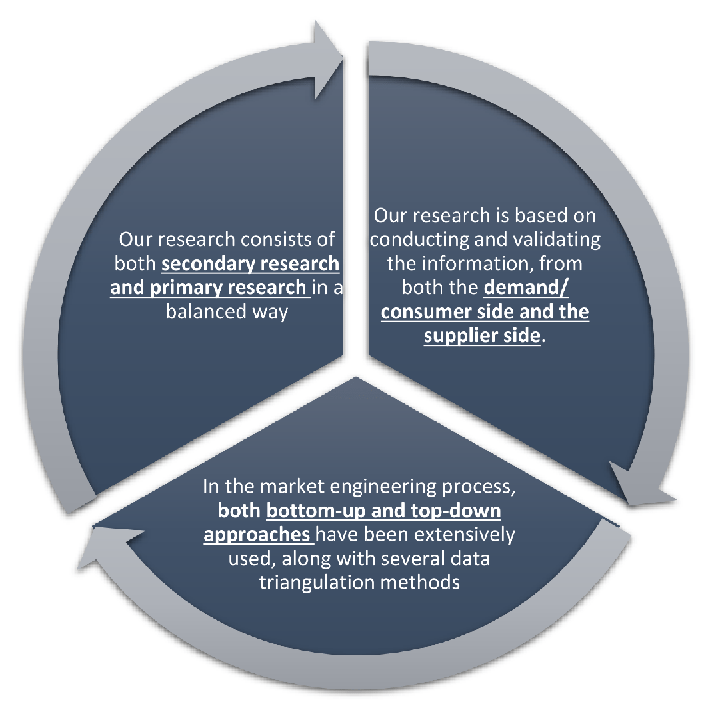
Our research design integrates both demand-side and supply-side analysis through a balanced combination of primary and secondary research methodologies. By utilizing both bottom-up and top-down approaches alongside rigorous data triangulation methods, we deliver robust market intelligence that supports strategic decision-making.
MarketGenics' comprehensive research design framework ensures the delivery of accurate, reliable, and actionable market intelligence. Through the integration of multiple research approaches, rigorous validation processes, and expert analysis, we provide our clients with the insights needed to make informed strategic decisions and capitalize on market opportunities.
MarketGenics leverages a dedicated industry panel of experts and a comprehensive suite of paid databases to effectively collect, consolidate, and analyze market intelligence.
Our approach has consistently proven to be reliable and effective in generating accurate market insights, identifying key industry trends, and uncovering emerging business opportunities.
Through both primary and secondary research, we capture and analyze critical company-level data such as manufacturing footprints, including technical centers, R&D facilities, sales offices, and headquarters.
Our expert panel further enhances our ability to estimate market size for specific brands based on validated field-level intelligence.
Our data mining techniques incorporate both parametric and non-parametric methods, allowing for structured data collection, sorting, processing, and cleaning.
Demand projections are derived from large-scale data sets analyzed through proprietary algorithms, culminating in robust and reliable market sizing.
Research Approach
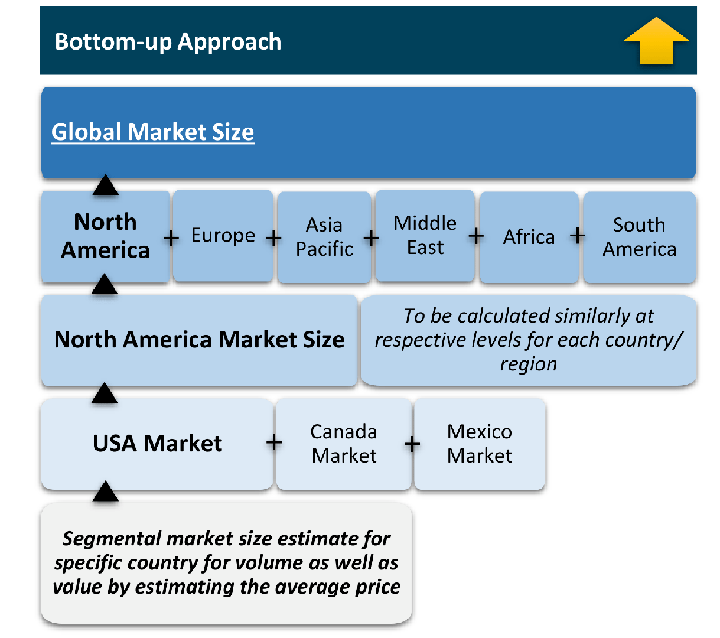
The bottom-up approach builds market estimates by starting with the smallest addressable market units and systematically aggregating them to create comprehensive market size projections.
This method begins with specific, granular data points and builds upward to create the complete market landscape.
Customer Analysis → Segmental Analysis → Geographical Analysis
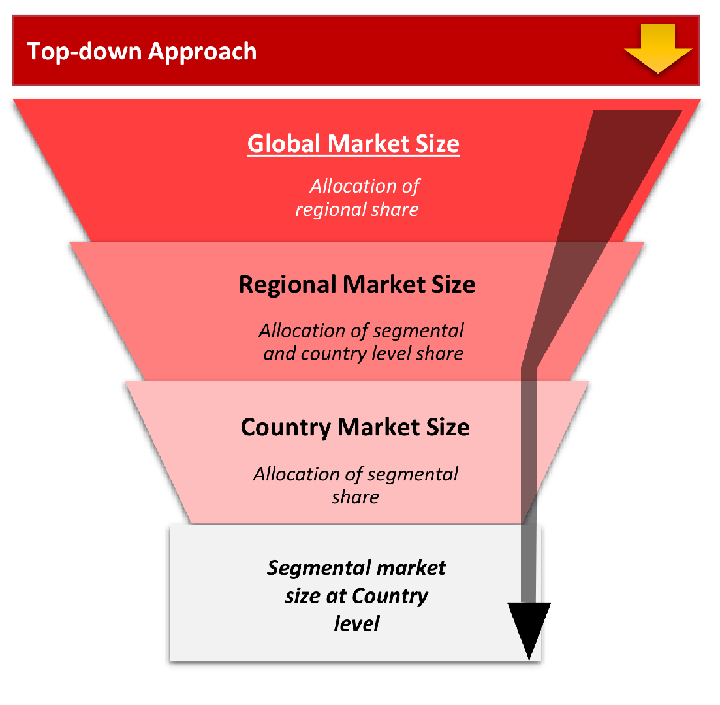
The top-down approach starts with the broadest possible market data and systematically narrows it down through a series of filters and assumptions to arrive at specific market segments or opportunities.
This method begins with the big picture and works downward to increasingly specific market slices.
TAM → SAM → SOM
Research Methods
Desk / Secondary Research
While analysing the market, we extensively study secondary sources, directories, and databases to identify and collect information useful for this technical, market-oriented, and commercial report. Secondary sources that we utilize are not only the public sources, but it is a combination of Open Source, Associations, Paid Databases, MG Repository & Knowledgebase, and others.
- Company websites, annual reports, financial reports, broker reports, and investor presentations
- National government documents, statistical databases and reports
- News articles, press releases and web-casts specific to the companies operating in the market, Magazines, reports, and others
- We gather information from commercial data sources for deriving company specific data such as segmental revenue, share for geography, product revenue, and others
- Internal and external proprietary databases (industry-specific), relevant patent, and regulatory databases
- Governing Bodies, Government Organizations
- Relevant Authorities, Country-specific Associations for Industries
We also employ the model mapping approach to estimate the product level market data through the players' product portfolio
Primary Research
Primary research/ interviews is vital in analyzing the market. Most of the cases involves paid primary interviews. Primary sources include primary interviews through e-mail interactions, telephonic interviews, surveys as well as face-to-face interviews with the different stakeholders across the value chain including several industry experts.
| Type of Respondents | Number of Primaries |
|---|---|
| Tier 2/3 Suppliers | ~20 |
| Tier 1 Suppliers | ~25 |
| End-users | ~25 |
| Industry Expert/ Panel/ Consultant | ~30 |
| Total | ~100 |
MG Knowledgebase
• Repository of industry blog, newsletter and case studies
• Online platform covering detailed market reports, and company profiles
Forecasting Factors and Models
Forecasting Factors
- Historical Trends – Past market patterns, cycles, and major events that shaped how markets behave over time. Understanding past trends helps predict future behavior.
- Industry Factors – Specific characteristics of the industry like structure, regulations, and innovation cycles that affect market dynamics.
- Macroeconomic Factors – Economic conditions like GDP growth, inflation, and employment rates that affect how much money people have to spend.
- Demographic Factors – Population characteristics like age, income, and location that determine who can buy your product.
- Technology Factors – How quickly people adopt new technology and how much technology infrastructure exists.
- Regulatory Factors – Government rules, laws, and policies that can help or restrict market growth.
- Competitive Factors – Analyzing competition structure such as degree of competition and bargaining power of buyers and suppliers.
Forecasting Models / Techniques
Multiple Regression Analysis
- Identify and quantify factors that drive market changes
- Statistical modeling to establish relationships between market drivers and outcomes
Time Series Analysis – Seasonal Patterns
- Understand regular cyclical patterns in market demand
- Advanced statistical techniques to separate trend, seasonal, and irregular components
Time Series Analysis – Trend Analysis
- Identify underlying market growth patterns and momentum
- Statistical analysis of historical data to project future trends
Expert Opinion – Expert Interviews
- Gather deep industry insights and contextual understanding
- In-depth interviews with key industry stakeholders
Multi-Scenario Development
- Prepare for uncertainty by modeling different possible futures
- Creating optimistic, pessimistic, and most likely scenarios
Time Series Analysis – Moving Averages
- Sophisticated forecasting for complex time series data
- Auto-regressive integrated moving average models with seasonal components
Econometric Models
- Apply economic theory to market forecasting
- Sophisticated economic models that account for market interactions
Expert Opinion – Delphi Method
- Harness collective wisdom of industry experts
- Structured, multi-round expert consultation process
Monte Carlo Simulation
- Quantify uncertainty and probability distributions
- Thousands of simulations with varying input parameters
Research Analysis
Our research framework is built upon the fundamental principle of validating market intelligence from both demand and supply perspectives. This dual-sided approach ensures comprehensive market understanding and reduces the risk of single-source bias.
Demand-Side Analysis: We understand end-user/application behavior, preferences, and market needs along with the penetration of the product for specific application.
Supply-Side Analysis: We estimate overall market revenue, analyze the segmental share along with industry capacity, competitive landscape, and market structure.
Validation & Evaluation
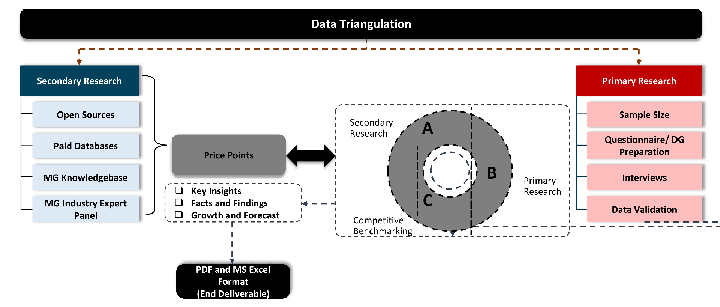
Data triangulation is a validation technique that uses multiple methods, sources, or perspectives to examine the same research question, thereby increasing the credibility and reliability of research findings. In market research, triangulation serves as a quality assurance mechanism that helps identify and minimize bias, validate assumptions, and ensure accuracy in market estimates.
- Data Source Triangulation – Using multiple data sources to examine the same phenomenon
- Methodological Triangulation – Using multiple research methods to study the same research question
- Investigator Triangulation – Using multiple researchers or analysts to examine the same data
- Theoretical Triangulation – Using multiple theoretical perspectives to interpret the same data
Custom Market Research Services
We will customise the research for you, in case the report listed above does not meet your requirements.
Get 10% Free Customisation