Automotive AC Compressor Market Size, Share & Trends Analysis Report by Compressor Type (Fixed Displacement Compressors, Variable Displacement Compressors, Electric Compressors), Vehicle Type, Propulsion Type, Refrigerant Type, Cooling Capacity, Technology, Sales Channel, and Geography (North America, Europe, Asia Pacific, Middle East, Africa, and South America) – Global Industry Data, Trends, and Forecasts, 2026–2035
|
|
|
Segmental Data Insights |
|
|
Demand Trends |
|
|
Competitive Landscape |
|
|
Strategic Development |
|
|
Future Outlook & Opportunities |
|
Automotive AC Compressor Market Size, Share, and Growth
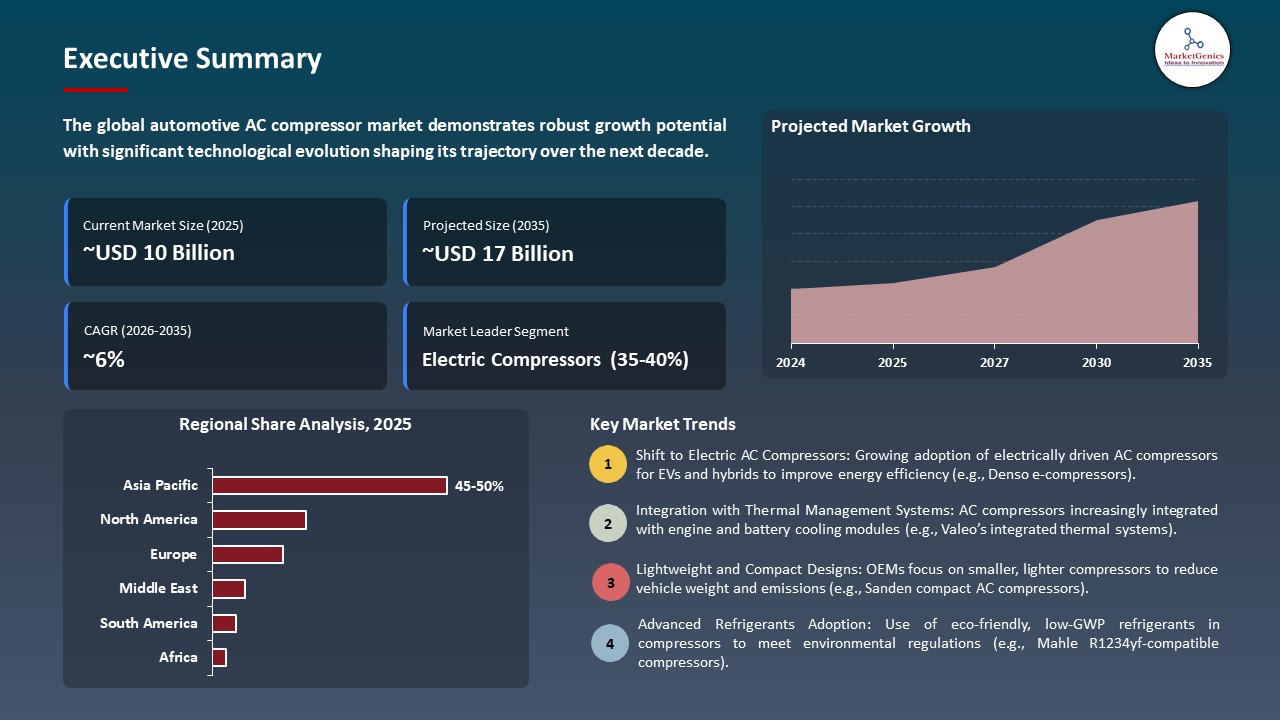
The global automotive AC compressor market is experiencing robust growth, with its estimated value of USD 9.8 billion in the year 2025 and USD 17.2 billion by 2035, registering a CAGR of 5.8%, during the forecast period. The automotive AC compressors market is experiencing a rapid development due to the emergence of a new generation of high-efficiency electric and variable-displacement compressors with in-built inverter control, sophisticated refrigerants, and intelligent thermal management control system.
Dr. Volkmar Dinstuhl, Member of the Executive Board of thyssenkrupp AG and CEO of thyssenkrupp Automotive Technology, highlights the company’s focus on innovation, stating that for decades they have collaborated with customers to develop relevant and forward-looking solutions for the automotive industry. He emphasizes that in a dynamic market environment, the company, like the entire industry, faces new challenges, and to remain a market leader it is essential to continuously develop the product portfolio. “That is why we are particularly pleased to be able to present our latest innovation in the field of thermal management today.
The automotive AC compressor is swiftly changing into a highly-performing, smart product in thermal management, as the emergence of electrified, connected, and autonomous cars drives the trend. Their increasing appeal suggests the possibility of a new functionality of compressors beyond the traditional cabin cooling setting, as the multi-loop cooling design, high-voltage e-compressors are increasingly integrated, and predictive energy optimization makes compressors a strategic contributor to vehicle efficiency and battery life.
New high-speed electric scroll compressors, R744/CO 2 refrigerant systems and adaptive control through an inverter, are increasing cooling density, accuracy thermal control and system stability in a wide variety of driving conditions. The advances in sensor-based compressors, onboard diagnostics, and modular HVAC offer dynamic control of thermal loads across battery packs, power electronics, and passenger compartments, and result in next-generation smart HVAC ecosystems. For Instance, in June 2024, Vibracoustic launched an enhanced Thermal Management Decoupling System to enable individual bundled HVAC modules such as air conditioning compressors, pumps, and heat exchangers in next-generation battery electric vehicles to enhance packaging efficiency, pressure losses and NVH issues in electrified thermal systems.
These technological innovations are making the automotive AC compressor market a high value, premium segment, and there is deep R&D cooperation amongst OEMs and Tier-1 suppliers. The compressor is becoming a fundamental part of vehicle thermal architecture with its growing contribution to sustainable and electrified mobility and its significance in vehicle performance, energy efficiency, and smart climate management at a global level.
Automotive AC Compressor Market Dynamics and Trends
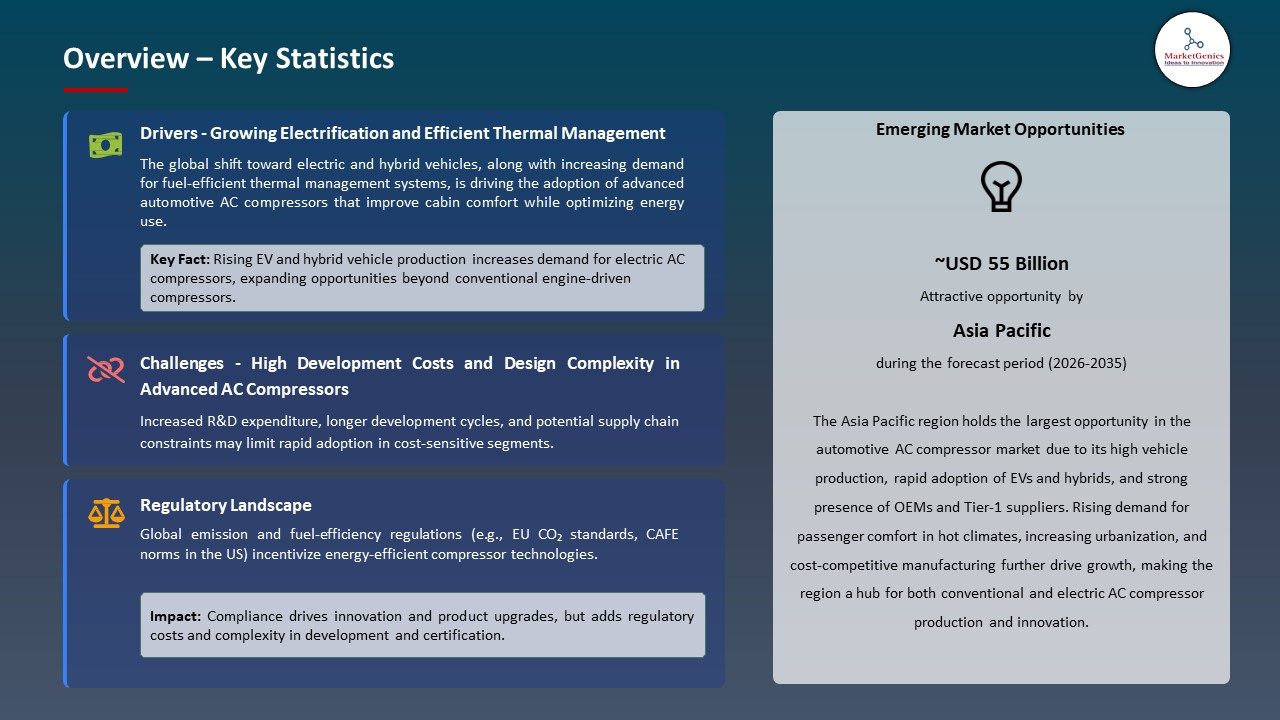
Driver: Rising Adoption of Electric and Hybrid Vehicles
-
The rising use of electric and hybrid vehicles as platforms that necessitate an electric and variable displacement compressor creates a global automotive AC compressor market opportunity, where some vehicle models are rapidly growing in number to offer efficient cabin cooling and battery thermal control regardless of engine activity.
- OEMs and component providers are working on smart compressors with in-built sensors, adaptive flow management, and invert integration to be able to cope with sophisticated thermal loads, provide multiple zones cooling, and provide a smooth integration with electrified powertrains. For instance, in April 2025, ZF unveiled its e-comp Scroll electric air compressor on electrified commercial vehicles, which operates without any oil, so that it can support HVAC systems on next-generation hybrid and battery-electric trucks and buses, which shows the push towards the adoption of electric compressors.
- This is enhancing the importance of forward-thinking AC compressors as key enablers of efficiency and thermal reliability of vehicles across the globe.
Restraint: High Initial and Production Costs of Advanced Compressors
-
Advanced automotive ac compressor modules, especially electric and variable displacement modules, are highly capital-intensive and costly to manufacture, and these are still limiting the growth in the market. Sensors and IoT connectivity in combination with energy efficiency components make systems more complex and, therefore, demand higher accuracy during assembly, high-quality materials, and sophisticated electronics, thereby raising production costs.
- The elements that lead to the high costs are long development cycles, specific motor and inverter development and tough quality and durability tests to make sure it is reliable in the conditions of the electrified and hybrid vehicles. Minimal automation in assembly lines, use of qualified workers, and shortages in supply chains of important parts of the assembly only drive the cost of production upward and hinder new competitors.
- High material, compliance, and integration costs limit penetration of the higher-tech AC compressors in cost-sensitive segments, slackening further adoption of advanced AC compressors in other regions across the globe.
Opportunity: Integration of Smart and IoT‑Enabled Climate Control Technologies
-
The increasing use of connected and electrified vehicles is opening opportunities of smart automotive AC compressors with embedded sensors, adaptive control algorithms and IoT connectivity. Fleet operators and vehicle manufacturers are also expecting compressors with real-time monitoring, predictive maintenance, and energy-efficient climate control to improve the comfort of its passengers and to minimize energy consumption in electric and hybrid motors.
- This is being incorporated in the next-generation vehicle HVAC system, battery thermal management loop and multizone cabin cooling platform. For instance, in October 2025, Valeo presented its EDC-120 electric compressor with built-in inverter to electric buses at Busworld Europe to achieve an improved performance, energy efficiency, and reliability in electrified cooling systems.
- Smart compressors and IoT-based features will improve the efficiency and predictive maintenance, energy optimization, and further growth and new revenue streams will be achieved in the long term.
Key Trend: Shift to Eco‑Friendly Refrigerants and Sustainable Designs
-
The global automotive AC compressor market is working towards the replacement of high-GWP refrigerants such as R-134a with low-GWP refrigerants such as R-1234yf and R-744 due to the high environmental requirements and sustainability goals of different locations. Manufacturers are standardizing compressor designs, valve systems and coolant interfaces so that they can act like each other regardless of the electric, hybrid and ICE platform and fit in with any sort of vehicle architecture with ease.
- Next-generation compressors are focused on energy-efficiency, variable displacement regulation, and new materials to meet the requirements of higher pressures, enhanced cooling performance, and reduced leakages. For instance, in September, 2025, Hanon Systems record that cumulative manufacturing of its R -744 (CO 2) electric compressors passed 1 million units, which assist in EV HVAC and heat pump systems and lowering the environment impact.
- Low-GWP refrigerant and low-energy consumptions in the compressor design likely increase the long-term uptake in both vehicles and assist the OEMs in the greener mobility ambitions.
Automotive AC Compressor Market Analysis and Segmental Data
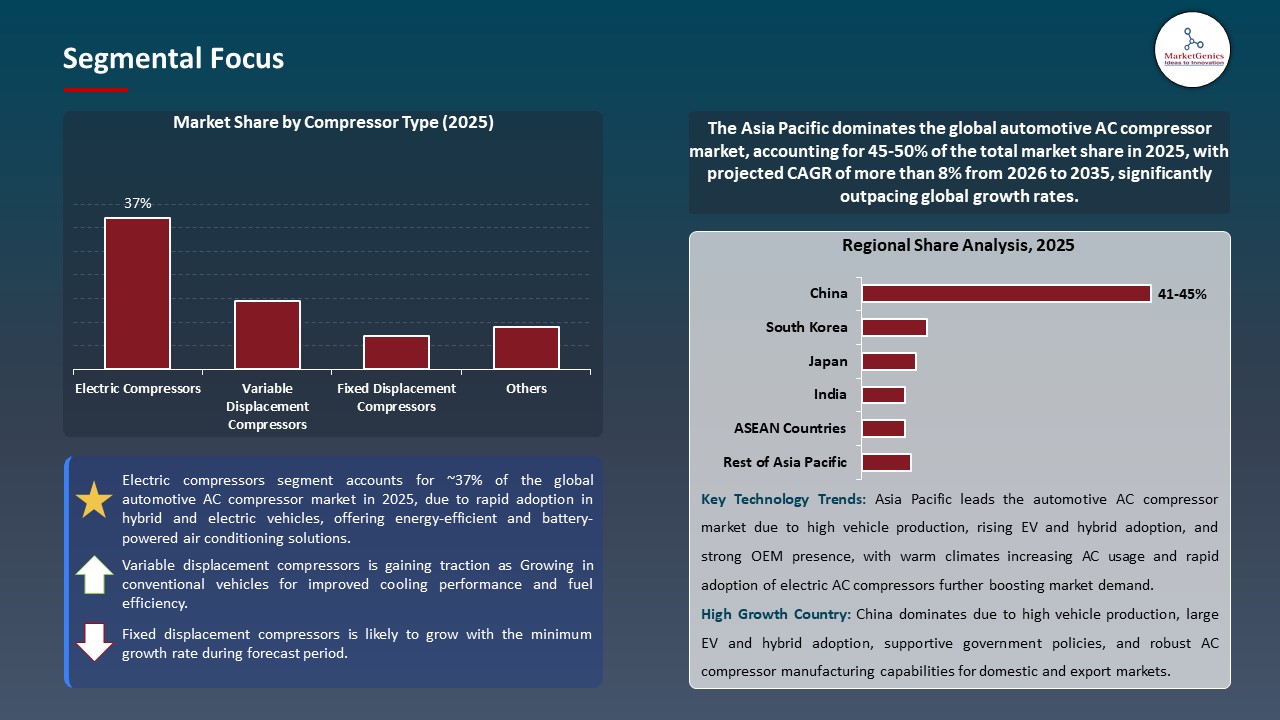
Electric Compressors Dominate Global Automotive AC Compressor Market
-
Electric compressors are dominating the global automotive AC compressor market because they are highly energy-efficient, more precisely thermally controlled, and can work with hybrid and fully electric powertrains. This is making them take advantage of their capacity to cool quickly with minimum energy wastage and thus being adopted in passenger automobiles, commercial automobiles, and electrified fleets.
- Some of the innovations which have accelerated the market increase are the high speed brushless motors, inverter technology integrated into it, and small modular designs. These innovations can be used to make the need more efficient, use less energy and have better outputs and promote the next generation electrified vehicles platforms.
- Electric compressors are also largely used because of their significant contribution to the functions of EVs and hybrids, the rise in electrification levels all over the world, and the rise in the desire of all consumers to have energy-saving climate control systems.
Asia Pacific Leads Global Automotive AC Compressor Market Demand
-
Asia Pacific is dominating the automotive AC compressor market as the pace of vehicle production has increased, faster electric and hybrid powertrain uptake and increased manufacturing centers in China, Japan, South Korea, and India. This allows massive implementation of energy saving and small size AC compressors in passenger and commercial vehicles.
- Market is growing with strategic collaborations and innovation programs with focus on lightweight designs, increased thermal efficiency and optimization of energy consumption in modern electrified vehicles. The manufactures are also making investment on smart compressor technologies which enhance the responsiveness of the system and less energy is used on vehicles and again this boosts the market growth.
- Government incentives, local R&D efforts, and sustainability goals further lead to growth and promote the electrification and fuel efficiency and the high penetration of advanced AC systems, furthering the leadership role of Asia Pacific in the global market.
Automotive AC Compressor Market Ecosystem
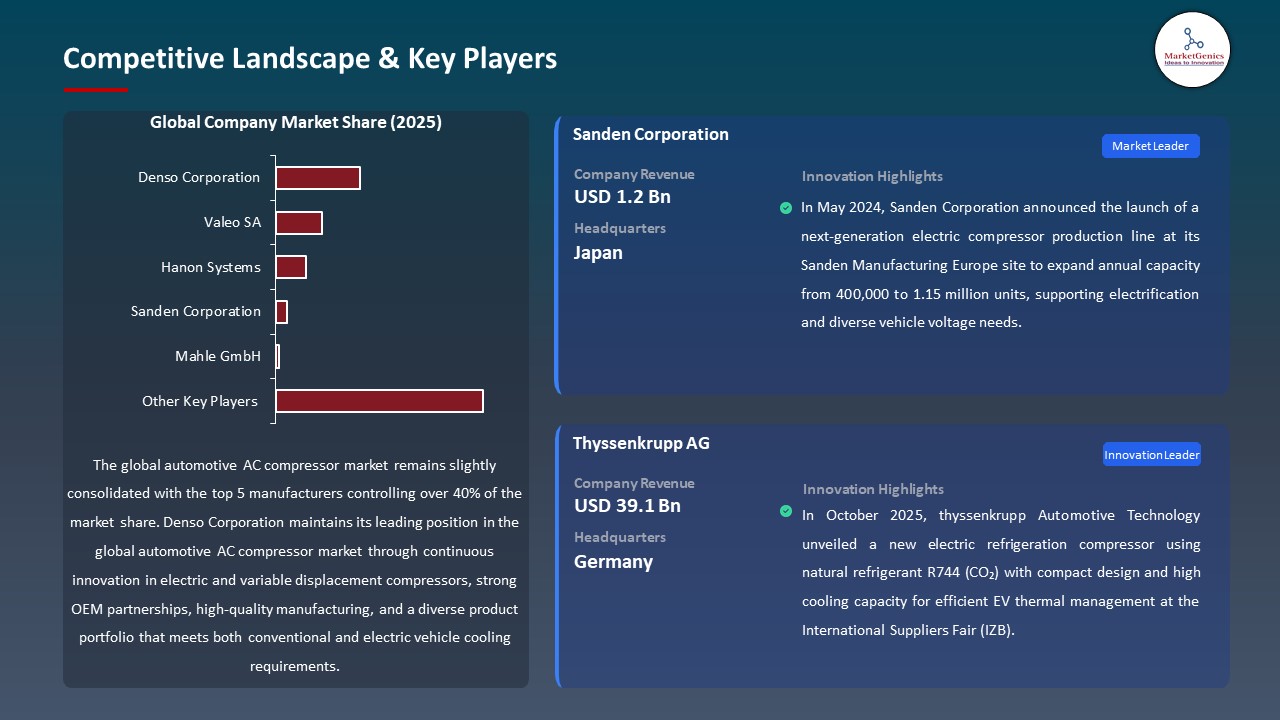
The global automotive AC compressor market is moderately consolidated with medium high level of concentration where Tier-1 multinational corporations have a big market share in terms of revenue generated by a high level of market research and development, huge amount of intellectual property in their portfolio and big base of international clients. The market is fueled by the novelty of the energy-efficient compressors, light, and compatibility with conventional, hybrid, and electric cars.
The market is controlled by Tier -1 players such as Denso Corporation, Valeo SA, Hanon Systems, Sanden Corporation, and Mahle GmbH, through proprietary technologies of variable displacement, strategic OEM, and scale economies. The companies are ahead of the pack by incorporating high-technology materials, enhancing compressor efficiency, and coming up with compact solutions to deal with modern architecture vehicles.
Tier-2 participants concentrate on the supply of regional OEM, cost-efficient components, and niche product adaptations, whereas Tier-3 participants, such as start-ups and local innovators, consider the supply of low-cost manufacturing, specialty electric compressors, and aftermarket solutions. This horizontal competition leads to a sustained technological development and general enhancement of the world AC compressor ecosystem, which facilitates the uptake in emerging EV and hybrid markets.
 Recent Development and Strategic Overview
-
In May 2024, Sanden Corporation announced the launch of a next‑generation electric compressor production line at its Sanden Manufacturing Europe (SME) facility in France to significantly expand capacity from 400,000 to 1.15 million units by fall 2025, supporting a broader range of high‑ and low‑voltage, large and compact electric AC compressors.
- In October 2024, thyssenkrupp Automotive Technology showcased a new electric refrigerant compressor for R744 (CO₂) at the International Suppliers Fair (IZB) in Wolfsburg, featuring a compact design with high cooling capacity (12 kW+) optimized for future electric vehicles, marking a significant development in sustainable and efficient AC compressor technology for electrified mobility.
Report Scope
|
Detail |
|
|
Market Size in 2025 |
USD 9.8 Bn |
|
Market Forecast Value in 2035 |
USD 17.2 Bn |
|
Growth Rate (CAGR) |
5.8% |
|
Forecast Period |
2026 – 2035 |
|
Historical Data Available for |
2021 – 2024 |
|
Market Size Units |
US$ Billion for Value Million Units for Volume |
|
Report Format |
Electronic (PDF) + Excel |
|
North America |
Europe |
Asia Pacific |
Middle East |
Africa |
South America |
|
|
|
|
|
|
|
Companies Covered |
|||||
|
|
|
|
|
|
Automotive AC Compressor Market Segmentation and Highlights
|
Segment |
Sub-segment |
|
Automotive AC Compressor Market, By Compressor Type |
|
|
Automotive AC Compressor Market, By Vehicle Type |
|
|
Automotive AC Compressor Market, By Propulsion Type |
|
|
Automotive AC Compressor Market, By Refrigerant Type |
|
|
Automotive AC Compressor Market, By Cooling Capacity |
|
|
Automotive AC Compressor Market, By Technology |
|
|
Automotive AC Compressor Market, By Sales Channel |
|
Frequently Asked Questions
Table of Contents
- 1. Research Methodology and Assumptions
- 1.1. Definitions
- 1.2. Research Design and Approach
- 1.3. Data Collection Methods
- 1.4. Base Estimates and Calculations
- 1.5. Forecasting Models
- 1.5.1. Key Forecast Factors & Impact Analysis
- 1.6. Secondary Research
- 1.6.1. Open Sources
- 1.6.2. Paid Databases
- 1.6.3. Associations
- 1.7. Primary Research
- 1.7.1. Primary Sources
- 1.7.2. Primary Interviews with Stakeholders across Ecosystem
- 2. Executive Summary
- 2.1. Global Automotive AC Compressor Market Outlook
- 2.1.1. Automotive AC Compressor Market Size Volume (Million Units) and Value (US$ Bn), and Forecasts, 2021-2035
- 2.1.2. Compounded Annual Growth Rate Analysis
- 2.1.3. Growth Opportunity Analysis
- 2.1.4. Segmental Share Analysis
- 2.1.5. Geographical Share Analysis
- 2.2. Market Analysis and Facts
- 2.3. Supply-Demand Analysis
- 2.4. Competitive Benchmarking
- 2.5. Go-to- Market Strategy
- 2.5.1. Customer/ End-use Industry Assessment
- 2.5.2. Growth Opportunity Data, 2026-2035
- 2.5.2.1. Regional Data
- 2.5.2.2. Country Data
- 2.5.2.3. Segmental Data
- 2.5.3. Identification of Potential Market Spaces
- 2.5.4. GAP Analysis
- 2.5.5. Potential Attractive Price Points
- 2.5.6. Prevailing Market Risks & Challenges
- 2.5.7. Preferred Sales & Marketing Strategies
- 2.5.8. Key Recommendations and Analysis
- 2.5.9. A Way Forward
- 2.1. Global Automotive AC Compressor Market Outlook
- 3. Industry Data and Premium Insights
- 3.1. Global Automotive & Transportation Industry Overview, 2025
- 3.1.1. Industry Ecosystem Analysis
- 3.1.2. Key Trends for Automotive & Transportation Industry
- 3.1.3. Regional Distribution for Automotive & Transportation Industry
- 3.2. Supplier Customer Data
- 3.3. Technology Roadmap and Developments
- 3.4. Trade Analysis
- 3.4.1. Import & Export Analysis, 2025
- 3.4.2. Top Importing Countries
- 3.4.3. Top Exporting Countries
- 3.5. Trump Tariff Impact Analysis
- 3.5.1. Manufacturer
- 3.5.1.1. Based on the component & Raw material
- 3.5.2. Supply Chain
- 3.5.3. End Consumer
- 3.5.1. Manufacturer
- 3.6. Raw Material Analysis
- 3.1. Global Automotive & Transportation Industry Overview, 2025
- 4. Market Overview
- 4.1. Market Dynamics
- 4.1.1. Drivers
- 4.1.1.1. Rising global vehicle production and increasing penetration of air-conditioning systems as a standard feature.
- 4.1.1.2. Growing consumer demand for in-vehicle comfort, especially in hot and developing regions.
- 4.1.1.3. Increasing adoption of electric and hybrid vehicles driving demand for electric and energy-efficient AC compressors.
- 4.1.2. Restraints
- 4.1.2.1. High cost and technical complexity of advanced and electric AC compressor systems.
- 4.1.2.2. Regulatory challenges and refrigerant transitions increasing compliance and development costs.
- 4.1.1. Drivers
- 4.2. Key Trend Analysis
- 4.3. Regulatory Framework
- 4.3.1. Key Regulations, Norms, and Subsidies, by Key Countries
- 4.3.2. Tariffs and Standards
- 4.3.3. Impact Analysis of Regulations on the Market
- 4.4. Value Chain Analysis
- 4.4.1. Component Suppliers
- 4.4.2. Compressor Manufacturers
- 4.4.3. Dealers/ Distributors
- 4.4.4. Vehicle Manufacturers/ Aftermarket
- 4.5. Cost Structure Analysis
- 4.5.1. Parameter’s Share for Cost Associated
- 4.5.2. COGP vs COGS
- 4.5.3. Profit Margin Analysis
- 4.6. Pricing Analysis
- 4.6.1. Regional Pricing Analysis
- 4.6.2. Segmental Pricing Trends
- 4.6.3. Factors Influencing Pricing
- 4.7. Porter’s Five Forces Analysis
- 4.8. PESTEL Analysis
- 4.9. Global Automotive AC Compressor Market Demand
- 4.9.1. Historical Market Size – Volume (Million Units) and Value (US$ Bn), 2020-2024
- 4.9.2. Current and Future Market Size – Volume (Million Units) and Value (US$ Bn), 2026–2035
- 4.9.2.1. Y-o-Y Growth Trends
- 4.9.2.2. Absolute $ Opportunity Assessment
- 4.1. Market Dynamics
- 5. Competition Landscape
- 5.1. Competition structure
- 5.1.1. Fragmented v/s consolidated
- 5.2. Company Share Analysis, 2025
- 5.2.1. Global Company Market Share
- 5.2.2. By Region
- 5.2.2.1. North America
- 5.2.2.2. Europe
- 5.2.2.3. Asia Pacific
- 5.2.2.4. Middle East
- 5.2.2.5. Africa
- 5.2.2.6. South America
- 5.3. Product Comparison Matrix
- 5.3.1. Specifications
- 5.3.2. Market Positioning
- 5.3.3. Pricing
- 5.1. Competition structure
- 6. Global Automotive AC Compressor Market Analysis, by Compressor Type
- 6.1. Key Segment Analysis
- 6.2. Automotive AC Compressor Market Size Volume (Million Units) and Value (US$ Bn), Analysis, and Forecasts, by Compressor Type, 2021-2035
- 6.2.1. Fixed Displacement Compressors
- 6.2.1.1. Reciprocating Compressors
- 6.2.1.2. Rotary Vane Compressors
- 6.2.1.3. Scroll Compressors
- 6.2.2. Variable Displacement Compressors
- 6.2.2.1. Swash Plate Type
- 6.2.2.2. Wobble Plate Type
- 6.2.3. Electric Compressors
- 6.2.3.1. Scroll Type Electric Compressors
- 6.2.3.2. Rotary Type Electric Compressors
- 6.2.1. Fixed Displacement Compressors
- 7. Global Automotive AC Compressor Market Analysis, by Vehicle Type
- 7.1. Key Segment Analysis
- 7.2. Automotive AC Compressor Market Size Volume (Million Units) and Value (US$ Bn), Analysis, and Forecasts, by Vehicle Type, 2021-2035
- 7.2.1. Passenger Cars
- 7.2.1.1. Hatchback
- 7.2.1.2. Sedan
- 7.2.1.3. SUV
- 7.2.1.4. Luxury Cars
- 7.2.2. Commercial Vehicles
- 7.2.2.1. Light Commercial Vehicles (LCV)
- 7.2.2.2. Medium Commercial Vehicles (MCV)
- 7.2.2.3. Heavy Commercial Vehicles (HCV)
- 7.2.3. Off-Highway Vehicles
- 7.2.3.1. Construction Equipment
- 7.2.3.2. Agricultural Vehicles
- 7.2.3.3. Mining Vehicles
- 7.2.3.4. Others
- 7.2.1. Passenger Cars
- 8. Global Automotive AC Compressor Market Analysis, by Propulsion Type
- 8.1. Key Segment Analysis
- 8.2. Automotive AC Compressor Market Size Volume (Million Units) and Value (US$ Bn), Analysis, and Forecasts, by Propulsion Type, 2021-2035
- 8.2.1. Internal Combustion Engine (ICE) Vehicles
- 8.2.1.1. Gasoline
- 8.2.1.2. Diesel
- 8.2.2. Electric Vehicles (EVs)
- 8.2.2.1. Battery Electric Vehicles (BEV)
- 8.2.2.2. Plug-in Hybrid Electric Vehicles (PHEV)
- 8.2.3. Hybrid Vehicles (HEV)
- 8.2.4. Fuel Cell Vehicles
- 8.2.1. Internal Combustion Engine (ICE) Vehicles
- 9. Global Automotive AC Compressor Market Analysis, by Refrigerant Type
- 9.1. Key Segment Analysis
- 9.2. Automotive AC Compressor Market Size Volume (Million Units) and Value (US$ Bn), Analysis, and Forecasts, by Refrigerant Type, 2021-2035
- 9.2.1. R-134a (HFC-134a)
- 9.2.2. R-1234yf (HFO-1234yf)
- 9.2.3. R-744 (CO2)
- 9.2.4. R-152a
- 9.2.5. Other Natural Refrigerants
- 10. Global Automotive AC Compressor Market Analysis, by Cooling Capacity
- 10.1. Key Segment Analysis
- 10.2. Automotive AC Compressor Market Size Volume (Million Units) and Value (US$ Bn), Analysis, and Forecasts, by Cooling Capacity, 2021-2035
- 10.2.1. Below 10cc
- 10.2.2. 10cc to 20cc
- 10.2.3. Above 20cc
- 11. Global Automotive AC Compressor Market Analysis, by Technology
- 11.1. Key Segment Analysis
- 11.2. Automotive AC Compressor Market Size Volume (Million Units) and Value (US$ Bn), Analysis, and Forecasts, by Technology, 2021-2035
- 11.2.1. Belt-Driven Compressors
- 11.2.2. Electric-Driven Compressors
- 11.2.3. Clutch Type
- 11.2.3.1. With Clutch
- 11.2.3.2. Clutchless (Variable)
- 11.2.4. Smart/Connected Compressors
- 12. Global Automotive AC Compressor Market Analysis, by Sales Channel
- 12.1. Key Segment Analysis
- 12.2. Automotive AC Compressor Market Size Volume (Million Units) and Value (US$ Bn), Analysis, and Forecasts, by Sales Channel, 2021-2035
- 12.2.1. Original Equipment Manufacturer (OEM)
- 12.2.2. Aftermarket
- 13. Global Automotive AC Compressor Market Analysis and Forecasts, by Region
- 13.1. Key Findings
- 13.2. Automotive AC Compressor Market Size Volume (Million Units) and Value (US$ Bn), Analysis, and Forecasts, by Region, 2021-2035
- 13.2.1. North America
- 13.2.2. Europe
- 13.2.3. Asia Pacific
- 13.2.4. Middle East
- 13.2.5. Africa
- 13.2.6. South America
- 14. North America Automotive AC Compressor Market Analysis
- 14.1. Key Segment Analysis
- 14.2. Regional Snapshot
- 14.3. North America Automotive AC Compressor Market Size- Volume (Million Units) and Value (US$ Bn), Analysis, and Forecasts, 2021-2035
- 14.3.1. Compressor Type
- 14.3.2. Vehicle Type
- 14.3.3. Propulsion Type
- 14.3.4. Refrigerant Type
- 14.3.5. Cooling Capacity
- 14.3.6. Technology
- 14.3.7. Sales Channel
- 14.3.8. Country
- 14.3.8.1. USA
- 14.3.8.2. Canada
- 14.3.8.3. Mexico
- 14.4. USA Automotive AC Compressor Market
- 14.4.1. Country Segmental Analysis
- 14.4.2. Compressor Type
- 14.4.3. Vehicle Type
- 14.4.4. Propulsion Type
- 14.4.5. Refrigerant Type
- 14.4.6. Cooling Capacity
- 14.4.7. Technology
- 14.4.8. Sales Channel
- 14.5. Canada Automotive AC Compressor Market
- 14.5.1. Country Segmental Analysis
- 14.5.2. Compressor Type
- 14.5.3. Vehicle Type
- 14.5.4. Propulsion Type
- 14.5.5. Refrigerant Type
- 14.5.6. Cooling Capacity
- 14.5.7. Technology
- 14.5.8. Sales Channel
- 14.6. Mexico Automotive AC Compressor Market
- 14.6.1. Country Segmental Analysis
- 14.6.2. Compressor Type
- 14.6.3. Vehicle Type
- 14.6.4. Propulsion Type
- 14.6.5. Refrigerant Type
- 14.6.6. Cooling Capacity
- 14.6.7. Technology
- 14.6.8. Sales Channel
- 15. Europe Automotive AC Compressor Market Analysis
- 15.1. Key Segment Analysis
- 15.2. Regional Snapshot
- 15.3. Europe Automotive AC Compressor Market Size Volume (Million Units) and Value (US$ Bn), Analysis, and Forecasts, 2021-2035
- 15.3.1. Compressor Type
- 15.3.2. Vehicle Type
- 15.3.3. Propulsion Type
- 15.3.4. Refrigerant Type
- 15.3.5. Cooling Capacity
- 15.3.6. Technology
- 15.3.7. Sales Channel
- 15.3.8. Country
- 15.3.8.1. Germany
- 15.3.8.2. United Kingdom
- 15.3.8.3. France
- 15.3.8.4. Italy
- 15.3.8.5. Spain
- 15.3.8.6. Netherlands
- 15.3.8.7. Nordic Countries
- 15.3.8.8. Poland
- 15.3.8.9. Russia & CIS
- 15.3.8.10. Rest of Europe
- 15.4. Germany Automotive AC Compressor Market
- 15.4.1. Country Segmental Analysis
- 15.4.2. Compressor Type
- 15.4.3. Vehicle Type
- 15.4.4. Propulsion Type
- 15.4.5. Refrigerant Type
- 15.4.6. Cooling Capacity
- 15.4.7. Technology
- 15.4.8. Sales Channel
- 15.5. United Kingdom Automotive AC Compressor Market
- 15.5.1. Country Segmental Analysis
- 15.5.2. Compressor Type
- 15.5.3. Vehicle Type
- 15.5.4. Propulsion Type
- 15.5.5. Refrigerant Type
- 15.5.6. Cooling Capacity
- 15.5.7. Technology
- 15.5.8. Sales Channel
- 15.6. France Automotive AC Compressor Market
- 15.6.1. Country Segmental Analysis
- 15.6.2. Compressor Type
- 15.6.3. Vehicle Type
- 15.6.4. Propulsion Type
- 15.6.5. Refrigerant Type
- 15.6.6. Cooling Capacity
- 15.6.7. Technology
- 15.6.8. Sales Channel
- 15.7. Italy Automotive AC Compressor Market
- 15.7.1. Country Segmental Analysis
- 15.7.2. Compressor Type
- 15.7.3. Vehicle Type
- 15.7.4. Propulsion Type
- 15.7.5. Refrigerant Type
- 15.7.6. Cooling Capacity
- 15.7.7. Technology
- 15.7.8. Sales Channel
- 15.8. Spain Automotive AC Compressor Market
- 15.8.1. Country Segmental Analysis
- 15.8.2. Compressor Type
- 15.8.3. Vehicle Type
- 15.8.4. Propulsion Type
- 15.8.5. Refrigerant Type
- 15.8.6. Cooling Capacity
- 15.8.7. Technology
- 15.8.8. Sales Channel
- 15.9. Netherlands Automotive AC Compressor Market
- 15.9.1. Country Segmental Analysis
- 15.9.2. Compressor Type
- 15.9.3. Vehicle Type
- 15.9.4. Propulsion Type
- 15.9.5. Refrigerant Type
- 15.9.6. Cooling Capacity
- 15.9.7. Technology
- 15.9.8. Sales Channel
- 15.10. Nordic Countries Automotive AC Compressor Market
- 15.10.1. Country Segmental Analysis
- 15.10.2. Compressor Type
- 15.10.3. Vehicle Type
- 15.10.4. Propulsion Type
- 15.10.5. Refrigerant Type
- 15.10.6. Cooling Capacity
- 15.10.7. Technology
- 15.10.8. Sales Channel
- 15.11. Poland Automotive AC Compressor Market
- 15.11.1. Country Segmental Analysis
- 15.11.2. Compressor Type
- 15.11.3. Vehicle Type
- 15.11.4. Propulsion Type
- 15.11.5. Refrigerant Type
- 15.11.6. Cooling Capacity
- 15.11.7. Technology
- 15.11.8. Sales Channel
- 15.12. Russia & CIS Automotive AC Compressor Market
- 15.12.1. Country Segmental Analysis
- 15.12.2. Compressor Type
- 15.12.3. Vehicle Type
- 15.12.4. Propulsion Type
- 15.12.5. Refrigerant Type
- 15.12.6. Cooling Capacity
- 15.12.7. Technology
- 15.12.8. Sales Channel
- 15.13. Rest of Europe Automotive AC Compressor Market
- 15.13.1. Country Segmental Analysis
- 15.13.2. Compressor Type
- 15.13.3. Vehicle Type
- 15.13.4. Propulsion Type
- 15.13.5. Refrigerant Type
- 15.13.6. Cooling Capacity
- 15.13.7. Technology
- 15.13.8. Sales Channel
- 16. Asia Pacific Automotive AC Compressor Market Analysis
- 16.1. Key Segment Analysis
- 16.2. Regional Snapshot
- 16.3. Asia Pacific Automotive AC Compressor Market Size Volume (Million Units) and Value (US$ Bn), Analysis, and Forecasts, 2021-2035
- 16.3.1. Compressor Type
- 16.3.2. Vehicle Type
- 16.3.3. Propulsion Type
- 16.3.4. Refrigerant Type
- 16.3.5. Cooling Capacity
- 16.3.6. Technology
- 16.3.7. Sales Channel
- 16.3.8. Country
- 16.3.8.1. China
- 16.3.8.2. India
- 16.3.8.3. Japan
- 16.3.8.4. South Korea
- 16.3.8.5. Australia and New Zealand
- 16.3.8.6. Indonesia
- 16.3.8.7. Malaysia
- 16.3.8.8. Thailand
- 16.3.8.9. Vietnam
- 16.3.8.10. Rest of Asia Pacific
- 16.4. China Automotive AC Compressor Market
- 16.4.1. Country Segmental Analysis
- 16.4.2. Compressor Type
- 16.4.3. Vehicle Type
- 16.4.4. Propulsion Type
- 16.4.5. Refrigerant Type
- 16.4.6. Cooling Capacity
- 16.4.7. Technology
- 16.4.8. Sales Channel
- 16.5. India Automotive AC Compressor Market
- 16.5.1. Country Segmental Analysis
- 16.5.2. Compressor Type
- 16.5.3. Vehicle Type
- 16.5.4. Propulsion Type
- 16.5.5. Refrigerant Type
- 16.5.6. Cooling Capacity
- 16.5.7. Technology
- 16.5.8. Sales Channel
- 16.6. Japan Automotive AC Compressor Market
- 16.6.1. Country Segmental Analysis
- 16.6.2. Compressor Type
- 16.6.3. Vehicle Type
- 16.6.4. Propulsion Type
- 16.6.5. Refrigerant Type
- 16.6.6. Cooling Capacity
- 16.6.7. Technology
- 16.6.8. Sales Channel
- 16.7. South Korea Automotive AC Compressor Market
- 16.7.1. Country Segmental Analysis
- 16.7.2. Compressor Type
- 16.7.3. Vehicle Type
- 16.7.4. Propulsion Type
- 16.7.5. Refrigerant Type
- 16.7.6. Cooling Capacity
- 16.7.7. Technology
- 16.7.8. Sales Channel
- 16.8. Australia and New Zealand Automotive AC Compressor Market
- 16.8.1. Country Segmental Analysis
- 16.8.2. Compressor Type
- 16.8.3. Vehicle Type
- 16.8.4. Propulsion Type
- 16.8.5. Refrigerant Type
- 16.8.6. Cooling Capacity
- 16.8.7. Technology
- 16.8.8. Sales Channel
- 16.9. Indonesia Automotive AC Compressor Market
- 16.9.1. Country Segmental Analysis
- 16.9.2. Compressor Type
- 16.9.3. Vehicle Type
- 16.9.4. Propulsion Type
- 16.9.5. Refrigerant Type
- 16.9.6. Cooling Capacity
- 16.9.7. Technology
- 16.9.8. Sales Channel
- 16.10. Malaysia Automotive AC Compressor Market
- 16.10.1. Country Segmental Analysis
- 16.10.2. Compressor Type
- 16.10.3. Vehicle Type
- 16.10.4. Propulsion Type
- 16.10.5. Refrigerant Type
- 16.10.6. Cooling Capacity
- 16.10.7. Technology
- 16.10.8. Sales Channel
- 16.11. Thailand Automotive AC Compressor Market
- 16.11.1. Country Segmental Analysis
- 16.11.2. Compressor Type
- 16.11.3. Vehicle Type
- 16.11.4. Propulsion Type
- 16.11.5. Refrigerant Type
- 16.11.6. Cooling Capacity
- 16.11.7. Technology
- 16.11.8. Sales Channel
- 16.12. Vietnam Automotive AC Compressor Market
- 16.12.1. Country Segmental Analysis
- 16.12.2. Compressor Type
- 16.12.3. Vehicle Type
- 16.12.4. Propulsion Type
- 16.12.5. Refrigerant Type
- 16.12.6. Cooling Capacity
- 16.12.7. Technology
- 16.12.8. Sales Channel
- 16.13. Rest of Asia Pacific Automotive AC Compressor Market
- 16.13.1. Country Segmental Analysis
- 16.13.2. Compressor Type
- 16.13.3. Vehicle Type
- 16.13.4. Propulsion Type
- 16.13.5. Refrigerant Type
- 16.13.6. Cooling Capacity
- 16.13.7. Technology
- 16.13.8. Sales Channel
- 17. Middle East Automotive AC Compressor Market Analysis
- 17.1. Key Segment Analysis
- 17.2. Regional Snapshot
- 17.3. Middle East Automotive AC Compressor Market Size Volume (Million Units) and Value (US$ Bn), Analysis, and Forecasts, 2021-2035
- 17.3.1. Compressor Type
- 17.3.2. Vehicle Type
- 17.3.3. Propulsion Type
- 17.3.4. Refrigerant Type
- 17.3.5. Cooling Capacity
- 17.3.6. Technology
- 17.3.7. Sales Channel
- 17.3.8. Country
- 17.3.8.1. Turkey
- 17.3.8.2. UAE
- 17.3.8.3. Saudi Arabia
- 17.3.8.4. Israel
- 17.3.8.5. Rest of Middle East
- 17.4. Turkey Automotive AC Compressor Market
- 17.4.1. Country Segmental Analysis
- 17.4.2. Compressor Type
- 17.4.3. Vehicle Type
- 17.4.4. Propulsion Type
- 17.4.5. Refrigerant Type
- 17.4.6. Cooling Capacity
- 17.4.7. Technology
- 17.4.8. Sales Channel
- 17.5. UAE Automotive AC Compressor Market
- 17.5.1. Country Segmental Analysis
- 17.5.2. Compressor Type
- 17.5.3. Vehicle Type
- 17.5.4. Propulsion Type
- 17.5.5. Refrigerant Type
- 17.5.6. Cooling Capacity
- 17.5.7. Technology
- 17.5.8. Sales Channel
- 17.6. Saudi Arabia Automotive AC Compressor Market
- 17.6.1. Country Segmental Analysis
- 17.6.2. Compressor Type
- 17.6.3. Vehicle Type
- 17.6.4. Propulsion Type
- 17.6.5. Refrigerant Type
- 17.6.6. Cooling Capacity
- 17.6.7. Technology
- 17.6.8. Sales Channel
- 17.7. Israel Automotive AC Compressor Market
- 17.7.1. Country Segmental Analysis
- 17.7.2. Compressor Type
- 17.7.3. Vehicle Type
- 17.7.4. Propulsion Type
- 17.7.5. Refrigerant Type
- 17.7.6. Cooling Capacity
- 17.7.7. Technology
- 17.7.8. Sales Channel
- 17.8. Rest of Middle East Automotive AC Compressor Market
- 17.8.1. Country Segmental Analysis
- 17.8.2. Compressor Type
- 17.8.3. Vehicle Type
- 17.8.4. Propulsion Type
- 17.8.5. Refrigerant Type
- 17.8.6. Cooling Capacity
- 17.8.7. Technology
- 17.8.8. Sales Channel
- 18. Africa Automotive AC Compressor Market Analysis
- 18.1. Key Segment Analysis
- 18.2. Regional Snapshot
- 18.3. Africa Automotive AC Compressor Market Size Volume (Million Units) and Value (US$ Bn), Analysis, and Forecasts, 2021-2035
- 18.3.1. Compressor Type
- 18.3.2. Vehicle Type
- 18.3.3. Propulsion Type
- 18.3.4. Refrigerant Type
- 18.3.5. Cooling Capacity
- 18.3.6. Technology
- 18.3.7. Sales Channel
- 18.3.8. country
- 18.3.8.1. South Africa
- 18.3.8.2. Egypt
- 18.3.8.3. Nigeria
- 18.3.8.4. Algeria
- 18.3.8.5. Rest of Africa
- 18.4. South Africa Automotive AC Compressor Market
- 18.4.1. Country Segmental Analysis
- 18.4.2. Compressor Type
- 18.4.3. Vehicle Type
- 18.4.4. Propulsion Type
- 18.4.5. Refrigerant Type
- 18.4.6. Cooling Capacity
- 18.4.7. Technology
- 18.4.8. Sales Channel
- 18.5. Egypt Automotive AC Compressor Market
- 18.5.1. Country Segmental Analysis
- 18.5.2. Compressor Type
- 18.5.3. Vehicle Type
- 18.5.4. Propulsion Type
- 18.5.5. Refrigerant Type
- 18.5.6. Cooling Capacity
- 18.5.7. Technology
- 18.5.8. Sales Channel
- 18.6. Nigeria Automotive AC Compressor Market
- 18.6.1. Country Segmental Analysis
- 18.6.2. Compressor Type
- 18.6.3. Vehicle Type
- 18.6.4. Propulsion Type
- 18.6.5. Refrigerant Type
- 18.6.6. Cooling Capacity
- 18.6.7. Technology
- 18.6.8. Sales Channel
- 18.7. Algeria Automotive AC Compressor Market
- 18.7.1. Country Segmental Analysis
- 18.7.2. Compressor Type
- 18.7.3. Vehicle Type
- 18.7.4. Propulsion Type
- 18.7.5. Refrigerant Type
- 18.7.6. Cooling Capacity
- 18.7.7. Technology
- 18.7.8. Sales Channel
- 18.8. Rest of Africa Automotive AC Compressor Market
- 18.8.1. Country Segmental Analysis
- 18.8.2. Compressor Type
- 18.8.3. Vehicle Type
- 18.8.4. Propulsion Type
- 18.8.5. Refrigerant Type
- 18.8.6. Cooling Capacity
- 18.8.7. Technology
- 18.8.8. Sales Channel
- 19. South America Automotive AC Compressor Market Analysis
- 19.1. Key Segment Analysis
- 19.2. Regional Snapshot
- 19.3. South America Automotive AC Compressor Market Size Volume (Million Units) and Value (US$ Bn), Analysis, and Forecasts, 2021-2035
- 19.3.1. Compressor Type
- 19.3.2. Vehicle Type
- 19.3.3. Propulsion Type
- 19.3.4. Refrigerant Type
- 19.3.5. Cooling Capacity
- 19.3.6. Technology
- 19.3.7. Sales Channel
- 19.3.8. Country
- 19.3.8.1. Brazil
- 19.3.8.2. Argentina
- 19.3.8.3. Rest of South America
- 19.4. Brazil Automotive AC Compressor Market
- 19.4.1. Country Segmental Analysis
- 19.4.2. Compressor Type
- 19.4.3. Vehicle Type
- 19.4.4. Propulsion Type
- 19.4.5. Refrigerant Type
- 19.4.6. Cooling Capacity
- 19.4.7. Technology
- 19.4.8. Sales Channel
- 19.5. Argentina Automotive AC Compressor Market
- 19.5.1. Country Segmental Analysis
- 19.5.2. Compressor Type
- 19.5.3. Vehicle Type
- 19.5.4. Propulsion Type
- 19.5.5. Refrigerant Type
- 19.5.6. Cooling Capacity
- 19.5.7. Technology
- 19.5.8. Sales Channel
- 19.6. Rest of South America Automotive AC Compressor Market
- 19.6.1. Country Segmental Analysis
- 19.6.2. Compressor Type
- 19.6.3. Vehicle Type
- 19.6.4. Propulsion Type
- 19.6.5. Refrigerant Type
- 19.6.6. Cooling Capacity
- 19.6.7. Technology
- 19.6.8. Sales Channel
- 20. Key Players/ Company Profile
- 20.1. Aotecar New Energy Technology Co., Ltd.
- 20.1.1. Company Details/ Overview
- 20.1.2. Company Financials
- 20.1.3. Key Customers and Competitors
- 20.1.4. Business/ Industry Portfolio
- 20.1.5. Product Portfolio/ Specification Details
- 20.1.6. Pricing Data
- 20.1.7. Strategic Overview
- 20.1.8. Recent Developments
- 20.2. Behr GmbH & Co. KG
- 20.3. Calsonic Kansei Corporation
- 20.4. Delphi Technologies
- 20.5. Denso Corporation
- 20.6. Eberspächer Group
- 20.7. Hanon Systems
- 20.8. Highly Marelli Corporation
- 20.9. Huayu Automotive Systems Company Limited
- 20.10. Keihin Corporation
- 20.11. Keleng Lengjian Automotive Air Conditioning Co., Ltd.
- 20.12. Mahle GmbH
- 20.13. MANN+HUMMEL Group
- 20.14. Mitsubishi Heavy Industries
- 20.15. Panasonic Corporation
- 20.16. Sanden Corporation
- 20.17. Schaeffler Group
- 20.18. Songz Automobile Air Conditioning Co., Ltd.
- 20.19. Spal Automotive
- 20.20. Subros Limited
- 20.21. Toyota Industries Corporation
- 20.22. Valeo SA
- 20.23. Xiezhong International Holdings Limited
- 20.24. Yinlun Co., Ltd.
- 20.25. Other Key Players
- 20.1. Aotecar New Energy Technology Co., Ltd.
Note* - This is just tentative list of players. While providing the report, we will cover more number of players based on their revenue and share for each geography
Research Design
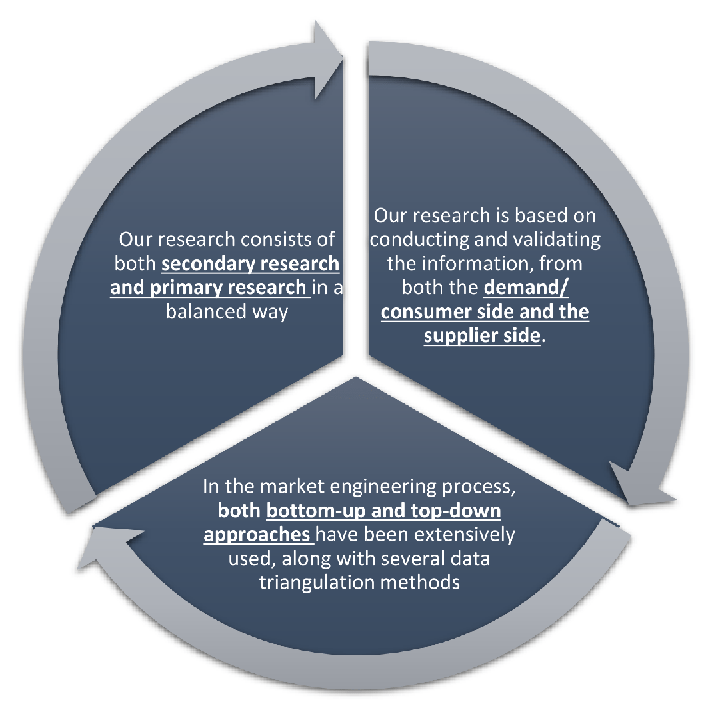
Our research design integrates both demand-side and supply-side analysis through a balanced combination of primary and secondary research methodologies. By utilizing both bottom-up and top-down approaches alongside rigorous data triangulation methods, we deliver robust market intelligence that supports strategic decision-making.
MarketGenics' comprehensive research design framework ensures the delivery of accurate, reliable, and actionable market intelligence. Through the integration of multiple research approaches, rigorous validation processes, and expert analysis, we provide our clients with the insights needed to make informed strategic decisions and capitalize on market opportunities.
MarketGenics leverages a dedicated industry panel of experts and a comprehensive suite of paid databases to effectively collect, consolidate, and analyze market intelligence.
Our approach has consistently proven to be reliable and effective in generating accurate market insights, identifying key industry trends, and uncovering emerging business opportunities.
Through both primary and secondary research, we capture and analyze critical company-level data such as manufacturing footprints, including technical centers, R&D facilities, sales offices, and headquarters.
Our expert panel further enhances our ability to estimate market size for specific brands based on validated field-level intelligence.
Our data mining techniques incorporate both parametric and non-parametric methods, allowing for structured data collection, sorting, processing, and cleaning.
Demand projections are derived from large-scale data sets analyzed through proprietary algorithms, culminating in robust and reliable market sizing.
Research Approach
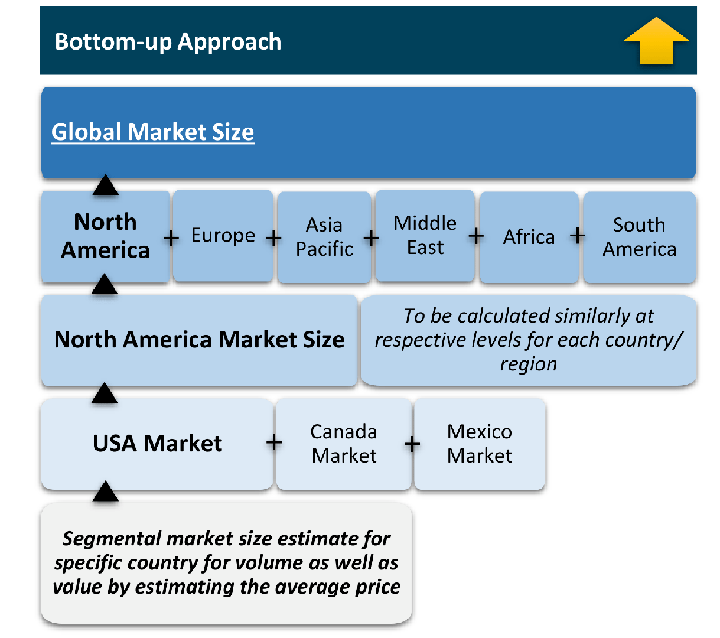
The bottom-up approach builds market estimates by starting with the smallest addressable market units and systematically aggregating them to create comprehensive market size projections.
This method begins with specific, granular data points and builds upward to create the complete market landscape.
Customer Analysis → Segmental Analysis → Geographical Analysis
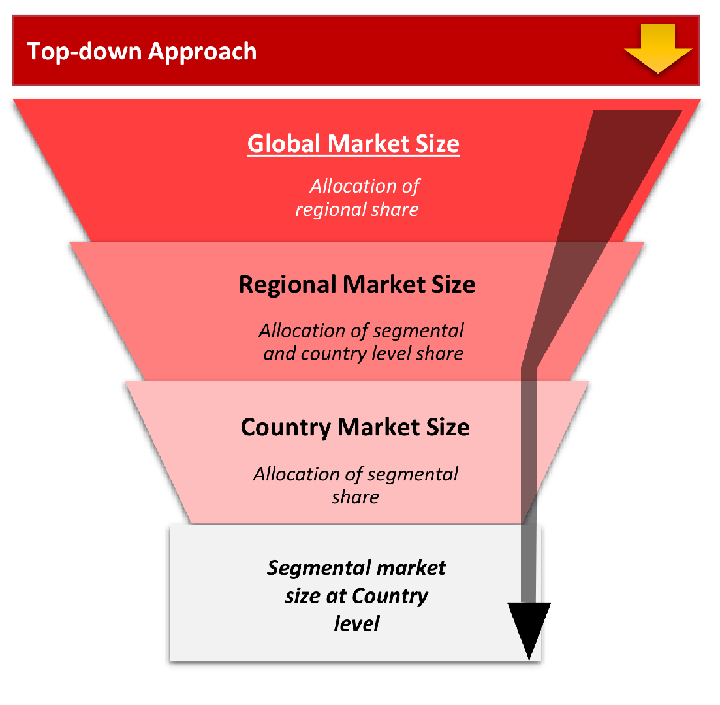
The top-down approach starts with the broadest possible market data and systematically narrows it down through a series of filters and assumptions to arrive at specific market segments or opportunities.
This method begins with the big picture and works downward to increasingly specific market slices.
TAM → SAM → SOM
Research Methods
Desk / Secondary Research
While analysing the market, we extensively study secondary sources, directories, and databases to identify and collect information useful for this technical, market-oriented, and commercial report. Secondary sources that we utilize are not only the public sources, but it is a combination of Open Source, Associations, Paid Databases, MG Repository & Knowledgebase, and others.
- Company websites, annual reports, financial reports, broker reports, and investor presentations
- National government documents, statistical databases and reports
- News articles, press releases and web-casts specific to the companies operating in the market, Magazines, reports, and others
- We gather information from commercial data sources for deriving company specific data such as segmental revenue, share for geography, product revenue, and others
- Internal and external proprietary databases (industry-specific), relevant patent, and regulatory databases
- Governing Bodies, Government Organizations
- Relevant Authorities, Country-specific Associations for Industries
We also employ the model mapping approach to estimate the product level market data through the players' product portfolio
Primary Research
Primary research/ interviews is vital in analyzing the market. Most of the cases involves paid primary interviews. Primary sources include primary interviews through e-mail interactions, telephonic interviews, surveys as well as face-to-face interviews with the different stakeholders across the value chain including several industry experts.
| Type of Respondents | Number of Primaries |
|---|---|
| Tier 2/3 Suppliers | ~20 |
| Tier 1 Suppliers | ~25 |
| End-users | ~25 |
| Industry Expert/ Panel/ Consultant | ~30 |
| Total | ~100 |
MG Knowledgebase
• Repository of industry blog, newsletter and case studies
• Online platform covering detailed market reports, and company profiles
Forecasting Factors and Models
Forecasting Factors
- Historical Trends – Past market patterns, cycles, and major events that shaped how markets behave over time. Understanding past trends helps predict future behavior.
- Industry Factors – Specific characteristics of the industry like structure, regulations, and innovation cycles that affect market dynamics.
- Macroeconomic Factors – Economic conditions like GDP growth, inflation, and employment rates that affect how much money people have to spend.
- Demographic Factors – Population characteristics like age, income, and location that determine who can buy your product.
- Technology Factors – How quickly people adopt new technology and how much technology infrastructure exists.
- Regulatory Factors – Government rules, laws, and policies that can help or restrict market growth.
- Competitive Factors – Analyzing competition structure such as degree of competition and bargaining power of buyers and suppliers.
Forecasting Models / Techniques
Multiple Regression Analysis
- Identify and quantify factors that drive market changes
- Statistical modeling to establish relationships between market drivers and outcomes
Time Series Analysis – Seasonal Patterns
- Understand regular cyclical patterns in market demand
- Advanced statistical techniques to separate trend, seasonal, and irregular components
Time Series Analysis – Trend Analysis
- Identify underlying market growth patterns and momentum
- Statistical analysis of historical data to project future trends
Expert Opinion – Expert Interviews
- Gather deep industry insights and contextual understanding
- In-depth interviews with key industry stakeholders
Multi-Scenario Development
- Prepare for uncertainty by modeling different possible futures
- Creating optimistic, pessimistic, and most likely scenarios
Time Series Analysis – Moving Averages
- Sophisticated forecasting for complex time series data
- Auto-regressive integrated moving average models with seasonal components
Econometric Models
- Apply economic theory to market forecasting
- Sophisticated economic models that account for market interactions
Expert Opinion – Delphi Method
- Harness collective wisdom of industry experts
- Structured, multi-round expert consultation process
Monte Carlo Simulation
- Quantify uncertainty and probability distributions
- Thousands of simulations with varying input parameters
Research Analysis
Our research framework is built upon the fundamental principle of validating market intelligence from both demand and supply perspectives. This dual-sided approach ensures comprehensive market understanding and reduces the risk of single-source bias.
Demand-Side Analysis: We understand end-user/application behavior, preferences, and market needs along with the penetration of the product for specific application.
Supply-Side Analysis: We estimate overall market revenue, analyze the segmental share along with industry capacity, competitive landscape, and market structure.
Validation & Evaluation
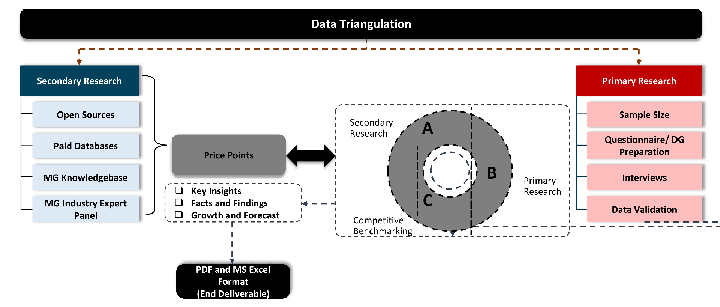
Data triangulation is a validation technique that uses multiple methods, sources, or perspectives to examine the same research question, thereby increasing the credibility and reliability of research findings. In market research, triangulation serves as a quality assurance mechanism that helps identify and minimize bias, validate assumptions, and ensure accuracy in market estimates.
- Data Source Triangulation – Using multiple data sources to examine the same phenomenon
- Methodological Triangulation – Using multiple research methods to study the same research question
- Investigator Triangulation – Using multiple researchers or analysts to examine the same data
- Theoretical Triangulation – Using multiple theoretical perspectives to interpret the same data
Custom Market Research Services
We will customise the research for you, in case the report listed above does not meet your requirements.
Get 10% Free Customisation