Automotive Water Pump Market Size, Share & Trends Analysis Report by Product Type (Mechanical Water Pumps, Electric Water Pumps, Auxiliary Water Pumps, Heater Water Pumps), Rated Power, Rated Capacity (Flow Rate), Impeller Type, Material Type, Vehicle Type, Propulsion Type, Application, Sales Channel, Mounting Type, and Geography (North America, Europe, Asia Pacific, Middle East, Africa, and South America) – Global Industry Data, Trends, and Forecasts, 2026–2035
|
|
|
Segmental Data Insights |
|
|
Demand Trends |
|
|
Competitive Landscape |
|
|
Strategic Development |
|
|
Future Outlook & Opportunities |
|
Automotive Water Pump Market Size, Share, and Growth
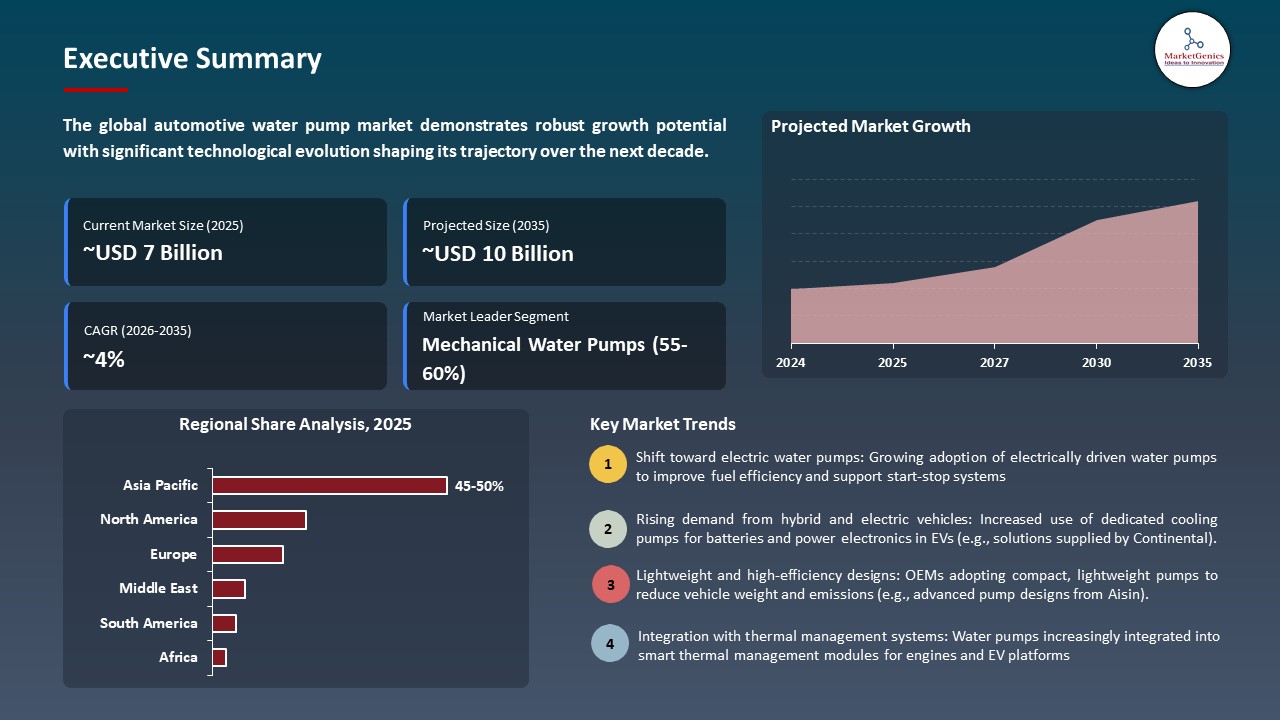
The global automotive water pump market is experiencing robust growth, with its estimated value of USD 6.8 billion in the year 2025 and USD 10.4 billion by 2035, registering a CAGR of 4.3%, during the forecast period. The global automotive water pump market is moving on a new breed of high-efficiency electric and smart water pumps, coupled with modular and built-in thermal management designs, which provide quantifiable gains in cooling performance, power consumption, and system dependability.
Mr. Harish Sheth, Chairman & MD, Setco Automotive Ltd., said, This launch is a significant step in our journey to diversify and deepen our presence across the auto component value chain. Our new Automotive Water Pump reflects the same quality, performance, and engineering excellence that has made Setco the benchmark in the clutch segment. With this product, we aim to deliver superior engine protection and performance, while strengthening our relationships with OEMs and aftermarket customers alike.
The automotive water pump market is quickly changing to a performance-based and premium segment of vehicle thermal control as the use of electric and hybrid transmissions, novel cooling platforms, and low-energy propulsion engine systems gains momentum. The growing requirements of extremely accurate coolant delivery, multiple loop thermal control and the need to be combined with power electronics and battery packs are prompting the advancement of intelligent and adaptive pump systems that can fulfill the intricate thermal demands in the current car.
The recent improvement of electric pump motors, embedded sensors, and smart control modules is improving the efficiency, reliability and integration into modular thermal systems. Such technologies as adaptive flow control, predictive diagnostics, and compact pump-valve assemblies are facilitating superior thermal performance at extreme operating conditions, battery life optimization, motor cooling and HVAC efficiency and complexity reduction of the system and minimized energy usage.
Combined, these trends make the automotive water pump market a very strategic and innovative segment with robust OEM-supplier relationships, technology alliances and engagement in next-generation electrified mobility platforms. It is believed that smart and integrated pump solutions are needed as an essential part of the progressive vehicle architecture, which supports global activities on vehicle electrification, energy efficiency, and long-term sustainability.
Automotive Water Pump Market Dynamics and Trends
Driver: Rising Vehicle Electrification & Thermal Complexity
-
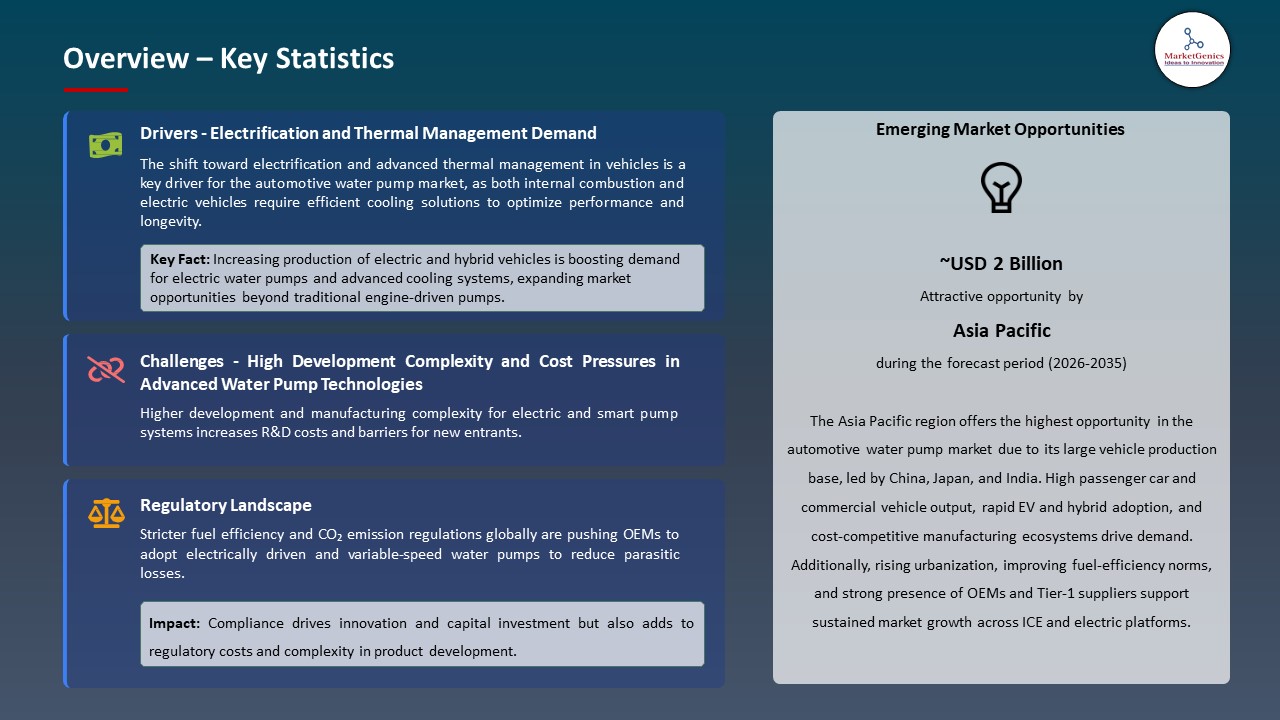
The global automotive water pump market is becoming increasingly activated by the accelerated transition to electric and hybrid cars, which should be carefully thermally controlled in terms of batteries, power electronics, and electric motors to provide performance, safety, and long life of components. Complex electric pumps enable dynamic flow control in several circuits which are helpful in removing heat efficiently during high loads, fast charging and high extreme operation conditions.
- Vehicle and thermal solution suppliers are also creating smart and adaptive pump designs with built-in sensors, predictive control, and CAN/LIN connectivity to provide optimal coolant delivery, minimize energy waste, and promote modular thermal systems. These innovations enable easy integration of battery management systems, inverter cooling and cabin HVAC without excessive complexity and weight of the system.
- The emergence of EVs and electrified powertrains is making electric water pumps more powerful vectors of vehicle efficiency and thermal control.
Restraint: Declining ICE Vehicle Production in Mature Markets
-
The automotive water pumps market is being curtailed by the slow maturation of internal combustion engine (ICE) vehicle production. Conventional mechanical pumps rely strongly on ICE platforms and lower volumes of production constrain the economies of scale, making the manufacturing cost per unit more expensive to the business and OEMs.
- Some contributing factors are the high cost of engineering and integration of current water pump systems to comply with tougher emissions and thermal efficiency requirements, the lengthy development time of long life pumps and the use of special materials and accuracy of manufacture to ensure reliability when operating in extreme conditions.
- Moving to electrified powertrains decreases the need of traditional mechanical pumps, as well as decreases market uptake in price-sensitive markets, which limits overall market maximization.
Opportunity: Opportunity: Expansion of Smart and Electrified Cooling Solutions
-
The increased use of electric and hybrid cars is opening up new opportunities to automotive water pumps as the high efficiency and energy-efficient cooling systems. To ensure the efficient management of various thermal loops over powertrains, battery packs and HVAC systems, OEMs, battery manufacturers and fleet operators are increasingly demanding smart pumps with adaptive flow control and predictive diagnostics.
- Such solutions are incorporated in next-generation electric powertrain and modular thermal systems, with the focus on increasing flow precision, energy-saving control and multi-loop management to maximize cooling effectiveness, decrease system complexity and increase component life.
- The implementation of intelligent and electrified cooling systems is more energy-saving, prolongs battery life, and allows predictive maintenance, which will become the impulse towards further growth of the global market in the long term and creative ways of generating revenue in components providers.
Key Trend: Integration of Pumps into Modular Thermal Systems
-
The global automotive water pump market focuses on modular thermal management and modular pump, valve, and sensor interfaces are being standardized to achieve a smooth flow of interoperability between ICE, hybrid, and electric vehicle platforms. The strategy increases the adoption by OEMs, and it can easily be integrated into multi-component vehicle thermal systems, simplifying the packaging and speeding the platform scalability.
- The next-generation modular thermal systems are under development with improved focus on increased functional density, control energy-efficiency and coolant multitasking. For instance, in July 2023, Marelli introduced its integrated Thermal Management Module (iTMM) designed to work with electric vehicles that will unite several thermal circuit e-powertrain, battery, and cabin into a single modular system.
- It also continue with the long-term usage of integrated water pump solutions in passenger vehicles, commercial fleets, and EV platforms worldwide due to this focus on standardized, high-performance modular architectures.
Automotive Water Pump Market Analysis and Segmental Data
Mechanical Water Pumps Dominate Global Automotive Water Pump Market
-
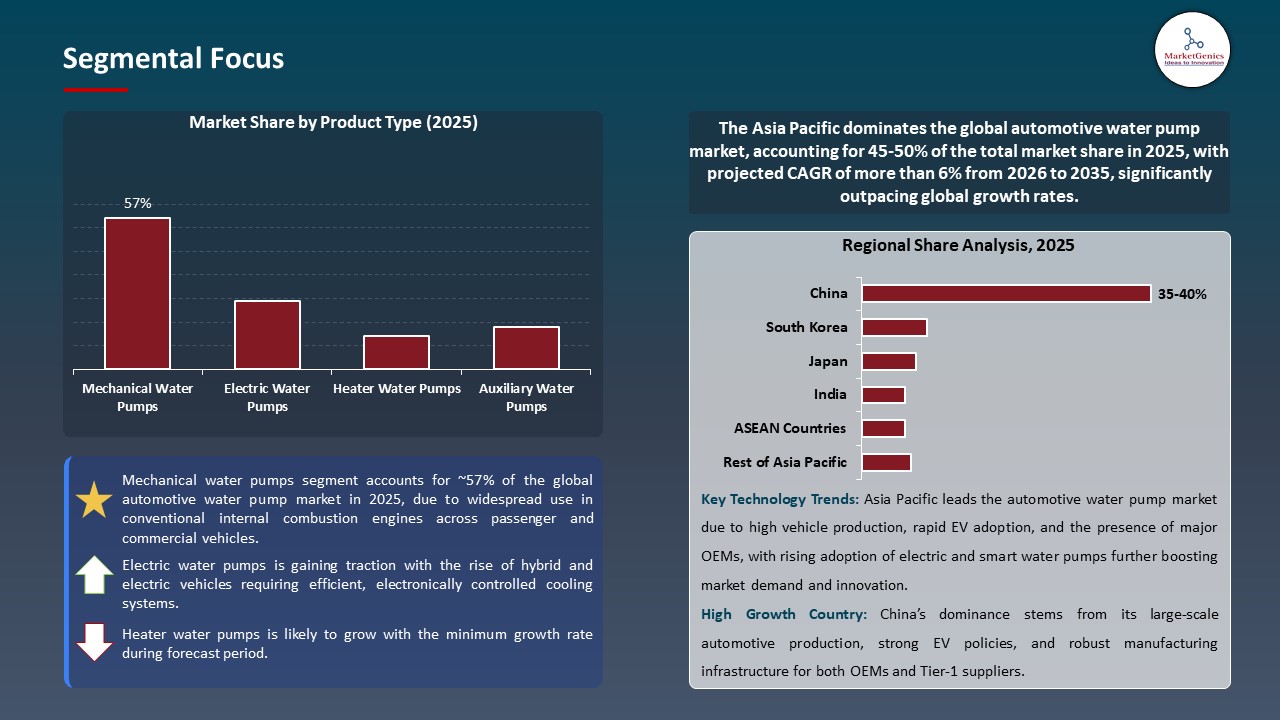
Mechanical water pumps leads the automotive water pump market because they are the most reliable, have high volumetric efficiency, and are widely compatible with internal combustion engines. The ease of construction, their ease of integration and the fact that they can be used to sustain stable cooling operation at high thermal loads makes them the choice in passenger vehicles, commercial fleets and heavy duty applications.
- The constant improvement of the materials, sealing technologies and hydraulic design have helped in strengthening the market demand. Enhanced impeller applications, non-corrosive housings and augmented bearing applications are increasing service life, lessening maintenance requirements as well as aiding effective engine thermal regulation in diverse operating environments.
- It is this mix of cost effectiveness, extensive aftermarket presence and sustained deployment in both ICE and hybrid vehicle platforms that keep the mechanical water pumps as a cornerstone to the overall world automotive water pump market.
Asia Pacific Leads Global Automotive Water Pump Market Demand
-
Asia Pacific is leading the automotive water pump market as there is a high production of vehicles, high rate of electric and hybrid cars and also due to the presence of OEMs and Tier-1 suppliers in Japan, South Korea, and India. The effective manufacturing networks and scalable production capabilities allow the mass implementation of the state-of-the-art water pump solutions.
- Innovation is being hastened through strategic partnerships and regional manufacturing. For instance, in February 2025, Schaeffer started mass production of high power electric water pumps at its Wuhu, China plant, targeting range-extended EVs. This project will enable the region to strengthen scale of manufacturing, OEM alliances, and adoption of superior thermal management technologies in Asia Pacific.
- The government incentives and domestic research efforts also make the transition to EVs, reduction of emissions, and long-term expansion of the market in the area.
Automotive Water Pump Market Ecosystem
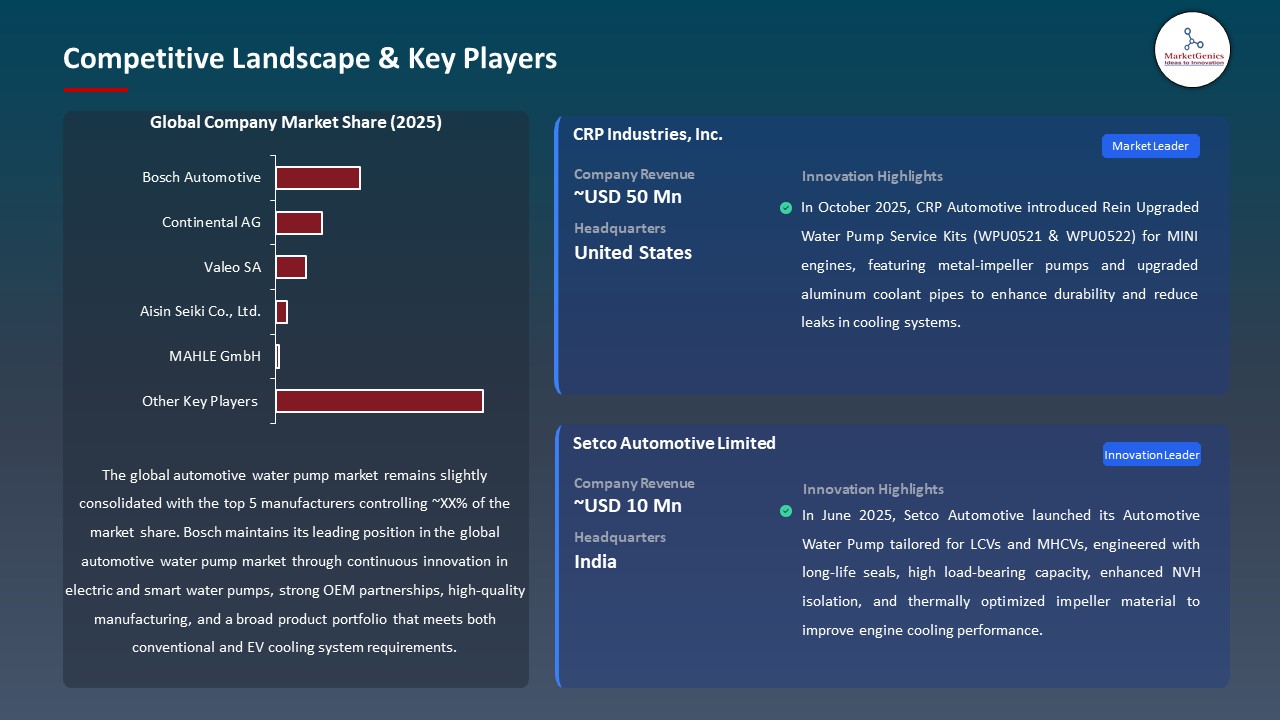
The automotive water pump market is moderately consolidated with medium high degree of market concentration, which is necessitated by the presence of leading players in Tier-1 multinational manufacturers with strong R&D, strong intellectual property hold and enormous international relations and networks. These Tier-1 players enjoy technological leadership, economies of scale and strategic alliance with OEMs to continue to dominate in conventional and electric vehicles use.
The major players in Tier-1 such as Bosch Automotive, Continental AG, Valeo SA, Aisin Seiki Co., Ltd, and MAHLE GmbH own a large market share due to their high-performance, long-lasting and dependable water pump applications. They have competitive advantage due to the high level of engineering in the design of the pumps, integration with the contemporary engine thermal management systems and association with the world vehicle manufacturers to optimize the performance.
Tier-2 players, including regional component suppliers, specialize in niche solutions, cost-effectiveness, and aftermarket offerings, and Tier-3 players, many of whom are start-ups, or local innovators, are the ones who innovate in lightweight materials, compact designs, and niche usage. The interaction among levels encourages small scale changes in technology, improves product diversification, and maintains competition within the entire global ecosystem.
 Recent Development and Strategic Overview
-
In October 2025, CRP Automotive launches Rein Upgraded Water Pump Service Kits for MINI Engines CRP expanded its Rein water pump lineup with service kits featuring upgraded water pumps (metal impellers), aluminum thermostat-to-pump coolant pipes, latest thermostats, gasket, and hardware to provide a complete, durable cooling system solution for MINI N12/N14/N16/N18 engines.
- In June 2025, Setco Automotive launched its new Automotive Water Pump designed for Light Commercial Vehicles (LCVs) and Medium & Heavy Commercial Vehicles (MHCVs), marking the company’s expansion into the engine cooling solutions segment. The pump features long-life seals, high load-bearing capacity, improved NVH isolation, and a thermally optimized impeller to ensure efficient coolant circulation and thermal stability under demanding conditions.
Report Scope
|
Detail |
|
|
Market Size in 2025 |
USD 6.8 Bn |
|
Market Forecast Value in 2035 |
USD 10.4 Bn |
|
Growth Rate (CAGR) |
4.3% |
|
Forecast Period |
2026 – 2035 |
|
Historical Data Available for |
2021 – 2024 |
|
Market Size Units |
US$ Billion for Value Million Units for Volume |
|
Report Format |
Electronic (PDF) + Excel |
|
North America |
Europe |
Asia Pacific |
Middle East |
Africa |
South America |
|
|
|
|
|
|
|
Companies Covered |
|||||
|
|
|
|
|
|
Automotive Water Pump Market Segmentation and Highlights
|
Segment |
Sub-segment |
|
Automotive Water Pump Market, By Product Type |
|
|
Automotive Water Pump Market, By Rated Power |
|
|
Automotive Water Pump Market, By Rated Capacity (Flow Rate) |
|
|
Automotive Water Pump Market, By Impeller Type |
|
|
Automotive Water Pump Market, By Material Type |
|
|
Automotive Water Pump Market, By Vehicle Type |
|
|
Automotive Water Pump Market, By Propulsion Type |
|
|
Automotive Water Pump Market, By Application |
|
|
Automotive Water Pump Market, By Sales Channel |
|
|
Automotive Water Pump Market, By Mounting Type |
|
Frequently Asked Questions
Table of Contents
- 1. Research Methodology and Assumptions
- 1.1. Definitions
- 1.2. Research Design and Approach
- 1.3. Data Collection Methods
- 1.4. Base Estimates and Calculations
- 1.5. Forecasting Models
- 1.5.1. Key Forecast Factors & Impact Analysis
- 1.6. Secondary Research
- 1.6.1. Open Sources
- 1.6.2. Paid Databases
- 1.6.3. Associations
- 1.7. Primary Research
- 1.7.1. Primary Sources
- 1.7.2. Primary Interviews with Stakeholders across Ecosystem
- 2. Executive Summary
- 2.1. Global Automotive Water Pump Market Outlook
- 2.1.1. Automotive Water Pump Market Size Volume (Million Units) and Value (US$ Bn), and Forecasts, 2021-2035
- 2.1.2. Compounded Annual Growth Rate Analysis
- 2.1.3. Growth Opportunity Analysis
- 2.1.4. Segmental Share Analysis
- 2.1.5. Geographical Share Analysis
- 2.2. Market Analysis and Facts
- 2.3. Supply-Demand Analysis
- 2.4. Competitive Benchmarking
- 2.5. Go-to- Market Strategy
- 2.5.1. Customer/ End-use Industry Assessment
- 2.5.2. Growth Opportunity Data, 2026-2035
- 2.5.2.1. Regional Data
- 2.5.2.2. Country Data
- 2.5.2.3. Segmental Data
- 2.5.3. Identification of Potential Market Spaces
- 2.5.4. GAP Analysis
- 2.5.5. Potential Attractive Price Points
- 2.5.6. Prevailing Market Risks & Challenges
- 2.5.7. Preferred Sales & Marketing Strategies
- 2.5.8. Key Recommendations and Analysis
- 2.5.9. A Way Forward
- 2.1. Global Automotive Water Pump Market Outlook
- 3. Industry Data and Premium Insights
- 3.1. Global Automotive & Transportation Industry Overview, 2025
- 3.1.1. Industry Ecosystem Analysis
- 3.1.2. Key Trends for Automotive & Transportation Industry
- 3.1.3. Regional Distribution for Automotive & Transportation Industry
- 3.2. Supplier Customer Data
- 3.3. Technology Roadmap and Developments
- 3.4. Trade Analysis
- 3.4.1. Import & Export Analysis, 2025
- 3.4.2. Top Importing Countries
- 3.4.3. Top Exporting Countries
- 3.5. Trump Tariff Impact Analysis
- 3.5.1. Manufacturer
- 3.5.1.1. Based on the component & Raw material
- 3.5.2. Supply Chain
- 3.5.3. End Consumer
- 3.5.1. Manufacturer
- 3.6. Raw Material Analysis
- 3.1. Global Automotive & Transportation Industry Overview, 2025
- 4. Market Overview
- 4.1. Market Dynamics
- 4.1.1. Drivers
- 4.1.1.1. Rising global vehicle production and parc growth, especially in emerging economies.
- 4.1.1.2. Increasing demand for fuel-efficient, low-emission vehicles driving adoption of advanced and electric water pumps.
- 4.1.1.3. Growing penetration of electric and hybrid vehicles requiring sophisticated thermal management systems.
- 4.1.2. Restraints
- 4.1.2.1. Declining long-term demand from conventional ICE vehicles and extended replacement cycles.
- 4.1.2.2. High cost and technical complexity of electric and advanced water pump systems.
- 4.1.1. Drivers
- 4.2. Key Trend Analysis
- 4.3. Regulatory Framework
- 4.3.1. Key Regulations, Norms, and Subsidies, by Key Countries
- 4.3.2. Tariffs and Standards
- 4.3.3. Impact Analysis of Regulations on the Market
- 4.4. Value Chain Analysis
- 4.4.1. Raw Material Suppliers
- 4.4.2. Pump Manufacturers
- 4.4.3. Dealers/ Distributors
- 4.4.4. Vehicle Manufacturers
- 4.5. Cost Structure Analysis
- 4.5.1. Parameter’s Share for Cost Associated
- 4.5.2. COGP vs COGS
- 4.5.3. Profit Margin Analysis
- 4.6. Pricing Analysis
- 4.6.1. Regional Pricing Analysis
- 4.6.2. Segmental Pricing Trends
- 4.6.3. Factors Influencing Pricing
- 4.7. Porter’s Five Forces Analysis
- 4.8. PESTEL Analysis
- 4.9. Global Automotive Water Pump Market Demand
- 4.9.1. Historical Market Size – Volume (Million Units) and Value (US$ Bn), 2020-2024
- 4.9.2. Current and Future Market Size – Volume (Million Units) and Value (US$ Bn), 2026–2035
- 4.9.2.1. Y-o-Y Growth Trends
- 4.9.2.2. Absolute $ Opportunity Assessment
- 4.1. Market Dynamics
- 5. Competition Landscape
- 5.1. Competition structure
- 5.1.1. Fragmented v/s consolidated
- 5.2. Company Share Analysis, 2025
- 5.2.1. Global Company Market Share
- 5.2.2. By Region
- 5.2.2.1. North America
- 5.2.2.2. Europe
- 5.2.2.3. Asia Pacific
- 5.2.2.4. Middle East
- 5.2.2.5. Africa
- 5.2.2.6. South America
- 5.3. Product Comparison Matrix
- 5.3.1. Specifications
- 5.3.2. Market Positioning
- 5.3.3. Pricing
- 5.1. Competition structure
- 6. Global Automotive Water Pump Market Analysis, by Product Type
- 6.1. Key Segment Analysis
- 6.2. Automotive Water Pump Market Size Volume (Million Units) and Value (US$ Bn), Analysis, and Forecasts, by Product Type, 2021-2035
- 6.2.1. Mechanical Water Pumps
- 6.2.2. Electric Water Pumps
- 6.2.3. Auxiliary Water Pumps
- 6.2.4. Heater Water Pumps
- 7. Global Automotive Water Pump Market Analysis, by Rated Power
- 7.1. Key Segment Analysis
- 7.2. Automotive Water Pump Market Size Volume (Million Units) and Value (US$ Bn), Analysis, and Forecasts, by Rated Power, 2021-2035
- 7.2.1. Below 50W
- 7.2.2. 50W to 100W
- 7.2.3. 100W to 200W
- 7.2.4. Above 200W
- 8. Global Automotive Water Pump Market Analysis, by Rated Capacity (Flow Rate)
- 8.1. Key Segment Analysis
- 8.2. Automotive Water Pump Market Size Volume (Million Units) and Value (US$ Bn), Analysis, and Forecasts, by Rated Capacity (Flow Rate), 2021-2035
- 8.2.1. Below 30 LPM (Liters Per Minute)
- 8.2.2. 30 to 60 LPM
- 8.2.3. 60 to 100 LPM
- 8.2.4. 100 to 150 LPM
- 8.2.5. Above 150 LPM
- 9. Global Automotive Water Pump Market Analysis, by Impeller Type
- 9.1. Key Segment Analysis
- 9.2. Automotive Water Pump Market Size Volume (Million Units) and Value (US$ Bn), Analysis, and Forecasts, by Impeller Type, 2021-2035
- 9.2.1. Open Impeller
- 9.2.2. Closed Impeller
- 9.2.3. Semi-Open Impeller
- 10. Global Automotive Water Pump Market Analysis, by Material Type
- 10.1. Key Segment Analysis
- 10.2. Automotive Water Pump Market Size Volume (Million Units) and Value (US$ Bn), Analysis, and Forecasts, by Material Type, 2021-2035
- 10.2.1. Cast Iron
- 10.2.2. Aluminum
- 10.2.3. Stainless Steel
- 10.2.4. Plastic/Composite Materials
- 11. Global Automotive Water Pump Market Analysis, by Vehicle Type
- 11.1. Key Segment Analysis
- 11.2. Automotive Water Pump Market Size Volume (Million Units) and Value (US$ Bn), Analysis, and Forecasts, by Vehicle Type, 2021-2035
- 11.2.1. Passenger Cars
- 11.2.1.1. Hatchback
- 11.2.1.2. Sedan
- 11.2.1.3. SUV
- 11.2.1.4. Luxury Cars
- 11.2.2. Commercial Vehicles
- 11.2.2.1. Light Commercial Vehicles (LCV)
- 11.2.2.2. Medium Commercial Vehicles (MCV)
- 11.2.2.3. Heavy Commercial Vehicles (HCV)
- 11.2.3. Two-Wheelers
- 11.2.4. Off-Highway Vehicles
- 11.2.4.1. Construction Equipment
- 11.2.4.2. Agricultural Vehicles
- 11.2.4.3. Mining Vehicles
- 11.2.4.4. Others
- 11.2.1. Passenger Cars
- 12. Global Automotive Water Pump Market Analysis, by Propulsion Type
- 12.1. Key Segment Analysis
- 12.2. Automotive Water Pump Market Size Volume (Million Units) and Value (US$ Bn), Analysis, and Forecasts, by Propulsion Type, 2021-2035
- 12.2.1. Internal Combustion Engine (ICE) Vehicles
- 12.2.1.1. Gasoline
- 12.2.1.2. Diesel
- 12.2.2. Electric Vehicles (EVs)
- 12.2.2.1. Battery Electric Vehicles (BEV)
- 12.2.2.2. Plug-in Hybrid Electric Vehicles (PHEV)
- 12.2.3. Hybrid Vehicles (HEV)
- 12.2.4. Fuel Cell Vehicles
- 12.2.1. Internal Combustion Engine (ICE) Vehicles
- 13. Global Automotive Water Pump Market Analysis, by Application
- 13.1. Key Segment Analysis
- 13.2. Automotive Water Pump Market Size Volume (Million Units) and Value (US$ Bn), Analysis, and Forecasts, by Application, 2021-2035
- 13.2.1. Engine Cooling
- 13.2.2. Battery Cooling
- 13.2.3. HVAC System Cooling
- 13.2.4. Turbocharger Cooling
- 13.2.5. Transmission Cooling
- 13.2.6. Inverter Cooling
- 14. Global Automotive Water Pump Market Analysis, by Sales Channel
- 14.1. Key Segment Analysis
- 14.2. Automotive Water Pump Market Size Volume (Million Units) and Value (US$ Bn), Analysis, and Forecasts, by Sales Channel, 2021-2035
- 14.2.1. Original Equipment Manufacturer (OEM)
- 14.2.2. Aftermarket
- 15. Global Automotive Water Pump Market Analysis, by Mounting Type
- 15.1. Key Segment Analysis
- 15.2. Automotive Water Pump Market Size Volume (Million Units) and Value (US$ Bn), Analysis, and Forecasts, by Mounting Type, 2021-2035
- 15.2.1. Engine Mounted
- 15.2.2. Chassis Mounted
- 15.2.3. Remote Mounted
- 16. Global Automotive Water Pump Market Analysis and Forecasts, by Region
- 16.1. Key Findings
- 16.2. Automotive Water Pump Market Size Volume (Million Units) and Value (US$ Bn), Analysis, and Forecasts, by Region, 2021-2035
- 16.2.1. North America
- 16.2.2. Europe
- 16.2.3. Asia Pacific
- 16.2.4. Middle East
- 16.2.5. Africa
- 16.2.6. South America
- 17. North America Automotive Water Pump Market Analysis
- 17.1. Key Segment Analysis
- 17.2. Regional Snapshot
- 17.3. North America Automotive Water Pump Market Size- Volume (Million Units) and Value (US$ Bn), Analysis, and Forecasts, 2021-2035
- 17.3.1. Product Type
- 17.3.2. Rated Power
- 17.3.3. Rated Capacity (Flow Rate)
- 17.3.4. Impeller Type
- 17.3.5. Material Type
- 17.3.6. Vehicle Type
- 17.3.7. Propulsion Type
- 17.3.8. Application
- 17.3.9. Sales Channel
- 17.3.10. Mounting Type
- 17.3.11. Country
- 17.3.11.1. USA
- 17.3.11.2. Canada
- 17.3.11.3. Mexico
- 17.4. USA Automotive Water Pump Market
- 17.4.1. Country Segmental Analysis
- 17.4.2. Product Type
- 17.4.3. Rated Power
- 17.4.4. Rated Capacity (Flow Rate)
- 17.4.5. Impeller Type
- 17.4.6. Material Type
- 17.4.7. Vehicle Type
- 17.4.8. Propulsion Type
- 17.4.9. Application
- 17.4.10. Sales Channel
- 17.4.11. Mounting Type
- 17.5. Canada Automotive Water Pump Market
- 17.5.1. Country Segmental Analysis
- 17.5.2. Product Type
- 17.5.3. Rated Power
- 17.5.4. Rated Capacity (Flow Rate)
- 17.5.5. Impeller Type
- 17.5.6. Material Type
- 17.5.7. Vehicle Type
- 17.5.8. Propulsion Type
- 17.5.9. Application
- 17.5.10. Sales Channel
- 17.5.11. Mounting Type
- 17.6. Mexico Automotive Water Pump Market
- 17.6.1. Country Segmental Analysis
- 17.6.2. Product Type
- 17.6.3. Rated Power
- 17.6.4. Rated Capacity (Flow Rate)
- 17.6.5. Impeller Type
- 17.6.6. Material Type
- 17.6.7. Vehicle Type
- 17.6.8. Propulsion Type
- 17.6.9. Application
- 17.6.10. Sales Channel
- 17.6.11. Mounting Type
- 18. Europe Automotive Water Pump Market Analysis
- 18.1. Key Segment Analysis
- 18.2. Regional Snapshot
- 18.3. Europe Automotive Water Pump Market Size Volume (Million Units) and Value (US$ Bn), Analysis, and Forecasts, 2021-2035
- 18.3.1. Product Type
- 18.3.2. Rated Power
- 18.3.3. Rated Capacity (Flow Rate)
- 18.3.4. Impeller Type
- 18.3.5. Material Type
- 18.3.6. Vehicle Type
- 18.3.7. Propulsion Type
- 18.3.8. Application
- 18.3.9. Sales Channel
- 18.3.10. Mounting Type
- 18.3.11. Country
- 18.3.11.1. Germany
- 18.3.11.2. United Kingdom
- 18.3.11.3. France
- 18.3.11.4. Italy
- 18.3.11.5. Spain
- 18.3.11.6. Netherlands
- 18.3.11.7. Nordic Countries
- 18.3.11.8. Poland
- 18.3.11.9. Russia & CIS
- 18.3.11.10. Rest of Europe
- 18.4. Germany Automotive Water Pump Market
- 18.4.1. Country Segmental Analysis
- 18.4.2. Product Type
- 18.4.3. Rated Power
- 18.4.4. Rated Capacity (Flow Rate)
- 18.4.5. Impeller Type
- 18.4.6. Material Type
- 18.4.7. Vehicle Type
- 18.4.8. Propulsion Type
- 18.4.9. Application
- 18.4.10. Sales Channel
- 18.4.11. Mounting Type
- 18.5. United Kingdom Automotive Water Pump Market
- 18.5.1. Country Segmental Analysis
- 18.5.2. Product Type
- 18.5.3. Rated Power
- 18.5.4. Rated Capacity (Flow Rate)
- 18.5.5. Impeller Type
- 18.5.6. Material Type
- 18.5.7. Vehicle Type
- 18.5.8. Propulsion Type
- 18.5.9. Application
- 18.5.10. Sales Channel
- 18.5.11. Mounting Type
- 18.6. France Automotive Water Pump Market
- 18.6.1. Country Segmental Analysis
- 18.6.2. Product Type
- 18.6.3. Rated Power
- 18.6.4. Rated Capacity (Flow Rate)
- 18.6.5. Impeller Type
- 18.6.6. Material Type
- 18.6.7. Vehicle Type
- 18.6.8. Propulsion Type
- 18.6.9. Application
- 18.6.10. Sales Channel
- 18.6.11. Mounting Type
- 18.7. Italy Automotive Water Pump Market
- 18.7.1. Country Segmental Analysis
- 18.7.2. Product Type
- 18.7.3. Rated Power
- 18.7.4. Rated Capacity (Flow Rate)
- 18.7.5. Impeller Type
- 18.7.6. Material Type
- 18.7.7. Vehicle Type
- 18.7.8. Propulsion Type
- 18.7.9. Application
- 18.7.10. Sales Channel
- 18.7.11. Mounting Type
- 18.8. Spain Automotive Water Pump Market
- 18.8.1. Country Segmental Analysis
- 18.8.2. Product Type
- 18.8.3. Rated Power
- 18.8.4. Rated Capacity (Flow Rate)
- 18.8.5. Impeller Type
- 18.8.6. Material Type
- 18.8.7. Vehicle Type
- 18.8.8. Propulsion Type
- 18.8.9. Application
- 18.8.10. Sales Channel
- 18.8.11. Mounting Type
- 18.9. Netherlands Automotive Water Pump Market
- 18.9.1. Country Segmental Analysis
- 18.9.2. Product Type
- 18.9.3. Rated Power
- 18.9.4. Rated Capacity (Flow Rate)
- 18.9.5. Impeller Type
- 18.9.6. Material Type
- 18.9.7. Vehicle Type
- 18.9.8. Propulsion Type
- 18.9.9. Application
- 18.9.10. Sales Channel
- 18.9.11. Mounting Type
- 18.10. Nordic Countries Automotive Water Pump Market
- 18.10.1. Country Segmental Analysis
- 18.10.2. Product Type
- 18.10.3. Rated Power
- 18.10.4. Rated Capacity (Flow Rate)
- 18.10.5. Impeller Type
- 18.10.6. Material Type
- 18.10.7. Vehicle Type
- 18.10.8. Propulsion Type
- 18.10.9. Application
- 18.10.10. Sales Channel
- 18.10.11. Mounting Type
- 18.11. Poland Automotive Water Pump Market
- 18.11.1. Country Segmental Analysis
- 18.11.2. Product Type
- 18.11.3. Rated Power
- 18.11.4. Rated Capacity (Flow Rate)
- 18.11.5. Impeller Type
- 18.11.6. Material Type
- 18.11.7. Vehicle Type
- 18.11.8. Propulsion Type
- 18.11.9. Application
- 18.11.10. Sales Channel
- 18.11.11. Mounting Type
- 18.12. Russia & CIS Automotive Water Pump Market
- 18.12.1. Country Segmental Analysis
- 18.12.2. Product Type
- 18.12.3. Rated Power
- 18.12.4. Rated Capacity (Flow Rate)
- 18.12.5. Impeller Type
- 18.12.6. Material Type
- 18.12.7. Vehicle Type
- 18.12.8. Propulsion Type
- 18.12.9. Application
- 18.12.10. Sales Channel
- 18.12.11. Mounting Type
- 18.13. Rest of Europe Automotive Water Pump Market
- 18.13.1. Country Segmental Analysis
- 18.13.2. Product Type
- 18.13.3. Rated Power
- 18.13.4. Rated Capacity (Flow Rate)
- 18.13.5. Impeller Type
- 18.13.6. Material Type
- 18.13.7. Vehicle Type
- 18.13.8. Propulsion Type
- 18.13.9. Application
- 18.13.10. Sales Channel
- 18.13.11. Mounting Type
- 19. Asia Pacific Automotive Water Pump Market Analysis
- 19.1. Key Segment Analysis
- 19.2. Regional Snapshot
- 19.3. Asia Pacific Automotive Water Pump Market Size Volume (Million Units) and Value (US$ Bn), Analysis, and Forecasts, 2021-2035
- 19.3.1. Product Type
- 19.3.2. Rated Power
- 19.3.3. Rated Capacity (Flow Rate)
- 19.3.4. Impeller Type
- 19.3.5. Material Type
- 19.3.6. Vehicle Type
- 19.3.7. Propulsion Type
- 19.3.8. Application
- 19.3.9. Sales Channel
- 19.3.10. Mounting Type
- 19.3.11. Country
- 19.3.11.1. China
- 19.3.11.2. India
- 19.3.11.3. Japan
- 19.3.11.4. South Korea
- 19.3.11.5. Australia and New Zealand
- 19.3.11.6. Indonesia
- 19.3.11.7. Malaysia
- 19.3.11.8. Thailand
- 19.3.11.9. Vietnam
- 19.3.11.10. Rest of Asia Pacific
- 19.4. China Automotive Water Pump Market
- 19.4.1. Country Segmental Analysis
- 19.4.2. Product Type
- 19.4.3. Rated Power
- 19.4.4. Rated Capacity (Flow Rate)
- 19.4.5. Impeller Type
- 19.4.6. Material Type
- 19.4.7. Vehicle Type
- 19.4.8. Propulsion Type
- 19.4.9. Application
- 19.4.10. Sales Channel
- 19.4.11. Mounting Type
- 19.5. India Automotive Water Pump Market
- 19.5.1. Country Segmental Analysis
- 19.5.2. Product Type
- 19.5.3. Rated Power
- 19.5.4. Rated Capacity (Flow Rate)
- 19.5.5. Impeller Type
- 19.5.6. Material Type
- 19.5.7. Vehicle Type
- 19.5.8. Propulsion Type
- 19.5.9. Application
- 19.5.10. Sales Channel
- 19.5.11. Mounting Type
- 19.6. Japan Automotive Water Pump Market
- 19.6.1. Country Segmental Analysis
- 19.6.2. Product Type
- 19.6.3. Rated Power
- 19.6.4. Rated Capacity (Flow Rate)
- 19.6.5. Impeller Type
- 19.6.6. Material Type
- 19.6.7. Vehicle Type
- 19.6.8. Propulsion Type
- 19.6.9. Application
- 19.6.10. Sales Channel
- 19.6.11. Mounting Type
- 19.7. South Korea Automotive Water Pump Market
- 19.7.1. Country Segmental Analysis
- 19.7.2. Product Type
- 19.7.3. Rated Power
- 19.7.4. Rated Capacity (Flow Rate)
- 19.7.5. Impeller Type
- 19.7.6. Material Type
- 19.7.7. Vehicle Type
- 19.7.8. Propulsion Type
- 19.7.9. Application
- 19.7.10. Sales Channel
- 19.7.11. Mounting Type
- 19.8. Australia and New Zealand Automotive Water Pump Market
- 19.8.1. Country Segmental Analysis
- 19.8.2. Product Type
- 19.8.3. Rated Power
- 19.8.4. Rated Capacity (Flow Rate)
- 19.8.5. Impeller Type
- 19.8.6. Material Type
- 19.8.7. Vehicle Type
- 19.8.8. Propulsion Type
- 19.8.9. Application
- 19.8.10. Sales Channel
- 19.8.11. Mounting Type
- 19.9. Indonesia Automotive Water Pump Market
- 19.9.1. Country Segmental Analysis
- 19.9.2. Product Type
- 19.9.3. Rated Power
- 19.9.4. Rated Capacity (Flow Rate)
- 19.9.5. Impeller Type
- 19.9.6. Material Type
- 19.9.7. Vehicle Type
- 19.9.8. Propulsion Type
- 19.9.9. Application
- 19.9.10. Sales Channel
- 19.9.11. Mounting Type
- 19.10. Malaysia Automotive Water Pump Market
- 19.10.1. Country Segmental Analysis
- 19.10.2. Product Type
- 19.10.3. Rated Power
- 19.10.4. Rated Capacity (Flow Rate)
- 19.10.5. Impeller Type
- 19.10.6. Material Type
- 19.10.7. Vehicle Type
- 19.10.8. Propulsion Type
- 19.10.9. Application
- 19.10.10. Sales Channel
- 19.10.11. Mounting Type
- 19.11. Thailand Automotive Water Pump Market
- 19.11.1. Country Segmental Analysis
- 19.11.2. Product Type
- 19.11.3. Rated Power
- 19.11.4. Rated Capacity (Flow Rate)
- 19.11.5. Impeller Type
- 19.11.6. Material Type
- 19.11.7. Vehicle Type
- 19.11.8. Propulsion Type
- 19.11.9. Application
- 19.11.10. Sales Channel
- 19.11.11. Mounting Type
- 19.12. Vietnam Automotive Water Pump Market
- 19.12.1. Country Segmental Analysis
- 19.12.2. Product Type
- 19.12.3. Rated Power
- 19.12.4. Rated Capacity (Flow Rate)
- 19.12.5. Impeller Type
- 19.12.6. Material Type
- 19.12.7. Vehicle Type
- 19.12.8. Propulsion Type
- 19.12.9. Application
- 19.12.10. Sales Channel
- 19.12.11. Mounting Type
- 19.13. Rest of Asia Pacific Automotive Water Pump Market
- 19.13.1. Country Segmental Analysis
- 19.13.2. Product Type
- 19.13.3. Rated Power
- 19.13.4. Rated Capacity (Flow Rate)
- 19.13.5. Impeller Type
- 19.13.6. Material Type
- 19.13.7. Vehicle Type
- 19.13.8. Propulsion Type
- 19.13.9. Application
- 19.13.10. Sales Channel
- 19.13.11. Mounting Type
- 20. Middle East Automotive Water Pump Market Analysis
- 20.1. Key Segment Analysis
- 20.2. Regional Snapshot
- 20.3. Middle East Automotive Water Pump Market Size Volume (Million Units) and Value (US$ Bn), Analysis, and Forecasts, 2021-2035
- 20.3.1. Product Type
- 20.3.2. Rated Power
- 20.3.3. Rated Capacity (Flow Rate)
- 20.3.4. Impeller Type
- 20.3.5. Material Type
- 20.3.6. Vehicle Type
- 20.3.7. Propulsion Type
- 20.3.8. Application
- 20.3.9. Sales Channel
- 20.3.10. Mounting Type
- 20.3.11. Country
- 20.3.11.1. Turkey
- 20.3.11.2. UAE
- 20.3.11.3. Saudi Arabia
- 20.3.11.4. Israel
- 20.3.11.5. Rest of Middle East
- 20.4. Turkey Automotive Water Pump Market
- 20.4.1. Country Segmental Analysis
- 20.4.2. Product Type
- 20.4.3. Rated Power
- 20.4.4. Rated Capacity (Flow Rate)
- 20.4.5. Impeller Type
- 20.4.6. Material Type
- 20.4.7. Vehicle Type
- 20.4.8. Propulsion Type
- 20.4.9. Application
- 20.4.10. Sales Channel
- 20.4.11. Mounting Type
- 20.5. UAE Automotive Water Pump Market
- 20.5.1. Country Segmental Analysis
- 20.5.2. Product Type
- 20.5.3. Rated Power
- 20.5.4. Rated Capacity (Flow Rate)
- 20.5.5. Impeller Type
- 20.5.6. Material Type
- 20.5.7. Vehicle Type
- 20.5.8. Propulsion Type
- 20.5.9. Application
- 20.5.10. Sales Channel
- 20.5.11. Mounting Type
- 20.6. Saudi Arabia Automotive Water Pump Market
- 20.6.1. Country Segmental Analysis
- 20.6.2. Product Type
- 20.6.3. Rated Power
- 20.6.4. Rated Capacity (Flow Rate)
- 20.6.5. Impeller Type
- 20.6.6. Material Type
- 20.6.7. Vehicle Type
- 20.6.8. Propulsion Type
- 20.6.9. Application
- 20.6.10. Sales Channel
- 20.6.11. Mounting Type
- 20.7. Israel Automotive Water Pump Market
- 20.7.1. Country Segmental Analysis
- 20.7.2. Product Type
- 20.7.3. Rated Power
- 20.7.4. Rated Capacity (Flow Rate)
- 20.7.5. Impeller Type
- 20.7.6. Material Type
- 20.7.7. Vehicle Type
- 20.7.8. Propulsion Type
- 20.7.9. Application
- 20.7.10. Sales Channel
- 20.7.11. Mounting Type
- 20.8. Rest of Middle East Automotive Water Pump Market
- 20.8.1. Country Segmental Analysis
- 20.8.2. Product Type
- 20.8.3. Rated Power
- 20.8.4. Rated Capacity (Flow Rate)
- 20.8.5. Impeller Type
- 20.8.6. Material Type
- 20.8.7. Vehicle Type
- 20.8.8. Propulsion Type
- 20.8.9. Application
- 20.8.10. Sales Channel
- 20.8.11. Mounting Type
- 21. Africa Automotive Water Pump Market Analysis
- 21.1. Key Segment Analysis
- 21.2. Regional Snapshot
- 21.3. Africa Automotive Water Pump Market Size Volume (Million Units) and Value (US$ Bn), Analysis, and Forecasts, 2021-2035
- 21.3.1. Product Type
- 21.3.2. Rated Power
- 21.3.3. Rated Capacity (Flow Rate)
- 21.3.4. Impeller Type
- 21.3.5. Material Type
- 21.3.6. Vehicle Type
- 21.3.7. Propulsion Type
- 21.3.8. Application
- 21.3.9. Sales Channel
- 21.3.10. Mounting Type
- 21.3.11. country
- 21.3.11.1. South Africa
- 21.3.11.2. Egypt
- 21.3.11.3. Nigeria
- 21.3.11.4. Algeria
- 21.3.11.5. Rest of Africa
- 21.4. South Africa Automotive Water Pump Market
- 21.4.1. Country Segmental Analysis
- 21.4.2. Product Type
- 21.4.3. Rated Power
- 21.4.4. Rated Capacity (Flow Rate)
- 21.4.5. Impeller Type
- 21.4.6. Material Type
- 21.4.7. Vehicle Type
- 21.4.8. Propulsion Type
- 21.4.9. Application
- 21.4.10. Sales Channel
- 21.4.11. Mounting Type
- 21.5. Egypt Automotive Water Pump Market
- 21.5.1. Country Segmental Analysis
- 21.5.2. Product Type
- 21.5.3. Rated Power
- 21.5.4. Rated Capacity (Flow Rate)
- 21.5.5. Impeller Type
- 21.5.6. Material Type
- 21.5.7. Vehicle Type
- 21.5.8. Propulsion Type
- 21.5.9. Application
- 21.5.10. Sales Channel
- 21.5.11. Mounting Type
- 21.6. Nigeria Automotive Water Pump Market
- 21.6.1. Country Segmental Analysis
- 21.6.2. Product Type
- 21.6.3. Rated Power
- 21.6.4. Rated Capacity (Flow Rate)
- 21.6.5. Impeller Type
- 21.6.6. Material Type
- 21.6.7. Vehicle Type
- 21.6.8. Propulsion Type
- 21.6.9. Application
- 21.6.10. Sales Channel
- 21.6.11. Mounting Type
- 21.7. Algeria Automotive Water Pump Market
- 21.7.1. Country Segmental Analysis
- 21.7.2. Product Type
- 21.7.3. Rated Power
- 21.7.4. Rated Capacity (Flow Rate)
- 21.7.5. Impeller Type
- 21.7.6. Material Type
- 21.7.7. Vehicle Type
- 21.7.8. Propulsion Type
- 21.7.9. Application
- 21.7.10. Sales Channel
- 21.7.11. Mounting Type
- 21.8. Rest of Africa Automotive Water Pump Market
- 21.8.1. Country Segmental Analysis
- 21.8.2. Product Type
- 21.8.3. Rated Power
- 21.8.4. Rated Capacity (Flow Rate)
- 21.8.5. Impeller Type
- 21.8.6. Material Type
- 21.8.7. Vehicle Type
- 21.8.8. Propulsion Type
- 21.8.9. Application
- 21.8.10. Sales Channel
- 21.8.11. Mounting Type
- 22. South America Automotive Water Pump Market Analysis
- 22.1. Key Segment Analysis
- 22.2. Regional Snapshot
- 22.3. South America Automotive Water Pump Market Size Volume (Million Units) and Value (US$ Bn), Analysis, and Forecasts, 2021-2035
- 22.3.1. Product Type
- 22.3.2. Rated Power
- 22.3.3. Rated Capacity (Flow Rate)
- 22.3.4. Impeller Type
- 22.3.5. Material Type
- 22.3.6. Vehicle Type
- 22.3.7. Propulsion Type
- 22.3.8. Application
- 22.3.9. Sales Channel
- 22.3.10. Mounting Type
- 22.3.11. Country
- 22.3.11.1. Brazil
- 22.3.11.2. Argentina
- 22.3.11.3. Rest of South America
- 22.4. Brazil Automotive Water Pump Market
- 22.4.1. Country Segmental Analysis
- 22.4.2. Product Type
- 22.4.3. Rated Power
- 22.4.4. Rated Capacity (Flow Rate)
- 22.4.5. Impeller Type
- 22.4.6. Material Type
- 22.4.7. Vehicle Type
- 22.4.8. Propulsion Type
- 22.4.9. Application
- 22.4.10. Sales Channel
- 22.4.11. Mounting Type
- 22.5. Argentina Automotive Water Pump Market
- 22.5.1. Country Segmental Analysis
- 22.5.2. Product Type
- 22.5.3. Rated Power
- 22.5.4. Rated Capacity (Flow Rate)
- 22.5.5. Impeller Type
- 22.5.6. Material Type
- 22.5.7. Vehicle Type
- 22.5.8. Propulsion Type
- 22.5.9. Application
- 22.5.10. Sales Channel
- 22.5.11. Mounting Type
- 22.6. Rest of South America Automotive Water Pump Market
- 22.6.1. Country Segmental Analysis
- 22.6.2. Product Type
- 22.6.3. Rated Power
- 22.6.4. Rated Capacity (Flow Rate)
- 22.6.5. Impeller Type
- 22.6.6. Material Type
- 22.6.7. Vehicle Type
- 22.6.8. Propulsion Type
- 22.6.9. Application
- 22.6.10. Sales Channel
- 22.6.11. Mounting Type
- 23. Key Players/ Company Profile
- 23.1. ACDelco (General Motors)
- 23.1.1. Company Details/ Overview
- 23.1.2. Company Financials
- 23.1.3. Key Customers and Competitors
- 23.1.4. Business/ Industry Portfolio
- 23.1.5. Product Portfolio/ Specification Details
- 23.1.6. Pricing Data
- 23.1.7. Strategic Overview
- 23.1.8. Recent Developments
- 23.2. Aisin Seiki Co., Ltd.
- 23.3. Behr-Hella Thermocontrol GmbH
- 23.4. Bosch Automotive
- 23.5. Cardone Industries
- 23.6. Continental AG
- 23.7. Dayco Products LLC
- 23.8. Dolz Group
- 23.9. Fawer Automotive Parts Co., Ltd.
- 23.10. Gates Corporation
- 23.11. Genuine Parts Company (NAPA)
- 23.12. GMB Corporation
- 23.13. Hitachi Astemo, Ltd.
- 23.14. KSPG AG (Rheinmetall Automotive)
- 23.15. MAHLE GmbH
- 23.16. Schaeffler Technologies AG & Co. KG
- 23.17. Tata AutoComp Systems Limited
- 23.18. US Motor Works
- 23.19. Valeo SA
- 23.20. Zhejiang Wanliyang Co., Ltd.
- 23.21. Other Key Players
- 23.1. ACDelco (General Motors)
Note* - This is just tentative list of players. While providing the report, we will cover more number of players based on their revenue and share for each geography
Research Design
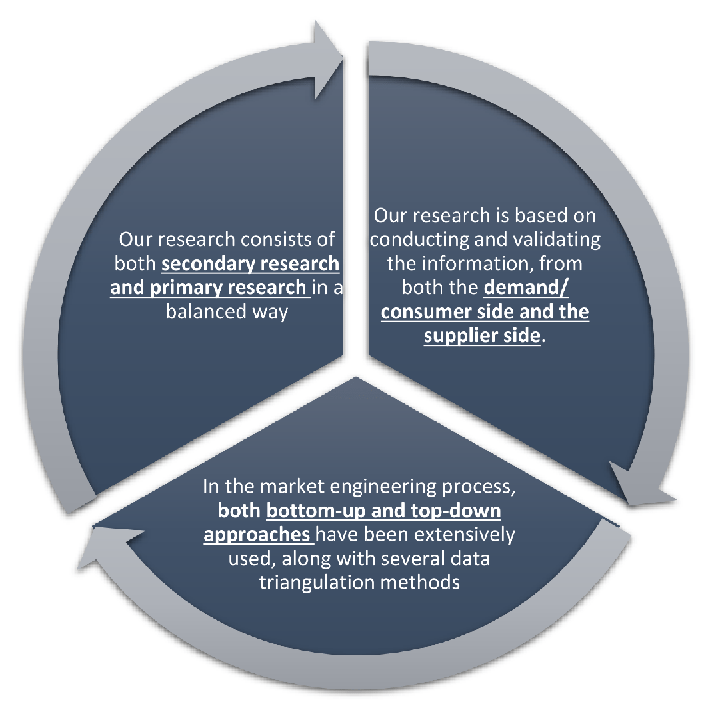
Our research design integrates both demand-side and supply-side analysis through a balanced combination of primary and secondary research methodologies. By utilizing both bottom-up and top-down approaches alongside rigorous data triangulation methods, we deliver robust market intelligence that supports strategic decision-making.
MarketGenics' comprehensive research design framework ensures the delivery of accurate, reliable, and actionable market intelligence. Through the integration of multiple research approaches, rigorous validation processes, and expert analysis, we provide our clients with the insights needed to make informed strategic decisions and capitalize on market opportunities.
MarketGenics leverages a dedicated industry panel of experts and a comprehensive suite of paid databases to effectively collect, consolidate, and analyze market intelligence.
Our approach has consistently proven to be reliable and effective in generating accurate market insights, identifying key industry trends, and uncovering emerging business opportunities.
Through both primary and secondary research, we capture and analyze critical company-level data such as manufacturing footprints, including technical centers, R&D facilities, sales offices, and headquarters.
Our expert panel further enhances our ability to estimate market size for specific brands based on validated field-level intelligence.
Our data mining techniques incorporate both parametric and non-parametric methods, allowing for structured data collection, sorting, processing, and cleaning.
Demand projections are derived from large-scale data sets analyzed through proprietary algorithms, culminating in robust and reliable market sizing.
Research Approach
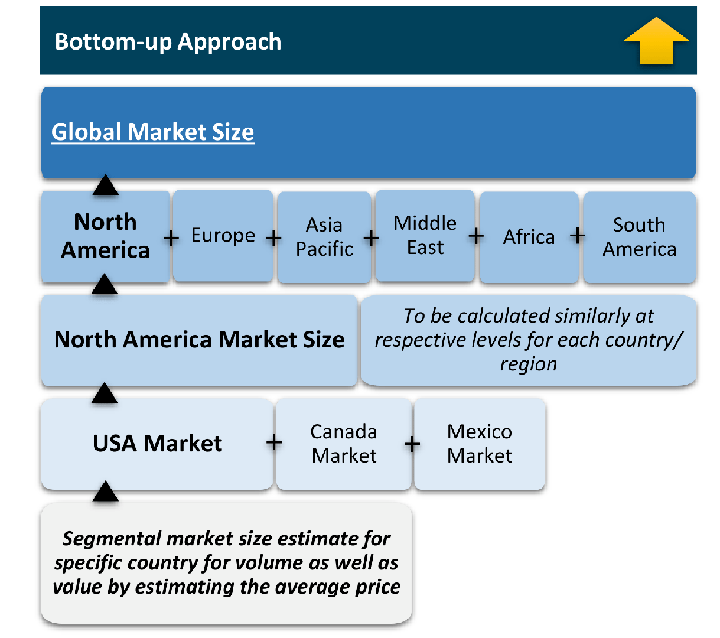
The bottom-up approach builds market estimates by starting with the smallest addressable market units and systematically aggregating them to create comprehensive market size projections.
This method begins with specific, granular data points and builds upward to create the complete market landscape.
Customer Analysis → Segmental Analysis → Geographical Analysis
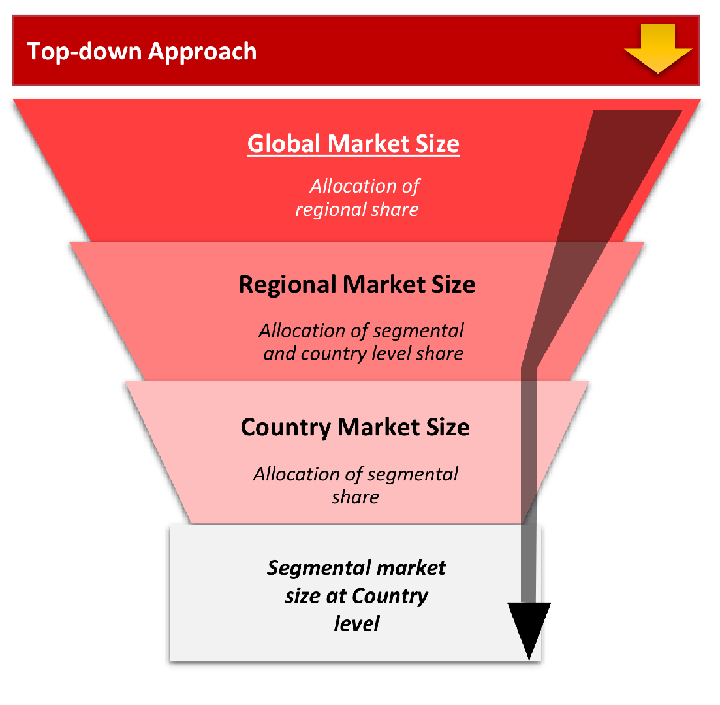
The top-down approach starts with the broadest possible market data and systematically narrows it down through a series of filters and assumptions to arrive at specific market segments or opportunities.
This method begins with the big picture and works downward to increasingly specific market slices.
TAM → SAM → SOM
Research Methods
Desk / Secondary Research
While analysing the market, we extensively study secondary sources, directories, and databases to identify and collect information useful for this technical, market-oriented, and commercial report. Secondary sources that we utilize are not only the public sources, but it is a combination of Open Source, Associations, Paid Databases, MG Repository & Knowledgebase, and others.
- Company websites, annual reports, financial reports, broker reports, and investor presentations
- National government documents, statistical databases and reports
- News articles, press releases and web-casts specific to the companies operating in the market, Magazines, reports, and others
- We gather information from commercial data sources for deriving company specific data such as segmental revenue, share for geography, product revenue, and others
- Internal and external proprietary databases (industry-specific), relevant patent, and regulatory databases
- Governing Bodies, Government Organizations
- Relevant Authorities, Country-specific Associations for Industries
We also employ the model mapping approach to estimate the product level market data through the players' product portfolio
Primary Research
Primary research/ interviews is vital in analyzing the market. Most of the cases involves paid primary interviews. Primary sources include primary interviews through e-mail interactions, telephonic interviews, surveys as well as face-to-face interviews with the different stakeholders across the value chain including several industry experts.
| Type of Respondents | Number of Primaries |
|---|---|
| Tier 2/3 Suppliers | ~20 |
| Tier 1 Suppliers | ~25 |
| End-users | ~25 |
| Industry Expert/ Panel/ Consultant | ~30 |
| Total | ~100 |
MG Knowledgebase
• Repository of industry blog, newsletter and case studies
• Online platform covering detailed market reports, and company profiles
Forecasting Factors and Models
Forecasting Factors
- Historical Trends – Past market patterns, cycles, and major events that shaped how markets behave over time. Understanding past trends helps predict future behavior.
- Industry Factors – Specific characteristics of the industry like structure, regulations, and innovation cycles that affect market dynamics.
- Macroeconomic Factors – Economic conditions like GDP growth, inflation, and employment rates that affect how much money people have to spend.
- Demographic Factors – Population characteristics like age, income, and location that determine who can buy your product.
- Technology Factors – How quickly people adopt new technology and how much technology infrastructure exists.
- Regulatory Factors – Government rules, laws, and policies that can help or restrict market growth.
- Competitive Factors – Analyzing competition structure such as degree of competition and bargaining power of buyers and suppliers.
Forecasting Models / Techniques
Multiple Regression Analysis
- Identify and quantify factors that drive market changes
- Statistical modeling to establish relationships between market drivers and outcomes
Time Series Analysis – Seasonal Patterns
- Understand regular cyclical patterns in market demand
- Advanced statistical techniques to separate trend, seasonal, and irregular components
Time Series Analysis – Trend Analysis
- Identify underlying market growth patterns and momentum
- Statistical analysis of historical data to project future trends
Expert Opinion – Expert Interviews
- Gather deep industry insights and contextual understanding
- In-depth interviews with key industry stakeholders
Multi-Scenario Development
- Prepare for uncertainty by modeling different possible futures
- Creating optimistic, pessimistic, and most likely scenarios
Time Series Analysis – Moving Averages
- Sophisticated forecasting for complex time series data
- Auto-regressive integrated moving average models with seasonal components
Econometric Models
- Apply economic theory to market forecasting
- Sophisticated economic models that account for market interactions
Expert Opinion – Delphi Method
- Harness collective wisdom of industry experts
- Structured, multi-round expert consultation process
Monte Carlo Simulation
- Quantify uncertainty and probability distributions
- Thousands of simulations with varying input parameters
Research Analysis
Our research framework is built upon the fundamental principle of validating market intelligence from both demand and supply perspectives. This dual-sided approach ensures comprehensive market understanding and reduces the risk of single-source bias.
Demand-Side Analysis: We understand end-user/application behavior, preferences, and market needs along with the penetration of the product for specific application.
Supply-Side Analysis: We estimate overall market revenue, analyze the segmental share along with industry capacity, competitive landscape, and market structure.
Validation & Evaluation
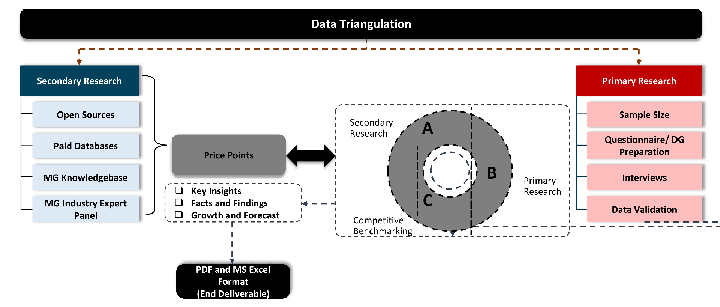
Data triangulation is a validation technique that uses multiple methods, sources, or perspectives to examine the same research question, thereby increasing the credibility and reliability of research findings. In market research, triangulation serves as a quality assurance mechanism that helps identify and minimize bias, validate assumptions, and ensure accuracy in market estimates.
- Data Source Triangulation – Using multiple data sources to examine the same phenomenon
- Methodological Triangulation – Using multiple research methods to study the same research question
- Investigator Triangulation – Using multiple researchers or analysts to examine the same data
- Theoretical Triangulation – Using multiple theoretical perspectives to interpret the same data
Custom Market Research Services
We will customise the research for you, in case the report listed above does not meet your requirements.
Get 10% Free Customisation