Mobility Scooters Market Size, Share & Trends Analysis Report by Type (3-Wheel Mobility Scooters, 4-Wheel Mobility Scooters, Portable/Folding Mobility Scooters, Heavy-Duty/All-Terrain Mobility Scooters, Others), Age Group, Drive Type, Battery Type, Speed Range, Application, End User, Sales Channel and Geography (North America, Europe, Asia Pacific, Middle East, Africa, and South America) – Global Industry Data, Trends, and Forecasts, 2026–2035
|
Market Structure & Evolution |
|
|
Segmental Data Insights |
|
|
Demand Trends |
|
|
Competitive Landscape |
|
|
Strategic Development |
|
|
Future Outlook & Opportunities |
|
Mobility-Scooters-Market Size, Share, and Growth
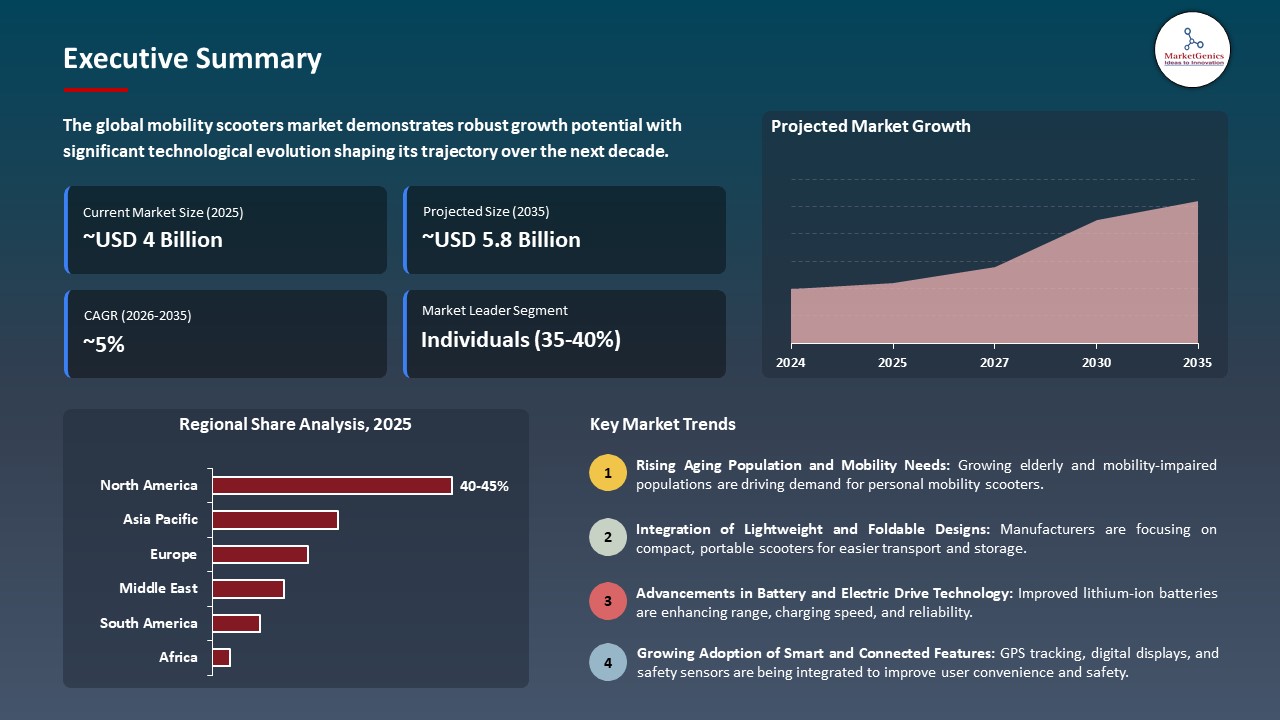
The global mobility scooters market is experiencing robust growth, with its estimated value of USD 3.5 billion in the year 2025 and USD 5.8 billion by the period 2035, registering a CAGR of 5.2% during the forecast period.
In July 2025, INTCO Medical introduced the foldable E CARY mobility scooter at MEDICAL FAIR THAILAND 2025. The scooter comes with an ultra-lightweight carbon fiber construction, NFC unlocking, and real time digital display connectivity, which considerably increases user convenience and portability for urban and travel use. With the compact design and smart features, independence and comfort of users with limited mobility are enhanced, contributing to the widespread adoption of modern mobility aids worldwide.
The continuous improvement of mobile scooters' design features improves the quality of life for the elderly and other people who have mobility impairments by providing them with devices to use independently at home or when travelling; The increasing cost of providing such services to those with Mobility Impairments is making it very difficult for many families to afford to provide for these individuals daily.
In addition, Increased research, as well as increased awareness of the benefits of mobility scooters has resulted in an increase in demand for innovative personal mobility products. In addition, a greater emphasis on Independent Living among seniors and individuals with mobility impairments has led to the increased popularity of lightweight, compact, and user-friendly mobility scooters as modes of Transportation. Healthcare Providers, Government Agencies, and Commercial Entities are also helping to promote Mobility Aids through a variety of means such as Subsidies and Insurance Policies in the United States; Accessibility Regulations and Government Sponsored Programs in other Countries.
With the increasing technological advancements, demographic factors, and regulatory commitments, there are multiple opportunities growing out of this industry which help make the mobility scooter more accessible than ever before for individuals to experience a higher quality of life through increased safety and independence.
The key opportunities emerging around battery manufacturing and charge systems, intelligent mobility accessories, seating/ergonomic enhancements to improve product design, telematic-based diagnostics for better product performance management, and aftermarket service solutions. By utilizing these ancillary market segments in parallel, manufacturers will create greater product offerings for customers while also improving customer experience and generating additional revenue streams in the greater assistive mobility space.
Mobility scooters Market Dynamics and Trends
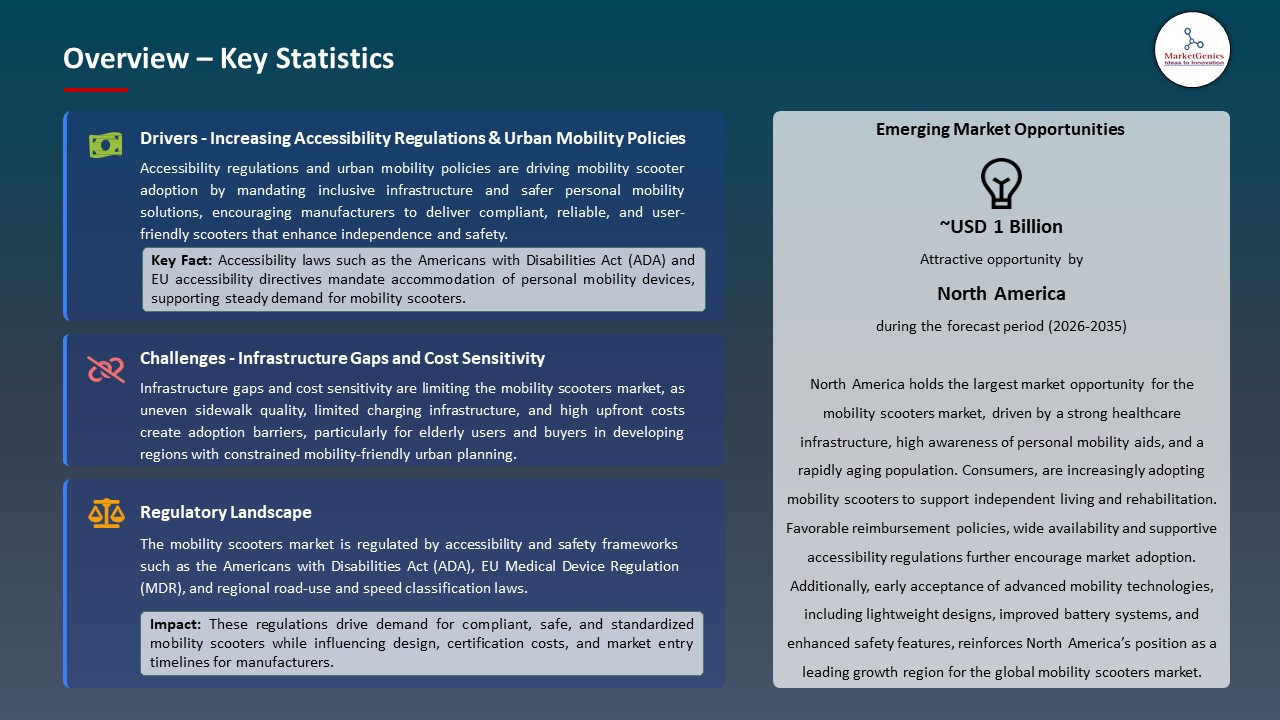
Driver: Increasing Accessibility Regulations and Urban Mobility Policies Driving Mobility Scooters Adoption
-
The globally urban mobility market for impaired individuals is witnessing a significant uptick in the adoption of powered mobility devices, with the trend being supported firmly by accessibility focused regulations and inclusive urban mobility policies across both developed and emerging regions. The local frameworks aligned with the Americans with Disabilities Act (ADA), the European Accessibility Act, and similar national disability inclusion policies in Asia Pacific are opening the way for the use of powered mobility devices in public spaces, transport systems, healthcare facilities, and residential complexes.
- The roll out of age friendly city programs and senior mobility initiatives, championed by governments, is acting as a powerful lever for the uptake of these devices as municipalities, driven by the goal of ensuring independent mobility for aging populations, are making it a priority.
- In several countries, public healthcare systems and insurers are taking steps to broaden the partial reimbursement coverage for mobility aids, thereby making it more affordable and accessible for the end users.
Restraint: Infrastructure Gaps and Cost Sensitivity Limiting Market Penetration
-
While the regulations have been favorable, the lack of sufficient infrastructure such as unlevel surface areas, looking at alternative curb ramps, narrow sidewalks, and no designated charger stations in the community limit how and when mobility scooters can be used and therefore limit the daily usage of mobility scooters. This is particularly true in a densely populated urban area.
- Many of the advanced models of mobility scooters are very expensive upfront due to their features, and require additional expenses for replacement batteries, maintenance services, and replacement parts, making it difficult for many cost-sensitive users, especially in many developing economies to purchase mobility scooters.
- In addition, the affordability of mobility scooters is limited by the fact that there is little to no reimbursement by insurers for mobility scooters; furthermore, there is inconsistencies in healthcare funding policies for the elderly and disabled in the various regions, which affects their ability to purchase mobility scooters since both groups of people typically live on fixed incomes.
Opportunity: Growth of Assisted Living, Home Healthcare, and Shared Mobility Models
-
The demand for durable, dependable, and well-maintained mobility scooters is expected to be stable due to the increasing number of assisted living facilities, home health care providers, and rehabilitation centers that will continue to expand rapidly and require mobility accessibility for their patients.
- Additionally, many airports, shopping mall and tourist attractions and other large public areas have begun using rental/shared mobility scooter service providers which are generating new and ongoing revenue opportunities for both manufacturers and fleet operators.
- The growth of subscription style mobility models and partnerships between scooter manufacturers and healthcare providers will continue to provide additional opportunities for both manufacturers and healthcare providers, as they offer solutions to achieve more scalable deployments and long-term service contracts.
Key Trend: Emergence of Connected, Lightweight, and User-Centric Scooter Designs
-
The trend in the e-bike market is currently moving towards the incorporation of smart technology along with a lightweight and foldable scooter design. The type of technology now included within the designs of the scooter include G.P.S. (Global Positioning System), battery health monitoring capabilities, anti-theft systems, and mobile applications to improve user experience and safety.
- The advancements of lithium-ion batteries, regenerative braking systems, and ergonomic seating designs have resulted in an increase in driving range, stability, and comfort. As a result, e-bikes are becoming more appropriate for both indoor and outdoor activities.
- To accommodate the varying needs of different users, manufacturers of lightweight, foldable scooters are placing greater emphasis on developing modular designs and customization options that allow users to personalize the look and feel of their scooter. In this way, manufacturers aim to attract users across a wide range of age groups and mobility levels.
Mobility-Scooters-Market Analysis and Segmental Data
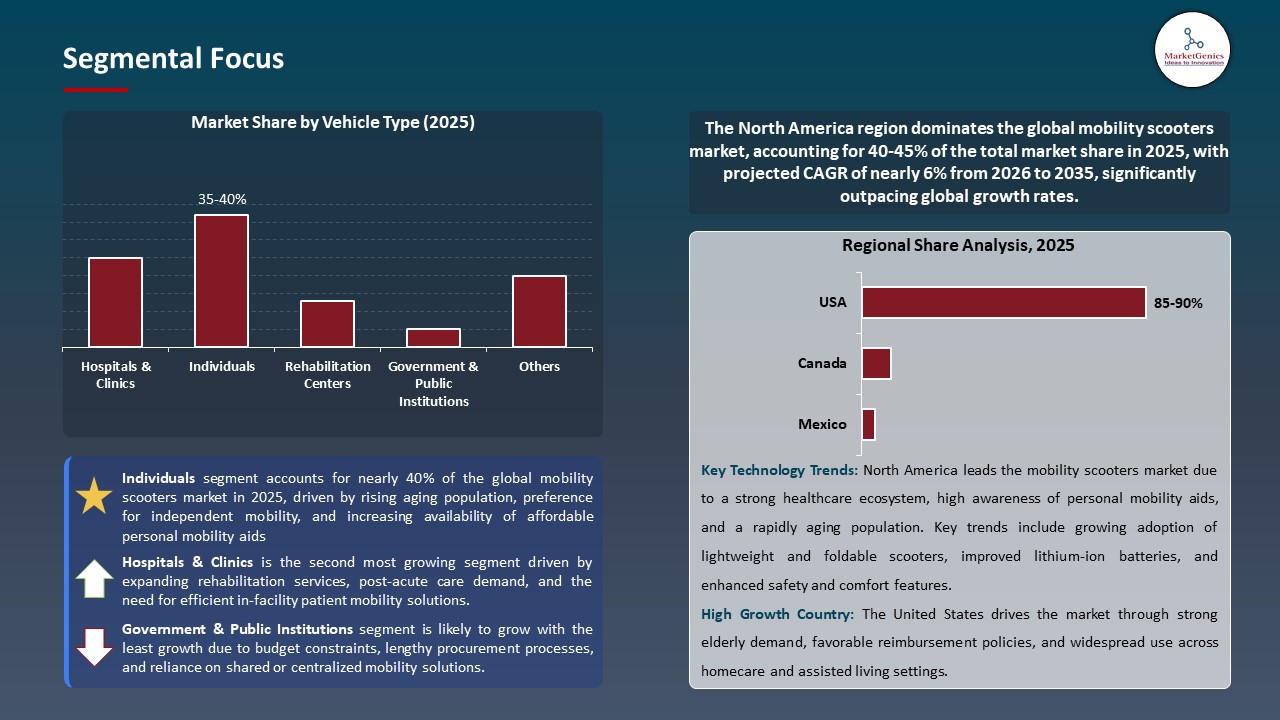
“Individual End User Dominates Global Mobility Scooters Market amid Rising Aging Population and Preference for Independent Living”
-
The individual consumer group makes up the largest share of the global mobility scooter marketplace. The increase in demand for mobility scooters has been spurred by the increase in the older demographic population and those with respiratory issues that require assistance getting around independently on an everyday basis. The increase in the population over the age of 60 as reported by WHO and UN has contributed to increased demand for assistive mobility products and to enable people to live safely and independently in their homes, neighborhoods, and public areas.
- There continues to be a trend toward the increased usage of lightweight, compact, and easy to transport scooters that are designed specifically for daily use and ownership by individuals. These scooters are designed with improved stability of the scooter body, improved battery life, and ergonomic seating that is specific to the physically challenged and older consumers.
- Further, the continued growth in consumer awareness of the rights of the disabled and establishing Accessibility standards and creating supportive reimbursement policies for the disabled within North America and Europe has created additional incentive for more individuals to acquire scooters. Today’s consumers want to live independently and rely less on caregivers, which keeps the individual consumer segment as the number one buyer type of mobility scooters, which, therefore, makes them the largest and most powerful end-user market.
“North America Dominates Mobility Scooters Market amid Strong Healthcare Infrastructure, Favorable Reimbursement Policies, and High Adoption of Personal Mobility Aids”
-
North America leads the global mobility scooters market. The dominance is backed by a robust healthcare infrastructure, substantial healthcare expenditure, and a wide availability of rehabilitation and assistive mobility services. The region is home to a significant aging population and records a high prevalence of mobility impairing conditions such as arthritis, osteoporosis, and post-surgical disabilities.
-
This, in turn, fuels the demand for personal mobility aids in homecare and community settings. Favorable reimbursement and funding mechanisms have been a key factor in the adoption trend, especially in the United States and Canada. Mobility scooters are partially covered under programs like Medicare Part B, Medicaid waivers, and Veterans Affairs (VA) benefits when they are prescribed as durable medical equipment. This provision encourages adoption among seniors and individuals with long term mobility limitations. The relief from the reimbursement support lowers out of pocket costs and thus, speeds up the market penetration.
- Market leadership is further sustained by high consumer awareness and strong distribution channels. Medical equipment suppliers have a wide reach in North America and the region has seen a rapid adoption of lightweight designs, improved battery life, and enhanced safety features.
Mobility-Scooters-Market Ecosystem
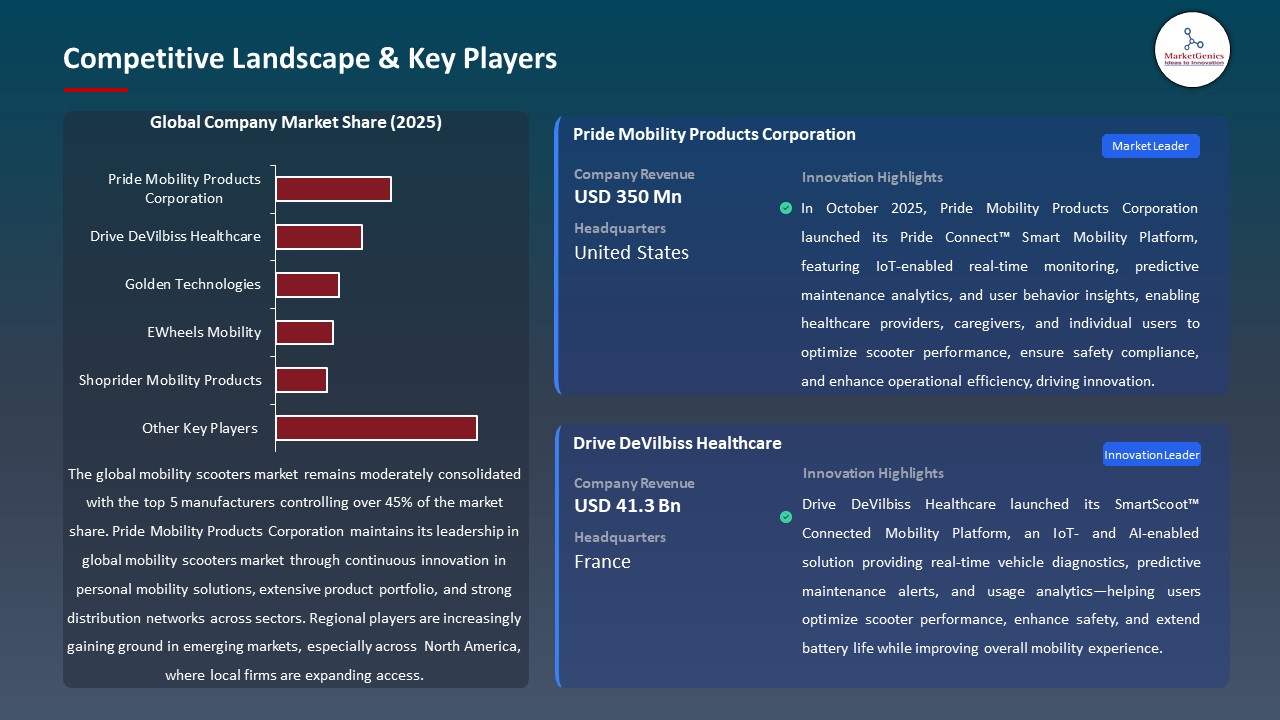
The global mobility scooter industry remains quite competitive, with leaders including Pride Mobility Products Corp., Invacare Corp., Sunrise Medical, Drive DeVilbiss Healthcare, Permobil Mobility Products, and Golden Technologies dominating in the marketplace due to advanced product engineering, battery technology, and user-friendly design. The ability for these companies to remain dominant within their industry occurs from strong distribution capabilities, together with relationships within the healthcare sector.
Industry leaders are paying increased attention to developing niche market product solutions for mobility scooter users. These manufacturers are producing specialized lightweight folding scooters, heavy-duty outdoor mobility scooters, and compact travel mobility scooters for older adults and persons with unique mobility challenges. Specialized mobility scooter features that are being utilized more often include superior suspension systems, ergonomic seats, and long-range lithium-ion batteries for increased user comfort, safety, and ease of operation.
Government agencies and organizations have also been instrumental in driving the growth of the mobility scooter industry. In April 2025, an initiative in the US focused on rehabilitation research supported the development of "smart mobility aids," which incorporate sensor technology to monitor stability, thereby improving user safety and reducing the likelihood of falls in assisted living facilities.
Market leaders are focusing on expanding their product lines, and they are starting to offer integrated mobility solutions (scooters, accessories, service packages, and digital diagnostics) that can improve company efficiency and sustainability through technology.
Recent Development and Strategic Overview:
-
In January 2025, 1800Wheelchair introduced a new line of advanced mobility scooters across the United States, designed with enhanced stability, comfort-focused seating, and improved control systems to support independent living for individuals with mobility challenges. This product release underscores the market’s emphasis on accessibility and user-centric design, empowering users to confidently navigate daily activities with greater reliability and ease.
- In July 2025, WHILL, Inc. expanded its autonomous personal mobility pilot programmed to major US and Japan airports, using AI-enabled LiDAR-equipped Mobility Scooters with Cloud Fleet Management Systems. The scooters allow those with limited mobility to independently navigate large indoor venues and destinations via predetermined route mapping, while operation personnel can track usage and maintenance through a Single Digital Platform.
Report Scope
|
Attribute |
Detail |
|
Market Size in 2025 |
USD 3.5 Bn |
|
Market Forecast Value in 2035 |
USD 5.8 Bn |
|
Growth Rate (CAGR) |
5.2% |
|
Forecast Period |
2026 – 2035 |
|
Historical Data Available for |
2021 – 2024 |
|
Market Size Units |
USD Bn for Value Thousand Units for Volume |
|
Report Format |
Electronic (PDF) + Excel |
|
Regions and Countries Covered |
|||||
|
North America |
Europe |
Asia Pacific |
Middle East |
Africa |
South America |
|
|
|
|
|
|
|
Companies Covered |
|||||
|
|
|
|
|
|
Mobility-Scooters-Market Segmentation and Highlights
|
Segment |
Sub-segment |
|
Mobility Scooters Market, By Type |
|
|
Mobility Scooters Market, By Age Group |
|
|
Mobility Scooters Market, By Drive Type |
|
|
Mobility Scooters Market, By Battery Type |
|
|
Mobility Scooters Market, By Speed Range |
|
|
Mobility Scooters Market, By Application |
|
|
Mobility Scooters Market, By End-User |
|
|
Mobility Scooters Market, By Sales Channel |
|
Frequently Asked Questions
Table of Contents
- 1. Research Methodology and Assumptions
- 1.1. Definitions
- 1.2. Research Design and Approach
- 1.3. Data Collection Methods
- 1.4. Base Estimates and Calculations
- 1.5. Forecasting Models
- 1.5.1. Key Forecast Factors & Impact Analysis
- 1.6. Secondary Research
- 1.6.1. Open Sources
- 1.6.2. Paid Databases
- 1.6.3. Associations
- 1.7. Primary Research
- 1.7.1. Primary Sources
- 1.7.2. Primary Interviews with Stakeholders across Ecosystem
- 2. Executive Summary
- 2.1. Global Mobility Scooters Market Outlook
- 2.1.1. Mobility Scooters Market Size (Value - US$ Bn and Volume - Thousand Units), and Forecasts, 2021-2035
- 2.1.2. Compounded Annual Growth Rate Analysis
- 2.1.3. Growth Opportunity Analysis
- 2.1.4. Segmental Share Analysis
- 2.1.5. Geographical Share Analysis
- 2.2. Market Analysis and Facts
- 2.3. Supply-Demand Analysis
- 2.4. Competitive Benchmarking
- 2.5. Go-to- Market Strategy
- 2.5.1. Customer/ End-use Industry Assessment
- 2.5.2. Growth Opportunity Data, 2026-2035
- 2.5.2.1. Regional Data
- 2.5.2.2. Country Data
- 2.5.2.3. Segmental Data
- 2.5.3. Identification of Potential Market Spaces
- 2.5.4. GAP Analysis
- 2.5.5. Potential Attractive Price Points
- 2.5.6. Prevailing Market Risks & Challenges
- 2.5.7. Preferred Sales & Marketing Strategies
- 2.5.8. Key Recommendations and Analysis
- 2.5.9. A Way Forward
- 2.1. Global Mobility Scooters Market Outlook
- 3. Industry Data and Premium Insights
- 3.1. Global Automotive & Transportation Ecosystem Overview, 2025
- 3.1.1. Automotive & Transportation Industry Analysis
- 3.1.2. Key Trends for Automotive & Transportation Industry
- 3.1.3. Regional Distribution for Automotive & Transportation Industry
- 3.2. Supplier Customer Data
- 3.3. Technology Roadmap and Developments
- 3.4. Trade Analysis
- 3.4.1. Import & Export Analysis, 2025
- 3.4.2. Top Importing Countries
- 3.4.3. Top Exporting Countries
- 3.5. Trump Tariff Impact Analysis
- 3.1. Global Automotive & Transportation Ecosystem Overview, 2025
- 4. Market Overview
- 4.1. Market Dynamics
- 4.1.1. Drivers
- 4.1.1.1. Rising demand for personal mobility solutions among aging populations and individuals with physical disabilities.
- 4.1.1.2. Growing adoption of electric-powered and AI-assisted mobility scooters for improved safety, efficiency, and independence.
- 4.1.1.3. Increasing investments in smart cabin integration, IoT-enabled battery management systems, and connected mobility solutions.
- 4.1.2. Restraints
- 4.1.2.1. High procurement and maintenance costs of advanced electric mobility scooters, limiting affordability for end users.
- 4.1.2.2. Challenges in integrating mobility scooters with existing infrastructure, such as urban transport systems, charging stations, and accessibility-compliant pathways.
- 4.1.1. Drivers
- 4.2. Key Trend Analysis
- 4.3. Regulatory Framework
- 4.3.1. Key Regulations, Norms, and Subsidies, by Key Countries
- 4.3.2. Tariffs and Standards
- 4.3.3. Impact Analysis of Regulations on the Market
- 4.4. Value Chain Analysis
- 4.4.1. Component Suppliers
- 4.4.2. System Integrators
- 4.4.3. Mobility Scooter Manufacturers
- 4.4.4. Dealers/ Showroom Owners
- 4.4.5. End Users/ Customers
- 4.5. Cost Structure Analysis
- 4.5.1. Parameter’s Share for Cost Associated
- 4.5.2. COGP vs COGS
- 4.5.3. Profit Margin Analysis
- 4.6. Pricing Analysis
- 4.6.1. Regional Pricing Analysis
- 4.6.2. Segmental Pricing Trends
- 4.6.3. Factors Influencing Pricing
- 4.7. Porter’s Five Forces Analysis
- 4.8. PESTEL Analysis
- 4.9. Global Mobility Scooters Market Demand
- 4.9.1. Historical Market Size –Value (US$ Bn) and Volume (Thousand Units), 2020-2024
- 4.9.2. Current and Future Market Size –Value (US$ Bn) and Volume (Thousand Units), 2026–2035
- 4.9.2.1. Y-o-Y Growth Trends
- 4.9.2.2. Absolute $ Opportunity Assessment
- 4.1. Market Dynamics
- 5. Competition Landscape
- 5.1. Competition structure
- 5.1.1. Fragmented v/s consolidated
- 5.2. Company Share Analysis, 2025
- 5.2.1. Global Company Market Share
- 5.2.2. By Region
- 5.2.2.1. North America
- 5.2.2.2. Europe
- 5.2.2.3. Asia Pacific
- 5.2.2.4. Middle East
- 5.2.2.5. Africa
- 5.2.2.6. South America
- 5.3. Product Comparison Matrix
- 5.3.1. Specifications
- 5.3.2. Market Positioning
- 5.3.3. Pricing
- 5.1. Competition structure
- 6. Global Mobility Scooters Market Analysis, by Type
- 6.1. Key Segment Analysis
- 6.2. Mobility Scooters Market Size (Value - US$ Bn and Volume - Thousand Units), Analysis, and Forecasts, by Type, 2021-2035
- 6.2.1. 3-Wheel Mobility Scooters
- 6.2.2. 4-Wheel Mobility Scooters
- 6.2.3. Portable/Folding Mobility Scooters
- 6.2.4. Heavy-Duty/All-Terrain Mobility Scooters
- 6.2.5. Others
- 7. Global Mobility Scooters Market Analysis, by Age Group
- 7.1. Key Segment Analysis
- 7.2. Mobility Scooters Market Size (Value - US$ Bn and Volume - Thousand Units), Analysis, and Forecasts, by Age Group, 2021-2035
- 7.2.1. Adults
- 7.2.2. Elderly
- 7.2.3. Disabled/Physically Challenged
- 8. Global Mobility Scooters Market Analysis, by Drive Type
- 8.1. Key Segment Analysis
- 8.2. Mobility Scooters Market Size (Value - US$ Bn and Volume - Thousand Units), Analysis, and Forecasts, by Drive Type, 2021-2035
- 8.2.1. Rear Drive
- 8.2.2. Front Drive
- 8.2.3. Mid Drive
- 9. Global Mobility Scooters Market Analysis, by Battery Type
- 9.1. Key Segment Analysis
- 9.2. Mobility Scooters Market Size (Value - US$ Bn and Volume - Thousand Units), Analysis, and Forecasts, by Battery Type, 2021-2035
- 9.2.1. Lead-Acid Battery
- 9.2.2. Lithium-Ion Battery
- 9.2.3. Gel Cell Battery
- 9.2.4. Others
- 10. Global Mobility Scooters Market Analysis, by Speed Range
- 10.1. Key Segment Analysis
- 10.2. Mobility Scooters Market Size (Value - US$ Bn and Volume - Thousand Units), Analysis, and Forecasts, by Speed Range, 2021-2035
- 10.2.1. Low Speed (<10 km/h)
- 10.2.2. Medium Speed (10–15 km/h)
- 10.2.3. High Speed (>15 km/h)
- 11. Global Mobility Scooters Market Analysis, by Application
- 11.1. Key Segment Analysis
- 11.2. Mobility Scooters Market Size (Value - US$ Bn and Volume - Thousand Units), Analysis, and Forecasts, by Application, 2021-2035
- 11.2.1. Residential Use
- 11.2.2. Commercial Use
- 11.2.3. Healthcare Facilities
- 11.2.4. Outdoor/Recreational Use
- 11.2.5. Others
- 12. Global Mobility Scooters Market Analysis, by End-User
- 12.1. Key Segment Analysis
- 12.2. Mobility Scooters Market Size (Value - US$ Bn and Volume - Thousand Units), Analysis, and Forecasts, by End-User, 2021-2035
- 12.2.1. Individuals
- 12.2.2. Hospitals & Clinics
- 12.2.3. Rehabilitation Centers
- 12.2.4. Nursing Homes & Assisted Living Facilities
- 12.2.5. Government & Public Institutions
- 12.2.6. Others
- 13. Global Mobility Scooters Market Analysis, by Sales Channel
- 13.1. Key Segment Analysis
- 13.2. Mobility Scooters Market Size (Value - US$ Bn and Volume - Thousand Units), Analysis, and Forecasts, by Sales Channel, 2021-2035
- 13.2.1. Direct Sales
- 13.2.2. Retail Stores
- 13.2.3. Online Sales
- 13.2.4. Distributors/ Dealers
- 14. Global Mobility Scooters Market Analysis and Forecasts, by Region
- 14.1. Key Findings
- 14.2. Mobility Scooters Market Size (Value - US$ Bn and Volume - Thousand Units), Analysis, and Forecasts, by Region, 2021-2035
- 14.2.1. North America
- 14.2.2. Europe
- 14.2.3. Asia Pacific
- 14.2.4. Middle East
- 14.2.5. Africa
- 14.2.6. South America
- 15. North America Mobility Scooters Market Analysis
- 15.1. Key Segment Analysis
- 15.2. Regional Snapshot
- 15.3. North America Mobility Scooters Market Size Value - US$ Bn and Volume - Thousand Units), Analysis, and Forecasts, 2021-2035
- 15.3.1. Type
- 15.3.2. Age Group
- 15.3.3. Drive Type
- 15.3.4. Battery Type
- 15.3.5. Speed Range
- 15.3.6. Application
- 15.3.7. End-User
- 15.3.8. Sales Channel
- 15.3.9. Country
- 15.3.9.1. USA
- 15.3.9.2. Canada
- 15.3.9.3. Mexico
- 15.4. USA Mobility Scooters Market
- 15.4.1. Country Segmental Analysis
- 15.4.2. Type
- 15.4.3. Age Group
- 15.4.4. Drive Type
- 15.4.5. Battery Type
- 15.4.6. Speed Range
- 15.4.7. Application
- 15.4.8. End-User
- 15.4.9. Sales Channel
- 15.5. Canada Mobility Scooters Market
- 15.5.1. Country Segmental Analysis
- 15.5.2. Type
- 15.5.3. Age Group
- 15.5.4. Drive Type
- 15.5.5. Battery Type
- 15.5.6. Speed Range
- 15.5.7. Application
- 15.5.8. End-User
- 15.5.9. Sales Channel
- 15.6. Mexico Mobility Scooters Market
- 15.6.1. Country Segmental Analysis
- 15.6.2. Type
- 15.6.3. Age Group
- 15.6.4. Drive Type
- 15.6.5. Battery Type
- 15.6.6. Speed Range
- 15.6.7. Application
- 15.6.8. End-User
- 15.6.9. Sales Channel
- 16. Europe Mobility Scooters Market Analysis
- 16.1. Key Segment Analysis
- 16.2. Regional Snapshot
- 16.3. Europe Mobility Scooters Market Size (Value - US$ Bn and Volume - Thousand Units), Analysis, and Forecasts, 2021-2035
- 16.3.1. Type
- 16.3.2. Age Group
- 16.3.3. Drive Type
- 16.3.4. Battery Type
- 16.3.5. Speed Range
- 16.3.6. Application
- 16.3.7. End-User
- 16.3.8. Sales Channel
- 16.3.9. Country
- 16.3.9.1. Germany
- 16.3.9.2. United Kingdom
- 16.3.9.3. France
- 16.3.9.4. Italy
- 16.3.9.5. Spain
- 16.3.9.6. Netherlands
- 16.3.9.7. Nordic Countries
- 16.3.9.8. Poland
- 16.3.9.9. Russia & CIS
- 16.3.9.10. Rest of Europe
- 16.4. Germany Mobility Scooters Market
- 16.4.1. Country Segmental Analysis
- 16.4.2. Type
- 16.4.3. Age Group
- 16.4.4. Drive Type
- 16.4.5. Battery Type
- 16.4.6. Speed Range
- 16.4.7. Application
- 16.4.8. End-User
- 16.4.9. Sales Channel
- 16.5. United Kingdom Mobility Scooters Market
- 16.5.1. Country Segmental Analysis
- 16.5.2. Type
- 16.5.3. Age Group
- 16.5.4. Drive Type
- 16.5.5. Battery Type
- 16.5.6. Speed Range
- 16.5.7. Application
- 16.5.8. End-User
- 16.5.9. Sales Channel
- 16.6. France Mobility Scooters Market
- 16.6.1. Country Segmental Analysis
- 16.6.2. Type
- 16.6.3. Age Group
- 16.6.4. Drive Type
- 16.6.5. Battery Type
- 16.6.6. Speed Range
- 16.6.7. Application
- 16.6.8. End-User
- 16.6.9. Sales Channel
- 16.7. Italy Mobility Scooters Market
- 16.7.1. Country Segmental Analysis
- 16.7.2. Type
- 16.7.3. Age Group
- 16.7.4. Drive Type
- 16.7.5. Battery Type
- 16.7.6. Speed Range
- 16.7.7. Application
- 16.7.8. End-User
- 16.7.9. Sales Channel
- 16.8. Spain Mobility Scooters Market
- 16.8.1. Country Segmental Analysis
- 16.8.2. Type
- 16.8.3. Age Group
- 16.8.4. Drive Type
- 16.8.5. Battery Type
- 16.8.6. Speed Range
- 16.8.7. Application
- 16.8.8. End-User
- 16.8.9. Sales Channel
- 16.9. Netherlands Mobility Scooters Market
- 16.9.1. Country Segmental Analysis
- 16.9.2. Type
- 16.9.3. Age Group
- 16.9.4. Drive Type
- 16.9.5. Battery Type
- 16.9.6. Speed Range
- 16.9.7. Application
- 16.9.8. End-User
- 16.9.9. Sales Channel
- 16.10. Nordic Countries Mobility Scooters Market
- 16.10.1. Country Segmental Analysis
- 16.10.2. Type
- 16.10.3. Age Group
- 16.10.4. Drive Type
- 16.10.5. Battery Type
- 16.10.6. Speed Range
- 16.10.7. Application
- 16.10.8. End-User
- 16.10.9. Sales Channel
- 16.11. Poland Mobility Scooters Market
- 16.11.1. Country Segmental Analysis
- 16.11.2. Type
- 16.11.3. Age Group
- 16.11.4. Drive Type
- 16.11.5. Battery Type
- 16.11.6. Speed Range
- 16.11.7. Application
- 16.11.8. End-User
- 16.11.9. Sales Channel
- 16.12. Russia & CIS Mobility Scooters Market
- 16.12.1. Country Segmental Analysis
- 16.12.2. Type
- 16.12.3. Age Group
- 16.12.4. Drive Type
- 16.12.5. Battery Type
- 16.12.6. Speed Range
- 16.12.7. Application
- 16.12.8. End-User
- 16.12.9. Sales Channel
- 16.13. Rest of Europe Mobility Scooters Market
- 16.13.1. Country Segmental Analysis
- 16.13.2. Type
- 16.13.3. Age Group
- 16.13.4. Drive Type
- 16.13.5. Battery Type
- 16.13.6. Speed Range
- 16.13.7. Application
- 16.13.8. End-User
- 16.13.9. Sales Channel
- 17. Asia Pacific Mobility Scooters Market Analysis
- 17.1. Key Segment Analysis
- 17.2. Regional Snapshot
- 17.3. Asia Pacific Mobility Scooters Market Size (Value - US$ Bn and Volume - Thousand Units), Analysis, and Forecasts, 2021-2035
- 17.3.1. Type
- 17.3.2. Age Group
- 17.3.3. Drive Type
- 17.3.4. Battery Type
- 17.3.5. Speed Range
- 17.3.6. Application
- 17.3.7. End-User
- 17.3.8. Sales Channel
- 17.3.9. Country
- 17.3.9.1. China
- 17.3.9.2. India
- 17.3.9.3. Japan
- 17.3.9.4. South Korea
- 17.3.9.5. Australia and New Zealand
- 17.3.9.6. Indonesia
- 17.3.9.7. Malaysia
- 17.3.9.8. Thailand
- 17.3.9.9. Vietnam
- 17.3.9.10. Rest of Asia Pacific
- 17.4. China Mobility Scooters Market
- 17.4.1. Country Segmental Analysis
- 17.4.2. Type
- 17.4.3. Age Group
- 17.4.4. Drive Type
- 17.4.5. Battery Type
- 17.4.6. Speed Range
- 17.4.7. Application
- 17.4.8. End-User
- 17.4.9. Sales Channel
- 17.5. India Mobility Scooters Market
- 17.5.1. Country Segmental Analysis
- 17.5.2. Type
- 17.5.3. Age Group
- 17.5.4. Drive Type
- 17.5.5. Battery Type
- 17.5.6. Speed Range
- 17.5.7. Application
- 17.5.8. End-User
- 17.5.9. Sales Channel
- 17.6. Japan Mobility Scooters Market
- 17.6.1. Country Segmental Analysis
- 17.6.2. Type
- 17.6.3. Age Group
- 17.6.4. Drive Type
- 17.6.5. Battery Type
- 17.6.6. Speed Range
- 17.6.7. Application
- 17.6.8. End-User
- 17.6.9. Sales Channel
- 17.7. South Korea Mobility Scooters Market
- 17.7.1. Country Segmental Analysis
- 17.7.2. Type
- 17.7.3. Age Group
- 17.7.4. Drive Type
- 17.7.5. Battery Type
- 17.7.6. Speed Range
- 17.7.7. Application
- 17.7.8. End-User
- 17.7.9. Sales Channel
- 17.8. Australia and New Zealand Mobility Scooters Market
- 17.8.1. Country Segmental Analysis
- 17.8.2. Type
- 17.8.3. Age Group
- 17.8.4. Drive Type
- 17.8.5. Battery Type
- 17.8.6. Speed Range
- 17.8.7. Application
- 17.8.8. End-User
- 17.8.9. Sales Channel
- 17.9. Indonesia Mobility Scooters Market
- 17.9.1. Country Segmental Analysis
- 17.9.2. Type
- 17.9.3. Age Group
- 17.9.4. Drive Type
- 17.9.5. Battery Type
- 17.9.6. Speed Range
- 17.9.7. Application
- 17.9.8. End-User
- 17.9.9. Sales Channel
- 17.10. Malaysia Mobility Scooters Market
- 17.10.1. Country Segmental Analysis
- 17.10.2. Type
- 17.10.3. Age Group
- 17.10.4. Drive Type
- 17.10.5. Battery Type
- 17.10.6. Speed Range
- 17.10.7. Application
- 17.10.8. End-User
- 17.10.9. Sales Channel
- 17.11. Thailand Mobility Scooters Market
- 17.11.1. Country Segmental Analysis
- 17.11.2. Type
- 17.11.3. Age Group
- 17.11.4. Drive Type
- 17.11.5. Battery Type
- 17.11.6. Speed Range
- 17.11.7. Application
- 17.11.8. End-User
- 17.11.9. Sales Channel
- 17.12. Vietnam Mobility Scooters Market
- 17.12.1. Country Segmental Analysis
- 17.12.2. Type
- 17.12.3. Age Group
- 17.12.4. Drive Type
- 17.12.5. Battery Type
- 17.12.6. Speed Range
- 17.12.7. Application
- 17.12.8. End-User
- 17.12.9. Sales Channel
- 17.13. Rest of Asia Pacific Mobility Scooters Market
- 17.13.1. Country Segmental Analysis
- 17.13.2. Type
- 17.13.3. Age Group
- 17.13.4. Drive Type
- 17.13.5. Battery Type
- 17.13.6. Speed Range
- 17.13.7. Application
- 17.13.8. End-User
- 17.13.9. Sales Channel
- 18. Middle East Mobility Scooters Market Analysis
- 18.1. Key Segment Analysis
- 18.2. Regional Snapshot
- 18.3. Middle East Mobility Scooters Market Size (Value - US$ Bn and Volume - Thousand Units), Analysis, and Forecasts, 2021-2035
- 18.3.1. Type
- 18.3.2. Age Group
- 18.3.3. Drive Type
- 18.3.4. Battery Type
- 18.3.5. Speed Range
- 18.3.6. Application
- 18.3.7. End-User
- 18.3.8. Sales Channel
- 18.3.9. Country
- 18.3.9.1. Turkey
- 18.3.9.2. UAE
- 18.3.9.3. Saudi Arabia
- 18.3.9.4. Israel
- 18.3.9.5. Rest of Middle East
- 18.4. Turkey Mobility Scooters Market
- 18.4.1. Country Segmental Analysis
- 18.4.2. Type
- 18.4.3. Age Group
- 18.4.4. Drive Type
- 18.4.5. Battery Type
- 18.4.6. Speed Range
- 18.4.7. Application
- 18.4.8. End-User
- 18.4.9. Sales Channel
- 18.5. UAE Mobility Scooters Market
- 18.5.1. Country Segmental Analysis
- 18.5.2. Type
- 18.5.3. Age Group
- 18.5.4. Drive Type
- 18.5.5. Battery Type
- 18.5.6. Speed Range
- 18.5.7. Application
- 18.5.8. End-User
- 18.5.9. Sales Channel
- 18.6. Saudi Arabia Mobility Scooters Market
- 18.6.1. Country Segmental Analysis
- 18.6.2. Type
- 18.6.3. Age Group
- 18.6.4. Drive Type
- 18.6.5. Battery Type
- 18.6.6. Speed Range
- 18.6.7. Application
- 18.6.8. End-User
- 18.6.9. Sales Channel
- 18.7. Israel Mobility Scooters Market
- 18.7.1. Country Segmental Analysis
- 18.7.2. Type
- 18.7.3. Age Group
- 18.7.4. Drive Type
- 18.7.5. Battery Type
- 18.7.6. Speed Range
- 18.7.7. Application
- 18.7.8. End-User
- 18.7.9. Sales Channel
- 18.8. Rest of Middle East Mobility Scooters Market
- 18.8.1. Country Segmental Analysis
- 18.8.2. Type
- 18.8.3. Age Group
- 18.8.4. Drive Type
- 18.8.5. Battery Type
- 18.8.6. Speed Range
- 18.8.7. Application
- 18.8.8. End-User
- 18.8.9. Sales Channel
- 19. Africa Mobility Scooters Market Analysis
- 19.1. Key Segment Analysis
- 19.2. Regional Snapshot
- 19.3. Africa Mobility Scooters Market Size (Value - US$ Bn and Volume - Thousand Units), Analysis, and Forecasts, 2021-2035
- 19.3.1. Type
- 19.3.2. Age Group
- 19.3.3. Drive Type
- 19.3.4. Battery Type
- 19.3.5. Speed Range
- 19.3.6. Application
- 19.3.7. End-User
- 19.3.8. Sales Channel
- 19.3.9. Country
- 19.3.9.1. South Africa
- 19.3.9.2. Egypt
- 19.3.9.3. Nigeria
- 19.3.9.4. Algeria
- 19.3.9.5. Rest of Africa
- 19.4. South Africa Mobility Scooters Market
- 19.4.1. Country Segmental Analysis
- 19.4.2. Type
- 19.4.3. Age Group
- 19.4.4. Drive Type
- 19.4.5. Battery Type
- 19.4.6. Speed Range
- 19.4.7. Application
- 19.4.8. End-User
- 19.4.9. Sales Channel
- 19.5. Egypt Mobility Scooters Market
- 19.5.1. Country Segmental Analysis
- 19.5.2. Type
- 19.5.3. Age Group
- 19.5.4. Drive Type
- 19.5.5. Battery Type
- 19.5.6. Speed Range
- 19.5.7. Application
- 19.5.8. End-User
- 19.5.9. Sales Channel
- 19.6. Nigeria Mobility Scooters Market
- 19.6.1. Country Segmental Analysis
- 19.6.2. Type
- 19.6.3. Age Group
- 19.6.4. Drive Type
- 19.6.5. Battery Type
- 19.6.6. Speed Range
- 19.6.7. Application
- 19.6.8. End-User
- 19.6.9. Sales Channel
- 19.7. Algeria Mobility Scooters Market
- 19.7.1. Country Segmental Analysis
- 19.7.2. Type
- 19.7.3. Age Group
- 19.7.4. Drive Type
- 19.7.5. Battery Type
- 19.7.6. Speed Range
- 19.7.7. Application
- 19.7.8. End-User
- 19.7.9. Sales Channel
- 19.8. Rest of Africa Mobility Scooters Market
- 19.8.1. Country Segmental Analysis
- 19.8.2. Type
- 19.8.3. Age Group
- 19.8.4. Drive Type
- 19.8.5. Battery Type
- 19.8.6. Speed Range
- 19.8.7. Application
- 19.8.8. End-User
- 19.8.9. Sales Channel
- 20. South America Mobility Scooters Market Analysis
- 20.1. Key Segment Analysis
- 20.2. Regional Snapshot
- 20.3. South America Mobility Scooters Market Size (Value - US$ Bn and Volume - Thousand Units), Analysis, and Forecasts, 2021-2035
- 20.3.1. Type
- 20.3.2. Age Group
- 20.3.3. Drive Type
- 20.3.4. Battery Type
- 20.3.5. Speed Range
- 20.3.6. Application
- 20.3.7. End-User
- 20.3.8. Sales Channel
- 20.3.9. Country
- 20.3.9.1. Brazil
- 20.3.9.2. Argentina
- 20.3.9.3. Rest of South America
- 20.4. Brazil Mobility Scooters Market
- 20.4.1. Country Segmental Analysis
- 20.4.2. Type
- 20.4.3. Age Group
- 20.4.4. Drive Type
- 20.4.5. Battery Type
- 20.4.6. Speed Range
- 20.4.7. Application
- 20.4.8. End-User
- 20.4.9. Sales Channel
- 20.5. Argentina Mobility Scooters Market
- 20.5.1. Country Segmental Analysis
- 20.5.2. Type
- 20.5.3. Age Group
- 20.5.4. Drive Type
- 20.5.5. Battery Type
- 20.5.6. Speed Range
- 20.5.7. Application
- 20.5.8. End-User
- 20.5.9. Sales Channel
- 20.6. Rest of South America Mobility Scooters Market
- 20.6.1. Country Segmental Analysis
- 20.6.2. Type
- 20.6.3. Age Group
- 20.6.4. Drive Type
- 20.6.5. Battery Type
- 20.6.6. Speed Range
- 20.6.7. Application
- 20.6.8. End-User
- 20.6.9. Sales Channel
- 21. Key Players/ Company Profile
- 21.1. Afikim Electric Vehicles
- 21.1.1. Company Details/ Overview
- 21.1.2. Company Financials
- 21.1.3. Key Customers and Competitors
- 21.1.4. Business/ Industry Portfolio
- 21.1.5. Product Portfolio/ Specification Details
- 21.1.6. Pricing Data
- 21.1.7. Strategic Overview
- 21.1.8. Recent Developments
- 21.2. Drive DeVilbiss Healthcare
- 21.3. Drive Medical
- 21.4. e-Glide Mobility Products
- 21.5. EWheels Mobility
- 21.6. Golden Technologies
- 21.7. Harmar Mobility
- 21.8. Heartway USA
- 21.9. Invacare Corporation
- 21.10. Kymco Healthcare Division
- 21.11. Merits Health Products
- 21.12. Permobile Mobility Products
- 21.13. Pride Go-Chair (Pride Mobility)
- 21.14. Pride Jazzy (Pride Mobility)
- 21.15. Pride Mobility Brands
- 21.16. Pride Mobility Products Corporation
- 21.17. SAKODA Medical Products
- 21.18. Shoprider Mobility Products
- 21.19. Sunrise Medical LLC
- 21.20. Tzora Active Systems
- 21.21. Other Key Players
- 21.1. Afikim Electric Vehicles
Note* - This is just tentative list of players. While providing the report, we will cover more number of players based on their revenue and share for each geography
Research Design
Our research design integrates both demand-side and supply-side analysis through a balanced combination of primary and secondary research methodologies. By utilizing both bottom-up and top-down approaches alongside rigorous data triangulation methods, we deliver robust market intelligence that supports strategic decision-making.
MarketGenics' comprehensive research design framework ensures the delivery of accurate, reliable, and actionable market intelligence. Through the integration of multiple research approaches, rigorous validation processes, and expert analysis, we provide our clients with the insights needed to make informed strategic decisions and capitalize on market opportunities.
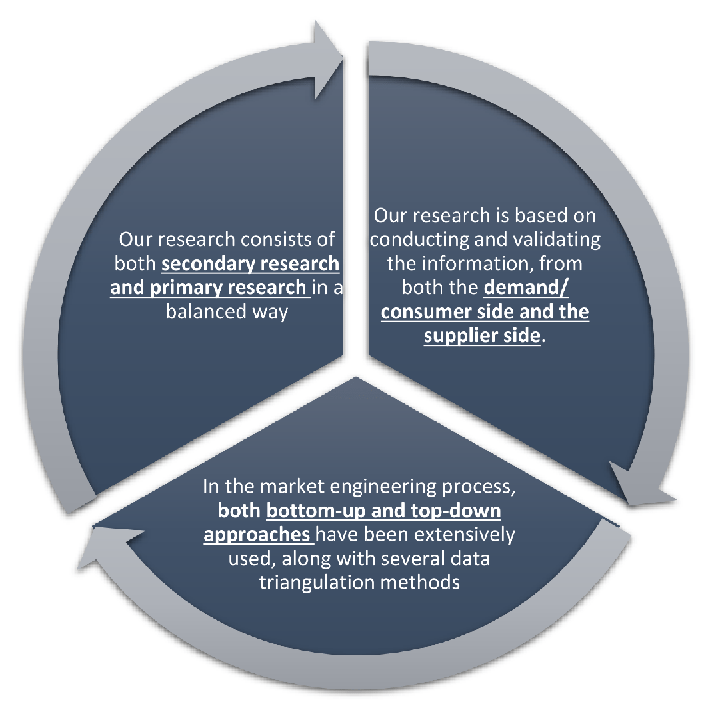
MarketGenics leverages a dedicated industry panel of experts and a comprehensive suite of paid databases to effectively collect, consolidate, and analyze market intelligence.
Our approach has consistently proven to be reliable and effective in generating accurate market insights, identifying key industry trends, and uncovering emerging business opportunities.
Through both primary and secondary research, we capture and analyze critical company-level data such as manufacturing footprints, including technical centers, R&D facilities, sales offices, and headquarters.
Our expert panel further enhances our ability to estimate market size for specific brands based on validated field-level intelligence.
Our data mining techniques incorporate both parametric and non-parametric methods, allowing for structured data collection, sorting, processing, and cleaning.
Demand projections are derived from large-scale data sets analyzed through proprietary algorithms, culminating in robust and reliable market sizing.
Research Approach
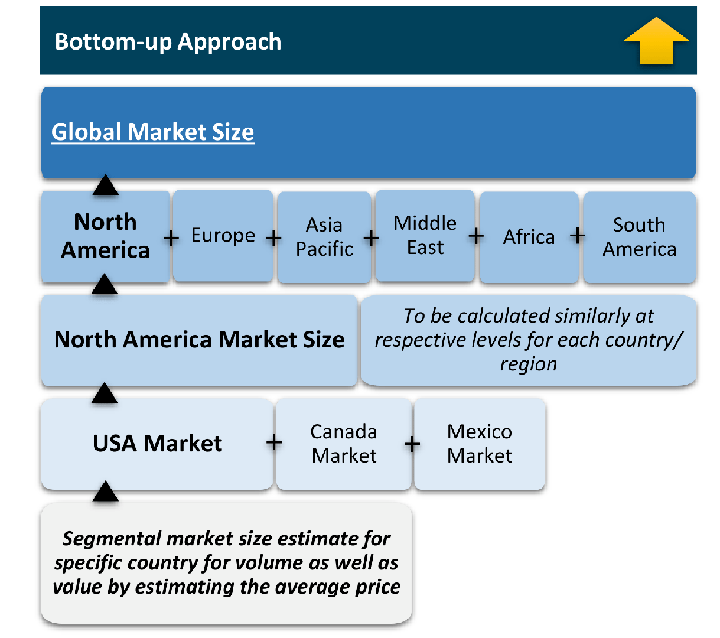
The bottom-up approach builds market estimates by starting with the smallest addressable market units and systematically aggregating them to create comprehensive market size projections.
This method begins with specific, granular data points and builds upward to create the complete market landscape.
Customer Analysis → Segmental Analysis → Geographical Analysis
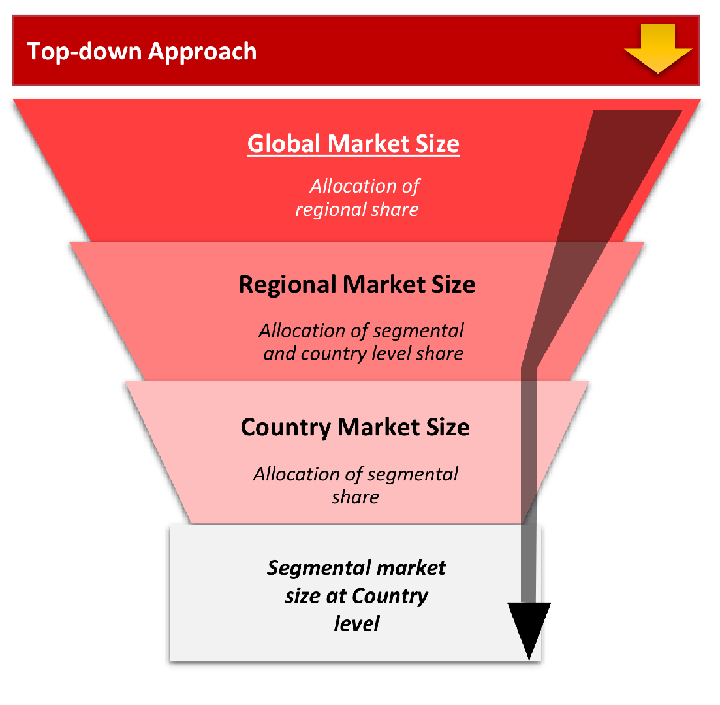
The top-down approach starts with the broadest possible market data and systematically narrows it down through a series of filters and assumptions to arrive at specific market segments or opportunities.
This method begins with the big picture and works downward to increasingly specific market slices.
TAM → SAM → SOM
Research Methods
Desk / Secondary Research
While analysing the market, we extensively study secondary sources, directories, and databases to identify and collect information useful for this technical, market-oriented, and commercial report. Secondary sources that we utilize are not only the public sources, but it is a combination of Open Source, Associations, Paid Databases, MG Repository & Knowledgebase, and others.
- Company websites, annual reports, financial reports, broker reports, and investor presentations
- National government documents, statistical databases and reports
- News articles, press releases and web-casts specific to the companies operating in the market, Magazines, reports, and others
- We gather information from commercial data sources for deriving company specific data such as segmental revenue, share for geography, product revenue, and others
- Internal and external proprietary databases (industry-specific), relevant patent, and regulatory databases
- Governing Bodies, Government Organizations
- Relevant Authorities, Country-specific Associations for Industries
We also employ the model mapping approach to estimate the product level market data through the players' product portfolio
Primary Research
Primary research/ interviews is vital in analyzing the market. Most of the cases involves paid primary interviews. Primary sources include primary interviews through e-mail interactions, telephonic interviews, surveys as well as face-to-face interviews with the different stakeholders across the value chain including several industry experts.
| Type of Respondents | Number of Primaries |
|---|---|
| Tier 2/3 Suppliers | ~20 |
| Tier 1 Suppliers | ~25 |
| End-users | ~25 |
| Industry Expert/ Panel/ Consultant | ~30 |
| Total | ~100 |
MG Knowledgebase
• Repository of industry blog, newsletter and case studies
• Online platform covering detailed market reports, and company profiles
Forecasting Factors and Models
Forecasting Factors
- Historical Trends – Past market patterns, cycles, and major events that shaped how markets behave over time. Understanding past trends helps predict future behavior.
- Industry Factors – Specific characteristics of the industry like structure, regulations, and innovation cycles that affect market dynamics.
- Macroeconomic Factors – Economic conditions like GDP growth, inflation, and employment rates that affect how much money people have to spend.
- Demographic Factors – Population characteristics like age, income, and location that determine who can buy your product.
- Technology Factors – How quickly people adopt new technology and how much technology infrastructure exists.
- Regulatory Factors – Government rules, laws, and policies that can help or restrict market growth.
- Competitive Factors – Analyzing competition structure such as degree of competition and bargaining power of buyers and suppliers.
Forecasting Models / Techniques
Multiple Regression Analysis
- Identify and quantify factors that drive market changes
- Statistical modeling to establish relationships between market drivers and outcomes
Time Series Analysis – Seasonal Patterns
- Understand regular cyclical patterns in market demand
- Advanced statistical techniques to separate trend, seasonal, and irregular components
Time Series Analysis – Trend Analysis
- Identify underlying market growth patterns and momentum
- Statistical analysis of historical data to project future trends
Expert Opinion – Expert Interviews
- Gather deep industry insights and contextual understanding
- In-depth interviews with key industry stakeholders
Multi-Scenario Development
- Prepare for uncertainty by modeling different possible futures
- Creating optimistic, pessimistic, and most likely scenarios
Time Series Analysis – Moving Averages
- Sophisticated forecasting for complex time series data
- Auto-regressive integrated moving average models with seasonal components
Econometric Models
- Apply economic theory to market forecasting
- Sophisticated economic models that account for market interactions
Expert Opinion – Delphi Method
- Harness collective wisdom of industry experts
- Structured, multi-round expert consultation process
Monte Carlo Simulation
- Quantify uncertainty and probability distributions
- Thousands of simulations with varying input parameters
Research Analysis
Our research framework is built upon the fundamental principle of validating market intelligence from both demand and supply perspectives. This dual-sided approach ensures comprehensive market understanding and reduces the risk of single-source bias.
Demand-Side Analysis: We understand end-user/application behavior, preferences, and market needs along with the penetration of the product for specific application.
Supply-Side Analysis: We estimate overall market revenue, analyze the segmental share along with industry capacity, competitive landscape, and market structure.
Validation & Evaluation
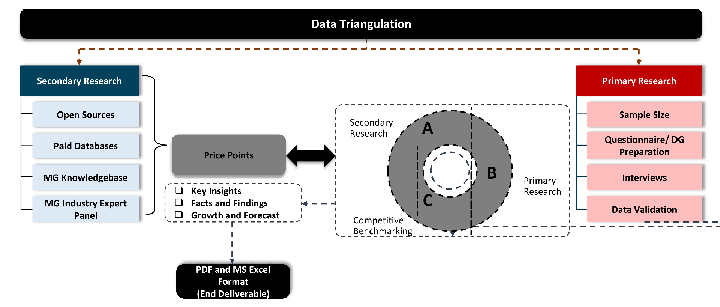
Data triangulation is a validation technique that uses multiple methods, sources, or perspectives to examine the same research question, thereby increasing the credibility and reliability of research findings. In market research, triangulation serves as a quality assurance mechanism that helps identify and minimize bias, validate assumptions, and ensure accuracy in market estimates.
- Data Source Triangulation – Using multiple data sources to examine the same phenomenon
- Methodological Triangulation – Using multiple research methods to study the same research question
- Investigator Triangulation – Using multiple researchers or analysts to examine the same data
- Theoretical Triangulation – Using multiple theoretical perspectives to interpret the same data
Custom Market Research Services
We will customise the research for you, in case the report listed above does not meet your requirements.
Get 10% Free Customisation