Outboard Engines Market Size, Share & Trends Analysis Report by Rated Power (Up to 30 HP, 31-100 HP, 101-200 HP, 201-400 HP, Above 400 HP), Engine Type, Fuel Type, Cylinder Configuration, Ignition Type, Propulsion Technology, Steering Control System, Mounting Type, End-use, and Geography (North America, Europe, Asia Pacific, Middle East, Africa, and South America) – Global Industry Data, Trends, and Forecasts, 2026–2035
|
|
|
Segmental Data Insights |
|
|
Demand Trends |
|
|
Competitive Landscape |
|
|
Strategic Development |
|
|
Future Outlook & Opportunities |
|
Outboard-Engines-Market Size, Share, and Growth
The global outboard engines market is experiencing robust growth, with its estimated value of USD 8.3 billion in the year 2025 and USD 15.6 billion by the period 2035, registering a CAGR of 6.5%, during the forecast period. The global outboard engines market, driven by the growing recreational boating industry, rising preference for fuel-efficient and eco-friendly propulsion systems, technological advancements in engine performance, and increasing adoption of electric and hybrid outboards.

Ben Speciale, President, Yamaha U.S. Marine Business Unit, said, “The new cowling design for select gray midrange models and the expansion of our Matte Brown color options, also within the midrange models, give customers more options to customize the look of their outboards to reflect the way they choose to boat. Finally, the new F150 and F200 Tiller Assisted models give boaters premium tiller steering with more horsepower an abundance of built-in features and benefits that come standard for more controlled maneuvering and added ride comfort.”
The outboard engines market highly, propelled by the growing recreational boating, water sports and coastal tourism market, as more and more consumers invest in leisure-boating and fishing vessels. For instance, Yamaha Motor Europe entered into a supply contract to supply popular Salpa Nautica boats outboard engines to satisfy increased leisure craft demand and expand its aftermarket presence in Europe. This recreational use increase widens the sales volume and promotes product diversification to high-performance outboards as well as leisure-based outboards.
Leading companies such as Mercury Marine and financial institutions like Truist Bank are increasingly focusing on integrated financing solutions to stimulate demand in the outboard engines market. For instance, in February 2026, Sheffield Financial partnered with Mercury Marine to introduce a retail financing program aimed at streamlining the purchase of outboard engines and boat packages. The initiative offers structured installment financing along with continuous access to a specialized marine underwriting team, enabling faster credit approvals and a more consistent purchasing experience for both dealers and end customers.
Additionally, the growing use of environmentally friendly and technologically modern propulsion engines like electric, hybrid, and low-emission outboard engines is expanding outboard engine market development because manufacturers are equating product innovation with the emerging environmental demands and the shifting consumer sustainability trends. For instance, in April 2025, Yamaha Motor Corporation announced a concept of H2 based on its XTO Offshore platform called the H2 outboard, highlighting its strategic emphasis on zero-emission marine propulsion systems. The change accelerates the investment in research and development and allows the manufacturers to claim the next-generation propulsion market segments that are sustainability-oriented.
Adjacent market opportunities for the global outboard engines system market include electric marine propulsion systems, marine battery and energy storage solutions, connected boat and telematics platforms, aftermarket parts and servicing, and small boat manufacturing for leisure and fishing applications. These adjacencies increase revenue, faster innovation, and market diversification and resilience over the long run.
Outboard Engines Market Dynamics and Trends
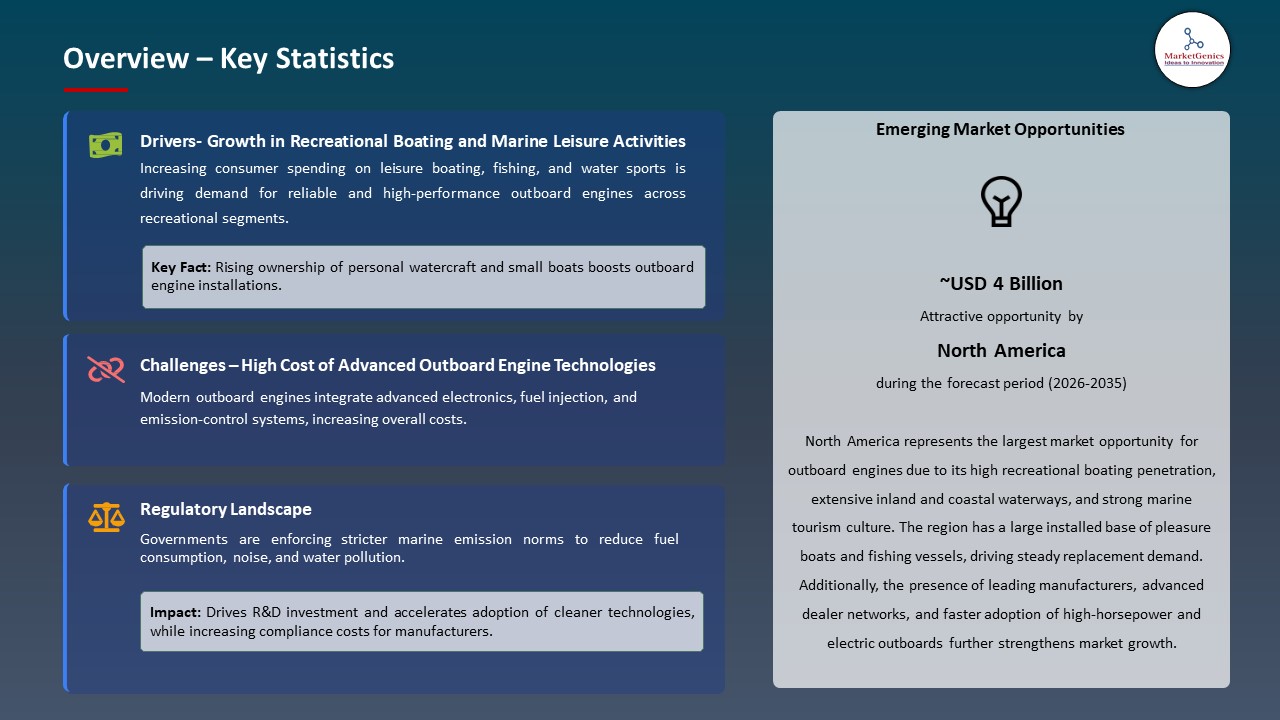
Driver: Government Emission Regulation Enforcement Driving Product Innovation and Compliance Investment
-
The increasing impacts of government-imposed emission controls on strategic decision-making in the outboard engines system market are forcing manufacturers to focus on cleaner propulsion technologies and need-driven compliance innovation. The stricter carbon emission protocols, noise control rules and fuel efficiency across North America, Europe and some parts of Asia are hastening the process of replacing traditional internal combustion engines to be replaced by electric, hybrid and other alternative-fuel technologies.
- Manufacturers are increasing R&D, upgrading engine platforms to meet regulations while ensuring performance. For instance, in 2025, Yamaha Motor Co. took this strategy a step further in the direction desired by the regulations by announcing its concept of hydrogen-powered outboard engine, which could be seen as a proactive investment in zero-carbon propulsion to meet future emissions requirements. This development underscores the reaction of manufacturers to the pressure of policies by seeking alternative fuels and minimizing the environmental impact of marine engines.
- Regulatory alignment is a competitive advantage of globalizing enforcement, as manufacturers that can commercially scale compliant technologies mix well. This promotes innovation, brand positioning and market resilience during the changing environmental standards.
Restraint: High Procurement Costs Constraining Adoption in Price-Sensitive Segments
-
The outboard engines market adoption of advanced engines is significantly restrained by high procurement costs, particularly for models incorporating electric, hybrid, or low-emission technologies. Premium features such as integrated digital controls, emission-compliant fuel systems, and advanced materials elevate manufacturing costs, which are passed on to end-users.
- This price barrier is particularly strong in emerging markets and in small boat owners with a constrained budget, which inhibits the market penetration of technologically advanced products. Moreover, special servicing and continuous maintenance needs on sophisticated engines raise the overall ownership cost.
- These factors collectively slow adoption rates and sustain demand for lower-cost alternatives, creating a market dynamic where cost remains a critical determinant of customer purchasing decisions.
- High prices constrain access and uptake, especially on price sensitive markets, limiting the overall market growth.
Opportunity: Expansion into Electric and Telematics Fleet Solutions Enhancing Operational Efficiency and Connectivity
-
The outboard engines market participants are increasingly pursuing electric propulsion systems and integrated telematics solutions to tap into fleet electrification, operational data insights, and connected services, unlocking adjacent revenue streams beyond traditional propulsion sales.
- Manufacturers are expanding their portfolios to meet rising demand for electric propulsion and connected fleet solutions. For instance, in June 2024, Mercury Marine expanded its Avator electric outboard lineup with the 75e and 110e models, offering scalable electric propulsion across a broader range of vessels. These models feature the SmartCraft Connect module, allowing wireless performance data transfer for efficient fleet monitoring.
- Additionally, emerging players such as Flux Marine are linking electric outboard power systems with fleet telematics platforms that enable real‑time diagnostics, remote maintenance insights, and predictive analytics for commercial operators. These developments respond to growing demand from commercial fleets, marinas, and rental services for cleaner propulsion and data‑driven asset management.
- Adoption of electric and connected solutions broadens market scope, strengthens service offerings, and drives long‑term customer engagement.
Key Trend: Adoption of Advanced Digital Control and Navigation Integration Technologies
-
The outboard engines market, which is determined by the introduction of innovative digital control and navigation technologies, contributing to the accuracy of operation, safety, and the overall performance of the vessel. As an example, fully integrated digital maneuvering systems like the Helm Master EX system (joystick control, electronic throttle and shift, autopilot operation, multifunction touch displays) have been implemented to offer user-friendly vessel control and automated positioning systems.
- These platforms offer wireless control and autopilot that facilitate real-time adjustments, pattern steering and automated navigation assistance and make complex tasks like docking and station-keeping simple. Also, smooth connection to external chart plotters and engine data networks enables the entire monitoring of the system as well as responsiveness.
- The implementation of smart, interconnected control systems is indicative of the wider industry trend in the direction of digitalization and the Internet of Things to support the increasing customer demands in terms of accuracy, convenience, and situational awareness.
- High digitalization will help to improve the customer experience, efficiency in operations, and competitiveness in the market.
Outboard-Engines-Market Analysis and Segmental Data
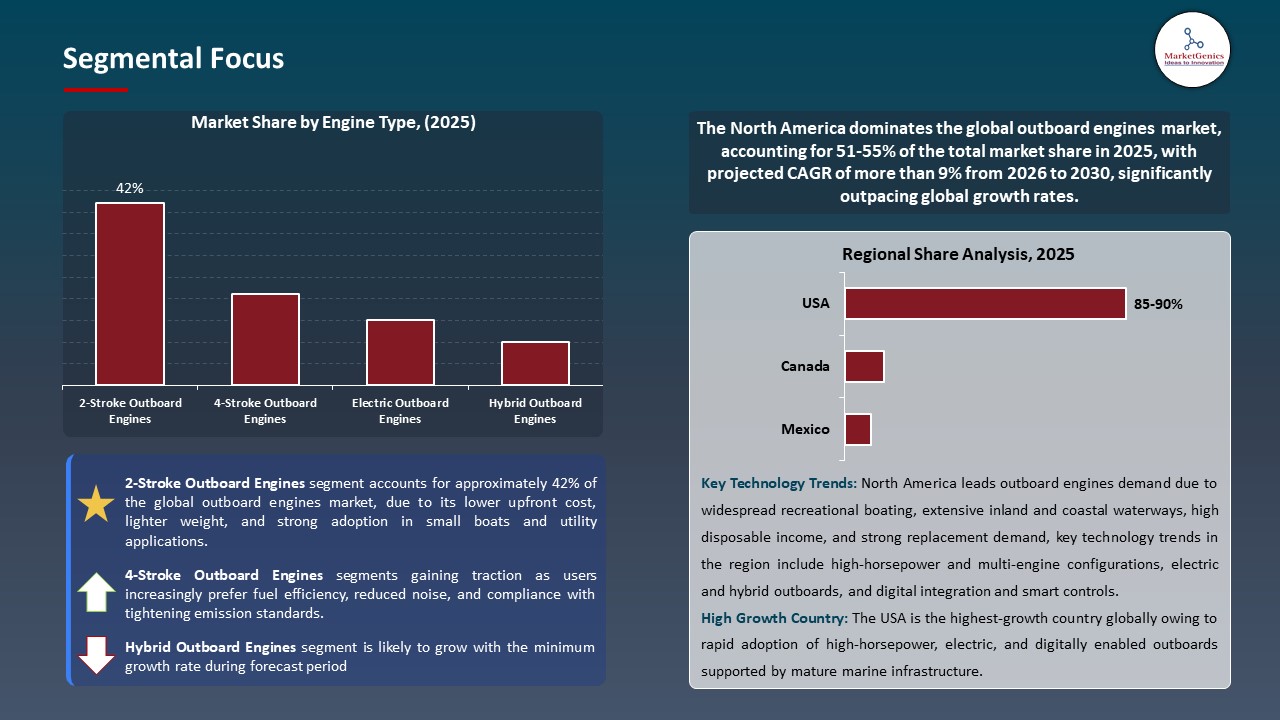
2-Stroke Outboard Engines Dominate Global Outboard Engines Market
-
The outboard engines market continues to be dominated by 2-stroke engines, because of the high power to weight ratio, simplicity, and cost-effectiveness, which suit small to medium-sized vessels in particular. These engines are powerful, have comparatively low maintenance needs, and are used in areas where cost-effectiveness and low purchase and maintenance are important buying factors.
- The 2 stroke technology, including direct fuel injection and better emission control systems, have resolved the existing issues that existed in the past and therefore, are now in line with the existing regulations.
- Their widespread availability, lower upfront costs, and strong performance in recreational and commercial boating applications sustain their dominance in the market. 2-stroke engines maintain high adoption rates, driving consistent sales and supporting market stability.
North America Leads Global Outboard Engines Market Demand
-
North America leads the outboard engines market, with high demand on fishing, cruising and water sports that has built a steady consumer demand in the small and medium sized vessels. For instance, in 2025, Yamaha added new high performance four stroke engine to the existing line up which targeted North American recreational boats and addressed the needs of enthusiasts who desired reliability and efficiency. This cultural affinity will guarantee a stable market growth and sustained aftermarket prospects.
- Additionally, the growing demand of consumers to low-emission engines, fuel-efficient engines, and technologically advanced engines contributes to the market growth in North America. For instance, in 2025, Mercury Marine’s introduction of its Avator electric outboard series exemplifies how manufacturers are meeting regulatory compliance and consumer demand for sustainable propulsion solutions. The use of innovative engines reinforces the ability to be competitive in the market and speed up of technology integration in the region.
- The solid recreational boating tradition in North America and the increased demand of sophisticated, eco-friendly engines continue to support robust market expansion, promotes the use of innovations, and boosts the competitive advantage in the outboard engines segment in the long-term.
Outboard-Engines-Market Ecosystem
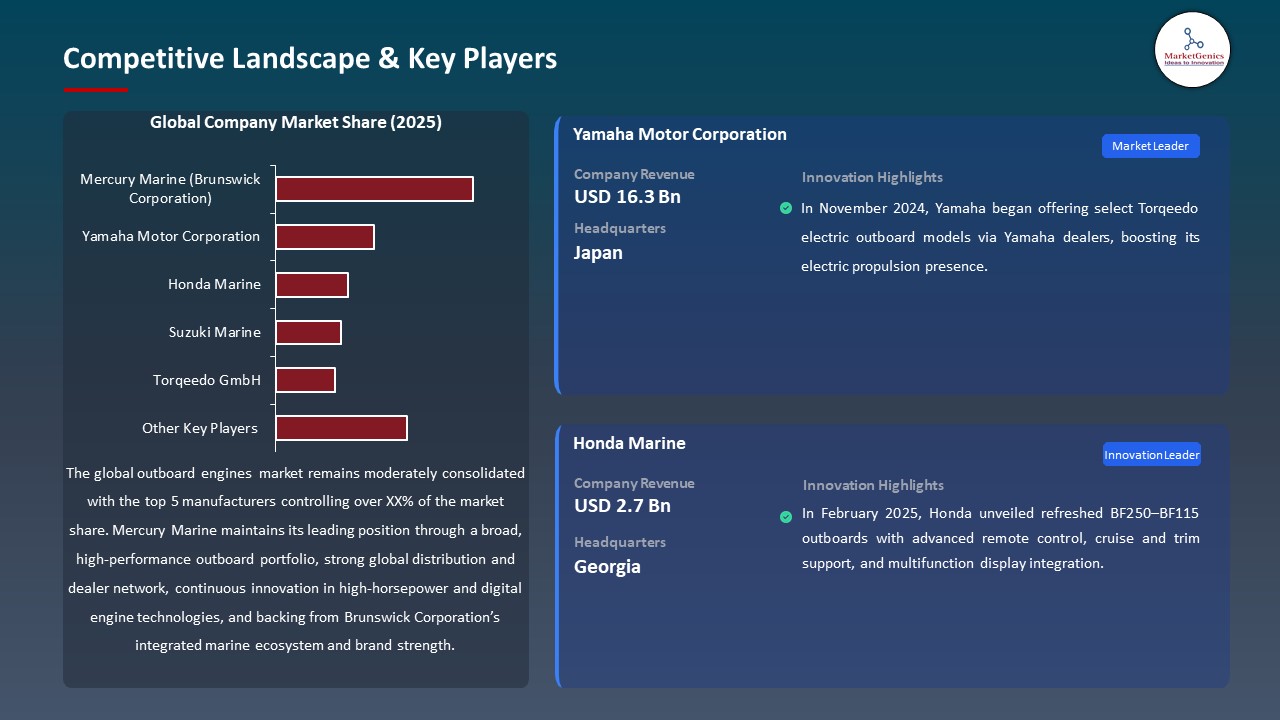
The global outboard engines market is moderately consolidated, with high concentration among key players such as Mercury Marine (Brunswick Corporation), Yamaha Motor Corporation, Honda Marine, Suzuki Marine, and Torqeedo GmbH, who dominate through continuous product innovation, strategic partnerships, extensive distribution networks, and strong brand recognition, allowing them to capture high-value segments, introduce technologically advanced propulsion systems, and meet evolving consumer and regulatory demands worldwide.
Market consolidation among these key players drives competitive innovation, ensures quality standards, and shapes pricing and technology trends across the global outboard engines industry.
Recent Development and Strategic Overview:
-
In January 2025, Yamaha Motor Corporation expanded its outboard portfolio with new fully‑electric HARMO outboards (single and twin configurations) integrated with advanced steering and helm control systems for intuitive boating. The rollout also includes new tiller‑assist F150/F200 models and refreshed cowling styles for 2025.
- In January 2025, Torqeedo GmbH began offering selected electric outboard models (Travel, Travel Ultralight, Cruise) through Yamaha’s dealer network across eight European countries from January 2025, enhancing distribution of advanced zero‑emission propulsion systems.
Report Scope
|
Detail |
|
|
Market Size in 2025 |
USD 8.3 Bn |
|
Market Forecast Value in 2035 |
USD 15.6 Bn |
|
Growth Rate (CAGR) |
6.5% |
|
Forecast Period |
2026 – 2035 |
|
Historical Data Available for |
2021 – 2024 |
|
Market Size Units |
US$ Billion for Value Thousand Units for Volume |
|
Report Format |
Electronic (PDF) + Excel |
|
North America |
Europe |
Asia Pacific |
Middle East |
Africa |
South America |
|
|
|
|
|
|
|
Companies Covered |
|||||
|
|
|
|
|
|
Outboard-Engines-Market Segmentation and Highlights
|
Segment |
Sub-segment |
|
Outboard Engines Market, By Rated Power |
|
|
Outboard Engines Market, By Engine Type |
|
|
Outboard Engines Market, By Fuel Type |
|
|
Outboard Engines Market, By Cylinder Configuration |
|
|
Outboard Engines Market, By Ignition Type
|
|
|
Outboard Engines Market, By Propulsion Technology
|
|
|
Outboard Engines Market, By Steering Control System |
|
|
Outboard Engines Market, By Mounting Type |
|
|
Outboard Engines Market, By End-use |
|
Frequently Asked Questions
Table of Contents
- 1. Research Methodology and Assumptions
- 1.1. Definitions
- 1.2. Research Design and Approach
- 1.3. Data Collection Methods
- 1.4. Base Estimates and Calculations
- 1.5. Forecasting Models
- 1.5.1. Key Forecast Factors & Impact Analysis
- 1.6. Secondary Research
- 1.6.1. Open Sources
- 1.6.2. Paid Databases
- 1.6.3. Associations
- 1.7. Primary Research
- 1.7.1. Primary Sources
- 1.7.2. Primary Interviews with Stakeholders across Ecosystem
- 2. Executive Summary
- 2.1. Global Outboard Engines Market Outlook
- 2.1.1. Outboard Engines Market Size (Volume – Thousand Units and Value – US$ Bn), and Forecasts, 2021-2035
- 2.1.2. Compounded Annual Growth Rate Analysis
- 2.1.3. Growth Opportunity Analysis
- 2.1.4. Segmental Share Analysis
- 2.1.5. Geographical Share Analysis
- 2.2. Market Analysis and Facts
- 2.3. Supply-Demand Analysis
- 2.4. Competitive Benchmarking
- 2.5. Go-to- Market Strategy
- 2.5.1. Customer/ End-use Industry Assessment
- 2.5.2. Growth Opportunity Data, 2026-2035
- 2.5.2.1. Regional Data
- 2.5.2.2. Country Data
- 2.5.2.3. Segmental Data
- 2.5.3. Identification of Potential Market Spaces
- 2.5.4. GAP Analysis
- 2.5.5. Potential Attractive Price Points
- 2.5.6. Prevailing Market Risks & Challenges
- 2.5.7. Preferred Sales & Marketing Strategies
- 2.5.8. Key Recommendations and Analysis
- 2.5.9. A Way Forward
- 2.1. Global Outboard Engines Market Outlook
- 3. Industry Data and Premium Insights
- 3.1. Global Automotive & Transportation Industry Overview, 2025
- 3.1.1. Automotive & Transportation Ecosystem Analysis
- 3.1.2. Key Trends for Automotive & Transportation Industry
- 3.1.3. Regional Distribution for Automotive & Transportation Industry
- 3.2. Supplier Customer Data
- 3.3. Technology Roadmap and Developments
- 3.4. Trade Analysis
- 3.4.1. Import & Export Analysis, 2025
- 3.4.2. Top Importing Countries
- 3.4.3. Top Exporting Countries
- 3.5. Trump Tariff Impact Analysis
- 3.5.1. Manufacturer
- 3.5.1.1. Based on the component & Raw material
- 3.5.2. Supply Chain
- 3.5.3. End Consumer
- 3.5.1. Manufacturer
- 3.6. Raw Material Analysis
- 3.1. Global Automotive & Transportation Industry Overview, 2025
- 4. Market Overview
- 4.1. Market Dynamics
- 4.1.1. Drivers
- 4.1.1.1. Rising participation in recreational boating and water sports
- 4.1.1.2. Technological advancements improving fuel efficiency and engine performance
- 4.1.1.3. Growing use of outboard engines in fishing and small commercial vessels
- 4.1.2. Restraints
- 4.1.2.1. High initial cost and ongoing maintenance expenses
- 4.1.2.2. Stringent emission and environmental regulations
- 4.1.1. Drivers
- 4.2. Key Trend Analysis
- 4.3. Regulatory Framework
- 4.3.1. Key Regulations, Norms, and Subsidies, by Key Countries
- 4.3.2. Tariffs and Standards
- 4.3.3. Impact Analysis of Regulations on the Market
- 4.4. Value Chain Analysis
- 4.4.1. Raw Material Suppliers
- 4.4.2. Component and Subsystem Manufacturers
- 4.4.3. Distribution & Wholesale Marketers
- 4.4.4. End Users
- 4.5. Cost Structure Analysis
- 4.5.1. Parameter’s Share for Cost Associated
- 4.5.2. COGP vs COGS
- 4.5.3. Profit Margin Analysis
- 4.6. Pricing Analysis
- 4.6.1. Regional Pricing Analysis
- 4.6.2. Segmental Pricing Trends
- 4.6.3. Factors Influencing Pricing
- 4.7. Porter’s Five Forces Analysis
- 4.8. PESTEL Analysis
- 4.9. Global Outboard Engines Market Demand
- 4.9.1. Historical Market Size – Volume (Thousand Units) and Value (US$ Bn), 2020-2024
- 4.9.2. Current and Future Market Size – Volume (Thousand Units) and Value (US$ Bn), 2026–2035
- 4.9.2.1. Y-o-Y Growth Trends
- 4.9.2.2. Absolute $ Opportunity Assessment
- 4.1. Market Dynamics
- 5. Competition Landscape
- 5.1. Competition structure
- 5.1.1. Fragmented v/s consolidated
- 5.2. Company Share Analysis, 2025
- 5.2.1. Global Company Market Share
- 5.2.2. By Region
- 5.2.2.1. North America
- 5.2.2.2. Europe
- 5.2.2.3. Asia Pacific
- 5.2.2.4. Middle East
- 5.2.2.5. Africa
- 5.2.2.6. South America
- 5.3. Product Comparison Matrix
- 5.3.1. Specifications
- 5.3.2. Market Positioning
- 5.3.3. Pricing
- 5.1. Competition structure
- 6. Global Outboard Engines Market Analysis, by Rated Power
- 6.1. Key Segment Analysis
- 6.2. Outboard Engines Market Size (Volume – Thousand Units and Value – US$ Bn), Analysis, and Forecasts, by Rated Power, 2021-2035
- 6.2.1. Up to 30 HP
- 6.2.2. 31-100 HP
- 6.2.3. 101-200 HP
- 6.2.4. 201-400 HP
- 6.2.5. Above 400 HP
- 7. Global Outboard Engines Market Analysis, by Engine Type
- 7.1. Key Segment Analysis
- 7.2. Outboard Engines Market Size (Volume – Thousand Units and Value – US$ Bn), Analysis, and Forecasts, by Engine Type, 2021-2035
- 7.2.1. 2-Stroke Outboard Engines
- 7.2.2. 4-Stroke Outboard Engines
- 7.2.3. Electric Outboard Engines
- 7.2.4. Hybrid Outboard Engines
- 8. Global Outboard Engines Market Analysis, by Fuel Type
- 8.1. Key Segment Analysis
- 8.2. Outboard Engines Market Size (Volume – Thousand Units and Value – US$ Bn), Analysis, and Forecasts, by Fuel Type, 2021-2035
- 8.2.1. Gasoline/Petrol
- 8.2.2. Diesel
- 8.2.3. Electric/Battery-Powered
- 8.2.4. LPG/CNG
- 8.2.5. Hybrid (Gasoline-Electric)
- 9. Global Outboard Engines Market Analysis, by Cylinder Configuration
- 9.1. Key Segment Analysis
- 9.2. Outboard Engines Market Size (Volume – Thousand Units and Value – US$ Bn), Analysis, and Forecasts, by Cylinder Configuration, 2021-2035
- 9.2.1. Single Cylinder
- 9.2.2. Twin Cylinder
- 9.2.3. Three Cylinder
- 9.2.4. Four Cylinder
- 9.2.5. Six Cylinder
- 9.2.6. Eight Cylinder
- 10. Global Outboard Engines Market Analysis, by Ignition Type
- 10.1. Key Segment Analysis
- 10.2. Outboard Engines Market Size (Volume – Thousand Units and Value – US$ Bn), Analysis, and Forecasts, by Ignition Type, 2021-2035
- 10.2.1. Manual/Pull Start
- 10.2.2. Electric Start
- 10.2.3. Remote Electric Start
- 11. Global Outboard Engines Market Analysis, by Propulsion Technology
- 11.1. Key Segment Analysis
- 11.2. Outboard Engines Market Size (Volume – Thousand Units and Value – US$ Bn), Analysis, and Forecasts, by Propulsion Technology, 2021-2035
- 11.2.1. Direct Drive
- 11.2.2. Jet Drive
- 11.2.3. Counter-Rotating Propellers
- 11.2.4. Dual Propeller System
- 11.2.5. Surface Piercing Propellers
- 12. Global Outboard Engines Market Analysis, by Steering Control System
- 12.1. Key Segment Analysis
- 12.2. Outboard Engines Market Size (Volume – Thousand Units and Value – US$ Bn), Analysis, and Forecasts, by Steering Control System, 2021-2035
- 12.2.1. Tiller Handle Control
- 12.2.2. Remote Steering Control
- 12.2.3. Power Steering
- 12.2.4. Fly-by-Wire Electronic Control
- 13. Global Outboard Engines Market Analysis, by Mounting Type
- 13.1. Key Segment Analysis
- 13.2. Outboard Engines Market Size (Volume – Thousand Units and Value – US$ Bn), Analysis, and Forecasts, by Mounting Type, 2021-2035
- 13.2.1. Transom Mount
- 13.2.2. Clamp-On Mount
- 13.2.3. Bolt-On Mount
- 14. Global Outboard Engines Market Analysis, by End-use
- 14.1. Key Segment Analysis
- 14.2. Outboard Engines Market Size (Volume – Thousand Units and Value – US$ Bn), Analysis, and Forecasts, by End-use, 2021-2035
- 14.2.1. Recreational Boating
- 14.2.2. Commercial Fishing
- 14.2.3. Commercial Maritime Services
- 14.2.4. Military & Defense
- 14.2.4.1. Naval Patrol Boats
- 14.2.4.2. Coast Guard Vessels
- 14.2.4.3. Military Inflatable Boats
- 14.2.4.4. Others
- 14.2.5. Industrial & Utility
- 14.2.5.1. Workboats
- 14.2.5.2. Survey Vessels
- 14.2.5.3. Port and Harbor Operations
- 14.2.5.4. Others
- 14.2.6. Emergency Services
- 14.2.7. Rescue Boats
- 14.2.8. Firefighting Boats
- 14.2.9. Others
- 15. Global Outboard Engines Market Analysis and Forecasts, by Region
- 15.1. Key Findings
- 15.2. Outboard Engines Market Size (Volume – Thousand Units and Value – US$ Bn), Analysis, and Forecasts, by Region, 2021-2035
- 15.2.1. North America
- 15.2.2. Europe
- 15.2.3. Asia Pacific
- 15.2.4. Middle East
- 15.2.5. Africa
- 15.2.6. South America
- 16. North America Outboard Engines Market Analysis
- 16.1. Key Segment Analysis
- 16.2. Regional Snapshot
- 16.3. North America Outboard Engines Market Size (Volume – Thousand Units and Value – US$ Bn), Analysis, and Forecasts, 2021-2035
- 16.3.1. Rated Power
- 16.3.2. Engine Type
- 16.3.3. Fuel Type
- 16.3.4. Cylinder Configuration
- 16.3.5. Ignition Type
- 16.3.6. Propulsion Technology
- 16.3.7. Steering Control System
- 16.3.8. Mounting Type
- 16.3.9. End-use
- 16.3.10. Country
- 16.3.10.1. USA
- 16.3.10.2. Canada
- 16.3.10.3. Mexico
- 16.4. USA Outboard Engines Market
- 16.4.1. Country Segmental Analysis
- 16.4.2. Rated Power
- 16.4.3. Engine Type
- 16.4.4. Fuel Type
- 16.4.5. Cylinder Configuration
- 16.4.6. Ignition Type
- 16.4.7. Propulsion Technology
- 16.4.8. Steering Control System
- 16.4.9. Mounting Type
- 16.4.10. End-use
- 16.5. Canada Outboard Engines Market
- 16.5.1. Country Segmental Analysis
- 16.5.2. Rated Power
- 16.5.3. Engine Type
- 16.5.4. Fuel Type
- 16.5.5. Cylinder Configuration
- 16.5.6. Ignition Type
- 16.5.7. Propulsion Technology
- 16.5.8. Steering Control System
- 16.5.9. Mounting Type
- 16.5.10. End-use
- 16.6. Mexico Outboard Engines Market
- 16.6.1. Country Segmental Analysis
- 16.6.2. Rated Power
- 16.6.3. Engine Type
- 16.6.4. Fuel Type
- 16.6.5. Cylinder Configuration
- 16.6.6. Ignition Type
- 16.6.7. Propulsion Technology
- 16.6.8. Steering Control System
- 16.6.9. Mounting Type
- 16.6.10. End-use
- 17. Europe Outboard Engines Market Analysis
- 17.1. Key Segment Analysis
- 17.2. Regional Snapshot
- 17.3. Europe Outboard Engines Market Size (Volume – Thousand Units and Value – US$ Bn), Analysis, and Forecasts, 2021-2035
- 17.3.1. Rated Power
- 17.3.2. Engine Type
- 17.3.3. Fuel Type
- 17.3.4. Cylinder Configuration
- 17.3.5. Ignition Type
- 17.3.6. Propulsion Technology
- 17.3.7. Steering Control System
- 17.3.8. Mounting Type
- 17.3.9. End-use
- 17.3.10. Country
- 17.3.10.1. Germany
- 17.3.10.2. United Kingdom
- 17.3.10.3. France
- 17.3.10.4. Italy
- 17.3.10.5. Spain
- 17.3.10.6. Netherlands
- 17.3.10.7. Nordic Countries
- 17.3.10.8. Poland
- 17.3.10.9. Russia & CIS
- 17.3.10.10. Rest of Europe
- 17.4. Germany Outboard Engines Market
- 17.4.1. Country Segmental Analysis
- 17.4.2. Rated Power
- 17.4.3. Engine Type
- 17.4.4. Fuel Type
- 17.4.5. Cylinder Configuration
- 17.4.6. Ignition Type
- 17.4.7. Propulsion Technology
- 17.4.8. Steering Control System
- 17.4.9. Mounting Type
- 17.4.10. End-use
- 17.5. United Kingdom Outboard Engines Market
- 17.5.1. Country Segmental Analysis
- 17.5.2. Rated Power
- 17.5.3. Engine Type
- 17.5.4. Fuel Type
- 17.5.5. Cylinder Configuration
- 17.5.6. Ignition Type
- 17.5.7. Propulsion Technology
- 17.5.8. Steering Control System
- 17.5.9. Mounting Type
- 17.5.10. End-use
- 17.6. France Outboard Engines Market
- 17.6.1. Country Segmental Analysis
- 17.6.2. Rated Power
- 17.6.3. Engine Type
- 17.6.4. Fuel Type
- 17.6.5. Cylinder Configuration
- 17.6.6. Ignition Type
- 17.6.7. Propulsion Technology
- 17.6.8. Steering Control System
- 17.6.9. Mounting Type
- 17.6.10. End-use
- 17.7. Italy Outboard Engines Market
- 17.7.1. Country Segmental Analysis
- 17.7.2. Rated Power
- 17.7.3. Engine Type
- 17.7.4. Fuel Type
- 17.7.5. Cylinder Configuration
- 17.7.6. Ignition Type
- 17.7.7. Propulsion Technology
- 17.7.8. Steering Control System
- 17.7.9. Mounting Type
- 17.7.10. End-use
- 17.8. Spain Outboard Engines Market
- 17.8.1. Country Segmental Analysis
- 17.8.2. Rated Power
- 17.8.3. Engine Type
- 17.8.4. Fuel Type
- 17.8.5. Cylinder Configuration
- 17.8.6. Ignition Type
- 17.8.7. Propulsion Technology
- 17.8.8. Steering Control System
- 17.8.9. Mounting Type
- 17.8.10. End-use
- 17.9. Netherlands Outboard Engines Market
- 17.9.1. Country Segmental Analysis
- 17.9.2. Rated Power
- 17.9.3. Engine Type
- 17.9.4. Fuel Type
- 17.9.5. Cylinder Configuration
- 17.9.6. Ignition Type
- 17.9.7. Propulsion Technology
- 17.9.8. Steering Control System
- 17.9.9. Mounting Type
- 17.9.10. End-use
- 17.10. Nordic Countries Outboard Engines Market
- 17.10.1. Country Segmental Analysis
- 17.10.2. Rated Power
- 17.10.3. Engine Type
- 17.10.4. Fuel Type
- 17.10.5. Cylinder Configuration
- 17.10.6. Ignition Type
- 17.10.7. Propulsion Technology
- 17.10.8. Steering Control System
- 17.10.9. Mounting Type
- 17.10.10. End-use
- 17.11. Poland Outboard Engines Market
- 17.11.1. Country Segmental Analysis
- 17.11.2. Rated Power
- 17.11.3. Engine Type
- 17.11.4. Fuel Type
- 17.11.5. Cylinder Configuration
- 17.11.6. Ignition Type
- 17.11.7. Propulsion Technology
- 17.11.8. Steering Control System
- 17.11.9. Mounting Type
- 17.11.10. End-use
- 17.12. Russia & CIS Outboard Engines Market
- 17.12.1. Country Segmental Analysis
- 17.12.2. Rated Power
- 17.12.3. Engine Type
- 17.12.4. Fuel Type
- 17.12.5. Cylinder Configuration
- 17.12.6. Ignition Type
- 17.12.7. Propulsion Technology
- 17.12.8. Steering Control System
- 17.12.9. Mounting Type
- 17.12.10. End-use
- 17.13. Rest of Europe Outboard Engines Market
- 17.13.1. Country Segmental Analysis
- 17.13.2. Rated Power
- 17.13.3. Engine Type
- 17.13.4. Fuel Type
- 17.13.5. Cylinder Configuration
- 17.13.6. Ignition Type
- 17.13.7. Propulsion Technology
- 17.13.8. Steering Control System
- 17.13.9. Mounting Type
- 17.13.10. End-use
- 18. Asia Pacific Outboard Engines Market Analysis
- 18.1. Key Segment Analysis
- 18.2. Regional Snapshot
- 18.3. Asia Pacific Outboard Engines Market Size (Volume – Thousand Units and Value – US$ Bn), Analysis, and Forecasts, 2021-2035
- 18.3.1. Rated Power
- 18.3.2. Engine Type
- 18.3.3. Fuel Type
- 18.3.4. Cylinder Configuration
- 18.3.5. Ignition Type
- 18.3.6. Propulsion Technology
- 18.3.7. Steering Control System
- 18.3.8. Mounting Type
- 18.3.9. End-use
- 18.3.10. Country
- 18.3.10.1. China
- 18.3.10.2. India
- 18.3.10.3. Japan
- 18.3.10.4. South Korea
- 18.3.10.5. Australia and New Zealand
- 18.3.10.6. Indonesia
- 18.3.10.7. Malaysia
- 18.3.10.8. Thailand
- 18.3.10.9. Vietnam
- 18.3.10.10. Rest of Asia Pacific
- 18.4. China Outboard Engines Market
- 18.4.1. Country Segmental Analysis
- 18.4.2. Rated Power
- 18.4.3. Engine Type
- 18.4.4. Fuel Type
- 18.4.5. Cylinder Configuration
- 18.4.6. Ignition Type
- 18.4.7. Propulsion Technology
- 18.4.8. Steering Control System
- 18.4.9. Mounting Type
- 18.4.10. End-use
- 18.5. India Outboard Engines Market
- 18.5.1. Country Segmental Analysis
- 18.5.2. Rated Power
- 18.5.3. Engine Type
- 18.5.4. Fuel Type
- 18.5.5. Cylinder Configuration
- 18.5.6. Ignition Type
- 18.5.7. Propulsion Technology
- 18.5.8. Steering Control System
- 18.5.9. Mounting Type
- 18.5.10. End-use
- 18.6. Japan Outboard Engines Market
- 18.6.1. Country Segmental Analysis
- 18.6.2. Rated Power
- 18.6.3. Engine Type
- 18.6.4. Fuel Type
- 18.6.5. Cylinder Configuration
- 18.6.6. Ignition Type
- 18.6.7. Propulsion Technology
- 18.6.8. Steering Control System
- 18.6.9. Mounting Type
- 18.6.10. End-use
- 18.7. South Korea Outboard Engines Market
- 18.7.1. Country Segmental Analysis
- 18.7.2. Rated Power
- 18.7.3. Engine Type
- 18.7.4. Fuel Type
- 18.7.5. Cylinder Configuration
- 18.7.6. Ignition Type
- 18.7.7. Propulsion Technology
- 18.7.8. Steering Control System
- 18.7.9. Mounting Type
- 18.7.10. End-use
- 18.8. Australia and New Zealand Outboard Engines Market
- 18.8.1. Country Segmental Analysis
- 18.8.2. Rated Power
- 18.8.3. Engine Type
- 18.8.4. Fuel Type
- 18.8.5. Cylinder Configuration
- 18.8.6. Ignition Type
- 18.8.7. Propulsion Technology
- 18.8.8. Steering Control System
- 18.8.9. Mounting Type
- 18.8.10. End-use
- 18.9. Indonesia Outboard Engines Market
- 18.9.1. Country Segmental Analysis
- 18.9.2. Rated Power
- 18.9.3. Engine Type
- 18.9.4. Fuel Type
- 18.9.5. Cylinder Configuration
- 18.9.6. Ignition Type
- 18.9.7. Propulsion Technology
- 18.9.8. Steering Control System
- 18.9.9. Mounting Type
- 18.9.10. End-use
- 18.10. Malaysia Outboard Engines Market
- 18.10.1. Country Segmental Analysis
- 18.10.2. Rated Power
- 18.10.3. Engine Type
- 18.10.4. Fuel Type
- 18.10.5. Cylinder Configuration
- 18.10.6. Ignition Type
- 18.10.7. Propulsion Technology
- 18.10.8. Steering Control System
- 18.10.9. Mounting Type
- 18.10.10. End-use
- 18.11. Thailand Outboard Engines Market
- 18.11.1. Country Segmental Analysis
- 18.11.2. Rated Power
- 18.11.3. Engine Type
- 18.11.4. Fuel Type
- 18.11.5. Cylinder Configuration
- 18.11.6. Ignition Type
- 18.11.7. Propulsion Technology
- 18.11.8. Steering Control System
- 18.11.9. Mounting Type
- 18.11.10. End-use
- 18.12. Vietnam Outboard Engines Market
- 18.12.1. Country Segmental Analysis
- 18.12.2. Rated Power
- 18.12.3. Engine Type
- 18.12.4. Fuel Type
- 18.12.5. Cylinder Configuration
- 18.12.6. Ignition Type
- 18.12.7. Propulsion Technology
- 18.12.8. Steering Control System
- 18.12.9. Mounting Type
- 18.12.10. End-use
- 18.13. Rest of Asia Pacific Outboard Engines Market
- 18.13.1. Country Segmental Analysis
- 18.13.2. Rated Power
- 18.13.3. Engine Type
- 18.13.4. Fuel Type
- 18.13.5. Cylinder Configuration
- 18.13.6. Ignition Type
- 18.13.7. Propulsion Technology
- 18.13.8. Steering Control System
- 18.13.9. Mounting Type
- 18.13.10. End-use
- 19. Middle East Outboard Engines Market Analysis
- 19.1. Key Segment Analysis
- 19.2. Regional Snapshot
- 19.3. Middle East Outboard Engines Market Size (Volume – Thousand Units and Value – US$ Bn), Analysis, and Forecasts, 2021-2035
- 19.3.1. Rated Power
- 19.3.2. Engine Type
- 19.3.3. Fuel Type
- 19.3.4. Cylinder Configuration
- 19.3.5. Ignition Type
- 19.3.6. Propulsion Technology
- 19.3.7. Steering Control System
- 19.3.8. Mounting Type
- 19.3.9. End-use
- 19.3.10. Country
- 19.3.10.1. Turkey
- 19.3.10.2. UAE
- 19.3.10.3. Saudi Arabia
- 19.3.10.4. Israel
- 19.3.10.5. Rest of Middle East
- 19.4. Turkey Outboard Engines Market
- 19.4.1. Country Segmental Analysis
- 19.4.2. Rated Power
- 19.4.3. Engine Type
- 19.4.4. Fuel Type
- 19.4.5. Cylinder Configuration
- 19.4.6. Ignition Type
- 19.4.7. Propulsion Technology
- 19.4.8. Steering Control System
- 19.4.9. Mounting Type
- 19.4.10. End-use
- 19.5. UAE Outboard Engines Market
- 19.5.1. Country Segmental Analysis
- 19.5.2. Rated Power
- 19.5.3. Engine Type
- 19.5.4. Fuel Type
- 19.5.5. Cylinder Configuration
- 19.5.6. Ignition Type
- 19.5.7. Propulsion Technology
- 19.5.8. Steering Control System
- 19.5.9. Mounting Type
- 19.5.10. End-use
- 19.6. Saudi Arabia Outboard Engines Market
- 19.6.1. Country Segmental Analysis
- 19.6.2. Rated Power
- 19.6.3. Engine Type
- 19.6.4. Fuel Type
- 19.6.5. Cylinder Configuration
- 19.6.6. Ignition Type
- 19.6.7. Propulsion Technology
- 19.6.8. Steering Control System
- 19.6.9. Mounting Type
- 19.6.10. End-use
- 19.7. Israel Outboard Engines Market
- 19.7.1. Country Segmental Analysis
- 19.7.2. Rated Power
- 19.7.3. Engine Type
- 19.7.4. Fuel Type
- 19.7.5. Cylinder Configuration
- 19.7.6. Ignition Type
- 19.7.7. Propulsion Technology
- 19.7.8. Steering Control System
- 19.7.9. Mounting Type
- 19.7.10. End-use
- 19.8. Rest of Middle East Outboard Engines Market
- 19.8.1. Country Segmental Analysis
- 19.8.2. Rated Power
- 19.8.3. Engine Type
- 19.8.4. Fuel Type
- 19.8.5. Cylinder Configuration
- 19.8.6. Ignition Type
- 19.8.7. Propulsion Technology
- 19.8.8. Steering Control System
- 19.8.9. Mounting Type
- 19.8.10. End-use
- 20. Africa Outboard Engines Market Analysis
- 20.1. Key Segment Analysis
- 20.2. Regional Snapshot
- 20.3. Africa Outboard Engines Market Size (Volume – Thousand Units and Value – US$ Bn), Analysis, and Forecasts, 2021-2035
- 20.3.1. Rated Power
- 20.3.2. Engine Type
- 20.3.3. Fuel Type
- 20.3.4. Cylinder Configuration
- 20.3.5. Ignition Type
- 20.3.6. Propulsion Technology
- 20.3.7. Steering Control System
- 20.3.8. Mounting Type
- 20.3.9. End-use
- 20.3.10. Country
- 20.3.10.1. South Africa
- 20.3.10.2. Egypt
- 20.3.10.3. Nigeria
- 20.3.10.4. Algeria
- 20.3.10.5. Rest of Africa
- 20.4. South Africa Outboard Engines Market
- 20.4.1. Country Segmental Analysis
- 20.4.2. Rated Power
- 20.4.3. Engine Type
- 20.4.4. Fuel Type
- 20.4.5. Cylinder Configuration
- 20.4.6. Ignition Type
- 20.4.7. Propulsion Technology
- 20.4.8. Steering Control System
- 20.4.9. Mounting Type
- 20.4.10. End-use
- 20.5. Egypt Outboard Engines Market
- 20.5.1. Country Segmental Analysis
- 20.5.2. Rated Power
- 20.5.3. Engine Type
- 20.5.4. Fuel Type
- 20.5.5. Cylinder Configuration
- 20.5.6. Ignition Type
- 20.5.7. Propulsion Technology
- 20.5.8. Steering Control System
- 20.5.9. Mounting Type
- 20.5.10. End-use
- 20.6. Nigeria Outboard Engines Market
- 20.6.1. Country Segmental Analysis
- 20.6.2. Rated Power
- 20.6.3. Engine Type
- 20.6.4. Fuel Type
- 20.6.5. Cylinder Configuration
- 20.6.6. Ignition Type
- 20.6.7. Propulsion Technology
- 20.6.8. Steering Control System
- 20.6.9. Mounting Type
- 20.6.10. End-use
- 20.7. Algeria Outboard Engines Market
- 20.7.1. Country Segmental Analysis
- 20.7.2. Rated Power
- 20.7.3. Engine Type
- 20.7.4. Fuel Type
- 20.7.5. Cylinder Configuration
- 20.7.6. Ignition Type
- 20.7.7. Propulsion Technology
- 20.7.8. Steering Control System
- 20.7.9. Mounting Type
- 20.7.10. End-use
- 20.8. Rest of Africa Outboard Engines Market
- 20.8.1. Country Segmental Analysis
- 20.8.2. Rated Power
- 20.8.3. Engine Type
- 20.8.4. Fuel Type
- 20.8.5. Cylinder Configuration
- 20.8.6. Ignition Type
- 20.8.7. Propulsion Technology
- 20.8.8. Steering Control System
- 20.8.9. Mounting Type
- 20.8.10. End-use
- 21. South America Outboard Engines Market Analysis
- 21.1. Key Segment Analysis
- 21.2. Regional Snapshot
- 21.3. South America Outboard Engines Market Size (Volume – Thousand Units and Value – US$ Bn), Analysis, and Forecasts, 2021-2035
- 21.3.1. Rated Power
- 21.3.2. Engine Type
- 21.3.3. Fuel Type
- 21.3.4. Cylinder Configuration
- 21.3.5. Ignition Type
- 21.3.6. Propulsion Technology
- 21.3.7. Steering Control System
- 21.3.8. Mounting Type
- 21.3.9. End-use
- 21.3.10. Country
- 21.3.10.1. Brazil
- 21.3.10.2. Argentina
- 21.3.10.3. Rest of South America
- 21.4. Brazil Outboard Engines Market
- 21.4.1. Country Segmental Analysis
- 21.4.2. Rated Power
- 21.4.3. Engine Type
- 21.4.4. Fuel Type
- 21.4.5. Cylinder Configuration
- 21.4.6. Ignition Type
- 21.4.7. Propulsion Technology
- 21.4.8. Steering Control System
- 21.4.9. Mounting Type
- 21.4.10. End-use
- 21.5. Argentina Outboard Engines Market
- 21.5.1. Country Segmental Analysis
- 21.5.2. Rated Power
- 21.5.3. Engine Type
- 21.5.4. Fuel Type
- 21.5.5. Cylinder Configuration
- 21.5.6. Ignition Type
- 21.5.7. Propulsion Technology
- 21.5.8. Steering Control System
- 21.5.9. Mounting Type
- 21.5.10. End-use
- 21.6. Rest of South America Outboard Engines Market
- 21.6.1. Country Segmental Analysis
- 21.6.2. Rated Power
- 21.6.3. Engine Type
- 21.6.4. Fuel Type
- 21.6.5. Cylinder Configuration
- 21.6.6. Ignition Type
- 21.6.7. Propulsion Technology
- 21.6.8. Steering Control System
- 21.6.9. Mounting Type
- 21.6.10. End-use
- 22. Key Players/ Company Profile
- 22.1. Cox Powertrain
- 22.1.1. Company Details/ Overview
- 22.1.2. Company Financials
- 22.1.3. Key Customers and Competitors
- 22.1.4. Business/ Industry Portfolio
- 22.1.5. Product Portfolio/ Specification Details
- 22.1.6. Pricing Data
- 22.1.7. Strategic Overview
- 22.1.8. Recent Developments
- 22.2. Craftsman Marine
- 22.3. Elco Motor Yachts
- 22.4. ePropulsion
- 22.5. EPropulsion Technology
- 22.6. Evinrude (BRP - Bombardier Recreational Products)
- 22.7. Hangkai Outboard Motor
- 22.8. Hidea Power Machinery
- 22.9. Honda Marine
- 22.10. Lehr Propane Outboards
- 22.11. Mercury Marine (Brunswick Corporation)
- 22.12. Nicolini Marine
- 22.13. Nissan Marine
- 22.14. Parsun Power Machine
- 22.15. Ray Electric Outboards
- 22.16. Selva Marine
- 22.17. Suzuki Marine
- 22.18. Tohatsu Corporation
- 22.19. Torqeedo GmbH
- 22.20. Volvo Penta
- 22.21. Yamaha Motor Corporation
- 22.22. Other Key Players
- 22.1. Cox Powertrain
Note* - This is just tentative list of players. While providing the report, we will cover more number of players based on their revenue and share for each geography
Research Design
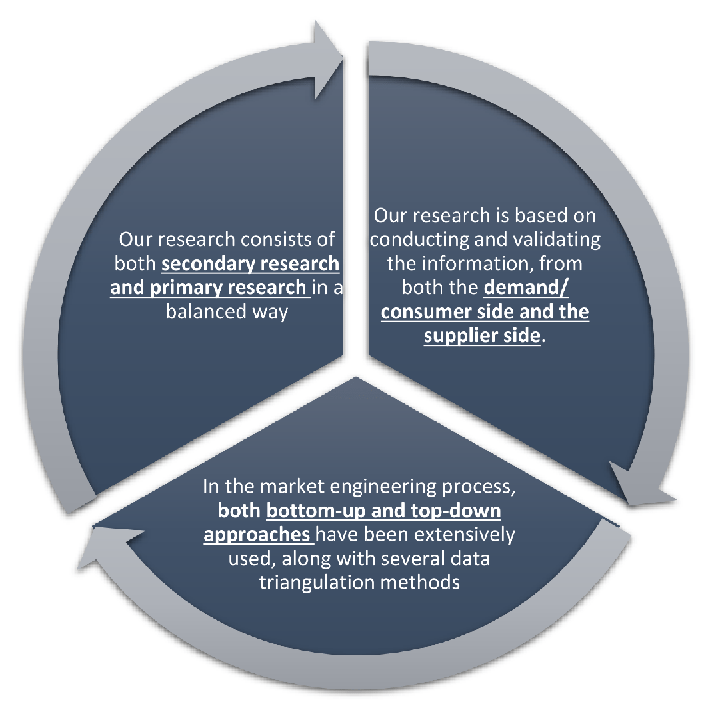
Our research design integrates both demand-side and supply-side analysis through a balanced combination of primary and secondary research methodologies. By utilizing both bottom-up and top-down approaches alongside rigorous data triangulation methods, we deliver robust market intelligence that supports strategic decision-making.
MarketGenics' comprehensive research design framework ensures the delivery of accurate, reliable, and actionable market intelligence. Through the integration of multiple research approaches, rigorous validation processes, and expert analysis, we provide our clients with the insights needed to make informed strategic decisions and capitalize on market opportunities.
MarketGenics leverages a dedicated industry panel of experts and a comprehensive suite of paid databases to effectively collect, consolidate, and analyze market intelligence.
Our approach has consistently proven to be reliable and effective in generating accurate market insights, identifying key industry trends, and uncovering emerging business opportunities.
Through both primary and secondary research, we capture and analyze critical company-level data such as manufacturing footprints, including technical centers, R&D facilities, sales offices, and headquarters.
Our expert panel further enhances our ability to estimate market size for specific brands based on validated field-level intelligence.
Our data mining techniques incorporate both parametric and non-parametric methods, allowing for structured data collection, sorting, processing, and cleaning.
Demand projections are derived from large-scale data sets analyzed through proprietary algorithms, culminating in robust and reliable market sizing.
Research Approach
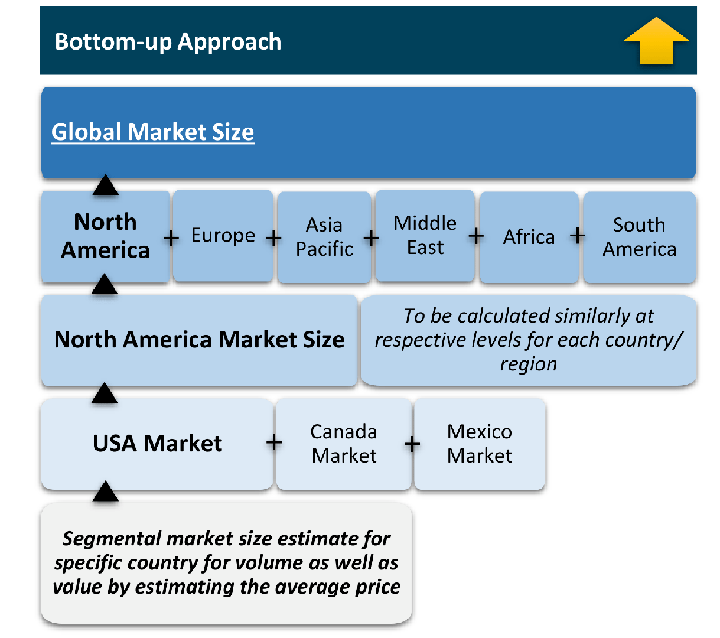
The bottom-up approach builds market estimates by starting with the smallest addressable market units and systematically aggregating them to create comprehensive market size projections.
This method begins with specific, granular data points and builds upward to create the complete market landscape.
Customer Analysis → Segmental Analysis → Geographical Analysis
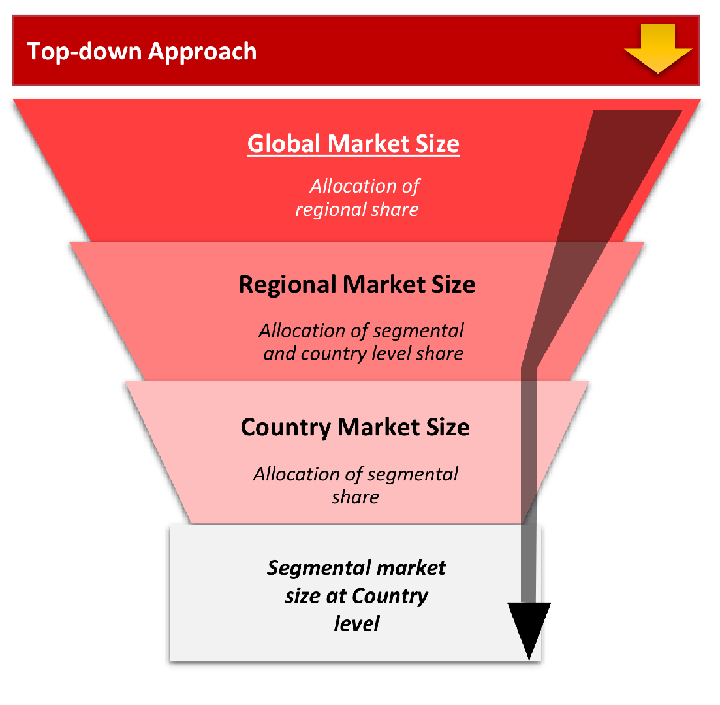
The top-down approach starts with the broadest possible market data and systematically narrows it down through a series of filters and assumptions to arrive at specific market segments or opportunities.
This method begins with the big picture and works downward to increasingly specific market slices.
TAM → SAM → SOM
Research Methods
Desk / Secondary Research
While analysing the market, we extensively study secondary sources, directories, and databases to identify and collect information useful for this technical, market-oriented, and commercial report. Secondary sources that we utilize are not only the public sources, but it is a combination of Open Source, Associations, Paid Databases, MG Repository & Knowledgebase, and others.
- Company websites, annual reports, financial reports, broker reports, and investor presentations
- National government documents, statistical databases and reports
- News articles, press releases and web-casts specific to the companies operating in the market, Magazines, reports, and others
- We gather information from commercial data sources for deriving company specific data such as segmental revenue, share for geography, product revenue, and others
- Internal and external proprietary databases (industry-specific), relevant patent, and regulatory databases
- Governing Bodies, Government Organizations
- Relevant Authorities, Country-specific Associations for Industries
We also employ the model mapping approach to estimate the product level market data through the players' product portfolio
Primary Research
Primary research/ interviews is vital in analyzing the market. Most of the cases involves paid primary interviews. Primary sources include primary interviews through e-mail interactions, telephonic interviews, surveys as well as face-to-face interviews with the different stakeholders across the value chain including several industry experts.
| Type of Respondents | Number of Primaries |
|---|---|
| Tier 2/3 Suppliers | ~20 |
| Tier 1 Suppliers | ~25 |
| End-users | ~25 |
| Industry Expert/ Panel/ Consultant | ~30 |
| Total | ~100 |
MG Knowledgebase
• Repository of industry blog, newsletter and case studies
• Online platform covering detailed market reports, and company profiles
Forecasting Factors and Models
Forecasting Factors
- Historical Trends – Past market patterns, cycles, and major events that shaped how markets behave over time. Understanding past trends helps predict future behavior.
- Industry Factors – Specific characteristics of the industry like structure, regulations, and innovation cycles that affect market dynamics.
- Macroeconomic Factors – Economic conditions like GDP growth, inflation, and employment rates that affect how much money people have to spend.
- Demographic Factors – Population characteristics like age, income, and location that determine who can buy your product.
- Technology Factors – How quickly people adopt new technology and how much technology infrastructure exists.
- Regulatory Factors – Government rules, laws, and policies that can help or restrict market growth.
- Competitive Factors – Analyzing competition structure such as degree of competition and bargaining power of buyers and suppliers.
Forecasting Models / Techniques
Multiple Regression Analysis
- Identify and quantify factors that drive market changes
- Statistical modeling to establish relationships between market drivers and outcomes
Time Series Analysis – Seasonal Patterns
- Understand regular cyclical patterns in market demand
- Advanced statistical techniques to separate trend, seasonal, and irregular components
Time Series Analysis – Trend Analysis
- Identify underlying market growth patterns and momentum
- Statistical analysis of historical data to project future trends
Expert Opinion – Expert Interviews
- Gather deep industry insights and contextual understanding
- In-depth interviews with key industry stakeholders
Multi-Scenario Development
- Prepare for uncertainty by modeling different possible futures
- Creating optimistic, pessimistic, and most likely scenarios
Time Series Analysis – Moving Averages
- Sophisticated forecasting for complex time series data
- Auto-regressive integrated moving average models with seasonal components
Econometric Models
- Apply economic theory to market forecasting
- Sophisticated economic models that account for market interactions
Expert Opinion – Delphi Method
- Harness collective wisdom of industry experts
- Structured, multi-round expert consultation process
Monte Carlo Simulation
- Quantify uncertainty and probability distributions
- Thousands of simulations with varying input parameters
Research Analysis
Our research framework is built upon the fundamental principle of validating market intelligence from both demand and supply perspectives. This dual-sided approach ensures comprehensive market understanding and reduces the risk of single-source bias.
Demand-Side Analysis: We understand end-user/application behavior, preferences, and market needs along with the penetration of the product for specific application.
Supply-Side Analysis: We estimate overall market revenue, analyze the segmental share along with industry capacity, competitive landscape, and market structure.
Validation & Evaluation
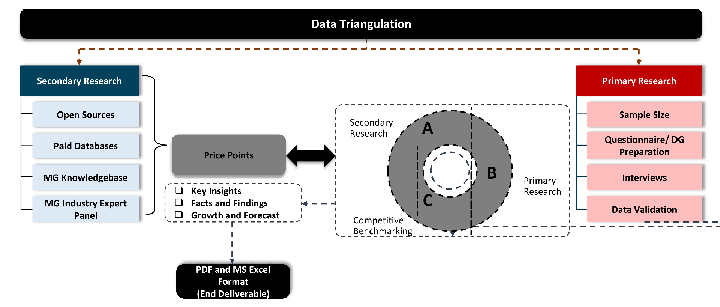
Data triangulation is a validation technique that uses multiple methods, sources, or perspectives to examine the same research question, thereby increasing the credibility and reliability of research findings. In market research, triangulation serves as a quality assurance mechanism that helps identify and minimize bias, validate assumptions, and ensure accuracy in market estimates.
- Data Source Triangulation – Using multiple data sources to examine the same phenomenon
- Methodological Triangulation – Using multiple research methods to study the same research question
- Investigator Triangulation – Using multiple researchers or analysts to examine the same data
- Theoretical Triangulation – Using multiple theoretical perspectives to interpret the same data
Custom Market Research Services
We will customise the research for you, in case the report listed above does not meet your requirements.
Get 10% Free Customisation