Pumps Market Size, Share & Trends Analysis Report by Pump Type (Centrifugal Pumps, Positive Displacement Pumps, Submersible Pumps, Vacuum Pumps, Slurry Pumps, Others), Technology, Power Rating, Material of Construction, Operation Mode, Discharge Pressure, Flow Rate Capacity, Mounting Type, Stage Type, Distribution Channel, End-use Industry X Application, Geography (North America, Europe, Asia Pacific, Middle East, Africa, and South America) – Global Industry Data, Trends, and Forecasts, 2026–2035
|
|
|
Segmental Data Insights |
|
|
Demand Trends |
|
|
Competitive Landscape |
|
|
Strategic Development |
|
|
Future Outlook & Opportunities |
|
Pumps-Market Size, Share, and Growth
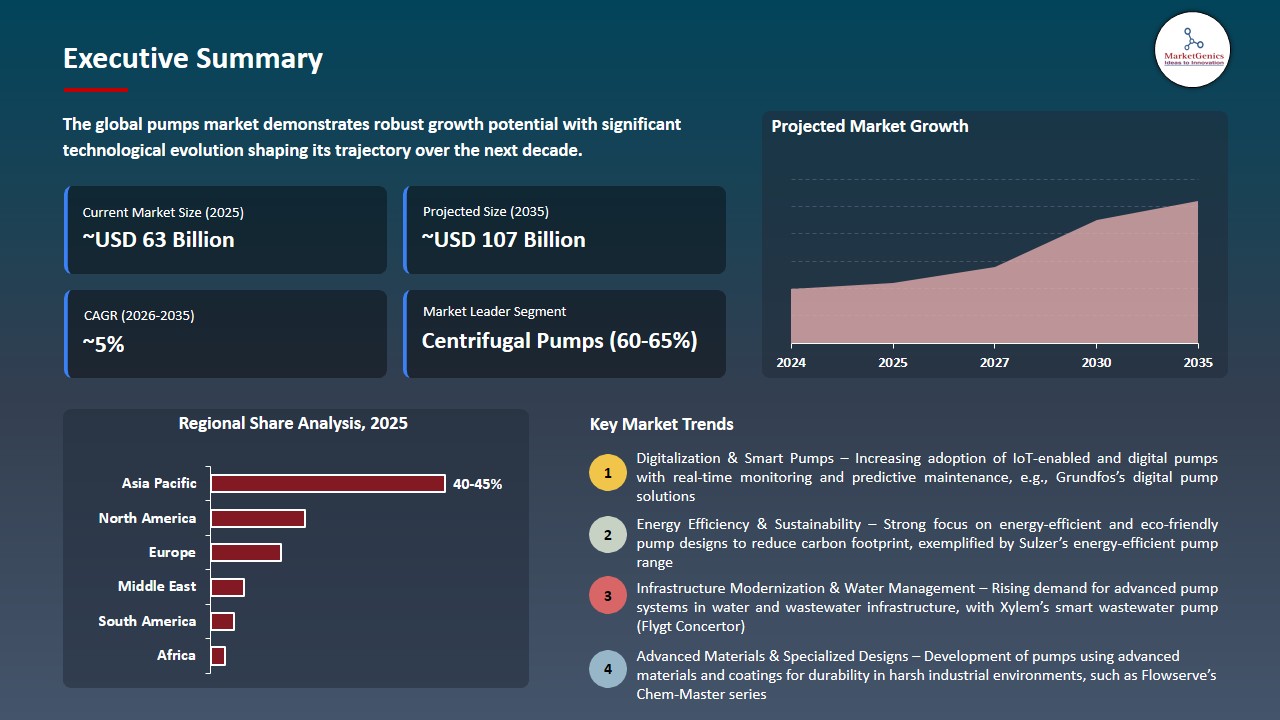
The global pumps market is witnessing strong growth, valued at USD 63.3 billion in 2025 and projected to reach USD 107.1 billion by 2035, expanding at a CAGR of 5.4% during the forecast period. North America is the fastest-growing region in the pumps market due to increasing investments in infrastructure upgrades, adoption of energy-efficient and smart pumping technologies, stringent environmental regulations, and rising demand for reliable water supply, wastewater management, and industrial fluid handling solutions.
Bruno Antoniassi, Senior Manager of Sales and Application Engineering at Sulzer Brazil, said, “Prior to deployment, we will manufacture the pumps and integrate them here in Brazil, then carry out testing at full power. Following that, we will assist in installation, commissioning, and site integration tests. Once in the field, our team is ready to provide local aftermarket engineering support for the next 30 years in operation”.
The increasing frequency of people facing extreme weather conditions and environment needs of changing climate makes the dewatering and flood-control systems demandable and thus it is among the key influencers of the pumps market. The pumps installed in the city, buildings and industrial facilities must be robust and have high capacity to manage the storm water, prevent flooding as well as preserve infrastructure. This is growing the rate of adoption of advanced pumping systems that are reactive and which are capable of running continuously even in the stringent operating environments.
The utilization of smart and connected pumps is one of the primary opportunities of the pumps market. The IoT sensors, predictive maintenance and remote monitoring enables real-time performance monitoring, early fault-detection and less downtime and end-users can lower the lifecycle costs. The trend presents opportunities to manufacturers of the recurring revenue through digital timing and analytics and subscriptions-based maintenance and ensuring the growing need to seek an efficient, reliable and technology-based pumping solution.
The adjacent opportunities in the pumps market include retrofit and upgrade of the older pump infrastructure, taking up of energy-efficient and VFD-enabled pumps, smart and connected solutions of the pumps, expansion of the market in emerging areas with increasing water and industrial demands, and specialized solutions to desalination, wastewater reuse, and oil field water management to sustainability, operational efficiency, and recurring service-based income streams.
Pumps Market Dynamics and Trends
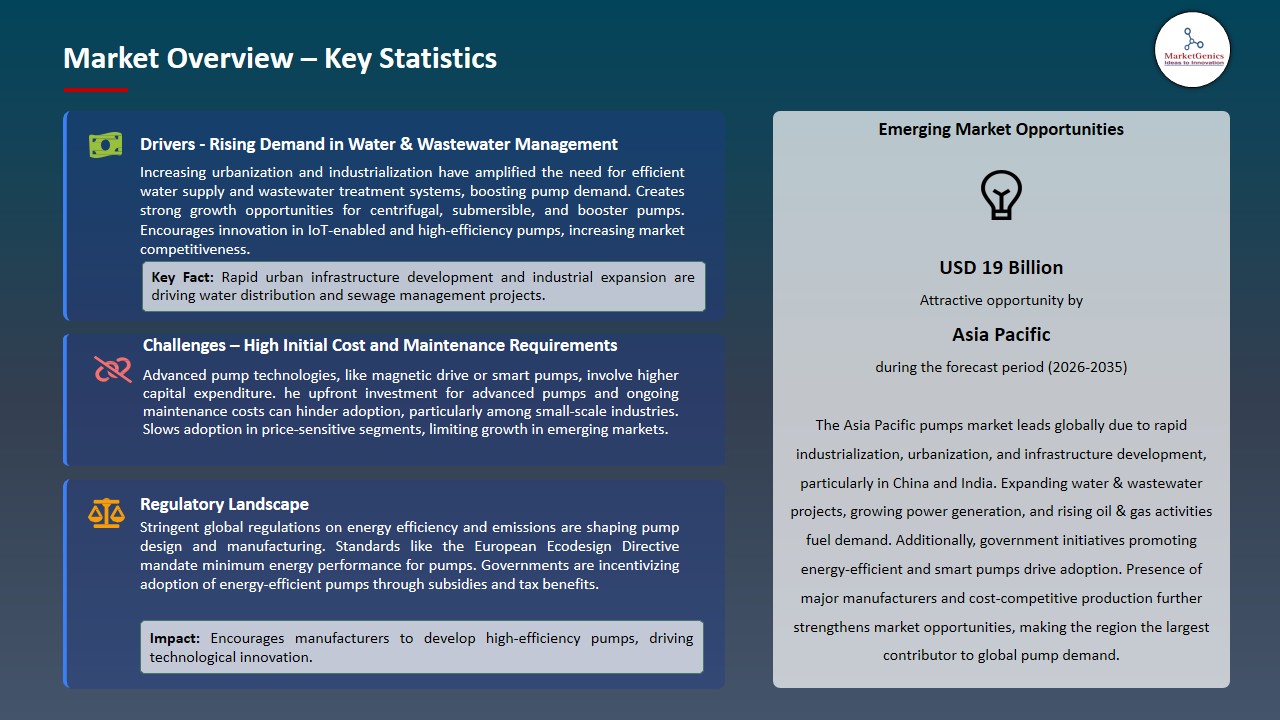
Driver: Oil & Gas Expansion and Water Management Needs Fuel Sustained Demand for High-Performance Pumps
-
Oil and gas production is a major contributor to pump market growth as the upstream, downstream, and midstream oil and gas operations rely on effective pumping system to facilitate the delicate transportation of fluids. Centrifugal and transfer pumps required in the centrifugal and transfer of crude oil, handling of the produced water, injection processes, and refinery operations are growing faster because of the increased drilling and the growth of the economy in the oil recovery projects.
- The growing concern about water management of oilfields like separation, treatment and reinjection of produced water other increases the rapid acceptance of pumps. Moreover, the expansion of the pipeline networks, storage facilities, and LNG facilities require the high capacity, which is not susceptible to corrosion pumps, capable of operating at high pressure and temperatures under the conditions of which the market is formed in general.
- Seatrium selected Sulzer to supply large offshore oil and gas projects with the P-84 and P-85 FPSO vessels of Petrobras with high-capacity, energy-efficient, water injection pump packages in November 2025, which again supports high demand of high-capacity, energy-efficient pumps.
- The expansion of oil and gas business, the increasing interest of efficient fluid and water management, and the constant construction of infrastructure are subjecting continuous pressure to the robust and high-performance pumps all over the world energy market.
Restraint: Supply-Chain Disruptions and Extended Lead Times Constrain Pumps Market Growth
-
Supply-chain disruptions, is a major limitation to pumps market is that manufacturers continue to face delays in getting key components of the product such as motors, bearings, castings, seals and electronic control systems. Dependence on the global supplier chain and the scarcity of the specialized raw materials, which are also likely to extend the production process, makes the pump OEMs fail to deliver their products within their delivery schedules as promised.
- Longer lead times directly impact on raising the project risk to the end users particularly in large infrastructure, industrial, and energy projects where the pumps are mission-critical equipment. To avoid delays and raise the working capital requirements and costs of storage, buyers and distributors are forced to maintain high levels of stock.
- Besides, logistics and component prices can vary and affect the profit margins of the manufacturers in question, causing uncertainty in the market budgets of the projects, which in turn hinders the pace of order execution and decreases the market expansion on the whole.
- All these combined with persistent supply-chain crises, lengthy lead-times, and unstable pricing are increasing risk of projects and the cost of operations, thus limiting deliveries in time and growth in the global pumps market.
Opportunity: Rising Adoption of VFD Pumps Drives Energy Efficiency and Market Growth
-
The expansion of the global pumps market is a significant opportunity in the transition of the pumps to the variable-frequency drive (VFD) pumps. VFD technology allows the pumps to be run in the optimum that the pumps require running and this is useful in maximizing energy efficiency, low cost of electricity, and mechanical wear to minimum.
- Growth in the prices of energy and tighter efficiency regulations globally are also forcing industries, cities, and commercial buildings to consider VFD-based pumping systems. The trend gives the manufacturers an opportunity to offer the market energy efficient pumps, give them the opportunity to connect with smart control systems and offer value added services such as monitoring and maintenance.
- Grundfos revealed the CUE 120 variable frequency drive (VFD) in India in April 2025, which was developed to utilize to the maximum the performance of pumps by the capacity to offer control in the precise speed and add the additional energy-efficiency. The CUE 120, which is compatible with a huge range of Grundfos pumps, will decrease the operating cost, energy consumption and permit sustainable pumping in the industrial, municipal and commercial applications, demonstrating the feasible application of the VFD technology to achieve the rising efficiency and environmental demands.
- Implementation of VFD pumps will not only help in achieving the sustainability targets by the end users, but also increase the market growth by participating in technology upgrades and retrofits.
Key Trend: Industry-Specific, High-Performance Pumps Drives Innovation
-
The increasing complexity and specialization of industrial processes is pushing the need of industry-specific, high-performance pumps and this is a major trend in the pumps market. Oil and gas, chemical processing, desalination, and wastewater treatment industries are among the industries that need pumps, which are resistant to corrosion, with high pressure capabilities, and designed to operate with a particular fluid or at a specific operating condition.
- Tailored pump applications are better in terms of reliability, safety, and efficiency in operations at the cost of decreased maintenance and downtime. With the industries implementing more demanding environment and safety laws, the demand of customized pumping systems is still on the increase.
- Flowserve Corporation introduced the INNOMAG TB-MAG Dual Drive Pump, the first sealless pump in the world with true secondary containment, in March 2025, to use in chemical and industrial plants to handle hazardous chemicals. Having double hermetic sealing, improved corrosion and the removal of leaks, the pump is a new standard in safety and environmental protection, responding to the increased demand of the high performance and industry specific pumping solutions in the need of critical fluid handling.
- This trend spurs pump manufacturers to invest in research and development and high-technology engineering, providing product specialization to fulfill even the most demanding industrial needs and sustain long operation in harsh settings.
Pumps-Market Analysis and Segmental Data
Centrifugal Pumps Dominate Global Pumps Market
-
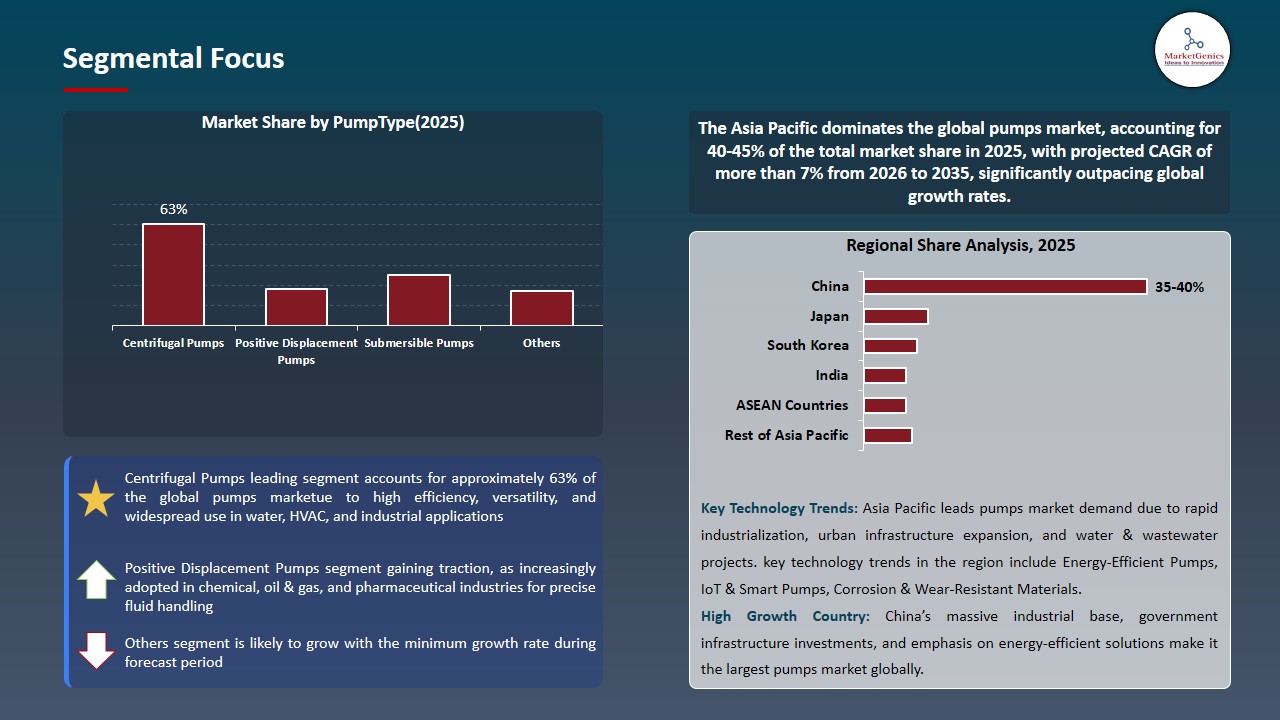
Centrifugal pumps continue to dominate the global pumps market due to their versatility, efficiency, and wide range of applications across industries. The pumps are widely applicable in water and wastewater, oil and gas, chemical processing, power generation and industrial manufacturing where they offer dependable fluid transportation in both low-pressure and high-pressure applications. They are easy to maintain, easy to adjust due to their simple design and are effective in the handling of high amounts of liquid.
- Moreover, increasing energy efficiency and smart centrifugal pump usage, with IoT-enabled monitoring and variable-frequency drive (VFD) options, is also contributing to adoption. The industrial growth, urban infrastructure and water management requirement contribute to the centrifugal pumps to emerge as the dominant segment of the global market environment.
- Sulzer introduced the Energy Optimization Service to centrifugal pumps in 2025, a mix of digital analysis, machine learning, and continuous monitoring to enhance the energy efficiency of centrifugal pumps, carbon emissions, and reduce the operational costs of the energy-intensive business domain. An experimental project in Spain proved savings of 1 million a year and more than 2300 tonnes of CO2 by increasing pump efficiency by 72 to 83 percent, which shows the effectiveness of the advanced pump lifecycle optimization.
- Centrifugal pumps still dominate the world pumps market and energy efficiency and intelligent technologies have been innovated to ensure continued usage and optimization of operation.
Asia Pacific Leads Global Pumps Market Demand
-
The Asia Pacific region is leading the global pumps market due to rapid urbanization, industrialization, and infrastructure expansion. Countries such as China, India, Japan, and South Korea are investing heavily in water supply, wastewater treatment, irrigation, and energy projects, driving demand for high-capacity, reliable pump systems. Growth in manufacturing, chemical, and oil & gas industries further fuels the adoption of industrial, centrifugal, submersible, and specialty pumps, along with energy-efficient and smart pumping solutions.
- Increasing population and government initiatives for sustainable water management are accelerating the deployment of municipal, wastewater, and desalination pumps. Simultaneously, industries are adopting IoT-enabled pumps, digital monitoring, and variable-frequency drives (VFDs) to optimize energy usage and reduce operational costs.
- In September 2025, Flowserve Corporation received U.S. Department of Energy approval to manufacture safety-critical nuclear reactor pumps at its Coimbatore, India facility in collaboration with Core Energy Systems. This milestone supports India’s expanding nuclear capacity and demonstrates the growing demand for mission-critical, high-performance pumps in Asia Pacific.
- These combined factors position Asia Pacific as the leading contributor to growth in the global pumps market.
Pumps-Market Ecosystem
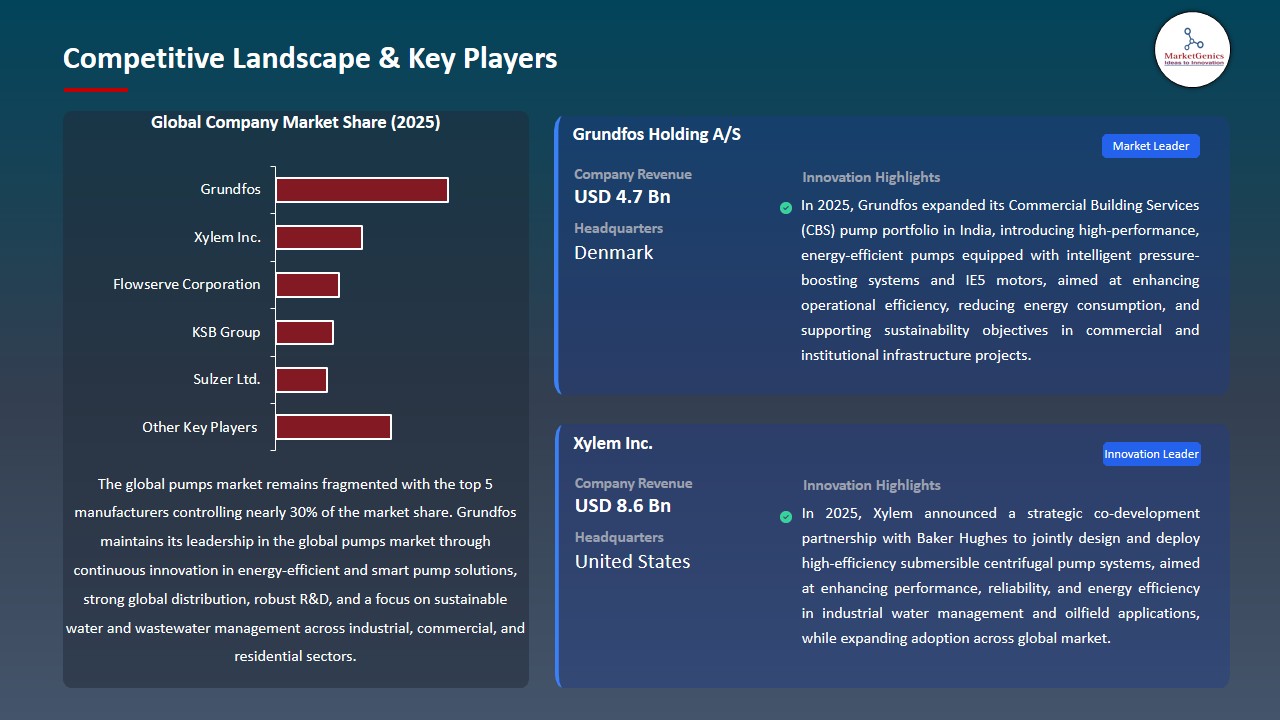
The global pumps market is fragmented, with leading players including Grundfos, Xylem Inc., Flowserve Corporation, KSB Group, and Sulzer Ltd. These companies maintain competitive advantages through high-efficiency pump designs, IoT-enabled monitoring, smart and digital pumping solutions, energy-efficient variable-frequency drives, corrosion-resistant and high-pressure pumps, and advanced automation for industrial, water, and oil & gas applications.
The market value chain encompasses the design and R&D of pumps, manufacturing of centrifugal, submersible, and specialty pumps, development of smart and IoT-enabled control systems, testing and calibration, deployment across municipal, industrial, and commercial applications, compliance with environmental and safety standards, and after-sales support including predictive maintenance, remote monitoring, and performance optimization.
Entry barriers remain high due to the capital-intensive nature of pump manufacturing, technical expertise required for advanced and smart pump systems, customization for diverse industrial and water applications, and strict adherence to efficiency and regulatory standards.
Ongoing technological innovations, such as IoT-connected pumps, AI-driven predictive maintenance, energy-efficient VFD pumps, corrosion- and chemical-resistant designs, and integration with digital water and industrial management platforms, continue to drive differentiation and adoption globally.
Recent Development and Strategic Overview:
-
In July 2025, Grundfos joined the ALLICE Alliance to accelerate industrial decarbonization through the "water-energy nexus" concept. Leveraging its smart pumps and water solutions, Grundfos promotes industrial water reuse to reduce energy and water consumption, cut costs, and enhance operational resilience. The initiative highlights the company’s role in delivering intelligent, sustainable pumping solutions that generate long-term efficiency and environmental benefits for industrial clients.
- In June 2025, Honeywell completed the $2.16 billion acquisition of Sundyne, a leading manufacturer of highly engineered, corrosion-resistant pumps for refining, petrochemicals, LNG, and clean fuels. The acquisition expands Honeywell’s portfolio of specialized pump solutions, enhances aftermarket services, and integrates critical equipment with Honeywell Forge IoT capabilities, demonstrating strong demand for custom-engineered, high-performance pumps in complex industrial applications.
Report Scope
|
Detail |
|
|
Market Size in 2025 |
USD 63.3 Bn |
|
Market Forecast Value in 2035 |
USD 107.1 Bn |
|
Growth Rate (CAGR) |
5.4% |
|
Forecast Period |
2026 – 2035 |
|
Historical Data Available for |
2021 – 2024 |
|
Market Size Units |
US$ Billion for Value Thousand Units for Volume |
|
Report Format |
Electronic (PDF) + Excel |
|
North America |
Europe |
Asia Pacific |
Middle East |
Africa |
South America |
|
|
|
|
|
|
|
Companies Covered |
|||||
|
|
|
|
|
|
Pumps-Market Segmentation and Highlights
|
Segment |
Sub-segment |
|
Pumps Market, By Pump Type |
|
|
Pumps Market, By Technology |
|
|
Pumps Market, By Power Rating |
|
|
Pumps Market, By Material of Construction |
|
|
Pumps Market, By Operation Mode |
|
|
Pumps Market, By Discharge Pressure |
|
|
Pumps Market, By Flow Rate Capacity |
|
|
Pumps Market, By Mounting Type |
|
|
Pumps Market, By Stage Type |
|
|
Pumps Market, By Distribution Channel |
|
|
Pumps Market, By End-use Industry X Application |
|
Frequently Asked Questions
Table of Contents
- 1. Research Methodology and Assumptions
- 1.1. Definitions
- 1.2. Research Design and Approach
- 1.3. Data Collection Methods
- 1.4. Base Estimates and Calculations
- 1.5. Forecasting Models
- 1.5.1. Key Forecast Factors & Impact Analysis
- 1.6. Secondary Research
- 1.6.1. Open Sources
- 1.6.2. Paid Databases
- 1.6.3. Associations
- 1.7. Primary Research
- 1.7.1. Primary Sources
- 1.7.2. Primary Interviews with Stakeholders across Ecosystem
- 2. Executive Summary
- 2.1. Global Pumps Market Outlook
- 2.1.1. Pumps Market Size Volume (Thousand Units) and Value (US$ Bn), and Forecasts, 2021-2035
- 2.1.2. Compounded Annual Growth Rate Analysis
- 2.1.3. Growth Opportunity Analysis
- 2.1.4. Segmental Share Analysis
- 2.1.5. Geographical Share Analysis
- 2.2. Market Analysis and Facts
- 2.3. Supply-Demand Analysis
- 2.4. Competitive Benchmarking
- 2.5. Go-to- Market Strategy
- 2.5.1. Customer/ End-use Industry Assessment
- 2.5.2. Growth Opportunity Data, 2026-2035
- 2.5.2.1. Regional Data
- 2.5.2.2. Country Data
- 2.5.2.3. Segmental Data
- 2.5.3. Identification of Potential Market Spaces
- 2.5.4. GAP Analysis
- 2.5.5. Potential Attractive Price Points
- 2.5.6. Prevailing Market Risks & Challenges
- 2.5.7. Preferred Sales & Marketing Strategies
- 2.5.8. Key Recommendations and Analysis
- 2.5.9. A Way Forward
- 2.1. Global Pumps Market Outlook
- 3. Industry Data and Premium Insights
- 3.1. Global Industrial Machinery Overview, 2025
- 3.1.1. Industrial Machinery Ecosystem Analysis
- 3.1.2. Key Trends for Industrial Machinery
- 3.1.3. Regional Distribution for Industrial Machinery
- 3.2. Supplier Customer Data
- 3.3. Technology Roadmap and Developments
- 3.4. Trade Analysis
- 3.4.1. Import & Export Analysis, 2025
- 3.4.2. Top Importing Countries
- 3.4.3. Top Exporting Countries
- 3.5. Trump Tariff Impact Analysis
- 3.5.1. Manufacturer
- 3.5.1.1. Based on the component & Raw material
- 3.5.2. Supply Chain
- 3.5.3. End Consumer
- 3.5.1. Manufacturer
- 3.6. Raw Material Analysis
- 3.1. Global Industrial Machinery Overview, 2025
- 4. Market Overview
- 4.1. Market Dynamics
- 4.1.1. Drivers
- 4.1.1.1. Rapid industrialization and infrastructure development increasing pump demand across industries.
- 4.1.1.2. Rising adoption of energy-efficient and smart pump technologies.
- 4.1.1.3. Growing need for water and wastewater management solutions.
- 4.1.2. Restraints
- 4.1.2.1. High initial investment and maintenance costs.
- 4.1.2.2. Volatile raw material prices and regulatory compliance challenges.
- 4.1.1. Drivers
- 4.2. Key Trend Analysis
- 4.3. Regulatory Framework
- 4.3.1. Key Regulations, Norms, and Subsidies, by Key Countries
- 4.3.2. Tariffs and Standards
- 4.3.3. Impact Analysis of Regulations on the Market
- 4.4. Value Chain Analysis
- 4.4.1. Raw Material & Component Suppliers
- 4.4.2. Pump Manufacturers
- 4.4.3. Distribution & Sales Channels
- 4.4.4. End-Use Industries
- 4.5. Cost Structure Analysis
- 4.6. Pricing Analysis
- 4.7. Porter’s Five Forces Analysis
- 4.8. PESTEL Analysis
- 4.9. Global Pumps Market Demand
- 4.9.1. Historical Market Size – Volume (Thousand Units) and Value (US$ Bn), 2020-2024
- 4.9.2. Current and Future Market Size – Volume (Thousand Units) and Value (US$ Bn), 2026–2035
- 4.9.2.1. Y-o-Y Growth Trends
- 4.9.2.2. Absolute $ Opportunity Assessment
- 4.1. Market Dynamics
- 5. Competition Landscape
- 5.1. Competition structure
- 5.1.1. Fragmented v/s consolidated
- 5.2. Company Share Analysis, 2025
- 5.2.1. Global Company Market Share
- 5.2.2. By Region
- 5.2.2.1. North America
- 5.2.2.2. Europe
- 5.2.2.3. Asia Pacific
- 5.2.2.4. Middle East
- 5.2.2.5. Africa
- 5.2.2.6. South America
- 5.3. Product Comparison Matrix
- 5.3.1. Specifications
- 5.3.2. Market Positioning
- 5.3.3. Pricing
- 5.1. Competition structure
- 6. Global Pumps Market Analysis, by Pump Type
- 6.1. Key Segment Analysis
- 6.2. Pumps Market Size Volume (Thousand Units) and Value (US$ Bn), Analysis, and Forecasts, by Pump Type, 2021-2035
- 6.2.1. Centrifugal Pumps
- 6.2.1.1. Single-stage Centrifugal Pumps
- 6.2.1.2. Multi-stage Centrifugal Pumps
- 6.2.1.3. Axial Flow Pumps
- 6.2.1.4. Radial Flow Pumps
- 6.2.1.5. Others
- 6.2.2. Positive Displacement Pumps
- 6.2.2.1. Rotary Pumps
- 6.2.2.1.1. Gear Pumps
- 6.2.2.1.2. Screw Pumps
- 6.2.2.1.3. Vane Pumps
- 6.2.2.1.4. Lobe Pumps
- 6.2.2.1.5. Progressive Cavity Pumps
- 6.2.2.1.6. Others
- 6.2.2.2. Reciprocating Pumps
- 6.2.2.2.1. Piston Pumps
- 6.2.2.2.2. Plunger Pumps
- 6.2.2.2.3. Diaphragm Pumps
- 6.2.2.2.4. Others
- 6.2.2.1. Rotary Pumps
- 6.2.3. Submersible Pumps
- 6.2.4. Vacuum Pumps
- 6.2.5. Slurry Pumps
- 6.2.6. Others
- 6.2.1. Centrifugal Pumps
- 7. Global Pumps Market Analysis, by Component
- 7.1. Key Segment Analysis
- 7.2. Pumps Market Size Volume (Thousand Units) and Value (US$ Bn), Analysis, and Forecasts, by Technology, 2021-2035
- 7.2.1. Conventional Pumps
- 7.2.2. Smart Pumps
- 7.2.3. Solar-powered Pumps
- 7.2.4. Magnetic Drive Pumps
- 7.2.5. Sealless Pumps
- 7.2.6. Others
- 8. Global Pumps Market Analysis, by Power Rating
- 8.1. Key Segment Analysis
- 8.2. Pumps Market Size Volume (Thousand Units) and Value (US$ Bn), Analysis, and Forecasts, by Power Rating, 2021-2035
- 8.2.1. Up to 5 HP
- 8.2.2. 5-75 HP
- 8.2.3. 75-300 HP
- 8.2.4. Above 300 HP
- 9. Global Pumps Market Analysis, by Material of Construction
- 9.1. Key Segment Analysis
- 9.2. Pumps Market Size Volume (Thousand Units) and Value (US$ Bn), Analysis, and Forecasts, by Material of Construction, 2021-2035
- 9.2.1. Cast Iron
- 9.2.2. Stainless Steel
- 9.2.3. Bronze
- 9.2.4. Plastic/Polymer
- 9.2.5. Alloy Steel
- 9.2.6. Titanium
- 9.2.7. Other Exotic Materials
- 10. Global Pumps Market Analysis, by Operation Mode
- 10.1. Key Segment Analysis
- 10.2. Pumps Market Size Volume (Thousand Units) and Value (US$ Bn), Analysis, and Forecasts, by Operation Mode, 2021-2035
- 10.2.1. Electric Motor Driven
- 10.2.2. Diesel Engine Driven
- 10.2.3. Hydraulic Driven
- 10.2.4. Pneumatic Driven
- 10.2.5. Manual Operated
- 10.2.6. Solar Powered
- 11. Global Pumps Market Analysis, by Discharge Pressure
- 11.1. Key Segment Analysis
- 11.2. Pumps Market Size Volume (Thousand Units) and Value (US$ Bn), Analysis, and Forecasts, by Discharge Pressure, 2021-2035
- 11.2.1. Up to 100 PSI
- 11.2.2. 100-500 PSI
- 11.2.3. 500-1500 PSI
- 11.2.4. Above 1500 PSI
- 12. Global Pumps Market Analysis, by Flow Rate Capacity
- 12.1. Key Segment Analysis
- 12.2. Pumps Market Size Volume (Thousand Units) and Value (US$ Bn), Analysis, and Forecasts, by Flow Rate Capacity, 2021-2035
- 12.2.1. Up to 100 GPM
- 12.2.2. 100-500 GPM
- 12.2.3. 500-2000 GPM
- 12.2.4. Above 2000 GPM
- 13. Global Pumps Market Analysis and Forecasts, by Mounting Type
- 13.1. Key Findings
- 13.2. Pumps Market Size Volume (Thousand Units) and Value (US$ Bn), Analysis, and Forecasts, by Mounting Type, 2021-2035
- 13.2.1. Horizontal Pumps
- 13.2.2. Vertical Pumps
- 13.2.3. Inline Pumps
- 13.2.4. Close-coupled Pumps
- 13.2.5. Long-coupled Pumps
- 14. Global Pumps Market Analysis and Forecasts, by Stage Type
- 14.1. Key Findings
- 14.2. Pumps Market Size Volume (Thousand Units) and Value (US$ Bn), Analysis, and Forecasts, by Stage Type, 2021-2035
- 14.2.1. Single Stage
- 14.2.2. Two Stage
- 14.2.3. Multi-stage
- 15. Global Pumps Market Analysis and Forecasts, by Distribution Channel
- 15.1. Key Findings
- 15.2. Pumps Market Size Volume (Thousand Units) and Value (US$ Bn), Analysis, and Forecasts, by Distribution Channel, 2021-2035
- 15.2.1. Direct Sales
- 15.2.2. Distributors
- 15.2.3. Online Channels
- 15.2.4. Aftermarket Services
- 16. Global Pumps Market Analysis and Forecasts, by End-use Industry X Application
- 16.1. Key Findings
- 16.2. Pumps Market Size Volume (Thousand Units) and Value (US$ Bn), Analysis, and Forecasts, by End-use Industry X Application, 2021-2035
- 16.2.1. Water & Wastewater
- 16.2.1.1. Municipal Water Supply
- 16.2.1.2. Wastewater Treatment
- 16.2.1.3. Desalination
- 16.2.1.4. Water Recycling
- 16.2.1.5. Irrigation Systems
- 16.2.1.6. Drainage Systems
- 16.2.1.7. Others
- 16.2.2. Oil & Gas
- 16.2.2.1. Upstream Operations (Drilling, Well Services)
- 16.2.2.2. Midstream Operations (Pipeline Transportation)
- 16.2.2.3. Downstream Operations (Refining, Petrochemicals)
- 16.2.2.4. Enhanced Oil Recovery
- 16.2.2.5. LNG Processing
- 16.2.2.6. Offshore Platforms
- 16.2.2.7. Others
- 16.2.3. Power Generation
- 16.2.3.1. Thermal Power Plants (Coal, Gas)
- 16.2.3.2. Nuclear Power Plants
- 16.2.3.3. Hydroelectric Power
- 16.2.3.4. Renewable Energy (Solar, Wind, Geothermal)
- 16.2.3.5. Cooling Water Circulation
- 16.2.3.6. Boiler Feed Systems
- 16.2.3.7. Others
- 16.2.4. Chemical & Petrochemical
- 16.2.4.1. Chemical Processing
- 16.2.4.2. Petrochemical Production
- 16.2.4.3. Polymer Manufacturing
- 16.2.4.4. Fertilizer Production
- 16.2.4.5. Specialty Chemicals
- 16.2.4.6. Acid & Caustic Handling
- 16.2.4.7. Others
- 16.2.5. Agriculture
- 16.2.5.1. Crop Irrigation
- 16.2.5.2. Livestock Water Supply
- 16.2.5.3. Fertilizer & Pesticide Application
- 16.2.5.4. Drainage Systems
- 16.2.5.5. Aquaculture
- 16.2.5.6. Greenhouse Operations
- 16.2.5.7. Others
- 16.2.6. Construction & Mining
- 16.2.6.1. Dewatering Operations
- 16.2.6.2. Slurry Handling
- 16.2.6.3. Concrete Pumping
- 16.2.6.4. Mine Drainage
- 16.2.6.5. Mineral Processing
- 16.2.6.6. Construction Site Water Supply
- 16.2.6.7. Others
- 16.2.7. Pharmaceutical & Biotechnology
- 16.2.7.1. API Manufacturing
- 16.2.7.2. Sterile Processing
- 16.2.7.3. Clean-in-Place (CIP) Systems
- 16.2.7.4. Bioreactor Operations
- 16.2.7.5. Formulation & Packaging
- 16.2.7.6. Laboratory Applications
- 16.2.7.7. Others
- 16.2.8. Food & Beverage
- 16.2.8.1. Food Processing
- 16.2.8.2. Beverage Production
- 16.2.8.3. Dairy Processing
- 16.2.8.4. Brewing & Distilling
- 16.2.8.5. Sanitary Applications
- 16.2.8.6. Clean-in-Place Systems
- 16.2.8.7. Others
- 16.2.9. Pulp & Paper
- 16.2.9.1. Pulp Processing
- 16.2.9.2. Paper Manufacturing
- 16.2.9.3. Stock Preparation
- 16.2.9.4. White Water Handling
- 16.2.9.5. Chemical Recovery
- 16.2.9.6. Wastewater Treatment
- 16.2.9.7. Others
- 16.2.10. HVAC (Heating, Ventilation, Air Conditioning)
- 16.2.10.1. Heating Systems
- 16.2.10.2. Cooling Systems
- 16.2.10.3. Chilled Water Circulation
- 16.2.10.4. Hot Water Circulation
- 16.2.10.5. District Heating/Cooling
- 16.2.10.6. Geothermal Systems
- 16.2.10.7. Others
- 16.2.11. Marine & Shipbuilding
- 16.2.11.1. Ballast Water Management
- 16.2.11.2. Cargo Handling
- 16.2.11.3. Bilge Pumping
- 16.2.11.4. Cooling Systems
- 16.2.11.5. Fire Fighting Systems
- 16.2.11.6. Seawater Desalination
- 16.2.11.7. Others
- 16.2.12. Automotive & Transportation
- 16.2.12.1. Fuel Transfer
- 16.2.12.2. Coolant Circulation
- 16.2.12.3. Oil Circulation
- 16.2.12.4. Hydraulic Systems
- 16.2.12.5. Fuel Stations
- 16.2.12.6. Car Wash Systems
- 16.2.12.7. Others
- 16.2.13. Building Services & Residential
- 16.2.13.1. Domestic Water Supply
- 16.2.13.2. Pressure Boosting
- 16.2.13.3. Sump & Sewage Pumping
- 16.2.13.4. Swimming Pool Circulation
- 16.2.13.5. Fountain & Water Features
- 16.2.13.6. Fire Protection Systems
- 16.2.13.7. Others
- 16.2.1. Water & Wastewater
- 17. Global Pumps Market Analysis and Forecasts, by Region
- 17.1. Key Findings
- 17.2. Pumps Market Size Volume (Thousand Units) and Value (US$ Bn), Analysis, and Forecasts, by Region, 2021-2035
- 17.2.1. North America
- 17.2.2. Europe
- 17.2.3. Asia Pacific
- 17.2.4. Middle East
- 17.2.5. Africa
- 17.2.6. South America
- 18. North America Pumps Market Analysis
- 18.1. Key Segment Analysis
- 18.2. Regional Snapshot
- 18.3. North America Pumps Market Size Volume (Thousand Units) and Value (US$ Bn), Analysis, and Forecasts, 2021-2035
- 18.3.1. Pump Type
- 18.3.2. Technology
- 18.3.3. Power Rating
- 18.3.4. Material of Construction
- 18.3.5. Operation Mode
- 18.3.6. Discharge Pressure
- 18.3.7. Flow Rate Capacity
- 18.3.8. Mounting Type
- 18.3.9. Stage Type
- 18.3.10. Distribution Channel
- 18.3.11. End-use Industry X Application
- 18.3.12. Country
- 18.3.12.1. USA
- 18.3.12.2. Canada
- 18.3.12.3. Mexico
- 18.4. USA Pumps Market
- 18.4.1. Country Segmental Analysis
- 18.4.2. Pump Type
- 18.4.3. Technology
- 18.4.4. Power Rating
- 18.4.5. Material of Construction
- 18.4.6. Operation Mode
- 18.4.7. Discharge Pressure
- 18.4.8. Flow Rate Capacity
- 18.4.9. Mounting Type
- 18.4.10. Stage Type
- 18.4.11. Distribution Channel
- 18.4.12. End-use Industry X Application
- 18.5. Canada Pumps Market
- 18.5.1. Country Segmental Analysis
- 18.5.2. Pump Type
- 18.5.3. Technology
- 18.5.4. Power Rating
- 18.5.5. Material of Construction
- 18.5.6. Operation Mode
- 18.5.7. Discharge Pressure
- 18.5.8. Flow Rate Capacity
- 18.5.9. Mounting Type
- 18.5.10. Stage Type
- 18.5.11. Distribution Channel
- 18.5.12. End-use Industry X Application
- 18.6. Mexico Pumps Market
- 18.6.1. Pump Type
- 18.6.2. Technology
- 18.6.3. Power Rating
- 18.6.4. Material of Construction
- 18.6.5. Operation Mode
- 18.6.6. Discharge Pressure
- 18.6.7. Flow Rate Capacity
- 18.6.8. Mounting Type
- 18.6.9. Stage Type
- 18.6.10. Distribution Channel
- 18.6.11. End-use Industry X Application
- 19. Europe Pumps Market Analysis
- 19.1. Key Segment Analysis
- 19.2. Regional Snapshot
- 19.3. Europe Pumps Market Size Volume (Thousand Units) and Value (US$ Bn), Analysis, and Forecasts, 2021-2035
- 19.3.1. Pump Type
- 19.3.2. Technology
- 19.3.3. Power Rating
- 19.3.4. Material of Construction
- 19.3.5. Operation Mode
- 19.3.6. Discharge Pressure
- 19.3.7. Flow Rate Capacity
- 19.3.8. Mounting Type
- 19.3.9. Stage Type
- 19.3.10. Distribution Channel
- 19.3.11. End-use Industry X Application
- 19.3.12. Country
- 19.3.12.1. Germany
- 19.3.12.2. United Kingdom
- 19.3.12.3. France
- 19.3.12.4. Italy
- 19.3.12.5. Spain
- 19.3.12.6. Netherlands
- 19.3.12.7. Nordic Countries
- 19.3.12.8. Poland
- 19.3.12.9. Russia & CIS
- 19.3.12.10. Rest of Europe
- 19.4. Germany Pumps Market
- 19.4.1. Country Segmental Analysis
- 19.4.2. Pump Type
- 19.4.3. Technology
- 19.4.4. Power Rating
- 19.4.5. Material of Construction
- 19.4.6. Operation Mode
- 19.4.7. Discharge Pressure
- 19.4.8. Flow Rate Capacity
- 19.4.9. Mounting Type
- 19.4.10. Stage Type
- 19.4.11. Distribution Channel
- 19.4.12. End-use Industry X Application
- 19.5. United Kingdom Pumps Market
- 19.5.1. Country Segmental Analysis
- 19.5.2. Pump Type
- 19.5.3. Technology
- 19.5.4. Power Rating
- 19.5.5. Material of Construction
- 19.5.6. Operation Mode
- 19.5.7. Discharge Pressure
- 19.5.8. Flow Rate Capacity
- 19.5.9. Mounting Type
- 19.5.10. Stage Type
- 19.5.11. Distribution Channel
- 19.5.12. End-use Industry X Application
- 19.6. France Pumps Market
- 19.6.1. Country Segmental Analysis
- 19.6.2. Pump Type
- 19.6.3. Technology
- 19.6.4. Power Rating
- 19.6.5. Material of Construction
- 19.6.6. Operation Mode
- 19.6.7. Discharge Pressure
- 19.6.8. Flow Rate Capacity
- 19.6.9. Mounting Type
- 19.6.10. Stage Type
- 19.6.11. Distribution Channel
- 19.6.12. End-use Industry X Application
- 19.7. Italy Pumps Market
- 19.7.1. Country Segmental Analysis
- 19.7.2. Pump Type
- 19.7.3. Technology
- 19.7.4. Power Rating
- 19.7.5. Material of Construction
- 19.7.6. Operation Mode
- 19.7.7. Discharge Pressure
- 19.7.8. Flow Rate Capacity
- 19.7.9. Mounting Type
- 19.7.10. Stage Type
- 19.7.11. Distribution Channel
- 19.7.12. End-use Industry X Application
- 19.8. Spain Pumps Market
- 19.8.1. Country Segmental Analysis
- 19.8.2. Pump Type
- 19.8.3. Technology
- 19.8.4. Power Rating
- 19.8.5. Material of Construction
- 19.8.6. Operation Mode
- 19.8.7. Discharge Pressure
- 19.8.8. Flow Rate Capacity
- 19.8.9. Mounting Type
- 19.8.10. Stage Type
- 19.8.11. Distribution Channel
- 19.8.12. End-use Industry X Application
- 19.9. Netherlands Pumps Market
- 19.9.1. Country Segmental Analysis
- 19.9.2. Pump Type
- 19.9.3. Technology
- 19.9.4. Power Rating
- 19.9.5. Material of Construction
- 19.9.6. Operation Mode
- 19.9.7. Discharge Pressure
- 19.9.8. Flow Rate Capacity
- 19.9.9. Mounting Type
- 19.9.10. Stage Type
- 19.9.11. Distribution Channel
- 19.9.12. End-use Industry X Application
- 19.10. Nordic Countries Pumps Market
- 19.10.1. Country Segmental Analysis
- 19.10.2. Pump Type
- 19.10.3. Technology
- 19.10.4. Power Rating
- 19.10.5. Material of Construction
- 19.10.6. Operation Mode
- 19.10.7. Discharge Pressure
- 19.10.8. Flow Rate Capacity
- 19.10.9. Mounting Type
- 19.10.10. Stage Type
- 19.10.11. Distribution Channel
- 19.10.12. End-use Industry X Application
- 19.11. Poland Pumps Market
- 19.11.1. Country Segmental Analysis
- 19.11.2. Pump Type
- 19.11.3. Technology
- 19.11.4. Power Rating
- 19.11.5. Material of Construction
- 19.11.6. Operation Mode
- 19.11.7. Discharge Pressure
- 19.11.8. Flow Rate Capacity
- 19.11.9. Mounting Type
- 19.11.10. Stage Type
- 19.11.11. Distribution Channel
- 19.11.12. End-use Industry X Application
- 19.12. Russia & CIS Pumps Market
- 19.12.1. Country Segmental Analysis
- 19.12.2. Pump Type
- 19.12.3. Technology
- 19.12.4. Power Rating
- 19.12.5. Material of Construction
- 19.12.6. Operation Mode
- 19.12.7. Discharge Pressure
- 19.12.8. Flow Rate Capacity
- 19.12.9. Mounting Type
- 19.12.10. Stage Type
- 19.12.11. Distribution Channel
- 19.12.12. End-use Industry X Application
- 19.13. Rest of Europe Pumps Market
- 19.13.1. Country Segmental Analysis
- 19.13.2. Pump Type
- 19.13.3. Technology
- 19.13.4. Power Rating
- 19.13.5. Material of Construction
- 19.13.6. Operation Mode
- 19.13.7. Discharge Pressure
- 19.13.8. Flow Rate Capacity
- 19.13.9. Mounting Type
- 19.13.10. Stage Type
- 19.13.11. Distribution Channel
- 19.13.12. End-use Industry X Application
- 20. Asia Pacific Pumps Market Analysis
- 20.1. Key Segment Analysis
- 20.2. Regional Snapshot
- 20.3. Asia Pacific Pumps Market Size Volume (Thousand Units) and Value (US$ Bn), Analysis, and Forecasts, 2021-2035
- 20.3.1. Pump Type
- 20.3.2. Technology
- 20.3.3. Power Rating
- 20.3.4. Material of Construction
- 20.3.5. Operation Mode
- 20.3.6. Discharge Pressure
- 20.3.7. Flow Rate Capacity
- 20.3.8. Mounting Type
- 20.3.9. Stage Type
- 20.3.10. Distribution Channel
- 20.3.11. End-use Industry X Application
- 20.3.12. Country
- 20.3.12.1. China
- 20.3.12.2. India
- 20.3.12.3. Japan
- 20.3.12.4. South Korea
- 20.3.12.5. Australia and New Zealand
- 20.3.12.6. Indonesia
- 20.3.12.7. Malaysia
- 20.3.12.8. Thailand
- 20.3.12.9. Vietnam
- 20.3.12.10. Rest of Asia Pacific
- 20.4. China Pumps Market
- 20.4.1. Country Segmental Analysis
- 20.4.2. Pump Type
- 20.4.3. Technology
- 20.4.4. Power Rating
- 20.4.5. Material of Construction
- 20.4.6. Operation Mode
- 20.4.7. Discharge Pressure
- 20.4.8. Flow Rate Capacity
- 20.4.9. Mounting Type
- 20.4.10. Stage Type
- 20.4.11. Distribution Channel
- 20.4.12. End-use Industry X Application
- 20.5. India Pumps Market
- 20.5.1. Country Segmental Analysis
- 20.5.2. Pump Type
- 20.5.3. Technology
- 20.5.4. Power Rating
- 20.5.5. Material of Construction
- 20.5.6. Operation Mode
- 20.5.7. Discharge Pressure
- 20.5.8. Flow Rate Capacity
- 20.5.9. Mounting Type
- 20.5.10. Stage Type
- 20.5.11. Distribution Channel
- 20.5.12. End-use Industry X Application
- 20.6. Japan Pumps Market
- 20.6.1. Country Segmental Analysis
- 20.6.2. Pump Type
- 20.6.3. Technology
- 20.6.4. Power Rating
- 20.6.5. Material of Construction
- 20.6.6. Operation Mode
- 20.6.7. Discharge Pressure
- 20.6.8. Flow Rate Capacity
- 20.6.9. Mounting Type
- 20.6.10. Stage Type
- 20.6.11. Distribution Channel
- 20.6.12. End-use Industry X Application
- 20.7. South Korea Pumps Market
- 20.7.1. Country Segmental Analysis
- 20.7.2. Pump Type
- 20.7.3. Technology
- 20.7.4. Power Rating
- 20.7.5. Material of Construction
- 20.7.6. Operation Mode
- 20.7.7. Discharge Pressure
- 20.7.8. Flow Rate Capacity
- 20.7.9. Mounting Type
- 20.7.10. Stage Type
- 20.7.11. Distribution Channel
- 20.7.12. End-use Industry X Application
- 20.8. Australia and New Zealand Pumps Market
- 20.8.1. Country Segmental Analysis
- 20.8.2. Pump Type
- 20.8.3. Technology
- 20.8.4. Power Rating
- 20.8.5. Material of Construction
- 20.8.6. Operation Mode
- 20.8.7. Discharge Pressure
- 20.8.8. Flow Rate Capacity
- 20.8.9. Mounting Type
- 20.8.10. Stage Type
- 20.8.11. Distribution Channel
- 20.8.12. End-use Industry X Application
- 20.9. Indonesia Pumps Market
- 20.9.1. Country Segmental Analysis
- 20.9.2. Pump Type
- 20.9.3. Technology
- 20.9.4. Power Rating
- 20.9.5. Material of Construction
- 20.9.6. Operation Mode
- 20.9.7. Discharge Pressure
- 20.9.8. Flow Rate Capacity
- 20.9.9. Mounting Type
- 20.9.10. Stage Type
- 20.9.11. Distribution Channel
- 20.9.12. End-use Industry X Application
- 20.10. Malaysia Pumps Market
- 20.10.1. Country Segmental Analysis
- 20.10.2. Pump Type
- 20.10.3. Technology
- 20.10.4. Power Rating
- 20.10.5. Material of Construction
- 20.10.6. Operation Mode
- 20.10.7. Discharge Pressure
- 20.10.8. Flow Rate Capacity
- 20.10.9. Mounting Type
- 20.10.10. Stage Type
- 20.10.11. Distribution Channel
- 20.10.12. End-use Industry X Application
- 20.11. Thailand Pumps Market
- 20.11.1. Country Segmental Analysis
- 20.11.2. Pump Type
- 20.11.3. Technology
- 20.11.4. Power Rating
- 20.11.5. Material of Construction
- 20.11.6. Operation Mode
- 20.11.7. Discharge Pressure
- 20.11.8. Flow Rate Capacity
- 20.11.9. Mounting Type
- 20.11.10. Stage Type
- 20.11.11. Distribution Channel
- 20.11.12. End-use Industry X Application
- 20.12. Vietnam Pumps Market
- 20.12.1. Country Segmental Analysis
- 20.12.2. Pump Type
- 20.12.3. Technology
- 20.12.4. Power Rating
- 20.12.5. Material of Construction
- 20.12.6. Operation Mode
- 20.12.7. Discharge Pressure
- 20.12.8. Flow Rate Capacity
- 20.12.9. Mounting Type
- 20.12.10. Stage Type
- 20.12.11. Distribution Channel
- 20.12.12. End-use Industry X Application
- 20.13. Rest of Asia Pacific Pumps Market
- 20.13.1. Country Segmental Analysis
- 20.13.2. Pump Type
- 20.13.3. Technology
- 20.13.4. Power Rating
- 20.13.5. Material of Construction
- 20.13.6. Operation Mode
- 20.13.7. Discharge Pressure
- 20.13.8. Flow Rate Capacity
- 20.13.9. Mounting Type
- 20.13.10. Stage Type
- 20.13.11. Distribution Channel
- 20.13.12. End-use Industry X Application
- 21. Middle East Pumps Market Analysis
- 21.1. Key Segment Analysis
- 21.2. Regional Snapshot
- 21.3. Middle East Pumps Market Size Volume (Thousand Units) and Value (US$ Bn), Analysis, and Forecasts, 2021-2035
- 21.3.1. Pump Type
- 21.3.2. Technology
- 21.3.3. Power Rating
- 21.3.4. Material of Construction
- 21.3.5. Operation Mode
- 21.3.6. Discharge Pressure
- 21.3.7. Flow Rate Capacity
- 21.3.8. Mounting Type
- 21.3.9. Stage Type
- 21.3.10. Distribution Channel
- 21.3.11. End-use Industry X Application
- 21.3.12. Country
- 21.3.12.1. Turkey
- 21.3.12.2. UAE
- 21.3.12.3. Saudi Arabia
- 21.3.12.4. Israel
- 21.3.12.5. Rest of Middle East
- 21.4. Turkey Pumps Market
- 21.4.1. Country Segmental Analysis
- 21.4.2. Pump Type
- 21.4.3. Technology
- 21.4.4. Power Rating
- 21.4.5. Material of Construction
- 21.4.6. Operation Mode
- 21.4.7. Discharge Pressure
- 21.4.8. Flow Rate Capacity
- 21.4.9. Mounting Type
- 21.4.10. Stage Type
- 21.4.11. Distribution Channel
- 21.4.12. End-use Industry X Application
- 21.5. UAE Pumps Market
- 21.5.1. Country Segmental Analysis
- 21.5.2. Pump Type
- 21.5.3. Technology
- 21.5.4. Power Rating
- 21.5.5. Material of Construction
- 21.5.6. Operation Mode
- 21.5.7. Discharge Pressure
- 21.5.8. Flow Rate Capacity
- 21.5.9. Mounting Type
- 21.5.10. Stage Type
- 21.5.11. Distribution Channel
- 21.5.12. End-use Industry X Application
- 21.6. Saudi Arabia Pumps Market
- 21.6.1. Country Segmental Analysis
- 21.6.2. Pump Type
- 21.6.3. Technology
- 21.6.4. Power Rating
- 21.6.5. Material of Construction
- 21.6.6. Operation Mode
- 21.6.7. Discharge Pressure
- 21.6.8. Flow Rate Capacity
- 21.6.9. Mounting Type
- 21.6.10. Stage Type
- 21.6.11. Distribution Channel
- 21.6.12. End-use Industry X Application
- 21.7. Israel Pumps Market
- 21.7.1. Country Segmental Analysis
- 21.7.2. Pump Type
- 21.7.3. Technology
- 21.7.4. Power Rating
- 21.7.5. Material of Construction
- 21.7.6. Operation Mode
- 21.7.7. Discharge Pressure
- 21.7.8. Flow Rate Capacity
- 21.7.9. Mounting Type
- 21.7.10. Stage Type
- 21.7.11. Distribution Channel
- 21.7.12. End-use Industry X Application
- 21.8. Rest of Middle East Pumps Market
- 21.8.1. Country Segmental Analysis
- 21.8.2. Pump Type
- 21.8.3. Technology
- 21.8.4. Power Rating
- 21.8.5. Material of Construction
- 21.8.6. Operation Mode
- 21.8.7. Discharge Pressure
- 21.8.8. Flow Rate Capacity
- 21.8.9. Mounting Type
- 21.8.10. Stage Type
- 21.8.11. Distribution Channel
- 21.8.12. End-use Industry X Application
- 22. Africa Pumps Market Analysis
- 22.1. Key Segment Analysis
- 22.2. Regional Snapshot
- 22.3. Africa Pumps Market Size Volume (Thousand Units) and Value (US$ Bn), Analysis, and Forecasts, 2021-2035
- 22.3.1. Pump Type
- 22.3.2. Technology
- 22.3.3. Power Rating
- 22.3.4. Material of Construction
- 22.3.5. Operation Mode
- 22.3.6. Discharge Pressure
- 22.3.7. Flow Rate Capacity
- 22.3.8. Mounting Type
- 22.3.9. Stage Type
- 22.3.10. Distribution Channel
- 22.3.11. End-use Industry X Application
- 22.3.12. Country
- 22.3.12.1. South Africa
- 22.3.12.2. Egypt
- 22.3.12.3. Nigeria
- 22.3.12.4. Algeria
- 22.3.12.5. Rest of Africa
- 22.4. South Africa Pumps Market
- 22.4.1. Country Segmental Analysis
- 22.4.2. Pump Type
- 22.4.3. Technology
- 22.4.4. Power Rating
- 22.4.5. Material of Construction
- 22.4.6. Operation Mode
- 22.4.7. Discharge Pressure
- 22.4.8. Flow Rate Capacity
- 22.4.9. Mounting Type
- 22.4.10. Stage Type
- 22.4.11. Distribution Channel
- 22.4.12. End-use Industry X Application
- 22.5. Egypt Pumps Market
- 22.5.1. Country Segmental Analysis
- 22.5.2. Pump Type
- 22.5.3. Technology
- 22.5.4. Power Rating
- 22.5.5. Material of Construction
- 22.5.6. Operation Mode
- 22.5.7. Discharge Pressure
- 22.5.8. Flow Rate Capacity
- 22.5.9. Mounting Type
- 22.5.10. Stage Type
- 22.5.11. Distribution Channel
- 22.5.12. End-use Industry X Application
- 22.6. Nigeria Pumps Market
- 22.6.1. Country Segmental Analysis
- 22.6.2. Pump Type
- 22.6.3. Technology
- 22.6.4. Power Rating
- 22.6.5. Material of Construction
- 22.6.6. Operation Mode
- 22.6.7. Discharge Pressure
- 22.6.8. Flow Rate Capacity
- 22.6.9. Mounting Type
- 22.6.10. Stage Type
- 22.6.11. Distribution Channel
- 22.6.12. End-use Industry X Application
- 22.7. Algeria Pumps Market
- 22.7.1. Country Segmental Analysis
- 22.7.2. Pump Type
- 22.7.3. Technology
- 22.7.4. Power Rating
- 22.7.5. Material of Construction
- 22.7.6. Operation Mode
- 22.7.7. Discharge Pressure
- 22.7.8. Flow Rate Capacity
- 22.7.9. Mounting Type
- 22.7.10. Stage Type
- 22.7.11. Distribution Channel
- 22.7.12. End-use Industry X Application
- 22.8. Rest of Africa Pumps Market
- 22.8.1. Country Segmental Analysis
- 22.8.2. Pump Type
- 22.8.3. Technology
- 22.8.4. Power Rating
- 22.8.5. Material of Construction
- 22.8.6. Operation Mode
- 22.8.7. Discharge Pressure
- 22.8.8. Flow Rate Capacity
- 22.8.9. Mounting Type
- 22.8.10. Stage Type
- 22.8.11. Distribution Channel
- 22.8.12. End-use Industry X Application
- 23. South America Pumps Market Analysis
- 23.1. Key Segment Analysis
- 23.2. Regional Snapshot
- 23.3. South America Pumps Market Size Volume (Thousand Units) and Value (US$ Bn), Analysis, and Forecasts, 2021-2035
- 23.3.1. Pump Type
- 23.3.2. Technology
- 23.3.3. Power Rating
- 23.3.4. Material of Construction
- 23.3.5. Operation Mode
- 23.3.6. Discharge Pressure
- 23.3.7. Flow Rate Capacity
- 23.3.8. Mounting Type
- 23.3.9. Stage Type
- 23.3.10. Distribution Channel
- 23.3.11. End-use Industry X Application
- 23.3.12. Country
- 23.3.12.1. Brazil
- 23.3.12.2. Argentina
- 23.3.12.3. Rest of South America
- 23.4. Brazil Pumps Market
- 23.4.1. Country Segmental Analysis
- 23.4.2. Pump Type
- 23.4.3. Technology
- 23.4.4. Power Rating
- 23.4.5. Material of Construction
- 23.4.6. Operation Mode
- 23.4.7. Discharge Pressure
- 23.4.8. Flow Rate Capacity
- 23.4.9. Mounting Type
- 23.4.10. Stage Type
- 23.4.11. Distribution Channel
- 23.4.12. End-use Industry X Application
- 23.5. Argentina Pumps Market
- 23.5.1. Country Segmental Analysis
- 23.5.2. Pump Type
- 23.5.3. Technology
- 23.5.4. Power Rating
- 23.5.5. Material of Construction
- 23.5.6. Operation Mode
- 23.5.7. Discharge Pressure
- 23.5.8. Flow Rate Capacity
- 23.5.9. Mounting Type
- 23.5.10. Stage Type
- 23.5.11. Distribution Channel
- 23.5.12. End-use Industry X Application
- 23.6. Rest of South America Pumps Market
- 23.6.1. Country Segmental Analysis
- 23.6.2. Pump Type
- 23.6.3. Technology
- 23.6.4. Power Rating
- 23.6.5. Material of Construction
- 23.6.6. Operation Mode
- 23.6.7. Discharge Pressure
- 23.6.8. Flow Rate Capacity
- 23.6.9. Mounting Type
- 23.6.10. Stage Type
- 23.6.11. Distribution Channel
- 23.6.12. End-use Industry X Application
- 24. Key Players/ Company Profile
- 24.1. Alfa Laval
- 24.1.1. Company Details/ Overview
- 24.1.2. Company Financials
- 24.1.3. Key Customers and Competitors
- 24.1.4. Business/ Industry Portfolio
- 24.1.5. Product Portfolio/ Specification Details
- 24.1.6. Pricing Data
- 24.1.7. Strategic Overview
- 24.1.8. Recent Developments
- 24.2. Andritz AG
- 24.3. Atlas Copco
- 24.4. EBARA Corporation
- 24.5. Flowserve Corporation
- 24.6. Gardner Denver
- 24.7. Grundfos
- 24.8. Idex Corporation
- 24.9. Ingersoll Rand
- 24.10. ITT Inc.
- 24.11. Kirloskar Brothers Limited
- 24.12. KSB Group
- 24.13. Metso Outotec
- 24.14. Nikkiso Co., Ltd.
- 24.15. Pentair plc
- 24.16. SPX Flow
- 24.17. Sulzer Ltd.
- 24.18. Tsurumi Pump
- 24.19. Weir Group
- 24.20. Wilo SE
- 24.21. Xylem Inc.
- 24.22. Other Key Players
- 24.1. Alfa Laval
Note* - This is just tentative list of players. While providing the report, we will cover more number of players based on their revenue and share for each geography
Research Design
Our research design integrates both demand-side and supply-side analysis through a balanced combination of primary and secondary research methodologies. By utilizing both bottom-up and top-down approaches alongside rigorous data triangulation methods, we deliver robust market intelligence that supports strategic decision-making.
MarketGenics' comprehensive research design framework ensures the delivery of accurate, reliable, and actionable market intelligence. Through the integration of multiple research approaches, rigorous validation processes, and expert analysis, we provide our clients with the insights needed to make informed strategic decisions and capitalize on market opportunities.
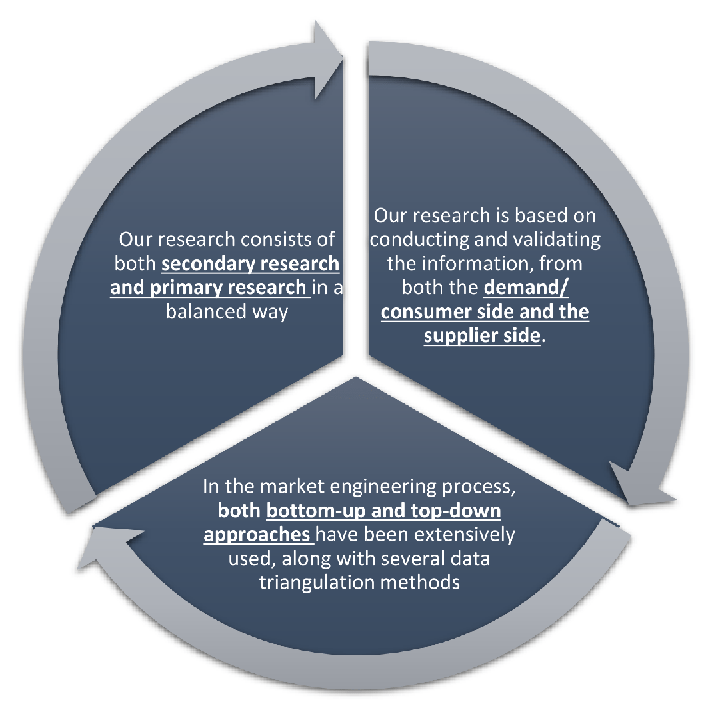
MarketGenics leverages a dedicated industry panel of experts and a comprehensive suite of paid databases to effectively collect, consolidate, and analyze market intelligence.
Our approach has consistently proven to be reliable and effective in generating accurate market insights, identifying key industry trends, and uncovering emerging business opportunities.
Through both primary and secondary research, we capture and analyze critical company-level data such as manufacturing footprints, including technical centers, R&D facilities, sales offices, and headquarters.
Our expert panel further enhances our ability to estimate market size for specific brands based on validated field-level intelligence.
Our data mining techniques incorporate both parametric and non-parametric methods, allowing for structured data collection, sorting, processing, and cleaning.
Demand projections are derived from large-scale data sets analyzed through proprietary algorithms, culminating in robust and reliable market sizing.
Research Approach
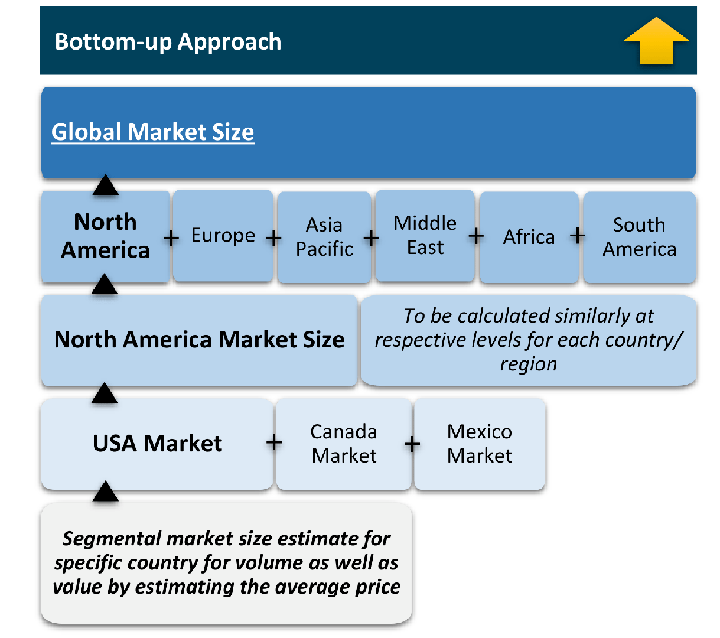
The bottom-up approach builds market estimates by starting with the smallest addressable market units and systematically aggregating them to create comprehensive market size projections.
This method begins with specific, granular data points and builds upward to create the complete market landscape.
Customer Analysis → Segmental Analysis → Geographical Analysis
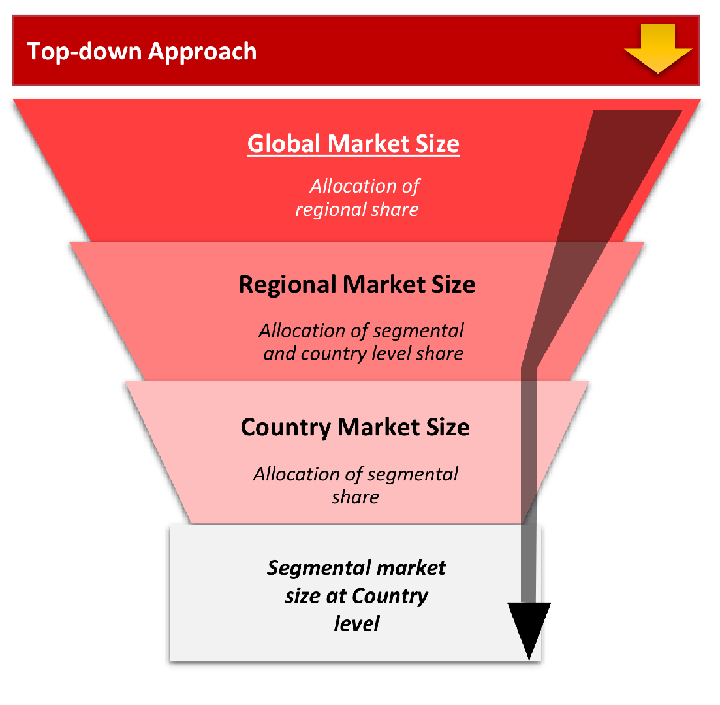
The top-down approach starts with the broadest possible market data and systematically narrows it down through a series of filters and assumptions to arrive at specific market segments or opportunities.
This method begins with the big picture and works downward to increasingly specific market slices.
TAM → SAM → SOM
Research Methods
Desk / Secondary Research
While analysing the market, we extensively study secondary sources, directories, and databases to identify and collect information useful for this technical, market-oriented, and commercial report. Secondary sources that we utilize are not only the public sources, but it is a combination of Open Source, Associations, Paid Databases, MG Repository & Knowledgebase, and others.
- Company websites, annual reports, financial reports, broker reports, and investor presentations
- National government documents, statistical databases and reports
- News articles, press releases and web-casts specific to the companies operating in the market, Magazines, reports, and others
- We gather information from commercial data sources for deriving company specific data such as segmental revenue, share for geography, product revenue, and others
- Internal and external proprietary databases (industry-specific), relevant patent, and regulatory databases
- Governing Bodies, Government Organizations
- Relevant Authorities, Country-specific Associations for Industries
We also employ the model mapping approach to estimate the product level market data through the players' product portfolio
Primary Research
Primary research/ interviews is vital in analyzing the market. Most of the cases involves paid primary interviews. Primary sources include primary interviews through e-mail interactions, telephonic interviews, surveys as well as face-to-face interviews with the different stakeholders across the value chain including several industry experts.
| Type of Respondents | Number of Primaries |
|---|---|
| Tier 2/3 Suppliers | ~20 |
| Tier 1 Suppliers | ~25 |
| End-users | ~25 |
| Industry Expert/ Panel/ Consultant | ~30 |
| Total | ~100 |
MG Knowledgebase
• Repository of industry blog, newsletter and case studies
• Online platform covering detailed market reports, and company profiles
Forecasting Factors and Models
Forecasting Factors
- Historical Trends – Past market patterns, cycles, and major events that shaped how markets behave over time. Understanding past trends helps predict future behavior.
- Industry Factors – Specific characteristics of the industry like structure, regulations, and innovation cycles that affect market dynamics.
- Macroeconomic Factors – Economic conditions like GDP growth, inflation, and employment rates that affect how much money people have to spend.
- Demographic Factors – Population characteristics like age, income, and location that determine who can buy your product.
- Technology Factors – How quickly people adopt new technology and how much technology infrastructure exists.
- Regulatory Factors – Government rules, laws, and policies that can help or restrict market growth.
- Competitive Factors – Analyzing competition structure such as degree of competition and bargaining power of buyers and suppliers.
Forecasting Models / Techniques
Multiple Regression Analysis
- Identify and quantify factors that drive market changes
- Statistical modeling to establish relationships between market drivers and outcomes
Time Series Analysis – Seasonal Patterns
- Understand regular cyclical patterns in market demand
- Advanced statistical techniques to separate trend, seasonal, and irregular components
Time Series Analysis – Trend Analysis
- Identify underlying market growth patterns and momentum
- Statistical analysis of historical data to project future trends
Expert Opinion – Expert Interviews
- Gather deep industry insights and contextual understanding
- In-depth interviews with key industry stakeholders
Multi-Scenario Development
- Prepare for uncertainty by modeling different possible futures
- Creating optimistic, pessimistic, and most likely scenarios
Time Series Analysis – Moving Averages
- Sophisticated forecasting for complex time series data
- Auto-regressive integrated moving average models with seasonal components
Econometric Models
- Apply economic theory to market forecasting
- Sophisticated economic models that account for market interactions
Expert Opinion – Delphi Method
- Harness collective wisdom of industry experts
- Structured, multi-round expert consultation process
Monte Carlo Simulation
- Quantify uncertainty and probability distributions
- Thousands of simulations with varying input parameters
Research Analysis
Our research framework is built upon the fundamental principle of validating market intelligence from both demand and supply perspectives. This dual-sided approach ensures comprehensive market understanding and reduces the risk of single-source bias.
Demand-Side Analysis: We understand end-user/application behavior, preferences, and market needs along with the penetration of the product for specific application.
Supply-Side Analysis: We estimate overall market revenue, analyze the segmental share along with industry capacity, competitive landscape, and market structure.
Validation & Evaluation
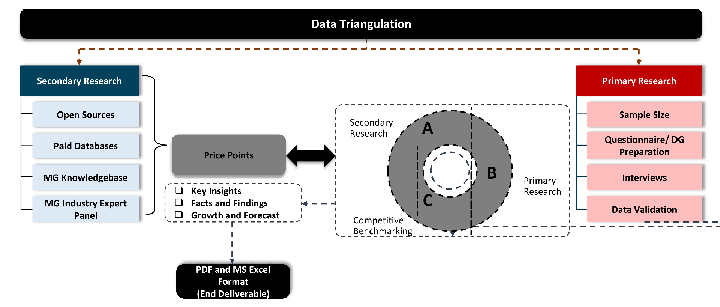
Data triangulation is a validation technique that uses multiple methods, sources, or perspectives to examine the same research question, thereby increasing the credibility and reliability of research findings. In market research, triangulation serves as a quality assurance mechanism that helps identify and minimize bias, validate assumptions, and ensure accuracy in market estimates.
- Data Source Triangulation – Using multiple data sources to examine the same phenomenon
- Methodological Triangulation – Using multiple research methods to study the same research question
- Investigator Triangulation – Using multiple researchers or analysts to examine the same data
- Theoretical Triangulation – Using multiple theoretical perspectives to interpret the same data
Custom Market Research Services
We will customise the research for you, in case the report listed above does not meet your requirements.
Get 10% Free Customisation