Two Wheeler Braking System Market Size, Share & Trends Analysis Report by Brake Type (Drum Brake, Disc Brake, Mechanical Parking Brake for Two Wheelers), Two Wheeler Type X Capacity, Technology, Brake Configuration, Components, Sales Channel, and Geography (North America, Europe, Asia Pacific, Middle East, Africa, and South America) – Global Industry Data, Trends, and Forecasts, 2026–2035
|
|
|
Segmental Data Insights |
|
|
Demand Trends |
|
|
Competitive Landscape |
|
|
Strategic Development |
|
|
Future Outlook & Opportunities |
|
Two Wheeler Braking System Market Size, Share, and Growth
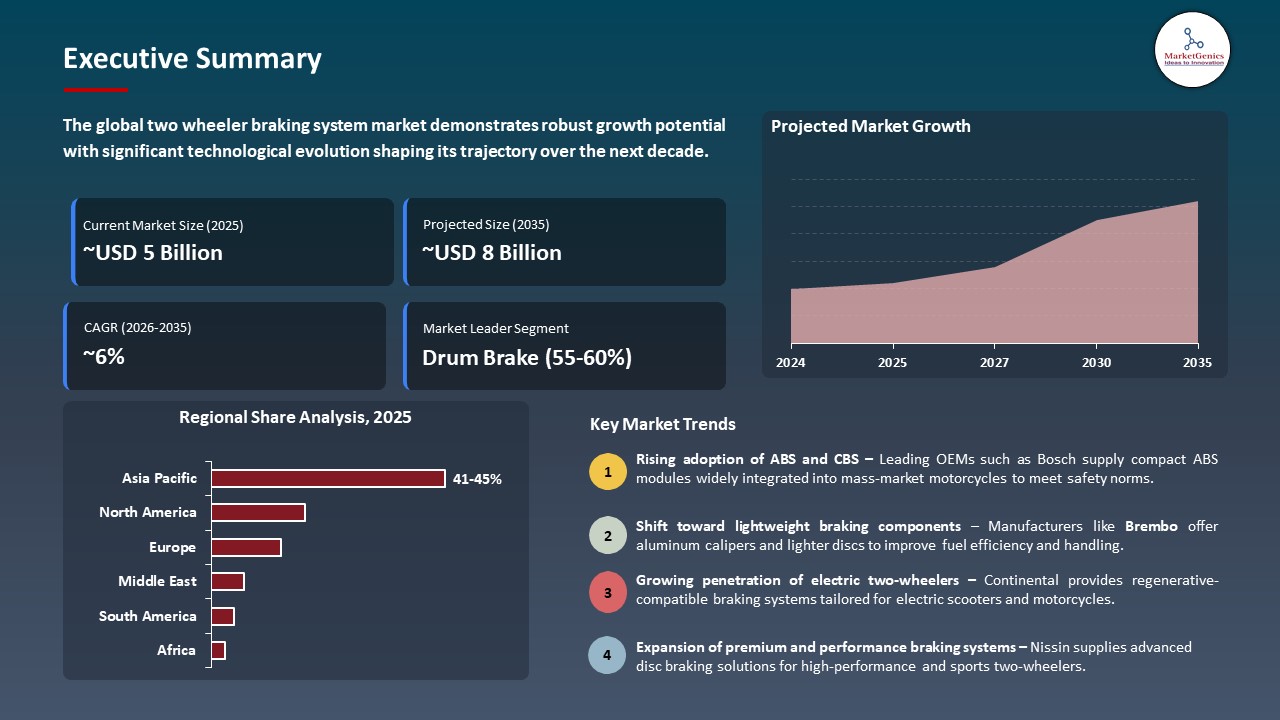
The global two wheeler braking system market is experiencing robust growth, with its estimated value of USD 4.5 billion in the year 2025 and USD 8.1 billion by the period 2035, registering a CAGR of 6.1%, during the forecast period. The global two wheeler braking system market, driven by rising road safety awareness, stricter government mandates for ABS and CBS, growing two-wheeler production in emerging economies, increasing adoption of electric two-wheelers, and consumer preference for improved braking performance, stability, and reliability across commuter and premium motorcycle segments.
Gil Pulliam, senior manager, aftermarket, ADVICS North America said, “We’re proud to expand our portfolio of ultra-premium brake rotors, offering customers exceptional coverage over a wide range of vehicles, this expansion allows us to meet the growing demands of the aftermarket and demonstrate our commitment to quality and performance.”
The two wheeler braking system market, driven by rising regulatory safety mandates, as governments across major automotive markets are progressively enforcing stringent vehicle safety regulations that require the integration of advanced braking technologies, such as anti-lock braking systems (ABS), in two-wheelers to enhance rider safety and reduce accident-related fatalities. For instance, India’s Ministry of Road Transport & Highways has mandated ABS on all new two-wheelers from January 1, 2026, pushing major OEMs such as Hero MotoCorp, TVS Motor, and Bajaj Auto to integrate compliant braking systems across their fleets to meet regulations. This regulatory push accelerates market growth by making advanced braking systems standard, boosting OEM procurement and safety tech penetration globally.
Leading companies such as ASK Automotive Limited and other braking system manufacturers are actively strengthening their production capabilities to address the rising demand from the two-wheeler segment, particularly in high-growth markets across Asia. For instance, in January 2026, ASK Automotive Limited announced a major capacity expansion in its advanced braking systems division, adding 6 crore pieces per annum of brake shoes and disc brake pads to its existing 26 crore units capacity, marking a 23 percent increase. The company has committed an investment of approximately ₹35 crore toward this initiative, with the new facilities scheduled for commissioning in the first quarter of fiscal year 2026–27, aiming to enhance supply reliability and support increasing OEM requirements.
Additionally, the two wheeler braking system market is also driven by continuous technological advancements by leading braking system manufacturers, who are developing more compact, cost-effective, and electronically enhanced braking solutions to improve performance and enable wider adoption across mass-market models. For instance, Bosch, at EICMA 2024, showcased its next-generation two-wheeler ABS with integrated inertial measurement unit (IMU) and advanced rider assistance functions, enabling improved stability, shorter braking distances, and better adaptability across riding conditions. This innovation-driven evolution encourages wider OEM adoption and accelerates the transition toward advanced, safety-focused braking systems across global two-wheeler platforms.
Key adjacent opportunities in the global two wheeler braking system market include electric two-wheeler braking solutions, advanced rider assistance systems (ARAS), connected and IoT-enabled braking technologies, aftermarket performance upgrades, and lightweight braking materials for improved efficiency. These adjacent opportunities enable market expansion, drive technological adoption, and create new revenue streams for OEMs and suppliers.
Two Wheeler Braking System Market Dynamics and Trends
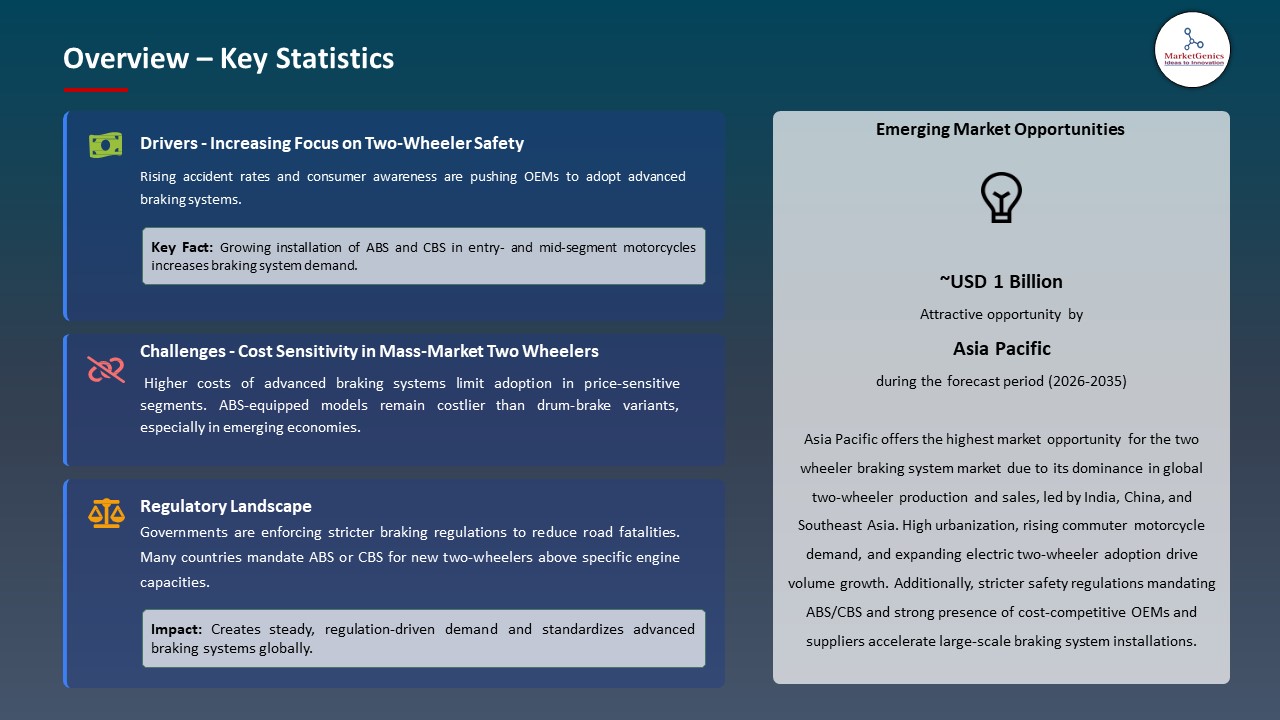
Driver: Rising Consumer Demand for High-Performance Braking Systems in Premium Two-Wheelers
-
The two wheeler braking system market is being increasingly driven by growing consumer preference for high-performance and safety-enhanced braking solutions, particularly in premium motorcycles and scooters. Riders today prioritize advanced braking capabilities, such as dual-channel ABS, disc brakes on both wheels, and electronic brake distribution, to improve control and reduce stopping distances under varied riding conditions.
- Additionally, this growing consumer emphasis on safety and performance is prompting OEMs to incorporate advanced braking technologies across mid-range two-wheeler models. For instance, in 2025, KTM expanded its Duke series in India with upgraded dual-channel ABS and larger disc brakes across multiple engine variants, responding to consumer demand for superior performance and enhanced safety features.
- Rising demand for high-performance braking solutions accelerates market growth and encourages continuous innovation in advanced two-wheeler braking systems.
Restraint: Rising Cost Pressures from Advanced Braking Technology Integration in Entry‑Level Models
-
The two wheeler braking system market faces restraint from higher production costs associated with integrating advanced electronic braking systems into mass-market, low-displacement two-wheelers. ABS mandates have increased manufacturing expenses for sub-125 cc bikes and scooters, challenging OEMs in price-sensitive markets to maintain margins without raising retail prices.
- This cost increase has sparked pushback from leading Indian manufacturers like Hero MotoCorp, Bajaj Auto, and TVS Motor Company, which have sought phased timelines and cost relief measures to manage margins without significantly increasing retail prices.
- Additionally, limited consumer willingness to pay higher upfront costs for advanced braking components in emerging regions further constrains widespread adoption. Supply chain challenges and the complexity of sourcing sophisticated sensors and controllers add to production hurdles.
- Cost pressures impede rapid market penetration, slowing adoption rates of next‑generation braking technologies despite regulatory momentum.
Opportunity: Integration of Smart IoT‑Enabled and Electronic Braking Solutions for Connected Mobility
-
The two wheeler braking system market is witnessing an emerging opportunity through the integration of smart, connected, and electronically enhanced braking solutions that align with broader vehicle connectivity trends. Manufacturers are increasingly focusing on next‑generation braking modules combining IoT connectivity, sensor fusion, and predictive algorithms to enable features such as adaptive ABS response and telematics reporting.
- Additionally, leading companies like Bosch and Continental are spearheading this development. Bosch’s dual‑sensor ABS units with AI‑enhanced predictive braking control, introduced in 2025 and planned for rollout across multiple OEM platforms, exemplify the move toward smarter, more responsive braking systems. These innovations enhance real-time safety performance and pave the way for future autonomous and semi-autonomous applications in two‑wheelers.
- Moreover, electronic brake‑by‑wire systems for premium sport motorcycles are gaining traction, offering opportunities for premium positioning and higher margins for suppliers. Smart braking solutions expand market potential, increase value per unit, and drive innovation-led revenue growth.
Key Trend: Adoption of Braking Solutions Tailored for Electric Two‑Wheeler Platforms
-
The two wheeler braking system market, influenced by the growing adoption of electric two‑wheelers, as OEMs demand braking solutions optimized for electric powertrain dynamics, regenerative braking integration, and lightweight construction. Electric scooters and motorcycles require braking systems capable of seamless operation with regenerative deceleration without compromising safety or rider experience, driving innovation in brake design, sensor calibration, and electronic control integration.
- Additionally, strategic collaborations between global braking system manufacturers and electric two‑wheeler OEMs are emerging to co-develop ABS and CBS units specifically tuned for electric powertrains, ensuring consistent performance across energy recovery and friction braking scenarios. Entry‑level electric models are also progressively incorporating advanced braking technologies to meet or exceed consumer expectations for safety and reliability.
- The shift toward electrification is further promoting the use of lightweight materials and modular designs, aligning with electric vehicle weight and efficiency requirements. Innovation in electric two‑wheeler braking systems accelerates market growth and creates new opportunities for specialized, high-performance safety solutions.
Two-Wheeler-Braking-System-Market Analysis and Segmental Data
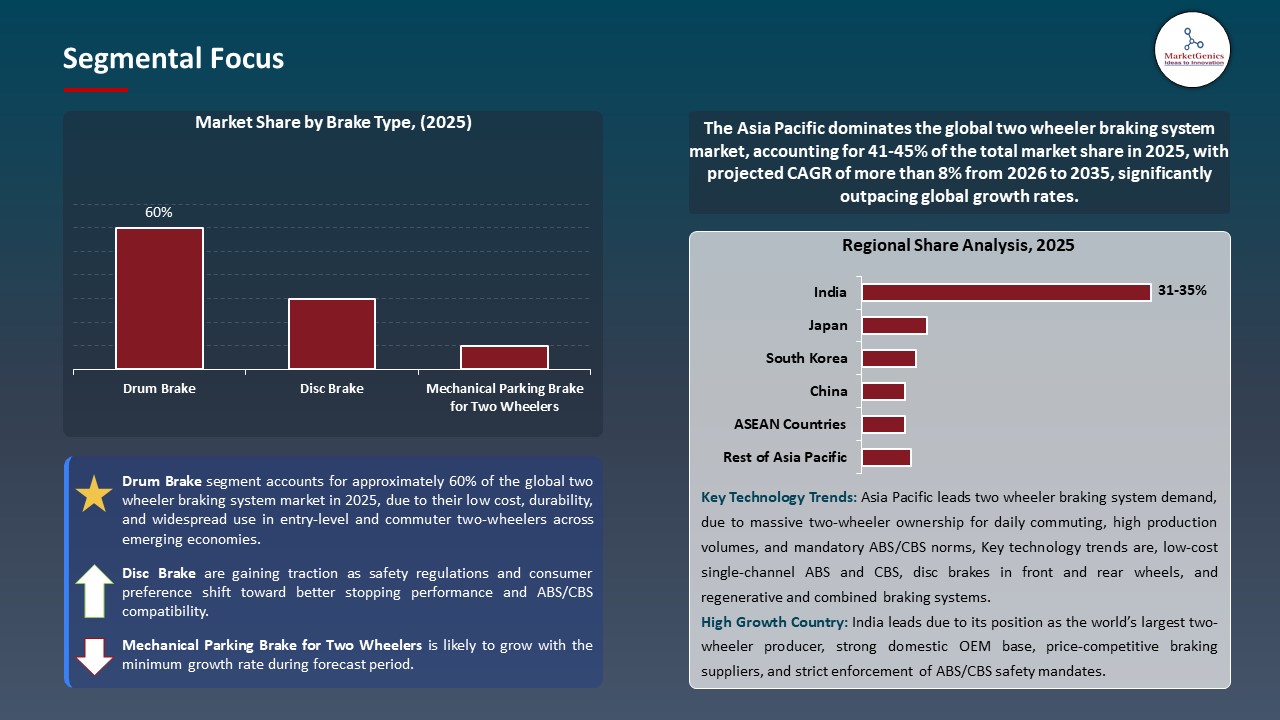
Drum Brake Dominate Global Two Wheeler Braking System Market
-
The drum brake segment dominates the global two wheeler braking system market, as despite rapid adoption of advanced systems like ABS and disc brakes in premium motorcycles and scooters, particularly in entry and mid-level segments across Asia, Africa, and Latin America. Their continued prevalence is supported by cost efficiency, simpler design, and lower maintenance requirements.
- Additionally, drum brakes are particularly well-suited for sub-125 cc motorcycles and scooters, which represent the largest volume segment of global two-wheeler sales. Their performance characteristics align with the needs of daily commuters and first-time riders who prioritize reliability and affordability over high-end braking capabilities.
- Moreover, as many first-time and budget-conscious buyers focus on purchase price and durability, drum brakes remain the default choice in mass-market two-wheelers. For instance, in 2025, Honda Motorcycle & Scooter India (HMSI) and Hero MotoCorp continued to specify drum brakes on the rear wheels of high-volume commuter models such as the Honda CB Shine and Hero Splendor Plus, ensuring balanced cost-performance for price-sensitive buyers.
- The cost-effectiveness and reliability of drum brakes sustain widespread adoption, anchoring braking system demand in high-volume segments.
Asia Pacific Leads Global Two Wheeler Braking System Market Demand
-
Asia Pacific leads the two wheeler braking system market, due to the rising awareness of road safety is driving adoption of ABS, CBS, and disc brakes even in mid-range motorcycles. For instance, in 2025, TVS Motor Company, introduced ABS-equipped variants across its Apache and commuter motorcycle lines to meet consumer safety expectations. Growing safety consciousness accelerates the penetration of advanced braking technologies across the Asia Pacific market.
- Additionally, emerging markets such as India, Indonesia, and Vietnam are experiencing significant expansion in two-wheeler manufacturing and sales to accommodate increasing demand for personal commuter mobility. Higher vehicle output increases the installed base of braking systems, sustaining market growth.
- The combined effect of rising safety awareness and expanding two-wheeler production in Asia Pacific is driving strong demand for advanced braking systems, reinforcing the region’s leadership in the global two-wheeler braking system market and fostering sustained growth for OEMs and component suppliers.
Two-Wheeler-Braking-System-Market Ecosystem
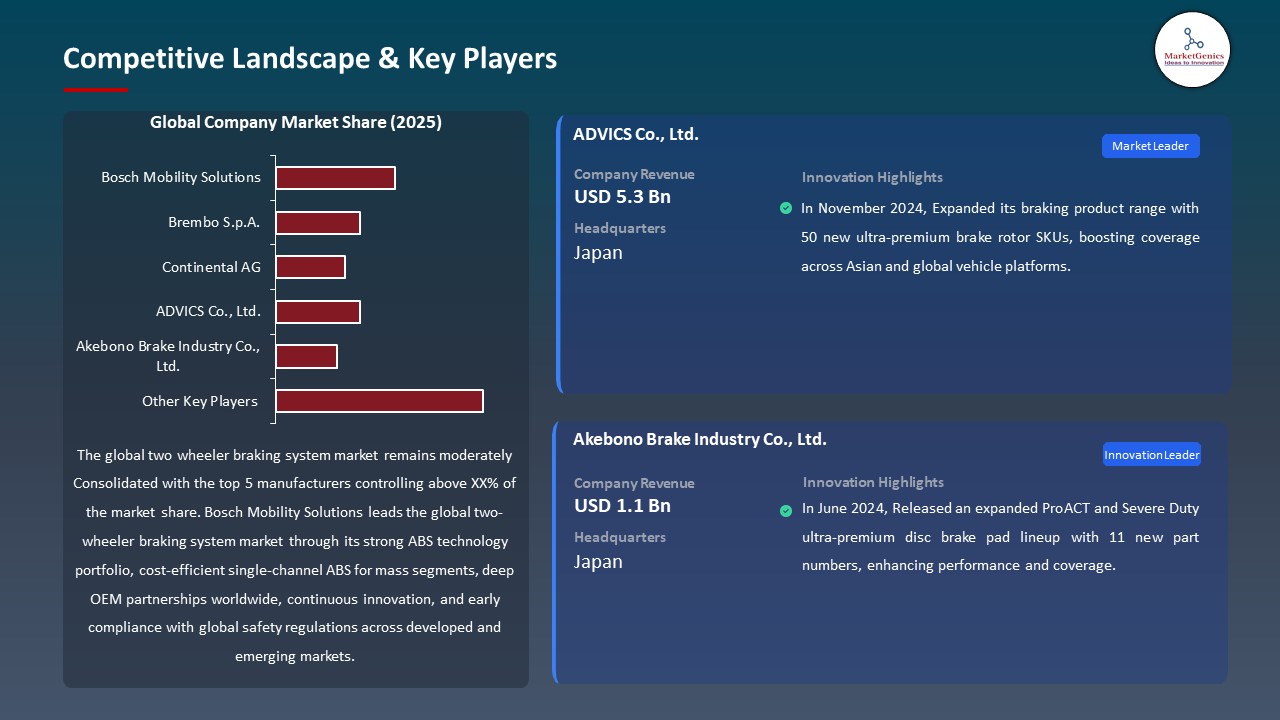
The global two wheeler braking system market is moderately consolidated, with high concentration among key players such as Bosch Mobility Solutions, Brembo S.p.A., Continental AG, ADVICS Co., Ltd., and Akebono Brake Industry Co., Ltd., who dominate through advanced product portfolios, extensive distribution networks, strategic partnerships with OEMs, and continuous innovation in braking technologies.
The high concentration of key players with strong technological capabilities and OEM partnerships strengthens market stability, drives innovation, and sets competitive benchmarks, shaping the evolution of two-wheeler braking systems globally.
Recent Development and Strategic Overview:
-
In November 2025, Brembo introduced new BYBRE calipers (P4.28 and P4.32) tailored for sport and adventure motorcycles, strengthening its competitive positioning and expanding its portfolio within the global two-wheeler braking components market.
- In 2024, Bosch showcased its integrated ABS incorporating an inertial measurement unit (ABSi) and advanced rider assistance features, designed to enhance safety performance while reducing system complexity for two-wheeler applications.
Report Scope
|
Detail |
|
|
Market Size in 2025 |
USD 4.5 Bn |
|
Market Forecast Value in 2035 |
USD 8.1 Bn |
|
Growth Rate (CAGR) |
6.1% |
|
Forecast Period |
2026 – 2035 |
|
Historical Data Available for |
2021 – 2024 |
|
Market Size Units |
US$ Billion for Value Million Units for Volume |
|
Report Format |
Electronic (PDF) + Excel |
|
North America |
Europe |
Asia Pacific |
Middle East |
Africa |
South America |
|
|
|
|
|
|
|
Companies Covered |
|||||
|
|
|
|
|
|
Two-Wheeler-Braking-System-Market Segmentation and Highlights
|
Segment |
Sub-segment |
|
Two Wheeler Braking System Market, By Brake Type |
|
|
Two Wheeler Braking System Market, By Two Wheeler Type X Capacity |
|
|
Two Wheeler Braking System Market, By Technology |
|
|
Two Wheeler Braking System Market, By Brake Configuration |
|
|
Two Wheeler Braking System Market, By Components
|
|
|
Two Wheeler Braking System Market, By Sales Channel
|
|
Frequently Asked Questions
Table of Contents
- 1. Research Methodology and Assumptions
- 1.1. Definitions
- 1.2. Research Design and Approach
- 1.3. Data Collection Methods
- 1.4. Base Estimates and Calculations
- 1.5. Forecasting Models
- 1.5.1. Key Forecast Factors & Impact Analysis
- 1.6. Secondary Research
- 1.6.1. Open Sources
- 1.6.2. Paid Databases
- 1.6.3. Associations
- 1.7. Primary Research
- 1.7.1. Primary Sources
- 1.7.2. Primary Interviews with Stakeholders across Ecosystem
- 2. Executive Summary
- 2.1. Global Two Wheeler Braking System Market Outlook
- 2.1.1. Two Wheeler Braking System Market Size (Volume – Million Units and Value – US$ Bn), and Forecasts, 2021-2035
- 2.1.2. Compounded Annual Growth Rate Analysis
- 2.1.3. Growth Opportunity Analysis
- 2.1.4. Segmental Share Analysis
- 2.1.5. Geographical Share Analysis
- 2.2. Market Analysis and Facts
- 2.3. Supply-Demand Analysis
- 2.4. Competitive Benchmarking
- 2.5. Go-to- Market Strategy
- 2.5.1. Customer/ End-use Industry Assessment
- 2.5.2. Growth Opportunity Data, 2026-2035
- 2.5.2.1. Regional Data
- 2.5.2.2. Country Data
- 2.5.2.3. Segmental Data
- 2.5.3. Identification of Potential Market Spaces
- 2.5.4. GAP Analysis
- 2.5.5. Potential Attractive Price Points
- 2.5.6. Prevailing Market Risks & Challenges
- 2.5.7. Preferred Sales & Marketing Strategies
- 2.5.8. Key Recommendations and Analysis
- 2.5.9. A Way Forward
- 2.1. Global Two Wheeler Braking System Market Outlook
- 3. Industry Data and Premium Insights
- 3.1. Global Automotive & Transportation Industry Overview, 2025
- 3.1.1. Automotive & Transportation Industry Ecosystem Analysis
- 3.1.2. Key Trends for Automotive & Transportation Industry
- 3.1.3. Regional Distribution for Automotive & Transportation Industry
- 3.2. Supplier Customer Data
- 3.3. Technology Roadmap and Developments
- 3.4. Trade Analysis
- 3.4.1. Import & Export Analysis, 2025
- 3.4.2. Top Importing Countries
- 3.4.3. Top Exporting Countries
- 3.5. Trump Tariff Impact Analysis
- 3.5.1. Manufacturer
- 3.5.1.1. Based on the component & Raw material
- 3.5.2. Supply Chain
- 3.5.3. End Consumer
- 3.5.1. Manufacturer
- 3.6. Raw Material Analysis
- 3.1. Global Automotive & Transportation Industry Overview, 2025
- 4. Market Overview
- 4.1. Market Dynamics
- 4.1.1. Drivers
- 4.1.1.1. Mandatory safety regulations for ABS/CBS adoption
- 4.1.1.2. Rising two-wheeler production and sales, including electric models
- 4.1.1.3. Growing consumer focus on road safety and vehicle control
- 4.1.2. Restraints
- 4.1.2.1. High cost of advanced braking systems in price-sensitive markets
- 4.1.2.2. Limited technical expertise and service infrastructure in developing regions
- 4.1.1. Drivers
- 4.2. Key Trend Analysis
- 4.3. Regulatory Framework
- 4.3.1. Key Regulations, Norms, and Subsidies, by Key Countries
- 4.3.2. Tariffs and Standards
- 4.3.3. Impact Analysis of Regulations on the Market
- 4.4. Value Chain Analysis
- 4.4.1. Raw Material & Component Suppliers
- 4.4.2. Brake Manufacturers
- 4.4.3. Distributors & Dealers
- 4.4.4. End Users
- 4.5. Cost Structure Analysis
- 4.5.1. Parameter’s Share for Cost Associated
- 4.5.2. COGP vs COGS
- 4.5.3. Profit Margin Analysis
- 4.6. Pricing Analysis
- 4.6.1. Regional Pricing Analysis
- 4.6.2. Segmental Pricing Trends
- 4.6.3. Factors Influencing Pricing
- 4.7. Porter’s Five Forces Analysis
- 4.8. PESTEL Analysis
- 4.9. Global Two Wheeler Braking System Market Demand
- 4.9.1. Historical Market Size – Volume (Million Units) and Value (US$ Bn), 2020-2024
- 4.9.2. Current and Future Market Size – Volume (Million Units) and Value (US$ Bn), 2026–2035
- 4.9.2.1. Y-o-Y Growth Trends
- 4.9.2.2. Absolute $ Opportunity Assessment
- 4.1. Market Dynamics
- 5. Competition Landscape
- 5.1. Competition structure
- 5.1.1. Fragmented v/s consolidated
- 5.2. Company Share Analysis, 2025
- 5.2.1. Global Company Market Share
- 5.2.2. By Region
- 5.2.2.1. North America
- 5.2.2.2. Europe
- 5.2.2.3. Asia Pacific
- 5.2.2.4. Middle East
- 5.2.2.5. Africa
- 5.2.2.6. South America
- 5.3. Product Comparison Matrix
- 5.3.1. Specifications
- 5.3.2. Market Positioning
- 5.3.3. Pricing
- 5.1. Competition structure
- 6. Global Two Wheeler Braking System Market Analysis, by Brake Type
- 6.1. Key Segment Analysis
- 6.2. Two Wheeler Braking System Market Size (Volume – Million Units and Value – US$ Bn), Analysis, and Forecasts, by Brake Type, 2021-2035
- 6.2.1. Drum Brake
- 6.2.2. Disc Brake
- 6.2.3. Mechanical Parking Brake for Two Wheelers
- 6.2.3.1. Hand Lever
- 6.2.3.2. Foot Pedal
- 6.2.3.3. Twist Grip
- 7. Global Two Wheeler Braking System Market Analysis, by Two Wheeler Type X Capacity
- 7.1. Key Segment Analysis
- 7.2. Two Wheeler Braking System Market Size (Volume – Million Units and Value – US$ Bn), Analysis, and Forecasts, by Two Wheeler Type X Capacity, 2021-2035
- 7.2.1. ICE Motorcycle (Engine Capacity)
- 7.2.1.1. Less than 100 cc
- 7.2.1.2. 101 cc – 125 cc
- 7.2.1.3. 126 cc – 150 cc
- 7.2.1.4. 151 cc – 200 cc
- 7.2.1.5. 201 cc – 250 cc
- 7.2.1.6. 251 cc – 400 cc
- 7.2.1.7. Above 400 cc
- 7.2.2. ICE Scooter/ Moped (Engine Capacity)
- 7.2.2.1. Less than 100 cc
- 7.2.2.2. 101 cc – 125 cc
- 7.2.2.3. 126 cc – 150 cc
- 7.2.2.4. More than 150 cc
- 7.2.3. Electric Motorcycle (Battery Capacity)
- 7.2.3.1. Less than 3.5 kWh
- 7.2.3.2. More than 3.5 kWh
- 7.2.4. Electric Scooter/ Moped (Battery Capacity)
- 7.2.4.1. Less than 1 kWh
- 7.2.4.2. 1 kWh to 2.5 kWh
- 7.2.4.3. 6 kWh to 3.5 kWh
- 7.2.4.4. 6 kWh to 5 kWh
- 7.2.4.5. More than 5 kWh
- 7.2.1. ICE Motorcycle (Engine Capacity)
- 8. Global Two Wheeler Braking System Market Analysis, by Technology
- 8.1. Key Segment Analysis
- 8.2. Two Wheeler Braking System Market Size (Volume – Million Units and Value – US$ Bn), Analysis, and Forecasts, by Technology, 2021-2035
- 8.2.1. Hydraulic Brake Systems
- 8.2.2. Mechanical Brake Systems
- 8.2.3. Combined Braking System (CBS)
- 8.2.4. Anti-lock Braking System (ABS)
- 8.2.4.1. Single Channel
- 8.2.4.2. Dual Channel
- 8.2.4.3. Cornering-ABS
- 8.2.5. Regenerative Braking Systems
- 9. Global Two Wheeler Braking System Market Analysis, by Brake Configuration
- 9.1. Key Segment Analysis
- 9.2. Two Wheeler Braking System Market Size (Volume – Million Units and Value – US$ Bn), Analysis, and Forecasts, by Brake Configuration, 2021-2035
- 9.2.1. Drum-Drum
- 9.2.2. Disc-Drum
- 9.2.3. Disc-Disc
- 10. Global Two Wheeler Braking System Market Analysis, by Components
- 10.1. Key Segment Analysis
- 10.2. Two Wheeler Braking System Market Size (Volume – Million Units and Value – US$ Bn), Analysis, and Forecasts, by Components, 2021-2035
- 10.2.1. Brake Rotors/ Discs
- 10.2.1.1. Fixed Rotor
- 10.2.1.2. Floating Rotor
- 10.2.2. Brake Calipers
- 10.2.2.1. Floating Caliper
- 10.2.2.2. Fixed/ Opposed Piston Caliper
- 10.2.3. Brake Pads (Sets)
- 10.2.4. Brake Drums
- 10.2.5. Brake Shoes
- 10.2.6. Brake Lines and Hoses
- 10.2.7. Brake Master Cylinder
- 10.2.8. Brake Fluid
- 10.2.9. ABS Module/ ECU
- 10.2.10. CBS Components
- 10.2.11. Other Components
- 10.2.1. Brake Rotors/ Discs
- 11. Global Two Wheeler Braking System Market Analysis, by Sales Channel
- 11.1. Key Segment Analysis
- 11.2. Two Wheeler Braking System Market Size (Volume – Million Units and Value – US$ Bn), Analysis, and Forecasts, by Sales Channel, 2021-2035
- 11.2.1. OEM
- 11.2.2. Aftermarket
- 11.2.3. Braking System
- 11.2.4. Braking Components
- 12. Global Two Wheeler Braking System Market Analysis and Forecasts, by Region
- 12.1. Key Findings
- 12.2. Two Wheeler Braking System Market Size (Volume – Million Units and Value – US$ Bn), Analysis, and Forecasts, by Region, 2021-2035
- 12.2.1. North America
- 12.2.2. Europe
- 12.2.3. Asia Pacific
- 12.2.4. Middle East
- 12.2.5. Africa
- 12.2.6. South America
- 13. North America Two Wheeler Braking System Market Analysis
- 13.1. Key Segment Analysis
- 13.2. Regional Snapshot
- 13.3. North America Two Wheeler Braking System Market Size (Volume – Million Units and Value – US$ Bn), Analysis, and Forecasts, 2021-2035
- 13.3.1. Brake Type
- 13.3.2. Two Wheeler Type X Capacity
- 13.3.3. Technology
- 13.3.4. Brake Configuration
- 13.3.5. Components
- 13.3.6. Sales Channel
- 13.3.7. Country
- 13.3.7.1. USA
- 13.3.7.2. Canada
- 13.3.7.3. Mexico
- 13.4. USA Two Wheeler Braking System Market
- 13.4.1. Country Segmental Analysis
- 13.4.2. Brake Type
- 13.4.3. Two Wheeler Type X Capacity
- 13.4.4. Technology
- 13.4.5. Brake Configuration
- 13.4.6. Components
- 13.4.7. Sales Channel
- 13.5. Canada Two Wheeler Braking System Market
- 13.5.1. Country Segmental Analysis
- 13.5.2. Brake Type
- 13.5.3. Two Wheeler Type X Capacity
- 13.5.4. Technology
- 13.5.5. Brake Configuration
- 13.5.6. Components
- 13.5.7. Sales Channel
- 13.6. Mexico Two Wheeler Braking System Market
- 13.6.1. Country Segmental Analysis
- 13.6.2. Brake Type
- 13.6.3. Two Wheeler Type X Capacity
- 13.6.4. Technology
- 13.6.5. Brake Configuration
- 13.6.6. Components
- 13.6.7. Sales Channel
- 14. Europe Two Wheeler Braking System Market Analysis
- 14.1. Key Segment Analysis
- 14.2. Regional Snapshot
- 14.3. Europe Two Wheeler Braking System Market Size (Volume – Million Units and Value – US$ Bn), Analysis, and Forecasts, 2021-2035
- 14.3.1. Brake Type
- 14.3.2. Two Wheeler Type X Capacity
- 14.3.3. Technology
- 14.3.4. Brake Configuration
- 14.3.5. Components
- 14.3.6. Sales Channel
- 14.3.7. Country
- 14.3.7.1. Germany
- 14.3.7.2. United Kingdom
- 14.3.7.3. France
- 14.3.7.4. Italy
- 14.3.7.5. Spain
- 14.3.7.6. Netherlands
- 14.3.7.7. Nordic Countries
- 14.3.7.8. Poland
- 14.3.7.9. Russia & CIS
- 14.3.7.10. Rest of Europe
- 14.4. Germany Two Wheeler Braking System Market
- 14.4.1. Country Segmental Analysis
- 14.4.2. Brake Type
- 14.4.3. Two Wheeler Type X Capacity
- 14.4.4. Technology
- 14.4.5. Brake Configuration
- 14.4.6. Components
- 14.4.7. Sales Channel
- 14.5. United Kingdom Two Wheeler Braking System Market
- 14.5.1. Country Segmental Analysis
- 14.5.2. Brake Type
- 14.5.3. Two Wheeler Type X Capacity
- 14.5.4. Technology
- 14.5.5. Brake Configuration
- 14.5.6. Components
- 14.5.7. Sales Channel
- 14.6. France Two Wheeler Braking System Market
- 14.6.1. Country Segmental Analysis
- 14.6.2. Brake Type
- 14.6.3. Two Wheeler Type X Capacity
- 14.6.4. Technology
- 14.6.5. Brake Configuration
- 14.6.6. Components
- 14.6.7. Sales Channel
- 14.7. Italy Two Wheeler Braking System Market
- 14.7.1. Country Segmental Analysis
- 14.7.2. Brake Type
- 14.7.3. Two Wheeler Type X Capacity
- 14.7.4. Technology
- 14.7.5. Brake Configuration
- 14.7.6. Components
- 14.7.7. Sales Channel
- 14.8. Spain Two Wheeler Braking System Market
- 14.8.1. Country Segmental Analysis
- 14.8.2. Brake Type
- 14.8.3. Two Wheeler Type X Capacity
- 14.8.4. Technology
- 14.8.5. Brake Configuration
- 14.8.6. Components
- 14.8.7. Sales Channel
- 14.9. Netherlands Two Wheeler Braking System Market
- 14.9.1. Country Segmental Analysis
- 14.9.2. Brake Type
- 14.9.3. Two Wheeler Type X Capacity
- 14.9.4. Technology
- 14.9.5. Brake Configuration
- 14.9.6. Components
- 14.9.7. Sales Channel
- 14.10. Nordic Countries Two Wheeler Braking System Market
- 14.10.1. Country Segmental Analysis
- 14.10.2. Brake Type
- 14.10.3. Two Wheeler Type X Capacity
- 14.10.4. Technology
- 14.10.5. Brake Configuration
- 14.10.6. Components
- 14.10.7. Sales Channel
- 14.11. Poland Two Wheeler Braking System Market
- 14.11.1. Country Segmental Analysis
- 14.11.2. Brake Type
- 14.11.3. Two Wheeler Type X Capacity
- 14.11.4. Technology
- 14.11.5. Brake Configuration
- 14.11.6. Components
- 14.11.7. Sales Channel
- 14.12. Russia & CIS Two Wheeler Braking System Market
- 14.12.1. Country Segmental Analysis
- 14.12.2. Brake Type
- 14.12.3. Two Wheeler Type X Capacity
- 14.12.4. Technology
- 14.12.5. Brake Configuration
- 14.12.6. Components
- 14.12.7. Sales Channel
- 14.13. Rest of Europe Two Wheeler Braking System Market
- 14.13.1. Country Segmental Analysis
- 14.13.2. Brake Type
- 14.13.3. Two Wheeler Type X Capacity
- 14.13.4. Technology
- 14.13.5. Brake Configuration
- 14.13.6. Components
- 14.13.7. Sales Channel
- 15. Asia Pacific Two Wheeler Braking System Market Analysis
- 15.1. Key Segment Analysis
- 15.2. Regional Snapshot
- 15.3. Asia Pacific Two Wheeler Braking System Market Size (Volume – Million Units and Value – US$ Bn), Analysis, and Forecasts, 2021-2035
- 15.3.1. Brake Type
- 15.3.2. Two Wheeler Type X Capacity
- 15.3.3. Technology
- 15.3.4. Brake Configuration
- 15.3.5. Components
- 15.3.6. Sales Channel
- 15.3.7. Country
- 15.3.7.1. China
- 15.3.7.2. India
- 15.3.7.3. Japan
- 15.3.7.4. South Korea
- 15.3.7.5. Australia and New Zealand
- 15.3.7.6. Indonesia
- 15.3.7.7. Malaysia
- 15.3.7.8. Thailand
- 15.3.7.9. Vietnam
- 15.3.7.10. Rest of Asia Pacific
- 15.4. China Two Wheeler Braking System Market
- 15.4.1. Country Segmental Analysis
- 15.4.2. Brake Type
- 15.4.3. Two Wheeler Type X Capacity
- 15.4.4. Technology
- 15.4.5. Brake Configuration
- 15.4.6. Components
- 15.4.7. Sales Channel
- 15.5. India Two Wheeler Braking System Market
- 15.5.1. Country Segmental Analysis
- 15.5.2. Brake Type
- 15.5.3. Two Wheeler Type X Capacity
- 15.5.4. Technology
- 15.5.5. Brake Configuration
- 15.5.6. Components
- 15.5.7. Sales Channel
- 15.6. Japan Two Wheeler Braking System Market
- 15.6.1. Country Segmental Analysis
- 15.6.2. Brake Type
- 15.6.3. Two Wheeler Type X Capacity
- 15.6.4. Technology
- 15.6.5. Brake Configuration
- 15.6.6. Components
- 15.6.7. Sales Channel
- 15.7. South Korea Two Wheeler Braking System Market
- 15.7.1. Country Segmental Analysis
- 15.7.2. Brake Type
- 15.7.3. Two Wheeler Type X Capacity
- 15.7.4. Technology
- 15.7.5. Brake Configuration
- 15.7.6. Components
- 15.7.7. Sales Channel
- 15.8. Australia and New Zealand Two Wheeler Braking System Market
- 15.8.1. Country Segmental Analysis
- 15.8.2. Brake Type
- 15.8.3. Two Wheeler Type X Capacity
- 15.8.4. Technology
- 15.8.5. Brake Configuration
- 15.8.6. Components
- 15.8.7. Sales Channel
- 15.9. Indonesia Two Wheeler Braking System Market
- 15.9.1. Country Segmental Analysis
- 15.9.2. Brake Type
- 15.9.3. Two Wheeler Type X Capacity
- 15.9.4. Technology
- 15.9.5. Brake Configuration
- 15.9.6. Components
- 15.9.7. Sales Channel
- 15.10. Malaysia Two Wheeler Braking System Market
- 15.10.1. Country Segmental Analysis
- 15.10.2. Brake Type
- 15.10.3. Two Wheeler Type X Capacity
- 15.10.4. Technology
- 15.10.5. Brake Configuration
- 15.10.6. Components
- 15.10.7. Sales Channel
- 15.11. Thailand Two Wheeler Braking System Market
- 15.11.1. Country Segmental Analysis
- 15.11.2. Brake Type
- 15.11.3. Two Wheeler Type X Capacity
- 15.11.4. Technology
- 15.11.5. Brake Configuration
- 15.11.6. Components
- 15.11.7. Sales Channel
- 15.12. Vietnam Two Wheeler Braking System Market
- 15.12.1. Country Segmental Analysis
- 15.12.2. Brake Type
- 15.12.3. Two Wheeler Type X Capacity
- 15.12.4. Technology
- 15.12.5. Brake Configuration
- 15.12.6. Components
- 15.12.7. Sales Channel
- 15.13. Rest of Asia Pacific Two Wheeler Braking System Market
- 15.13.1. Country Segmental Analysis
- 15.13.2. Brake Type
- 15.13.3. Two Wheeler Type X Capacity
- 15.13.4. Technology
- 15.13.5. Brake Configuration
- 15.13.6. Components
- 15.13.7. Sales Channel
- 16. Middle East Two Wheeler Braking System Market Analysis
- 16.1. Key Segment Analysis
- 16.2. Regional Snapshot
- 16.3. Middle East Two Wheeler Braking System Market Size (Volume – Million Units and Value – US$ Bn), Analysis, and Forecasts, 2021-2035
- 16.3.1. Brake Type
- 16.3.2. Two Wheeler Type X Capacity
- 16.3.3. Technology
- 16.3.4. Brake Configuration
- 16.3.5. Components
- 16.3.6. Sales Channel
- 16.3.7. Country
- 16.3.7.1. Turkey
- 16.3.7.2. UAE
- 16.3.7.3. Saudi Arabia
- 16.3.7.4. Israel
- 16.3.7.5. Rest of Middle East
- 16.4. Turkey Two Wheeler Braking System Market
- 16.4.1. Country Segmental Analysis
- 16.4.2. Brake Type
- 16.4.3. Two Wheeler Type X Capacity
- 16.4.4. Technology
- 16.4.5. Brake Configuration
- 16.4.6. Components
- 16.4.7. Sales Channel
- 16.5. UAE Two Wheeler Braking System Market
- 16.5.1. Country Segmental Analysis
- 16.5.2. Brake Type
- 16.5.3. Two Wheeler Type X Capacity
- 16.5.4. Technology
- 16.5.5. Brake Configuration
- 16.5.6. Components
- 16.5.7. Sales Channel
- 16.6. Saudi Arabia Two Wheeler Braking System Market
- 16.6.1. Country Segmental Analysis
- 16.6.2. Brake Type
- 16.6.3. Two Wheeler Type X Capacity
- 16.6.4. Technology
- 16.6.5. Brake Configuration
- 16.6.6. Components
- 16.6.7. Sales Channel
- 16.7. Israel Two Wheeler Braking System Market
- 16.7.1. Country Segmental Analysis
- 16.7.2. Brake Type
- 16.7.3. Two Wheeler Type X Capacity
- 16.7.4. Technology
- 16.7.5. Brake Configuration
- 16.7.6. Components
- 16.7.7. Sales Channel
- 16.8. Rest of Middle East Two Wheeler Braking System Market
- 16.8.1. Country Segmental Analysis
- 16.8.2. Brake Type
- 16.8.3. Two Wheeler Type X Capacity
- 16.8.4. Technology
- 16.8.5. Brake Configuration
- 16.8.6. Components
- 16.8.7. Sales Channel
- 17. Africa Two Wheeler Braking System Market Analysis
- 17.1. Key Segment Analysis
- 17.2. Regional Snapshot
- 17.3. Africa Two Wheeler Braking System Market Size (Volume – Million Units and Value – US$ Bn), Analysis, and Forecasts, 2021-2035
- 17.3.1. Brake Type
- 17.3.2. Two Wheeler Type X Capacity
- 17.3.3. Technology
- 17.3.4. Brake Configuration
- 17.3.5. Components
- 17.3.6. Sales Channel
- 17.3.7. Country
- 17.3.7.1. South Africa
- 17.3.7.2. Egypt
- 17.3.7.3. Nigeria
- 17.3.7.4. Algeria
- 17.3.7.5. Rest of Africa
- 17.4. South Africa Two Wheeler Braking System Market
- 17.4.1. Country Segmental Analysis
- 17.4.2. Brake Type
- 17.4.3. Two Wheeler Type X Capacity
- 17.4.4. Technology
- 17.4.5. Brake Configuration
- 17.4.6. Components
- 17.4.7. Sales Channel
- 17.5. Egypt Two Wheeler Braking System Market
- 17.5.1. Country Segmental Analysis
- 17.5.2. Brake Type
- 17.5.3. Two Wheeler Type X Capacity
- 17.5.4. Technology
- 17.5.5. Brake Configuration
- 17.5.6. Components
- 17.5.7. Sales Channel
- 17.6. Nigeria Two Wheeler Braking System Market
- 17.6.1. Country Segmental Analysis
- 17.6.2. Brake Type
- 17.6.3. Two Wheeler Type X Capacity
- 17.6.4. Technology
- 17.6.5. Brake Configuration
- 17.6.6. Components
- 17.6.7. Sales Channel
- 17.7. Algeria Two Wheeler Braking System Market
- 17.7.1. Country Segmental Analysis
- 17.7.2. Brake Type
- 17.7.3. Two Wheeler Type X Capacity
- 17.7.4. Technology
- 17.7.5. Brake Configuration
- 17.7.6. Components
- 17.7.7. Sales Channel
- 17.8. Rest of Africa Two Wheeler Braking System Market
- 17.8.1. Country Segmental Analysis
- 17.8.2. Brake Type
- 17.8.3. Two Wheeler Type X Capacity
- 17.8.4. Technology
- 17.8.5. Brake Configuration
- 17.8.6. Components
- 17.8.7. Sales Channel
- 18. South America Two Wheeler Braking System Market Analysis
- 18.1. Key Segment Analysis
- 18.2. Regional Snapshot
- 18.3. South America Two Wheeler Braking System Market Size (Volume – Million Units and Value – US$ Bn), Analysis, and Forecasts, 2021-2035
- 18.3.1. Brake Type
- 18.3.2. Two Wheeler Type X Capacity
- 18.3.3. Technology
- 18.3.4. Brake Configuration
- 18.3.5. Components
- 18.3.6. Sales Channel
- 18.3.7. Country
- 18.3.7.1. Brazil
- 18.3.7.2. Argentina
- 18.3.7.3. Rest of South America
- 18.4. Brazil Two Wheeler Braking System Market
- 18.4.1. Country Segmental Analysis
- 18.4.2. Brake Type
- 18.4.3. Two Wheeler Type X Capacity
- 18.4.4. Technology
- 18.4.5. Brake Configuration
- 18.4.6. Components
- 18.4.7. Sales Channel
- 18.5. Argentina Two Wheeler Braking System Market
- 18.5.1. Country Segmental Analysis
- 18.5.2. Brake Type
- 18.5.3. Two Wheeler Type X Capacity
- 18.5.4. Technology
- 18.5.5. Brake Configuration
- 18.5.6. Components
- 18.5.7. Sales Channel
- 18.6. Rest of South America Two Wheeler Braking System Market
- 18.6.1. Country Segmental Analysis
- 18.6.2. Brake Type
- 18.6.3. Two Wheeler Type X Capacity
- 18.6.4. Technology
- 18.6.5. Brake Configuration
- 18.6.6. Components
- 18.6.7. Sales Channel
- 19. Key Players/ Company Profile
- 19.1. ADVICS Co., Ltd.
- 19.1.1. Company Details/ Overview
- 19.1.2. Company Financials
- 19.1.3. Key Customers and Competitors
- 19.1.4. Business/ Industry Portfolio
- 19.1.5. Product Portfolio/ Specification Details
- 19.1.6. Pricing Data
- 19.1.7. Strategic Overview
- 19.1.8. Recent Developments
- 19.2. Akebono Brake Industry Co., Ltd.
- 19.3. ASK Automotive Limited
- 19.4. Astemo, Ltd.
- 19.5. Bosch Mobility Solutions
- 19.6. Brakes India Private Limited
- 19.7. Brembo S.p.A
- 19.8. BWI Group
- 19.9. Continental AG
- 19.10. EBC Brakes
- 19.11. Endurance Technologies Limited
- 19.12. Federal-Mogul Motorparts LLC
- 19.13. Knorr-Bremse AG
- 19.14. Lucas TVS Limited
- 19.15. Mando Corporation
- 19.16. Nissin Kogyo Co., Ltd.
- 19.17. SBS Friction A/S
- 19.18. Uno Minda Limited
- 19.19. ZF Friedrichshafen AG
- 19.20. Other Key Players
- 19.1. ADVICS Co., Ltd.
Note* - This is just tentative list of players. While providing the report, we will cover more number of players based on their revenue and share for each geography
Research Design
Our research design integrates both demand-side and supply-side analysis through a balanced combination of primary and secondary research methodologies. By utilizing both bottom-up and top-down approaches alongside rigorous data triangulation methods, we deliver robust market intelligence that supports strategic decision-making.
MarketGenics' comprehensive research design framework ensures the delivery of accurate, reliable, and actionable market intelligence. Through the integration of multiple research approaches, rigorous validation processes, and expert analysis, we provide our clients with the insights needed to make informed strategic decisions and capitalize on market opportunities.

MarketGenics leverages a dedicated industry panel of experts and a comprehensive suite of paid databases to effectively collect, consolidate, and analyze market intelligence.
Our approach has consistently proven to be reliable and effective in generating accurate market insights, identifying key industry trends, and uncovering emerging business opportunities.
Through both primary and secondary research, we capture and analyze critical company-level data such as manufacturing footprints, including technical centers, R&D facilities, sales offices, and headquarters.
Our expert panel further enhances our ability to estimate market size for specific brands based on validated field-level intelligence.
Our data mining techniques incorporate both parametric and non-parametric methods, allowing for structured data collection, sorting, processing, and cleaning.
Demand projections are derived from large-scale data sets analyzed through proprietary algorithms, culminating in robust and reliable market sizing.
Research Approach
The bottom-up approach builds market estimates by starting with the smallest addressable market units and systematically aggregating them to create comprehensive market size projections.
This method begins with specific, granular data points and builds upward to create the complete market landscape.
Customer Analysis → Segmental Analysis → Geographical Analysis
The top-down approach starts with the broadest possible market data and systematically narrows it down through a series of filters and assumptions to arrive at specific market segments or opportunities.
This method begins with the big picture and works downward to increasingly specific market slices.
TAM → SAM → SOM


Research Methods
Desk / Secondary Research
While analysing the market, we extensively study secondary sources, directories, and databases to identify and collect information useful for this technical, market-oriented, and commercial report. Secondary sources that we utilize are not only the public sources, but it is a combination of Open Source, Associations, Paid Databases, MG Repository & Knowledgebase, and others.
- Company websites, annual reports, financial reports, broker reports, and investor presentations
- National government documents, statistical databases and reports
- News articles, press releases and web-casts specific to the companies operating in the market, Magazines, reports, and others
- We gather information from commercial data sources for deriving company specific data such as segmental revenue, share for geography, product revenue, and others
- Internal and external proprietary databases (industry-specific), relevant patent, and regulatory databases
- Governing Bodies, Government Organizations
- Relevant Authorities, Country-specific Associations for Industries
We also employ the model mapping approach to estimate the product level market data through the players' product portfolio
Primary Research
Primary research/ interviews is vital in analyzing the market. Most of the cases involves paid primary interviews. Primary sources include primary interviews through e-mail interactions, telephonic interviews, surveys as well as face-to-face interviews with the different stakeholders across the value chain including several industry experts.
| Type of Respondents | Number of Primaries |
|---|---|
| Tier 2/3 Suppliers | ~20 |
| Tier 1 Suppliers | ~25 |
| End-users | ~25 |
| Industry Expert/ Panel/ Consultant | ~30 |
| Total | ~100 |
MG Knowledgebase
• Repository of industry blog, newsletter and case studies
• Online platform covering detailed market reports, and company profiles
Forecasting Factors and Models
Forecasting Factors
- Historical Trends – Past market patterns, cycles, and major events that shaped how markets behave over time. Understanding past trends helps predict future behavior.
- Industry Factors – Specific characteristics of the industry like structure, regulations, and innovation cycles that affect market dynamics.
- Macroeconomic Factors – Economic conditions like GDP growth, inflation, and employment rates that affect how much money people have to spend.
- Demographic Factors – Population characteristics like age, income, and location that determine who can buy your product.
- Technology Factors – How quickly people adopt new technology and how much technology infrastructure exists.
- Regulatory Factors – Government rules, laws, and policies that can help or restrict market growth.
- Competitive Factors – Analyzing competition structure such as degree of competition and bargaining power of buyers and suppliers.
Forecasting Models / Techniques
Multiple Regression Analysis
- Identify and quantify factors that drive market changes
- Statistical modeling to establish relationships between market drivers and outcomes
Time Series Analysis – Seasonal Patterns
- Understand regular cyclical patterns in market demand
- Advanced statistical techniques to separate trend, seasonal, and irregular components
Time Series Analysis – Trend Analysis
- Identify underlying market growth patterns and momentum
- Statistical analysis of historical data to project future trends
Expert Opinion – Expert Interviews
- Gather deep industry insights and contextual understanding
- In-depth interviews with key industry stakeholders
Multi-Scenario Development
- Prepare for uncertainty by modeling different possible futures
- Creating optimistic, pessimistic, and most likely scenarios
Time Series Analysis – Moving Averages
- Sophisticated forecasting for complex time series data
- Auto-regressive integrated moving average models with seasonal components
Econometric Models
- Apply economic theory to market forecasting
- Sophisticated economic models that account for market interactions
Expert Opinion – Delphi Method
- Harness collective wisdom of industry experts
- Structured, multi-round expert consultation process
Monte Carlo Simulation
- Quantify uncertainty and probability distributions
- Thousands of simulations with varying input parameters
Research Analysis
Our research framework is built upon the fundamental principle of validating market intelligence from both demand and supply perspectives. This dual-sided approach ensures comprehensive market understanding and reduces the risk of single-source bias.
Demand-Side Analysis: We understand end-user/application behavior, preferences, and market needs along with the penetration of the product for specific application.
Supply-Side Analysis: We estimate overall market revenue, analyze the segmental share along with industry capacity, competitive landscape, and market structure.
Validation & Evaluation
Data triangulation is a validation technique that uses multiple methods, sources, or perspectives to examine the same research question, thereby increasing the credibility and reliability of research findings. In market research, triangulation serves as a quality assurance mechanism that helps identify and minimize bias, validate assumptions, and ensure accuracy in market estimates.
- Data Source Triangulation – Using multiple data sources to examine the same phenomenon
- Methodological Triangulation – Using multiple research methods to study the same research question
- Investigator Triangulation – Using multiple researchers or analysts to examine the same data
- Theoretical Triangulation – Using multiple theoretical perspectives to interpret the same data

Custom Market Research Services
We will customise the research for you, in case the report listed above does not meet your requirements.
Get 10% Free Customisation