Web3 Customer Data Platforms Market Size, Share & Trends Analysis Report by Component (Data Ingestion & Connectors, Decentralized Storage & Indexing, Identity & Wallet Resolution, Data Normalization & Enrichment, Customer Profile Graph & Identity Graph, Analytics & Attribution Engine, Consent, Privacy & Governance Module, APIs & Activation / SDKs, Others), Deployment Mode, Data Type Supported, Identity Approach, Analytics & ML Capability, Integration/ Ecosystem, Activation/ Use Case, Vertical and Geography (North America, Europe, Asia Pacific, Middle East, Africa, and South America) – Global Industry Data, Trends, and Forecasts, 2026–2035
Market Overview:
As per MarketGenics, the global Web3 customer data platforms market is experiencing significant growth, valued at USD 87.3 million in 2025 and projected to reach USD 2,369.2 million by 2035, expanding at a CAGR of 39.1% during the forecast period.
|
Market Structure & Evolution |
|
|
Segmental Data Insights |
|
|
Demand Trends |
|
|
Competitive Landscape |
|
|
Strategic Development |
|
|
Future Outlook & Opportunities |
|
Web3 Customer Data Platforms Market Size, Share, and Growth
The web3-customer-data-platforms-market is spreading rapidly all over the world, supported by many factors which drive the adoption of this architecture.

"Digital identity is becoming one of the most significant applications of Web3 that can handle large-scale operations," said Alexandre Maaza from the Cardano Foundation. He was pointing out that identity for people, products, data, and documents is the main driver that can take the use of blockchain to the next level by bringing in the mass adoption. Maaza argued that with the evolution of blockchain ecosystems, an on-chain identity is the fundamental layer that makes trust, interoperability, and safe interactions possible in decentralized environments.
The Web3 customer data platforms market is expanding very fast all over the world and is mainly driven by the increasing demand of wallet-level attribution, decentralized identity management, and privacy-preserving analytics. New platforms that can unify on-chain and off-chain data have significantly deepened the accuracy and reliability of user insights in decentralized applications.
The energetic involvement in DeFi, gaming, NFTs, and tokenized commerce has escalated the need for solutions that are capable of resolving wallet identities, tracking multi-chain interactions, and delivering compliant intelligence without giving away the privacy. However, worldwide data-protection standards and new digital-asset regulations are at the same time inviting investments in secure, encrypted, and verifiable data infrastructure. The rise of the Web3 customer data platforms market is largely caused by the combination of advanced analytics, stronger privacy frameworks, and increasing Web3 adoption. This trend opens up the possibilities for more accurate personalization, improved fraud prevention, and safer user experiences.
Nearby possibilities are decentralized identity services, cross-chain indexing, consent-management tools, Web3 CRM platforms, privacy-enhancing technologies (PETs), and smart-contract-based loyalty systems, which, in turn, help the unlimited expansion of the Web3 data ecosystem.
Web3 Customer Data Platforms Market Dynamics and Trends
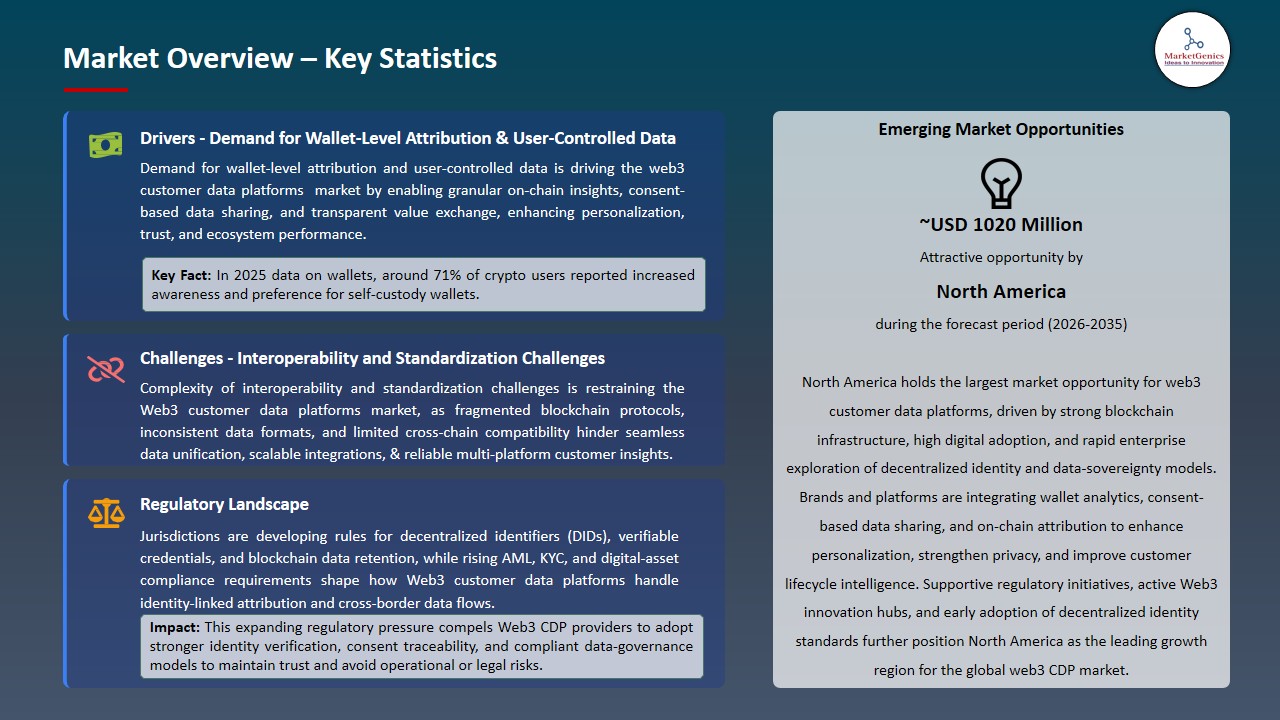
Driver: Rising Demand for Wallet-Level Attribution and User-Controlled Data Accelerating Web3 Customer Data Platforms Adoption
-
A key factor behind CDP adoption is the demand for self-sovereign identities and data ownership in Web3 - through wallets, decentralized identifiers, and verifiable credentials - as enterprises and applications are increasingly required to manage consent, privacy, and data portability instead of depending on centralized user profiles. As an instance, a 2025 report stated that more than 20,000 companies are currently collaborating with decentralized data‑ownership protocols to facilitate the transition from centralized data hoarding to user‑centric data models.
- The rise of multi‑chain and cross‑dApp activities (DeFi, NFTs, gaming, decentralized social apps, tokenized commerce) is amplifying the requirement for unified data‑platforms that can pool on‑chain and off‑chain signals - thus allowing correct wallet‑level attribution, behavior analysis, and real-time user journey mapping across different Web3 ecosystems.
- The growing demand for privacy-first identity and data models - led by decentralized identity standards such as DIDs, verifiable credentials, and privacy-preserving protocols - is prompting enterprises to deploy web3 customer data platforms that uphold user sovereignty while delivering analytics, compliance, and secure identity resolution and boost web3 customer data platforms market.
Restraint: Interoperability and Standardization Challenges Across Blockchains Limiting Web3 Customer Data Platforms Adoption
-
The web3 customer data platforms market is riddled with issues that hinder quick adoption of the technology. One of the biggest challenges that stand out is the problem of interoperability. This is because most blockchains and identity frameworks differ in the way they handle decentralized identifiers, verifiable credentials, and on-chain/off-chain data linkage, thus making it almost impossible to have seamless cross-chain identity resolution and unified data views.
- Additionally, the difficulty in implementing decentralized identity infrastructure also causes discomfort to users and businesses. The management of self-sovereign identity, cryptographic keys, and decentralized credentialing usually requires a lot of technical expertise thus it becomes a barrier to smaller projects and newcomers in the ecosystem.
- Moreover, the issues of scalability and trust are still there. Most of the decentralized identity and data-platform systems have not been tested under extreme conditions globally and problems like wallet reuse, dormant chains, or incomplete data can be some of the factors that limit the reliability and completeness of Web3 CDP analytics.
Opportunity: Integration with Decentralized AI and Data-Market Ecosystems Boosting Web3 Customer Data Platforms
-
Notwithstanding these issues, the web3 customer data platforms market has substantial prospects for expansion and innovation. An emerging decentralized identity infrastructure, comprising projects focused on domain resolution and data ownership tools, is a source of complementary solutions that CDPs can either integrate or partner with in order to deliver richer, privacy-first analytics. The rise of multi-chain and cross-dApp engagement opens up the possibility for platforms to provide unified user attribution, lifecycle analytics, and helping businesses to understand complex user journeys across different Web3 environments.
- By using decentralized data-warehouse and indexing solutions (i.e. combining on-chain and off-chain data) - as part of broader infrastructure evolution, projects are setting up the next generation of robust Web3 CDPs which can support cross-chain analytics, identity resolution, and real-time data intelligence. Notably, Ainvest reports USD 104.7 Mn deployed across 9,800 Web3 funding rounds and highlights surging activity in ETH, FIL, and ENS tied to decentralized-identity and storage infrastructure.
- Lastly, the collaboration with decentralized AI, data-market ecosystems, and digital-twin initiatives gives CDPs the capability to move beyond the basic user profiling, thus enabling data monetization, AI-driven personalization, reputation scoring, and user-owned data economies, all these factors are likely to boost web3 customer data platforms market.
Key Trend: Rise of Self-Sovereign Identity and Data Ownership Models Enhancing Web3 Customer Data Platforms
-
The web3 customer data platforms market is being influenced by several significant trends. The move to self-sovereign identity and decentralized data ownership is gaining speed, thus positioning CDPs as instruments that give power to users and at the same time provide businesses with analytics without compromising privacy. The rise of decentralized data warehouses and advanced indexing protocols is allowing platforms to fetch both on-chain and off-chain data in real time, thus enabling cross-chain analytics at scale.
- There is also a considerable increase in demand for consent-based, user-centric data governance with platforms embedding mechanisms to ensure transparent, permissioned data usage. Lastly, the merging of Web3 data with AI-driven analytics is opening the way for more sophisticated and privacy-respecting insights that blend behavioral signals with on-chain activity to facilitate personalized experiences, fraud detection, and data-driven decision-making. All these factors are likely to scale up the growth of the web3 customer data platforms market.
Web3-Customer-Data-Platforms-Market Analysis and Segmental Data
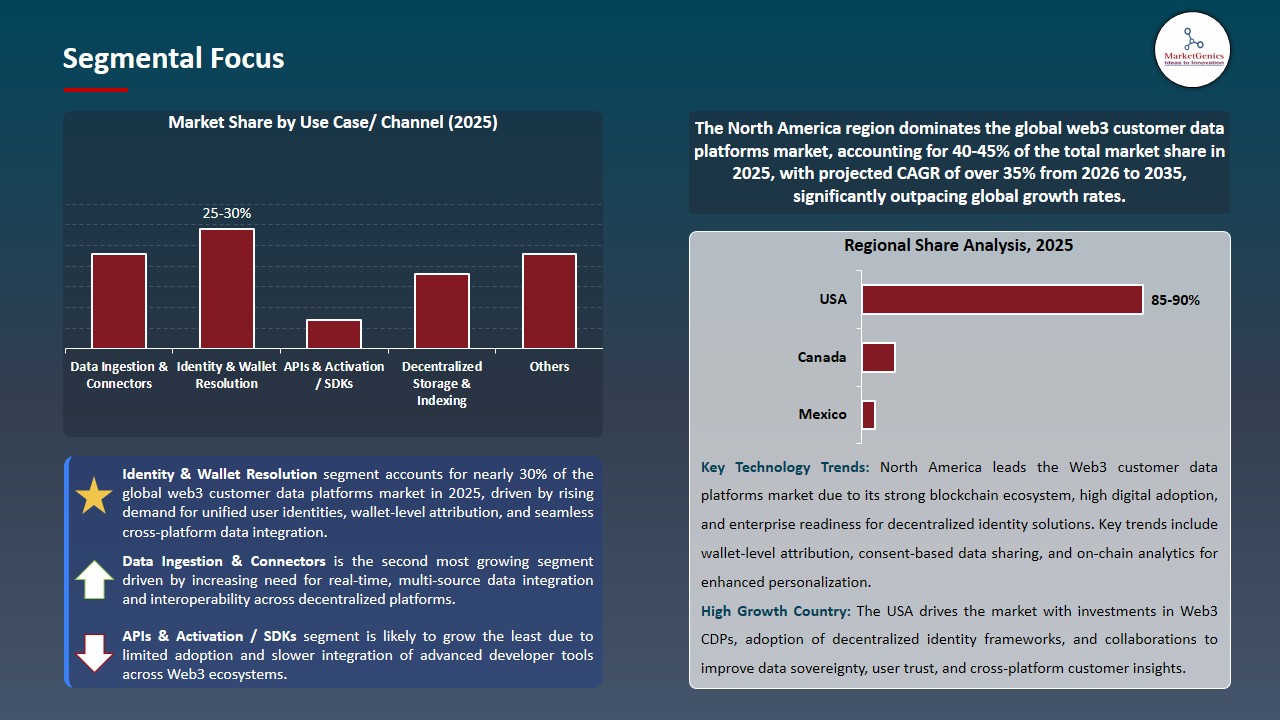
“Identity & Wallet Resolution Dominates Global Web3 Customer Data Platforms Market amid Wallet-Level Identity Resolution"
-
The identity & wallet-resolution segment is the major contributor to the global web3 customer data platforms market. This increase is mainly due to the rising need to integrate fragmented on-chain data to create a unified user profile. As the use of Web3 grows through DeFi, NFTs, gaming, tokenized commerce, and cross-chain apps, companies require tools that can identify multiple wallets belonging to a single user, unify the activities on different chains and link the on-chain behavior to the off-chain data.
- It is very important to note that, unlike Web2 users whose identities are emails or cookies, Web3 users might have several pseudonymous wallets and, hence, wallet-level tracking is not sufficient to get accurate insights or provide personalized services. The recent launch of the "multichain CDP" by MetaCRM in 2025 is one such example which indicates the trend. This platform creates a single UID-based profile for a user by collecting wallet data from different blockchains, social logins, and off-chain credentials - thus, customer analytics and segmentation across ecosystems become feasible.
- On the other hand, identity-wallet solutions and decentralized identity frameworks (DIDs) are getting more popular. They give users the power to manage their digital footprint and also allow platforms to use privacy-first, verifiable identity resolution that can comply with regulations and user-consent requirements. This has made Web3 CDP providers capable of offering more precise attribution, customized experiences, fraud-resistant onboarding, and privacy-respecting analytics - all while maintaining user privacy. The convergence of technical capability, user demand, and growing regulatory concern for data privacy are factors that are positioning identity and wallet resolution as the main driver of growth for the Web3 customer data platforms market.
“North America Leads the Web3 Customer Data Platforms Market"
-
Web3 customer data platforms remain the most significant market in North America, which is, largely, due to the well-developed digital infrastructure ecosystem, continued institutional investments, and the concentration of innovative blockchain and Web3 companies mainly in the United States and Canada. This regional leadership is, also, enabled by very high levels of venture capital funding and startup activity in Web3 that give the US and Canada a head start in the development and deployment of advanced CDP technologies.
- Enterprise-friendly regulatory regimes and adoption of the finance, technology, and digital services sectors give enterprises a green light to integrate Web3-based data and identity solutions, thereby, speeding up the demand for platforms that facilitate wallet resolution, decentralized identity, and cross-chain analytics.
- Moreover, the presence of a large and active Web3 user base, which is composed of retail and institutional wallets, among others, contributes to the need for sophisticated customer-data infrastructure that is capable of aggregating on-chain and off-chain signals, managing multiple wallets per user, and supporting compliance, personalization, and fraud detection at scale.
- North America has been able to leverage the combined effect of strong infrastructure, investment, regulatory clarity, and a deep web3 user ecosystem, which has put the region in a leading position in terms of global demand for web3 customer data platforms.
Web3-Customer-Data-Platforms-Market Ecosystem
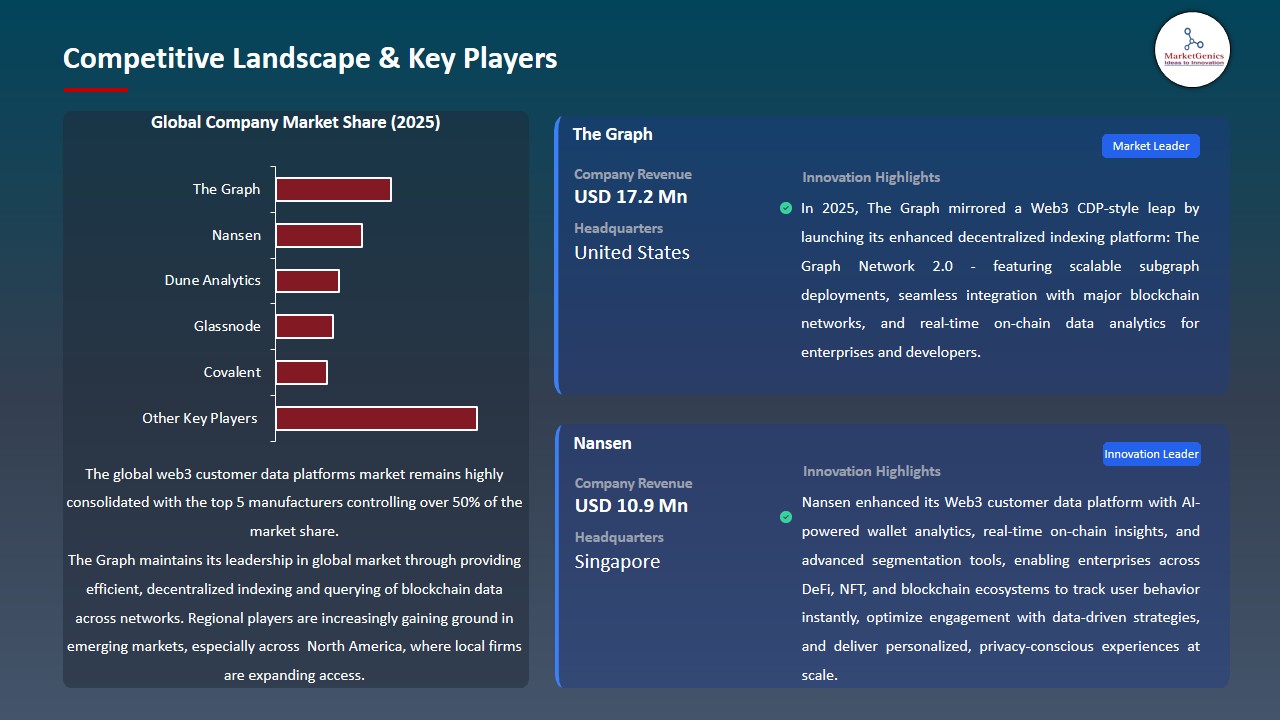
The web3 customer data platforms (CDP) market is showing high consolidation between the top firms, which accounts for the most trading volume. The Graph, Dune Analytics, Covalent, Nansen, Flipside Crypto, Aleph.im, Ocean Protocol, and mParticle are the major players that accomplish the most through their highly advanced indexing, analytics, and decentralized data-infrastructure technologies. These entities use particular tech stacks to take the biggest slices of the market and to be the first movers in the industry.
One key takeaway is that major players focusing on niche solutions to drive innovation. For instance, The Graph offers decentralized subgraph-based indexing for dApps; Dune Analytics provides SQL-driven multi-chain dashboards; Covalent supports unified APIs for cross-chain data; Nansen monitors wallet intelligence and “smart-money” flows; Flipside Crypto and Aleph.im allow multi-chain aggregation and decentralized storage. In essence, these features are instrumental in enhancing the reliability of Web3 data and the productivity of developers.
The market is even more compelling with the presence of institutional support and R&D investments. As a matter of fact, The Graph upgraded its services in September 2025 by adding easy-to-understand indexing and real-time substream features that not only sped up data ingestion but also allowed real-time analytics for dApps.
The leaders of the market are shifting their attention towards product diversification, among other things, integrating on-chain and off-chain data, wallet resolution, developer SDKs, and AI-driven insights to boost operational efficiency, personalization, and compliance. An example of a 2025 platform that uses AI analytics combined with multi-chain wallet behavior tracking that led to a 30-40% increase in attribution accuracy, thus, exemplifying how innovation is a growth engine in the web3 customer data platforms market.
Recent Development and Strategic Overview:
-
In November 2025, The Graph took a step further in its data-infrastructure offer by launching a new "Token API" for the TRON network, which goes well with its current Substreams real-time data-streaming tool. With this update, developers and Web3 platforms get on-demand, tokenized access to token balances, swap data, and decentralized exchange metrics on TRON.
- In June 2025, MetaCRM rolled out a "multichain CDP" feature that leverages a unified UID-based identity model for the gathering of user data across multiple wallets, blockchains, email/social logins, and exchange accounts - thus, fragmented on-chain identity turns into customer profiles. Transitioning from wallet-based tracking to UID-level identity resolution allows for more precise customer segmentation, lifecycle analytics, and tailored communication strategies in Web3 applications.
Report Scope
|
Attribute |
Detail |
|
Market Size in 2025 |
USD 87.3 Mn |
|
Market Forecast Value in 2035 |
USD 2369.2 Mn |
|
Growth Rate (CAGR) |
39.1% |
|
Forecast Period |
2026 – 2035 |
|
Historical Data Available for |
2021 – 2024 |
|
Market Size Units |
USD Mn for Value |
|
Report Format |
Electronic (PDF) + Excel |
|
Regions and Countries Covered |
|||||
|
North America |
Europe |
Asia Pacific |
Middle East |
Africa |
South America |
|
|
|
|
|
|
|
Companies Covered |
|||||
|
|
|
|
|
|
Web3-Customer-Data-Platforms-Market Segmentation and Highlights
|
Segment |
Sub-segment |
|
Web3 Customer Data Platforms Market, By Component |
|
|
Web3 Customer Data Platforms Market, By Deployment Mode |
|
|
Web3 Customer Data Platforms Market, By Data Type Supported |
|
|
Web3 Customer Data Platforms Market, By Identity Approach |
|
|
Web3 Customer Data Platforms Market, By Analytics & ML Capability |
|
|
Web3 Customer Data Platforms Market, By Integration/ Ecosystem |
|
|
Web3 Customer Data Platforms Market By Activation/ Use Case |
|
|
Web3 Customer Data Platforms Market By Vertical |
|
Frequently Asked Questions
Table of Contents
- 1. Research Methodology and Assumptions
- 1.1. Definitions
- 1.2. Research Design and Approach
- 1.3. Data Collection Methods
- 1.4. Base Estimates and Calculations
- 1.5. Forecasting Models
- 1.5.1. Key Forecast Factors & Impact Analysis
- 1.6. Secondary Research
- 1.6.1. Open Sources
- 1.6.2. Paid Databases
- 1.6.3. Associations
- 1.7. Primary Research
- 1.7.1. Primary Sources
- 1.7.2. Primary Interviews with Stakeholders across Ecosystem
- 2. Executive Summary
- 2.1. Global Web3 Customer Data Platforms Market Outlook
- 2.1.1. Web3 Customer Data Platforms Market Size (Value - US$ Mn), and Forecasts, 2021-2035
- 2.1.2. Compounded Annual Growth Rate Analysis
- 2.1.3. Growth Opportunity Analysis
- 2.1.4. Segmental Share Analysis
- 2.1.5. Geographical Share Analysis
- 2.2. Market Analysis and Facts
- 2.3. Supply-Demand Analysis
- 2.4. Competitive Benchmarking
- 2.5. Go-to- Market Strategy
- 2.5.1. Customer/ End-use Industry Assessment
- 2.5.2. Growth Opportunity Data, 2026-2035
- 2.5.2.1. Regional Data
- 2.5.2.2. Country Data
- 2.5.2.3. Segmental Data
- 2.5.3. Identification of Potential Market Spaces
- 2.5.4. GAP Analysis
- 2.5.5. Potential Attractive Price Points
- 2.5.6. Prevailing Market Risks & Challenges
- 2.5.7. Preferred Sales & Marketing Strategies
- 2.5.8. Key Recommendations and Analysis
- 2.5.9. A Way Forward
- 2.1. Global Web3 Customer Data Platforms Market Outlook
- 3. Industry Data and Premium Insights
- 3.1. Global Information Technology & Media Ecosystem Overview, 2025
- 3.1.1. Information Technology & Media Industry Analysis
- 3.1.2. Key Trends for Information Technology & Media Industry
- 3.1.3. Regional Distribution for Information Technology & Media Industry
- 3.2. Supplier Customer Data
- 3.3. Technology Roadmap and Developments
- 3.1. Global Information Technology & Media Ecosystem Overview, 2025
- 4. Market Overview
- 4.1. Market Dynamics
- 4.1.1. Drivers
- 4.1.1.1. Rising demand for decentralized, privacy-first customer data management using blockchain.
- 4.1.1.2. Adoption of AI/ML analytics for segmentation, personalized marketing, and loyalty optimization.
- 4.1.1.3. Investment in interoperable Web3 infrastructure and smart contracts to unify on-chain and off-chain data.
- 4.1.2. Restraints
- 4.1.2.1. High development and operational costs for decentralized data platforms.
- 4.1.2.2. Integration challenges with existing CRM, marketing, and legacy enterprise systems.
- 4.1.1. Drivers
- 4.2. Key Trend Analysis
- 4.3. Regulatory Framework
- 4.3.1. Key Regulations, Norms, and Subsidies, by Key Countries
- 4.3.2. Tariffs and Standards
- 4.3.3. Impact Analysis of Regulations on the Market
- 4.4. Value Chain Analysis
- 4.4.1. Blockchain Infrastructure & Data Ingestion Layer Providers
- 4.4.2. System Integrators/ Technology Providers
- 4.4.3. Web3 Customer Data Platforms Suppliers
- 4.4.4. End Users
- 4.5. Cost Structure Analysis
- 4.5.1. Parameter’s Share for Cost Associated
- 4.5.2. COGP vs COGS
- 4.5.3. Profit Margin Analysis
- 4.6. Pricing Analysis
- 4.6.1. Regional Pricing Analysis
- 4.6.2. Segmental Pricing Trends
- 4.6.3. Factors Influencing Pricing
- 4.7. Porter’s Five Forces Analysis
- 4.8. PESTEL Analysis
- 4.9. Global Web3 Customer Data Platforms Market Demand
- 4.9.1. Historical Market Size –Value (US$ Mn), 2020-2024
- 4.9.2. Current and Future Market Size –Value (US$ Mn), 2026–2035
- 4.9.2.1. Y-o-Y Growth Trends
- 4.9.2.2. Absolute $ Opportunity Assessment
- 4.1. Market Dynamics
- 5. Competition Landscape
- 5.1. Competition structure
- 5.1.1. Fragmented v/s consolidated
- 5.2. Company Share Analysis, 2025
- 5.2.1. Global Company Market Share
- 5.2.2. By Region
- 5.2.2.1. North America
- 5.2.2.2. Europe
- 5.2.2.3. Asia Pacific
- 5.2.2.4. Middle East
- 5.2.2.5. Africa
- 5.2.2.6. South America
- 5.3. Product Comparison Matrix
- 5.3.1. Specifications
- 5.3.2. Market Positioning
- 5.3.3. Pricing
- 5.1. Competition structure
- 6. Global Web3 Customer Data Platforms Market Analysis, by Component
- 6.1. Key Segment Analysis
- 6.2. Web3 Customer Data Platforms Market Size (Value - US$ Mn), Analysis, and Forecasts, by Component, 2021-2035
- 6.2.1. Data Ingestion & Connectors
- 6.2.2. Decentralized Storage & Indexing
- 6.2.3. Identity & Wallet Resolution
- 6.2.4. Data Normalization & Enrichment
- 6.2.5. Customer Profile Graph & Identity Graph
- 6.2.6. Analytics & Attribution Engine
- 6.2.7. Consent, Privacy & Governance Module
- 6.2.8. APIs & Activation / SDKs
- 6.2.9. Others
- 7. Global Web3 Customer Data Platforms Market Analysis, by Deployment Mode
- 7.1. Key Segment Analysis
- 7.2. Web3 Customer Data Platforms Market Size (Value - US$ Mn), Analysis, and Forecasts, by Deployment Mode, 2021-2035
- 7.2.1. Cloud-Based
- 7.2.2. On-Premises
- 7.2.3. Hybrid
- 8. Global Web3 Customer Data Platforms Market Analysis, by Data Type Supported
- 8.1. Key Segment Analysis
- 8.2. Web3 Customer Data Platforms Market Size (Value - US$ Mn), Analysis, and Forecasts, by Data Type Supported, 2021-2035
- 8.2.1. On-chain Transactional Data
- 8.2.2. Off-chain Behavioral Data (web, app)
- 8.2.3. Wallet & Address Metadata
- 8.2.4. Token Holdings & NFT Ownership
- 8.2.5. Social / Reputation Signals
- 8.2.6. Oracle / External Data Feeds
- 8.2.7. Others
- 9. Global Web3 Customer Data Platforms Market Analysis, by Identity Approach
- 9.1. Key Segment Analysis
- 9.2. Web3 Customer Data Platforms Market Size (Value - US$ Mn), Analysis, and Forecasts, by Identity Approach, 2021-2035
- 9.2.1. Wallet-centric Profiles (address-first)
- 9.2.2. Decentralized ID (DID) based Profiles
- 9.2.3. Cross-wallet Identity Resolution (clustering)
- 9.2.4. KYC / Verified Identity integration
- 9.2.5. Others
- 10. Global Web3 Customer Data Platforms Market Analysis, by Analytics & ML Capability
- 10.1. Key Segment Analysis
- 10.2. Web3 Customer Data Platforms Market Size (Value - US$ Mn), Analysis, and Forecasts, by Analytics & ML Capability, 2021-2035
- 10.2.1. Real-time Streaming Analytics
- 10.2.2. Cohort / Lifecycle Modeling for wallets/users
- 10.2.3. Propensity & Churn Predictive Models
- 10.2.4. On-chain Behavioral Pattern Detection
- 10.2.5. Token/NFT Lifetime Value (LTV) Modeling
- 10.2.6. Others
- 11. Global Web3 Customer Data Platforms Market Analysis, by Integration/ Ecosystem
- 11.1. Key Segment Analysis
- 11.2. Web3 Customer Data Platforms Market Size (Value - US$ Mn), Analysis, and Forecasts, by Integration/ Ecosystem, 2021-2035
- 11.2.1. Wallet Providers & Wallet SDKs
- 11.2.2. DEXs, Marketplaces & NFT Platforms
- 11.2.3. Oracles & Price Feeds
- 11.2.4. Traditional MarTech / CDP / CRM connectors
- 11.2.5. Analytics / BI & Visualization tools
- 11.2.6. Others
- 12. Global Web3 Customer Data Platforms Market Analysis, by Activation/ Use Case
- 12.1. Key Segment Analysis
- 12.2. Web3 Customer Data Platforms Market Size (Value - US$ Mn), Analysis, and Forecasts, by Activation/ Use Case, 2021-2035
- 12.2.1. Personalized Web3 Onsite / In-app Experiences
- 12.2.2. Targeted Airdrops / Token Incentivization
- 12.2.3. Programmatic NFT Drops & Gated Access
- 12.2.4. Loyalty & Reward Orchestration
- 12.2.5. Fraud, Sybil & Risk Scoring
- 12.2.6. Cross-channel Retargeting (email, push, on-chain tx)
- 12.2.7. Others
- 13. Global Web3 Customer Data Platforms Market Analysis, by Vertical
- 13.1. Key Segment Analysis
- 13.2. Web3 Customer Data Platforms Market Size (Value - US$ Mn), Analysis, and Forecasts, by Vertical, 2021-2035
- 13.2.1. NFT Marketplaces & Collectibles
- 13.2.2. Gaming & Play-to-Earn Platforms
- 13.2.3. DeFi Exchanges & Yield Protocols
- 13.2.4. Brand & Creator Communities
- 13.2.5. Web3 Native Marketplaces & DAOs
- 13.2.6. Others
- 14. Global Web3 Customer Data Platforms Market Analysis and Forecasts, by Region
- 14.1. Key Findings
- 14.2. Web3 Customer Data Platforms Market Size (Value - US$ Mn), Analysis, and Forecasts, by Region, 2021-2035
- 14.2.1. North America
- 14.2.2. Europe
- 14.2.3. Asia Pacific
- 14.2.4. Middle East
- 14.2.5. Africa
- 14.2.6. South America
- 15. North America Web3 Customer Data Platforms Market Analysis
- 15.1. Key Segment Analysis
- 15.2. Regional Snapshot
- 15.3. North America Web3 Customer Data Platforms Market Size Value - US$ Mn), Analysis, and Forecasts, 2021-2035
- 15.3.1. Component
- 15.3.2. Deployment Mode
- 15.3.3. Data Type Supported
- 15.3.4. Identity Approach
- 15.3.5. Analytics & ML Capability
- 15.3.6. Integration/ Ecosystem
- 15.3.7. Activation/ Use Case
- 15.3.8. Vertical
- 15.3.9. Country
- 15.3.9.1. USA
- 15.3.9.2. Canada
- 15.3.9.3. Mexico
- 15.4. USA Web3 Customer Data Platforms Market
- 15.4.1. Country Segmental Analysis
- 15.4.2. Component
- 15.4.3. Deployment Mode
- 15.4.4. Data Type Supported
- 15.4.5. Identity Approach
- 15.4.6. Analytics & ML Capability
- 15.4.7. Integration/ Ecosystem
- 15.4.8. Activation/ Use Case
- 15.4.9. Vertical
- 15.5. Canada Web3 Customer Data Platforms Market
- 15.5.1. Country Segmental Analysis
- 15.5.2. Component
- 15.5.3. Deployment Mode
- 15.5.4. Data Type Supported
- 15.5.5. Identity Approach
- 15.5.6. Analytics & ML Capability
- 15.5.7. Integration/ Ecosystem
- 15.5.8. Activation/ Use Case
- 15.5.9. Vertical
- 15.6. Mexico Web3 Customer Data Platforms Market
- 15.6.1. Country Segmental Analysis
- 15.6.2. Component
- 15.6.3. Deployment Mode
- 15.6.4. Data Type Supported
- 15.6.5. Identity Approach
- 15.6.6. Analytics & ML Capability
- 15.6.7. Integration/ Ecosystem
- 15.6.8. Activation/ Use Case
- 15.6.9. Vertical
- 16. Europe Web3 Customer Data Platforms Market Analysis
- 16.1. Key Segment Analysis
- 16.2. Regional Snapshot
- 16.3. Europe Web3 Customer Data Platforms Market Size (Value - US$ Mn), Analysis, and Forecasts, 2021-2035
- 16.3.1. Component
- 16.3.2. Deployment Mode
- 16.3.3. Data Type Supported
- 16.3.4. Identity Approach
- 16.3.5. Analytics & ML Capability
- 16.3.6. Integration/ Ecosystem
- 16.3.7. Activation/ Use Case
- 16.3.8. Vertical
- 16.3.9. Country
- 16.3.9.1. Germany
- 16.3.9.2. United Kingdom
- 16.3.9.3. France
- 16.3.9.4. Italy
- 16.3.9.5. Spain
- 16.3.9.6. Netherlands
- 16.3.9.7. Nordic Countries
- 16.3.9.8. Poland
- 16.3.9.9. Russia & CIS
- 16.3.9.10. Rest of Europe
- 16.4. Germany Web3 Customer Data Platforms Market
- 16.4.1. Country Segmental Analysis
- 16.4.2. Component
- 16.4.3. Deployment Mode
- 16.4.4. Data Type Supported
- 16.4.5. Identity Approach
- 16.4.6. Analytics & ML Capability
- 16.4.7. Integration/ Ecosystem
- 16.4.8. Activation/ Use Case
- 16.4.9. Vertical
- 16.5. United Kingdom Web3 Customer Data Platforms Market
- 16.5.1. Country Segmental Analysis
- 16.5.2. Component
- 16.5.3. Deployment Mode
- 16.5.4. Data Type Supported
- 16.5.5. Identity Approach
- 16.5.6. Analytics & ML Capability
- 16.5.7. Integration/ Ecosystem
- 16.5.8. Activation/ Use Case
- 16.5.9. Vertical
- 16.6. France Web3 Customer Data Platforms Market
- 16.6.1. Country Segmental Analysis
- 16.6.2. Component
- 16.6.3. Deployment Mode
- 16.6.4. Data Type Supported
- 16.6.5. Identity Approach
- 16.6.6. Analytics & ML Capability
- 16.6.7. Integration/ Ecosystem
- 16.6.8. Activation/ Use Case
- 16.6.9. Vertical
- 16.7. Italy Web3 Customer Data Platforms Market
- 16.7.1. Country Segmental Analysis
- 16.7.2. Component
- 16.7.3. Deployment Mode
- 16.7.4. Data Type Supported
- 16.7.5. Identity Approach
- 16.7.6. Analytics & ML Capability
- 16.7.7. Integration/ Ecosystem
- 16.7.8. Activation/ Use Case
- 16.7.9. Vertical
- 16.8. Spain Web3 Customer Data Platforms Market
- 16.8.1. Country Segmental Analysis
- 16.8.2. Component
- 16.8.3. Deployment Mode
- 16.8.4. Data Type Supported
- 16.8.5. Identity Approach
- 16.8.6. Analytics & ML Capability
- 16.8.7. Integration/ Ecosystem
- 16.8.8. Activation/ Use Case
- 16.8.9. Vertical
- 16.9. Netherlands Web3 Customer Data Platforms Market
- 16.9.1. Country Segmental Analysis
- 16.9.2. Component
- 16.9.3. Deployment Mode
- 16.9.4. Data Type Supported
- 16.9.5. Identity Approach
- 16.9.6. Analytics & ML Capability
- 16.9.7. Integration/ Ecosystem
- 16.9.8. Activation/ Use Case
- 16.9.9. Vertical
- 16.10. Nordic Countries Web3 Customer Data Platforms Market
- 16.10.1. Country Segmental Analysis
- 16.10.2. Component
- 16.10.3. Deployment Mode
- 16.10.4. Data Type Supported
- 16.10.5. Identity Approach
- 16.10.6. Analytics & ML Capability
- 16.10.7. Integration/ Ecosystem
- 16.10.8. Activation/ Use Case
- 16.10.9. Vertical
- 16.11. Poland Web3 Customer Data Platforms Market
- 16.11.1. Country Segmental Analysis
- 16.11.2. Component
- 16.11.3. Deployment Mode
- 16.11.4. Data Type Supported
- 16.11.5. Identity Approach
- 16.11.6. Analytics & ML Capability
- 16.11.7. Integration/ Ecosystem
- 16.11.8. Activation/ Use Case
- 16.11.9. Vertical
- 16.12. Russia & CIS Web3 Customer Data Platforms Market
- 16.12.1. Country Segmental Analysis
- 16.12.2. Component
- 16.12.3. Deployment Mode
- 16.12.4. Data Type Supported
- 16.12.5. Identity Approach
- 16.12.6. Analytics & ML Capability
- 16.12.7. Integration/ Ecosystem
- 16.12.8. Activation/ Use Case
- 16.12.9. Vertical
- 16.13. Rest of Europe Web3 Customer Data Platforms Market
- 16.13.1. Country Segmental Analysis
- 16.13.2. Component
- 16.13.3. Deployment Mode
- 16.13.4. Data Type Supported
- 16.13.5. Identity Approach
- 16.13.6. Analytics & ML Capability
- 16.13.7. Integration/ Ecosystem
- 16.13.8. Activation/ Use Case
- 16.13.9. Vertical
- 17. Asia Pacific Web3 Customer Data Platforms Market Analysis
- 17.1. Key Segment Analysis
- 17.2. Regional Snapshot
- 17.3. Asia Pacific Web3 Customer Data Platforms Market Size (Value - US$ Mn), Analysis, and Forecasts, 2021-2035
- 17.3.1. Component
- 17.3.2. Deployment Mode
- 17.3.3. Data Type Supported
- 17.3.4. Identity Approach
- 17.3.5. Analytics & ML Capability
- 17.3.6. Integration/ Ecosystem
- 17.3.7. Activation/ Use Case
- 17.3.8. Vertical
- 17.3.9. Country
- 17.3.9.1. China
- 17.3.9.2. India
- 17.3.9.3. Japan
- 17.3.9.4. South Korea
- 17.3.9.5. Australia and New Zealand
- 17.3.9.6. Indonesia
- 17.3.9.7. Malaysia
- 17.3.9.8. Thailand
- 17.3.9.9. Vietnam
- 17.3.9.10. Rest of Asia Pacific
- 17.4. China Web3 Customer Data Platforms Market
- 17.4.1. Country Segmental Analysis
- 17.4.2. Component
- 17.4.3. Deployment Mode
- 17.4.4. Data Type Supported
- 17.4.5. Identity Approach
- 17.4.6. Analytics & ML Capability
- 17.4.7. Integration/ Ecosystem
- 17.4.8. Activation/ Use Case
- 17.4.9. Vertical
- 17.5. India Web3 Customer Data Platforms Market
- 17.5.1. Country Segmental Analysis
- 17.5.2. Component
- 17.5.3. Deployment Mode
- 17.5.4. Data Type Supported
- 17.5.5. Identity Approach
- 17.5.6. Analytics & ML Capability
- 17.5.7. Integration/ Ecosystem
- 17.5.8. Activation/ Use Case
- 17.5.9. Vertical
- 17.6. Japan Web3 Customer Data Platforms Market
- 17.6.1. Country Segmental Analysis
- 17.6.2. Component
- 17.6.3. Deployment Mode
- 17.6.4. Data Type Supported
- 17.6.5. Identity Approach
- 17.6.6. Analytics & ML Capability
- 17.6.7. Integration/ Ecosystem
- 17.6.8. Activation/ Use Case
- 17.6.9. Vertical
- 17.7. South Korea Web3 Customer Data Platforms Market
- 17.7.1. Country Segmental Analysis
- 17.7.2. Component
- 17.7.3. Deployment Mode
- 17.7.4. Data Type Supported
- 17.7.5. Identity Approach
- 17.7.6. Analytics & ML Capability
- 17.7.7. Integration/ Ecosystem
- 17.7.8. Activation/ Use Case
- 17.7.9. Vertical
- 17.8. Australia and New Zealand Web3 Customer Data Platforms Market
- 17.8.1. Country Segmental Analysis
- 17.8.2. Component
- 17.8.3. Deployment Mode
- 17.8.4. Data Type Supported
- 17.8.5. Identity Approach
- 17.8.6. Analytics & ML Capability
- 17.8.7. Integration/ Ecosystem
- 17.8.8. Activation/ Use Case
- 17.8.9. Vertical
- 17.9. Indonesia Web3 Customer Data Platforms Market
- 17.9.1. Country Segmental Analysis
- 17.9.2. Component
- 17.9.3. Deployment Mode
- 17.9.4. Data Type Supported
- 17.9.5. Identity Approach
- 17.9.6. Analytics & ML Capability
- 17.9.7. Integration/ Ecosystem
- 17.9.8. Activation/ Use Case
- 17.9.9. Vertical
- 17.10. Malaysia Web3 Customer Data Platforms Market
- 17.10.1. Country Segmental Analysis
- 17.10.2. Component
- 17.10.3. Deployment Mode
- 17.10.4. Data Type Supported
- 17.10.5. Identity Approach
- 17.10.6. Analytics & ML Capability
- 17.10.7. Integration/ Ecosystem
- 17.10.8. Activation/ Use Case
- 17.10.9. Vertical
- 17.11. Thailand Web3 Customer Data Platforms Market
- 17.11.1. Country Segmental Analysis
- 17.11.2. Component
- 17.11.3. Deployment Mode
- 17.11.4. Data Type Supported
- 17.11.5. Identity Approach
- 17.11.6. Analytics & ML Capability
- 17.11.7. Integration/ Ecosystem
- 17.11.8. Activation/ Use Case
- 17.11.9. Vertical
- 17.12. Vietnam Web3 Customer Data Platforms Market
- 17.12.1. Country Segmental Analysis
- 17.12.2. Component
- 17.12.3. Deployment Mode
- 17.12.4. Data Type Supported
- 17.12.5. Identity Approach
- 17.12.6. Analytics & ML Capability
- 17.12.7. Integration/ Ecosystem
- 17.12.8. Activation/ Use Case
- 17.12.9. Vertical
- 17.13. Rest of Asia Pacific Web3 Customer Data Platforms Market
- 17.13.1. Country Segmental Analysis
- 17.13.2. Component
- 17.13.3. Deployment Mode
- 17.13.4. Data Type Supported
- 17.13.5. Identity Approach
- 17.13.6. Analytics & ML Capability
- 17.13.7. Integration/ Ecosystem
- 17.13.8. Activation/ Use Case
- 17.13.9. Vertical
- 18. Middle East Web3 Customer Data Platforms Market Analysis
- 18.1. Key Segment Analysis
- 18.2. Regional Snapshot
- 18.3. Middle East Web3 Customer Data Platforms Market Size (Value - US$ Mn), Analysis, and Forecasts, 2021-2035
- 18.3.1. Component
- 18.3.2. Deployment Mode
- 18.3.3. Data Type Supported
- 18.3.4. Identity Approach
- 18.3.5. Analytics & ML Capability
- 18.3.6. Integration/ Ecosystem
- 18.3.7. Activation/ Use Case
- 18.3.8. Vertical
- 18.3.9. Country
- 18.3.9.1. Turkey
- 18.3.9.2. UAE
- 18.3.9.3. Saudi Arabia
- 18.3.9.4. Israel
- 18.3.9.5. Rest of Middle East
- 18.4. Turkey Web3 Customer Data Platforms Market
- 18.4.1. Country Segmental Analysis
- 18.4.2. Component
- 18.4.3. Deployment Mode
- 18.4.4. Data Type Supported
- 18.4.5. Identity Approach
- 18.4.6. Analytics & ML Capability
- 18.4.7. Integration/ Ecosystem
- 18.4.8. Activation/ Use Case
- 18.4.9. Vertical
- 18.5. UAE Web3 Customer Data Platforms Market
- 18.5.1. Country Segmental Analysis
- 18.5.2. Component
- 18.5.3. Deployment Mode
- 18.5.4. Data Type Supported
- 18.5.5. Identity Approach
- 18.5.6. Analytics & ML Capability
- 18.5.7. Integration/ Ecosystem
- 18.5.8. Activation/ Use Case
- 18.5.9. Vertical
- 18.6. Saudi Arabia Web3 Customer Data Platforms Market
- 18.6.1. Country Segmental Analysis
- 18.6.2. Component
- 18.6.3. Deployment Mode
- 18.6.4. Data Type Supported
- 18.6.5. Identity Approach
- 18.6.6. Analytics & ML Capability
- 18.6.7. Integration/ Ecosystem
- 18.6.8. Activation/ Use Case
- 18.6.9. Vertical
- 18.7. Israel Web3 Customer Data Platforms Market
- 18.7.1. Country Segmental Analysis
- 18.7.2. Component
- 18.7.3. Deployment Mode
- 18.7.4. Data Type Supported
- 18.7.5. Identity Approach
- 18.7.6. Analytics & ML Capability
- 18.7.7. Integration/ Ecosystem
- 18.7.8. Activation/ Use Case
- 18.7.9. Vertical
- 18.8. Rest of Middle East Web3 Customer Data Platforms Market
- 18.8.1. Country Segmental Analysis
- 18.8.2. Component
- 18.8.3. Deployment Mode
- 18.8.4. Data Type Supported
- 18.8.5. Identity Approach
- 18.8.6. Analytics & ML Capability
- 18.8.7. Integration/ Ecosystem
- 18.8.8. Activation/ Use Case
- 18.8.9. Vertical
- 19. Africa Web3 Customer Data Platforms Market Analysis
- 19.1. Key Segment Analysis
- 19.2. Regional Snapshot
- 19.3. Africa Web3 Customer Data Platforms Market Size (Value - US$ Mn), Analysis, and Forecasts, 2021-2035
- 19.3.1. Component
- 19.3.2. Deployment Mode
- 19.3.3. Data Type Supported
- 19.3.4. Identity Approach
- 19.3.5. Analytics & ML Capability
- 19.3.6. Integration/ Ecosystem
- 19.3.7. Activation/ Use Case
- 19.3.8. Vertical
- 19.3.9. Country
- 19.3.9.1. South Africa
- 19.3.9.2. Egypt
- 19.3.9.3. Nigeria
- 19.3.9.4. Algeria
- 19.3.9.5. Rest of Africa
- 19.4. South Africa Web3 Customer Data Platforms Market
- 19.4.1. Country Segmental Analysis
- 19.4.2. Component
- 19.4.3. Deployment Mode
- 19.4.4. Data Type Supported
- 19.4.5. Identity Approach
- 19.4.6. Analytics & ML Capability
- 19.4.7. Integration/ Ecosystem
- 19.4.8. Activation/ Use Case
- 19.4.9. Vertical
- 19.5. Egypt Web3 Customer Data Platforms Market
- 19.5.1. Country Segmental Analysis
- 19.5.2. Component
- 19.5.3. Deployment Mode
- 19.5.4. Data Type Supported
- 19.5.5. Identity Approach
- 19.5.6. Analytics & ML Capability
- 19.5.7. Integration/ Ecosystem
- 19.5.8. Activation/ Use Case
- 19.5.9. Vertical
- 19.6. Nigeria Web3 Customer Data Platforms Market
- 19.6.1. Country Segmental Analysis
- 19.6.2. Component
- 19.6.3. Deployment Mode
- 19.6.4. Data Type Supported
- 19.6.5. Identity Approach
- 19.6.6. Analytics & ML Capability
- 19.6.7. Integration/ Ecosystem
- 19.6.8. Activation/ Use Case
- 19.6.9. Vertical
- 19.7. Algeria Web3 Customer Data Platforms Market
- 19.7.1. Country Segmental Analysis
- 19.7.2. Component
- 19.7.3. Deployment Mode
- 19.7.4. Data Type Supported
- 19.7.5. Identity Approach
- 19.7.6. Analytics & ML Capability
- 19.7.7. Integration/ Ecosystem
- 19.7.8. Activation/ Use Case
- 19.7.9. Vertical
- 19.8. Rest of Africa Web3 Customer Data Platforms Market
- 19.8.1. Country Segmental Analysis
- 19.8.2. Component
- 19.8.3. Deployment Mode
- 19.8.4. Data Type Supported
- 19.8.5. Identity Approach
- 19.8.6. Analytics & ML Capability
- 19.8.7. Integration/ Ecosystem
- 19.8.8. Activation/ Use Case
- 19.8.9. Vertical
- 20. South America Web3 Customer Data Platforms Market Analysis
- 20.1. Key Segment Analysis
- 20.2. Regional Snapshot
- 20.3. South America Web3 Customer Data Platforms Market Size (Value - US$ Mn), Analysis, and Forecasts, 2021-2035
- 20.3.1. Component
- 20.3.2. Deployment Mode
- 20.3.3. Data Type Supported
- 20.3.4. Identity Approach
- 20.3.5. Analytics & ML Capability
- 20.3.6. Integration/ Ecosystem
- 20.3.7. Activation/ Use Case
- 20.3.8. Vertical
- 20.3.9. Country
- 20.3.9.1. Brazil
- 20.3.9.2. Argentina
- 20.3.9.3. Rest of South America
- 20.4. Brazil Web3 Customer Data Platforms Market
- 20.4.1. Country Segmental Analysis
- 20.4.2. Component
- 20.4.3. Deployment Mode
- 20.4.4. Data Type Supported
- 20.4.5. Identity Approach
- 20.4.6. Analytics & ML Capability
- 20.4.7. Integration/ Ecosystem
- 20.4.8. Activation/ Use Case
- 20.4.9. Vertical
- 20.5. Argentina Web3 Customer Data Platforms Market
- 20.5.1. Country Segmental Analysis
- 20.5.2. Component
- 20.5.3. Deployment Mode
- 20.5.4. Data Type Supported
- 20.5.5. Identity Approach
- 20.5.6. Analytics & ML Capability
- 20.5.7. Integration/ Ecosystem
- 20.5.8. Activation/ Use Case
- 20.5.9. Vertical
- 20.6. Rest of South America Web3 Customer Data Platforms Market
- 20.6.1. Country Segmental Analysis
- 20.6.2. Component
- 20.6.3. Deployment Mode
- 20.6.4. Data Type Supported
- 20.6.5. Identity Approach
- 20.6.6. Analytics & ML Capability
- 20.6.7. Integration/ Ecosystem
- 20.6.8. Activation/ Use Case
- 20.6.9. Vertical
- 21. Key Players/ Company Profile
- 21.1. Aleph.im
- 21.1.1. Company Details/ Overview
- 21.1.2. Company Financials
- 21.1.3. Key Customers and Competitors
- 21.1.4. Business/ Industry Portfolio
- 21.1.5. Product Portfolio/ Specification Details
- 21.1.6. Pricing Data
- 21.1.7. Strategic Overview
- 21.1.8. Recent Developments
- 21.2. Attestiv/ Verifiable-data tooling
- 21.3. Bloom
- 21.4. Ceramic/ 3Box Labs
- 21.5. Chainlink
- 21.6. Covalent
- 21.7. Covalent-like indexing providers
- 21.8. Dune Analytics
- 21.9. Flipside Crypto
- 21.10. Glassnode
- 21.11. Lit Protocol
- 21.12. mParticle
- 21.13. Nansen
- 21.14. Ocean Protocol
- 21.15. Pinecone
- 21.16. RudderStack
- 21.17. The Graph
- 21.18. Treasure Data
- 21.19. Unstoppable Domains
- 21.20. Other Key Players
- 21.1. Aleph.im
Note* - This is just tentative list of players. While providing the report, we will cover more number of players based on their revenue and share for each geography
Research Design
Our research design integrates both demand-side and supply-side analysis through a balanced combination of primary and secondary research methodologies. By utilizing both bottom-up and top-down approaches alongside rigorous data triangulation methods, we deliver robust market intelligence that supports strategic decision-making.
MarketGenics' comprehensive research design framework ensures the delivery of accurate, reliable, and actionable market intelligence. Through the integration of multiple research approaches, rigorous validation processes, and expert analysis, we provide our clients with the insights needed to make informed strategic decisions and capitalize on market opportunities.
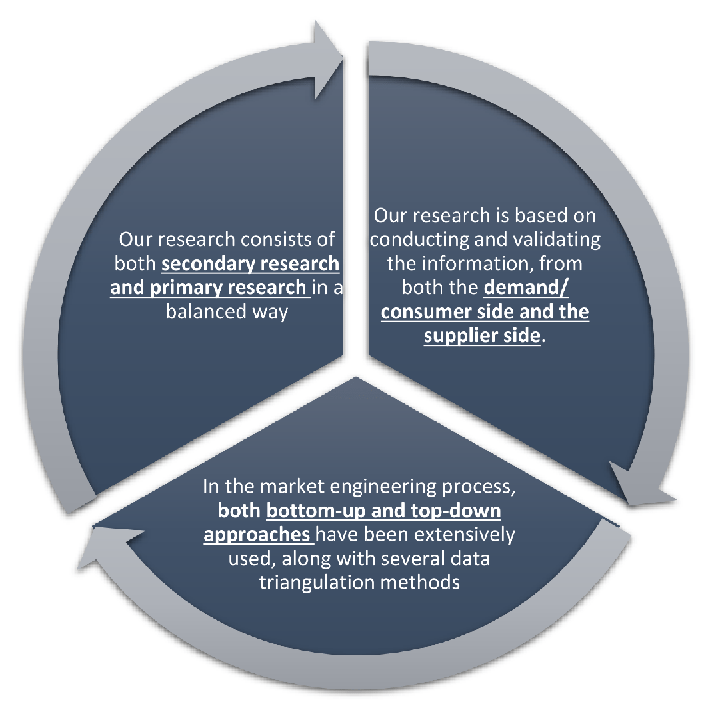
MarketGenics leverages a dedicated industry panel of experts and a comprehensive suite of paid databases to effectively collect, consolidate, and analyze market intelligence.
Our approach has consistently proven to be reliable and effective in generating accurate market insights, identifying key industry trends, and uncovering emerging business opportunities.
Through both primary and secondary research, we capture and analyze critical company-level data such as manufacturing footprints, including technical centers, R&D facilities, sales offices, and headquarters.
Our expert panel further enhances our ability to estimate market size for specific brands based on validated field-level intelligence.
Our data mining techniques incorporate both parametric and non-parametric methods, allowing for structured data collection, sorting, processing, and cleaning.
Demand projections are derived from large-scale data sets analyzed through proprietary algorithms, culminating in robust and reliable market sizing.
Research Approach
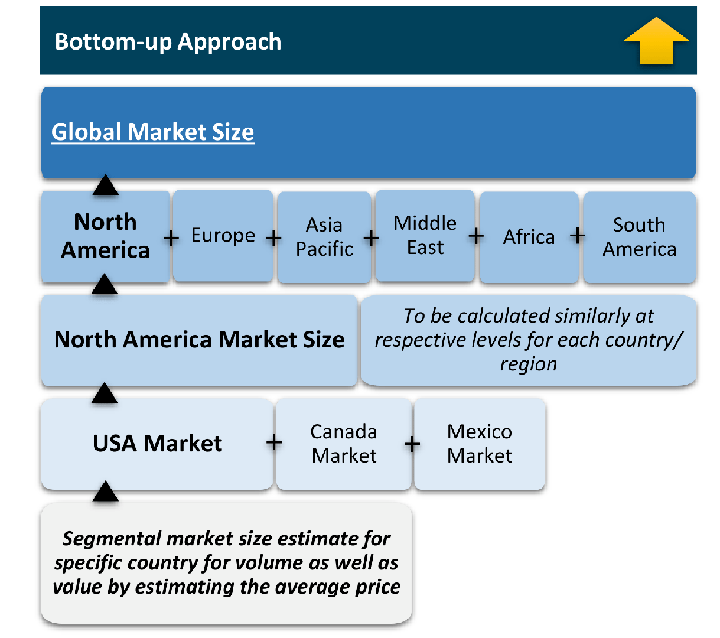
The bottom-up approach builds market estimates by starting with the smallest addressable market units and systematically aggregating them to create comprehensive market size projections.
This method begins with specific, granular data points and builds upward to create the complete market landscape.
Customer Analysis → Segmental Analysis → Geographical Analysis
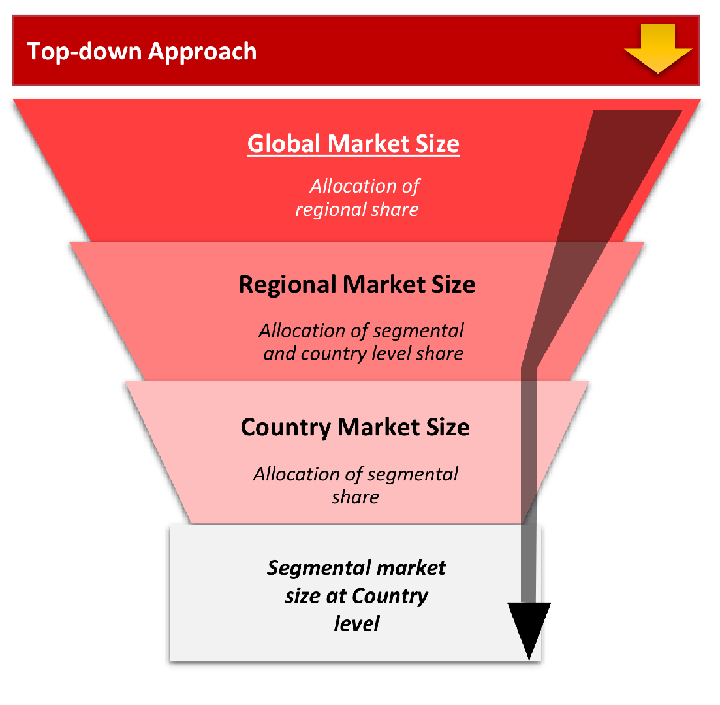
The top-down approach starts with the broadest possible market data and systematically narrows it down through a series of filters and assumptions to arrive at specific market segments or opportunities.
This method begins with the big picture and works downward to increasingly specific market slices.
TAM → SAM → SOM
Research Methods
Desk / Secondary Research
While analysing the market, we extensively study secondary sources, directories, and databases to identify and collect information useful for this technical, market-oriented, and commercial report. Secondary sources that we utilize are not only the public sources, but it is a combination of Open Source, Associations, Paid Databases, MG Repository & Knowledgebase, and others.
- Company websites, annual reports, financial reports, broker reports, and investor presentations
- National government documents, statistical databases and reports
- News articles, press releases and web-casts specific to the companies operating in the market, Magazines, reports, and others
- We gather information from commercial data sources for deriving company specific data such as segmental revenue, share for geography, product revenue, and others
- Internal and external proprietary databases (industry-specific), relevant patent, and regulatory databases
- Governing Bodies, Government Organizations
- Relevant Authorities, Country-specific Associations for Industries
We also employ the model mapping approach to estimate the product level market data through the players' product portfolio
Primary Research
Primary research/ interviews is vital in analyzing the market. Most of the cases involves paid primary interviews. Primary sources include primary interviews through e-mail interactions, telephonic interviews, surveys as well as face-to-face interviews with the different stakeholders across the value chain including several industry experts.
| Type of Respondents | Number of Primaries |
|---|---|
| Tier 2/3 Suppliers | ~20 |
| Tier 1 Suppliers | ~25 |
| End-users | ~25 |
| Industry Expert/ Panel/ Consultant | ~30 |
| Total | ~100 |
MG Knowledgebase
• Repository of industry blog, newsletter and case studies
• Online platform covering detailed market reports, and company profiles
Forecasting Factors and Models
Forecasting Factors
- Historical Trends – Past market patterns, cycles, and major events that shaped how markets behave over time. Understanding past trends helps predict future behavior.
- Industry Factors – Specific characteristics of the industry like structure, regulations, and innovation cycles that affect market dynamics.
- Macroeconomic Factors – Economic conditions like GDP growth, inflation, and employment rates that affect how much money people have to spend.
- Demographic Factors – Population characteristics like age, income, and location that determine who can buy your product.
- Technology Factors – How quickly people adopt new technology and how much technology infrastructure exists.
- Regulatory Factors – Government rules, laws, and policies that can help or restrict market growth.
- Competitive Factors – Analyzing competition structure such as degree of competition and bargaining power of buyers and suppliers.
Forecasting Models / Techniques
Multiple Regression Analysis
- Identify and quantify factors that drive market changes
- Statistical modeling to establish relationships between market drivers and outcomes
Time Series Analysis – Seasonal Patterns
- Understand regular cyclical patterns in market demand
- Advanced statistical techniques to separate trend, seasonal, and irregular components
Time Series Analysis – Trend Analysis
- Identify underlying market growth patterns and momentum
- Statistical analysis of historical data to project future trends
Expert Opinion – Expert Interviews
- Gather deep industry insights and contextual understanding
- In-depth interviews with key industry stakeholders
Multi-Scenario Development
- Prepare for uncertainty by modeling different possible futures
- Creating optimistic, pessimistic, and most likely scenarios
Time Series Analysis – Moving Averages
- Sophisticated forecasting for complex time series data
- Auto-regressive integrated moving average models with seasonal components
Econometric Models
- Apply economic theory to market forecasting
- Sophisticated economic models that account for market interactions
Expert Opinion – Delphi Method
- Harness collective wisdom of industry experts
- Structured, multi-round expert consultation process
Monte Carlo Simulation
- Quantify uncertainty and probability distributions
- Thousands of simulations with varying input parameters
Research Analysis
Our research framework is built upon the fundamental principle of validating market intelligence from both demand and supply perspectives. This dual-sided approach ensures comprehensive market understanding and reduces the risk of single-source bias.
Demand-Side Analysis: We understand end-user/application behavior, preferences, and market needs along with the penetration of the product for specific application.
Supply-Side Analysis: We estimate overall market revenue, analyze the segmental share along with industry capacity, competitive landscape, and market structure.
Validation & Evaluation
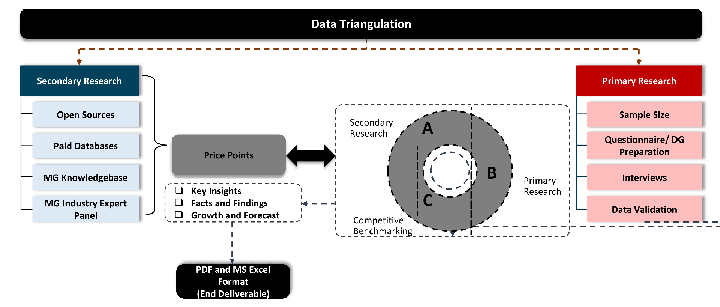
Data triangulation is a validation technique that uses multiple methods, sources, or perspectives to examine the same research question, thereby increasing the credibility and reliability of research findings. In market research, triangulation serves as a quality assurance mechanism that helps identify and minimize bias, validate assumptions, and ensure accuracy in market estimates.
- Data Source Triangulation – Using multiple data sources to examine the same phenomenon
- Methodological Triangulation – Using multiple research methods to study the same research question
- Investigator Triangulation – Using multiple researchers or analysts to examine the same data
- Theoretical Triangulation – Using multiple theoretical perspectives to interpret the same data
Custom Market Research Services
We will customise the research for you, in case the report listed above does not meet your requirements.
Get 10% Free Customisation