Winter Tire Market Size, Share & Trends Analysis Report by Tire Type (Studded Winter Tires, Non-studded Tires, Performance Winter Tires), Rim Size, Tire Width, Aspect Ratio, Vehicle Type, Propulsion Type, End User, Sales Channel and Geography (North America, Europe, Asia Pacific, Middle East, Africa, and South America) – Global Industry Data, Trends, and Forecasts, 2026–2035
|
Market Structure & Evolution |
|
|
Segmental Data Insights |
|
|
Demand Trends |
|
|
Competitive Landscape |
|
|
Strategic Development |
|
|
Future Outlook & 0Opportunities |
|
Winter Tire Market Size, Share, and Growth
The global winter tire market is experiencing robust growth, with its estimated value of USD 24.7 billion in the year 2025 and USD 43.8 billion by the period 2035, registering a CAGR of 5.9% during the forecast period.
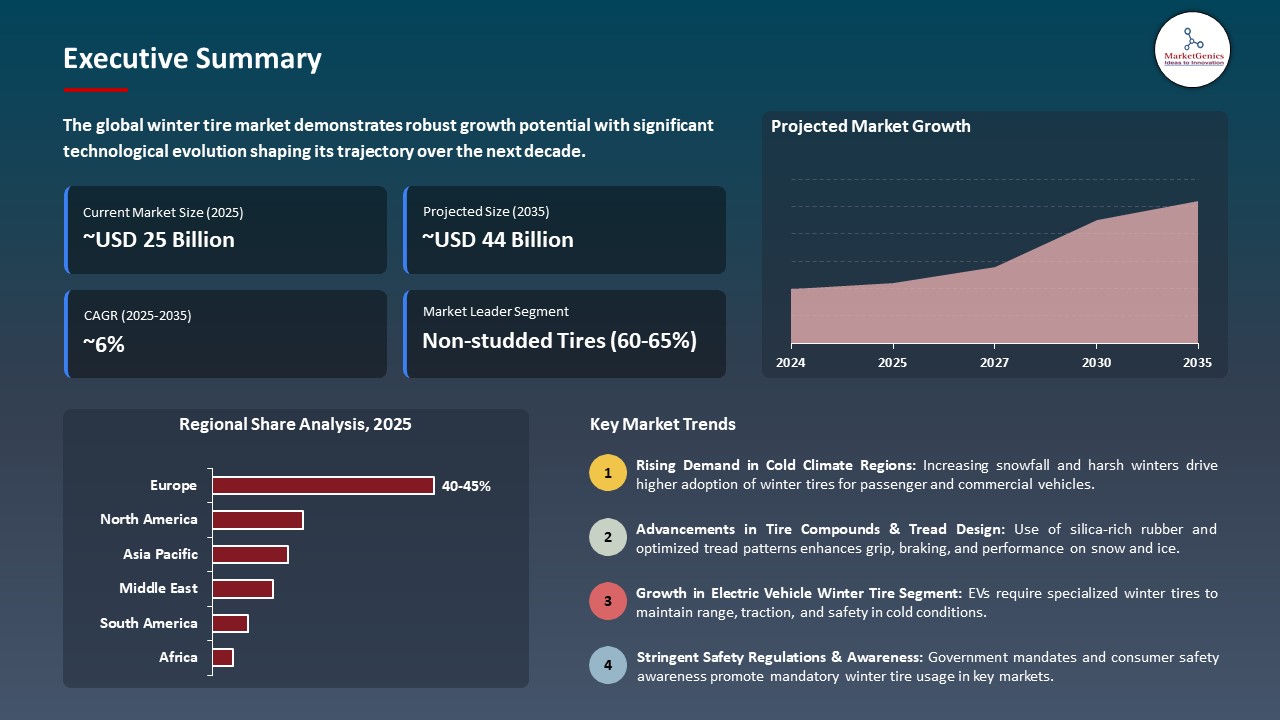
According to Teemu Soini, VP of Innovations and Development for Nokian Tyres, "At Nokian Tyres, we continuously innovate in our winter tire technology with regards to developing new materials such as advanced rubber compounds and optimizing the tread design process. We will continue to invest in R&D geared toward providing winter tire solutions for the toughest climates around the world so that we can reinforce our leadership position in the global winter tire market and ultimately provide confidence to consumers driving through the harshest winter climates."
Enhanced traction, improved braking performance and superior handling on snow and ice are all aspects of winter tires that are now available by the development of new advanced rubber compounds and innovative tread designs. For example, in October 2025, Michelin introduced the X-Ice Snow 3 winter tire range which includes improved silica rubber compounds and optimized tread patterns that deliver added grip under extreme winter conditions.
Continental launched its WinterContact TS 990 range of winter tires in September 2025 with new advanced tread patterns that several European fleets have purchased in order to improve safety and performance when operating in cold weather conditions.
The increasing number of personal vehicles in regions that experience severe winters and the increased use of fleet modernization programmes have resulted in a greater demand for highly dependable winter tires than ever before. Regulatory standards in a number of countries, including the mandatory use of winter tires during snow in parts of Europe and Canada, have encouraged both consumers and fleet owners to invest in high quality, performance-oriented winter tire products. The winter tire industry's growth can be attributed to the combination of innovative tire technology, regulatory requirements and increased cold weather mobility resulting in safer driving experiences and improved operational efficiencies.
There are adjacent opportunities in the global winter tire market, such as studded tire manufacturing; tire pressure monitoring systems; smart tires with integrated sensors; snow chains and hybrid products that combine snow tires with other types of winter tire technologies. Manufacturers can take advantage of these additional markets to provide improved safety products, enhance the quality of winter transportation for consumers and grow sales in the market for tires designed for cold weather use.
Winter Tire Market Dynamics and Trends
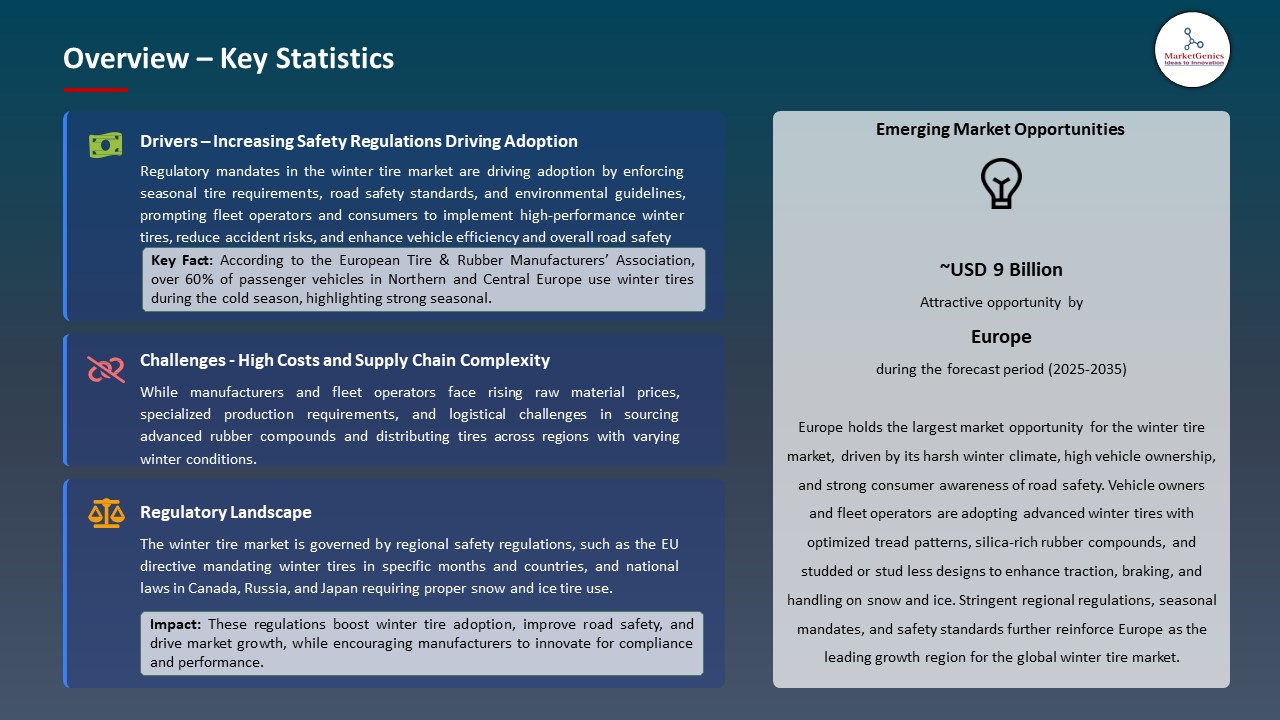
Driver: Increasing Safety Regulations Driving Adoption of Advanced Winter Tires
-
The winter tire market has grown rapidly due in part to new regulations being developed and implemented globally. For instance, Germany, Finland, and Canada require that a vehicle be fitted with either snow tires or winter tires for designated months or under specified weather conditions (specifying that vehicles must be able to conform to greater safety standards for snow and ice). Because, many consumers and fleet operators have had to buy tires with very good cold weather performance.
- A growing trend among insurance companies and automotive safety programs that place both coverage and incentive programs into compliance with where winter tires are fitted to vehicles. In October of 2025 Michelin launched its X-Ice Snow 3 series of tires, which have specially optimized tread pattern designs for icy roads. The series of tires meets both North American and EU Winter Safety standards and represent a global push to provide Safe Driving Solutions during the Winter months.
- The growing use of road transport in areas with severe winter weather continues to stimulate demand for winter tires that provide effective traction, a shorter stopping distance and longevity in extreme environments.
Restraint: High Costs and Supply Chain Complexity Limiting Widespread Winter Tire Adoption
-
There are some areas where the higher price of premium winter tires compared to all-season tires limits the number of people who buy them despite the increasing number of rules about how winter tires should be manufactured (regulatory) and the need to keep drivers safe in winter (safety). Many fleet operators and private customers do not have enough money to purchase premium winter tires, so this has slowed the adoption rate of premium winter tires in these areas.
- Further, to manufacture advanced winter tires requires the use of specialized chemical compounds, extensive research and development (R&D), and tire tread designs that work specifically for winter weather conditions. Global supply chain issues, and increased costs of raw materials also affect large-scale production of advanced winter tires, especially in developing nations.
- Additionally, manufacturers and consumers face the ongoing challenge of finding a balance among high performance, long-term performance (durability) and affordability, which is also a reason for the slow rate of adoption of premium winter tires by consumers.
Opportunity: Expansion in Emerging Markets and Fleet Modernization Programs
-
Emerging economies in Asia, Eastern Europe, and South America are actively building out winter roadway safety based on increasing winter tires used. Additionally, through government-sponsored road safety programs and incentives that promote the use of safer vehicle components, there is an accelerated growth in adoption of these measures.
- There has been a growing number of partnerships between global tire manufacturers and automotive OEMs for fleet modernization programs adding advanced winter tires. An example of this would be Bridgestone's partnership with European logistics companies to provide winter tire kits to increase operational efficiency during the winter months of 2025.
- For premium tire manufacturers, smart tire solution providers and manufacturers of winter-specific tire accessories, these fleet modernization programs are creating opportunities for establishing their companies as viable players in emerging markets.
Key Trend: Smart Tire Technologies, AI-Enhanced Performance Monitoring, and Sustainable Materials Driving the Market
-
Winter tires integrate smart sensors into next-generation versions to monitor temperature, tread wear and grip in real time in order to provide accurate information to both drivers and fleet managers, so they can take advantage of ideal performance throughout various winter driving conditions.
- To maximize traction while minimizing rolling resistance and environmental impact, AI-based modelling and simulation tools have been developed to identify optimal tread patterns and compounds.
- The demand for eco-friendly, sustainable winter tires that use recycled materials and have low-emission manufacturing processes is changing the way the marketplace operates due to the increased consumer demand for both safety and sustainability and the enforcement of new environmental regulations.
Winter-Tire-Market Analysis and Segmental Data
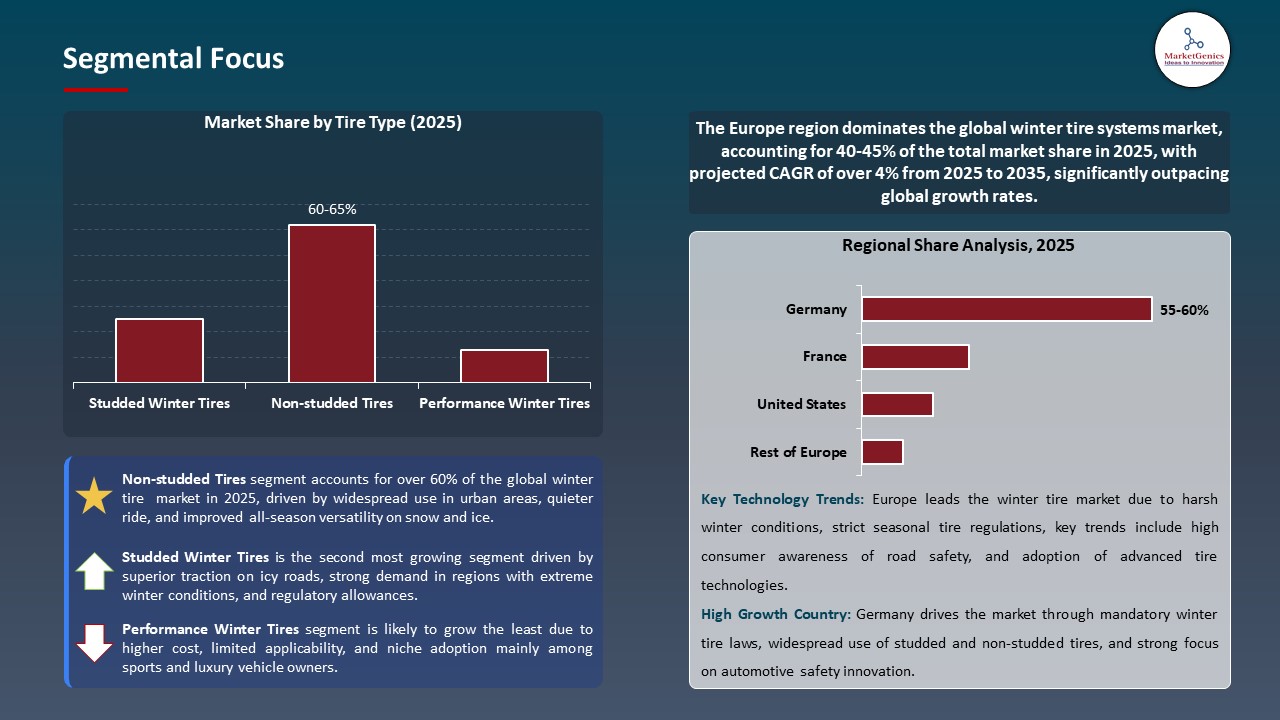
“Non-studded Tires Dominate Global Winter Tire Market amid Stricter Environmental Regulations and Broad Consumer Adoption"
-
As stricter environmental regulations are in effect, strongly continued consumer acceptance leads non-studded tires to dominate the global winter tire market due to government initiatives promoting non-studded tire use in several countries across Northern Europe and parts of Asia because studded tires are viewed negatively based on road wear, noise, and particulate emissions.
- Through ongoing innovations in the development of improved silica-based compounds and advanced siping/patterns, tire manufacturers have improved non-studded tires' strength in terms of traction/braking performance on snow/ice while also maintaining non-studded tires' capabilities in urban highway/urban environments.
- An example of this trend is Goodyear's most recent expansion of Goodyear's UltraGrip Performance 3 Range through 2024-2025, designed for improved performance on snow/water with decreased resistance, consistent with EU regulation for winter tires and growing consumer demand for quieter, more sustainable solutions.
- Leading manufacturers such as Michelin, Continental, Bridgestone, and Nokian Tires have also introduced advanced product offerings that emphasize improved traction at colder/ winter temperatures with reduced rolling resistance and increased longevity due to stronger design characteristics. Shifting toward more environmentally-friendly materials, evolving safety standards continue to reinforce the trend toward non-studded tires' growing position as the leading solution in the global winter tire market.
“Europe Dominates Winter Tire Market amid Strict Seasonal Tire Regulations and High Road Safety Awareness”
-
Europe is the leading winter tires market globally because of its stringent winter tire laws and developed road safety cultures in countries like Germany, Austria, Sweden, Finland, and France. In these countries, all vehicles must use a winter/snow tire when there are certain winter weather conditions (heavily impacted by road safety awareness).
- Road safety concerns and the effects of sub-zero temperatures and regular snowfall on private vehicles have resulted in a strong demand for winter tires from both commercial fleets and individual consumers. There are several high-profile tires manufactures and innovation factories based in Europe, including Michelin, Continental, Nokian Tires, and Pirelli, with ongoing development of technology for newer tread patterns, silica compounds, and noise suppression systems.
- Additionally, these manufactures have established close ties with European automobile manufacturers to partner on Original Equipment Manufacturers (OEM) products. Europe has been successful in adopting more non-studded winter tire types. Manufacturers are also now focused more than ever on developing non-studded tires that meet European noise and road-wear laws. Customers and fleets often select tires that have received the Three-Peak Mountain Snowflake Certification (3PMSF).
Winter-Tire-Market Ecosystem
The global winter tire market is a moderately consolidated with established manufacturers such as Michelin Group, Bridgestone Corporation, Continental AG, Goodyear Tire & Rubber Company, Pirelli & C. S.p.A and Nokian Tires being dominant through advanced rubber chemistry, precise tread engineering, and strong OEM and aftermarket distribution networks. These players utilize proprietary formulations of winter compounds, 3D siping technology and extensive cold weather testing to ensure their competitive advantage.
With more emphasis, these key companies are concentrating on specialized winter solutions, including non-studded tires designed to create less noise and wear on roads, studded tires for extreme ice conditions, and winter tires specifically made for electric vehicles to reduce rolling resistance and increase load capacity. Premium examples of this specialization-driven innovation include Michelin X-Ice, Continental WinterContact, and Pirelli Winter Sottozero.
Research facilities and government organizations also help support road safety standards and tire certification programmes. In January 2024, organizations within Europe improved testing protocols for the evaluation of winter tires under the Three-Peak Mountain Snowflake (3PMSF) framework, encouraging manufacturers to improve braking and traction performance on snow and ice.
Several tire manufacturers have been placing increased emphasis on developing and offering products that are both varied in type and uses (including passenger, commercial, and fleet) as well as integrating sustainable materials (e.g. bio-based) and improving product life.

Recent Development and Strategic Overview:
-
In October 2024, The newly released Blizzak 6 is a winter tire for Europe from Bridgestone Corporation; it was developed using ENLITEN technology, which is a platform that combines the latest in rubber compounds with optimized tread design and reduces rolling resistance while delivering better snow traction and improved braking ability. This innovation allows consumers to use less fuel while driving and makes electric vehicles compatible with safer and more environmentally friendly winter travel for all types of passenger vehicles.
- In September 2024, Nokian Tires previously launched the Snowproof 2 range of winter tires for Central/Southern Europe which incorporates its innovative Alpine Sense Grip new rubber compound and adaptive frost technology applicable to different seasonal weather conditions. Apart from providing better traction on wet/snowy roads and lower noise/wear levels compared to other winter tires, the Snowproof 2 was developed in accordance with the European Winter Tire Regulations and to give drivers greater security to drive safely through winter months without requiring the use of studded tires.
Report Scope
|
Attribute |
Detail |
|
Market Size in 2025 |
USD 24.7 Bn |
|
Market Forecast Value in 2035 |
USD 43.8 Bn |
|
Growth Rate (CAGR) |
5.9% |
|
Forecast Period |
2026 – 2035 |
|
Historical Data Available for |
2021 – 2024 |
|
Market Size Units |
USD Bn for Value Million Units for Volume |
|
Report Format |
Electronic (PDF) + Excel |
|
Regions and Countries Covered |
|||||
|
North America |
Europe |
Asia Pacific |
Middle East |
Africa |
South America |
|
|
|
|
|
|
|
Companies Covered |
|||||
|
|
|
|
|
|
Winter-Tire-Market Segmentation and Highlights
|
Segment |
Sub-segment |
|
Winter Tire Market, By Tire Type |
|
|
Winter Tire Market, By Rim Size |
|
|
Winter Tire Market, By Tire Width |
|
|
Winter Tire Market, By Aspect Ratio |
|
|
Winter Tire Market, By Vehicle Type |
|
|
Winter Tire Market, By Propulsion Type |
|
|
Winter Tire Market, By End User |
|
|
Winter Tire Market, By Sales Channel |
|
Frequently Asked Questions
Table of Contents
- 1. Research Methodology and Assumptions
- 1.1. Definitions
- 1.2. Research Design and Approach
- 1.3. Data Collection Methods
- 1.4. Base Estimates and Calculations
- 1.5. Forecasting Models
- 1.5.1. Key Forecast Factors & Impact Analysis
- 1.6. Secondary Research
- 1.6.1. Open Sources
- 1.6.2. Paid Databases
- 1.6.3. Associations
- 1.7. Primary Research
- 1.7.1. Primary Sources
- 1.7.2. Primary Interviews with Stakeholders across Ecosystem
- 2. Executive Summary
- 2.1. Global Winter Tire Market Outlook
- 2.1.1. Winter Tire Market Size (Value - US$ Bn and Volume - Million Units), and Forecasts, 2021-2035
- 2.1.2. Compounded Annual Growth Rate Analysis
- 2.1.3. Growth Opportunity Analysis
- 2.1.4. Segmental Share Analysis
- 2.1.5. Geographical Share Analysis
- 2.2. Market Analysis and Facts
- 2.3. Supply-Demand Analysis
- 2.4. Competitive Benchmarking
- 2.5. Go-to- Market Strategy
- 2.5.1. Customer/ End-use Industry Assessment
- 2.5.2. Growth Opportunity Data, 2026-2035
- 2.5.2.1. Regional Data
- 2.5.2.2. Country Data
- 2.5.2.3. Segmental Data
- 2.5.3. Identification of Potential Market Spaces
- 2.5.4. GAP Analysis
- 2.5.5. Potential Attractive Price Points
- 2.5.6. Prevailing Market Risks & Challenges
- 2.5.7. Preferred Sales & Marketing Strategies
- 2.5.8. Key Recommendations and Analysis
- 2.5.9. A Way Forward
- 2.1. Global Winter Tire Market Outlook
- 3. Industry Data and Premium Insights
- 3.1. Global Automotive & Transportation Ecosystem Overview, 2025
- 3.1.1. Automotive & Transportation Industry Analysis
- 3.1.2. Key Trends for Automotive & Transportation Industry
- 3.1.3. Regional Distribution for Automotive & Transportation Industry
- 3.2. Supplier Customer Data
- 3.3. Technology Roadmap and Developments
- 3.4. Trade Analysis
- 3.4.1. Import & Export Analysis, 2025
- 3.4.2. Top Importing Countries
- 3.4.3. Top Exporting Countries
- 3.5. Trump Tariff Impact Analysis
- 3.5.1. Manufacturer
- 3.5.1.1. Based on the component & Raw material
- 3.5.2. Supply Chain
- 3.5.3. End Consumer
- 3.5.1. Manufacturer
- 3.6. Raw Material Analysis
- 3.1. Global Automotive & Transportation Ecosystem Overview, 2025
- 4. Market Overview
- 4.1. Market Dynamics
- 4.1.1. Drivers
- 4.1.1.1. Rising demand for enhanced vehicle safety and traction in extreme winter conditions due to increasing snowfall, icy roads, and climate variability.
- 4.1.1.2. Growing adoption of advanced winter tire technologies, including studless tires, silica-based compounds, and directional tread designs for improved grip and braking.
- 4.1.1.3. Increasing investments by tire manufacturers in R&D, smart manufacturing, and premium winter tire portfolios to meet stringent safety standards and consumer expectations.
- 4.1.2. Restraints
- 4.1.2.1. High costs associated with premium winter tires and seasonal replacement, limiting adoption among price-sensitive consumers.
- 4.1.2.2. Challenges related to storage, seasonal demand fluctuations, and lack of winter tire regulations in certain regions, impacting consistent market penetration.
- 4.1.1. Drivers
- 4.2. Key Trend Analysis
- 4.3. Regulatory Framework
- 4.3.1. Key Regulations, Norms, and Subsidies, by Key Countries
- 4.3.2. Tariffs and Standards
- 4.3.3. Impact Analysis of Regulations on the Market
- 4.4. Value Chain Analysis
- 4.4.1. Raw Material Suppliers
- 4.4.2. Winter Tire Manufacturers
- 4.4.3. Dealers/ Distributors
- 4.4.4. Vehicle Manufacturers/ OEM
- 4.4.5. End Users/ Customers
- 4.5. Cost Structure Analysis
- 4.5.1. Parameter’s Share for Cost Associated
- 4.5.2. COGP vs COGS
- 4.5.3. Profit Margin Analysis
- 4.6. Pricing Analysis
- 4.6.1. Regional Pricing Analysis
- 4.6.2. Segmental Pricing Trends
- 4.6.3. Factors Influencing Pricing
- 4.7. Porter’s Five Forces Analysis
- 4.8. PESTEL Analysis
- 4.9. Global Winter Tire Market Demand
- 4.9.1. Historical Market Size –Value (US$ Bn) and Volume (Million Units), 2020-2024
- 4.9.2. Current and Future Market Size –Value (US$ Bn) and Volume (Million Units), 2026–2035
- 4.9.2.1. Y-o-Y Growth Trends
- 4.9.2.2. Absolute $ Opportunity Assessment
- 4.1. Market Dynamics
- 5. Competition Landscape
- 5.1. Competition structure
- 5.1.1. Fragmented v/s consolidated
- 5.2. Company Share Analysis, 2025
- 5.2.1. Global Company Market Share
- 5.2.2. By Region
- 5.2.2.1. North America
- 5.2.2.2. Europe
- 5.2.2.3. Asia Pacific
- 5.2.2.4. Middle East
- 5.2.2.5. Africa
- 5.2.2.6. South America
- 5.3. Product Comparison Matrix
- 5.3.1. Specifications
- 5.3.2. Market Positioning
- 5.3.3. Pricing
- 5.1. Competition structure
- 6. Global Winter Tire Market Analysis, by Tire Type
- 6.1. Key Segment Analysis
- 6.2. Winter Tire Market Size (Value - US$ Bn and Volume - Million Units), Analysis, and Forecasts, by Tire Type, 2021-2035
- 6.2.1. Studded Winter Tires
- 6.2.2. Non-studded Tires
- 6.2.3. Performance Winter Tires
- 7. Global Winter Tire Market Analysis, by Rim Size
- 7.1. Key Segment Analysis
- 7.2. Winter Tire Market Size (Value - US$ Bn and Volume - Million Units), Analysis, and Forecasts, by Rim Size, 2021-2035
- 7.2.1. Below 15 inches
- 7.2.2. 15–16 inches
- 7.2.3. 17–18 inches
- 7.2.4. 19–20 inches
- 7.2.5. Above 20 inches
- 8. Global Winter Tire Market Analysis, by Rim Size
- 8.1. Key Segment Analysis
- 8.2. Winter Tire Market Size (Value - US$ Bn and Volume - Million Units), Analysis, and Forecasts, by Rim Size, 2021-2035
- 8.2.1. Below 15 inches
- 8.2.2. 15–16 inches
- 8.2.3. 17–18 inches
- 8.2.4. 19–20 inches
- 8.2.5. Above 20 inches
- 9. Global Winter Tire Market Analysis, by Tire Width
- 9.1. Key Segment Analysis
- 9.2. Winter Tire Market Size (Value - US$ Bn and Volume - Million Units), Analysis, and Forecasts, by Tire Width, 2021-2035
- 9.2.1. Below 195 mm
- 9.2.2. 195–215 mm
- 9.2.3. 216–235 mm
- 9.2.4. 236–255 mm
- 9.2.5. Above 255 mm
- 10. Global Winter Tire Market Analysis, by Aspect Ratio
- 10.1. Key Segment Analysis
- 10.2. Winter Tire Market Size (Value - US$ Bn and Volume - Million Units), Analysis, and Forecasts, by Aspect Ratio, 2021-2035
- 10.2.1. Below 50
- 10.2.2. 50–60
- 10.2.3. 61–70
- 10.2.4. Above 70
- 11. Global Winter Tire Market Analysis, by Vehicle Type
- 11.1. Key Segment Analysis
- 11.2. Winter Tire Market Size (Value - US$ Bn and Volume - Million Units), Analysis, and Forecasts, by Vehicle Type, 2021-2035
- 11.2.1. Passenger Vehicles
- 11.2.1.1. Hatchback
- 11.2.1.2. Sedan
- 11.2.1.3. SUVs
- 11.2.2. Light Commercial Vehicles
- 11.2.3. Heavy Duty Trucks
- 11.2.4. Buses & Coaches
- 11.2.5. Off-road Vehicles
- 11.2.1. Passenger Vehicles
- 12. Global Winter Tire Market Analysis, by Propulsion Type
- 12.1. Key Segment Analysis
- 12.2. Winter Tire Market Size (Value - US$ Bn and Volume - Million Units), Analysis, and Forecasts, by Propulsion Type, 2021-2035
- 12.2.1. ICE Vehicles
- 12.2.1.1. Gasoline
- 12.2.1.2. Diesel
- 12.2.2. Electric Vehicles
- 12.2.2.1. Hybrid Electric Vehicle (HEV)
- 12.2.2.2. Plug-in Hybrid Electric Vehicle (PHEV)
- 12.2.2.3. Battery Electric Vehicle (BEV)
- 12.2.1. ICE Vehicles
- 13. Global Winter Tire Market Analysis, by End User
- 13.1. Key Segment Analysis
- 13.2. Winter Tire Market Size (Value - US$ Bn and Volume - Million Units), Analysis, and Forecasts, by End User, 2021-2035
- 13.2.1. Individual Consumers
- 13.2.2. Fleet Operators
- 13.2.3. Rental & Leasing Companies
- 13.2.4. Others
- 14. Global Winter Tire Market Analysis and Forecasts, by Sales Channel
- 14.1. Key Findings
- 14.2. Winter Tire Market Size (Value - US$ Bn and Volume - Million Units), Analysis, and Forecasts, by Sales Channel, 2021-2035
- 14.2.1. OEM
- 14.2.2. Aftermarket
- 15. Global Winter Tire Market Analysis and Forecasts, by Region
- 15.1. Key Findings
- 15.2. Winter Tire Market Size (Value - US$ Bn and Volume - Million Units), Analysis, and Forecasts, by Region, 2021-2035
- 15.2.1. North America
- 15.2.2. Europe
- 15.2.3. Asia Pacific
- 15.2.4. Middle East
- 15.2.5. Africa
- 15.2.6. South America
- 16. North America Winter Tire Market Analysis
- 16.1. Key Segment Analysis
- 16.2. Regional Snapshot
- 16.3. North America Winter Tire Market Size Value - US$ Bn and Volume - Million Units), Analysis, and Forecasts, 2021-2035
- 16.3.1. Tire Type
- 16.3.2. Rim Size
- 16.3.3. Tire Width
- 16.3.4. Aspect Ratio
- 16.3.5. Vehicle Type
- 16.3.6. Propulsion Type
- 16.3.7. End User
- 16.3.8. Sales Channel
- 16.3.9. Country
- 16.3.9.1. USA
- 16.3.9.2. Canada
- 16.3.9.3. Mexico
- 16.4. USA Winter Tire Market
- 16.4.1. Country Segmental Analysis
- 16.4.2. Tire Type
- 16.4.3. Rim Size
- 16.4.4. Tire Width
- 16.4.5. Aspect Ratio
- 16.4.6. Vehicle Type
- 16.4.7. Propulsion Type
- 16.4.8. End User
- 16.4.9. Sales Channel
- 16.5. Canada Winter Tire Market
- 16.5.1. Country Segmental Analysis
- 16.5.2. Tire Type
- 16.5.3. Rim Size
- 16.5.4. Tire Width
- 16.5.5. Aspect Ratio
- 16.5.6. Vehicle Type
- 16.5.7. Propulsion Type
- 16.5.8. End User
- 16.5.9. Sales Channel
- 16.6. Mexico Winter Tire Market
- 16.6.1. Country Segmental Analysis
- 16.6.2. Tire Type
- 16.6.3. Rim Size
- 16.6.4. Tire Width
- 16.6.5. Aspect Ratio
- 16.6.6. Vehicle Type
- 16.6.7. Propulsion Type
- 16.6.8. End User
- 16.6.9. Sales Channel
- 17. Europe Winter Tire Market Analysis
- 17.1. Key Segment Analysis
- 17.2. Regional Snapshot
- 17.3. Europe Winter Tire Market Size (Value - US$ Bn and Volume - Million Units), Analysis, and Forecasts, 2021-2035
- 17.3.1. Tire Type
- 17.3.2. Rim Size
- 17.3.3. Tire Width
- 17.3.4. Aspect Ratio
- 17.3.5. Vehicle Type
- 17.3.6. Propulsion Type
- 17.3.7. End User
- 17.3.8. Sales Channel
- 17.3.9. Country
- 17.3.9.1. Germany
- 17.3.9.2. United Kingdom
- 17.3.9.3. France
- 17.3.9.4. Italy
- 17.3.9.5. Spain
- 17.3.9.6. Netherlands
- 17.3.9.7. Nordic Countries
- 17.3.9.8. Poland
- 17.3.9.9. Russia & CIS
- 17.3.9.10. Rest of Europe
- 17.4. Germany Winter Tire Market
- 17.4.1. Country Segmental Analysis
- 17.4.2. Tire Type
- 17.4.3. Rim Size
- 17.4.4. Tire Width
- 17.4.5. Aspect Ratio
- 17.4.6. Vehicle Type
- 17.4.7. Propulsion Type
- 17.4.8. End User
- 17.4.9. Sales Channel
- 17.5. United Kingdom Winter Tire Market
- 17.5.1. Country Segmental Analysis
- 17.5.2. Tire Type
- 17.5.3. Rim Size
- 17.5.4. Tire Width
- 17.5.5. Aspect Ratio
- 17.5.6. Vehicle Type
- 17.5.7. Propulsion Type
- 17.5.8. End User
- 17.5.9. Sales Channel
- 17.6. France Winter Tire Market
- 17.6.1. Country Segmental Analysis
- 17.6.2. Tire Type
- 17.6.3. Rim Size
- 17.6.4. Tire Width
- 17.6.5. Aspect Ratio
- 17.6.6. Vehicle Type
- 17.6.7. Propulsion Type
- 17.6.8. End User
- 17.6.9. Sales Channel
- 17.7. Italy Winter Tire Market
- 17.7.1. Country Segmental Analysis
- 17.7.2. Tire Type
- 17.7.3. Rim Size
- 17.7.4. Tire Width
- 17.7.5. Aspect Ratio
- 17.7.6. Vehicle Type
- 17.7.7. Propulsion Type
- 17.7.8. End User
- 17.7.9. Sales Channel
- 17.8. Spain Winter Tire Market
- 17.8.1. Country Segmental Analysis
- 17.8.2. Tire Type
- 17.8.3. Rim Size
- 17.8.4. Tire Width
- 17.8.5. Aspect Ratio
- 17.8.6. Vehicle Type
- 17.8.7. Propulsion Type
- 17.8.8. End User
- 17.8.9. Sales Channel
- 17.9. Netherlands Winter Tire Market
- 17.9.1. Country Segmental Analysis
- 17.9.2. Tire Type
- 17.9.3. Rim Size
- 17.9.4. Tire Width
- 17.9.5. Aspect Ratio
- 17.9.6. Vehicle Type
- 17.9.7. Propulsion Type
- 17.9.8. End User
- 17.9.9. Sales Channel
- 17.10. Nordic Countries Winter Tire Market
- 17.10.1. Country Segmental Analysis
- 17.10.2. Tire Type
- 17.10.3. Rim Size
- 17.10.4. Tire Width
- 17.10.5. Aspect Ratio
- 17.10.6. Vehicle Type
- 17.10.7. Propulsion Type
- 17.10.8. End User
- 17.10.9. Sales Channel
- 17.11. Poland Winter Tire Market
- 17.11.1. Country Segmental Analysis
- 17.11.2. Tire Type
- 17.11.3. Rim Size
- 17.11.4. Tire Width
- 17.11.5. Aspect Ratio
- 17.11.6. Vehicle Type
- 17.11.7. Propulsion Type
- 17.11.8. End User
- 17.11.9. Sales Channel
- 17.12. Russia & CIS Winter Tire Market
- 17.12.1. Country Segmental Analysis
- 17.12.2. Tire Type
- 17.12.3. Rim Size
- 17.12.4. Tire Width
- 17.12.5. Aspect Ratio
- 17.12.6. Vehicle Type
- 17.12.7. Propulsion Type
- 17.12.8. End User
- 17.12.9. Sales Channel
- 17.13. Rest of Europe Winter Tire Market
- 17.13.1. Country Segmental Analysis
- 17.13.2. Tire Type
- 17.13.3. Rim Size
- 17.13.4. Tire Width
- 17.13.5. Aspect Ratio
- 17.13.6. Vehicle Type
- 17.13.7. Propulsion Type
- 17.13.8. End User
- 17.13.9. Sales Channel
- 18. Asia Pacific Winter Tire Market Analysis
- 18.1. Key Segment Analysis
- 18.2. Regional Snapshot
- 18.3. Asia Pacific Winter Tire Market Size (Value - US$ Bn and Volume - Million Units), Analysis, and Forecasts, 2021-2035
- 18.3.1. Tire Type
- 18.3.2. Rim Size
- 18.3.3. Tire Width
- 18.3.4. Aspect Ratio
- 18.3.5. Vehicle Type
- 18.3.6. Propulsion Type
- 18.3.7. End User
- 18.3.8. Sales Channel
- 18.3.9. Country
- 18.3.9.1. China
- 18.3.9.2. India
- 18.3.9.3. Japan
- 18.3.9.4. South Korea
- 18.3.9.5. Australia and New Zealand
- 18.3.9.6. Indonesia
- 18.3.9.7. Malaysia
- 18.3.9.8. Thailand
- 18.3.9.9. Vietnam
- 18.3.9.10. Rest of Asia Pacific
- 18.4. China Winter Tire Market
- 18.4.1. Country Segmental Analysis
- 18.4.2. Tire Type
- 18.4.3. Rim Size
- 18.4.4. Tire Width
- 18.4.5. Aspect Ratio
- 18.4.6. Vehicle Type
- 18.4.7. Propulsion Type
- 18.4.8. End User
- 18.4.9. Sales Channel
- 18.5. India Winter Tire Market
- 18.5.1. Country Segmental Analysis
- 18.5.2. Tire Type
- 18.5.3. Rim Size
- 18.5.4. Tire Width
- 18.5.5. Aspect Ratio
- 18.5.6. Vehicle Type
- 18.5.7. Propulsion Type
- 18.5.8. End User
- 18.5.9. Sales Channel
- 18.6. Japan Winter Tire Market
- 18.6.1. Country Segmental Analysis
- 18.6.2. Tire Type
- 18.6.3. Rim Size
- 18.6.4. Tire Width
- 18.6.5. Aspect Ratio
- 18.6.6. Vehicle Type
- 18.6.7. Propulsion Type
- 18.6.8. End User
- 18.6.9. Sales Channel
- 18.7. South Korea Winter Tire Market
- 18.7.1. Country Segmental Analysis
- 18.7.2. Tire Type
- 18.7.3. Rim Size
- 18.7.4. Tire Width
- 18.7.5. Aspect Ratio
- 18.7.6. Vehicle Type
- 18.7.7. Propulsion Type
- 18.7.8. End User
- 18.7.9. Sales Channel
- 18.8. Australia and New Zealand Winter Tire Market
- 18.8.1. Country Segmental Analysis
- 18.8.2. Tire Type
- 18.8.3. Rim Size
- 18.8.4. Tire Width
- 18.8.5. Aspect Ratio
- 18.8.6. Vehicle Type
- 18.8.7. Propulsion Type
- 18.8.8. End User
- 18.8.9. Sales Channel
- 18.9. Indonesia Winter Tire Market
- 18.9.1. Country Segmental Analysis
- 18.9.2. Tire Type
- 18.9.3. Rim Size
- 18.9.4. Tire Width
- 18.9.5. Aspect Ratio
- 18.9.6. Vehicle Type
- 18.9.7. Propulsion Type
- 18.9.8. End User
- 18.9.9. Sales Channel
- 18.10. Malaysia Winter Tire Market
- 18.10.1. Country Segmental Analysis
- 18.10.2. Tire Type
- 18.10.3. Rim Size
- 18.10.4. Tire Width
- 18.10.5. Aspect Ratio
- 18.10.6. Vehicle Type
- 18.10.7. Propulsion Type
- 18.10.8. End User
- 18.10.9. Sales Channel
- 18.11. Thailand Winter Tire Market
- 18.11.1. Country Segmental Analysis
- 18.11.2. Tire Type
- 18.11.3. Rim Size
- 18.11.4. Tire Width
- 18.11.5. Aspect Ratio
- 18.11.6. Vehicle Type
- 18.11.7. Propulsion Type
- 18.11.8. End User
- 18.11.9. Sales Channel
- 18.12. Vietnam Winter Tire Market
- 18.12.1. Country Segmental Analysis
- 18.12.2. Tire Type
- 18.12.3. Rim Size
- 18.12.4. Tire Width
- 18.12.5. Aspect Ratio
- 18.12.6. Vehicle Type
- 18.12.7. Propulsion Type
- 18.12.8. End User
- 18.12.9. Sales Channel
- 18.13. Rest of Asia Pacific Winter Tire Market
- 18.13.1. Country Segmental Analysis
- 18.13.2. Tire Type
- 18.13.3. Rim Size
- 18.13.4. Tire Width
- 18.13.5. Aspect Ratio
- 18.13.6. Vehicle Type
- 18.13.7. Propulsion Type
- 18.13.8. End User
- 18.13.9. Sales Channel
- 19. Middle East Winter Tire Market Analysis
- 19.1. Key Segment Analysis
- 19.2. Regional Snapshot
- 19.3. Middle East Winter Tire Market Size (Value - US$ Bn and Volume - Million Units), Analysis, and Forecasts, 2021-2035
- 19.3.1. Tire Type
- 19.3.2. Rim Size
- 19.3.3. Tire Width
- 19.3.4. Aspect Ratio
- 19.3.5. Vehicle Type
- 19.3.6. Propulsion Type
- 19.3.7. End User
- 19.3.8. Sales Channel
- 19.3.9. Country
- 19.3.9.1. Turkey
- 19.3.9.2. UAE
- 19.3.9.3. Saudi Arabia
- 19.3.9.4. Israel
- 19.3.9.5. Rest of Middle East
- 19.4. Turkey Winter Tire Market
- 19.4.1. Country Segmental Analysis
- 19.4.2. Tire Type
- 19.4.3. Rim Size
- 19.4.4. Tire Width
- 19.4.5. Aspect Ratio
- 19.4.6. Vehicle Type
- 19.4.7. Propulsion Type
- 19.4.8. End User
- 19.4.9. Sales Channel
- 19.5. UAE Winter Tire Market
- 19.5.1. Country Segmental Analysis
- 19.5.2. Tire Type
- 19.5.3. Rim Size
- 19.5.4. Tire Width
- 19.5.5. Aspect Ratio
- 19.5.6. Vehicle Type
- 19.5.7. Propulsion Type
- 19.5.8. End User
- 19.5.9. Sales Channel
- 19.6. Saudi Arabia Winter Tire Market
- 19.6.1. Country Segmental Analysis
- 19.6.2. Tire Type
- 19.6.3. Rim Size
- 19.6.4. Tire Width
- 19.6.5. Aspect Ratio
- 19.6.6. Vehicle Type
- 19.6.7. Propulsion Type
- 19.6.8. End User
- 19.6.9. Sales Channel
- 19.7. Israel Winter Tire Market
- 19.7.1. Country Segmental Analysis
- 19.7.2. Tire Type
- 19.7.3. Rim Size
- 19.7.4. Tire Width
- 19.7.5. Aspect Ratio
- 19.7.6. Vehicle Type
- 19.7.7. Propulsion Type
- 19.7.8. End User
- 19.7.9. Sales Channel
- 19.8. Rest of Middle East Winter Tire Market
- 19.8.1. Country Segmental Analysis
- 19.8.2. Tire Type
- 19.8.3. Rim Size
- 19.8.4. Tire Width
- 19.8.5. Aspect Ratio
- 19.8.6. Vehicle Type
- 19.8.7. Propulsion Type
- 19.8.8. End User
- 19.8.9. Sales Channel
- 20. Africa Winter Tire Market Analysis
- 20.1. Key Segment Analysis
- 20.2. Regional Snapshot
- 20.3. Africa Winter Tire Market Size (Value - US$ Bn and Volume - Million Units), Analysis, and Forecasts, 2021-2035
- 20.3.1. Tire Type
- 20.3.2. Rim Size
- 20.3.3. Tire Width
- 20.3.4. Aspect Ratio
- 20.3.5. Vehicle Type
- 20.3.6. Propulsion Type
- 20.3.7. End User
- 20.3.8. Sales Channel
- 20.3.9. Country
- 20.3.9.1. South Africa
- 20.3.9.2. Egypt
- 20.3.9.3. Nigeria
- 20.3.9.4. Algeria
- 20.3.9.5. Rest of Africa
- 20.4. South Africa Winter Tire Market
- 20.4.1. Country Segmental Analysis
- 20.4.2. Tire Type
- 20.4.3. Rim Size
- 20.4.4. Tire Width
- 20.4.5. Aspect Ratio
- 20.4.6. Vehicle Type
- 20.4.7. Propulsion Type
- 20.4.8. End User
- 20.4.9. Sales Channel
- 20.5. Egypt Winter Tire Market
- 20.5.1. Country Segmental Analysis
- 20.5.2. Tire Type
- 20.5.3. Rim Size
- 20.5.4. Tire Width
- 20.5.5. Aspect Ratio
- 20.5.6. Vehicle Type
- 20.5.7. Propulsion Type
- 20.5.8. End User
- 20.5.9. Sales Channel
- 20.6. Nigeria Winter Tire Market
- 20.6.1. Country Segmental Analysis
- 20.6.2. Tire Type
- 20.6.3. Rim Size
- 20.6.4. Tire Width
- 20.6.5. Aspect Ratio
- 20.6.6. Vehicle Type
- 20.6.7. Propulsion Type
- 20.6.8. End User
- 20.6.9. Sales Channel
- 20.7. Algeria Winter Tire Market
- 20.7.1. Country Segmental Analysis
- 20.7.2. Tire Type
- 20.7.3. Rim Size
- 20.7.4. Tire Width
- 20.7.5. Aspect Ratio
- 20.7.6. Vehicle Type
- 20.7.7. Propulsion Type
- 20.7.8. End User
- 20.7.9. Sales Channel
- 20.8. Rest of Africa Winter Tire Market
- 20.8.1. Country Segmental Analysis
- 20.8.2. Tire Type
- 20.8.3. Rim Size
- 20.8.4. Tire Width
- 20.8.5. Aspect Ratio
- 20.8.6. Vehicle Type
- 20.8.7. Propulsion Type
- 20.8.8. End User
- 20.8.9. Sales Channel
- 21. South America Winter Tire Market Analysis
- 21.1. Key Segment Analysis
- 21.2. Regional Snapshot
- 21.3. South America Winter Tire Market Size (Value - US$ Bn and Volume - Million Units), Analysis, and Forecasts, 2021-2035
- 21.3.1. Tire Type
- 21.3.2. Rim Size
- 21.3.3. Tire Width
- 21.3.4. Aspect Ratio
- 21.3.5. Vehicle Type
- 21.3.6. Propulsion Type
- 21.3.7. End User
- 21.3.8. Sales Channel
- 21.3.9. Country
- 21.3.9.1. Brazil
- 21.3.9.2. Argentina
- 21.3.9.3. Rest of South America
- 21.4. Brazil Winter Tire Market
- 21.4.1. Country Segmental Analysis
- 21.4.2. Tire Type
- 21.4.3. Rim Size
- 21.4.4. Tire Width
- 21.4.5. Aspect Ratio
- 21.4.6. Vehicle Type
- 21.4.7. Propulsion Type
- 21.4.8. End User
- 21.4.9. Sales Channel
- 21.5. Argentina Winter Tire Market
- 21.5.1. Country Segmental Analysis
- 21.5.2. Tire Type
- 21.5.3. Rim Size
- 21.5.4. Tire Width
- 21.5.5. Aspect Ratio
- 21.5.6. Vehicle Type
- 21.5.7. Propulsion Type
- 21.5.8. End User
- 21.5.9. Sales Channel
- 21.6. Rest of South America Winter Tire Market
- 21.6.1. Country Segmental Analysis
- 21.6.2. Tire Type
- 21.6.3. Rim Size
- 21.6.4. Tire Width
- 21.6.5. Aspect Ratio
- 21.6.6. Vehicle Type
- 21.6.7. Propulsion Type
- 21.6.8. End User
- 21.6.9. Sales Channel
- 22. Key Players/ Company Profile
- 22.1. Apollo Tyres Ltd.
- 22.1.1. Company Details/ Overview
- 22.1.2. Company Financials
- 22.1.3. Key Customers and Competitors
- 22.1.4. Business/ Industry Portfolio
- 22.1.5. Product Portfolio/ Specification Details
- 22.1.6. Pricing Data
- 22.1.7. Strategic Overview
- 22.1.8. Recent Developments
- 22.2. BFGoodrich Tires
- 22.3. Bridgestone Corporation
- 22.4. Continental AG
- 22.5. Cooper Tire & Rubber Company
- 22.6. Falken Tires
- 22.7. Giti Tire
- 22.8. Goodyear Tire & Rubber Company
- 22.9. Hankook Tire & Technology Co., Ltd.
- 22.10. Kumho Tire Co., Inc.
- 22.11. Michelin Group
- 22.12. MRF (Madras Rubber Factory)
- 22.13. Nexen Tire Corporation
- 22.14. Pirelli & C. S.p.A.
- 22.15. Sumitomo Rubber Industries, Ltd. (Dunlop)
- 22.16. Toyo Tire Corporation
- 22.17. Vredestein B.V.
- 22.18. Yokohama Rubber Co., Ltd.
- 22.19. ZAFCO (Zahid Group)
- 22.20. Other Key Players
- 22.1. Apollo Tyres Ltd.
Note* - This is just tentative list of players. While providing the report, we will cover more number of players based on their revenue and share for each geography
Research Design
Our research design integrates both demand-side and supply-side analysis through a balanced combination of primary and secondary research methodologies. By utilizing both bottom-up and top-down approaches alongside rigorous data triangulation methods, we deliver robust market intelligence that supports strategic decision-making.
MarketGenics' comprehensive research design framework ensures the delivery of accurate, reliable, and actionable market intelligence. Through the integration of multiple research approaches, rigorous validation processes, and expert analysis, we provide our clients with the insights needed to make informed strategic decisions and capitalize on market opportunities.

MarketGenics leverages a dedicated industry panel of experts and a comprehensive suite of paid databases to effectively collect, consolidate, and analyze market intelligence.
Our approach has consistently proven to be reliable and effective in generating accurate market insights, identifying key industry trends, and uncovering emerging business opportunities.
Through both primary and secondary research, we capture and analyze critical company-level data such as manufacturing footprints, including technical centers, R&D facilities, sales offices, and headquarters.
Our expert panel further enhances our ability to estimate market size for specific brands based on validated field-level intelligence.
Our data mining techniques incorporate both parametric and non-parametric methods, allowing for structured data collection, sorting, processing, and cleaning.
Demand projections are derived from large-scale data sets analyzed through proprietary algorithms, culminating in robust and reliable market sizing.
Research Approach
The bottom-up approach builds market estimates by starting with the smallest addressable market units and systematically aggregating them to create comprehensive market size projections.
This method begins with specific, granular data points and builds upward to create the complete market landscape.
Customer Analysis → Segmental Analysis → Geographical Analysis
The top-down approach starts with the broadest possible market data and systematically narrows it down through a series of filters and assumptions to arrive at specific market segments or opportunities.
This method begins with the big picture and works downward to increasingly specific market slices.
TAM → SAM → SOM


Research Methods
Desk / Secondary Research
While analysing the market, we extensively study secondary sources, directories, and databases to identify and collect information useful for this technical, market-oriented, and commercial report. Secondary sources that we utilize are not only the public sources, but it is a combination of Open Source, Associations, Paid Databases, MG Repository & Knowledgebase, and others.
- Company websites, annual reports, financial reports, broker reports, and investor presentations
- National government documents, statistical databases and reports
- News articles, press releases and web-casts specific to the companies operating in the market, Magazines, reports, and others
- We gather information from commercial data sources for deriving company specific data such as segmental revenue, share for geography, product revenue, and others
- Internal and external proprietary databases (industry-specific), relevant patent, and regulatory databases
- Governing Bodies, Government Organizations
- Relevant Authorities, Country-specific Associations for Industries
We also employ the model mapping approach to estimate the product level market data through the players' product portfolio
Primary Research
Primary research/ interviews is vital in analyzing the market. Most of the cases involves paid primary interviews. Primary sources include primary interviews through e-mail interactions, telephonic interviews, surveys as well as face-to-face interviews with the different stakeholders across the value chain including several industry experts.
| Type of Respondents | Number of Primaries |
|---|---|
| Tier 2/3 Suppliers | ~20 |
| Tier 1 Suppliers | ~25 |
| End-users | ~25 |
| Industry Expert/ Panel/ Consultant | ~30 |
| Total | ~100 |
MG Knowledgebase
• Repository of industry blog, newsletter and case studies
• Online platform covering detailed market reports, and company profiles
Forecasting Factors and Models
Forecasting Factors
- Historical Trends – Past market patterns, cycles, and major events that shaped how markets behave over time. Understanding past trends helps predict future behavior.
- Industry Factors – Specific characteristics of the industry like structure, regulations, and innovation cycles that affect market dynamics.
- Macroeconomic Factors – Economic conditions like GDP growth, inflation, and employment rates that affect how much money people have to spend.
- Demographic Factors – Population characteristics like age, income, and location that determine who can buy your product.
- Technology Factors – How quickly people adopt new technology and how much technology infrastructure exists.
- Regulatory Factors – Government rules, laws, and policies that can help or restrict market growth.
- Competitive Factors – Analyzing competition structure such as degree of competition and bargaining power of buyers and suppliers.
Forecasting Models / Techniques
Multiple Regression Analysis
- Identify and quantify factors that drive market changes
- Statistical modeling to establish relationships between market drivers and outcomes
Time Series Analysis – Seasonal Patterns
- Understand regular cyclical patterns in market demand
- Advanced statistical techniques to separate trend, seasonal, and irregular components
Time Series Analysis – Trend Analysis
- Identify underlying market growth patterns and momentum
- Statistical analysis of historical data to project future trends
Expert Opinion – Expert Interviews
- Gather deep industry insights and contextual understanding
- In-depth interviews with key industry stakeholders
Multi-Scenario Development
- Prepare for uncertainty by modeling different possible futures
- Creating optimistic, pessimistic, and most likely scenarios
Time Series Analysis – Moving Averages
- Sophisticated forecasting for complex time series data
- Auto-regressive integrated moving average models with seasonal components
Econometric Models
- Apply economic theory to market forecasting
- Sophisticated economic models that account for market interactions
Expert Opinion – Delphi Method
- Harness collective wisdom of industry experts
- Structured, multi-round expert consultation process
Monte Carlo Simulation
- Quantify uncertainty and probability distributions
- Thousands of simulations with varying input parameters
Research Analysis
Our research framework is built upon the fundamental principle of validating market intelligence from both demand and supply perspectives. This dual-sided approach ensures comprehensive market understanding and reduces the risk of single-source bias.
Demand-Side Analysis: We understand end-user/application behavior, preferences, and market needs along with the penetration of the product for specific application.
Supply-Side Analysis: We estimate overall market revenue, analyze the segmental share along with industry capacity, competitive landscape, and market structure.
Validation & Evaluation
Data triangulation is a validation technique that uses multiple methods, sources, or perspectives to examine the same research question, thereby increasing the credibility and reliability of research findings. In market research, triangulation serves as a quality assurance mechanism that helps identify and minimize bias, validate assumptions, and ensure accuracy in market estimates.
- Data Source Triangulation – Using multiple data sources to examine the same phenomenon
- Methodological Triangulation – Using multiple research methods to study the same research question
- Investigator Triangulation – Using multiple researchers or analysts to examine the same data
- Theoretical Triangulation – Using multiple theoretical perspectives to interpret the same data

Custom Market Research Services
We will customise the research for you, in case the report listed above does not meet your requirements.
Get 10% Free Customisation