Aerospace Composites Market Size, Share & Trends Analysis Report by Component/Application (Fuselage, Wings, Empennage, Interior Components, Engine Components, Landing Gear Components, Propellers & Rotors, Flight Control Surfaces, Radomes, Others), Composite Form, Fiber Type, Resin Type, Layer Configuration, End-Users, and Geography (North America, Europe, Asia Pacific, Middle East, Africa, and South America) – Global Industry Data, Trends, and Forecasts, 2026–2035
|
|
|
Segmental Data Insights |
|
|
Demand Trends |
|
|
Competitive Landscape |
|
|
Strategic Development |
|
|
Future Outlook & Opportunities |
|
Aerospace-Composites-Market Size, Share, and Growth
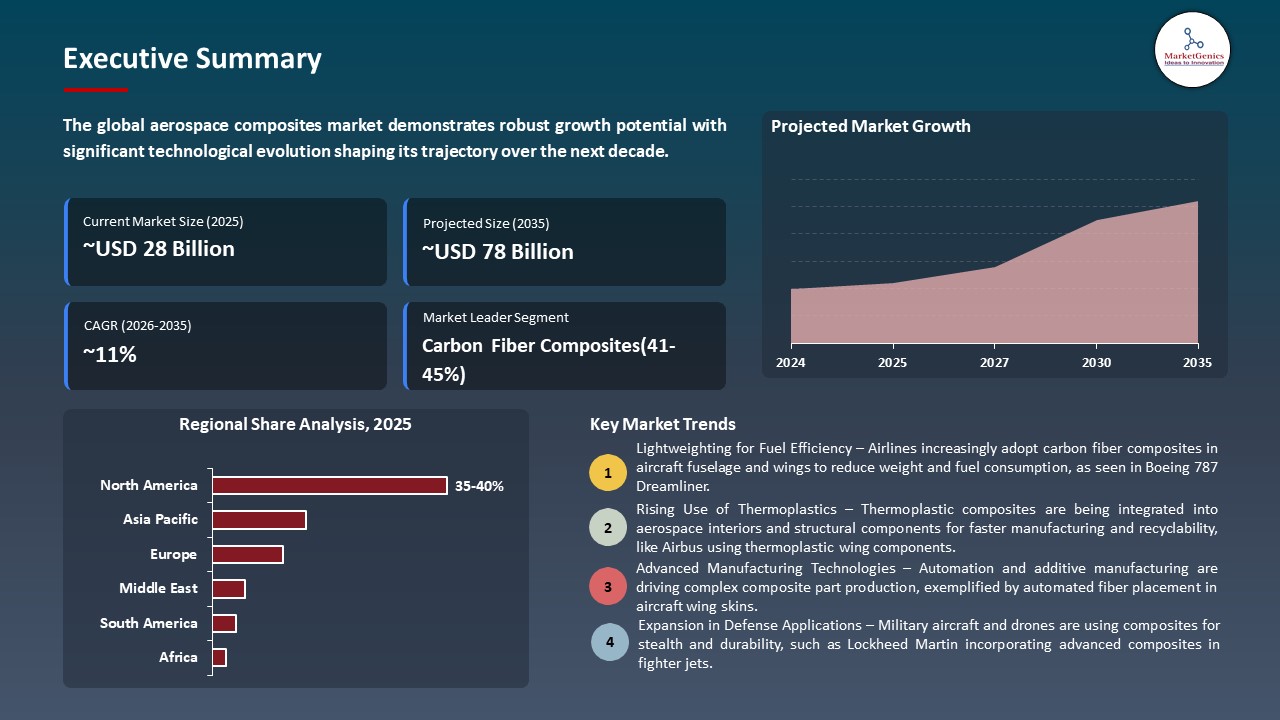
The global aerospace composites market is witnessing strong growth, valued at USD 28.1 billion in 2025 and projected to reach USD 78.4 billion by 2035, expanding at a CAGR of 10.8% during the forecast period. The use of next-generation materials and automated fabrication technologies have driven the global aerospace composites market to high-strength, lightweight commercial aircraft, military jet, and spaceship structures.
Claire Baker, Development Lead, Space & Comms, Toray Advanced Composites, states, With over 40 years of space-flight heritage, Toray is proud to support the next generation of LEO satellite constellations with our flight-proven material systems. Our lightweight composites offer the ideal combination of high stiffness, excellent toughness, and low outgassing—which when combined with their proven inflight reliability makes them perfectly suited for demanding space environments and for automated, scalable manufacturing.
The aerospace composites market is growing rapidly because aircraft manufacturers, defense agencies, and space agencies have concentrated on lightweight yet high-strength materials. These composites make them extremely fuel efficient, minimise emissions and also improve their performance. State of the art carbon fiber, thermoplastic and composite-metal structures are even more eroding the old metals and making next generation commercial aircraft, military jet and space craft’s more durable and less expensive in terms of lifecycle costs.
The production efficiency is being facilitated by innovations in automated layup, out of autoclave curing, and additive manufacturing. The technologies lower the amount of waste material, enhance quality and decrease time to market of important aerospace parts. Scalability is also enhanced by the use of smart manufacturing and precision tooling that helps in the production of composites that are cost effective.
The adjacent opportunities in the aerospace composites market are sustainable bio-based composite, recyclable thermoplastics, lightweight hybrid-composites, and compatibility with advanced avionics systems and propulsion systems. The trend is propelling them into commercial applications, defense, and space applications, and assisting in innovation, resilience, and expansion of global market.
 Aerospace Composites Market Dynamics and Trends
Driver: Need for Lightweight and Fuel‑Efficient Aircraft
-
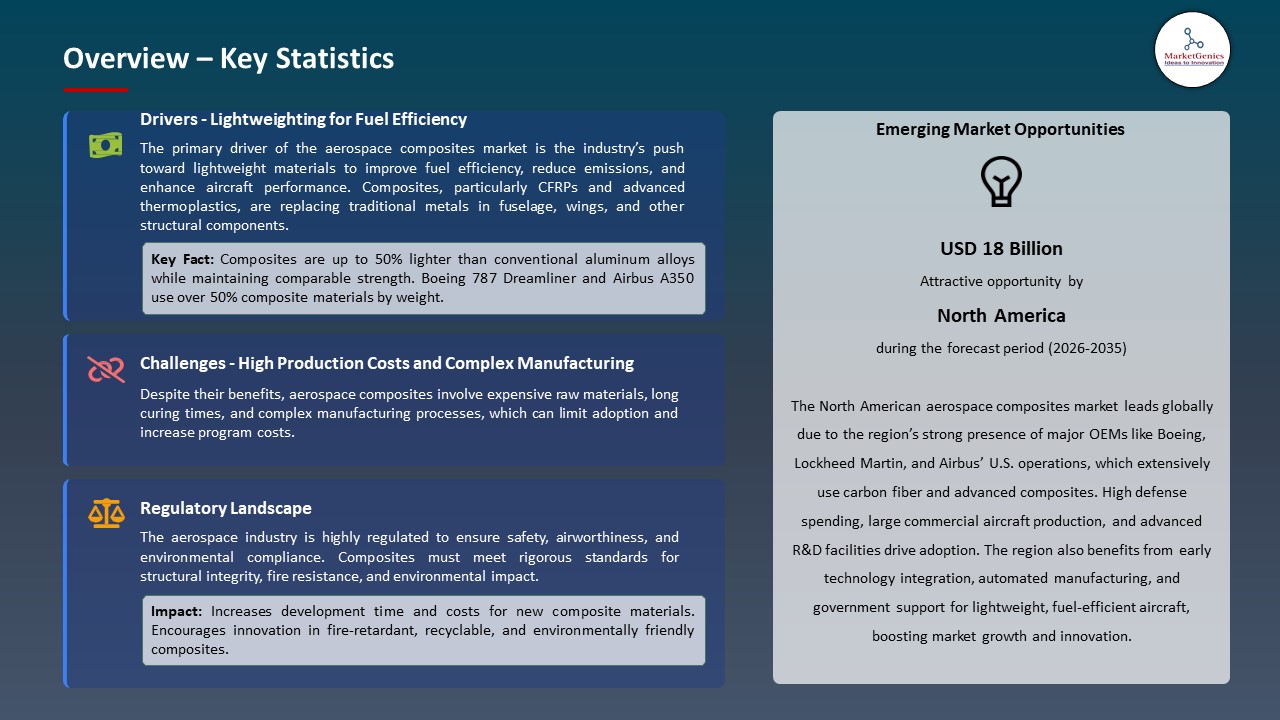
The global aerospace composite market is given by the need to have a lightweight aircraft that consumes less fuel and carbon fiber and thermoplastic composites are widely used to substitute metals in the airframes, wings, and fuselage.
- Aerospace OEMs and airlines are beginning to invest in next-generation composite structures to enhance the performance of the aircraft and to decrease the cost of maintenance lifecycle. For instance, in June 2024, Airbus created and flight-tested a bio-based composite panel (proof-of-concept) on its H145 PioneerLab helicopter, using renewable sources of carbon-based fibers to reduce weight and CO 2, and ensure structural performance.
- The world aerospace composite market development is experiencing expansion due to the conversion to lightweight composites in commercial and military aircraft and spacecraft.
Restraint: High Production Costs and Complex Manufacturing
-
The global aerospace composite market faces high price of manufacturing the advanced aerospace composites. Carbon fiber, thermoplastic composite, and high-performance prepreg manufacturing needs are sensitive equipment, autoclaves, and quality control, and are very expensive overheads to capital equipment among OEMs and suppliers.
- The large scale adoption is restricted by the labor intensive production processes, time-consuming curing processes and also, the highly trained technicians. Production costs are also increased by tooling, automated layup and process certification, thus making it hard to enter a business when one is small and new.
- Multiple supply chains, specialized machinery and stringent certification requirements on aerospace parts inhibit scalability of production, and reduce the overall market expansion.
Opportunity: Sustainable and Recyclable Composite Materials
-
Growing environmental awareness and emissions regulations are also stimulating demand in the sustainable, and recyclable aerospace composite and manufacturers are currently looking into the use of circular material solutions to lower lifecycle waste and achieve net-zero aims in commercial and defence aviation.
- The recycling technologies and high-tech applications of composite are being joined through industry efforts. For instance, in July 2025, Toray Advanced Composites agreed to collaborate to provide space-grade carbon fiber composite to mega-constellation satellite solar arrays, extending the use of aerospace composites to next-generation space infrastructure.
- High-quality and recyclable aerospace composite: The high-performance and recyclable aerospace composites generate new revenue, along with supporting sustainability and increasing lifecycle value on a global scale.
Key Trend: Integration of Smart Manufacturing and Automation
-
The global aerospace composites market is becoming more dominated by the adoption of smart manufacturing solutions like automated fiber placement (AFP), additive manufacturing, and real-time quality control that allow engineered production of complex aerospace composite structures to be precision, repeatable, and high-throughput with commercial, military, and space aerospace applications.
- There are strategic partnerships and viable implementations that are accelerating operational effectiveness and innovation. For instance, in June 2025 Hexcel presented its next generation HexPly M51 rapid-cure composite material, intended to be used in automated tape laying (ATL), in automated aerospace composite additive process (AFP), and pick-and-place technology, to improve high throughput in aerospace composite manufacturing and production.
- Scalability, lead times, and high quality aerospace composites are being enhanced by automation, digital twins, and process control using AI.
 Aerospace Composites Market Analysis and Segmental Data
Carbon Fiber Composites Dominate Global Aerospace Composites Market
-
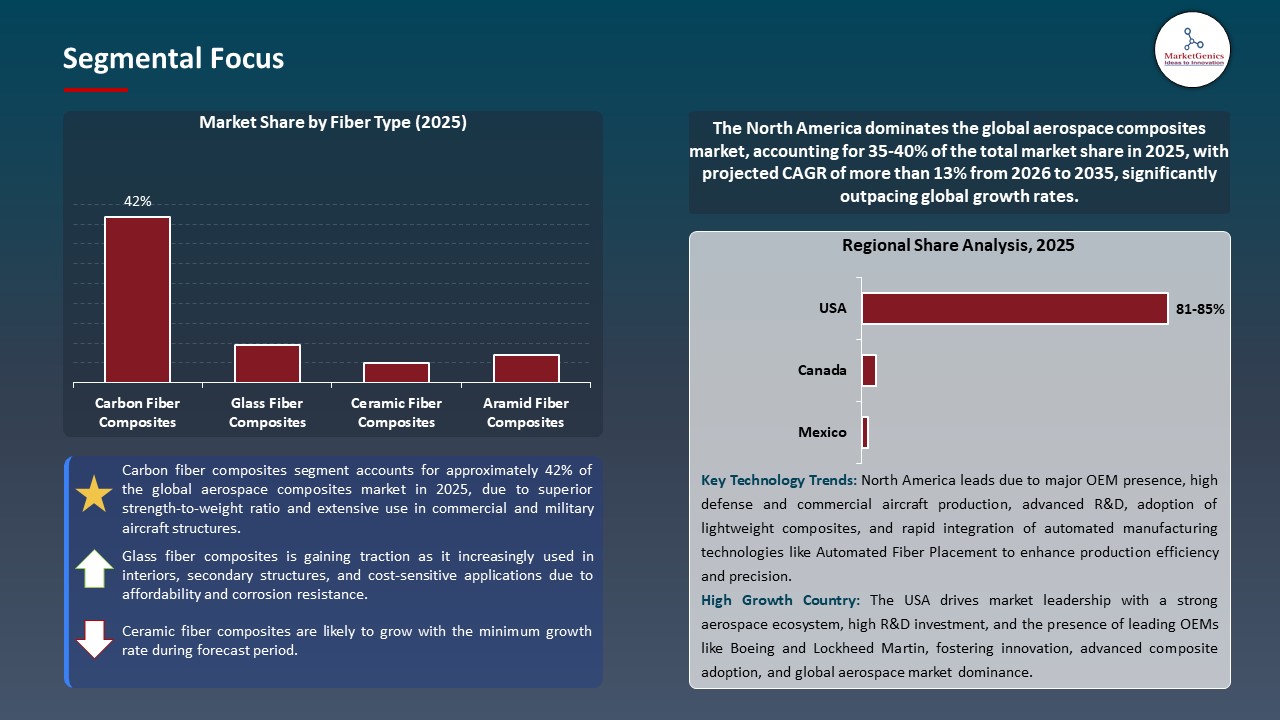
Carbon fiber composites dominate the global aerospace composites market because with high strength-to-weight ratio, better fatigue behavior, and capacity to enhance the fuel economy and payload capacity of commercial, defense and space aerospace systems around the world.
- Rapid developments in automated fiber placement, resin transfer molding, and high temperature prepreg systems are giving manufacturers the capability to manufacture larger, more complicated and lightweight parts with better structural performance at lower assembly times and lower operational costs. For instance, in June 2025, Toray Industries demonstrated its next-generation aircraft structure using its high-strength and lightweight carbon fiber prepreg, the TORAYCA, in the U.S. Army FLRAA program, which has led to innovation in high-strength and lightweight aerospace and defense composites.
- The business aircraft, military jet airplanes and satellites are the major sources of revenue where carbon fiber composite can provide solutions to lightweight, dependability and high performance.
North America Leads Global Aerospace Composites Market Demand
-
North America leads the global aerospace composite market, dominates in carbon fiber, thermoplastic and prepreg take-up in both commercial, defense and space platforms, owing to the increase in aircraft manufacturing and defense modernization.
- The establishment of the region is supported with strategic government strategies, taxation incentives, and military contracts, which enhance a faster pace of implementation of future-generation composite materials. For instance, in May 2025, Hexcel participated in the FAST program with JetZero to certify advanced composite materials to the blended all-wing Z4 aircraft demonstrator to speed up the development of lightweight, fuel-efficient aerospace structures and enhance the status of North America as a world leader in the power of aerospace composite material.
- The developed supply chains and manufacturing facilities, along with partnership with Aerospace OEMs, give North America the biggest and most developed Aerospace Composites market.
Aerospace Composites Market Ecosystem
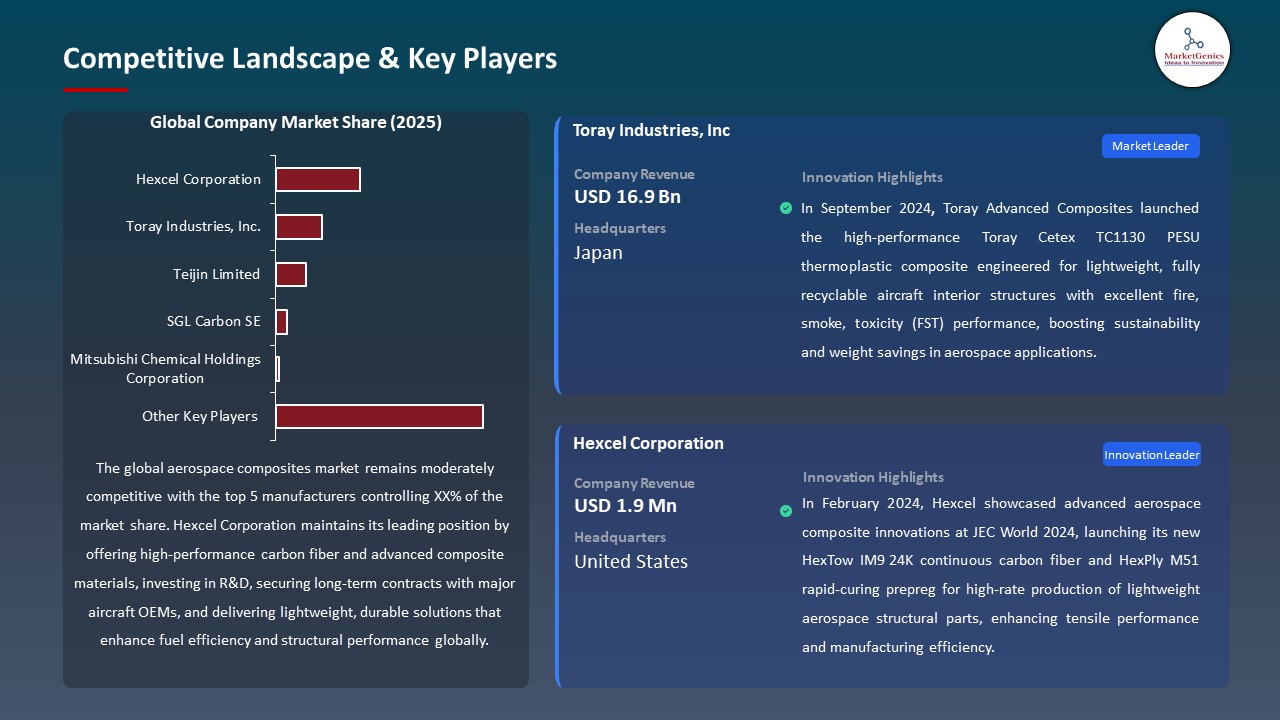
The global aerospace composites market is moderately consolidated with few major material companies controlling much of the advanced composite output, aerospace grade carbon fiber and prepreg technology. Key participants in the ecosystem such as Hexcel Corporation, Toray Industries, Inc., Teijin Limited, SGL Carbon SE and Mitsubishi Chemical Holdings Corporation have vertical integrated composite material production, proprietary fiber and resin technology and large-scale prepreg and laminate manufacturing plants, which are combined to provide high-performance aerospace structures, which are applied in commercial, defense and space applications.
The market players are distinguishing themselves by differentiating in product portfolios and technology. Whereas Hexcel and Toray are oriented towards high-strength carbon fiber and prepreg systems of commercial and defense aircraft, Teijin and Mitsubishi are oriented towards thermoplastic and advanced polymer composites of lightweight structures. SGL Carbon focuses on specialty markets, such as radome and space-grade composites. New technologies which include automated fiber placement (AFP), 3D weaving, thermoplastic infusion, and high-temperature resin systems are being adopted to guarantee structural integrity, weight reduction and enhanced durability throughout aerospace applications.
There are also other equipment suppliers, resin and fiber innovators, composite tooling, automation experts and regulatory agencies, which further strengthen the ecosystem. Aerospace Composites ecosystem is developing as a strong, competitive, and sustainable environment driven by technological integration, strategic specialization and coordinated collaborations between manufacturers and aerospace OEMs, which is able to help achieve scalable production, high-performance applications, and long-term sustainability in the markets.
 Recent Development and Strategic Overview
-
In November 2025, Airborne and Lockheed Martin partnered on next-generation composites automation, integrating new automation systems such as Automated Ply Placement and intelligent material handling systems, to increase production throughput and advanced fabrication of complex composite parts used on spaceships.
- In March 2025, Industrial Summit Technology (IST) introduced its IMIDETEX advanced polyimide fibre at JEC World, offering high strength, thermal stability, and improved vibration damping to enhance aerospace composite performance in demanding environments
Report Scope
|
Detail |
|
|
Market Size in 2025 |
USD 28.1 Bn |
|
Market Forecast Value in 2035 |
USD 78.4 Bn |
|
Growth Rate (CAGR) |
10.8% |
|
Forecast Period |
2026 – 2035 |
|
Historical Data Available for |
2021 – 2024 |
|
Market Size Units |
US$ Billion for Value |
|
Report Format |
Electronic (PDF) + Excel |
|
North America |
Europe |
Asia Pacific |
Middle East |
Africa |
South America |
|
|
|
|
|
|
|
Companies Covered |
|||||
|
|
|
|
|
|
Aerospace Composites Market Segmentation and Highlights
|
Segment |
Sub-segment |
|
Aerospace Composites Market, By Component/Application |
|
|
Aerospace Composites Market, By Composite Form |
|
|
Aerospace Composites Market, By Fiber Type |
|
|
Aerospace Composites Market, By Resin Type |
|
|
Aerospace Composites Market, By Layer Configuration |
|
|
Aerospace Composites Market, By End-Users |
|
Frequently Asked Questions
Table of Contents
- 1. Research Methodology and Assumptions
- 1.1. Definitions
- 1.2. Research Design and Approach
- 1.3. Data Collection Methods
- 1.4. Base Estimates and Calculations
- 1.5. Forecasting Models
- 1.5.1. Key Forecast Factors & Impact Analysis
- 1.6. Secondary Research
- 1.6.1. Open Sources
- 1.6.2. Paid Databases
- 1.6.3. Associations
- 1.7. Primary Research
- 1.7.1. Primary Sources
- 1.7.2. Primary Interviews with Stakeholders across Ecosystem
- 2. Executive Summary
- 2.1. Global Aerospace Composites Market Outlook
- 2.1.1. Aerospace Composites Market Size (Value - US$ Bn), and Forecasts, 2021-2035
- 2.1.2. Compounded Annual Growth Rate Analysis
- 2.1.3. Growth Opportunity Analysis
- 2.1.4. Segmental Share Analysis
- 2.1.5. Geographical Share Analysis
- 2.2. Market Analysis and Facts
- 2.3. Supply-Demand Analysis
- 2.4. Competitive Benchmarking
- 2.5. Go-to- Market Strategy
- 2.5.1. Customer/ End-use Industry Assessment
- 2.5.2. Growth Opportunity Data, 2026-2035
- 2.5.2.1. Regional Data
- 2.5.2.2. Country Data
- 2.5.2.3. Segmental Data
- 2.5.3. Identification of Potential Market Spaces
- 2.5.4. GAP Analysis
- 2.5.5. Potential Attractive Price Points
- 2.5.6. Prevailing Market Risks & Challenges
- 2.5.7. Preferred Sales & Marketing Strategies
- 2.5.8. Key Recommendations and Analysis
- 2.5.9. A Way Forward
- 2.1. Global Aerospace Composites Market Outlook
- 3. Industry Data and Premium Insights
- 3.1. Global Aerospace & Defense Industry Overview, 2025
- 3.1.1. Aerospace & Defense Industry Ecosystem Analysis
- 3.1.2. Key Trends for Aerospace & Defense Industry
- 3.1.3. Regional Distribution for Aerospace & Defense Industry
- 3.2. Supplier Customer Data
- 3.3. Technology Roadmap and Developments
- 3.4. Trade Analysis
- 3.4.1. Import & Export Analysis, 2025
- 3.4.2. Top Importing Countries
- 3.4.3. Top Exporting Countries
- 3.5. Trump Tariff Impact Analysis
- 3.5.1. Manufacturer
- 3.5.1.1. Based on the component & Raw material
- 3.5.2. Supply Chain
- 3.5.3. End Consumer
- 3.5.1. Manufacturer
- 3.6. Raw Material Analysis
- 3.1. Global Aerospace & Defense Industry Overview, 2025
- 4. Market Overview
- 4.1. Market Dynamics
- 4.1.1. Drivers
- 4.1.1.1. Increasing demand for lightweight, fuel-efficient, and high-performance aircraft structures.
- 4.1.1.2. Advancements in automated composite manufacturing technologies and high-strength materials.
- 4.1.1.3. Rising aircraft production and fleet modernization programs in commercial and defense aviation.
- 4.1.2. Restraints
- 4.1.2.1. High production and tooling costs associated with advanced composite materials.
- 4.1.2.2. Lengthy certification and qualification processes for new aerospace composite materials.
- 4.1.1. Drivers
- 4.2. Key Trend Analysis
- 4.3. Regulatory Framework
- 4.3.1. Key Regulations, Norms, and Subsidies, by Key Countries
- 4.3.2. Tariffs and Standards
- 4.3.3. Impact Analysis of Regulations on the Market
- 4.4. Value Chain Analysis
- 4.4.1. Raw Material Suppliers
- 4.4.2. Manufacturers
- 4.4.3. Dealers/ Distributors
- 4.4.4. End-Users/ Customers
- 4.5. Porter’s Five Forces Analysis
- 4.6. PESTEL Analysis
- 4.7. Global Aerospace Composites Market Demand
- 4.7.1. Historical Market Size – Value (US$ Bn), 2020-2024
- 4.7.2. Current and Future Market Size – Value (US$ Bn), 2026–2035
- 4.7.2.1. Y-o-Y Growth Trends
- 4.7.2.2. Absolute $ Opportunity Assessment
- 4.1. Market Dynamics
- 5. Competition Landscape
- 5.1. Competition structure
- 5.1.1. Fragmented v/s consolidated
- 5.2. Company Share Analysis, 2025
- 5.2.1. Global Company Market Share
- 5.2.2. By Region
- 5.2.2.1. North America
- 5.2.2.2. Europe
- 5.2.2.3. Asia Pacific
- 5.2.2.4. Middle East
- 5.2.2.5. Africa
- 5.2.2.6. South America
- 5.3. Product Comparison Matrix
- 5.3.1. Specifications
- 5.3.2. Market Positioning
- 5.3.3. Pricing
- 5.1. Competition structure
- 6. Global Aerospace Composites Market Analysis, by Component/Application
- 6.1. Key Segment Analysis
- 6.2. Aerospace Composites Market Size (Value - US$ Bn), Analysis, and Forecasts, by Component/Application, 2021-2035
- 6.2.1. Fuselage
- 6.2.1.1. Fuselage Panels
- 6.2.1.2. Fuselage Frames
- 6.2.2. Wings
- 6.2.2.1. Wing Skin
- 6.2.2.2. Wing Spars
- 6.2.2.3. Winglets
- 6.2.3. Empennage
- 6.2.3.1. Horizontal Stabilizers
- 6.2.3.2. Vertical Stabilizers
- 6.2.3.3. Rudders
- 6.2.4. Interior Components
- 6.2.4.1. Cabin Panels
- 6.2.4.2. Overhead Bins
- 6.2.4.3. Seating Components
- 6.2.4.4. Lavatories
- 6.2.4.5. Galleys
- 6.2.4.6. Others
- 6.2.5. Engine Components
- 6.2.5.1. Fan Blades
- 6.2.5.2. Fan Cases
- 6.2.5.3. Nacelles
- 6.2.5.4. Others
- 6.2.6. Landing Gear Components
- 6.2.7. Propellers & Rotors
- 6.2.8. Flight Control Surfaces
- 6.2.8.1. Ailerons
- 6.2.8.2. Flaps
- 6.2.8.3. Spoilers
- 6.2.8.4. Others
- 6.2.9. Radomes
- 6.2.10. Others
- 6.2.1. Fuselage
- 7. Global Aerospace Composites Market Analysis, by Composite Form
- 7.1. Key Segment Analysis
- 7.2. Aerospace Composites Market Size (Value - US$ Bn), Analysis, and Forecasts, by Composite Form, 2021-2035
- 7.2.1. Prepreg
- 7.2.1.1. Unidirectional Prepreg
- 7.2.1.2. Woven Prepreg
- 7.2.1.3. Out-of-Autoclave Prepreg
- 7.2.2. Dry Fiber
- 7.2.2.1. Woven Fabrics
- 7.2.2.2. Non-woven Fabrics
- 7.2.2.3. Unidirectional Tapes
- 7.2.3. Resin Infusion Materials
- 7.2.4. Core Materials
- 7.2.4.1. Honeycomb Cores
- 7.2.4.2. Foam Cores
- 7.2.4.3. Balsa Wood Cores
- 7.2.1. Prepreg
- 8. Global Aerospace Composites Market Analysis, by Fiber Type
- 8.1. Key Segment Analysis
- 8.2. Aerospace Composites Market Size (Value - US$ Bn), Analysis, and Forecasts, by Fiber Type, 2021-2035
- 8.2.1. Carbon Fiber Composites
- 8.2.1.1. PAN-based Carbon Fiber
- 8.2.1.2. Pitch-based Carbon Fiber
- 8.2.2. Glass Fiber Composites
- 8.2.2.1. E-glass
- 8.2.2.2. S-glass
- 8.2.3. Aramid Fiber Composites
- 8.2.3.1. Kevlar
- 8.2.3.2. Nomex
- 8.2.4. Ceramic Fiber Composites
- 8.2.5. Boron Fiber Composites
- 8.2.6. Hybrid Fiber Composites
- 8.2.1. Carbon Fiber Composites
- 9. Global Aerospace Composites Market Analysis, by Resin Type
- 9.1. Key Segment Analysis
- 9.2. Aerospace Composites Market Size (Value - US$ Bn), Analysis, and Forecasts, by Resin Type, 2021-2035
- 9.2.1. Thermoset Composites
- 9.2.1.1. Epoxy Resin
- 9.2.1.2. Polyester Resin
- 9.2.1.3. Vinyl Ester Resin
- 9.2.1.4. Phenolic Resin
- 9.2.1.5. Bismaleimide (BMI)
- 9.2.1.6. Others
- 9.2.2. Thermoplastic Composites
- 9.2.2.1. PEEK (Polyetheretherketone)
- 9.2.2.2. PPS (Polyphenylene Sulfide)
- 9.2.2.3. Polyimide
- 9.2.2.4. Polycarbonate
- 9.2.2.5. Others
- 9.2.1. Thermoset Composites
- 10. Global Aerospace Composites Market Analysis, by Layer Configuration
- 10.1. Key Segment Analysis
- 10.2. Aerospace Composites Market Size (Value - US$ Bn), Analysis, and Forecasts, by Layer Configuration, 2021-2035
- 10.2.1. Unidirectional Laminates
- 10.2.2. Cross-Ply Laminates
- 10.2.3. Angle-Ply Laminates
- 10.2.4. Quasi-Isotropic Laminates
- 10.2.5. Multi-Directional Laminates
- 11. Global Aerospace Composites Market Analysis, by End-Users
- 11.1. Key Segment Analysis
- 11.2. Aerospace Composites Market Size (Value - US$ Bn), Analysis, and Forecasts, by End-Users, 2021-2035
- 11.2.1. Commercial Aviation
- 11.2.2. Military & Defense
- 11.2.3. Space & Satellite
- 11.2.4. Business & General Aviation
- 11.2.5. Helicopter & Rotorcraft
- 11.2.6. Unmanned Aerial Vehicles (UAVs)
- 11.2.7. Maintenance, Repair & Overhaul (MRO)
- 12. Global Aerospace Composites Market Analysis and Forecasts, by Region
- 12.1. Key Findings
- 12.2. Aerospace Composites Market Size (Value - US$ Bn), Analysis, and Forecasts, by Region, 2021-2035
- 12.2.1. North America
- 12.2.2. Europe
- 12.2.3. Asia Pacific
- 12.2.4. Middle East
- 12.2.5. Africa
- 12.2.6. South America
- 13. North America Aerospace Composites Market Analysis
- 13.1. Key Segment Analysis
- 13.2. Regional Snapshot
- 13.3. North America Aerospace Composites Market Size (Value - US$ Bn), Analysis, and Forecasts, 2021-2035
- 13.3.1. Component/Application
- 13.3.2. Composite Form
- 13.3.3. Fiber Type
- 13.3.4. Resin Type
- 13.3.5. Layer Configuration
- 13.3.6. End-Users
- 13.3.7. Country
- 13.3.7.1. USA
- 13.3.7.2. Canada
- 13.3.7.3. Mexico
- 13.4. USA Aerospace Composites Market
- 13.4.1. Country Segmental Analysis
- 13.4.2. Component/Application
- 13.4.3. Composite Form
- 13.4.4. Fiber Type
- 13.4.5. Resin Type
- 13.4.6. Layer Configuration
- 13.4.7. End-Users
- 13.5. Canada Aerospace Composites Market
- 13.5.1. Country Segmental Analysis
- 13.5.2. Component/Application
- 13.5.3. Composite Form
- 13.5.4. Fiber Type
- 13.5.5. Resin Type
- 13.5.6. Layer Configuration
- 13.5.7. End-Users
- 13.6. Mexico Aerospace Composites Market
- 13.6.1. Country Segmental Analysis
- 13.6.2. Component/Application
- 13.6.3. Composite Form
- 13.6.4. Fiber Type
- 13.6.5. Resin Type
- 13.6.6. Layer Configuration
- 13.6.7. End-Users
- 14. Europe Aerospace Composites Market Analysis
- 14.1. Key Segment Analysis
- 14.2. Regional Snapshot
- 14.3. Europe Aerospace Composites Market Size (Value - US$ Bn), Analysis, and Forecasts, 2021-2035
- 14.3.1. Component/Application
- 14.3.2. Composite Form
- 14.3.3. Fiber Type
- 14.3.4. Resin Type
- 14.3.5. Layer Configuration
- 14.3.6. End-Users
- 14.3.7. Country
- 14.3.7.1. Germany
- 14.3.7.2. United Kingdom
- 14.3.7.3. France
- 14.3.7.4. Italy
- 14.3.7.5. Spain
- 14.3.7.6. Netherlands
- 14.3.7.7. Nordic Countries
- 14.3.7.8. Poland
- 14.3.7.9. Russia & CIS
- 14.3.7.10. Rest of Europe
- 14.4. Germany Aerospace Composites Market
- 14.4.1. Country Segmental Analysis
- 14.4.2. Component/Application
- 14.4.3. Composite Form
- 14.4.4. Fiber Type
- 14.4.5. Resin Type
- 14.4.6. Layer Configuration
- 14.4.7. End-Users
- 14.5. United Kingdom Aerospace Composites Market
- 14.5.1. Country Segmental Analysis
- 14.5.2. Component/Application
- 14.5.3. Composite Form
- 14.5.4. Fiber Type
- 14.5.5. Resin Type
- 14.5.6. Layer Configuration
- 14.5.7. End-Users
- 14.6. France Aerospace Composites Market
- 14.6.1. Country Segmental Analysis
- 14.6.2. Component/Application
- 14.6.3. Composite Form
- 14.6.4. Fiber Type
- 14.6.5. Resin Type
- 14.6.6. Layer Configuration
- 14.6.7. End-Users
- 14.7. Italy Aerospace Composites Market
- 14.7.1. Country Segmental Analysis
- 14.7.2. Component/Application
- 14.7.3. Composite Form
- 14.7.4. Fiber Type
- 14.7.5. Resin Type
- 14.7.6. Layer Configuration
- 14.7.7. End-Users
- 14.8. Spain Aerospace Composites Market
- 14.8.1. Country Segmental Analysis
- 14.8.2. Component/Application
- 14.8.3. Composite Form
- 14.8.4. Fiber Type
- 14.8.5. Resin Type
- 14.8.6. Layer Configuration
- 14.8.7. End-Users
- 14.9. Netherlands Aerospace Composites Market
- 14.9.1. Country Segmental Analysis
- 14.9.2. Component/Application
- 14.9.3. Composite Form
- 14.9.4. Fiber Type
- 14.9.5. Resin Type
- 14.9.6. Layer Configuration
- 14.9.7. End-Users
- 14.10. Nordic Countries Aerospace Composites Market
- 14.10.1. Country Segmental Analysis
- 14.10.2. Component/Application
- 14.10.3. Composite Form
- 14.10.4. Fiber Type
- 14.10.5. Resin Type
- 14.10.6. Layer Configuration
- 14.10.7. End-Users
- 14.11. Poland Aerospace Composites Market
- 14.11.1. Country Segmental Analysis
- 14.11.2. Component/Application
- 14.11.3. Composite Form
- 14.11.4. Fiber Type
- 14.11.5. Resin Type
- 14.11.6. Layer Configuration
- 14.11.7. End-Users
- 14.12. Russia & CIS Aerospace Composites Market
- 14.12.1. Country Segmental Analysis
- 14.12.2. Component/Application
- 14.12.3. Composite Form
- 14.12.4. Fiber Type
- 14.12.5. Resin Type
- 14.12.6. Layer Configuration
- 14.12.7. End-Users
- 14.13. Rest of Europe Aerospace Composites Market
- 14.13.1. Country Segmental Analysis
- 14.13.2. Component/Application
- 14.13.3. Composite Form
- 14.13.4. Fiber Type
- 14.13.5. Resin Type
- 14.13.6. Layer Configuration
- 14.13.7. End-Users
- 15. Asia Pacific Aerospace Composites Market Analysis
- 15.1. Key Segment Analysis
- 15.2. Regional Snapshot
- 15.3. Asia Pacific Aerospace Composites Market Size (Value - US$ Bn), Analysis, and Forecasts, 2021-2035
- 15.3.1. Component/Application
- 15.3.2. Composite Form
- 15.3.3. Fiber Type
- 15.3.4. Resin Type
- 15.3.5. Layer Configuration
- 15.3.6. End-Users
- 15.3.7. Country
- 15.3.7.1. China
- 15.3.7.2. India
- 15.3.7.3. Japan
- 15.3.7.4. South Korea
- 15.3.7.5. Australia and New Zealand
- 15.3.7.6. Indonesia
- 15.3.7.7. Malaysia
- 15.3.7.8. Thailand
- 15.3.7.9. Vietnam
- 15.3.7.10. Rest of Asia Pacific
- 15.4. China Aerospace Composites Market
- 15.4.1. Country Segmental Analysis
- 15.4.2. Component/Application
- 15.4.3. Composite Form
- 15.4.4. Fiber Type
- 15.4.5. Resin Type
- 15.4.6. Layer Configuration
- 15.4.7. End-Users
- 15.5. India Aerospace Composites Market
- 15.5.1. Country Segmental Analysis
- 15.5.2. Component/Application
- 15.5.3. Composite Form
- 15.5.4. Fiber Type
- 15.5.5. Resin Type
- 15.5.6. Layer Configuration
- 15.5.7. End-Users
- 15.6. Japan Aerospace Composites Market
- 15.6.1. Country Segmental Analysis
- 15.6.2. Component/Application
- 15.6.3. Composite Form
- 15.6.4. Fiber Type
- 15.6.5. Resin Type
- 15.6.6. Layer Configuration
- 15.6.7. End-Users
- 15.7. South Korea Aerospace Composites Market
- 15.7.1. Country Segmental Analysis
- 15.7.2. Component/Application
- 15.7.3. Composite Form
- 15.7.4. Fiber Type
- 15.7.5. Resin Type
- 15.7.6. Layer Configuration
- 15.7.7. End-Users
- 15.8. Australia and New Zealand Aerospace Composites Market
- 15.8.1. Country Segmental Analysis
- 15.8.2. Component/Application
- 15.8.3. Composite Form
- 15.8.4. Fiber Type
- 15.8.5. Resin Type
- 15.8.6. Layer Configuration
- 15.8.7. End-Users
- 15.9. Indonesia Aerospace Composites Market
- 15.9.1. Country Segmental Analysis
- 15.9.2. Component/Application
- 15.9.3. Composite Form
- 15.9.4. Fiber Type
- 15.9.5. Resin Type
- 15.9.6. Layer Configuration
- 15.9.7. End-Users
- 15.10. Malaysia Aerospace Composites Market
- 15.10.1. Country Segmental Analysis
- 15.10.2. Component/Application
- 15.10.3. Composite Form
- 15.10.4. Fiber Type
- 15.10.5. Resin Type
- 15.10.6. Layer Configuration
- 15.10.7. End-Users
- 15.11. Thailand Aerospace Composites Market
- 15.11.1. Country Segmental Analysis
- 15.11.2. Component/Application
- 15.11.3. Composite Form
- 15.11.4. Fiber Type
- 15.11.5. Resin Type
- 15.11.6. Layer Configuration
- 15.11.7. End-Users
- 15.12. Vietnam Aerospace Composites Market
- 15.12.1. Country Segmental Analysis
- 15.12.2. Component/Application
- 15.12.3. Composite Form
- 15.12.4. Fiber Type
- 15.12.5. Resin Type
- 15.12.6. Layer Configuration
- 15.12.7. End-Users
- 15.13. Rest of Asia Pacific Aerospace Composites Market
- 15.13.1. Country Segmental Analysis
- 15.13.2. Component/Application
- 15.13.3. Composite Form
- 15.13.4. Fiber Type
- 15.13.5. Resin Type
- 15.13.6. Layer Configuration
- 15.13.7. End-Users
- 16. Middle East Aerospace Composites Market Analysis
- 16.1. Key Segment Analysis
- 16.2. Regional Snapshot
- 16.3. Middle East Aerospace Composites Market Size (Value - US$ Bn), Analysis, and Forecasts, 2021-2035
- 16.3.1. Component/Application
- 16.3.2. Composite Form
- 16.3.3. Fiber Type
- 16.3.4. Resin Type
- 16.3.5. Layer Configuration
- 16.3.6. End-Users
- 16.3.7. Country
- 16.3.7.1. Turkey
- 16.3.7.2. UAE
- 16.3.7.3. Saudi Arabia
- 16.3.7.4. Israel
- 16.3.7.5. Rest of Middle East
- 16.4. Turkey Aerospace Composites Market
- 16.4.1. Country Segmental Analysis
- 16.4.2. Component/Application
- 16.4.3. Composite Form
- 16.4.4. Fiber Type
- 16.4.5. Resin Type
- 16.4.6. Layer Configuration
- 16.4.7. End-Users
- 16.5. UAE Aerospace Composites Market
- 16.5.1. Country Segmental Analysis
- 16.5.2. Component/Application
- 16.5.3. Composite Form
- 16.5.4. Fiber Type
- 16.5.5. Resin Type
- 16.5.6. Layer Configuration
- 16.5.7. End-Users
- 16.6. Saudi Arabia Aerospace Composites Market
- 16.6.1. Country Segmental Analysis
- 16.6.2. Component/Application
- 16.6.3. Composite Form
- 16.6.4. Fiber Type
- 16.6.5. Resin Type
- 16.6.6. Layer Configuration
- 16.6.7. End-Users
- 16.7. Israel Aerospace Composites Market
- 16.7.1. Country Segmental Analysis
- 16.7.2. Component/Application
- 16.7.3. Composite Form
- 16.7.4. Fiber Type
- 16.7.5. Resin Type
- 16.7.6. Layer Configuration
- 16.7.7. End-Users
- 16.8. Rest of Middle East Aerospace Composites Market
- 16.8.1. Country Segmental Analysis
- 16.8.2. Component/Application
- 16.8.3. Composite Form
- 16.8.4. Fiber Type
- 16.8.5. Resin Type
- 16.8.6. Layer Configuration
- 16.8.7. End-Users
- 17. Africa Aerospace Composites Market Analysis
- 17.1. Key Segment Analysis
- 17.2. Regional Snapshot
- 17.3. Africa Aerospace Composites Market Size (Value - US$ Bn), Analysis, and Forecasts, 2021-2035
- 17.3.1. Component/Application
- 17.3.2. Composite Form
- 17.3.3. Fiber Type
- 17.3.4. Resin Type
- 17.3.5. Layer Configuration
- 17.3.6. End-Users
- 17.3.7. Country
- 17.3.7.1. South Africa
- 17.3.7.2. Egypt
- 17.3.7.3. Nigeria
- 17.3.7.4. Algeria
- 17.3.7.5. Rest of Africa
- 17.4. South Africa Aerospace Composites Market
- 17.4.1. Country Segmental Analysis
- 17.4.2. Component/Application
- 17.4.3. Composite Form
- 17.4.4. Fiber Type
- 17.4.5. Resin Type
- 17.4.6. Layer Configuration
- 17.4.7. End-Users
- 17.5. Egypt Aerospace Composites Market
- 17.5.1. Country Segmental Analysis
- 17.5.2. Component/Application
- 17.5.3. Composite Form
- 17.5.4. Fiber Type
- 17.5.5. Resin Type
- 17.5.6. Layer Configuration
- 17.5.7. End-Users
- 17.6. Nigeria Aerospace Composites Market
- 17.6.1. Country Segmental Analysis
- 17.6.2. Component/Application
- 17.6.3. Composite Form
- 17.6.4. Fiber Type
- 17.6.5. Resin Type
- 17.6.6. Layer Configuration
- 17.6.7. End-Users
- 17.7. Algeria Aerospace Composites Market
- 17.7.1. Country Segmental Analysis
- 17.7.2. Component/Application
- 17.7.3. Composite Form
- 17.7.4. Fiber Type
- 17.7.5. Resin Type
- 17.7.6. Layer Configuration
- 17.7.7. End-Users
- 17.8. Rest of Africa Aerospace Composites Market
- 17.8.1. Country Segmental Analysis
- 17.8.2. Component/Application
- 17.8.3. Composite Form
- 17.8.4. Fiber Type
- 17.8.5. Resin Type
- 17.8.6. Layer Configuration
- 17.8.7. End-Users
- 18. South America Aerospace Composites Market Analysis
- 18.1. Key Segment Analysis
- 18.2. Regional Snapshot
- 18.3. South America Aerospace Composites Market Size (Value - US$ Bn), Analysis, and Forecasts, 2021-2035
- 18.3.1. Component/Application
- 18.3.2. Composite Form
- 18.3.3. Fiber Type
- 18.3.4. Resin Type
- 18.3.5. Layer Configuration
- 18.3.6. End-Users
- 18.3.7. Country
- 18.3.7.1. Brazil
- 18.3.7.2. Argentina
- 18.3.7.3. Rest of South America
- 18.4. Brazil Aerospace Composites Market
- 18.4.1. Country Segmental Analysis
- 18.4.2. Component/Application
- 18.4.3. Composite Form
- 18.4.4. Fiber Type
- 18.4.5. Resin Type
- 18.4.6. Layer Configuration
- 18.4.7. End-Users
- 18.5. Argentina Aerospace Composites Market
- 18.5.1. Country Segmental Analysis
- 18.5.2. Component/Application
- 18.5.3. Composite Form
- 18.5.4. Fiber Type
- 18.5.5. Resin Type
- 18.5.6. Layer Configuration
- 18.5.7. End-Users
- 18.6. Rest of South America Aerospace Composites Market
- 18.6.1. Country Segmental Analysis
- 18.6.2. Component/Application
- 18.6.3. Composite Form
- 18.6.4. Fiber Type
- 18.6.5. Resin Type
- 18.6.6. Layer Configuration
- 18.6.7. End-Users
- 19. Key Players/ Company Profile
- 19.1. AGY Holding Corp.
- 19.1.1. Company Details/ Overview
- 19.1.2. Company Financials
- 19.1.3. Key Customers and Competitors
- 19.1.4. Business/ Industry Portfolio
- 19.1.5. Product Portfolio/ Specification Details
- 19.1.6. Pricing Data
- 19.1.7. Strategic Overview
- 19.1.8. Recent Developments
- 19.2. Albany International Corp.
- 19.3. Axiom Materials Inc.
- 19.4. Cytec Solvay Group
- 19.5. GKN Aerospace
- 19.6. Gurit Holding AG
- 19.7. Hexcel Corporation
- 19.8. Holding Company Composite (HCC)
- 19.9. Materion Corporation
- 19.10. Mitsubishi Chemical Holdings Corporation
- 19.11. Owens Corning
- 19.12. Park Aerospace Corp.
- 19.13. Premium AEROTEC GmbH
- 19.14. Renegade Materials Corporation
- 19.15. Royal TenCate N.V.
- 19.16. SGL Carbon SE
- 19.17. Solvay S.A.
- 19.18. Spirit AeroSystems Inc.
- 19.19. Teijin Limited
- 19.20. Toray Industries Inc.
- 19.21. Other Key Players
- 19.1. AGY Holding Corp.
Note* - This is just tentative list of players. While providing the report, we will cover more number of players based on their revenue and share for each geography
Research Design
Our research design integrates both demand-side and supply-side analysis through a balanced combination of primary and secondary research methodologies. By utilizing both bottom-up and top-down approaches alongside rigorous data triangulation methods, we deliver robust market intelligence that supports strategic decision-making.
MarketGenics' comprehensive research design framework ensures the delivery of accurate, reliable, and actionable market intelligence. Through the integration of multiple research approaches, rigorous validation processes, and expert analysis, we provide our clients with the insights needed to make informed strategic decisions and capitalize on market opportunities.
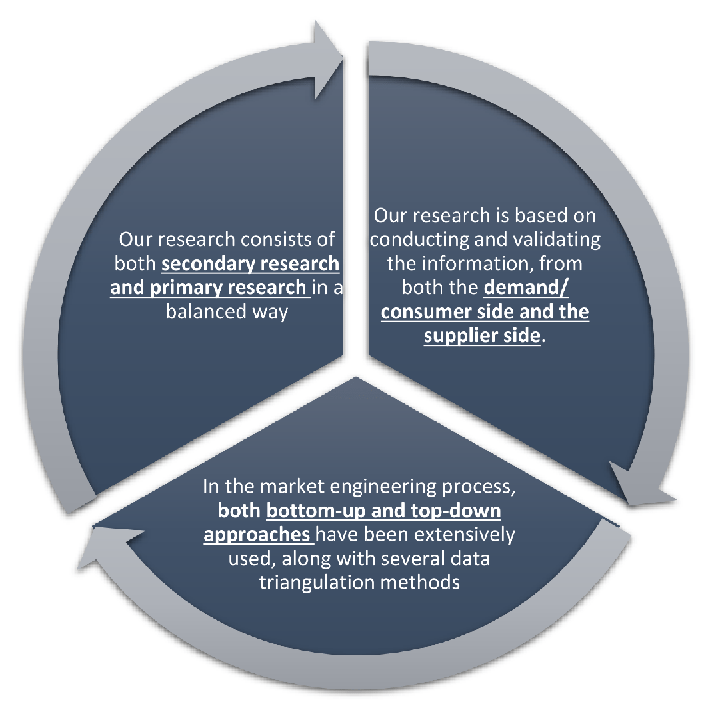
MarketGenics leverages a dedicated industry panel of experts and a comprehensive suite of paid databases to effectively collect, consolidate, and analyze market intelligence.
Our approach has consistently proven to be reliable and effective in generating accurate market insights, identifying key industry trends, and uncovering emerging business opportunities.
Through both primary and secondary research, we capture and analyze critical company-level data such as manufacturing footprints, including technical centers, R&D facilities, sales offices, and headquarters.
Our expert panel further enhances our ability to estimate market size for specific brands based on validated field-level intelligence.
Our data mining techniques incorporate both parametric and non-parametric methods, allowing for structured data collection, sorting, processing, and cleaning.
Demand projections are derived from large-scale data sets analyzed through proprietary algorithms, culminating in robust and reliable market sizing.
Research Approach
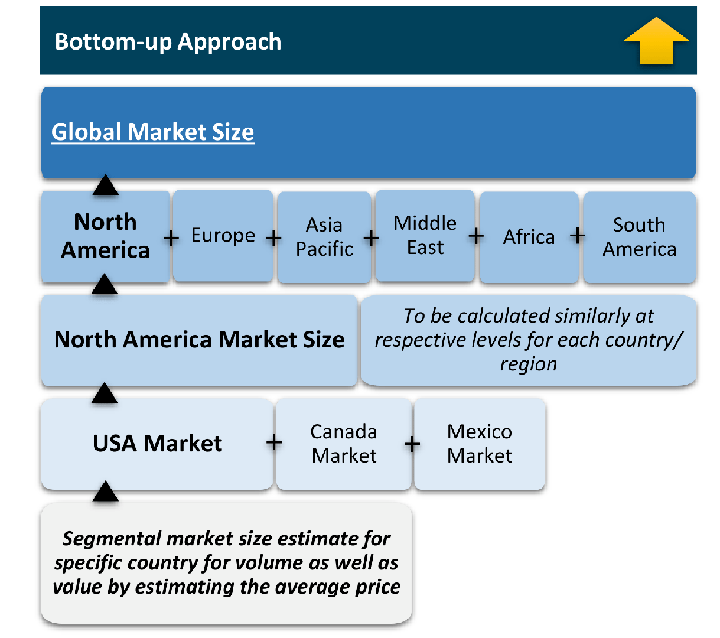
The bottom-up approach builds market estimates by starting with the smallest addressable market units and systematically aggregating them to create comprehensive market size projections.
This method begins with specific, granular data points and builds upward to create the complete market landscape.
Customer Analysis → Segmental Analysis → Geographical Analysis
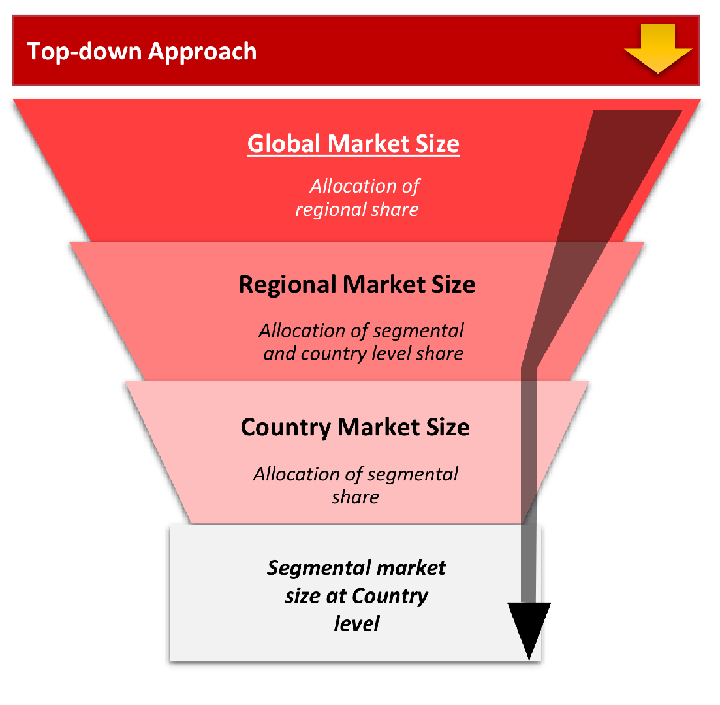
The top-down approach starts with the broadest possible market data and systematically narrows it down through a series of filters and assumptions to arrive at specific market segments or opportunities.
This method begins with the big picture and works downward to increasingly specific market slices.
TAM → SAM → SOM
Research Methods
Desk / Secondary Research
While analysing the market, we extensively study secondary sources, directories, and databases to identify and collect information useful for this technical, market-oriented, and commercial report. Secondary sources that we utilize are not only the public sources, but it is a combination of Open Source, Associations, Paid Databases, MG Repository & Knowledgebase, and others.
- Company websites, annual reports, financial reports, broker reports, and investor presentations
- National government documents, statistical databases and reports
- News articles, press releases and web-casts specific to the companies operating in the market, Magazines, reports, and others
- We gather information from commercial data sources for deriving company specific data such as segmental revenue, share for geography, product revenue, and others
- Internal and external proprietary databases (industry-specific), relevant patent, and regulatory databases
- Governing Bodies, Government Organizations
- Relevant Authorities, Country-specific Associations for Industries
We also employ the model mapping approach to estimate the product level market data through the players' product portfolio
Primary Research
Primary research/ interviews is vital in analyzing the market. Most of the cases involves paid primary interviews. Primary sources include primary interviews through e-mail interactions, telephonic interviews, surveys as well as face-to-face interviews with the different stakeholders across the value chain including several industry experts.
| Type of Respondents | Number of Primaries |
|---|---|
| Tier 2/3 Suppliers | ~20 |
| Tier 1 Suppliers | ~25 |
| End-users | ~25 |
| Industry Expert/ Panel/ Consultant | ~30 |
| Total | ~100 |
MG Knowledgebase
• Repository of industry blog, newsletter and case studies
• Online platform covering detailed market reports, and company profiles
Forecasting Factors and Models
Forecasting Factors
- Historical Trends – Past market patterns, cycles, and major events that shaped how markets behave over time. Understanding past trends helps predict future behavior.
- Industry Factors – Specific characteristics of the industry like structure, regulations, and innovation cycles that affect market dynamics.
- Macroeconomic Factors – Economic conditions like GDP growth, inflation, and employment rates that affect how much money people have to spend.
- Demographic Factors – Population characteristics like age, income, and location that determine who can buy your product.
- Technology Factors – How quickly people adopt new technology and how much technology infrastructure exists.
- Regulatory Factors – Government rules, laws, and policies that can help or restrict market growth.
- Competitive Factors – Analyzing competition structure such as degree of competition and bargaining power of buyers and suppliers.
Forecasting Models / Techniques
Multiple Regression Analysis
- Identify and quantify factors that drive market changes
- Statistical modeling to establish relationships between market drivers and outcomes
Time Series Analysis – Seasonal Patterns
- Understand regular cyclical patterns in market demand
- Advanced statistical techniques to separate trend, seasonal, and irregular components
Time Series Analysis – Trend Analysis
- Identify underlying market growth patterns and momentum
- Statistical analysis of historical data to project future trends
Expert Opinion – Expert Interviews
- Gather deep industry insights and contextual understanding
- In-depth interviews with key industry stakeholders
Multi-Scenario Development
- Prepare for uncertainty by modeling different possible futures
- Creating optimistic, pessimistic, and most likely scenarios
Time Series Analysis – Moving Averages
- Sophisticated forecasting for complex time series data
- Auto-regressive integrated moving average models with seasonal components
Econometric Models
- Apply economic theory to market forecasting
- Sophisticated economic models that account for market interactions
Expert Opinion – Delphi Method
- Harness collective wisdom of industry experts
- Structured, multi-round expert consultation process
Monte Carlo Simulation
- Quantify uncertainty and probability distributions
- Thousands of simulations with varying input parameters
Research Analysis
Our research framework is built upon the fundamental principle of validating market intelligence from both demand and supply perspectives. This dual-sided approach ensures comprehensive market understanding and reduces the risk of single-source bias.
Demand-Side Analysis: We understand end-user/application behavior, preferences, and market needs along with the penetration of the product for specific application.
Supply-Side Analysis: We estimate overall market revenue, analyze the segmental share along with industry capacity, competitive landscape, and market structure.
Validation & Evaluation
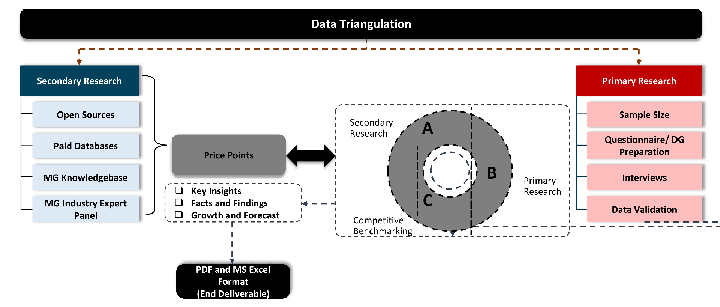
Data triangulation is a validation technique that uses multiple methods, sources, or perspectives to examine the same research question, thereby increasing the credibility and reliability of research findings. In market research, triangulation serves as a quality assurance mechanism that helps identify and minimize bias, validate assumptions, and ensure accuracy in market estimates.
- Data Source Triangulation – Using multiple data sources to examine the same phenomenon
- Methodological Triangulation – Using multiple research methods to study the same research question
- Investigator Triangulation – Using multiple researchers or analysts to examine the same data
- Theoretical Triangulation – Using multiple theoretical perspectives to interpret the same data
Custom Market Research Services
We will customise the research for you, in case the report listed above does not meet your requirements.
Get 10% Free Customisation