Child-Resistant Packaging Market Size, Share & Trends Analysis Report by Packaging Type (Blister Packs, Bottles & Containers, Pouches & Bags, Tubes, Clamshells, Cartons & Boxes, Other Types), Material Type, Closure Mechanism, Capacity Range, Product Form, Distribution Channel, Technology Type, End-use Applications, and Geography (North America, Europe, Asia Pacific, Middle East, Africa, and South America) – Global Industry Data, Trends, and Forecasts, 2026–2035
|
|
|
Segmental Data Insights |
|
|
Demand Trends |
|
|
Competitive Landscape |
|
|
Strategic Development |
|
|
Future Outlook & Opportunities |
|
Child Resistant Packaging Market Size, Share, and Growth
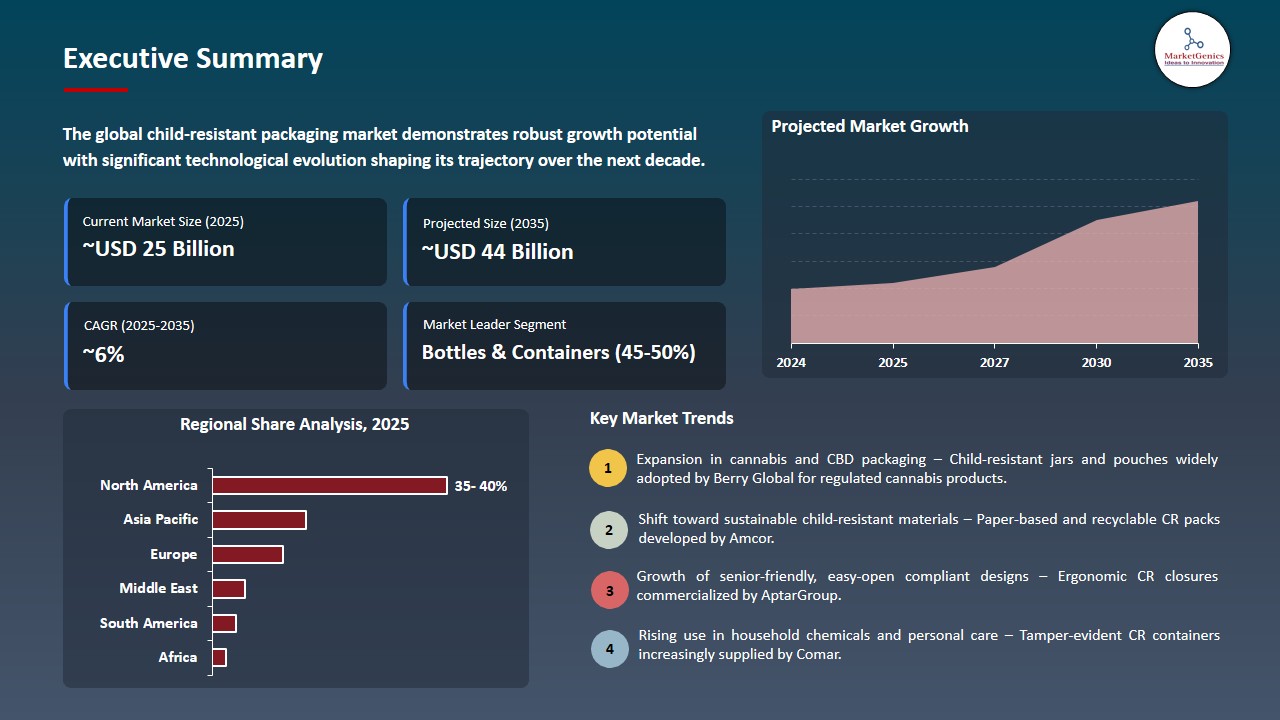
The global child-resistant packaging market is experiencing robust growth, with its estimated value of USD 25.3 billion in the year 2025 and ~USD 44 billion by the period 2035, registering a CAGR of 5.7%, during the forecast period. The global child-resistant packaging market is growing as more and more regulators and brand owners are becoming aware of the risks of accidental ingestion, driving up the demand of secure, non-tamperable, and misuse preventive packaging. Applying tested consistency of opening forces, usability friendly to the elderly and integrating anti-counterfeiting to ensure product integrity across pharmaceuticals, nutraceuticals, household chemicals, and cannabis products along the distribution and retail channels.
Chuck Newswanger, Director of Global Commercial Innovation and Technical Development–Pharmaceutical Packaging at CSI, said: In the OTC and nutraceutical market, child-resistant closures demonstrate a brand’s commitment to consumer safety and regulatory compliance. A well-engineered design meets the expectations of today’s health-conscious shoppers, ensures compliance, and integrates seamlessly with high-speed filling and capping lines.
The child-resistant packaging market is moving away by regulation based safety solution to brand-sensitive risk-management and premiumization instrument in pharmaceuticals, nutraceuticals, cannabis, agrochemicals and household concentrates. The increasing litigation risk, the increase of global poison-prevention regulations, as well as the increase of child access to high strength products, are compelling manufacturers to re-architecture closures, blisters, and pouches with known multi-step opening logic, as opposed to simple push-and-turn architectures. Simultaneously, child-resistant packages are becoming a trust-building element of high-priced OTC drugs, edibles and prescription therapies that directly affect consumer buying behavior and pharmacy inventory selection.
The conflict between the mechanical safety performance and recyclability requirements are driving material innovation in this market. The owners of brands are shifting towards single-resin child-resistant systems, fiber-based locking cartons, and solvent-free barrier films to achieve safety certification and circular-economy goals. With its child-resistant flexible pouches and blister packs, the most rapid design conversions are taking place, where dosage accuracy, portability, and supply-chain effectiveness are very beneficial to a contract packer and an export-driven pharma manufacturer in terms of cost and compliance.
The automation-compatible child-resistant formats are changing the market on the front of supply, as reducing the line-change time and human intervention in high-speed pharmaceutical filling processes. This is facilitating scalability in terms of deployment in new markets where regulation is increasing and the majority use manual packaging. Regulatory convergence, sustainable material substitution and automation-ready safety formats are all converting the child-resistant packaging as a lot of compliance accessories into a strategic facilitator of global market entry and brand security.

Child Resistant Packaging Market Dynamics and Trends
Driver: Growing Focus on Child Safety and Regulatory Compliance
-
The global child-resistant packaging market is gaining momentum due to the increasing demand of child safety, evidence of tampering, and adherence to high standards of pharmaceutical products by manufacturers and regulators. The production of high-risk drugs, liquid drugs and non-prescription drugs is growing in demand, and packaging in ways that prevent accidental ingestion is necessary without compromising the integrity of products in the supply chain.
- One such solution is the introduction of new child-resistant packaging technologies by packaging industries. For instance, in 2023, Amcor introduced an accredited child-resistant PET bottle and closure combination of pharmaceutical syrups, offering a globally-compliant, tamper-evidential and completely-recyclable method of packaging. The innovation is child-safe, environmentally sustainable, and increases the use of the product by those taking care of the children and those who have the children. The other manufacturers are also working on the smart, compliant closures to address the regulatory requirements without sacrificing the convenience.
- Regulatory compliance, patient safety, and increasing awareness among caregivers are all driving child-resistant packaging as a fundamental requirement in pharmaceuticals, which is driving the major growth of the market across the globe.
Restraint: Higher Manufacturing Costs for Child-Resistant Solutions
-
The kid-resistant package market has cost challenges with the complexity of specialty closures, caps and bottles to prevent the occurrence of accidental ingestion. High unit manufacturing costs are a result of materials like high grade plastics, multi-layered foils, safety compliant polymers as well as precision-molding processes. The small and mid-sized pharmaceutical and consumer product manufacturers are inclined to use the third-party packagers that lead to a greater reliance on operations, and loss of control on costs.
- Logistics and compliance are also additional financial strains. Temperature sensitive drugs, the over the counter medicines and nutraceuticals are commonly stored under controlled conditions and handled with care, and regulatory inspection and testing child resistant lines increase the indirect expenses.
- In addition, the packaging or non-conformance can lead to recall of the product, insurance reimbursements and government fines. Such cumulative problems render high manufacturing costs to be an important constraint that prevents the mass implementation of child-resistant solutions, particularly with the emerging markets and budget-conscious segments.
Opportunity: Demand for Eco-Friendly and Recyclable Child-Resistant Packaging
-
The global child-resistant packaging market has been transforming more and more into environmentally friendly and recyclable ones as the pressure of governments to reduce plastic waste, decrease carbon emissions, and enhance packaging sustainability grows. To address ESG objectives and patient safety and regulatory compliance, pharmaceutical, OTC, and nutraceutical companies are focusing on recyclable bottles, closures, and blister packs.
- Producers are also developing to combine sustainability and functionality. For instance, in October 2024, Berry Global debuted ClariPPil 100 per cent recyclable bottles made of polypropylene, which provide better moisture protection and the ability to use common child-resistant closures. These bottles are both environmentally conscious and safe and useful, and it is a wider industry trend that packaging should be circular and easy to use by patients.
- Also, increasing developments in the types of bio-based plastics, recyclable closures, and modular designs are lowering the cost of lifecycle and material wastes. The emergence of circular supply chains and the demand on eco-friendly products makes recyclable, child-resistant packaging one of the growth opportunities in the global market.
Key Trend: Integration of Smart Features for Enhanced Safety and Compliance
-
A child-resistant packaging market is also shifting toward smart and intelligent closures, bottles, and caps with built-in IoT and NFC/RFID sensors, digital monitoring and smartness. Such technologies can provide real-time monitoring of usage, storage conditions, and compliance, which improve the safety of the product, its compliance with the laws and the safety of patients. The trend is especially applicable to high-risk medications, prescription drugs, and temperature-sensitive formulations, in which proper usage and accidental ingestion are of particular concern.
- Manufacturers are integrating high-tech monitoring and analytics into child proof packaging. For instance, in March 2025, Berry Global introduced its Digi-Cap smart child-resistant closure, which monitors the bottle openings, stores the temperature at which the bottle was kept, and sends the information to other devices as well through NFC. This enables manufacturers, caregivers and healthcare providers to monitor misuse or tampering, enhance patient compliance and maximize packaging and supply-chain results.
- IoT-enabled smart packaging is becoming a major point of differentiation, enhancing traceability, patient adherence, regulatory compliance, and brand trust and opening up opportunities to innovative, eco-friendly, digital, and patient-centered packaging solutions.
Child-Resistant-Packaging-Market Analysis and Segmental Data
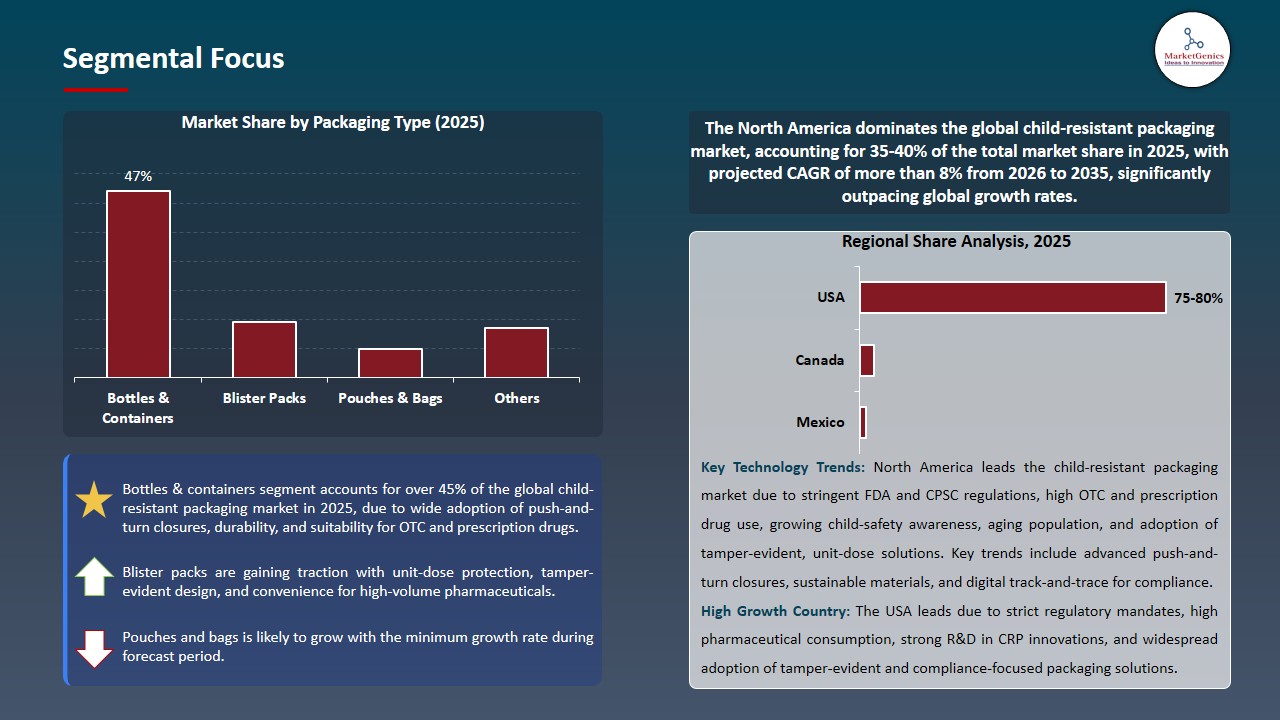
Bottles & Containers Dominate Global Child-Resistant Packaging Market
-
The bottles and containers dominate the child-resistant packaging market in terms of reliability, regulatory compliance, and solidity of pharmaceutical, nutraceutical and household chemical products. Their safe closures will not allow accidental ingestion and allow safe distribution through retail and e-commerce channels.
- There is an innovation trend of child resistant bottles and closures. For instance, in July 2025, Closure Systems International (CSI) introduced the Defender-Lok Child-Resistant Closure, an OTC and nutraceutical bottle cap on bottles, which was certified as recyclable. Defender-Lok is a child safety compliance system with simple implementation into existing filling lines, which contributes to both efficiency and sustainability.
- Bottles and containers have become the basis of child-resistant packaging in every corner of the world due to their proven reliability, ergonomics design, and material sustainability. This has continued to dominate both pharmaceutical and consumer products segments as a result of their potential to integrate safety, scalability and eco-friendly materials.
North America Leads Global Child-Resistant Packaging Market Demand
-
North America leads the child-resistant packaging market because of the high regulatory requirements like the Poison Prevention Packaging Act, high levels of consumer awareness regarding child safety, and strong demand in the pharmaceutical industry, OTC drugs, household chemicals and cannabis-derived products. The presence of mature healthcare and retail industries in the region along with the high usage of prescription and non-prescription drugs create the continuous acceptance of CRP solutions.
- Manufacturers and packaging providers are developing to achieve compliance, usability and sustainability demand. For instance, in July 2025, Amcor plc launched the Hector Child-Resistant Closure, a future recyclable household and chemical product closure. The closures weigh 7.25g much less than standard closures, which decreases the use of plastic without compromising on standards of child-safety and recycling.
- North America is able to lead the development of child-resistant packaging that is viable, cost-effective, and complies with regulations for the pharmaceutical and consumer goods sectors worldwide.
Child-Resistant-Packaging-Market Ecosystem
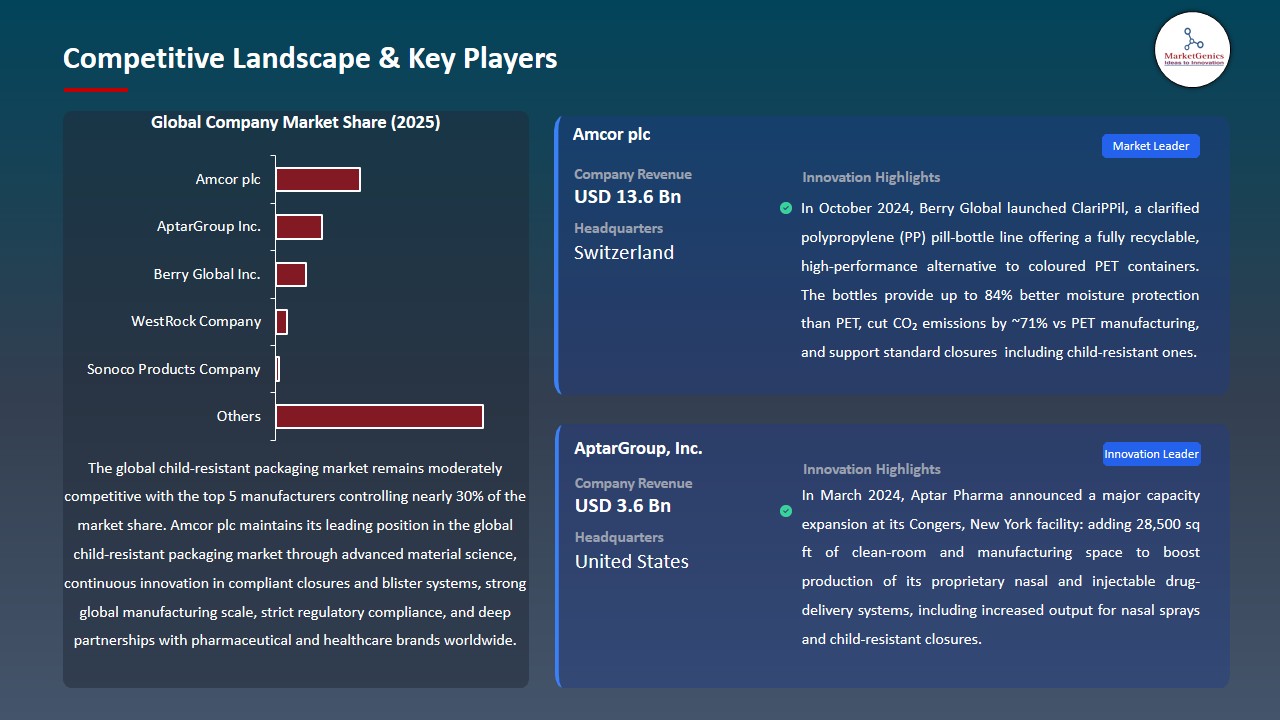
The global child-resistant packaging market is slightly fragmented as it is promoted by multinational packaging pioneers and specialized solutions oriented on safety serving the pharmaceutical, food and beverage, chemical as well as household product segments. Amcor plc, AptarGroup Inc., Berry Global Inc., WestRock Company and Sonoco Products Company are the main market players with the highest levels of child-resistant closures, blister packs, flexible pouches, and rigid containers. Their efficient global manufacturing capabilities, timeless product development, regulatory acumen and diversified exposure to end-users enable them to address high-safety standards at low costs and scale.
The child-resistant packaging value chain is made up of raw material suppliers (plastics, paperboard, aluminum), packaging converters, closure and mechanism designers, pharmaceutical and consumer-goods brand owners and downstream retail and e-commerce channels. It is enhancing the ecosystem through investment in sustainable mono-material designs, lightweight closures, elder-friendly but child-secure designs, intelligent tamper-evident designs, and automation-based production. The major corporations are also paying attention to vertical integration, recycled-content contents, digital quality control, and compliance-based design optimization to add value to the product safety, sustainability performance, and unified regulatory compliance in all the markets of the world.
Recent Development and Strategic Overview
-
In April 2024, SnapSlide launched its no-torque, child-resistant prescription and OTC vials cap, which opens with a push-slide to provide enhanced ease of use. The new design also saves approximately 25 percent of plastic use because everything is one solution child safety, senior friendly to use, and sustainable.
- In December 2025, Origin Pharma Packaging introduced SmartX child-resistant blister-pack wallet, a tamper-evident, recyclable mono-board. The new format increases child safety and at the same time ensures more sustainability and allows full-colour branding and regulatory information to be included.
Report Scope
|
Detail |
|
|
Market Size in 2025 |
USD 25.3 Bn |
|
Market Forecast Value in 2035 |
~USD 44 Bn |
|
Growth Rate (CAGR) |
5.7% |
|
Forecast Period |
2026 – 2035 |
|
Historical Data Available for |
2021 – 2024 |
|
Market Size Units |
US$ Billion for Value |
|
Report Format |
Electronic (PDF) + Excel |
|
North America |
Europe |
Asia Pacific |
Middle East |
Africa |
South America |
|
|
|
|
|
|
|
Companies Covered |
|||||
|
|
|
|
|
|
Child-Resistant-Packaging-Market Segmentation and Highlights
|
Segment |
Sub-segment |
|
Child-Resistant Packaging Market, By Packaging Type |
|
|
Child-Resistant Packaging Market, By Material Type |
|
|
Child-Resistant Packaging Market, By Closure Mechanism |
|
|
Child-Resistant Packaging Market, By Capacity Range |
|
|
Child-Resistant Packaging Market, By Product Form |
|
|
Child-Resistant Packaging Market, By Distribution Channel |
|
|
Child-Resistant Packaging Market, By Technology Type |
|
|
Child-Resistant Packaging Market, By End-use Applications |
|
Frequently Asked Questions
Table of Contents
- 1. Research Methodology and Assumptions
- 1.1. Definitions
- 1.2. Research Design and Approach
- 1.3. Data Collection Methods
- 1.4. Base Estimates and Calculations
- 1.5. Forecasting Models
- 1.5.1. Key Forecast Factors & Impact Analysis
- 1.6. Secondary Research
- 1.6.1. Open Sources
- 1.6.2. Paid Databases
- 1.6.3. Associations
- 1.7. Primary Research
- 1.7.1. Primary Sources
- 1.7.2. Primary Interviews with Stakeholders across Ecosystem
- 2. Executive Summary
- 2.1. Global Child-Resistant Packaging Market Outlook
- 2.1.1. Child-Resistant Packaging Market Size Value (US$ Bn), and Forecasts, 2021-2035
- 2.1.2. Compounded Annual Growth Rate Analysis
- 2.1.3. Growth Opportunity Analysis
- 2.1.4. Segmental Share Analysis
- 2.1.5. Geographical Share Analysis
- 2.2. Market Analysis and Facts
- 2.3. Supply-Demand Analysis
- 2.4. Competitive Benchmarking
- 2.5. Go-to- Market Strategy
- 2.5.1. Customer/ End-use Industry Assessment
- 2.5.2. Growth Opportunity Data, 2026-2035
- 2.5.2.1. Regional Data
- 2.5.2.2. Country Data
- 2.5.2.3. Segmental Data
- 2.5.3. Identification of Potential Market Spaces
- 2.5.4. GAP Analysis
- 2.5.5. Potential Attractive Price Points
- 2.5.6. Prevailing Market Risks & Challenges
- 2.5.7. Preferred Sales & Marketing Strategies
- 2.5.8. Key Recommendations and Analysis
- 2.5.9. A Way Forward
- 2.1. Global Child-Resistant Packaging Market Outlook
- 3. Industry Data and Premium Insights
- 3.1. Global Packaging Industry Overview, 2025
- 3.1.1. Packaging Industry Ecosystem Analysis
- 3.1.2. Key Trends for Packaging Industry
- 3.1.3. Regional Distribution for Packaging Industry
- 3.2. Supplier Customer Data
- 3.3. Technology Roadmap and Developments
- 3.4. Trade Analysis
- 3.4.1. Import & Export Analysis, 2025
- 3.4.2. Top Importing Countries
- 3.4.3. Top Exporting Countries
- 3.5. Trump Tariff Impact Analysis
- 3.5.1. Manufacturer
- 3.5.1.1. Based on the component & Raw material
- 3.5.2. Supply Chain
- 3.5.3. End Consumer
- 3.5.1. Manufacturer
- 3.6. Raw Material Analysis
- 3.1. Global Packaging Industry Overview, 2025
- 4. Market Overview
- 4.1. Market Dynamics
- 4.1.1. Drivers
- 4.1.1.1. Stringent child-safety regulations for pharmaceuticals and household chemicals.
- 4.1.1.2. Rising pharmaceutical consumption and growth of OTC medicines.
- 4.1.1.3. Increasing adoption in cannabis, e-liquids, and household care products.
- 4.1.2. Restraints
- 4.1.2.1. Higher packaging and compliance costs compared to conventional packaging.
- 4.1.2.2. Design complexity affecting usability for elderly and disabled users.
- 4.1.1. Drivers
- 4.2. Key Trend Analysis
- 4.3. Regulatory Framework
- 4.3.1. Key Regulations, Norms, and Subsidies, by Key Countries
- 4.3.2. Tariffs and Standards
- 4.3.3. Impact Analysis of Regulations on the Market
- 4.4. Value Chain Analysis
- 4.4.1. Raw Material Suppliers
- 4.4.2. Manufacturing
- 4.4.3. Distribution
- 4.4.4. End-Use
- 4.5. Porter’s Five Forces Analysis
- 4.6. PESTEL Analysis
- 4.7. Global Child-Resistant Packaging Market Demand
- 4.7.1. Historical Market Size – Value (US$ Bn), 2020-2024
- 4.7.2. Current and Future Market Size – Value (US$ Bn), 2026–2035
- 4.7.2.1. Y-o-Y Growth Trends
- 4.7.2.2. Absolute $ Opportunity Assessment
- 4.1. Market Dynamics
- 5. Competition Landscape
- 5.1. Competition structure
- 5.1.1. Fragmented v/s consolidated
- 5.2. Company Share Analysis, 2025
- 5.2.1. Global Company Market Share
- 5.2.2. By Region
- 5.2.2.1. North America
- 5.2.2.2. Europe
- 5.2.2.3. Asia Pacific
- 5.2.2.4. Middle East
- 5.2.2.5. Africa
- 5.2.2.6. South America
- 5.3. Product Comparison Matrix
- 5.3.1. Specifications
- 5.3.2. Market Positioning
- 5.3.3. Pricing
- 5.1. Competition structure
- 6. Global Child-Resistant Packaging Market Analysis, by Packaging Type
- 6.1. Key Segment Analysis
- 6.2. Child-Resistant Packaging Market Size Value (US$ Bn), Analysis, and Forecasts, by Packaging Type, 2021-2035
- 6.2.1. Blister Packs
- 6.2.1.1. Push-Through Blister Packs
- 6.2.1.2. Peel-Push Blister Packs
- 6.2.1.3. Others
- 6.2.2. Bottles & Containers
- 6.2.2.1. Squeeze & Turn Caps
- 6.2.2.2. Push & Turn Caps
- 6.2.2.3. Snap Caps
- 6.2.2.4. Others
- 6.2.3. Pouches & Bags
- 6.2.3.1. Reclosable Zipper Pouches
- 6.2.3.2. Press-to-Close Pouches
- 6.2.3.3. Others
- 6.2.4. Tubes
- 6.2.5. Clamshells
- 6.2.6. Cartons & Boxes
- 6.2.7. Other Types
- 6.2.1. Blister Packs
- 7. Global Child-Resistant Packaging Market Analysis, by Material Type
- 7.1. Key Segment Analysis
- 7.2. Child-Resistant Packaging Market Size Value (US$ Bn), Analysis, and Forecasts, by Material Type, 2021-2035
- 7.2.1. Plastic
- 7.2.1.1. Polyethylene (PE)
- 7.2.1.2. Polypropylene (PP)
- 7.2.1.3. Polyethylene Terephthalate (PET)
- 7.2.1.4. Polyvinyl Chloride (PVC)
- 7.2.1.5. Others
- 7.2.2. Metal
- 7.2.2.1. Aluminum
- 7.2.2.2. Tin-Plated Steel
- 7.2.2.3. Others
- 7.2.3. Glass
- 7.2.4. Paperboard
- 7.2.5. Multi-Material/Composite
- 7.2.1. Plastic
- 8. Global Child-Resistant Packaging Market Analysis, by Closure Mechanism
- 8.1. Key Segment Analysis
- 8.2. Child-Resistant Packaging Market Size Value (US$ Bn), Analysis, and Forecasts, by Closure Mechanism, 2021-2035
- 8.2.1. Push & Turn
- 8.2.2. Squeeze & Turn
- 8.2.3. Press & Pull
- 8.2.4. Snap-On
- 8.2.5. Latch Systems
- 8.2.6. Slide & Lock
- 8.2.7. Child-Resistant Zippers
- 9. Global Child-Resistant Packaging Market Analysis, by Capacity Range
- 9.1. Key Segment Analysis
- 9.2. Child-Resistant Packaging Market Size Value (US$ Bn), Analysis, and Forecasts, by Capacity Range, 2021-2035
- 9.2.1. Below 50 ml/grams
- 9.2.2. 50-100 ml/grams
- 9.2.3. 100-250 ml/grams
- 9.2.4. 250-500 ml/grams
- 9.2.5. Above 500 ml/grams
- 10. Global Child-Resistant Packaging Market Analysis, by Product Form
- 10.1. Key Segment Analysis
- 10.2. Child-Resistant Packaging Market Size Value (US$ Bn), Analysis, and Forecasts, by Product Form, 2021-2035
- 10.2.1. Solid Dosage
- 10.2.1.1. Tablets
- 10.2.1.2. Capsules
- 10.2.1.3. Gummies
- 10.2.1.4. Others
- 10.2.2. Liquid Dosage
- 10.2.2.1. Syrups
- 10.2.2.2. Drops
- 10.2.2.3. Solutions
- 10.2.2.4. Others
- 10.2.3. Semi-Solid
- 10.2.3.1. Creams
- 10.2.3.2. Gels
- 10.2.3.3. Ointments
- 10.2.3.4. Others
- 10.2.4. Powder
- 10.2.5. Other Forms
- 10.2.1. Solid Dosage
- 11. Global Child-Resistant Packaging Market Analysis, by Distribution Channel
- 11.1. Key Segment Analysis
- 11.2. Child-Resistant Packaging Market Size Value (US$ Bn), Analysis, and Forecasts, by Load Distribution Channel, 2021-2035
- 11.2.1. Direct Sales
- 11.2.2. Contract Manufacturing
- 11.2.3. OEM Partnerships
- 11.2.4. Distributors & Wholesalers
- 11.2.5. Online Platforms
- 11.2.6. Retail Packaging Suppliers
- 12. Global Child-Resistant Packaging Market Analysis, by Technology Type
- 12.1. Key Segment Analysis
- 12.2. Child-Resistant Packaging Market Size Value (US$ Bn), Analysis, and Forecasts, by Technology Type, 2021-2035
- 12.2.1. Traditional Mechanical Systems
- 12.2.2. Advanced Locking Mechanisms
- 12.2.3. Smart Packaging with Electronic Locks
- 12.2.4. Tamper-Evident Features
- 12.2.5. Senior-Friendly Child-Resistant Design
- 12.2.6. Others
- 13. Global Child-Resistant Packaging Market Analysis, by End-use Applications
- 13.1. Key Segment Analysis
- 13.2. Child-Resistant Packaging Market Size Value (US$ Bn), Analysis, and Forecasts, by End-use Applications, 2021-2035
- 13.2.1. Pharmaceuticals
- 13.2.1.1. Prescription Medications
- 13.2.1.2. Over-the-Counter (OTC) Drugs
- 13.2.1.3. Controlled Substances
- 13.2.1.4. Vitamins & Supplements
- 13.2.1.5. Others
- 13.2.2. Cannabis & Hemp Products
- 13.2.2.1. Medical Marijuana
- 13.2.2.2. Recreational Cannabis
- 13.2.2.3. CBD Products
- 13.2.2.4. Cannabis Edibles
- 13.2.2.5. Vape Products
- 13.2.2.6. Others
- 13.2.3. Household Chemicals
- 13.2.3.1. Cleaning Agents
- 13.2.3.2. Detergents & Bleach
- 13.2.3.3. Pesticides & Insecticides
- 13.2.3.4. Automotive Chemicals
- 13.2.3.5. Others
- 13.2.4. Personal Care & Cosmetics
- 13.2.4.1. Essential Oils
- 13.2.4.2. Nail Care Products
- 13.2.4.3. Hair Care Products with Harmful Chemicals
- 13.2.4.4. Perfumes with High Alcohol Content
- 13.2.4.5. Others
- 13.2.5. Food & Beverages
- 13.2.5.1. Alcoholic Beverages
- 13.2.5.2. Caffeinated Products
- 13.2.5.3. Dietary Supplements
- 13.2.5.4. Nicotine Products
- 13.2.5.5. Others
- 13.2.6. Agriculture & Veterinary
- 13.2.6.1. Animal Medications
- 13.2.6.2. Fertilizers
- 13.2.6.3. Veterinary Pharmaceuticals
- 13.2.6.4. Pet Care Products
- 13.2.6.5. Others
- 13.2.7. Industrial Chemicals
- 13.2.7.1. Laboratory Chemicals
- 13.2.7.2. Industrial Solvents
- 13.2.7.3. Adhesives & Glues
- 13.2.7.4. Others
- 13.2.8. E-Liquids & Vaping
- 13.2.8.1. Nicotine E-Liquids
- 13.2.8.2. Vape Cartridges
- 13.2.8.3. Vaping Accessories
- 13.2.8.4. Others
- 13.2.1. Pharmaceuticals
- 14. Global Child-Resistant Packaging Market Analysis and Forecasts, by Region
- 14.1. Key Findings
- 14.2. Child-Resistant Packaging Market Size Value (US$ Bn), Analysis, and Forecasts, by Region, 2021-2035
- 14.2.1. North America
- 14.2.2. Europe
- 14.2.3. Asia Pacific
- 14.2.4. Middle East
- 14.2.5. Africa
- 14.2.6. South America
- 15. North America Child-Resistant Packaging Market Analysis
- 15.1. Key Segment Analysis
- 15.2. Regional Snapshot
- 15.3. North America Child-Resistant Packaging Market Size- Value (US$ Bn), Analysis, and Forecasts, 2021-2035
- 15.3.1. Packaging Type
- 15.3.2. Material Type
- 15.3.3. Closure Mechanism
- 15.3.4. Capacity Range
- 15.3.5. Product Form
- 15.3.6. Distribution Channel
- 15.3.7. Technology Type
- 15.3.8. End-use Applications
- 15.3.9. Country
- 15.3.9.1. USA
- 15.3.9.2. Canada
- 15.3.9.3. Mexico
- 15.4. USA Child-Resistant Packaging Market
- 15.4.1. Country Segmental Analysis
- 15.4.2. Packaging Type
- 15.4.3. Material Type
- 15.4.4. Closure Mechanism
- 15.4.5. Capacity Range
- 15.4.6. Product Form
- 15.4.7. Distribution Channel
- 15.4.8. Technology Type
- 15.4.9. End-use Applications
- 15.5. Canada Child-Resistant Packaging Market
- 15.5.1. Country Segmental Analysis
- 15.5.2. Packaging Type
- 15.5.3. Material Type
- 15.5.4. Closure Mechanism
- 15.5.5. Capacity Range
- 15.5.6. Product Form
- 15.5.7. Distribution Channel
- 15.5.8. Technology Type
- 15.5.9. End-use Applications
- 15.6. Mexico Child-Resistant Packaging Market
- 15.6.1. Country Segmental Analysis
- 15.6.2. Packaging Type
- 15.6.3. Material Type
- 15.6.4. Closure Mechanism
- 15.6.5. Capacity Range
- 15.6.6. Product Form
- 15.6.7. Distribution Channel
- 15.6.8. Technology Type
- 15.6.9. End-use Applications
- 16. Europe Child-Resistant Packaging Market Analysis
- 16.1. Key Segment Analysis
- 16.2. Regional Snapshot
- 16.3. Europe Child-Resistant Packaging Market Size Value (US$ Bn), Analysis, and Forecasts, 2021-2035
- 16.3.1. Packaging Type
- 16.3.2. Material Type
- 16.3.3. Closure Mechanism
- 16.3.4. Capacity Range
- 16.3.5. Product Form
- 16.3.6. Distribution Channel
- 16.3.7. Technology Type
- 16.3.8. End-use Applications
- 16.3.9. Country
- 16.3.9.1. Germany
- 16.3.9.2. United Kingdom
- 16.3.9.3. France
- 16.3.9.4. Italy
- 16.3.9.5. Spain
- 16.3.9.6. Netherlands
- 16.3.9.7. Nordic Countries
- 16.3.9.8. Poland
- 16.3.9.9. Russia & CIS
- 16.3.9.10. Rest of Europe
- 16.4. Germany Child-Resistant Packaging Market
- 16.4.1. Country Segmental Analysis
- 16.4.2. Packaging Type
- 16.4.3. Material Type
- 16.4.4. Closure Mechanism
- 16.4.5. Capacity Range
- 16.4.6. Product Form
- 16.4.7. Distribution Channel
- 16.4.8. Technology Type
- 16.4.9. End-use Applications
- 16.5. United Kingdom Child-Resistant Packaging Market
- 16.5.1. Country Segmental Analysis
- 16.5.2. Packaging Type
- 16.5.3. Material Type
- 16.5.4. Closure Mechanism
- 16.5.5. Capacity Range
- 16.5.6. Product Form
- 16.5.7. Distribution Channel
- 16.5.8. Technology Type
- 16.5.9. End-use Applications
- 16.6. France Child-Resistant Packaging Market
- 16.6.1. Country Segmental Analysis
- 16.6.2. Packaging Type
- 16.6.3. Material Type
- 16.6.4. Closure Mechanism
- 16.6.5. Capacity Range
- 16.6.6. Product Form
- 16.6.7. Distribution Channel
- 16.6.8. Technology Type
- 16.6.9. End-use Applications
- 16.7. Italy Child-Resistant Packaging Market
- 16.7.1. Country Segmental Analysis
- 16.7.2. Packaging Type
- 16.7.3. Material Type
- 16.7.4. Closure Mechanism
- 16.7.5. Capacity Range
- 16.7.6. Product Form
- 16.7.7. Distribution Channel
- 16.7.8. Technology Type
- 16.7.9. End-use Applications
- 16.8. Spain Child-Resistant Packaging Market
- 16.8.1. Country Segmental Analysis
- 16.8.2. Packaging Type
- 16.8.3. Material Type
- 16.8.4. Closure Mechanism
- 16.8.5. Capacity Range
- 16.8.6. Product Form
- 16.8.7. Distribution Channel
- 16.8.8. Technology Type
- 16.8.9. End-use Applications
- 16.9. Netherlands Child-Resistant Packaging Market
- 16.9.1. Country Segmental Analysis
- 16.9.2. Packaging Type
- 16.9.3. Material Type
- 16.9.4. Closure Mechanism
- 16.9.5. Capacity Range
- 16.9.6. Product Form
- 16.9.7. Distribution Channel
- 16.9.8. Technology Type
- 16.9.9. End-use Applications
- 16.10. Nordic Countries Child-Resistant Packaging Market
- 16.10.1. Country Segmental Analysis
- 16.10.2. Packaging Type
- 16.10.3. Material Type
- 16.10.4. Closure Mechanism
- 16.10.5. Capacity Range
- 16.10.6. Product Form
- 16.10.7. Distribution Channel
- 16.10.8. Technology Type
- 16.10.9. End-use Applications
- 16.11. Poland Child-Resistant Packaging Market
- 16.11.1. Country Segmental Analysis
- 16.11.2. Packaging Type
- 16.11.3. Material Type
- 16.11.4. Closure Mechanism
- 16.11.5. Capacity Range
- 16.11.6. Product Form
- 16.11.7. Distribution Channel
- 16.11.8. Technology Type
- 16.11.9. End-use Applications
- 16.12. Russia & CIS Child-Resistant Packaging Market
- 16.12.1. Country Segmental Analysis
- 16.12.2. Packaging Type
- 16.12.3. Material Type
- 16.12.4. Closure Mechanism
- 16.12.5. Capacity Range
- 16.12.6. Product Form
- 16.12.7. Distribution Channel
- 16.12.8. Technology Type
- 16.12.9. End-use Applications
- 16.13. Rest of Europe Child-Resistant Packaging Market
- 16.13.1. Country Segmental Analysis
- 16.13.2. Packaging Type
- 16.13.3. Material Type
- 16.13.4. Closure Mechanism
- 16.13.5. Capacity Range
- 16.13.6. Product Form
- 16.13.7. Distribution Channel
- 16.13.8. Technology Type
- 16.13.9. End-use Applications
- 17. Asia Pacific Child-Resistant Packaging Market Analysis
- 17.1. Key Segment Analysis
- 17.2. Regional Snapshot
- 17.3. Asia Pacific Child-Resistant Packaging Market Size Value (US$ Bn), Analysis, and Forecasts, 2021-2035
- 17.3.1. Packaging Type
- 17.3.2. Material Type
- 17.3.3. Closure Mechanism
- 17.3.4. Capacity Range
- 17.3.5. Product Form
- 17.3.6. Distribution Channel
- 17.3.7. Technology Type
- 17.3.8. End-use Applications
- 17.3.9. Country
- 17.3.9.1. China
- 17.3.9.2. India
- 17.3.9.3. Japan
- 17.3.9.4. South Korea
- 17.3.9.5. Australia and New Zealand
- 17.3.9.6. Indonesia
- 17.3.9.7. Malaysia
- 17.3.9.8. Thailand
- 17.3.9.9. Vietnam
- 17.3.9.10. Rest of Asia Pacific
- 17.4. China Child-Resistant Packaging Market
- 17.4.1. Country Segmental Analysis
- 17.4.2. Packaging Type
- 17.4.3. Material Type
- 17.4.4. Closure Mechanism
- 17.4.5. Capacity Range
- 17.4.6. Product Form
- 17.4.7. Distribution Channel
- 17.4.8. Technology Type
- 17.4.9. End-use Applications
- 17.5. India Child-Resistant Packaging Market
- 17.5.1. Country Segmental Analysis
- 17.5.2. Packaging Type
- 17.5.3. Material Type
- 17.5.4. Closure Mechanism
- 17.5.5. Capacity Range
- 17.5.6. Product Form
- 17.5.7. Distribution Channel
- 17.5.8. Technology Type
- 17.5.9. End-use Applications
- 17.6. Japan Child-Resistant Packaging Market
- 17.6.1. Country Segmental Analysis
- 17.6.2. Packaging Type
- 17.6.3. Material Type
- 17.6.4. Closure Mechanism
- 17.6.5. Capacity Range
- 17.6.6. Product Form
- 17.6.7. Distribution Channel
- 17.6.8. Technology Type
- 17.6.9. End-use Applications
- 17.7. South Korea Child-Resistant Packaging Market
- 17.7.1. Country Segmental Analysis
- 17.7.2. Packaging Type
- 17.7.3. Material Type
- 17.7.4. Closure Mechanism
- 17.7.5. Capacity Range
- 17.7.6. Product Form
- 17.7.7. Distribution Channel
- 17.7.8. Technology Type
- 17.7.9. End-use Applications
- 17.8. Australia and New Zealand Child-Resistant Packaging Market
- 17.8.1. Country Segmental Analysis
- 17.8.2. Packaging Type
- 17.8.3. Material Type
- 17.8.4. Closure Mechanism
- 17.8.5. Capacity Range
- 17.8.6. Product Form
- 17.8.7. Distribution Channel
- 17.8.8. Technology Type
- 17.8.9. End-use Applications
- 17.9. Indonesia Child-Resistant Packaging Market
- 17.9.1. Country Segmental Analysis
- 17.9.2. Packaging Type
- 17.9.3. Material Type
- 17.9.4. Closure Mechanism
- 17.9.5. Capacity Range
- 17.9.6. Product Form
- 17.9.7. Distribution Channel
- 17.9.8. Technology Type
- 17.9.9. End-use Applications
- 17.10. Malaysia Child-Resistant Packaging Market
- 17.10.1. Country Segmental Analysis
- 17.10.2. Packaging Type
- 17.10.3. Material Type
- 17.10.4. Closure Mechanism
- 17.10.5. Capacity Range
- 17.10.6. Product Form
- 17.10.7. Distribution Channel
- 17.10.8. Technology Type
- 17.10.9. End-use Applications
- 17.11. Thailand Child-Resistant Packaging Market
- 17.11.1. Country Segmental Analysis
- 17.11.2. Packaging Type
- 17.11.3. Material Type
- 17.11.4. Closure Mechanism
- 17.11.5. Capacity Range
- 17.11.6. Product Form
- 17.11.7. Distribution Channel
- 17.11.8. Technology Type
- 17.11.9. End-use Applications
- 17.12. Vietnam Child-Resistant Packaging Market
- 17.12.1. Country Segmental Analysis
- 17.12.2. Packaging Type
- 17.12.3. Material Type
- 17.12.4. Closure Mechanism
- 17.12.5. Capacity Range
- 17.12.6. Product Form
- 17.12.7. Distribution Channel
- 17.12.8. Technology Type
- 17.12.9. End-use Applications
- 17.13. Rest of Asia Pacific Child-Resistant Packaging Market
- 17.13.1. Country Segmental Analysis
- 17.13.2. Packaging Type
- 17.13.3. Material Type
- 17.13.4. Closure Mechanism
- 17.13.5. Capacity Range
- 17.13.6. Product Form
- 17.13.7. Distribution Channel
- 17.13.8. Technology Type
- 17.13.9. End-use Applications
- 18. Middle East Child-Resistant Packaging Market Analysis
- 18.1. Key Segment Analysis
- 18.2. Regional Snapshot
- 18.3. Middle East Child-Resistant Packaging Market Size Value (US$ Bn), Analysis, and Forecasts, 2021-2035
- 18.3.1. Packaging Type
- 18.3.2. Material Type
- 18.3.3. Closure Mechanism
- 18.3.4. Capacity Range
- 18.3.5. Product Form
- 18.3.6. Distribution Channel
- 18.3.7. Technology Type
- 18.3.8. End-use Applications
- 18.3.9. Country
- 18.3.9.1. Turkey
- 18.3.9.2. UAE
- 18.3.9.3. Saudi Arabia
- 18.3.9.4. Israel
- 18.3.9.5. Rest of Middle East
- 18.4. Turkey Child-Resistant Packaging Market
- 18.4.1. Country Segmental Analysis
- 18.4.2. Packaging Type
- 18.4.3. Material Type
- 18.4.4. Closure Mechanism
- 18.4.5. Capacity Range
- 18.4.6. Product Form
- 18.4.7. Distribution Channel
- 18.4.8. Technology Type
- 18.4.9. End-use Applications
- 18.5. UAE Child-Resistant Packaging Market
- 18.5.1. Country Segmental Analysis
- 18.5.2. Packaging Type
- 18.5.3. Material Type
- 18.5.4. Closure Mechanism
- 18.5.5. Capacity Range
- 18.5.6. Product Form
- 18.5.7. Distribution Channel
- 18.5.8. Technology Type
- 18.5.9. End-use Applications
- 18.6. Saudi Arabia Child-Resistant Packaging Market
- 18.6.1. Country Segmental Analysis
- 18.6.2. Packaging Type
- 18.6.3. Material Type
- 18.6.4. Closure Mechanism
- 18.6.5. Capacity Range
- 18.6.6. Product Form
- 18.6.7. Distribution Channel
- 18.6.8. Technology Type
- 18.6.9. End-use Applications
- 18.7. Israel Child-Resistant Packaging Market
- 18.7.1. Country Segmental Analysis
- 18.7.2. Packaging Type
- 18.7.3. Material Type
- 18.7.4. Closure Mechanism
- 18.7.5. Capacity Range
- 18.7.6. Product Form
- 18.7.7. Distribution Channel
- 18.7.8. Technology Type
- 18.7.9. End-use Applications
- 18.8. Rest of Middle East Child-Resistant Packaging Market
- 18.8.1. Country Segmental Analysis
- 18.8.2. Packaging Type
- 18.8.3. Material Type
- 18.8.4. Closure Mechanism
- 18.8.5. Capacity Range
- 18.8.6. Product Form
- 18.8.7. Distribution Channel
- 18.8.8. Technology Type
- 18.8.9. End-use Applications
- 19. Africa Child-Resistant Packaging Market Analysis
- 19.1. Key Segment Analysis
- 19.2. Regional Snapshot
- 19.3. Africa Child-Resistant Packaging Market Size Value (US$ Bn), Analysis, and Forecasts, 2021-2035
- 19.3.1. Packaging Type
- 19.3.2. Material Type
- 19.3.3. Closure Mechanism
- 19.3.4. Capacity Range
- 19.3.5. Product Form
- 19.3.6. Distribution Channel
- 19.3.7. Technology Type
- 19.3.8. End-use Applications
- 19.3.9. country
- 19.3.9.1. South Africa
- 19.3.9.2. Egypt
- 19.3.9.3. Nigeria
- 19.3.9.4. Algeria
- 19.3.9.5. Rest of Africa
- 19.4. South Africa Child-Resistant Packaging Market
- 19.4.1. Country Segmental Analysis
- 19.4.2. Packaging Type
- 19.4.3. Material Type
- 19.4.4. Closure Mechanism
- 19.4.5. Capacity Range
- 19.4.6. Product Form
- 19.4.7. Distribution Channel
- 19.4.8. Technology Type
- 19.4.9. End-use Applications
- 19.5. Egypt Child-Resistant Packaging Market
- 19.5.1. Country Segmental Analysis
- 19.5.2. Packaging Type
- 19.5.3. Material Type
- 19.5.4. Closure Mechanism
- 19.5.5. Capacity Range
- 19.5.6. Product Form
- 19.5.7. Distribution Channel
- 19.5.8. Technology Type
- 19.5.9. End-use Applications
- 19.6. Nigeria Child-Resistant Packaging Market
- 19.6.1. Country Segmental Analysis
- 19.6.2. Packaging Type
- 19.6.3. Material Type
- 19.6.4. Closure Mechanism
- 19.6.5. Capacity Range
- 19.6.6. Product Form
- 19.6.7. Distribution Channel
- 19.6.8. Technology Type
- 19.6.9. End-use Applications
- 19.7. Algeria Child-Resistant Packaging Market
- 19.7.1. Country Segmental Analysis
- 19.7.2. Packaging Type
- 19.7.3. Material Type
- 19.7.4. Closure Mechanism
- 19.7.5. Capacity Range
- 19.7.6. Product Form
- 19.7.7. Distribution Channel
- 19.7.8. Technology Type
- 19.7.9. End-use Applications
- 19.8. Rest of Africa Child-Resistant Packaging Market
- 19.8.1. Country Segmental Analysis
- 19.8.2. Packaging Type
- 19.8.3. Material Type
- 19.8.4. Closure Mechanism
- 19.8.5. Capacity Range
- 19.8.6. Product Form
- 19.8.7. Distribution Channel
- 19.8.8. Technology Type
- 19.8.9. End-use Applications
- 20. South America Child-Resistant Packaging Market Analysis
- 20.1. Key Segment Analysis
- 20.2. Regional Snapshot
- 20.3. South America Child-Resistant Packaging Market Size Value (US$ Bn), Analysis, and Forecasts, 2021-2035
- 20.3.1. Packaging Type
- 20.3.2. Material Type
- 20.3.3. Closure Mechanism
- 20.3.4. Capacity Range
- 20.3.5. Product Form
- 20.3.6. Distribution Channel
- 20.3.7. Technology Type
- 20.3.8. End-use Applications
- 20.3.9. Country
- 20.3.9.1. Brazil
- 20.3.9.2. Argentina
- 20.3.9.3. Rest of South America
- 20.4. Brazil Child-Resistant Packaging Market
- 20.4.1. Country Segmental Analysis
- 20.4.2. Packaging Type
- 20.4.3. Material Type
- 20.4.4. Closure Mechanism
- 20.4.5. Capacity Range
- 20.4.6. Product Form
- 20.4.7. Distribution Channel
- 20.4.8. Technology Type
- 20.4.9. End-use Applications
- 20.5. Argentina Child-Resistant Packaging Market
- 20.5.1. Country Segmental Analysis
- 20.5.2. Packaging Type
- 20.5.3. Material Type
- 20.5.4. Closure Mechanism
- 20.5.5. Capacity Range
- 20.5.6. Product Form
- 20.5.7. Distribution Channel
- 20.5.8. Technology Type
- 20.5.9. End-use Applications
- 20.6. Rest of South America Child-Resistant Packaging Market
- 20.6.1. Country Segmental Analysis
- 20.6.2. Packaging Type
- 20.6.3. Material Type
- 20.6.4. Closure Mechanism
- 20.6.5. Capacity Range
- 20.6.6. Product Form
- 20.6.7. Distribution Channel
- 20.6.8. Technology Type
- 20.6.9. End-use Applications
- 21. Key Players/ Company Profile
- 21.1. Alpha Packaging
- 21.1.1. Company Details/ Overview
- 21.1.2. Company Financials
- 21.1.3. Key Customers and Competitors
- 21.1.4. Business/ Industry Portfolio
- 21.1.5. Product Portfolio/ Specification Details
- 21.1.6. Pricing Data
- 21.1.7. Strategic Overview
- 21.1.8. Recent Developments
- 21.2. Amcor plc
- 21.3. AptarGroup Inc.
- 21.4. Bemis Manufacturing Company
- 21.5. Berlin Packaging
- 21.6. Berry Global Inc.
- 21.7. CannaCraft
- 21.8. Cobra Plastics Inc.
- 21.9. Comar LLC
- 21.10. Constantia Flexibles
- 21.11. Gerresheimer AG
- 21.12. Kaufman Container Company
- 21.13. Korber AG
- 21.14. LeafLocker
- 21.15. Mold-Rite Plastics
- 21.16. O.Berk Company
- 21.17. Packman Industries
- 21.18. Parkway Plastics Inc.
- 21.19. Pretium Packaging
- 21.20. Silgan Holdings Inc.
- 21.21. SKS Bottle & Packaging
- 21.22. Sonoco Products Company
- 21.23. TCL Packaging
- 21.24. TricorBraun
- 21.25. WestRock Company
- 21.26. Other Key Players
- 21.1. Alpha Packaging
Note* - This is just tentative list of players. While providing the report, we will cover more number of players based on their revenue and share for each geography
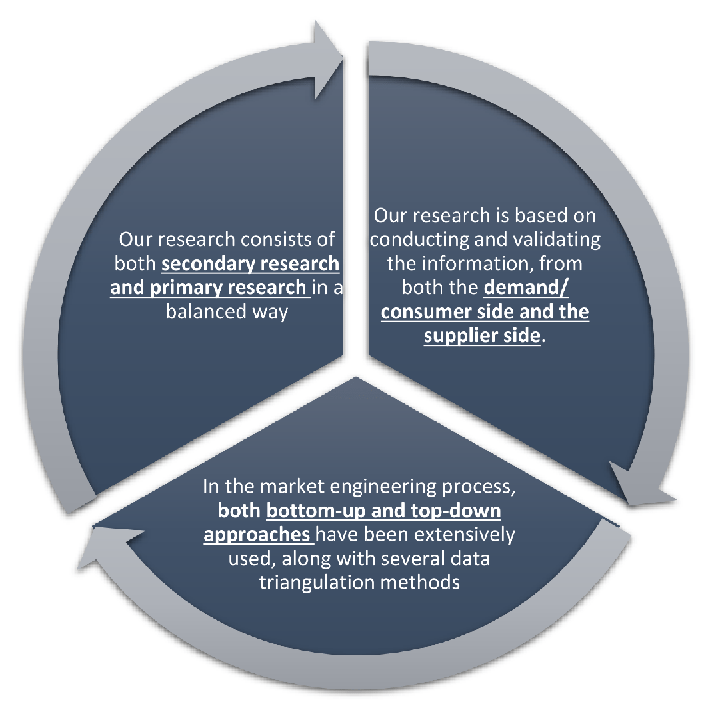
Research Design
Our research design integrates both demand-side and supply-side analysis through a balanced combination of primary and secondary research methodologies. By utilizing both bottom-up and top-down approaches alongside rigorous data triangulation methods, we deliver robust market intelligence that supports strategic decision-making.
MarketGenics' comprehensive research design framework ensures the delivery of accurate, reliable, and actionable market intelligence. Through the integration of multiple research approaches, rigorous validation processes, and expert analysis, we provide our clients with the insights needed to make informed strategic decisions and capitalize on market opportunities.
MarketGenics leverages a dedicated industry panel of experts and a comprehensive suite of paid databases to effectively collect, consolidate, and analyze market intelligence.
Our approach has consistently proven to be reliable and effective in generating accurate market insights, identifying key industry trends, and uncovering emerging business opportunities.
Through both primary and secondary research, we capture and analyze critical company-level data such as manufacturing footprints, including technical centers, R&D facilities, sales offices, and headquarters.
Our expert panel further enhances our ability to estimate market size for specific brands based on validated field-level intelligence.
Our data mining techniques incorporate both parametric and non-parametric methods, allowing for structured data collection, sorting, processing, and cleaning.
Demand projections are derived from large-scale data sets analyzed through proprietary algorithms, culminating in robust and reliable market sizing.
Research Approach
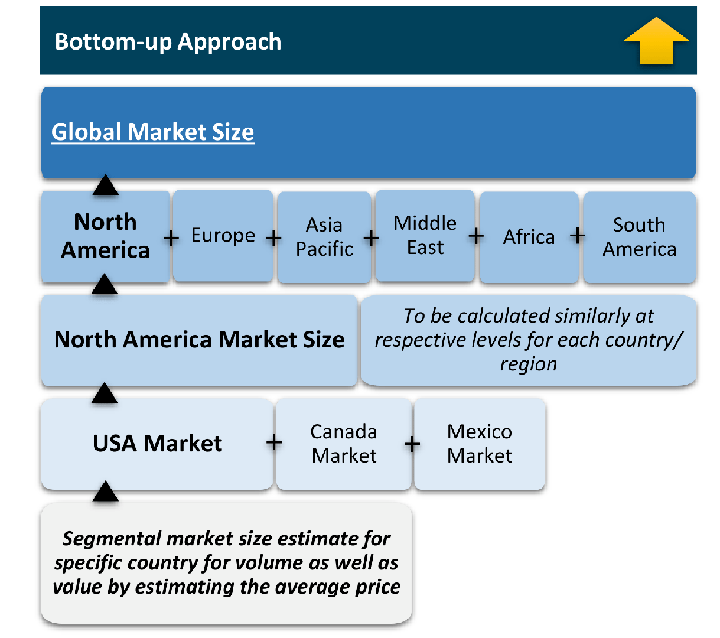
The bottom-up approach builds market estimates by starting with the smallest addressable market units and systematically aggregating them to create comprehensive market size projections.
This method begins with specific, granular data points and builds upward to create the complete market landscape.
Customer Analysis → Segmental Analysis → Geographical Analysis
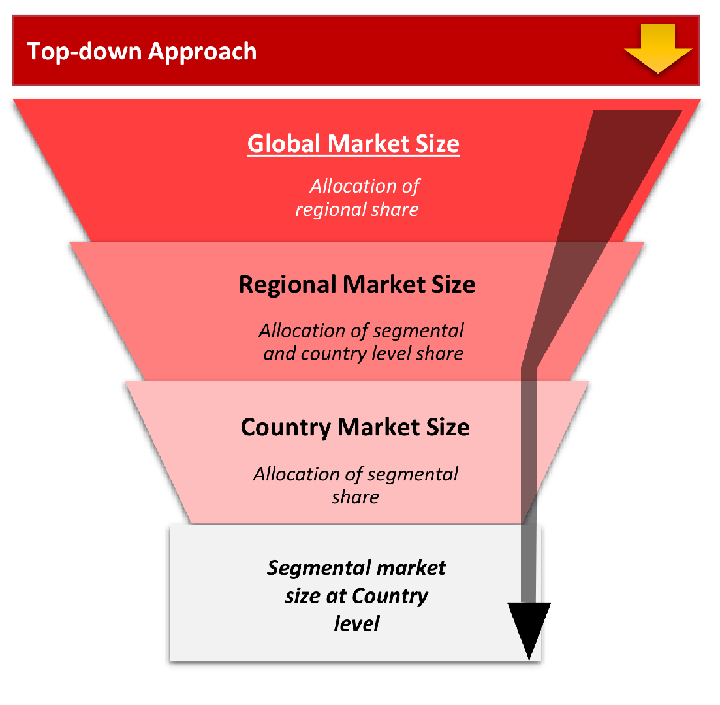
The top-down approach starts with the broadest possible market data and systematically narrows it down through a series of filters and assumptions to arrive at specific market segments or opportunities.
This method begins with the big picture and works downward to increasingly specific market slices.
TAM → SAM → SOM
Research Methods
Desk / Secondary Research
While analysing the market, we extensively study secondary sources, directories, and databases to identify and collect information useful for this technical, market-oriented, and commercial report. Secondary sources that we utilize are not only the public sources, but it is a combination of Open Source, Associations, Paid Databases, MG Repository & Knowledgebase, and others.
- Company websites, annual reports, financial reports, broker reports, and investor presentations
- National government documents, statistical databases and reports
- News articles, press releases and web-casts specific to the companies operating in the market, Magazines, reports, and others
- We gather information from commercial data sources for deriving company specific data such as segmental revenue, share for geography, product revenue, and others
- Internal and external proprietary databases (industry-specific), relevant patent, and regulatory databases
- Governing Bodies, Government Organizations
- Relevant Authorities, Country-specific Associations for Industries
We also employ the model mapping approach to estimate the product level market data through the players' product portfolio
Primary Research
Primary research/ interviews is vital in analyzing the market. Most of the cases involves paid primary interviews. Primary sources include primary interviews through e-mail interactions, telephonic interviews, surveys as well as face-to-face interviews with the different stakeholders across the value chain including several industry experts.
| Type of Respondents | Number of Primaries |
|---|---|
| Tier 2/3 Suppliers | ~20 |
| Tier 1 Suppliers | ~25 |
| End-users | ~25 |
| Industry Expert/ Panel/ Consultant | ~30 |
| Total | ~100 |
MG Knowledgebase
• Repository of industry blog, newsletter and case studies
• Online platform covering detailed market reports, and company profiles
Forecasting Factors and Models
Forecasting Factors
- Historical Trends – Past market patterns, cycles, and major events that shaped how markets behave over time. Understanding past trends helps predict future behavior.
- Industry Factors – Specific characteristics of the industry like structure, regulations, and innovation cycles that affect market dynamics.
- Macroeconomic Factors – Economic conditions like GDP growth, inflation, and employment rates that affect how much money people have to spend.
- Demographic Factors – Population characteristics like age, income, and location that determine who can buy your product.
- Technology Factors – How quickly people adopt new technology and how much technology infrastructure exists.
- Regulatory Factors – Government rules, laws, and policies that can help or restrict market growth.
- Competitive Factors – Analyzing competition structure such as degree of competition and bargaining power of buyers and suppliers.
Forecasting Models / Techniques
Multiple Regression Analysis
- Identify and quantify factors that drive market changes
- Statistical modeling to establish relationships between market drivers and outcomes
Time Series Analysis – Seasonal Patterns
- Understand regular cyclical patterns in market demand
- Advanced statistical techniques to separate trend, seasonal, and irregular components
Time Series Analysis – Trend Analysis
- Identify underlying market growth patterns and momentum
- Statistical analysis of historical data to project future trends
Expert Opinion – Expert Interviews
- Gather deep industry insights and contextual understanding
- In-depth interviews with key industry stakeholders
Multi-Scenario Development
- Prepare for uncertainty by modeling different possible futures
- Creating optimistic, pessimistic, and most likely scenarios
Time Series Analysis – Moving Averages
- Sophisticated forecasting for complex time series data
- Auto-regressive integrated moving average models with seasonal components
Econometric Models
- Apply economic theory to market forecasting
- Sophisticated economic models that account for market interactions
Expert Opinion – Delphi Method
- Harness collective wisdom of industry experts
- Structured, multi-round expert consultation process
Monte Carlo Simulation
- Quantify uncertainty and probability distributions
- Thousands of simulations with varying input parameters
Research Analysis
Our research framework is built upon the fundamental principle of validating market intelligence from both demand and supply perspectives. This dual-sided approach ensures comprehensive market understanding and reduces the risk of single-source bias.
Demand-Side Analysis: We understand end-user/application behavior, preferences, and market needs along with the penetration of the product for specific application.
Supply-Side Analysis: We estimate overall market revenue, analyze the segmental share along with industry capacity, competitive landscape, and market structure.
Validation & Evaluation
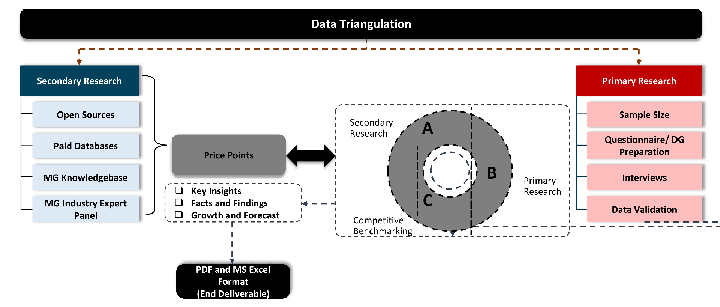
Data triangulation is a validation technique that uses multiple methods, sources, or perspectives to examine the same research question, thereby increasing the credibility and reliability of research findings. In market research, triangulation serves as a quality assurance mechanism that helps identify and minimize bias, validate assumptions, and ensure accuracy in market estimates.
- Data Source Triangulation – Using multiple data sources to examine the same phenomenon
- Methodological Triangulation – Using multiple research methods to study the same research question
- Investigator Triangulation – Using multiple researchers or analysts to examine the same data
- Theoretical Triangulation – Using multiple theoretical perspectives to interpret the same data
Custom Market Research Services
We will customise the research for you, in case the report listed above does not meet your requirements.
Get 10% Free Customisation