Pharmaceutical Blister Packaging Market Size, Share & Trends Analysis Report by Material Type (Plastic Films, Aluminum Foil, Paper & Paperboard, Other Material Type), Product Type, Technology/Process Type, Machine Type, Rated Capacity (Blisters per Minute), Pack Size, Blister Configuration, Drug Form, Distribution Channel, End-use Applications, and Geography (North America, Europe, Asia Pacific, Middle East, Africa, and South America) – Global Industry Data, Trends, and Forecasts, 2026–2035
|
|
|
Segmental Data Insights |
|
|
Demand Trends |
|
|
Competitive Landscape |
|
|
Strategic Development |
|
|
Future Outlook & Opportunities |
|
Pharmaceutical-Blister-Packaging-Market Size, Share, and Growth
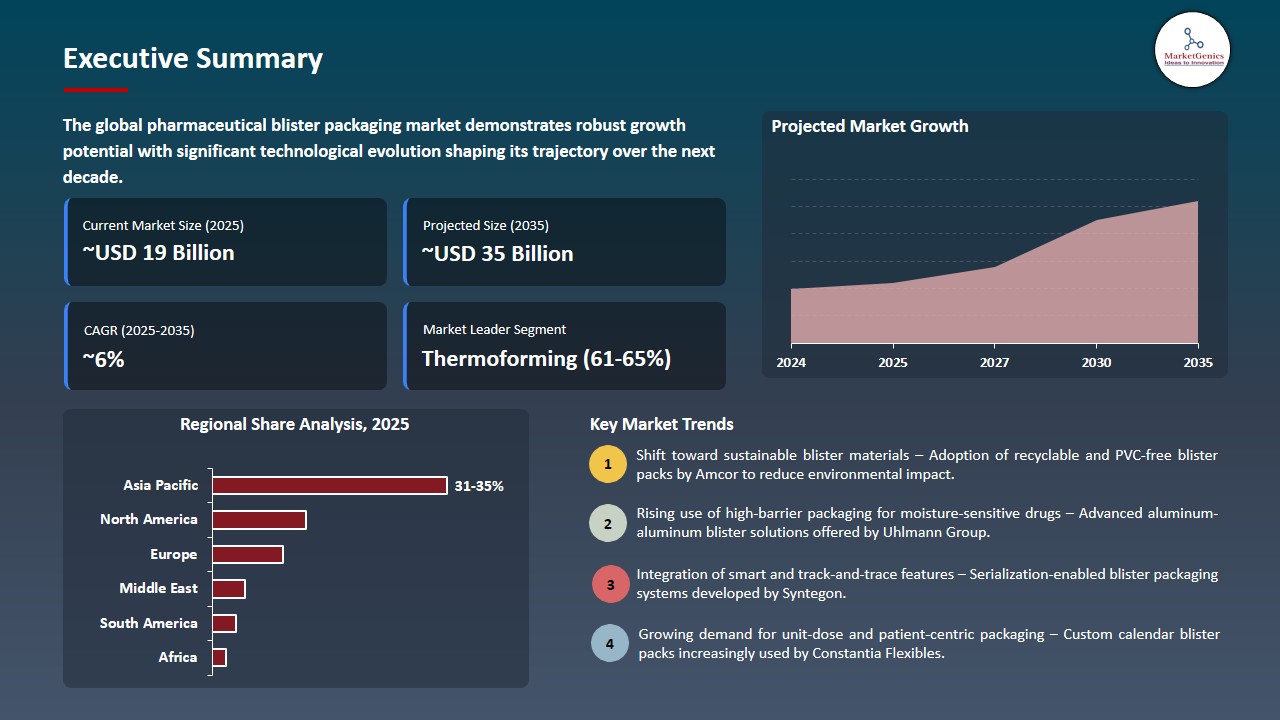
The global pharmaceutical blister packaging market is experiencing robust growth, with its estimated value of USD 19.2 billion in the year 2025 and USD 34.7 billion by the period 2035, registering a CAGR of 6.1%, during the forecast period. The global pharmaceutical blister packaging market is being driven by the growing needs of safe and tamper evident, and dosage accurate packaging of prescription drugs and assorted OTC drugs.
Dr. Carsten Heldmann, CEO of Liveo Research, said, With the introduction of our PET One-Material Blister into Bayer’s Aleve product range, we’ve proven that more sustainable blister packaging is possible on a large, global scale. Waste and CO₂ can already be saved today. As a specialized pharmaceutical packaging company, we will continue to support this industry to deliver their sustainability targets while complying with the strict regulatory requirements.
Beyond the conventional solid-dose protection, the pharmaceutical blister packaging market is now venturing into the high-value, stability-sensitive drug products, including oncology pills, hormone doses, pediatric doses and moisture-sensitive nutraceuticals. The high rate of urban healthcare access, telepharmacy and e-prescription fulfilment requirements are accelerating the need of long shelf life, error-free dosing, and tamper-resistant unit formulations.
The emphasis made by manufacturers on product integrity, contamination prevention, and protection against counterfeiting is being increasingly stressed on the pharmaceutical supply chain. This is increasing the use of high-barrier blister format on sensitive drugs, chronic therapy as well as specialty formulations. Furthermore, to minimize cold-chain infrastructure manufacturers are using high-barrier cold-form blisters, thermoform films with no PVC and ultra-low WVTR laminates protecting drug integrity during long-distances distribution.
The products are centered on the functional materials, barrier engineering and sustainable blister structures. The solution to this is to strike a balance between regulatory quality and ESG quality by moving to recyclable mono material films, thinner aluminum cavities, and hybrid paper-polymer lidstock that does not compromise on moisture or oxygen shielding. These newer blister forms are currently being customization over a broad spectrum of drugs ranging between prescription generic drugs and high-strength medications that ensure the safety of delivery, comfort of patients and storage stability without affecting the dosage.
The pharmaceutical blister packaging market is developing into a networked system of packaging with the emergence of digitalization and intelligent pharmaceutical logistics. The addition of serialization, QR-linked traceability, IoT-supported temperature control, and AI-enhanced inspection are improving the visibility of the supply-chain and minimizing the risk of counterfeit and spoilage. Such digital capabilities coupled with sustainable material platforms are enhancing patient trust, brand protection, and expansion in the market over the long term in both developed and emerging healthcare economies.
Pharmaceutical Blister Packaging Market Dynamics and Trends
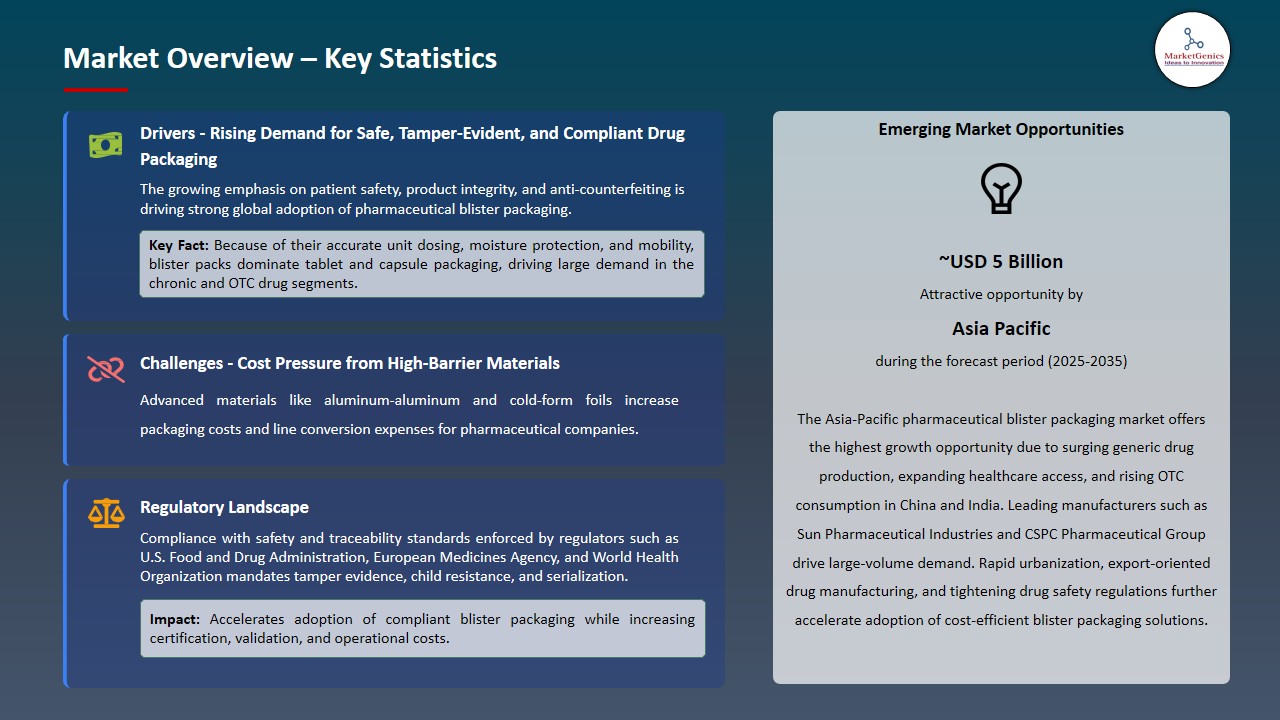
Driver: Rising Demand for Safe and Compliant Drug Packaging
-
The pharmaceutical blister packaging market is growing due to the increased manufacturing of biologics, specialty injectable and advanced vaccinations. To ensure the efficacy, adherence to regulations, and patient safety, temperature-sensitive products should be provided with the same protection. At the same time, there is an increase in the number of shipments in the world of perishable foods, expensive dairy, and meat products, which implies the necessity of high-quality packaging maintaining the integrity of the product during the extensive transportation of goods.
- Manufacturers are upgrading what they offer to these demands. For instance, in December 2025, TekniPlex Healthcare, increased its injection-blow molded bottle and blown-film production at PharmaPack Europe, which will produce sustainable and barrier-coated blister films to enhance the protection of its products. Also, CSafe introduced its silverskin RE thermal reusable Silverskin RE cover, which further improves temperature control during pharmaceutical shipments and allows sustainable reuse. These solutions show the increased attention to safe, compliant, and ecologically-friendly packaging solutions.
- High-performance, reliable and sustainable packaging has become a strategic demand, which is propelling the pharmaceutical blister packaging market to continue growing.
Restraint: High Raw Material and Compliance Costs
-
• The pharmaceutical blister packaging market faces significant cost pressure due to the high cost of specialty materials such as PVC, PVDC, and aluminum foils, as well as high-tech barrier films required for product stability, shelf-life, and regulatory compliance. The adoption of child-resistant and tamper-evident characteristics, as well as track and trace, increases production costs even further.
- Small and medium-sized pharmaceutical producers may struggle to afford these initial expenditures, necessitating outsourcing to contract packaging businesses. Similarly, additional financial pressures include shipping costs and regulatory compliance. Temperature-sensitive medicines and biologics require particular storage and transit conditions, as well as continuous quality inspections.
- Regular regulatory audits and new blister line validation include ancillary costs that may be prohibitive for a company looking to enter the market quickly. Product recalls, insurance claims, and regulatory fines might result from quality failures or temperature variations.
- All of these combined considerations make high material, production, and compliance costs a major impediment to pharmaceutical blister packaging market expansion around the world.
Opportunity: Growth of Personalized and Patient-Centric Packaging
-
The pharmaceutical blister packaging market is starting to prioritize personalized and patient-centric packaging that improves adherence, accuracy in dosing, safety, and patient experience in general. Pharmaceutical manufacturers are investing in unit dose blisters, modular packs, intelligent labeling and ergonomic design which enhance usability and as well as guarantee regulatory compliance and product protection.
- Manufacturers are adapting to changing expectations by integrating digital capabilities and smart packaging. For example, during CPhI in October 2025, Amcor displayed mono-PE blister systems and patient-focused closures that were more usable, sustainable, and regulatory compliant.
- These improvements reflect an industry trend that prioritizes patient convenience and environmental responsibility, and it is clear that packaging adds to therapeutic outcomes as well as market distinctiveness. New technologies such as connected packaging, adherence monitoring, and serialization provide real-time package tracking, reminders, and patient engagement.
- Patient-centered solutions improve treatment outcomes, increase brand loyalty, and offer new revenue streams, driving worldwide industry growth.
Key Trend: Adoption of Smart Packaging with IoT‑Enabled Temperature Monitoring
-
Pharmaceutical blister packaging is becoming more and more enthusiastic about using smart blister and intelligent packaging solutions to track the storage and transit conditions in real-time. Cold-chain compliance, product integrity, and patient safety are provided with the help of the IoT-enabled sensors, RFID/NFC tags, and time-temperature indicators (TTIs). Biologics, vaccines, and temperature-sensitive pharmaceuticals are especially sensitive to such innovations where even slight differences can affect the effectiveness and compliance with regulations.
- Manufacturers are also ensuring that they add advanced analytics and monitoring systems on the packaging. For instance, in January 2025, Jimi IoT, launched its Attach-and-Go Cold Chain Solution that allows monitoring the temperature, humidity, positioning, and door status in transit in real-time. This enables supply chain managers to detect the deviations early enough, streamline delivery routes, reduce spoilage of the products and improve operational efficiency.
- Smart packaging with IoT technology is a key differentiator in the pharmaceutical blister packaging market. It improves supply chain visibility, traceability, regulatory compliance, brand loyalty, and reduces losses due to temperature fluctuations.
Pharmaceutical-Blister-Packaging-Market Analysis and Segmental Data
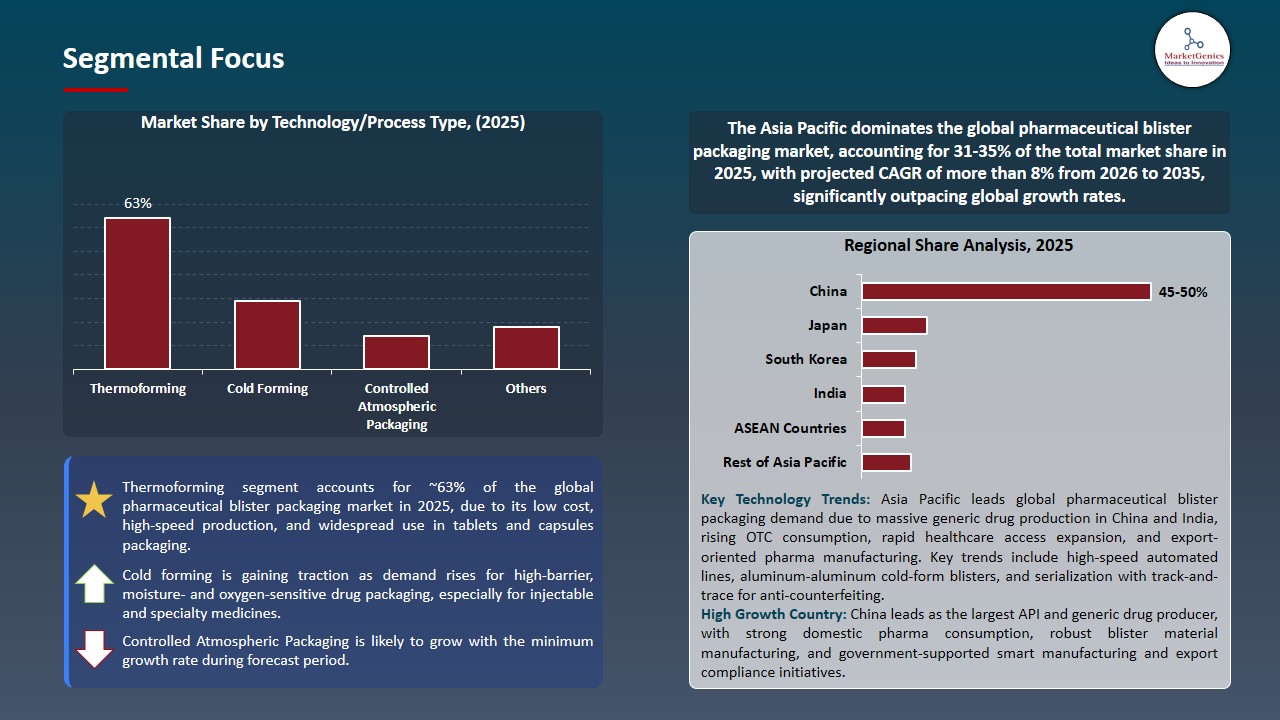
Thermoforming Dominate Global Pharmaceutical Blister Packaging Market
-
Thermoforming dominates the pharmaceutical blister packaging market due to its ability to offer high volume efficiency, the ability to work with multiple types of film substrates, and reduced tooling costs. Its capability in manufacturing stable, compliant and scalable blister packs that deliver the oral solid dosage form makes it the choice of pharmaceutical manufactures across the globe.
- Packaging makers and suppliers strive to meet compliance, environmental, and operational efficiency standards. Pharmaworks, for example, announced in April 2024 that their blister-packaging equipment could now be used with 100 percent recyclable mono-material films (mono-base + mono-lid), allowing pharmaceutical manufacturers to transition to sustainable and eco-friendly thermoformed blister packs without purchasing new equipment or compromising barrier properties or regulatory compliance.
- Thermoforming is widely used for pharmaceutical blister packaging due to its reliability, speed, and material flexibility. Its performance, low cost, and ability to combine sustainable and regulatory-compliant materials continue to drive its market leadership in both branded and generic medications.
Asia Pacific Leads Global Pharmaceutical Blister Packaging Market Demand
-
Asia-Pacific leads the pharmaceutical blister packaging market as biopharma manufacturing has been growing, generics and biologics have been growing, and the domestic and export demand of temperature-sensitive pharmaceuticals, vaccines and over the counter drugs have been rising. The growth is being sustained by countries like India, China and Indonesia through massive production plants and low cost manufacturing model.
- Manufacturers and packaging suppliers are developing to respond to APAC needs of regulatory compliance, efficiency, and sustainability. For instance, in April 2025, Uhlmann Pac-Systeme GmbH expanded and established a new branch in Jakarta, Indonesia, and established a local presence to serve pharmaceutical production in the region. The company also promoted its high-efficiency, ECO 350 blister line, which can produce up to 450 blisters and 300 cartons per minute, to supply its supply-chain resilience in Southeast Asia.
- APAC also build upon regional supply chains by investing in digital quality control, serialization-ready supply chains, high-volume, low-cost, and regulatory-compliant blister-packaging globally.
Pharmaceutical-Blister-Packaging-Market Ecosystem
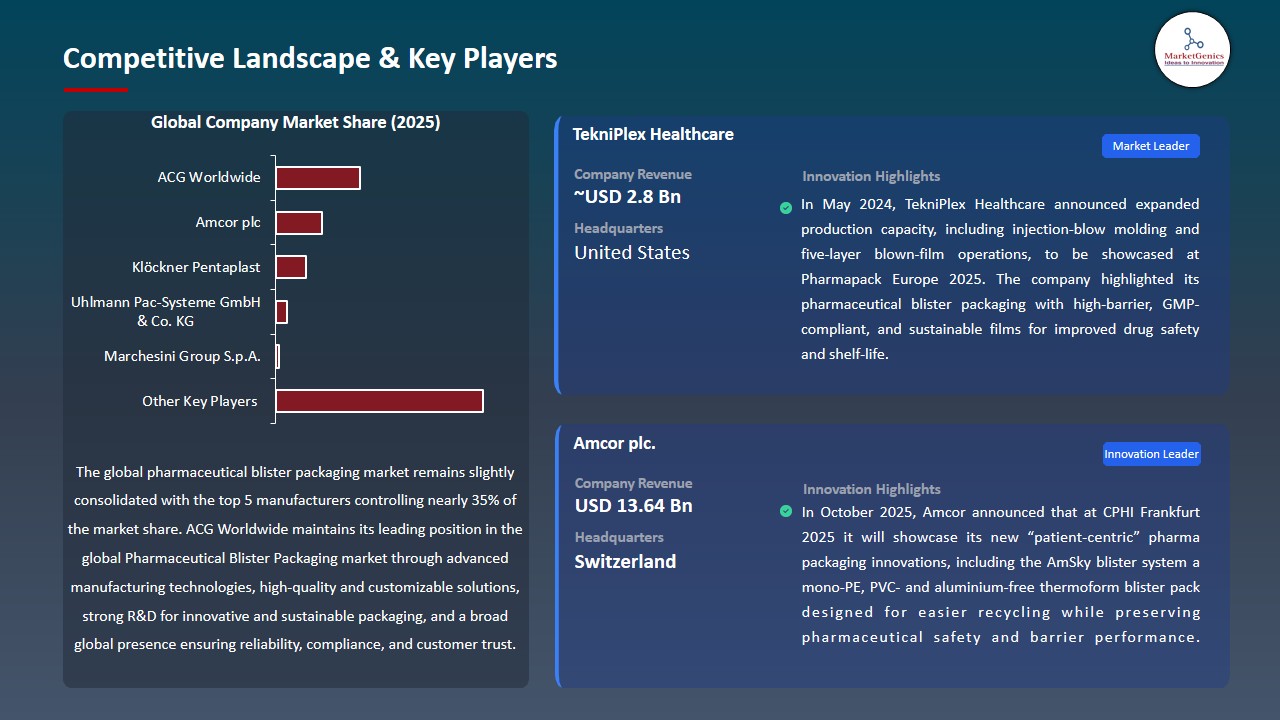
The pharmaceutical blistering packaging market is a slightly consolidated, and multinationally-converters of packaging and high-precision machinery manufacturers contribute to the creation of the competitive force collectively. The main players like ACG Worldwide, Amcor plc, Klockner Pentaplast, Uhlmann pac systeme GmbH Co. Kirk and Marchesini Group S.p.A dominate with developed blister films, cold-form foils, and fully automated high-speed blister packaging lines.
The presence in their smart and sustainable packaging solutions, global manufacturing and knowledge in regulation gives them good competitive differentiation. Value chain encompasses suppliers of polymers and aluminum foils, manufacturers of blister films and lidding, machinery and automation suppliers, owners of pharmaceutical brand, and distributors at the downstream.
Mono-material recyclable blisters, digital printing, serialization, track-and-trace systems, and smart compliance packaging are increasing the strength of the ecosystem. The major companies have been targeted to vertical integration, sustainable material innovation, robotics-based automation, and data-enabled quality surveillance to achieve efficiency, strict regulatory requirements, and large-scale pharmaceutical manufacturing across the planet.
Recent Development and Strategic Overview
-
In October 2024, Bayer, together with Liveo Research, introduced an industry first one-material PET blister package with Aleve to enhance the recyclability process. The new mono-material blister cuts carbon footprint by 38 per cent, and water usage and material weight by far, and it has been a significant breakthrough in sustainability in the pharmaceutical packaging.
- In February 2025, Uhlmann Pac -Systeme, in partnership with ETIMEX Primary Packaging and others, released the successful cooperation of recyclable PP blister packs. The project demonstrated how sustainability of mono-material blisters can be achieved to satisfy pharmaceutical barrier and machine-run performances.
Report Scope
|
Detail |
|
|
Market Size in 2025 |
USD 19.2 Bn |
|
Market Forecast Value in 2035 |
USD 34.7 Bn |
|
Growth Rate (CAGR) |
6.1% |
|
Forecast Period |
2026 – 2035 |
|
Historical Data Available for |
2021 – 2024 |
|
Market Size Units |
US$ Billion for Value |
|
Report Format |
Electronic (PDF) + Excel |
|
North America |
Europe |
Asia Pacific |
Middle East |
Africa |
South America |
|
|
|
|
|
|
|
Companies Covered |
|||||
|
|
|
|
|
|
Pharmaceutical-Blister-Packaging-Market Segmentation and Highlights
|
Segment |
Sub-segment |
|
Pharmaceutical Blister Packaging Market, By Material Type |
|
|
Pharmaceutical Blister Packaging Market, By Product Type |
|
|
Pharmaceutical Blister Packaging Market, By Technology/Process Type |
|
|
Pharmaceutical Blister Packaging Market, By Machine Type |
|
|
Pharmaceutical Blister Packaging Market, By Rated Capacity (Blisters per Minute) |
|
|
Pharmaceutical Blister Packaging Market, By Pack Size |
|
|
Pharmaceutical Blister Packaging Market, By Blister Configuration |
|
|
Pharmaceutical Blister Packaging Market, By Drug Form |
|
|
Pharmaceutical Blister Packaging Market, By Distribution Channel |
|
|
Pharmaceutical Blister Packaging Market, By End-use Applications |
|
Frequently Asked Questions
Table of Contents
- 1. Research Methodology and Assumptions
- 1.1. Definitions
- 1.2. Research Design and Approach
- 1.3. Data Collection Methods
- 1.4. Base Estimates and Calculations
- 1.5. Forecasting Models
- 1.5.1. Key Forecast Factors & Impact Analysis
- 1.6. Secondary Research
- 1.6.1. Open Sources
- 1.6.2. Paid Databases
- 1.6.3. Associations
- 1.7. Primary Research
- 1.7.1. Primary Sources
- 1.7.2. Primary Interviews with Stakeholders across Ecosystem
- 2. Executive Summary
- 2.1. Global Pharmaceutical Blister Packaging Market Outlook
- 2.1.1. Pharmaceutical Blister Packaging Market Size Value (US$ Bn), and Forecasts, 2021-2035
- 2.1.2. Compounded Annual Growth Rate Analysis
- 2.1.3. Growth Opportunity Analysis
- 2.1.4. Segmental Share Analysis
- 2.1.5. Geographical Share Analysis
- 2.2. Market Analysis and Facts
- 2.3. Supply-Demand Analysis
- 2.4. Competitive Benchmarking
- 2.5. Go-to- Market Strategy
- 2.5.1. Customer/ End-use Industry Assessment
- 2.5.2. Growth Opportunity Data, 2026-2035
- 2.5.2.1. Regional Data
- 2.5.2.2. Country Data
- 2.5.2.3. Segmental Data
- 2.5.3. Identification of Potential Market Spaces
- 2.5.4. GAP Analysis
- 2.5.5. Potential Attractive Price Points
- 2.5.6. Prevailing Market Risks & Challenges
- 2.5.7. Preferred Sales & Marketing Strategies
- 2.5.8. Key Recommendations and Analysis
- 2.5.9. A Way Forward
- 2.1. Global Pharmaceutical Blister Packaging Market Outlook
- 3. Industry Data and Premium Insights
- 3.1. Global Packaging Industry Overview, 2025
- 3.1.1. Packaging Industry Ecosystem Analysis
- 3.1.2. Key Trends for Packaging Industry
- 3.1.3. Regional Distribution for Packaging Industry
- 3.2. Supplier Customer Data
- 3.3. Technology Roadmap and Developments
- 3.4. Trade Analysis
- 3.4.1. Import & Export Analysis, 2025
- 3.4.2. Top Importing Countries
- 3.4.3. Top Exporting Countries
- 3.5. Trump Tariff Impact Analysis
- 3.5.1. Manufacturer
- 3.5.1.1. Based on the component & Raw material
- 3.5.2. Supply Chain
- 3.5.3. End Consumer
- 3.5.1. Manufacturer
- 3.6. Raw Material Analysis
- 3.1. Global Packaging Industry Overview, 2025
- 4. Market Overview
- 4.1. Market Dynamics
- 4.1.1. Drivers
- 4.1.1.1. Growing demand for oral solid-dose medicines and rising chronic disease burden.
- 4.1.1.2. Stringent regulatory/safety requirements (tamper-evidence, serialization, dose accuracy).
- 4.1.1.3. Technological advances (automated blistering, high-barrier films, smart/serialized packaging).
- 4.1.2. Restraints
- 4.1.2.1. High capital expenditure for blistering lines, tooling and validation.
- 4.1.2.2. Environmental concerns and shift toward sustainable/flexible packaging alternatives.
- 4.1.1. Drivers
- 4.2. Key Trend Analysis
- 4.3. Regulatory Framework
- 4.3.1. Key Regulations, Norms, and Subsidies, by Key Countries
- 4.3.2. Tariffs and Standards
- 4.3.3. Impact Analysis of Regulations on the Market
- 4.4. Value Chain Analysis
- 4.4.1. Raw Material Suppliers
- 4.4.2. Manufacturing
- 4.4.3. Distribution
- 4.4.4. End-Use
- 4.5. Porter’s Five Forces Analysis
- 4.6. PESTEL Analysis
- 4.7. Global Pharmaceutical Blister Packaging Market Demand
- 4.7.1. Historical Market Size – Value (US$ Bn), 2020-2024
- 4.7.2. Current and Future Market Size – Value (US$ Bn), 2026–2035
- 4.7.2.1. Y-o-Y Growth Trends
- 4.7.2.2. Absolute $ Opportunity Assessment
- 4.1. Market Dynamics
- 5. Competition Landscape
- 5.1. Competition structure
- 5.1.1. Fragmented v/s consolidated
- 5.2. Company Share Analysis, 2025
- 5.2.1. Global Company Market Share
- 5.2.2. By Region
- 5.2.2.1. North America
- 5.2.2.2. Europe
- 5.2.2.3. Asia Pacific
- 5.2.2.4. Middle East
- 5.2.2.5. Africa
- 5.2.2.6. South America
- 5.3. Product Comparison Matrix
- 5.3.1. Specifications
- 5.3.2. Market Positioning
- 5.3.3. Pricing
- 5.1. Competition structure
- 6. Global Pharmaceutical Blister Packaging Market Analysis, by Material Type
- 6.1. Key Segment Analysis
- 6.2. Pharmaceutical Blister Packaging Market Size Value (US$ Bn), Analysis, and Forecasts, by Material Type, 2021-2035
- 6.2.1. Plastic Films
- 6.2.1.1. PVC (Polyvinyl Chloride)
- 6.2.1.2. PVDC (Polyvinylidene Chloride)
- 6.2.1.3. Aclar (PCTFE)
- 6.2.1.4. PET (Polyethylene Terephthalate)
- 6.2.1.5. PE (Polyethylene)
- 6.2.1.6. PP (Polypropylene)
- 6.2.1.7. Others
- 6.2.2. Aluminum Foil
- 6.2.2.1. Push-through Aluminum Foil
- 6.2.2.2. Child-resistant Aluminum Foil
- 6.2.2.3. Tropical Aluminum Foil
- 6.2.2.4. Others
- 6.2.3. Paper & Paperboard
- 6.2.4. Other Material Type
- 6.2.1. Plastic Films
- 7. Global Pharmaceutical Blister Packaging Market Analysis, by Product Type
- 7.1. Key Segment Analysis
- 7.2. Pharmaceutical Blister Packaging Market Size Value (US$ Bn), Analysis, and Forecasts, by Product Type, 2021-2035
- 7.2.1. Carded Blister
- 7.2.2. Clamshell Blister
- 7.2.3. Slide Blister
- 7.2.4. Mock Clamshell
- 7.2.5. Trapped Blister
- 7.2.6. Face Seal Blister
- 7.2.7. Others
- 8. Global Pharmaceutical Blister Packaging Market Analysis, by Technology/Process Type
- 8.1. Key Segment Analysis
- 8.2. Pharmaceutical Blister Packaging Market Size Value (US$ Bn), Analysis, and Forecasts, by Technology/Process Type, 2021-2035
- 8.2.1. Thermoforming
- 8.2.2. Cold Forming
- 8.2.3. Controlled Atmospheric Packaging
- 8.2.4. Others
- 9. Global Pharmaceutical Blister Packaging Market Analysis, by Machine Type
- 9.1. Key Segment Analysis
- 9.2. Pharmaceutical Blister Packaging Market Size Value (US$ Bn), Analysis, and Forecasts, by Machine Type, 2021-2035
- 9.2.1. Rotary Blister Packaging Machines
- 9.2.2. Flat-Bed Blister Packaging Machines
- 9.2.3. Continuous Motion Machines
- 9.2.4. Intermittent Motion Machines
- 9.2.5. Others
- 10. Global Pharmaceutical Blister Packaging Market Analysis, by Rated Capacity (Blisters per Minute)
- 10.1. Key Segment Analysis
- 10.2. Pharmaceutical Blister Packaging Market Size Value (US$ Bn), Analysis, and Forecasts, by Rated Capacity (Blisters per Minute), 2021-2035
- 10.2.1. Below 100 BPM
- 10.2.2. 100-300 BPM
- 10.2.3. 300-600 BPM
- 10.2.4. Above 600 BPM
- 11. Global Pharmaceutical Blister Packaging Market Analysis, by Pack Size
- 11.1. Key Segment Analysis
- 11.2. Pharmaceutical Blister Packaging Market Size Value (US$ Bn), Analysis, and Forecasts, by Pack Size, 2021-2035
- 11.2.1. Single-dose Blister
- 11.2.2. Multi-dose Blister
- 11.2.2.1. 7 Count
- 11.2.2.2. 10 Count
- 11.2.2.3. Custom Count
- 12. Global Pharmaceutical Blister Packaging Market Analysis, by Blister Configuration
- 12.1. Key Segment Analysis
- 12.2. Pharmaceutical Blister Packaging Market Size Value (US$ Bn), Analysis, and Forecasts, by Blister Configuration, 2021-2035
- 12.2.1. Single Cavity
- 12.2.2. Multi-Cavity
- 12.2.3. Unit Dose
- 12.2.4. Compliance Packaging
- 12.2.5. Peelable Blister
- 13. Global Pharmaceutical Blister Packaging Market Analysis, by Drug Form
- 13.1. Key Segment Analysis
- 13.2. Pharmaceutical Blister Packaging Market Size Value (US$ Bn), Analysis, and Forecasts, by Drug Form, 2021-2035
- 13.2.1. Tablets & Capsules
- 13.2.2. Lozenges
- 13.2.3. Medical Devices
- 13.2.4. Suppositories
- 13.2.5. Ampoules/Vials
- 13.2.6. Others
- 14. Global Pharmaceutical Blister Packaging Market Analysis, by Distribution Channel
- 14.1. Key Segment Analysis
- 14.2. Pharmaceutical Blister Packaging Market Size Value (US$ Bn), Analysis, and Forecasts, by Distribution Channel, 2021-2035
- 14.2.1. Direct Sales
- 14.2.2. Distributors
- 14.2.3. Online Channels
- 15. Global Pharmaceutical Blister Packaging Market Analysis, by End-use Applications
- 15.1. Key Segment Analysis
- 15.2. Pharmaceutical Blister Packaging Market Size Value (US$ Bn), Analysis, and Forecasts, by End-use Applications, 2021-2035
- 15.2.1. Pharmaceutical Manufacturing Companies
- 15.2.1.1. Prescription Drugs Packaging
- 15.2.1.2. Over-the-Counter (OTC) Drugs Packaging
- 15.2.1.3. Generic Drugs Packaging
- 15.2.1.4. Branded Drugs Packaging
- 15.2.1.5. Veterinary Drugs Packaging
- 15.2.1.6. Others
- 15.2.2. Contract Packaging Organizations
- 15.2.2.1. Clinical Trial Packaging
- 15.2.2.2. Commercial Packaging Services
- 15.2.2.3. Re-packaging Services
- 15.2.2.4. Serialization Services
- 15.2.2.5. Temperature-controlled Packaging
- 15.2.2.6. Others
- 15.2.3. Hospital & Retail Pharmacies
- 15.2.3.1. Unit Dose Packaging
- 15.2.3.2. Patient-specific Packaging
- 15.2.3.3. Compliance Packaging
- 15.2.3.4. Dispensing Packaging
- 15.2.3.5. Institutional Packaging
- 15.2.3.6. Others
- 15.2.4. Nutraceutical & Dietary Supplement Manufacturers
- 15.2.4.1. Vitamin Packaging
- 15.2.4.2. Mineral Supplement Packaging
- 15.2.4.3. Herbal Supplement Packaging
- 15.2.4.4. Probiotic Packaging
- 15.2.4.5. Sports Nutrition Packaging
- 15.2.4.6. Others
- 15.2.5. Biotechnology Companies
- 15.2.5.1. Biologic Drugs Packaging
- 15.2.5.2. Biosimilar Packaging
- 15.2.5.3. Specialty Therapeutics Packaging
- 15.2.5.4. Personalized Medicine Packaging
- 15.2.5.5. Others
- 15.2.6. Medical Device Manufacturers
- 15.2.6.1. Surgical Instrument Packaging
- 15.2.6.2. Diagnostic Device Packaging
- 15.2.6.3. Implantable Device Packaging
- 15.2.6.4. Disposable Medical Device Packaging
- 15.2.6.5. Others
- 15.2.1. Pharmaceutical Manufacturing Companies
- 16. Global Pharmaceutical Blister Packaging Market Analysis and Forecasts, by Region
- 16.1. Key Findings
- 16.2. Pharmaceutical Blister Packaging Market Size Value (US$ Bn), Analysis, and Forecasts, by Region, 2021-2035
- 16.2.1. North America
- 16.2.2. Europe
- 16.2.3. Asia Pacific
- 16.2.4. Middle East
- 16.2.5. Africa
- 16.2.6. South America
- 17. North America Pharmaceutical Blister Packaging Market Analysis
- 17.1. Key Segment Analysis
- 17.2. Regional Snapshot
- 17.3. North America Pharmaceutical Blister Packaging Market Size- Value (US$ Bn), Analysis, and Forecasts, 2021-2035
- 17.3.1. Material Type
- 17.3.2. Product Type
- 17.3.3. Technology/Process Type
- 17.3.4. Machine Type
- 17.3.5. Pack Size
- 17.3.6. Blister Configuration
- 17.3.7. Drug Form
- 17.3.8. Distribution Channel
- 17.3.9. End-use Applications
- 17.3.10. Country
- 17.3.10.1. USA
- 17.3.10.2. Canada
- 17.3.10.3. Mexico
- 17.4. USA Pharmaceutical Blister Packaging Market
- 17.4.1. Country Segmental Analysis
- 17.4.2. Material Type
- 17.4.3. Product Type
- 17.4.4. Technology/Process Type
- 17.4.5. Machine Type
- 17.4.6. Pack Size
- 17.4.7. Blister Configuration
- 17.4.8. Drug Form
- 17.4.9. Distribution Channel
- 17.4.10. End-use Applications
- 17.5. Canada Pharmaceutical Blister Packaging Market
- 17.5.1. Country Segmental Analysis
- 17.5.2. Material Type
- 17.5.3. Product Type
- 17.5.4. Technology/Process Type
- 17.5.5. Machine Type
- 17.5.6. Pack Size
- 17.5.7. Blister Configuration
- 17.5.8. Drug Form
- 17.5.9. Distribution Channel
- 17.5.10. End-use Applications
- 17.6. Mexico Pharmaceutical Blister Packaging Market
- 17.6.1. Country Segmental Analysis
- 17.6.2. Material Type
- 17.6.3. Product Type
- 17.6.4. Technology/Process Type
- 17.6.5. Machine Type
- 17.6.6. Pack Size
- 17.6.7. Blister Configuration
- 17.6.8. Drug Form
- 17.6.9. Distribution Channel
- 17.6.10. End-use Applications
- 18. Europe Pharmaceutical Blister Packaging Market Analysis
- 18.1. Key Segment Analysis
- 18.2. Regional Snapshot
- 18.3. Europe Pharmaceutical Blister Packaging Market Size Value (US$ Bn), Analysis, and Forecasts, 2021-2035
- 18.3.1. Material Type
- 18.3.2. Product Type
- 18.3.3. Technology/Process Type
- 18.3.4. Machine Type
- 18.3.5. Pack Size
- 18.3.6. Blister Configuration
- 18.3.7. Drug Form
- 18.3.8. Distribution Channel
- 18.3.9. End-use Applications
- 18.3.10. Country
- 18.3.10.1. Germany
- 18.3.10.2. United Kingdom
- 18.3.10.3. France
- 18.3.10.4. Italy
- 18.3.10.5. Spain
- 18.3.10.6. Netherlands
- 18.3.10.7. Nordic Countries
- 18.3.10.8. Poland
- 18.3.10.9. Russia & CIS
- 18.3.10.10. Rest of Europe
- 18.4. Germany Pharmaceutical Blister Packaging Market
- 18.4.1. Country Segmental Analysis
- 18.4.2. Material Type
- 18.4.3. Product Type
- 18.4.4. Technology/Process Type
- 18.4.5. Machine Type
- 18.4.6. Pack Size
- 18.4.7. Blister Configuration
- 18.4.8. Drug Form
- 18.4.9. Distribution Channel
- 18.4.10. End-use Applications
- 18.5. United Kingdom Pharmaceutical Blister Packaging Market
- 18.5.1. Country Segmental Analysis
- 18.5.2. Material Type
- 18.5.3. Product Type
- 18.5.4. Technology/Process Type
- 18.5.5. Machine Type
- 18.5.6. Pack Size
- 18.5.7. Blister Configuration
- 18.5.8. Drug Form
- 18.5.9. Distribution Channel
- 18.5.10. End-use Applications
- 18.6. France Pharmaceutical Blister Packaging Market
- 18.6.1. Country Segmental Analysis
- 18.6.2. Material Type
- 18.6.3. Product Type
- 18.6.4. Technology/Process Type
- 18.6.5. Machine Type
- 18.6.6. Pack Size
- 18.6.7. Blister Configuration
- 18.6.8. Drug Form
- 18.6.9. Distribution Channel
- 18.6.10. End-use Applications
- 18.7. Italy Pharmaceutical Blister Packaging Market
- 18.7.1. Country Segmental Analysis
- 18.7.2. Material Type
- 18.7.3. Product Type
- 18.7.4. Technology/Process Type
- 18.7.5. Machine Type
- 18.7.6. Pack Size
- 18.7.7. Blister Configuration
- 18.7.8. Drug Form
- 18.7.9. Distribution Channel
- 18.7.10. End-use Applications
- 18.8. Spain Pharmaceutical Blister Packaging Market
- 18.8.1. Country Segmental Analysis
- 18.8.2. Material Type
- 18.8.3. Product Type
- 18.8.4. Technology/Process Type
- 18.8.5. Machine Type
- 18.8.6. Pack Size
- 18.8.7. Blister Configuration
- 18.8.8. Drug Form
- 18.8.9. Distribution Channel
- 18.8.10. End-use Applications
- 18.9. Netherlands Pharmaceutical Blister Packaging Market
- 18.9.1. Country Segmental Analysis
- 18.9.2. Material Type
- 18.9.3. Product Type
- 18.9.4. Technology/Process Type
- 18.9.5. Machine Type
- 18.9.6. Pack Size
- 18.9.7. Blister Configuration
- 18.9.8. Drug Form
- 18.9.9. Distribution Channel
- 18.9.10. End-use Applications
- 18.10. Nordic Countries Pharmaceutical Blister Packaging Market
- 18.10.1. Country Segmental Analysis
- 18.10.2. Material Type
- 18.10.3. Product Type
- 18.10.4. Technology/Process Type
- 18.10.5. Machine Type
- 18.10.6. Pack Size
- 18.10.7. Blister Configuration
- 18.10.8. Drug Form
- 18.10.9. Distribution Channel
- 18.10.10. End-use Applications
- 18.11. Poland Pharmaceutical Blister Packaging Market
- 18.11.1. Country Segmental Analysis
- 18.11.2. Material Type
- 18.11.3. Product Type
- 18.11.4. Technology/Process Type
- 18.11.5. Machine Type
- 18.11.6. Pack Size
- 18.11.7. Blister Configuration
- 18.11.8. Drug Form
- 18.11.9. Distribution Channel
- 18.11.10. End-use Applications
- 18.12. Russia & CIS Pharmaceutical Blister Packaging Market
- 18.12.1. Country Segmental Analysis
- 18.12.2. Material Type
- 18.12.3. Product Type
- 18.12.4. Technology/Process Type
- 18.12.5. Machine Type
- 18.12.6. Pack Size
- 18.12.7. Blister Configuration
- 18.12.8. Drug Form
- 18.12.9. Distribution Channel
- 18.12.10. End-use Applications
- 18.13. Rest of Europe Pharmaceutical Blister Packaging Market
- 18.13.1. Country Segmental Analysis
- 18.13.2. Material Type
- 18.13.3. Product Type
- 18.13.4. Technology/Process Type
- 18.13.5. Machine Type
- 18.13.6. Pack Size
- 18.13.7. Blister Configuration
- 18.13.8. Drug Form
- 18.13.9. Distribution Channel
- 18.13.10. End-use Applications
- 19. Asia Pacific Pharmaceutical Blister Packaging Market Analysis
- 19.1. Key Segment Analysis
- 19.2. Regional Snapshot
- 19.3. Asia Pacific Pharmaceutical Blister Packaging Market Size Value (US$ Bn), Analysis, and Forecasts, 2021-2035
- 19.3.1. Material Type
- 19.3.2. Product Type
- 19.3.3. Technology/Process Type
- 19.3.4. Machine Type
- 19.3.5. Pack Size
- 19.3.6. Blister Configuration
- 19.3.7. Drug Form
- 19.3.8. Distribution Channel
- 19.3.9. End-use Applications
- 19.3.10. Country
- 19.3.10.1. China
- 19.3.10.2. India
- 19.3.10.3. Japan
- 19.3.10.4. South Korea
- 19.3.10.5. Australia and New Zealand
- 19.3.10.6. Indonesia
- 19.3.10.7. Malaysia
- 19.3.10.8. Thailand
- 19.3.10.9. Vietnam
- 19.3.10.10. Rest of Asia Pacific
- 19.4. China Pharmaceutical Blister Packaging Market
- 19.4.1. Country Segmental Analysis
- 19.4.2. Material Type
- 19.4.3. Product Type
- 19.4.4. Technology/Process Type
- 19.4.5. Machine Type
- 19.4.6. Pack Size
- 19.4.7. Blister Configuration
- 19.4.8. Drug Form
- 19.4.9. Distribution Channel
- 19.4.10. End-use Applications
- 19.5. India Pharmaceutical Blister Packaging Market
- 19.5.1. Country Segmental Analysis
- 19.5.2. Material Type
- 19.5.3. Product Type
- 19.5.4. Technology/Process Type
- 19.5.5. Machine Type
- 19.5.6. Pack Size
- 19.5.7. Blister Configuration
- 19.5.8. Drug Form
- 19.5.9. Distribution Channel
- 19.5.10. End-use Applications
- 19.6. Japan Pharmaceutical Blister Packaging Market
- 19.6.1. Country Segmental Analysis
- 19.6.2. Material Type
- 19.6.3. Product Type
- 19.6.4. Technology/Process Type
- 19.6.5. Machine Type
- 19.6.6. Pack Size
- 19.6.7. Blister Configuration
- 19.6.8. Drug Form
- 19.6.9. Distribution Channel
- 19.6.10. End-use Applications
- 19.7. South Korea Pharmaceutical Blister Packaging Market
- 19.7.1. Country Segmental Analysis
- 19.7.2. Material Type
- 19.7.3. Product Type
- 19.7.4. Technology/Process Type
- 19.7.5. Machine Type
- 19.7.6. Pack Size
- 19.7.7. Blister Configuration
- 19.7.8. Drug Form
- 19.7.9. Distribution Channel
- 19.7.10. End-use Applications
- 19.8. Australia and New Zealand Pharmaceutical Blister Packaging Market
- 19.8.1. Country Segmental Analysis
- 19.8.2. Material Type
- 19.8.3. Product Type
- 19.8.4. Technology/Process Type
- 19.8.5. Machine Type
- 19.8.6. Pack Size
- 19.8.7. Blister Configuration
- 19.8.8. Drug Form
- 19.8.9. Distribution Channel
- 19.8.10. End-use Applications
- 19.9. Indonesia Pharmaceutical Blister Packaging Market
- 19.9.1. Country Segmental Analysis
- 19.9.2. Material Type
- 19.9.3. Product Type
- 19.9.4. Technology/Process Type
- 19.9.5. Machine Type
- 19.9.6. Pack Size
- 19.9.7. Blister Configuration
- 19.9.8. Drug Form
- 19.9.9. Distribution Channel
- 19.9.10. End-use Applications
- 19.10. Malaysia Pharmaceutical Blister Packaging Market
- 19.10.1. Country Segmental Analysis
- 19.10.2. Material Type
- 19.10.3. Product Type
- 19.10.4. Technology/Process Type
- 19.10.5. Machine Type
- 19.10.6. Pack Size
- 19.10.7. Blister Configuration
- 19.10.8. Drug Form
- 19.10.9. Distribution Channel
- 19.10.10. End-use Applications
- 19.11. Thailand Pharmaceutical Blister Packaging Market
- 19.11.1. Country Segmental Analysis
- 19.11.2. Material Type
- 19.11.3. Product Type
- 19.11.4. Technology/Process Type
- 19.11.5. Machine Type
- 19.11.6. Pack Size
- 19.11.7. Blister Configuration
- 19.11.8. Drug Form
- 19.11.9. Distribution Channel
- 19.11.10. End-use Applications
- 19.12. Vietnam Pharmaceutical Blister Packaging Market
- 19.12.1. Country Segmental Analysis
- 19.12.2. Material Type
- 19.12.3. Product Type
- 19.12.4. Technology/Process Type
- 19.12.5. Machine Type
- 19.12.6. Pack Size
- 19.12.7. Blister Configuration
- 19.12.8. Drug Form
- 19.12.9. Distribution Channel
- 19.12.10. End-use Applications
- 19.13. Rest of Asia Pacific Pharmaceutical Blister Packaging Market
- 19.13.1. Country Segmental Analysis
- 19.13.2. Material Type
- 19.13.3. Product Type
- 19.13.4. Technology/Process Type
- 19.13.5. Machine Type
- 19.13.6. Pack Size
- 19.13.7. Blister Configuration
- 19.13.8. Drug Form
- 19.13.9. Distribution Channel
- 19.13.10. End-use Applications
- 20. Middle East Pharmaceutical Blister Packaging Market Analysis
- 20.1. Key Segment Analysis
- 20.2. Regional Snapshot
- 20.3. Middle East Pharmaceutical Blister Packaging Market Size Value (US$ Bn), Analysis, and Forecasts, 2021-2035
- 20.3.1. Material Type
- 20.3.2. Product Type
- 20.3.3. Technology/Process Type
- 20.3.4. Machine Type
- 20.3.5. Pack Size
- 20.3.6. Blister Configuration
- 20.3.7. Drug Form
- 20.3.8. Distribution Channel
- 20.3.9. End-use Applications
- 20.3.10. Country
- 20.3.10.1. Turkey
- 20.3.10.2. UAE
- 20.3.10.3. Saudi Arabia
- 20.3.10.4. Israel
- 20.3.10.5. Rest of Middle East
- 20.4. Turkey Pharmaceutical Blister Packaging Market
- 20.4.1. Country Segmental Analysis
- 20.4.2. Material Type
- 20.4.3. Product Type
- 20.4.4. Technology/Process Type
- 20.4.5. Machine Type
- 20.4.6. Pack Size
- 20.4.7. Blister Configuration
- 20.4.8. Drug Form
- 20.4.9. Distribution Channel
- 20.4.10. End-use Applications
- 20.5. UAE Pharmaceutical Blister Packaging Market
- 20.5.1. Country Segmental Analysis
- 20.5.2. Material Type
- 20.5.3. Product Type
- 20.5.4. Technology/Process Type
- 20.5.5. Machine Type
- 20.5.6. Pack Size
- 20.5.7. Blister Configuration
- 20.5.8. Drug Form
- 20.5.9. Distribution Channel
- 20.5.10. End-use Applications
- 20.6. Saudi Arabia Pharmaceutical Blister Packaging Market
- 20.6.1. Country Segmental Analysis
- 20.6.2. Material Type
- 20.6.3. Product Type
- 20.6.4. Technology/Process Type
- 20.6.5. Machine Type
- 20.6.6. Pack Size
- 20.6.7. Blister Configuration
- 20.6.8. Drug Form
- 20.6.9. Distribution Channel
- 20.6.10. End-use Applications
- 20.7. Israel Pharmaceutical Blister Packaging Market
- 20.7.1. Country Segmental Analysis
- 20.7.2. Material Type
- 20.7.3. Product Type
- 20.7.4. Technology/Process Type
- 20.7.5. Machine Type
- 20.7.6. Pack Size
- 20.7.7. Blister Configuration
- 20.7.8. Drug Form
- 20.7.9. Distribution Channel
- 20.7.10. End-use Applications
- 20.8. Rest of Middle East Pharmaceutical Blister Packaging Market
- 20.8.1. Country Segmental Analysis
- 20.8.2. Material Type
- 20.8.3. Product Type
- 20.8.4. Technology/Process Type
- 20.8.5. Machine Type
- 20.8.6. Pack Size
- 20.8.7. Blister Configuration
- 20.8.8. Drug Form
- 20.8.9. Distribution Channel
- 20.8.10. End-use Applications
- 21. Africa Pharmaceutical Blister Packaging Market Analysis
- 21.1. Key Segment Analysis
- 21.2. Regional Snapshot
- 21.3. Africa Pharmaceutical Blister Packaging Market Size Value (US$ Bn), Analysis, and Forecasts, 2021-2035
- 21.3.1. Material Type
- 21.3.2. Product Type
- 21.3.3. Technology/Process Type
- 21.3.4. Machine Type
- 21.3.5. Pack Size
- 21.3.6. Blister Configuration
- 21.3.7. Drug Form
- 21.3.8. Distribution Channel
- 21.3.9. End-use Applications
- 21.3.9.1. South Africa
- 21.3.9.2. Egypt
- 21.3.9.3. Nigeria
- 21.3.9.4. Algeria
- 21.3.9.5. Rest of Africa
- 21.4. South Africa Pharmaceutical Blister Packaging Market
- 21.4.1. Country Segmental Analysis
- 21.4.2. Material Type
- 21.4.3. Product Type
- 21.4.4. Technology/Process Type
- 21.4.5. Machine Type
- 21.4.6. Pack Size
- 21.4.7. Blister Configuration
- 21.4.8. Drug Form
- 21.4.9. Distribution Channel
- 21.4.10. End-use Applications
- 21.5. Egypt Pharmaceutical Blister Packaging Market
- 21.5.1. Country Segmental Analysis
- 21.5.2. Material Type
- 21.5.3. Product Type
- 21.5.4. Technology/Process Type
- 21.5.5. Machine Type
- 21.5.6. Pack Size
- 21.5.7. Blister Configuration
- 21.5.8. Drug Form
- 21.5.9. Distribution Channel
- 21.5.10. End-use Applications
- 21.6. Nigeria Pharmaceutical Blister Packaging Market
- 21.6.1. Country Segmental Analysis
- 21.6.2. Material Type
- 21.6.3. Product Type
- 21.6.4. Technology/Process Type
- 21.6.5. Machine Type
- 21.6.6. Pack Size
- 21.6.7. Blister Configuration
- 21.6.8. Drug Form
- 21.6.9. Distribution Channel
- 21.6.10. End-use Applications
- 21.7. Algeria Pharmaceutical Blister Packaging Market
- 21.7.1. Country Segmental Analysis
- 21.7.2. Material Type
- 21.7.3. Product Type
- 21.7.4. Technology/Process Type
- 21.7.5. Machine Type
- 21.7.6. Pack Size
- 21.7.7. Blister Configuration
- 21.7.8. Drug Form
- 21.7.9. Distribution Channel
- 21.7.10. End-use Applications
- 21.8. Rest of Africa Pharmaceutical Blister Packaging Market
- 21.8.1. Country Segmental Analysis
- 21.8.2. Material Type
- 21.8.3. Product Type
- 21.8.4. Technology/Process Type
- 21.8.5. Machine Type
- 21.8.6. Pack Size
- 21.8.7. Blister Configuration
- 21.8.8. Drug Form
- 21.8.9. Distribution Channel
- 21.8.10. End-use Applications
- 22. South America Pharmaceutical Blister Packaging Market Analysis
- 22.1. Key Segment Analysis
- 22.2. Regional Snapshot
- 22.3. South America Pharmaceutical Blister Packaging Market Size Value (US$ Bn), Analysis, and Forecasts, 2021-2035
- 22.3.1. Material Type
- 22.3.2. Product Type
- 22.3.3. Technology/Process Type
- 22.3.4. Machine Type
- 22.3.5. Pack Size
- 22.3.6. Blister Configuration
- 22.3.7. Drug Form
- 22.3.8. Distribution Channel
- 22.3.9. End-use Applications
- 22.3.10. Country
- 22.3.10.1. Brazil
- 22.3.10.2. Argentina
- 22.3.10.3. Rest of South America
- 22.4. Brazil Pharmaceutical Blister Packaging Market
- 22.4.1. Country Segmental Analysis
- 22.4.2. Material Type
- 22.4.3. Product Type
- 22.4.4. Technology/Process Type
- 22.4.5. Machine Type
- 22.4.6. Pack Size
- 22.4.7. Blister Configuration
- 22.4.8. Drug Form
- 22.4.9. Distribution Channel
- 22.4.10. End-use Applications
- 22.5. Argentina Pharmaceutical Blister Packaging Market
- 22.5.1. Country Segmental Analysis
- 22.5.2. Material Type
- 22.5.3. Product Type
- 22.5.4. Technology/Process Type
- 22.5.5. Machine Type
- 22.5.6. Pack Size
- 22.5.7. Blister Configuration
- 22.5.8. Drug Form
- 22.5.9. Distribution Channel
- 22.5.10. End-use Applications
- 22.6. Rest of South America Pharmaceutical Blister Packaging Market
- 22.6.1. Country Segmental Analysis
- 22.6.2. Material Type
- 22.6.3. Product Type
- 22.6.4. Technology/Process Type
- 22.6.5. Machine Type
- 22.6.6. Pack Size
- 22.6.7. Blister Configuration
- 22.6.8. Drug Form
- 22.6.9. Distribution Channel
- 22.6.10. End-use Applications
- 23. Key Players/ Company Profile
- 23.1. ACG Worldwide
- 23.1.1. Company Details/ Overview
- 23.1.2. Company Financials
- 23.1.3. Key Customers and Competitors
- 23.1.4. Business/ Industry Portfolio
- 23.1.5. Product Portfolio/ Specification Details
- 23.1.6. Pricing Data
- 23.1.7. Strategic Overview
- 23.1.8. Recent Developments
- 23.2. Algus Packaging Inc.
- 23.3. Amcor plc
- 23.4. Bausch + Ströbel
- 23.5. Bilcare Limited
- 23.6. Constantia Flexibles Group
- 23.7. Gerresheimer AG
- 23.8. Honeywell International Inc.
- 23.9. IMA Group
- 23.10. Klöckner Pentaplast
- 23.11. Körber AG
- 23.12. Marchesini Group S.p.A.
- 23.13. Multivac Group
- 23.14. Nipro Corporation
- 23.15. Pharma Packaging Solutions
- 23.16. Rollprint Packaging Products
- 23.17. Romaco Group
- 23.18. Schott AG
- 23.19. Sonoco Products Company
- 23.20. Tekni-Plex
- 23.21. Uhlmann Pac-Systeme GmbH & Co. KG
- 23.22. WestRock Company
- 23.23. Other Key Players
- 23.1. ACG Worldwide
Note* - This is just tentative list of players. While providing the report, we will cover more number of players based on their revenue and share for each geography
Research Design
Our research design integrates both demand-side and supply-side analysis through a balanced combination of primary and secondary research methodologies. By utilizing both bottom-up and top-down approaches alongside rigorous data triangulation methods, we deliver robust market intelligence that supports strategic decision-making.
MarketGenics' comprehensive research design framework ensures the delivery of accurate, reliable, and actionable market intelligence. Through the integration of multiple research approaches, rigorous validation processes, and expert analysis, we provide our clients with the insights needed to make informed strategic decisions and capitalize on market opportunities.
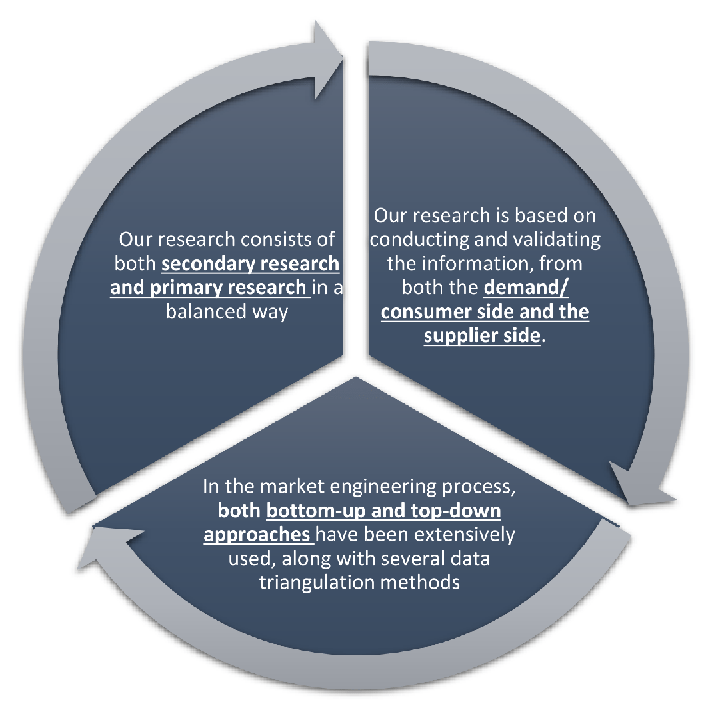
MarketGenics leverages a dedicated industry panel of experts and a comprehensive suite of paid databases to effectively collect, consolidate, and analyze market intelligence.
Our approach has consistently proven to be reliable and effective in generating accurate market insights, identifying key industry trends, and uncovering emerging business opportunities.
Through both primary and secondary research, we capture and analyze critical company-level data such as manufacturing footprints, including technical centers, R&D facilities, sales offices, and headquarters.
Our expert panel further enhances our ability to estimate market size for specific brands based on validated field-level intelligence.
Our data mining techniques incorporate both parametric and non-parametric methods, allowing for structured data collection, sorting, processing, and cleaning.
Demand projections are derived from large-scale data sets analyzed through proprietary algorithms, culminating in robust and reliable market sizing.
Research Approach
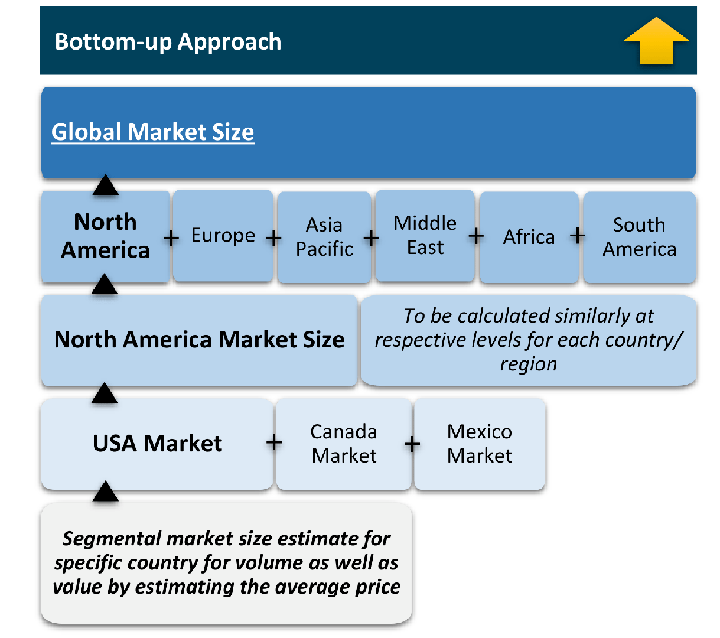
The bottom-up approach builds market estimates by starting with the smallest addressable market units and systematically aggregating them to create comprehensive market size projections.
This method begins with specific, granular data points and builds upward to create the complete market landscape.
Customer Analysis → Segmental Analysis → Geographical Analysis
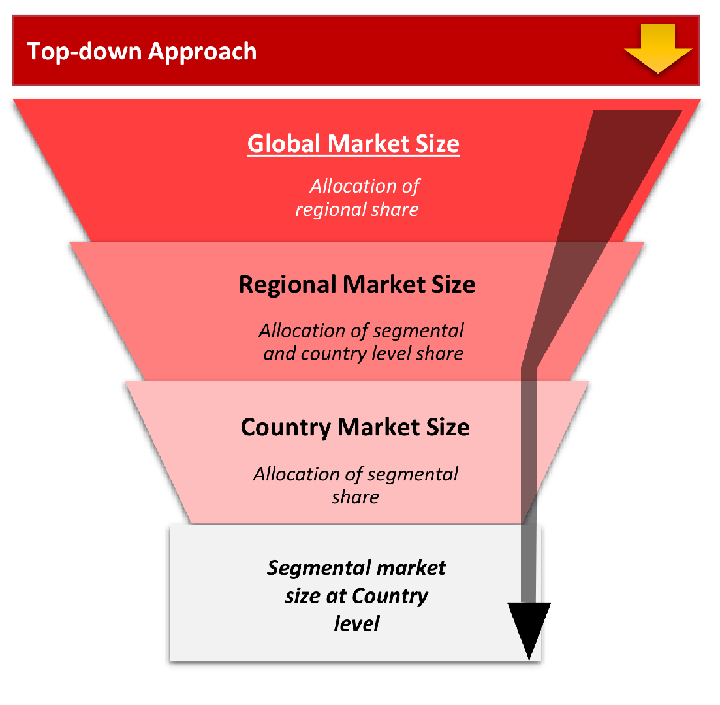
The top-down approach starts with the broadest possible market data and systematically narrows it down through a series of filters and assumptions to arrive at specific market segments or opportunities.
This method begins with the big picture and works downward to increasingly specific market slices.
TAM → SAM → SOM
Research Methods
Desk / Secondary Research
While analysing the market, we extensively study secondary sources, directories, and databases to identify and collect information useful for this technical, market-oriented, and commercial report. Secondary sources that we utilize are not only the public sources, but it is a combination of Open Source, Associations, Paid Databases, MG Repository & Knowledgebase, and others.
- Company websites, annual reports, financial reports, broker reports, and investor presentations
- National government documents, statistical databases and reports
- News articles, press releases and web-casts specific to the companies operating in the market, Magazines, reports, and others
- We gather information from commercial data sources for deriving company specific data such as segmental revenue, share for geography, product revenue, and others
- Internal and external proprietary databases (industry-specific), relevant patent, and regulatory databases
- Governing Bodies, Government Organizations
- Relevant Authorities, Country-specific Associations for Industries
We also employ the model mapping approach to estimate the product level market data through the players' product portfolio
Primary Research
Primary research/ interviews is vital in analyzing the market. Most of the cases involves paid primary interviews. Primary sources include primary interviews through e-mail interactions, telephonic interviews, surveys as well as face-to-face interviews with the different stakeholders across the value chain including several industry experts.
| Type of Respondents | Number of Primaries |
|---|---|
| Tier 2/3 Suppliers | ~20 |
| Tier 1 Suppliers | ~25 |
| End-users | ~25 |
| Industry Expert/ Panel/ Consultant | ~30 |
| Total | ~100 |
MG Knowledgebase
• Repository of industry blog, newsletter and case studies
• Online platform covering detailed market reports, and company profiles
Forecasting Factors and Models
Forecasting Factors
- Historical Trends – Past market patterns, cycles, and major events that shaped how markets behave over time. Understanding past trends helps predict future behavior.
- Industry Factors – Specific characteristics of the industry like structure, regulations, and innovation cycles that affect market dynamics.
- Macroeconomic Factors – Economic conditions like GDP growth, inflation, and employment rates that affect how much money people have to spend.
- Demographic Factors – Population characteristics like age, income, and location that determine who can buy your product.
- Technology Factors – How quickly people adopt new technology and how much technology infrastructure exists.
- Regulatory Factors – Government rules, laws, and policies that can help or restrict market growth.
- Competitive Factors – Analyzing competition structure such as degree of competition and bargaining power of buyers and suppliers.
Forecasting Models / Techniques
Multiple Regression Analysis
- Identify and quantify factors that drive market changes
- Statistical modeling to establish relationships between market drivers and outcomes
Time Series Analysis – Seasonal Patterns
- Understand regular cyclical patterns in market demand
- Advanced statistical techniques to separate trend, seasonal, and irregular components
Time Series Analysis – Trend Analysis
- Identify underlying market growth patterns and momentum
- Statistical analysis of historical data to project future trends
Expert Opinion – Expert Interviews
- Gather deep industry insights and contextual understanding
- In-depth interviews with key industry stakeholders
Multi-Scenario Development
- Prepare for uncertainty by modeling different possible futures
- Creating optimistic, pessimistic, and most likely scenarios
Time Series Analysis – Moving Averages
- Sophisticated forecasting for complex time series data
- Auto-regressive integrated moving average models with seasonal components
Econometric Models
- Apply economic theory to market forecasting
- Sophisticated economic models that account for market interactions
Expert Opinion – Delphi Method
- Harness collective wisdom of industry experts
- Structured, multi-round expert consultation process
Monte Carlo Simulation
- Quantify uncertainty and probability distributions
- Thousands of simulations with varying input parameters
Research Analysis
Our research framework is built upon the fundamental principle of validating market intelligence from both demand and supply perspectives. This dual-sided approach ensures comprehensive market understanding and reduces the risk of single-source bias.
Demand-Side Analysis: We understand end-user/application behavior, preferences, and market needs along with the penetration of the product for specific application.
Supply-Side Analysis: We estimate overall market revenue, analyze the segmental share along with industry capacity, competitive landscape, and market structure.
Validation & Evaluation
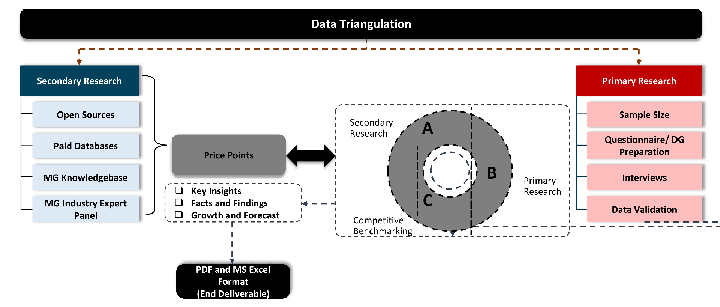
Data triangulation is a validation technique that uses multiple methods, sources, or perspectives to examine the same research question, thereby increasing the credibility and reliability of research findings. In market research, triangulation serves as a quality assurance mechanism that helps identify and minimize bias, validate assumptions, and ensure accuracy in market estimates.
- Data Source Triangulation – Using multiple data sources to examine the same phenomenon
- Methodological Triangulation – Using multiple research methods to study the same research question
- Investigator Triangulation – Using multiple researchers or analysts to examine the same data
- Theoretical Triangulation – Using multiple theoretical perspectives to interpret the same data
Custom Market Research Services
We will customise the research for you, in case the report listed above does not meet your requirements.
Get 10% Free Customisation