Data Center Cooling Market Size, Share & Trends Analysis Report by Cooling Solution Type (Air-Based Cooling, Liquid-Based Cooling, Evaporative Cooling, Free Cooling, Chilled Water Systems, Others), Cooling Technique, Data Center Type, Component, Service Type, and Geography (North America, Europe, Asia Pacific, Middle East, Africa, and South America) – Global Industry Data, Trends, and Forecasts, 2026–2035
Market Overview:
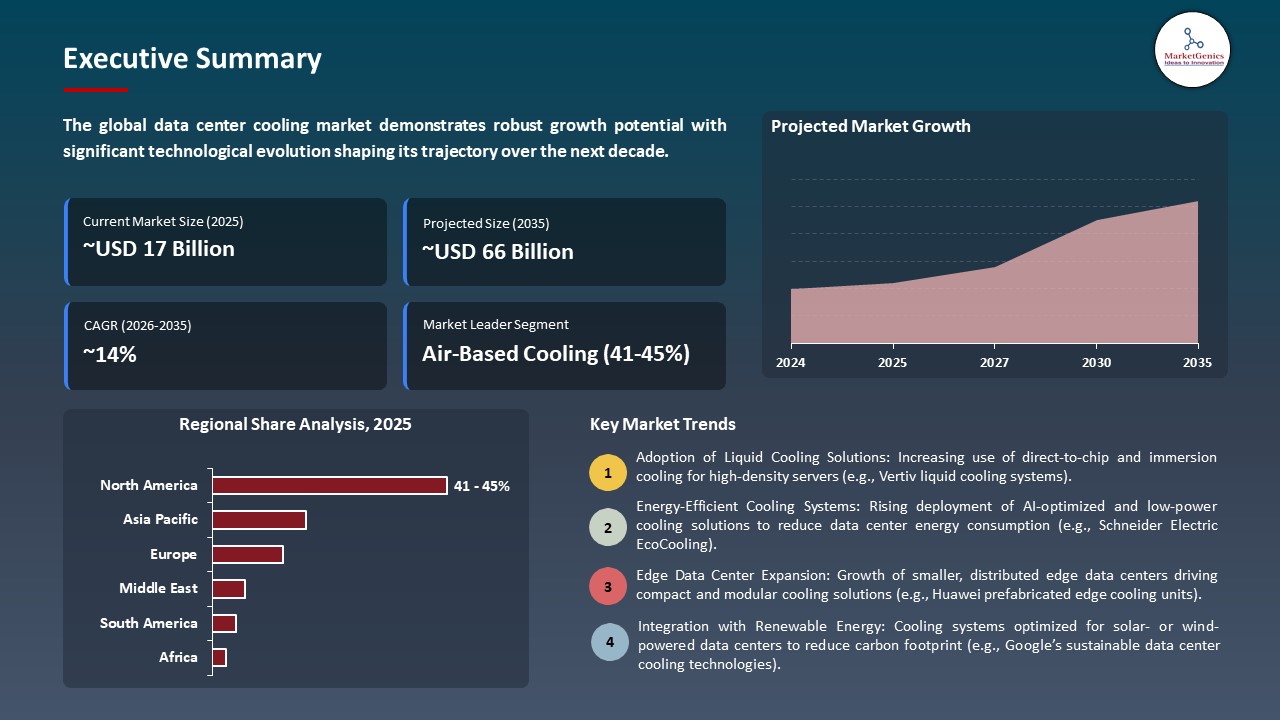
According to MarketGenics analysis, the global Data Center Cooling Market is experiencing strong and sustained growth and is projected to expand from approximately USD 17.4 billion in 2025 to nearly USD 65.6 billion by 2035, registering a robust CAGR of 14.2% during the forecast period.
|
|
|
Segmental Data Insights |
|
|
Demand Trends |
|
|
Competitive Landscape |
|
|
Strategic Development |
|
|
Future Outlook & Opportunities |
|
Data-Center-Cooling-Market Size, Share, and Growth
A fresh wave of performance-based cooling architectures and tightly integrated thermal compute designs are also powering the global data center cooling market, offering quantifiable improvements in heat dissipation efficiency, support of rack-level power density, and energy performance as a whole, plus reliable operation of high-density AI, HPC and hyperscale computing environments.
Austin Domenici, Vice President and General Manager of Data Center Solutions at Johnson Controls, stated that the launch of the expanded CDU technology series marks a pivotal step in advancing data center cooling from chip to chiller. He highlighted that collaboration with hyperscale, colocation, and semiconductor ecosystem partners has enabled the development of an innovative and scalable platform designed to meet the performance demands of next-generation AI training and inference hardware, while reinforcing Johnson Controls’ role as a strategic partner supporting the digital economy.
The global data center cooling market is transforming into a building block of the contemporary digital infrastructure due to the necessity of a highly efficient and scalable thermal management of the next-generation compute surroundings. Increasing the power density of racks in hyperscale operators, and large-scale enterprises is exceeding the capability of traditional air cooling, innovative methods like liquid immersion cooling are becoming popular. For instance, in November 2025, Vertiv added to its liquid cooling line the CoolCenter Immersion system that supports 25 240 kW capacities that facilitate equal heat dissipation in AI and HPC workloads a good sign that innovative cooling technologies are being commercialized to satisfy extreme thermal needs.
Real-time thermal telemetry, automatic routing of coolant and adaptive environmental control innovations are improving operational reliability and allowing the seamless integration of data centers spread across a wide geographical area. In September 2025, Johnson Controls added to its thermal management offering a scalable liquid cooling platform with advanced monitoring, digital twin-based thermal modelling, and predictive airflow modelling to enable operators to proactively optimize heat loads, enhance energy efficiency and increase hardware lifecycle in high-density AI and HPC systems.
Joint initiatives between data center operators, thermal technology providers, and energy management systems are faster track implementation of the state of the art cooling systems. Besides lowering the operational carbon footprint, these efforts also generate differentiated value to high-efficiency and sustainable computing facility and make advanced cooling a key enabler in future digital ecosystems.
 Data Center Cooling Market Dynamics and Trends
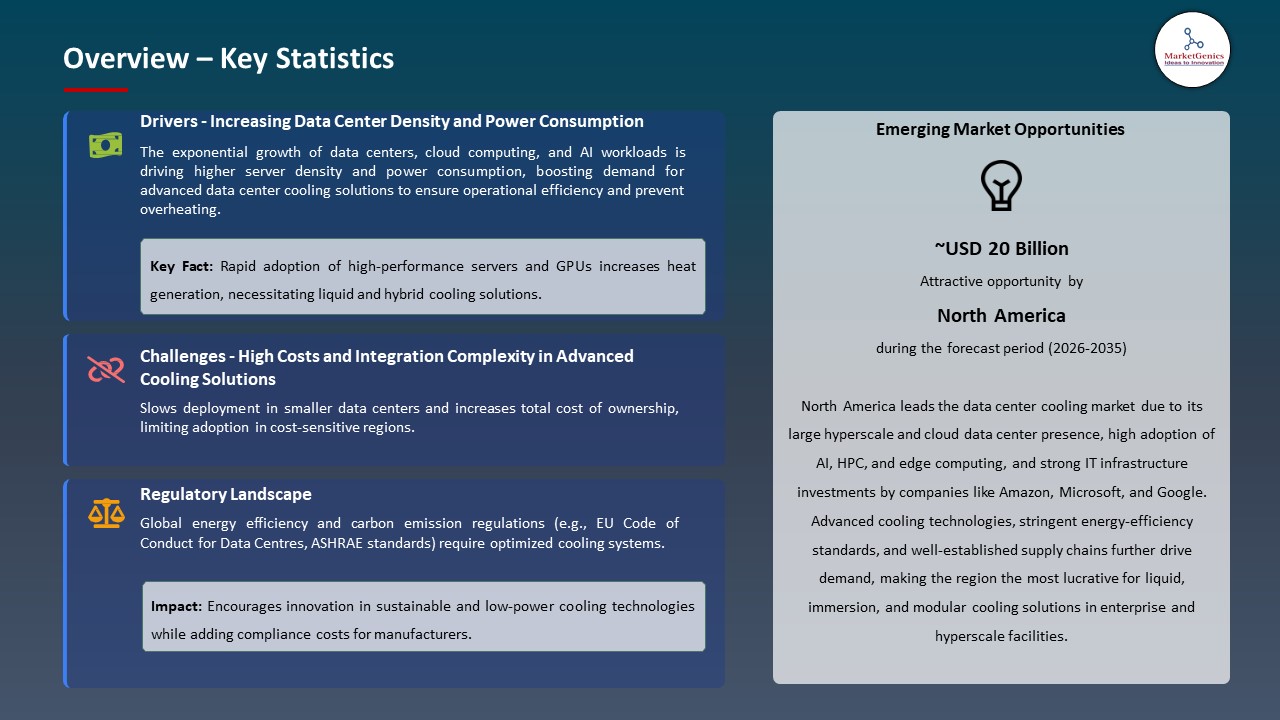
Driver: Rising Demand from High-Density and Hyperscale Data Centers
-
The global data center cooling market is increasingly being driven by the emerging boom in artificial intelligence training, generative AI inference, and high-performance computing workloads with massive parallelogram data access, very low latency, and very high thermal dissipation control needed to maximize the performance of the GPUs and accelerators.
- Makers of technology and semiconductor engineers are endeavoring to make memory roadmaps to align with current and future computing platforms to enable the delivery of very dense stacks, high power efficiency, and scalable packet bandwidth on a package basis. In November 2025, Flex and LG Electronics collaborated to co-innovate modular cooling systems based on both liquid and air-based cooling modules to address thermal management in high-density AI and hyperscale data centers.
- Developing cloud platforms, and HPC implementations are also increasing the adoption of innovative cooling solutions in the world data centers.
Restraint: High Capital Expenditure and Infrastructure Complexity
-
High initial expenditures and running expenses inhibit the implementation of high-level data center cooling solutions. The introduction of innovative technologies including liquid immersion cooling, thermal management based on AI, modular hot/cold aisle containment, and others demands special equipment, finely tuned placement, and connection to the existing infrastructure, raising the complexity of the project in general.
- Long design times, high-reliability, and certified components in high density and hyperscale environments add further to the cost. The reliance on expert engineers, accuracy calibration and advanced monitoring technology places a strain on small data center operators and hinders adoption in small market economies.
- Other factors Commissioning costs, predictive maintenance, and energy efficiency standards: additional requirements mean that advanced cooling solutions cannot be widely applied in the cost-sensitive market.
Opportunity: Renewable Energy-Powered and AI-Enabled Cooling Solutions
-
Hyperscale and edge data centers are driving up their energy requirements, providing an opportunity to the renewable energy-powered cooling systems coupled with AI-driven thermal management. Solar power or wind power or hybrid power with predictive cooling algorithms can provide operators with the ability to minimize carbon footprint, maximize power use, and assure consistent control of temperature.
- The AI-powered solutions are being implemented in the next-generation high-density compute racks, liquid immersion, and modular cooling units. For instance, in September 2025, Equinix, Dell Technologies and Schneider Electric installed a 50 kW, in-rack direct-to-chip liquid cooling system at the Equinix HK1 data center in Hong Kong that combines the liquid-cooled server offerings of Dell with the cooling CDU of Schneider to enable 50 density AI workloads to be effectively thermally managed.
- Implementation of renewable energy-powered and AI-enhanced cooling technologies will increase efficiency, reduce the energy price, and enhance sustainability, which will lead to the long-term development on a global scale.
Key Trend: Modular, Scalable, and Sensor-Integrated Cooling Systems
-
The global data center cooling market is emphasizing on centralized cooling protocols and integrated management frameworks so that interoperability and integration of liquid cooling, immersion units, in-row chillers and distributed air handlers can be easily managed in a multi-vendor setting to ensure uniform thermal control across the multi-vendor environment.
- Next-generation frameworks of modular cooling are under development including integrated sensor cloth, AI-based thermal sensors, and workload-anticipated airflow coordination. For instance, a distributed cooling system introduced by YMK Technology Group in the November 2025 CDCC Data Center Standards Conference, which combines modular deployment with AI assisted predictive thermal control and edge intelligence, and illustrates the ability of plug-and-play thermal subsystems to make real-time optimizations in airflow and cooling efficiency to heterogeneous compute clusters.
- Sensor-driven automation and scalability In line with the adoption of advanced cooling, modular scalability, sensor-driven automation, will increase deployment, ease of integration, and energy efficiency in advanced cooling across the globe.
Data Center Cooling Market Analysis and Segmental Data
Air-Based Cooling Dominate Global Data Center Cooling Market
-
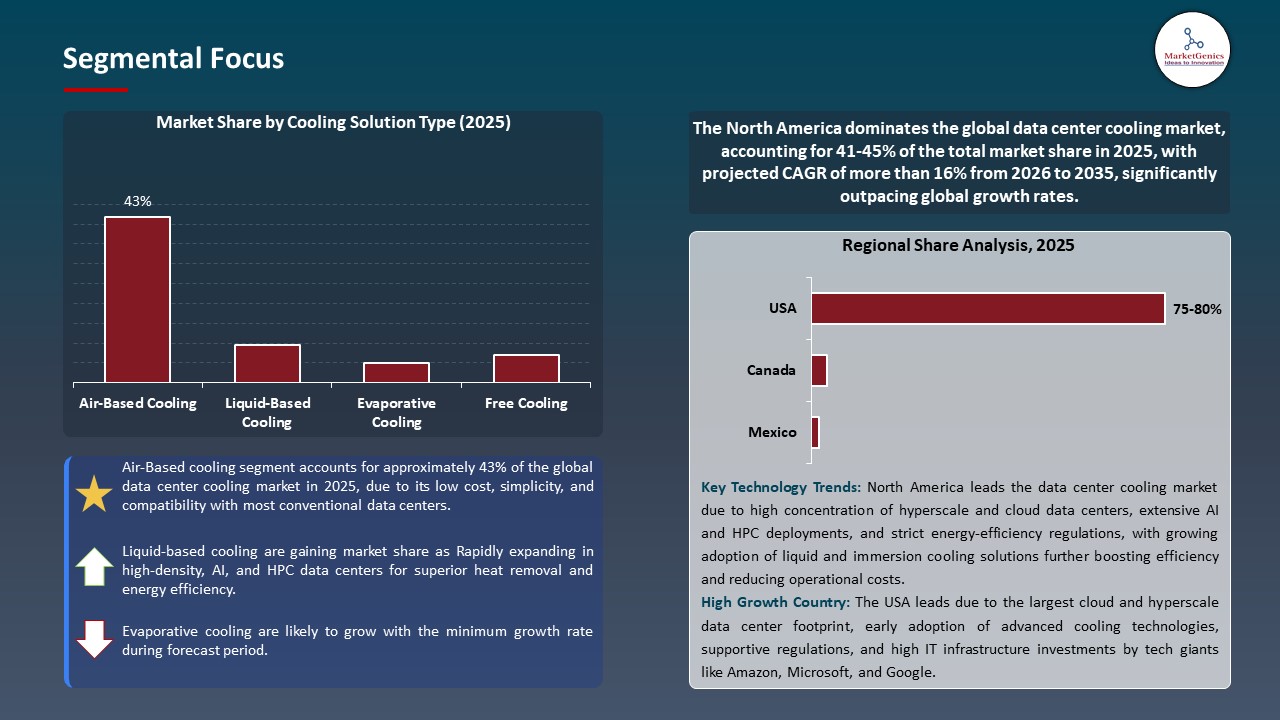
Air based cooling dominate the global data center cooling market because of the reliability, flexibility, and cost effectiveness of air cooling in large scale data centers. Its high thermal conductivity to dissipate heat and support 2-dense server rack density is the solution of choice in hyperscale and enterprise facility applications.
- Other factors that have enhanced the market demand are technological development in fan systems, airflow control and modularity in the design. For instance, in April 2025, Lennox introduced its CRAH ApX cooling product range, which has flexible coil options and EC fans with high-efficiency to provide high-capacity, robust air cooling at a wide capacity span.
- The fact that it is easy to install, widely used, and consumes less energy makes it still to be dominant as far as air-based cooling is concerned in the world of data centers.
North America Leads Global Data Center Cooling Market Demand
-
North America leads the data center cooling market because of the vigorous demand of hyperscale data centers, cloud computing service providers as well as sophisticated compute deployments in the United States and Canada. The facilities use the best cooling technologies to achieve high-speed performance, low-energy use and low-latency operation.
- Close collaborations and innovation efforts in the industry remain a growth driver in the region. For instance, in June 2025, Schneider Electric introduced new integrated data center offerings that are particularly focused on responding to the needs of high-density AI and accelerated compute applications, improved thermal management, and energy efficiency of North American data centers.
- The developed infrastructure, favorable government programs, and further investment in artificial intelligence and high-performance computers support the positions of North America in the global data center cooling market.
Data Center Cooling Market Ecosystem
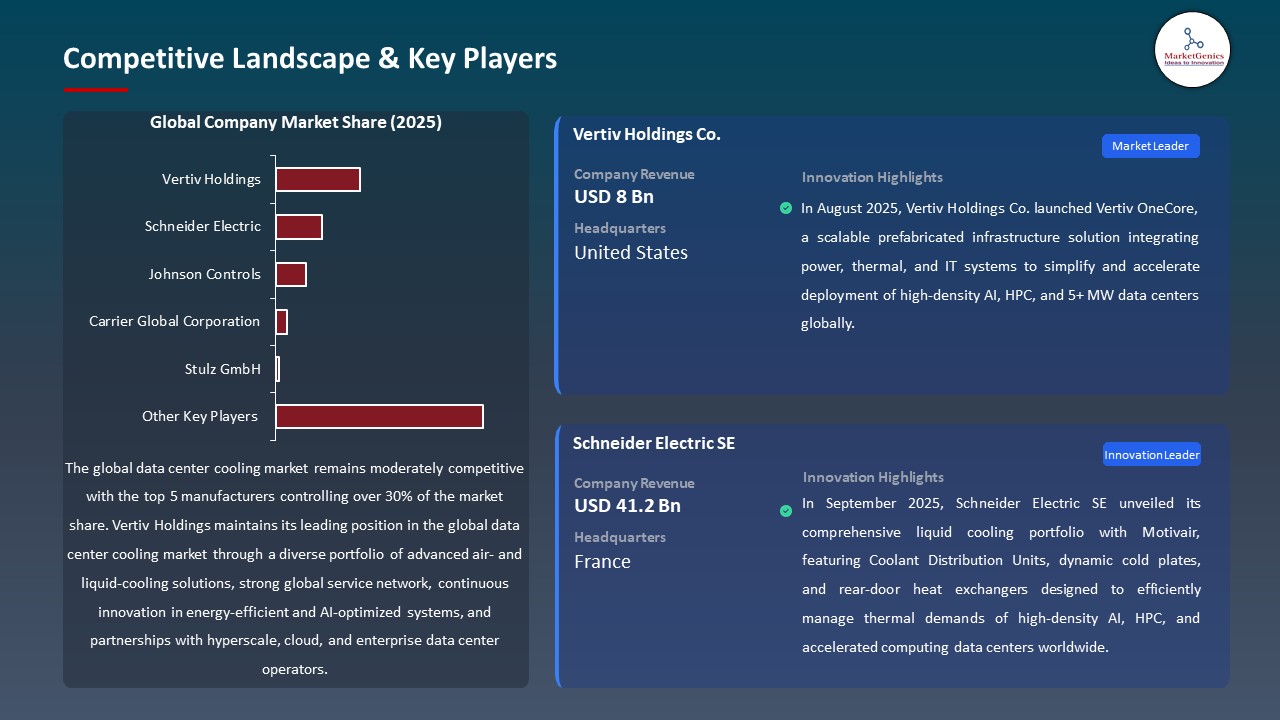
The global data center cooling market is slightly consolidated with the Tier-1 multinational companies that have monopolized because of the strong capability in research and development, rich intellectual property, and a global network of clients. The concentration level in the market is medium-high with leading participants making use of technological innovation, energy-saving solutions, as well as strategic alliances to sustain the competitive advantages.
The market is headed by key Tier-1 players, including Vertiv Holdings, Schneider Electric, Johnson Controls, Carrier Global Corporation and Stulz GmbH, which provide integrated cooling services such as liquid cooling and precision air systems, and modular cooling systems to hyperscale, cloud and high-performance computing data centers. These firms take advantage of the economies of scale, proprietary thermal management technology and close working relationship with server and infrastructure vendors in order to make the system as efficient as possible.
Tier-3 players, including regional manufacturers and start-ups, specialize in cost-effective and application-specific cooling kinds of solutions, and market niche cooling technologies, including immersion cooling and hybrid air-liquid. This inter-tier competition leads to the ever-evolution of technology, energy-efficient and sustainable cooling technologies, and enhances the overall ecosystem of the global data center cooling market.
 Recent Development and Strategic Overview
-
In August 2025, Vertiv launched the OneCore prefabricated infrastructure solution, which is used in high-density AI, HPC, and mixed-load data centers. The system combines the high-tech thermal management, liquid-cooling solutions together with the modular power and IT infrastructure. This solution will facilitate scalable deployment, efficient control of airflow and energy-efficient cooling, which is applicable to the next-generation data center.
- In September 2025, Schneider Electric introduced its Motivair liquid cooling line-up consisting of Coolant Distribution Unit, rear-door heat exchangers, dynamic cold plates, and chillers. The solutions are aimed at high-density AI, HPC, and accelerated computing data centers, which will allow them to manage their thermal efficiency, deployments, and scale efficiently as well as provide energy-efficient cooling to next-generation infrastructure.
Report Scope
|
Detail |
|
|
Market Size in 2025 |
USD 17.4 Bn |
|
Market Forecast Value in 2035 |
USD 65.6 Bn |
|
Growth Rate (CAGR) |
14.2% |
|
Forecast Period |
2026 – 2035 |
|
Historical Data Available for |
2021 – 2024 |
|
Market Size Units |
US$ Billion for Value Million Units for Volume |
|
Report Format |
Electronic (PDF) + Excel |
|
North America |
Europe |
Asia Pacific |
Middle East |
Africa |
South America |
|
|
|
|
|
|
|
Companies Covered |
|||||
|
|
|
|
|
|
Data Center Cooling Market Segmentation and Highlights
|
Segment |
Sub-segment |
|
Data Center Cooling Market, By Cooling Solution Type |
|
|
Data Center Cooling Market, By Cooling Technique |
|
|
Data Center Cooling Market, By Data Center Type |
|
|
Data Center Cooling Market, By Component |
|
|
Data Center Cooling Market, By Service Type |
|
Frequently Asked Questions
Table of Contents
- 1. Research Methodology and Assumptions
- 1.1. Definitions
- 1.2. Research Design and Approach
- 1.3. Data Collection Methods
- 1.4. Base Estimates and Calculations
- 1.5. Forecasting Models
- 1.5.1. Key Forecast Factors & Impact Analysis
- 1.6. Secondary Research
- 1.6.1. Open Sources
- 1.6.2. Paid Databases
- 1.6.3. Associations
- 1.7. Primary Research
- 1.7.1. Primary Sources
- 1.7.2. Primary Interviews with Stakeholders across Ecosystem
- 2. Executive Summary
- 2.1. Global Data Center Cooling Market Outlook
- 2.1.1. Data Center Cooling Market Size Volume (Million Units) and Value (US$ Bn), and Forecasts, 2021-2035
- 2.1.2. Compounded Annual Growth Rate Analysis
- 2.1.3. Growth Opportunity Analysis
- 2.1.4. Segmental Share Analysis
- 2.1.5. Geographical Share Analysis
- 2.2. Market Analysis and Facts
- 2.3. Supply-Demand Analysis
- 2.4. Competitive Benchmarking
- 2.5. Go-to- Market Strategy
- 2.5.1. Customer/ End-use Industry Assessment
- 2.5.2. Growth Opportunity Data, 2026-2035
- 2.5.2.1. Regional Data
- 2.5.2.2. Country Data
- 2.5.2.3. Segmental Data
- 2.5.3. Identification of Potential Market Spaces
- 2.5.4. GAP Analysis
- 2.5.5. Potential Attractive Price Points
- 2.5.6. Prevailing Market Risks & Challenges
- 2.5.7. Preferred Sales & Marketing Strategies
- 2.5.8. Key Recommendations and Analysis
- 2.5.9. A Way Forward
- 2.1. Global Data Center Cooling Market Outlook
- 3. Industry Data and Premium Insights
- 3.1. Global Chemicals & Materials Industry Overview, 2025
- 3.1.1. Industry Ecosystem Analysis
- 3.1.2. Key Trends for Chemicals & Materials Industry
- 3.1.3. Regional Distribution for Chemicals & Materials Industry
- 3.2. Supplier Customer Data
- 3.3. Technology Roadmap and Developments
- 3.4. Trade Analysis
- 3.4.1. Import & Export Analysis, 2025
- 3.4.2. Top Importing Countries
- 3.4.3. Top Exporting Countries
- 3.5. Trump Tariff Impact Analysis
- 3.5.1. Manufacturer
- 3.5.1.1. Based on the component & Raw material
- 3.5.2. Supply Chain
- 3.5.3. End Consumer
- 3.5.1. Manufacturer
- 3.6. Raw Material Analysis
- 3.1. Global Chemicals & Materials Industry Overview, 2025
- 4. Market Overview
- 4.1. Market Dynamics
- 4.1.1. Drivers
- 4.1.1.1. Rapid growth of hyperscale and cloud data centers increasing cooling demand.
- 4.1.1.2. Rising adoption of AI, HPC, and high-density server deployments generating higher heat loads.
- 4.1.1.3. Increasing focus on energy-efficient and sustainable data center operations.
- 4.1.2. Restraints
- 4.1.2.1. High capital and operating costs of advanced cooling solutions.
- 4.1.2.2. Technical complexity in upgrading or retrofitting legacy data center infrastructure.
- 4.1.1. Drivers
- 4.2. Key Trend Analysis
- 4.3. Regulatory Framework
- 4.3.1. Key Regulations, Norms, and Subsidies, by Key Countries
- 4.3.2. Tariffs and Standards
- 4.3.3. Impact Analysis of Regulations on the Market
- 4.4. Value Chain Analysis
- 4.4.1. Raw Material & Component Suppliers
- 4.4.2. System Manufacturers
- 4.4.3. Technology Integrators
- 4.4.4. Distribution & Sales Channel
- 4.4.5. End-Users
- 4.5. Cost Structure Analysis
- 4.5.1. Parameter’s Share for Cost Associated
- 4.5.2. COGP vs COGS
- 4.5.3. Profit Margin Analysis
- 4.6. Pricing Analysis
- 4.6.1. Regional Pricing Analysis
- 4.6.2. Segmental Pricing Trends
- 4.6.3. Factors Influencing Pricing
- 4.7. Porter’s Five Forces Analysis
- 4.8. PESTEL Analysis
- 4.9. Global Data Center Cooling Market Demand
- 4.9.1. Historical Market Size – Volume (Million Units) and Value (US$ Bn), 2020-2024
- 4.9.2. Current and Future Market Size – Volume (Million Units) and Value (US$ Bn), 2026–2035
- 4.9.2.1. Y-o-Y Growth Trends
- 4.9.2.2. Absolute $ Opportunity Assessment
- 4.1. Market Dynamics
- 5. Competition Landscape
- 5.1. Competition structure
- 5.1.1. Fragmented v/s consolidated
- 5.2. Company Share Analysis, 2025
- 5.2.1. Global Company Market Share
- 5.2.2. By Region
- 5.2.2.1. North America
- 5.2.2.2. Europe
- 5.2.2.3. Asia Pacific
- 5.2.2.4. Middle East
- 5.2.2.5. Africa
- 5.2.2.6. South America
- 5.3. Product Comparison Matrix
- 5.3.1. Specifications
- 5.3.2. Market Positioning
- 5.3.3. Pricing
- 5.1. Competition structure
- 6. Global Data Center Cooling Market Analysis, by Cooling Solution Type
- 6.1. Key Segment Analysis
- 6.2. Data Center Cooling Market Size Volume (Million Units) and Value (US$ Bn), Analysis, and Forecasts, by Cooling Solution Type, 2021-2035
- 6.2.1. Air-Based Cooling
- 6.2.1.1. Computer Room Air Conditioning (CRAC)
- 6.2.1.2. Computer Room Air Handler (CRAH)
- 6.2.1.3. In-Row Cooling
- 6.2.1.4. Rear Door Heat Exchanger
- 6.2.2. Liquid-Based Cooling
- 6.2.2.1. Direct-to-Chip Liquid Cooling
- 6.2.2.2. Immersion Cooling
- 6.2.2.2.1. Single-Phase Immersion
- 6.2.2.2.2. Two-Phase Immersion
- 6.2.2.3. Liquid-Cooled Racks
- 6.2.3. Evaporative Cooling
- 6.2.4. Free Cooling
- 6.2.4.1. Air-Side Free Cooling
- 6.2.4.2. Water-Side Free Cooling
- 6.2.5. Chilled Water Systems
- 6.2.6. Others
- 6.2.1. Air-Based Cooling
- 7. Global Data Center Cooling Market Analysis, by Cooling Technique
- 7.1. Key Segment Analysis
- 7.2. Data Center Cooling Market Size Volume (Million Units) and Value (US$ Bn), Analysis, and Forecasts, by Cooling Technique, 2021-2035
- 7.2.1. Room-Based Cooling
- 7.2.2. Row-Based Cooling
- 7.2.3. Rack-Based Cooling
- 7.2.4. Chip-Level Cooling
- 8. Global Data Center Cooling Market Analysis, by Data Center Type
- 8.1. Key Segment Analysis
- 8.2. Data Center Cooling Market Size Volume (Million Units) and Value (US$ Bn), Analysis, and Forecasts, by Data Center Type, 2021-2035
- 8.2.1. Enterprise Data Centers
- 8.2.2. Colocation Data Centers
- 8.2.3. Hyperscale Data Centers
- 8.2.4. Edge Data Centers
- 8.2.5. Cloud Data Centers
- 9. Global Data Center Cooling Market Analysis, by Component
- 9.1. Key Segment Analysis
- 9.2. Data Center Cooling Market Size Volume (Million Units) and Value (US$ Bn), Analysis, and Forecasts, by Component, 2021-2035
- 9.2.1. Chillers
- 9.2.1.1. Air-Cooled Chillers
- 9.2.1.2. Water-Cooled Chillers
- 9.2.2. Cooling Towers
- 9.2.3. Economizers
- 9.2.3.1. Air-Side Economizers
- 9.2.3.2. Water-Side Economizers
- 9.2.4. Pumps
- 9.2.5. CRAC/CRAH Units
- 9.2.6. Cooling Distribution Units (CDUs)
- 9.2.7. Heat Exchangers
- 9.2.8. Control Systems & Sensors
- 9.2.9. Other Components
- 9.2.1. Chillers
- 10. Global Data Center Cooling Market Analysis, by Service Type
- 10.1. Key Segment Analysis
- 10.2. Data Center Cooling Market Size Volume (Million Units) and Value (US$ Bn), Analysis, and Forecasts, by Service Type, 2021-2035
- 10.2.1. Installation and Deployment Services
- 10.2.2. Maintenance and Support Services
- 10.2.3. Consulting Services
- 10.2.4. Training Services
- 11. Global Data Center Cooling Market Analysis and Forecasts, by Region
- 11.1. Key Findings
- 11.2. Data Center Cooling Market Size Volume (Million Units) and Value (US$ Bn), Analysis, and Forecasts, by Region, 2021-2035
- 11.2.1. North America
- 11.2.2. Europe
- 11.2.3. Asia Pacific
- 11.2.4. Middle East
- 11.2.5. Africa
- 11.2.6. South America
- 12. North America Data Center Cooling Market Analysis
- 12.1. Key Segment Analysis
- 12.2. Regional Snapshot
- 12.3. North America Data Center Cooling Market Size Volume (Million Units) and Value (US$ Bn), Analysis, and Forecasts, 2021-2035
- 12.3.1. Cooling Solution Type
- 12.3.2. Cooling Technique
- 12.3.3. Data Center Type
- 12.3.4. Component
- 12.3.5. Service Type
- 12.3.6. Country
- 12.3.6.1. USA
- 12.3.6.2. Canada
- 12.3.6.3. Mexico
- 12.4. USA Data Center Cooling Market
- 12.4.1. Country Segmental Analysis
- 12.4.2. Cooling Solution Type
- 12.4.3. Cooling Technique
- 12.4.4. Data Center Type
- 12.4.5. Component
- 12.4.6. Service Type
- 12.5. Canada Data Center Cooling Market
- 12.5.1. Country Segmental Analysis
- 12.5.2. Cooling Solution Type
- 12.5.3. Cooling Technique
- 12.5.4. Data Center Type
- 12.5.5. Component
- 12.5.6. Service Type
- 12.6. Mexico Data Center Cooling Market
- 12.6.1. Country Segmental Analysis
- 12.6.2. Cooling Solution Type
- 12.6.3. Cooling Technique
- 12.6.4. Data Center Type
- 12.6.5. Component
- 12.6.6. Service Type
- 13. Europe Data Center Cooling Market Analysis
- 13.1. Key Segment Analysis
- 13.2. Regional Snapshot
- 13.3. Europe Data Center Cooling Market Size Volume (Million Units) and Value (US$ Bn), Analysis, and Forecasts, 2021-2035
- 13.3.1. Cooling Solution Type
- 13.3.2. Cooling Technique
- 13.3.3. Data Center Type
- 13.3.4. Component
- 13.3.5. Service Type
- 13.3.6. Country
- 13.3.6.1. Germany
- 13.3.6.2. United Kingdom
- 13.3.6.3. France
- 13.3.6.4. Italy
- 13.3.6.5. Spain
- 13.3.6.6. Netherlands
- 13.3.6.7. Nordic Countries
- 13.3.6.8. Poland
- 13.3.6.9. Russia & CIS
- 13.3.6.10. Rest of Europe
- 13.4. Germany Data Center Cooling Market
- 13.4.1. Country Segmental Analysis
- 13.4.2. Cooling Solution Type
- 13.4.3. Cooling Technique
- 13.4.4. Data Center Type
- 13.4.5. Component
- 13.4.6. Service Type
- 13.5. United Kingdom Data Center Cooling Market
- 13.5.1. Country Segmental Analysis
- 13.5.2. Cooling Solution Type
- 13.5.3. Cooling Technique
- 13.5.4. Data Center Type
- 13.5.5. Component
- 13.5.6. Service Type
- 13.6. France Data Center Cooling Market
- 13.6.1. Country Segmental Analysis
- 13.6.2. Cooling Solution Type
- 13.6.3. Cooling Technique
- 13.6.4. Data Center Type
- 13.6.5. Component
- 13.6.6. Service Type
- 13.7. Italy Data Center Cooling Market
- 13.7.1. Country Segmental Analysis
- 13.7.2. Cooling Solution Type
- 13.7.3. Cooling Technique
- 13.7.4. Data Center Type
- 13.7.5. Component
- 13.7.6. Service Type
- 13.8. Spain Data Center Cooling Market
- 13.8.1. Country Segmental Analysis
- 13.8.2. Cooling Solution Type
- 13.8.3. Cooling Technique
- 13.8.4. Data Center Type
- 13.8.5. Component
- 13.8.6. Service Type
- 13.9. Netherlands Data Center Cooling Market
- 13.9.1. Country Segmental Analysis
- 13.9.2. Cooling Solution Type
- 13.9.3. Cooling Technique
- 13.9.4. Data Center Type
- 13.9.5. Component
- 13.9.6. Service Type
- 13.10. Nordic Countries Data Center Cooling Market
- 13.10.1. Country Segmental Analysis
- 13.10.2. Cooling Solution Type
- 13.10.3. Cooling Technique
- 13.10.4. Data Center Type
- 13.10.5. Component
- 13.10.6. Service Type
- 13.11. Poland Data Center Cooling Market
- 13.11.1. Country Segmental Analysis
- 13.11.2. Cooling Solution Type
- 13.11.3. Cooling Technique
- 13.11.4. Data Center Type
- 13.11.5. Component
- 13.11.6. Service Type
- 13.12. Russia & CIS Data Center Cooling Market
- 13.12.1. Country Segmental Analysis
- 13.12.2. Cooling Solution Type
- 13.12.3. Cooling Technique
- 13.12.4. Data Center Type
- 13.12.5. Component
- 13.12.6. Service Type
- 13.13. Rest of Europe Data Center Cooling Market
- 13.13.1. Country Segmental Analysis
- 13.13.2. Cooling Solution Type
- 13.13.3. Cooling Technique
- 13.13.4. Data Center Type
- 13.13.5. Component
- 13.13.6. Service Type
- 14. Asia Pacific Data Center Cooling Market Analysis
- 14.1. Key Segment Analysis
- 14.2. Regional Snapshot
- 14.3. Asia Pacific Data Center Cooling Market Size Volume (Million Units) and Value (US$ Bn), Analysis, and Forecasts, 2021-2035
- 14.3.1. Cooling Solution Type
- 14.3.2. Cooling Technique
- 14.3.3. Data Center Type
- 14.3.4. Component
- 14.3.5. Service Type
- 14.3.6. Country
- 14.3.6.1. China
- 14.3.6.2. India
- 14.3.6.3. Japan
- 14.3.6.4. South Korea
- 14.3.6.5. Australia and New Zealand
- 14.3.6.6. Indonesia
- 14.3.6.7. Malaysia
- 14.3.6.8. Thailand
- 14.3.6.9. Vietnam
- 14.3.6.10. Rest of Asia Pacific
- 14.4. China Data Center Cooling Market
- 14.4.1. Country Segmental Analysis
- 14.4.2. Cooling Solution Type
- 14.4.3. Cooling Technique
- 14.4.4. Data Center Type
- 14.4.5. Component
- 14.4.6. Service Type
- 14.5. India Data Center Cooling Market
- 14.5.1. Country Segmental Analysis
- 14.5.2. Cooling Solution Type
- 14.5.3. Cooling Technique
- 14.5.4. Data Center Type
- 14.5.5. Component
- 14.5.6. Service Type
- 14.6. Japan Data Center Cooling Market
- 14.6.1. Country Segmental Analysis
- 14.6.2. Cooling Solution Type
- 14.6.3. Cooling Technique
- 14.6.4. Data Center Type
- 14.6.5. Component
- 14.6.6. Service Type
- 14.7. South Korea Data Center Cooling Market
- 14.7.1. Country Segmental Analysis
- 14.7.2. Cooling Solution Type
- 14.7.3. Cooling Technique
- 14.7.4. Data Center Type
- 14.7.5. Component
- 14.7.6. Service Type
- 14.8. Australia and New Zealand Data Center Cooling Market
- 14.8.1. Country Segmental Analysis
- 14.8.2. Cooling Solution Type
- 14.8.3. Cooling Technique
- 14.8.4. Data Center Type
- 14.8.5. Component
- 14.8.6. Service Type
- 14.9. Indonesia Data Center Cooling Market
- 14.9.1. Country Segmental Analysis
- 14.9.2. Cooling Solution Type
- 14.9.3. Cooling Technique
- 14.9.4. Data Center Type
- 14.9.5. Component
- 14.9.6. Service Type
- 14.10. Malaysia Data Center Cooling Market
- 14.10.1. Country Segmental Analysis
- 14.10.2. Cooling Solution Type
- 14.10.3. Cooling Technique
- 14.10.4. Data Center Type
- 14.10.5. Component
- 14.10.6. Service Type
- 14.11. Thailand Data Center Cooling Market
- 14.11.1. Country Segmental Analysis
- 14.11.2. Cooling Solution Type
- 14.11.3. Cooling Technique
- 14.11.4. Data Center Type
- 14.11.5. Component
- 14.11.6. Service Type
- 14.12. Vietnam Data Center Cooling Market
- 14.12.1. Country Segmental Analysis
- 14.12.2. Cooling Solution Type
- 14.12.3. Cooling Technique
- 14.12.4. Data Center Type
- 14.12.5. Component
- 14.12.6. Service Type
- 14.13. Rest of Asia Pacific Data Center Cooling Market
- 14.13.1. Country Segmental Analysis
- 14.13.2. Cooling Solution Type
- 14.13.3. Cooling Technique
- 14.13.4. Data Center Type
- 14.13.5. Component
- 14.13.6. Service Type
- 15. Middle East Data Center Cooling Market Analysis
- 15.1. Key Segment Analysis
- 15.2. Regional Snapshot
- 15.3. Middle East Data Center Cooling Market Size Volume (Million Units) and Value (US$ Bn), Analysis, and Forecasts, 2021-2035
- 15.3.1. Cooling Solution Type
- 15.3.2. Cooling Technique
- 15.3.3. Data Center Type
- 15.3.4. Component
- 15.3.5. Service Type
- 15.3.6. Country
- 15.3.6.1. Turkey
- 15.3.6.2. UAE
- 15.3.6.3. Saudi Arabia
- 15.3.6.4. Israel
- 15.3.6.5. Rest of Middle East
- 15.4. Turkey Data Center Cooling Market
- 15.4.1. Country Segmental Analysis
- 15.4.2. Cooling Solution Type
- 15.4.3. Cooling Technique
- 15.4.4. Data Center Type
- 15.4.5. Component
- 15.4.6. Service Type
- 15.5. UAE Data Center Cooling Market
- 15.5.1. Country Segmental Analysis
- 15.5.2. Cooling Solution Type
- 15.5.3. Cooling Technique
- 15.5.4. Data Center Type
- 15.5.5. Component
- 15.5.6. Service Type
- 15.6. Saudi Arabia Data Center Cooling Market
- 15.6.1. Country Segmental Analysis
- 15.6.2. Cooling Solution Type
- 15.6.3. Cooling Technique
- 15.6.4. Data Center Type
- 15.6.5. Component
- 15.6.6. Service Type
- 15.7. Israel Data Center Cooling Market
- 15.7.1. Country Segmental Analysis
- 15.7.2. Cooling Solution Type
- 15.7.3. Cooling Technique
- 15.7.4. Data Center Type
- 15.7.5. Component
- 15.7.6. Service Type
- 15.8. Rest of Middle East Data Center Cooling Market
- 15.8.1. Country Segmental Analysis
- 15.8.2. Cooling Solution Type
- 15.8.3. Cooling Technique
- 15.8.4. Data Center Type
- 15.8.5. Component
- 15.8.6. Service Type
- 16. Africa Data Center Cooling Market Analysis
- 16.1. Key Segment Analysis
- 16.2. Regional Snapshot
- 16.3. Africa Data Center Cooling Market Size Volume (Million Units) and Value (US$ Bn), Analysis, and Forecasts, 2021-2035
- 16.3.1. Cooling Solution Type
- 16.3.2. Cooling Technique
- 16.3.3. Data Center Type
- 16.3.4. Component
- 16.3.5. Service Type
- 16.3.6. country
- 16.3.6.1. South Africa
- 16.3.6.2. Egypt
- 16.3.6.3. Nigeria
- 16.3.6.4. Algeria
- 16.3.6.5. Rest of Africa
- 16.4. South Africa Data Center Cooling Market
- 16.4.1. Country Segmental Analysis
- 16.4.2. Cooling Solution Type
- 16.4.3. Cooling Technique
- 16.4.4. Data Center Type
- 16.4.5. Component
- 16.4.6. Service Type
- 16.5. Egypt Data Center Cooling Market
- 16.5.1. Country Segmental Analysis
- 16.5.2. Cooling Solution Type
- 16.5.3. Cooling Technique
- 16.5.4. Data Center Type
- 16.5.5. Component
- 16.5.6. Service Type
- 16.6. Nigeria Data Center Cooling Market
- 16.6.1. Country Segmental Analysis
- 16.6.2. Cooling Solution Type
- 16.6.3. Cooling Technique
- 16.6.4. Data Center Type
- 16.6.5. Component
- 16.6.6. Service Type
- 16.7. Algeria Data Center Cooling Market
- 16.7.1. Country Segmental Analysis
- 16.7.2. Cooling Solution Type
- 16.7.3. Cooling Technique
- 16.7.4. Data Center Type
- 16.7.5. Component
- 16.7.6. Service Type
- 16.8. Rest of Africa Data Center Cooling Market
- 16.8.1. Country Segmental Analysis
- 16.8.2. Cooling Solution Type
- 16.8.3. Cooling Technique
- 16.8.4. Data Center Type
- 16.8.5. Component
- 16.8.6. Service Type
- 17. South America Data Center Cooling Market Analysis
- 17.1. Key Segment Analysis
- 17.2. Regional Snapshot
- 17.3. South America Data Center Cooling Market Size Volume (Million Units) and Value (US$ Bn), Analysis, and Forecasts, 2021-2035
- 17.3.1. Cooling Solution Type
- 17.3.2. Cooling Technique
- 17.3.3. Data Center Type
- 17.3.4. Component
- 17.3.5. Service Type
- 17.3.6. Country
- 17.3.6.1. Brazil
- 17.3.6.2. Argentina
- 17.3.6.3. Rest of South America
- 17.4. Brazil Data Center Cooling Market
- 17.4.1. Country Segmental Analysis
- 17.4.2. Cooling Solution Type
- 17.4.3. Cooling Technique
- 17.4.4. Data Center Type
- 17.4.5. Component
- 17.4.6. Service Type
- 17.5. Argentina Data Center Cooling Market
- 17.5.1. Country Segmental Analysis
- 17.5.2. Cooling Solution Type
- 17.5.3. Cooling Technique
- 17.5.4. Data Center Type
- 17.5.5. Component
- 17.5.6. Service Type
- 17.6. Rest of South America Data Center Cooling Market
- 17.6.1. Country Segmental Analysis
- 17.6.2. Cooling Solution Type
- 17.6.3. Cooling Technique
- 17.6.4. Data Center Type
- 17.6.5. Component
- 17.6.6. Service Type
- 18. Key Players/ Company Profile
- 18.1. Air Enterprises
- 18.1.1. Company Details/ Overview
- 18.1.2. Company Financials
- 18.1.3. Key Customers and Competitors
- 18.1.4. Business/ Industry Portfolio
- 18.1.5. Product Portfolio/ Specification Details
- 18.1.6. Pricing Data
- 18.1.7. Strategic Overview
- 18.1.8. Recent Developments
- 18.2. Airedale International Air Conditioning
- 18.3. Asetek, Inc.
- 18.4. Baltimore Aircoil Company, Inc.
- 18.5. Carrier Global Corporation
- 18.6. Climaveneta Climate Technologies PVT. LTD.
- 18.7. CoolIT Systems
- 18.8. Iceotope Technologies
- 18.9. Johnson Controls
- 18.10. KyotoCooling, Inc.
- 18.11. Mitsubishi Electric Corporation
- 18.12. Nortek Air Solutions, LLC
- 18.13. NTT Ltd.
- 18.14. nVent
- 18.15. Rittal GmbH & Co. KG
- 18.16. Schneider Electric
- 18.17. Stulz GmbH
- 18.18. Vertiv Holdings
- 18.19. Other Key Players
- 18.1. Air Enterprises
Note* - This is just tentative list of players. While providing the report, we will cover more number of players based on their revenue and share for each geography
Research Design
Our research design integrates both demand-side and supply-side analysis through a balanced combination of primary and secondary research methodologies. By utilizing both bottom-up and top-down approaches alongside rigorous data triangulation methods, we deliver robust market intelligence that supports strategic decision-making.
MarketGenics' comprehensive research design framework ensures the delivery of accurate, reliable, and actionable market intelligence. Through the integration of multiple research approaches, rigorous validation processes, and expert analysis, we provide our clients with the insights needed to make informed strategic decisions and capitalize on market opportunities.
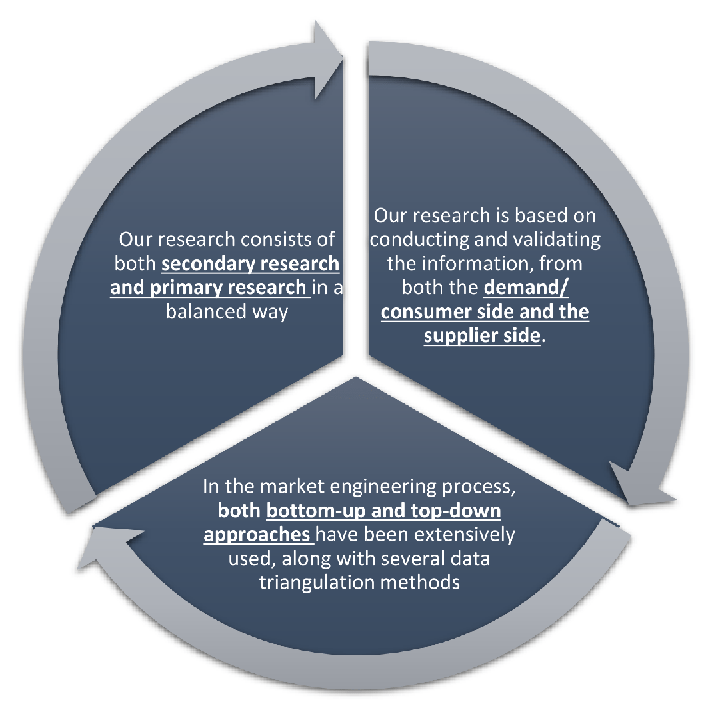
MarketGenics leverages a dedicated industry panel of experts and a comprehensive suite of paid databases to effectively collect, consolidate, and analyze market intelligence.
Our approach has consistently proven to be reliable and effective in generating accurate market insights, identifying key industry trends, and uncovering emerging business opportunities.
Through both primary and secondary research, we capture and analyze critical company-level data such as manufacturing footprints, including technical centers, R&D facilities, sales offices, and headquarters.
Our expert panel further enhances our ability to estimate market size for specific brands based on validated field-level intelligence.
Our data mining techniques incorporate both parametric and non-parametric methods, allowing for structured data collection, sorting, processing, and cleaning.
Demand projections are derived from large-scale data sets analyzed through proprietary algorithms, culminating in robust and reliable market sizing.
Research Approach
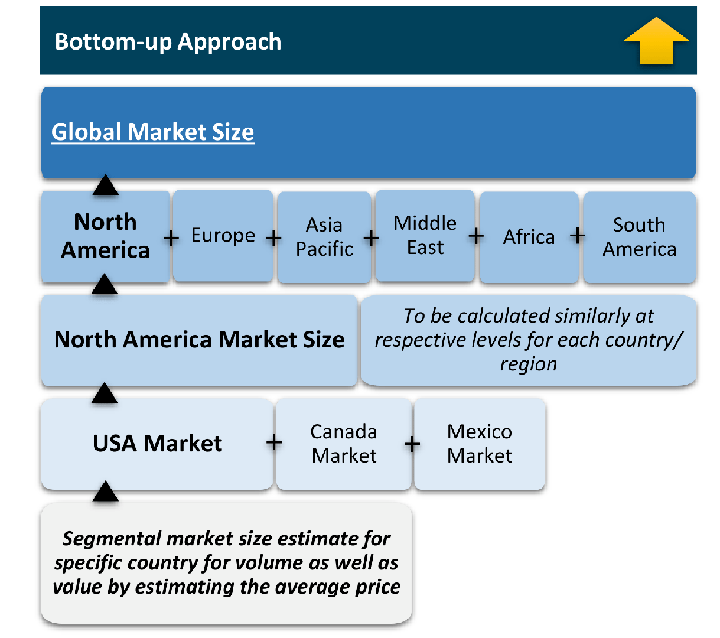
The bottom-up approach builds market estimates by starting with the smallest addressable market units and systematically aggregating them to create comprehensive market size projections.
This method begins with specific, granular data points and builds upward to create the complete market landscape.
Customer Analysis → Segmental Analysis → Geographical Analysis
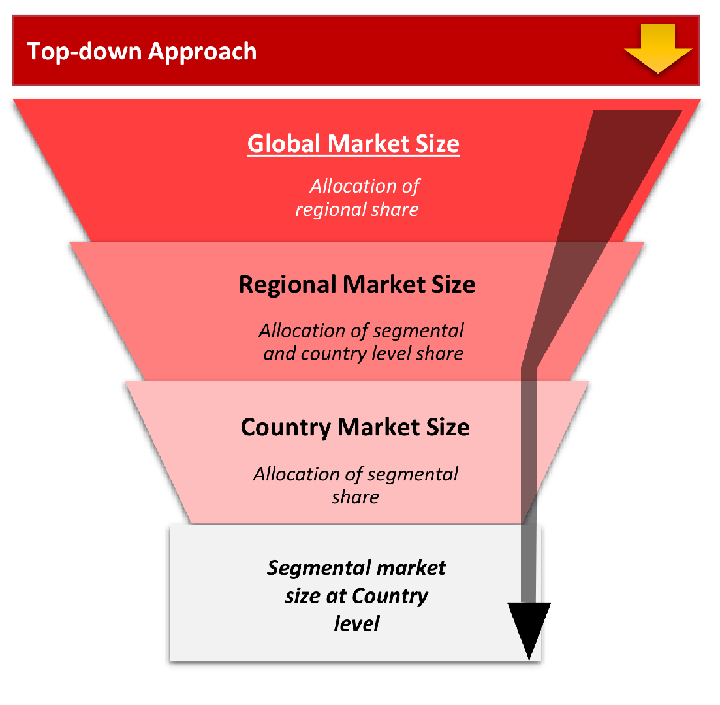
The top-down approach starts with the broadest possible market data and systematically narrows it down through a series of filters and assumptions to arrive at specific market segments or opportunities.
This method begins with the big picture and works downward to increasingly specific market slices.
TAM → SAM → SOM
Research Methods
Desk / Secondary Research
While analysing the market, we extensively study secondary sources, directories, and databases to identify and collect information useful for this technical, market-oriented, and commercial report. Secondary sources that we utilize are not only the public sources, but it is a combination of Open Source, Associations, Paid Databases, MG Repository & Knowledgebase, and others.
- Company websites, annual reports, financial reports, broker reports, and investor presentations
- National government documents, statistical databases and reports
- News articles, press releases and web-casts specific to the companies operating in the market, Magazines, reports, and others
- We gather information from commercial data sources for deriving company specific data such as segmental revenue, share for geography, product revenue, and others
- Internal and external proprietary databases (industry-specific), relevant patent, and regulatory databases
- Governing Bodies, Government Organizations
- Relevant Authorities, Country-specific Associations for Industries
We also employ the model mapping approach to estimate the product level market data through the players' product portfolio
Primary Research
Primary research/ interviews is vital in analyzing the market. Most of the cases involves paid primary interviews. Primary sources include primary interviews through e-mail interactions, telephonic interviews, surveys as well as face-to-face interviews with the different stakeholders across the value chain including several industry experts.
| Type of Respondents | Number of Primaries |
|---|---|
| Tier 2/3 Suppliers | ~20 |
| Tier 1 Suppliers | ~25 |
| End-users | ~25 |
| Industry Expert/ Panel/ Consultant | ~30 |
| Total | ~100 |
MG Knowledgebase
• Repository of industry blog, newsletter and case studies
• Online platform covering detailed market reports, and company profiles
Forecasting Factors and Models
Forecasting Factors
- Historical Trends – Past market patterns, cycles, and major events that shaped how markets behave over time. Understanding past trends helps predict future behavior.
- Industry Factors – Specific characteristics of the industry like structure, regulations, and innovation cycles that affect market dynamics.
- Macroeconomic Factors – Economic conditions like GDP growth, inflation, and employment rates that affect how much money people have to spend.
- Demographic Factors – Population characteristics like age, income, and location that determine who can buy your product.
- Technology Factors – How quickly people adopt new technology and how much technology infrastructure exists.
- Regulatory Factors – Government rules, laws, and policies that can help or restrict market growth.
- Competitive Factors – Analyzing competition structure such as degree of competition and bargaining power of buyers and suppliers.
Forecasting Models / Techniques
Multiple Regression Analysis
- Identify and quantify factors that drive market changes
- Statistical modeling to establish relationships between market drivers and outcomes
Time Series Analysis – Seasonal Patterns
- Understand regular cyclical patterns in market demand
- Advanced statistical techniques to separate trend, seasonal, and irregular components
Time Series Analysis – Trend Analysis
- Identify underlying market growth patterns and momentum
- Statistical analysis of historical data to project future trends
Expert Opinion – Expert Interviews
- Gather deep industry insights and contextual understanding
- In-depth interviews with key industry stakeholders
Multi-Scenario Development
- Prepare for uncertainty by modeling different possible futures
- Creating optimistic, pessimistic, and most likely scenarios
Time Series Analysis – Moving Averages
- Sophisticated forecasting for complex time series data
- Auto-regressive integrated moving average models with seasonal components
Econometric Models
- Apply economic theory to market forecasting
- Sophisticated economic models that account for market interactions
Expert Opinion – Delphi Method
- Harness collective wisdom of industry experts
- Structured, multi-round expert consultation process
Monte Carlo Simulation
- Quantify uncertainty and probability distributions
- Thousands of simulations with varying input parameters
Research Analysis
Our research framework is built upon the fundamental principle of validating market intelligence from both demand and supply perspectives. This dual-sided approach ensures comprehensive market understanding and reduces the risk of single-source bias.
Demand-Side Analysis: We understand end-user/application behavior, preferences, and market needs along with the penetration of the product for specific application.
Supply-Side Analysis: We estimate overall market revenue, analyze the segmental share along with industry capacity, competitive landscape, and market structure.
Validation & Evaluation
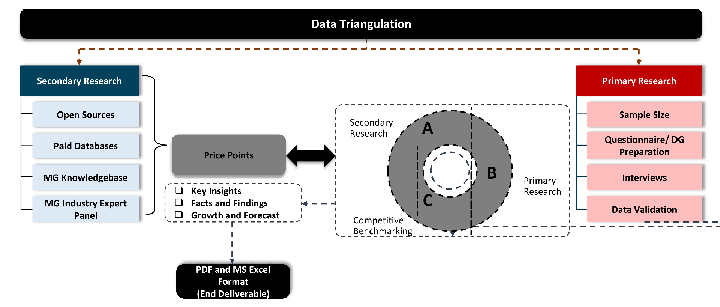
Data triangulation is a validation technique that uses multiple methods, sources, or perspectives to examine the same research question, thereby increasing the credibility and reliability of research findings. In market research, triangulation serves as a quality assurance mechanism that helps identify and minimize bias, validate assumptions, and ensure accuracy in market estimates.
- Data Source Triangulation – Using multiple data sources to examine the same phenomenon
- Methodological Triangulation – Using multiple research methods to study the same research question
- Investigator Triangulation – Using multiple researchers or analysts to examine the same data
- Theoretical Triangulation – Using multiple theoretical perspectives to interpret the same data
Custom Market Research Services
We will customise the research for you, in case the report listed above does not meet your requirements.
Get 10% Free Customisation