Green Packaging Materials Market Size, Share & Trends Analysis Report by Material Type (Recycled Content Material, Biodegradable/Compostable Materials, Reusable Materials, Plant-based Materials), Packaging Type, Application, Recyclability Type, Source Type, Distribution Channel, End-use Industry, and Geography (North America, Europe, Asia Pacific, Middle East, Africa, and South America) – Global Industry Data, Trends, and Forecasts, 2026–2035
|
|
|
Segmental Data Insights |
|
|
Demand Trends |
|
|
Competitive Landscape |
|
|
Strategic Development |
|
|
Future Outlook & Opportunities |
|
Green-Packaging-Materials-Market Size, Share, and Growth
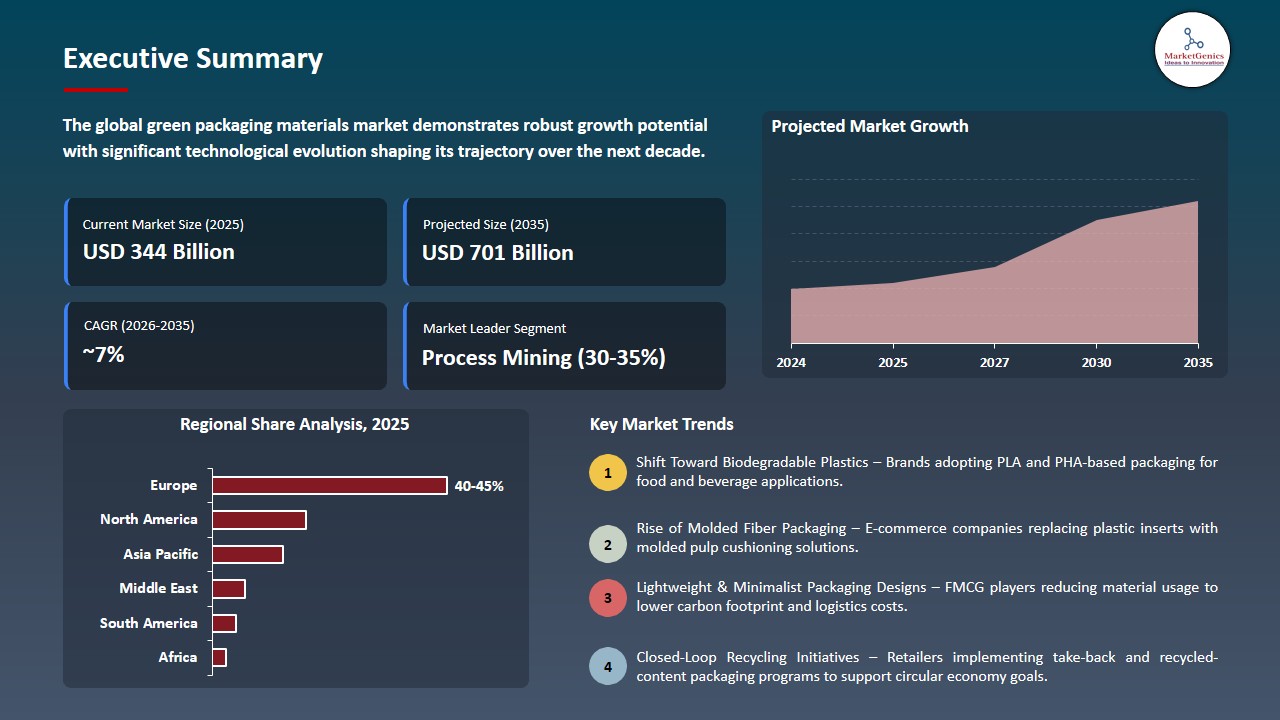
The global green packaging materials market is witnessing strong growth, valued at USD 343.5 billion in 2025 and projected to reach USD 701.4 billion by 2035, expanding at a CAGR of 7.4% during the forecast period. North America is the fastest-growing green packaging materials market due to increasing consumer demand for sustainable packaging, strict environmental regulations, corporate sustainability commitments, advanced recycling infrastructure, and widespread adoption of recyclable, biodegradable, and compostable materials across food, beverage, and consumer goods industries.
Mr. Ashish Saxena, Joint President, Packaging Films Business, UFlex Limited, said, “Since our inception, we have always been committed to pioneering sustainable packaging solutions. We are pleased to offer our latest innovation the single-pellet solution, which will be a game-changer for food and beverage brands striving to meet EPR compliance under the new FSSAI guidelines.”
Increased environmental awareness, governmental policies on single use plastics, and corporate responsibility to sustainability are driving the green packaging materials market with brands moving to recyclable, biodegradable, and compostable materials. The packaging of food, personal care, and e-commerce industries in consumer demand requires eco-friendly packaging solutions that stimulate the use of plant-based polymers and recycled content solutions. Amcor also increased the manufacture of Certified Recycled Resin (PCR) bottled beverage packaging in 2025, which boosted the circularity of the process and minimized the consumption of virgin plastic. On the same note Ball Corporation declared that it will utilize more recycled aluminum and low-carbon can manufacturing technologies in order to achieve brand sustainability goals and reduce the lifecycle emissions.
Bio-based polymers including polylastic or polyethylene derived out of sugarcane, paper-based flexible packaging alternatives are also innovating to adopt the broader market. This shift to green materials is being supported with regulatory attempts such as extended producer responsibility (EPR) frameworks and plastic bans. Rapid growth and long-term sustainability in the areas of sustainable packaging are minimizing the environmental effects and transforming the supply chains and consumer demands.
Adjacent opportunities to the green packaging materials market are growth in the production of biopolymer resins, composting and organic waste handling systems, recycled content processing technology, sustainable printing inks and coatings, and environmentally friendly packaging machinery and automation systems. Expansion of these interdependent industries boosts the integration of circular supply chains and improves end to end sustainability. These are all the neighboring markets, which enhance innovation, scalability, and value creation throughout the green packaging ecosystem.
Green Packaging Materials Market Dynamics and Trends
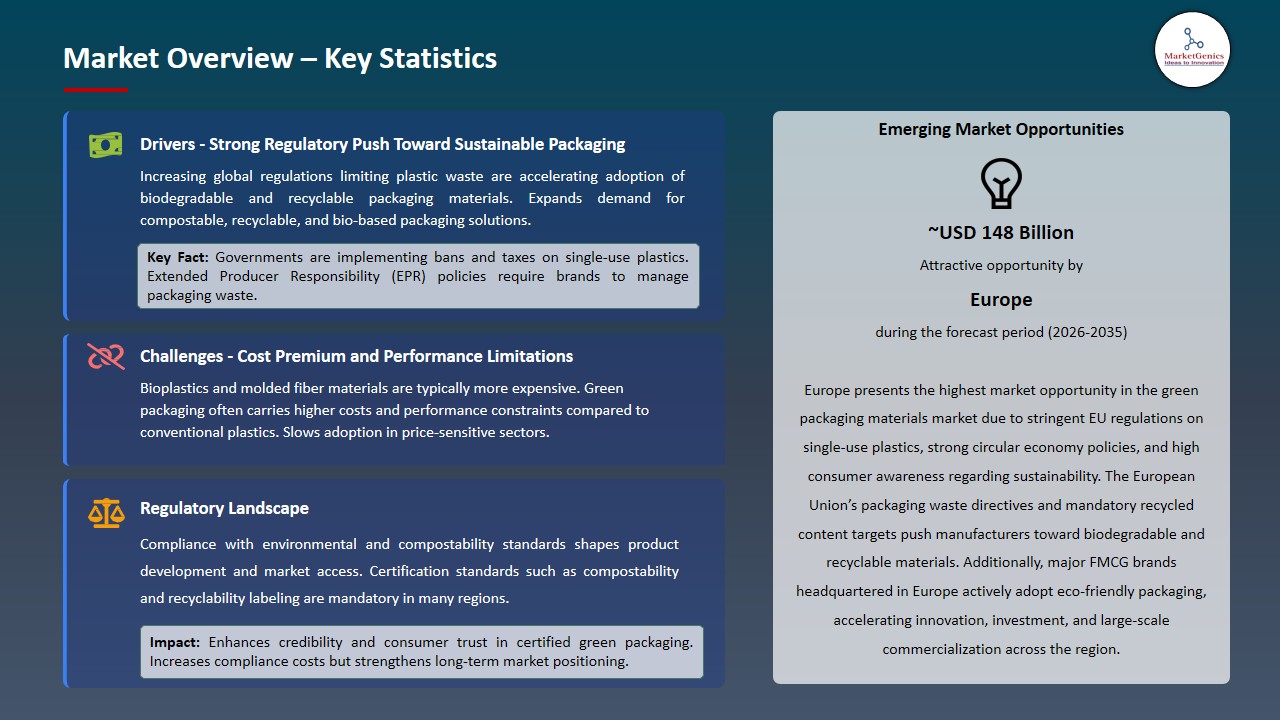
Driver: Rising Regulatory Pressure and Sustainability Targets Driving Green Packaging Demand
-
Regulatory pressure on waste reduction of single-use plastics and packaging is gaining momentum at a very high rate hence the demand of green packaging materials. Plastic bans, extended producer responsibility (EPR) schemes, recycled content requirements, and tighter waste management policies are some measures governments are introducing to ensure control of environmental pollution and reliance on landfills.
- These measures are forcing manufacturers and brand owners to re-design packaging formats, use more recycled materials and more bio-based materials and implement compostable/reusable alternatives, leading to structural change throughout the packaging supply chains.
- Unilever also changed its targets of plastic packaging to reduce by 50% by 2025 to 30% by 2026 and 40% by 2028, and delayed the aims of achieving 100% plastic recyclable or compostable packaging to 2035. The tweaking incorporates changing regulatory demands and realities of operations that define sustainable packaging shifts.
- Tightened laws and changing corporate sustainability goals are spurring more rapid conversions to more friendly and compliant green packaging solutions worldwide.
Restraint: Stringent Regulatory Approval Processes for Implantable Green Packaging Materials
-
High costs of production and supply chain limitations are challenging the development of the green packaging materials in the market considerably. Other innovative materials, including bio-based plastics, compostable polymers, and recycled content packaging, may involve a specialized raw material, an energy-intensive process and complex manufacturing technologies, which raise the overall cost of production. Such increased costs will inhibit adoption especially with small and medium-sized manufacturers who may not absorb or transmit the extra costs.
- These problems are further worsened by supply chain constraints. Renewable feedstock availability, variation in raw materials availability and complexities in logistics can affect the continuity in production and delay time to market. The manufactures also need to control uniformity of quality in sustainable material that might be different depending on the sourcing region.
- The conditions have the potential to decelerate the market growth and influence the competitiveness of prices in price sensitive markets, limiting the wider implementation of green packaging solutions.
Opportunity: Expansion of Circular Economy Solutions Through Recycled Content Integration Programs
-
The increasing focus on the principles of the circular economy is a great opportunity of the green packaging material market. Firms are also adopting a high recycled content in packaging products, less virgin material use, less waste and less carbon footprints.
- Innovations like refillable, reusable and recyclable packaging, collaborative R&D between supply chains help manufacturers to boost sustainability credentials in addition to satisfying regulatory pressures and consumer expectations of greener solutions, as long-term solutions of circular packaging systems.
- Ball has a 90 percent recycling goal of its products, 85 percent of total recycles in cans and bottles, and 75 percent recycles in ReAl aerosol containers demonstrating sustainable, low-emission, and resource-efficient packaging solutions.
- The circular economy practices are improving sustainability, reducing emissions, and boosting the market of green packaging materials.
Key Trend: Adoption of Smart, Intelligent, and Functional Green Packaging Solutions
-
Incorporation of smart and functional technologies in green packaging is becoming a major trend in the market. Smart capabilities, including QR-codes, NFC tags, and sensors help to track products and authenticate them in real-time, engage consumers, and add value to the brand and supply chain visibilities.
- The functional packaging solutions such as moisture-control, anti-microbial coating, and active preservation layers increase the product shelf life and safety. With sustainability design and smart functionality, manufacturers are able to address the demand of consumers to achieve eco-friendly, convenient, and high-performance packaging solution.
- In 2025, Fujian Nanwang has introduced industrial durable and pressure-sensitive labels featuring 3-layer technology, which allows the labels to have dependable adhesion and readability to strengthen smart, functional, and sustainable packaging solutions in manufacturing, logistics, and asset management.
- The trend is influencing the use of smart, high-quality, and sustainable packaging, enhancing supply chain effectiveness, product security, and consumer-interaction.
Green Packaging Materials Market Analysis and Segmental Data
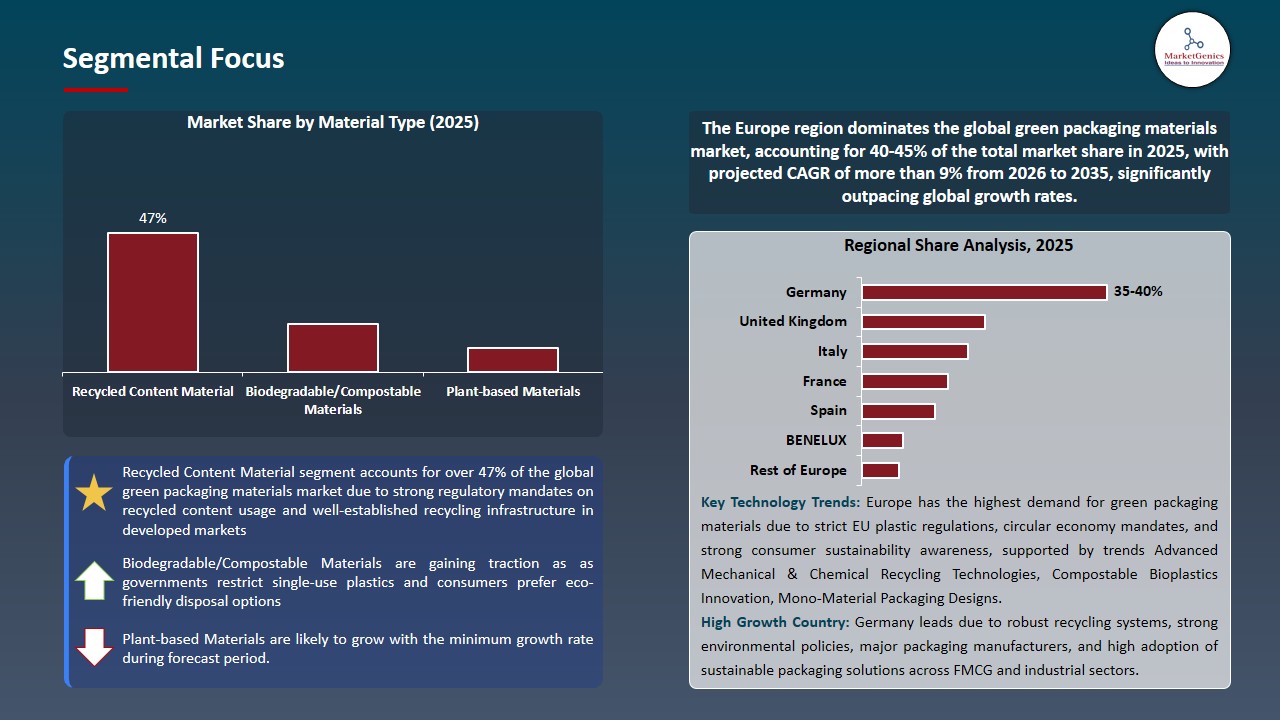
Recycled Content Material Dominate Global Green Packaging Materials Market
-
The recycled content material segment is leading in the international green packaging material market. The power of the company is mainly because of the high level of regulatory requirements, the consumers favoring the sustainability packaging and the recycling system that is well established, in the developed countries.
- Recycled plastics, paper and metals are increasingly being used by manufacturers to create packaging that would fulfill environmental requirements with less virgin materials being used. These materials deliver performance similar to traditional packaging but reduce considerably on the environmental impact including use of energy and carbon emissions.
- Adoption is further enhanced by continuous innovations in recycling technologies, corporate sustainability commitments. The growth of the segment is anchored on the rise of investment in collection sorting and processing systems that may guarantee a scaling and economically viable green packaging solutions.
- The recycled content material sector will continue to lead the market, which will be supported through regulation, consumer needs, technological empowerment, and the sustainable packaging solutions to be scaled.
North America Leads Global Green Packaging Materials Market Demand
-
North America holds a leading position in the global green packaging materials market due to high consumer awareness of sustainability, strict environmental regulations, and strong corporate commitments to reducing packaging waste.
- The high-developed recycling system and waste management solutions of the region allow the extensive use of recycled, biodegradable, and compostable materials in various industry sectors such as food and beverage, personal care, and e-commerce packaging. Large manufacturers and stores in North America are progressively incorporating eco-friendly packaging into the supply chain in an effort to address regulatory demands and consumer demands.
- Strategic investments in innovation, research and development in sustainable materials are also a boost to the market dominance of the region such that solutions in green packaging are scalable, cost effective and offers a continuous growth potential.
Green Packaging Materials Market Ecosystem
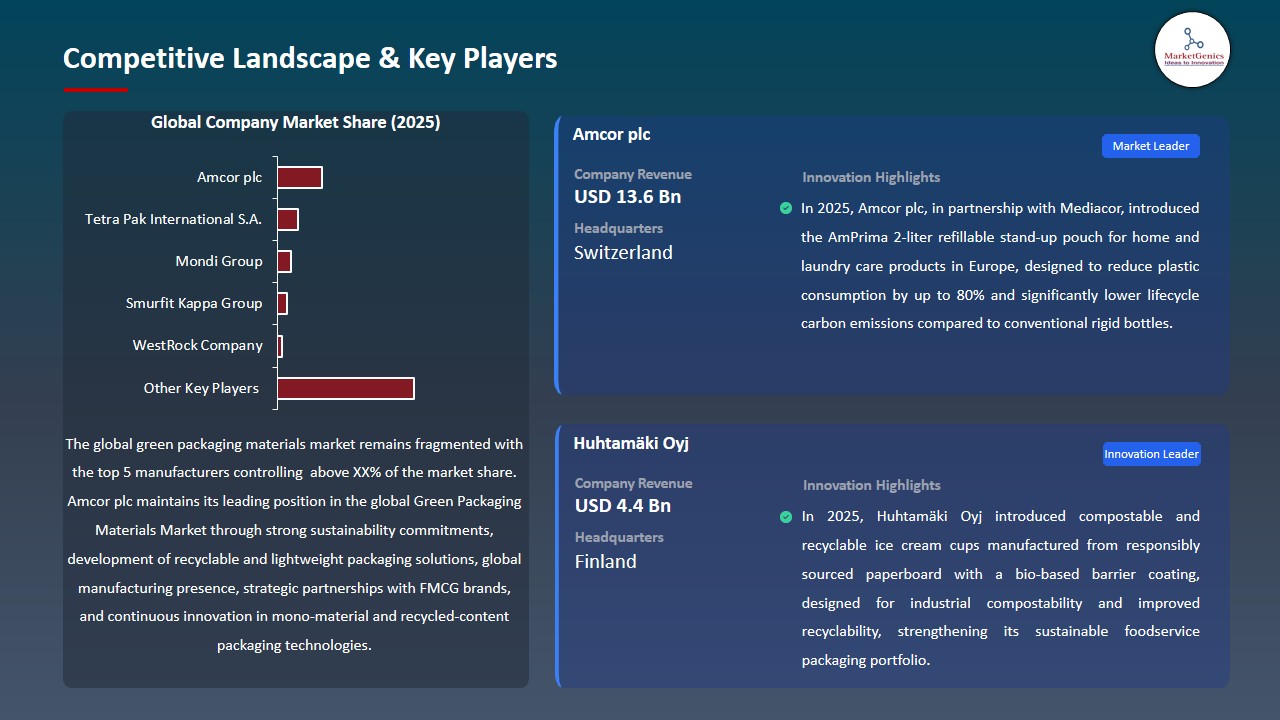
The global green packaging materials market is moderately fragmented, with key players including Amcor plc, Tetra Pak International S.A., Mondi Group, Smurfit Kappa Group, and WestRock Company. The strategies that enable these companies to be in high competitiveness include; diversified sustainable packaging portfolio, new material technologies and global distribution network. Their dominance in the market has been enhanced by the constant investment in the recyclable and biodegradable solutions, innovative packaging designs, and strategic partnerships with food, beverage, and consumer goods producers.
The market value chain of green packaging materials includes sourcing of raw materials, processing of materials, design and manufacture of packaging, integration of system, distribution of raw material and recycling after use. Quality assurance, regulatory compliance, and recycling of products at end-of-life also help in augmenting the performance and sustainability of products, contributing to their usage in the industrial, retail, and e-commerce segments.
Entry barriers are high owing to technological demands, capital-threatening production, compliance to environmental policies, as well as the long-term supplier and customer relationships. Ongoing innovations like enhanced recyclable materials, compostable finishes, designing based on mono-material, and lightweight packaging are also leading to market differentiation, low cost and green solutions sustainable growth of the world green packaging materials market.
Recent Development and Strategic Overview:
-
In June 2025, UFlex launched an FSSAI-compliant single-pellet solution for recycled PET in food and beverage packaging, enabling brands to meet EPR requirements. The high-purity resin ensures mechanical stability, safety for direct food contact, and seamless integration with existing PET lines, supporting sustainable, scalable, and regulatory-compliant packaging solutions across India.
- In September 2025, Avery Dennison launched advanced labeling solutions, including AD CleanGlass and AD CleanFiber for improved recycling, premium Infinity and Sensorial Collections, chemically recycled PET labels for automotive and EV batteries, and UV barrier pharmaceutical labels, combining sustainability, connectivity, and enhanced functionality to support circular packaging, traceability, and product safety across multiple industries.
Report Scope
|
Detail |
|
|
Market Size in 2025 |
USD 343.5 Bn |
|
Market Forecast Value in 2035 |
USD 701.4 Bn |
|
Growth Rate (CAGR) |
7.4% |
|
Forecast Period |
2026 – 2035 |
|
Historical Data Available for |
2021 – 2024 |
|
Market Size Units |
US$ Billion for Value |
|
Report Format |
Electronic (PDF) + Excel |
|
North America |
Europe |
Asia Pacific |
Middle East |
Africa |
South America |
|
|
|
|
|
|
|
Companies Covered |
|||||
|
|
|
|
|
|
Green Packaging Materials Market Segmentation and Highlights
|
Segment |
Sub-segment |
|
Green Packaging Materials Market, By Material Type |
|
|
Green Packaging Materials Market, By Packaging Type |
|
|
Green Packaging Materials Market, By Application |
|
|
Green Packaging Materials Market, By Recyclability Type |
|
|
Green Packaging Materials Market, By Source Type |
|
|
Green Packaging Materials Market, By Distribution Channel |
|
|
Green Packaging Materials Market, By End-use Industry |
|
Frequently Asked Questions
Table of Contents
- 1. Research Methodology and Assumptions
- 1.1. Definitions
- 1.2. Research Design and Approach
- 1.3. Data Collection Methods
- 1.4. Base Estimates and Calculations
- 1.5. Forecasting Models
- 1.5.1. Key Forecast Factors & Impact Analysis
- 1.6. Secondary Research
- 1.6.1. Open Sources
- 1.6.2. Paid Databases
- 1.6.3. Associations
- 1.7. Primary Research
- 1.7.1. Primary Sources
- 1.7.2. Primary Interviews with Stakeholders across Ecosystem
- 2. Executive Summary
- 2.1. Global Green Packaging Materials Market Outlook
- 2.1.1. Green Packaging Materials Market Size Value (US$ Bn), and Forecasts, 2021-2035
- 2.1.2. Compounded Annual Growth Rate Analysis
- 2.1.3. Growth Opportunity Analysis
- 2.1.4. Segmental Share Analysis
- 2.1.5. Geographical Share Analysis
- 2.2. Market Analysis and Facts
- 2.3. Supply-Demand Analysis
- 2.4. Competitive Benchmarking
- 2.5. Go-to- Market Strategy
- 2.5.1. Customer/ End-use Industry Assessment
- 2.5.2. Growth Opportunity Data, 2026-2035
- 2.5.2.1. Regional Data
- 2.5.2.2. Country Data
- 2.5.2.3. Segmental Data
- 2.5.3. Identification of Potential Market Spaces
- 2.5.4. GAP Analysis
- 2.5.5. Potential Attractive Price Points
- 2.5.6. Prevailing Market Risks & Challenges
- 2.5.7. Preferred Sales & Marketing Strategies
- 2.5.8. Key Recommendations and Analysis
- 2.5.9. A Way Forward
- 2.1. Global Green Packaging Materials Market Outlook
- 3. Industry Data and Premium Insights
- 3.1. Global Chemicals & Materials Industry Overview, 2025
- 3.1.1. Chemicals & Materials Industry Ecosystem Analysis
- 3.1.2. Key Trends for Chemicals & Materials Industry
- 3.1.3. Regional Distribution for Chemicals & Materials Industry
- 3.2. Supplier Customer Data
- 3.3. Technology Roadmap and Developments
- 3.4. Trade Analysis
- 3.4.1. Import & Export Analysis, 2025
- 3.4.2. Top Importing Countries
- 3.4.3. Top Exporting Countries
- 3.5. Trump Tariff Impact Analysis
- 3.5.1. Manufacturer
- 3.5.1.1. Based on the component & Raw material
- 3.5.2. Supply Chain
- 3.5.3. End Consumer
- 3.5.1. Manufacturer
- 3.6. Raw Material Analysis
- 3.1. Global Chemicals & Materials Industry Overview, 2025
- 4. Market Overview
- 4.1. Market Dynamics
- 4.1.1. Drivers
- 4.1.1.1. Rising consumer demand for sustainable and recyclable packaging solutions.
- 4.1.1.2. Stringent government regulations restricting single-use plastics.
- 4.1.1.3. Corporate sustainability commitments and circular economy initiatives.
- 4.1.2. Restraints
- 4.1.2.1. Higher cost compared to conventional packaging materials.
- 4.1.2.2. Limited recycling and composting infrastructure in developing regions.
- 4.1.1. Drivers
- 4.2. Key Trend Analysis
- 4.3. Regulatory Framework
- 4.3.1. Key Regulations, Norms, and Subsidies, by Key Countries
- 4.3.2. Tariffs and Standards
- 4.3.3. Impact Analysis of Regulations on the Market
- 4.4. Value Chain Analysis
- 4.5. Porter’s Five Forces Analysis
- 4.6. PESTEL Analysis
- 4.7. Global Green Packaging Materials Market Demand
- 4.7.1. Historical Market Size – Value (US$ Bn), 2020-2024
- 4.7.2. Current and Future Market Size – Value (US$ Bn), 2026–2035
- 4.7.2.1. Y-o-Y Growth Trends
- 4.7.2.2. Absolute $ Opportunity Assessment
- 4.1. Market Dynamics
- 5. Competition Landscape
- 5.1. Competition structure
- 5.1.1. Fragmented v/s consolidated
- 5.2. Company Share Analysis, 2025
- 5.2.1. Global Company Market Share
- 5.2.2. By Region
- 5.2.2.1. North America
- 5.2.2.2. Europe
- 5.2.2.3. Asia Pacific
- 5.2.2.4. Middle East
- 5.2.2.5. Africa
- 5.2.2.6. South America
- 5.3. Product Comparison Matrix
- 5.3.1. Specifications
- 5.3.2. Market Positioning
- 5.3.3. Pricing
- 5.1. Competition structure
- 6. Global Green Packaging Materials Market Analysis, by Material Type
- 6.1. Key Segment Analysis
- 6.2. Green Packaging Materials Market Size (Value (US$ Bn)), Analysis, and Forecasts, by Material Type, 2021-2035
- 6.2.1. Recycled Content Material
- 6.2.1.1. Recycled Paper & Paperboard
- 6.2.1.2. Recycled Plastics
- 6.2.1.2.1. rPET
- 6.2.1.2.2. rPE
- 6.2.1.2.3. rPP
- 6.2.1.3. Recycled Glass
- 6.2.1.4. Recycled Metal
- 6.2.1.5. Others
- 6.2.2. Biodegradable/Compostable Materials
- 6.2.2.1. PLA (Polylactic Acid)
- 6.2.2.2. PHA (Polyhydroxyalkanoates)
- 6.2.2.3. Starch Blends
- 6.2.2.4. Cellulose-based Materials
- 6.2.2.5. PBS (Polybutylene Succinate)
- 6.2.2.6. Others
- 6.2.3. Reusable Materials
- 6.2.3.1. Durable Plastics
- 6.2.3.2. Glass
- 6.2.3.3. Metal
- 6.2.3.4. Others
- 6.2.4. Plant-based Materials
- 6.2.4.1. Bamboo
- 6.2.4.2. Bagasse
- 6.2.4.3. Mushroom-based
- 6.2.4.4. Seaweed-based
- 6.2.4.5. Hemp
- 6.2.4.6. Others
- 6.2.1. Recycled Content Material
- 7. Global Green Packaging Materials Market Analysis, by Packaging Type
- 7.1. Key Segment Analysis
- 7.2. Green Packaging Materials Market Size (Value (US$ Bn)), Analysis, and Forecasts, by Packaging Type, 2021-2035
- 7.2.1. Rigid Packaging
- 7.2.1.1. Bottles & Jars
- 7.2.1.2. Containers
- 7.2.1.3. Boxes
- 7.2.1.4. Cans
- 7.2.1.5. Trays
- 7.2.1.6. Others
- 7.2.2. Flexible Packaging
- 7.2.2.1. Films
- 7.2.2.2. Pouches
- 7.2.2.3. Bags
- 7.2.2.4. Wraps
- 7.2.2.5. Sachets
- 7.2.2.6. Others
- 7.2.1. Rigid Packaging
- 8. Global Green Packaging Materials Market Analysis, by Application
- 8.1. Key Segment Analysis
- 8.2. Green Packaging Materials Market Size (Value (US$ Bn)), Analysis, and Forecasts, by Application, 2021-2035
- 8.2.1. Primary Packaging
- 8.2.2. Secondary Packaging
- 8.2.3. Tertiary Packaging
- 8.2.4. Transportation Packaging
- 8.2.5. Protective Packaging
- 9. Global Green Packaging Materials Market Analysis, by Recyclability Type
- 9.1. Key Segment Analysis
- 9.2. Green Packaging Materials Market Size (Value (US$ Bn)), Analysis, and Forecasts, by Recyclability Type, 2021-2035
- 9.2.1. Readily Recyclable
- 9.2.2. Limited Recyclability
- 9.2.3. Non-recyclable but Compostable
- 9.2.4. Reusable
- 10. Global Green Packaging Materials Market Analysis, by Source Type
- 10.1. Key Segment Analysis
- 10.2. Green Packaging Materials Market Size (Value (US$ Bn)), Analysis, and Forecasts, by Source Type, 2021-2035
- 10.2.1. Post-consumer Recycled
- 10.2.2. Post-industrial Recycled
- 10.2.3. Bio-based/Renewable
- 10.2.4. Hybrid
- 11. Global Green Packaging Materials Market Analysis, by Distribution Channel
- 11.1. Key Segment Analysis
- 11.2. Green Packaging Materials Market Size (Value (US$ Bn)), Analysis, and Forecasts, by Distribution Channel, 2021-2035
- 11.2.1. Direct Sales
- 11.2.2. Distributors
- 11.2.3. Online Channels
- 11.2.4. Retail
- 12. Global Green Packaging Materials Market Analysis, by End-use Industry
- 12.1. Key Segment Analysis
- 12.2. Green Packaging Materials Market Size (Value (US$ Bn)), Analysis, and Forecasts, by End-use Industry, 2021-2035
- 12.2.1. Food & Beverages
- 12.2.1.1. Fresh Food
- 12.2.1.2. Processed Food
- 12.2.1.3. Beverages
- 12.2.1.4. Dairy Products
- 12.2.1.5. Bakery & Confectionery
- 12.2.1.6. Frozen Foods
- 12.2.1.7. Others
- 12.2.2. Personal Care & Cosmetics
- 12.2.2.1. Skincare
- 12.2.2.2. Haircare
- 12.2.2.3. Color Cosmetics
- 12.2.2.4. Fragrances
- 12.2.2.5. Oral Care
- 12.2.2.6. Others
- 12.2.3. Pharmaceuticals & Healthcare
- 12.2.3.1. Prescription Drugs
- 12.2.3.2. OTC Medications
- 12.2.3.3. Medical Devices
- 12.2.3.4. Nutraceuticals
- 12.2.3.5. Others
- 12.2.4. Home Care & Household Products
- 12.2.4.1. Detergents
- 12.2.4.2. Cleaning Products
- 12.2.4.3. Air Care
- 12.2.4.4. Dishwashing Products
- 12.2.4.5. Others
- 12.2.5. E-commerce & Retail
- 12.2.5.1. Online Retail
- 12.2.5.2. Traditional Retail
- 12.2.5.3. Omnichannel Retail
- 12.2.5.4. Others
- 12.2.6. Industrial & Chemicals
- 12.2.6.1. Industrial Chemicals
- 12.2.6.2. Lubricants
- 12.2.6.3. Adhesives & Sealants
- 12.2.6.4. Others
- 12.2.7. Agriculture
- 12.2.7.1. Seeds
- 12.2.7.2. Fertilizers
- 12.2.7.3. Pesticides
- 12.2.7.4. Animal Feed
- 12.2.7.5. Others
- 12.2.8. Electronics & Consumer Goods
- 12.2.8.1. Consumer Electronics
- 12.2.8.2. Appliances
- 12.2.8.3. Toys & Games
- 12.2.8.4. Sporting Goods
- 12.2.8.5. Others
- 12.2.9. Automotive
- 12.2.9.1. Auto Parts
- 12.2.9.2. Fluids & Lubricants
- 12.2.9.3. Accessories
- 12.2.9.4. Others
- 12.2.10. Textile & Apparel
- 12.2.10.1. Clothing
- 12.2.10.2. Footwear
- 12.2.10.3. Accessories
- 12.2.10.4. Others
- 12.2.11. Others
- 12.2.1. Food & Beverages
- 13. Global Green Packaging Materials Market Analysis and Forecasts, by Region
- 13.1. Key Findings
- 13.2. Green Packaging Materials Market Size (Value (US$ Bn)), Analysis, and Forecasts, by Region, 2021-2035
- 13.2.1. North America
- 13.2.2. Europe
- 13.2.3. Asia Pacific
- 13.2.4. Middle East
- 13.2.5. Africa
- 13.2.6. South America
- 14. North America Green Packaging Materials Market Analysis
- 14.1. Key Segment Analysis
- 14.2. Regional Snapshot
- 14.3. North America Green Packaging Materials Market Size (Value (US$ Bn)), Analysis, and Forecasts, 2021-2035
- 14.3.1. Material Type
- 14.3.2. Packaging Type
- 14.3.3. Biodegradability
- 14.3.4. Application
- 14.3.5. Source Type
- 14.3.6. Distribution Channel
- 14.3.7. End-use Industry
- 14.3.8. Country
- 14.3.8.1. USA
- 14.3.8.2. Canada
- 14.3.8.3. Mexico
- 14.4. USA Green Packaging Materials Market
- 14.4.1. Country Segmental Analysis
- 14.4.2. Material Type
- 14.4.3. Packaging Type
- 14.4.4. Biodegradability
- 14.4.5. Application
- 14.4.6. Source Type
- 14.4.7. Distribution Channel
- 14.4.8. End-use Industry
- 14.5. Canada Green Packaging Materials Market
- 14.5.1. Country Segmental Analysis
- 14.5.2. Material Type
- 14.5.3. Packaging Type
- 14.5.4. Biodegradability
- 14.5.5. Application
- 14.5.6. Source Type
- 14.5.7. Distribution Channel
- 14.5.8. End-use Industry
- 14.6. Mexico Green Packaging Materials Market
- 14.6.1. Country Segmental Analysis
- 14.6.2. Material Type
- 14.6.3. Packaging Type
- 14.6.4. Biodegradability
- 14.6.5. Application
- 14.6.6. Source Type
- 14.6.7. Distribution Channel
- 14.6.8. End-use Industry
- 15. Europe Green Packaging Materials Market Analysis
- 15.1. Key Segment Analysis
- 15.2. Regional Snapshot
- 15.3. Europe Green Packaging Materials Market Size (Value (US$ Bn)), Analysis, and Forecasts, 2021-2035
- 15.3.1. Material Type
- 15.3.2. Packaging Type
- 15.3.3. Biodegradability
- 15.3.4. Application
- 15.3.5. Source Type
- 15.3.6. Distribution Channel
- 15.3.7. End-use Industry
- 15.3.8. Country
- 15.3.8.1. Germany
- 15.3.8.2. United Kingdom
- 15.3.8.3. France
- 15.3.8.4. Italy
- 15.3.8.5. Spain
- 15.3.8.6. Netherlands
- 15.3.8.7. Nordic Countries
- 15.3.8.8. Poland
- 15.3.8.9. Russia & CIS
- 15.3.8.10. Rest of Europe
- 15.4. Germany Green Packaging Materials Market
- 15.4.1. Country Segmental Analysis
- 15.4.2. Material Type
- 15.4.3. Packaging Type
- 15.4.4. Biodegradability
- 15.4.5. Application
- 15.4.6. Source Type
- 15.4.7. Distribution Channel
- 15.4.8. End-use Industry
- 15.5. United Kingdom Green Packaging Materials Market
- 15.5.1. Country Segmental Analysis
- 15.5.2. Material Type
- 15.5.3. Packaging Type
- 15.5.4. Biodegradability
- 15.5.5. Application
- 15.5.6. Source Type
- 15.5.7. Distribution Channel
- 15.5.8. End-use Industry
- 15.6. France Green Packaging Materials Market
- 15.6.1. Country Segmental Analysis
- 15.6.2. Material Type
- 15.6.3. Packaging Type
- 15.6.4. Biodegradability
- 15.6.5. Application
- 15.6.6. Source Type
- 15.6.7. Distribution Channel
- 15.6.8. End-use Industry
- 15.7. Italy Green Packaging Materials Market
- 15.7.1. Country Segmental Analysis
- 15.7.2. Material Type
- 15.7.3. Packaging Type
- 15.7.4. Biodegradability
- 15.7.5. Application
- 15.7.6. Source Type
- 15.7.7. Distribution Channel
- 15.7.8. End-use Industry
- 15.8. Spain Green Packaging Materials Market
- 15.8.1. Country Segmental Analysis
- 15.8.2. Material Type
- 15.8.3. Packaging Type
- 15.8.4. Biodegradability
- 15.8.5. Application
- 15.8.6. Source Type
- 15.8.7. Distribution Channel
- 15.8.8. End-use Industry
- 15.9. Netherlands Green Packaging Materials Market
- 15.9.1. Country Segmental Analysis
- 15.9.2. Material Type
- 15.9.3. Packaging Type
- 15.9.4. Biodegradability
- 15.9.5. Application
- 15.9.6. Source Type
- 15.9.7. Distribution Channel
- 15.9.8. End-use Industry
- 15.10. Nordic Countries Green Packaging Materials Market
- 15.10.1. Country Segmental Analysis
- 15.10.2. Material Type
- 15.10.3. Packaging Type
- 15.10.4. Biodegradability
- 15.10.5. Application
- 15.10.6. Source Type
- 15.10.7. Distribution Channel
- 15.10.8. End-use Industry
- 15.11. Poland Green Packaging Materials Market
- 15.11.1. Country Segmental Analysis
- 15.11.2. Material Type
- 15.11.3. Packaging Type
- 15.11.4. Biodegradability
- 15.11.5. Application
- 15.11.6. Source Type
- 15.11.7. Distribution Channel
- 15.11.8. End-use Industry
- 15.12. Russia & CIS Green Packaging Materials Market
- 15.12.1. Country Segmental Analysis
- 15.12.2. Material Type
- 15.12.3. Packaging Type
- 15.12.4. Biodegradability
- 15.12.5. Application
- 15.12.6. Source Type
- 15.12.7. Distribution Channel
- 15.12.8. End-use Industry
- 15.13. Rest of Europe Green Packaging Materials Market
- 15.13.1. Country Segmental Analysis
- 15.13.2. Material Type
- 15.13.3. Packaging Type
- 15.13.4. Biodegradability
- 15.13.5. Application
- 15.13.6. Source Type
- 15.13.7. Distribution Channel
- 15.13.8. End-use Industry
- 16. Asia Pacific Green Packaging Materials Market Analysis
- 16.1. Key Segment Analysis
- 16.2. Regional Snapshot
- 16.3. Asia Pacific Green Packaging Materials Market Size (Value (US$ Bn)), Analysis, and Forecasts, 2021-2035
- 16.3.1. Material Type
- 16.3.2. Packaging Type
- 16.3.3. Biodegradability
- 16.3.4. Application
- 16.3.5. Source Type
- 16.3.6. Distribution Channel
- 16.3.7. End-use Industry
- 16.3.8. Country
- 16.3.8.1. China
- 16.3.8.2. India
- 16.3.8.3. Japan
- 16.3.8.4. South Korea
- 16.3.8.5. Australia and New Zealand
- 16.3.8.6. Indonesia
- 16.3.8.7. Malaysia
- 16.3.8.8. Thailand
- 16.3.8.9. Vietnam
- 16.3.8.10. Rest of Asia Pacific
- 16.4. China Green Packaging Materials Market
- 16.4.1. Country Segmental Analysis
- 16.4.2. Material Type
- 16.4.3. Packaging Type
- 16.4.4. Biodegradability
- 16.4.5. Application
- 16.4.6. Source Type
- 16.4.7. Distribution Channel
- 16.4.8. End-use Industry
- 16.5. India Green Packaging Materials Market
- 16.5.1. Country Segmental Analysis
- 16.5.2. Material Type
- 16.5.3. Packaging Type
- 16.5.4. Biodegradability
- 16.5.5. Application
- 16.5.6. Source Type
- 16.5.7. Distribution Channel
- 16.5.8. End-use Industry
- 16.6. Japan Green Packaging Materials Market
- 16.6.1. Country Segmental Analysis
- 16.6.2. Material Type
- 16.6.3. Packaging Type
- 16.6.4. Biodegradability
- 16.6.5. Application
- 16.6.6. Source Type
- 16.6.7. Distribution Channel
- 16.6.8. End-use Industry
- 16.7. South Korea Green Packaging Materials Market
- 16.7.1. Country Segmental Analysis
- 16.7.2. Material Type
- 16.7.3. Packaging Type
- 16.7.4. Biodegradability
- 16.7.5. Application
- 16.7.6. Source Type
- 16.7.7. Distribution Channel
- 16.7.8. End-use Industry
- 16.8. Australia and New Zealand Green Packaging Materials Market
- 16.8.1. Country Segmental Analysis
- 16.8.2. Material Type
- 16.8.3. Packaging Type
- 16.8.4. Biodegradability
- 16.8.5. Application
- 16.8.6. Source Type
- 16.8.7. Distribution Channel
- 16.8.8. End-use Industry
- 16.9. Indonesia Green Packaging Materials Market
- 16.9.1. Country Segmental Analysis
- 16.9.2. Material Type
- 16.9.3. Packaging Type
- 16.9.4. Biodegradability
- 16.9.5. Application
- 16.9.6. Source Type
- 16.9.7. Distribution Channel
- 16.9.8. End-use Industry
- 16.10. Malaysia Green Packaging Materials Market
- 16.10.1. Country Segmental Analysis
- 16.10.2. Material Type
- 16.10.3. Packaging Type
- 16.10.4. Biodegradability
- 16.10.5. Application
- 16.10.6. Source Type
- 16.10.7. Distribution Channel
- 16.10.8. End-use Industry
- 16.11. Thailand Green Packaging Materials Market
- 16.11.1. Country Segmental Analysis
- 16.11.2. Material Type
- 16.11.3. Packaging Type
- 16.11.4. Biodegradability
- 16.11.5. Application
- 16.11.6. Source Type
- 16.11.7. Distribution Channel
- 16.11.8. End-use Industry
- 16.12. Vietnam Green Packaging Materials Market
- 16.12.1. Country Segmental Analysis
- 16.12.2. Material Type
- 16.12.3. Packaging Type
- 16.12.4. Biodegradability
- 16.12.5. Application
- 16.12.6. Source Type
- 16.12.7. Distribution Channel
- 16.12.8. End-use Industry
- 16.13. Rest of Asia Pacific Green Packaging Materials Market
- 16.13.1. Country Segmental Analysis
- 16.13.2. Material Type
- 16.13.3. Packaging Type
- 16.13.4. Biodegradability
- 16.13.5. Application
- 16.13.6. Source Type
- 16.13.7. Distribution Channel
- 16.13.8. End-use Industry
- 17. Middle East Green Packaging Materials Market Analysis
- 17.1. Key Segment Analysis
- 17.2. Regional Snapshot
- 17.3. Middle East Green Packaging Materials Market Size (Value (US$ Bn)), Analysis, and Forecasts, 2021-2035
- 17.3.1. Material Type
- 17.3.2. Packaging Type
- 17.3.3. Biodegradability
- 17.3.4. Application
- 17.3.5. Source Type
- 17.3.6. Distribution Channel
- 17.3.7. End-use Industry
- 17.3.8. Country
- 17.3.8.1. Turkey
- 17.3.8.2. UAE
- 17.3.8.3. Saudi Arabia
- 17.3.8.4. Israel
- 17.3.8.5. Rest of Middle East
- 17.4. Turkey Green Packaging Materials Market
- 17.4.1. Country Segmental Analysis
- 17.4.2. Material Type
- 17.4.3. Packaging Type
- 17.4.4. Biodegradability
- 17.4.5. Application
- 17.4.6. Source Type
- 17.4.7. Distribution Channel
- 17.4.8. End-use Industry
- 17.5. UAE Green Packaging Materials Market
- 17.5.1. Country Segmental Analysis
- 17.5.2. Material Type
- 17.5.3. Packaging Type
- 17.5.4. Biodegradability
- 17.5.5. Application
- 17.5.6. Source Type
- 17.5.7. Distribution Channel
- 17.5.8. End-use Industry
- 17.6. Saudi Arabia Green Packaging Materials Market
- 17.6.1. Country Segmental Analysis
- 17.6.2. Material Type
- 17.6.3. Packaging Type
- 17.6.4. Biodegradability
- 17.6.5. Application
- 17.6.6. Source Type
- 17.6.7. Distribution Channel
- 17.6.8. End-use Industry
- 17.7. Israel Green Packaging Materials Market
- 17.7.1. Country Segmental Analysis
- 17.7.2. Material Type
- 17.7.3. Packaging Type
- 17.7.4. Biodegradability
- 17.7.5. Application
- 17.7.6. Source Type
- 17.7.7. Distribution Channel
- 17.7.8. End-use Industry
- 17.8. Rest of Middle East Green Packaging Materials Market
- 17.8.1. Country Segmental Analysis
- 17.8.2. Material Type
- 17.8.3. Packaging Type
- 17.8.4. Biodegradability
- 17.8.5. Application
- 17.8.6. Source Type
- 17.8.7. Distribution Channel
- 17.8.8. End-use Industry
- 18. Africa Green Packaging Materials Market Analysis
- 18.1. Key Segment Analysis
- 18.2. Regional Snapshot
- 18.3. Africa Green Packaging Materials Market Size (Value (US$ Bn)), Analysis, and Forecasts, 2021-2035
- 18.3.1. Material Type
- 18.3.2. Packaging Type
- 18.3.3. Biodegradability
- 18.3.4. Application
- 18.3.5. Source Type
- 18.3.6. Distribution Channel
- 18.3.7. End-use Industry
- 18.3.8. Country
- 18.3.8.1. South Africa
- 18.3.8.2. Egypt
- 18.3.8.3. Nigeria
- 18.3.8.4. Algeria
- 18.3.8.5. Rest of Africa
- 18.4. South Africa Green Packaging Materials Market
- 18.4.1. Country Segmental Analysis
- 18.4.2. Material Type
- 18.4.3. Packaging Type
- 18.4.4. Biodegradability
- 18.4.5. Application
- 18.4.6. Source Type
- 18.4.7. Distribution Channel
- 18.4.8. End-use Industry
- 18.5. Egypt Green Packaging Materials Market
- 18.5.1. Country Segmental Analysis
- 18.5.2. Material Type
- 18.5.3. Packaging Type
- 18.5.4. Biodegradability
- 18.5.5. Application
- 18.5.6. Source Type
- 18.5.7. Distribution Channel
- 18.5.8. End-use Industry
- 18.6. Nigeria Green Packaging Materials Market
- 18.6.1. Country Segmental Analysis
- 18.6.2. Material Type
- 18.6.3. Packaging Type
- 18.6.4. Biodegradability
- 18.6.5. Application
- 18.6.6. Source Type
- 18.6.7. Distribution Channel
- 18.6.8. End-use Industry
- 18.7. Algeria Green Packaging Materials Market
- 18.7.1. Country Segmental Analysis
- 18.7.2. Material Type
- 18.7.3. Packaging Type
- 18.7.4. Biodegradability
- 18.7.5. Application
- 18.7.6. Source Type
- 18.7.7. Distribution Channel
- 18.7.8. End-use Industry
- 18.8. Rest of Africa Green Packaging Materials Market
- 18.8.1. Country Segmental Analysis
- 18.8.2. Material Type
- 18.8.3. Packaging Type
- 18.8.4. Biodegradability
- 18.8.5. Application
- 18.8.6. Source Type
- 18.8.7. Distribution Channel
- 18.8.8. End-use Industry
- 19. South America Green Packaging Materials Market Analysis
- 19.1. Key Segment Analysis
- 19.2. Regional Snapshot
- 19.3. South America Green Packaging Materials Market Size (Value (US$ Bn)), Analysis, and Forecasts, 2021-2035
- 19.3.1. Material Type
- 19.3.2. Packaging Type
- 19.3.3. Biodegradability
- 19.3.4. Application
- 19.3.5. Source Type
- 19.3.6. Distribution Channel
- 19.3.7. End-use Industry
- 19.3.8. Country
- 19.3.8.1. Brazil
- 19.3.8.2. Argentina
- 19.3.8.3. Rest of South America
- 19.4. Brazil Green Packaging Materials Market
- 19.4.1. Country Segmental Analysis
- 19.4.2. Material Type
- 19.4.3. Packaging Type
- 19.4.4. Biodegradability
- 19.4.5. Application
- 19.4.6. Source Type
- 19.4.7. Distribution Channel
- 19.4.8. End-use Industry
- 19.5. Argentina Green Packaging Materials Market
- 19.5.1. Country Segmental Analysis
- 19.5.2. Material Type
- 19.5.3. Packaging Type
- 19.5.4. Biodegradability
- 19.5.5. Application
- 19.5.6. Source Type
- 19.5.7. Distribution Channel
- 19.5.8. End-use Industry
- 19.6. Rest of South America Green Packaging Materials Market
- 19.6.1. Country Segmental Analysis
- 19.6.2. Material Type
- 19.6.3. Packaging Type
- 19.6.4. Biodegradability
- 19.6.5. Application
- 19.6.6. Source Type
- 19.6.7. Distribution Channel
- 19.6.8. End-use Industry
- 20. Key Players/ Company Profile
- 20.1. Amcor plc
- 20.1.1. Company Details/ Overview
- 20.1.2. Company Financials
- 20.1.3. Key Customers and Competitors
- 20.1.4. Business/ Industry Portfolio
- 20.1.5. Product Portfolio/ Specification Details
- 20.1.6. Pricing Data
- 20.1.7. Strategic Overview
- 20.1.8. Recent Developments
- 20.2. Ardagh Group S.A.
- 20.3. Ball Corporation
- 20.4. BASF SE
- 20.5. Berry Global Group, Inc.
- 20.6. Coveris Holdings S.A.
- 20.7. Crown Holdings, Inc.
- 20.8. DS Smith plc
- 20.9. Futamura Chemical Co., Ltd.
- 20.10. Huhtamaki Oyj
- 20.11. International Paper Company
- 20.12. Mondi Group
- 20.13. NatureWorks LLC
- 20.14. Novamont S.p.A.
- 20.15. Printpack Inc.
- 20.16. Sealed Air Corporation
- 20.17. Smurfit Kappa Group
- 20.18. Sonoco Products Company
- 20.19. Tetra Pak International S.A.
- 20.20. WestRock Company
- 20.21. Other Key Players
- 20.1. Amcor plc
Note* - This is just tentative list of players. While providing the report, we will cover more number of players based on their revenue and share for each geography
Research Design
Our research design integrates both demand-side and supply-side analysis through a balanced combination of primary and secondary research methodologies. By utilizing both bottom-up and top-down approaches alongside rigorous data triangulation methods, we deliver robust market intelligence that supports strategic decision-making.
MarketGenics' comprehensive research design framework ensures the delivery of accurate, reliable, and actionable market intelligence. Through the integration of multiple research approaches, rigorous validation processes, and expert analysis, we provide our clients with the insights needed to make informed strategic decisions and capitalize on market opportunities.
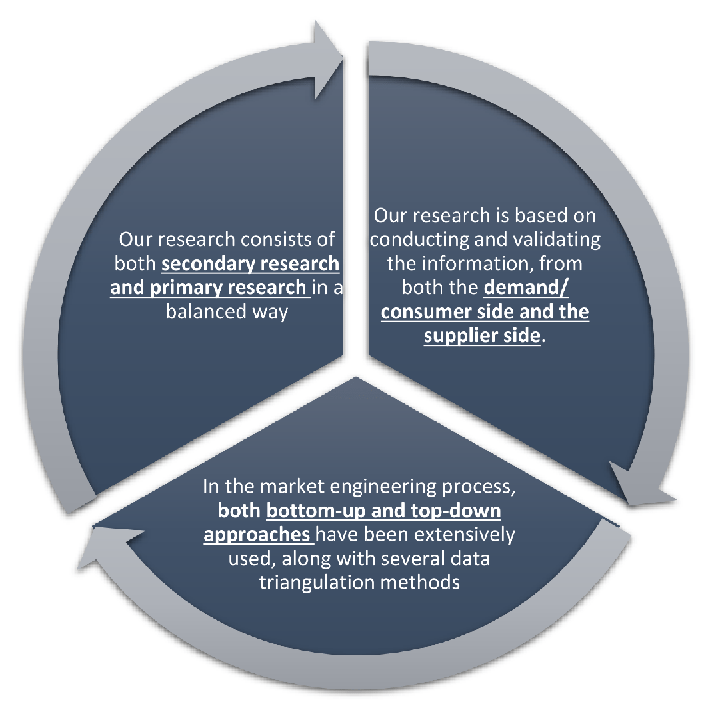
MarketGenics leverages a dedicated industry panel of experts and a comprehensive suite of paid databases to effectively collect, consolidate, and analyze market intelligence.
Our approach has consistently proven to be reliable and effective in generating accurate market insights, identifying key industry trends, and uncovering emerging business opportunities.
Through both primary and secondary research, we capture and analyze critical company-level data such as manufacturing footprints, including technical centers, R&D facilities, sales offices, and headquarters.
Our expert panel further enhances our ability to estimate market size for specific brands based on validated field-level intelligence.
Our data mining techniques incorporate both parametric and non-parametric methods, allowing for structured data collection, sorting, processing, and cleaning.
Demand projections are derived from large-scale data sets analyzed through proprietary algorithms, culminating in robust and reliable market sizing.
Research Approach
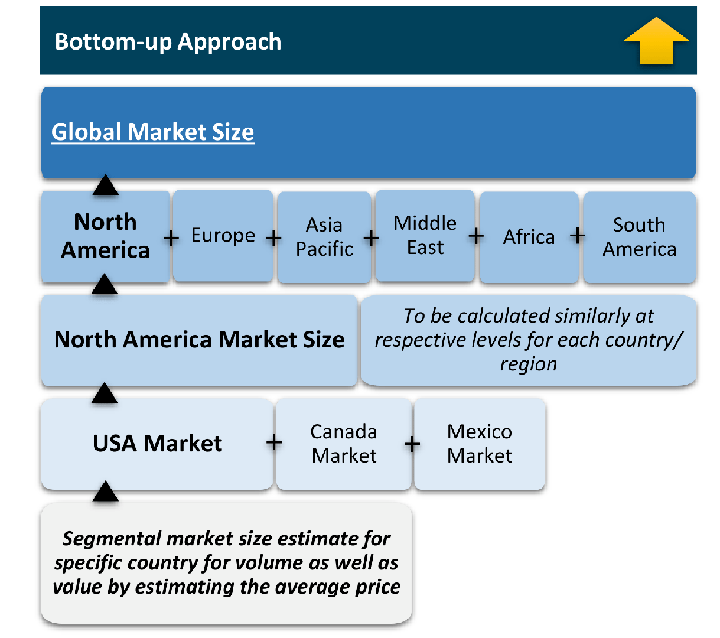
The bottom-up approach builds market estimates by starting with the smallest addressable market units and systematically aggregating them to create comprehensive market size projections.
This method begins with specific, granular data points and builds upward to create the complete market landscape.
Customer Analysis → Segmental Analysis → Geographical Analysis
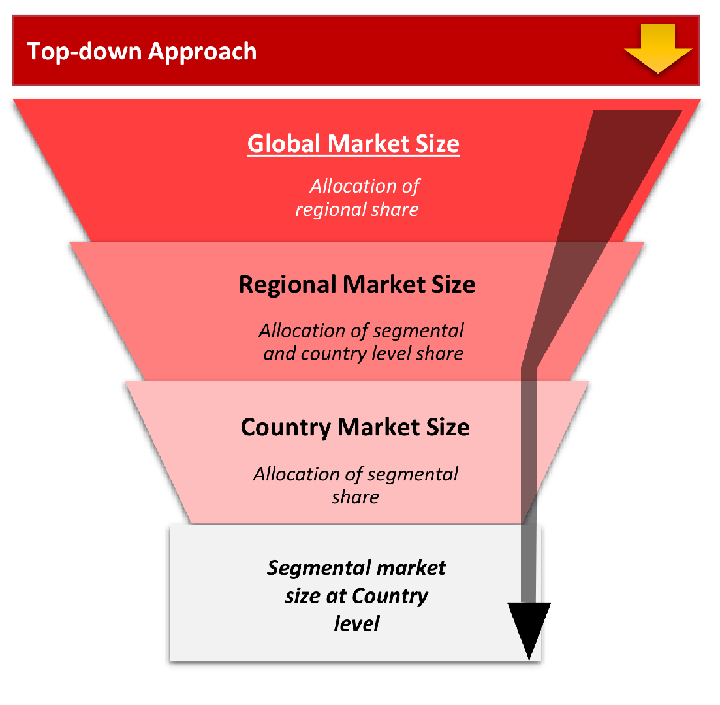
The top-down approach starts with the broadest possible market data and systematically narrows it down through a series of filters and assumptions to arrive at specific market segments or opportunities.
This method begins with the big picture and works downward to increasingly specific market slices.
TAM → SAM → SOM
Research Methods
Desk / Secondary Research
While analysing the market, we extensively study secondary sources, directories, and databases to identify and collect information useful for this technical, market-oriented, and commercial report. Secondary sources that we utilize are not only the public sources, but it is a combination of Open Source, Associations, Paid Databases, MG Repository & Knowledgebase, and others.
- Company websites, annual reports, financial reports, broker reports, and investor presentations
- National government documents, statistical databases and reports
- News articles, press releases and web-casts specific to the companies operating in the market, Magazines, reports, and others
- We gather information from commercial data sources for deriving company specific data such as segmental revenue, share for geography, product revenue, and others
- Internal and external proprietary databases (industry-specific), relevant patent, and regulatory databases
- Governing Bodies, Government Organizations
- Relevant Authorities, Country-specific Associations for Industries
We also employ the model mapping approach to estimate the product level market data through the players' product portfolio
Primary Research
Primary research/ interviews is vital in analyzing the market. Most of the cases involves paid primary interviews. Primary sources include primary interviews through e-mail interactions, telephonic interviews, surveys as well as face-to-face interviews with the different stakeholders across the value chain including several industry experts.
| Type of Respondents | Number of Primaries |
|---|---|
| Tier 2/3 Suppliers | ~20 |
| Tier 1 Suppliers | ~25 |
| End-users | ~25 |
| Industry Expert/ Panel/ Consultant | ~30 |
| Total | ~100 |
MG Knowledgebase
• Repository of industry blog, newsletter and case studies
• Online platform covering detailed market reports, and company profiles
Forecasting Factors and Models
Forecasting Factors
- Historical Trends – Past market patterns, cycles, and major events that shaped how markets behave over time. Understanding past trends helps predict future behavior.
- Industry Factors – Specific characteristics of the industry like structure, regulations, and innovation cycles that affect market dynamics.
- Macroeconomic Factors – Economic conditions like GDP growth, inflation, and employment rates that affect how much money people have to spend.
- Demographic Factors – Population characteristics like age, income, and location that determine who can buy your product.
- Technology Factors – How quickly people adopt new technology and how much technology infrastructure exists.
- Regulatory Factors – Government rules, laws, and policies that can help or restrict market growth.
- Competitive Factors – Analyzing competition structure such as degree of competition and bargaining power of buyers and suppliers.
Forecasting Models / Techniques
Multiple Regression Analysis
- Identify and quantify factors that drive market changes
- Statistical modeling to establish relationships between market drivers and outcomes
Time Series Analysis – Seasonal Patterns
- Understand regular cyclical patterns in market demand
- Advanced statistical techniques to separate trend, seasonal, and irregular components
Time Series Analysis – Trend Analysis
- Identify underlying market growth patterns and momentum
- Statistical analysis of historical data to project future trends
Expert Opinion – Expert Interviews
- Gather deep industry insights and contextual understanding
- In-depth interviews with key industry stakeholders
Multi-Scenario Development
- Prepare for uncertainty by modeling different possible futures
- Creating optimistic, pessimistic, and most likely scenarios
Time Series Analysis – Moving Averages
- Sophisticated forecasting for complex time series data
- Auto-regressive integrated moving average models with seasonal components
Econometric Models
- Apply economic theory to market forecasting
- Sophisticated economic models that account for market interactions
Expert Opinion – Delphi Method
- Harness collective wisdom of industry experts
- Structured, multi-round expert consultation process
Monte Carlo Simulation
- Quantify uncertainty and probability distributions
- Thousands of simulations with varying input parameters
Research Analysis
Our research framework is built upon the fundamental principle of validating market intelligence from both demand and supply perspectives. This dual-sided approach ensures comprehensive market understanding and reduces the risk of single-source bias.
Demand-Side Analysis: We understand end-user/application behavior, preferences, and market needs along with the penetration of the product for specific application.
Supply-Side Analysis: We estimate overall market revenue, analyze the segmental share along with industry capacity, competitive landscape, and market structure.
Validation & Evaluation
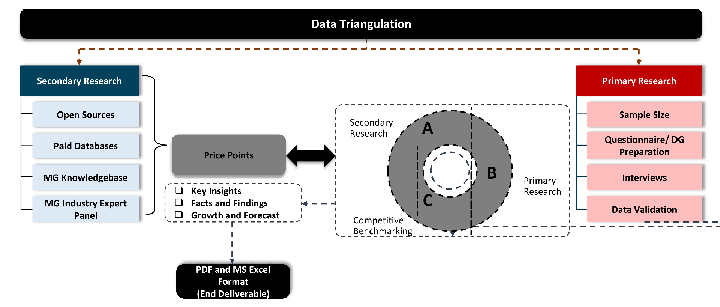
Data triangulation is a validation technique that uses multiple methods, sources, or perspectives to examine the same research question, thereby increasing the credibility and reliability of research findings. In market research, triangulation serves as a quality assurance mechanism that helps identify and minimize bias, validate assumptions, and ensure accuracy in market estimates.
- Data Source Triangulation – Using multiple data sources to examine the same phenomenon
- Methodological Triangulation – Using multiple research methods to study the same research question
- Investigator Triangulation – Using multiple researchers or analysts to examine the same data
- Theoretical Triangulation – Using multiple theoretical perspectives to interpret the same data
Custom Market Research Services
We will customise the research for you, in case the report listed above does not meet your requirements.
Get 10% Free Customisation