Luxury and Premium Packaging with Authentication Technology Market Size, Share & Trends Analysis Report by Packaging Type (Boxes and Cases, Bottles and Containers, Bags and Pouches, Tubes and Cylinders, Wrapping and Sleeves, Others), Material Type, Authentication Level, Authentication Technology, Distribution Channel, Printing & Finishing Technology, End-Use Industry, and Geography (North America, Europe, Asia Pacific, Middle East, Africa, and South America) – Global Industry Data, Trends, and Forecasts, 2026–2035
|
|
|
Segmental Data Insights |
|
|
Demand Trends |
|
|
Competitive Landscape |
|
|
Strategic Development |
|
|
Future Outlook & Opportunities |
|
Luxury-and-Premium-Packaging-with-Authentication-Technology-Market Size, Share, and Growth
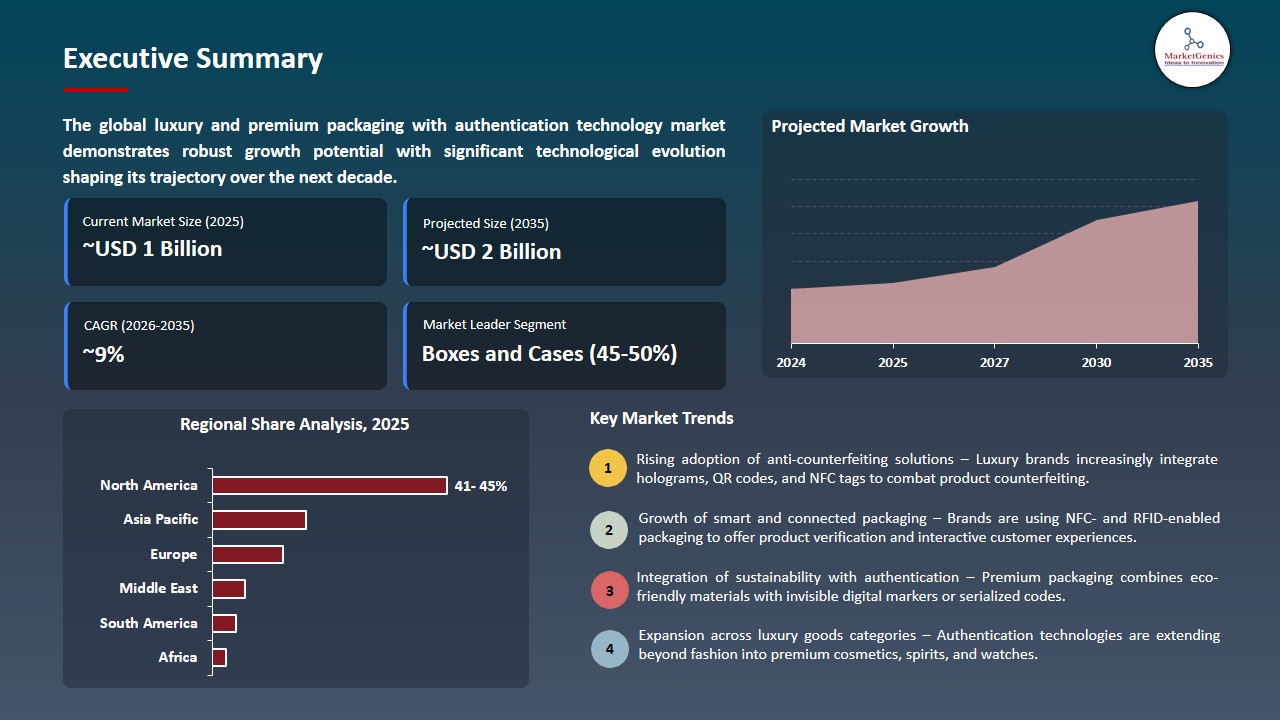
The global luxury and premium packaging with authentication technology market is experiencing robust growth, with its estimated value of USD 0.8 billion in the year 2025 and ~USD 2 billion by 2035, registering a CAGR of 9.4% during the forecast period. The luxury and premium packaging with authentication technology market is an emerging market with brands, manufacturers, and regulators concentrating in secure, traceable and interactive packaging to increase product integrity, consumer protection and brand protection. The increasing threats of counterfeits and the need to ensure authenticity are leading to the use of NFC and RFID, QR codes, block chain, and tamper-evident solutions.
Andy Zosel, Senior Vice President and General Manager, Intelligent Automation, Zebra Technologies, said: “Zebra is deeply committed to providing technology that improves frontline performance today while shaping the future of workflows with collaborative solutions that empower our customers to achieve unprecedented efficiency. Our ProMat booth visitors will experience how our solutions automate critical business workflows by leveraging advanced technologies such as machine vision, mobile computers, robotics, RFID, and AI.
The luxury and premium packaging with authentication technology market operates at a fast pace as brands start adopting smart, secure and interactive packaging as a means to improve product integrity, consumer confidence and consumer engagement in the luxury food, beverage, cosmetics, spirits, pharmaceutical and high end personal-care industries. The increasing number of counterfeit risks, the intensified control of the situation by the authorities, and the desire by consumers to purchase more traceable and environmentally friendly products are compelling firms to invest in authentication-based high-quality packaging.
The high technology in materials and format is driving the innovation behind labels embedded with NFC/RFID, blockchain-interconnected digital passports, rigid boxes made of mono materials, bio-based polymers, recycled PET, and high-barrier paper. For instance, in November 2025, Cellr introduced smart bottle technology that incorporates NFC and RFID chips into the caps of wine bottles so that consumers can immediately authenticate their identities and digitally verify their purchases to prevent counterfeit wine, protect brand identity and regain consumer trust in high-end beverages. Compliance, consistent quality and sustainability are also being achieved by manufacturers through introduction of automation friendly production, precision fill and seal and digitally traceable supply chain, which are combined with enhanced premium aesthetics and functionality.
Adjacent opportunities to the luxury and premium packaging with authentication technology market include smart labels with NFC and RFID, blockchain-enabled traceability platforms, tamper-evident and anti-counterfeit seals, connected packaging for brand engagement, and high-end sustainable packaging materials, driven by brand protection and consumer trust needs, thereby expanding value-added services, enabling premiumization, and reducing counterfeiting risks across luxury supply chains.
Luxury and Premium Packaging with Authentication Technology Market Dynamics and Trends
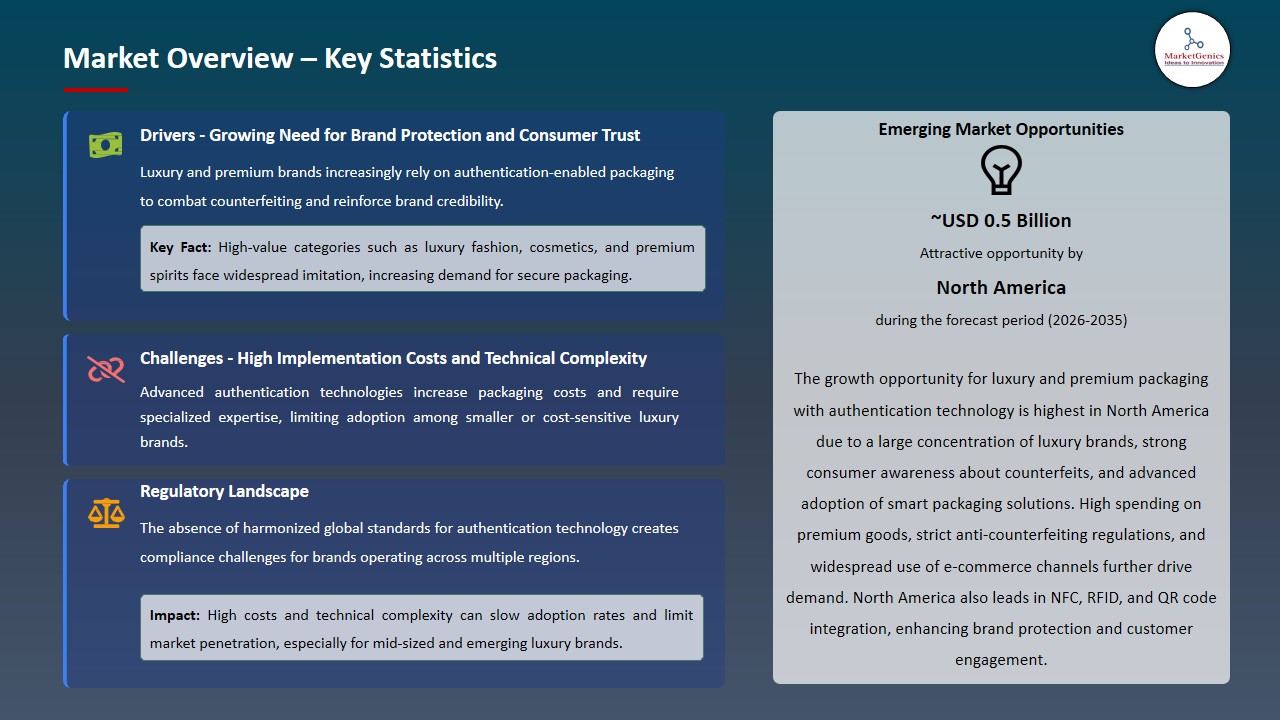
Driver: Increasing Counterfeit Risks and Brand Protection Needs
-
The growth of advanced counterfeiting of luxury products, cosmetics, high-end spirits, and pharmaceutical products is the major defining factor in the global luxury and premium packaging with authentication technology market as the products have not only carried out brand equity loss but also become a safety threat. Large companies are also feeling the pressure to ensure the security of their products over global supply chain networks to avoid losing revenues and safeguard customers against poor-quality or dangerous counterfeits.
- Organizations are implementing multi-layered authentication systems including NFC/RFID tags connected to blockchain, serial QRs with real-time authentication, hidden security inks and forensic markers to establish item level-tracking and end to end safe verification. For instance, in October 2025, Toppan Digital Inc. introduced secure NFC tags and digital identifiers of luxury beverages and fragrances to give these products authentication, supply-chain traceability, and consumer authentication via smartphones.
- Increased insecurity in the law and the demand of luxury brands by consumers to understand the authenticity of the products they are buying is forcing luxury brands to use high-levels of packaging authentication systems that is fueling an increase in market across all parts of the world.
Restraint: High Implementation and Technology Costs
-
The luxury and premium packaging with authentication technology market faces very high price of advanced authentication technologies, including embedded NFC/RFID tags, coded QR codes, blockchain connectivity, and tamper-evident security solutions. Such technologies demand special design, printing, and digital infrastructure, which add to high costs of production that is both not easily absorbed by many small and mid-sized brands without increasing product prices or reducing margins.
- The sophistication and the expenses of the digital backend systems such as secure databases, cloud authentication systems and real-time tracking software add additional expenses to the overall implementation cost. Making interoperable with current ERP, IT security measures and the cost of continual maintenance/license fees all creates long-term costs, discouraging new market adoption in cost-constrained segments and emerging markets.
- Limited standards of interoperability and shortage of skilled workers mean that the implementation costs are higher and brands are required to spend on bespoke solution or outsourcing, which slows adoption, especially by regional players and niche luxury segments.
Opportunity: Integration with Digital and Interactive Consumer Experiences
-
The luxury and premium packaging with authentication technology market has a large untapped growth in connecting digital interactivity with physical packaging, so the brands can communicate directly with consumers using the capabilities of smart functions, including QR codes, NFC chips, augmented reality, and connected blockchain applications that raise both the authentication and experience.
- Interactive authenticated packaging is on the issue. For instance, in 2024, Meiyume launched NFC- and QR-based smart packaging on high-end cosmetics and fragrances that enabled consumers to access product information, verify authenticity and personal brand content on their smartphone. This solution can show how the interactive authentication can enhance consumer reaction and brand loyalty in addition to offering traceability and reliable verification.
- The demand to have an immersive experience by consumers is a strategic opportunity to packaging manufacturers to add portfolios of digital engagement capabilities that lead to brand loyalty, customized stories, and premium differentiation in global markets.
Key Trend: Shift towards Sustainable and Eco-Friendly Authentication Solutions
-
The primary trends in the global luxury and high-end market regarding eco-authenticated packaging include a significant market demand for green authenticated options, with brands merging sustainability and anti-counterfeiting features. Brands are focusing more on eco-authenticated packaging, which is an authenticated type of premium packaging typically combined with sustainability and anti-counterfeiting features. High-performance sustainable substrates such as recycled paperboard with embedded NFC/QR authentication layers, compostable bioplastics with security tags, and mono-material structures do not impact the product protection or supply-chain traceability of alternative products.
- Sustainable authenticated platforms have become quicker to innovate. For instance, in June 2025, Avery Dennison introduced an RFID-tagged label that is recognized by the APR, compatibilized with PET recycling streams and can perform secure item-level authentication on high-end beverages and cosmetics, as well as remains recyclable and meets the needs of the circular economy.
- Eco-certified authenticated solutions are on the rise around the globe, linked to regulatory drive, ESG, and brand differentiation as well as consumers shifting to low-impact packaging to boost brand differentiation and sustainability as well as adoption of sustainable smart packaging.
Luxury-and-Premium-Packaging-with-Authentication-Technology-Market Analysis and Segmental Data
Boxes and Cases Dominate Global Luxury and Premium Packaging with Authentication Technology Market
-
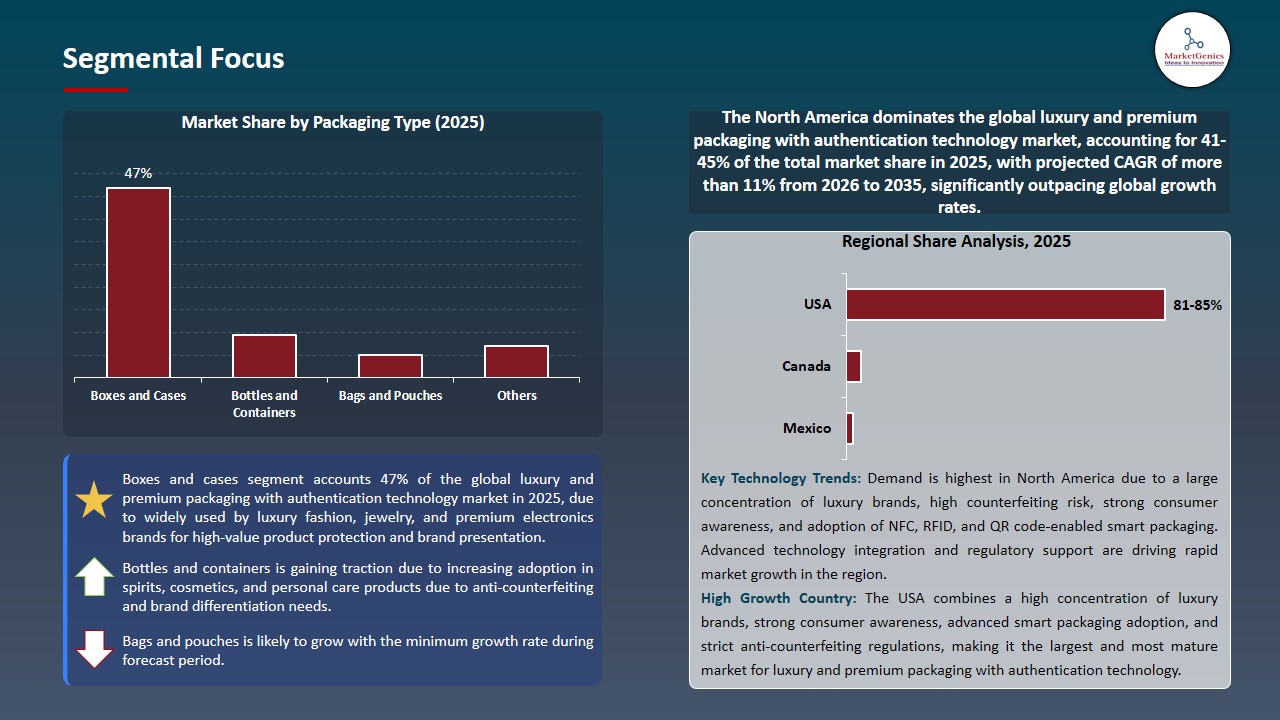
Boxes and cases dominates the global luxury and premium packaging with authentication technology market, act as aesthetic brand canvases, as well as a secure authentication platform with NFC, QR codes, RFID tags and tamper-evident closures of high value good in the cosmetics, jewelry, spirits and electronics business.
- Interactive and smart rigid box innovations are evolving at a high rate because luxury brands tend to differentiate and guard their products. For instance, in March 2025, Tiffany & Co. launched NFC-based smart jewelry boxes, which means that customers can be sure of the authenticity of the product, obtain detailed information about it, or read exclusive brand content by scanning it with a smartphone. Technology and tactile luxury are now more combined in the premium packaging, and the unboxing experience moves well beyond the aesthetics into the digital arena to build trust.
- Sustainability and reusable designs enhance the supremacy of the boxes, whereby eco-luxury rigid boxes adopt recyclable, biodegradable and reusable designs that integrate high presentation with environmental friendliness.
North America Leads Global Luxury and Premium Packaging with Authentication Technology Market Demand
-
North America leads the luxury and premium packaging with authentication technology market, with great brand-protection needs and common utilization of digital authentication, as well as high penetration of luxurious products in cosmetics, spirits, pharmaceutical and luxury retail. Owners of the brands in the region focus on item-level traceability, anti-counterfeiting, and consumer-engagement technologies to help protect revenue and brand equity.
- North America manufacturers and technology suppliers are focusing on smart-packaging architectures, such as NFC-tagged labels, serialized QR codes, RFID-tagged closures, and cloud-based verification platforms. For instance, in May 2025, U.S.-based Identiv collaborated with ZATAP and Genuine Analytics to release an NFC and blockchain-powered authentication system to high-end wine, where the physical bottle is connected to a digital twin to be tracked and prevented against counterfeit.
- High-speed digital infrastructure, innovative analytics, and AI-supported supply chains allow tracing and detecting counterfeits in real-time, whereas the high level of consumer confidence and protection of intellectual property consolidate the leadership of North America in the sphere of luxury packaging innovations.
Luxury-and-Premium-Packaging-with-Authentication-Technology-Market Ecosystem
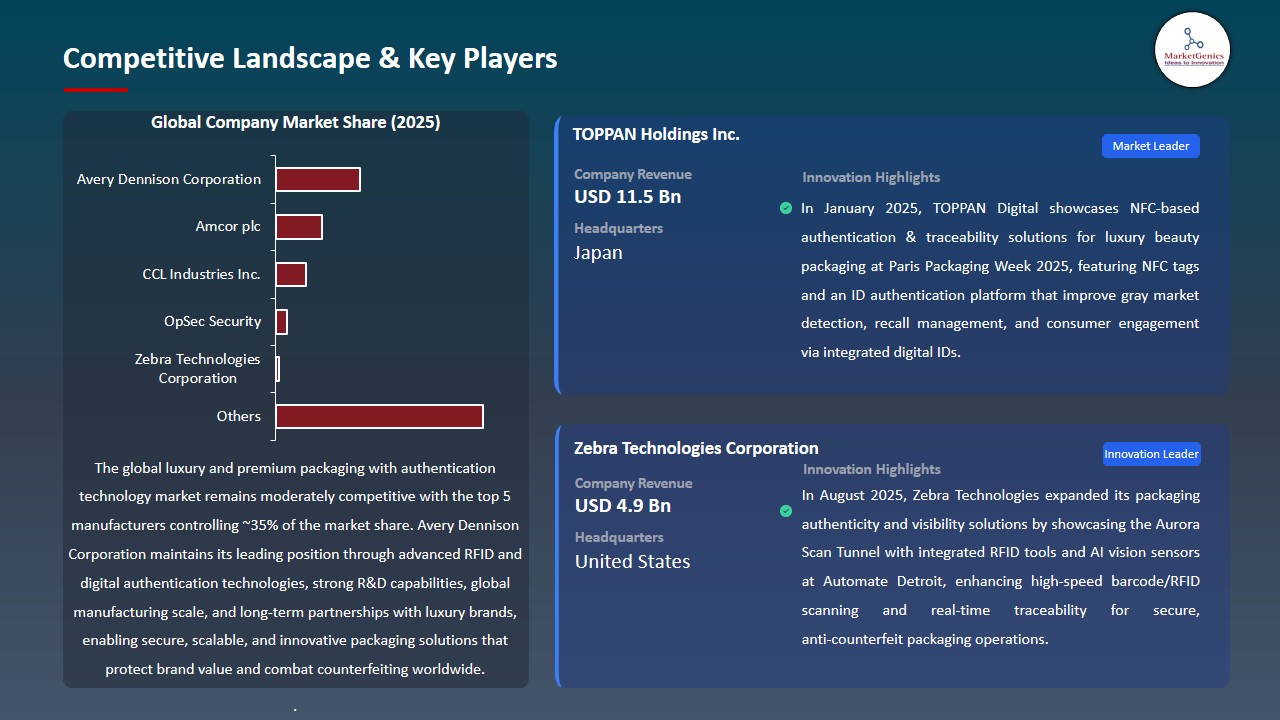
The global luxury and premium packaging with authentication technology is slightly consolidated and has medium concentration degree predetermined by the interdependence of multinational packaging companies, specialized authentication technology vendors and solution-oriented industrial players within the luxury goods, pharmaceutical, beverage, and personal-care industries.
Tier-1 suppliers like Amcor plc and Avery Dennison Corporation integrate a combination of large manufacturing networks, high-quality material science and robust forward-looking and research and development pipelines to provide elevated levels of packaging solutions with RFID and smart labels and track-and-trace capabilities at scale. Tier-2 players, such as CCL Industries Inc. and Zebra Technologies Corporation, target value-added products like smart labels, RFID printers, data capture, and supply-chain visibility systems and usually target the brand owners, who are looking to achieve digital authentication and operational efficiency.
Tier-3 professionals such as OpSec Security will focus on the highest security anti-counterfeiting measures, such as covert markers, forensic features, and digital authentication platforms and will target niche luxury and high-risk product markets. A strategic partnership, digitalization of packaging and convergence of material innovation with data-driven authentication are increasingly defining the ecosystem to increase brand protection, regulatory compliance, and consumer trust in the global markets.
Recent Development and Strategic Overview
-
In January 2025, TOPPAN Digital (TOPPAN Holdings Inc.) demonstrated high security NFC tags and an ID authentication platform at Paris Packaging Week 2025. The solutions were to enable the gray-market detection, product traceability, recall management, and consumer engagement improvement in the case of luxury and premium packaging applications.
- In September 2025, Zebra Technologies launched a next generation marking and tracking solution suite specifically designed to meet the needs of packaging operations with advanced RFID-enabled printers and real-time tracking to enhance supply chain visibility, losses, and improvements in manufacturing and logistics operations.
Report Scope
|
Detail |
|
|
Market Size in 2025 |
USD 0.8 Bn |
|
Market Forecast Value in 2035 |
~USD 2 Bn |
|
Growth Rate (CAGR) |
9.4% |
|
Forecast Period |
2026 – 2035 |
|
Historical Data Available for |
2021 – 2024 |
|
Market Size Units |
US$ Billion for Value |
|
Report Format |
Electronic (PDF) + Excel |
|
North America |
Europe |
Asia Pacific |
Middle East |
Africa |
South America |
|
|
|
|
|
|
|
Companies Covered |
|||||
|
|
|
|
|
|
Luxury-and-Premium-Packaging-with-Authentication-Technology-Market Segmentation and Highlights
|
Segment |
Sub-segment |
|
Luxury and Premium Packaging with Authentication Technology Market, By Packaging Type |
|
|
Luxury and Premium Packaging with Authentication Technology Market, By Material Type |
|
|
Luxury and Premium Packaging with Authentication Technology Market, By Authentication Level |
|
|
Luxury and Premium Packaging with Authentication Technology Market, By Authentication Technology |
|
|
Luxury and Premium Packaging with Authentication Technology Market, By Distribution Channel |
|
|
Luxury and Premium Packaging with Authentication Technology Market, By Printing & Finishing Technology |
|
|
Luxury and Premium Packaging with Authentication Technology Market, By End-Use Industry |
|
Frequently Asked Questions
Table of Contents
- 1. Research Methodology and Assumptions
- 1.1. Definitions
- 1.2. Research Design and Approach
- 1.3. Data Collection Methods
- 1.4. Base Estimates and Calculations
- 1.5. Forecasting Models
- 1.5.1. Key Forecast Factors & Impact Analysis
- 1.6. Secondary Research
- 1.6.1. Open Sources
- 1.6.2. Paid Databases
- 1.6.3. Associations
- 1.7. Primary Research
- 1.7.1. Primary Sources
- 1.7.2. Primary Interviews with Stakeholders across Ecosystem
- 2. Executive Summary
- 2.1. Global Luxury and Premium Packaging with Authentication Technology Market Outlook
- 2.1.1. Luxury and Premium Packaging with Authentication Technology Market Size (Value - US$ Bn), and Forecasts, 2021-2035
- 2.1.2. Compounded Annual Growth Rate Analysis
- 2.1.3. Growth Opportunity Analysis
- 2.1.4. Segmental Share Analysis
- 2.1.5. Geographical Share Analysis
- 2.2. Market Analysis and Facts
- 2.3. Supply-Demand Analysis
- 2.4. Competitive Benchmarking
- 2.5. Go-to- Market Strategy
- 2.5.1. Customer/ End-use Industry Assessment
- 2.5.2. Growth Opportunity Data, 2026-2035
- 2.5.2.1. Regional Data
- 2.5.2.2. Country Data
- 2.5.2.3. Segmental Data
- 2.5.3. Identification of Potential Market Spaces
- 2.5.4. GAP Analysis
- 2.5.5. Potential Attractive Price Points
- 2.5.6. Prevailing Market Risks & Challenges
- 2.5.7. Preferred Sales & Marketing Strategies
- 2.5.8. Key Recommendations and Analysis
- 2.5.9. A Way Forward
- 2.1. Global Luxury and Premium Packaging with Authentication Technology Market Outlook
- 3. Industry Data and Premium Insights
- 3.1. Global Packaging Industry Overview, 2025
- 3.1.1. Packaging Industry Ecosystem Analysis
- 3.1.2. Key Trends for Packaging Industry
- 3.1.3. Regional Distribution for Packaging Industry
- 3.2. Supplier Customer Data
- 3.3. Technology Roadmap and Developments
- 3.4. Trade Analysis
- 3.4.1. Import & Export Analysis, 2025
- 3.4.2. Top Importing Countries
- 3.4.3. Top Exporting Countries
- 3.5. Trump Tariff Impact Analysis
- 3.5.1. Manufacturer
- 3.5.1.1. Based on the component & Raw material
- 3.5.2. Supply Chain
- 3.5.3. End Consumer
- 3.5.1. Manufacturer
- 3.6. Raw Material Analysis
- 3.1. Global Packaging Industry Overview, 2025
- 4. Market Overview
- 4.1. Market Dynamics
- 4.1.1. Drivers
- 4.1.1.1. Rising demand for anti-counterfeit and brand-protection solutions in luxury and premium products.
- 4.1.1.2. Increasing consumer preference for sustainable and visually appealing packaging with authentication features.
- 4.1.1.3. Integration of smart packaging technologies such as QR codes, NFC, and RFID for traceability and consumer engagement.
- 4.1.2. Restraints
- 4.1.2.1. High cost of advanced authentication and smart packaging solutions limiting adoption, especially among mid-tier brands.
- 4.1.2.2. Complex regulatory compliance and lack of standardization across regions affecting implementation.
- 4.1.1. Drivers
- 4.2. Key Trend Analysis
- 4.3. Regulatory Framework
- 4.3.1. Key Regulations, Norms, and Subsidies, by Key Countries
- 4.3.2. Tariffs and Standards
- 4.3.3. Impact Analysis of Regulations on the Market
- 4.4. Value Chain Analysis
- 4.4.1. Raw Material Suppliers
- 4.4.2. Manufacturers
- 4.4.3. Dealers/ Distributors
- 4.4.4. End-Users/ Customers
- 4.5. Porter’s Five Forces Analysis
- 4.6. PESTEL Analysis
- 4.7. Global Luxury and Premium Packaging with Authentication Technology Market Demand
- 4.7.1. Historical Market Size – Value (US$ Bn), 2020-2024
- 4.7.2. Current and Future Market Size – Value (US$ Bn), 2026–2035
- 4.7.2.1. Y-o-Y Growth Trends
- 4.7.2.2. Absolute $ Opportunity Assessment
- 4.1. Market Dynamics
- 5. Competition Landscape
- 5.1. Competition structure
- 5.1.1. Fragmented v/s consolidated
- 5.2. Company Share Analysis, 2025
- 5.2.1. Global Company Market Share
- 5.2.2. By Region
- 5.2.2.1. North America
- 5.2.2.2. Europe
- 5.2.2.3. Asia Pacific
- 5.2.2.4. Middle East
- 5.2.2.5. Africa
- 5.2.2.6. South America
- 5.3. Product Comparison Matrix
- 5.3.1. Specifications
- 5.3.2. Market Positioning
- 5.3.3. Pricing
- 5.1. Competition structure
- 6. Global Luxury and Premium Packaging with Authentication Technology Market Analysis, by Packaging Type
- 6.1. Key Segment Analysis
- 6.2. Luxury and Premium Packaging with Authentication Technology Market Size (Value - US$ Bn), Analysis, and Forecasts, by Packaging Type, 2021-2035
- 6.2.1. Boxes and Cases
- 6.2.1.1. Rigid Boxes
- 6.2.1.2. Folding Cartons
- 6.2.1.3. Presentation Cases
- 6.2.1.4. Others
- 6.2.2. Bottles and Containers
- 6.2.2.1. Glass Bottles
- 6.2.2.2. Premium Plastic Containers
- 6.2.2.3. Metal Containers
- 6.2.2.4. Others
- 6.2.3. Bags and Pouches
- 6.2.3.1. Stand-up Pouches
- 6.2.3.2. Drawstring Bags
- 6.2.3.3. Velvet Pouches
- 6.2.3.4. Others
- 6.2.4. Tubes and Cylinders
- 6.2.5. Wrapping and Sleeves
- 6.2.6. Others
- 6.2.1. Boxes and Cases
- 7. Global Luxury and Premium Packaging with Authentication Technology Market Analysis, by Material Type
- 7.1. Key Segment Analysis
- 7.2. Luxury and Premium Packaging with Authentication Technology Market Size (Value - US$ Bn), Analysis, and Forecasts, by Material Type, 2021-2035
- 7.2.1. Paper and Paperboard
- 7.2.1.1. Coated Paper
- 7.2.1.2. Specialty Paper
- 7.2.1.3. Metallic Paper
- 7.2.1.4. Others
- 7.2.2. Plastic
- 7.2.2.1. PET (Polyethylene Terephthalate)
- 7.2.2.2. PP (Polypropylene)
- 7.2.2.3. PVC (Polyvinyl Chloride)
- 7.2.2.4. Others
- 7.2.3. Glass
- 7.2.4. Metal
- 7.2.4.1. Aluminum
- 7.2.4.2. Tin
- 7.2.4.3. Stainless Steel
- 7.2.4.4. Others
- 7.2.5. Wood
- 7.2.6. Leather and Fabric
- 7.2.7. Composite Materials
- 7.2.1. Paper and Paperboard
- 8. Global Luxury and Premium Packaging with Authentication Technology Market Analysis, by Authentication Level
- 8.1. Key Segment Analysis
- 8.2. Luxury and Premium Packaging with Authentication Technology Market Size (Value - US$ Bn), Analysis, and Forecasts, by Authentication Level, 2021-2035
- 8.2.1. Level 1 (Overt Authentication)
- 8.2.2. Level 2 (Covert Authentication)
- 8.2.3. Level 3 (Forensic Authentication)
- 8.2.4. Multi-Level Authentication
- 9. Global Luxury and Premium Packaging with Authentication Technology Market Analysis, by Authentication Technology
- 9.1. Key Segment Analysis
- 9.2. Luxury and Premium Packaging with Authentication Technology Market Size (Value - US$ Bn), Analysis, and Forecasts, by Authentication Technology, 2021-2035
- 9.2.1. RFID (Radio Frequency Identification)
- 9.2.1.1. Passive RFID
- 9.2.1.2. Active RFID
- 9.2.1.3. Semi-Passive RFID
- 9.2.1.4. Others
- 9.2.2. NFC (Near Field Communication)
- 9.2.2.1. QR Codes and Barcodes
- 9.2.2.2. 2D Barcodes
- 9.2.2.3. Dynamic QR Codes
- 9.2.2.4. Encrypted QR Codes
- 9.2.2.5. Others
- 9.2.3. Holograms
- 9.2.3.1. 2D Holograms
- 9.2.3.2. 3D Holograms
- 9.2.3.3. Kinematic Holograms
- 9.2.3.4. Others
- 9.2.4. Digital Watermarks
- 9.2.5. Blockchain-Based Authentication
- 9.2.6. Smart Labels and Tags
- 9.2.7. Tamper-Evident Features
- 9.2.8. Biometric Authentication
- 9.2.9. Microtext and Nanotext
- 9.2.10. Others
- 9.2.1. RFID (Radio Frequency Identification)
- 10. Global Luxury and Premium Packaging with Authentication Technology Market Analysis, by Distribution Channel
- 10.1. Key Segment Analysis
- 10.2. Luxury and Premium Packaging with Authentication Technology Market Size (Value - US$ Bn), Analysis, and Forecasts, by Distribution Channel, 2021-2035
- 10.2.1. Direct Sales
- 10.2.1.1. Brand Owned Stores
- 10.2.1.2. Company Websites
- 10.2.1.3. Others
- 10.2.2. Retail
- 10.2.2.1. Specialty Stores
- 10.2.2.2. Department Stores
- 10.2.2.3. Duty-Free Shops
- 10.2.2.4. Others
- 10.2.3. E-commerce
- 10.2.3.1. Brand E-commerce Platforms
- 10.2.3.2. Third-Party E-commerce
- 10.2.3.3. Others
- 10.2.4. Wholesale and Distributors
- 10.2.1. Direct Sales
- 11. Global Luxury and Premium Packaging with Authentication Technology Market Analysis, by Printing & Finishing Technology
- 11.1. Key Segment Analysis
- 11.2. Luxury and Premium Packaging with Authentication Technology Market Size (Value - US$ Bn), Analysis, and Forecasts, by Printing & Finishing Technology, 2021-2035
- 11.2.1. Digital Printing
- 11.2.2. Offset Printing
- 11.2.3. Flexographic Printing
- 11.2.4. Screen Printing
- 11.2.5. Hot Stamping and Foiling
- 11.2.6. Embossing and Debossing
- 11.2.7. UV Coating
- 11.2.8. Lamination
- 12. Global Luxury and Premium Packaging with Authentication Technology Market Analysis, by End-Use Industry
- 12.1. Key Segment Analysis
- 12.2. Luxury and Premium Packaging with Authentication Technology Market Size (Value - US$ Bn), Analysis, and Forecasts, by End-Use Industry, 2021-2035
- 12.2.1. Cosmetics and Personal Care
- 12.2.1.1. Skincare Products
- 12.2.1.2. Fragrances and Perfumes
- 12.2.1.3. Makeup and Color Cosmetics
- 12.2.1.4. Hair Care Products
- 12.2.1.5. Premium Bath Products
- 12.2.1.6. Others
- 12.2.2. Food and Beverages
- 12.2.2.1. Premium Alcoholic Beverages
- 12.2.2.1.1. Wines
- 12.2.2.1.2. Spirits
- 12.2.2.1.3. Champagne
- 12.2.2.1.4. Craft Beers
- 12.2.2.1.5. Others
- 12.2.2.2. Gourmet Food Products
- 12.2.2.2.1. Chocolates and Confectionery
- 12.2.2.2.2. Specialty Coffee and Tea
- 12.2.2.2.3. Artisanal Foods
- 12.2.2.2.4. Others
- 12.2.2.3. Health and Wellness Products
- 12.2.2.4. Others
- 12.2.2.1. Premium Alcoholic Beverages
- 12.2.3. Pharmaceuticals and Healthcare
- 12.2.3.1. Prescription Medications
- 12.2.3.2. Over-the-Counter Drugs
- 12.2.3.3. Nutraceuticals
- 12.2.3.4. Medical Devices
- 12.2.3.5. Wellness Supplements
- 12.2.3.6. Others
- 12.2.4. Electronics and Technology
- 12.2.4.1. Consumer Electronics
- 12.2.4.2. Wearable Devices
- 12.2.4.3. Accessories
- 12.2.4.4. Audio Equipment
- 12.2.4.5. Others
- 12.2.5. Fashion and Apparel
- 12.2.5.1. Luxury Clothing
- 12.2.5.2. Accessories
- 12.2.5.2.1. Handbags
- 12.2.5.2.2. Wallets
- 12.2.5.2.3. Belts
- 12.2.5.2.4. Others
- 12.2.5.3. Footwear
- 12.2.5.4. Jewelry Packaging
- 12.2.5.5. Others
- 12.2.6. Watches and Jewelry
- 12.2.6.1. Luxury Watches
- 12.2.6.2. Fine Jewelry
- 12.2.6.3. Fashion Jewelry
- 12.2.6.4. Gemstones
- 12.2.6.5. Others
- 12.2.7. Tobacco Products
- 12.2.7.1. Premium Cigars
- 12.2.7.2. Cigarettes
- 12.2.7.3. Tobacco Accessories
- 12.2.7.4. Others
- 12.2.8. Automotive
- 12.2.8.1. Spare Parts
- 12.2.8.2. Accessories
- 12.2.8.3. Luxury Car Care Products
- 12.2.8.4. Others
- 12.2.9. Gifts and Collectibles
- 12.2.9.1. Premium Gift Items
- 12.2.9.2. Limited Edition Products
- 12.2.9.3. Collectible Items
- 12.2.9.4. Others
- 12.2.10. Home and Living
- 12.2.10.1. Home Décor
- 12.2.10.2. Premium Homeware
- 12.2.10.3. Art and Artifacts
- 12.2.10.4. Others
- 12.2.1. Cosmetics and Personal Care
- 13. Global Luxury and Premium Packaging with Authentication Technology Market Analysis and Forecasts, by Region
- 13.1. Key Findings
- 13.2. Luxury and Premium Packaging with Authentication Technology Market Size (Value - US$ Bn), Analysis, and Forecasts, by Region, 2021-2035
- 13.2.1. North America
- 13.2.2. Europe
- 13.2.3. Asia Pacific
- 13.2.4. Middle East
- 13.2.5. Africa
- 13.2.6. South America
- 14. North America Luxury and Premium Packaging with Authentication Technology Market Analysis
- 14.1. Key Segment Analysis
- 14.2. Regional Snapshot
- 14.3. North America Luxury and Premium Packaging with Authentication Technology Market Size (Value - US$ Bn), Analysis, and Forecasts, 2021-2035
- 14.3.1. Packaging Type
- 14.3.2. Material Type
- 14.3.3. Authentication Level
- 14.3.4. Authentication Technology
- 14.3.5. Distribution Channel
- 14.3.6. Printing & Finishing Technology
- 14.3.7. End-Use Industry
- 14.3.8. Country
- 14.3.8.1. USA
- 14.3.8.2. Canada
- 14.3.8.3. Mexico
- 14.4. USA Luxury and Premium Packaging with Authentication Technology Market
- 14.4.1. Country Segmental Analysis
- 14.4.2. Packaging Type
- 14.4.3. Material Type
- 14.4.4. Authentication Level
- 14.4.5. Authentication Technology
- 14.4.6. Distribution Channel
- 14.4.7. Printing & Finishing Technology
- 14.4.8. End-Use Industry
- 14.5. Canada Luxury and Premium Packaging with Authentication Technology Market
- 14.5.1. Country Segmental Analysis
- 14.5.2. Packaging Type
- 14.5.3. Material Type
- 14.5.4. Authentication Level
- 14.5.5. Authentication Technology
- 14.5.6. Distribution Channel
- 14.5.7. Printing & Finishing Technology
- 14.5.8. End-Use Industry
- 14.6. Mexico Luxury and Premium Packaging with Authentication Technology Market
- 14.6.1. Country Segmental Analysis
- 14.6.2. Packaging Type
- 14.6.3. Material Type
- 14.6.4. Authentication Level
- 14.6.5. Authentication Technology
- 14.6.6. Distribution Channel
- 14.6.7. Printing & Finishing Technology
- 14.6.8. End-Use Industry
- 15. Europe Luxury and Premium Packaging with Authentication Technology Market Analysis
- 15.1. Key Segment Analysis
- 15.2. Regional Snapshot
- 15.3. Europe Luxury and Premium Packaging with Authentication Technology Market Size (Value - US$ Bn), Analysis, and Forecasts, 2021-2035
- 15.3.1. Packaging Type
- 15.3.2. Material Type
- 15.3.3. Authentication Level
- 15.3.4. Authentication Technology
- 15.3.5. Distribution Channel
- 15.3.6. Printing & Finishing Technology
- 15.3.7. End-Use Industry
- 15.3.8. Country
- 15.3.8.1. Germany
- 15.3.8.2. United Kingdom
- 15.3.8.3. France
- 15.3.8.4. Italy
- 15.3.8.5. Spain
- 15.3.8.6. Netherlands
- 15.3.8.7. Nordic Countries
- 15.3.8.8. Poland
- 15.3.8.9. Russia & CIS
- 15.3.8.10. Rest of Europe
- 15.4. Germany Luxury and Premium Packaging with Authentication Technology Market
- 15.4.1. Country Segmental Analysis
- 15.4.2. Packaging Type
- 15.4.3. Material Type
- 15.4.4. Authentication Level
- 15.4.5. Authentication Technology
- 15.4.6. Distribution Channel
- 15.4.7. Printing & Finishing Technology
- 15.4.8. End-Use Industry
- 15.5. United Kingdom Luxury and Premium Packaging with Authentication Technology Market
- 15.5.1. Country Segmental Analysis
- 15.5.2. Packaging Type
- 15.5.3. Material Type
- 15.5.4. Authentication Level
- 15.5.5. Authentication Technology
- 15.5.6. Distribution Channel
- 15.5.7. Printing & Finishing Technology
- 15.5.8. End-Use Industry
- 15.6. France Luxury and Premium Packaging with Authentication Technology Market
- 15.6.1. Country Segmental Analysis
- 15.6.2. Packaging Type
- 15.6.3. Material Type
- 15.6.4. Authentication Level
- 15.6.5. Authentication Technology
- 15.6.6. Distribution Channel
- 15.6.7. Printing & Finishing Technology
- 15.6.8. End-Use Industry
- 15.7. Italy Luxury and Premium Packaging with Authentication Technology Market
- 15.7.1. Country Segmental Analysis
- 15.7.2. Packaging Type
- 15.7.3. Material Type
- 15.7.4. Authentication Level
- 15.7.5. Authentication Technology
- 15.7.6. Distribution Channel
- 15.7.7. Printing & Finishing Technology
- 15.7.8. End-Use Industry
- 15.8. Spain Luxury and Premium Packaging with Authentication Technology Market
- 15.8.1. Country Segmental Analysis
- 15.8.2. Packaging Type
- 15.8.3. Material Type
- 15.8.4. Authentication Level
- 15.8.5. Authentication Technology
- 15.8.6. Distribution Channel
- 15.8.7. Printing & Finishing Technology
- 15.8.8. End-Use Industry
- 15.9. Netherlands Luxury and Premium Packaging with Authentication Technology Market
- 15.9.1. Country Segmental Analysis
- 15.9.2. Packaging Type
- 15.9.3. Material Type
- 15.9.4. Authentication Level
- 15.9.5. Authentication Technology
- 15.9.6. Distribution Channel
- 15.9.7. Printing & Finishing Technology
- 15.9.8. End-Use Industry
- 15.10. Nordic Countries Luxury and Premium Packaging with Authentication Technology Market
- 15.10.1. Country Segmental Analysis
- 15.10.2. Packaging Type
- 15.10.3. Material Type
- 15.10.4. Authentication Level
- 15.10.5. Authentication Technology
- 15.10.6. Distribution Channel
- 15.10.7. Printing & Finishing Technology
- 15.10.8. End-Use Industry
- 15.11. Poland Luxury and Premium Packaging with Authentication Technology Market
- 15.11.1. Country Segmental Analysis
- 15.11.2. Packaging Type
- 15.11.3. Material Type
- 15.11.4. Authentication Level
- 15.11.5. Authentication Technology
- 15.11.6. Distribution Channel
- 15.11.7. Printing & Finishing Technology
- 15.11.8. End-Use Industry
- 15.12. Russia & CIS Luxury and Premium Packaging with Authentication Technology Market
- 15.12.1. Country Segmental Analysis
- 15.12.2. Packaging Type
- 15.12.3. Material Type
- 15.12.4. Authentication Level
- 15.12.5. Authentication Technology
- 15.12.6. Distribution Channel
- 15.12.7. Printing & Finishing Technology
- 15.12.8. End-Use Industry
- 15.13. Rest of Europe Luxury and Premium Packaging with Authentication Technology Market
- 15.13.1. Country Segmental Analysis
- 15.13.2. Packaging Type
- 15.13.3. Material Type
- 15.13.4. Authentication Level
- 15.13.5. Authentication Technology
- 15.13.6. Distribution Channel
- 15.13.7. Printing & Finishing Technology
- 15.13.8. End-Use Industry
- 16. Asia Pacific Luxury and Premium Packaging with Authentication Technology Market Analysis
- 16.1. Key Segment Analysis
- 16.2. Regional Snapshot
- 16.3. Asia Pacific Luxury and Premium Packaging with Authentication Technology Market Size (Value - US$ Bn), Analysis, and Forecasts, 2021-2035
- 16.3.1. Packaging Type
- 16.3.2. Material Type
- 16.3.3. Authentication Level
- 16.3.4. Authentication Technology
- 16.3.5. Distribution Channel
- 16.3.6. Printing & Finishing Technology
- 16.3.7. End-Use Industry
- 16.3.8. Country
- 16.3.8.1. China
- 16.3.8.2. India
- 16.3.8.3. Japan
- 16.3.8.4. South Korea
- 16.3.8.5. Australia and New Zealand
- 16.3.8.6. Indonesia
- 16.3.8.7. Malaysia
- 16.3.8.8. Thailand
- 16.3.8.9. Vietnam
- 16.3.8.10. Rest of Asia Pacific
- 16.4. China Luxury and Premium Packaging with Authentication Technology Market
- 16.4.1. Country Segmental Analysis
- 16.4.2. Packaging Type
- 16.4.3. Material Type
- 16.4.4. Authentication Level
- 16.4.5. Authentication Technology
- 16.4.6. Distribution Channel
- 16.4.7. Printing & Finishing Technology
- 16.4.8. End-Use Industry
- 16.5. India Luxury and Premium Packaging with Authentication Technology Market
- 16.5.1. Country Segmental Analysis
- 16.5.2. Packaging Type
- 16.5.3. Material Type
- 16.5.4. Authentication Level
- 16.5.5. Authentication Technology
- 16.5.6. Distribution Channel
- 16.5.7. Printing & Finishing Technology
- 16.5.8. End-Use Industry
- 16.6. Japan Luxury and Premium Packaging with Authentication Technology Market
- 16.6.1. Country Segmental Analysis
- 16.6.2. Packaging Type
- 16.6.3. Material Type
- 16.6.4. Authentication Level
- 16.6.5. Authentication Technology
- 16.6.6. Distribution Channel
- 16.6.7. Printing & Finishing Technology
- 16.6.8. End-Use Industry
- 16.7. South Korea Luxury and Premium Packaging with Authentication Technology Market
- 16.7.1. Country Segmental Analysis
- 16.7.2. Packaging Type
- 16.7.3. Material Type
- 16.7.4. Authentication Level
- 16.7.5. Authentication Technology
- 16.7.6. Distribution Channel
- 16.7.7. Printing & Finishing Technology
- 16.7.8. End-Use Industry
- 16.8. Australia and New Zealand Luxury and Premium Packaging with Authentication Technology Market
- 16.8.1. Country Segmental Analysis
- 16.8.2. Packaging Type
- 16.8.3. Material Type
- 16.8.4. Authentication Level
- 16.8.5. Authentication Technology
- 16.8.6. Distribution Channel
- 16.8.7. Printing & Finishing Technology
- 16.8.8. End-Use Industry
- 16.9. Indonesia Luxury and Premium Packaging with Authentication Technology Market
- 16.9.1. Country Segmental Analysis
- 16.9.2. Packaging Type
- 16.9.3. Material Type
- 16.9.4. Authentication Level
- 16.9.5. Authentication Technology
- 16.9.6. Distribution Channel
- 16.9.7. Printing & Finishing Technology
- 16.9.8. End-Use Industry
- 16.10. Malaysia Luxury and Premium Packaging with Authentication Technology Market
- 16.10.1. Country Segmental Analysis
- 16.10.2. Packaging Type
- 16.10.3. Material Type
- 16.10.4. Authentication Level
- 16.10.5. Authentication Technology
- 16.10.6. Distribution Channel
- 16.10.7. Printing & Finishing Technology
- 16.10.8. End-Use Industry
- 16.11. Thailand Luxury and Premium Packaging with Authentication Technology Market
- 16.11.1. Country Segmental Analysis
- 16.11.2. Packaging Type
- 16.11.3. Material Type
- 16.11.4. Authentication Level
- 16.11.5. Authentication Technology
- 16.11.6. Distribution Channel
- 16.11.7. Printing & Finishing Technology
- 16.11.8. End-Use Industry
- 16.12. Vietnam Luxury and Premium Packaging with Authentication Technology Market
- 16.12.1. Country Segmental Analysis
- 16.12.2. Packaging Type
- 16.12.3. Material Type
- 16.12.4. Authentication Level
- 16.12.5. Authentication Technology
- 16.12.6. Distribution Channel
- 16.12.7. Printing & Finishing Technology
- 16.12.8. End-Use Industry
- 16.13. Rest of Asia Pacific Luxury and Premium Packaging with Authentication Technology Market
- 16.13.1. Country Segmental Analysis
- 16.13.2. Packaging Type
- 16.13.3. Material Type
- 16.13.4. Authentication Level
- 16.13.5. Authentication Technology
- 16.13.6. Distribution Channel
- 16.13.7. Printing & Finishing Technology
- 16.13.8. End-Use Industry
- 17. Middle East Luxury and Premium Packaging with Authentication Technology Market Analysis
- 17.1. Key Segment Analysis
- 17.2. Regional Snapshot
- 17.3. Middle East Luxury and Premium Packaging with Authentication Technology Market Size (Value - US$ Bn), Analysis, and Forecasts, 2021-2035
- 17.3.1. Packaging Type
- 17.3.2. Material Type
- 17.3.3. Authentication Level
- 17.3.4. Authentication Technology
- 17.3.5. Distribution Channel
- 17.3.6. Printing & Finishing Technology
- 17.3.7. End-Use Industry
- 17.3.8. Country
- 17.3.8.1. Turkey
- 17.3.8.2. UAE
- 17.3.8.3. Saudi Arabia
- 17.3.8.4. Israel
- 17.3.8.5. Rest of Middle East
- 17.4. Turkey Luxury and Premium Packaging with Authentication Technology Market
- 17.4.1. Country Segmental Analysis
- 17.4.2. Packaging Type
- 17.4.3. Material Type
- 17.4.4. Authentication Level
- 17.4.5. Authentication Technology
- 17.4.6. Distribution Channel
- 17.4.7. Printing & Finishing Technology
- 17.4.8. End-Use Industry
- 17.5. UAE Luxury and Premium Packaging with Authentication Technology Market
- 17.5.1. Country Segmental Analysis
- 17.5.2. Packaging Type
- 17.5.3. Material Type
- 17.5.4. Authentication Level
- 17.5.5. Authentication Technology
- 17.5.6. Distribution Channel
- 17.5.7. Printing & Finishing Technology
- 17.5.8. End-Use Industry
- 17.6. Saudi Arabia Luxury and Premium Packaging with Authentication Technology Market
- 17.6.1. Country Segmental Analysis
- 17.6.2. Packaging Type
- 17.6.3. Material Type
- 17.6.4. Authentication Level
- 17.6.5. Authentication Technology
- 17.6.6. Distribution Channel
- 17.6.7. Printing & Finishing Technology
- 17.6.8. End-Use Industry
- 17.7. Israel Luxury and Premium Packaging with Authentication Technology Market
- 17.7.1. Country Segmental Analysis
- 17.7.2. Packaging Type
- 17.7.3. Material Type
- 17.7.4. Authentication Level
- 17.7.5. Authentication Technology
- 17.7.6. Distribution Channel
- 17.7.7. Printing & Finishing Technology
- 17.7.8. End-Use Industry
- 17.8. Rest of Middle East Luxury and Premium Packaging with Authentication Technology Market
- 17.8.1. Country Segmental Analysis
- 17.8.2. Packaging Type
- 17.8.3. Material Type
- 17.8.4. Authentication Level
- 17.8.5. Authentication Technology
- 17.8.6. Distribution Channel
- 17.8.7. Printing & Finishing Technology
- 17.8.8. End-Use Industry
- 18. Africa Luxury and Premium Packaging with Authentication Technology Market Analysis
- 18.1. Key Segment Analysis
- 18.2. Regional Snapshot
- 18.3. Africa Luxury and Premium Packaging with Authentication Technology Market Size (Value - US$ Bn), Analysis, and Forecasts, 2021-2035
- 18.3.1. Packaging Type
- 18.3.2. Material Type
- 18.3.3. Authentication Level
- 18.3.4. Authentication Technology
- 18.3.5. Distribution Channel
- 18.3.6. Printing & Finishing Technology
- 18.3.7. End-Use Industry
- 18.3.8. Country
- 18.3.8.1. South Africa
- 18.3.8.2. Egypt
- 18.3.8.3. Nigeria
- 18.3.8.4. Algeria
- 18.3.8.5. Rest of Africa
- 18.4. South Africa Luxury and Premium Packaging with Authentication Technology Market
- 18.4.1. Country Segmental Analysis
- 18.4.2. Packaging Type
- 18.4.3. Material Type
- 18.4.4. Authentication Level
- 18.4.5. Authentication Technology
- 18.4.6. Distribution Channel
- 18.4.7. Printing & Finishing Technology
- 18.4.8. End-Use Industry
- 18.5. Egypt Luxury and Premium Packaging with Authentication Technology Market
- 18.5.1. Country Segmental Analysis
- 18.5.2. Packaging Type
- 18.5.3. Material Type
- 18.5.4. Authentication Level
- 18.5.5. Authentication Technology
- 18.5.6. Distribution Channel
- 18.5.7. Printing & Finishing Technology
- 18.5.8. End-Use Industry
- 18.6. Nigeria Luxury and Premium Packaging with Authentication Technology Market
- 18.6.1. Country Segmental Analysis
- 18.6.2. Packaging Type
- 18.6.3. Material Type
- 18.6.4. Authentication Level
- 18.6.5. Authentication Technology
- 18.6.6. Distribution Channel
- 18.6.7. Printing & Finishing Technology
- 18.6.8. End-Use Industry
- 18.7. Algeria Luxury and Premium Packaging with Authentication Technology Market
- 18.7.1. Country Segmental Analysis
- 18.7.2. Packaging Type
- 18.7.3. Material Type
- 18.7.4. Authentication Level
- 18.7.5. Authentication Technology
- 18.7.6. Distribution Channel
- 18.7.7. Printing & Finishing Technology
- 18.7.8. End-Use Industry
- 18.8. Rest of Africa Luxury and Premium Packaging with Authentication Technology Market
- 18.8.1. Country Segmental Analysis
- 18.8.2. Packaging Type
- 18.8.3. Material Type
- 18.8.4. Authentication Level
- 18.8.5. Authentication Technology
- 18.8.6. Distribution Channel
- 18.8.7. Printing & Finishing Technology
- 18.8.8. End-Use Industry
- 19. South America Luxury and Premium Packaging with Authentication Technology Market Analysis
- 19.1. Key Segment Analysis
- 19.2. Regional Snapshot
- 19.3. South America Luxury and Premium Packaging with Authentication Technology Market Size (Value - US$ Bn), Analysis, and Forecasts, 2021-2035
- 19.3.1. Packaging Type
- 19.3.2. Material Type
- 19.3.3. Authentication Level
- 19.3.4. Authentication Technology
- 19.3.5. Distribution Channel
- 19.3.6. Printing & Finishing Technology
- 19.3.7. End-Use Industry
- 19.3.8. Country
- 19.3.8.1. Brazil
- 19.3.8.2. Argentina
- 19.3.8.3. Rest of South America
- 19.4. Brazil Luxury and Premium Packaging with Authentication Technology Market
- 19.4.1. Country Segmental Analysis
- 19.4.2. Packaging Type
- 19.4.3. Material Type
- 19.4.4. Authentication Level
- 19.4.5. Authentication Technology
- 19.4.6. Distribution Channel
- 19.4.7. Printing & Finishing Technology
- 19.4.8. End-Use Industry
- 19.5. Argentina Luxury and Premium Packaging with Authentication Technology Market
- 19.5.1. Country Segmental Analysis
- 19.5.2. Packaging Type
- 19.5.3. Material Type
- 19.5.4. Authentication Level
- 19.5.5. Authentication Technology
- 19.5.6. Distribution Channel
- 19.5.7. Printing & Finishing Technology
- 19.5.8. End-Use Industry
- 19.6. Rest of South America Luxury and Premium Packaging with Authentication Technology Market
- 19.6.1. Country Segmental Analysis
- 19.6.2. Packaging Type
- 19.6.3. Material Type
- 19.6.4. Authentication Level
- 19.6.5. Authentication Technology
- 19.6.6. Distribution Channel
- 19.6.7. Printing & Finishing Technology
- 19.6.8. End-Use Industry
- 20. Key Players/ Company Profile
- 20.1. Alien Technology LLC
- 20.1.1. Company Details/ Overview
- 20.1.2. Company Financials
- 20.1.3. Key Customers and Competitors
- 20.1.4. Business/ Industry Portfolio
- 20.1.5. Product Portfolio/ Specification Details
- 20.1.6. Pricing Data
- 20.1.7. Strategic Overview
- 20.1.8. Recent Developments
- 20.2. Amcor plc
- 20.3. Ardagh Group
- 20.4. Authentix Inc.
- 20.5. Avery Dennison Corporation
- 20.6. Ball Corporation
- 20.7. Bemis Company (Amcor)
- 20.8. CCL Industries Inc.
- 20.9. Coveris Holdings
- 20.10. Crown Holdings Inc.
- 20.11. De La Rue plc
- 20.12. DS Smith plc
- 20.13. Gerresheimer AG
- 20.14. International Paper Company
- 20.15. Mondi Group
- 20.16. OpSec Security
- 20.17. Sealed Air Corporation
- 20.18. Smurfit Kappa Group
- 20.19. Sonoco Products Company
- 20.20. Stora Enso Oyj
- 20.21. Systech International
- 20.22. WestRock Company
- 20.23. Zebra Technologies Corporation
- 20.24. Other Key Players
- 20.1. Alien Technology LLC
Note* - This is just tentative list of players. While providing the report, we will cover more number of players based on their revenue and share for each geography
Research Design
Our research design integrates both demand-side and supply-side analysis through a balanced combination of primary and secondary research methodologies. By utilizing both bottom-up and top-down approaches alongside rigorous data triangulation methods, we deliver robust market intelligence that supports strategic decision-making.
MarketGenics' comprehensive research design framework ensures the delivery of accurate, reliable, and actionable market intelligence. Through the integration of multiple research approaches, rigorous validation processes, and expert analysis, we provide our clients with the insights needed to make informed strategic decisions and capitalize on market opportunities.
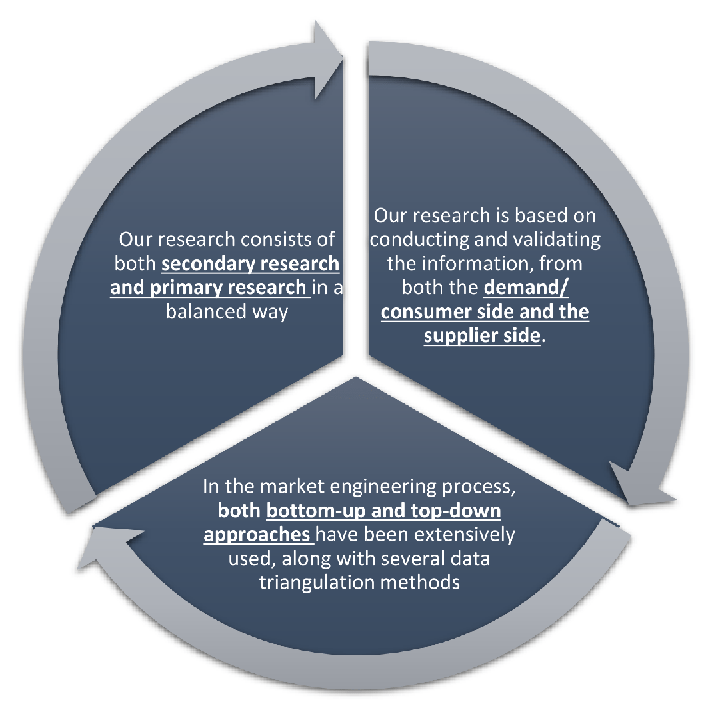
MarketGenics leverages a dedicated industry panel of experts and a comprehensive suite of paid databases to effectively collect, consolidate, and analyze market intelligence.
Our approach has consistently proven to be reliable and effective in generating accurate market insights, identifying key industry trends, and uncovering emerging business opportunities.
Through both primary and secondary research, we capture and analyze critical company-level data such as manufacturing footprints, including technical centers, R&D facilities, sales offices, and headquarters.
Our expert panel further enhances our ability to estimate market size for specific brands based on validated field-level intelligence.
Our data mining techniques incorporate both parametric and non-parametric methods, allowing for structured data collection, sorting, processing, and cleaning.
Demand projections are derived from large-scale data sets analyzed through proprietary algorithms, culminating in robust and reliable market sizing.
Research Approach
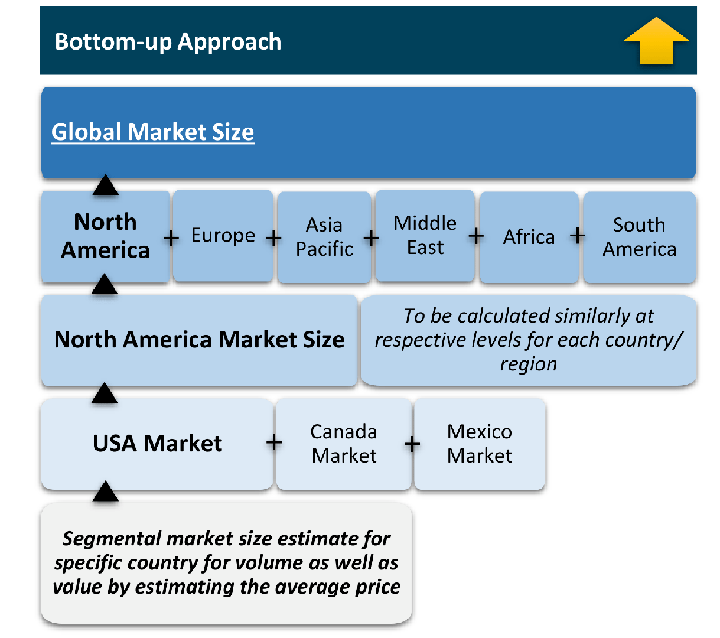
The bottom-up approach builds market estimates by starting with the smallest addressable market units and systematically aggregating them to create comprehensive market size projections.
This method begins with specific, granular data points and builds upward to create the complete market landscape.
Customer Analysis → Segmental Analysis → Geographical Analysis
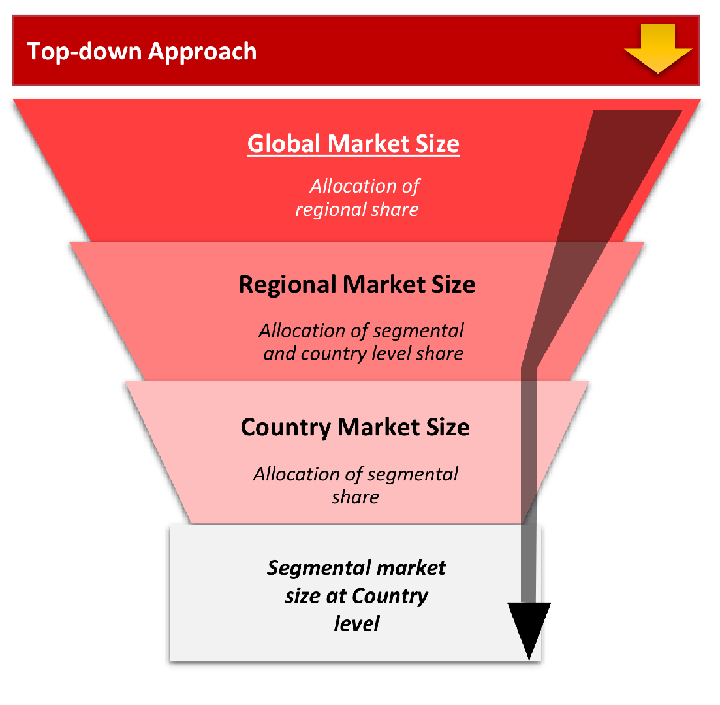
The top-down approach starts with the broadest possible market data and systematically narrows it down through a series of filters and assumptions to arrive at specific market segments or opportunities.
This method begins with the big picture and works downward to increasingly specific market slices.
TAM → SAM → SOM
Research Methods
Desk / Secondary Research
While analysing the market, we extensively study secondary sources, directories, and databases to identify and collect information useful for this technical, market-oriented, and commercial report. Secondary sources that we utilize are not only the public sources, but it is a combination of Open Source, Associations, Paid Databases, MG Repository & Knowledgebase, and others.
- Company websites, annual reports, financial reports, broker reports, and investor presentations
- National government documents, statistical databases and reports
- News articles, press releases and web-casts specific to the companies operating in the market, Magazines, reports, and others
- We gather information from commercial data sources for deriving company specific data such as segmental revenue, share for geography, product revenue, and others
- Internal and external proprietary databases (industry-specific), relevant patent, and regulatory databases
- Governing Bodies, Government Organizations
- Relevant Authorities, Country-specific Associations for Industries
We also employ the model mapping approach to estimate the product level market data through the players' product portfolio
Primary Research
Primary research/ interviews is vital in analyzing the market. Most of the cases involves paid primary interviews. Primary sources include primary interviews through e-mail interactions, telephonic interviews, surveys as well as face-to-face interviews with the different stakeholders across the value chain including several industry experts.
| Type of Respondents | Number of Primaries |
|---|---|
| Tier 2/3 Suppliers | ~20 |
| Tier 1 Suppliers | ~25 |
| End-users | ~25 |
| Industry Expert/ Panel/ Consultant | ~30 |
| Total | ~100 |
MG Knowledgebase
• Repository of industry blog, newsletter and case studies
• Online platform covering detailed market reports, and company profiles
Forecasting Factors and Models
Forecasting Factors
- Historical Trends – Past market patterns, cycles, and major events that shaped how markets behave over time. Understanding past trends helps predict future behavior.
- Industry Factors – Specific characteristics of the industry like structure, regulations, and innovation cycles that affect market dynamics.
- Macroeconomic Factors – Economic conditions like GDP growth, inflation, and employment rates that affect how much money people have to spend.
- Demographic Factors – Population characteristics like age, income, and location that determine who can buy your product.
- Technology Factors – How quickly people adopt new technology and how much technology infrastructure exists.
- Regulatory Factors – Government rules, laws, and policies that can help or restrict market growth.
- Competitive Factors – Analyzing competition structure such as degree of competition and bargaining power of buyers and suppliers.
Forecasting Models / Techniques
Multiple Regression Analysis
- Identify and quantify factors that drive market changes
- Statistical modeling to establish relationships between market drivers and outcomes
Time Series Analysis – Seasonal Patterns
- Understand regular cyclical patterns in market demand
- Advanced statistical techniques to separate trend, seasonal, and irregular components
Time Series Analysis – Trend Analysis
- Identify underlying market growth patterns and momentum
- Statistical analysis of historical data to project future trends
Expert Opinion – Expert Interviews
- Gather deep industry insights and contextual understanding
- In-depth interviews with key industry stakeholders
Multi-Scenario Development
- Prepare for uncertainty by modeling different possible futures
- Creating optimistic, pessimistic, and most likely scenarios
Time Series Analysis – Moving Averages
- Sophisticated forecasting for complex time series data
- Auto-regressive integrated moving average models with seasonal components
Econometric Models
- Apply economic theory to market forecasting
- Sophisticated economic models that account for market interactions
Expert Opinion – Delphi Method
- Harness collective wisdom of industry experts
- Structured, multi-round expert consultation process
Monte Carlo Simulation
- Quantify uncertainty and probability distributions
- Thousands of simulations with varying input parameters
Research Analysis
Our research framework is built upon the fundamental principle of validating market intelligence from both demand and supply perspectives. This dual-sided approach ensures comprehensive market understanding and reduces the risk of single-source bias.
Demand-Side Analysis: We understand end-user/application behavior, preferences, and market needs along with the penetration of the product for specific application.
Supply-Side Analysis: We estimate overall market revenue, analyze the segmental share along with industry capacity, competitive landscape, and market structure.
Validation & Evaluation
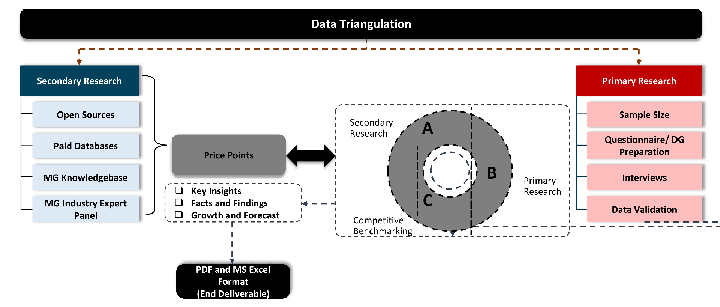
Data triangulation is a validation technique that uses multiple methods, sources, or perspectives to examine the same research question, thereby increasing the credibility and reliability of research findings. In market research, triangulation serves as a quality assurance mechanism that helps identify and minimize bias, validate assumptions, and ensure accuracy in market estimates.
- Data Source Triangulation – Using multiple data sources to examine the same phenomenon
- Methodological Triangulation – Using multiple research methods to study the same research question
- Investigator Triangulation – Using multiple researchers or analysts to examine the same data
- Theoretical Triangulation – Using multiple theoretical perspectives to interpret the same data
Custom Market Research Services
We will customise the research for you, in case the report listed above does not meet your requirements.
Get 10% Free Customisation