Minimalist Packaging Market Size, Share & Trends Analysis Report by Material Type (Paper & Paperboard, Corrugated Board, Biodegradable Plastics, Recycled Plastics, Glass, Metal, Compostable Materials, Others), Packaging Type, Design Feature, Printing & Decoration Type, Application, End-Use Industry, and Geography (North America, Europe, Asia Pacific, Middle East, Africa, and South America) – Global Industry Data, Trends, and Forecasts, 2026–2035
Minimalist Packaging Market Overview:
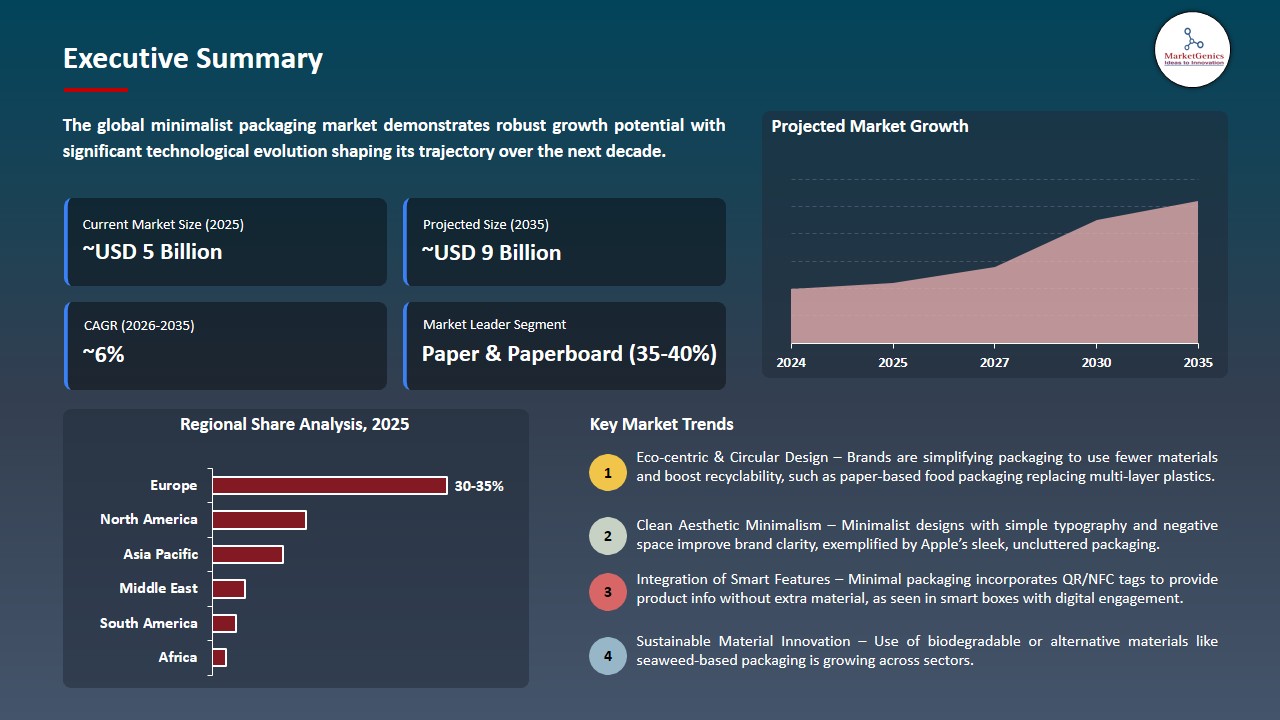
The global minimalist packaging market is witnessing strong growth, valued at USD 4.7 billion in 2025 and projected to reach USD 8.7 billion by 2035, expanding at a CAGR of 6.3% during the forecast period.
|
|
|
Segmental Data Insights |
|
|
Demand Trends |
|
|
Competitive Landscape |
|
|
Strategic Development |
|
|
Future Outlook & Opportunities |
|
Minimalist Packaging Market Size, Share, and Growth
The minimalist packaging market has automated production units, intelligent sensors and real-time data integration, which enhance the precision of the packaging, decrease the resources of materials, streamline the supply chains and augment the product traceability, lower the number of production mistakes, and minimise the cost of operations in high-volume manufacturing facilities.
Carmen Houston, ANZ Head of Marketing & Sustainability at SIG: At SIG, we have been at the forefront of bag-in-box packaging globally. This product reflects our ongoing commitment to innovation and leadership in sustainable packaging solutions for our customers, consumers, and the planet. By collaborating with APCO and our winery partners, we are delivering a recycle-ready solution that aligns with Australian recycling infrastructure while ensuring wine quality throughout the supply chain.
The world is fast evolving into the minimalist packaging market with brands and producers focusing on simplicity, sustainability, and material efficiency to comply with the tightening environmental requirements and changing consumer priorities. Minimalist packaging that is characterized by the usage of the minimum amount of material required and its protection of the product and also its beauty is gaining momentum in the food, beverage, personal care and e-commerce industries as companies look to reduce waste, save on costs and enhance brand authenticity.
Technological innovation is also changing the way minimalist packaging is developed and produced new bio-based materials, moulded pulp, and lightweight mono-materials are becoming a feasible alternative to conventional plastics and the ability to design durable yet compostable or recyclable designs that can be made durable enough to meet the challenge of plastic waste on a large scale is being introduced. The smart, interactive, and transparent design elements such as QR codes, digital storytelling, and clear eco-labeling are contributing to the amplified consumer engagement and conveying the sustainability requirements and instilling trust.
The adjacent opportunities are minimalist design usage, smart and interactive packaging, eco-focused materials integration, and packaging with traceability. These technologies increase brand differentiation, consumer interactions, efficiency in production, and compliance with sustainability. Minimalist packaging is becoming a valuable value multiplier in the food, beverage, personal care, and e-commerce industries around the world because of an increased utilization of recyclable mono-materials, modular packaging and digital labeling systems.
Minimalist Packaging Market Dynamics and Trends
Driver: Growing Sustainability Mandates & Consumer Demand
-
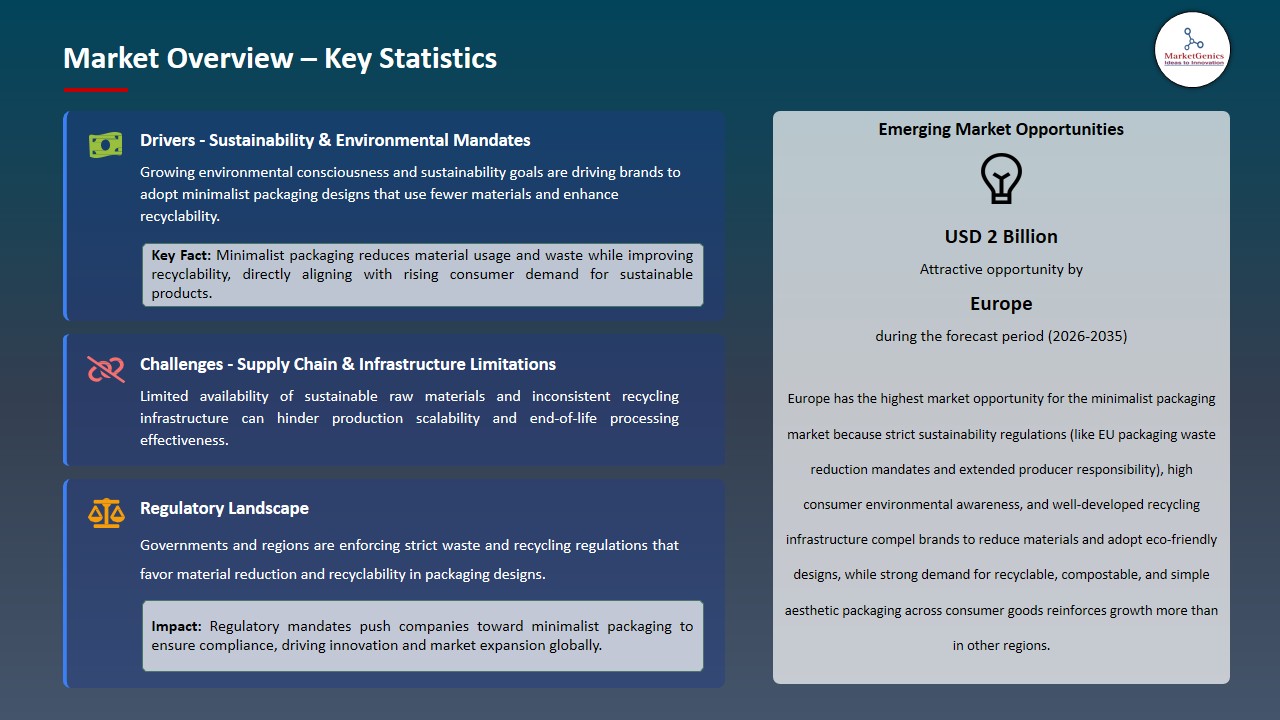
Minimalist and eco-friendly and recyclable packaging is increasingly being adopted worldwide as companies strive to minimise carbon emissions, adhere to plastic bans, and satisfy high environmental reporting benchmarks.
- The need by consumers to use environmentally-friendly and resource-efficient packaging is driving increased innovation. For instance, in 2025, the Karnataka Milk Federation (KMF) launched eco-friendly biodegradable milk packets to its Nandini brand in Bengaluru, crafted out of plant-based materials that break down naturally within 90 days and replace millions of traditional polythene sachets, also satisfying consumer needs of sustainable everyday packaging.
- Sustainable minimalist packaging is on the move due to its capacity to improve brand image, live up to regulation requirements, and eco-friendly consumers wanting sustainable products.
Restraint: High Initial Costs & Material Limitations
-
The creation and use of smarter minimalist packaging are not cost-effective because of the expenses of bio-based polymers, intelligent coating, and addition of digital elements such as QR codes and NFC sensors, so the introduction cost is large, as compared to conventional packaging.
- Continued manufacturing and operating expenses such as special equipment, raw material sourcing, and recycling systems integration remain a financial drain; e.g. installation of high performance biodegradable films or mono material smart pouches on a factory scale can add 2040 units further, which small and medium-sized businesses cannot afford.
- There is a lack of material supply and technical knowledge to scale and implement on a mass basis in new markets.
Opportunity: Innovation in Sustainable Materials & Smart Packaging
-
Material developers, packaging innovators, and technology integrators are providing new avenues in the global minimalist packaging market through the development of lightweight materials, bio-based materials as well as recyclable materials with reduced impact to the environment yet with durability, protection, and shelf appeal.
- Another development is the use of agro-waste to develop functional packaging material by research institutions and industry collaborations. In 2025, Central Citrus Research Institute (ICAR-CCRI) and Visvesvaraya national Institute of Technology (VNIT) produced orange peel waste-based biodegradable packaging films, transforming agricultural industrial by-products into useable biopolymer packaging, and increasing the choice of sustainable materials in food and consumer products.
- Smart package containing QR code, NFC and sensors is increasing traceability, consumer interactions and waste minimization.
Key Trend: Circular Economy & Eco‑Centric Design Adoption
-
Global brands and packaging innovators are implementing circular economy principles in minimalist packaging, emphasizing on recyclability and material recovery as well as efficiency in lifecycle to reduce waste and emissions.
- The reusable and re-packaging systems are more actively piloted by companies that want to introduce circular models into the world of supply chains and implement them practically. For instance, in August 2024, Ocado Retail became the first significant online reusable packaging initiative in the UK in collaboration with the UK Refill Coalition, in which strong, reusable boxes would be used to deliver grocery goods such as rice, pasta, and laundry products.
- Design-for-disassembly and closed-loop recovery technologies also contribute to materials being more circular and allowing the supply chain to have eco-centric certification roadmaps.
Minimalist Packaging Market Analysis and Segmental Data
Paper & Paperboard Dominate Global Minimalist Packaging Market
-
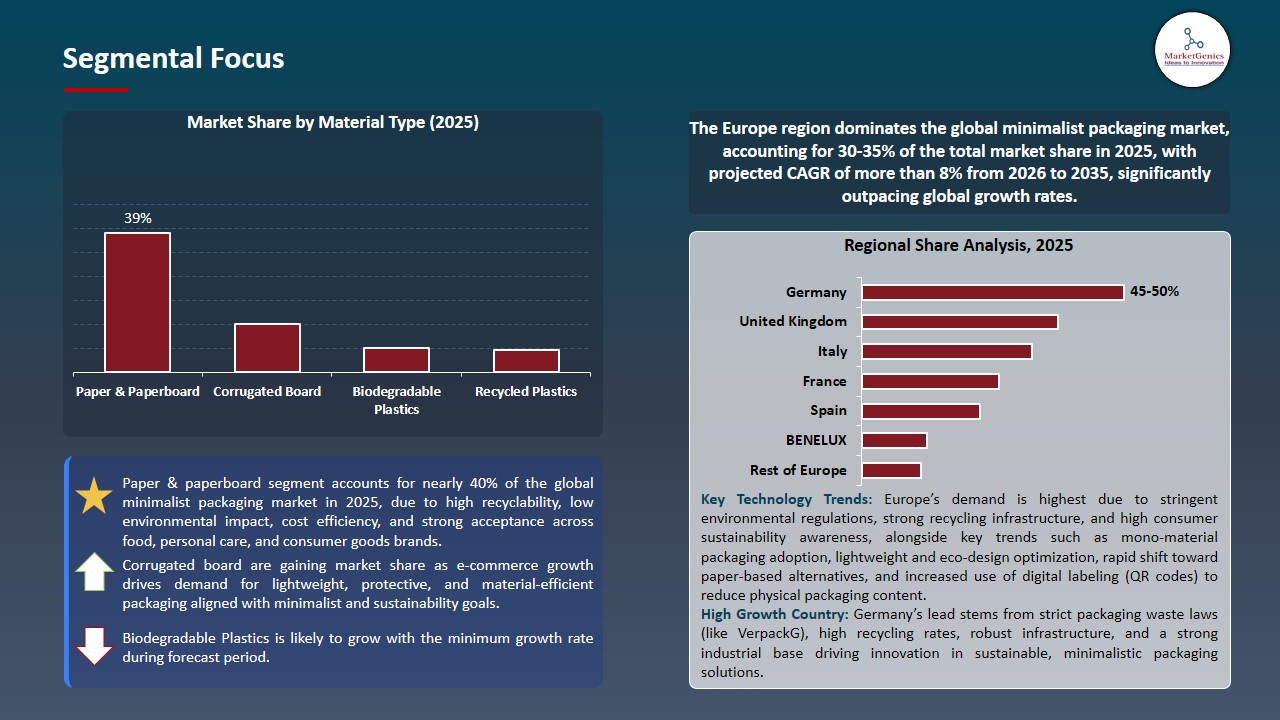
Paper and paperboard dominate the global minimalist packaging market with more and more brands shifting the use of multi-layer plastics to the use of fibers to reduce materials usage, enhance recyclability and satisfy the sustainability requirements in food and beverage and consumer goods industries.
- Paper and paperboard are also popular in minimalist packaging due to recyclability and low material costs; in January 2026, Mini Babybel repackaged its cheese in completely recyclable paper wrap, instead of plastic and in favour of sustainability.
- Paper and paperboard dominate the minimalist packaging market with the benefits of low weight, renewable sourcing, favourableness and high levels of compatibility with circular-economy packaging objectives.
Europe Leads Global Minimalist Packaging Market Demand
-
Europe dominates the global minimalist packaging market because regulators, brands, and e-commerce actors focus on the reduction of materials, recyclability, and the absence of plastics to achieve the objective of the circular-economy.
- Regional leadership is enhanced by product innovation and strategic partnership. For instance, in September 2024, Amazon, and Mondi developed a paper-padded envelope to deliver e-commerce in Europe, a 100 percent recyclable, shock-absorbing, paper-based mailer that replaces plastic padding at all stages, and lowers the total material usage and preserves the products during transportation.
- The high sustainability laws, environmentally-friendly customers, and brand-manufacturer cooperation deeply make Europe a major global market on minimalist packaging diffusion.
Minimalist Packaging Market Ecosystem
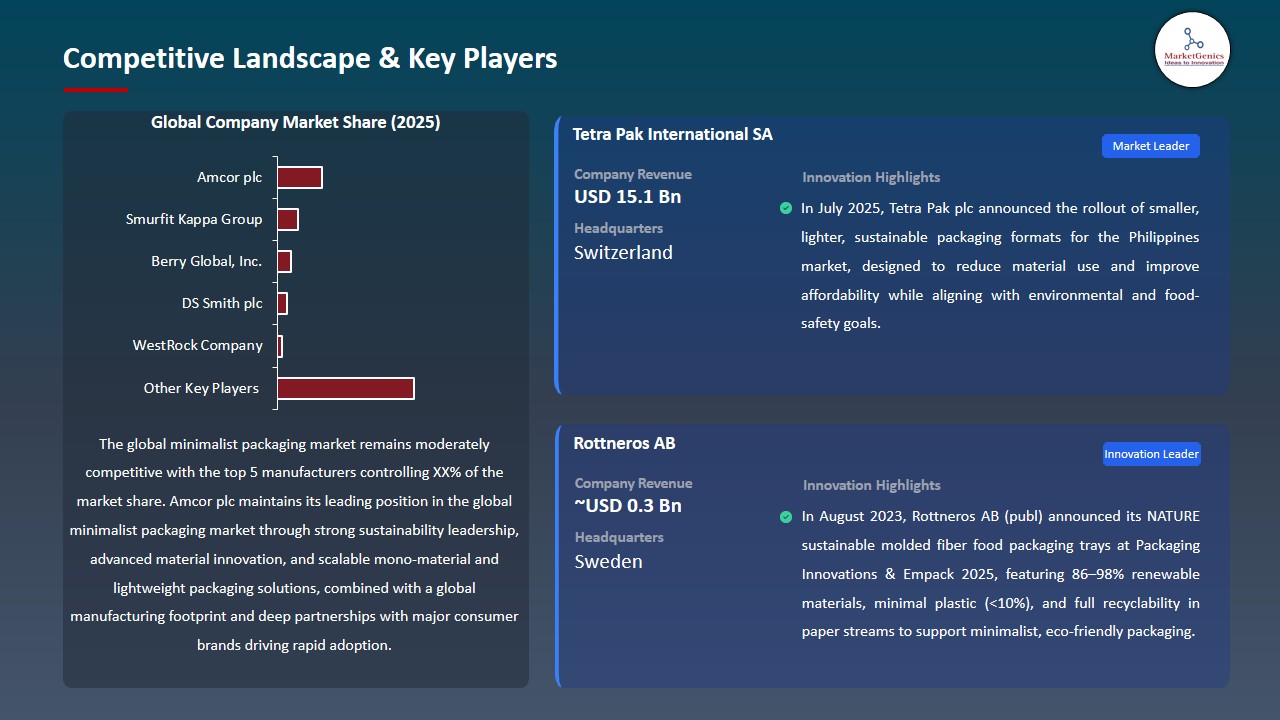
The global minimalist packaging market is moderately consolidated, and the rivalry is oriented on the sustainable materials development, simplification of designs, increasing recyclability, and lightweight forms. Amcor plc, Smurfit Kappa Group, Berry Global, Inc., DS Smith plc, and WestRock Company are some of the key players, which rely on state-of-the-art materials, eco-friendly design platforms, and multi-sector packaging solutions to facilitate the brand sustainability agenda in the food and beverage, consumer items, e-commerce, and specialty products.
The giants in the market are innovating the technological and design limits to eliminate the material usage and still retain the functionality. Amcor plc is concerned with high-grade mono-material structures and recyclable films instead of multi-layered plastics; Smurfit Kappa Group is passionate about innovative fiber-based packaging systems and minimal board designs that increase recyclability and strength. Berry Global, Inc. incorporates bio-based resins and lightweight extrusion systems to work down carbon footprint, and DS Smith plc invent biodegradable paper-based insulation and customized minimalist systems that decrease wastage and enhance recovery at the end of life. WestRock Company develops molded fiber and paperboard solutions with optimized geometry that will reduce material at the same time maintaining protective performance.
Ecosystem activities such as collaborations with material scientists, converters, brand owners and sustainability consortia are catalyzing innovation in minimalist design platforms, recyclable substrate development and circular-economy plans. Consortia in the industry and research efforts center on next generation bio-polymers, water coatings and alignment of recycling infrastructure. Such processes in an ecosystem enhance competitive differentiation, aid regulatory compliance (e.g., national recycling goals) and enable global packaging providers to respond to increasing demand for environmental responsible, minimal packaging systems in markets.
Recent Development and Strategic Overview
-
In April 2025, SIG launched the first recycle-ready bag-in-box wine package in Australia made with mono-material SIG Terra RecShield, and 100 per cent recyclable material, which contributes to national recycling targets and designs enhanced circular packaging.
- In October 2025, Frugalpac, ITC’s Packaging & Printing Business, and Rhea Distilleries launched India’s first paper bottle for Fidalgo Premium Cashew Feni, made from 94 % recycled paperboard to reduce weight and carbon footprint, marking a significant sustainable packaging innovation.
Report Scope
|
Detail |
|
|
Market Size in 2025 |
USD 4.7 Bn |
|
Market Forecast Value in 2035 |
USD 8.7 Bn |
|
Growth Rate (CAGR) |
6.3% |
|
Forecast Period |
2026 – 2035 |
|
Historical Data Available for |
2021 – 2024 |
|
Market Size Units |
US$ Billion for Value |
|
Report Format |
Electronic (PDF) + Excel |
|
North America |
Europe |
Asia Pacific |
Middle East |
Africa |
South America |
|
|
|
|
|
|
|
Companies Covered |
|||||
|
|
|
|
|
|
Minimalist Packaging Market Segmentation and Highlights
|
Segment |
Sub-segment |
|
Minimalist Packaging Market, By Material Type |
|
|
Minimalist Packaging Market, By Packaging Type |
|
|
Minimalist Packaging Market, By Design Feature |
|
|
Minimalist Packaging Market, By Printing & Decoration Type |
|
|
Minimalist Packaging Market, By Application |
|
|
Minimalist Packaging Market, By End-Use Industry |
|
Frequently Asked Questions
Table of Contents
- 1. Research Methodology and Assumptions
- 1.1. Definitions
- 1.2. Research Design and Approach
- 1.3. Data Collection Methods
- 1.4. Base Estimates and Calculations
- 1.5. Forecasting Models
- 1.5.1. Key Forecast Factors & Impact Analysis
- 1.6. Secondary Research
- 1.6.1. Open Sources
- 1.6.2. Paid Databases
- 1.6.3. Associations
- 1.7. Primary Research
- 1.7.1. Primary Sources
- 1.7.2. Primary Interviews with Stakeholders across Ecosystem
- 2. Executive Summary
- 2.1. Global Minimalist Packaging Market Outlook
- 2.1.1. Minimalist Packaging Market Size (Value - US$ Bn), and Forecasts, 2021-2035
- 2.1.2. Compounded Annual Growth Rate Analysis
- 2.1.3. Growth Opportunity Analysis
- 2.1.4. Segmental Share Analysis
- 2.1.5. Geographical Share Analysis
- 2.2. Market Analysis and Facts
- 2.3. Supply-Demand Analysis
- 2.4. Competitive Benchmarking
- 2.5. Go-to- Market Strategy
- 2.5.1. Customer/ End-use Industry Assessment
- 2.5.2. Growth Opportunity Data, 2026-2035
- 2.5.2.1. Regional Data
- 2.5.2.2. Country Data
- 2.5.2.3. Segmental Data
- 2.5.3. Identification of Potential Market Spaces
- 2.5.4. GAP Analysis
- 2.5.5. Potential Attractive Price Points
- 2.5.6. Prevailing Market Risks & Challenges
- 2.5.7. Preferred Sales & Marketing Strategies
- 2.5.8. Key Recommendations and Analysis
- 2.5.9. A Way Forward
- 2.1. Global Minimalist Packaging Market Outlook
- 3. Industry Data and Premium Insights
- 3.1. Global Packaging Industry Overview, 2025
- 3.1.1. Packaging Industry Ecosystem Analysis
- 3.1.2. Key Trends for Packaging Industry
- 3.1.3. Regional Distribution for Packaging Industry
- 3.2. Supplier Customer Data
- 3.3. Technology Roadmap and Developments
- 3.4. Trade Analysis
- 3.4.1. Import & Export Analysis, 2025
- 3.4.2. Top Importing Countries
- 3.4.3. Top Exporting Countries
- 3.5. Trump Tariff Impact Analysis
- 3.5.1. Manufacturer
- 3.5.1.1. Based on the component & Raw material
- 3.5.2. Supply Chain
- 3.5.3. End Consumer
- 3.5.1. Manufacturer
- 3.6. Raw Material Analysis
- 3.1. Global Packaging Industry Overview, 2025
- 4. Market Overview
- 4.1. Market Dynamics
- 4.1.1. Drivers
- 4.1.1.1. Rising consumer preference for simple, clean, and functional packaging designs that enhance brand transparency.
- 4.1.1.2. Increasing focus on material reduction and waste minimization to support sustainability and circular economy goals.
- 4.1.1.3. Strong adoption by premium and eco-conscious brands seeking cost efficiency through reduced packaging components.
- 4.1.2. Restraints
- 4.1.2.1. Limited scope for complex branding and visual differentiation due to simplified design formats.
- 4.1.2.2. Performance and durability challenges when using reduced or lightweight packaging materials.
- 4.1.1. Drivers
- 4.2. Key Trend Analysis
- 4.3. Regulatory Framework
- 4.3.1. Key Regulations, Norms, and Subsidies, by Key Countries
- 4.3.2. Tariffs and Standards
- 4.3.3. Impact Analysis of Regulations on the Market
- 4.4. Value Chain Analysis
- 4.5. Porter’s Five Forces Analysis
- 4.6. PESTEL Analysis
- 4.7. Global Minimalist Packaging Market Demand
- 4.7.1. Historical Market Size – Value (US$ Bn), 2020-2024
- 4.7.2. Current and Future Market Size – Value (US$ Bn), 2026–2035
- 4.7.2.1. Y-o-Y Growth Trends
- 4.7.2.2. Absolute $ Opportunity Assessment
- 4.1. Market Dynamics
- 5. Competition Landscape
- 5.1. Competition structure
- 5.1.1. Fragmented v/s consolidated
- 5.2. Company Share Analysis, 2025
- 5.2.1. Global Company Market Share
- 5.2.2. By Region
- 5.2.2.1. North America
- 5.2.2.2. Europe
- 5.2.2.3. Asia Pacific
- 5.2.2.4. Middle East
- 5.2.2.5. Africa
- 5.2.2.6. South America
- 5.3. Product Comparison Matrix
- 5.3.1. Specifications
- 5.3.2. Market Positioning
- 5.3.3. Pricing
- 5.1. Competition structure
- 6. Global Minimalist Packaging Market Analysis, by Material Type
- 6.1. Key Segment Analysis
- 6.2. Minimalist Packaging Market Size (Value - US$ Bn), Analysis, and Forecasts, by Material Type, 2021-2035
- 6.2.1. Paper & Paperboard
- 6.2.2. Corrugated Board
- 6.2.3. Biodegradable Plastics
- 6.2.4. Recycled Plastics
- 6.2.5. Glass
- 6.2.6. Metal
- 6.2.7. Compostable Materials
- 6.2.8. Others
- 7. Global Minimalist Packaging Market Analysis, by Packaging Type
- 7.1. Key Segment Analysis
- 7.2. Minimalist Packaging Market Size (Value - US$ Bn), Analysis, and Forecasts, by Packaging Type, 2021-2035
- 7.2.1. Primary Packaging
- 7.2.2. Secondary Packaging
- 7.2.3. Tertiary Packaging
- 8. Global Minimalist Packaging Market Analysis, by Design Feature
- 8.1. Key Segment Analysis
- 8.2. Minimalist Packaging Market Size (Value - US$ Bn), Analysis, and Forecasts, by Design Feature, 2021-2035
- 8.2.1. Simple/Single-Color Design
- 8.2.2. Eco-Friendly/Green Design
- 8.2.3. Transparent/See-Through Design
- 8.2.4. Monogram/Minimal Branding
- 8.2.5. Typography-Centric Design
- 8.2.6. Others
- 9. Global Minimalist Packaging Market Analysis, by Printing & Decoration Type
- 9.1. Key Segment Analysis
- 9.2. Minimalist Packaging Market Size (Value - US$ Bn), Analysis, and Forecasts, by Printing & Decoration Type, 2021-2035
- 9.2.1. Digital Printing
- 9.2.2. Flexographic Printing
- 9.2.3. Letterpress Printing
- 9.2.4. Screen Printing
- 9.2.5. Embossing/Debossing
- 9.2.6. Others
- 10. Global Minimalist Packaging Market Analysis, by Application
- 10.1. Key Segment Analysis
- 10.2. Minimalist Packaging Market Size (Value - US$ Bn), Analysis, and Forecasts, by Application, 2021-2035
- 10.2.1. Product Protection
- 10.2.2. Branding & Labeling
- 10.2.3. Retail Display Packaging
- 10.2.4. Shipping & Transportation Packaging
- 10.2.5. Promotional Packaging
- 10.2.6. Others
- 11. Global Minimalist Packaging Market Analysis, by End-Use Industry
- 11.1. Key Segment Analysis
- 11.2. Minimalist Packaging Market Size (Value - US$ Bn), Analysis, and Forecasts, by End-Use Industry, 2021-2035
- 11.2.1. Food & Beverage
- 11.2.2. Cosmetics & Personal Care
- 11.2.3. Pharmaceuticals & Healthcare
- 11.2.4. Consumer Electronics
- 11.2.5. Apparel & Fashion
- 11.2.6. Household Goods
- 11.2.7. Luxury Goods
- 11.2.8. E-commerce
- 11.2.9. Others
- 12. Global Minimalist Packaging Market Analysis and Forecasts, by Region
- 12.1. Key Findings
- 12.2. Minimalist Packaging Market Size (Value - US$ Bn), Analysis, and Forecasts, by Region, 2021-2035
- 12.2.1. North America
- 12.2.2. Europe
- 12.2.3. Asia Pacific
- 12.2.4. Middle East
- 12.2.5. Africa
- 12.2.6. South America
- 13. North America Minimalist Packaging Market Analysis
- 13.1. Key Segment Analysis
- 13.2. Regional Snapshot
- 13.3. North America Minimalist Packaging Market Size (Value - US$ Bn), Analysis, and Forecasts, 2021-2035
- 13.3.1. Material Type
- 13.3.2. Packaging Type
- 13.3.3. Design Feature
- 13.3.4. Printing & Decoration Type
- 13.3.5. Application
- 13.3.6. End-Use Industry
- 13.3.7. Country
- 13.3.7.1. USA
- 13.3.7.2. Canada
- 13.3.7.3. Mexico
- 13.4. USA Minimalist Packaging Market
- 13.4.1. Country Segmental Analysis
- 13.4.2. Material Type
- 13.4.3. Packaging Type
- 13.4.4. Design Feature
- 13.4.5. Printing & Decoration Type
- 13.4.6. Application
- 13.4.7. End-Use Industry
- 13.5. Canada Minimalist Packaging Market
- 13.5.1. Country Segmental Analysis
- 13.5.2. Material Type
- 13.5.3. Packaging Type
- 13.5.4. Design Feature
- 13.5.5. Printing & Decoration Type
- 13.5.6. Application
- 13.5.7. End-Use Industry
- 13.6. Mexico Minimalist Packaging Market
- 13.6.1. Country Segmental Analysis
- 13.6.2. Material Type
- 13.6.3. Packaging Type
- 13.6.4. Design Feature
- 13.6.5. Printing & Decoration Type
- 13.6.6. Application
- 13.6.7. End-Use Industry
- 14. Europe Minimalist Packaging Market Analysis
- 14.1. Key Segment Analysis
- 14.2. Regional Snapshot
- 14.3. Europe Minimalist Packaging Market Size (Value - US$ Bn), Analysis, and Forecasts, 2021-2035
- 14.3.1. Material Type
- 14.3.2. Packaging Type
- 14.3.3. Design Feature
- 14.3.4. Printing & Decoration Type
- 14.3.5. Application
- 14.3.6. End-Use Industry
- 14.3.7. Country
- 14.3.7.1. Germany
- 14.3.7.2. United Kingdom
- 14.3.7.3. France
- 14.3.7.4. Italy
- 14.3.7.5. Spain
- 14.3.7.6. Netherlands
- 14.3.7.7. Nordic Countries
- 14.3.7.8. Poland
- 14.3.7.9. Russia & CIS
- 14.3.7.10. Rest of Europe
- 14.4. Germany Minimalist Packaging Market
- 14.4.1. Country Segmental Analysis
- 14.4.2. Material Type
- 14.4.3. Packaging Type
- 14.4.4. Design Feature
- 14.4.5. Printing & Decoration Type
- 14.4.6. Application
- 14.4.7. End-Use Industry
- 14.5. United Kingdom Minimalist Packaging Market
- 14.5.1. Country Segmental Analysis
- 14.5.2. Material Type
- 14.5.3. Packaging Type
- 14.5.4. Design Feature
- 14.5.5. Printing & Decoration Type
- 14.5.6. Application
- 14.5.7. End-Use Industry
- 14.6. France Minimalist Packaging Market
- 14.6.1. Country Segmental Analysis
- 14.6.2. Material Type
- 14.6.3. Packaging Type
- 14.6.4. Design Feature
- 14.6.5. Printing & Decoration Type
- 14.6.6. Application
- 14.6.7. End-Use Industry
- 14.7. Italy Minimalist Packaging Market
- 14.7.1. Country Segmental Analysis
- 14.7.2. Component
- 14.7.3. Deployment Mode
- 14.7.4. Application
- 14.7.5. Technology
- 14.7.6. Use Case
- 14.7.7. Network Type
- 14.7.8. End-Users
- 14.8. Spain Minimalist Packaging Market
- 14.8.1. Country Segmental Analysis
- 14.8.2. Component
- 14.8.3. Deployment Mode
- 14.8.4. Application
- 14.8.5. Technology
- 14.8.6. Use Case
- 14.8.7. Network Type
- 14.8.8. End-Users
- 14.9. Netherlands Minimalist Packaging Market
- 14.9.1. Country Segmental Analysis
- 14.9.2. Component
- 14.9.3. Deployment Mode
- 14.9.4. Application
- 14.9.5. Technology
- 14.9.6. Use Case
- 14.9.7. Network Type
- 14.9.8. End-Users
- 14.10. Nordic Countries Minimalist Packaging Market
- 14.10.1. Country Segmental Analysis
- 14.10.2. Component
- 14.10.3. Deployment Mode
- 14.10.4. Application
- 14.10.5. Technology
- 14.10.6. Use Case
- 14.10.7. Network Type
- 14.10.8. End-Users
- 14.11. Poland Minimalist Packaging Market
- 14.11.1. Country Segmental Analysis
- 14.11.2. Component
- 14.11.3. Deployment Mode
- 14.11.4. Application
- 14.11.5. Technology
- 14.11.6. Use Case
- 14.11.7. Network Type
- 14.11.8. End-Users
- 14.12. Russia & CIS Minimalist Packaging Market
- 14.12.1. Country Segmental Analysis
- 14.12.2. Component
- 14.12.3. Deployment Mode
- 14.12.4. Application
- 14.12.5. Technology
- 14.12.6. Use Case
- 14.12.7. Network Type
- 14.12.8. End-Users
- 14.13. Rest of Europe Minimalist Packaging Market
- 14.13.1. Country Segmental Analysis
- 14.13.2. Component
- 14.13.3. Deployment Mode
- 14.13.4. Application
- 14.13.5. Technology
- 14.13.6. Use Case
- 14.13.7. Network Type
- 14.13.8. End-Users
- 15. Asia Pacific Minimalist Packaging Market Analysis
- 15.1. Key Segment Analysis
- 15.2. Regional Snapshot
- 15.3. Asia Pacific Minimalist Packaging Market Size (Value - US$ Bn), Analysis, and Forecasts, 2021-2035
- 15.3.1. Component
- 15.3.2. Deployment Mode
- 15.3.3. Application
- 15.3.4. Technology
- 15.3.5. Use Case
- 15.3.6. Network Type
- 15.3.7. End-Users
- 15.3.8. Country
- 15.3.8.1. China
- 15.3.8.2. India
- 15.3.8.3. Japan
- 15.3.8.4. South Korea
- 15.3.8.5. Australia and New Zealand
- 15.3.8.6. Indonesia
- 15.3.8.7. Malaysia
- 15.3.8.8. Thailand
- 15.3.8.9. Vietnam
- 15.3.8.10. Rest of Asia Pacific
- 15.4. China Minimalist Packaging Market
- 15.4.1. Country Segmental Analysis
- 15.4.2. Component
- 15.4.3. Deployment Mode
- 15.4.4. Application
- 15.4.5. Technology
- 15.4.6. Use Case
- 15.4.7. Network Type
- 15.4.8. End-Users
- 15.5. India Minimalist Packaging Market
- 15.5.1. Country Segmental Analysis
- 15.5.2. Component
- 15.5.3. Deployment Mode
- 15.5.4. Application
- 15.5.5. Technology
- 15.5.6. Use Case
- 15.5.7. Network Type
- 15.5.8. End-Users
- 15.6. Japan Minimalist Packaging Market
- 15.6.1. Country Segmental Analysis
- 15.6.2. Component
- 15.6.3. Deployment Mode
- 15.6.4. Application
- 15.6.5. Technology
- 15.6.6. Use Case
- 15.6.7. Network Type
- 15.6.8. End-Users
- 15.7. South Korea Minimalist Packaging Market
- 15.7.1. Country Segmental Analysis
- 15.7.2. Component
- 15.7.3. Deployment Mode
- 15.7.4. Application
- 15.7.5. Technology
- 15.7.6. Use Case
- 15.7.7. Network Type
- 15.7.8. End-Users
- 15.8. Australia and New Zealand Minimalist Packaging Market
- 15.8.1. Country Segmental Analysis
- 15.8.2. Component
- 15.8.3. Deployment Mode
- 15.8.4. Application
- 15.8.5. Technology
- 15.8.6. Use Case
- 15.8.7. Network Type
- 15.8.8. End-Users
- 15.9. Indonesia Minimalist Packaging Market
- 15.9.1. Country Segmental Analysis
- 15.9.2. Component
- 15.9.3. Deployment Mode
- 15.9.4. Application
- 15.9.5. Technology
- 15.9.6. Use Case
- 15.9.7. Network Type
- 15.9.8. End-Users
- 15.10. Malaysia Minimalist Packaging Market
- 15.10.1. Country Segmental Analysis
- 15.10.2. Component
- 15.10.3. Deployment Mode
- 15.10.4. Application
- 15.10.5. Technology
- 15.10.6. Use Case
- 15.10.7. Network Type
- 15.10.8. End-Users
- 15.11. Thailand Minimalist Packaging Market
- 15.11.1. Country Segmental Analysis
- 15.11.2. Component
- 15.11.3. Deployment Mode
- 15.11.4. Application
- 15.11.5. Technology
- 15.11.6. Use Case
- 15.11.7. Network Type
- 15.11.8. End-Users
- 15.12. Vietnam Minimalist Packaging Market
- 15.12.1. Country Segmental Analysis
- 15.12.2. Component
- 15.12.3. Deployment Mode
- 15.12.4. Application
- 15.12.5. Technology
- 15.12.6. Use Case
- 15.12.7. Network Type
- 15.12.8. End-Users
- 15.13. Rest of Asia Pacific Minimalist Packaging Market
- 15.13.1. Country Segmental Analysis
- 15.13.2. Component
- 15.13.3. Deployment Mode
- 15.13.4. Application
- 15.13.5. Technology
- 15.13.6. Use Case
- 15.13.7. Network Type
- 15.13.8. End-Users
- 16. Middle East Minimalist Packaging Market Analysis
- 16.1. Key Segment Analysis
- 16.2. Regional Snapshot
- 16.3. Middle East Minimalist Packaging Market Size (Value - US$ Bn), Analysis, and Forecasts, 2021-2035
- 16.3.1. Component
- 16.3.2. Deployment Mode
- 16.3.3. Application
- 16.3.4. Technology
- 16.3.5. Use Case
- 16.3.6. Network Type
- 16.3.7. End-Users
- 16.3.8. Country
- 16.3.8.1. Turkey
- 16.3.8.2. UAE
- 16.3.8.3. Saudi Arabia
- 16.3.8.4. Israel
- 16.3.8.5. Rest of Middle East
- 16.4. Turkey Minimalist Packaging Market
- 16.4.1. Country Segmental Analysis
- 16.4.2. Component
- 16.4.3. Deployment Mode
- 16.4.4. Application
- 16.4.5. Technology
- 16.4.6. Use Case
- 16.4.7. Network Type
- 16.4.8. End-Users
- 16.5. UAE Minimalist Packaging Market
- 16.5.1. Country Segmental Analysis
- 16.5.2. Component
- 16.5.3. Deployment Mode
- 16.5.4. Application
- 16.5.5. Technology
- 16.5.6. Use Case
- 16.5.7. Network Type
- 16.5.8. End-Users
- 16.6. Saudi Arabia Minimalist Packaging Market
- 16.6.1. Country Segmental Analysis
- 16.6.2. Component
- 16.6.3. Deployment Mode
- 16.6.4. Application
- 16.6.5. Technology
- 16.6.6. Use Case
- 16.6.7. Network Type
- 16.6.8. End-Users
- 16.7. Israel Minimalist Packaging Market
- 16.7.1. Country Segmental Analysis
- 16.7.2. Component
- 16.7.3. Deployment Mode
- 16.7.4. Application
- 16.7.5. Technology
- 16.7.6. Use Case
- 16.7.7. Network Type
- 16.7.8. End-Users
- 16.8. Rest of Middle East Minimalist Packaging Market
- 16.8.1. Country Segmental Analysis
- 16.8.2. Component
- 16.8.3. Deployment Mode
- 16.8.4. Application
- 16.8.5. Technology
- 16.8.6. Use Case
- 16.8.7. Network Type
- 16.8.8. End-Users
- 17. Africa Minimalist Packaging Market Analysis
- 17.1. Key Segment Analysis
- 17.2. Regional Snapshot
- 17.3. Africa Minimalist Packaging Market Size (Value - US$ Bn), Analysis, and Forecasts, 2021-2035
- 17.3.1. Component
- 17.3.2. Deployment Mode
- 17.3.3. Application
- 17.3.4. Technology
- 17.3.5. Use Case
- 17.3.6. Network Type
- 17.3.7. End-Users
- 17.3.8. Country
- 17.3.8.1. South Africa
- 17.3.8.2. Egypt
- 17.3.8.3. Nigeria
- 17.3.8.4. Algeria
- 17.3.8.5. Rest of Africa
- 17.4. South Africa Minimalist Packaging Market
- 17.4.1. Country Segmental Analysis
- 17.4.2. Component
- 17.4.3. Deployment Mode
- 17.4.4. Application
- 17.4.5. Technology
- 17.4.6. Use Case
- 17.4.7. Network Type
- 17.4.8. End-Users
- 17.5. Egypt Minimalist Packaging Market
- 17.5.1. Country Segmental Analysis
- 17.5.2. Component
- 17.5.3. Deployment Mode
- 17.5.4. Application
- 17.5.5. Technology
- 17.5.6. Use Case
- 17.5.7. Network Type
- 17.5.8. End-Users
- 17.6. Nigeria Minimalist Packaging Market
- 17.6.1. Country Segmental Analysis
- 17.6.2. Component
- 17.6.3. Deployment Mode
- 17.6.4. Application
- 17.6.5. Technology
- 17.6.6. Use Case
- 17.6.7. Network Type
- 17.6.8. End-Users
- 17.7. Algeria Minimalist Packaging Market
- 17.7.1. Country Segmental Analysis
- 17.7.2. Component
- 17.7.3. Deployment Mode
- 17.7.4. Application
- 17.7.5. Technology
- 17.7.6. Use Case
- 17.7.7. Network Type
- 17.7.8. End-Users
- 17.8. Rest of Africa Minimalist Packaging Market
- 17.8.1. Country Segmental Analysis
- 17.8.2. Component
- 17.8.3. Deployment Mode
- 17.8.4. Application
- 17.8.5. Technology
- 17.8.6. Use Case
- 17.8.7. Network Type
- 17.8.8. End-Users
- 18. South America Minimalist Packaging Market Analysis
- 18.1. Key Segment Analysis
- 18.2. Regional Snapshot
- 18.3. South America Minimalist Packaging Market Size (Value - US$ Bn), Analysis, and Forecasts, 2021-2035
- 18.3.1. Component
- 18.3.2. Deployment Mode
- 18.3.3. Application
- 18.3.4. Technology
- 18.3.5. Use Case
- 18.3.6. Network Type
- 18.3.7. End-Users
- 18.3.8. Country
- 18.3.8.1. Brazil
- 18.3.8.2. Argentina
- 18.3.8.3. Rest of South America
- 18.4. Brazil Minimalist Packaging Market
- 18.4.1. Country Segmental Analysis
- 18.4.2. Component
- 18.4.3. Deployment Mode
- 18.4.4. Application
- 18.4.5. Technology
- 18.4.6. Use Case
- 18.4.7. Network Type
- 18.4.8. End-Users
- 18.5. Argentina Minimalist Packaging Market
- 18.5.1. Country Segmental Analysis
- 18.5.2. Component
- 18.5.3. Deployment Mode
- 18.5.4. Application
- 18.5.5. Technology
- 18.5.6. Use Case
- 18.5.7. Network Type
- 18.5.8. End-Users
- 18.6. Rest of South America Minimalist Packaging Market
- 18.6.1. Country Segmental Analysis
- 18.6.2. Component
- 18.6.3. Deployment Mode
- 18.6.4. Application
- 18.6.5. Technology
- 18.6.6. Use Case
- 18.6.7. Network Type
- 18.6.8. End-Users
- 19. Key Players/ Company Profile
- 19.1. Amcor plc
- 19.1.1. Company Details/ Overview
- 19.1.2. Company Financials
- 19.1.3. Key Customers and Competitors
- 19.1.4. Business/ Industry Portfolio
- 19.1.5. Product Portfolio/ Specification Details
- 19.1.6. Pricing Data
- 19.1.7. Strategic Overview
- 19.1.8. Recent Developments
- 19.2. Ball Corporation
- 19.3. Berry Global, Inc.
- 19.4. Coveris Holdings S.A.
- 19.5. DS Smith plc
- 19.6. Ecolean AB
- 19.7. Graphic Packaging Holding Company
- 19.8. Huhtamaki Group
- 19.9. International Paper Company
- 19.10. Koehler Paper Group
- 19.11. Mondi Group
- 19.12. Owens-Illinois, Inc.
- 19.13. Pregis LLC
- 19.14. Reynolds Consumer Products
- 19.15. Sealed Air Corporation
- 19.16. Silgan Holdings Inc.
- 19.17. Smurfit Kappa Group
- 19.18. Sonoco Products Company
- 19.19. Stora Enso Oyj
- 19.20. WestRock Company
- 19.21. Other Key Players
- 19.1. Amcor plc
Note* - This is just tentative list of players. While providing the report, we will cover more number of players based on their revenue and share for each geography
Research Design
Our research design integrates both demand-side and supply-side analysis through a balanced combination of primary and secondary research methodologies. By utilizing both bottom-up and top-down approaches alongside rigorous data triangulation methods, we deliver robust market intelligence that supports strategic decision-making.
MarketGenics' comprehensive research design framework ensures the delivery of accurate, reliable, and actionable market intelligence. Through the integration of multiple research approaches, rigorous validation processes, and expert analysis, we provide our clients with the insights needed to make informed strategic decisions and capitalize on market opportunities.
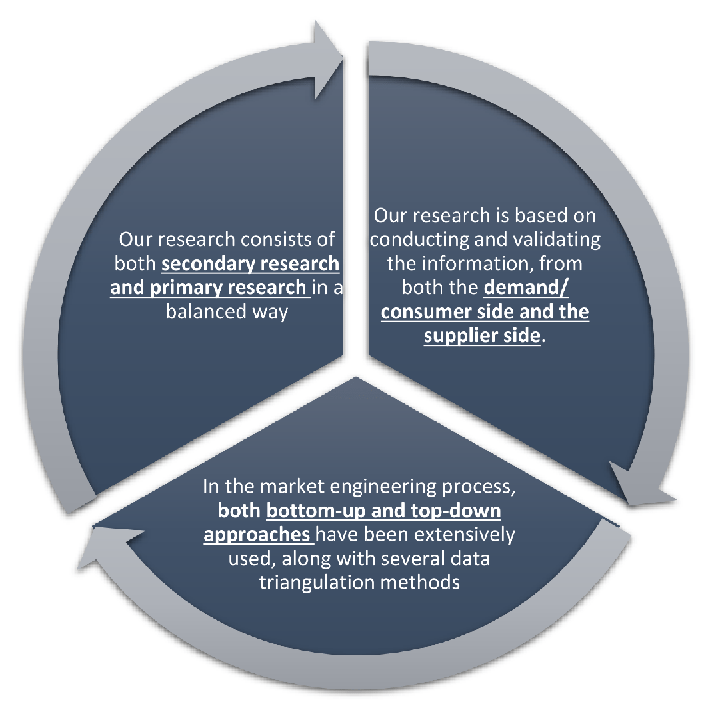
MarketGenics leverages a dedicated industry panel of experts and a comprehensive suite of paid databases to effectively collect, consolidate, and analyze market intelligence.
Our approach has consistently proven to be reliable and effective in generating accurate market insights, identifying key industry trends, and uncovering emerging business opportunities.
Through both primary and secondary research, we capture and analyze critical company-level data such as manufacturing footprints, including technical centers, R&D facilities, sales offices, and headquarters.
Our expert panel further enhances our ability to estimate market size for specific brands based on validated field-level intelligence.
Our data mining techniques incorporate both parametric and non-parametric methods, allowing for structured data collection, sorting, processing, and cleaning.
Demand projections are derived from large-scale data sets analyzed through proprietary algorithms, culminating in robust and reliable market sizing.
Research Approach
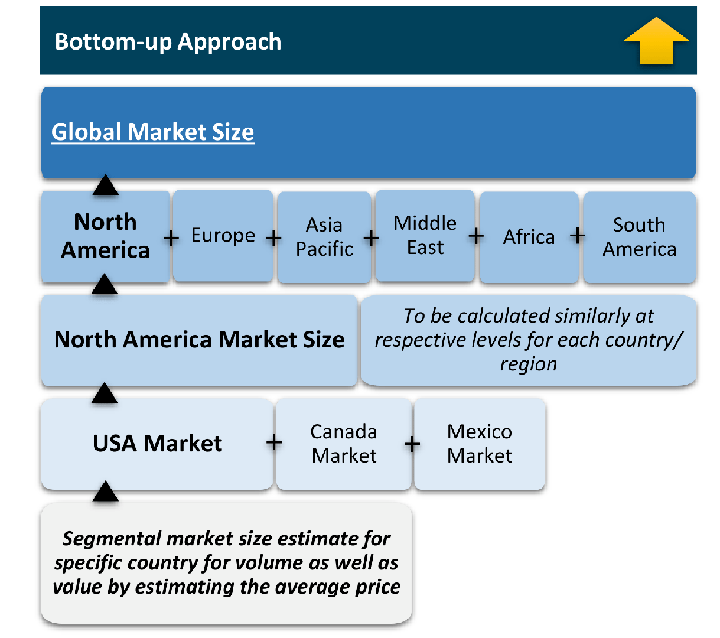
The bottom-up approach builds market estimates by starting with the smallest addressable market units and systematically aggregating them to create comprehensive market size projections.
This method begins with specific, granular data points and builds upward to create the complete market landscape.
Customer Analysis → Segmental Analysis → Geographical Analysis
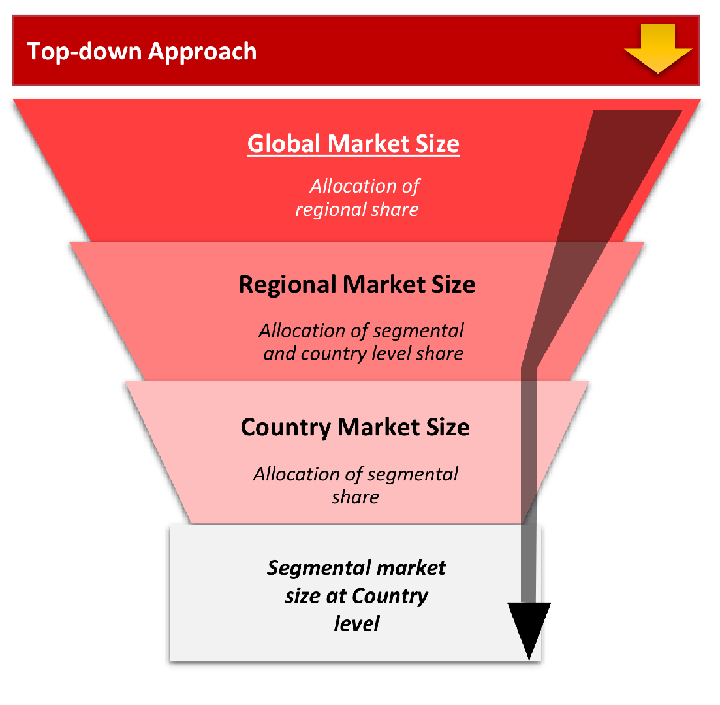
The top-down approach starts with the broadest possible market data and systematically narrows it down through a series of filters and assumptions to arrive at specific market segments or opportunities.
This method begins with the big picture and works downward to increasingly specific market slices.
TAM → SAM → SOM
Research Methods
Desk / Secondary Research
While analysing the market, we extensively study secondary sources, directories, and databases to identify and collect information useful for this technical, market-oriented, and commercial report. Secondary sources that we utilize are not only the public sources, but it is a combination of Open Source, Associations, Paid Databases, MG Repository & Knowledgebase, and others.
- Company websites, annual reports, financial reports, broker reports, and investor presentations
- National government documents, statistical databases and reports
- News articles, press releases and web-casts specific to the companies operating in the market, Magazines, reports, and others
- We gather information from commercial data sources for deriving company specific data such as segmental revenue, share for geography, product revenue, and others
- Internal and external proprietary databases (industry-specific), relevant patent, and regulatory databases
- Governing Bodies, Government Organizations
- Relevant Authorities, Country-specific Associations for Industries
We also employ the model mapping approach to estimate the product level market data through the players' product portfolio
Primary Research
Primary research/ interviews is vital in analyzing the market. Most of the cases involves paid primary interviews. Primary sources include primary interviews through e-mail interactions, telephonic interviews, surveys as well as face-to-face interviews with the different stakeholders across the value chain including several industry experts.
| Type of Respondents | Number of Primaries |
|---|---|
| Tier 2/3 Suppliers | ~20 |
| Tier 1 Suppliers | ~25 |
| End-users | ~25 |
| Industry Expert/ Panel/ Consultant | ~30 |
| Total | ~100 |
MG Knowledgebase
• Repository of industry blog, newsletter and case studies
• Online platform covering detailed market reports, and company profiles
Forecasting Factors and Models
Forecasting Factors
- Historical Trends – Past market patterns, cycles, and major events that shaped how markets behave over time. Understanding past trends helps predict future behavior.
- Industry Factors – Specific characteristics of the industry like structure, regulations, and innovation cycles that affect market dynamics.
- Macroeconomic Factors – Economic conditions like GDP growth, inflation, and employment rates that affect how much money people have to spend.
- Demographic Factors – Population characteristics like age, income, and location that determine who can buy your product.
- Technology Factors – How quickly people adopt new technology and how much technology infrastructure exists.
- Regulatory Factors – Government rules, laws, and policies that can help or restrict market growth.
- Competitive Factors – Analyzing competition structure such as degree of competition and bargaining power of buyers and suppliers.
Forecasting Models / Techniques
Multiple Regression Analysis
- Identify and quantify factors that drive market changes
- Statistical modeling to establish relationships between market drivers and outcomes
Time Series Analysis – Seasonal Patterns
- Understand regular cyclical patterns in market demand
- Advanced statistical techniques to separate trend, seasonal, and irregular components
Time Series Analysis – Trend Analysis
- Identify underlying market growth patterns and momentum
- Statistical analysis of historical data to project future trends
Expert Opinion – Expert Interviews
- Gather deep industry insights and contextual understanding
- In-depth interviews with key industry stakeholders
Multi-Scenario Development
- Prepare for uncertainty by modeling different possible futures
- Creating optimistic, pessimistic, and most likely scenarios
Time Series Analysis – Moving Averages
- Sophisticated forecasting for complex time series data
- Auto-regressive integrated moving average models with seasonal components
Econometric Models
- Apply economic theory to market forecasting
- Sophisticated economic models that account for market interactions
Expert Opinion – Delphi Method
- Harness collective wisdom of industry experts
- Structured, multi-round expert consultation process
Monte Carlo Simulation
- Quantify uncertainty and probability distributions
- Thousands of simulations with varying input parameters
Research Analysis
Our research framework is built upon the fundamental principle of validating market intelligence from both demand and supply perspectives. This dual-sided approach ensures comprehensive market understanding and reduces the risk of single-source bias.
Demand-Side Analysis: We understand end-user/application behavior, preferences, and market needs along with the penetration of the product for specific application.
Supply-Side Analysis: We estimate overall market revenue, analyze the segmental share along with industry capacity, competitive landscape, and market structure.
Validation & Evaluation
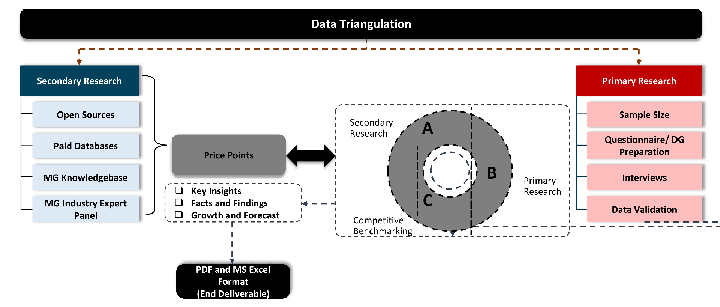
Data triangulation is a validation technique that uses multiple methods, sources, or perspectives to examine the same research question, thereby increasing the credibility and reliability of research findings. In market research, triangulation serves as a quality assurance mechanism that helps identify and minimize bias, validate assumptions, and ensure accuracy in market estimates.
- Data Source Triangulation – Using multiple data sources to examine the same phenomenon
- Methodological Triangulation – Using multiple research methods to study the same research question
- Investigator Triangulation – Using multiple researchers or analysts to examine the same data
- Theoretical Triangulation – Using multiple theoretical perspectives to interpret the same data
Custom Market Research Services
We will customise the research for you, in case the report listed above does not meet your requirements.
Get 10% Free Customisation