Pharmaceutical Packaging Market Size, Share & Trends Analysis Report Packaging Type (Primary Packaging, Secondary Packaging, Tertiary Packaging), Material, Technology, Drug Delivery Form, End-Users, and Geography (North America, Europe, Asia Pacific, Middle East, Africa, and South America) – Global Industry Data, Trends, and Forecasts, 2026–2035
|
|
|
Segmental Data Insights |
|
|
Demand Trends |
|
|
Competitive Landscape |
|
|
Strategic Development |
|
|
Future Outlook & Opportunities |
|
Pharmaceutical-Packaging-Market Size, Share, and Growth
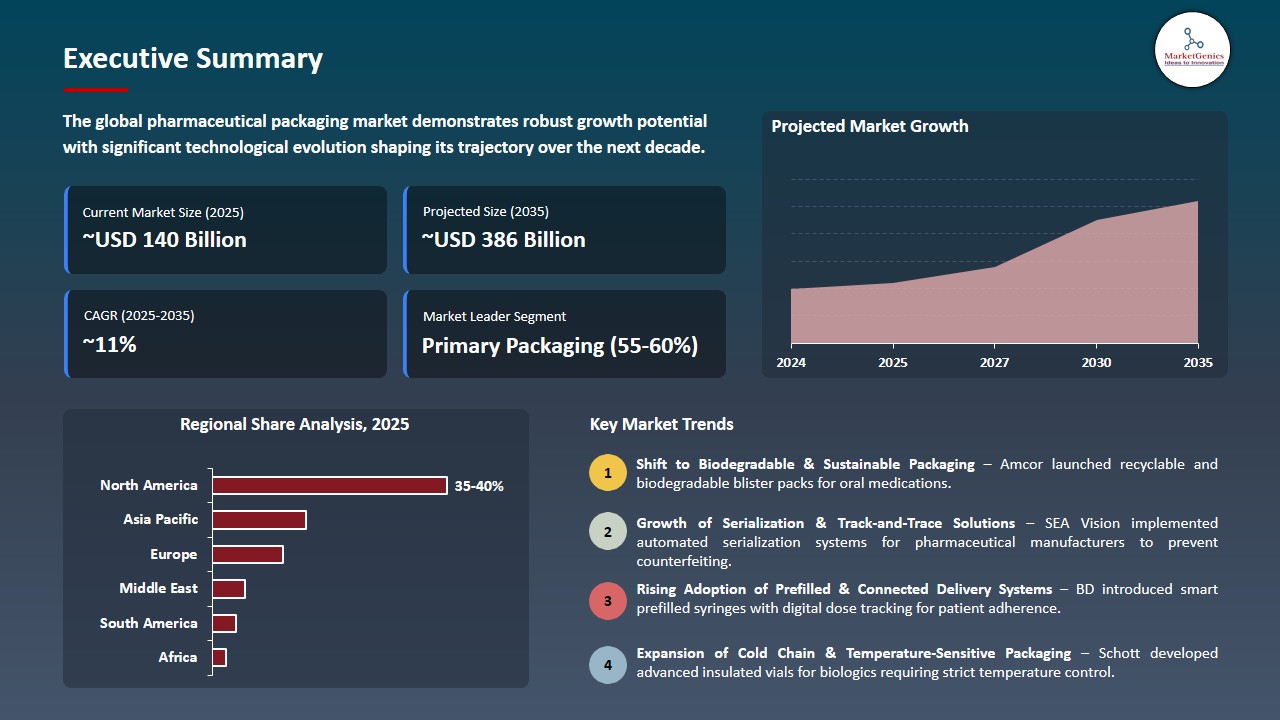
The global pharmaceutical packaging market is exhibiting strong growth, with an estimated value of USD 139.5 billion in 2025 and USD 386.4 billion by 2035, achieving a CAGR of 10.7%, during the forecast period. The global pharmaceutical packaging market is driven by rising demand for biologics and vaccines, stringent regulatory requirements for safety and serialization, growth in chronic disease treatments, increasing patient-centric and sustainable packaging solutions, and rapid adoption of advanced, tamper-evident, and smart packaging technologies.
“This strategic expansion marks a significant milestone in our journey to support pharmaceutical packaging capabilities in India,” said Sundeep Prabhu, Sr. Vice President Sales & Marketing, SCHOTT Glass India. “As the first in India to locally manufacture high-precision syringe and cartridge glass tubing, we are not only elevating our operational capabilities but also reinforcing India's healthcare self-sufficiency. This investment aligns strongly with the ‘Make in India’ initiative and showcases our ongoing commitment to driving excellence, and economic growth in the country.”
The increasing requirement in the sustainable and technologically superior packaging solutions is driving the pharmaceutical packaging market as the pharmaceutical manufacturers and regulatory bodies are placing more emphasis on the recyclable, high-performance materials, which guarantee the stability of drugs and reduce their environmental impact. For instance, in April 2025, Amcor plc has secured commercial orders of its AmSky Blister System, a recyclable, high density polyethylene blister packaging which are used to pack pharmaceutical and healthcare products, reflecting the industry transition to eco-friendly packaging solutions. The trend is contributing to the growth of markets and innovation, as manufacturers are turning to eco-friendly, compliance-oriented packaging technologies.
Additionally, the increasing use of biologics, specialty drugs, and complex therapies is causing pressure on secure, traceable packaging in the form of high-barrier vials, prefilled syringes, and serialization solutions in addition to fueling innovation and investment among major manufacturers. For instance, in September 2024, Becton, Dickinson and Company (BD) introduced its BD Neopak XtraFlow Glass Prefillable Syringe and Neopak platform capacity to accommodate next-generation biologics, which reflects investment in safe and high-performance syringes to make its products stable and deliver. The trend is driving the growth of the market faster and the use of new state-of-the-art pharmaceutical packaging solutions that are compliant.
The global pharmaceutical packaging market presents adjacent opportunities in biologics and specialty drug packaging, prefilled syringes and injectable devices, cold chain and temperature-controlled packaging, serialization and track-and-trace solutions, and sustainable or eco-friendly packaging materials. By using these adjacent markets, it can enable innovation, introduce more services, and grow revenue more quickly throughout the pharmaceutical packaging ecosystem.
Pharmaceutical Packaging Market Dynamics and Trends
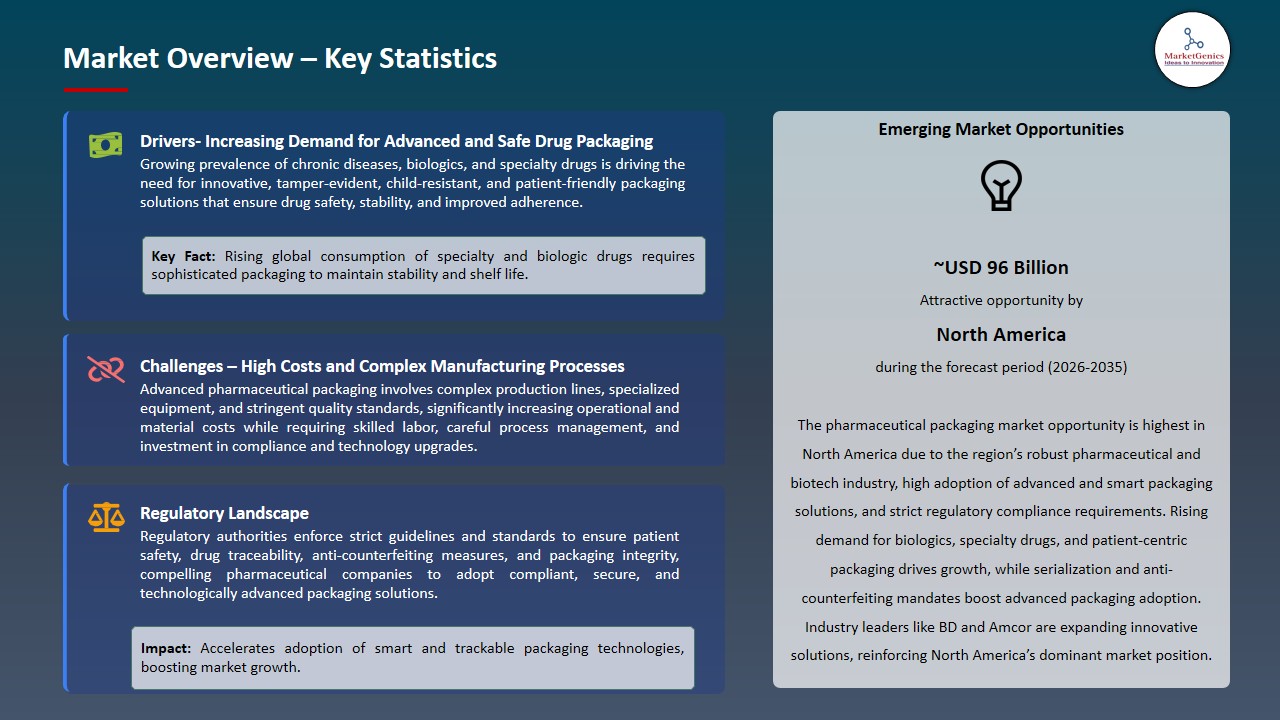
Driver: Strategic Capital Expansion in Manufacturing and Packaging Infrastructure Worldwide
-
The strategic capital investments by the major pharmaceutical firms to increase manufacturing and packaging infrastructure is playing an important role in driving the pharmaceutical packaging market.
- The strategic commitment underscores the company’s focus on resilient onshore production, scalable operations, and alignment with growing therapeutic volumes. For instance, in October 2025, AbbVie Inc. reported a multi-billion-dollar project in the United States, including a 195 million expansion of its active pharmaceutical ingredient (apI) plant at North Chicago and in a wider project of a 10 billion investment over the next ten years to further expand its capabilities in APIs, drug products, peptides, and medical devices.
- By increasing production throughput, ensuring regulatory compliance, and modernizing packaging systems, such investments enable consistent product quality, operational efficiency, and responsiveness to evolving global pharmaceutical demand.
- These capital expansions enhance supply chain resiliency, scalability, and capacity, as well, propelling the pharmaceutical packaging market to continued growth.
Restraint: Persistent Regional Skills & Automation Gaps Limit Technological Uptake
-
Regional differences in technical proficiency and automation adoption across packaging operations are a major barrier to the pharmaceutical packaging market. Smaller manufacturers and mid-sized manufacturers may not be able to adopt the latest technology and digitalization as rapidly as large players in the industry do.
- Most organizations are still using semi-automated or old technology equipment which limits production throughput, makes it difficult to comply with the ever-changing traceability requirements, and more dependent on manual quality control, which makes operations very expensive and risky. This technology adoption gap is especially large in the developing world which constraints investments in robotics, integrated vision inspection systems and real-time serialization technologies by both capital intensity and lack of skilled personnel.
- These limitations limit the efficiency of operations, industry-wide modernization, and the degree of competitive parity, limiting the growth of markets in some regions.
Opportunity: Expansion in Sterile‑Barrier Packaging Capacity Across Regions
-
The development of sterile-barrier and healthcare packaging capabilities by specialist providers to satisfy the needs of innovative therapies, medical equipment, and diagnostic goods that require high-integrity protection represents a significant potential opportunity in the pharmaceutical packaging market.
- For instance, in July 2025, Nelipak Corporation started the building a 60,000 sq ft ISO 13485 certified plant in Grecia, Costa Rica. The plant has ISO-7 cleanrooms to produce sterile-barrier trays, blisters and inserts to package pharmaceutical and medical devices and this has dramatically increased the capacity in the region with stringent quality standards. The development will support existing and new clients in Latin America and other markets to meet the increasing demand of complex and high-performance packaging solutions.
- The increase in sterile-barrier capacity will allow the packaging partners to address the growing demand, open new commercial opportunities, and facilitate the provision of sophisticated and complicated pharmaceutical and healthcare products.
Key Trend: Global Adoption of Sustainable, High-Performance Primary Packaging Solutions
-
The broad use of high-performance, sustainable primary packaging that strikes a balance between product protection and less environmental effect is a notable trend in the pharmaceutical packaging market.
- The increasing interest of manufacturers in material and design that provide both sustainability and functional integrity along the supply chains on a global scale. For instance, LOG Pharma Primary Packaging is a movement that shows its next-generation Eco Barrier packaging technology at Pharmapack Europe 2026. The solution incorporates less heavy multilayer resins, which are environmentally friendly and which reduce the material weight by up to 30% without compromising on the oxygen and moisture barrier characteristics that are important in sensitive pharmaceutical formulations.
- The adoption of eco-optimized primary packaging enhances market differentiation, strengthens sustainability credentials, and supports long-term environmental performance within the pharmaceutical packaging industry.
Pharmaceutical Packaging Market Analysis and Segmental Data
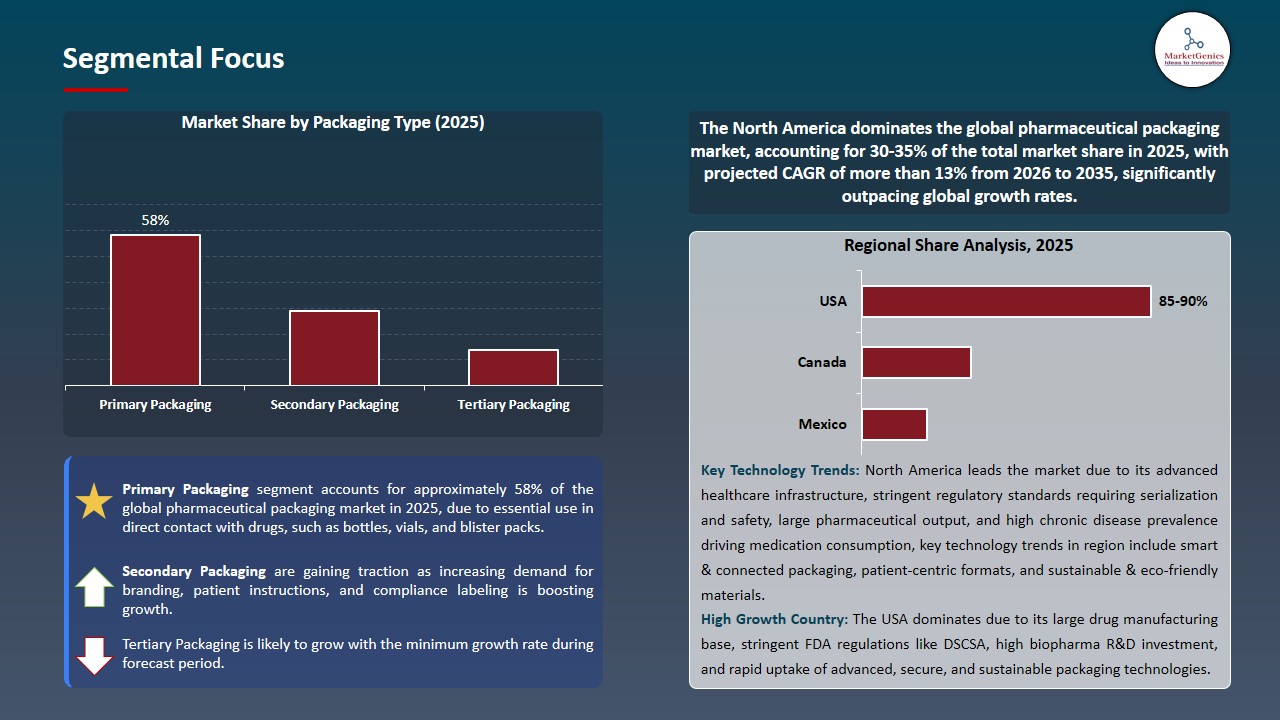
Primary Packaging Dominate Global Pharmaceutical Packaging Market
-
The primary packaging segment dominates the global pharmaceutical packaging market, because the primary packaging offers the first important barrier to guarantee sterility, safety, compliance, and hold the product together over the entire supply chain. This category of the pharmaceutical packaging covers most of the pharmaceutical packaging revenues because it plays a crucial role in ensuring that the sensitive formulations including biologic, vaccines and high-end therapies, are not contaminated, damp, exposed to light etc.
- The current investment and innovation on high-performance primary packaging technologies. For instance, SGD Pharma presented its new glass primary packaging line which included innovative molded and tubular glass vials and ready-to-use solutions which would help strengthen drug protection and operational performance and supply chain dependability.
- The importance of the segment in the stability and safety of drugs strengthens its position of leadership in the market and generates constant innovation within the pharmaceutical packaging industry.
North America Leads Global Pharmaceutical Packaging Market Demand
-
North America leads the pharmaceutical packaging is driven by the strategic facility expansions of the leading contract packaging providers to meet the growing volume and complexity of the drug products. For instance, in December 2025, Tjoapack announced plans to construct a new 170,000 sq. ft. Good Manufacturing Practice (GMP) facility in Tennessee, USA, which will increase its packaging, labeling, cold chain and ambient storage capacity to support increasing pharmaceutical and biotech packaging demands and respond more quickly to supply chains.
- Moreover, the growing number of investments by the global pharmaceutical companies to localize manufacturing operations and packaging operations in North America due to the imperative of supply chain resilience, regulatory compliance and increased control of operations. For instance, in November 2025, Novartis announced it was planning to construct a new flagship manufacturing facility in North Carolina, as part of a $23 billion U.S. infrastructure investment, which includes sterile packaging and end-to-end production of its most important medicines.
- These localized investments and strategic expansions are contributing to the North American dominance in pharmaceutical packaging, which improves supply chain resilience, operational efficiency, and capacity to satisfy increasing demand in the market.
Pharmaceutical Packaging Market Ecosystem
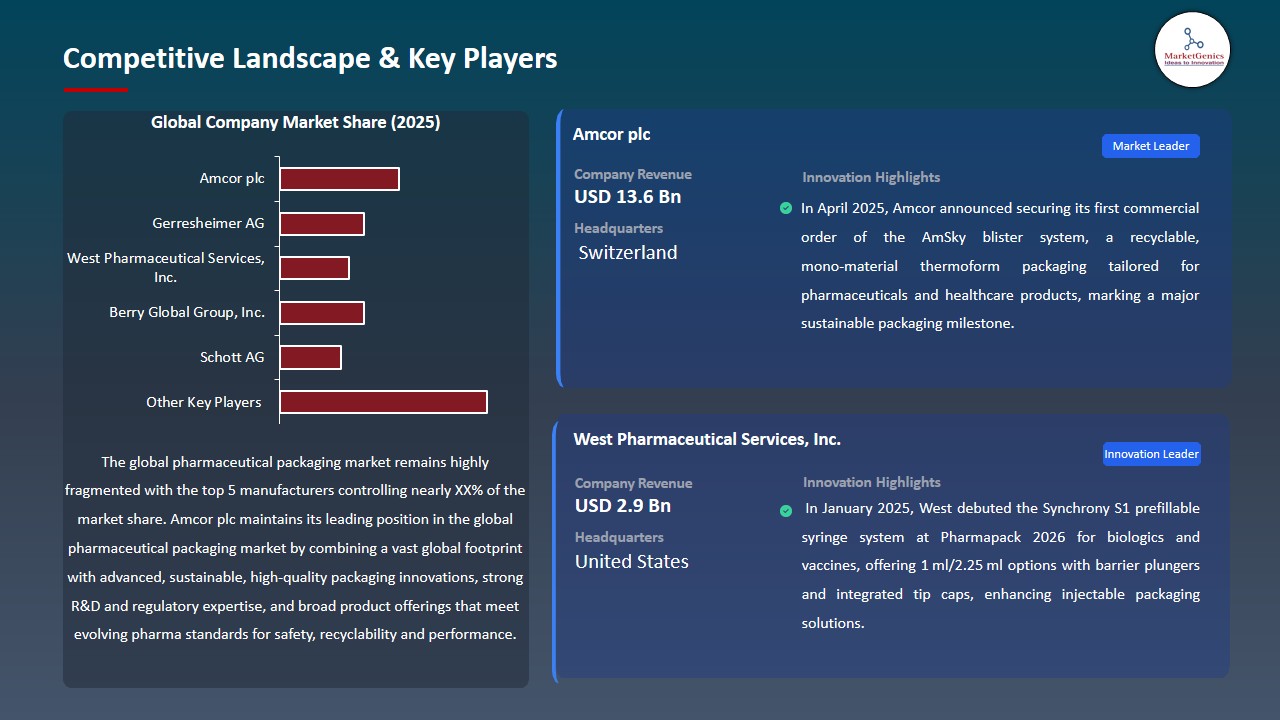
The global pharmaceutical packaging market is highly fragmented, with major players like Amcor plc, Gerresheimer AG, West Pharmaceutical Services, Inc., Berry Global Group, Inc., and SCHOTT AG dominating through scale, global production networks, and advanced technologies such as smart packaging, eco‑friendly materials, and high‑precision containers. These leaders use innovation to ensure competitive advantage and comply with tough regulatory conditions.
These enterprises are paying more attention to niche or specialized solutions that would result in market innovation. Amcor focuses on sustainable blister and flexible packaging, Gerresheimer focuses on glass and injectable prefillable systems, West focuses on smart injectable containment and elastomeric parts, Berry focuses on digital and compliance-oriented packaging, and SCHOTT focuses on high-performance glass products to sensitive biologics.
Government bodies, institutions, and R&D organizations also play a crucial role in advancing technologies across the market. For instance, regulatory attention toward the requirements of serialization and track-and-trace has increased the use of digital products such as RFID and IoT sensors across 2025 to increase supply-chain visibility and patient safety.
The combination of these industry leadership and regulatory efforts is leading to increased efficiency, lesser chances of counterfeiting, better patient safety and faster innovation making the pharmaceutical packaging market poised towards long term growth and innovation.
Recent Development and Strategic Overview:
-
In October 2025, Amcor formally introduced its ClariPPil clarified polypropylene oral dose jars, ergonomically designed ophthalmic bottles, and the digitally integrated RS01X DPI platform, delivering enhanced sustainability, operational efficiency, and patient-centric functionality across pharmaceutical packaging applications.
- In August 2025, SCHOTT AG inaugurated India’s first locally manufactured high‑precision glass tubing for syringes and cartridges at its Jambusar facility, enhancing the domestic supply of critical primary pharmaceutical packaging glass, supporting injectable drug production, improving supply chain resilience, and meeting stringent quality and regulatory standards.
Report Scope
|
Detail |
|
|
Market Size in 2025 |
USD 139.5 Bn |
|
Market Forecast Value in 2035 |
USD 386.4 Bn |
|
Growth Rate (CAGR) |
10.7% |
|
Forecast Period |
2026 – 2035 |
|
Historical Data Available for |
2021 – 2024 |
|
Market Size Units |
US$ Billion for Value |
|
Report Format |
Electronic (PDF) + Excel |
|
North America |
Europe |
Asia Pacific |
Middle East |
Africa |
South America |
|
|
|
|
|
|
|
Companies Covered |
|||||
|
|
|
|
|
|
Pharmaceutical Packaging Market Segmentation and Highlights
|
Segment |
Sub-segment |
|
Pharmaceutical Packaging Market, By Packaging Type |
|
|
Pharmaceutical Packaging Market, By Material |
|
|
Pharmaceutical Packaging Market, By Technology |
|
|
Pharmaceutical Packaging Market, By Drug Delivery Form |
|
|
Pharmaceutical Packaging Market, By End-Users |
|
Frequently Asked Questions
Table of Contents
- 1. Research Methodology and Assumptions
- 1.1. Definitions
- 1.2. Research Design and Approach
- 1.3. Data Collection Methods
- 1.4. Base Estimates and Calculations
- 1.5. Forecasting Models
- 1.5.1. Key Forecast Factors & Impact Analysis
- 1.6. Secondary Research
- 1.6.1. Open Sources
- 1.6.2. Paid Databases
- 1.6.3. Associations
- 1.7. Primary Research
- 1.7.1. Primary Sources
- 1.7.2. Primary Interviews with Stakeholders across Ecosystem
- 2. Executive Summary
- 2.1. Global Pharmaceutical Packaging Market Outlook
- 2.1.1. Pharmaceutical Packaging Market Size (Value - US$ Bn), and Forecasts, 2021-2035
- 2.1.2. Compounded Annual Growth Rate Analysis
- 2.1.3. Growth Opportunity Analysis
- 2.1.4. Segmental Share Analysis
- 2.1.5. Geographical Share Analysis
- 2.2. Market Analysis and Facts
- 2.3. Supply-Demand Analysis
- 2.4. Competitive Benchmarking
- 2.5. Go-to- Market Strategy
- 2.5.1. Customer/ End-use Industry Assessment
- 2.5.2. Growth Opportunity Data, 2026-2035
- 2.5.2.1. Regional Data
- 2.5.2.2. Country Data
- 2.5.2.3. Segmental Data
- 2.5.3. Identification of Potential Market Spaces
- 2.5.4. GAP Analysis
- 2.5.5. Potential Attractive Price Points
- 2.5.6. Prevailing Market Risks & Challenges
- 2.5.7. Preferred Sales & Marketing Strategies
- 2.5.8. Key Recommendations and Analysis
- 2.5.9. A Way Forward
- 2.1. Global Pharmaceutical Packaging Market Outlook
- 3. Industry Data and Premium Insights
- 3.1. Global Packaging Overview, 2025
- 3.1.1. Packaging Ecosystem Analysis
- 3.1.2. Key Trends for Packaging Industry
- 3.1.3. Regional Distribution for Packaging Industry
- 3.2. Supplier Customer Data
- 3.3. Technology Roadmap and Developments
- 3.4. Trade Analysis
- 3.4.1. Import & Export Analysis, 2025
- 3.4.2. Top Importing Countries
- 3.4.3. Top Exporting Countries
- 3.5. Trump Tariff Impact Analysis
- 3.5.1. Manufacturer
- 3.5.1.1. Based on the component & Raw material
- 3.5.2. Supply Chain
- 3.5.3. End Consumer
- 3.5.1. Manufacturer
- 3.6. Raw Material Analysis
- 3.1. Global Packaging Overview, 2025
- 4. Market Overview
- 4.1. Market Dynamics
- 4.1.1. Drivers
- 4.1.1.1. Growth of biologics, specialty drugs, and advanced therapies increasing demand for sophisticated, high-performance packaging solutions
- 4.1.1.2. Aging population and rising prevalence of chronic diseases boosting pharmaceutical product consumption and packaging needs
- 4.1.1.3. Regulatory compliance requirements, including serialization and anti-counterfeiting measures, driving adoption of advanced packaging technologies
- 4.1.2. Restraints
- 4.1.2.1. High costs and complexity due to stringent regulatory compliance and evolving standards
- 4.1.2.2. Volatility and rising costs of raw materials and supply chain constraints limiting market growth
- 4.1.1. Drivers
- 4.2. Key Trend Analysis
- 4.3. Regulatory Framework
- 4.3.1. Key Regulations, Norms, and Subsidies, by Key Countries
- 4.3.2. Tariffs and Standards
- 4.3.3. Impact Analysis of Regulations on the Market
- 4.4. Value Chain Analysis
- 4.5. Porter’s Five Forces Analysis
- 4.6. PESTEL Analysis
- 4.7. Global Pharmaceutical Packaging Market Demand
- 4.7.1. Historical Market Size – in Value (US$ Bn), 2020-2024
- 4.7.2. Current and Future Market Size – in Value (US$ Bn), 2026–2035
- 4.7.2.1. Y-o-Y Growth Trends
- 4.7.2.2. Absolute $ Opportunity Assessment
- 4.1. Market Dynamics
- 5. Competition Landscape
- 5.1. Competition structure
- 5.1.1. Fragmented v/s consolidated
- 5.2. Company Share Analysis, 2025
- 5.2.1. Global Company Market Share
- 5.2.2. By Region
- 5.2.2.1. North America
- 5.2.2.2. Europe
- 5.2.2.3. Asia Pacific
- 5.2.2.4. Middle East
- 5.2.2.5. Africa
- 5.2.2.6. South America
- 5.3. Product Comparison Matrix
- 5.3.1. Specifications
- 5.3.2. Market Positioning
- 5.3.3. Pricing
- 5.1. Competition structure
- 6. Global Pharmaceutical Packaging Market Analysis, by Packaging Type
- 6.1. Key Segment Analysis
- 6.2. Pharmaceutical Packaging Market Size (Value - US$ Bn), Analysis, and Forecasts, by Packaging Type, 2021-2035
- 6.2.1. Primary Packaging
- 6.2.1.1. Bottles & Containers
- 6.2.1.2. Blister Packs
- 6.2.1.3. Ampoules & Vials
- 6.2.1.4. Prefilled Syringes
- 6.2.1.5. Cartridges
- 6.2.1.6. Sachets & Pouches
- 6.2.1.7. Tubes
- 6.2.1.8. Caps, Closures & Stoppers
- 6.2.1.9. Others
- 6.2.2. Secondary Packaging
- 6.2.2.1. Folding Cartons
- 6.2.2.2. Wraparound Labels & Sleeves
- 6.2.2.3. Trays & Inserts
- 6.2.2.4. Leaflets & Package Inserts
- 6.2.2.5. Others
- 6.2.3. Tertiary Packaging
- 6.2.3.1. Corrugated Boxes
- 6.2.3.2. Stretch-Wrap Pallets
- 6.2.3.3. Intermediate Bulk Containers (IBCs)
- 6.2.3.4. Others
- 6.2.1. Primary Packaging
- 7. Global Pharmaceutical Packaging Market Analysis, by Material
- 7.1. Key Segment Analysis
- 7.2. Pharmaceutical Packaging Market Size (Value - US$ Bn), Analysis, and Forecasts, by Material, 2021-2035
- 7.2.1. Plastic
- 7.2.2. Glass
- 7.2.3. Metal
- 7.2.4. Paper & Paperboard
- 7.2.5. Others
- 8. Global Pharmaceutical Packaging Market Analysis, by Technology
- 8.1. Key Segment Analysis
- 8.2. Pharmaceutical Packaging Market Size (Value - US$ Bn), Analysis, and Forecasts, by Technology, 2021-2035
- 8.2.1. Aseptic Packaging
- 8.2.2. Child-Resistant Packaging (CRP)
- 8.2.3. Easy-Open Packaging
- 8.2.4. Tamper-Evident Packaging
- 8.2.5. Anti-Counterfeiting Packaging
- 8.2.6. Smart & Connected Packaging
- 8.2.7. Modified Atmosphere Packaging (MAP)
- 8.2.8. Cold Chain / Temperature-Controlled Packaging
- 8.2.9. Eco-Friendly Packaging
- 8.2.10. Unit-Dose & Compliance Packaging
- 8.2.11. Others
- 9. Global Pharmaceutical Packaging Market Analysis, by Drug Delivery Form
- 9.1. Key Segment Analysis
- 9.2. Pharmaceutical Packaging Market Size (Value - US$ Bn), Analysis, and Forecasts, by Drug Delivery Form, 2021-2035
- 9.2.1. Solid Dosage Forms
- 9.2.1.1. Tablets
- 9.2.1.2. Capsules
- 9.2.1.3. Powders & Granules
- 9.2.1.4. Lozenges & Troches
- 9.2.1.5. Others
- 9.2.2. Liquid Dosage Forms
- 9.2.2.1. Oral Solutions & Syrups
- 9.2.2.2. Injectable Solutions
- 9.2.2.3. Ophthalmic & Otic Drops
- 9.2.2.4. Nasal Sprays
- 9.2.2.5. Others
- 9.2.3. Semi-Solid Dosage Forms
- 9.2.3.1. Ointments & Creams
- 9.2.3.2. Gels & Jellies
- 9.2.3.3. Others
- 9.2.4. Gaseous / Inhalation Forms
- 9.2.4.1. Metered Dose Inhalers (MDIs)
- 9.2.4.2. Dry Powder Inhalers (DPIs)
- 9.2.4.3. Nebulizer Solutions
- 9.2.4.4. Others
- 9.2.5. Transdermal & Topical Forms
- 9.2.1. Solid Dosage Forms
- 10. Global Pharmaceutical Packaging Market Analysis, by End-Users
- 10.1. Key Segment Analysis
- 10.2. Pharmaceutical Packaging Market Size (Value - US$ Bn), Analysis, and Forecasts, by End-Users, 2021-2035
- 10.2.1. Pharmaceutical Manufacturers
- 10.2.2. Biopharmaceutical & Biotech Companies
- 10.2.3. Contract Packaging Organizations
- 10.2.4. Hospital & Healthcare Systems
- 10.2.5. Diagnostic & IVD Companies
- 10.2.6. Medical Device Manufacturers
- 10.2.7. Retail Pharmacy & Chain Drug Store Operators
- 10.2.8. Others
- 11. Global Pharmaceutical Packaging Market Analysis, by Region
- 11.1. Key Findings
- 11.2. Pharmaceutical Packaging Market Size (Value - US$ Bn), Analysis, and Forecasts, by Region, 2021-2035
- 11.2.1. North America
- 11.2.2. Europe
- 11.2.3. Asia Pacific
- 11.2.4. Middle East
- 11.2.5. Africa
- 11.2.6. South America
- 12. North America Pharmaceutical Packaging Market Analysis
- 12.1. Key Segment Analysis
- 12.2. Regional Snapshot
- 12.3. North America Pharmaceutical Packaging Market (Size Value - US$ Bn), Analysis, and Forecasts, 2021-2035
- 12.3.1. Packaging Type
- 12.3.2. Material
- 12.3.3. Technology
- 12.3.4. Drug Delivery Form
- 12.3.5. End-Users
- 12.3.6. Country
- 12.3.6.1. USA
- 12.3.6.2. Canada
- 12.3.6.3. Mexico
- 12.4. USA Pharmaceutical Packaging Market
- 12.4.1. Country Segmental Analysis
- 12.4.2. Packaging Type
- 12.4.3. Material
- 12.4.4. Technology
- 12.4.5. Drug Delivery Form
- 12.4.6. End-Users
- 12.5. Canada Pharmaceutical Packaging Market
- 12.5.1. Country Segmental Analysis
- 12.5.2. Packaging Type
- 12.5.3. Material
- 12.5.4. Technology
- 12.5.5. Drug Delivery Form
- 12.5.6. End-Users
- 12.6. Mexico Pharmaceutical Packaging Market
- 12.6.1. Country Segmental Analysis
- 12.6.2. Packaging Type
- 12.6.3. Material
- 12.6.4. Technology
- 12.6.5. Drug Delivery Form
- 12.6.6. End-Users
- 13. Europe Pharmaceutical Packaging Market Analysis
- 13.1. Key Segment Analysis
- 13.2. Regional Snapshot
- 13.3. Europe Pharmaceutical Packaging Market Size (Value - US$ Bn), Analysis, and Forecasts, 2021-2035
- 13.3.1. Packaging Type
- 13.3.2. Material
- 13.3.3. Technology
- 13.3.4. Drug Delivery Form
- 13.3.5. End-Users
- 13.3.6. Country
- 13.3.6.1. Germany
- 13.3.6.2. United Kingdom
- 13.3.6.3. France
- 13.3.6.4. Italy
- 13.3.6.5. Spain
- 13.3.6.6. Netherlands
- 13.3.6.7. Nordic Countries
- 13.3.6.8. Poland
- 13.3.6.9. Russia & CIS
- 13.3.6.10. Rest of Europe
- 13.4. Germany Pharmaceutical Packaging Market
- 13.4.1. Country Segmental Analysis
- 13.4.2. Packaging Type
- 13.4.3. Material
- 13.4.4. Technology
- 13.4.5. Drug Delivery Form
- 13.4.6. End-Users
- 13.5. United Kingdom Pharmaceutical Packaging Market
- 13.5.1. Country Segmental Analysis
- 13.5.2. Packaging Type
- 13.5.3. Material
- 13.5.4. Technology
- 13.5.5. Drug Delivery Form
- 13.5.6. End-Users
- 13.6. France Pharmaceutical Packaging Market
- 13.6.1. Country Segmental Analysis
- 13.6.2. Packaging Type
- 13.6.3. Material
- 13.6.4. Technology
- 13.6.5. Drug Delivery Form
- 13.6.6. End-Users
- 13.7. Italy Pharmaceutical Packaging Market
- 13.7.1. Country Segmental Analysis
- 13.7.2. Packaging Type
- 13.7.3. Material
- 13.7.4. Technology
- 13.7.5. Drug Delivery Form
- 13.7.6. End-Users
- 13.8. Spain Pharmaceutical Packaging Market
- 13.8.1. Country Segmental Analysis
- 13.8.2. Packaging Type
- 13.8.3. Material
- 13.8.4. Technology
- 13.8.5. Drug Delivery Form
- 13.8.6. End-Users
- 13.9. Netherlands Pharmaceutical Packaging Market
- 13.9.1. Country Segmental Analysis
- 13.9.2. Packaging Type
- 13.9.3. Material
- 13.9.4. Technology
- 13.9.5. Drug Delivery Form
- 13.9.6. End-Users
- 13.10. Nordic Countries Pharmaceutical Packaging Market
- 13.10.1. Country Segmental Analysis
- 13.10.2. Packaging Type
- 13.10.3. Material
- 13.10.4. Technology
- 13.10.5. Drug Delivery Form
- 13.10.6. End-Users
- 13.11. Poland Pharmaceutical Packaging Market
- 13.11.1. Country Segmental Analysis
- 13.11.2. Packaging Type
- 13.11.3. Material
- 13.11.4. Technology
- 13.11.5. Drug Delivery Form
- 13.11.6. End-Users
- 13.12. Russia & CIS Pharmaceutical Packaging Market
- 13.12.1. Country Segmental Analysis
- 13.12.2. Packaging Type
- 13.12.3. Material
- 13.12.4. Technology
- 13.12.5. Drug Delivery Form
- 13.12.6. End-Users
- 13.13. Rest of Europe Pharmaceutical Packaging Market
- 13.13.1. Country Segmental Analysis
- 13.13.2. Packaging Type
- 13.13.3. Material
- 13.13.4. Technology
- 13.13.5. Drug Delivery Form
- 13.13.6. End-Users
- 14. Asia Pacific Pharmaceutical Packaging Market Analysis
- 14.1. Key Segment Analysis
- 14.2. Regional Snapshot
- 14.3. Asia Pacific Pharmaceutical Packaging Market Size (Value - US$ Bn), Analysis, and Forecasts, 2021-2035
- 14.3.1. Packaging Type
- 14.3.2. Material
- 14.3.3. Technology
- 14.3.4. Drug Delivery Form
- 14.3.5. End-Users
- 14.3.6. Country
- 14.3.6.1. China
- 14.3.6.2. India
- 14.3.6.3. Japan
- 14.3.6.4. South Korea
- 14.3.6.5. Australia and New Zealand
- 14.3.6.6. Indonesia
- 14.3.6.7. Malaysia
- 14.3.6.8. Thailand
- 14.3.6.9. Vietnam
- 14.3.6.10. Rest of Asia Pacific
- 14.4. China Pharmaceutical Packaging Market
- 14.4.1. Country Segmental Analysis
- 14.4.2. Packaging Type
- 14.4.3. Material
- 14.4.4. Technology
- 14.4.5. Drug Delivery Form
- 14.4.6. End-Users
- 14.5. India Pharmaceutical Packaging Market
- 14.5.1. Country Segmental Analysis
- 14.5.2. Packaging Type
- 14.5.3. Material
- 14.5.4. Technology
- 14.5.5. Drug Delivery Form
- 14.5.6. End-Users
- 14.6. Japan Pharmaceutical Packaging Market
- 14.6.1. Country Segmental Analysis
- 14.6.2. Packaging Type
- 14.6.3. Material
- 14.6.4. Technology
- 14.6.5. Drug Delivery Form
- 14.6.6. End-Users
- 14.7. South Korea Pharmaceutical Packaging Market
- 14.7.1. Country Segmental Analysis
- 14.7.2. Packaging Type
- 14.7.3. Material
- 14.7.4. Technology
- 14.7.5. Drug Delivery Form
- 14.7.6. End-Users
- 14.8. Australia and New Zealand Pharmaceutical Packaging Market
- 14.8.1. Country Segmental Analysis
- 14.8.2. Packaging Type
- 14.8.3. Material
- 14.8.4. Technology
- 14.8.5. Drug Delivery Form
- 14.8.6. End-Users
- 14.9. Indonesia Pharmaceutical Packaging Market
- 14.9.1. Country Segmental Analysis
- 14.9.2. Packaging Type
- 14.9.3. Material
- 14.9.4. Technology
- 14.9.5. Drug Delivery Form
- 14.9.6. End-Users
- 14.10. Malaysia Pharmaceutical Packaging Market
- 14.10.1. Country Segmental Analysis
- 14.10.2. Packaging Type
- 14.10.3. Material
- 14.10.4. Technology
- 14.10.5. Drug Delivery Form
- 14.10.6. End-Users
- 14.11. Thailand Pharmaceutical Packaging Market
- 14.11.1. Country Segmental Analysis
- 14.11.2. Packaging Type
- 14.11.3. Material
- 14.11.4. Technology
- 14.11.5. Drug Delivery Form
- 14.11.6. End-Users
- 14.12. Vietnam Pharmaceutical Packaging Market
- 14.12.1. Country Segmental Analysis
- 14.12.2. Packaging Type
- 14.12.3. Material
- 14.12.4. Technology
- 14.12.5. Drug Delivery Form
- 14.12.6. End-Users
- 14.13. Rest of Asia Pacific Pharmaceutical Packaging Market
- 14.13.1. Country Segmental Analysis
- 14.13.2. Packaging Type
- 14.13.3. Material
- 14.13.4. Technology
- 14.13.5. Drug Delivery Form
- 14.13.6. End-Users
- 15. Middle East Pharmaceutical Packaging Market Analysis
- 15.1. Key Segment Analysis
- 15.2. Regional Snapshot
- 15.3. Middle East Pharmaceutical Packaging Market Size (Value - US$ Bn), Analysis, and Forecasts, 2021-2035
- 15.3.1. Packaging Type
- 15.3.2. Material
- 15.3.3. Technology
- 15.3.4. Drug Delivery Form
- 15.3.5. End-Users
- 15.3.6. Country
- 15.3.6.1. Turkey
- 15.3.6.2. UAE
- 15.3.6.3. Saudi Arabia
- 15.3.6.4. Israel
- 15.3.6.5. Rest of Middle East
- 15.4. Turkey Pharmaceutical Packaging Market
- 15.4.1. Country Segmental Analysis
- 15.4.2. Packaging Type
- 15.4.3. Material
- 15.4.4. Technology
- 15.4.5. Drug Delivery Form
- 15.4.6. End-Users
- 15.5. UAE Pharmaceutical Packaging Market
- 15.5.1. Country Segmental Analysis
- 15.5.2. Packaging Type
- 15.5.3. Material
- 15.5.4. Technology
- 15.5.5. Drug Delivery Form
- 15.5.6. End-Users
- 15.6. Saudi Arabia Pharmaceutical Packaging Market
- 15.6.1. Country Segmental Analysis
- 15.6.2. Packaging Type
- 15.6.3. Material
- 15.6.4. Technology
- 15.6.5. Drug Delivery Form
- 15.6.6. End-Users
- 15.7. Israel Pharmaceutical Packaging Market
- 15.7.1. Country Segmental Analysis
- 15.7.2. Packaging Type
- 15.7.3. Material
- 15.7.4. Technology
- 15.7.5. Drug Delivery Form
- 15.7.6. End-Users
- 15.8. Rest of Middle East Pharmaceutical Packaging Market
- 15.8.1. Country Segmental Analysis
- 15.8.2. Packaging Type
- 15.8.3. Material
- 15.8.4. Technology
- 15.8.5. Drug Delivery Form
- 15.8.6. End-Users
- 16. Africa Pharmaceutical Packaging Market Analysis
- 16.1. Key Segment Analysis
- 16.2. Regional Snapshot
- 16.3. Africa Pharmaceutical Packaging Market Size (Value - US$ Bn), Analysis, and Forecasts, 2021-2035
- 16.3.1. Packaging Type
- 16.3.2. Material
- 16.3.3. Technology
- 16.3.4. Drug Delivery Form
- 16.3.5. End-Users
- 16.3.6. Country
- 16.3.6.1. South Africa
- 16.3.6.2. Egypt
- 16.3.6.3. Nigeria
- 16.3.6.4. Algeria
- 16.3.6.5. Rest of Africa
- 16.4. South Africa Pharmaceutical Packaging Market
- 16.4.1. Country Segmental Analysis
- 16.4.2. Packaging Type
- 16.4.3. Material
- 16.4.4. Technology
- 16.4.5. Drug Delivery Form
- 16.4.6. End-Users
- 16.5. Egypt Pharmaceutical Packaging Market
- 16.5.1. Country Segmental Analysis
- 16.5.2. Packaging Type
- 16.5.3. Material
- 16.5.4. Technology
- 16.5.5. Drug Delivery Form
- 16.5.6. End-Users
- 16.6. Nigeria Pharmaceutical Packaging Market
- 16.6.1. Country Segmental Analysis
- 16.6.2. Packaging Type
- 16.6.3. Material
- 16.6.4. Technology
- 16.6.5. Drug Delivery Form
- 16.6.6. End-Users
- 16.7. Algeria Pharmaceutical Packaging Market
- 16.7.1. Country Segmental Analysis
- 16.7.2. Packaging Type
- 16.7.3. Material
- 16.7.4. Technology
- 16.7.5. Drug Delivery Form
- 16.7.6. End-Users
- 16.8. Rest of Africa Pharmaceutical Packaging Market
- 16.8.1. Country Segmental Analysis
- 16.8.2. Packaging Type
- 16.8.3. Material
- 16.8.4. Technology
- 16.8.5. Drug Delivery Form
- 16.8.6. End-Users
- 17. South America Pharmaceutical Packaging Market Analysis
- 17.1. Key Segment Analysis
- 17.2. Regional Snapshot
- 17.3. South America Pharmaceutical Packaging Market Size (Value - US$ Bn), Analysis, and Forecasts, 2021-2035
- 17.3.1. Packaging Type
- 17.3.2. Material
- 17.3.3. Technology
- 17.3.4. Drug Delivery Form
- 17.3.5. End-Users
- 17.3.6. Country
- 17.3.6.1. Brazil
- 17.3.6.2. Argentina
- 17.3.6.3. Rest of South America
- 17.4. Brazil Pharmaceutical Packaging Market
- 17.4.1. Country Segmental Analysis
- 17.4.2. Packaging Type
- 17.4.3. Material
- 17.4.4. Technology
- 17.4.5. Drug Delivery Form
- 17.4.6. End-Users
- 17.5. Argentina Pharmaceutical Packaging Market
- 17.5.1. Country Segmental Analysis
- 17.5.2. Packaging Type
- 17.5.3. Material
- 17.5.4. Technology
- 17.5.5. Drug Delivery Form
- 17.5.6. End-Users
- 17.6. Rest of South America Pharmaceutical Packaging Market
- 17.6.1. Country Segmental Analysis
- 17.6.2. Packaging Type
- 17.6.3. Material
- 17.6.4. Technology
- 17.6.5. Drug Delivery Form
- 17.6.6. End-Users
- 18. Key Players/ Company Profile
- 18.1. Amcor plc
- 18.1.1. Company Details/ Overview
- 18.1.2. Company Financials
- 18.1.3. Key Customers and Competitors
- 18.1.4. Business/ Industry Portfolio
- 18.1.5. Product Portfolio/ Specification Details
- 18.1.6. Pricing Data
- 18.1.7. Strategic Overview
- 18.1.8. Recent Developments
- 18.2. AptarGroup, Inc.
- 18.3. Becton, Dickinson and Company (BD)
- 18.4. Berry Global Group, Inc.
- 18.5. Bilcare Limited
- 18.6. Catalent, Inc.
- 18.7. CCL Industries Inc.
- 18.8. Constantia Flexibles Group GmbH
- 18.9. Datwyler Holding Inc.
- 18.10. DS Smith plc
- 18.11. Gerresheimer AG
- 18.12. Huhtamaki Oyj
- 18.13. Klöckner Pentaplast Group
- 18.14. Owen Mumford Ltd.
- 18.15. Piramal Glass Ltd.
- 18.16. Schott AG
- 18.17. Sealed Air Corporation
- 18.18. SGD Pharma
- 18.19. Sonoco Products Company
- 18.20. West Pharmaceutical Services, Inc.
- 18.21. Other Key Players
- 18.1. Amcor plc
Note* - This is just tentative list of players. While providing the report, we will cover more number of players based on their revenue and share for each geography
Research Design
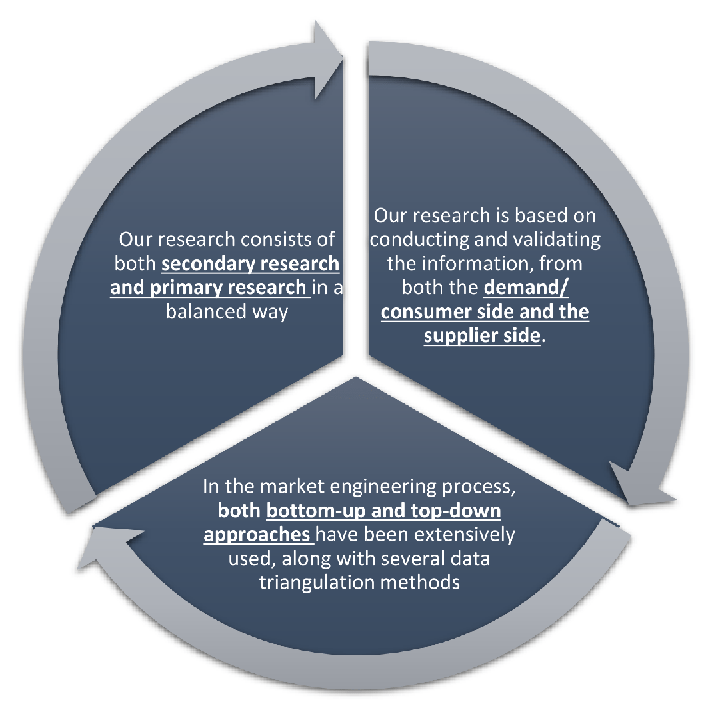
Our research design integrates both demand-side and supply-side analysis through a balanced combination of primary and secondary research methodologies. By utilizing both bottom-up and top-down approaches alongside rigorous data triangulation methods, we deliver robust market intelligence that supports strategic decision-making.
MarketGenics' comprehensive research design framework ensures the delivery of accurate, reliable, and actionable market intelligence. Through the integration of multiple research approaches, rigorous validation processes, and expert analysis, we provide our clients with the insights needed to make informed strategic decisions and capitalize on market opportunities.
MarketGenics leverages a dedicated industry panel of experts and a comprehensive suite of paid databases to effectively collect, consolidate, and analyze market intelligence.
Our approach has consistently proven to be reliable and effective in generating accurate market insights, identifying key industry trends, and uncovering emerging business opportunities.
Through both primary and secondary research, we capture and analyze critical company-level data such as manufacturing footprints, including technical centers, R&D facilities, sales offices, and headquarters.
Our expert panel further enhances our ability to estimate market size for specific brands based on validated field-level intelligence.
Our data mining techniques incorporate both parametric and non-parametric methods, allowing for structured data collection, sorting, processing, and cleaning.
Demand projections are derived from large-scale data sets analyzed through proprietary algorithms, culminating in robust and reliable market sizing.
Research Approach
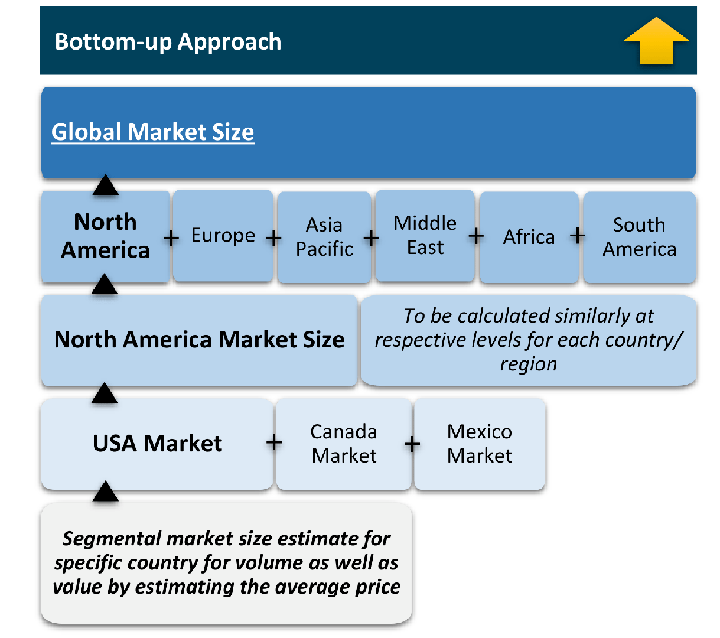
The bottom-up approach builds market estimates by starting with the smallest addressable market units and systematically aggregating them to create comprehensive market size projections.
This method begins with specific, granular data points and builds upward to create the complete market landscape.
Customer Analysis → Segmental Analysis → Geographical Analysis
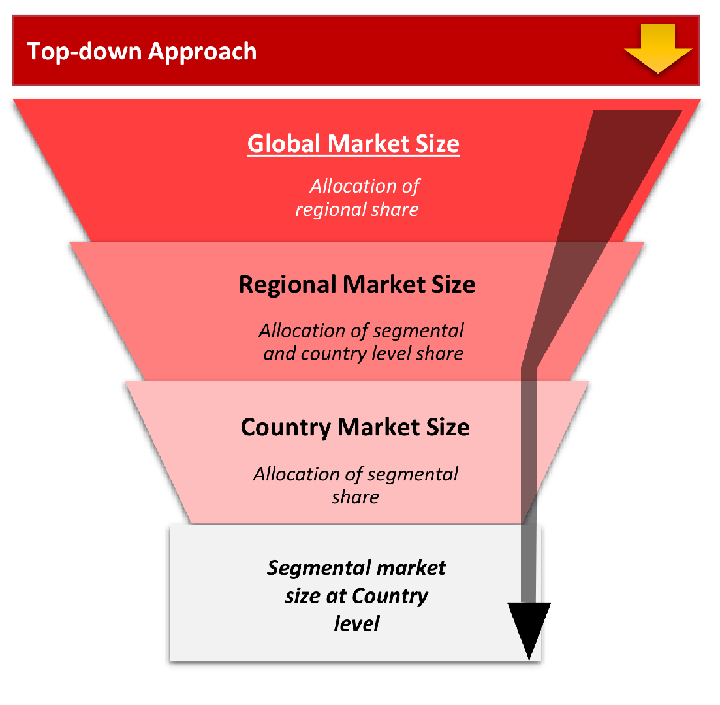
The top-down approach starts with the broadest possible market data and systematically narrows it down through a series of filters and assumptions to arrive at specific market segments or opportunities.
This method begins with the big picture and works downward to increasingly specific market slices.
TAM → SAM → SOM
Research Methods
Desk / Secondary Research
While analysing the market, we extensively study secondary sources, directories, and databases to identify and collect information useful for this technical, market-oriented, and commercial report. Secondary sources that we utilize are not only the public sources, but it is a combination of Open Source, Associations, Paid Databases, MG Repository & Knowledgebase, and others.
- Company websites, annual reports, financial reports, broker reports, and investor presentations
- National government documents, statistical databases and reports
- News articles, press releases and web-casts specific to the companies operating in the market, Magazines, reports, and others
- We gather information from commercial data sources for deriving company specific data such as segmental revenue, share for geography, product revenue, and others
- Internal and external proprietary databases (industry-specific), relevant patent, and regulatory databases
- Governing Bodies, Government Organizations
- Relevant Authorities, Country-specific Associations for Industries
We also employ the model mapping approach to estimate the product level market data through the players' product portfolio
Primary Research
Primary research/ interviews is vital in analyzing the market. Most of the cases involves paid primary interviews. Primary sources include primary interviews through e-mail interactions, telephonic interviews, surveys as well as face-to-face interviews with the different stakeholders across the value chain including several industry experts.
| Type of Respondents | Number of Primaries |
|---|---|
| Tier 2/3 Suppliers | ~20 |
| Tier 1 Suppliers | ~25 |
| End-users | ~25 |
| Industry Expert/ Panel/ Consultant | ~30 |
| Total | ~100 |
MG Knowledgebase
• Repository of industry blog, newsletter and case studies
• Online platform covering detailed market reports, and company profiles
Forecasting Factors and Models
Forecasting Factors
- Historical Trends – Past market patterns, cycles, and major events that shaped how markets behave over time. Understanding past trends helps predict future behavior.
- Industry Factors – Specific characteristics of the industry like structure, regulations, and innovation cycles that affect market dynamics.
- Macroeconomic Factors – Economic conditions like GDP growth, inflation, and employment rates that affect how much money people have to spend.
- Demographic Factors – Population characteristics like age, income, and location that determine who can buy your product.
- Technology Factors – How quickly people adopt new technology and how much technology infrastructure exists.
- Regulatory Factors – Government rules, laws, and policies that can help or restrict market growth.
- Competitive Factors – Analyzing competition structure such as degree of competition and bargaining power of buyers and suppliers.
Forecasting Models / Techniques
Multiple Regression Analysis
- Identify and quantify factors that drive market changes
- Statistical modeling to establish relationships between market drivers and outcomes
Time Series Analysis – Seasonal Patterns
- Understand regular cyclical patterns in market demand
- Advanced statistical techniques to separate trend, seasonal, and irregular components
Time Series Analysis – Trend Analysis
- Identify underlying market growth patterns and momentum
- Statistical analysis of historical data to project future trends
Expert Opinion – Expert Interviews
- Gather deep industry insights and contextual understanding
- In-depth interviews with key industry stakeholders
Multi-Scenario Development
- Prepare for uncertainty by modeling different possible futures
- Creating optimistic, pessimistic, and most likely scenarios
Time Series Analysis – Moving Averages
- Sophisticated forecasting for complex time series data
- Auto-regressive integrated moving average models with seasonal components
Econometric Models
- Apply economic theory to market forecasting
- Sophisticated economic models that account for market interactions
Expert Opinion – Delphi Method
- Harness collective wisdom of industry experts
- Structured, multi-round expert consultation process
Monte Carlo Simulation
- Quantify uncertainty and probability distributions
- Thousands of simulations with varying input parameters
Research Analysis
Our research framework is built upon the fundamental principle of validating market intelligence from both demand and supply perspectives. This dual-sided approach ensures comprehensive market understanding and reduces the risk of single-source bias.
Demand-Side Analysis: We understand end-user/application behavior, preferences, and market needs along with the penetration of the product for specific application.
Supply-Side Analysis: We estimate overall market revenue, analyze the segmental share along with industry capacity, competitive landscape, and market structure.
Validation & Evaluation
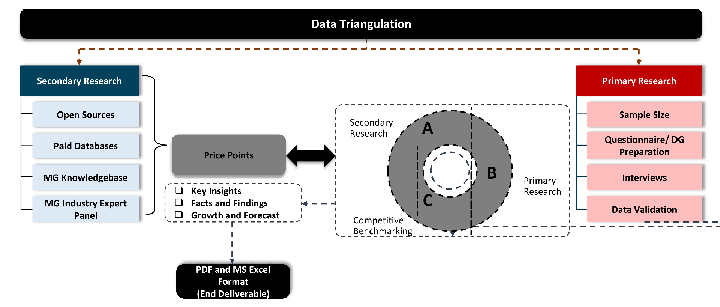
Data triangulation is a validation technique that uses multiple methods, sources, or perspectives to examine the same research question, thereby increasing the credibility and reliability of research findings. In market research, triangulation serves as a quality assurance mechanism that helps identify and minimize bias, validate assumptions, and ensure accuracy in market estimates.
- Data Source Triangulation – Using multiple data sources to examine the same phenomenon
- Methodological Triangulation – Using multiple research methods to study the same research question
- Investigator Triangulation – Using multiple researchers or analysts to examine the same data
- Theoretical Triangulation – Using multiple theoretical perspectives to interpret the same data
Custom Market Research Services
We will customise the research for you, in case the report listed above does not meet your requirements.
Get 10% Free Customisation