Protective Packaging Market Size, Share & Trends Analysis Report by Material Type (Plastic Films, Paper & Paperboard, Foam Plastics, Aluminum Foil, Others), Product Type, Packaging Format, Technology/Manufacturing Process, Thickness/Grade, Load Capacity/Strength Rating, Barrier Properties, Distribution Channel, End-Use Industry, and Geography (North America, Europe, Asia Pacific, Middle East, Africa, and South America) – Global Industry Data, Trends, and Forecasts, 2026–2035
|
|
|
Segmental Data Insights |
|
|
Demand Trends |
|
|
Competitive Landscape |
|
|
Strategic Development |
|
|
Future Outlook & Opportunities |
|
Protective-Packaging-Market Size, Share, and Growth
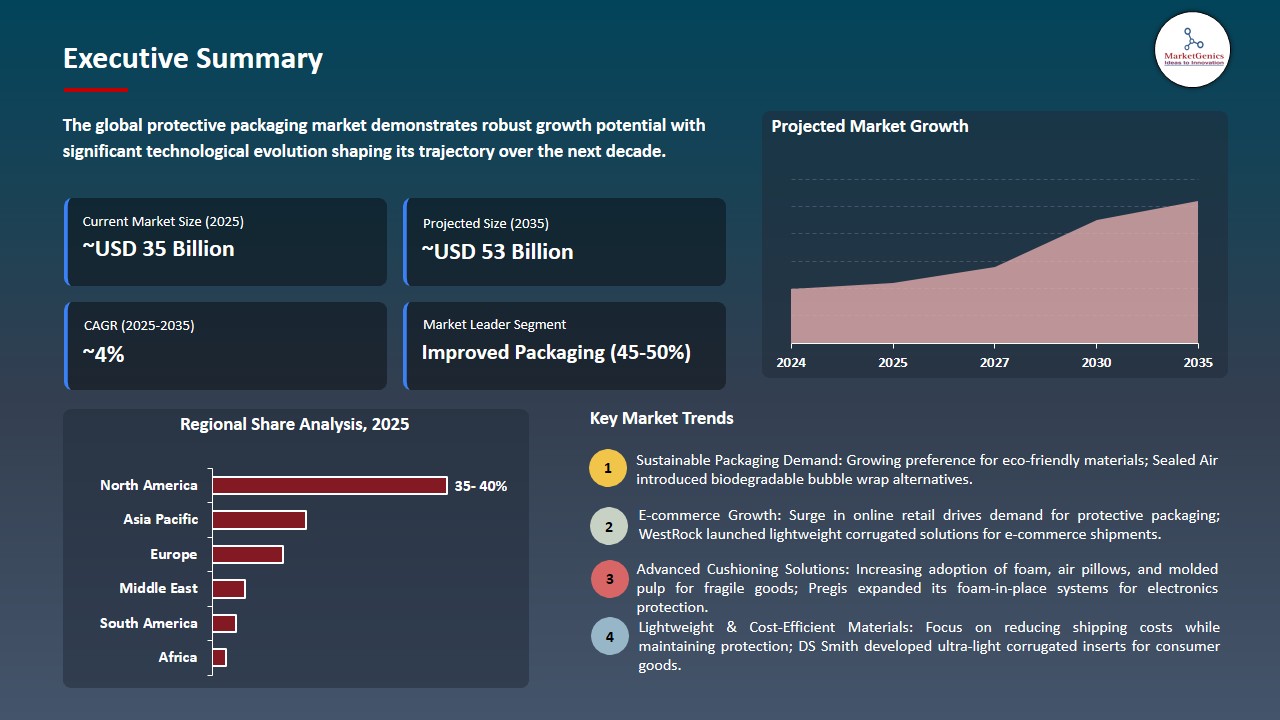
The global protective packaging market is experiencing robust growth, with its estimated value of USD 34.9 billion in the year 2025 and USD 52.6 billion by the period 2035, registering a CAGR of 4.2%, during the forecast period. Consumer demands are increasingly influencing the global protective packaging market in terms of safe, convenient, and long shelf life packaged products, drinks, and ambient products. With the rise of ready-to-drink products, plant-based beverages, dairy substitutes, and shelf-stable foods, manufacturers need packaging that allows the preservation of products, counteracts spoilage, and does not ruin in a long term in transit or storage without refrigeration.
Guillaume Latourette, Vice President of Ahlstrom’s Global Food Packaging business, says, With LamiBak Flex, we address the critical challenge of delivering high-barrier paper for flexible packaging while supporting sustainability goals. This innovation represents the future of functionalized base paper for converters and brands alike.
The protective packaging market is growing at a high rate in high value and specialized segments, which are not related to the more traditional food and beverage categories, under which convenience, product safety and shelf-life are highly valued. Flexible formats enable manufacturers to produce products of high quality, safety and ease of use without having to depend on refrigeration, which opens up new markets and increases the adoption of the products. For instance, in March 2025, Ahlstrom increased Lamibak product range with a new base paper that was developed to work in flexible food packaging, having barrier properties and recyclability. This highlights the way the flexible packaging is changing to suit the requirements of the modern-day that have to be both performance-based and sustainable.
Advanced materials, barrier technologies, and multi-format solutions are all the current trends of product innovation in protective packaging. For instance, in June 2025, Dow introduced its INNATE TF 220 resin a high-density polyethylene developed to form high-performance fully recyclable BoPE films. These movies have high durability, heat resistance, superior optical clearness and stiffness with mono-material structure and recyclable flexible packaging can be used to package food, personal care, and other consumer products. Consequently, flexible packaging formats, such as pouches and sachets up to shrink films are changing to provide high barrier capabilities as well as recyclability to meet the current demands of portability, product protection, sustainability and regulatory-compliance.
The market is further being transformed by digital integration, smart packaging and sustainability programs. Embedded sensors, QR-based tracking and eco-friendly materials are improving performance in the supply-chain, minimizing waste, and making it possible to engage the consumer, boosting brand loyalty and promoting growth in the market both in developed and developing markets.
Protective Packaging Market Dynamics and Trends
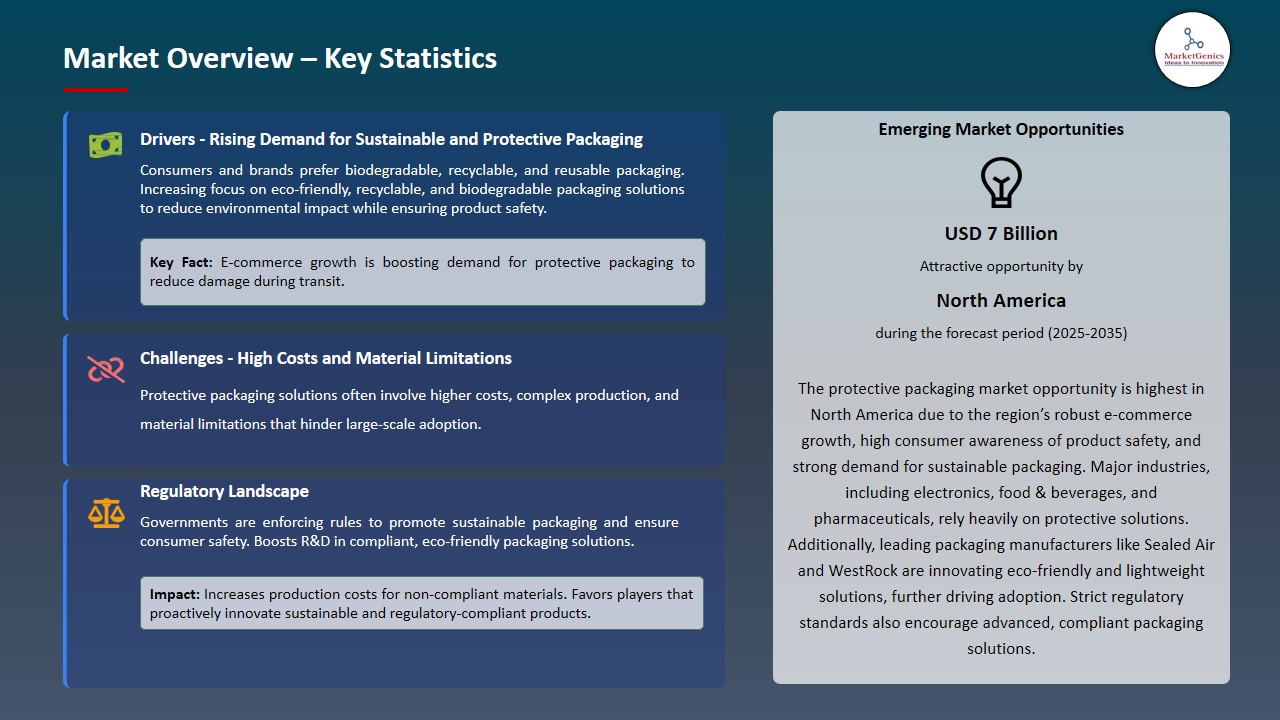
Driver: Rising Demand for Safe, Durable, and Shock-Resistant Packaging
-
Growing consumer demand of protective packaging incorporating the use of the latest packaging technology, which is safe, durable, and shock-resistant, is pushing its adoption. As the popularity of the ready-to-eat, minimally processed and temperature-sensitive food and beverage products continues to rise, manufacturers are exploring ways in which they can package the products in order to provide increased stability to the product, longer shelf life and reduced damage during storage and transportation.
- Manufacturers are responding to this demand by coming up with new materials and designs. For instance, in March 2025, JPFL Films Private Limited introduced the first BOPA nylon films in India to use with the flexible packaging, which have high durability, good puncture resistance, and high barrier properties. This shows the way flexible packaging is being changed to fit the requirement of sturdy, secure, and efficient package of delicate items.
- Flexible packaging is increasingly becoming the preference in food, beverage, and pharmaceutical packaging with consumers placing more demands on product integrity, convenience, and safety, which is spurring new innovations and growth in the protective packaging market.
Restraint: High Cost of Advanced Protective Packaging Materials and Equipment
-
The protective packaging market is highly challenged by cost because of the use of improved materials in form of biodegradable polymers, multi-layer/barrier films and active or intelligent aspects of packaging. Small and medium-sized manufacturers may find it difficult to invest in high-performance lines of production that would be able to process such materials, so they could not enter the market and move slower to price-sensitive locations.
- Operation cost also limits growth. Complex machines of filling and sealing, sterilizing, and devices of controlled temperature are hardware that need highly qualified personnel, frequent maintenance, and quality checks. The adherence to the international standards like the ISO 9001, HACCP, and the local safety certified standards imposes a further cost to the company in terms of finance and administration and therefore superior packaging solutions are expensive to implement regularly.
- High set up costs and operation reduce flexibility by restricting experimentation (with new pack formats or small batch launch) and slows penetration of markets as demand requires protective packaging and sustainable packaging.
Opportunity: Expansion of E-commerce and Last-Mile Delivery Services
-
The e-commerce and the last-mile delivery service are rapidly increasing the benefit of the protective packaging market. The growth in the use of online retailing, especially in food, pharmaceuticals, and consumer electronics, is generating a boom in the demand of packaging solutions that require their products to be safe in transit, withstand a series of handling stages, and to provide the end-user with convenience. Differentiated packaging that is based on shipping such as bubble wraps, padded mailers and shock absorbing inserts is becoming more popular as customers become more concerned with the delivery of their packages without damages.
- The companies have invested in specialized protective packaging that fits the e-commerce logistics. For instance, in May 2025, Mondi has increased the manufacture of its re/cycle MailerBAG line to satisfy the increased demand of e-commerce customers. The portfolio is comprised of recyclable and flexible protective mailers of different product sizes that can guarantee a safe delivery and also promote the idea of sustainability and circular-economy.
- As the consumer preference changes to quick and consistent delivery, protective packaging suppliers will build brand loyalty, get more returns, and grow a larger market share, unlocking the long-term growth and value addition in the developed and the emerging markets.
Key Trend: Adoption of Sustainable and Recyclable Packaging Solutions
-
As manufacturers react to the rising consumer awareness, regulations and corporate ESG requirements the protective packaging market is moving towards sustainable and recyclable solutions. Conventional plastics and EPS foams are being substituted with lightweight, multi-layered and all-recyclable material, bio-based polymers, corrugated inserts, and molded pulp solutions offer protection and minimize the environmental impact.
- Manufacturers are hastening to shift away from traditional packaging and foam-based, to high-performance and environmentally friendly, instead. This is changing in the new product innovations. For instance, Ranpak Holdings Corp. recently released its naturemailer padded mailer and climaliner Plus cold-chain liner (both 100 per cent curbside recyclable and 100 per cent paper-based). Instead of foam or bubble wrap, the naturemailer relies on honeycomb-paper cushioning which offers good protection to e-commerce, electronics, and consumer goods delivery and reduces the plastic wastes.
- With increased adoption, sustainable protective packaging can make its way into high-volume e-commerce deliveries as well as into the markets of higher-end products to provide differentiation, boost brand image, and grow a market in a more ecosystem-oriented environment.
Protective-Packaging-Market Analysis and Segmental Data
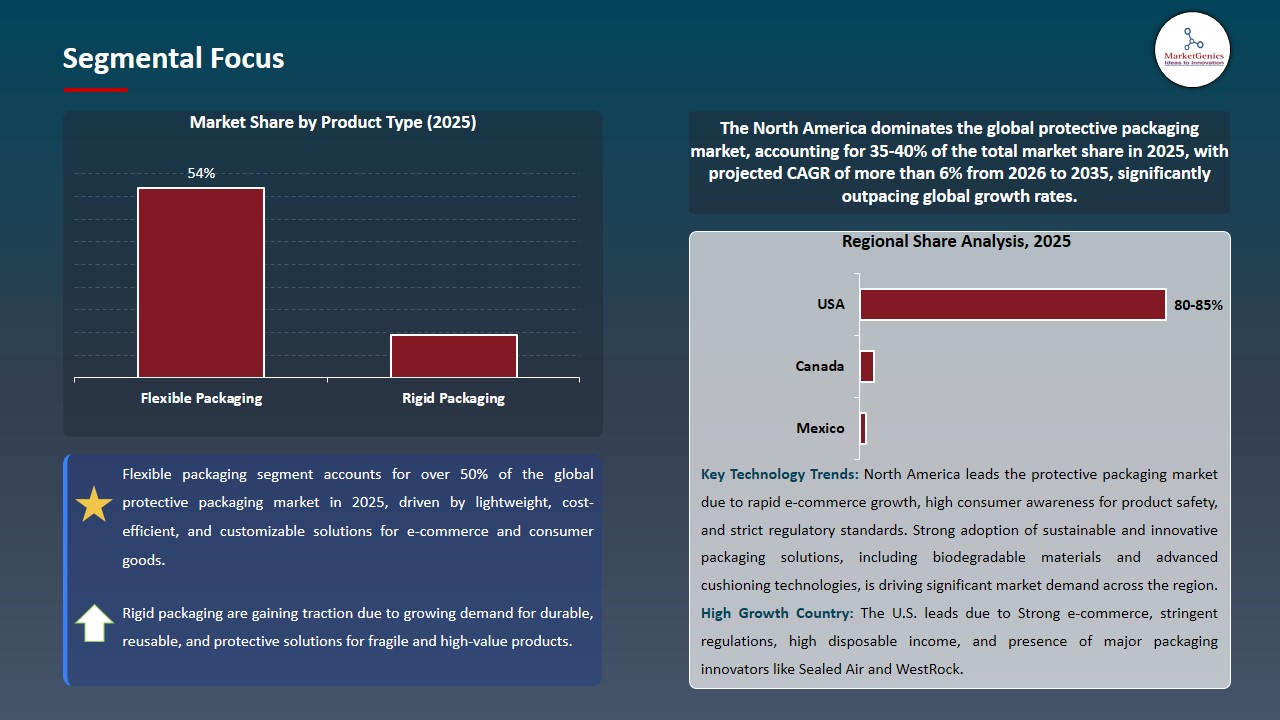
Flexible Packaging Dominate Global Protective Packaging Market
-
Flexible packaging leads the protective packaging market as it is flexible and lightweight and capable of offering high-barrier protection to food, pharmaceuticals, as well as consumer goods. Pouches, sachets, and shrink films can enable the manufacturers to maximize storage, transportation, and shelf-life and minimize material consumption and expenditure. Flexible packaging is a multi-layer material with moisture, oxygen, and impact barriers that enable the use of multiple types of products with high sensitivity and scalability through the e-commerce and logistics networks.
- This segment is increasing in the pace of innovation. For instance, in 2023, UFlex Limited introduced high-barrier flexible packaging film (F‑PSX transparent BOPET film) that is used in pouches and flexible packs. The movie offers superior moisture and oxygen barrier, substitute’s ordinary PVDC/EVOH films and guarantees high clarity and product visibility that makes it ideal in snacks, microwavable food, confectionaries, and other flexible pack-packages. This shows the demand to have high-performance, multi-functional, and sustainable flexible packaging solutions.
- The synergistic combination of material efficiency, barrier performance and scalability keeps on reaffirming flexible packaging as the predominant protective packaging format across the globe.
North America Leads Global Protective Packaging Market Demand
-
North America dominates protective packaging market as it provides the highest level of e-commerce facilities, massive industrial production, and high demand in the fields of electronics, healthcare, and direct to consumer retail. The large volumes of parcels, the capital of the same-day delivery, and increasing rates of the product returns are compelling brands to use high-performance cushioning, mailers, and impact-resistance packaging methods.
- Such leadership is demonstrated by vigorous growth of capacity throughout the region. For instnace, in August 2024, Pregis LLC increased its output at its plant in Bethel, Pennsylvania and Reno, Nevada to satisfy soaring demand on its EverTec recyclable protective mailers. The growth also enhances supply resiliency in the region of sustainable e-commerce protective packaging.
- Manufacturers in North America are also intensifying innovation in fiber-based protective formats, automation-ready package systems and temperature controlled protective solutions to medical and biotech logistics to reinforce the long-term market leadership in the region
Protective-Packaging-Market Ecosystem
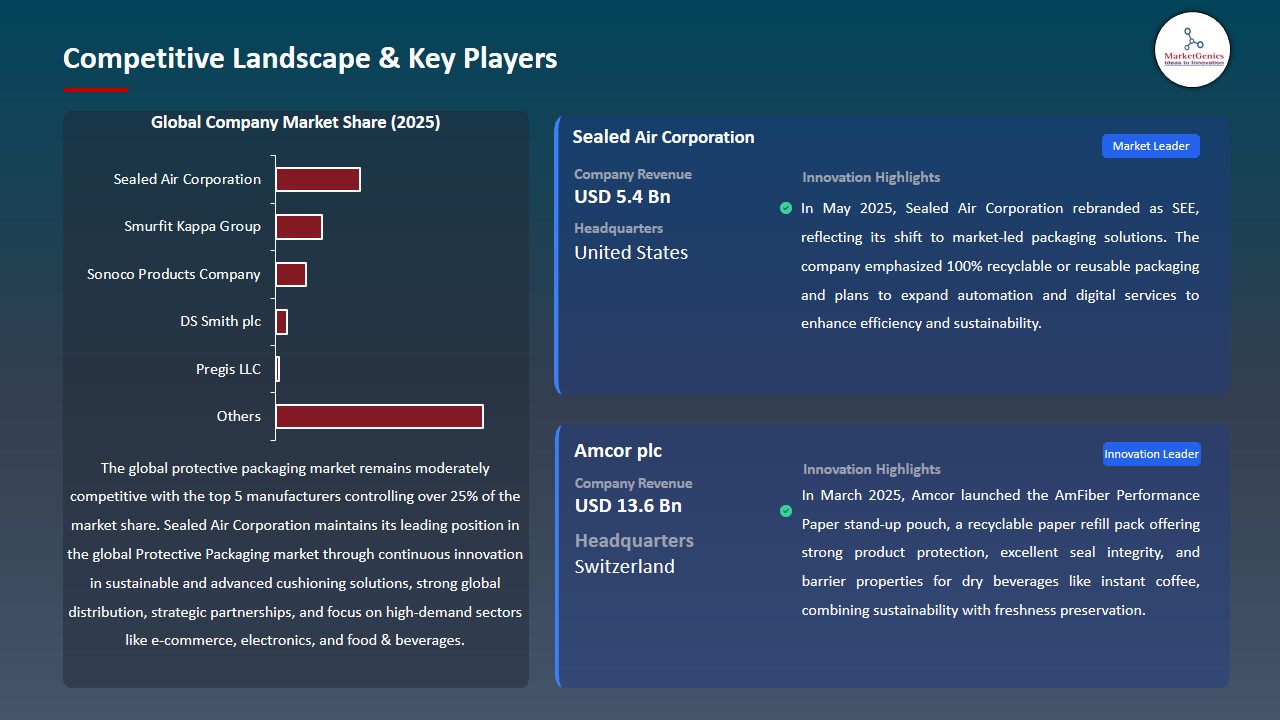
The protective packaging market is characterized by strong competitors as integrated multinational packaging groups, including Sealed Air Corporation, Smurfit Kappa Group, Sonoco Products Company, DS Smith plc, and Pregis LLC. These corporations run large worldwide fabrication infrastructures and are extensively engaged in high-performance cushioning, packaging that can be automated, and material invention sustainability to meet the swiftly expanding final consumption markets of e-commerce, electronics, pharmaceuticals, and industrial logistics.
The resin and paperboard suppliers, foam and film converters, protective-system equipment providers, fulfilment centres, logistics operators and brand owners form the ecosystem. Most of the major market participants are beginning to invest in production that is vertically integrated, smart packaging, and materials that are made to the circular economy, including foams and paper-based cushioning that can be recycled. Global expansion of strategic capacities around major e-commerce centers, digitalization of packing and automated void-fill systems, is enhancing damage avoidance, lowering freight expenses and reinforcing resilience in the supply-chain in an extremely competitive global market.
Recent Development and Strategic Overview
-
In September 2024, Mondi introduced a 100 percent paper-based, recyclable protective mailer together with Amazon. The 100% plastic-free mailer is an alternative to bubble wrap, offering the cushioning effect and protection of transit of the fragile product in place of the bubble wrap, which is lightweight and can be easily recycled, contributing to the sustainability and overall safety of the product.
- In September 2025, PAC Worldwide introduced new sustainable protective-packaging solutions at PACK EXPO 2025, such as a Post-Consumer Recycled (PCR) Bubble Roll and a fixed-release liner on its paper mailers, integrating protection of the product with enhanced sustainability.
Report Scope
|
Detail |
|
|
Market Size in 2025 |
USD 34.9 Bn |
|
Market Forecast Value in 2035 |
USD 52.6 Bn |
|
Growth Rate (CAGR) |
4.2% |
|
Forecast Period |
2026 – 2035 |
|
Historical Data Available for |
2021 – 2024 |
|
Market Size Units |
US$ Billion for Value |
|
Report Format |
Electronic (PDF) + Excel |
|
North America |
Europe |
Asia Pacific |
Middle East |
Africa |
South America |
|
|
|
|
|
|
|
Companies Covered |
|||||
|
|
|
|
|
|
Protective-Packaging-Market Segmentation and Highlights
|
Segment |
Sub-segment |
|
Protective Packaging Market, By Material Type |
|
|
Protective Packaging Market, By Product Type |
|
|
Protective Packaging Market, By Packaging Format |
|
|
Protective Packaging Market, By Technology/Manufacturing Process |
|
|
Protective Packaging Market, By Thickness/Grade |
|
|
Protective Packaging Market, By Load Capacity/Strength Rating |
|
|
Protective Packaging Market, By Barrier Properties |
|
|
Protective Packaging Market, By Distribution Channel |
|
|
Protective Packaging Market, By End-Use Industry |
|
Frequently Asked Questions
Table of Contents
- 1. Research Methodology and Assumptions
- 1.1. Definitions
- 1.2. Research Design and Approach
- 1.3. Data Collection Methods
- 1.4. Base Estimates and Calculations
- 1.5. Forecasting Models
- 1.5.1. Key Forecast Factors & Impact Analysis
- 1.6. Secondary Research
- 1.6.1. Open Sources
- 1.6.2. Paid Databases
- 1.6.3. Associations
- 1.7. Primary Research
- 1.7.1. Primary Sources
- 1.7.2. Primary Interviews with Stakeholders across Ecosystem
- 2. Executive Summary
- 2.1. Global Protective Packaging Market Outlook
- 2.1.1. Protective Packaging Market Size Value (US$ Bn), and Forecasts, 2021-2035
- 2.1.2. Compounded Annual Growth Rate Analysis
- 2.1.3. Growth Opportunity Analysis
- 2.1.4. Segmental Share Analysis
- 2.1.5. Geographical Share Analysis
- 2.2. Market Analysis and Facts
- 2.3. Supply-Demand Analysis
- 2.4. Competitive Benchmarking
- 2.5. Go-to- Market Strategy
- 2.5.1. Customer/ End-use Industry Assessment
- 2.5.2. Growth Opportunity Data, 2026-2035
- 2.5.2.1. Regional Data
- 2.5.2.2. Country Data
- 2.5.2.3. Segmental Data
- 2.5.3. Identification of Potential Market Spaces
- 2.5.4. GAP Analysis
- 2.5.5. Potential Attractive Price Points
- 2.5.6. Prevailing Market Risks & Challenges
- 2.5.7. Preferred Sales & Marketing Strategies
- 2.5.8. Key Recommendations and Analysis
- 2.5.9. A Way Forward
- 2.1. Global Protective Packaging Market Outlook
- 3. Industry Data and Premium Insights
- 3.1. Global Packaging Industry Overview, 2025
- 3.1.1. Packaging Industry Ecosystem Analysis
- 3.1.2. Key Trends for Packaging Industry
- 3.1.3. Regional Distribution for Packaging Industry
- 3.2. Supplier Customer Data
- 3.3. Technology Roadmap and Developments
- 3.4. Trade Analysis
- 3.4.1. Import & Export Analysis, 2025
- 3.4.2. Top Importing Countries
- 3.4.3. Top Exporting Countries
- 3.5. Trump Tariff Impact Analysis
- 3.5.1. Manufacturer
- 3.5.1.1. Based on the component & Raw material
- 3.5.2. Supply Chain
- 3.5.3. End Consumer
- 3.5.1. Manufacturer
- 3.6. Raw Material Analysis
- 3.1. Global Packaging Industry Overview, 2025
- 4. Market Overview
- 4.1. Market Dynamics
- 4.1.1. Drivers
- 4.1.1.1. Increasing e-commerce and online retail shipments requiring safe packaging.
- 4.1.1.2. Rising demand for fragile and high-value product protection during transit.
- 4.1.1.3. Growth in the electronics, automotive, and pharmaceutical industries.
- 4.1.2. Restraints
- 4.1.2.1. High cost of advanced protective packaging materials.
- 4.1.2.2. Environmental concerns over non-recyclable or single-use packaging.
- 4.1.1. Drivers
- 4.2. Key Trend Analysis
- 4.3. Regulatory Framework
- 4.3.1. Key Regulations, Norms, and Subsidies, by Key Countries
- 4.3.2. Tariffs and Standards
- 4.3.3. Impact Analysis of Regulations on the Market
- 4.4. Value Chain Analysis
- 4.4.1. Raw Material Suppliers
- 4.4.2. Manufacturing
- 4.4.3. Distribution
- 4.4.4. End-Use
- 4.5. Porter’s Five Forces Analysis
- 4.6. PESTEL Analysis
- 4.7. Global Protective Packaging Market Demand
- 4.7.1. Historical Market Size –Value (US$ Bn), 2020-2024
- 4.7.2. Current and Future Market Size - Value (US$ Bn), 2026–2035
- 4.7.2.1. Y-o-Y Growth Trends
- 4.7.2.2. Absolute $ Opportunity Assessment
- 4.1. Market Dynamics
- 5. Competition Landscape
- 5.1. Competition structure
- 5.1.1. Fragmented v/s consolidated
- 5.2. Company Share Analysis, 2025
- 5.2.1. Global Company Market Share
- 5.2.2. By Region
- 5.2.2.1. North America
- 5.2.2.2. Europe
- 5.2.2.3. Asia Pacific
- 5.2.2.4. Middle East
- 5.2.2.5. Africa
- 5.2.2.6. South America
- 5.3. Product Comparison Matrix
- 5.3.1. Specifications
- 5.3.2. Market Positioning
- 5.3.3. Pricing
- 5.1. Competition structure
- 6. Global Protective Packaging Market Analysis, by Material Type
- 6.1. Key Segment Analysis
- 6.2. Protective Packaging Market Size Value (US$ Bn), Analysis, and Forecasts, by Material Type, 2021-2035
- 6.2.1. Plastic Films
- 6.2.1.1. Polyethylene (PE)
- 6.2.1.2. Polypropylene (PP)
- 6.2.1.3. Polyvinyl Chloride (PVC)
- 6.2.1.4. Polyethylene Terephthalate (PET)
- 6.2.1.5. Others
- 6.2.2. Paper & Paperboard
- 6.2.2.1. Corrugated Board
- 6.2.2.2. Kraft Paper
- 6.2.2.3. Molded Pulp
- 6.2.2.4. Others
- 6.2.3. Foam Plastics
- 6.2.3.1. Polyurethane Foam
- 6.2.3.2. Polystyrene Foam
- 6.2.3.3. Polyethylene Foam
- 6.2.3.4. Others
- 6.2.4. Aluminum Foil
- 6.2.5. Others
- 6.2.1. Plastic Films
- 7. Global Protective Packaging Market Analysis, by Product Type
- 7.1. Key Segment Analysis
- 7.2. Protective Packaging Market Size Value (US$ Bn), Analysis, and Forecasts, by Product Type, 2021-2035
- 7.2.1. Flexible Packaging
- 7.2.1.1. Bubble Wrap
- 7.2.1.2. Air Pillows
- 7.2.1.3. Foam Pouches
- 7.2.1.4. Stretch Films
- 7.2.1.5. Shrink Films
- 7.2.1.6. Others
- 7.2.2. Rigid Packaging
- 7.2.2.1. Corrugated Boxes
- 7.2.2.2. Foam Inserts
- 7.2.2.3. Molded Pulp Trays
- 7.2.2.4. Plastic Containers
- 7.2.2.5. Edge Protectors
- 7.2.2.6. Corner Boards
- 7.2.2.7. Others
- 7.2.1. Flexible Packaging
- 8. Global Protective Packaging Market Analysis, by Packaging Format
- 8.1. Key Segment Analysis
- 8.2. Protective Packaging Market Size Value (US$ Bn), Analysis, and Forecasts, by Packaging Format, 2021-2035
- 8.2.1. Bags & Pouches
- 8.2.2. Boxes & Cartons
- 8.2.3. Wraps & Films
- 8.2.4. Mailers & Envelopes
- 8.2.5. Pallets & Crates
- 8.2.6. Void Fill Systems
- 8.2.7. Cushioning Materials
- 9. Global Protective Packaging Market Analysis, by Technology/Manufacturing Process
- 9.1. Key Segment Analysis
- 9.2. Protective Packaging Market Size Value (US$ Bn), Analysis, and Forecasts, by Technology/Manufacturing Process, 2021-2035
- 9.2.1. Extrusion
- 9.2.2. Molding
- 9.2.2.1. Injection Molding
- 9.2.2.2. Blow Molding
- 9.2.2.3. Thermoforming
- 9.2.2.4. Others
- 9.2.3. Lamination
- 9.2.4. Coating
- 9.2.5. Die-Cutting
- 9.2.6. Corrugation
- 10. Global Protective Packaging Market Analysis, by Thickness/Grade
- 10.1. Key Segment Analysis
- 10.2. Protective Packaging Market Size Value (US$ Bn), Analysis, and Forecasts, by Thickness/Grade, 2021-2035
- 10.2.1. Light Duty (< 2 mm)
- 10.2.2. Medium Duty (2-5 mm)
- 10.2.3. Heavy Duty (5-10 mm)
- 10.2.4. Extra Heavy Duty (> 10 mm)
- 11. Global Protective Packaging Market Analysis, by Load Capacity/Strength Rating
- 11.1. Key Segment Analysis
- 11.2. Protective Packaging Market Size Value (US$ Bn), Analysis, and Forecasts, by Load Capacity/Strength Rating, 2021-2035
- 11.2.1. Light Load (< 10 kg)
- 11.2.2. Medium Load (10-50 kg)
- 11.2.3. Heavy Load (50-200 kg)
- 11.2.4. Extra Heavy Load (> 200 kg)
- 12. Global Protective Packaging Market Analysis, by Barrier Properties
- 12.1. Key Segment Analysis
- 12.2. Protective Packaging Market Size Value (US$ Bn), Analysis, and Forecasts, by Barrier Properties, 2021-2035
- 12.2.1. Moisture Barrier
- 12.2.2. Oxygen Barrier
- 12.2.3. UV Barrier
- 12.2.4. Static Dissipative/ESD Protection
- 12.2.5. Multi-Barrier Laminated
- 13. Global Protective Packaging Market Analysis, by Distribution Channel
- 13.1. Key Segment Analysis
- 13.2. Protective Packaging Market Size Value (US$ Bn), Analysis, and Forecasts, by Distribution Channel, 2021-2035
- 13.2.1. Direct Sales
- 13.2.2. Distributors & Wholesalers
- 13.2.3. Online Retail/E-commerce Platforms
- 13.2.4. Specialty Packaging Suppliers
- 14. Global Protective Packaging Market Analysis, by End-Use Industry
- 14.1. Key Segment Analysis
- 14.2. Protective Packaging Market Size Value (US$ Bn), Analysis, and Forecasts, by End-Use Industry, 2021-2035
- 14.2.1. Food & Beverage
- 14.2.1.1. Fresh Produce Packaging
- 14.2.1.2. Dairy Products Protection
- 14.2.1.3. Frozen Food Packaging
- 14.2.1.4. Beverage Bottling & Canning
- 14.2.1.5. Bakery & Confectionery
- 14.2.1.6. Meat & Seafood Packaging
- 14.2.1.7. Others
- 14.2.2. Electronics & Electrical
- 14.2.2.1. Consumer Electronics Packaging
- 14.2.2.2. Semiconductor & IC Protection
- 14.2.2.3. Computer Hardware Shipping
- 14.2.2.4. Mobile Device Packaging
- 14.2.2.5. Electronic Components
- 14.2.2.6. White Goods/Appliances
- 14.2.2.7. Others
- 14.2.3. E-commerce & Retail
- 14.2.3.1. Parcel Shipping
- 14.2.3.2. Subscription Box Packaging
- 14.2.3.3. Fragile Item Protection
- 14.2.3.4. Omnichannel Fulfillment
- 14.2.3.5. Returns Packaging
- 14.2.3.6. Others
- 14.2.4. Automotive
- 14.2.4.1. Auto Parts Packaging
- 14.2.4.2. Aftermarket Components
- 14.2.4.3. Vehicle Assembly Parts
- 14.2.4.4. Export/Import Shipping
- 14.2.4.5. Spare Parts Distribution
- 14.2.4.6. Others
- 14.2.5. Healthcare & Pharmaceuticals
- 14.2.5.1. Medical Device Packaging
- 14.2.5.2. Pharmaceutical Products
- 14.2.5.3. Diagnostic Equipment
- 14.2.5.4. Surgical Instruments
- 14.2.5.5. Temperature-Sensitive Drugs
- 14.2.5.6. Biopharmaceuticals
- 14.2.5.7. Others
- 14.2.6. Industrial & Manufacturing
- 14.2.6.1. Machinery Parts
- 14.2.6.2. Tools & Equipment
- 14.2.6.3. Raw Material Handling
- 14.2.6.4. Work-in-Progress Protection
- 14.2.6.5. Finished Goods Packaging
- 14.2.6.6. Others
- 14.2.7. Consumer Goods
- 14.2.7.1. Personal Care Products
- 14.2.7.2. Cosmetics & Fragrances
- 14.2.7.3. Household Products
- 14.2.7.4. Toys & Games
- 14.2.7.5. Sporting Goods
- 14.2.7.6. Furniture & Home Décor
- 14.2.7.7. Others
- 14.2.8. Aerospace & Defense
- 14.2.8.1. Aircraft Components
- 14.2.8.2. Military Equipment
- 14.2.8.3. Precision Instruments
- 14.2.8.4. Sensitive Electronics
- 14.2.8.5. Export Crating
- 14.2.8.6. Others
- 14.2.9. Logistics & Transportation
- 14.2.9.1. Third-Party Logistics (3PL)
- 14.2.9.2. Freight Forwarding
- 14.2.9.3. Warehousing & Distribution
- 14.2.9.4. Last-Mile Delivery
- 14.2.9.5. Cross-Border Shipping
- 14.2.9.6. Others
- 14.2.10. Agriculture
- 14.2.10.1. Seeds & Fertilizers
- 14.2.10.2. Agricultural Equipment
- 14.2.10.3. Harvested Crops
- 14.2.10.4. Horticultural Products
- 14.2.10.5. Others
- 14.2.1. Food & Beverage
- 15. Global Protective Packaging Market Analysis and Forecasts, by Region
- 15.1. Key Findings
- 15.2. Protective Packaging Market Size Value (US$ Bn), Analysis, and Forecasts, by Region, 2021-2035
- 15.2.1. North America
- 15.2.2. Europe
- 15.2.3. Asia Pacific
- 15.2.4. Middle East
- 15.2.5. Africa
- 15.2.6. South America
- 16. North America Protective Packaging Market Analysis
- 16.1. Key Segment Analysis
- 16.2. Regional Snapshot
- 16.3. North America Protective Packaging Market Size- Value (US$ Bn), Analysis, and Forecasts, 2021-2035
- 16.3.1. Material Type
- 16.3.2. Product Type
- 16.3.3. Packaging Format
- 16.3.4. Technology/Manufacturing Process
- 16.3.5. Thickness/Grade
- 16.3.6. Load Capacity/Strength Rating
- 16.3.7. Barrier Properties
- 16.3.8. Distribution Channel
- 16.3.9. End-Use Industry
- 16.3.10. Country
- 16.3.10.1. USA
- 16.3.10.2. Canada
- 16.3.10.3. Mexico
- 16.4. USA Protective Packaging Market
- 16.4.1. Country Segmental Analysis
- 16.4.2. Material Type
- 16.4.3. Product Type
- 16.4.4. Packaging Format
- 16.4.5. Technology/Manufacturing Process
- 16.4.6. Thickness/Grade
- 16.4.7. Load Capacity/Strength Rating
- 16.4.8. Barrier Properties
- 16.4.9. Distribution Channel
- 16.4.10. End-Use Industry
- 16.5. Canada Protective Packaging Market
- 16.5.1. Country Segmental Analysis
- 16.5.2. Material Type
- 16.5.3. Product Type
- 16.5.4. Packaging Format
- 16.5.5. Technology/Manufacturing Process
- 16.5.6. Thickness/Grade
- 16.5.7. Load Capacity/Strength Rating
- 16.5.8. Barrier Properties
- 16.5.9. Distribution Channel
- 16.5.10. End-Use Industry
- 16.6. Mexico Protective Packaging Market
- 16.6.1. Country Segmental Analysis
- 16.6.2. Material Type
- 16.6.3. Product Type
- 16.6.4. Packaging Format
- 16.6.5. Technology/Manufacturing Process
- 16.6.6. Thickness/Grade
- 16.6.7. Load Capacity/Strength Rating
- 16.6.8. Barrier Properties
- 16.6.9. Distribution Channel
- 16.6.10. End-Use Industry
- 17. Europe Protective Packaging Market Analysis
- 17.1. Key Segment Analysis
- 17.2. Regional Snapshot
- 17.3. Europe Protective Packaging Market Size Value (US$ Bn), Analysis, and Forecasts, 2021-2035
- 17.3.1. Material Type
- 17.3.2. Product Type
- 17.3.3. Packaging Format
- 17.3.4. Technology/Manufacturing Process
- 17.3.5. Thickness/Grade
- 17.3.6. Load Capacity/Strength Rating
- 17.3.7. Barrier Properties
- 17.3.8. Distribution Channel
- 17.3.9. End-Use Industry
- 17.3.10. Country
- 17.3.10.1. Germany
- 17.3.10.2. United Kingdom
- 17.3.10.3. France
- 17.3.10.4. Italy
- 17.3.10.5. Spain
- 17.3.10.6. Netherlands
- 17.3.10.7. Nordic Countries
- 17.3.10.8. Poland
- 17.3.10.9. Russia & CIS
- 17.3.10.10. Rest of Europe
- 17.4. Germany Protective Packaging Market
- 17.4.1. Country Segmental Analysis
- 17.4.2. Material Type
- 17.4.3. Product Type
- 17.4.4. Packaging Format
- 17.4.5. Technology/Manufacturing Process
- 17.4.6. Thickness/Grade
- 17.4.7. Load Capacity/Strength Rating
- 17.4.8. Barrier Properties
- 17.4.9. Distribution Channel
- 17.4.10. End-Use Industry
- 17.5. United Kingdom Protective Packaging Market
- 17.5.1. Country Segmental Analysis
- 17.5.2. Material Type
- 17.5.3. Product Type
- 17.5.4. Packaging Format
- 17.5.5. Technology/Manufacturing Process
- 17.5.6. Thickness/Grade
- 17.5.7. Load Capacity/Strength Rating
- 17.5.8. Barrier Properties
- 17.5.9. Distribution Channel
- 17.5.10. End-Use Industry
- 17.6. France Protective Packaging Market
- 17.6.1. Country Segmental Analysis
- 17.6.2. Material Type
- 17.6.3. Product Type
- 17.6.4. Packaging Format
- 17.6.5. Technology/Manufacturing Process
- 17.6.6. Thickness/Grade
- 17.6.7. Load Capacity/Strength Rating
- 17.6.8. Barrier Properties
- 17.6.9. Distribution Channel
- 17.6.10. End-Use Industry
- 17.7. Italy Protective Packaging Market
- 17.7.1. Country Segmental Analysis
- 17.7.2. Material Type
- 17.7.3. Product Type
- 17.7.4. Packaging Format
- 17.7.5. Technology/Manufacturing Process
- 17.7.6. Thickness/Grade
- 17.7.7. Load Capacity/Strength Rating
- 17.7.8. Barrier Properties
- 17.7.9. Distribution Channel
- 17.7.10. End-Use Industry
- 17.8. Spain Protective Packaging Market
- 17.8.1. Country Segmental Analysis
- 17.8.2. Material Type
- 17.8.3. Product Type
- 17.8.4. Packaging Format
- 17.8.5. Technology/Manufacturing Process
- 17.8.6. Thickness/Grade
- 17.8.7. Load Capacity/Strength Rating
- 17.8.8. Barrier Properties
- 17.8.9. Distribution Channel
- 17.8.10. End-Use Industry
- 17.9. Netherlands Protective Packaging Market
- 17.9.1. Country Segmental Analysis
- 17.9.2. Material Type
- 17.9.3. Product Type
- 17.9.4. Packaging Format
- 17.9.5. Technology/Manufacturing Process
- 17.9.6. Thickness/Grade
- 17.9.7. Load Capacity/Strength Rating
- 17.9.8. Barrier Properties
- 17.9.9. Distribution Channel
- 17.9.10. End-Use Industry
- 17.10. Nordic Countries Protective Packaging Market
- 17.10.1. Country Segmental Analysis
- 17.10.2. Material Type
- 17.10.3. Product Type
- 17.10.4. Packaging Format
- 17.10.5. Technology/Manufacturing Process
- 17.10.6. Thickness/Grade
- 17.10.7. Load Capacity/Strength Rating
- 17.10.8. Barrier Properties
- 17.10.9. Distribution Channel
- 17.10.10. End-Use Industry
- 17.11. Poland Protective Packaging Market
- 17.11.1. Country Segmental Analysis
- 17.11.2. Material Type
- 17.11.3. Product Type
- 17.11.4. Packaging Format
- 17.11.5. Technology/Manufacturing Process
- 17.11.6. Thickness/Grade
- 17.11.7. Load Capacity/Strength Rating
- 17.11.8. Barrier Properties
- 17.11.9. Distribution Channel
- 17.11.10. End-Use Industry
- 17.12. Russia & CIS Protective Packaging Market
- 17.12.1. Country Segmental Analysis
- 17.12.2. Material Type
- 17.12.3. Product Type
- 17.12.4. Packaging Format
- 17.12.5. Technology/Manufacturing Process
- 17.12.6. Thickness/Grade
- 17.12.7. Load Capacity/Strength Rating
- 17.12.8. Barrier Properties
- 17.12.9. Distribution Channel
- 17.12.10. End-Use Industry
- 17.13. Rest of Europe Protective Packaging Market
- 17.13.1. Country Segmental Analysis
- 17.13.2. Material Type
- 17.13.3. Product Type
- 17.13.4. Packaging Format
- 17.13.5. Technology/Manufacturing Process
- 17.13.6. Thickness/Grade
- 17.13.7. Load Capacity/Strength Rating
- 17.13.8. Barrier Properties
- 17.13.9. Distribution Channel
- 17.13.10. End-Use Industry
- 18. Asia Pacific Protective Packaging Market Analysis
- 18.1. Key Segment Analysis
- 18.2. Regional Snapshot
- 18.3. Asia Pacific Protective Packaging Market Size Value (US$ Bn), Analysis, and Forecasts, 2021-2035
- 18.3.1. Material Type
- 18.3.2. Product Type
- 18.3.3. Packaging Format
- 18.3.4. Technology/Manufacturing Process
- 18.3.5. Thickness/Grade
- 18.3.6. Load Capacity/Strength Rating
- 18.3.7. Barrier Properties
- 18.3.8. Distribution Channel
- 18.3.9. End-Use Industry
- 18.3.10. Country
- 18.3.10.1. China
- 18.3.10.2. India
- 18.3.10.3. Japan
- 18.3.10.4. South Korea
- 18.3.10.5. Australia and New Zealand
- 18.3.10.6. Indonesia
- 18.3.10.7. Malaysia
- 18.3.10.8. Thailand
- 18.3.10.9. Vietnam
- 18.3.10.10. Rest of Asia Pacific
- 18.4. China Protective Packaging Market
- 18.4.1. Country Segmental Analysis
- 18.4.2. Material Type
- 18.4.3. Product Type
- 18.4.4. Packaging Format
- 18.4.5. Technology/Manufacturing Process
- 18.4.6. Thickness/Grade
- 18.4.7. Load Capacity/Strength Rating
- 18.4.8. Barrier Properties
- 18.4.9. Distribution Channel
- 18.4.10. End-Use Industry
- 18.5. India Protective Packaging Market
- 18.5.1. Country Segmental Analysis
- 18.5.2. Material Type
- 18.5.3. Product Type
- 18.5.4. Packaging Format
- 18.5.5. Technology/Manufacturing Process
- 18.5.6. Thickness/Grade
- 18.5.7. Load Capacity/Strength Rating
- 18.5.8. Barrier Properties
- 18.5.9. Distribution Channel
- 18.5.10. End-Use Industry
- 18.6. Japan Protective Packaging Market
- 18.6.1. Country Segmental Analysis
- 18.6.2. Material Type
- 18.6.3. Product Type
- 18.6.4. Packaging Format
- 18.6.5. Technology/Manufacturing Process
- 18.6.6. Thickness/Grade
- 18.6.7. Load Capacity/Strength Rating
- 18.6.8. Barrier Properties
- 18.6.9. Distribution Channel
- 18.6.10. End-Use Industry
- 18.7. South Korea Protective Packaging Market
- 18.7.1. Country Segmental Analysis
- 18.7.2. Material Type
- 18.7.3. Product Type
- 18.7.4. Packaging Format
- 18.7.5. Technology/Manufacturing Process
- 18.7.6. Thickness/Grade
- 18.7.7. Load Capacity/Strength Rating
- 18.7.8. Barrier Properties
- 18.7.9. Distribution Channel
- 18.7.10. End-Use Industry
- 18.8. Australia and New Zealand Protective Packaging Market
- 18.8.1. Country Segmental Analysis
- 18.8.2. Material Type
- 18.8.3. Product Type
- 18.8.4. Packaging Format
- 18.8.5. Technology/Manufacturing Process
- 18.8.6. Thickness/Grade
- 18.8.7. Load Capacity/Strength Rating
- 18.8.8. Barrier Properties
- 18.8.9. Distribution Channel
- 18.8.10. End-Use Industry
- 18.9. Indonesia Protective Packaging Market
- 18.9.1. Country Segmental Analysis
- 18.9.2. Material Type
- 18.9.3. Product Type
- 18.9.4. Packaging Format
- 18.9.5. Technology/Manufacturing Process
- 18.9.6. Thickness/Grade
- 18.9.7. Load Capacity/Strength Rating
- 18.9.8. Barrier Properties
- 18.9.9. Distribution Channel
- 18.9.10. End-Use Industry
- 18.10. Malaysia Protective Packaging Market
- 18.10.1. Country Segmental Analysis
- 18.10.2. Material Type
- 18.10.3. Product Type
- 18.10.4. Packaging Format
- 18.10.5. Technology/Manufacturing Process
- 18.10.6. Thickness/Grade
- 18.10.7. Load Capacity/Strength Rating
- 18.10.8. Barrier Properties
- 18.10.9. Distribution Channel
- 18.10.10. End-Use Industry
- 18.11. Thailand Protective Packaging Market
- 18.11.1. Country Segmental Analysis
- 18.11.2. Material Type
- 18.11.3. Product Type
- 18.11.4. Packaging Format
- 18.11.5. Technology/Manufacturing Process
- 18.11.6. Thickness/Grade
- 18.11.7. Load Capacity/Strength Rating
- 18.11.8. Barrier Properties
- 18.11.9. Distribution Channel
- 18.11.10. End-Use Industry
- 18.12. Vietnam Protective Packaging Market
- 18.12.1. Country Segmental Analysis
- 18.12.2. Material Type
- 18.12.3. Product Type
- 18.12.4. Packaging Format
- 18.12.5. Technology/Manufacturing Process
- 18.12.6. Thickness/Grade
- 18.12.7. Load Capacity/Strength Rating
- 18.12.8. Barrier Properties
- 18.12.9. Distribution Channel
- 18.12.10. End-Use Industry
- 18.13. Rest of Asia Pacific Protective Packaging Market
- 18.13.1. Country Segmental Analysis
- 18.13.2. Material Type
- 18.13.3. Product Type
- 18.13.4. Packaging Format
- 18.13.5. Technology/Manufacturing Process
- 18.13.6. Thickness/Grade
- 18.13.7. Load Capacity/Strength Rating
- 18.13.8. Barrier Properties
- 18.13.9. Distribution Channel
- 18.13.10. End-Use Industry
- 19. Middle East Protective Packaging Market Analysis
- 19.1. Key Segment Analysis
- 19.2. Regional Snapshot
- 19.3. Middle East Protective Packaging Market Size Value (US$ Bn), Analysis, and Forecasts, 2021-2035
- 19.3.1. Material Type
- 19.3.2. Product Type
- 19.3.3. Packaging Format
- 19.3.4. Technology/Manufacturing Process
- 19.3.5. Thickness/Grade
- 19.3.6. Load Capacity/Strength Rating
- 19.3.7. Barrier Properties
- 19.3.8. Distribution Channel
- 19.3.9. End-Use Industry
- 19.3.10. Country
- 19.3.10.1. Turkey
- 19.3.10.2. UAE
- 19.3.10.3. Saudi Arabia
- 19.3.10.4. Israel
- 19.3.10.5. Rest of Middle East
- 19.4. Turkey Protective Packaging Market
- 19.4.1. Country Segmental Analysis
- 19.4.2. Material Type
- 19.4.3. Product Type
- 19.4.4. Packaging Format
- 19.4.5. Technology/Manufacturing Process
- 19.4.6. Thickness/Grade
- 19.4.7. Load Capacity/Strength Rating
- 19.4.8. Barrier Properties
- 19.4.9. Distribution Channel
- 19.4.10. End-Use Industry
- 19.5. UAE Protective Packaging Market
- 19.5.1. Country Segmental Analysis
- 19.5.2. Material Type
- 19.5.3. Product Type
- 19.5.4. Packaging Format
- 19.5.5. Technology/Manufacturing Process
- 19.5.6. Thickness/Grade
- 19.5.7. Load Capacity/Strength Rating
- 19.5.8. Barrier Properties
- 19.5.9. Distribution Channel
- 19.5.10. End-Use Industry
- 19.6. Saudi Arabia Protective Packaging Market
- 19.6.1. Country Segmental Analysis
- 19.6.2. Material Type
- 19.6.3. Product Type
- 19.6.4. Packaging Format
- 19.6.5. Technology/Manufacturing Process
- 19.6.6. Thickness/Grade
- 19.6.7. Load Capacity/Strength Rating
- 19.6.8. Barrier Properties
- 19.6.9. Distribution Channel
- 19.6.10. End-Use Industry
- 19.7. Israel Protective Packaging Market
- 19.7.1. Country Segmental Analysis
- 19.7.2. Material Type
- 19.7.3. Product Type
- 19.7.4. Packaging Format
- 19.7.5. Technology/Manufacturing Process
- 19.7.6. Thickness/Grade
- 19.7.7. Load Capacity/Strength Rating
- 19.7.8. Barrier Properties
- 19.7.9. Distribution Channel
- 19.7.10. End-Use Industry
- 19.8. Rest of Middle East Protective Packaging Market
- 19.8.1. Country Segmental Analysis
- 19.8.2. Material Type
- 19.8.3. Product Type
- 19.8.4. Packaging Format
- 19.8.5. Technology/Manufacturing Process
- 19.8.6. Thickness/Grade
- 19.8.7. Load Capacity/Strength Rating
- 19.8.8. Barrier Properties
- 19.8.9. Distribution Channel
- 19.8.10. End-Use Industry
- 20. Africa Protective Packaging Market Analysis
- 20.1. Key Segment Analysis
- 20.2. Regional Snapshot
- 20.3. Africa Protective Packaging Market Size Value (US$ Bn), Analysis, and Forecasts, 2021-2035
- 20.3.1. Material Type
- 20.3.2. Product Type
- 20.3.3. Packaging Format
- 20.3.4. Technology/Manufacturing Process
- 20.3.5. Thickness/Grade
- 20.3.6. Load Capacity/Strength Rating
- 20.3.7. Barrier Properties
- 20.3.8. Distribution Channel
- 20.3.9. End-Use Industry
- 20.3.9.1. South Africa
- 20.3.9.2. Egypt
- 20.3.9.3. Nigeria
- 20.3.9.4. Algeria
- 20.3.9.5. Rest of Africa
- 20.4. South Africa Protective Packaging Market
- 20.4.1. Country Segmental Analysis
- 20.4.2. Material Type
- 20.4.3. Product Type
- 20.4.4. Packaging Format
- 20.4.5. Technology/Manufacturing Process
- 20.4.6. Thickness/Grade
- 20.4.7. Load Capacity/Strength Rating
- 20.4.8. Barrier Properties
- 20.4.9. Distribution Channel
- 20.4.10. End-Use Industry
- 20.5. Egypt Protective Packaging Market
- 20.5.1. Country Segmental Analysis
- 20.5.2. Material Type
- 20.5.3. Product Type
- 20.5.4. Packaging Format
- 20.5.5. Technology/Manufacturing Process
- 20.5.6. Thickness/Grade
- 20.5.7. Load Capacity/Strength Rating
- 20.5.8. Barrier Properties
- 20.5.9. Distribution Channel
- 20.5.10. End-Use Industry
- 20.6. Nigeria Protective Packaging Market
- 20.6.1. Country Segmental Analysis
- 20.6.2. Material Type
- 20.6.3. Product Type
- 20.6.4. Packaging Format
- 20.6.5. Technology/Manufacturing Process
- 20.6.6. Thickness/Grade
- 20.6.7. Load Capacity/Strength Rating
- 20.6.8. Barrier Properties
- 20.6.9. Distribution Channel
- 20.6.10. End-Use Industry
- 20.7. Algeria Protective Packaging Market
- 20.7.1. Country Segmental Analysis
- 20.7.2. Material Type
- 20.7.3. Product Type
- 20.7.4. Packaging Format
- 20.7.5. Technology/Manufacturing Process
- 20.7.6. Thickness/Grade
- 20.7.7. Load Capacity/Strength Rating
- 20.7.8. Barrier Properties
- 20.7.9. Distribution Channel
- 20.7.10. End-Use Industry
- 20.8. Rest of Africa Protective Packaging Market
- 20.8.1. Country Segmental Analysis
- 20.8.2. Material Type
- 20.8.3. Product Type
- 20.8.4. Packaging Format
- 20.8.5. Technology/Manufacturing Process
- 20.8.6. Thickness/Grade
- 20.8.7. Load Capacity/Strength Rating
- 20.8.8. Barrier Properties
- 20.8.9. Distribution Channel
- 20.8.10. End-Use Industry
- 21. South America Protective Packaging Market Analysis
- 21.1. Key Segment Analysis
- 21.2. Regional Snapshot
- 21.3. South America Protective Packaging Market Size Value (US$ Bn), Analysis, and Forecasts, 2021-2035
- 21.3.1. Material Type
- 21.3.2. Product Type
- 21.3.3. Packaging Format
- 21.3.4. Technology/Manufacturing Process
- 21.3.5. Thickness/Grade
- 21.3.6. Load Capacity/Strength Rating
- 21.3.7. Barrier Properties
- 21.3.8. Distribution Channel
- 21.3.9. End-Use Industry
- 21.3.10. Country
- 21.3.10.1. Brazil
- 21.3.10.2. Argentina
- 21.3.10.3. Rest of South America
- 21.4. Brazil Protective Packaging Market
- 21.4.1. Country Segmental Analysis
- 21.4.2. Material Type
- 21.4.3. Product Type
- 21.4.4. Packaging Format
- 21.4.5. Technology/Manufacturing Process
- 21.4.6. Thickness/Grade
- 21.4.7. Load Capacity/Strength Rating
- 21.4.8. Barrier Properties
- 21.4.9. Distribution Channel
- 21.4.10. End-Use Industry
- 21.5. Argentina Protective Packaging Market
- 21.5.1. Country Segmental Analysis
- 21.5.2. Material Type
- 21.5.3. Product Type
- 21.5.4. Packaging Format
- 21.5.5. Technology/Manufacturing Process
- 21.5.6. Thickness/Grade
- 21.5.7. Load Capacity/Strength Rating
- 21.5.8. Barrier Properties
- 21.5.9. Distribution Channel
- 21.5.10. End-Use Industry
- 21.6. Rest of South America Protective Packaging Market
- 21.6.1. Country Segmental Analysis
- 21.6.2. Material Type
- 21.6.3. Product Type
- 21.6.4. Packaging Format
- 21.6.5. Technology/Manufacturing Process
- 21.6.6. Thickness/Grade
- 21.6.7. Load Capacity/Strength Rating
- 21.6.8. Barrier Properties
- 21.6.9. Distribution Channel
- 21.6.10. End-Use Industry
- 22. Key Players/ Company Profile
- 22.1. Amcor Limited
- 22.1.1. Company Details/ Overview
- 22.1.2. Company Financials
- 22.1.3. Key Customers and Competitors
- 22.1.4. Business/ Industry Portfolio
- 22.1.5. Product Portfolio/ Specification Details
- 22.1.6. Pricing Data
- 22.1.7. Strategic Overview
- 22.1.8. Recent Developments
- 22.2. Atlas Molded Products
- 22.3. Automated Packaging Systems
- 22.4. Cascades Inc.
- 22.5. DS Smith Plc
- 22.6. Encase Ltd.
- 22.7. GWP Group Limited
- 22.8. Huhtamaki Group
- 22.9. International Paper Company
- 22.10. Intertape Polymer Group
- 22.11. Macfarlane Group PLC
- 22.12. Nefab Group
- 22.13. Packaging Corporation of America
- 22.14. Polyair Inter Pack Inc.
- 22.15. Pregis LLC
- 22.16. Ranpak Holdings Corp.
- 22.17. Salford Box Company
- 22.18. Sealed Air Corporation
- 22.19. Signode Industrial Group
- 22.20. Smurfit Kappa Group
- 22.21. Sonoco Products Company
- 22.22. Storopack Hans Reichenecker GmbH
- 22.23. UFP Technologies Inc.
- 22.24. Veritiv Corporation
- 22.25. WestRock Company
- 22.26. Other Key Players
- 22.1. Amcor Limited
Note* - This is just tentative list of players. While providing the report, we will cover more number of players based on their revenue and share for each geography
Research Design
Our research design integrates both demand-side and supply-side analysis through a balanced combination of primary and secondary research methodologies. By utilizing both bottom-up and top-down approaches alongside rigorous data triangulation methods, we deliver robust market intelligence that supports strategic decision-making.
MarketGenics' comprehensive research design framework ensures the delivery of accurate, reliable, and actionable market intelligence. Through the integration of multiple research approaches, rigorous validation processes, and expert analysis, we provide our clients with the insights needed to make informed strategic decisions and capitalize on market opportunities.
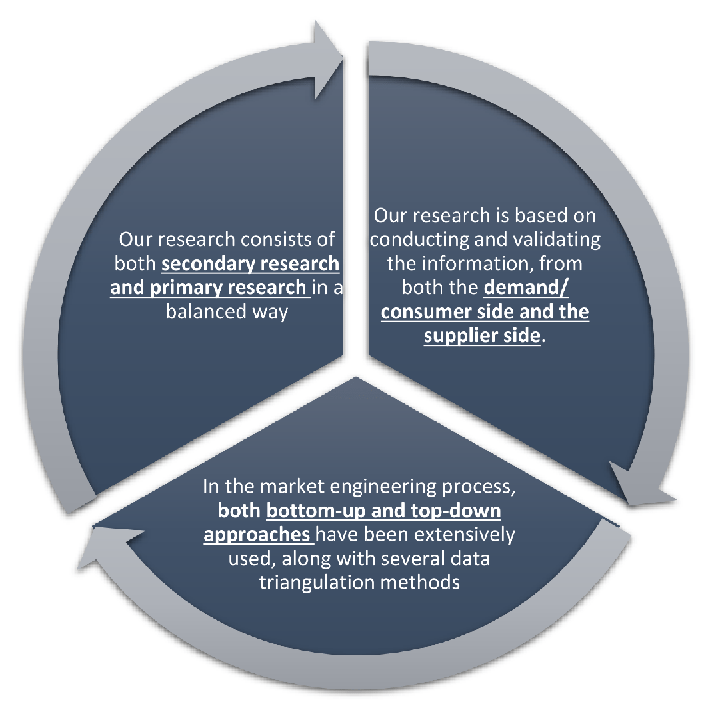
MarketGenics leverages a dedicated industry panel of experts and a comprehensive suite of paid databases to effectively collect, consolidate, and analyze market intelligence.
Our approach has consistently proven to be reliable and effective in generating accurate market insights, identifying key industry trends, and uncovering emerging business opportunities.
Through both primary and secondary research, we capture and analyze critical company-level data such as manufacturing footprints, including technical centers, R&D facilities, sales offices, and headquarters.
Our expert panel further enhances our ability to estimate market size for specific brands based on validated field-level intelligence.
Our data mining techniques incorporate both parametric and non-parametric methods, allowing for structured data collection, sorting, processing, and cleaning.
Demand projections are derived from large-scale data sets analyzed through proprietary algorithms, culminating in robust and reliable market sizing.
Research Approach
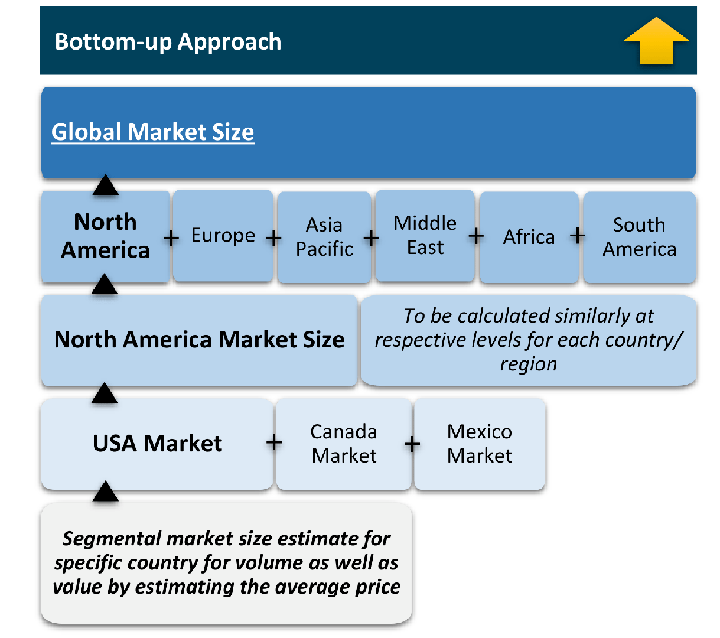
The bottom-up approach builds market estimates by starting with the smallest addressable market units and systematically aggregating them to create comprehensive market size projections.
This method begins with specific, granular data points and builds upward to create the complete market landscape.
Customer Analysis → Segmental Analysis → Geographical Analysis
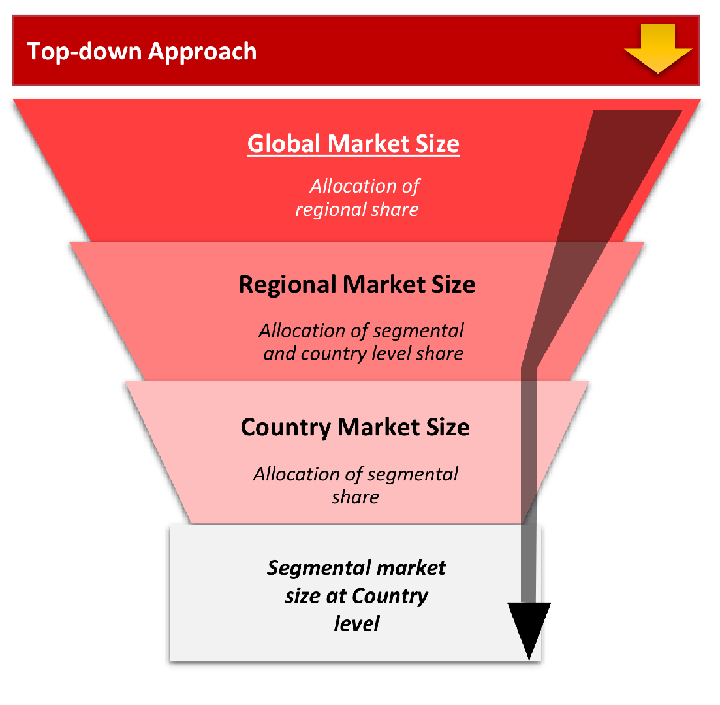
The top-down approach starts with the broadest possible market data and systematically narrows it down through a series of filters and assumptions to arrive at specific market segments or opportunities.
This method begins with the big picture and works downward to increasingly specific market slices.
TAM → SAM → SOM
Research Methods
Desk / Secondary Research
While analysing the market, we extensively study secondary sources, directories, and databases to identify and collect information useful for this technical, market-oriented, and commercial report. Secondary sources that we utilize are not only the public sources, but it is a combination of Open Source, Associations, Paid Databases, MG Repository & Knowledgebase, and others.
- Company websites, annual reports, financial reports, broker reports, and investor presentations
- National government documents, statistical databases and reports
- News articles, press releases and web-casts specific to the companies operating in the market, Magazines, reports, and others
- We gather information from commercial data sources for deriving company specific data such as segmental revenue, share for geography, product revenue, and others
- Internal and external proprietary databases (industry-specific), relevant patent, and regulatory databases
- Governing Bodies, Government Organizations
- Relevant Authorities, Country-specific Associations for Industries
We also employ the model mapping approach to estimate the product level market data through the players' product portfolio
Primary Research
Primary research/ interviews is vital in analyzing the market. Most of the cases involves paid primary interviews. Primary sources include primary interviews through e-mail interactions, telephonic interviews, surveys as well as face-to-face interviews with the different stakeholders across the value chain including several industry experts.
| Type of Respondents | Number of Primaries |
|---|---|
| Tier 2/3 Suppliers | ~20 |
| Tier 1 Suppliers | ~25 |
| End-users | ~25 |
| Industry Expert/ Panel/ Consultant | ~30 |
| Total | ~100 |
MG Knowledgebase
• Repository of industry blog, newsletter and case studies
• Online platform covering detailed market reports, and company profiles
Forecasting Factors and Models
Forecasting Factors
- Historical Trends – Past market patterns, cycles, and major events that shaped how markets behave over time. Understanding past trends helps predict future behavior.
- Industry Factors – Specific characteristics of the industry like structure, regulations, and innovation cycles that affect market dynamics.
- Macroeconomic Factors – Economic conditions like GDP growth, inflation, and employment rates that affect how much money people have to spend.
- Demographic Factors – Population characteristics like age, income, and location that determine who can buy your product.
- Technology Factors – How quickly people adopt new technology and how much technology infrastructure exists.
- Regulatory Factors – Government rules, laws, and policies that can help or restrict market growth.
- Competitive Factors – Analyzing competition structure such as degree of competition and bargaining power of buyers and suppliers.
Forecasting Models / Techniques
Multiple Regression Analysis
- Identify and quantify factors that drive market changes
- Statistical modeling to establish relationships between market drivers and outcomes
Time Series Analysis – Seasonal Patterns
- Understand regular cyclical patterns in market demand
- Advanced statistical techniques to separate trend, seasonal, and irregular components
Time Series Analysis – Trend Analysis
- Identify underlying market growth patterns and momentum
- Statistical analysis of historical data to project future trends
Expert Opinion – Expert Interviews
- Gather deep industry insights and contextual understanding
- In-depth interviews with key industry stakeholders
Multi-Scenario Development
- Prepare for uncertainty by modeling different possible futures
- Creating optimistic, pessimistic, and most likely scenarios
Time Series Analysis – Moving Averages
- Sophisticated forecasting for complex time series data
- Auto-regressive integrated moving average models with seasonal components
Econometric Models
- Apply economic theory to market forecasting
- Sophisticated economic models that account for market interactions
Expert Opinion – Delphi Method
- Harness collective wisdom of industry experts
- Structured, multi-round expert consultation process
Monte Carlo Simulation
- Quantify uncertainty and probability distributions
- Thousands of simulations with varying input parameters
Research Analysis
Our research framework is built upon the fundamental principle of validating market intelligence from both demand and supply perspectives. This dual-sided approach ensures comprehensive market understanding and reduces the risk of single-source bias.
Demand-Side Analysis: We understand end-user/application behavior, preferences, and market needs along with the penetration of the product for specific application.
Supply-Side Analysis: We estimate overall market revenue, analyze the segmental share along with industry capacity, competitive landscape, and market structure.
Validation & Evaluation
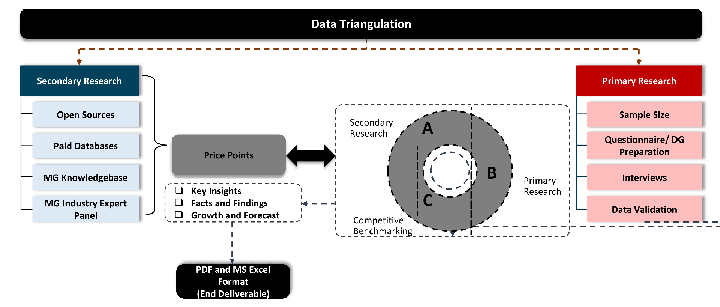
Data triangulation is a validation technique that uses multiple methods, sources, or perspectives to examine the same research question, thereby increasing the credibility and reliability of research findings. In market research, triangulation serves as a quality assurance mechanism that helps identify and minimize bias, validate assumptions, and ensure accuracy in market estimates.
- Data Source Triangulation – Using multiple data sources to examine the same phenomenon
- Methodological Triangulation – Using multiple research methods to study the same research question
- Investigator Triangulation – Using multiple researchers or analysts to examine the same data
- Theoretical Triangulation – Using multiple theoretical perspectives to interpret the same data
Custom Market Research Services
We will customise the research for you, in case the report listed above does not meet your requirements.
Get 10% Free Customisation