Refill and Reuse Packaging Systems Market Size, Share & Trends Analysis Report by Product Type (Refillable Bottles, Refillable Containers, Refillable Pouches, Refillable Dispensers, Reusable Crates and Pallets, Refill Stations and Systems, Others), Material Type, Capacity Range, Technology/System Type, Distribution Channel, Closure/Dispensing Mechanism, End-use Industry, and Geography (North America, Europe, Asia Pacific, Middle East, Africa, and South America) – Global Industry Data, Trends, and Forecasts, 2026–2035
|
|
|
Segmental Data Insights |
|
|
Demand Trends |
|
|
Competitive Landscape |
|
|
Strategic Development |
|
|
Future Outlook & Opportunities |
|
Refill-and-Reuse-Packaging-Systems-Market Size, Share, and Growth
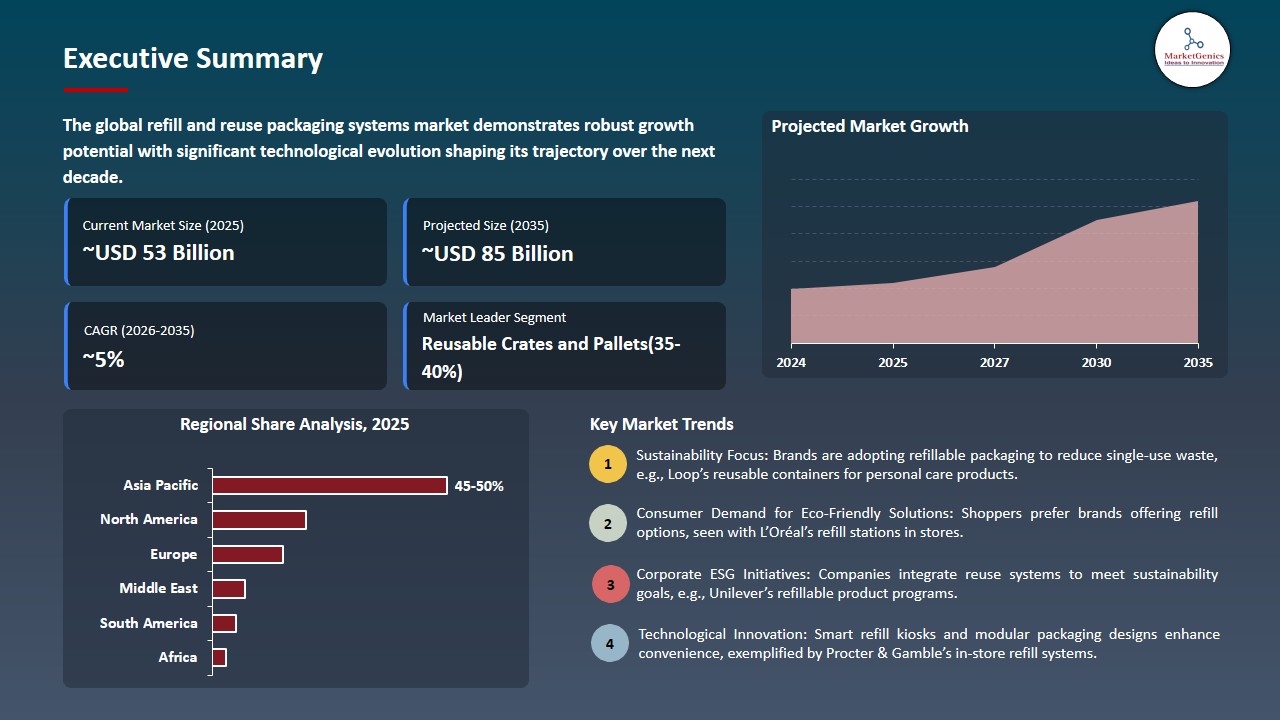
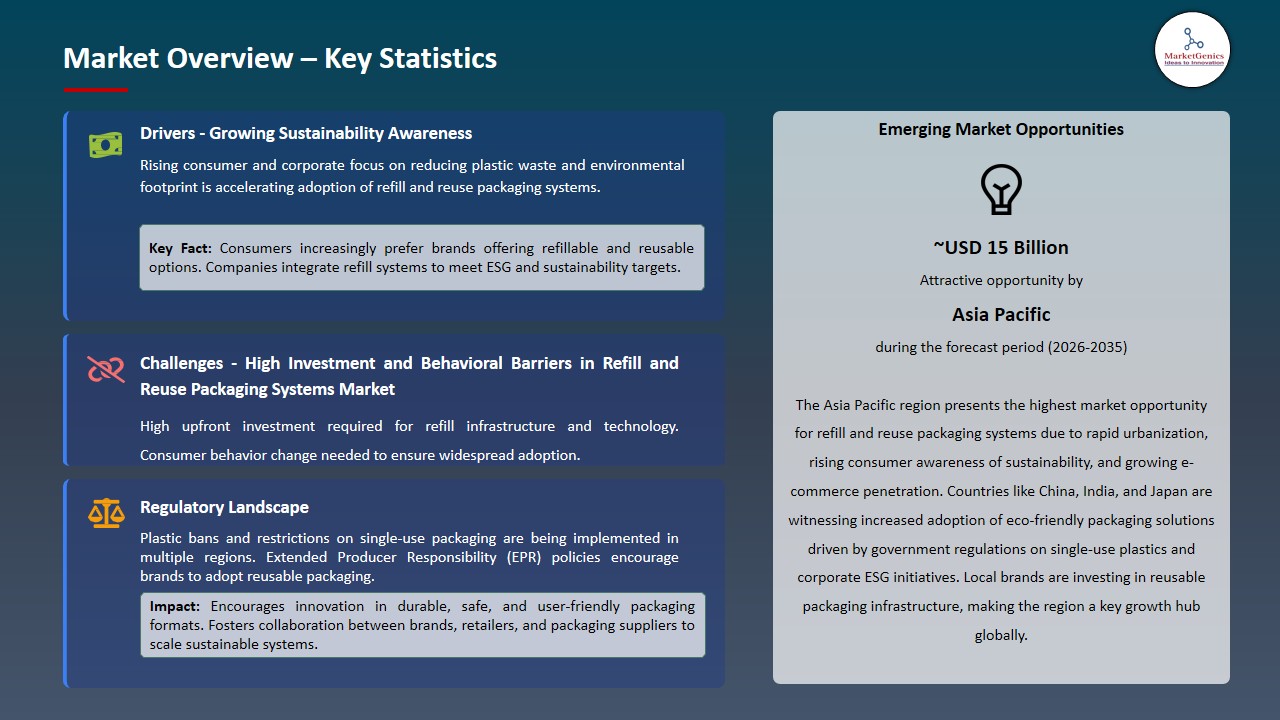
The global refill and reuse packaging systems market is experiencing robust growth, with its estimated value of USD 52.9 billion in the year 2025 and USD 84.5 billion by the period 2035, registering a CAGR of 4.8%, during the forecast period. The refill and reuse packaging systems market is expanding at a very fast pace with manufacturers and regulators giving preference to sustainable, circular, and reusable packaging.
Lars Gade Hansen, Faerch Group CEO says, with this launch, we are not just introducing a new product; we are future-proofing the use of recycled content in our CPET ready meal trays.
Compliance and sustainability continue to dominate the market of refill and reuse packaging systems, and manufacturers are redesigning bottles, pouches, closures, and rigid/flexible formats to enhance the safety of the product, its functionality and environmental performance. In September 2024, ARRAY Technologies proposed a reusable bulk-packaging system having durable plastic casings, whereby long-term reuse is possible throughout logistics and supplier networks. Firms are also going towards mono-material formats, high-barrier paper, bio-based polymers, recycled PET, and compostable laminates to minimize environmental impact without compromise of performance.
The integration of sustainability is bringing innovativeness to the market of refill and reuse packaging systems via mono material structures, high-barrier fiber-based paper, bio-based polymers, recycled PET, and compostable laminates. The adoption of closed loop systems, refill systems, and closed supply chains, as well as filling, sealing, and quality control with respect to automation, ensure the consistency of production standards. Besides making operations more efficient, such measures contribute to high reductions in environmental impact, which can help in achieving regulatory compliance and brand sustainability objectives.
Adjacent opportunities to the refill and reuse packaging systems market include durable primary containers, reverse logistics and return infrastructure, smart packaging with tracking and deposit systems, concentrated product formats, and in-store refill station technologies, driven by circular economy mandates and sustainability goals, thereby expanding ecosystem partnerships, accelerating adoption across FMCG and retail, and reducing dependence on single-use packaging.
Refill and Reuse Packaging Systems Market Dynamics and Trends
Driver: Regulatory & Sustainability Pressure Driving Refill Adoption
-
The refill and reuse packaging systems are being kick-started as the length of green regulations and producer responsibility (EPR) increases. Governments of the majority of countries adhere to policies that include recyclable, compostable or recycled-content packaging in food, beverage, and personal care as well as e-commerce sectors, which makes manufacturers resort to the use of sustainable materials, which reduce carbon footprint and waste.
- Companies are incorporating eco-friendly materials and designs that consist of mono-materials to comply with sustainability demands and quotas on plastic-cutting. For instance, the amendment of the Plastic Waste Management Rules 2022 (India) by the Central Pollution Control Board (CPCB) stipulates minimum required recycling rates, EPR requirements, and certain reuse requirements of rigid plastic packaging, which require the producer to transition to a reuse and recycling-friendly system of packaging.
- These consumer attitudes toward environmental awareness, combined with regulatory penalties on non-conformity, make usage stronger in packaged-food, beverages, and personal-care markets, driving growth in the global market at a faster rate.
Restraint: High Capital & Operational Costs, Logistics Complexity
-
Implementation of refill and reuse packaging systems are hampered by high initial costs incurred in the special refill stations, modular dispensing units, and reusable packaging facilities. SMEs and medium-size manufacturers are often unable to provide the necessary funds on the new equipment, clean and sterilize equipment, which affects their profitability and market share.
- The collection, cleaning, sorting, and redistribution of reusable containers entail a strong tracking system, cleanliness in handling, and employee training. Regional differences in recycling and logistics systems also enhance uncertainty and inefficiency in operations particularly in the emergent markets.
- Quality management, risk of contamination, and adherence to safety and food-grade standards present an additional burden on manufacturers, preventing the extension of the reusable packaging program worldwide.
Opportunity: Growth of E‑commerce & Circular Economy‑Driven Reusable Logistics
-
The refill and reuse packaging systems market has opportunity due to the prospect of greater opportunities in utilization of circular economy and closed-loop packaging solutions in food, beverage, personal-care, and e-commerce markets. The pressure on the material and system to be easily collected, recycle or compost is occurring because of an increase in regulatory pressure on recycled-content packaging, and the rising popularity of sustainable and low-carbon products among consumers.
- Manufacturers are attempting to exploit these opportunities through innovation. For instance, in November 2024, Faerch launched chilled ready-meal trays with minimum 40 percent post-consumer recycled PET (rPET) manufactured in kerbside collection. These trays were completely food grade, with superior barrier performance in the market, reduced the amount of virgin plastics used, and reduced the carbon footprint, which demonstrated the commercial viability of closed-loop, recycled content, packaging solutions.
- The shift toward circular, recycled-content, and refillable packaging is creating opportunities for producers to expand portfolios, introduce multifunctional solutions, and meet rising sustainability demand in high-growth markets.
Key Trend: Increase in Smart, Tech‑Enabled Reuse Systems (Tracking, IoT, Pooling Networks)
-
The digital and IoT based tracking solutions to optimize the life cycle of reusable containers, pallets and crates are being rapidly adopted in the global refill and reuse packaging systems market. To track usage, returns, and cleaning periods, companies are launching smart sensors, QR/RFID codes, and clouds, and minimize the loss, improve the use of assets, and facilitate circular-economy activities.
- Technological advancements in logistics systems have grown in pace. For instnace, in May 2025, UnaBiz introduced low-cost IoT trackers on reusable pallets, crates, and roll-cages, which would allow real-time tracking and pooling of large-scale supply chains, halting the loss of assets by more than 50 percent and reducing administrative verification costs by 40 percent. These advancements demonstrate the efficiency of smart systems in improving the operational efficiency and supporting the sustainability objectives.
- Smart, traceable reuse systems are steadily being adopted because of regulatory pressure, corporate environmental sustainability pledges, and consumer desire of sustainable products.
Refill-and-Reuse-Packaging-Systems-Market Analysis and Segmental Data
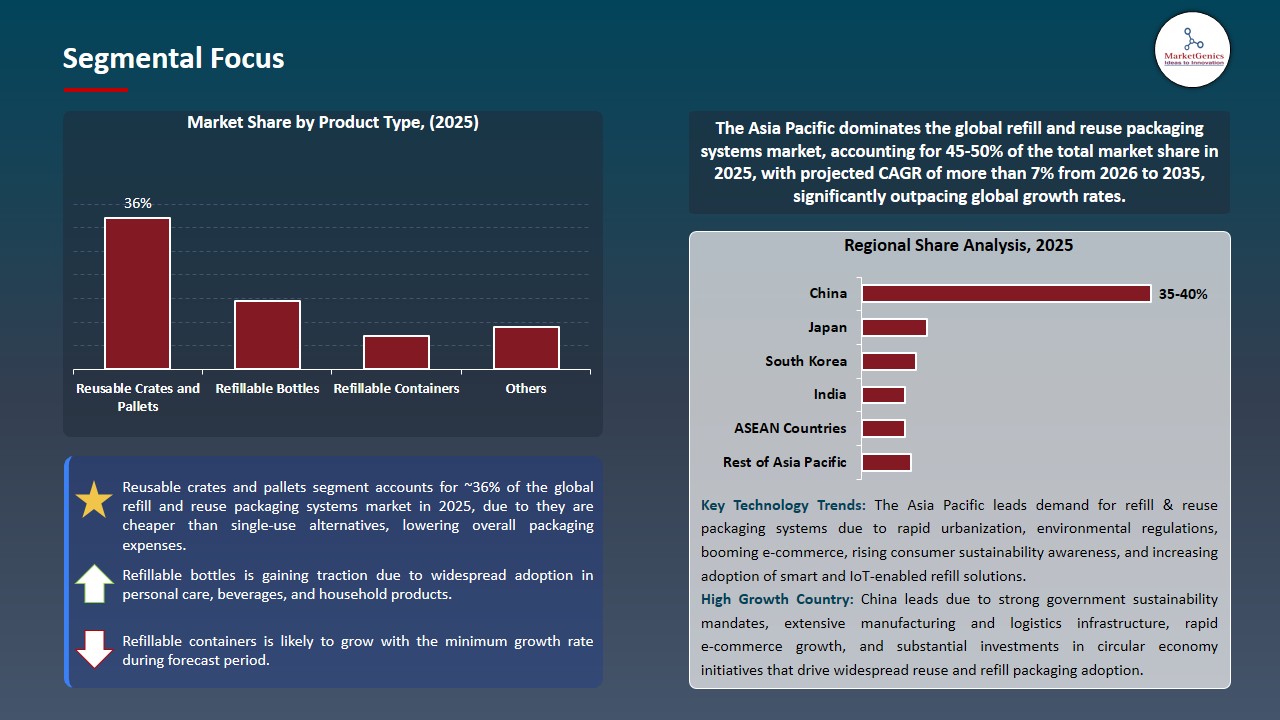
Reusable Crates and Pallets Dominate Global Refill and Reuse Packaging Systems Market
-
Reusable crates and pallets take up the majority of the market in the refill and reuse packaging systems market with their sturdiness, long life cycle, and capability to lessen the amount of single-use packaging that could be wasted by food chains, beverage chains, pharmaceutical chains and e-commerce supply chains. They are very efficient, as they are durable, stackable, and compatible with automated material-handling systems, and they help to build a circular economy.
- There is an increasing trend in terms of innovation in the design of modular and lightweight pallets and crates. For instance, CHEP launched a new range of lightweight, fully reusable pallets fitted with tracking, to reuse in cold-chain distribution and grocery distribution networks in Asia Pacific, in 2025, showing the scalability and efficiency of reusable transport packages in large volumes of operation.
- Pallets and crates the popularity of reusable crates and pallets is increasing compared to disposable options, as they are more cost-effective, enhance supply-chain security, and can be standardized regardless of whether they are rigid or collapsible.
Asia Pacific Leads Global Refill and Reuse Packaging Systems Market Demand
-
The Asia Pacific leads the market, which has been attributable to the rising manufacturing facilities, the growing consumer consciousness of cost effective environmentally friendly packaging and the increasing demand in packaged foods, beverages and personal-care products. The productive platforms, the modular material innovations and the regional alliances of the region allow manufacturers to respond quickly to the changing regulatory demands and the changing consumer tastes.
- Other factors that drive penetration of reusable packaging solution into the Asia Pacific markets include development of cold-chain logistics, growth of urban retailing, and sustainability-driven initiatives. For instance, in 2025, the Indonesian Reuse Association (AGUNI), which was formed by 13 organisations to support refill and reuse packaging and runs more than 1,000 refill and reuse access points in the country.
- Policy initiatives, consumer education programs, and manufacturer-retail networks partnerships help to promote the adoption of refill and reuse systems and enhance the situation of the region as the most rapidly developing market in the world.
Refill-and-Reuse-Packaging-Systems-Market Ecosystem
The global refill and reuse packaging systems market is relatively fragmented; it includes multinational packaging vendors, local systems, and innovative solutions of sustainable refill and reuse, that accompany the food and beverage industry, the personal-care industry, and the household industry. Tier-1 players, such as Amcor plc and Smurfit, have been taking advantage of massive production networks worldwide, research and development powers, and sustainability-oriented innovations to offer high volume, recyclable, reusable, and compostable packaging solutions.
Tier-2 suppliers like WestRock plc and Menasha Packaging Company provide customized solutions that take the form of barrier-coated cartons, reusable rigid containers, and molded pulp designs, with most of the products being sold to regional or niche end-use markets. The examples of Tier-3 innovators are digital-enabled reuse systems, e-commerce returnable packaging, and circular business models aimed at tech-savvy and environmentally-conscious consumers, e.g., RePack.
The market ecosystem includes raw material suppliers (bioplastics, recycled polymers, PLA, glass, and paperboard), converters, contract packagers, retailers, including the e-commerce distribution channels. The main categories of investments include automation-based production, lifecycle assessment, eco-design, closed-loop logistics, and regulatory alignment to meet the ESG targets, increase the efficiency of the operations, and motivate the world to implement refill and reuse packaging solutions.

Recent Development and Strategic Overview
-
In February 2025, Unilever increased its worldwide refill and reuse by trying more than 50 pilot projects in the personal-care and home-care divisions. This involved the URefill scheme in Bangladesh, with its refill-dispensing stores, which minimize plastic waste, reusable bottles, as well as cost-efficient and sustainable packaging solutions.
- In May 2025, SC Johnson introduced the first store refill machine in the USA, which is a refillable bottle of Method and Mrs. Meyer soaps, at London Drugs. This project will minimize single-use plastic waste, increase circular packaging, and show a viable application of refill and reuse systems of packaging within the household-care segment.
Report Scope
|
Detail |
|
|
Market Size in 2025 |
USD 52.9 Bn |
|
Market Forecast Value in 2035 |
USD 84.5 Bn |
|
Growth Rate (CAGR) |
4.8% |
|
Forecast Period |
2026 – 2035 |
|
Historical Data Available for |
2021 – 2024 |
|
Market Size Units |
US$ Billion for Value Thousand Units for Volume |
|
Report Format |
Electronic (PDF) + Excel |
|
North America |
Europe |
Asia Pacific |
Middle East |
Africa |
South America |
|
|
|
|
|
|
|
Companies Covered |
|||||
|
|
|
|
|
|
Refill-and-Reuse-Packaging-Systems-Market Segmentation and Highlights
|
Segment |
Sub-segment |
|
Refill and Reuse Packaging Systems Market, By Product Type |
|
|
Refill and Reuse Packaging Systems Market, By Material Type |
|
|
Refill and Reuse Packaging Systems Market, By Capacity Range |
|
|
Refill and Reuse Packaging Systems Market, By Technology/System Type |
|
|
Refill and Reuse Packaging Systems Market, By Distribution Channel |
|
|
Refill and Reuse Packaging Systems Market, By Closure/Dispensing Mechanism |
|
|
Refill and Reuse Packaging Systems Market, By End-use Industry |
|
Frequently Asked Questions
Table of Contents
- 1. Research Methodology and Assumptions
- 1.1. Definitions
- 1.2. Research Design and Approach
- 1.3. Data Collection Methods
- 1.4. Base Estimates and Calculations
- 1.5. Forecasting Models
- 1.5.1. Key Forecast Factors & Impact Analysis
- 1.6. Secondary Research
- 1.6.1. Open Sources
- 1.6.2. Paid Databases
- 1.6.3. Associations
- 1.7. Primary Research
- 1.7.1. Primary Sources
- 1.7.2. Primary Interviews with Stakeholders across Ecosystem
- 2. Executive Summary
- 2.1. Global Refill and Reuse Packaging Systems Market Outlook
- 2.1.1. Refill and Reuse Packaging Systems Market Size Volume (Thousand Units) and Value (US$ Bn), and Forecasts, 2021-2035
- 2.1.2. Compounded Annual Growth Rate Analysis
- 2.1.3. Growth Opportunity Analysis
- 2.1.4. Segmental Share Analysis
- 2.1.5. Geographical Share Analysis
- 2.2. Market Analysis and Facts
- 2.3. Supply-Demand Analysis
- 2.4. Competitive Benchmarking
- 2.5. Go-to- Market Strategy
- 2.5.1. Customer/ End-use Industry Assessment
- 2.5.2. Growth Opportunity Data, 2026-2035
- 2.5.2.1. Regional Data
- 2.5.2.2. Country Data
- 2.5.2.3. Segmental Data
- 2.5.3. Identification of Potential Market Spaces
- 2.5.4. GAP Analysis
- 2.5.5. Potential Attractive Price Points
- 2.5.6. Prevailing Market Risks & Challenges
- 2.5.7. Preferred Sales & Marketing Strategies
- 2.5.8. Key Recommendations and Analysis
- 2.5.9. A Way Forward
- 2.1. Global Refill and Reuse Packaging Systems Market Outlook
- 3. Industry Data and Premium Insights
- 3.1. Global Packaging Industry Overview, 2025
- 3.1.1. Industry Ecosystem Analysis
- 3.1.2. Key Trends for Packaging Industry
- 3.1.3. Regional Distribution for Packaging Industry
- 3.2. Supplier Customer Data
- 3.3. Technology Roadmap and Developments
- 3.4. Trade Analysis
- 3.4.1. Import & Export Analysis, 2025
- 3.4.2. Top Importing Countries
- 3.4.3. Top Exporting Countries
- 3.5. Trump Tariff Impact Analysis
- 3.5.1. Manufacturer
- 3.5.1.1. Based on the component & Raw material
- 3.5.2. Supply Chain
- 3.5.3. End Consumer
- 3.5.1. Manufacturer
- 3.6. Raw Material Analysis
- 3.1. Global Packaging Industry Overview, 2025
- 4. Market Overview
- 4.1. Market Dynamics
- 4.1.1. Drivers
- 4.1.1.1. Rising demand for waste-reduction models driven by zero-waste initiatives and extended producer responsibility (EPR) regulations.
- 4.1.1.2. Increasing consumer preference for cost-efficient, durable, and reusable packaging formats across personal care, food, and household segments.
- 4.1.1.3. Expansion of refill-station infrastructure and brand-owned take-back programs supporting circular-economy adoption.
- 4.1.2. Restraints
- 4.1.2.1. High upfront investment in reverse-logistics, cleaning, and refill-dispensing infrastructure.
- 4.1.2.2. Operational complexity related to hygiene assurance, quality control, and standardization across multiple reuse cycles.
- 4.1.1. Drivers
- 4.2. Key Trend Analysis
- 4.3. Regulatory Framework
- 4.3.1. Key Regulations, Norms, and Subsidies, by Key Countries
- 4.3.2. Tariffs and Standards
- 4.3.3. Impact Analysis of Regulations on the Market
- 4.4. Value Chain Analysis
- 4.4.1. Raw Material Suppliers
- 4.4.2. Manufacturers
- 4.4.3. Distributors
- 4.4.4. End-Users/ Customers
- 4.5. Cost Structure Analysis
- 4.5.1. Parameter’s Share for Cost Associated
- 4.5.2. COGP vs COGS
- 4.5.3. Profit Margin Analysis
- 4.6. Pricing Analysis
- 4.6.1. Regional Pricing Analysis
- 4.6.2. Segmental Pricing Trends
- 4.6.3. Factors Influencing Pricing
- 4.7. Porter’s Five Forces Analysis
- 4.8. PESTEL Analysis
- 4.9. Global Refill and Reuse Packaging Systems Market Demand
- 4.9.1. Historical Market Size – Volume (Thousand Units) and Value (US$ Bn), 2020-2024
- 4.9.2. Current and Future Market Size – Volume (Thousand Units) and Value (US$ Bn), 2026–2035
- 4.9.2.1. Y-o-Y Growth Trends
- 4.9.2.2. Absolute $ Opportunity Assessment
- 4.1. Market Dynamics
- 5. Competition Landscape
- 5.1. Competition structure
- 5.1.1. Fragmented v/s consolidated
- 5.2. Company Share Analysis, 2025
- 5.2.1. Global Company Market Share
- 5.2.2. By Region
- 5.2.2.1. North America
- 5.2.2.2. Europe
- 5.2.2.3. Asia Pacific
- 5.2.2.4. Middle East
- 5.2.2.5. Africa
- 5.2.2.6. South America
- 5.3. Product Comparison Matrix
- 5.3.1. Specifications
- 5.3.2. Market Positioning
- 5.3.3. Pricing
- 5.1. Competition structure
- 6. Global Refill and Reuse Packaging Systems Market Analysis, by Product Type
- 6.1. Key Segment Analysis
- 6.2. Refill and Reuse Packaging Systems Market Size Volume (Thousand Units) and Value (US$ Bn), Analysis, and Forecasts, by Product Type, 2021-2035
- 6.2.1. Refillable Bottles
- 6.2.1.1. Glass Refillable Bottles
- 6.2.1.2. Plastic Refillable Bottles
- 6.2.1.3. Metal Refillable Bottles
- 6.2.2. Refillable Containers
- 6.2.2.1. Rigid Containers
- 6.2.2.2. Flexible Containers
- 6.2.3. Refillable Pouches
- 6.2.4. Refillable Dispensers
- 6.2.5. Reusable Crates and Pallets
- 6.2.6. Refill Stations and Systems
- 6.2.7. Others
- 6.2.1. Refillable Bottles
- 7. Global Refill and Reuse Packaging Systems Market Analysis, by Material Type
- 7.1. Key Segment Analysis
- 7.2. Refill and Reuse Packaging Systems Market Size Volume (Thousand Units) and Value (US$ Bn), Analysis, and Forecasts, by Material Type, 2021-2035
- 7.2.1. Glass
- 7.2.1.1. Borosilicate Glass
- 7.2.1.2. Soda-Lime Glass
- 7.2.1.3. Others
- 7.2.2. Plastic
- 7.2.2.1. PET (Polyethylene Terephthalate)
- 7.2.2.2. HDPE (High-Density Polyethylene)
- 7.2.2.3. PP (Polypropylene)
- 7.2.2.4. Bio-based Plastics
- 7.2.2.5. Others
- 7.2.3. Metal
- 7.2.3.1. Aluminum
- 7.2.3.2. Stainless Steel
- 7.2.3.3. Tin-plated Steel
- 7.2.3.4. Others
- 7.2.4. Hybrid Materials
- 7.2.1. Glass
- 8. Global Refill and Reuse Packaging Systems Market Analysis, by Capacity Range
- 8.1. Key Segment Analysis
- 8.2. Refill and Reuse Packaging Systems Market Size Volume (Thousand Units) and Value (US$ Bn), Analysis, and Forecasts, by Capacity Range, 2021-2035
- 8.2.1. Less than 100ml
- 8.2.2. 100ml - 500ml
- 8.2.3. 500ml - 1L
- 8.2.4. Above 1L
- 9. Global Refill and Reuse Packaging Systems Market Analysis, by Technology/System Type
- 9.1. Key Segment Analysis
- 9.2. Refill and Reuse Packaging Systems Market Size Volume (Thousand Units) and Value (US$ Bn), Analysis, and Forecasts, by Technology/System Type, 2021-2035
- 9.2.1. Manual Refill Systems
- 9.2.2. Semi-Automated Refill Systems
- 9.2.3. Fully Automated Refill Systems
- 9.2.4. Smart Refill Systems
- 9.2.4.1. IoT-enabled Systems
- 9.2.4.2. RFID-tracked Systems
- 9.2.4.3. QR Code-based Systems
- 9.2.4.4. Others
- 9.2.5. In-store Refill Stations
- 9.2.6. Home Delivery Refill Systems
- 10. Global Refill and Reuse Packaging Systems Market Analysis, by Distribution Channel
- 10.1. Key Segment Analysis
- 10.2. Refill and Reuse Packaging Systems Market Size Volume (Thousand Units) and Value (US$ Bn), Analysis, and Forecasts, by Distribution Channel, 2021-2035
- 10.2.1. Direct-to-Consumer (D2C)
- 10.2.1.1. Online Platforms
- 10.2.1.2. Subscription Services
- 10.2.2. Retail Stores
- 10.2.2.1. Supermarkets/Hypermarkets
- 10.2.2.2. Specialty Stores
- 10.2.2.3. Convenience Stores
- 10.2.3. Refill Stations
- 10.2.3.1. Standalone Stations
- 10.2.3.2. In-store Stations
- 10.2.4. B2B Distribution
- 10.2.5. Wholesale Distribution
- 10.2.1. Direct-to-Consumer (D2C)
- 11. Global Refill and Reuse Packaging Systems Market Analysis, by Closure/Dispensing Mechanism
- 11.1. Key Segment Analysis
- 11.2. Refill and Reuse Packaging Systems Market Size Volume (Thousand Units) and Value (US$ Bn), Analysis, and Forecasts, by Closure/Dispensing Mechanism, 2021-2035
- 11.2.1. Pump Dispensers
- 11.2.2. Flip-top Caps
- 11.2.3. Screw Caps
- 11.2.4. Spray Mechanisms
- 11.2.5. Pour Spouts
- 11.2.6. Trigger Sprayers
- 11.2.7. Dropper Mechanisms
- 12. Global Refill and Reuse Packaging Systems Market Analysis, by End-use Industry
- 12.1. Key Segment Analysis
- 12.2. Refill and Reuse Packaging Systems Market Size Volume (Thousand Units) and Value (US$ Bn), Analysis, and Forecasts, by End-use Industry, 2021-2035
- 12.2.1. Food & Beverage
- 12.2.1.1. Beverages
- 12.2.1.2. Edible Oils
- 12.2.1.3. Sauces and Condiments
- 12.2.1.4. Dry Foods and Grains
- 12.2.1.5. Others
- 12.2.2. Personal Care & Cosmetics
- 12.2.2.1. Skincare Products
- 12.2.2.2. Hair Care Products
- 12.2.2.3. Body Care Products
- 12.2.2.4. Cosmetics
- 12.2.2.5. Others
- 12.2.3. Home Care & Cleaning Products
- 12.2.3.1. Laundry Detergents
- 12.2.3.2. Dishwashing Products
- 12.2.3.3. Surface Cleaners
- 12.2.3.4. Fabric Softeners
- 12.2.3.5. Specialty Cleaners
- 12.2.3.6. Others
- 12.2.4. Healthcare & Pharmaceutical
- 12.2.4.1. Over-the-Counter Medications
- 12.2.4.2. Vitamins and Supplements
- 12.2.4.3. Medical Liquids
- 12.2.4.4. Sanitizers and Disinfectants
- 12.2.4.5. Others
- 12.2.5. Industrial & Chemical
- 12.2.6. Retail & E-commerce
- 12.2.7. Other Industries
- 12.2.1. Food & Beverage
- 13. Global Refill and Reuse Packaging Systems Market Analysis and Forecasts, by Region
- 13.1. Key Findings
- 13.2. Refill and Reuse Packaging Systems Market Size Volume (Thousand Units) and Value (US$ Bn), Analysis, and Forecasts, by Region, 2021-2035
- 13.2.1. North America
- 13.2.2. Europe
- 13.2.3. Asia Pacific
- 13.2.4. Middle East
- 13.2.5. Africa
- 13.2.6. South America
- 14. North America Refill and Reuse Packaging Systems Market Analysis
- 14.1. Key Segment Analysis
- 14.2. Regional Snapshot
- 14.3. North America Refill and Reuse Packaging Systems Market Size- Volume (Thousand Units) and Value (US$ Bn), Analysis, and Forecasts, 2021-2035
- 14.3.1. Product Type
- 14.3.2. Material Type
- 14.3.3. Capacity Range
- 14.3.4. Technology/System Type
- 14.3.5. Distribution Channel
- 14.3.6. Closure/Dispensing Mechanism
- 14.3.7. End-use Industry
- 14.3.8. Country
- 14.3.8.1. USA
- 14.3.8.2. Canada
- 14.3.8.3. Mexico
- 14.4. USA Refill and Reuse Packaging Systems Market
- 14.4.1. Country Segmental Analysis
- 14.4.2. Product Type
- 14.4.3. Material Type
- 14.4.4. Capacity Range
- 14.4.5. Technology/System Type
- 14.4.6. Distribution Channel
- 14.4.7. Closure/Dispensing Mechanism
- 14.4.8. End-use Industry
- 14.5. Canada Refill and Reuse Packaging Systems Market
- 14.5.1. Country Segmental Analysis
- 14.5.2. Product Type
- 14.5.3. Material Type
- 14.5.4. Capacity Range
- 14.5.5. Technology/System Type
- 14.5.6. Distribution Channel
- 14.5.7. Closure/Dispensing Mechanism
- 14.5.8. End-use Industry
- 14.6. Mexico Refill and Reuse Packaging Systems Market
- 14.6.1. Country Segmental Analysis
- 14.6.2. Product Type
- 14.6.3. Material Type
- 14.6.4. Capacity Range
- 14.6.5. Technology/System Type
- 14.6.6. Distribution Channel
- 14.6.7. Closure/Dispensing Mechanism
- 14.6.8. End-use Industry
- 15. Europe Refill and Reuse Packaging Systems Market Analysis
- 15.1. Key Segment Analysis
- 15.2. Regional Snapshot
- 15.3. Europe Refill and Reuse Packaging Systems Market Size Volume (Thousand Units) and Value (US$ Bn), Analysis, and Forecasts, 2021-2035
- 15.3.1. Product Type
- 15.3.2. Material Type
- 15.3.3. Capacity Range
- 15.3.4. Technology/System Type
- 15.3.5. Distribution Channel
- 15.3.6. Closure/Dispensing Mechanism
- 15.3.7. End-use Industry
- 15.3.8. Country
- 15.3.8.1. Germany
- 15.3.8.2. United Kingdom
- 15.3.8.3. France
- 15.3.8.4. Italy
- 15.3.8.5. Spain
- 15.3.8.6. Netherlands
- 15.3.8.7. Nordic Countries
- 15.3.8.8. Poland
- 15.3.8.9. Russia & CIS
- 15.3.8.10. Rest of Europe
- 15.4. Germany Refill and Reuse Packaging Systems Market
- 15.4.1. Country Segmental Analysis
- 15.4.2. Product Type
- 15.4.3. Material Type
- 15.4.4. Capacity Range
- 15.4.5. Technology/System Type
- 15.4.6. Distribution Channel
- 15.4.7. Closure/Dispensing Mechanism
- 15.4.8. End-use Industry
- 15.5. United Kingdom Refill and Reuse Packaging Systems Market
- 15.5.1. Country Segmental Analysis
- 15.5.2. Product Type
- 15.5.3. Material Type
- 15.5.4. Capacity Range
- 15.5.5. Technology/System Type
- 15.5.6. Distribution Channel
- 15.5.7. Closure/Dispensing Mechanism
- 15.5.8. End-use Industry
- 15.6. France Refill and Reuse Packaging Systems Market
- 15.6.1. Country Segmental Analysis
- 15.6.2. Product Type
- 15.6.3. Material Type
- 15.6.4. Capacity Range
- 15.6.5. Technology/System Type
- 15.6.6. Distribution Channel
- 15.6.7. Closure/Dispensing Mechanism
- 15.6.8. End-use Industry
- 15.7. Italy Refill and Reuse Packaging Systems Market
- 15.7.1. Country Segmental Analysis
- 15.7.2. Product Type
- 15.7.3. Material Type
- 15.7.4. Capacity Range
- 15.7.5. Technology/System Type
- 15.7.6. Distribution Channel
- 15.7.7. Closure/Dispensing Mechanism
- 15.7.8. End-use Industry
- 15.8. Spain Refill and Reuse Packaging Systems Market
- 15.8.1. Country Segmental Analysis
- 15.8.2. Product Type
- 15.8.3. Material Type
- 15.8.4. Capacity Range
- 15.8.5. Technology/System Type
- 15.8.6. Distribution Channel
- 15.8.7. Closure/Dispensing Mechanism
- 15.8.8. End-use Industry
- 15.9. Netherlands Refill and Reuse Packaging Systems Market
- 15.9.1. Country Segmental Analysis
- 15.9.2. Product Type
- 15.9.3. Material Type
- 15.9.4. Capacity Range
- 15.9.5. Technology/System Type
- 15.9.6. Distribution Channel
- 15.9.7. Closure/Dispensing Mechanism
- 15.9.8. End-use Industry
- 15.10. Nordic Countries Refill and Reuse Packaging Systems Market
- 15.10.1. Country Segmental Analysis
- 15.10.2. Product Type
- 15.10.3. Material Type
- 15.10.4. Capacity Range
- 15.10.5. Technology/System Type
- 15.10.6. Distribution Channel
- 15.10.7. Closure/Dispensing Mechanism
- 15.10.8. End-use Industry
- 15.11. Poland Refill and Reuse Packaging Systems Market
- 15.11.1. Country Segmental Analysis
- 15.11.2. Product Type
- 15.11.3. Material Type
- 15.11.4. Capacity Range
- 15.11.5. Technology/System Type
- 15.11.6. Distribution Channel
- 15.11.7. Closure/Dispensing Mechanism
- 15.11.8. End-use Industry
- 15.12. Russia & CIS Refill and Reuse Packaging Systems Market
- 15.12.1. Country Segmental Analysis
- 15.12.2. Product Type
- 15.12.3. Material Type
- 15.12.4. Capacity Range
- 15.12.5. Technology/System Type
- 15.12.6. Distribution Channel
- 15.12.7. Closure/Dispensing Mechanism
- 15.12.8. End-use Industry
- 15.13. Rest of Europe Refill and Reuse Packaging Systems Market
- 15.13.1. Country Segmental Analysis
- 15.13.2. Product Type
- 15.13.3. Material Type
- 15.13.4. Capacity Range
- 15.13.5. Technology/System Type
- 15.13.6. Distribution Channel
- 15.13.7. Closure/Dispensing Mechanism
- 15.13.8. End-use Industry
- 16. Asia Pacific Refill and Reuse Packaging Systems Market Analysis
- 16.1. Key Segment Analysis
- 16.2. Regional Snapshot
- 16.3. Asia Pacific Refill and Reuse Packaging Systems Market Size Volume (Thousand Units) and Value (US$ Bn), Analysis, and Forecasts, 2021-2035
- 16.3.1. Product Type
- 16.3.2. Material Type
- 16.3.3. Capacity Range
- 16.3.4. Technology/System Type
- 16.3.5. Distribution Channel
- 16.3.6. Closure/Dispensing Mechanism
- 16.3.7. End-use Industry
- 16.3.8. Country
- 16.3.8.1. China
- 16.3.8.2. India
- 16.3.8.3. Japan
- 16.3.8.4. South Korea
- 16.3.8.5. Australia and New Zealand
- 16.3.8.6. Indonesia
- 16.3.8.7. Malaysia
- 16.3.8.8. Thailand
- 16.3.8.9. Vietnam
- 16.3.8.10. Rest of Asia Pacific
- 16.4. China Refill and Reuse Packaging Systems Market
- 16.4.1. Country Segmental Analysis
- 16.4.2. Product Type
- 16.4.3. Material Type
- 16.4.4. Capacity Range
- 16.4.5. Technology/System Type
- 16.4.6. Distribution Channel
- 16.4.7. Closure/Dispensing Mechanism
- 16.4.8. End-use Industry
- 16.5. India Refill and Reuse Packaging Systems Market
- 16.5.1. Country Segmental Analysis
- 16.5.2. Product Type
- 16.5.3. Material Type
- 16.5.4. Capacity Range
- 16.5.5. Technology/System Type
- 16.5.6. Distribution Channel
- 16.5.7. Closure/Dispensing Mechanism
- 16.5.8. End-use Industry
- 16.6. Japan Refill and Reuse Packaging Systems Market
- 16.6.1. Country Segmental Analysis
- 16.6.2. Product Type
- 16.6.3. Material Type
- 16.6.4. Capacity Range
- 16.6.5. Technology/System Type
- 16.6.6. Distribution Channel
- 16.6.7. Closure/Dispensing Mechanism
- 16.6.8. End-use Industry
- 16.7. South Korea Refill and Reuse Packaging Systems Market
- 16.7.1. Country Segmental Analysis
- 16.7.2. Product Type
- 16.7.3. Material Type
- 16.7.4. Capacity Range
- 16.7.5. Technology/System Type
- 16.7.6. Distribution Channel
- 16.7.7. Closure/Dispensing Mechanism
- 16.7.8. End-use Industry
- 16.8. Australia and New Zealand Refill and Reuse Packaging Systems Market
- 16.8.1. Country Segmental Analysis
- 16.8.2. Product Type
- 16.8.3. Material Type
- 16.8.4. Capacity Range
- 16.8.5. Technology/System Type
- 16.8.6. Distribution Channel
- 16.8.7. Closure/Dispensing Mechanism
- 16.8.8. End-use Industry
- 16.9. Indonesia Refill and Reuse Packaging Systems Market
- 16.9.1. Country Segmental Analysis
- 16.9.2. Product Type
- 16.9.3. Material Type
- 16.9.4. Capacity Range
- 16.9.5. Technology/System Type
- 16.9.6. Distribution Channel
- 16.9.7. Closure/Dispensing Mechanism
- 16.9.8. End-use Industry
- 16.10. Malaysia Refill and Reuse Packaging Systems Market
- 16.10.1. Country Segmental Analysis
- 16.10.2. Product Type
- 16.10.3. Material Type
- 16.10.4. Capacity Range
- 16.10.5. Technology/System Type
- 16.10.6. Distribution Channel
- 16.10.7. Closure/Dispensing Mechanism
- 16.10.8. End-use Industry
- 16.11. Thailand Refill and Reuse Packaging Systems Market
- 16.11.1. Country Segmental Analysis
- 16.11.2. Product Type
- 16.11.3. Material Type
- 16.11.4. Capacity Range
- 16.11.5. Technology/System Type
- 16.11.6. Distribution Channel
- 16.11.7. Closure/Dispensing Mechanism
- 16.11.8. End-use Industry
- 16.12. Vietnam Refill and Reuse Packaging Systems Market
- 16.12.1. Country Segmental Analysis
- 16.12.2. Product Type
- 16.12.3. Material Type
- 16.12.4. Capacity Range
- 16.12.5. Technology/System Type
- 16.12.6. Distribution Channel
- 16.12.7. Closure/Dispensing Mechanism
- 16.12.8. End-use Industry
- 16.13. Rest of Asia Pacific Refill and Reuse Packaging Systems Market
- 16.13.1. Country Segmental Analysis
- 16.13.2. Product Type
- 16.13.3. Material Type
- 16.13.4. Capacity Range
- 16.13.5. Technology/System Type
- 16.13.6. Distribution Channel
- 16.13.7. Closure/Dispensing Mechanism
- 16.13.8. End-use Industry
- 17. Middle East Refill and Reuse Packaging Systems Market Analysis
- 17.1. Key Segment Analysis
- 17.2. Regional Snapshot
- 17.3. Middle East Refill and Reuse Packaging Systems Market Size Volume (Thousand Units) and Value (US$ Bn), Analysis, and Forecasts, 2021-2035
- 17.3.1. Product Type
- 17.3.2. Material Type
- 17.3.3. Capacity Range
- 17.3.4. Technology/System Type
- 17.3.5. Distribution Channel
- 17.3.6. Closure/Dispensing Mechanism
- 17.3.7. End-use Industry
- 17.3.8. Country
- 17.3.8.1. Turkey
- 17.3.8.2. UAE
- 17.3.8.3. Saudi Arabia
- 17.3.8.4. Israel
- 17.3.8.5. Rest of Middle East
- 17.4. Turkey Refill and Reuse Packaging Systems Market
- 17.4.1. Country Segmental Analysis
- 17.4.2. Product Type
- 17.4.3. Material Type
- 17.4.4. Capacity Range
- 17.4.5. Technology/System Type
- 17.4.6. Distribution Channel
- 17.4.7. Closure/Dispensing Mechanism
- 17.4.8. End-use Industry
- 17.5. UAE Refill and Reuse Packaging Systems Market
- 17.5.1. Country Segmental Analysis
- 17.5.2. Product Type
- 17.5.3. Material Type
- 17.5.4. Capacity Range
- 17.5.5. Technology/System Type
- 17.5.6. Distribution Channel
- 17.5.7. Closure/Dispensing Mechanism
- 17.5.8. End-use Industry
- 17.6. Saudi Arabia Refill and Reuse Packaging Systems Market
- 17.6.1. Country Segmental Analysis
- 17.6.2. Product Type
- 17.6.3. Material Type
- 17.6.4. Capacity Range
- 17.6.5. Technology/System Type
- 17.6.6. Distribution Channel
- 17.6.7. Closure/Dispensing Mechanism
- 17.6.8. End-use Industry
- 17.7. Israel Refill and Reuse Packaging Systems Market
- 17.7.1. Country Segmental Analysis
- 17.7.2. Product Type
- 17.7.3. Material Type
- 17.7.4. Capacity Range
- 17.7.5. Technology/System Type
- 17.7.6. Distribution Channel
- 17.7.7. Closure/Dispensing Mechanism
- 17.7.8. End-use Industry
- 17.8. Rest of Middle East Refill and Reuse Packaging Systems Market
- 17.8.1. Country Segmental Analysis
- 17.8.2. Product Type
- 17.8.3. Material Type
- 17.8.4. Capacity Range
- 17.8.5. Technology/System Type
- 17.8.6. Distribution Channel
- 17.8.7. Closure/Dispensing Mechanism
- 17.8.8. End-use Industry
- 18. Africa Refill and Reuse Packaging Systems Market Analysis
- 18.1. Key Segment Analysis
- 18.2. Regional Snapshot
- 18.3. Africa Refill and Reuse Packaging Systems Market Size Volume (Thousand Units) and Value (US$ Bn), Analysis, and Forecasts, 2021-2035
- 18.3.1. Product Type
- 18.3.2. Material Type
- 18.3.3. Capacity Range
- 18.3.4. Technology/System Type
- 18.3.5. Distribution Channel
- 18.3.6. Closure/Dispensing Mechanism
- 18.3.7. End-use Industry
- 18.3.8. country
- 18.3.8.1. South Africa
- 18.3.8.2. Egypt
- 18.3.8.3. Nigeria
- 18.3.8.4. Algeria
- 18.3.8.5. Rest of Africa
- 18.4. South Africa Refill and Reuse Packaging Systems Market
- 18.4.1. Country Segmental Analysis
- 18.4.2. Product Type
- 18.4.3. Material Type
- 18.4.4. Capacity Range
- 18.4.5. Technology/System Type
- 18.4.6. Distribution Channel
- 18.4.7. Closure/Dispensing Mechanism
- 18.4.8. End-use Industry
- 18.5. Egypt Refill and Reuse Packaging Systems Market
- 18.5.1. Country Segmental Analysis
- 18.5.2. Product Type
- 18.5.3. Material Type
- 18.5.4. Capacity Range
- 18.5.5. Technology/System Type
- 18.5.6. Distribution Channel
- 18.5.7. Closure/Dispensing Mechanism
- 18.5.8. End-use Industry
- 18.6. Nigeria Refill and Reuse Packaging Systems Market
- 18.6.1. Country Segmental Analysis
- 18.6.2. Product Type
- 18.6.3. Material Type
- 18.6.4. Capacity Range
- 18.6.5. Technology/System Type
- 18.6.6. Distribution Channel
- 18.6.7. Closure/Dispensing Mechanism
- 18.6.8. End-use Industry
- 18.7. Algeria Refill and Reuse Packaging Systems Market
- 18.7.1. Country Segmental Analysis
- 18.7.2. Product Type
- 18.7.3. Material Type
- 18.7.4. Capacity Range
- 18.7.5. Technology/System Type
- 18.7.6. Distribution Channel
- 18.7.7. Closure/Dispensing Mechanism
- 18.7.8. End-use Industry
- 18.8. Rest of Africa Refill and Reuse Packaging Systems Market
- 18.8.1. Country Segmental Analysis
- 18.8.2. Product Type
- 18.8.3. Material Type
- 18.8.4. Capacity Range
- 18.8.5. Technology/System Type
- 18.8.6. Distribution Channel
- 18.8.7. Closure/Dispensing Mechanism
- 18.8.8. End-use Industry
- 19. South America Refill and Reuse Packaging Systems Market Analysis
- 19.1. Key Segment Analysis
- 19.2. Regional Snapshot
- 19.3. South America Refill and Reuse Packaging Systems Market Size Volume (Thousand Units) and Value (US$ Bn), Analysis, and Forecasts, 2021-2035
- 19.3.1. Product Type
- 19.3.2. Material Type
- 19.3.3. Capacity Range
- 19.3.4. Technology/System Type
- 19.3.5. Distribution Channel
- 19.3.6. Closure/Dispensing Mechanism
- 19.3.7. End-use Industry
- 19.3.8. Country
- 19.3.8.1. Brazil
- 19.3.8.2. Argentina
- 19.3.8.3. Rest of South America
- 19.4. Brazil Refill and Reuse Packaging Systems Market
- 19.4.1. Country Segmental Analysis
- 19.4.2. Product Type
- 19.4.3. Material Type
- 19.4.4. Capacity Range
- 19.4.5. Technology/System Type
- 19.4.6. Distribution Channel
- 19.4.7. Closure/Dispensing Mechanism
- 19.4.8. End-use Industry
- 19.5. Argentina Refill and Reuse Packaging Systems Market
- 19.5.1. Country Segmental Analysis
- 19.5.2. Product Type
- 19.5.3. Material Type
- 19.5.4. Capacity Range
- 19.5.5. Technology/System Type
- 19.5.6. Distribution Channel
- 19.5.7. Closure/Dispensing Mechanism
- 19.5.8. End-use Industry
- 19.6. Rest of South America Refill and Reuse Packaging Systems Market
- 19.6.1. Country Segmental Analysis
- 19.6.2. Product Type
- 19.6.3. Material Type
- 19.6.4. Capacity Range
- 19.6.5. Technology/System Type
- 19.6.6. Distribution Channel
- 19.6.7. Closure/Dispensing Mechanism
- 19.6.8. End-use Industry
- 20. Key Players/ Company Profile
- 20.1. Amcor plc
- 20.1.1. Company Details/ Overview
- 20.1.2. Company Financials
- 20.1.3. Key Customers and Competitors
- 20.1.4. Business/ Industry Portfolio
- 20.1.5. Product Portfolio/ Specification Details
- 20.1.6. Pricing Data
- 20.1.7. Strategic Overview
- 20.1.8. Recent Developments
- 20.2. Algramo
- 20.3. Colgate-Palmolive
- 20.4. Danone
- 20.5. Ecostore
- 20.6. Ecover
- 20.7. Henkel
- 20.8. Kiehl's (L'Oréal Group)
- 20.9. Menasha Packaging Company
- 20.10. Henkel
- 20.11. Loop (TerraCycle)
- 20.12. Bower Collective
- 20.13. TerraCycle
- 20.14. RePack
- 20.15. Fillgood
- 20.16. CHEP (Brambles Limited)
- 20.17. DS Smith
- 20.18. Ball Corporation
- 20.19. Ardagh Group
- 20.20. O-I Glass, Inc.
- 20.21. Smurfit Westrock plc
- 20.22. The Body Shop
- 20.23. The Coca-Cola Company
- 20.24. Unilever
- 20.25. Other Key Players
- 20.1. Amcor plc
Note* - This is just tentative list of players. While providing the report, we will cover more number of players based on their revenue and share for each geography
Research Design
Our research design integrates both demand-side and supply-side analysis through a balanced combination of primary and secondary research methodologies. By utilizing both bottom-up and top-down approaches alongside rigorous data triangulation methods, we deliver robust market intelligence that supports strategic decision-making.
MarketGenics' comprehensive research design framework ensures the delivery of accurate, reliable, and actionable market intelligence. Through the integration of multiple research approaches, rigorous validation processes, and expert analysis, we provide our clients with the insights needed to make informed strategic decisions and capitalize on market opportunities.
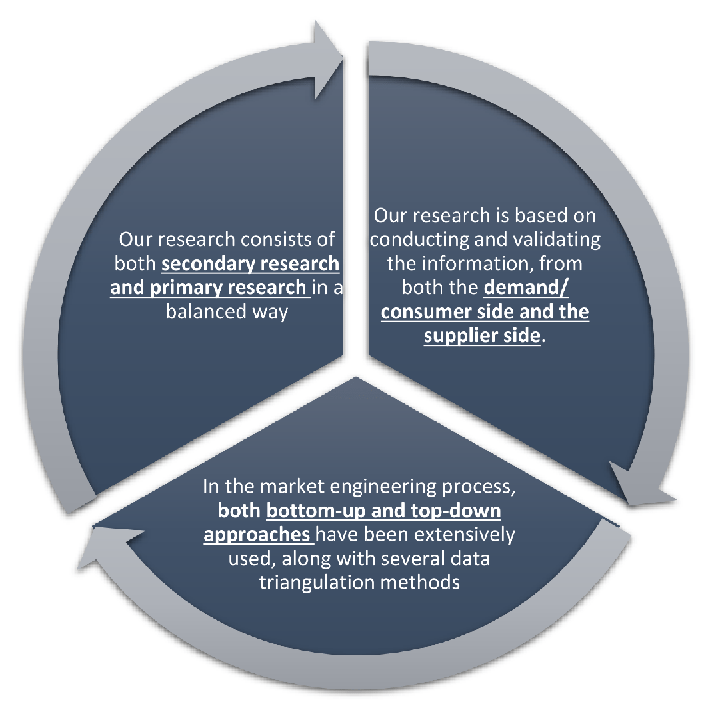
MarketGenics leverages a dedicated industry panel of experts and a comprehensive suite of paid databases to effectively collect, consolidate, and analyze market intelligence.
Our approach has consistently proven to be reliable and effective in generating accurate market insights, identifying key industry trends, and uncovering emerging business opportunities.
Through both primary and secondary research, we capture and analyze critical company-level data such as manufacturing footprints, including technical centers, R&D facilities, sales offices, and headquarters.
Our expert panel further enhances our ability to estimate market size for specific brands based on validated field-level intelligence.
Our data mining techniques incorporate both parametric and non-parametric methods, allowing for structured data collection, sorting, processing, and cleaning.
Demand projections are derived from large-scale data sets analyzed through proprietary algorithms, culminating in robust and reliable market sizing.
Research Approach
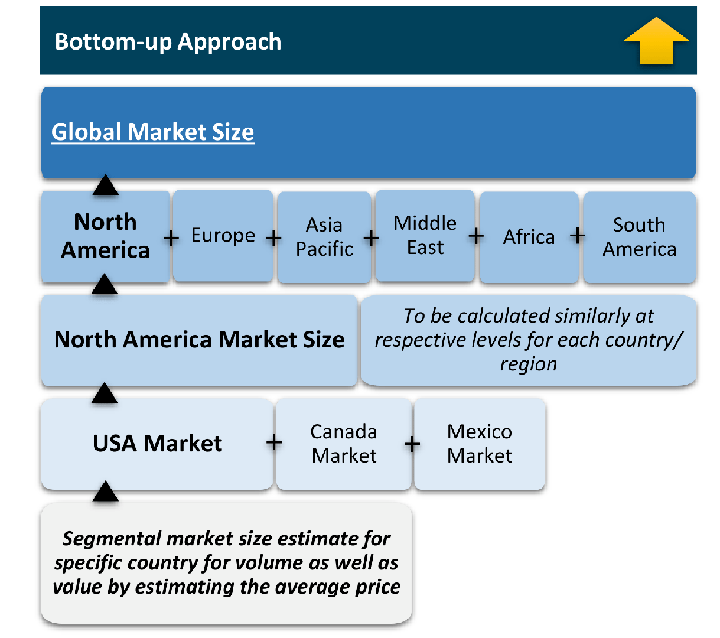
The bottom-up approach builds market estimates by starting with the smallest addressable market units and systematically aggregating them to create comprehensive market size projections.
This method begins with specific, granular data points and builds upward to create the complete market landscape.
Customer Analysis → Segmental Analysis → Geographical Analysis
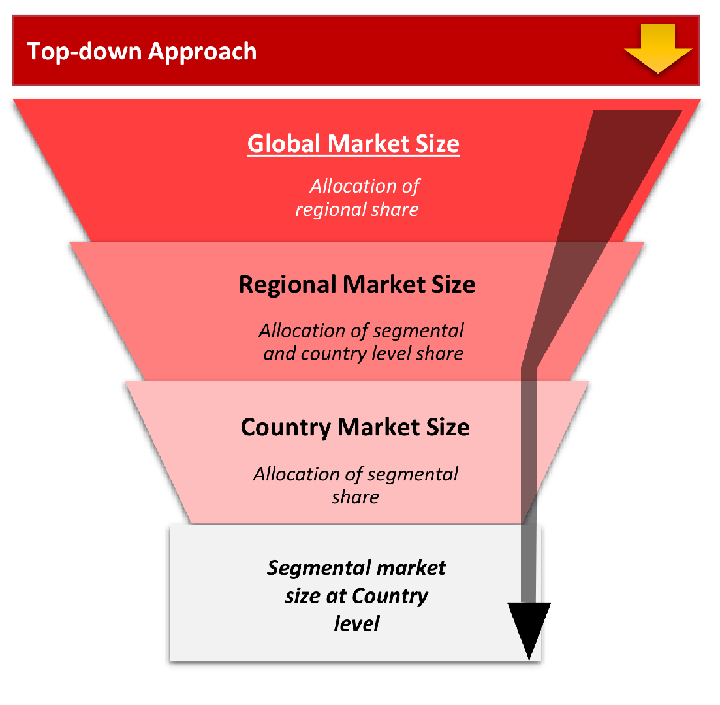
The top-down approach starts with the broadest possible market data and systematically narrows it down through a series of filters and assumptions to arrive at specific market segments or opportunities.
This method begins with the big picture and works downward to increasingly specific market slices.
TAM → SAM → SOM
Research Methods
Desk / Secondary Research
While analysing the market, we extensively study secondary sources, directories, and databases to identify and collect information useful for this technical, market-oriented, and commercial report. Secondary sources that we utilize are not only the public sources, but it is a combination of Open Source, Associations, Paid Databases, MG Repository & Knowledgebase, and others.
- Company websites, annual reports, financial reports, broker reports, and investor presentations
- National government documents, statistical databases and reports
- News articles, press releases and web-casts specific to the companies operating in the market, Magazines, reports, and others
- We gather information from commercial data sources for deriving company specific data such as segmental revenue, share for geography, product revenue, and others
- Internal and external proprietary databases (industry-specific), relevant patent, and regulatory databases
- Governing Bodies, Government Organizations
- Relevant Authorities, Country-specific Associations for Industries
We also employ the model mapping approach to estimate the product level market data through the players' product portfolio
Primary Research
Primary research/ interviews is vital in analyzing the market. Most of the cases involves paid primary interviews. Primary sources include primary interviews through e-mail interactions, telephonic interviews, surveys as well as face-to-face interviews with the different stakeholders across the value chain including several industry experts.
| Type of Respondents | Number of Primaries |
|---|---|
| Tier 2/3 Suppliers | ~20 |
| Tier 1 Suppliers | ~25 |
| End-users | ~25 |
| Industry Expert/ Panel/ Consultant | ~30 |
| Total | ~100 |
MG Knowledgebase
• Repository of industry blog, newsletter and case studies
• Online platform covering detailed market reports, and company profiles
Forecasting Factors and Models
Forecasting Factors
- Historical Trends – Past market patterns, cycles, and major events that shaped how markets behave over time. Understanding past trends helps predict future behavior.
- Industry Factors – Specific characteristics of the industry like structure, regulations, and innovation cycles that affect market dynamics.
- Macroeconomic Factors – Economic conditions like GDP growth, inflation, and employment rates that affect how much money people have to spend.
- Demographic Factors – Population characteristics like age, income, and location that determine who can buy your product.
- Technology Factors – How quickly people adopt new technology and how much technology infrastructure exists.
- Regulatory Factors – Government rules, laws, and policies that can help or restrict market growth.
- Competitive Factors – Analyzing competition structure such as degree of competition and bargaining power of buyers and suppliers.
Forecasting Models / Techniques
Multiple Regression Analysis
- Identify and quantify factors that drive market changes
- Statistical modeling to establish relationships between market drivers and outcomes
Time Series Analysis – Seasonal Patterns
- Understand regular cyclical patterns in market demand
- Advanced statistical techniques to separate trend, seasonal, and irregular components
Time Series Analysis – Trend Analysis
- Identify underlying market growth patterns and momentum
- Statistical analysis of historical data to project future trends
Expert Opinion – Expert Interviews
- Gather deep industry insights and contextual understanding
- In-depth interviews with key industry stakeholders
Multi-Scenario Development
- Prepare for uncertainty by modeling different possible futures
- Creating optimistic, pessimistic, and most likely scenarios
Time Series Analysis – Moving Averages
- Sophisticated forecasting for complex time series data
- Auto-regressive integrated moving average models with seasonal components
Econometric Models
- Apply economic theory to market forecasting
- Sophisticated economic models that account for market interactions
Expert Opinion – Delphi Method
- Harness collective wisdom of industry experts
- Structured, multi-round expert consultation process
Monte Carlo Simulation
- Quantify uncertainty and probability distributions
- Thousands of simulations with varying input parameters
Research Analysis
Our research framework is built upon the fundamental principle of validating market intelligence from both demand and supply perspectives. This dual-sided approach ensures comprehensive market understanding and reduces the risk of single-source bias.
Demand-Side Analysis: We understand end-user/application behavior, preferences, and market needs along with the penetration of the product for specific application.
Supply-Side Analysis: We estimate overall market revenue, analyze the segmental share along with industry capacity, competitive landscape, and market structure.
Validation & Evaluation
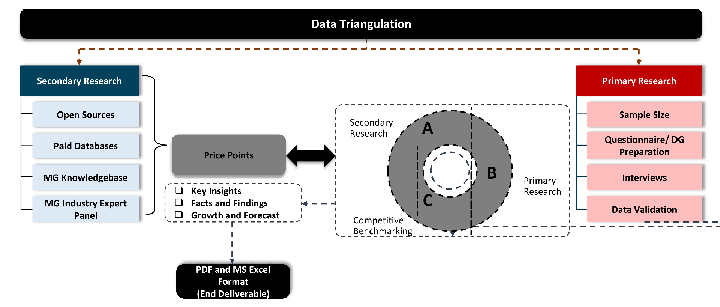
Data triangulation is a validation technique that uses multiple methods, sources, or perspectives to examine the same research question, thereby increasing the credibility and reliability of research findings. In market research, triangulation serves as a quality assurance mechanism that helps identify and minimize bias, validate assumptions, and ensure accuracy in market estimates.
- Data Source Triangulation – Using multiple data sources to examine the same phenomenon
- Methodological Triangulation – Using multiple research methods to study the same research question
- Investigator Triangulation – Using multiple researchers or analysts to examine the same data
- Theoretical Triangulation – Using multiple theoretical perspectives to interpret the same data
Custom Market Research Services
We will customise the research for you, in case the report listed above does not meet your requirements.
Get 10% Free Customisation