Silanes Market Size, Share & Trends Analysis Report by Product Type (Functional Silanes, Mono/Chloro Silanes, Silanes Coupling Agents), Industry Vertical X Application, and Geography (North America, Europe, Asia Pacific, Middle East, Africa, and South America) – Global Industry Data, Trends, and Forecasts, 2026–2035
|
|
|
Segmental Data Insights |
|
|
Demand Trends |
|
|
Competitive Landscape |
|
|
Strategic Development |
|
|
Future Outlook & Opportunities |
|
Silanes Market Size, Share, and Growth
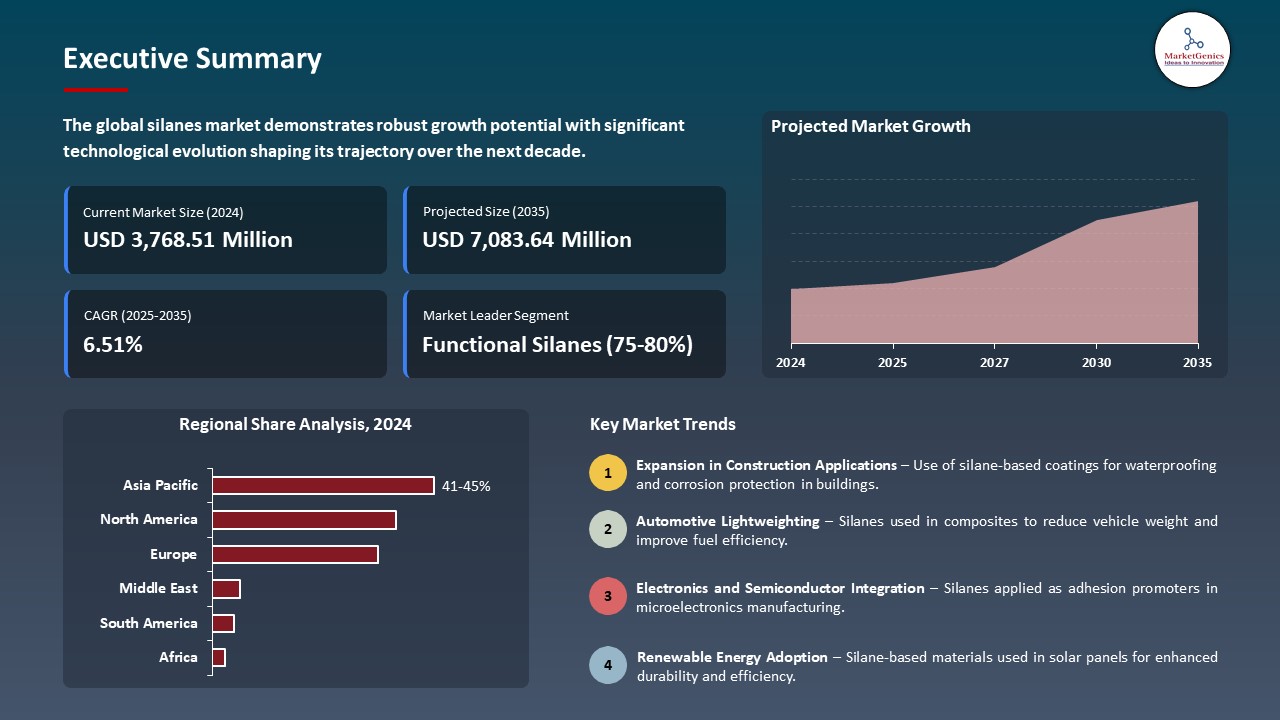
The global silanes market is experiencing robust growth, with its estimated value of USD 3,768.51 Million in the year 2025 and USD 7,083.64 Million by the period 2035, registering a CAGR of 6.5%, during the forecast period. The global silanes market is driven by expanding construction activity requiring high-performance sealants and coatings, growing automotive production using silane-based composites and adhesives, rising electronics manufacturing, and increased use in renewable energy applications such as solar panels, where silanes enhance durability and efficiency.
Thomas Koini, head of WACKER’s SILICONES Division said, “Thanks to intensive research work, our chemists have succeeded in developing a silane that improves the performance of microchips significantly, the product facilitates the development of computer chips with highly integrated and highly complex structures. These types of chips are increasingly required for applications that have to handle intensive computational tasks, such as artificial intelligence, autonomous driving, and cloud computing.”
The global silanes market growth is being driven by rising global construction and infrastructure development, with silanes extensively used in adhesives, sealants, and coatings to enhance durability, water resistance, and weatherproofing performance. For instance, in January 2025 Evonik Industries merged its Silica and Silanes business lines into a new unit called Smart Effects to strengthen its silane portfolio for markets like automotive, electronics and building protection. This merger strengthens the silane portfolio, enhancing market presence and supporting growth across construction, automotive, and electronics sectors.
Moreover, the global silanes market growth is driven by rising demand from automotive and electronics sectors, where they are essential for high-performance tires, lightweight composites, and semiconductor or solar applications. For instance, in March 2025, Wacker introduced silane‑terminated polyethers (GENIOSIL STP‑E 140 and STP‑E 340), enabling highly elastic, tin‑free adhesives and sealants for construction and assembly applications. This development enhances the availability of advanced silane solutions, supporting innovation and growth across automotive, electronics, and construction sectors.
Adjacent opportunities to the global silanes market include high-performance coatings, advanced adhesives and sealants, composite materials for automotive and aerospace, semiconductor and solar encapsulation, and water‑repellent or corrosion‑resistant building materials. These sectors leverage silane chemistry to enhance performance, durability, and sustainability. Expansion into these adjacent markets drives innovation, diversifies applications, and strengthens overall silanes market growth.

Silanes Market Dynamics and Trends
Driver: Synergistic Use of Silanes in Advanced Silica Applications
-
The global silanes market is increasingly being driven by its integration with high-performance silica systems in diverse applications, particularly in the automotive and construction industries. Silanes, especially functional organosilanes, act as key coupling agents that bond polymers with inorganic substrates like silica and glass, enhancing mechanical strength, hydrophobicity, chemical resistance, and durability in rubber, coatings, sealants, and adhesives.
- Silane-silica systems are gaining demand as industries shift to energy-efficient vehicles and sustainable construction, with green tires using silica instead of carbon black—making silanes essential for lowering rolling resistance and improving fuel efficiency.
- A recent example comes from a global specialty chemicals manufacturer that strategically consolidated its silanes and silica operations to create an integrated “smart materials” division. This initiative allows the company to co-develop silane-silica technologies optimized for specific market needs, such as anti-slip coatings, fuel-saving tires, or long-lasting sealants. These new material platforms offer tailored properties and reduce development time for customers.
- The combined use of silanes and engineered silica enables durable, low-emission, performance-enhanced materials, supporting growing demand for sustainable, lightweight solutions in transportation, electronics, and packaging making this synergy a key driver of silanes market growth.
Restraint: High Capital and Operational Costs for Clean and Compliant Production Technologies
-
The integration of advanced, clean, and compliant production technologies in Asia—especially across China, India, and Southeast Asia—has become a significant hurdle due to the region’s cost-sensitive industrial environment. Manufacturers in these countries often rely on legacy production systems that are optimized for volume rather than environmental compliance.
- Transitioning to clean technologies requires costly machinery upgrades and emission controls, creating financial pressure for small and mid-sized Asian silane producers, leading many to delay improvements and slowing overall industry modernization
- Operational costs remain a challenge as clean technologies require skilled labor, advanced controls, and frequent maintenance, while compliance with evolving chemical safety regulations demands continuous monitoring and documentation, raising administrative and running expenses.
- A leading example is Jiangxi Chenguang New Materials, which postponed its silane capacity expansion after stricter emission norms under China’s “Blue Sky” initiative, as meeting new discharge standards required over USD 60 million in upgrades—showing how compliance costs hinder even major producers’ growth plans.
- High upfront and recurring costs to implement eco-compliant silane production in Asia are constraining global supply growth and trade competitiveness.
Opportunity: Growing Adoption of Tin-Free and Moisture-Curing Silane-Modified Polymers in Sustainable Adhesives
-
The growing global emphasis on sustainability and environmental safety has significantly accelerated the adoption of tin-free and moisture-curing silane-modified polymers (SMPs) in the adhesives industry. Traditional adhesive systems often rely on tin catalysts, which are associated with toxicity concerns and regulatory restrictions, especially in the European Union and North America.
- As a response, silane-modified polymers that offer high performance, without the environmental and health risks, have emerged as viable alternatives. These tin-free SMPs are particularly gaining favor across construction, automotive, and packaging sectors due to their enhanced weather resistance, durability, and low VOC emissions. Their alignment with green building standards such as LEED and BREEAM further elevates their demand among eco-conscious end-users.
- Manufacturers have swiftly recognized this shift and are investing heavily in R&D to cater to the evolving demand. A notable example is Wacker Chemie AG, which in March 2024 expanded its GENIOSIL product line to include new tin-free, moisture-curing SMPs tailored for high-strength bonding in automotive and industrial applications.
- These formulations offer fast curing under ambient conditions and superior mechanical properties, making them especially suitable for replacing polyurethane-based adhesives that require isocyanates or tin compounds. Such innovation not only addresses regulatory pressures but also meets the industry's need for high-performance sustainable materials.
- The trend is catalyzing a structural shift in silane demand, positioning them as indispensable components in next-generation sustainable adhesives.
Key Trend: Advanced Hybrid Silanes in EVs and High-Performance Adhesives
-
The EV boom and move toward tin-free adhesives are boosting demand for hybrid silanes like STPEs and silane-modified polymers, which are replacing polyurethane and epoxy options due to better sustainability, flexibility, and adhesion, driving their use in battery enclosures, thermal management modules, and industrial adhesives.
- Moreover, many global regulations are now restricting the use of harmful tin catalysts and isocyanates in adhesives, making silane crosslinking technology a compliant and safer alternative.
- A major European chemical producer has invested in a new facility to scale up silane-terminated polymers, targeting rising demand from automotive and construction sectors for greener, durable bonding solutions with fast curing, moisture resistance, and broad substrate compatibility for EV batteries, composites, and glass.
- As the market for electric vehicles, modular construction, and sustainable packaging continues to rise, the opportunity for advanced hybrid silanes is expected to drive the next wave of innovation and revenue growth for silane suppliers.

Silanes-Market Analysis and Segmental Data
Functional Silanes Dominate Global Silanes Market
-
The functional silanes segment dominates the global silanes market due to their versatile chemical properties, which make them indispensable in a wide range of industrial applications. Functional silanes, such as amino, epoxy, methacryloxy, and vinyl silanes, are valued for their ability to serve as coupling agents, adhesion promoters, crosslinkers, and surface modifiers.
- These compounds contain both hydrolyzable groups that react with inorganic substrates like glass, metal, or silica, and organic functional groups that bond with resins, polymers, and other organic materials. This dual reactivity makes them ideal for enhancing adhesion between dissimilar materials, improving mechanical properties, and increasing moisture resistance. As industries seek to optimize material performance, reduce failure rates, and extend the lifespan of products, functional silanes offer a tailored solution.
- For example, in the construction industry, methacryloxy silanes are used to improve the bonding of concrete sealants and coatings, resulting in longer-lasting infrastructure with improved resistance to weather and chemical exposure.
Asia Pacific Leads Global Silanes Market Demand
-
Asia Pacific leads the global silanes market is due to its rapid industrialization, urban infrastructure development, and dominance in manufacturing-centric economies. Countries such as China, India, Japan, and South Korea have undergone significant growth in sectors like construction, automotive, electronics, and energy each being a major consumer of silane-based materials. In the construction industry, silanes are used as water-repellent agents, adhesion promoters in sealants, and surface modifiers for concrete structures.
- The region’s accelerated investment in urban housing, transport infrastructure, and commercial buildings has fueled consistent consumption of these materials. For example, China’s mega infrastructure projects including high-speed railways, smart cities, and urban metro systems involve large-scale application of silane-based concrete coatings and protective treatments to enhance durability against moisture and chemical corrosion.
- Similarly, India’s push for smart infrastructure and sustainable buildings under initiatives like the Smart Cities Mission has also prompted increased use of functional silanes to improve the longevity and environmental resilience of construction materials.
- Asia Pacific’s rapid industrial growth and heavy investment in construction, automotive, and electronics are boosting silane demand, with major projects in China and India driving strong use of silane-based coatings and sealants, solidifying the region’s market dominance.
Silanes-Market Ecosystem
The global silanes market is highly consolidated, with high concentration among key players such as Dow Inc., Wacker Chemie, KCC SILICONE Corporation, Shin-Etsu Chemical, and Evonik Industries AG, who dominate through extensive R&D, broad product portfolios, and strong global distribution networks.
For instance, in September 2024, Wacker Chemie launched a specialized silane precursor for semiconductor applications, designed to enable the production of ultra-thin, low-dielectric insulation layers for high-performance microchips. The launch of a specialized silane precursor for semiconductor applications strengthens technological leadership, meets rising demand for high-performance microchips, and reinforces competitive positioning, driving innovation and supporting sustained growth in the global silanes market.

Recent Development and Strategic Overview:
-
In January 2025, Evonik launched Smart Effects from the strategic merger of its Silica and Silanes business lines that will be part of "Advanced Technologies" within the new company organization. This merger leverages the expertise of both business lines to deliver innovative solutions that benefit both customers & the planet.
- In April 2024, Wacker Chemie AG announced the expansion of its silane production facility at Zhangjiagang, China, to meet rising regional demand for high-performance silanes used in construction and electronics. The move strengthens Wacker’s supply chain and responsiveness in the Asia-Pacific region, aligning with its localization and sustainability strategy.
Report Scope
|
Detail |
|
|
Market Size in 2025 |
USD 3,768.51 Mn |
|
Market Forecast Value in 2035 |
USD 7,083.64 Mn |
|
Growth Rate (CAGR) |
6.5% |
|
Forecast Period |
2026 – 2035 |
|
Historical Data Available for |
2021 – 2024 |
|
Market Size Units |
US$ Million for Value Thousand Tons for Volume |
|
Report Format |
Electronic (PDF) + Excel |
|
North America |
Europe |
Asia Pacific |
Middle East |
Africa |
South America |
|
|
|
|
|
|
|
Companies Covered |
|||||
|
|
|
|
|
|
Silanes-Market Segmentation and Highlights
|
Segment |
Sub-segment |
|
Silanes Market, By Product Type |
|
|
Silanes Market, By Industry Vertical X Application |
|
Frequently Asked Questions
Table of Contents
- 1. Research Methodology and Assumptions
- 1.1. Definitions
- 1.2. Research Design and Approach
- 1.3. Data Collection Methods
- 1.4. Base Estimates and Calculations
- 1.5. Forecasting Models
- 1.5.1. Key Forecast Factors & Impact Analysis
- 1.6. Secondary Research
- 1.6.1. Open Sources
- 1.6.2. Paid Databases
- 1.6.3. Associations
- 1.7. Primary Research
- 1.7.1. Primary Sources
- 1.7.2. Primary Interviews with Stakeholders across Ecosystem
- 2. Executive Summary
- 2.1. Global Silanes Market Outlook
- 2.1.1. Silanes Market Size (Volume - Thousand Tons and Value - US$ Mn), and Forecasts, 2021-2035
- 2.1.2. Compounded Annual Growth Rate Analysis
- 2.1.3. Growth Opportunity Analysis
- 2.1.4. Segmental Share Analysis
- 2.1.5. Geographical Share Analysis
- 2.2. Market Analysis and Facts
- 2.3. Supply-Demand Analysis
- 2.4. Competitive Benchmarking
- 2.5. Go-to- Market Strategy
- 2.5.1. Customer/ End-use Industry Assessment
- 2.5.2. Growth Opportunity Data, 2026-2035
- 2.5.2.1. Regional Data
- 2.5.2.2. Country Data
- 2.5.2.3. Segmental Data
- 2.5.3. Identification of Potential Market Spaces
- 2.5.4. GAP Analysis
- 2.5.5. Potential Attractive Price Points
- 2.5.6. Prevailing Market Risks & Challenges
- 2.5.7. Preferred Sales & Marketing Strategies
- 2.5.8. Key Recommendations and Analysis
- 2.5.9. A Way Forward
- 2.1. Global Silanes Market Outlook
- 3. Industry Data and Premium Insights
- 3.1. Global Chemicals & Materials Industry Overview, 2025
- 3.1.1. Chemicals & Materials Industry Ecosystem Analysis
- 3.1.2. Key Trends for Chemicals & Materials Industry
- 3.1.3. Regional Distribution for Chemicals & Materials Industry
- 3.2. Supplier Customer Data
- 3.3. Technology Roadmap and Developments
- 3.4. Trade Analysis
- 3.4.1. Import & Export Analysis, 2025
- 3.4.2. Top Importing Countries
- 3.4.3. Top Exporting Countries
- 3.5. Trump Tariff Impact Analysis
- 3.5.1. Manufacturer
- 3.5.1.1. Based on the component & Raw material
- 3.5.2. Supply Chain
- 3.5.3. End Consumer
- 3.5.1. Manufacturer
- 3.6. Raw Material Analysis
- 3.1. Global Chemicals & Materials Industry Overview, 2025
- 4. Market Overview
- 4.1. Market Dynamics
- 4.1.1. Drivers
- 4.1.1.1. Rising demand from construction and infrastructure expansion
- 4.1.1.2. Growth in the automotive sector, especially for green tires and lightweight composites
- 4.1.1.3. Increasing adoption in electronics, renewable energy, and high-performance materials
- 4.1.2. Restraints
- 4.1.2.1. Volatility and high costs of raw materials and energy
- 4.1.2.2. Environmental, regulatory, and safety concerns
- 4.1.1. Drivers
- 4.2. Key Trend Analysis
- 4.3. Regulatory Framework
- 4.3.1. Key Regulations, Norms, and Subsidies, by Key Countries
- 4.3.2. Tariffs and Standards
- 4.3.3. Impact Analysis of Regulations on the Market
- 4.4. Value Chain Analysis
- 4.4.1. Raw Material Suppliers
- 4.4.2. Silanes Manufacturers
- 4.4.3. Packaging & Distribution
- 4.4.4. End-Users/Application
- 4.5. Cost Structure Analysis
- 4.5.1. Parameter’s Share for Cost Associated
- 4.5.2. COGP vs COGS
- 4.5.3. Profit Margin Analysis
- 4.6. Pricing Analysis
- 4.6.1. Regional Pricing Analysis
- 4.6.2. Segmental Pricing Trends
- 4.6.3. Factors Influencing Pricing
- 4.7. Porter’s Five Forces Analysis
- 4.8. PESTEL Analysis
- 4.9. Global Silanes Market Demand
- 4.9.1. Historical Market Size – Volume (Thousand Tons) and Value (US$ Mn), 2020-2024
- 4.9.2. Current and Future Market Size – Volume (Thousand Tons) and Value (US$ Mn), 2026–2035
- 4.9.2.1. Y-o-Y Growth Trends
- 4.9.2.2. Absolute $ Opportunity Assessment
- 4.1. Market Dynamics
- 5. Competition Landscape
- 5.1. Competition structure
- 5.1.1. Fragmented v/s consolidated
- 5.2. Company Share Analysis, 2025
- 5.2.1. Global Company Market Share
- 5.2.2. By Region
- 5.2.2.1. North America
- 5.2.2.2. Europe
- 5.2.2.3. Asia Pacific
- 5.2.2.4. Middle East
- 5.2.2.5. Africa
- 5.2.2.6. South America
- 5.3. Product Comparison Matrix
- 5.3.1. Specifications
- 5.3.2. Market Positioning
- 5.3.3. Pricing
- 5.1. Competition structure
- 6. Global Silanes Market Analysis, by Product Type
- 6.1. Key Segment Analysis
- 6.2. Silanes Market Size (Volume - Thousand Tons and Value - US$ Mn), Analysis, and Forecasts, by Product Type, 2021-2035
- 6.2.1. Functional Silanes
- 6.2.1.1. Amino Silanes
- 6.2.1.1.1. 3-Aminopropyltriethoxysilane (APTES)
- 6.2.1.1.2. 3-Aminopropyltrimethoxysilane (APTMS)
- 6.2.1.1.3. N-β-(Aminoethyl)-γ-aminopropyltrimethoxysilane
- 6.2.1.1.4. Others
- 6.2.1.2. Epoxy Silanes
- 6.2.1.2.1. 3-Glycidoxypropyltrimethoxysilane (GPTMS)
- 6.2.1.2.2. 3-Glycidoxypropyltriethoxysilane (GPTES)
- 6.2.1.2.3. 2-(3,4-Epoxycyclohexyl) ethyltrimethoxysilane
- 6.2.1.2.4. 3-Glycidoxypropylmethyldiethoxysilane
- 6.2.1.2.5. Others
- 6.2.1.3. Methacryloxy Silanes
- 6.2.1.3.1. 3-Methacryloxypropyltrimethoxysilane (MPTMS)
- 6.2.1.3.2. 3-Methacryloxypropyltriethoxysilane (MPTES)
- 6.2.1.3.3. Methacryloxyethyltrimethoxysilane
- 6.2.1.3.4. 3-Methacryloxypropylmethyldimethoxysilane
- 6.2.1.3.5. Others
- 6.2.1.4. Vinyl Silanes
- 6.2.1.4.1. Vinyltriethoxysilane (VTES)
- 6.2.1.4.2. Vinyltrimethoxysilane (VTMS)
- 6.2.1.4.3. Vinyltris(2-methoxyethoxy)silane
- 6.2.1.4.4. Vinylmethyldiethoxysilane
- 6.2.1.4.5. Others
- 6.2.1.5. Sulfur Silanes
- 6.2.1.5.1. Bis(3-triethoxysilylpropyl)tetrasulfide (TESPT)
- 6.2.1.5.2. Bis(3-triethoxysilylpropyl)disulfide (TESPD)
- 6.2.1.5.3. 3-Mercaptopropyltrimethoxysilane (MPTMS)
- 6.2.1.5.4. Others
- 6.2.1.6. Alkyl Silanes
- 6.2.1.6.1. Methyltriethoxysilane (MTES)
- 6.2.1.6.2. Methyltrimethoxysilane (MTMS)
- 6.2.1.6.3. n-Octyltriethoxysilane
- 6.2.1.6.4. Isobutyltriethoxysilane (IBTES)
- 6.2.1.6.5. Others
- 6.2.1.7. Others
- 6.2.1.1. Amino Silanes
- 6.2.2. Mono/Chloro Silanes
- 6.2.2.1. TrichloroSilanes
- 6.2.2.2. DichloroSilanes
- 6.2.2.3. MonochloroSilanes
- 6.2.2.4. Silicon Tetrachloride
- 6.2.3. Silanes Coupling Agents
- 6.2.3.1. Organofunctional Silanes
- 6.2.3.2. Hydrolyzable Silanes
- 6.2.1. Functional Silanes
- 7. Global Silanes Market Analysis, by Industry Vertical X Application
- 7.1. Key Segment Analysis
- 7.2. Silanes Market Size (Volume - Thousand Tons and Value - US$ Mn), Analysis, and Forecasts, by Industry Vertical X Application, 2021-2035
- 7.2.1. Automotive
- 7.2.1.1. Rubber & Plastics
- 7.2.1.2. Adhesives & Sealants
- 7.2.1.3. Paint & Coatings
- 7.2.1.4. Fiber Treatment
- 7.2.1.5. Others
- 7.2.2. Construction
- 7.2.2.1. Construction Materials
- 7.2.2.2. Adhesives & Sealants
- 7.2.2.3. Paint & Coatings
- 7.2.2.4. Fiber Treatment
- 7.2.2.5. Others
- 7.2.3. Electrical & Electronics
- 7.2.3.1. Textiles
- 7.2.3.2. Fiber Treatment & Processing
- 7.2.3.3. Dyeing & Finishing
- 7.2.3.4. Function Textiles
- 7.2.3.5. Others
- 7.2.4. Aerospace
- 7.2.4.1. Rubber & Plastics
- 7.2.4.2. Adhesives & Sealants
- 7.2.4.3. Paint & Coatings
- 7.2.4.4. Fiber Treatment
- 7.2.4.5. Others
- 7.2.5. Other Industries
- 7.2.1. Automotive
- 8. Global Silanes Market Analysis and Forecasts, by Region
- 8.1. Key Findings
- 8.2. Silanes Market Size (Volume - Thousand Tons and Value - US$ Mn), Analysis, and Forecasts, by Region, 2021-2035
- 8.2.1. North America
- 8.2.2. Europe
- 8.2.3. Asia Pacific
- 8.2.4. Middle East
- 8.2.5. Africa
- 8.2.6. South America
- 9. North America Silanes Market Analysis
- 9.1. Key Segment Analysis
- 9.2. Regional Snapshot
- 9.3. North America Silanes Market Size (Volume - Thousand Tons and Value - US$ Mn), Analysis, and Forecasts, 2021-2035
- 9.3.1. Product Type
- 9.3.2. Industry Vertical X Application
- 9.3.3. Country
- 9.3.3.1. USA
- 9.3.3.2. Canada
- 9.3.3.3. Mexico
- 9.4. USA Silanes Market
- 9.4.1. Country Segmental Analysis
- 9.4.2. Product Type
- 9.4.3. Industry Vertical X Application
- 9.5. Canada Silanes Market
- 9.5.1. Country Segmental Analysis
- 9.5.2. Product Type
- 9.5.3. Industry Vertical X Application
- 9.6. Mexico Silanes Market
- 9.6.1. Country Segmental Analysis
- 9.6.2. Product Type
- 9.6.3. Industry Vertical X Application
- 10. Europe Silanes Market Analysis
- 10.1. Key Segment Analysis
- 10.2. Regional Snapshot
- 10.3. Europe Silanes Market Size (Volume - Thousand Tons and Value - US$ Mn), Analysis, and Forecasts, 2021-2035
- 10.3.1. Product Type
- 10.3.2. Industry Vertical X Application
- 10.3.3. Country
- 10.3.3.1. Germany
- 10.3.3.2. United Kingdom
- 10.3.3.3. France
- 10.3.3.4. Italy
- 10.3.3.5. Spain
- 10.3.3.6. Netherlands
- 10.3.3.7. Nordic Countries
- 10.3.3.8. Poland
- 10.3.3.9. Russia & CIS
- 10.3.3.10. Rest of Europe
- 10.4. Germany Silanes Market
- 10.4.1. Country Segmental Analysis
- 10.4.2. Product Type
- 10.4.3. Industry Vertical X Application
- 10.5. United Kingdom Silanes Market
- 10.5.1. Country Segmental Analysis
- 10.5.2. Product Type
- 10.5.3. Industry Vertical X Application
- 10.6. France Silanes Market
- 10.6.1. Country Segmental Analysis
- 10.6.2. Product Type
- 10.6.3. Industry Vertical X Application
- 10.7. Italy Silanes Market
- 10.7.1. Country Segmental Analysis
- 10.7.2. Product Type
- 10.7.3. Industry Vertical X Application
- 10.8. Spain Silanes Market
- 10.8.1. Country Segmental Analysis
- 10.8.2. Product Type
- 10.8.3. Industry Vertical X Application
- 10.9. Netherlands Silanes Market
- 10.9.1. Country Segmental Analysis
- 10.9.2. Product Type
- 10.9.3. Industry Vertical X Application
- 10.10. Nordic Countries Silanes Market
- 10.10.1. Country Segmental Analysis
- 10.10.2. Product Type
- 10.10.3. Industry Vertical X Application
- 10.11. Poland Silanes Market
- 10.11.1. Country Segmental Analysis
- 10.11.2. Product Type
- 10.11.3. Industry Vertical X Application
- 10.12. Russia & CIS Silanes Market
- 10.12.1. Country Segmental Analysis
- 10.12.2. Product Type
- 10.12.3. Industry Vertical X Application
- 10.13. Rest of Europe Silanes Market
- 10.13.1. Country Segmental Analysis
- 10.13.2. Product Type
- 10.13.3. Industry Vertical X Application
- 11. Asia Pacific Silanes Market Analysis
- 11.1. Key Segment Analysis
- 11.2. Regional Snapshot
- 11.3. Asia Pacific Silanes Market Size (Volume - Thousand Tons and Value - US$ Mn), Analysis, and Forecasts, 2021-2035
- 11.3.1. Product Type
- 11.3.2. Industry Vertical X Application
- 11.3.3. Country
- 11.3.3.1. China
- 11.3.3.2. India
- 11.3.3.3. Japan
- 11.3.3.4. South Korea
- 11.3.3.5. Australia and New Zealand
- 11.3.3.6. Indonesia
- 11.3.3.7. Malaysia
- 11.3.3.8. Thailand
- 11.3.3.9. Vietnam
- 11.3.3.10. Rest of Asia Pacific
- 11.4. China Silanes Market
- 11.4.1. Country Segmental Analysis
- 11.4.2. Product Type
- 11.4.3. Industry Vertical X Application
- 11.5. India Silanes Market
- 11.5.1. Country Segmental Analysis
- 11.5.2. Product Type
- 11.5.3. Industry Vertical X Application
- 11.6. Japan Silanes Market
- 11.6.1. Country Segmental Analysis
- 11.6.2. Product Type
- 11.6.3. Industry Vertical X Application
- 11.7. South Korea Silanes Market
- 11.7.1. Country Segmental Analysis
- 11.7.2. Product Type
- 11.7.3. Industry Vertical X Application
- 11.8. Australia and New Zealand Silanes Market
- 11.8.1. Country Segmental Analysis
- 11.8.2. Product Type
- 11.8.3. Industry Vertical X Application
- 11.9. Indonesia Silanes Market
- 11.9.1. Country Segmental Analysis
- 11.9.2. Product Type
- 11.9.3. Industry Vertical X Application
- 11.10. Malaysia Silanes Market
- 11.10.1. Country Segmental Analysis
- 11.10.2. Product Type
- 11.10.3. Industry Vertical X Application
- 11.11. Thailand Silanes Market
- 11.11.1. Country Segmental Analysis
- 11.11.2. Product Type
- 11.11.3. Industry Vertical X Application
- 11.12. Vietnam Silanes Market
- 11.12.1. Country Segmental Analysis
- 11.12.2. Product Type
- 11.12.3. Industry Vertical X Application
- 11.13. Rest of Asia Pacific Silanes Market
- 11.13.1. Country Segmental Analysis
- 11.13.2. Product Type
- 11.13.3. Industry Vertical X Application
- 12. Middle East Silanes Market Analysis
- 12.1. Key Segment Analysis
- 12.2. Regional Snapshot
- 12.3. Middle East Silanes Market Size (Volume - Thousand Tons and Value - US$ Mn), Analysis, and Forecasts, 2021-2035
- 12.3.1. Product Type
- 12.3.2. Industry Vertical X Application
- 12.3.3. Country
- 12.3.3.1. Turkey
- 12.3.3.2. UAE
- 12.3.3.3. Saudi Arabia
- 12.3.3.4. Israel
- 12.3.3.5. Rest of Middle East
- 12.4. Turkey Silanes Market
- 12.4.1. Country Segmental Analysis
- 12.4.2. Product Type
- 12.4.3. Industry Vertical X Application
- 12.5. UAE Silanes Market
- 12.5.1. Country Segmental Analysis
- 12.5.2. Product Type
- 12.5.3. Industry Vertical X Application
- 12.6. Saudi Arabia Silanes Market
- 12.6.1. Country Segmental Analysis
- 12.6.2. Product Type
- 12.6.3. Industry Vertical X Application
- 12.7. Israel Silanes Market
- 12.7.1. Country Segmental Analysis
- 12.7.2. Product Type
- 12.7.3. Industry Vertical X Application
- 12.8. Rest of Middle East Silanes Market
- 12.8.1. Country Segmental Analysis
- 12.8.2. Product Type
- 12.8.3. Industry Vertical X Application
- 13. Africa Silanes Market Analysis
- 13.1. Key Segment Analysis
- 13.2. Regional Snapshot
- 13.3. Africa Silanes Market Size (Volume - Thousand Tons and Value - US$ Mn), Analysis, and Forecasts, 2021-2035
- 13.3.1. Product Type
- 13.3.2. Industry Vertical X Application
- 13.3.3. Country
- 13.3.3.1. South Africa
- 13.3.3.2. Egypt
- 13.3.3.3. Nigeria
- 13.3.3.4. Algeria
- 13.3.3.5. Rest of Africa
- 13.4. South Africa Silanes Market
- 13.4.1. Country Segmental Analysis
- 13.4.2. Product Type
- 13.4.3. Industry Vertical X Application
- 13.5. Egypt Silanes Market
- 13.5.1. Country Segmental Analysis
- 13.5.2. Product Type
- 13.5.3. Industry Vertical X Application
- 13.6. Nigeria Silanes Market
- 13.6.1. Country Segmental Analysis
- 13.6.2. Product Type
- 13.6.3. Industry Vertical X Application
- 13.7. Algeria Silanes Market
- 13.7.1. Country Segmental Analysis
- 13.7.2. Product Type
- 13.7.3. Industry Vertical X Application
- 13.8. Rest of Africa Silanes Market
- 13.8.1. Country Segmental Analysis
- 13.8.2. Product Type
- 13.8.3. Industry Vertical X Application
- 14. South America Silanes Market Analysis
- 14.1. Key Segment Analysis
- 14.2. Regional Snapshot
- 14.3. South America Silanes Market Size (Volume - Thousand Tons and Value - US$ Mn), Analysis, and Forecasts, 2021-2035
- 14.3.1. Product Type
- 14.3.2. Industry Vertical X Application
- 14.3.3. Country
- 14.3.3.1. Brazil
- 14.3.3.2. Argentina
- 14.3.3.3. Rest of South America
- 14.4. Brazil Silanes Market
- 14.4.1. Country Segmental Analysis
- 14.4.2. Product Type
- 14.4.3. Industry Vertical X Application
- 14.5. Argentina Silanes Market
- 14.5.1. Country Segmental Analysis
- 14.5.2. Product Type
- 14.5.3. Industry Vertical X Application
- 14.6. Rest of South America Silanes Market
- 14.6.1. Country Segmental Analysis
- 14.6.2. Product Type
- 14.6.3. Industry Vertical X Application
- 15. Key Players/ Company Profile
- 15.1. Dow Inc.
- 15.1.1. Company Details/ Overview
- 15.1.2. Company Financials
- 15.1.3. Key Customers and Competitors
- 15.1.4. Business/ Industry Portfolio
- 15.1.5. Product Portfolio/ Specification Details
- 15.1.6. Pricing Data
- 15.1.7. Strategic Overview
- 15.1.8. Recent Developments
- 15.2. Wacker Chemie
- 15.3. KCC SILICONE Corporation
- 15.4. Shin-Etsu Chemical
- 15.5. Evonik Industries AG
- 15.6. Elkem
- 15.7. Hubei Jingzhou Huabang Chemical Co., Ltd.
- 15.8. Dongyue Group
- 15.9. Gelest Inc.
- 15.10. Jiangxi Chenguang New Materials Co., Ltd.
- 15.11. Nanjing SiSiB Silicones Co., Ltd.
- 15.12. Solvay
- 15.13. Wynca Group
- 15.14. Zhejiang Jiancheng New Material Co., Ltd.
- 15.15. Nanjing Shuguang Chemical Group Co., Ltd.
- 15.16. Guangzhou ECOPOWER New Material Co. Limited.
- 15.17. Supreme Silicones India Pvt Ltd.
- 15.18. Entegris
- 15.19. 3N Composite Products LLP
- 15.20. Tokyo Chemical Industry Co., Ltd. (TCI)
- 15.21. Other Key Players
- 15.1. Dow Inc.
Note* - This is just tentative list of players. While providing the report, we will cover more number of players based on their revenue and share for each geography
Research Design
Our research design integrates both demand-side and supply-side analysis through a balanced combination of primary and secondary research methodologies. By utilizing both bottom-up and top-down approaches alongside rigorous data triangulation methods, we deliver robust market intelligence that supports strategic decision-making.
MarketGenics' comprehensive research design framework ensures the delivery of accurate, reliable, and actionable market intelligence. Through the integration of multiple research approaches, rigorous validation processes, and expert analysis, we provide our clients with the insights needed to make informed strategic decisions and capitalize on market opportunities.
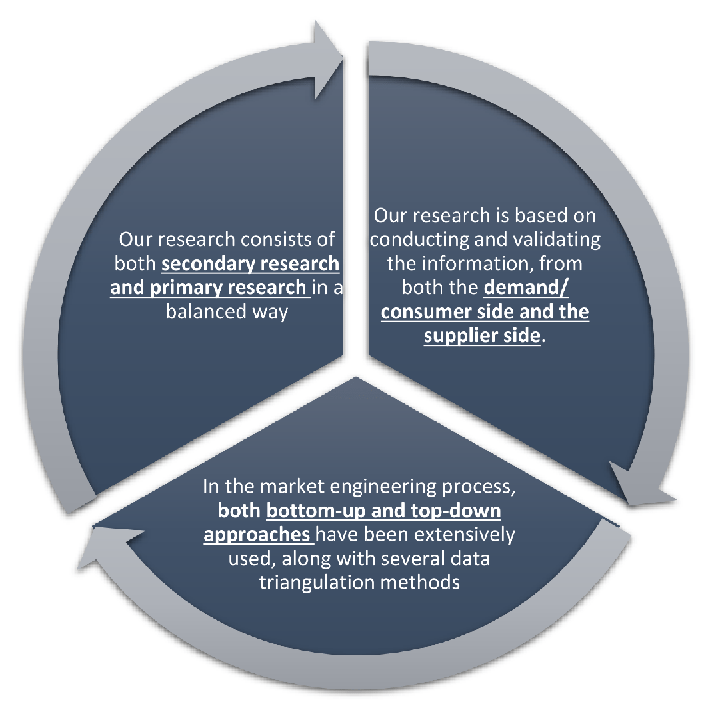
MarketGenics leverages a dedicated industry panel of experts and a comprehensive suite of paid databases to effectively collect, consolidate, and analyze market intelligence.
Our approach has consistently proven to be reliable and effective in generating accurate market insights, identifying key industry trends, and uncovering emerging business opportunities.
Through both primary and secondary research, we capture and analyze critical company-level data such as manufacturing footprints, including technical centers, R&D facilities, sales offices, and headquarters.
Our expert panel further enhances our ability to estimate market size for specific brands based on validated field-level intelligence.
Our data mining techniques incorporate both parametric and non-parametric methods, allowing for structured data collection, sorting, processing, and cleaning.
Demand projections are derived from large-scale data sets analyzed through proprietary algorithms, culminating in robust and reliable market sizing.
Research Approach
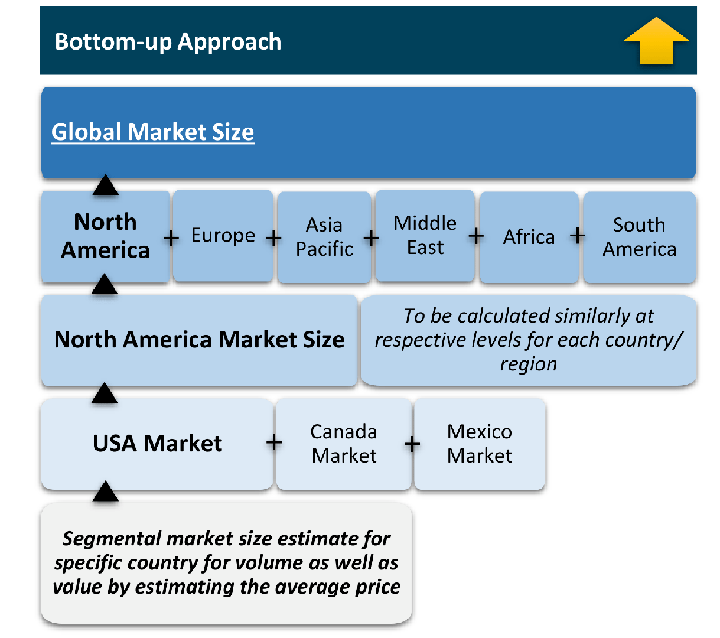
The bottom-up approach builds market estimates by starting with the smallest addressable market units and systematically aggregating them to create comprehensive market size projections.
This method begins with specific, granular data points and builds upward to create the complete market landscape.
Customer Analysis → Segmental Analysis → Geographical Analysis
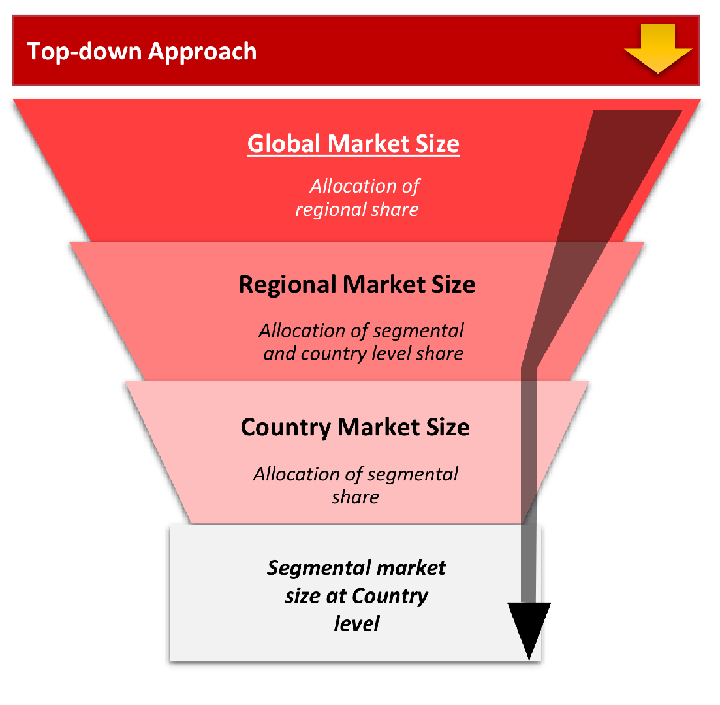
The top-down approach starts with the broadest possible market data and systematically narrows it down through a series of filters and assumptions to arrive at specific market segments or opportunities.
This method begins with the big picture and works downward to increasingly specific market slices.
TAM → SAM → SOM
Research Methods
Desk / Secondary Research
While analysing the market, we extensively study secondary sources, directories, and databases to identify and collect information useful for this technical, market-oriented, and commercial report. Secondary sources that we utilize are not only the public sources, but it is a combination of Open Source, Associations, Paid Databases, MG Repository & Knowledgebase, and others.
- Company websites, annual reports, financial reports, broker reports, and investor presentations
- National government documents, statistical databases and reports
- News articles, press releases and web-casts specific to the companies operating in the market, Magazines, reports, and others
- We gather information from commercial data sources for deriving company specific data such as segmental revenue, share for geography, product revenue, and others
- Internal and external proprietary databases (industry-specific), relevant patent, and regulatory databases
- Governing Bodies, Government Organizations
- Relevant Authorities, Country-specific Associations for Industries
We also employ the model mapping approach to estimate the product level market data through the players' product portfolio
Primary Research
Primary research/ interviews is vital in analyzing the market. Most of the cases involves paid primary interviews. Primary sources include primary interviews through e-mail interactions, telephonic interviews, surveys as well as face-to-face interviews with the different stakeholders across the value chain including several industry experts.
| Type of Respondents | Number of Primaries |
|---|---|
| Tier 2/3 Suppliers | ~20 |
| Tier 1 Suppliers | ~25 |
| End-users | ~25 |
| Industry Expert/ Panel/ Consultant | ~30 |
| Total | ~100 |
MG Knowledgebase
• Repository of industry blog, newsletter and case studies
• Online platform covering detailed market reports, and company profiles
Forecasting Factors and Models
Forecasting Factors
- Historical Trends – Past market patterns, cycles, and major events that shaped how markets behave over time. Understanding past trends helps predict future behavior.
- Industry Factors – Specific characteristics of the industry like structure, regulations, and innovation cycles that affect market dynamics.
- Macroeconomic Factors – Economic conditions like GDP growth, inflation, and employment rates that affect how much money people have to spend.
- Demographic Factors – Population characteristics like age, income, and location that determine who can buy your product.
- Technology Factors – How quickly people adopt new technology and how much technology infrastructure exists.
- Regulatory Factors – Government rules, laws, and policies that can help or restrict market growth.
- Competitive Factors – Analyzing competition structure such as degree of competition and bargaining power of buyers and suppliers.
Forecasting Models / Techniques
Multiple Regression Analysis
- Identify and quantify factors that drive market changes
- Statistical modeling to establish relationships between market drivers and outcomes
Time Series Analysis – Seasonal Patterns
- Understand regular cyclical patterns in market demand
- Advanced statistical techniques to separate trend, seasonal, and irregular components
Time Series Analysis – Trend Analysis
- Identify underlying market growth patterns and momentum
- Statistical analysis of historical data to project future trends
Expert Opinion – Expert Interviews
- Gather deep industry insights and contextual understanding
- In-depth interviews with key industry stakeholders
Multi-Scenario Development
- Prepare for uncertainty by modeling different possible futures
- Creating optimistic, pessimistic, and most likely scenarios
Time Series Analysis – Moving Averages
- Sophisticated forecasting for complex time series data
- Auto-regressive integrated moving average models with seasonal components
Econometric Models
- Apply economic theory to market forecasting
- Sophisticated economic models that account for market interactions
Expert Opinion – Delphi Method
- Harness collective wisdom of industry experts
- Structured, multi-round expert consultation process
Monte Carlo Simulation
- Quantify uncertainty and probability distributions
- Thousands of simulations with varying input parameters
Research Analysis
Our research framework is built upon the fundamental principle of validating market intelligence from both demand and supply perspectives. This dual-sided approach ensures comprehensive market understanding and reduces the risk of single-source bias.
Demand-Side Analysis: We understand end-user/application behavior, preferences, and market needs along with the penetration of the product for specific application.
Supply-Side Analysis: We estimate overall market revenue, analyze the segmental share along with industry capacity, competitive landscape, and market structure.
Validation & Evaluation
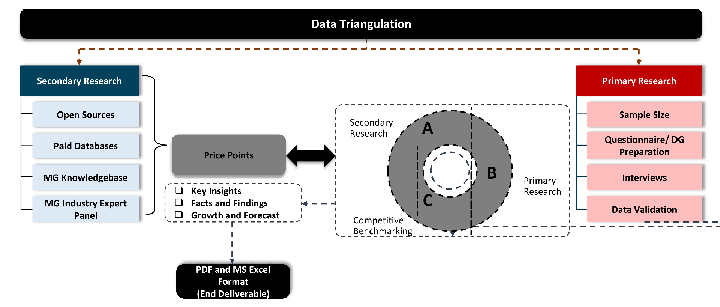
Data triangulation is a validation technique that uses multiple methods, sources, or perspectives to examine the same research question, thereby increasing the credibility and reliability of research findings. In market research, triangulation serves as a quality assurance mechanism that helps identify and minimize bias, validate assumptions, and ensure accuracy in market estimates.
- Data Source Triangulation – Using multiple data sources to examine the same phenomenon
- Methodological Triangulation – Using multiple research methods to study the same research question
- Investigator Triangulation – Using multiple researchers or analysts to examine the same data
- Theoretical Triangulation – Using multiple theoretical perspectives to interpret the same data
Custom Market Research Services
We will customise the research for you, in case the report listed above does not meet your requirements.
Get 10% Free Customisation